Human-Computer Interaction · arXiv:2610.26447 v1 · submitted 19 Oct 2026 · 27 references
Comparing Experiences of Speech-Driven Game Modification in Solo Play, Paired Play, and Paired Watching Using the Fighting Game PATCH FIGHTER
The paper says
“Players often have ideas about a game while playing it, but turning them into changes usually means stepping out of play to edit it. We built PATCH FIGHTER, a two-player fighting game defined by 91 types of adjustable parameters.”
more of the abstract
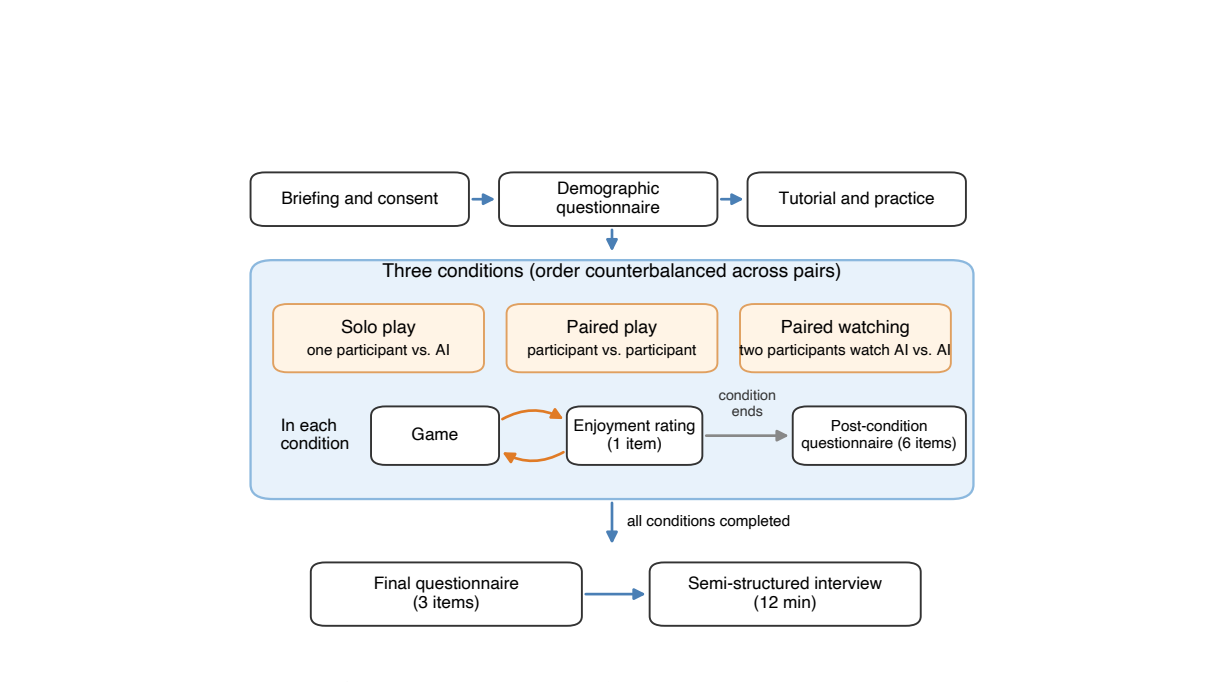
A large language model (LLM) reads players' conversations during play and rewrites these parameters between games, so players can change the game just by talking. We conducted a within-subjects experiment with 27 pairs (54 participants) comparing three conditions, solo play, paired play, and paired watching. Participants rated enjoyment after each game and answered a questionnaire on speech and changes after each condition. Paired play was the most enjoyable condition. In paired play, participants also felt more able to say what they thought about the game than in solo play. In interviews, participants valued talking with the partner and checking changes through their own play. Paired watching was less preferred because they could not try the changes themselves. As our design cannot separate the enjoyment of editing from that of play, we outline a design that measures them separately and the evaluation of the resulting games as future work.
from the abstract
Pith says
Machine review · deepseek-v4-flash · 20 Oct 2026 · what was read was not recorded · not checked by a person
It can be wrong. Challenge this review or reply to it.
Holds up, with conditions. A genuinely new interaction loop with a disciplined, honest study behind it; the headline enjoyment result holds as an overall-experience comparison, but the mechanism—conversation faithfully turned into intended changes—is never directly tested. This line is wrong
2 major objections · 5 minor
How often objections from reviews like this one are right: not yet measured
Not checked: figures, code, what the 27 references say.
The paper says, at §3.1, §5.2, §7.1
The review did not quote this passage.
A classifier read this sentence of the paper as acknowledging the concern (probability 0.65):
“It is necessary to examine whether intentions were shared, how the system understood them, and whether the changes were accepted.”
Pith says: Objection 1 of 2 · major
The paper's title and abstract present PATCH FIGHTER as turning natural conversation into game changes, but the study provides no validation that the L1/L4 pipeline maps speech to participants' intended parameter changes. The only direct self-report, Q2, is fragile: it survives Holm correction under ordinal modeling (OR=3.09, p=.033) but not when Q2 is treated as continuous (Holm p=.063), and Q4 shows no clear difference in either contrast.
more of objection 1
Change counts alone do not establish that the changes tracked intent. The authors acknowledge in Section 7.1 that enjoyment of editing and play cannot be separated, and Section 7.2 lists linking speech, rationales, and changes as future work; these acknowledgments are appropriate, but the abstract and the RQ wording still imply the mechanism. Because speech, LLM responses, and applied changes were logged, I ask for representative traces from the logs showing what was said, what L1/L4 proposed, and what was applied, or else a clear restatement that the speech-to-change mapping is unvalidated. Without this, the headline should be read only as a holistic comparison of the three participation conditions.
The paper says, at §5.2, §7.1
The review did not quote this passage.
A classifier read this sentence of the paper as acknowledging the concern (probability 0.78):
“Separating the effects of these factors requires additional conditions.”
Pith says: Objection 2 of 2 · major
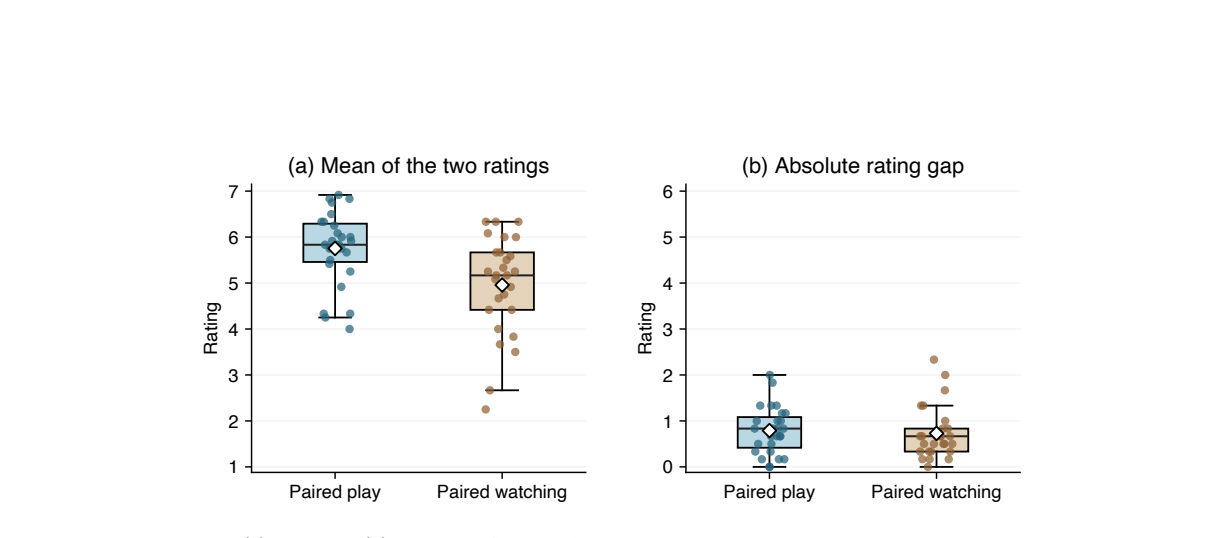
There is no condition in which changes occur without being derived from the conversation, or in which changes are withheld, so the study cannot distinguish 'changing the game by talking' from 'talking while the game changes.' The near-identical change counts in paired play and paired watching (4.33 per game in both, Section 5.2) show that change volume does not explain the enjoyment difference, but they do not provide a baseline for the contribution of change authorship.
more of objection 2
The authors correctly state that separating editing from play requires additional conditions (Section 7.1), but the Introduction's statement that the system reads the natural conversation and turns it into changes is presented as fact. I recommend either adding a random-change or no-change control in future work and stating this explicitly as a boundary of the current claim, or removing the implication that the enjoyment advantage is attributable to conversation-driven editing.
5 minor objections
The paper says, at §4.3
Pith says: minor objection 1 of 5
Please provide the exact model equations or a supplement specifying the random-effect structure and how the averaged log odds ratio over game progress was computed; the current verbal description is clear but not reproducible in detail.
The paper says, at Table 3
Pith says: minor objection 2 of 5
For Q1 and Q5, the footnote says approximate diagnostics raised concerns about the proportional odds assumption, but the diagnostics themselves are not reported; please report the test statistics or fit a partial proportional odds model instead of relying on the footnote.
show 3 more
The paper says, at §5.4
Pith says: minor objection 3 of 5
The interview tallies are reported at the pair level, but the coding procedure is not described; please state whether the codes were derived inductively or deductively and whether more than one coder was involved, and report inter-rater reliability if applicable.
The paper says, at Figure 3a
Pith says: minor objection 4 of 5
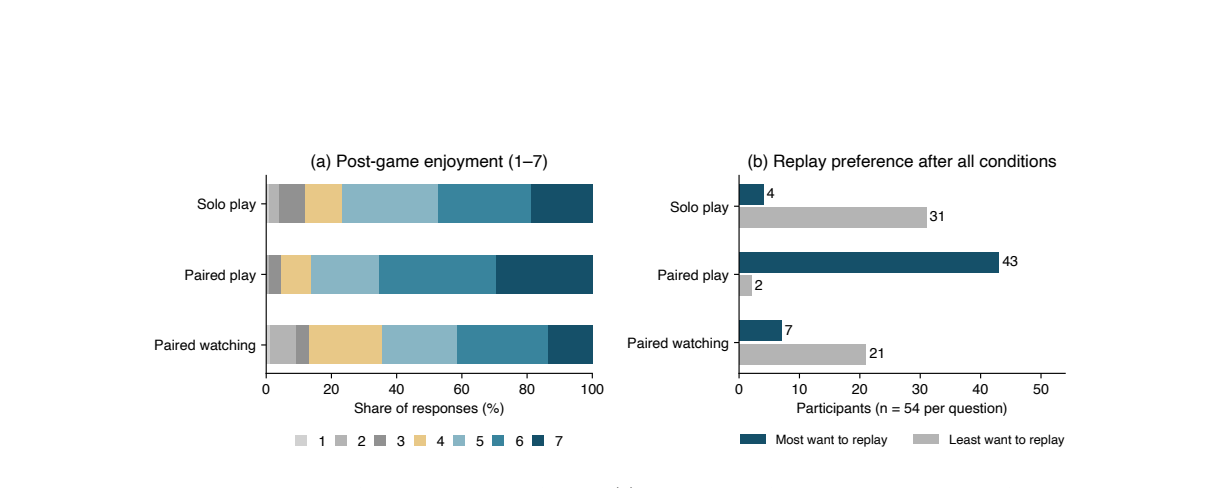
The stacked distributions pool repeated ratings from the same participants; adding per-participant mean distributions or a note explaining the repeated-rating interpretation would guard against overinterpretation of the raw distribution.
The paper says, at References
Pith says: minor objection 5 of 5
References [13], [15], [16], and [23] are arXiv preprints without DOIs; please mark them as preprints and, where possible, cite published versions.
What would settle it
Run a fourth within-subjects condition: paired play with conversation-blind edits, where L1 proposals are replaced by random valid changes drawn from the same CLAMP_TABLE at the same rate and category distribution as the real LLM condition, with L0 validation still applied. Compare per-game enjoyment, Q2, and Q4 between this control and the real paired-play condition. If the LLM condition does not exceed the random-edit control on enjoyment and Q2/Q4, the advantage cannot be attributed to faithful speech-to-change mapping; if it does, the mapping is behaviorally load-bearing.
from the skeptic's reading
How the review went
4 readings by deepseek-v4-flash · 20 Oct 2026
- Reader holds up, with conditions
- Skeptic agrees
- Editor wrote the verdict above
- Referee major revision: 2 major objections, 5 minor
Not run on this paper: the simulated authors' defence.
Pith did not check this review's objections against the paper.
The review in full
The review in brief, machine-written
Quick take: this is a genuine step beyond the authors' own LaS-Arcade loop. PATCH FIGHTER takes two players' natural conversation, not single-user commands, and runs it through an LLM pipeline (L1 per game, L4 per match, rule-based L0 validation) that rewrites game parameters between rounds. The three-condition within-subjects design—solo play, paired play, paired watching—with pre-specified contrasts, ordinal logistic mixed models, Holm correction, and sensitivity analyses is more disciplined than most work of this kind. The headline result, that paired play was most enjoyable (OR 3.18 vs solo, 6.68 vs watching, both Holm p<.001; 79.6% replay preference), holds up as stated, namely as a comparison of overall experiences. The paper is careful to scope it that way, in the abstract, Section 1, and again in the conclusion. The interviews also give genuine texture: paired watching lost because participants could not try the changes themselves.
Credit where due: the analysis is transparent, the limitations section names the main threats rather than burying them, and the discussion cleanly separates enjoyment of the game from experience of changing the game.
The soft spot is the load-bearing mechanism. Reading the paired-play advantage as "changing the game by talking is enjoyable" requires that the L1/L4 pipeline actually turns conversation into changes that track intent. That mapping is never validated directly: no ground-truth check linking logged speech to applied changes, no random- or no-change control condition, and the one direct self-report (Q2) is fragile—OR 3.09, Holm p=.033 under ordinal modeling, but p=.063 treated as continuous—while Q4 shows no clear difference in any contrast. The authors acknowledge this in Sections 7.1 and 7.2, listing speech-to-change linkage as future work, so this is not a hidden flaw. The honest summary is: well-supported holistic preference, unestablished mechanism. For a first demonstration that is not fatal, but it is the difference between a system paper and a proof of the experiential claim.
Two smaller flags. The body-size handicap removed mid-study is acknowledged, but the paper does not show period-stratified numbers, which would let a reviewer judge that threat directly. And no code, data, or system artifact is released, so the statistics and the system cannot be independently checked.
Who it is for: HCI people working on player-participatory design, computational co-creativity, and speech interfaces; the discussion of why editing and play cannot be separated, and how to measure them apart, is the most reusable part. I would send it to review and ask, in revision, for a mechanism check (even a small control with random or no changes), the stratified analysis, and an artifact. My own verdict is conditional on exactly those items; I would not cite the central claim as it stands, only the design discussion.
The strongest objection
The central comparison is supported as a description of overall experiences: OR=3.18 and 6.68 with Holm-adjusted p<.001 and 79.6% replay preference (Section 5.1). The load-bearing part is the interpretation of that advantage as an effect of conversation-driven editing. That interpretation requires that the L1/L4 pipeline (Section 3.1) actually converts the pair's speech into changes that track intent. The paper provides no ground-truth check connecting logged speech to applied parameter changes, and it includes no condition with random or absent changes. The only direct self-report, Q2, is fragile (ordinal OR=3.09, Holm p=.033; continuous p=.063, Section 5.2), and Q4 (match with intent) shows no clear difference in any contrast. The exploratory associations between change volume and enjoyment or Q2 are also unclear (Section 5.2). The authors acknowledge in Section 7.1 that the design cannot separate editing from play, and Section 7.2 lists linking speech, rationales, and changes as future work; these acknowledgements are accurate but leave the mechanism claim unresolved. As it stands, the paired-play advantage could be produced by playing against a person, by having a partner to talk with, or by any automatic change activity, without the LLM's mapping being faithful. Hence the mechanism-specific reading of the headline—'changing the game by talking is enjoyable'—is not established, even though the holistic experience comparison is.
The paper does what it says: it compares three holistic experiences, and the reported effect sizes, Holm-corrected p-values, and replay preference support the difference in post-game enjoyment. The authors also state the scope honestly: the abstract and Section 7.1 note that enjoyment of editing cannot be separated from play, and Section 7.2 lists linking speech, rationales, and changes as future work. For that reason I am not treating the missing mechanism test as an internal inconsistency; it is a scope gap. The gap is load-bearing because the paper's contribution, and the reader's strongest claim, is not merely 'two people playing together is fun'—that is already known from prior work (e.g., Gajadhar et al. 2008). The novel part is that natural conversation is turned into intended game changes and that this experience is evaluated. If the L1/L4 mapping is arbitrary, the study still shows a social/active-play effect but not the claimed effect of speech-driven modification. Q2 is the only direct check and it is method-dependent; Q4 shows nothing; no condition removes or randomizes the edits. So the mechanism-specific conclusion should be read conditionally. The concrete fix is a conversation-blind control condition, which is a natural next step given the authors' own outline of designs that separate editing from play. No change to the reader's CONDITIONAL verdict is needed.
The referee's report
If taken as a holistic comparison of three participation formats, the result is valuable and unusually well analyzed for a user study in this area: the contrasts C1 and C2 are pre-specified, the ordinal models and Holm correction are reported transparently, sensitivity analyses are direction-consistent, and the limitation sections are unusually candid. The 79.6% replay preference and large effect sizes make the experiential difference credible. The main gap is that the speech-to-change mapping itself is not validated, so the mechanism-specific reading suggested by the title and abstract—'changing the game by talking is enjoyable'—is not established. The paper's own conclusion is appropriately cautious, but the framing in the introduction and abstract goes beyond what the evidence supports.
Pith's reading of the paper (a machine's summary, not the authors')
Talking is usually not an editing interface: changing a game means stopping play and working in an editor. The paper tries to establish that a game can instead be modified from the players' own conversation, with no explicit commands, and that this works best as a shared, first-person experience. Its test bed is PATCH FIGHTER, a fighting game whose 91 parameters are rewritten between rounds by a large language model that listens to the pair talk. In a within-subjects study with 27 pairs, post-game enjoyment was higher when both participants played each other than when one played alone or when both watched two AIs fight, and 43 of 54 participants chose paired play as the condition they would most like to replay. Interviews attribute the preference to talking with a partner and verifying the changes through one's own play, and the authors state that the design cannot separate the enjoyment of editing from the enjoyment of playing.
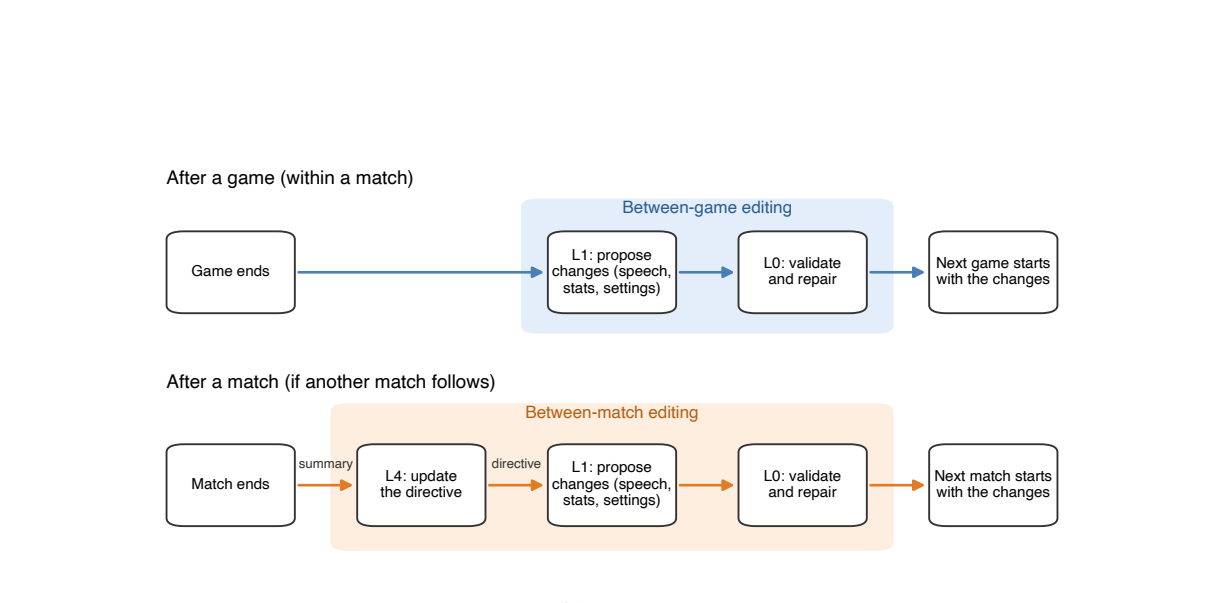
What carries the argument. The carrying mechanism is a two-level editing loop built around one configuration object, GameConfig, which encodes the whole game as 91 modifiable axes with defined ranges. After each game, an LLM layer called L1 reads the speech spoken since the last change, statistics from recent games, and the current settings, and proposes new parameter values; after each best-of-three match, a second LLM layer, L4, summarizes the match and updates a directive, a short natural-language policy describing the intended game, which L1 receives as part of its instructions. A rule-based layer, L0, validates every proposal before it is applied, clamping values to their ranges and rejecting changes to nonexistent axes or of the wrong type, and applied changes are announced on screen. This loop — conversation in, parameter changes out, at both the game level and the match level — is what the paper claims turns talk into playable design decisions, and the three-condition comparison isolates how the social composition and the form of engagement change that experience.
Core claim. On the paper's own terms, the discovery is that conversational game modification becomes a more enjoyable experience when it happens between two people who are both playing. The pre-specified contrasts were paired play versus solo play and paired play versus paired watching; in both, paired play came out ahead, with an odds ratio of $OR = 3.18$ (95% CI $[2.06, 4.90]$) against solo play and $OR = 6.68$ (95% CI $[4.10, 10.87]$) against paired watching, both Holm-adjusted $p < .001$, and paired play was the most-chosen replay condition at 79.6%. Paired play also beat solo play on feeling able to say enough about the game ($OR = 4.96$) and on feeling that speech was reflected in the changes ($OR = 3.09$), though the authors note the second result depends on the analysis method and the remaining questionnaire items showed no clear differences. Because paired watching produced as much speech as paired play but was enjoyed least, the paper argues that the advantage of paired play lies in checking the results of the conversation through one's own play rather than in the amount of talking. The authors acknowledge that between solo and paired play the number of people, the opponent, and the shared experience change simultaneously, and they caution that the results rest on 27 pairs of acquaintances, that the questionnaire uses single-item measures with proportional-odds concerns, and that a body-size handicap was removed partway through data collection, with sensitivity analyses confirming the direction of the results (Section 7.1).
The premise it rests on. The load-bearing premise is that the LLM pipeline (L1 after each game, L4 after each match) turns what the pair actually says into parameter changes that track the players' intent, a mapping the paper never validates against ground truth and that no random-change or no-change baseline tests; if that mapping were noisy or arbitrary, the measured experience would be talking while the game changes rather than changing the game by talking.
If the paper is right (Pith's inferences, not the authors')
If paired play really is the most enjoyable form, speech-driven game modification should be designed as a co-located activity in which everyone can play, rather than as a solo editing console or a pure spectator mode.
Watching produced as much or more speech than playing yet was enjoyed least, so a conversational editing system needs to give watchers a first-person way to try out changes; the interviews locate the missing piece precisely there.
Speech volume and the number of applied changes did not clearly predict enjoyment or the feeling that speech was reflected, so design effort should target the shared request and the visibility of its effect rather than raw output quantity.
Because ratings were higher after wins than losses within each condition, post-game enjoyment includes the match outcome, and the separate-measurement design the paper outlines as future work is required before the enjoyment gain can be attributed to editing itself.
My inference: the decisive control the study lacks is a random-change arm — the same paired-play condition but with the LLM's proposals replaced by parameter edits of equal size and frequency; if enjoyment and replay preference survive that substitution, the effect belongs to playing and talking together, not to faithful speech-to-change translation, a mapping the paper never validates.
My inference: the 'director versus player' roles participants described suggest a continuum rather than two fixed conditions, so giving watchers a rewindable replay or a lightweight way to test a proposed change could convert paired watching from frustrating to satisfying; this is directly testable with the existing system.
My inference: if the speech-to-parameter mapping is faithful, the same architecture transfers to other live co-creative settings where a group's natural talk is the editing language, such as live performance direction or collaborative simulation tuning, wherever first-person verification of the change is possible.
Check this review
Pith stored no record of this review's passes and took no fingerprint of it. Reviews made by code from 13 Nov 2026 on carry both.
How often reviews like this one are right
Reviews like this one: written by deepseek-v4-flash, where what was read was not recorded.
How often objections from reviews like this one are right: not yet measured
Reviews by people
This review was written by a machine. No person has reviewed this paper on Pith yet. A scientist listed on Pith can review it for a fee, and their review is published here whatever it concludes.
The paper
Abstract
Players often have ideas about a game while playing it, but turning them into changes usually means stepping out of play to edit it. We built PATCH FIGHTER, a two-player fighting game defined by 91 types of adjustable parameters. A large language model (LLM) reads players' conversations during play and rewrites these parameters between games, so players can change the game just by talking. We conducted a within-subjects experiment with 27 pairs (54 participants) comparing three conditions, solo play, paired play, and paired watching. Participants rated enjoyment after each game and answered a questionnaire on speech and changes after each condition. Paired play was the most enjoyable condition. In paired play, participants also felt more able to say what they thought about the game than in solo play. In interviews, participants valued talking with the partner and checking changes through their own play. Paired watching was less preferred because they could not try the changes themselves. As our design cannot separate the enjoyment of editing from that of play, we outline a design that measures them separately and the evaluation of the resulting games as future work.
The paper's own sentences, arranged, kept beside the review and separate from it. Each label is drawn from a closed vocabulary; the number beside it is the probability the classifier gave that label. No sentence in this record was written by a model.
abstract compiled · 2026-10-20
The authors' main claim, as the classifier picked it out 0.95
“Paired play was the most enjoyable condition.”
How the main claim is stated: asserted 1.00
What the abstract itself states, as probabilities: claims first 0.04 · states limitation 0.98 · human participants 0.98 · controlled comparison 0.46 · randomized assignment 0.04 · states quantitative result 0.87 · compares with prior results 0.22 · mentions code or data availability 0.03
The abstract, sentence by sentence
This table labels the abstract only (arXiv listing abstract v1). The number is the probability the classifier gave the label.
| Sentence | Role | The authors' own work | States the main conclusion | Strength |
|---|---|---|---|---|
| Players often have ideas about a game while playing it, but turning them into changes usually means stepping out of play to edit it. | background 0.95 | 0.05 | 0.02 | asserted 0.96 |
| We built PATCH FIGHTER, a two-player fighting game defined by 91 types of adjustable parameters. | contribution 0.69 | 0.94 | 0.02 | asserted 1.00 |
| A large language model (LLM) reads players' conversations during play and rewrites these parameters between games, so players can change the game just by talking. | method 0.61 | 0.85 | 0.03 | asserted 1.00 |
| We conducted a within-subjects experiment with 27 pairs (54 participants) comparing three conditions, solo play, paired play, and paired watching. | method 0.96 | 0.97 | 0.03 | asserted 0.99 |
| Participants rated enjoyment after each game and answered a questionnaire on speech and changes after each condition. | method 1.00 | 0.96 | 0.02 | asserted 0.98 |
| Paired play was the most enjoyable condition. | result 1.00 | 0.95 | 0.48 | asserted 1.00 |
| In paired play, participants also felt more able to say what they thought about the game than in solo play. | result 1.00 | 0.95 | 0.10 | asserted 1.00 |
| In interviews, participants valued talking with the partner and checking changes through their own play. | result 0.88 | 0.91 | 0.08 | asserted 1.00 |
| Paired watching was less preferred because they could not try the changes themselves. | result 0.81 | 0.90 | 0.06 | asserted 1.00 |
| As our design cannot separate the enjoyment of editing from that of play, we outline a design that measures them separately and the evaluation of the resulting games as future work. | future work 0.72 | 0.32 | 0.04 | asserted 0.93 |
What kind of paper the classifier reports this is: empirical study 0.90 · evidence from observation or experiment 1.00
What was examined, and what was not
Sources read
- arXiv listing abstract v1
Not examined
- full text
- figures and tables
- references and citing sentences
- relations to other papers
Levels run
- P abstract
Not run
- S sections
- T body sentences
- C citations
- R cross-paper relations
How the labels were made
Compiled by classifier-1.13.0 via TypeSafe API, question bank abstract-p1-20260923, 2026-10-20: 1 request, 7,366 input tokens.
Every quoted sentence on this record is the authors'. Every label is from Pith's closed vocabulary, with the probability shown beside it. This record as JSON
Figures (4)
Figures are the authors', reproduced from the paper.
References (27)
- [1] RobertoGallotta, GrahamTodd, MarvinZammit, SamEarle, AntoniosLiapis, JulianTogelius, and Georgios N. Yannakakis. Large language models and games: A survey and roadmap.IEEE Transactions on Games, 2024. doi: 10.1109/TG.2024.3461510. 14 on Pithdoi:10.1109/tg.2024.3461510
- [2] Shyam Sudhakaran, Miguel González-Duque, Matthias Freiberger, Claire Glanois, Elias Na- jarro, and Sebastian Risi. MarioGPT: Open-ended text2level generation through large lan- guage models. InAdvances in Neural Information Processing Systems, volume 36, pages 54213–54227. Cur... on Pithdoi:10.52202/075280-2361
- [3] Roberto Gallotta, Antonios Liapis, and Georgios N. Yannakakis. LLMaker: A game level design interface using (only) natural language. In2024 IEEE Conference on Games (CoG), pages 1–2, 2024. doi: 10.1109/CoG60054.2024.10645626 on Pithdoi:10.1109/cog60054.2024.10645626
- [4] Jim Whitehead et al. Conversational interactions with procedural generators using large lan- guage models. InProceedings of the 20th International Conference on the Foundations of Digital Games (FDG ’25), pages 1–7. ACM, 2025. doi: 10.1145/3723498.3723788 on Pithdoi:10.1145/3723498.3723788
- [5] Jeba Rezwana and Mary Lou Maher. Designing creative AI partners with COFI: A framework for modeling interaction in human-AI co-creative systems.ACM Transactions on Computer- Human Interaction, 30(5):1–28, 2023. doi: 10.1145/3519026 on Pithdoi:10.1145/3519026
- [6] Fiona Draxler, Anna Werner, Florian Lehmann, Matthias Hoppe, Albrecht Schmidt, Daniel Buschek, and Robin Welsch. The AI ghostwriter effect: When users do not perceive ownership of AI-generated text but self-declare as authors.ACM Transactions on Computer-Human Interaction, 31(... on Pithdoi:10.1145/3637875
- [7] Maya Grace Torii, Takahito Murakami, and Yoichi Ochiai. Lottery and sprint: Generate a board game with design sprint method on AutoGPT. InCompanion Proceedings of the Annual Symposium on Computer-Human Interaction in Play (CHI PLAY Companion ’23), pages 259–265. ACM, 2023. doi... on Pithdoi:10.1145/3573382.3623706
- [8] MayaGraceTorii, TakahitoMurakami, andYoichiOchiai. Lotteryandsprintarcade: Enabling player-driven game editing with generative AI.The Journal of the Society for Art and Science, 25(2):12:1–12:14, 2026. doi: 10.3756/artsci.25.12_1 on Pithdoi:10.3756/artsci.25.12_1
- [9] Georgios N. Yannakakis and Julian Togelius. Experience-driven procedural content generation. IEEE Transactions on Affective Computing, 2(3):147–161, 2011. doi: 10.1109/T-AFFC.2011.6 on Pithdoi:10.1109/t-affc.2011.6
- [10] Nicholas Jennings, Han Wang, Isabel Li, James Smith, and Bjoern Hartmann. What’s the game, then? Opportunities and challenges for runtime behavior generation. InProceedings of the 37th Annual ACM Symposium on User Interface Software and Technology (UIST ’24), pages 1–13. ACM, ... on Pithdoi:10.1145/3654777.3676358
- [11] Carina Liebers, Niklas Pfützenreuter, Jonas Auda, Uwe Gruenefeld, and Stefan Schneegass. “Computer, generate!” – investigating user-controlled generation of immersive virtual environ- ments. InHHAI 2024: Hybrid Human AI Systems for the Social Good, Frontiers in Artificial Inte... on Pithdoi:10.3233/faia240196
- [12] Riemer van Rozen. Live game design: Prototyping at the speed of play. InProceedings of the 20th International Conference on the Foundations of Digital Games (FDG ’25), pages 1–12. ACM, 2025. doi: 10.1145/3723498.3723726 on Pithdoi:10.1145/3723498.3723726
- [13] Dake Chen, Haoyang Zhang, Hanbin Wang, Yunhao Huo, Yuzhao Li, and Junjie Wang. GameGPT: Multi-agent collaborative framework for game development, 2025. arXiv:2310.08067v2. 15 on PithPith's reviewarXiv
- [14] Jiale Hong, Hongqiu Wu, and Hai Zhao. Game development as human-LLM interaction. InProceedings of the 63rd Annual Meeting of the Association for Computational Linguistics (Volume 1: Long Papers), pages 4333–4354, 2025. doi: 10.18653/v1/2025.acl-long.218 on Pithdoi:10.18653/v1/2025.acl-long.218
- [15] Yixu Huang, Bo Li, Na Li, Zhe Wang, Kaijie Chen, Haonan Ge, Qingyi Si, Yuanzhe Shen, Rui- han Yang, Guangjing Wang, and Hongcheng Guo. GUI agents for continual game generation, on Pith
- [16] Wenyi Wu, Minghao Fu, Jieyu You, Kun Zhou, Siqi Liu, Aayush Salvi, Yiheng Lin, Ce Zhang, Xiaohan Lan, Jiahui Zhu, Yujie Zhong, Qi She, and Biwei Huang. RSIGame: Autonomous agentic game development with recursive self-improvement, 2026. arXiv:2609.39045 on PithPith's reviewarXiv
- [17] Michael Xieyang Liu, Advait Sarkar, Carina Negreanu, Benjamin Zorn, Jack Williams, Neil Toronto, and Andrew D. Gordon. “What it wants me to say”: Bridging the abstraction gap between end-user programmers and code-generating large language models. InProceedings of the 2023 CHI ... on Pithdoi:10.1145/3544548.3580817
- [18] J.D. Zamfirescu-Pereira, Richmond Y. Wong, Bjoern Hartmann, and Qian Yang. Why Johnny can’t prompt: How non-AI experts try (and fail) to design LLM prompts. InProceedings of the 2023 CHI Conference on Human Factors in Computing Systems (CHI ’23), pages 1–21. ACM, 2023. doi: 10... on Pithdoi:10.1145/3544548.3581388
- [19] Hari Subramonyam, Roy Pea, Christopher Pondoc, Maneesh Agrawala, and Colleen Seifert. Bridging the gulf of envisioning: Cognitive challenges in prompt based interactions with LLMs. InProceedings of the CHI Conference on Human Factors in Computing Systems (CHI ’24), pages 1–19.... on Pithdoi:10.1145/3613904.3642754
- [20] Herbert H. Clark and Susan E. Brennan. Grounding in communication. In Lauren B. Resnick, John M. Levine, and Stephanie D. Teasley, editors,Perspectives on Socially Shared Cognition, pages 127–149. American Psychological Association, 1991. doi: 10.1037/10096-006 on Pithdoi:10.1037/10096-006
show 7 more
- [21] Naomi Miyake. Constructive interaction and the iterative process of understanding.Cognitive Science, 10(2):151–177, 1986. doi: 10.1207/s15516709cog1002_2 on Pithdoi:10.1207/s15516709cog1002_2
- [22] Yuanning Han, Ziyi Qiu, Jiale Cheng, and RAY LC. When teams embrace AI: Human collab- oration strategies in generative prompting in a creative design task. InProceedings of the CHI Conference on Human Factors in Computing Systems (CHI ’24), pages 1–14. ACM, 2024. doi: 10.1145/... on Pithdoi:10.1145/3613904.3642133
- [23] Andrew Zhu, Evan Osgood, and Chris Callison-Burch. First steps towards overhearing LLM agents: A case study with Dungeons & Dragons gameplay, 2025. arXiv:2505.22809 on PithPith's reviewarXiv
- [24] Brian J. Gajadhar, Yvonne A. W. de Kort, and Wijnand A. IJsselsteijn. Shared fun is doubled fun: Player enjoyment as a function of social setting. InFun and Games 2008, Lecture Notes in Computer Science, pages 106–117. Springer, 2008. doi: 10.1007/978-3-540-88322-7_11 on Pithdoi:10.1007/978-3-540-88322-7_11
- [25] Stuart Reeves, Steve Benford, Claire O’Malley, and Mike Fraser. Designing the spectator experience. InProceedings of the SIGCHI Conference on Human Factors in Computing Systems (CHI ’05), pages 741–750. ACM, 2005. doi: 10.1145/1054972.1055074. 16 on Pithdoi:10.1145/1054972.1055074
- [26] Gifford Cheung and Jeff Huang. Starcraft from the stands: Understanding the game spectator. InProceedings of the SIGCHI Conference on Human Factors in Computing Systems (CHI ’11), pages 763–772. ACM, 2011. doi: 10.1145/1978942.1979053 on Pithdoi:10.1145/1978942.1979053
- [27] Pujana Paliyawan, Ruck Thawonmas, Kingkarn Sookhanaphibarn, and Worawat Choensawat. Audience participation fighting game: Exploring social facilitation for an enhanced APG ex- perience.Heliyon, 10(2):e23967, 2024. doi: 10.1016/j.heliyon.2023.e23967. 17 on Pithdoi:10.1016/j.heliyon.2023.e23967
Challenges and discussion
Disagree with the review, or know something it missed? Leave a comment, or challenge this review formally: a challenge becomes a permanent entry in this paper's record, and its decision is published here.
Come back by email
A short list of the week's newly reviewed papers. Nothing is sent until you confirm from your inbox, and every email has a link that stops it. No account.
No comments yet.
Sign in to comment