Computation and Language · arXiv:2610.27541 v1 · submitted 20 Oct 2026 · 18 references
EviDial: When Correct Depression Predictions Lack Evidence
The paper says
“Depression dialogue benchmarks commonly assess models by comparing predicted symptom labels with clinical scale scores. However, a prediction may agree with a benchmark label even when the dialogue lacks enough evidence to justify it.”
more of the abstract
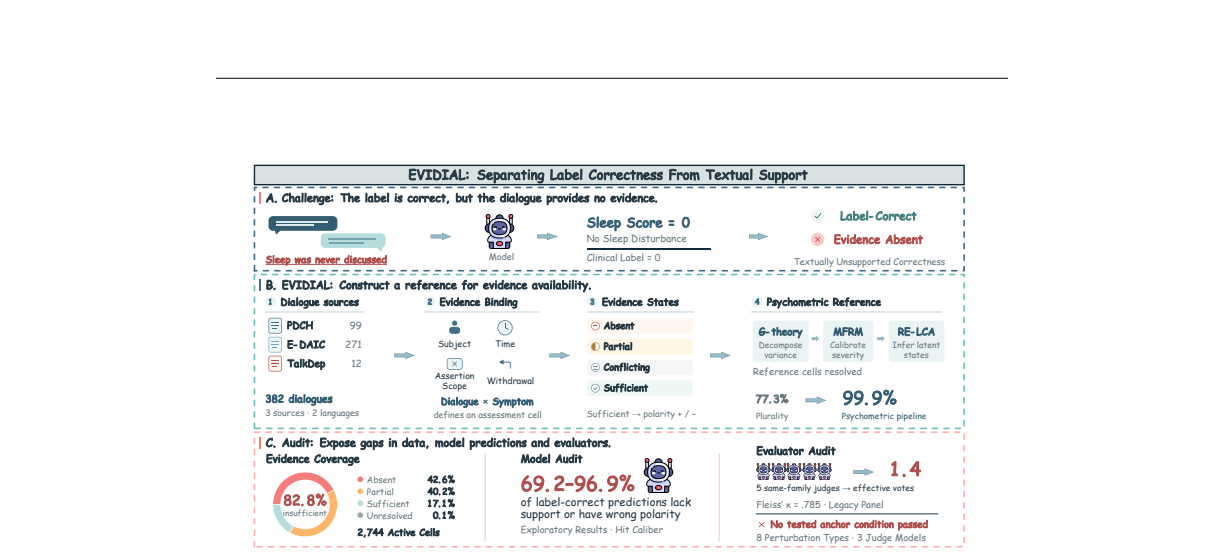
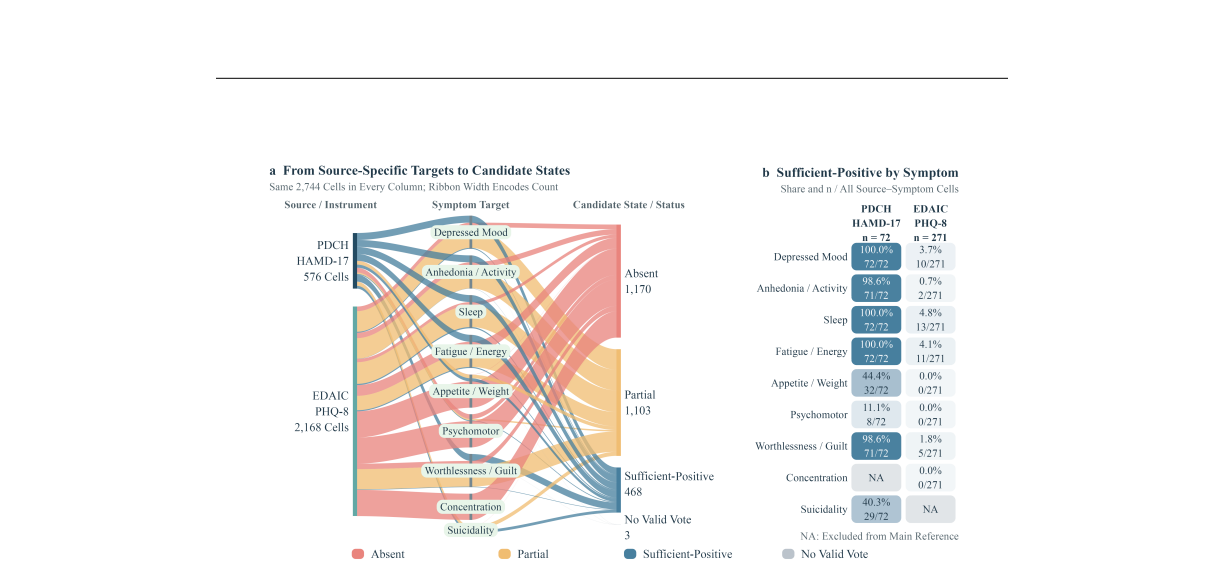
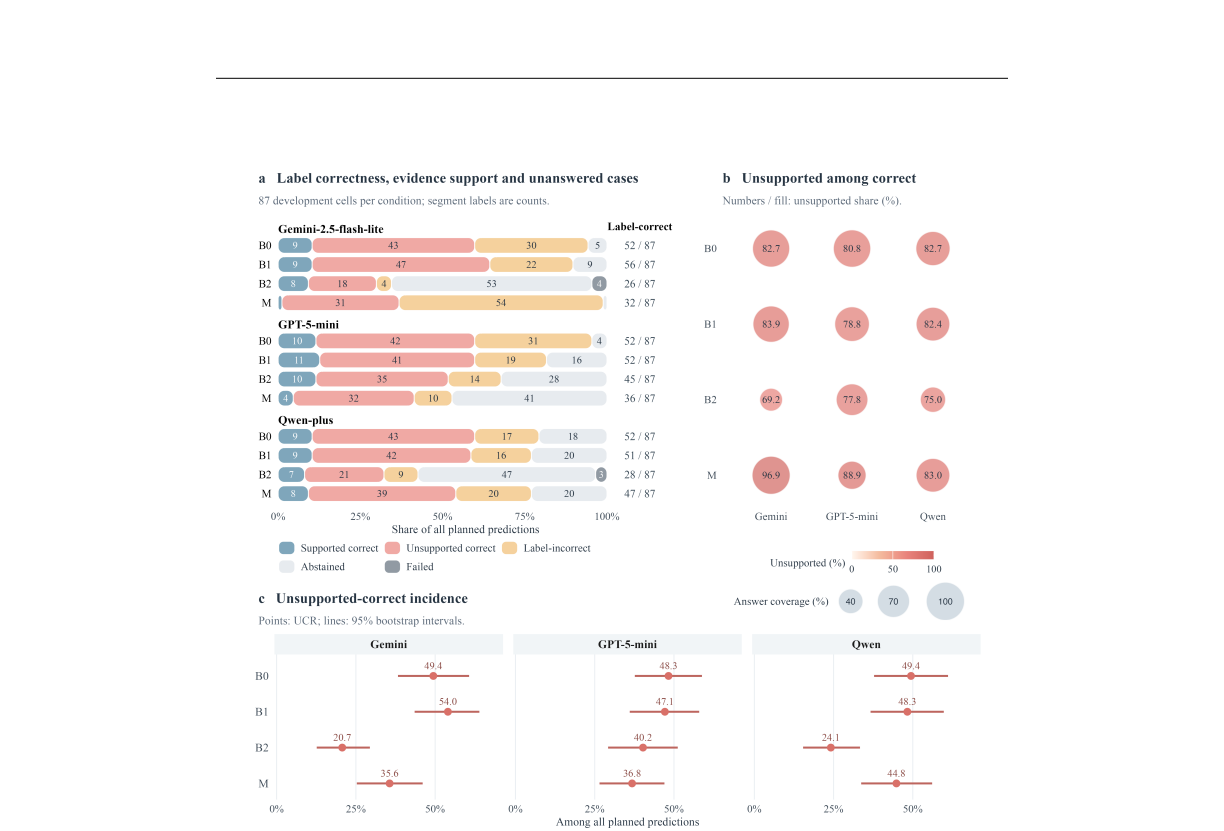
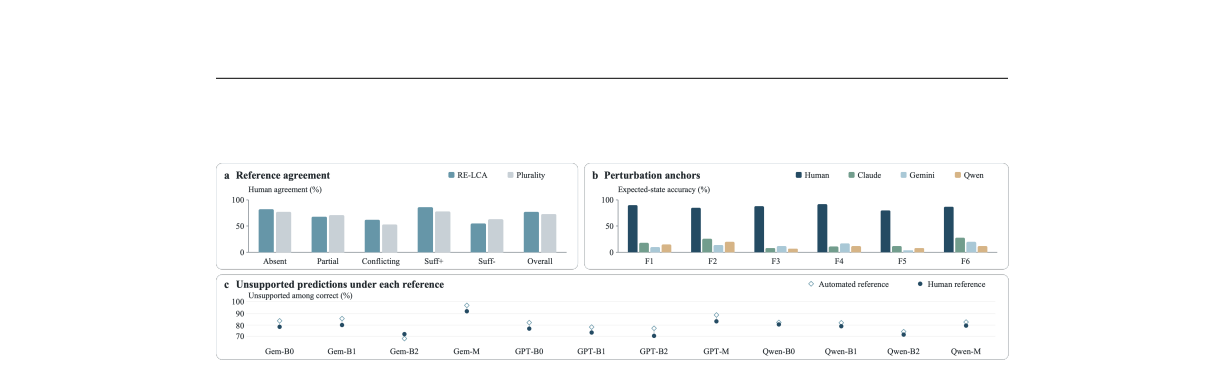
We introduce EviDial, a benchmark that distinguishes label agreement from evidence-grounded assessment. EviDial comprises 382 depression dialogues from three sources and 2,744 participant-symptom cells, each classified as having absent, partial, conflicting, or sufficient evidence. Because evidence sufficiency lacks a directly observable gold standard, we derive calibrated evidence references from multiple judgments using generalizability theory, many-facet Rasch measurement, and random-effects latent class analysis. Our audit reveals that 82.8% of participant-symptom cells lack sufficient textual evidence for the corresponding symptom assessment, with substantial variation across sources. Across model families and prompting strategies, 69.2%-96.9% of predictions judged correct by benchmark labels are nonetheless unsupported by sufficient dialogue evidence. Further analyses show that strong agreement among LLM evaluators need not reflect independent evidence judgments, underscoring the need to calibrate automated reference panels. These findings demonstrate that label-based evaluation can overestimate evidence-grounded performance by conflating agreement with clinical labels and support in the observed dialogue. EviDial provides a measurement layer for separating these constructs and auditing LLM-based depression assessment more faithfully.
from the abstract
Pith says
Machine review · deepseek-v4-flash · 21 Oct 2026 · what was read was not recorded · not checked by a person
It can be wrong. Challenge this review or reply to it.
The passes disagreed. Reader: holds up. Skeptic: holds up only with conditions. Referee: major revision.
A conceptually clean benchmark that exposes a real evaluation gap, backed by unusually thorough psychometric scaffolding—but the central estimate depends on a reference whose validation, while extensive, still has blind spots. This line is wrong
4 major objections · 7 minor
How often objections from reviews like this one are right: not yet measured
Not checked: figures, code, what the 18 references say.
The paper says, at §4.1, §5, and Limitations (§7)
The review did not quote this passage.
Pith says: Objection 1 of 4 · major
The central 82.8% insufficient-evidence figure rests entirely on the RE-LCA reference. The human validation on 120 cells (4.4% of pool) shows 76.5% agreement with RE-LCA and rescoring preserves unsupported rates. However, the human reference's own evidence-state prevalence is not reported.
more of objection 1
Without knowing whether the human annotators also assign high insufficient prevalence (e.g., 70-80% ABSENT/PARTIAL), the agreement could reflect shared systematic bias (e.g., a conservative interpretation of the annotation contract or difficulty retrieving evidence). The authors should report the human reference's state distribution and discuss whether the agreement is meaningfully higher than what would be expected if both references share similar biases. This is load-bearing because the claim that the evidence gap cannot be an artifact of random reference error (scale argument in §4.3) does not bound systematic error.
The paper says, at §4.2, model-audit scope
The review did not quote this passage.
Pith says: Objection 2 of 4 · major
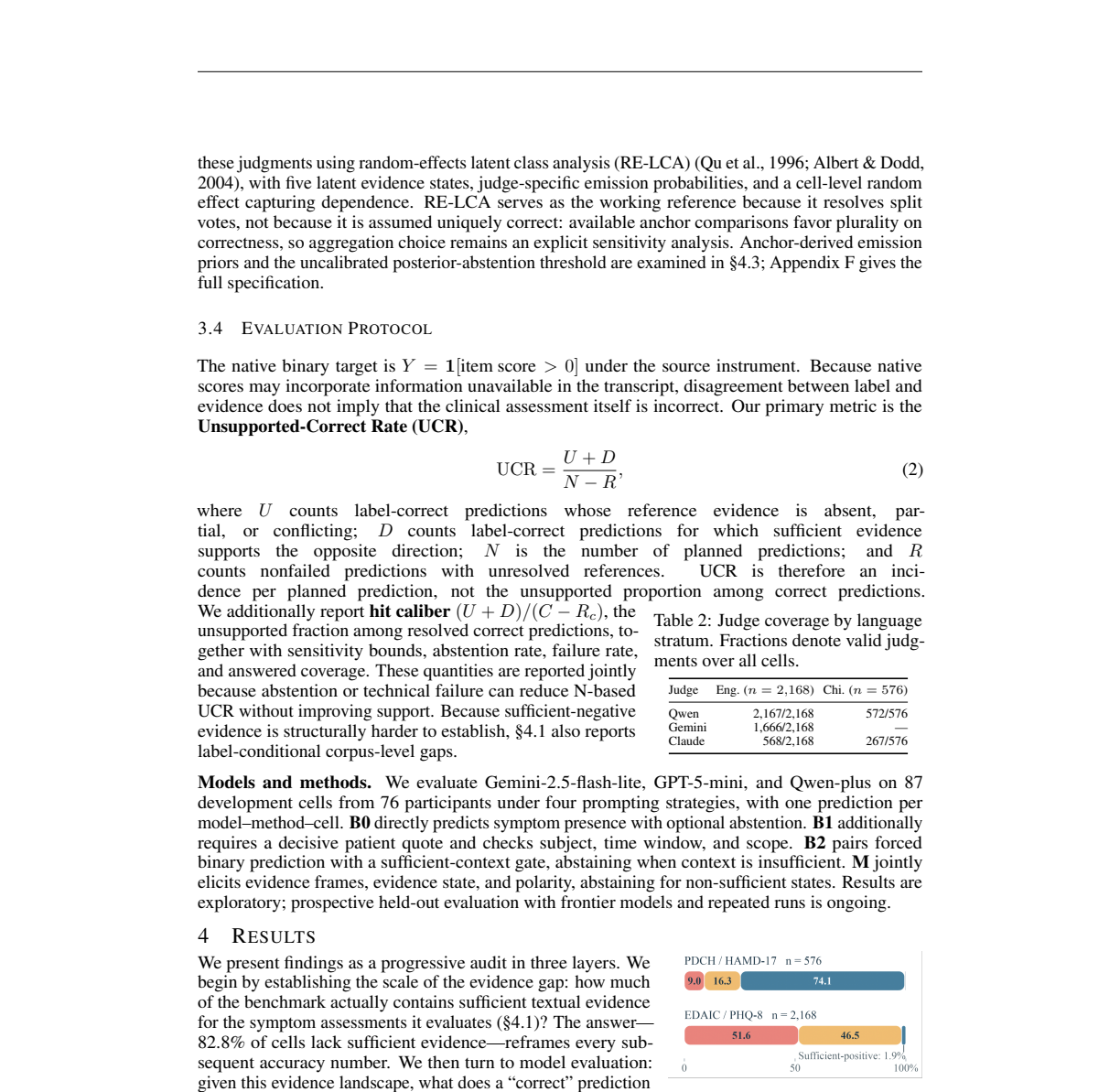
The model audit uses only 87 development cells from 76 participants, with no description of source composition. Given the sharp source-level variation (PDCH: 74.1% sufficient vs E-DAIC: 1.9%), the representativeness of these cells is unclear. If the audit sample over-represents PDCH, the unsupported rates might be conservative; if it over-represents E-DAIC, they might be inflated.
more of objection 2
The authors should report the source distribution of the 87 audit cells (and the broader 2,744 cell pool) and discuss how any imbalance affects the generalizability of the hit-caliber and UCR estimates. Without this, the claim that 69-97% of correct predictions are unsupported is only descriptive of this specific sample.
The paper says, at §4.3 and Table 4
The review did not quote this passage.
A classifier read this sentence of the paper as acknowledging the concern (probability 0.64):
“In particular, ABSENT or PARTIAL should not be interpreted as evidence that a participant does not have the corresponding symptom or condition; they indicate only that the available transcript does not provide sufficient evidence under the specified evidence contract.”
Pith says: Objection 3 of 4 · major
The perturbation anchor tests fail for all conditions, and the paper argues that the evidence gap is too large to be explained by reference error (scale argument: moving 10-13% of cells would still leave majority unsupported). This bounds random reference error but not systematic error.
more of objection 3
If the reference systematically labels cells as ABSENT or PARTIAL when evidence is merely difficult to retrieve (e.g., due to prompt ambiguity or judge biases), the gap could be substantially inflated. The human validation mitigates this but does not fully rule it out, as human annotators could share similar biases. The authors should discuss plausible systematic error scenarios that could reduce the gap (e.g., to below 50%) and explain why those are unlikely given the existing evidence, or provide additional analyses (e.g., sensitivity analysis with relaxed evidence thresholds).
The paper says, at §3.3, §4.1, Appendix F
The review did not quote this passage.
Pith says: Objection 4 of 4 · major
The RE-LCA reference assigns no sufficient-negative MAP assignments, while plurality assigns six sufficient-negative cells. The paper notes that one judge family (Gemini) can produce sufficient-negative judgments on perturbation anchors. The absence of sufficient-negative assignments limits the audit of negative predictions, where sufficient evidence is structurally harder to establish (§3.2).
more of objection 4
This asymmetry affects the hit-caliber estimates for negative labels and should be explicitly discussed as a limitation of the reference. The authors should clarify how the evaluation of unsupported correctness might be affected for cells with negative native labels.
7 minor objections
The paper says, at Abstract
Pith says: minor objection 1 of 7
The sentence "82.8% of participant-symptom cells lack sufficient textual evidence" should explicitly note that this figure is based on the candidate RE-LCA reference, not an independent gold standard.
The paper says, at Table 2
Pith says: minor objection 2 of 7
The table shows that Gemini has 0 Chinese judgments (i.e., 576 of 576 cells have missing judgments). This should be stated in the text, as it affects the reference construction for the Chinese subset.
show 5 more
The paper says, at Figure 5 caption
Pith says: minor objection 3 of 7
The rescoring results report mean absolute change of 3.1 percentage points and maximum 4.9 points. It would be helpful to include the range or bootstrap confidence intervals for these changes to gauge variability.
The paper says, at §4.1
Pith says: minor objection 4 of 7
The 95% confidence intervals for the evidence gap (82.1-83.5%) are provided, but the bootstrap procedure is not described. State whether resampling was done at the cell level, participant level, or with blocking by source, as this affects interpretation.
The paper says, at §2, Related Work
Pith says: minor objection 5 of 7
The paper mentions that E-DAIC transcripts were reformatted with claude-3-5-sonnet-latest and notes that preservation of clinical meaning has not been independently verified. This caveat should be reiterated when discussing the E-DAIC evidence gap, as reformatting could affect evidence availability.
The paper says, at §4.3 (legacy panel quality)
Pith says: minor objection 6 of 7
The legacy panel participation ratio (1.4) is reported, indicating low independence. The paper should state whether the new panel (Gemini, Qwen, Claude) was assessed for independence as well, and if not, discuss how judge overlap might affect the RE-LCA reference.
The paper says, at §7, Limitations
Pith says: minor objection 7 of 7
The limitation that "coverage is uneven, and some evaluator and judge families overlap" could be made more concrete by quantifying the overlap (e.g., percentage of cells where two or more judges come from the same model family).
What would settle it
Conduct a larger human validation on a stratified random sample of 200 cells from each source (PDCH and E-DAIC), plus all cells currently labeled CONFLICTING or sufficient-negative under any aggregator. Have three blinded annotators assign evidence states and compute the human consensus reference. Report the insufficient-evidence proportion and compare to the RE-LCA-based 82.8%. If the human proportion is significantly lower (e.g., below 75%), the headline gap is not robust. Additionally, the paper should report the source breakdown of the 87 model audit cells.
from the skeptic's reading
How the review went
4 readings by deepseek-v4-flash · 21 Oct 2026
- Reader holds up
- Skeptic partly agrees: says it holds up only with conditions The RE-LCA reference may systematically overestimate the evidence gap; the human validation covers only 4.4% of cells and does not report the human reference's own state distribution, leaving the 82.8% figure empirically unverified on the full pool.
- Editor wrote the verdict above
- Referee major revision: 4 major objections, 7 minor
Not run on this paper: the simulated authors' defence.
Pith did not check this review's objections against the paper.
The review in full
The review in brief, machine-written
What the paper does well: it identifies a genuine blind spot in clinical dialogue evaluation—label accuracy doesn't guarantee textual support—and builds a benchmark, EviDial, to measure it. The reference construction is unusually careful for the field: G-theory, MFRM, RE-LCA, perturbation tests, and a blind human validation. The paper is transparent about its own limitations, which is rare and welcome. The main finding—that 69–97% of label-correct predictions lack sufficient evidence—survives the human rescoring on the 120-cell overlap, which gives some confidence.
Soft spots: the 82.8% figure rests on the RE-LCA reference, and the human validation covers only 4.4% of cells without reporting the human reference's own state distribution. The model audit uses only 87 development cells, with source composition not fully described—important given the sharp PDCH vs. E-DAIC split. Sufficient-negative assignments are absent from the reference, making negative-prediction audits incomplete. None of these kill the central claim, but they temper how strongly you can state the numbers.
Bottom line: this is a solid paper for clinical NLP. It deserves a serious referee—the concept is timely, the methodology is rigorous (if imperfect), and the authors have been unusually upfront about weaknesses. The gap it exposes is real; the exact magnitude is still somewhat reference-dependent, but the direction is clear.
The strongest objection
The central 82.8% insufficient-evidence figure rests on the RE-LCA reference. A blinded human validation (120 cells, 4.4% of the pool) shows substantial agreement (76.5%), but the paper does not report the human reference's own evidence-state prevalence. Without that, we cannot rule out that systematic reference bias (e.g., a tendency to label cells ABSENT when evidence is merely difficult to retrieve) inflates the gap. The human validation was used to rescore model predictions, which preserved the unsupported-among-correct rates, but that is conditional on the human reference's own state assignments; if the human reference also has high insufficient proportion, the agreement is unsurprising. The human reference itself could share similar biases if the annotation contract is ambiguous or favors conservative evidence judgments. Moreover, the model audit sample (87 cells from 76 participants) is not described in terms of source composition, raising concern about representativeness given the sharp source-level variation (PDCH: 74.1% sufficient vs E-DAIC: 1.9%). The absence of sufficient-negative MAP assignments also raises a red flag about the reference's sensitivity to negative evidence.
The reader correctly identifies reference validity as the weakest assumption. I add specificity: the risk is systematic bias, not just random error, because the reference produces zero sufficient-negative assignments and the human validation does not report the state distribution of the human reference itself. The human validation confirms agreement on a small subset but does not independently verify the magnitude of the evidence gap across the full pool. Additionally, the model audit sample's source composition is unreported, which is critical given the source-level evidence heterogeneity. These weaknesses are addressable and do not invalidate the paper's direction, but they warrant a conditional verdict until the robustness of the headline figure is confirmed on a larger sample.
The referee's report
If the main results hold, EviDial makes an important contribution by demonstrating that label accuracy in depression dialogue benchmarks can conflate correctness with evidence support, motivating a separate evaluation axis. The methodological framework for constructing evidence references without a directly observable gold standard (using generalizability theory, many-facet Rasch measurement, and random-effects latent class analysis) is innovative and carefully presented. The thorough sensitivity analyses, perturbation tests, and human validation raise the bar for benchmark construction in clinical NLP. The findings have implications beyond depression dialogue, applying whenever evaluation targets contain information not recoverable from model-visible input.
Pith's reading of the paper (a machine's summary, not the authors')
EviDial shows that benchmark accuracy conflates two separate properties: whether a model's prediction matches the clinical label, and whether the dialogue contains sufficient textual evidence to justify that prediction. Across 2,744 assessment cells from three depression dialogue sources, 82.8% of cells lack sufficient evidence for the corresponding symptom. When models are evaluated on label accuracy alone, 69.2% to 96.9% of correct predictions remain unsupported by sufficient dialogue evidence, regardless of model family or prompting strategy. This gap persists even for positive symptom labels, where evidence is easier to establish. The findings demonstrate that conventional label-based evaluation can substantially overestimate evidence-grounded performance.
What carries the argument. EviDial is a benchmark that defines assessment cells (dialogue × symptom dimension) and classifies evidence into four states through binding operations (subject, temporal, assertion scope, withdrawal). The evidence reference is constructed from multiple LLM judgments fused via random-effects latent class analysis (RE-LCA), with complementary analysis using generalizability theory and many-facet Rasch measurement to quantify judge dependence and protocol severity. The primary metric is the Unsupported-Correct Rate (UCR), which measures the proportion of planned predictions that are label-correct but lack sufficient evidence.
Core claim. The paper establishes that textual evidence support and label correctness are distinct measurement dimensions in depression dialogue assessment. By constructing a psychometric reference for evidence states (absent, partial, conflicting, sufficient) using random-effects latent class analysis, many-facet Rasch measurement, and generalizability theory, the authors show that the majority of assessment cells lack sufficient evidence and that a large fraction of label-correct model predictions are unsupported by the available dialogue. This divergence is systematic across models and methods, and is not an artifact of measurement choices, as a blind human validation preserves the pattern.
The premise it rests on. The automated evidence reference, derived from LLM judgments fused via RE-LCA, accurately reflects the true evidence state of each cell, despite imperfect agreement with plurality and partial human validation on a small subset.
If the paper is right (Pith's inferences, not the authors')
Depression dialogue benchmarks should report evidence support metrics alongside accuracy to avoid overstating model capability.
Model auditing must distinguish between predictions that are correct by coincidence (e.g., relying on base rates) and those that are grounded in the dialogue.
The finding that evidence availability varies sharply across sources (74.1% sufficient in PDCH vs. 1.9% in E-DAIC) implies that benchmark comparisons need to control for the evidence interface.
High agreement among LLM evaluators does not guarantee independent evidence judgments; panel calibration is necessary.
Selective prediction methods that abstain when evidence is insufficient can reduce unsupported correctness but at the cost of coverage, which must be reported jointly.
The evidence gap documented for depression likely generalizes to other clinical domains where benchmark labels are derived from information not fully present in the model-visible input (e.g., physical exams, patient history).
The study's finding that 76% of positive-label cells lack sufficient evidence challenges the assumption that positive symptoms leave clearer textual traces; the asymmetry of negative evidence is not the sole driver.
The failure of perturbation tests to pass gate thresholds suggests that current LLM judges cannot reliably detect controlled evidence manipulations, which has implications for using LLMs as evaluators in high-stakes settings.
Future work should explore whether models that are explicitly trained to ground predictions in evidence (e.g., via retrieval or reasoning chains) achieve lower UCR, and whether the reference construction can be improved with human-in-the-loop calibration.
Check this review
Pith stored no record of this review's passes and took no fingerprint of it. Reviews made by code from 13 Nov 2026 on carry both.
How often reviews like this one are right
Reviews like this one: written by deepseek-v4-flash, where what was read was not recorded.
How often objections from reviews like this one are right: not yet measured
Reviews by people
This review was written by a machine. No person has reviewed this paper on Pith yet. A scientist listed on Pith can review it for a fee, and their review is published here whatever it concludes.
The paper
Abstract
Depression dialogue benchmarks commonly assess models by comparing predicted symptom labels with clinical scale scores. However, a prediction may agree with a benchmark label even when the dialogue lacks enough evidence to justify it. We introduce EviDial, a benchmark that distinguishes label agreement from evidence-grounded assessment. EviDial comprises 382 depression dialogues from three sources and 2,744 participant-symptom cells, each classified as having absent, partial, conflicting, or sufficient evidence. Because evidence sufficiency lacks a directly observable gold standard, we derive calibrated evidence references from multiple judgments using generalizability theory, many-facet Rasch measurement, and random-effects latent class analysis. Our audit reveals that 82.8% of participant-symptom cells lack sufficient textual evidence for the corresponding symptom assessment, with substantial variation across sources. Across model families and prompting strategies, 69.2%-96.9% of predictions judged correct by benchmark labels are nonetheless unsupported by sufficient dialogue evidence. Further analyses show that strong agreement among LLM evaluators need not reflect independent evidence judgments, underscoring the need to calibrate automated reference panels. These findings demonstrate that label-based evaluation can overestimate evidence-grounded performance by conflating agreement with clinical labels and support in the observed dialogue. EviDial provides a measurement layer for separating these constructs and auditing LLM-based depression assessment more faithfully.
The paper's own sentences, arranged, kept beside the review and separate from it. Each label is drawn from a closed vocabulary; the number beside it is the probability the classifier gave that label. No sentence in this record was written by a model.
abstract compiled · 2026-10-21
The authors' main claim, as the classifier picked it out 1.00
“These findings demonstrate that label-based evaluation can overestimate evidence-grounded performance by conflating agreement with clinical labels and support in the observed dialogue.”
How the main claim is stated: asserted 1.00
What the abstract itself states, as probabilities: claims first 0.09 · states limitation 0.71 · human participants 0.82 · controlled comparison 0.07 · randomized assignment 0.02 · states quantitative result 0.99 · compares with prior results 0.45 · mentions code or data availability 0.06
The abstract, sentence by sentence
This table labels the abstract only (arXiv listing abstract v1). The number is the probability the classifier gave the label.
| Sentence | Role | The authors' own work | States the main conclusion | Strength |
|---|---|---|---|---|
| Depression dialogue benchmarks commonly assess models by comparing predicted symptom labels with clinical scale scores. | background 1.00 | 0.05 | 0.02 | asserted 1.00 |
| However, a prediction may agree with a benchmark label even when the dialogue lacks enough evidence to justify it. | gap 0.70 | 0.12 | 0.10 | hedged possibility 0.99 |
| We introduce EviDial, a benchmark that distinguishes label agreement from evidence-grounded assessment. | contribution 1.00 | 0.92 | 0.08 | asserted 1.00 |
| EviDial comprises 382 depression dialogues from three sources and 2,744 participant-symptom cells, each classified as having absent, partial, conflicting, or sufficient evidence. | method 0.84 | 0.93 | 0.03 | asserted 1.00 |
| Because evidence sufficiency lacks a directly observable gold standard, we derive calibrated evidence references from multiple judgments using generalizability theory, many-facet Rasch measurement, and random-effects latent class analysis. | method 1.00 | 0.95 | 0.03 | asserted 1.00 |
| Our audit reveals that 82.8% of participant-symptom cells lack sufficient textual evidence for the corresponding symptom assessment, with substantial variation across sources. | result 1.00 | 0.96 | 0.12 | asserted 1.00 |
| Across model families and prompting strategies, 69.2%-96.9% of predictions judged correct by benchmark labels are nonetheless unsupported by sufficient dialogue evidence. | result 1.00 | 0.94 | 0.40 | asserted 1.00 |
| Further analyses show that strong agreement among LLM evaluators need not reflect independent evidence judgments, underscoring the need to calibrate automated reference panels. | result 0.62 | 0.88 | 0.07 | asserted 0.99 |
| These findings demonstrate that label-based evaluation can overestimate evidence-grounded performance by conflating agreement with clinical labels and support in the observed dialogue. | interpretation 1.00 | 0.86 | 0.85 | asserted 1.00 |
| EviDial provides a measurement layer for separating these constructs and auditing LLM-based depression assessment more faithfully. | contribution 0.89 | 0.81 | 0.18 | asserted 1.00 |
What kind of paper the classifier reports this is: dataset or benchmark 1.00 · evidence from analysis of existing data 0.52
What was examined, and what was not
Sources read
- arXiv listing abstract v1
Not examined
- full text
- figures and tables
- references and citing sentences
- relations to other papers
Levels run
- P abstract
Not run
- S sections
- T body sentences
- C citations
- R cross-paper relations
How the labels were made
Compiled by classifier-1.13.0 via TypeSafe API, question bank abstract-p1-20260923, 2026-10-21: 1 request, 7,557 input tokens.
Every quoted sentence on this record is the authors'. Every label is from Pith's closed vocabulary, with the probability shown beside it. This record as JSON
Figures (5)
Figures are the authors', reproduced from the paper.
References (18)
- [7] arXiv:2411.06037. Amita Kamath, Robin Jia, and Percy Liang. Selective question answering under domain shift. In Proceedings of the 58th Annual Meeting of the Association for Computational Linguistics (ACL), pp. 5684–5696, on PithPith's reviewarXiv
- [8] Shreyas KC. Babeljudge: Measuring LLM-as-a-judge reliability across languages and agent trajecto- ries.arXiv preprint arXiv:2606.22329, on PithPith's reviewarXiv
- [10] doi: 10.1016/j.jad.2008.06.026. John Michael Linacre.Many-faceted Rasch measurement. PhD thesis, The University of Chicago, on Pithdoi:10.1016/j.jad.2008.06.026
- [12] Sewon Min, Kalpesh Krishna, Xinxi Lyu, Mike Lewis, Wen-tau Yih, Pang Wei Koh, Mohit Iyyer, Luke Zettlemoyer, and Hannaneh Hajishirzi. FActScore: Fine-grained atomic evaluation of factual precision in long form text generation. InProceedings of the 2023 Conference on Empirical ... on Pith
- [13] doi: 10.1109/ICASSP43922.2022.9746569. Dan Song, Won-Chan Lee, and Hong Jiao. Exploring LLM autoscoring reliability in large-scale writing assessments using generalizability theory.arXiv preprint arXiv:2507.19980, on PithPith's reviewarXiv
- [14] Hoyun Song, Migyeong Kang, Jisu Shin, Jihyun Kim, Chanbi Park, et al. Mentalbench: A DSM- grounded benchmark for evaluating psychiatric diagnostic capability of large language models. arXiv preprint arXiv:2602.12871, on PithPith's reviewarXiv
- [15] Veerendra Kumar Sunkavalli. LLM judges as raters: A pre-registered audit of severity, halo, reliability, and version instability in LLM essay scoring on public corpora.arXiv preprint arXiv:2608.29517, on PithPith's reviewarXiv
- [16] arXiv:2410.12784. Pat Verga, Sebastian Hofstatter, Sophia Althammer, Yixuan Su, Aleksandra Piktus, Arkady Arkhang- orodsky, Minjie Xu, Naomi White, and Patrick Lewis. Replacing judges with juries: Evaluating LLM generations with a panel of diverse models.arXiv preprint arXiv:2... on PithPith's reviewarXiv
- [17] Shihao Xu, Tiancheng Zhou, Jiatong Ma, Yanli Ding, Yiming Yan, et al. Lingxidiagbench: A multi-agent framework for benchmarking LLMs in chinese psychiatric consultation and diagnosis. arXiv preprint arXiv:2602.09379, on PithPith's reviewarXiv
- [18] These results limit substantive interpretation of the legacy latent-class models and their use for reference validation. D MTMMANDLANGUAGECOMPARISONS Multitrait–Multimethod analysis.Following Campbell & Fiske (1959), we compute mean same- trait, different-method correlations a... on Pith
- [1989] Joshua Maynez, Shashi Narayan, Bernd Bohnet, and Ryan McDonald. On faithfulness and factuality in abstractive summarization. InProceedings of the 58th Annual Meeting of the Association for Computational Linguistics (ACL), pp. 1906–1919, on Pith
- [2001] doi: 10.1006/jbin.2001.1029. Junhyuk Choi, Sohhyung Park, Chanhee Cho, Hyeonchu Park, and Bugeun Kim. Diagnosing the reliability of LLM-as-a-judge via item response theory. InInternational Conference on Machine Learning (ICML), on Pithdoi:10.1006/jbin.2001.1029
- [2009] doi: 10.1016/j.jbi.2009.05.002. Or Honovich, Roee Aharoni, Jonathan Herzig, Hagai Taitelbaum, Doron Kuper, Idan Szpektor, Noam Slonim, et al. TRUE: Re-evaluating factual consistency evaluation. InProceedings of the 2022 Conference of the North American Chapter of the Associati... on Pithdoi:10.1016/j.jbi.2009.05.002
- [2020] doi: 10.1038/s42256-020-00257-z. Jonathan Gratch, Ron Artstein, Gale M Lucas, Giota Stratou, Stefan Scherer, Angela Nazarian, Rachel Wood, Jill Boberg, David DeVault, Stacy Marsella, et al. The distress analysis interview corpus of human and computer interviews. InLrec, volume... on Pithdoi:10.1038/s42256-020-00257-z
- [2022] Takehiro Ishikawa and Jon Duke. A multi-probe audit of clinical-interview depression detection benchmarks.arXiv preprint arXiv:2605.23977, on PithPith's reviewarXiv
- [2024] 12 Guneet Kohli. Nine judges, two effective votes: Correlated errors undermine LLM evaluation panels. arXiv preprint arXiv:2605.29800, on PithPith's reviewarXiv
- [2025] doi: 10.1038/s41597-025-05817-9. Wendy W. Chapman, Will Bridewell, Paul Hanbury, Gregory F. Cooper, and Bruce G. Buchanan. A simple algorithm for identifying negated findings and diseases in discharge summaries.Journal of Biomedical Informatics, 34(5):301–310, on Pithdoi:10.1038/s41597-025-05817-9
- [2026] arXiv:2602.00521. A. P. Dawid and A. M. Skene. Maximum likelihood estimation of observer error-rates using the EM algorithm.Journal of the Royal Statistical Society: Series C (Applied Statistics), 28(1):20–28, on PithPith's reviewarXiv
Challenges and discussion
Disagree with the review, or know something it missed? Leave a comment, or challenge this review formally: a challenge becomes a permanent entry in this paper's record, and its decision is published here.
Come back by email
A short list of the week's newly reviewed papers. Nothing is sent until you confirm from your inbox, and every email has a link that stops it. No account.
No comments yet.
Sign in to comment