Computers and Society · arXiv:2610.29929 v4 · submitted 21 Oct 2026
Privacy Preference Controls for Agentic Systems
The paper says
“In response to vast and widespread online tracking, regulators and technologists alike have worked to develop laws and tools that allow people to express their privacy preferences.”
more of the abstract
These measures seek to offer users greater control over the sale and sharing of personal information, putting agency in their hands to protect their privacy. However, the web is undergoing a seismic shift, away from strictly user-driven behavior towards agentic behavior, where AI agents take autonomous actions on behalf of users. In this study, we ask: What should privacy preference controls look like in the agentic web and agentic systems more generally? To answer this question, we develop a taxonomy of enforceable privacy preferences for agentic systems. Our taxonomy is informed both by laws and empirical studies of existing privacy tools as well as an audit of 30 leading AI assistants and agent platforms. To explore how our taxonomy can be implemented, we design and develop eight open-source prototypes that mirror real-world agentic applications and demonstrate how major aspects of our taxonomy can be structurally integrated in agentic protocols, such as the Model Context Protocol and Agent2Agent protocol. Ultimately, our study seeks to provide the groundwork for ensuring end-user privacy and autonomy is not lost in the newly arriving agentic world.
from the abstract
Pith says
Machine review · deepseek-v4-flash · 23 Oct 2026 · of version 2 of the paper; version 4 is newer · what was read was not recorded · not checked by a person
It can be wrong. Challenge this review or reply to it.
Holds up, with conditions. The taxonomy is the contribution; the enforcement gap is real and the paper already admits it. Worth a serious referee with a conditional verdict. This line is wrong
1 major objection · 5 minor
How often objections from reviews like this one are right: not yet measured
Not checked: figures, code, what the references say.
The paper says, at §5 (Prototype 4), §6.3, Appendices D–E
The review did not quote this passage.
Pith says: Objection 1 of 1 · major
The repeated claim that the user receives the same result with and without preferences (Prototypes 1, 2, 5, 6, 7: 'The user receives the same itinerary/answer/search results/polished email in both cases') is asserted without supporting evidence; no output diffs, test logs, or comparable artifacts are shown in the paper, and the open-source repository is not evaluated in the manuscript.
more of objection 1
The generalized conclusion in the Lessons paragraph that privacy preference controls 'can often be implemented without significantly reducing utility' therefore rests on eight hand-built demonstrative scenarios. Because this utility-parity claim is central to the feasibility argument and is checkable from the shipped code, the authors should add a short evaluation—for example, a table of inputs and outputs with and without preferences, or a runnable test suite from the repository—or explicitly qualify these statements as scenario demonstrations rather than measured utility parity.
5 minor objections
The paper says, at §1
Pith says: minor objection 1 of 5
There are two grammatical errors in the introduction: 'system's like Meta's Muse' should be 'systems like Meta's Muse,' and 'are thus both fundamentally reshape our relationship with privacy' should be 'fundamentally reshape' or 'are thus both reshaping.'
The paper says, at §5, Lessons from the Prototypes
Pith says: minor objection 2 of 5
'These examples we show that privacy preference controls can often be implemented without significantly reducing utility' is ungrammatical; it should read 'These examples show that...'.
show 3 more
The paper says, at §3.2 and §4.6
Pith says: minor objection 3 of 5
The 72% coverage figure is partly by construction because subcategory C4 (human review) was added after the audit surfaced it, as the paper discloses. The effect is small—C4 accounts for 9 of 788 instances, so coverage excluding it is about 558/788 ≈ 71%—but reporting the figure with and without the post-audit addition would make the coverage claim fully robust.
The paper says, at Abstract and §3.2
Pith says: minor objection 4 of 5
The abstract describes 'an audit of 30 leading AI assistants and agent platforms,' but §3.2 describes 30 products from 18 of 22 companies selected by company rankings and chatbot usage, where four companies had no public product; the abstract's wording is looser than the actual sampling procedure and could be aligned with it.
The paper says, at References [81], §2.3 and §4.6
Pith says: minor objection 5 of 5
Reference [81] is listed as 'To appear' and is used to support the empirical claims that tracking technologies in conversational AI are proliferating and that ChatGPT serves as an example; the authors should confirm the final venue and version or supplement it with a published source before publication.
What would settle it
Re-run Prototype 4 with the publisher configured to ignore the propagated preference and with the orchestrator allowed to reach the publisher through a direct HTTP call that bypasses the dispatcher, while instrumenting both paths to record whether the preference field is present at the publisher and whether any log write is blocked. Run a cooperating-publisher control through the dispatcher first to confirm the blocker works. If the ignoring publisher's log is unchanged in either path and the user's side produces no auditable evidence of non-compliance, the 'structural integration' claim holds only for cooperative recipients, confirming the concern.
from the skeptic's reading
How the review went
4 readings by deepseek-v4-flash · 23 Oct 2026
- Reader holds up, with conditions
- Skeptic agrees
- Editor wrote the verdict above
- Referee major revision: 1 major objection, 5 minor
Not run on this paper: the simulated authors' defence.
Pith did not check this review's objections against the paper.
The review in full
The review in brief, machine-written
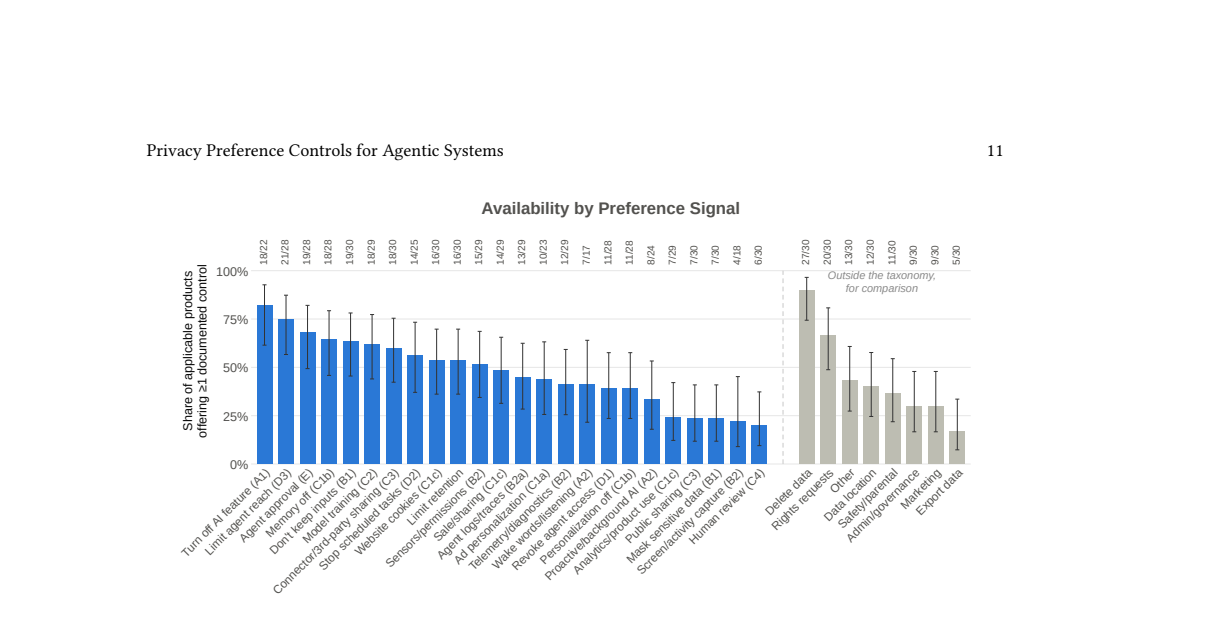
The taxonomy is the real content here, and it is well built: five categories, Presence, Collection, Secondary Use, Persistence, Autonomy, grounded in the GPC work, privacy law, contextual integrity, and an audit of 30 AI products from 22 companies. The audit is honest about method: LLM-assisted retrieval with independent human verification, Wilson confidence intervals, and clear limits on documentation access and U.S.-only viewing. The findings are concrete and useful: only 14 of 29 products offer an opt-out of sale or sharing, 7 of 29 block analytics, 6 of 30 block human review, and several temporary modes still keep chats for 24 to 72 hours. That evidence is the strongest part of the paper. The eight open-source prototypes demonstrate that a preference signal can travel with MCP and A2A messages and that tool-level blocking can preserve the user-visible result, which is a genuine feasibility result. But the enforcement gap is load-bearing and the paper itself concedes it. Prototype 4 leaves the provider's middleware log basically unchanged. Appendix D says a direct network route bypasses the dispatcher and that a receipt does not establish compliance. Scenario 4 says any dropped hop defeats the opt-out. The lessons section says cloud-hosted agents require the user to trust that the company deleted the data. So structural integration holds only for cooperating recipients on paths with no bypass route. The authors do not overclaim beyond this; the discussion explicitly names end-to-end verifiability as future work. What is missing: no quantitative evaluation of the prototypes, no user study on taxonomy usability, and no verification model for multi-hop compliance. These are flagged as future work, not hidden flaws. The citation pattern is fine, and the 72 percent coverage figure is presented as descriptive, not as validation of the taxonomy. This paper is for regulators, standards bodies, and product teams who need a concrete checklist and a demonstrated path for signal propagation. It is not a breakthrough measurement or a theorem, but it is a sound organizational contribution that deserves a serious referee, a conditional verdict, and heavy emphasis on the cooperation assumption in any revised framing.
The strongest objection
The strongest claim has two parts: a taxonomy of enforceable preferences and a demonstration that major aspects can be structurally integrated into MCP/A2A such that propagation blocks retention and secondary use. The load-bearing condition for the second part is that the preference is honored at every hop, and the paper's own text shows where that condition fails. Prototype 4 states that publishers 'that honor them' stop logging while the provider's middleware log 'is basically unchanged.' Appendix D says an unrestricted direct network route bypasses the dispatcher and that 'a receipt alone does not establish compliance.' Appendix E, scenario 4, says 'if any hop drops the signal, no downstream site can enforce the opt-out.' The Lessons paragraph makes the same point: for a cloud-hosted agent the user 'must trust that the company deleted the session data,' and enforceability varies with whether anyone can confirm that the preference was honored. These are honest limitations, but they delimit the claim: the prototypes demonstrate propagation and enforcement within trusted, cooperating code paths, not structural enforcement across independent recipients. 'Structurally integrated' is therefore accurate only for a deployment in which every recipient cooperates and no direct route exists. The taxonomy remains a coherent design foundation and the prototypes remain a feasibility demonstration, but the enforcement component of the central claim is not established end-to-end and is left to future verification work.
The reader's weakest_assumption is the same concern I would put first: recipients must honor the propagated signal. I agree with that identification. I considered three alternatives and found them weaker. (1) A missing user study is real but is a stated future-work item and does not undercut the normative and legal derivation of the taxonomy. (2) The audit could be read as circular because 72% of controls were mapped back into a taxonomy that partly came from the audit, but the categories are independently grounded in laws, GPC, contextual integrity, and prior taxonomies, and the audit added only one subcategory (human review). (3) GPC is a binary signal while the taxonomy is granular; however the prototypes use the protocol 'meta' field and Prototype 2 demonstrates separate per-purpose opt-outs, so granular expression is at least shown to be implementable. The enforcement gap is more load-bearing because 'enforceable' and 'structurally integrated' are the paper's own labels for the contribution, and the paper's own Appendices D and E and Prototype 4 document that a non-cooperating hop or a direct route defeats the mechanism. This does not make the paper wrong; it makes the correct verdict conditional, which is exactly what the reader issued. No verdict adjustment is needed.
The referee's report
If the claims hold, this is a timely organizing framework and a feasibility proof for a privacy-control plane inside agentic protocols, valuable for the ongoing standardization discussions around MCP and A2A and for regulators. The audit methodology is transparent (company and product selection from stated rankings, LLM-assisted retrieval with manual verification, Wilson confidence intervals), the prototypes are open-source and reproducible, and the paper is unusually candid about the limits of its own demonstrations: enforceability varies with context, an unrestricted direct route bypasses the dispatcher, a receipt does not establish compliance, and a dropped signal defeats downstream enforcement. The taxonomy is a coherent design foundation, and the prototypes demonstrate that preference propagation and cooperative blocking are implementable without protocol redesign.
Pith's reading of the paper (a machine's summary, not the authors')
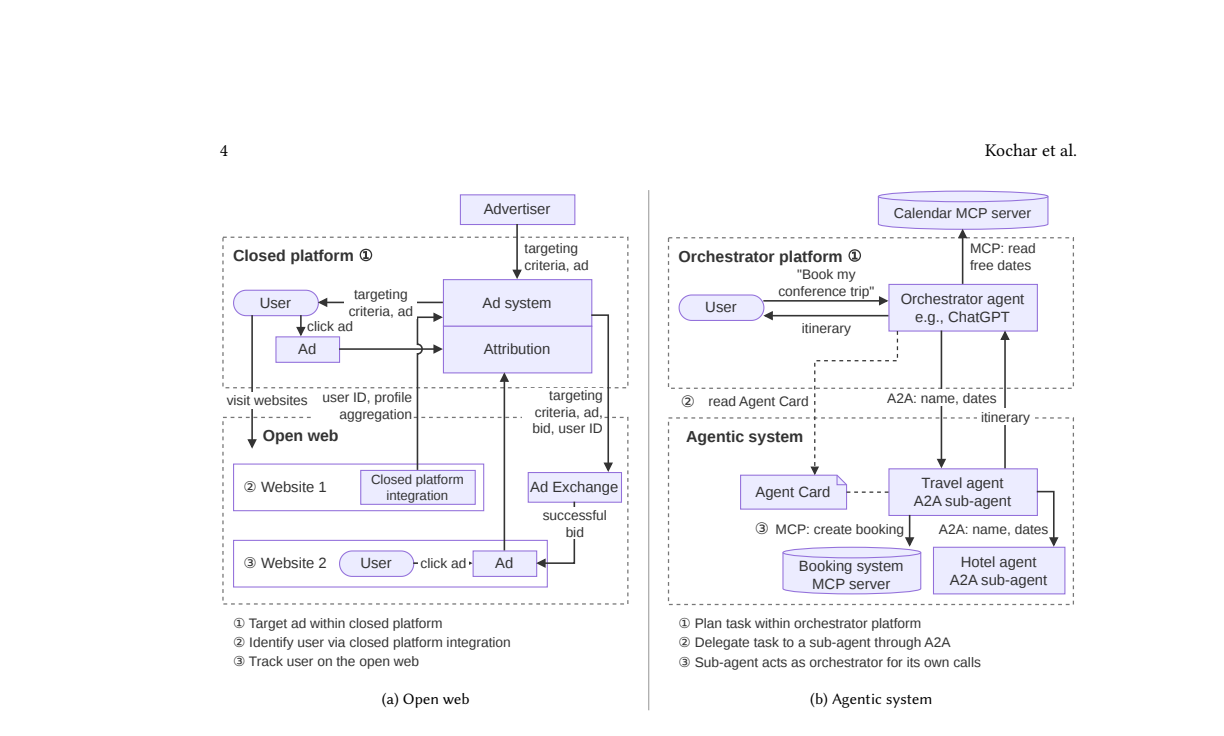
This paper claims that the shift from user-driven web browsing to AI agents acting on a user's behalf breaks the existing privacy-preference machinery: browser signals such as GPC attach a preference to every outgoing request, but an agent's data travels through delegation chains the user never sees. To fill that gap, the authors propose a five-category taxonomy of enforceable privacy preferences — Presence, Collection, Secondary Use, Persistence, and Autonomy — spanning the full lifecycle of an agent task, with data minimization as the default and the user's own task as the boundary. They then show that major parts of the taxonomy can be built into the two dominant agent protocols, MCP and A2A, by attaching a preference signal to every message and tool call; eight working prototypes demonstrate the signal blocking retention, inference, and secondary use while the user-visible answer stays identical. If correct, this means privacy preferences could become a structural property of agent protocols rather than a promise each company makes separately, an opportunity the paper argues should be seized while the agentic web is still forming.
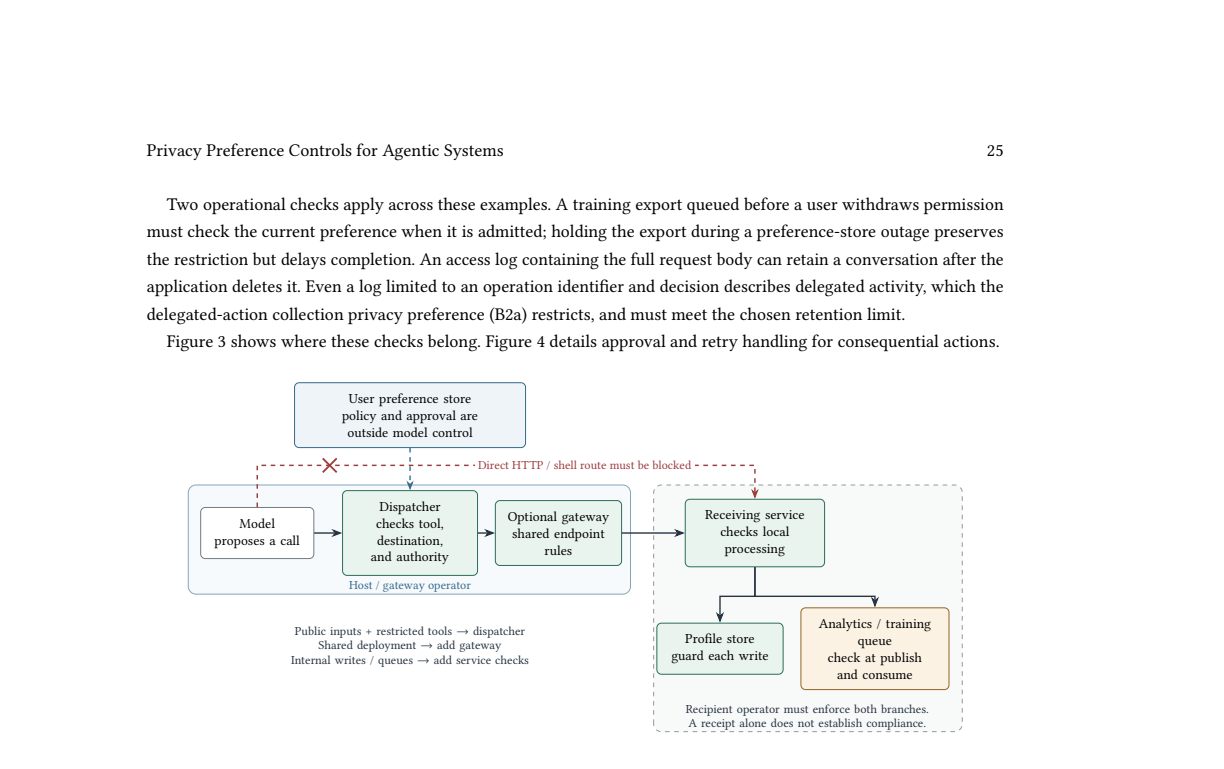
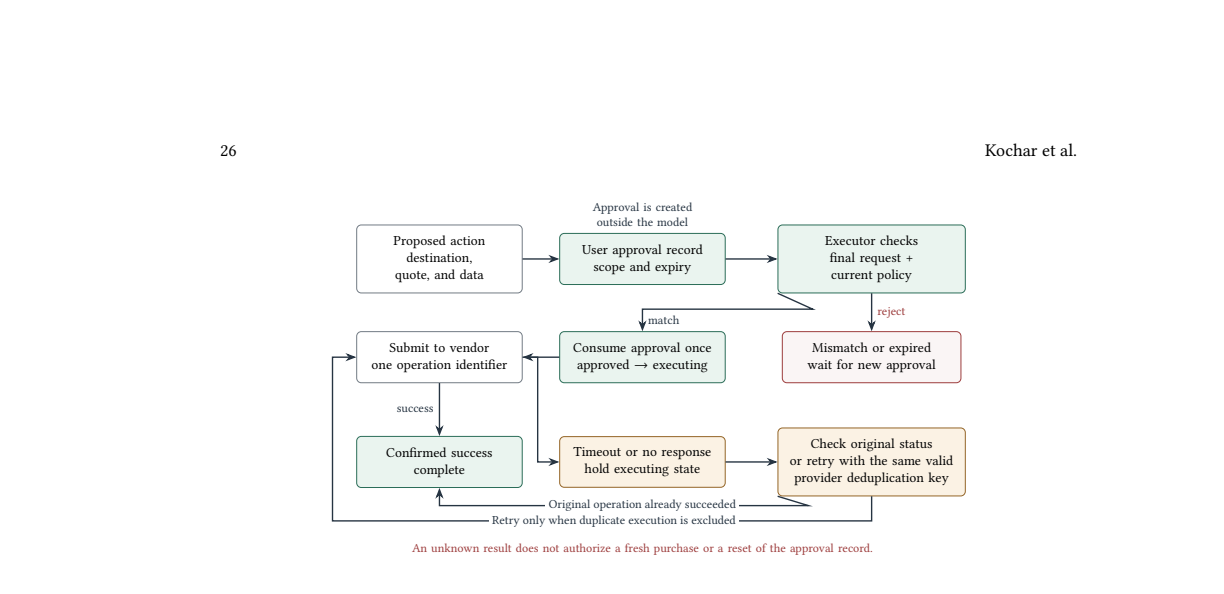
What carries the argument. The load-bearing object is the taxonomy itself — five categories (Presence, Collection, Secondary Use, Persistence, Autonomy) with thirteen subcategories, each mapped to concrete protocol behavior — together with the propagation mechanism that carries it: a GPC-style preference signal placed in the meta field of every MCP and A2A message so that each hop in a delegation chain receives the preference along with the data. MCP (Model Context Protocol) connects agents to tools and data, while A2A (Agent2Agent) connects agents to each other. Enforcement points sit at each transfer: consent checks compare tool categories against a versioned record of what the user approved, MCP servers block writes and reads that violate the preference, and recipient-side checks gate profile stores, training queues, and analytics jobs. The normative engine is data minimization scoped to the user-authorized task rather than the company-defined purpose, with contextual integrity supplying the boundary concept that decides which flows are appropriate.
Core claim. The paper's central claim is that the privacy preferences users need in agentic systems can be systematized into a five-part taxonomy: A. Presence (may an agent enter my environment, and may it run in the background), B. Collection (what inputs, metadata, and action records may be gathered), C. Secondary use (may data be used for targeting, inference, analytics, training, sharing, or human review), D. Persistence (may the agent stay, act unprompted, or expand scope after the task), and E. Autonomy (which actions may it take without asking me). Each category rests on a data-minimization default: data may be collected and retained only as needed to complete the user-specified task, and any use beyond that requires an explicit user preference. The authors argue the taxonomy is enforceable, not merely descriptive: an audit of 30 AI products found that 72% of documented privacy settings fall inside it, and eight open-source prototypes show a GPC-style preference signal traveling with each A2A message and each MCP call, with checks that block profile writes, interaction logs, inference profiles, analytics, and training feeds. Across the prototypes the user-visible result — the itinerary, the medical answer, the search results, the polished email — is identical whether or not preferences are set. The paper also reports that enforceability varies with context: a locally running agent can be inspected and verified by the user, while a cloud-hosted agent requires trust in the operator.
The premise it rests on. The whole scheme assumes that every recipient of a propagated preference signal — sub-agents, publishers, middleware, and the user's own orchestrator — chooses to honor it, since the paper itself shows a provider's middleware log unchanged when publishers stop logging and notes that an acknowledgment does not establish compliance and that a direct network route can bypass the dispatcher.
If the paper is right (Pith's inferences, not the authors')
If preference signals ride inside MCP and A2A, emerging agentic advertising and commerce protocols can inherit the same constraints rather than invent their own.
A task-bounded data-minimization default would put users into opted-out-by-default retention and secondary use, reversing today's data-maximization baseline.
The five categories would give users lifecycle-wide control, from whether an agent is installed and active, through what it collects and shares, to whether it lingers afterward and what it may do on its own.
Because the taxonomy covers 72% of the documented controls found in existing AI products, it offers a common vocabulary for comparing products and auditing compliance.
The prototypes indicate the controls can be added without degrading the user-visible result, which lowers the adoption cost relative to earlier notice-and-choice mechanisms.
The audit's gaps — only 6 of 30 products let users opt out of human review and only 7 of 29 out of analytics — suggest the taxonomy could double as a regulatory checklist; a testable extension is scoring each product against all thirteen subcategories and measuring how often documented defaults contradict the data-minimization baseline.
The paper's own prototype 4 shows a provider's middleware log essentially unchanged when publishers stop logging, which implies the propagation mechanism alone is not end-to-end; a natural next experiment is measuring how often direct network routes bypass the dispatcher in real agent frameworks and whether mandatory interceptors can close that gap.
The Autonomy category implies a default ask-first regime for consequential actions, and whether users find that burdensome — or whether approval prompts recreate the cookie-banner deluge — is a question the paper flags but does not resolve.
The eight prototypes demonstrate blocking only inside code the authors control; the stronger claim, that external recipient operators would honor the signal, could be tested by deploying a preference-carrying agent against third-party services and measuring their actual retention behavior.
Check this review
Pith stored no record of this review's passes and took no fingerprint of it. Reviews made by code from 13 Nov 2026 on carry both.
How often reviews like this one are right
Reviews like this one: written by deepseek-v4-flash, where what was read was not recorded.
How often objections from reviews like this one are right: not yet measured
Reviews by people
This review was written by a machine. No person has reviewed this paper on Pith yet. A scientist listed on Pith can review it for a fee, and their review is published here whatever it concludes.
How Pith checks papers · The full audit of this paper · Review history (2 versions)
The paper
Abstract
In response to vast and widespread online tracking, regulators and technologists alike have worked to develop laws and tools that allow people to express their privacy preferences. These measures seek to offer users greater control over the sale and sharing of personal information, putting agency in their hands to protect their privacy. However, the web is undergoing a seismic shift, away from strictly user-driven behavior towards agentic behavior, where AI agents take autonomous actions on behalf of users. In this study, we ask: What should privacy preference controls look like in the agentic web and agentic systems more generally? To answer this question, we develop a taxonomy of enforceable privacy preferences for agentic systems. Our taxonomy is informed both by laws and empirical studies of existing privacy tools as well as an audit of 30 leading AI assistants and agent platforms. To explore how our taxonomy can be implemented, we design and develop eight open-source prototypes that mirror real-world agentic applications and demonstrate how major aspects of our taxonomy can be structurally integrated in agentic protocols, such as the Model Context Protocol and Agent2Agent protocol. Ultimately, our study seeks to provide the groundwork for ensuring end-user privacy and autonomy is not lost in the newly arriving agentic world.
The paper's own sentences, arranged, kept beside the review and separate from it. Each label is drawn from a closed vocabulary; the number beside it is the probability the classifier gave that label. No sentence in this record was written by a model.
abstract compiled · 2026-10-22
The authors' main claim, as the classifier picked it out 0.88
“Ultimately, our study seeks to provide the groundwork for ensuring end-user privacy and autonomy is not lost in the newly arriving agentic world.”
How the main claim is stated: asserted 0.44
What the abstract itself states, as probabilities: claims first 0.06 · states limitation 0.09 · human participants 0.13 · controlled comparison 0.04 · randomized assignment 0.01 · states quantitative result 0.72 · compares with prior results 0.14 · mentions code or data availability 0.86
The abstract, sentence by sentence
This table labels the abstract only (arXiv listing abstract v1). The number is the probability the classifier gave the label.
| Sentence | Role | The authors' own work | States the main conclusion | Strength |
|---|---|---|---|---|
| In response to vast and widespread online tracking, regulators and technologists alike have worked to develop laws and tools that allow people to express their privacy preferences. | background 1.00 | 0.04 | 0.02 | asserted 1.00 |
| These measures seek to offer users greater control over the sale and sharing of personal information, putting agency in their hands to protect their privacy. | background 1.00 | 0.04 | 0.03 | asserted 0.94 |
| However, the web is undergoing a seismic shift, away from strictly \textit{user-driven} behavior towards \textit{agentic behavior}, where AI agents take autonomous actions on behalf of users. | background 0.66 | 0.06 | 0.03 | asserted 1.00 |
| In this study, we ask: What should privacy preference controls look like in the agentic web and agentic systems more generally? | gap 0.76 | 0.21 | 0.02 | unclear 0.97 |
| To answer this question, we develop a taxonomy of enforceable privacy preferences for agentic systems. | contribution 0.98 | 0.96 | 0.06 | asserted 1.00 |
| Our taxonomy is informed both by laws and empirical studies of existing privacy tools as well as an audit of 30 leading AI assistants and agent platforms. | method 0.93 | 0.86 | 0.03 | asserted 1.00 |
| To explore how our taxonomy can be implemented, we design and develop eight open-source prototypes that mirror real-world agentic applications and demonstrate how major aspects of our taxonomy can be structurally integrated in agentic protocols, such as the Model Control Protocol and Agent2Agent protocol. | contribution 0.65 | 0.97 | 0.06 | asserted 1.00 |
| Ultimately, our study seeks to provide the groundwork for ensuring end-user privacy and autonomy is not lost in the newly arriving agentic world. | future work 0.53 | 0.22 | 0.39 | asserted 0.44 |
What kind of paper the classifier reports this is: method or tool 0.98 · evidence from observation or experiment 0.59
What was examined, and what was not
Sources read
- arXiv listing abstract v1
Not examined
- full text
- figures and tables
- references and citing sentences
- relations to other papers
Levels run
- P abstract
Not run
- S sections
- T body sentences
- C citations
- R cross-paper relations
How the labels were made
Compiled by classifier-1.13.0 via TypeSafe API, question bank abstract-p1-20260923, 2026-10-22: 1 request, 6,287 input tokens.
Every quoted sentence on this record is the authors'. Every label is from Pith's closed vocabulary, with the probability shown beside it. This record as JSON
Figures (4)
Figures are the authors', reproduced from the paper.
Challenges and discussion
Disagree with the review, or know something it missed? Leave a comment, or challenge this review formally: a challenge becomes a permanent entry in this paper's record, and its decision is published here.
Come back by email
A short list of the week's newly reviewed papers. Nothing is sent until you confirm from your inbox, and every email has a link that stops it. No account.
No comments yet.
Sign in to comment