Artificial Intelligence · arXiv:2610.30769 v1 · submitted 22 Oct 2026 · 122 references
LLM Multi-Agent Systems Are Vulnerable to Herding and Runaway Cascades
The paper says
“Large language models (LLMs) increasingly operate in multi-agent systems where they collaborate by responding to others' choices, creating endogenous feedback loops with vulnerability to social influence, herding behavior and runaway cascades.”
more of the abstract
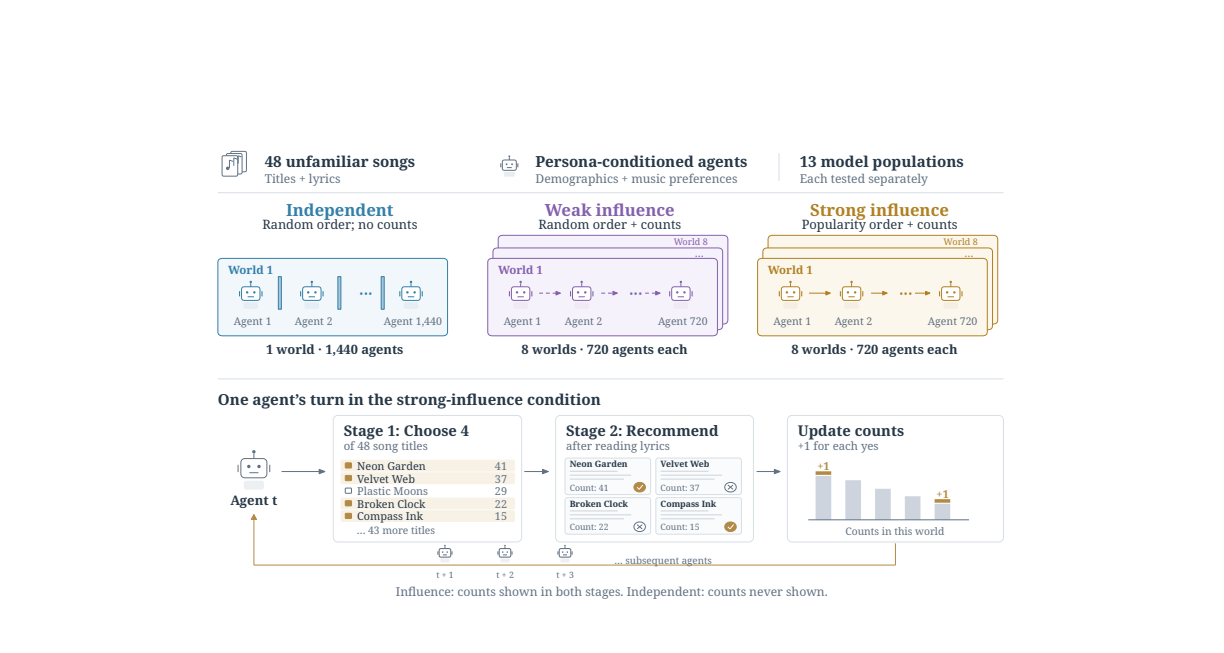
Following the design of the classic Music Lab experiment, we tested this vulnerability in large populations of LLM agents that recommended unfamiliar songs, with or without exposure to cumulative recommendation counts. Exposure led to runaway cascades that generated extreme and unpredictable collective recommendations increasingly divergent from a song's intrinsic appeal. Compared to humans, LLM populations were generally far more susceptible to herding behavior, and unlike humans, LLM cascades were less able to self-correct. This vulnerability has implications for multi-agent collaboration in recommender systems, automated evaluation, complex problem-solving, and unauthorized conspiracies.
from the abstract
Pith says
Machine review · deepseek-v4-flash · 23 Oct 2026 · what was read was not recorded · not checked by a person
It can be wrong. Challenge this review or reply to it.
Holds up, with conditions. Solid internal experiment on LLM herding, but the headline human comparison rests on an unvalidated task mismatch. This line is wrong
2 major objections · 5 minor
How often objections from reviews like this one are right: not yet measured
Not checked: figures, code, what the 122 references say.
The paper says, at Abstract, Section 3 (Results), Section 4 (Discussion), Appendix B.5
The review did not quote this passage.
A classifier read this sentence of the paper as acknowledging the concern (probability 0.94):
“These differences limit attribution of human–LLM contrasts to population type, so we treat the human results as a qualitative benchmark.”
Pith says: Objection 1 of 2 · major
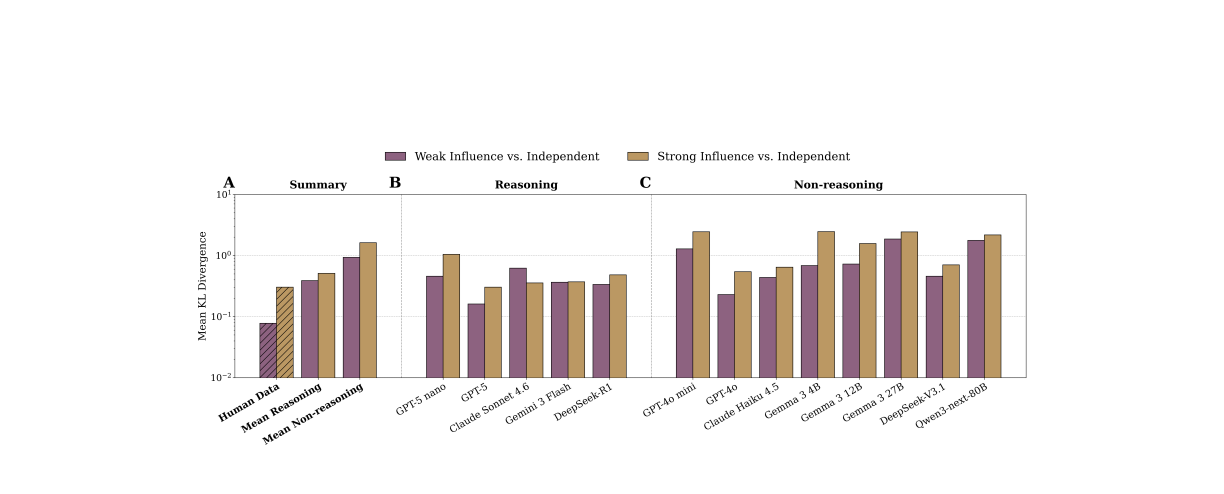
The paper's central comparative claims in the abstract and discussion—e.g., 'far more susceptible to herding behavior' and 'less able to self-correct'—are quantified with magnitudes such as 'nine times the human benchmark' (Fig. 2) and self-correction contrasts (Fig. 5). However, as the authors acknowledge in Appendix B.5 (lines S4–S5, sentences b176, b177, b426), the human benchmark differs from the LLM experiment …
more of objection 1
… in multiple ways: stimulus modality (audio vs. lyrics), response task (download vs. recommendation), selection budget (variable vs. fixed), and presentation format (grid vs. list). These differences 'limit attribution of human–LLM contrasts to population type' and the authors themselves state that 'a matched human replication … is needed to rule out these design differences.' Given this explicit limitation, presenting the comparative magnitudes and the self-correction contrast as key findings in the abstract and discussion is inconsistent with the paper's own stated caveats. I recommend that the authors either (a) substantially tone down the comparative claims throughout the manuscript, presenting the human benchmark solely as a qualitative reference and removing abstract language such as 'far more susceptible' and 'less able to self-correct,' or (b) provide a controlled human replication or a convincing argument that the design differences cannot explain the observed gaps. Without this revision, the comparative contribution is not supported by the evidence presented.
The paper says, at Section 3.3, Figure 4
The review did not quote this passage.
Pith says: Objection 2 of 2 · major
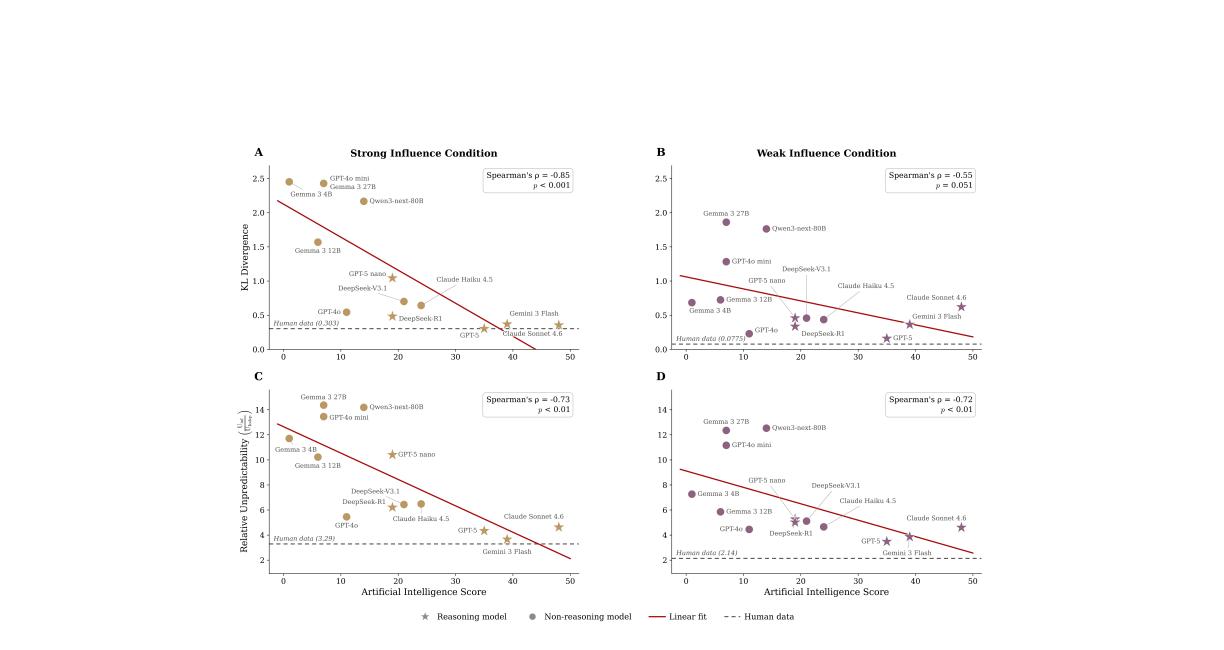
The authors report Spearman correlations between the Artificial Analysis Intelligence Index (AAII) and the outcome measures. While the analysis is descriptive (as acknowledged in Appendix C.1, line b480), the paper later treats these correlations as evidence that 'higher model intelligence is associated with lower divergence and relative unpredictability.'
more of objection 2
However, AAII scores are strongly correlated with reasoning class (mean 32.0 vs. 11.4; Table S3). Given only 13 models, the partial correlation with intelligence beyond the binary reasoning classification is not established. The authors should add a caveat that the association may be driven by the reasoning vs. non-reasoning class distinction rather than a continuous intelligence gradient, or else conduct a partial correlation or regression controlling for reasoning class. This is a load-bearing point because the claim of a continuous intelligence gradient is a key part of the narrative.
5 minor objections
The paper says, at Figure 3 caption
Pith says: minor objection 1 of 5
The caption contains a typo: 'independnet' should be 'independent.'
The paper says, at Section 3.2, sentence b125
Pith says: minor objection 2 of 5
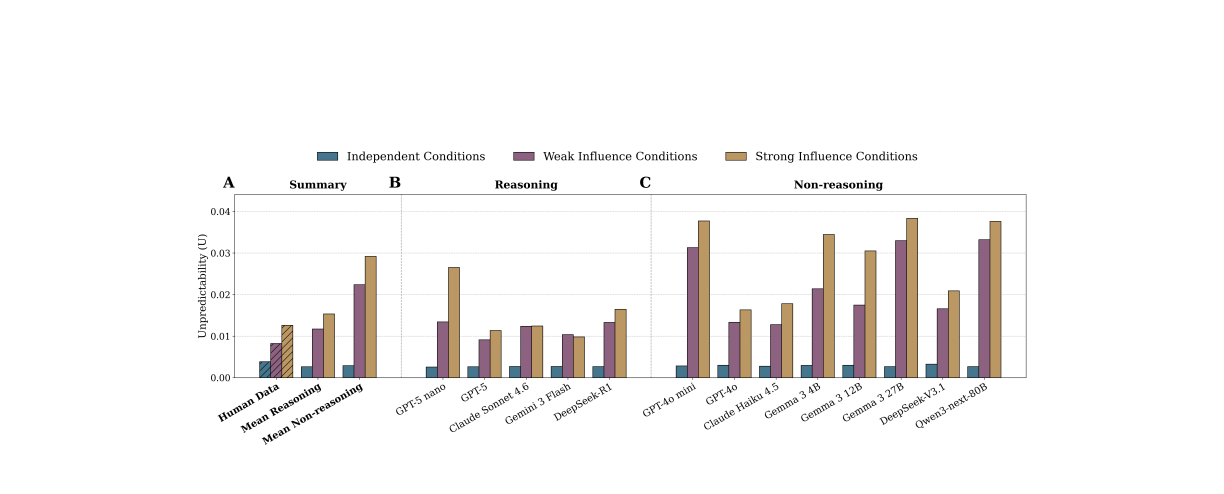
The sentence 'Social influence increased unpredictability in every model' is contradicted by earlier text (sentence b117) which states that strong influence increased unpredictability in 12 of 13 models, with Gemini 3 Flash as the lone exception. Please correct to reflect the actual data: either note that this statement refers to any influence condition (weak or strong) and clarify that for strong influence one model did not show an increase, or revise to avoid overstatement.
show 3 more
The paper says, at Table S2 caption
Pith says: minor objection 3 of 5
The caption states 'Class means are arithmetic averages of model-level coefficients.' This is clear. However, the correlation values for 'First 30 vs. later agents' under weak influence for GPT-4o mini is 0.925, which is very high. Given the small number of songs (48) and eight worlds, a confidence interval would be informative. Consider adding bootstrap confidence intervals or noting that these are not independent observations (as the appendix B.6 warns about for the Influence vs. independent correlations).
The paper says, at Appendix C.5, Position bias discussion
Pith says: minor objection 4 of 5
The authors discuss that position bias could partially explain strong-influence effects and argue that human position bias is stronger, which would understate the LLM–human gap. This is a reasonable argument, but it would benefit from a formal test or at least a more explicit statement about whether the available data allow for a definitive conclusion.
more of objection 4
The current text ('If this inference is supported … the reported human–LLM differences … are more likely to be understated than overstated') is appropriately cautious but could be tightened.
The paper says, at General
Pith says: minor objection 5 of 5
The paper would benefit from a brief section in the main text (perhaps at the end of the Introduction) that clearly states how the study addresses each of the seven research questions listed at the end of Section 1. Currently, the results sections map to the questions but the mapping is implicit. A table or explicit reference would improve readability.
What would settle it
Conduct a human experiment (N approximately 1,440 per condition, matching the LLM agent counts) using the same 48 Suno-generated songs (lyrics only), the same recommendation task (yes/no after reading lyrics), the same fixed selection budget (four songs out of 48), the same list presentation (randomized order for weak influence, popularity-ordered for strong influence), and the same 17-world design (one independent, eight weak, eight strong). Compute mean KL divergence, unpredictability, and self-correction change scores for humans and compare them with the LLM model values. If human values fall within the range of LLM values or exceed them, the claim of greater LLM susceptibility would not be supported.
from the skeptic's reading
How the review went
4 readings by deepseek-v4-flash · 23 Oct 2026
- Reader holds up, with conditions
- Skeptic agrees
- Editor wrote the verdict above
- Referee major revision: 2 major objections, 5 minor
Not run on this paper: the simulated authors' defence.
Pith did not check this review's objections against the paper.
The review in full
The review in brief, machine-written
This paper does something genuinely useful: it takes the classic Music Lab cascade design and ports it to LLM agents, with 13 models, parallel worlds, independent baselines, and decent robustness checks. The internal results are clear – LLM populations do herd, produce unpredictable outcomes, and generally fail to self-correct over the observed horizon. The reasoning vs. non-reasoning model breakdown and the correlation with a composite intelligence score are nice touches. On its own terms, the LLM-only part is well executed and worth engaging with.
The soft spot is the human benchmark, and it's a big one. The paper's strongest comparative claims – "nine times the human benchmark" under weak influence, "far more susceptible," "less able to self-correct" – come from comparing their LLM task (lyrics recommendation, fixed budget, list presentation) to the original Music Lab (audio listening, free download, grid/list). The authors acknowledge this (b176, b177, b426) and call the benchmark qualitative, but the abstract and discussion still push the quantitative contrast as a headline finding. A matched replication using the same stimuli and task for both populations is needed before these magnitude comparisons can be taken at face value. Because of this mismatch, the central claim about human-LLM differences remains conditional.
That said, the paper's internal validity for LLM populations is strong. The self-correction finding – near zero mean change in correlation with intrinsic appeal across influence worlds – is a credible result even without the human anchor. If you work on multi-agent systems, recommender systems, or AI alignment, this paper will be relevant, but you should read the appendix on design differences before citing the human comparison.
I'd recommend the editor send this to peer review. The experiment is too carefully done to desk reject, and the comparative claims can be tightened by revision – either by softening the abstract, or by committing to a matched human study. A serious referee will flag the task mismatch, but the paper itself provides enough evidence to warrant that conversation.
The strongest objection
The paper's strongest comparative claims (abstract: 'far more susceptible,' 'less able to self-correct') depend on the human benchmark from the Music Lab experiment. However, the tasks differ in multiple ways: audio versus lyrics, download versus recommendation, free sampling versus fixed selection budget, grid versus list presentation. These differences could systematically affect the strength of social influence. For example, lyrics may be harder to evaluate than audio, making LLM agents more reliant on social information; the fixed selection budget may limit exploration, amplifying cascades. The authors acknowledge this limitation (Appendix B.5, lines S4-S5, and sentences b176, b177) and treat the human benchmark as qualitative. Yet the abstract and discussion present the comparative magnitudes ('nine times,' 'four times') and the self-correction contrast as key findings. Without a controlled replication using the same stimuli, task, and interface for both populations, we cannot attribute the observed differences to population type (LLM versus human) rather than to procedural differences.
The reader's weakest assumption identifies the design differences between the human and LLM experiments as a threat to the comparative claims. The paper itself acknowledges this limitation in Appendix B.5. I agree that this is the single most load-bearing concern because the headline comparative results ('far more susceptible,' 'less able to self-correct') depend entirely on the validity of the human benchmark. All internal validity checks within the LLM experiments (divergence, unpredictability, self-correction trends) are robust and well-controlled. The conditional verdict already captures the need for a matched human replication, so no verdict change is warranted. My concrete test is precisely that replication. No other concern is as foundational: position bias is analyzed and shown to not drive results; the self-correction measure is standard; the capability correlations are acknowledged as descriptive. Thus, the reader's verdict remains appropriate.
The referee's report
If the comparative claims about human–LLM differences are correct, the paper would make a strong contribution to AI safety and multi-agent systems by identifying a systematic vulnerability to runaway social influence that exceeds what is observed in human populations. Even without the human benchmark, the within-LLM findings are valuable: they demonstrate that self-reinforcing cascades arise from endogenous feedback in sequential LLM decisions, that reasoning models are more robust than non-reasoning models, and that susceptibility decreases with model intelligence. The experimental design is rigorous (parallel worlds, independent baseline, multiple robustness checks, statistical testing) and the results are presented with appropriate quantitative measures (KL divergence, unpredictability, self-correlation diagnostics). The paper also provides reproducible method details and openly acknowledges key limitations.
Pith's reading of the paper (a machine's summary, not the authors')
The paper tests whether populations of LLM agents, when tasked with recommending unfamiliar songs, exhibit herding behavior and runaway cascades when exposed to cumulative recommendation counts. Using a parallel-world design modeled on the classic Music Lab experiment, the authors find that LLM recommendations diverge strongly from independent judgment, with mean KL divergence nine times higher than humans under weak influence and four times higher under strong influence. Unlike humans, LLM populations show no consistent self-correction over time: the correlation between popularity and intrinsic appeal does not improve in the second half of the sequence. This suggests that multi-agent LLM systems are vulnerable to information cascades that can lock in arbitrary early favorites and resist correction.
What carries the argument. The key mechanism is the social-information feedback loop: each agent's recommendation updates a cumulative count displayed to subsequent agents, and under strong influence, songs are also ordered by count. This creates a cascade where early arbitrary advantages become self-reinforcing. The parallel-world design—17 worlds per model (1 independent + 8 weak-influence + 8 strong-influence)—allows measurement of divergence (KL divergence from independent distribution) and unpredictability (variation across replicate worlds). Self-correction is measured by the change in Spearman correlation between popularity and independent ranking between the first and second halves of the recommendation sequence.
Core claim. Across 13 LLM models (5 reasoning, 8 non-reasoning) and over 168,000 agents, the paper establishes that exposure to cumulative recommendation counts creates self-reinforcing herding: songs with an early advantage become more likely to be selected and recommended, amplifying initial differences. The primary quantitative findings are: (1) mean KL divergence from independent ranking is approximately nine times the human benchmark under weak influence and four times under strong influence; (2) non-reasoning models diverge 2.4–3.2 times as far as reasoning models; (3) unpredictability across replicate worlds (the spread of outcomes under identical conditions) is far greater under influence, especially for non-reasoning models; (4) human cascades self-correct in 15 of 16 influence worlds (mean correlation increase +0.085 to +0.140), while LLM self-correction averages near zero under strong influence. The paper concludes that LLM populations are generally more susceptible to herding and less able to self-correct than humans, and that higher model intelligence (as measured by AAII scores) is associated with lower susceptibility.
The premise it rests on. The qualitative comparison between LLM and human populations rests on the assumption that procedural differences between the two experiments (lyrics vs. audio, recommendation vs. download, fixed vs. variable selection budget, list vs. grid presentation) do not systematically bias the measured differences in herding and self-correction.
If the paper is right (Pith's inferences, not the authors')
Recommender systems that rely on LLM agents to rank items may produce outcomes that are highly sensitive to initial choices and resistant to quality-based correction.
Automated evaluation systems (e.g., peer review) using LLM agents could converge on arbitrary early favorites, undermining the validity of collective assessments.
Multi-agent collaboration for complex problem-solving may suffer from runaway consensus around suboptimal solutions if agents weight peer output too heavily.
Designers of multi-agent systems should incorporate mechanisms for diversity, independent input, or delayed social information to counteract herding.
The finding that higher-intelligence models show less susceptibility suggests that model capability improvements may reduce, but not eliminate, cascade risks.
The absence of self-correction in LLMs may stem from a lack of metacognitive reflection: humans can recognize when popularity diverges from personal taste and adjust, but LLMs may simply follow the strongest signal in the prompt.
If multi-agent LLM systems are used for consensus-building in real-world decisions (e.g., policy recommendation), the cascade vulnerability documented here could lead to amplified biases that are hard to detect without independent baselines.
The study's reliance on a single text-based task (song recommendation) leaves open the possibility that other tasks (e.g., factual reasoning with correct answers) might show different cascade dynamics, since the ground truth is not subjective.
Check this review
Pith stored no record of this review's passes and took no fingerprint of it. Reviews made by code from 13 Nov 2026 on carry both.
How often reviews like this one are right
Reviews like this one: written by deepseek-v4-flash, where what was read was not recorded.
How often objections from reviews like this one are right: not yet measured
Reviews by people
This review was written by a machine. No person has reviewed this paper on Pith yet. A scientist listed on Pith can review it for a fee, and their review is published here whatever it concludes.
The paper
Abstract
Large language models (LLMs) increasingly operate in multi-agent systems where they collaborate by responding to others' choices, creating endogenous feedback loops with vulnerability to social influence, herding behavior and runaway cascades. Following the design of the classic Music Lab experiment, we tested this vulnerability in large populations of LLM agents that recommended unfamiliar songs, with or without exposure to cumulative recommendation counts. Exposure led to runaway cascades that generated extreme and unpredictable collective recommendations increasingly divergent from a song's intrinsic appeal. Compared to humans, LLM populations were generally far more susceptible to herding behavior, and unlike humans, LLM cascades were less able to self-correct. This vulnerability has implications for multi-agent collaboration in recommender systems, automated evaluation, complex problem-solving, and unauthorized conspiracies.
The paper's own sentences, arranged, kept beside the review and separate from it. Each label is drawn from a closed vocabulary; the number beside it is the probability the classifier gave that label. No sentence in this record was written by a model.
abstract compiled · 2026-10-23
The authors' main claim, as the classifier picked it out 0.54
“Compared to humans, LLM populations were generally far more susceptible to herding behavior, and unlike humans, LLM cascades were less able to self-correct.”
How the main claim is stated: asserted 1.00
What the abstract itself states, as probabilities: claims first 0.04 · states limitation 0.16 · human participants 0.18 · controlled comparison 0.90 · randomized assignment 0.05 · states quantitative result 0.06 · compares with prior results 0.85 · mentions code or data availability 0.03
The abstract, sentence by sentence
This table labels the abstract only (arXiv listing abstract v1). The number is the probability the classifier gave the label.
| Sentence | Role | The authors' own work | States the main conclusion | Strength |
|---|---|---|---|---|
| Large language models (LLMs) increasingly operate in multi-agent systems where they collaborate by responding to others' choices, creating endogenous feedback loops with vulnerability to social influence, herding behavior and runaway cascades. | background 1.00 | 0.07 | 0.31 | asserted 0.98 |
| Following the design of the classic Music Lab experiment, we tested this vulnerability in large populations of LLM agents that recommended unfamiliar songs, with or without exposure to cumulative recommendation counts. | method 0.92 | 0.95 | 0.04 | asserted 0.93 |
| Exposure led to runaway cascades that generated extreme and unpredictable collective recommendations increasingly divergent from a song's intrinsic appeal. | result 1.00 | 0.92 | 0.33 | asserted 1.00 |
| Compared to humans, LLM populations were generally far more susceptible to herding behavior, and unlike humans, LLM cascades were less able to self-correct. | result 1.00 | 0.91 | 0.47 | asserted 1.00 |
| This vulnerability has implications for multi-agent collaboration in recommender systems, automated evaluation, complex problem-solving, and unauthorized conspiracies. | interpretation 1.00 | 0.18 | 0.18 | asserted 0.90 |
What kind of paper the classifier reports this is: simulation study 0.60 · evidence from observation or experiment 0.70
What was examined, and what was not
Sources read
- arXiv listing abstract v1
Not examined
- full text
- figures and tables
- references and citing sentences
- relations to other papers
Levels run
- P abstract
Not run
- S sections
- T body sentences
- C citations
- R cross-paper relations
How the labels were made
Compiled by classifier-1.13.0 via TypeSafe API, question bank abstract-p1-20260923, 2026-10-23: 1 request, 4,301 input tokens.
Every quoted sentence on this record is the authors'. Every label is from Pith's closed vocabulary, with the probability shown beside it. This record as JSON
Figures (5)
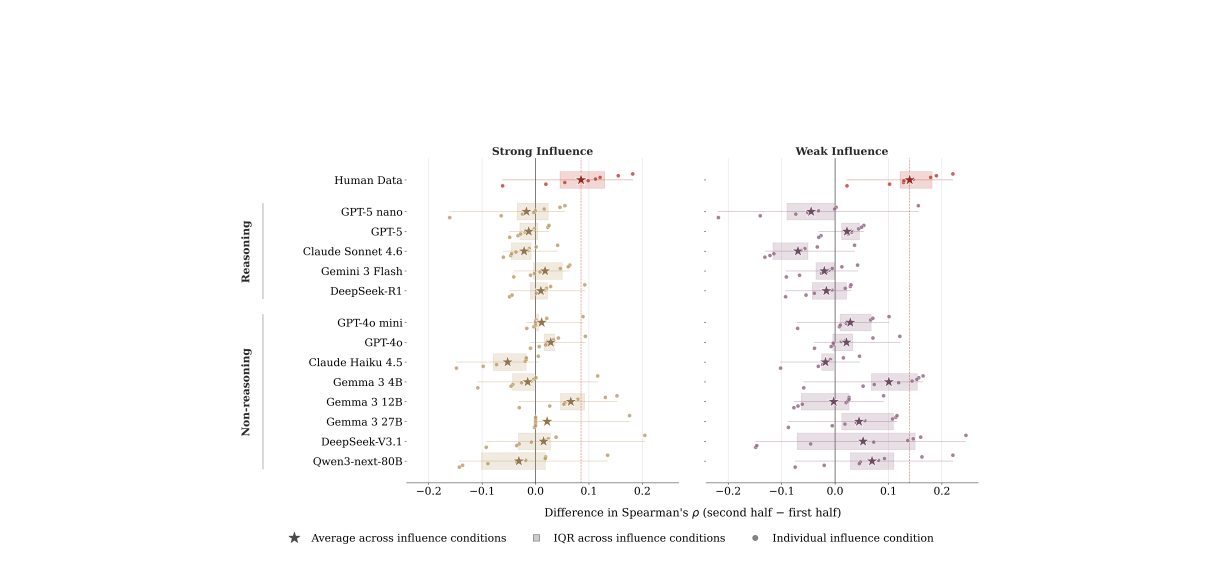
Figures are the authors', reproduced from the paper.
References (122)
- [1] Gati V. Aher, Rosa I. Arriaga, and Adam Tauman Kalai. Using large language models to simulate multiple humans and replicate human subject studies. In Proceedings of the 40th International Conference on Machine Learning, volume 202 of Proceedings of Machine Learning Research, p... on Pith
- [2] Lisa P. Argyle, Ethan C. Busby, Nancy Fulda, Joshua R. Gubler, Christopher Rytting, and David Wingate. Out of one, many: Using language models to simulate human samples. Political Analysis, 31 0 (3): 0 337--351, 2023. doi:10.1017/pan.2023.2 on Pithdoi:10.1017/pan.2023.2
- [3] Artificial Analysis . Artificial analysis intelligence index v4.1. https://artificialanalysis.ai/articles/artificial-analysis-intelligence-index-v4-1, 2026 on Pith
- [4] Ashwini Ashokkumar, Luke Hewitt, Isaias Ghezae, and Robb Willer. Large language models can predict the results of social science experiments. Nature, 656 0 (8126): 0 115--122, 2026. doi:10.1038/s41586-026-10742-x on Pithdoi:10.1038/s41586-026-10742-x
- [6] Abhijit V Banerjee. A simple model of herd behavior. The quarterly journal of economics, 107 0 (3): 0 797--817, 1992 on Pith
- [8] Sushil Bikhchandani, David Hirshleifer, and Ivo Welch. A theory of fads, fashion, custom, and cultural change as informational cascades. Journal of Political Economy, 100 0 (5): 0 992--1026, 1992. doi:10.1086/261849 on Pithdoi:10.1086/261849
- [9] James Bisbee, Joshua D. Clinton, Cassy Dorff, Brenton Kenkel, and Jennifer M. Larson. Synthetic replacements for human survey data? The perils of large language models. Political Analysis, 32 0 (4): 0 401--416, 2024. doi:10.1017/pan.2024.5 on Pithdoi:10.1017/pan.2024.5
- [10] Levin Brinkmann, Fabian Baumann, Jean-Fran c ois Bonnefon, Maxime Derex, Thomas F. M \"u ller, Anne-Marie Nussberger, Agnieszka Czaplicka, Alberto Acerbi, Thomas L. Griffiths, Joseph Henrich, Joel Z. Leibo, Richard McElreath, Pierre-Yves Oudeyer, Jonathan Stray, and Iyad Rahwa... on Pithdoi:10.1038/s41562-023-01742-2
- [11] Allison J. B. Chaney, Brandon M. Stewart, and Barbara E. Engelhardt. How algorithmic confounding in recommendation systems increases homogeneity and decreases utility. In Proceedings of the 12th ACM Conference on Recommender Systems, pages 224--232, 2018. doi:10.1145/3240323.3240370 on Pithdoi:10.1145/3240323.3240370
- [14] Yun-Shiuan Chuang, Agam Goyal, Nikunj Harlalka, Siddharth Suresh, Robert Hawkins, Sijia Yang, Dhavan Shah, Junjie Hu, and Timothy T. Rogers. Simulating opinion dynamics with networks of LLM -based agents. In Findings of the Association for Computational Linguistics: NAACL 2024... on Pithdoi:10.18653/v1/2024.findings-naacl.211
- [15] Paul Covington, Jay Adams, and Emre Sargin. Deep neural networks for YouTube recommendations. In Proceedings of the 10th ACM Conference on Recommender Systems, pages 191--198, New York, NY, USA, 2016. Association for Computing Machinery. doi:10.1145/2959100.2959190 on Pithdoi:10.1145/2959100.2959190
- [16] Nick Craswell, Onno Zoeter, Michael Taylor, and Bill Ramsey. An experimental comparison of click position-bias models. In Proceedings of the 2008 International Conference on Web Search and Data Mining, pages 87--94. ACM, 2008. doi:10.1145/1341531.1341545 on Pithdoi:10.1145/1341531.1341545
- [18] Yilun Du, Shuang Li, Antonio Torralba, Joshua B. Tenenbaum, and Igor Mordatch. Improving factuality and reasoning in language models through multiagent debate. In Proceedings of the 41st International Conference on Machine Learning, ICML'24. JMLR.org, 2024 on Pith
- [19] Aaron Fanous, Jacob Goldberg, Ank Agarwal, Joanna Lin, Anson Zhou, Sonnet Xu, Vasiliki Bikia, Roxana Daneshjou, and Sanmi Koyejo. Syceval: Evaluating llm sycophancy. In Proceedings of the AAAI/ACM Conference on AI, Ethics, and Society, volume 8, pages 893--900, 2025 on Pith
- [20] Giorgos Filandrianos, Angeliki Dimitriou, Maria Lymperaiou, Konstantinos Thomas, and Giorgos Stamou. Bias beware: The impact of cognitive biases on llm-driven product recommendations. In Proceedings of the 2025 Conference on Empirical Methods in Natural Language Processing, pa... on Pith
- [21] Daniel Fleder and Kartik Hosanagar. Blockbuster culture's next rise or fall: The impact of recommender systems on sales diversity. Management Science, 55 0 (5): 0 697--712, 2009. doi:10.1287/mnsc.1080.0974 on Pithdoi:10.1287/mnsc.1080.0974
- [22] Ariel Flint Ashery , Luca Maria Aiello, and Andrea Baronchelli. Emergent social conventions and collective bias in LLM populations. Science Advances, 11 0 (20): 0 eadu9368, 2025. doi:10.1126/sciadv.adu9368 on Pithdoi:10.1126/sciadv.adu9368
- [23] Leon Fr \"o hling, Gianluca Demartini, and Dennis Assenmacher. Personas with attitudes: Controlling LLM s for diverse data annotation. In Agostina Calabrese, Christine de Kock, Debora Nozza, Flor Miriam Plaza-del Arco, Zeerak Talat, and Francielle Vargas, editors, Proceedings ... on Pith
- [25] Moshe Glickman and Tali Sharot. How human-- AI feedback loops alter human perceptual, emotional and social judgements. Nature Human Behaviour, 9 0 (2): 0 345--359, 2025. doi:10.1038/s41562-024-02077-2 on Pithdoi:10.1038/s41562-024-02077-2
- [26] Igor Grossmann, Matthew Feinberg, Dawn C. Parker, Nicholas A. Christakis, Philip E. Tetlock, and William A. Cunningham. AI and the transformation of social science research. Science, 380 0 (6650): 0 1108--1109, 2023. doi:10.1126/science.adi1778 on Pithdoi:10.1126/science.adi1778
show 80 more
- [27] C. Han, J. Tan, B. Yu, W. Zheng, and X. Tang. Conformity dynamics in LLM multi-agent systems: The roles of topology and self-social weighting. arXiv:2601.05606, 2026. URL https://arxiv.org/abs/2601.05606 on PitharXiv
- [28] Farnoosh Hashemi and Michael Macy. Collective social behaviors in llms: an analysis of llms social networks. In Large Language Models for Scientific and Societal Advances, 2025 on Pith
- [30] Yupeng Hou, Junjie Zhang, Zihan Lin, Hongyu Lu, Ruobing Xie, Julian McAuley, and Wayne Xin Zhao. Large language models are zero-shot rankers for recommender systems. In European conference on information retrieval, pages 364--381. Springer, 2024 on Pith
- [32] Adit Jain and Vikram Krishnamurthy. Interacting large language model agents. bayesian social learning based interpretable models. IEEE Access, 13: 0 25465--25504, 2025. doi:10.1109/ACCESS.2025.3538599 on Pithdoi:10.1109/access.2025.3538599
- [33] Thorsten Joachims, Laura Granka, Bing Pan, Helene Hembrooke, and Geri Gay. Accurately interpreting clickthrough data as implicit feedback. In Proceedings of the 28th Annual International ACM SIGIR Conference on Research and Development in Information Retrieval, pages 154--161.... on Pithdoi:10.1145/1076034.1076063
- [34] Patrick Lewis, Ethan Perez, Aleksandra Piktus, Fabio Petroni, Vladimir Karpukhin, Naman Goyal, Heinrich K \"u ttler, Mike Lewis, Wen-tau Yih, Tim Rockt \"a schel, Sebastian Riedel, and Douwe Kiela. Retrieval-augmented generation for knowledge-intensive NLP tasks. In Advances i... on Pith
- [35] Hsien-Tsung Lin, Pei-Cing Huang, Chan-Tung Ku, Chan Hsu, Pei-Xuan Shieh, and Yihuang Kang. Towards simulating social influence dynamics with llm-based multi-agents. In 2025 IEEE International Conference on Information Reuse and Integration and Data Science (IRI), pages 307--31... on Pith
- [36] Nelson F. Liu, Kevin Lin, John Hewitt, Ashwin Paranjape, Michele Bevilacqua, Fabio Petroni, and Percy Liang. Lost in the middle: How language models use long contexts. Transactions of the Association for Computational Linguistics, 12: 0 157--173, 2024. doi:10.1162/tacl_a_00638 on Pithdoi:10.1162/tacl_a_00638
- [37] Jan Lorenz, Heiko Rauhut, Frank Schweitzer, and Dirk Helbing. How social influence can undermine the wisdom of crowd effect. Proceedings of the National Academy of Sciences, 108 0 (22): 0 9020--9025, 2011. doi:10.1073/pnas.1008636108 on Pithdoi:10.1073/pnas.1008636108
- [38] Michael Macy, Sebastian Deri, Alexander Ruch, and Natalie Tong. Opinion cascades and the unpredictability of partisan polarization. Science Advances, 5 0 (8): 0 eaax0754, 2019. doi:10.1126/sciadv.aax0754 on Pithdoi:10.1126/sciadv.aax0754
- [40] Robert K. Merton. The Matthew effect in science. Science, 159 0 (3810): 0 56--63, 1968. doi:10.1126/science.159.3810.56 on Pithdoi:10.1126/science.159.3810.56
- [41] Lev Muchnik, Sinan Aral, and Sean J. Taylor. Social influence bias: A randomized experiment. Science, 341 0 (6146): 0 647--651, 2013. doi:10.1126/science.1240466 on Pithdoi:10.1126/science.1240466
- [44] Ethan Perez, Sam Ringer, Kamile Lukosiute, Karina Nguyen, Edwin Chen, Scott Heiner, Craig Pettit, Catherine Olsson, Sandipan Kundu, Saurav Kadavath, Andy Jones, Anna Chen, Benjamin Mann, Brian Israel, Bryan Seethor, Cameron McKinnon, Christopher Olah, Da Yan, Daniela Amodei, D... on Pith
- [45] Pouya Pezeshkpour and Estevam Hruschka. Large language models sensitivity to the order of options in multiple-choice questions. In Findings of the Association for Computational Linguistics: NAACL 2024, pages 2006--2017. Association for Computational Linguistics, 2024. doi:10.1... on Pithdoi:10.18653/v1/2024.findings-naacl.130
- [47] Iyad Rahwan, Manuel Cebrian, Nick Obradovich, Josh Bongard, Jean-Fran c ois Bonnefon, Cynthia Breazeal, Jacob W Crandall, Nicholas A Christakis, Iain D Couzin, Matthew O Jackson, et al. Machine behaviour. Nature, 568 0 (7753): 0 477--486, 2019 on Pith
- [48] Matthew J Salganik and Duncan J Watts. Leading the herd astray: An experimental study of self-fulfilling prophecies in an artificial cultural market. Social psychology quarterly, 71 0 (4): 0 338--355, 2008 on Pith
- [49] Matthew J. Salganik, Peter Sheridan Dodds, and Duncan J. Watts. Experimental study of inequality and unpredictability in an artificial cultural market. Science, 311 0 (5762): 0 854--856, 2006. doi:10.1126/science.1121066 on Pithdoi:10.1126/science.1121066
- [50] Shibani Santurkar, Esin Durmus, Faisal Ladhak, Cinoo Lee, Percy Liang, and Tatsunori Hashimoto. Whose opinions do language models reflect? In Proceedings of the 40th International Conference on Machine Learning, volume 202 of Proceedings of Machine Learning Research, pages 299... on Pith
- [51] Mrinank Sharma, Meg Tong, Tomasz Korbak, David Duvenaud, Amanda Askell, Samuel R. Bowman, Newton Cheng, Esin Durmus, Zac Hatfield-Dodds, Scott R. Johnston, Shauna Kravec, Timothy Maxwell, Sam McCandlish, Kamal Ndousse, Oliver Rausch, Nicholas Schiefer, Da Yan, Miranda Zhang, a... on Pith
- [52] Shota Shiiku, Raja Marjieh, Thomas L. Griffiths, Manuel Anglada-Tort, and Nori Jacoby. Hybrid human-- AI societies balance creativity and diversity. PsyArXiv preprint, 2026. URL https://osf.io/preprints/psyarxiv/wzh2x_v1 on Pith
- [53] Liron Soffer, Ravid Shwartz-Ziv, and Chen Shani. LLMs trust their own: Identity-dependent conformity in multi-agent systems. arXiv:2609.33495, 2026. URL https://arxiv.org/abs/2609.33495 on PithPith's reviewarXiv
- [54] Maojia Song, Tej Deep Pala, Ruiwen Zhou, Weisheng Jin, Amir Zadeh, Chuan Li, Dorien Herremans, and Soujanya Poria. Measuring and mitigating rapport bias of large language models under multi-agent social interactions. In International Conference on Learning Representations, vol... on Pith
- [55] Team Suno . Introducing v4.5. https://suno.com/blog/introducing-v4-5, 2025 on Pith
- [56] Arnout Van de Rijt. Self-correcting dynamics in social influence processes. In Handbook of Sociological Science, pages 446--473. Edward Elgar Publishing, 2022 on Pith
- [57] Arnout van de Rijt, Soong Moon Kang, Michael Restivo, and Akshay Patil. Field experiments of success-breeds-success dynamics. Proceedings of the National Academy of Sciences, 111 0 (19): 0 6934--6939, 2014. doi:10.1073/pnas.1316836111 on Pithdoi:10.1073/pnas.1316836111
- [58] Benno Weck, Ilaria Manco, Emmanouil Benetos, Elio Quinton, György Fazekas, and Dmitry Bogdanov. Muchomusic: Evaluating music understanding in multimodal audio-language models. In Proceedings of the 25th International Society for Music Information Retrieval Conference (ISMIR), 2024 on Pith
- [59] Zhiyuan Weng, Guikun Chen, and Wenguan Wang. Do as we do, not as you think: The conformity of large language models. In International Conference on Learning Representations, 2025 on Pith
- [61] Andrea Wynn, Harsh Satija, and Gillian Hadfield. Talk isn't always cheap: Understanding failure modes in multi-agent debate. arXiv:2509.05396, 2025. URL https://arxiv.org/abs/2509.05396 on PitharXiv
- [62] Jiayi Ye, Yanbo Wang, Yue Huang, Dongping Chen, Qihui Zhang, Nuno Moniz, Tian Gao, Werner Geyer, Chao Huang, Pin-Yu Chen, et al. Justice or prejudice? quantifying biases in llm-as-a-judge. In International Conference on Learning Representations, volume 2025, pages 102351--102390, 2025 on Pith
- [64] Chujie Zheng, Hao Zhou, Fandong Meng, Jie Zhou, and Minlie Huang. Large language models are not robust multiple choice selectors. In The Twelfth International Conference on Learning Representations, 2024. URL https://openreview.net/forum?id=shr9PXz7T0 on Pith
- [65] Lianmin Zheng, Wei-Lin Chiang, Ying Sheng, Siyuan Zhuang, Zhanghao Wu, Yonghao Zhuang, Zi Lin, Zhuohan Li, Dacheng Li, Eric P. Xing, Hao Zhang, Joseph E. Gonzalez, and Ion Stoica. Judging LLM -as-a-judge with MT-Bench and Chatbot Arena . In Advances in Neural Information Proce... on Pith
- [67] Xiaochen Zhu, Caiqi Zhang, Tom Stafford, Nigel Collier, and Andreas Vlachos. Conformity in large language models. In Proceedings of the 63rd Annual Meeting of the Association for Computational Linguistics (Volume 1: Long Papers), pages 3854--3872, 2025 on Pith
- [68] Machine behaviour , author=. Nature , volume=. 2019 , publisher= on Pith
- [69] Grossmann, Igor and Feinberg, Matthew and Parker, Dawn C. and Christakis, Nicholas A. and Tetlock, Philip E. and Cunningham, William A. , title =. Science , volume =. 2023 , doi = on Pith
- [70] Zheng, Lianmin and Chiang, Wei-Lin and Sheng, Ying and Zhuang, Siyuan and Wu, Zhanghao and Zhuang, Yonghao and Lin, Zi and Li, Zhuohan and Li, Dacheng and Xing, Eric P. and Zhang, Hao and Gonzalez, Joseph E. and Stoica, Ion , title =. Advances in Neural Information Processing ... on Pith
- [71] Park, Joon Sung and O'Brien, Joseph and Cai, Carrie Jun and Morris, Meredith Ringel and Liang, Percy and Bernstein, Michael S. , title =. 2023 , isbn =. doi:10.1145/3586183.3606763 , booktitle = on Pithdoi:10.1145/3586183.3606763
- [72] Brinkmann, Levin and Baumann, Fabian and Bonnefon, Jean-Fran. Machine culture , journal =. 2023 , doi = on Pith
- [73] A simple model of herd behavior , author=. The quarterly journal of economics , volume=. 1992 , publisher= on Pith
- [74] Bikhchandani, Sushil and Hirshleifer, David and Welch, Ivo , title =. Journal of Political Economy , volume =. 1992 , doi = on Pith
- [75] Merton, Robert K. , title =. Science , volume =. 1968 , doi = on Pith
- [76] Salganik, Matthew J. and Dodds, Peter Sheridan and Watts, Duncan J. , title =. Science , volume =. 2006 , doi = on Pith
- [77] Leading the herd astray: An experimental study of self-fulfilling prophecies in an artificial cultural market , author=. Social psychology quarterly , volume=. 2008 , publisher= on Pith
- [78] Lorenz, Jan and Rauhut, Heiko and Schweitzer, Frank and Helbing, Dirk , title =. Proceedings of the National Academy of Sciences , volume =. 2011 , doi = on Pith
- [79] Muchnik, Lev and Aral, Sinan and Taylor, Sean J. , title =. Science , volume =. 2013 , doi = on Pith
- [80] van de Rijt, Arnout and Kang, Soong Moon and Restivo, Michael and Patil, Akshay , title =. Proceedings of the National Academy of Sciences , volume =. 2014 , doi = on Pith
- [81] Macy, Michael and Deri, Sebastian and Ruch, Alexander and Tong, Natalie , title =. Science Advances , volume =. 2019 , doi = on Pith
- [82] Fleder, Daniel and Hosanagar, Kartik , title =. Management Science , volume =. 2009 , doi = on Pith
- [83] Chaney, Allison J. B. and Stewart, Brandon M. and Engelhardt, Barbara E. , title =. Proceedings of the 12th ACM Conference on Recommender Systems , pages =. 2018 , doi = on Pith
- [84] Mansoury, Masoud and Abdollahpouri, Himan and Pechenizkiy, Mykola and Mobasher, Bamshad and Burke, Robin , title =. 2020 , isbn =. doi:10.1145/3340531.3412152 , booktitle = on Pithdoi:10.1145/3340531.3412152
- [85] Glickman, Moshe and Sharot, Tali , title =. Nature Human Behaviour , volume =. 2025 , doi = on Pith
- [86] Argyle, Lisa P. and Busby, Ethan C. and Fulda, Nancy and Gubler, Joshua R. and Rytting, Christopher and Wingate, David , title =. Political Analysis , volume =. 2023 , doi = on Pith
- [87] Aher, Gati V. and Arriaga, Rosa I. and Kalai, Adam Tauman , title =. Proceedings of the 40th International Conference on Machine Learning , series = on Pith
- [88] Santurkar, Shibani and Durmus, Esin and Ladhak, Faisal and Lee, Cinoo and Liang, Percy and Hashimoto, Tatsunori , title =. Proceedings of the 40th International Conference on Machine Learning , series = on Pith
- [89] Bisbee, James and Clinton, Joshua D. and Dorff, Cassy and Kenkel, Brenton and Larson, Jennifer M. , title =. Political Analysis , volume =. 2024 , doi = on Pith
- [90] Ziems, Caleb and Held, William and Shaikh, Omar and Chen, Jiaao and Zhang, Zhehao and Yang, Diyi , title =. Computational Linguistics , volume =. 2024 , doi = on Pith
- [91] Chuang, Yun-Shiuan and Goyal, Agam and Harlalka, Nikunj and Suresh, Siddharth and Hawkins, Robert and Yang, Sijia and Shah, Dhavan and Hu, Junjie and Rogers, Timothy T. , title =. Findings of the Association for Computational Linguistics: NAACL 2024 , pages =. 2024 , doi = on Pith
- [92] Sharma, Mrinank and Tong, Meg and Korbak, Tomasz and Duvenaud, David and Askell, Amanda and Bowman, Samuel R. and Cheng, Newton and Durmus, Esin and Hatfield-Dodds, Zac and Johnston, Scott R. and Kravec, Shauna and Maxwell, Timothy and McCandlish, Sam and Ndousse, Kamal and Ra... on Pith
- [93] Weng, Zhiyuan and Chen, Guikun and Wang, Wenguan , title =. International Conference on Learning Representations , year = on Pith
- [94] Han, C. and Tan, J. and Yu, B. and Zheng, W. and Tang, X. , title =. 2026 , howpublished = on Pith
- [95] Emergent social conventions and collective bias in. Science Advances , volume =. 2025 , doi = on Pith
- [96] Fr. Personas with Attitudes: Controlling LLM s for Diverse Data Annotation. Proceedings of the 9th Workshop on Online Abuse and Harms ( WOAH ). 2025 on Pith
- [97] Ashokkumar, Ashwini and Hewitt, Luke and Ghezae, Isaias and Willer, Robb , title =. Nature , volume =. 2026 , doi = on Pith
- [98] Large language models are zero-shot rankers for recommender systems , author=. European conference on information retrieval , pages=. 2024 , organization= on Pith
- [99] Liu, Nelson F. and Lin, Kevin and Hewitt, John and Paranjape, Ashwin and Bevilacqua, Michele and Petroni, Fabio and Liang, Percy , title =. Transactions of the Association for Computational Linguistics , volume =. 2024 , doi = on Pith
- [100] Lewis, Patrick and Perez, Ethan and Piktus, Aleksandra and Petroni, Fabio and Karpukhin, Vladimir and Goyal, Naman and K. Retrieval-Augmented Generation for Knowledge-Intensive. Advances in Neural Information Processing Systems , volume =. 2020 , publisher = on Pith
- [101] Covington, Paul and Adams, Jay and Sargin, Emre , title =. Proceedings of the 10th ACM Conference on Recommender Systems , pages =. 2016 , publisher = on Pith
- [102] Self-correcting dynamics in social influence processes , author=. Handbook of Sociological Science , pages=. 2022 , publisher= on Pith
- [103] Chujie Zheng and Hao Zhou and Fandong Meng and Jie Zhou and Minlie Huang , title =. The Twelfth International Conference on Learning Representations , year = on Pith
- [104] Pouya Pezeshkpour and Estevam Hruschka , title =. Findings of the Association for Computational Linguistics: NAACL 2024 , pages =. 2024 , publisher = on Pith
- [105] Thorsten Joachims and Laura Granka and Bing Pan and Helene Hembrooke and Geri Gay , title =. Proceedings of the 28th Annual International ACM SIGIR Conference on Research and Development in Information Retrieval , pages =. 2005 , publisher = on Pith
- [106] Nick Craswell and Onno Zoeter and Michael Taylor and Bill Ramsey , title =. Proceedings of the 2008 International Conference on Web Search and Data Mining , pages =. 2008 , publisher = on Pith
- [107] Yiwei Wang and Yujun Cai and Muhao Chen and Yuxuan Liang and Bryan Hooi , title =. Proceedings of the 2023 Conference on Empirical Methods in Natural Language Processing , pages =. 2023 , publisher = on Pith
- [108] Artificial Analysis Intelligence Index v4.1 , year = on Pith
- [109] Introducing v4.5 , year = on Pith
- [110] MuChoMusic: Evaluating Music Understanding in Multimodal Audio-Language Models , author=. Proceedings of the 25th International Society for Music Information Retrieval Conference (ISMIR) , year= on Pith
- [111] Baltaji, Razan and Hemmatian, Babak and Varshney, Lav. Conformity, Confabulation, and Impersonation: Persona Inconstancy in Multi-Agent LLM Collaboration. Proceedings of the 2nd Workshop on Cross-Cultural Considerations in NLP. 2024. doi:10.18653/v1/2024.c3nlp-1.2 on Pithdoi:10.18653/v1/2024.c3nlp-1.2
- [112] Conformity and social impact on ai agents , author=. arXiv preprint arXiv:2601.05384 , year= on PithPith's reviewarXiv
- [113] Herd behavior: Investigating peer influence in llm-based multi-agent systems , author=. arXiv preprint arXiv:2505.21588 , year= on PithPith's reviewarXiv
- [114] Choi, Min and Kim, Keonwoo and Chae, Sungwon and Baek, Sangyeop. An Empirical Study of Group Conformity in Multi-Agent Systems. Findings of the A ssociation for C omputational L inguistics: ACL 2025. 2025. doi:10.18653/v1/2025.findings-acl.265 on Pithdoi:10.18653/v1/2025.findings-acl.265
- [115] Conformity Generates Collective Misalignment in AI Agents Societies , author=. arXiv preprint arXiv:2605.10721 , year= on PithPith's reviewarXiv
The first 100 of 122 references are listed here. All of them are in this paper's citation record.
Challenges and discussion
Disagree with the review, or know something it missed? Leave a comment, or challenge this review formally: a challenge becomes a permanent entry in this paper's record, and its decision is published here.
Come back by email
A short list of the week's newly reviewed papers. Nothing is sent until you confirm from your inbox, and every email has a link that stops it. No account.
No comments yet.
Sign in to comment