Machine Learning · arXiv:2610.30792 v2 · submitted 22 Oct 2026
Trace2World: Reconstructing App Worlds from Real Interaction Traces for Scalable GUI Agent Training
The paper says
“Scaling GUI reinforcement learning requires environments that preserve real-app behavior. Yet coupling behavior inference with coding can turn partial traces into runnable mocks with incorrect state transitions. We introduce \textbfTrace2World, which separates global behavior reconstruction from implementation.”
more of the abstract
It reconciles traces into a shared, source-linked app model, then compiles an executable environment. Independent replay of source workflows localizes mismatches for bounded implementation repair. Validated worlds then support learner-adaptive task and environment augmentation within source-supported behavior. From 1,570 traces, Trace2World constructs 50 environments. On 200 workflows across ten apps, 91.1% are reproduced end to end, versus 59.8% for the strongest matched task-local baseline. Source-grounded validation retains 94.0% of simulated training gains on real devices, versus 54.7% under self-validation. Learner guidance raises benchmark success from 56.9% to 61.1%. Training in Trace2World further improves the model by 20.2 points on our benchmark, 5.4–16.2 points across four external GUI benchmarks, and 16.3 points on 100 real-device tasks. Reliable reconstruction separates what behavior source evidence supports from whether the implementation preserves it.
from the abstract
Pith says
Machine review · deepseek-v4-flash · 23 Oct 2026 · of version 1 of the paper; version 2 is newer · what was read was not recorded · not checked by a person
It can be wrong. Challenge this review or reply to it.
Holds up. Trace2World separates semantic reconstruction from implementation for GUI simulation, with strong quantitative evidence across fidelity, transfer, and policy improvement. This line is wrong
2 major objections · 5 minor
How often objections from reviews like this one are right: not yet measured
Not checked: figures, code, what the references say.
The paper says, at Appendix E.1.2 (PhoneWorld-style and GUI-GENESIS-style reimplementations)
The review did not quote this passage.
A classifier read this sentence of the paper as acknowledging the concern (probability 0.77):
“At our September 2026 artifact check, the linked public PhoneWorld repository provides app source, tasks, and an evaluation runner, but not the construction agent’s orchestration, prompts, and repair workflow.”
Pith says: Objection 1 of 2 · major
The paper compares Trace2World against 'PhoneWorld-style' and 'GUI-GENESIS-style' baselines that are reimplementations of the described construction routes, not the original code. As the paper notes, the original PhoneWorld construction pipeline is not publicly available. While the authors take care to match model capability and rules per route (Appendix D.2), any reimplementation may omit details or introduce discrepancies.
more of objection 1
Since the headline 31.3 pp workflow-fidelity gap against GUI-GENESIS-style partly rests on these reimplementations, it would strengthen the paper to provide a more detailed justification of the fidelity of the reimplementations, or to present sensitivity analyses (e.g., varying model capability, retry budgets) that bound the possible error.
The paper says, at §4.1, Table 1; Appendix E.1.4
The review did not quote this passage.
A classifier read this sentence of the paper as acknowledging the concern (probability 0.65):
“We treat this as an amplifier rather than an explanation of Trace2World’s advantage: cross-trace ambiguity is a property of partial evidence rather than of the constructor, and a builder-written verifier remains self-referential however strong that constructor becomes.”
Pith says: Objection 2 of 2 · major
The primary fidelity metric (91.1%) is determined by an automated LLM-based reviewer (GPT-5.6 Sol). The paper acknowledges this limitation and provides a human audit (90.2% agreement, conservative bias). However, the human audit uses only two annotators (87.8% raw agreement) and a single adjudicator, and it does not cover all 1,200 packets from all conditions independently.
more of objection 2
Given that the reviewer is a closed-source model (GPT-5.6 Sol), the reproducibility of the fidelity numbers by other researchers is limited. The paper could discuss whether open-weight substitutes (e.g., a fine-tuned Llama, or a programmatic oracle) could serve as a reviewer in future work, even if the present study relies on the proprietary system.
5 minor objections
The paper says, at Figure 1
Pith says: minor objection 1 of 5
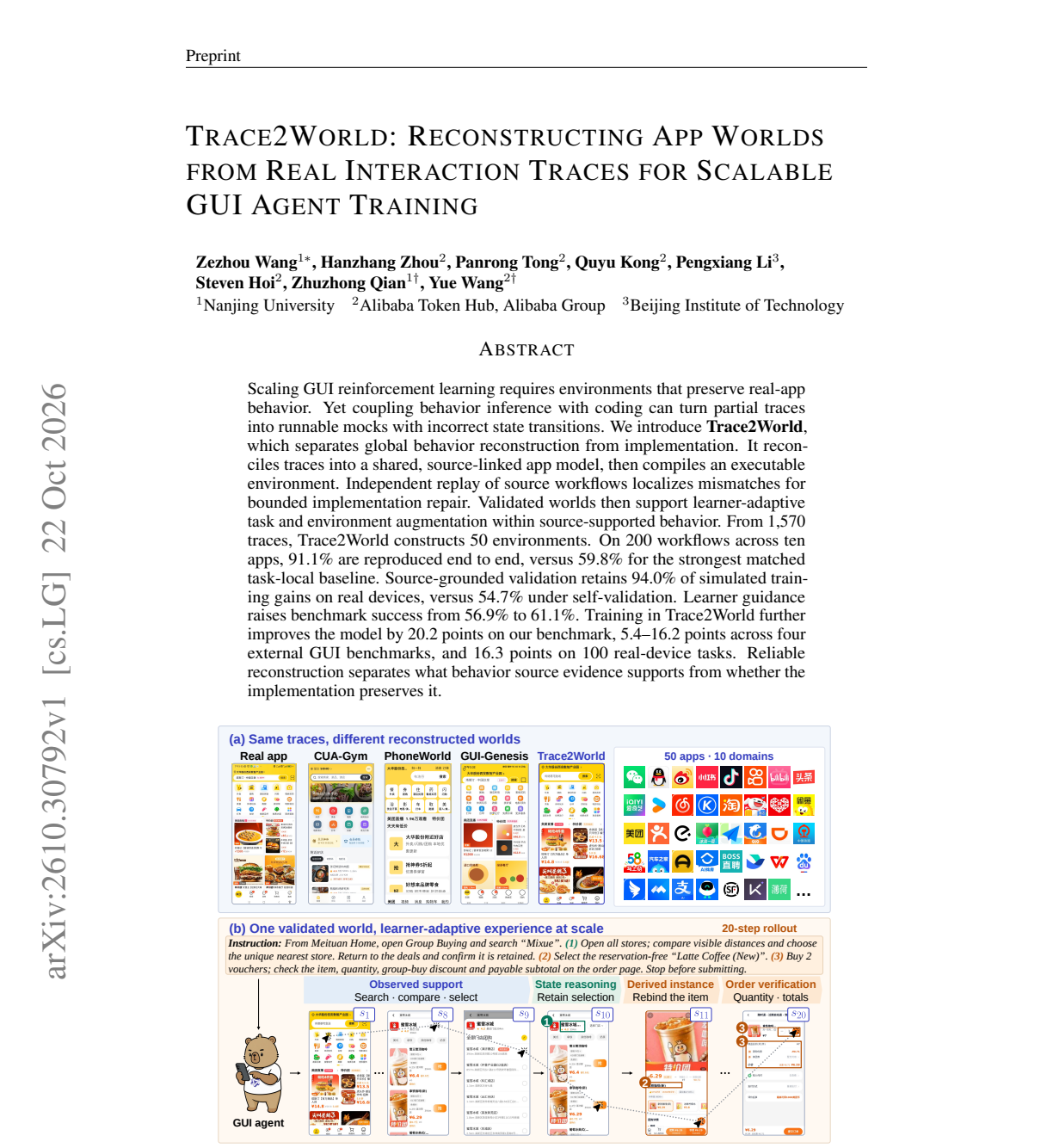
Figure 1 is visually dense. The left panel (a) lists three baselines but the text discusses four; the right panel (b) shows a 20-step rollout but the caption says 'a latte replaces the source trace’s snow-top coffee.' Consider enlarging the font in the small icons and adding a numbered step list in the caption to help readers follow the sequence.
The paper says, at §4.1, Table 1
Pith says: minor objection 2 of 5
The 'Self-validation' row is a control, not a separate method. The caption already marks it as 'Control (not our method),' which is helpful. For clarity, consider adding a footnote explaining that 'All six (workflow fidelity)' requires every check to pass and that the automated reviewer is blind to method identity.
show 3 more
The paper says, at Appendix E.1.2, 'PhoneWorld-style (reimpl.)'
Pith says: minor objection 3 of 5
The paper states that the phoneWorld-style baseline 'replaces the original human audit with an isolated model reviewer.' This is a potentially important difference from the original work, where human QA may capture subtleties that a model reviewer misses. The paper should briefly note the potential impact of this substitution on the baseline's fidelity.
The paper says, at §3.2, Figure 4
Pith says: minor objection 4 of 5
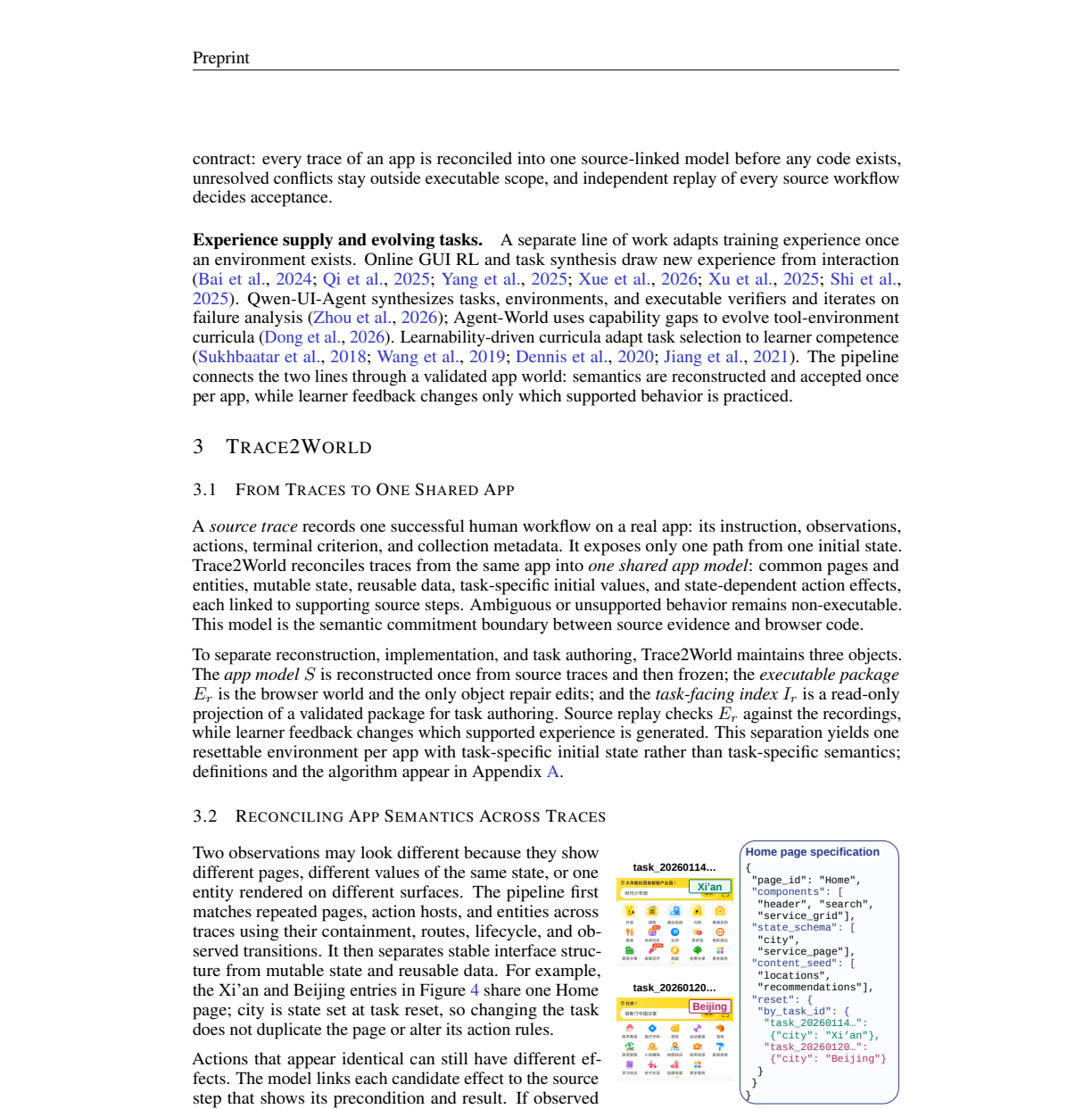
The figure caption says 'The task selects a reset value; subsequent behavior uses the shared page and state-dependent action rules.' The term 'content_seed' in the JSON is not defined until Appendix A.4; consider a forward reference.
The paper says, at General
Pith says: minor objection 5 of 5
The paper uses 'trace' and 'workflow' nearly interchangeably, though a trace is a recorded execution and a workflow is the task definition. Clarify the distinction early, perhaps in §3.1.
What would settle it
Reconstruct the same 5 apps (covering ~100 workflows) using the identical pipeline but with an open-weight LLM (e.g., Llama 3.1 70B) for all construction and verification roles, and measure workflow fidelity via the same GPT-5.6 Sol reviewer. If the fidelity drops by more than 5 pp relative to the GPT-5.2-based construction, the results are partially sensitive to the specific proprietary model and the method's generalizability is more limited than claimed.
from the skeptic's reading
How the review went
4 readings by deepseek-v4-flash · 23 Oct 2026
- Reader holds up
- Skeptic agrees
- Editor wrote the verdict above
- Referee minor revision: 2 major objections, 5 minor
Not run on this paper: the simulated authors' defence.
Pith did not check this review's objections against the paper.
The review in full
The review in brief, machine-written
You should know two things about this paper. First, it actually solves an important problem: building faithful GUI environments from partial traces for RL training, where prior work conflates behavior inference with coding and produces mocks with wrong transitions. Second, the evidence is unusually thorough — workflow fidelity, ablation controls, human audit, and real-device transfer all line up. The claims hold up.
What's new is the separation of concerns: reconcile traces into a shared, source-linked app model before any code exists; then compile and repair against the frozen model. This lets unresolved conflicts stay outside executable scope, which is clean and principled. The 91.1% workflow fidelity versus 59.8% for the best baseline (GUI-GENESIS-style) is a real gap, and the 94.0% sim-to-real gain retention (versus 54.7% under self-validation) shows the validation contract matters for training. The learner-guided task generation also gives a solid 4.2 pp improvement on the benchmark.
The soft spots are real but bounded. The whole pipeline depends on LLMs (GPT-5.2 for modeling, GPT-5.5 for repair, GPT-5.6 Sol for review). The paper acknowledges this and provides a human audit (90.2% agreement) that shows the automated reviewer is conservative and preserves ordering. The real-device transfer results give an independent non-LLM validation. So the central claim doesn't rest on the LLM's accuracy alone. Other limitations: the substrate gap (browser vs. native app) is acknowledged and bounded by the paired device study; and all training tasks are single-app (though gains transfer to held-out cross-app tasks). These are stated shortcomings, not hidden gotchas.
Who should read this: anyone working on GUI agent training, simulation-based RL, or program synthesis from demonstrations. The paper deserves a serious referee — it's a solid contribution with credible evidence.
For review: the paper is in good shape. The main questions a reviewer should probe are about generalizability to different app domains and the cost of refreshing worlds when apps change. But the core ideas and empirical support are strong.
The strongest objection
The paper acknowledges that the reconciliation step (Algorithm 1) relies on LLMs and that the automated fidelity reviewer (GPT-5.6 Sol) is not perfect (90.2% agreement with human adjudication). However, the human audit reveals that the automated reviewer is consistently conservative: for Trace2World, the human-adjudicated workflow fidelity is 93.5% versus 91.1% automated, and the ordering against all baselines is preserved (Appendix E.1.4, Table E3). This means the headline 91.1% is a lower bound under the evaluation protocol. Furthermore, the real-device transfer results (Table 3) provide an external, non-LLM-dependent validation: source-grounded environments retain 94.0% of simulated gains on real devices, demonstrating that the environments are genuinely faithful for training. The central claim therefore does not rest solely on the fidelity reviewer's accuracy; it is corroborated by independent device experiments. I find no load-bearing concern that would invalidate the paper's main conclusions.
The reader correctly identifies that LLM reliability is the weakest assumption, but the paper provides multiple layers of mitigation: (1) human audit confirms the automated reviewer is conservative, (2) real-device transfer directly validates that environments are useful for training, and (3) the self-validation control demonstrates that source-grounded validation is critical for that transfer. I agree with the reader's assessment of the weakest point but find that the evidence presented is sufficient to support the central claims. No new objection was identified.
The referee's report
If these results hold, Trace2World offers a principled solution to a critical bottleneck in GUI RL: generating environments that preserve real-app behavior at scale. The core idea—fixing source-linked semantics before implementation and then using independent source replay for acceptance—is clearly articulated and supported by an extensive empirical evaluation. The paper includes multiple baselines, careful ablation controls (e.g., self-validation, no-trace variants), a human audit of the automated fidelity reviewer (90.2% agreement, conservatively biased), per-app permutation tests, and a real-device transfer study. The open-source release of traces, environments, and evaluation artifacts further strengthens the contribution.
Pith's reading of the paper (a machine's summary, not the authors')
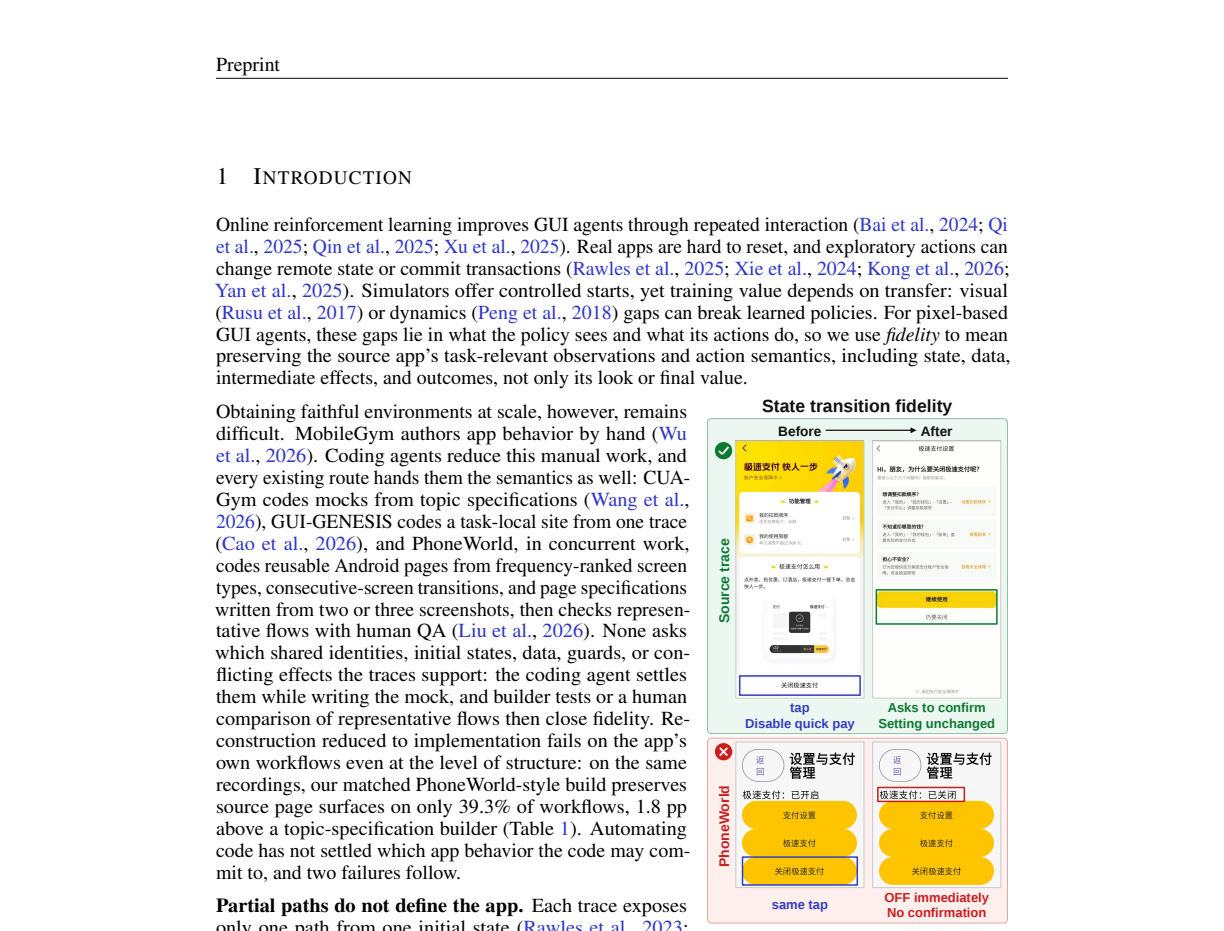
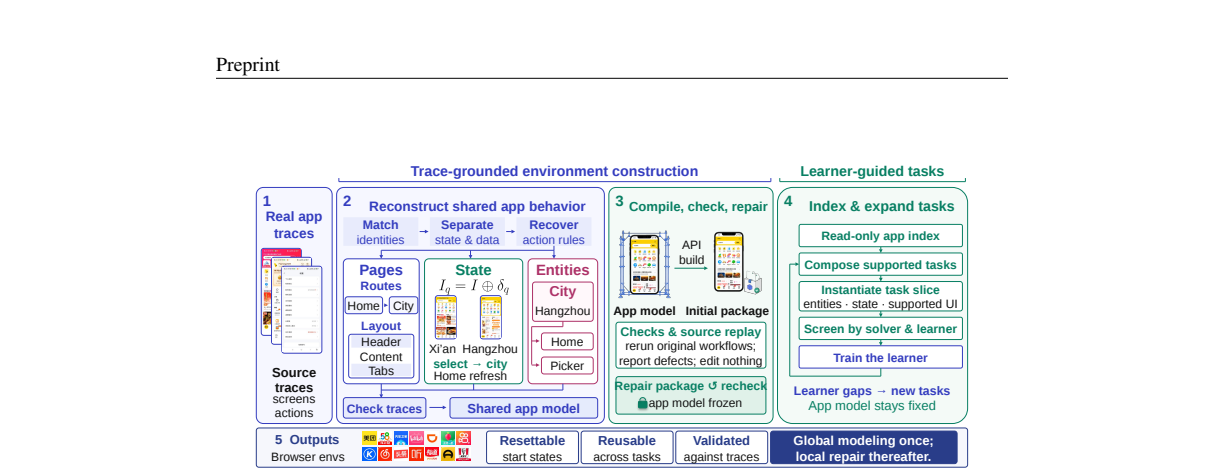
Training GUI agents by reinforcement learning requires simulation environments that faithfully reproduce real app behavior. Existing methods couple semantic inference with code generation, forcing ambiguous page identities, state fields, and action effects into hardcoded choices before cross-trace evidence is reconciled. Trace2World breaks this coupling: it first reconciles all available interaction traces into one source-linked app model—resolving shared pages, mutable state, data entities, and conditional action rules—and only then compiles an executable environment. Independent replay of every source workflow then checks six fidelity obligations, and mismatches are repaired locally without changing the frozen semantic model. On 200 workflows from ten apps, 91.1% pass all checks versus 59.8% for the strongest existing route (a GUI-GENESIS-style builder). Source-grounded validation also retains 94.0% of simulated training gains on real devices, compared with 54.7% under self-validation. This contract makes large-scale, high-fidelity GUI RL environments feasible without human QA.
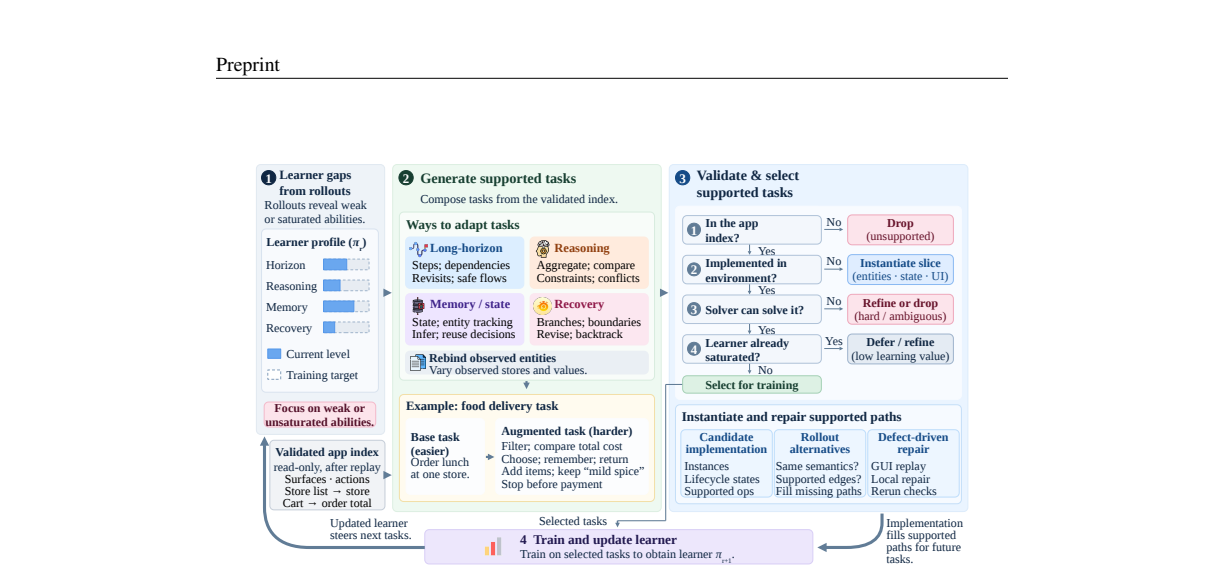
What carries the argument. The core mechanism is semantic reconciliation before implementation (Algorithm 1). Traces from the same app are first reconciled into a shared app model with canonical page identities, state fields, guards, and action effects, each linked to supporting source steps. Unresolved conflicts—those not explained by observed state—are kept outside executable scope rather than settled by a coding agent. Bounded API calls then compile the model into a DOM-backed browser package; code checks and independent replay of each original source workflow compare information, intermediate effects, and terminal state with the recording. Defect packets drive bounded package edits under the frozen model, without changing the semantics. This yields one resettable environment per app with task-specific initial state, not task-specific dynamics.
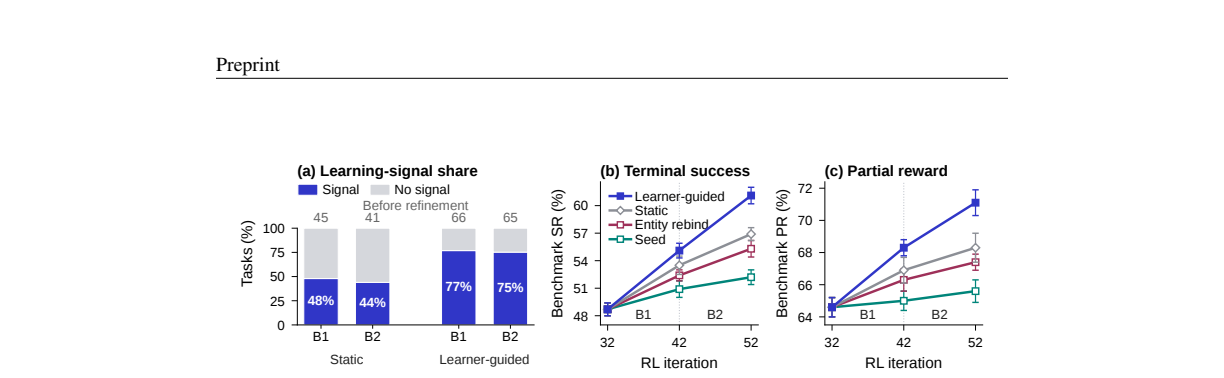
Core claim. Trace2World demonstrates that the dominant obstacle to faithful GUI simulation is not coding capability but the ambiguity of partial trace evidence. By separating global semantic reconstruction from local implementation repair, the pipeline achieves 91.1% workflow fidelity across 200 workflows from ten apps—a 31.3 percentage point improvement over the best existing end-to-end builder. The separation further ensures that source replay catches transition errors invisible to self-consistency checks: 13.8% of self-accepted executions fail independent recheck, versus 0.6% of source-accepted ones. On the downstream policy, learners trained in Trace2World environments retain 87.5–94.0% of their simulated gain on real devices, and learner-guided task composition raises benchmark success from 56.9% to 61.1%.
The premise it rests on. The semantic reconciliation step depends on large language models (GPT-5.2 for initial modeling, GPT-5.5 for repair) to correctly infer page identities, state fields, guards, and action effects from traces; the paper bounds context and audited agreement but does not formally verify the semantic correctness of the inferred model.
If the paper is right (Pith's inferences, not the authors')
High-fidelity GUI environments can be constructed at scale from partial traces without human QA, enabling RL training that transfers to real devices.
Source-trace validation should replace self-consistency checks as the default acceptance standard for simulated GUI environments.
Learner-guided task generation, bounded by a read-only index of validated worlds, composes harder tasks within fixed semantics and raises policy performance without risking unsupported behavior.
The separation of semantic model from executable package means that application updates can be handled by incremental trace refresh rather than full rebuild.
The pipeline's gains on four external GUI benchmarks (5.4–16.2 pp) show that training in reconstructed worlds generalizes beyond the reconstruction set.
The principle of 'semantic commitment before implementation' likely extends to desktop and web applications that generate partial traces, though the paper only evaluates mobile apps.
If the reconciliation step relies on proprietary LLMs (GPT-5.2/5.5), an open-weight substitute would establish the method's generalizability and reduce dependency costs.
The paired real-device transfer study covers only policy-training apps; extending it to held-out apps would test whether the fidelity advantage translates to truly unseen worlds.
Learner-guided task generation could be combined with automatic curriculum learning to further close the gap between simulated and real-device success.
Check this review
Pith stored no record of this review's passes and took no fingerprint of it. Reviews made by code from 13 Nov 2026 on carry both.
How often reviews like this one are right
Reviews like this one: written by deepseek-v4-flash, where what was read was not recorded.
How often objections from reviews like this one are right: not yet measured
Reviews by people
This review was written by a machine. No person has reviewed this paper on Pith yet. A scientist listed on Pith can review it for a fee, and their review is published here whatever it concludes.
The paper
Abstract
Scaling GUI reinforcement learning requires environments that preserve real-app behavior. Yet coupling behavior inference with coding can turn partial traces into runnable mocks with incorrect state transitions. We introduce \textbfTrace2World, which separates global behavior reconstruction from implementation. It reconciles traces into a shared, source-linked app model, then compiles an executable environment. Independent replay of source workflows localizes mismatches for bounded implementation repair. Validated worlds then support learner-adaptive task and environment augmentation within source-supported behavior. From 1,570 traces, Trace2World constructs 50 environments. On 200 workflows across ten apps, 91.1% are reproduced end to end, versus 59.8% for the strongest matched task-local baseline. Source-grounded validation retains 94.0% of simulated training gains on real devices, versus 54.7% under self-validation. Learner guidance raises benchmark success from 56.9% to 61.1%. Training in Trace2World further improves the model by 20.2 points on our benchmark, 5.4–16.2 points across four external GUI benchmarks, and 16.3 points on 100 real-device tasks. Reliable reconstruction separates what behavior source evidence supports from whether the implementation preserves it.
The paper's own sentences, arranged, kept beside the review and separate from it. Each label is drawn from a closed vocabulary; the number beside it is the probability the classifier gave that label. No sentence in this record was written by a model.
abstract compiled · 2026-10-23
The authors' main claim, as the classifier picked it out 0.71
“Reliable reconstruction separates what behavior source evidence supports from whether the implementation preserves it.”
How the main claim is stated: asserted 1.00
What the abstract itself states, as probabilities: claims first 0.06 · states limitation 0.27 · human participants 0.10 · controlled comparison 0.97 · randomized assignment 0.02 · states quantitative result 0.99 · compares with prior results 0.98 · mentions code or data availability 0.04
The abstract, sentence by sentence
This table labels the abstract only (arXiv listing abstract v1). The number is the probability the classifier gave the label.
| Sentence | Role | The authors' own work | States the main conclusion | Strength |
|---|---|---|---|---|
| Scaling GUI reinforcement learning requires environments that preserve real-app behavior. | background 1.00 | 0.07 | 0.05 | asserted 1.00 |
| Yet coupling behavior inference with coding can turn partial traces into runnable mocks with incorrect state transitions. | gap 0.52 | 0.12 | 0.03 | asserted 0.70 |
| We introduce \textbf{Trace2World}, which separates global behavior reconstruction from implementation. | contribution 0.99 | 0.88 | 0.13 | asserted 1.00 |
| It reconciles traces into a shared, source-linked app model, then compiles an executable environment. | method 0.98 | 0.84 | 0.08 | asserted 1.00 |
| Independent replay of source workflows localizes mismatches for bounded implementation repair. | method 0.99 | 0.71 | 0.08 | asserted 1.00 |
| Validated worlds then support learner-adaptive task and environment augmentation within source-supported behavior. | method 0.74 | 0.57 | 0.10 | asserted 0.90 |
| From 1,570 traces, Trace2World constructs 50 environments. | result 0.76 | 0.96 | 0.05 | asserted 1.00 |
| On 200 workflows across ten apps, 91.1% are reproduced end to end, versus 59.8% for the strongest matched task-local baseline. | result 1.00 | 0.96 | 0.15 | asserted 1.00 |
| Source-grounded validation retains 94.0% of simulated training gains on real devices, versus 54.7% under self-validation. | result 1.00 | 0.95 | 0.13 | asserted 1.00 |
| Learner guidance raises benchmark success from 56.9% to 61.1%. | result 1.00 | 0.92 | 0.08 | asserted 1.00 |
| Training in Trace2World further improves the model by 20.2 points on our benchmark, 5.4--16.2 points across four external GUI benchmarks, and 16.3 points on 100 real-device tasks. | result 1.00 | 0.95 | 0.30 | asserted 1.00 |
| Reliable reconstruction separates what behavior source evidence supports from whether the implementation preserves it. | interpretation 0.93 | 0.40 | 0.59 | asserted 1.00 |
What kind of paper the classifier reports this is: method or tool 1.00 · evidence from observation or experiment 0.95
What was examined, and what was not
Sources read
- arXiv listing abstract v1
Not examined
- full text
- figures and tables
- references and citing sentences
- relations to other papers
Levels run
- P abstract
Not run
- S sections
- T body sentences
- C citations
- R cross-paper relations
How the labels were made
Compiled by classifier-1.13.0 via TypeSafe API, question bank abstract-p1-20260923, 2026-10-23: 1 request, 8,682 input tokens.
Every quoted sentence on this record is the authors'. Every label is from Pith's closed vocabulary, with the probability shown beside it. This record as JSON
Figures (6)
Figures are the authors', reproduced from the paper.
Challenges and discussion
Disagree with the review, or know something it missed? Leave a comment, or challenge this review formally: a challenge becomes a permanent entry in this paper's record, and its decision is published here.
Come back by email
A short list of the week's newly reviewed papers. Nothing is sent until you confirm from your inbox, and every email has a link that stops it. No account.
No comments yet.
Sign in to comment