Robotics · arXiv:2610.31569 v1 · submitted 22 Oct 2026 · 30 references
Echo: Coupled Action and Task Status Signal Denoising for Vision Language Action Models
The paper says
“Recognizing task completion and failure enables robots to stop upon success and initiate recovery or replanning after failure. Existing methods augment Vision Language Action (VLA) policies with task status signal prediction to support these execution decisions.”
more of the abstract
However, learning and integrating these signals can require fine-grained supervision, external monitoring models, or complex architectural designs. Moreover, the potential of task status signals to directly guide action generation remains underexplored. We present Echo, a framework that combines task status signal learning without frame-level progress annotations with a compact design for status prediction and action generation within a single VLA. Specifically, Echo represents task status with stop and failure signals, added as two dimensions of each action chunk and denoised together with robot actions. Their combination distinguishes ongoing execution, successful completion, and failure. To learn these signals without fine-grained progress annotations, Echo constructs successful, failed, and recovery trajectories with complementary supervision properties. To enable status signal-guided action generation, Echo controls interactions between the signals and actions and denoises the signals faster than the actions. These allow later action denoising steps to condition on cleaner status estimates while preserving accurate signal prediction. Extensive real-world manipulation experiments show that Echo accurately predicts task status and consistently improves policy performance.
from the abstract
Pith says
Machine review · deepseek-v4-flash · 23 Oct 2026 · what was read was not recorded · not checked by a person
It can be wrong. Challenge this review or reply to it.
Holds up, with conditions. Echo's simple trick—status signals as extra flow-matching action-chunk dimensions with boundary-derived labels—holds up on matched real-robot baselines, but frame-level F1 partly reflects the label schedule and stop-on-success is never tested closed-loop. This line is wrong
2 major objections · 4 minor
How often objections from reviews like this one are right: not yet measured
Not checked: figures, code, what the 30 references say.
The paper says, at §3.2.2, Table 1; §4.2, Table 9
The review did not quote this passage.
Pith says: Objection 1 of 2 · major
The boundary-as-label supervision does not currently establish that FS encodes a failure state rather than a position relative to a segment boundary. In terminal-failure and pre-intervention failure data, FS=1 is supervised only on padded positions past the segment end, while valid non-padding positions inside the failure segment receive FS=0; the only non-boundary FS=1 supervision is the all-ones chunk at recovery starts (Eq. 9).
more of objection 1
Consequently, the frame-level failure recall in Table 9, and part of the S->A gain in Table 5, could reflect the label schedule rather than genuine interior-state recognition. Please report an interior-frame breakdown, for example by excluding frames within one chunk horizon of segment ends and recovery starts, and preferably an additional experiment that supervises interior failure frames with FS=1, so that the reader can see whether FS tracks execution state throughout the segment rather than only near the boundary.
The paper says, at §3.2.2, Eq. (8)–(9); §3.2.3
The review did not quote this passage.
Pith says: Objection 2 of 2 · major
The recovery FS target in Eq. (9) is per-frame inverted relative to the stated recovery semantics. At recovery progress u_t the target is [0_{n_t}, 1_{H-n_t}], so within a single chunk the later, closer-to-success positions are labelled 1 while the earlier, closer-to-recovery-start positions are labelled 0; only the chunk mean decreases with recovery progress.
more of objection 2
Because asynchronous denoising (§3.2.3) holds these per-frame signal values fixed and feeds them through attention to later action denoising steps, the temporal direction of the per-frame target matters for the claimed status-guided recovery behavior. Please either justify the per-frame inversion or compare against a target whose per-frame values decrease across the horizon, and report both task completion and status prediction for the alternative.
4 minor objections
The paper says, at §4.4.1, Table 4
Pith says: minor objection 1 of 4
The ID/OOD comparison is based on only 15 trials per condition and no significance test; on Insert Flower Echo's ID score is numerically below the baseline (8.67 vs 9.33), while the OOD gain is large. Please add confidence intervals or a paired comparison, or soften the abstract and conclusion claim of larger out-of-distribution gains.
The paper says, at §4.5, Table 10
Pith says: minor objection 2 of 4
The simulation result is reported as a single average over three seeds sharing one checkpoint per model, with a 2.09 percentage-point improvement and no trial-level uncertainty. It would be helpful to report bootstrap confidence intervals or explicitly label the simulation result as suggestive rather than an independent confirmation.
show 2 more
The paper says, at A.7, Table 9
Pith says: minor objection 3 of 4
Capsule Toy and Open Drawer contain no ground-truth failure examples, so their trajectory-level F1 is computed over success outcomes only; the appendix notes this with counts, but a one-line reminder in Section 4.2 would prevent a misleading cross-task reading of the trajectory F1 column.
The paper says, at Figure 3
Pith says: minor objection 4 of 4
The motivating experiment plots SS and FS on separate 10^-2 scales, which makes the convergence comparison hard to read in the main text; the caption should state the scale conventions directly rather than only describing them in Appendix A.5.
What would settle it
Split the already-scored evaluation rollouts (which carry per-frame status annotations, per Appendix A.2) into frames at least one action-chunk horizon (60 frames, 12 s) from any annotated status boundary and frames within one horizon of a boundary, then recompute Echo's frame-level success and failure recall on the interior set. Failure intervals beginning well before episode end (Insert Flower, Make Tanghulu) make this interior regime well populated. If interior success/failure recall stays close to the reported 75-80% levels, the boundary-as-label concern is refuted; if it collapses, the headline F1 and the signal-guided-recovery story largely encode the Section 3.2.2 label schedule.
from the skeptic's reading
How the review went
4 readings by deepseek-v4-flash · 23 Oct 2026
- Reader holds up, with conditions
- Skeptic agrees
- Editor wrote the verdict above
- Referee major revision: 2 major objections, 4 minor
Not run on this paper: the simulated authors' defence.
Pith did not check this review's objections against the paper.
The review in full
The review in brief, machine-written
Echo's core idea is simple and worth knowing: in a flow-matching VLA, append stop and failure signals as two extra dimensions of each action chunk, denoise them together with the actions, clean the signals before the actions finish, and let later action updates attend to the cleaner estimates. Labels come from segment boundaries and episode-level success/failure, not frame-level progress annotations. That combination is new relative to CycleVLA, ProgressVLA, and Robometer, and it is compact—the paper reports +5 ms inference overhead.
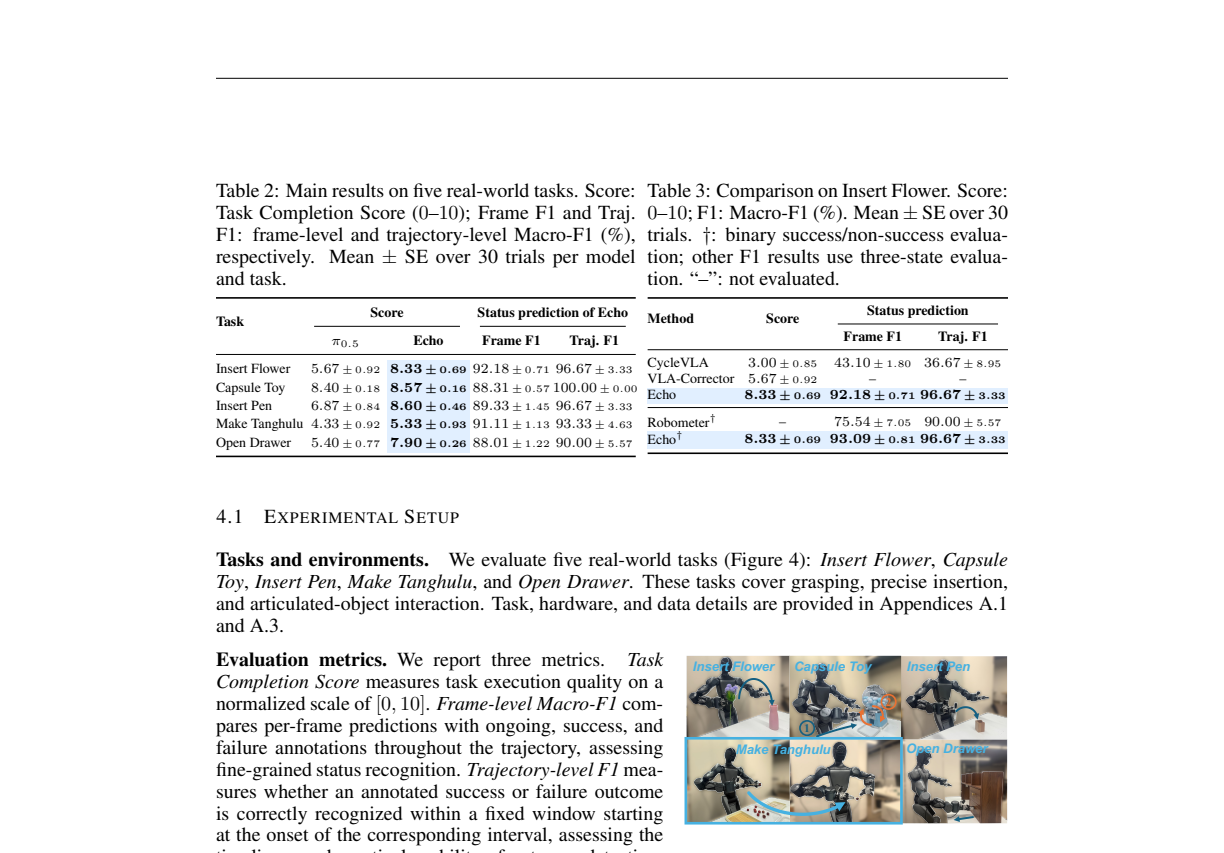
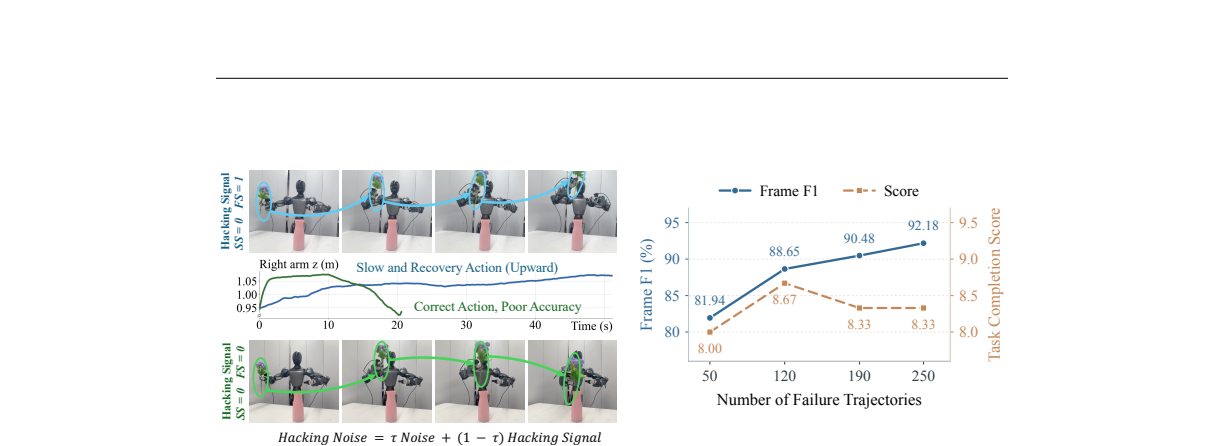
The empirical work is more careful than most in this area. The action-only pi-0.5 baseline is trained on the same demonstrations with matched steps, and Echo beats it on all five real-world tasks, with the larger gains under OOD conditions. The ablations localize the gain: removing signal-to-action attention drops Insert Flower from 8.33 to 5.00, near the baseline, while signal accuracy holds. The imposed-signal intervention (FS=1 elicits upward recovery motion) probes the mechanism rather than just fitting the architecture. Together these carry the central claim, and the paper does not oversell the scope.
The soft spots, in rough order. No code or data released. Method comparisons run on one task only. The headline motivation—stop on success—is never tested closed-loop: in simulation the paper states plainly that signals do not terminate the rollout, and nothing in the real-world protocol suggests status predictions drive termination. That gap is acknowledged but still the largest mismatch between motivation and evaluation. The boundary-as-label concern is real but contained: FS=1 is supervised only past segment ends and at recovery starts, so the 88-92% frame F1 partly measures boundary detection, not necessarily per-frame state recognition. An interior-frame recall split would settle it and should be requested. The per-frame inversion inside intermediate recovery targets looks like a modeling quirk—the chunk-mean decision rule preserves the intended decreasing semantics—so I would not treat it as load-bearing. The simulation gain (34.76 vs 32.67) is small and rests on one checkpoint across three evaluation seeds, which the paper acknowledges.
Recommendation: send it to peer review. Require artifacts and an interior-frame F1 breakdown; ideally a closed-loop stopping experiment or multi-task comparison before acceptance.
The strongest objection
The central claim requires the Section 3.2.2 SS/FS targets to track true execution status, not just positions in a boundary-defined schedule. Two properties make this the weakest link. First, in terminal-failure and pre-intervention data, FS is never taught to be 1 on a frame interior to the segment. Per Table 1, those data types supervise FS only on chunks containing padding, with target [0_n, 1_{H-n}] over the full chunk: supervised non-padding frames (which lie inside the failure segment) are explicitly taught FS=0, and FS=1 appears only past the segment end. The only non-boundary FS=1 supervision is the all-ones chunks at recovery starts (Eq. 9). The learned FS semantics are therefore 'state resembles the start of a recovery demonstration' or 'chunk extends past a segment end', not 'this frame is failed'. The 66-80% success/failure frame recalls in Table 9 are not self-interpreting without knowing where the responsible frames sit relative to boundaries. Second, Eq. 8-9's recovery target is per-frame inverted within every intermediate chunk: at progress u_t the target is [0_{n_t}, 1_{H-n_t}] with n_t = round(H*u_t), so FS is taught to rise from 0 to 1 across the chunk while the segment narrative says recovery decreases failure. Only the chunk mean (1-u_t) matches the intended linearly decreasing schedule; per-frame supervision optimizes the opposite temporal direction. Because asynchronous denoising holds these per-frame signal values fixed and feeds them to later action updates via attention, actions are conditioned on a schedule-shaped pattern rather than a genuine state trajectory, and the Figure 5 FS=1 -> upward-motion coupling may be partly a target-schedule artifact. This is not a rejection: the matched action-supervision data, the w/oS->A ablation (5.00 vs 5.67), the exclusion of failed actions from imitation, and the imposed-signal intervention genuinely support that the architecture couples signals to actions.
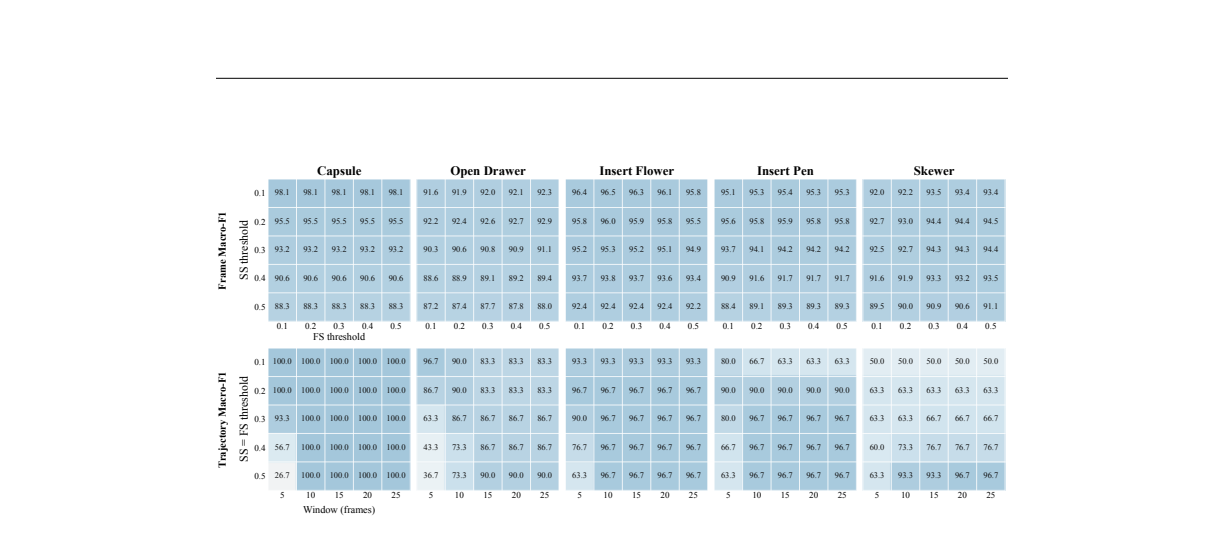
The central claim rests on two legs: Echo predicts task status accurately from boundary-derived supervision, and those predictions improve task completion. I agree with the reader that the first leg depends on the weakest premise, the Section 3.2.2 boundary-as-label assumption, and two concrete details make that premise more fragile than the text suggests. First, FS is never taught to be 1 on a frame interior to a terminal-failure or pre-intervention segment: Table 1 supervises FS only on chunks containing padding, with target [0_n, 1_{H-n}] over the full chunk, so interior frames are explicitly taught FS=0 and FS=1 lives only past the segment end. The only non-boundary FS=1 supervision is the all-ones chunks at recovery starts (Eq. 9), so the model's FS semantics are 'resembles the start of a recovery demonstration' or 'chunk extends past a segment end', not 'this frame is failed'. Second, Eq. 8-9's recovery target is per-frame inverted within every intermediate chunk: [0_{n_t}, 1_{H-n_t}] teaches FS rising across the chunk while recovery should decrease failure; only the chunk mean carries the intended schedule, and since asynchronous denoising feeds these per-frame values to later action updates via attention, the action-conditioning channel inherits a schedule-shaped pattern. I am not rejecting Echo: the matched action-supervision data, the w/oS->A ablation (5.00 vs the 5.67 action-only baseline), the exclusion of failed actions from imitation, and the imposed-signal intervention are genuine internal support for signal-action coupling, and the threshold-sensitivity grids (Fig. 9) show the default operating point sits on plateaus. The paper also states its scope honestly: no closed-loop stopping anywhere, one shared checkpoint per model in simulation, offline threshold analysis (b409), and 'improved performance from a particular combined system requires a separate evaluation' (b415). Those are acknowledged; my concern is what remains unresolved. The decisive check is cheap and offline: recompute success/failure frame-level recall on frames at least one chunk horizon from any annotated boundary in the already-scored evaluation episodes. If recognition survives away from boundaries, the concern is refuted; if it collapses, the headline F1 and the signal-guided-recovery story partly encode the label schedule, and the status-prediction claim needs re-scoping. A confirmatory retrain with the per-frame-correct recovery target [1_{H-n_t}, 0_{n_t}] tests whether the coupling is an artifact. Secondary observation: completion gains are unequal across tasks, with Capsule Toy (8.57 vs 8.40) and Make Tanghulu (5.33 vs 4.33) within about one SE of baseline, so 'consistently improves over all five tasks' rests mainly on Insert Flower and Open Drawer; paired-difference reporting would help. This does not change the verdict.
The referee's report
If the status-semantics concern is resolved, Echo is an attractive design: it adds negligible parameter overhead and about 5 ms of inference latency, requires no external monitoring model, and provides a matched-data comparison on five real tasks in which the appended signals improve task completion over an action-only baseline. The w/o S->A ablation (Table 5, Insert Flower: 8.33 vs 5.00), the signal intervention in Figure 5, the hyperparameter sensitivity analysis in Figure 9, and the class-wise recall table in Table 9 are useful mechanistic and diagnostic checks. The main caveat is that the FS supervision schedule may teach boundary proximity or position in a label schedule rather than an intrinsic failure state; this must be settled before the 'accurate task-status prediction' part of the central claim can be taken at face value.
Pith's reading of the paper (a machine's summary, not the authors')
Echo claims that a single vision-language-action (VLA) policy can recognize when a manipulation task is ongoing, done, or failed and use that recognition to improve its own actions, without frame-level progress annotations, external monitoring models, or extra training loops. The method appends a stop signal and a failure signal as two extra dimensions of each flow-matched action chunk, labels the signals from segment boundaries and episode-level success/failure labels, and denoises them faster than the actions so later action-generation steps condition on cleaner status estimates. On five real-world tasks, Echo reports accurate frame-level and trajectory-level status prediction and higher task-completion scores than the action-only $\pi_{0.5}$ baseline on every task, with the largest gains under out-of-distribution conditions. The claim matters because it collapses monitoring and control into one model: the same status estimate that decides whether to stop can steer corrective motion.
What carries the argument. The load-bearing objects are the two appended signal dimensions and the schedule that cleans them. Stop signal $S_t$ and failure signal $F_t$ are column vectors in $\mathbb{R}^{H \times 1}$ concatenated with the action matrix to form the joint flow-matching target $X_t = [\tilde{A}_t, S_t, F_t] \in \mathbb{R}^{H \times (d_a + 2)}$; scalar status is the chunk mean, thresholded at $\delta_s = \delta_f = 0.5$. Supervision comes from the padding mask of each chunk combined with the segment type — the boundary where a success or terminal-failure segment ends becomes the stop/failure target, and recovery segments get a linearly decreasing failure-signal target encoding progress out of the failure state. The second mechanism is asynchronous denoising: with per-token flow times, signal groups use $\tau_q = \max(0, (\tau_A - \tau_{\text{clean}})/(1 - \tau_{\text{clean}}))$ with $\tau_{\text{clean}} = 0.5$, so signals are clean and held fixed while actions are still being denoised. The attention mask (actions and signals attend both ways, but no direct SS–FS attention) lets the clean signals condition action updates without cross-signal interference.
Core claim. On the paper's own terms: a task's status can be carried inside the action chunk itself, as two extra signal series — a stop signal indicating whether execution should terminate, and a failure signal indicating whether the policy is in a failure state. Their combination distinguishes ongoing execution (low stop), success (high stop, low failure), and terminal failure (high stop, high failure), while an elevated failure signal during ongoing execution marks a recoverable failure. Echo learns these signals from data it already collects — successful teleoperation, terminal-failure rollouts, pre-intervention failure segments, and recovery demonstrations — by reading the padding mask of each chunk together with the segment type, so no per-frame status annotation is needed. The signals then participate in action generation through a controlled attention scheme (actions and signals attend to each other, but the two signals cannot attend to each other) and through asynchronous denoising: with per-token flow times and $\tau_{\text{clean}} = 0.5$, signal tokens are clean and frozen while action denoising continues. Echo reports that this joint scheme improves task-completion score over the action-only $\pi_{0.5}$ baseline on all five real-world tasks, and that directly forcing the failure signal on during inference visibly redirects generated motions toward recovery behavior.
The premise it rests on. The load-bearing premise is that segment boundaries and episode-level labels mark the true moment of success or failure — and, for recovery segments, that the segment start is genuinely a recoverable-failure state — so the signal targets derived from padding masks need no per-frame status annotation.
If the paper is right (Pith's inferences, not the authors')
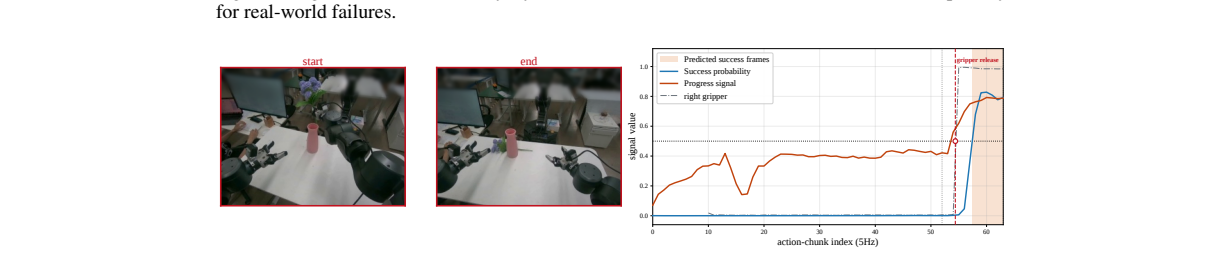
One VLA can serve as its own execution monitor: at inference the policy outputs stop- and failure-signal means whose thresholds yield ongoing, success, and terminal-failure decisions, so no separate monitoring model is needed for the tested tasks.
The same status estimates improve action generation: ablating action-to-signal attention drops task completion back to near the action-only baseline, while forcing FS = 1 during inference elicits upward recovery motions and FS = 0 produces task-directed motions.
The gains concentrate under distribution shift: on Insert Flower and Open Drawer, Echo's completion score holds up under out-of-distribution object and drawer positions where the action-only baseline drops sharply.
Status prediction scales with failure data: frame-level F1 rises from 81.94% to 92.18% as terminal-failure trajectories grow from 50 to 250, while task-completion score stays broadly flat, consistent with terminal-failure data supplying supervision rather than corrective actions.
The design costs little at inference: latency increases by 5 ms (115 to 120 ms) despite tripling the generated-token sequence, and simulation on 150 fixed LIBERO-Recovery scenes reproduces the pattern (34.76% vs 32.67% task success).
The boundary-as-label scheme implies that the reported frame-level F1 is partly a measure of how well segment boundaries coincide with true status transitions; on tasks with messy failure onsets, per-frame re-annotation would likely reveal the ceiling of the trick.
The asynchronous-denoising idea is general: any low-dimensional, quickly resolvable side channel (gripper state, contact events, subtask indices) could be denoised ahead of the continuous action stream and used as a clean conditioning signal, without the specific SS/FS semantics.
Because the threshold analysis shows the best stop-signal threshold varies by task, a per-task or learned threshold on the chunk means could raise frame-level F1 without retraining.
A testable prediction from the data design: recovery demonstrations do double duty (corrective actions plus the decreasing FS target that teaches transition out of failure), so removing them should hurt recovery behavior more than status prediction.
Check this review
Pith stored no record of this review's passes and took no fingerprint of it. Reviews made by code from 13 Nov 2026 on carry both.
How often reviews like this one are right
Reviews like this one: written by deepseek-v4-flash, where what was read was not recorded.
How often objections from reviews like this one are right: not yet measured
Reviews by people
This review was written by a machine. No person has reviewed this paper on Pith yet. A scientist listed on Pith can review it for a fee, and their review is published here whatever it concludes.
The paper
Abstract
Recognizing task completion and failure enables robots to stop upon success and initiate recovery or replanning after failure. Existing methods augment Vision Language Action (VLA) policies with task status signal prediction to support these execution decisions. However, learning and integrating these signals can require fine-grained supervision, external monitoring models, or complex architectural designs. Moreover, the potential of task status signals to directly guide action generation remains underexplored. We present Echo, a framework that combines task status signal learning without frame-level progress annotations with a compact design for status prediction and action generation within a single VLA. Specifically, Echo represents task status with stop and failure signals, added as two dimensions of each action chunk and denoised together with robot actions. Their combination distinguishes ongoing execution, successful completion, and failure. To learn these signals without fine-grained progress annotations, Echo constructs successful, failed, and recovery trajectories with complementary supervision properties. To enable status signal-guided action generation, Echo controls interactions between the signals and actions and denoises the signals faster than the actions. These allow later action denoising steps to condition on cleaner status estimates while preserving accurate signal prediction. Extensive real-world manipulation experiments show that Echo accurately predicts task status and consistently improves policy performance.
The paper's own sentences, arranged, kept beside the review and separate from it. Each label is drawn from a closed vocabulary; the number beside it is the probability the classifier gave that label. No sentence in this record was written by a model.
abstract compiled · 2026-10-23
The authors' main claim, as the classifier picked it out 1.00
“Extensive real-world manipulation experiments show that Echo accurately predicts task status and consistently improves policy performance.”
How the main claim is stated: asserted 1.00
What the abstract itself states, as probabilities: claims first 0.08 · states limitation 0.10 · human participants 0.05 · controlled comparison 0.19 · randomized assignment 0.02 · states quantitative result 0.05 · compares with prior results 0.45 · mentions code or data availability 0.02
The abstract, sentence by sentence
This table labels the abstract only (arXiv listing abstract v1). The number is the probability the classifier gave the label.
| Sentence | Role | The authors' own work | States the main conclusion | Strength |
|---|---|---|---|---|
| Recognizing task completion and failure enables robots to stop upon success and initiate recovery or replanning after failure. | background 1.00 | 0.04 | 0.04 | asserted 0.97 |
| Existing methods augment Vision Language Action (VLA) policies with task status signal prediction to support these execution decisions. | background 1.00 | 0.03 | 0.02 | asserted 1.00 |
| However, learning and integrating these signals can require fine-grained supervision, external monitoring models, or complex architectural designs. | background 0.48 | 0.04 | 0.02 | hedged possibility 0.76 |
| Moreover, the potential of task status signals to directly guide action generation remains underexplored. | gap 1.00 | 0.07 | 0.03 | asserted 0.76 |
| We present Echo, a framework that combines task status signal learning without frame-level progress annotations with a compact design for status prediction and action generation within a single VLA. | contribution 1.00 | 0.92 | 0.21 | asserted 1.00 |
| Specifically, Echo represents task status with stop and failure signals, added as two dimensions of each action chunk and denoised together with robot actions. | method 0.97 | 0.86 | 0.06 | asserted 1.00 |
| Their combination distinguishes ongoing execution, successful completion, and failure. | method 0.90 | 0.60 | 0.06 | asserted 1.00 |
| To learn these signals without fine-grained progress annotations, Echo constructs successful, failed, and recovery trajectories with complementary supervision properties. | method 0.99 | 0.91 | 0.04 | asserted 0.99 |
| To enable status signal-guided action generation, Echo controls interactions between the signals and actions and denoises the signals faster than the actions. | method 0.98 | 0.88 | 0.06 | asserted 0.99 |
| These allow later action denoising steps to condition on cleaner status estimates while preserving accurate signal prediction. | method 0.88 | 0.76 | 0.09 | asserted 0.96 |
| Extensive real-world manipulation experiments show that Echo accurately predicts task status and consistently improves policy performance. | result 1.00 | 0.96 | 0.84 | asserted 1.00 |
What kind of paper the classifier reports this is: method or tool 1.00 · evidence from observation or experiment 1.00
What was examined, and what was not
Sources read
- arXiv listing abstract v1
Not examined
- full text
- figures and tables
- references and citing sentences
- relations to other papers
Levels run
- P abstract
Not run
- S sections
- T body sentences
- C citations
- R cross-paper relations
How the labels were made
Compiled by classifier-1.13.0 via TypeSafe API, question bank abstract-p1-20260923, 2026-10-23: 1 request, 8,032 input tokens.
Every quoted sentence on this record is the authors'. Every label is from Pith's closed vocabulary, with the probability shown beside it. This record as JSON
Figures (10)




Showing 9 of the paper's 10 figures. Figures are the authors', reproduced from the paper.
References (30)
- [1] Christopher Agia, Rohan Sinha, Jingyun Yang, Zi-ang Cao, Rika Antonova, Marco Pavone, and Jeannette Bohg. Unpacking failure modes of generative policies: Runtime monitoring of consis- tency and progress.arXiv preprint arXiv:2410.04640, on PithPith's reviewarXiv
- [3] I Apanasevich, M Artemyev, R Babakyan, P Fedotova, Denis Grankin, E Kupryashin, A Misailidi, D Nerus, A Nutalapati, G Sidorov, et al. Green-vla: Staged vision-language-action model for generalist robots.arXiv preprint arXiv:2602.00919, on PitharXiv
- [6] Kevin Black, Allen Z Ren, Michael Equi, and Sergey Levine. Training-time action conditioning for efficient real-time chunking.arXiv preprint arXiv:2512.05964, on PitharXiv
- [7] Tingjun Dai, Mingfei Han, Tingwen Du, Zhiheng Liu, Zihao Zhang, Zhihui Li, Salman Khan, Jun Yu, and Xiaojun Chang. See, plan, rewind: Progress-aware vision-language-action models for robust robotic manipulation.arXiv preprint arXiv:2603.09292, on PithPith's reviewarXiv
- [8] Haoyuan Deng, Yitong Gao, Yudong Lin, Haichao Liu, Zhenyu Wu, and Ziwei Wang. Uniin- tervene: Agentic intervention for efficient real-world reinforcement learning.arXiv preprint arXiv:2606.12372, on PithPith's reviewarXiv
- [9] 10 Jiafei Duan, Wilbert Pumacay, Nishanth Kumar, Yi Ru Wang, Shulin Tian, Wentao Yuan, Ranjay Krishna, Dieter Fox, Ajay Mandlekar, and Yijie Guo. Aha: A vision-language-model for detecting and reasoning over failures in robotic manipulation.arXiv preprint arXiv:2410.00371, on PithPith's reviewarXiv
- [10] Youhe Feng, Hansen Shi, Haoyang Li, Xinlei Guo, Yang Wang, Chengyang Zhang, Jinkai Zhang, Xiaohan Zhang, Jie Tang, and Jing Zhang. Procvlm: Learning procedure-grounded progress rewards for robotic manipulation.arXiv preprint arXiv:2605.08774, on PithPith's reviewarXiv
- [11] Jinbang Huang, Yuanzhao Hu, Zhiyuan Li, Ran Qi, Yixin Xiao, Yangzheng Wu, Tengyue Ba, Zhanguang Zhang, and Yingxue Zhang. Stageguard: Learning stage transitions for long-horizon robot tasks via agentic distillation.arXiv preprint arXiv:2609.20791, on PithPith's reviewarXiv
- [12] Physical Intelligence, Kevin Black, Noah Brown, James Darpinian, Karan Dhabalia, Danny Driess, Adnan Esmail, Michael Equi, Chelsea Finn, Niccolo Fusai, et al.π 0.5: a vision-language-action model with open-world generalization.arXiv preprint arXiv:2504.16054, on PithPith's reviewarXiv
- [13] Seungsu Kim, Jinyoung Choi, Seungmin Baek, and Jean-Michel Renders. Progvla: Progress-aware robot manipulation skill learning.arXiv preprint arXiv:2605.28231, on PithPith's reviewarXiv
- [14] Tony Lee, Andrew Wagenmaker, Karl Pertsch, Percy Liang, Sergey Levine, and Chelsea Finn. Roboreward: General-purpose vision-language reward models for robotics.arXiv preprint arXiv:2601.00675, on PitharXiv
- [15] Wenhao Li, Xiu Su, Dan Niu, Yichao Cao, Hongyan Xu, Zhe Qu, Lei Fan, Shan You, and Chang Xu. Sentinel-vla: A metacognitive vla model with active status monitoring for dynamic reasoning and error recovery.arXiv preprint arXiv:2605.01191, on PithPith's reviewarXiv
- [16] Anthony Liang, Yigit Korkmaz, Jiahui Zhang, Minyoung Hwang, Abrar Anwar, Sidhant Kaushik, Aditya Shah, Alex S Huang, Luke Zettlemoyer, Dieter Fox, et al. Robometer: Scaling general- purpose robotic reward models via trajectory comparisons.arXiv preprint arXiv:2603.02115, on PithPith's reviewarXiv
- [17] Zijun Lin, Jiafei Duan, Haoquan Fang, Dieter Fox, Ranjay Krishna, Cheston Tan, and Bihan Wen. Failsafe: Reasoning and recovery from failures in vision-language-action models.arXiv preprint arXiv:2510.01642, on PithPith's reviewarXiv
- [19] Lin Liu, Zhicheng Bao, Lu Zhang, Ziying Song, Wu Yang, Shuai Tao, Wulong Liu, and Huchuan Lu. Libero-recover: Beyond task success towards failure recovery in robotic manipulation models. arXiv preprint arXiv:2609.05178, 2026b. Yuanzhe Liu, Jingyuan Zhu, Yuchen Mo, Gen Li, Xu C... on PithPith's reviewarXiv
- [20] 11 Chenyang Ma, Kai Lu, Guangyu Yang, Jiuming Liu, Shitong Xu, Bill Byrne, Ioannis Havoutis, Niki Trigoni, and Andrew Markham. Cyclevla: Proactive self-correcting vision-language-action mod- els via subtask backtracking and minimum bayes risk decoding.arXiv preprint arXiv:2601.02295, on PithPith's reviewarXiv
- [21] Paul Pacaud, Ricardo Garcia, Shizhe Chen, and Cordelia Schmid. Scaling cross-environment failure reasoning data for vision-language robotic manipulation.arXiv preprint arXiv:2512.01946, on PithPith's reviewarXiv
- [22] Yi Pan, Miao Pan, Qi Lu, Jiaming Huang, Man Zhang, Siteng Huang, Xin Li, Jie Zhang, Yongliang Shen, Xuhong Zhang, et al. Vla-corrector: Lightweight detect-and-correct inference for adaptive action horizon.arXiv preprint arXiv:2607.01804, on PithPith's reviewarXiv
- [23] Seongheon Park, Wendi Li, Changdae Oh, Samuel Yeh, Zsolt Kira, Michael Hagenow, and Sharon Li. Hide-and-seek in trajectories: Discovering failure signals for vla runtime monitoring.arXiv preprint arXiv:2605.30834, on PithPith's reviewarXiv
- [24] Xiaomi Robotics Team, Jun Guo, Piaopiao Jin, Jason Li, Peiyan Li, Yingyan Li, Futeng Liu, Wanli Peng, Optimus Qin, Yifei Su, et al. Xiaomi-robotics-1: Scaling vision-language-action models with over 100k hours of real-world trajectories.arXiv preprint arXiv:2607.15330, on PithPith's reviewarXiv
show 10 more
- [25] Chen Xu, Tony Khuong Nguyen, Emma Dixon, Christopher Rodriguez, Patrick Miller, Robert Lee, Paarth Shah, Rares Ambrus, Haruki Nishimura, and Masha Itkina. Can we detect failures without failure data? uncertainty-aware runtime failure detection for imitation learning policies.a... on PithPith's reviewarXiv
- [26] Hongyu Yan, Qiwei Li, Jiaolong Yang, and Yadong Mu. Progressvla: Progress-guided diffusion policy for vision-language robotic manipulation.arXiv preprint arXiv:2603.27670, on PitharXiv
- [27] Ran Yang, Zijian An, Lifeng Zhou, and Yiming Feng. Seqvla: Sequential task execution for long-horizon manipulation with completion-aware vision-language-action model.arXiv preprint arXiv:2509.14138, on PitharXiv
- [28] Shaopeng Zhai, Qi Zhang, Tianyi Zhang, Fuxian Huang, Haoran Zhang, Ming Zhou, Shengzhe Zhang, Litao Liu, Sixu Lin, and Jiangmiao Pang. A vision-language-action-critic model for robotic real-world reinforcement learning.arXiv preprint arXiv:2509.15937, on PitharXiv
- [29] Jiahui Zhang, Yusen Luo, Abrar Anwar, Sumedh Anand Sontakke, Joseph J Lim, Jesse Thomason, Erdem Biyik, and Jesse Zhang. Rewind: Language-guided rewards teach robot policies without new demonstrations.arXiv preprint arXiv:2505.10911, on PitharXiv
- [30] Zijian Zhang, Kaiyuan Zheng, Zhaorun Chen, Joel Jang, Yi Li, Siwei Han, Chaoqi Wang, Mingyu Ding, Dieter Fox, and Huaxiu Yao. Grape: Generalizing robot policy via preference alignment. arXiv preprint arXiv:2411.19309, on PithPith's reviewarXiv
- [2023] Chenyv Liu, Wentao Tan, Lei Zhu, Fengling Li, Jingjing Li, Guoli Yang, and Heng Tao Shen. Self-correcting vla: Online action refinement via sparse world imagination.arXiv preprint arXiv:2602.21633, 2026a. Huihan Liu, Shivin Dass, Roberto Mart´ın-Mart´ın, and Yuke Zhu. Model-ba... on PitharXiv
- [2024] Minttu Alakuijala, Reginald McLean, Isaac Woungang, Nariman Farsad, Samuel Kaski, Pekka Marttinen, and Kai Yuan. Video-language critic: Transferable reward functions for language- conditioned robotics.arXiv preprint arXiv:2405.19988, on PitharXiv
- [2025] Atiksh Bhardwaj, Edward Weiyi Duan, Prithwish Dan, Wei-Chiu Ma, and Preston Culbertson. De- coding task progress from vla representations.arXiv preprint arXiv:2608.13474, on PithPith's reviewarXiv
- [2026] Johan Bjorck, Fernando Casta ˜neda, Nikita Cherniadev, Xingye Da, Runyu Ding, Linxi Fan, Yu Fang, Dieter Fox, Fengyuan Hu, Spencer Huang, et al. Gr00t n1: An open foundation model for generalist humanoid robots.arXiv preprint arXiv:2503.14734, on PithPith's reviewarXiv
Challenges and discussion
Disagree with the review, or know something it missed? Leave a comment, or challenge this review formally: a challenge becomes a permanent entry in this paper's record, and its decision is published here.
Come back by email
A short list of the week's newly reviewed papers. Nothing is sent until you confirm from your inbox, and every email has a link that stops it. No account.
No comments yet.
Sign in to comment