Robotics · arXiv:2609.05178 v4 · submitted 4 Sep 2026
LIBERO-RECOVER: Beyond Task Success Towards Failure Recovery in Robotic Manipulation Models
The paper says
“Vision-Language-Action (VLA) or World Action (WAM) models have recently demonstrated remarkable performance in robotic manipulation. On LIBERO, SOTA method have achieved nearly 100% success rates, seemingly suggesting that the models are ready for deployment in real world.”
more of the abstract
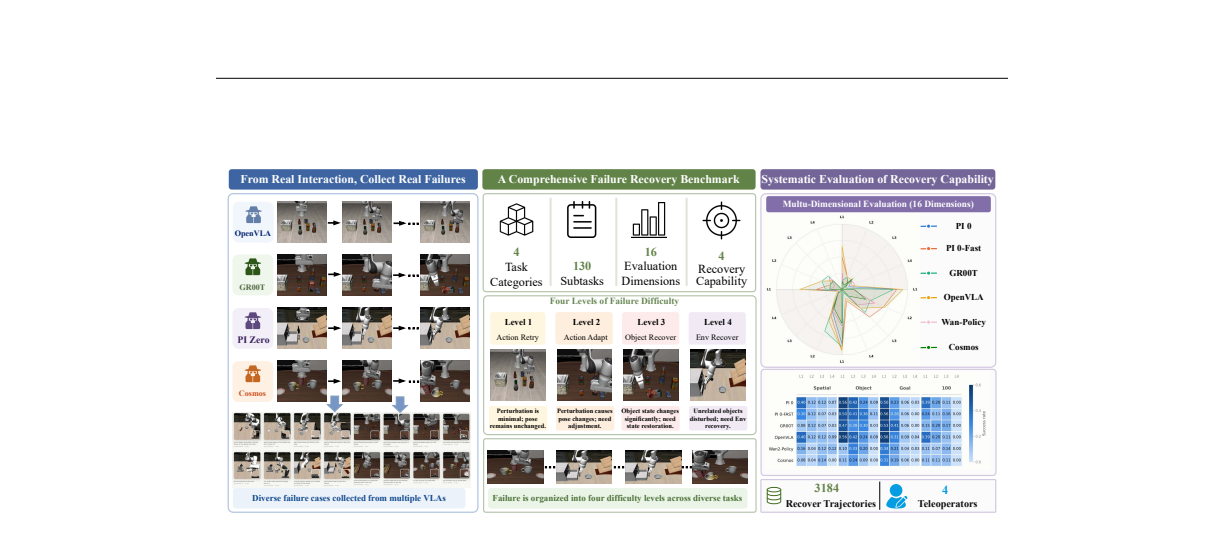
However, near perfect performance on existing benchmarks can be misleading: success under ideal conditions does not imply real world robustness. Existing benchmarks primarily evaluate task completion from predefined initial states, while real world interactions inevitably involve failures such as failed grasps, collisions, and unintended object movements. A robot must therefore not only execute tasks successfully, but also recognize and recover from failures to continue the task. Yet this capability remains largely unmeasured, revealing a critical gap between benchmark performance and real world reliability. To address this gap, we introduce LIBERO-Recover Benchmark, a large scale benchmark for failure recovery in robotic manipulation. Built upon LIBERO, we collect real execution failures from SOTA embodied models and construct 1,000+ scenarios across four recovery levels: (1) Action Retry, (2) Action Adaptation, (3) Object State Recovery, and (4) Environmental Recovery. We evaluate four core capabilities: spatial understanding, object structure reasoning, interaction understanding, and topological reasoning. As the first large-scale benchmark for embodied failure recovery, LIBERO-Recover shifts evaluation from Can the robot succeed?” to Can the robot recover after failure?”, promoting robust and generalizable embodied agents. The project will be avaible in \textcolorbluehttps://liulin815.github.io/LIBERO-Recovery/.
from the abstract
Pith says
Machine review · deepseek-v4-flash · 8 Sep 2026 · of version 1 of the paper; version 4 is newer · what was read was not recorded · not checked by a person
It can be wrong. Challenge this review or reply to it.
Holds up. LIBERO-Recover fills a real gap in robotic manipulation evaluation, but a plausible confound in time limits needs a clean rebuttal. This line is wrong
2 major objections · 6 minor
How often objections from reviews like this one are right: not yet measured
Not checked: figures, code, what the references say.
The paper says, at Section 5.1 (Experimental Setup)
The review did not quote this passage.
Pith says: Objection 1 of 2 · major
The paper states that evaluations use a time limit of 1.1× average human completion time scaled by task difficulty, following LIBERO. However, it is not specified whether this time limit was adjusted for recovery scenarios, which start from a failure state rather than the standard initial state.
more of objection 1
If the same time limit is used, models have less effective time to complete the task (they must first undo the failure before making forward progress), which could artificially suppress RSR and confound the central claim that 'all models suffer over 50% performance drops.' The authors should either (a) report whether the time limit was adjusted for recovery scenarios, (b) provide an analysis of how many failures are due to time expiration versus inability to recover, or (c) discuss this limitation explicitly.
The paper says, at Section 3.4 (Stage 3: Failure Characterization)
The review did not quote this passage.
Pith says: Objection 2 of 2 · major
The failure type and difficulty level are automatically labeled by Qwen3.5-27B-Instruct using video analysis. The paper does not report any manual validation or inter-annotator agreement for this labeling. If the VLM misclassifies failure types or temporal boundaries, the per-level evaluation (RSR_L1–L4) could be noisy. The authors should provide a human validation study on a random subset of scenarios to quantify labeling accuracy, or at least discuss this limitation.
6 minor objections
The paper says, at Abstract
Pith says: minor objection 1 of 6
Typo: 'avaible' should be 'available'.
The paper says, at Figure 6 caption
Pith says: minor objection 2 of 6
Typo: 'performace' should be 'performance'.
show 4 more
The paper says, at Table 1
Pith says: minor objection 3 of 6
The method abbreviations are inconsistent: 'PI' is used for π0, but the caption writes 'PI (PI-0)'. Use consistent notation throughout (e.g., π0, π0-Fast).
The paper says, at Section 1 (Introduction)
Pith says: minor objection 4 of 6
The claim that 'SOTA method have achieved nearly 100% success rates' is not accompanied by specific citations. Please provide references for the methods achieving these rates on LIBERO.
The paper says, at Section 3.4 (Stage 2)
Pith says: minor objection 5 of 6
The sentence '10 578 · 27.3%' appears to be a formatting artifact from Figure 5. Please clean up the text.
The paper says, at Section 5.2.1
Pith says: minor objection 6 of 6
Figure 10 is referenced but the correct figure for the main results is Figure 6. Please correct the cross-reference.
What would settle it
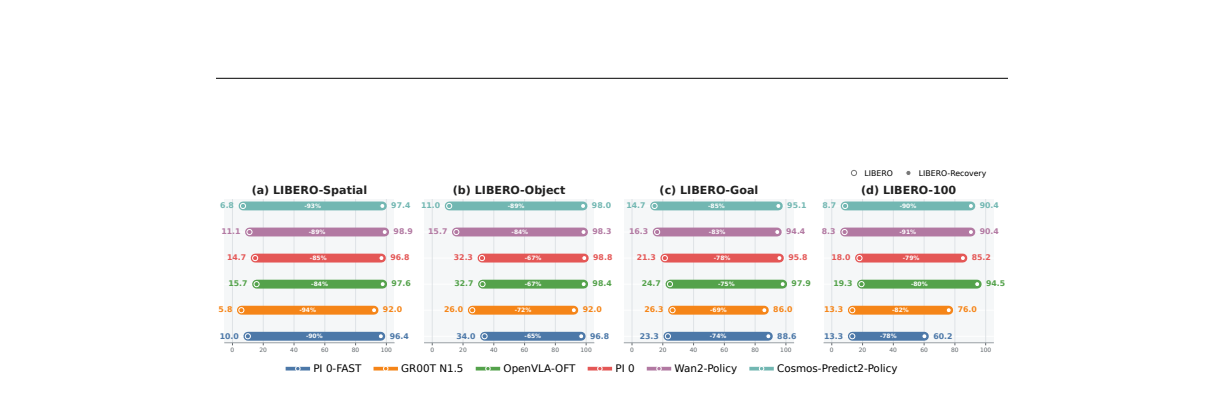
For each failure scenario, measure the average human recovery time from the 3,184 human teleoperator trajectories (Section 4.1). Recompute RSR using a time limit of 1.1× that scenario-specific human recovery time (or a fixed multiplier). Compare the new RSR to the original values in Figure 6. If the gap between LIBERO and LIBERO-Recover shrinks by more than 10 percentage points, the reported >50% drop is partly an artifact of insufficient time.
from the skeptic's reading
How the review went
4 readings by deepseek-v4-flash · 8 Sep 2026
- Reader holds up
- Skeptic disagrees
- Editor wrote the verdict above
- Referee minor revision: 2 major objections, 6 minor
Not run on this paper: the simulated authors' defence.
Pith did not check this review's objections against the paper.
The review in full
The review in brief, machine-written
Let me give you a direct read on this paper. The core idea—building a benchmark from naturally occurring execution failures rather than hand-crafted scene perturbations—is the right move. The taxonomy (Action Retry → Action Adaptation → Object State Recovery → Environmental Recovery) is well-motivated, and the scale (2,178 scenarios across 130 subtasks) is substantial. The experiments are thorough: six models, four task suites, careful metrics (RSR, RD, RC). The findings about chunk size and temporal context are informative and actionable.
What the reader’s report gets right: this is a genuine contribution to the benchmark ecosystem, and the paper is clearly written. The reader’s weak spot flag about VLM labeling accuracy is fair—the paper relies on Qwen3.5-27B-Instruct for both temporal localization and failure-level classification without any human validation or agreement numbers. That introduces real noise, especially for the harder levels (L3/L4) where misclassification could alter conclusions.
Now the stress-test note about time limits: this is not a minor nit. The paper explicitly states it uses 1.1× average human completion time, following LIBERO. But recovery scenarios start from a failure state, not the initial state. The model must first undo the failure (e.g., re-grasp a displaced bowl) before making forward progress. If the time budget is unchanged, the model effectively has less usable time. This could systematically depress RSR, especially on L3/L4 where recovery actions are longer. The paper does not discuss this, nor does it provide sensitivity analysis. The central claim that "all models suffer over 50% performance drops" might be partially confounded. The direction of the claim is probably still correct given the magnitude of the drops, but the exact number is uncertain.
Other soft spots: no real-world validation (simulation only, which limits the claim about real-world robustness), and the fine-tuning results (Key Finding 6) are interesting but the transfer gap interpretation needs stronger statistical support.
Who is this for? Robotics evaluation researchers, especially those working on VLA/WAM robustness. It deserves a serious referee, but I would ask for (1) time-limit analysis for recovery scenarios, (2) human validation of VLM labeling, and (3) a limitations section that explicitly addresses these points.
For our group: maybe bring to reading group if someone is working on benchmarking; I’d cite it as related work. I’d accept peer review with a request for revisions on the time-limit issue.
The strongest objection
Section 5.1 states that all evaluations use a time limit of 1.1× average human completion time scaled by task difficulty, following LIBERO. However, recovery scenarios in LIBERO-Recover start from a failure state, not the standard initial state. Human teleoperators collected recovery trajectories (Section 4.1), but the paper does not report whether the time limit was adjusted for recovery. If the same time limit as the original task is used, the model has less time to complete the task because it must first undo the failure before making forward progress. This could artificially suppress RSR, especially on challenging L3 and L4 scenarios. The central claim that 'all models suffer over 50% performance drops' may be partially confounded by this design choice. The paper does not discuss this limitation or provide analysis of time limit impact.
The paper's central claim depends on the observed large performance gap between standard LIBERO and LIBERO-Recover. While VLM labeling accuracy is a valid concern (the reader's weakest_assumption), it primarily affects per-level categorization rather than the overall RSR gap. A more direct threat to the headline claim is the time limit: recovery scenarios are inherently time-consuming because they require both recovery and task execution. Using the same time limit as the original task (for which the initial state is controlled) may unfairly penalize models. The paper does not discuss whether the time limit was adjusted or how it was set. This is a clean experimental design issue that can be resolved by recomputing with appropriate time limits. The benchmark contribution remains valuable regardless of the exact magnitude of the drop, so the verdict does not change, but the authors should address this in future work.
The referee's report
LIBERO-Recover addresses a critical gap in robotic manipulation evaluation: the ability to recover from failures that inevitably occur in real-world deployment. The benchmark is large-scale, systematically constructed from actual model failures rather than manual perturbations, and covers a diverse set of tasks and recovery levels. The finding that all tested models suffer >50% performance drops is striking and highlights that current benchmarks may overestimate real-world robustness. The analysis of action chunk size, temporal context, and recovery training transfer provides actionable insights for future research. This benchmark is likely to become a standard evaluation tool for failure-aware embodied agents.
Pith's reading of the paper (a machine's summary, not the authors')
The paper argues that existing robotic manipulation benchmarks, which report near-perfect success rates, are misleading because they only evaluate one-shot task completion from predefined initial states. In real-world deployment, robots inevitably encounter failures like failed grasps or collisions and must recover from them. LIBERO-Recover is a new benchmark that collects naturally occurring failures from state-of-the-art models and evaluates recovery across four difficulty levels. The central finding is that all evaluated models suffer over 50% performance drops when tested on failure recovery, revealing a critical gap between benchmark success and real-world robustness.
What carries the argument. The four-level failure taxonomy (Action Retry, Action Adaptation, Object State Recovery, Environmental Recovery) organizes failures by the amount of state reasoning required to resume the task. The construction pipeline uses real model executions as failure generators and a vision-language model (Qwen3.5-27B-Instruct) to temporally localize and classify failures, producing 2,117 recovery scenarios grounded in actual execution failures rather than manual perturbations.
Core claim. The paper discovers that all six state-of-the-art vision-language-action and world-action models (OpenVLA, π0, π0-Fast, GR00T, Wan2-Policy, Cosmos-Predict2-Policy) experience a performance degradation of more than 50% when evaluated on failure recovery compared to standard task success. The degradation is most severe for higher-level failures requiring object state or environmental recovery. Furthermore, training on recovery data does not transfer well to failures encountered during standard execution, and smaller action chunks improve recovery by enabling more frequent state feedback.
The premise it rests on. The failure scenarios are automatically labeled by a single vision-language model (Qwen3.5-27B-Instruct) without manual validation, so the accuracy of failure type classification and temporal boundaries is unknown and may introduce noise into the evaluation.
If the paper is right (Pith's inferences, not the authors')
Standard benchmarks overestimate real-world robustness of robotic manipulation models.
Recovery capability degrades sharply as failures require deeper state reasoning (Level 3 and Level 4).
Smaller action chunks consistently improve recovery success across all models and task suites.
Providing temporal context (the initial task frame) improves recovery performance.
Training on recovery data does not effectively transfer to failures arising during standard task execution.
The automatic labeling by a single vision-language model without human validation is a potential source of noise; future benchmarks should incorporate human verification or multiple annotators to ensure reliability.
The failure-recovery transfer gap suggests that models need to learn online failure detection during their own execution, not just recovery actions from static failure states.
The concentrated state distribution of failures around critical interactions (grasping, placing) implies that targeted data augmentation in those regions could be more sample-efficient than broad recovery training.
Check this review
Pith stored no record of this review's passes and took no fingerprint of it. Reviews made by code from 13 Nov 2026 on carry both.
How often reviews like this one are right
Reviews like this one: written by deepseek-v4-flash, where what was read was not recorded.
How often objections from reviews like this one are right: not yet measured
Reviews by people
This review was written by a machine. No person has reviewed this paper on Pith yet. A scientist listed on Pith can review it for a fee, and their review is published here whatever it concludes.
The paper
Abstract
Vision-Language-Action (VLA) or World Action (WAM) models have recently demonstrated remarkable performance in robotic manipulation. On LIBERO, SOTA method have achieved nearly 100% success rates, seemingly suggesting that the models are ready for deployment in real world. However, near perfect performance on existing benchmarks can be misleading: success under ideal conditions does not imply real world robustness. Existing benchmarks primarily evaluate task completion from predefined initial states, while real world interactions inevitably involve failures such as failed grasps, collisions, and unintended object movements. A robot must therefore not only execute tasks successfully, but also recognize and recover from failures to continue the task. Yet this capability remains largely unmeasured, revealing a critical gap between benchmark performance and real world reliability. To address this gap, we introduce LIBERO-Recover Benchmark, a large scale benchmark for failure recovery in robotic manipulation. Built upon LIBERO, we collect real execution failures from SOTA embodied models and construct 1,000+ scenarios across four recovery levels: (1) Action Retry, (2) Action Adaptation, (3) Object State Recovery, and (4) Environmental Recovery. We evaluate four core capabilities: spatial understanding, object structure reasoning, interaction understanding, and topological reasoning. As the first large-scale benchmark for embodied failure recovery, LIBERO-Recover shifts evaluation from Can the robot succeed?” to Can the robot recover after failure?”, promoting robust and generalizable embodied agents. The project will be avaible in \textcolorbluehttps://liulin815.github.io/LIBERO-Recovery/.
The paper's own sentences, arranged, kept beside the review and separate from it. Each label is drawn from a closed vocabulary; the number beside it is the probability the classifier gave that label. No sentence in this record was written by a model.
abstract compiled · 2026-09-23
The authors' main claim, as the classifier picked it out 0.88
“As the first large-scale benchmark for embodied failure recovery, LIBERO-Recover shifts evaluation from \emph{Can the robot succeed?''} to \emph{Can the robot recover after failure?''}, promoting robust and generalizable embodied agents.”
How the main claim is stated: asserted 0.99
What the abstract itself states, as probabilities: claims first 0.94 · states limitation 0.11 · human participants 0.05 · controlled comparison 0.13 · randomized assignment 0.02 · states quantitative result 0.83 · compares with prior results 0.57 · mentions code or data availability 0.84
The abstract, sentence by sentence
This table labels the abstract only (arXiv listing abstract v2). The number is the probability the classifier gave the label.
| Sentence | Role | The authors' own work | States the main conclusion | Strength |
|---|---|---|---|---|
| Vision-Language-Action (VLA) or World Action (WAM) models have recently demonstrated remarkable performance in robotic manipulation. | background 1.00 | 0.03 | 0.02 | asserted 1.00 |
| On LIBERO, SOTA method have achieved nearly 100\% success rates, seemingly suggesting that the models are ready for deployment in real world. | background 0.85 | 0.06 | 0.04 | hedged possibility 0.58 |
| However, near perfect performance on existing benchmarks can be misleading: success under ideal conditions does not imply real world robustness. | background 0.47 | 0.13 | 0.20 | asserted 0.93 |
| Existing benchmarks primarily evaluate task completion from predefined initial states, while real world interactions inevitably involve failures such as failed grasps, collisions, and unintended object movements. | gap 0.52 | 0.08 | 0.07 | asserted 1.00 |
| A robot must therefore not only execute tasks successfully, but also recognize and recover from failures to continue the task. | background 0.83 | 0.06 | 0.16 | asserted 0.99 |
| Yet this capability remains largely unmeasured, revealing a critical gap between benchmark performance and real world reliability. | gap 1.00 | 0.17 | 0.16 | asserted 1.00 |
| To address this gap, we introduce LIBERO-Recover Benchmark, a large scale benchmark for failure recovery in robotic manipulation. | contribution 1.00 | 0.94 | 0.09 | asserted 1.00 |
| Built upon LIBERO, we collect real execution failures from SOTA embodied models and construct 1,000+ scenarios across four recovery levels: (1) Action Retry, (2) Action Adaptation, (3) Object State Recovery, and (4) Environmental Recovery. | method 0.88 | 0.96 | 0.06 | asserted 1.00 |
| We evaluate four core capabilities: spatial understanding, object structure reasoning, interaction understanding, and topological reasoning. | method 0.72 | 0.79 | 0.05 | asserted 0.97 |
| As the first large-scale benchmark for embodied failure recovery, LIBERO-Recover shifts evaluation from \emph{Can the robot succeed?''} to \emph{Can the robot recover after failure?''}, promoting robust and generalizable embodied agents. | contribution 0.63 | 0.74 | 0.63 | asserted 0.99 |
| The project will be avaible in \textcolor{blue}{https://liulin815.github.io/LIBERO-Recovery/}. | contribution 0.59 | 0.28 | 0.02 | asserted 0.88 |
What kind of paper the classifier reports this is: dataset or benchmark 1.00 · evidence from observation or experiment 0.81
What was examined, and what was not
Sources read
- arXiv listing abstract v2
Not examined
- full text
- figures and tables
- references and citing sentences
- relations to other papers
Levels run
- P abstract
Not run
- S sections
- T body sentences
- C citations
- R cross-paper relations
How the labels were made
Compiled by classifier-1.13.0 via TypeSafe API, question bank abstract-p1-20260923, 2026-09-23: 1 request, 8,305 input tokens.
Every quoted sentence on this record is the authors'. Every label is from Pith's closed vocabulary, with the probability shown beside it. This record as JSON
Figures (10)




Figures are the authors', reproduced from the paper.
Cited by 10 Pith papers
Reviewed papers on Pith that cite this one. The full citation record
- FailPoint-X: A Policy-Matched, Failure-Anchored Benchmark for Offline VLA Post-Training from Human Takeovers cs.RO · Nov 2026
- Can LLMs Debug Robots by Editing Their Weights? cs.RO · Nov 2026
- Retrieve to Act: Motion Primitive Graph Retrieval for Robust VLA Execution cs.RO · Oct 2026
- Echo: Coupled Action and Task Status Signal Denoising for Vision Language Action Models cs.RO · Oct 2026
- CarryOn: A Dual-Loop Harness for Personalized and Reliable Robot Assistance cs.RO · Oct 2026
- Recova: Agent-Guided Failure Recovery for Autonomous Robotic Manipulation cs.RO · Oct 2026
- Kintsugi-VLA: Turning Failed Robot Rollouts into Recovery Data through Interventional Recoverability cs.RO · Sep 2026
- FIT-MAC: A Closed-Loop Multi-Agent Framework for Robust Vision-Language-Action Models cs.RO · Oct 2026
- RegenHarness: A Robot Agent Harness with Evidence-Gated Recursive Self-Improvement cs.RO · Sep 2026
- Towards Agentic Robots: Model, Data, Environment, and Harness cs.RO · Oct 2026
Challenges and discussion
Disagree with the review, or know something it missed? Leave a comment, or challenge this review formally: a challenge becomes a permanent entry in this paper's record, and its decision is published here.
Come back by email
A short list of the week's newly reviewed papers. Nothing is sent until you confirm from your inbox, and every email has a link that stops it. No account.
No comments yet.
Sign in to comment