Robotics · arXiv:2609.31048 v1 · submitted 25 Sep 2026 · 15 references
Kintsugi-VLA: Turning Failed Robot Rollouts into Recovery Data through Interventional Recoverability
The paper says
“Simulation enables scalable training of Vision-Language-Action policies by using privileged experts to generate visual demonstrations without requiring every trajectory to be collected through manual teleoperation.”
more of the abstract
However, such pipelines typically retain successful demonstrations while failed rollouts are discarded, even though they expose precisely the off-nominal states from which recovery must be learned. We introduce Kintsugi-VLA, a framework for converting failed rollouts into targeted synthetic recovery data by exploiting exact state restoration and branching in simulation. For a fixed privileged expert, we define interventional recoverability as the probability of completing the original task after the simulator is restored to a given state, estimate it using adaptive Monte Carlo continuations with pointwise Wilson intervals, and characterize its non-monotonic evolution along failed trajectories. These estimates identify an observed terminal low-recoverability frontier-the point after which measured recoverability remains below a threshold-which is then used to select informative recovery starting states. In a simulated Franka manipulation task, targeted recovery data yield aggregate SmolVLA recovery success of 34.6% and 38.4% under difficulty- and frame-budget matching, respectively, 5.8 and 6.7 percentage points above uniform sampling within the same recovery window. The same ordering is observed under disturbed end-to-end execution and shifted clutter and physics conditions, while clean-task success decreases from 76.8% to 74.7%. Kintsugi-VLA demonstrates how failed simulator rollouts can be transformed from discarded experience into structured recovery-training data through direct interventional measurement.
from the abstract
Pith says
Machine review · deepseek-v4-flash · 28 Sep 2026 · what was read was not recorded · not checked by a person
It can be wrong. Challenge this review or reply to it.
Holds up, with conditions. A genuinely new selection signal — restore-and-branch recoverability — with an unusually honest paper that flags its own statistical gate; worth a serious referee even though the headline gains lack per-seed dispersion. This line is wrong
3 major objections · 4 minor
How often objections from reviews like this one are right: not yet measured
Not checked: figures, code, what the 15 references say.
The paper says, at Sec. V.F, Table IV
The review did not quote this passage.
A classifier read this sentence of the paper as acknowledging the concern (probability 0.91):
“Between-training-seed dispersion is not reported for these aggregate rates.”
Pith says: Objection 1 of 3 · major
The headline claim—V3 over V2 gains of 5.8 and 6.7 pp—rests on single aggregate rates with no between-training-seed dispersion, which the authors concede (b184), and the text states these differences 'do not establish statistical significance' (b193). Protocol A evaluates 300 shared frozen states with five attempts per state; attempts within a state are correlated and states are paired across policies, …
more of objection 1
… so a 5.8 pp gap is roughly 17 of 300 states, while teacher-level state variance is large (40.0–98.0% across difficulty bins, b164). Weighing the transfer implication: the paper states at least three training seeds per variant were trained (Sec. IV.C). I request that these per-seed results be reported and a paired analysis performed that respects the state/episode structure (e.g., a paired test over states, or a bootstrap that keeps the five attempts per state intact). Without this, the central claim that targeted selection beats uniform-window selection is not verifiable from the paper as written.
The paper says, at Sec. III.D, Sec. V.F, Sec. VI
The review did not quote this passage.
A classifier read this sentence of the paper as acknowledging the concern (probability 0.64):
“Historical cohorts also differ in restoration se- mantics, preventing direct longitudinal comparison.”
Pith says: Objection 2 of 3 · major
The load-bearing structural premise—that teacher-measured recoverability along the failed trajectory orders the benefit the downstream VLA obtains from recovery training at those states—is untested, as the authors themselves state in Sec. VI (b216): bin separation establishes teacher-level difficulty ordering but not fine-grained calibration or direct transfer to VLA recovery difficulty.
more of objection 2
Note that difficulty matching (Sec. III.E) equalizes demonstration counts across shared expert-recoverability bins, which controls for bin composition; what remains unvalidated is the positional benefit of the fixed depths 0.15/0.50/0.85 over uniform sampling within the window. The selector uses only the frontier location, not local recoverability values (Sec. III.D). Please provide direct evidence for transfer, for example per-bin or per-depth VLA recovery success under Protocol A, or a correlation between teacher recoverability at a checkpoint and the VLA's recovery success from that checkpoint. This is the weakest link in the causal story from intervention to curation benefit.
The paper says, at Sec. IV.F, b138
The review did not quote this passage.
A classifier read this sentence of the paper as acknowledging the concern (probability 0.95):
“Those historical training records did not contain state IDs, object IDs, scene parameters, or source-snapshot hashes, so the audit cannot exclude overlap beyond the identifiers that were recorded.”
Pith says: Objection 3 of 3 · major
The leakage audit cannot exclude state-level overlap between training manifests and the 300 frozen evaluation states because the historical training records lack state IDs, object IDs, scene parameters, and source-snapshot hashes (b138). The authors acknowledge this, but the residual risk is material for the central claim precisely because the reported margins are small (5.8 pp) and are conceded to be statistically unresolved.
more of objection 3
Given that the same failed-rollout source corpus feeds both training and the Protocol A evaluation pool, I ask that the paper either bound the possible overlap (for example by hashing and matching whatever source identifiers are available retroactively) or state explicitly which part of the selection pipeline makes training/evaluation state overlap impossible.
4 minor objections
The paper says, at Table IV
Pith says: minor objection 1 of 4
The V0 row reads '12.5 12.5 55.776.89.6'—the disturbed and clean Protocol B columns are concatenated and should be separated (55.7, 76.8, 9.6).
The paper says, at Sec. III.B, Sec. V.B
Pith says: minor objection 2 of 4
With zero successes in 30 trials the Wilson upper endpoint is approximately 0.1135, so the ladder cannot resolve thresholds below about 0.11; the frontier count of zero at τ=0.1 (b148) is a direct consequence. The text mentions this, but Fig. 5 and the threshold-sweep discussion would be clearer if the measurement-resolution floor were marked explicitly, since the τ=0.1 result is a resolution artifact rather than evidence of absent low-recoverability frontiers.
show 2 more
The paper says, at Sec. V.B
Pith says: minor objection 3 of 4
The historical frontier statistics were not recomputed with the revised Protocol G restoration procedure, and the two cohorts therefore differ in restoration semantics (b216). A sentence stating which qualitative conclusions (non-monotonicity, islands, frontier localization) are believed robust to that change would help the reader weigh the historical findings against the Protocol G results.
The paper says, at Sec. III.D
Pith says: minor objection 4 of 4
The deliberate choice to use only the frontier location and not the local recoverability values or recovery islands in state selection is stated, but it deserves emphasis in the main text: given that islands are documented as common (70.9% of episodes), the fact that island-aware selection is deferred to future work is a notable scope decision that readers may otherwise miss.
What would settle it
Recompute the Protocol A V3-versus-V2 contrast reporting per-training-seed recovery success, and run a state-blocked analysis paired over the 300 shared frozen states (five attempts each) — a mixed-effects model or state-ID bootstrap — on the difference under both difficulty and frame-budget matching. If the 95% interval on the V3 minus V2 difference includes zero under either scheme, the headline selection gain is unestablished even within the single evaluated setting. As an adjacent verification, re-run the overlap audit with state/object/snapshot hashes added to the training manifests to close the b138 gap; if no state-level overlap is found, that residual correctness risk is retired.
from the skeptic's reading
How the review went
4 readings by deepseek-v4-flash · 28 Sep 2026
- Reader holds up, with conditions
- Skeptic partly agrees
- Editor wrote the verdict above
- Referee major revision: 3 major objections, 4 minor
Not run on this paper: the simulated authors' defence.
Pith did not check this review's objections against the paper.
The review in full
The review in brief, machine-written
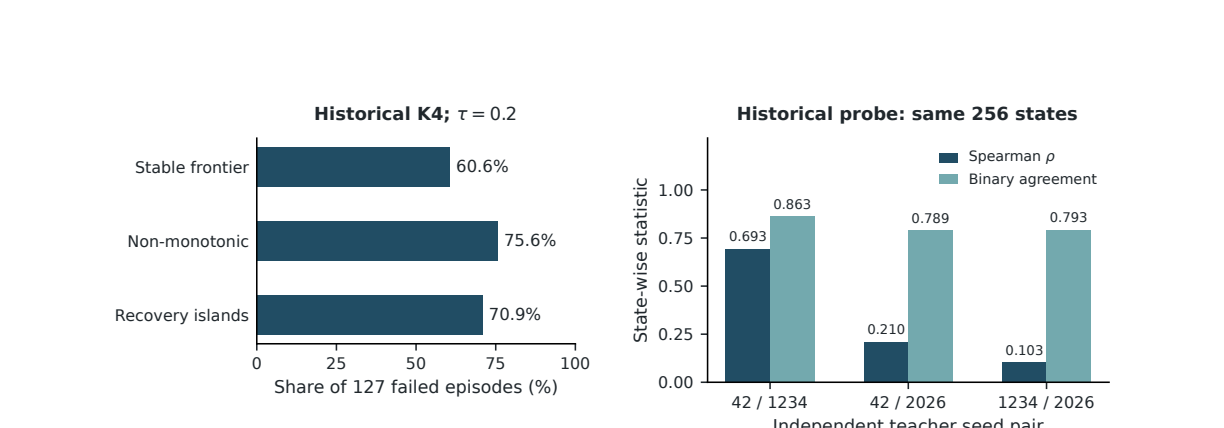
The one thing to know: this is a genuinely new idea, and the paper is unusually honest about where it falls short. Measuring expert-relative recoverability by restoring simulator states and branching under a privileged teacher, then using the measured frontier to pick recovery-training states, does not appear in the IntervenGen, RaC, SAFE, or LIBERO-RECOVER lines. The paper measures the curriculum signal directly via interventional Monte Carlo rather than leaning on a learned failure predictor. Design is careful too: Protocol A separates the 300 frozen evaluation states from training selections, matching is done on manifests, restoration semantics are specified to a 2e-5 tolerance. The teacher-dependence audit is a real contribution — Spearman as low as 0.103 between nominally competent teachers (b159) is an honest, uncomfortable result that supports treating recoverability as teacher-relative rather than a ground-truth state property. The paper is coherent on its own terms and the authors flag their limitations explicitly (b184, b193, b138, b216), which is more than most submissions do.
The soft spot is the statistical gate, and it is load-bearing for the headline claim. The 5.8 and 6.7 pp gains over the uniform-window control are single aggregates with no per-seed dispersion (b184), and the authors concede the differences do not establish significance (b193). On 300 paired states with five attempts each, a 5.8 pp gap is roughly 17 states; teacher-level recoverability spans 40 to 98 percent across bins (b164), so state-level noise is not trivially small relative to the gain. The transfer assumption — that teacher-measured recoverability at the fixed depths orders VLA learning benefit — is real but partially tested by the V3-versus-V2 contrast itself, so its residual force is a generalization limit rather than the first gate. The leakage audit cannot exclude state-level overlap because training records lacked state and object IDs (b138). These are unresolved gates, not hidden defects; the paper states all of them.
One thing the stress-test note underweighs: the ordering is consistent across four independent contrasts — Protocol A difficulty and frames, Protocol B disturbed execution, Protocol G recovery — all in the same direction. That does not substitute for significance testing, but it weakens the pure-noise worry. The clean-task cost is modest (2.1 points) and honestly reported.
Who it is for: anyone building synthetic VLA data pipelines or working on failure recovery in imitation learning. The method is useful even if the headline gain needs firmer statistical grounding. Send it to review — it will not be accepted as-is, the per-seed analysis has to be added, but the idea and the honest failure analysis earn the referee time.
The strongest objection
The central claim — targeted depth selection (V3) beats uniform-window selection (V2) by 5.8 and 6.7 pp — rests on single aggregate rates with no between-training-seed dispersion (b184), and the authors concede the differences do not establish statistical significance (b193). Protocol A evaluates on 300 shared frozen states with five attempts per state; the unit of independence is the state (attempts within a state are correlated, and states are paired across policies). A 5.8 pp gap is roughly 17 of 300 states, while teacher-level recoverability shows high state variance (40.0–98.0% success across difficulty bins, b164), so plausible state-level noise approaches the reported gain. The teacher bootstrap (b211) targets a different estimand and cannot quantify VLA uncertainty. Compounding the issue, the signal's own robustness is weak: the independent-teacher audit shows state-wise recoverability rankings differ substantially across nominally competent teachers (Spearman as low as 0.103, b159) and cross-expert frontier stability is untested (b162, b207). Additionally, the leakage audit could not exclude state-level overlap between training manifests and the 300 evaluation states because training records lacked state/object IDs and source-snapshot hashes (b138); if such overlap existed, part of the gain could be an artifact. The Section VI transfer premise (b216) — that teacher-measured recoverability at depths 0.15/0.50/0.85 orders VLA learning benefit — is a real but partially tested assumption: the V3-versus-V2 contrast itself tests it within one teacher and one task, so its residual force is a generalization limit rather than the first gate. The first gate is statistical: the headline numbers are currently unqualified by any uncertainty measure.
The design is genuinely careful: evaluation states are frozen, paired across policies and separated from training selections; V2 is a strong control sharing the same frontier-defined window; difficulty- and frame-budget matching address quantity confounds; and the adaptive-stopping, time-uniform-coverage, and teacher-relativity caveats are openly flagged. The honesty is a strength, not a defect, and I make no imputation against the authors. My independent read converges on much of the reader's assessment but weights the gates differently. I regard per-seed dispersion and significance testing as the most load-bearing condition, because it gates the headline numbers even within the single evaluated setting: the V3 versus V2 difference of 5.8–6.7 pp on roughly 300 correlated states, with teacher-level state variance spanning 40–98%, is plausibly within noise, and the authors themselves concede significance is not established (b184, b193). The transfer premise the reader flags as weakest (b216) is, in my reading, partly tested by the V3-versus-V2 contrast itself — both variants share the window and source trajectories and differ only in depth positioning — so its residual force is a generalization limit (one teacher, one task, one depth schedule) rather than the first gate. The paper's own most incisive self-observation is the teacher-instability audit (b159): ranking correlations down to 0.103 across nominally competent teachers, with cross-expert frontier stability untested, show the recoverability signal is teacher-idiosyncratic; this compounds the statistical gate because any future re-analysis with a different teacher could plausibly shift the frontier and the selected depths. The leakage-audit gap (b138) is a real but fully disclosed residual correctness risk. Because my concern identifies the same unresolved gates the reader used to justify CONDITIONAL — it sharpens one of them rather than introducing a new category — I do not move the verdict. If the proposed concrete test resolves the interval away from zero, the central claim would be substantially supported; if it straddles zero, the paper would need a re-analysis or a downgraded, mechanism-only reading.
The referee's report
If the reported gains hold, this is a genuinely useful contribution: it gives a principled, expert-relative criterion for deciding which states of a failed rollout to turn into recovery demonstrations, and it is built on an unusually careful experimental skeleton. Protocol A uses 300 frozen evaluation states kept separate from the selected training states, matching is applied to demonstration manifests rather than to raw trajectories, and restoration semantics are checked to a 2×10⁻⁵ tolerance (Sec. IV.E). The authors are also commendably explicit about scope: recoverability is defined as expert-relative, the teacher-dependence audit (Table II, Fig. 6) is reported rather than hidden, and the limitations section (Sec. VI) concedes the main unresolved points. Those concessions, however, land precisely on the load-bearing claim: the headline selection gain is a single aggregate with no per-seed dispersion and is conceded to be statistically unresolved, and the teacher-to-VLA transfer premise is untested.
Pith's reading of the paper (a machine's summary, not the authors')
This paper asks a question upstream of most failure-recovery work: when a robot rollout fails in simulation, which states along that failed trajectory should be used to generate recovery demonstrations? The proposed framework, Kintsugi-VLA, answers it by restoring each saved simulator checkpoint, repeatedly handing control to a fixed privileged expert, and measuring the fraction of continuations that complete the original task. Targeted selection at three fixed depths of the measured recovery window raises closed-loop recovery success of a vision-language-action policy by 5.8 and 6.7 percentage points over uniform sampling at matched difficulty and frame budgets, with the same ordering under disturbed execution and shifted clutter-physics conditions. The work establishes that failed rollouts, normally discarded, can be converted into structured recovery data through direct interventional measurement.
What carries the argument. The central object is the expert-relative recoverability function $p^E_{\mathrm{rec}}(t_i)$: the probability that a fixed recovery expert $\pi^E$ completes the original task when the simulator is restored to checkpoint $t_i$ and control is handed over under a specified continuation and restoration protocol. It is estimated by adaptive Monte Carlo continuations along a 5 to 15 to 30 trial ladder, summarized with pointwise Wilson intervals, and condensed into a terminal low-recoverability frontier, the earliest checkpoint after which all upper interval endpoints stay below threshold $\tau$. The frontier localizes the recovery window, and targeted sampling at normalized depths 0.15, 0.50, and 0.85 selects the states from which complete successful expert continuations are exported as synthetic recovery demonstrations for VLA adaptation.
Core claim. The central claim is that expert-relative interventional recoverability, estimated by branching repeated continuations from restored simulator snapshots, is a useful signal for curating recovery training data. On a simulated Franka cube lift-and-transport task, the teacher-measured curve is neither monotonic nor expert-independent: 60.6% of failed episodes show a stable terminal low-recoverability frontier, 75.6% show non-monotonic structure, and 70.9% contain later recovery islands, while three nominally competent teachers disagree substantially on state rankings (Spearman 0.103 to 0.693). Selecting recovery starting states at normalized depths 0.15, 0.50, and 0.85 relative to the detected frontier outperforms uniform sampling within the same window, reaching 34.6% and 38.4% aggregate SmolVLA recovery success versus 28.8% and 31.7% under difficulty- and frame-budget matching, at a cost of a 2.1-point drop in clean-task success.
The premise it rests on. The load-bearing assumption is that teacher-measured recoverability at the three fixed depths transfers to how well the downstream vision-language-action policy learns recovery from those states; the paper itself notes that bin separation establishes teacher-level difficulty ordering but not direct transfer to VLA recovery difficulty.
If the paper is right (Pith's inferences, not the authors')
Failed simulator rollouts become a recoverable training resource: restoring a checkpoint and measuring expert continuation success identifies states worth converting into synthetic recovery demonstrations.
Targeted data selection, at matched difficulty and frame budgets, yields higher aggregate closed-loop recovery success than uniform sampling within the same recovery window, with the same ordering under disturbed end-to-end execution and shifted clutter-physics conditions.
Recovery adaptation costs nominal performance: clean-task success drops from 76.8% (nominal-only) to 74.7% (targeted recovery data), quantifying a trade-off that recovery-data schemes must account for.
The same recovery level is reached with roughly 30% fewer demonstrations and frame records under targeted selection, when simulator compute for measurement is excluded.
The fixed normalized depths (0.15, 0.50, 0.85) are a pragmatic choice, since the paper measures local recoverability values and islands but does not use them directly; a natural extension, which the authors flag as open, is depth selection driven by the estimated curve itself.
Because state rankings differ across nominally competent teachers, the selection signal is teacher-relative; a testable extension is whether retraining targeted data from a teacher with a different ranking preserves the VLA gain, and if it does not, the teacher-to-VLA transfer assumption is the load-bearing point.
The clean-task drop suggests a capacity trade-off between recovery and nominal behavior; mixing nominal and recovery data in different ratios, or limiting recovery-data exposure, could recover the clean baseline without losing the recovery gain.
Check this review
Pith stored no record of this review's passes and took no fingerprint of it. Reviews made by code from 13 Nov 2026 on carry both.
How often reviews like this one are right
Reviews like this one: written by deepseek-v4-flash, where what was read was not recorded.
How often objections from reviews like this one are right: not yet measured
Reviews by people
This review was written by a machine. No person has reviewed this paper on Pith yet. A scientist listed on Pith can review it for a fee, and their review is published here whatever it concludes.
The paper
Abstract
Simulation enables scalable training of Vision-Language-Action policies by using privileged experts to generate visual demonstrations without requiring every trajectory to be collected through manual teleoperation. However, such pipelines typically retain successful demonstrations while failed rollouts are discarded, even though they expose precisely the off-nominal states from which recovery must be learned. We introduce Kintsugi-VLA, a framework for converting failed rollouts into targeted synthetic recovery data by exploiting exact state restoration and branching in simulation. For a fixed privileged expert, we define interventional recoverability as the probability of completing the original task after the simulator is restored to a given state, estimate it using adaptive Monte Carlo continuations with pointwise Wilson intervals, and characterize its non-monotonic evolution along failed trajectories. These estimates identify an observed terminal low-recoverability frontier-the point after which measured recoverability remains below a threshold-which is then used to select informative recovery starting states. In a simulated Franka manipulation task, targeted recovery data yield aggregate SmolVLA recovery success of 34.6% and 38.4% under difficulty- and frame-budget matching, respectively, 5.8 and 6.7 percentage points above uniform sampling within the same recovery window. The same ordering is observed under disturbed end-to-end execution and shifted clutter and physics conditions, while clean-task success decreases from 76.8% to 74.7%. Kintsugi-VLA demonstrates how failed simulator rollouts can be transformed from discarded experience into structured recovery-training data through direct interventional measurement.
The paper's own sentences, arranged, kept beside the review and separate from it. Each label is drawn from a closed vocabulary; the number beside it is the probability the classifier gave that label. No sentence in this record was written by a model.
abstract compiled · 2026-09-28
The authors' main claim, as the classifier picked it out 0.99
“Kintsugi-VLA demonstrates how failed simulator rollouts can be transformed from discarded experience into structured recovery-training data through direct interventional measurement.”
How the main claim is stated: asserted 1.00
What the abstract itself states, as probabilities: claims first 0.07 · states limitation 0.63 · human participants 0.04 · controlled comparison 0.94 · randomized assignment 0.03 · states quantitative result 0.99 · compares with prior results 0.89 · mentions code or data availability 0.03
The abstract, sentence by sentence
This table labels the abstract only (arXiv listing abstract v1). The number is the probability the classifier gave the label.
| Sentence | Role | The authors' own work | States the main conclusion | Strength |
|---|---|---|---|---|
| Simulation enables scalable training of Vision-Language-Action policies by using privileged experts to generate visual demonstrations without requiring every trajectory to be collected through manual teleoperation. | background 1.00 | 0.06 | 0.02 | asserted 1.00 |
| However, such pipelines typically retain successful demonstrations while failed rollouts are discarded, even though they expose precisely the off-nominal states from which recovery must be learned. | gap 0.82 | 0.06 | 0.03 | asserted 0.99 |
| We introduce Kintsugi-VLA, a framework for converting failed rollouts into targeted synthetic recovery data by exploiting exact state restoration and branching in simulation. | contribution 0.99 | 0.91 | 0.21 | asserted 1.00 |
| For a fixed privileged expert, we define interventional recoverability as the probability of completing the original task after the simulator is restored to a given state, estimate it using adaptive Monte Carlo continuations with pointwise Wilson intervals, and characterize its non-monotonic evolution along failed trajectories. | method 0.97 | 0.95 | 0.06 | asserted 1.00 |
| These estimates identify an observed terminal low-recoverability frontier-the point after which measured recoverability remains below a threshold-which is then used to select informative recovery starting states. | method 0.92 | 0.93 | 0.08 | asserted 1.00 |
| In a simulated Franka manipulation task, targeted recovery data yield aggregate SmolVLA recovery success of 34.6\% and 38.4\% under difficulty- and frame-budget matching, respectively, 5.8 and 6.7 percentage points above uniform sampling within the same recovery window. | result 1.00 | 0.96 | 0.21 | asserted 1.00 |
| The same ordering is observed under disturbed end-to-end execution and shifted clutter and physics conditions, while clean-task success decreases from 76.8\% to 74.7\%. | result 1.00 | 0.95 | 0.08 | asserted 1.00 |
| Kintsugi-VLA demonstrates how failed simulator rollouts can be transformed from discarded experience into structured recovery-training data through direct interventional measurement. | interpretation 0.69 | 0.92 | 0.84 | asserted 1.00 |
What kind of paper the classifier reports this is: method or tool 1.00 · evidence from simulation or computation 0.93
What was examined, and what was not
Sources read
- arXiv listing abstract v1
Not examined
- full text
- figures and tables
- references and citing sentences
- relations to other papers
Levels run
- P abstract
Not run
- S sections
- T body sentences
- C citations
- R cross-paper relations
How the labels were made
Compiled by classifier-1.13.0 via TypeSafe API, question bank abstract-p1-20260923, 2026-09-28: 1 request, 6,518 input tokens.
Every quoted sentence on this record is the authors'. Every label is from Pith's closed vocabulary, with the probability shown beside it. This record as JSON
Figures (7)



Showing 6 of the paper's 7 figures. Figures are the authors', reproduced from the paper.
References (15)
- [1] M. J. Kimet al., “OpenVLA: An open-source vision-language-action model,” inProc. Conf. on Robot Learning, 2025, pp. 2679–2713 on Pith
- [2] M. Shukoret al., “SmolVLA: A Vision-Language-Action Model for Affordable and Efficient Robotics,” 2025, arXiv:2506.01844 on PithPith's reviewarXiv
- [3] A. Mandlekaret al., “MimicGen: A Data Generation System for Scalable Robot Learning using Human Demonstrations,” inProc. Conf. on Robot Learning, ser. Proceedings of Machine Learning Research, vol. 229. PMLR, 2023, pp. 1820–1864 on Pith
- [4] S. Nasirianyet al., “RoboCasa: Large-Scale Simulation of Household Tasks for Generalist Robots,” inProc. Robotics: Science and Systems, Delft, Netherlands, Jul. 2024 on Pith
- [5] T. G. W. Lumet al., “DextrAH-G: Pixels-to-Action Dexterous Arm- Hand Grasping with Geometric Fabrics,” inProc. Conf. on Robot Learning, ser. Proceedings of Machine Learning Research, vol. 270. PMLR, 2025, pp. 3182–3211 on Pith
- [6] Q. Guet al., “SAFE: Multitask Failure Detection for Vision-Language- Action Models,” inAdvances in Neural Information Processing Sys- tems (NeurIPS), vol. 38, 2025, pp. 44 801–44 836 on Pith
- [7] Y . Dai, J. Lee, N. Fazeli, and J. Chai, “RACER: Rich Language- Guided Failure Recovery Policies for Imitation Learning,” inProc. IEEE Int. Conf. on Robotics and Automation (ICRA), 2025, pp. 15 657–15 664 on Pith
- [8] S. Shinet al., “Back to the Familiar Future: Failure Recovery for VLA Policies via Pre-Imagined Milestone Selection,” 2026, arXiv:2606.09258 on PithPith's reviewarXiv
- [9] Y . Zhanget al., “Imagining Recovery: Inference-Time Counter- factual Realignment for Vision-Language-Action Models,” 2026, arXiv:2608.14822 on PithPith's reviewarXiv
- [10] G. Zhao, Z. Tang, X. Chen, Z. Kuang, Y . Tian, and G. Li, “FLARE: A Failure-Aware Framework for Autonomous Correction and Recovery in Visual-Language Robotic Manipulation,” inProc. IEEE/CVF Conf. on Computer Vision and Pattern Recognition (CVPR), Jun. 2026, pp. 22 391–22 401 on Pith
- [11] L. Liuet al., “LIBERO-RECOVER: Beyond Task Success To- wards Failure Recovery in Robotic Manipulation Models,” 2026, arXiv:2609.05178 on PithPith's reviewarXiv
- [12] R. Hoque, A. Mandlekar, C. R. Garrett, K. Goldberg, and D. Fox, “IntervenGen: Interventional Data Generation for Robust and Data- Efficient Robot Imitation Learning,” inProc. IEEE/RSJ Int. Conf. on Intelligent Robots and Systems (IROS), 2024, pp. 2840–2846. 8 on Pith
- [13] Z. Huet al., “RaC: Robot Learning for Long-Horizon Tasks by Scaling Recovery and Correction,” 2025, arXiv:2509.07953 on PithPith's reviewarXiv
- [14] L. D. Brown, T. T. Cai, and A. DasGupta, “Interval Estimation for a Binomial Proportion,”Statistical Science, vol. 16, no. 2, pp. 101–133, 2001 on Pith
- [15] S. R. Howard, A. Ramdas, J. McAuliffe, and J. Sekhon, “Time- Uniform, Nonparametric, Nonasymptotic Confidence Sequences,”The Annals of Statistics, vol. 49, no. 2, pp. 1055–1080, 2021. 9 on Pith
Cited by 1 Pith paper
Reviewed papers on Pith that cite this one. The full citation record
Challenges and discussion
Disagree with the review, or know something it missed? Leave a comment, or challenge this review formally: a challenge becomes a permanent entry in this paper's record, and its decision is published here.
Come back by email
A short list of the week's newly reviewed papers. Nothing is sent until you confirm from your inbox, and every email has a link that stops it. No account.
No comments yet.
Sign in to comment