Robotics · arXiv:2611.33769 v1 · submitted 25 Nov 2026 · 33 references
FailPoint-X: A Policy-Matched, Failure-Anchored Benchmark for Offline VLA Post-Training from Human Takeovers
The paper says
“Human takeovers offer corrective supervision for vision-language-action (VLA) policies, but their contribution to offline post-training must be separated from that of continued optimization. We introduce FailPoint-X, a benchmark for offline VLA post-training with human takeovers.”
more of the abstract
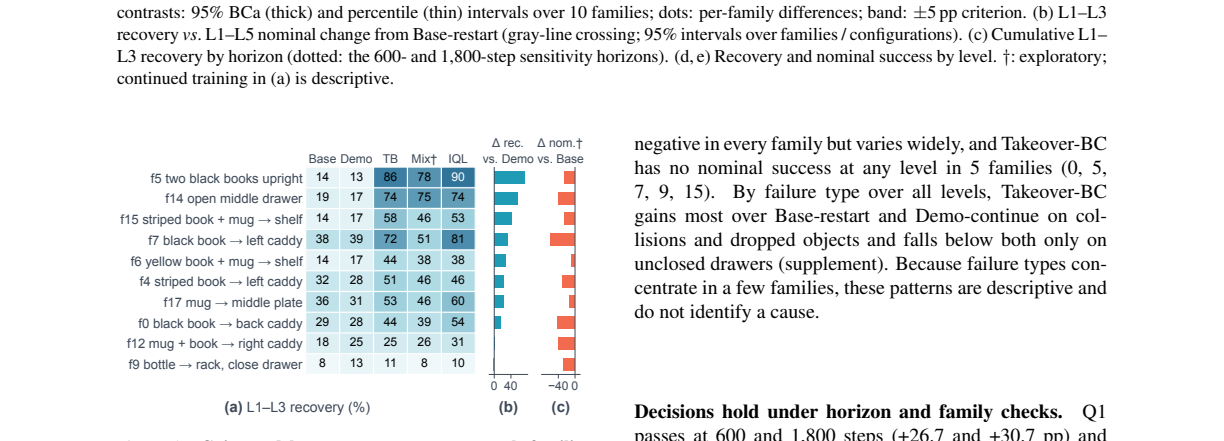
To represent uncertainty in failure onset, an annotator marks an interval for each failure, and training takeovers start at seeded frames sampled within it. From one fixed π0.5 checkpoint, which also initializes post-training, we assemble 629 natural failures across 10 LIBERO-X task families at up to five difficulty levels. All 2,823 takeover attempts are logged; 2,400 are accepted recoveries, of which 2,320 are used for post-training. Evaluation restarts every method from the fixed midpoints of 384 held-out failure intervals. Under matched actor-update counts, we compare behavior cloning of recoveries, value-based offline learning on recoveries and failed rollouts, and continued training on existing demonstrations. Within 1,200 steps on the 240 L1-L3 held-out failures, cloning improves recovery by 29.4 percentage points (pp) over the demonstration-only control; the value-based learner does not establish a further gain (1.5 pp). In exploratory evaluation from L1-L5 nominal starts at the same horizon, cloning loses 30.0 pp of success relative to the base policy; mixing in demonstrations reduces the loss to 16.5 pp, a reduction that shrinks under a stricter, pre-specified horizon. Restorable failure states and a shared evaluator let all methods be compared from identical starts.
from the abstract
Pith says
Machine review · deepseek-v4-flash · 26 Nov 2026 · read the full text (251,573 characters) · not checked by a person
It can be wrong. Challenge this review or reply to it.
Holds up. FailPoint-X provides a controlled benchmark for offline VLA post-training from human takeovers, showing that behavior cloning of recoveries improves recovery by 29.4 pp over continued demonstration training at matched actor updates, while value-based methods show no further gain. This line is wrong
7 minor
How often objections from reviews like this one are right: not yet measured
The paper, first character to last
The reviewer was given the whole text, 251,573 characters. Not checked: figures, code, what the 33 references say.
7 minor objections
The paper says, at abstract
Pith says: minor objection 1 of 7
The abstract in the manuscript differs from the arXiv metadata abstract. For example, the manuscript abstract includes 'Restorable failure states and a shared evaluator let all methods be compared from identical starts' which is not in the arXiv metadata. Ensure consistency between the two versions.
The paper says, at 1
Pith says: minor objection 2 of 7
The paper uses many custom macros (e.g., 'nFailReleased', 'DeltaOne') that make the text hard to read in source form. In the final version, ensure all macros are expanded or the text is readable without macro definitions. Consider providing a table of key macros in the supplement.
show 5 more
The paper says, at 1
Pith says: minor objection 3 of 7
Table 1 (related work) is very dense with many symbols and footnotes. Consider making it more readable by using a larger font or splitting into two tables (one for simulation, one for real-robot).
The paper says, at 6
Pith says: minor objection 4 of 7
The paper mentions 'one training run per trained arm' but does not specify the number of training seeds. Clarify that only one seed was used and discuss the implications for reproducibility.
The paper says, at 5.2
Pith says: minor objection 5 of 7
The paper's Section 5.2 mentions 'the critic weighting fails its pre-specified check' but the check is described only in the supplement. Consider moving the check description to the main paper or at least referencing it more clearly with a pointer to the supplement.
The paper says, at abstract
Pith says: minor objection 6 of 7
The paper uses 'exploratory' for many analyses (nominal starts, L4-L5, Mix-BC, etc.). Ensure that the distinction between confirmatory and exploratory is clear throughout, especially in the abstract and conclusion where the exploratory nominal results are highlighted.
The paper says, at 6
Pith says: minor objection 7 of 7
The conclusion mentions 'Next steps include restarts from several states along each held-out failure' but this is not discussed elsewhere. Consider adding a brief discussion of this direction in the main text or removing it from the conclusion.
What would settle it
Re-run the TakeoverBC and DemoCont arms with a different training seed (e.g., seed 1234) while keeping all other settings identical. If the L1-L3 recovery improvement remains above 5 pp with a 95% BCa interval excluding zero, the result is robust to training seed variation.
from the skeptic's reading
How the review went
5 passes by deepseek-v4-flash · 26 Nov 2026
- Reader holds up
- Skeptic agrees
- Referee 7 minor
- Check against the paper kept 0 of 3 objections
- Editor wrote the verdict above
Not run on this paper: the simulated authors' defence.
Pith's passes raised 3 objections. A check against the paper's text kept 0 and withdrew 3 (3 the paper already says).
The review in full
The review in brief, machine-written
FailPoint-X is a carefully constructed benchmark that isolates what human takeovers contribute to offline VLA post-training. Its key design choices—policy-matched failures (one checkpoint generates failures and initializes post-training), interval-based annotation of failure onset, matched actor-update budgets across methods, and joint evaluation on held-out failures and nominal starts—let the authors ask two clean questions: does training on recoveries beat continued training on demonstrations, and does value-based learning beat behavior cloning of recoveries? The answer to the first is yes (29.4 pp improvement on L1–L3 failures within 1,200 steps), and to the second, no (1.5 pp, interval includes zero). The dataset of 629 failures and 2,400 accepted recoveries across 10 LIBERO-X families is released with full attempt logs, and the modular interface makes it easy to plug in new methods. The paper is transparent about its limitations: one checkpoint, one operator, one training seed, simulation only. The nominal-task retention loss is real and exploratory, and the IQLR critic’s weighting diagnostic failed, which the authors report honestly. The study does not test policy matching itself, takeover timing, or gains over new demonstrations of equal human time. These are acknowledged boundaries, not oversights. The benchmark deserves a serious referee. It addresses an important gap, the controlled comparison is sound, and the released infrastructure will be useful to the community. The main empirical claim—that takeover BC improves recovery over continued demonstration training—is supported by the evidence. The value-based result is inconclusive, which is itself a finding worth reporting.
The strongest objection
The paper is thorough, with extensive sensitivity analyses and acknowledged limitations. The central claim—that behavior cloning of human takeovers improves recovery by 29.4 pp over continued demonstration training at matched actor updates—is supported by the evidence presented. The statistical inference is appropriate for the fixed checkpoints and one training seed. The main limitations (single checkpoint, one operator, simulation, one training seed) are transparently stated and do not undermine the internal validity of the comparison. No additional load-bearing concern beyond those already acknowledged by the authors is apparent.
The paper provides a well-controlled benchmark with clear methodology, extensive documentation, and sensitivity analyses. The central claim is supported by the data. The acknowledged limitations are appropriate and do not invalidate the findings within the study's scope. No additional load-bearing concern was identified.
The referee's report
Not published. Pith's referee wrote this assessment before its objections were checked against the paper, and 3 of its 3 major objections did not survive that check.
Pith's reading of the paper (a machine's summary, not the authors')
The paper introduces FailPoint-X, a benchmark for offline VLA post-training that uses human takeovers from a policy's own failures. The central question is whether training on human recoveries improves failure recovery more than continued training on existing demonstrations, and whether value-based offline learning adds further benefit. The authors report that behavior cloning of the collected recoveries improves recovery success by 29.4 percentage points over continued demonstration training at matched actor updates, while a value-based method (IQL) does not establish a further gain. However, these recovery gains come with a substantial loss in nominal task success, which can be partially offset by mixing demonstrations with recoveries. The benchmark provides restorable failure states, fixed splits, and a shared evaluator to enable controlled comparisons.
What carries the argument. The central object is the FailPoint-X benchmark, which provides policy-matched failure states (generated by the same checkpoint that initializes post-training), interval-based human takeover collection (annotator marks an onset interval, training takeovers start at seeded frames within it), and a restore-and-continue evaluation protocol (every method restarts from the same held-out failure midpoints). The key mechanism is the controlled comparison: all methods start from the same base checkpoint, use the same number of actor updates, and are evaluated from identical held-out failure states, with a demonstration-only control to isolate the effect of takeover data.
Core claim. The paper claims that for a fixed VLA checkpoint (π0.5 fine-tuned on LIBERO-X), behavior cloning of human takeovers from the policy's own failures improves recovery success on held-out L1–L3 failures by 29.4 percentage points (95% BCa interval [16.9, 44.7]) over continued training on demonstrations alone, at matched actor updates. The value-based offline learning method (IQL-R2) does not establish a further gain over behavior cloning (1.5 pp, interval [−2.2, 5.1]). However, recovery gains come with a loss in nominal task success (30.0 pp loss for Takeover-BC), which can be partially mitigated by mixing demonstrations with recoveries.
The premise it rests on. The results are based on a single base checkpoint (π0.5 fine-tuned on LIBERO-X demonstrations), one human operator/annotator, and simulation only. The benchmark's policy-matched design means that the failure-generating policy and the post-training initialization are identical, which may not generalize to other policies or real-world settings. The authors acknowledge this limitation in Section 6 and the supplement.
If the paper is right (Pith's inferences, not the authors')
Simple behavior cloning of human recoveries is a strong baseline for offline VLA post-training from failures, outperforming continued training on demonstrations alone.
Value-based offline RL methods (IQL) may not provide additional benefit over behavior cloning in this setting, at least with the tested recipe and data composition.
The recovery–retention trade-off suggests that post-training on recoveries alone can degrade nominal task performance, and mixing demonstrations can help mitigate this loss.
The FailPoint-X benchmark provides reusable infrastructure for evaluating other post-training methods on identical failure states, enabling controlled comparisons.
The failure of IQL to improve over BC may be due to the critic's inability to generalize to out-of-distribution states or the mismatch between the critic's reward design and the actual recovery task; the paper's critic diagnostic (mean weight on failure-window chunks exceeding that on recovery chunks) supports this interpretation.
The nominal task loss may be partly due to the slower command scale inherited from the SpaceMouse, which could be mitigated by action scaling or fine-tuning on demonstrations; the paper notes that takeover-trained policies produce smaller commands than the VR-collected demonstrations.
The benchmark's design could be extended to study the effect of takeover timing by restarting from different frames within the failure interval, or to evaluate the effect of policy matching by initializing post-training from a different checkpoint.
The single-operator limitation suggests that future work should examine inter-operator variability and its effect on post-training outcomes, as well as the impact of the redo rule on data quality.
Check this review
What was read
The passes were given all 251,573 characters of the paper's LaTeX source.
Fingerprint of that text (SHA-256): 13eee549705471563a2a8c97356aab1c70a39e2d62bd098d30acec1dee138515
Pith does not keep that text. Rebuilt from the paper's source or PDF by the same code, it has this fingerprint if it is the same text. From a copy of Pith's code:
PYTHONPATH=. python scripts/review_input_check.py 2611.33769
The passes, in the order they ran
- Reader deepseek-v4-flash · medium effort · $0.0078 · instructions of the Reader, fingerprint f9ead7300382…
- Skeptic deepseek-v4-flash · medium effort · $0.0074 · instructions of the Skeptic, fingerprint 8f88c0f61488…
- Referee deepseek-v4-flash · medium effort · $0.0076 · instructions of the Referee, fingerprint a852d99aea0d…
- Check against the paper deepseek-v4-flash · medium effort · $0.0098 · instructions of the Check against the paper, fingerprint 6c7a6883d551…
- Editor deepseek-v4-flash · medium effort · $0.0072 · instructions of the Editor, fingerprint e7211f6a3d27…
- Circularity check deepseek-v4-flash · medium effort · $0.0072 · instructions of the Circularity check, fingerprint e9946e39d67b…
- Summary for the page deepseek-v4-flash · medium effort · temperature 0.2 · $0.0077 · instructions of the Summary for the page, fingerprint e4f56bf568e7…
The passes cost $0.055 in model calls together.
Version stamped on this review: pith-pipeline@v1.4.1-daily-deepseek-or-medium+deepseek/deepseek-v4-flash+p.d60f54226f00
Each link opens a pass's instructions as plain text, the exact bytes its fingerprint was taken over. Every stored set of instructions.
curl -s https://pith.science/methodology/prompts/f9ead730038216984cfb56d7cb34332bdf691828296a1de4245f3d6667d4bf56 | sha256sum
prints the fingerprint of the reader's instructions. The same works for every pass.
The receipt
The review's fingerprint was taken on 26 Nov 2026. The review you are reading still matches it.
Fingerprint of the review (SHA-256): 5cecabc3a86ea4edbc45aafc583523ac0b52d91379df7b2b085cbc632aba2e4f
curl -s 'https://pith.science/api/v1/verdicts/2611.33769?form=canonical' | sha256sum
prints the fingerprint of the review as it stands now. The rule, in four steps.
A matching fingerprint shows the review has not changed since that date. It does not show that the review is right.
How often reviews like this one are right
Reviews like this one: written by deepseek-v4-flash, from the paper's LaTeX source.
How often objections from reviews like this one are right: not yet measured
Reviews by people
This review was written by a machine. No person has reviewed this paper on Pith yet. A scientist listed on Pith can review it for a fee, and their review is published here whatever it concludes.
The paper
Abstract
Human takeovers offer corrective supervision for vision-language-action (VLA) policies, but their contribution to offline post-training must be separated from that of continued optimization. We introduce FailPoint-X, a benchmark for offline VLA post-training with human takeovers. To represent uncertainty in failure onset, an annotator marks an interval for each failure, and training takeovers start at seeded frames sampled within it. From one fixed π0.5 checkpoint, which also initializes post-training, we assemble 629 natural failures across 10 LIBERO-X task families at up to five difficulty levels. All 2,823 takeover attempts are logged; 2,400 are accepted recoveries, of which 2,320 are used for post-training. Evaluation restarts every method from the fixed midpoints of 384 held-out failure intervals. Under matched actor-update counts, we compare behavior cloning of recoveries, value-based offline learning on recoveries and failed rollouts, and continued training on existing demonstrations. Within 1,200 steps on the 240 L1-L3 held-out failures, cloning improves recovery by 29.4 percentage points (pp) over the demonstration-only control; the value-based learner does not establish a further gain (1.5 pp). In exploratory evaluation from L1-L5 nominal starts at the same horizon, cloning loses 30.0 pp of success relative to the base policy; mixing in demonstrations reduces the loss to 16.5 pp, a reduction that shrinks under a stricter, pre-specified horizon. Restorable failure states and a shared evaluator let all methods be compared from identical starts.
The paper's own sentences, arranged, kept beside the review and separate from it. Each label is drawn from a closed vocabulary; the number beside it is the probability the classifier gave that label. No sentence in this record was written by a model.
abstract compiled · 2026-11-26
The authors' main claim, as the classifier picked it out 0.98
“Within 1,200 steps on the 240 L1-L3 held-out failures, cloning improves recovery by 29.4 percentage points (pp) over the demonstration-only control; the value-based learner does not establish a further gain (1.5 pp).”
How the main claim is stated: asserted 1.00
What the abstract itself states, as probabilities: claims first 0.11 · states limitation 0.77 · human participants 0.69 · controlled comparison 0.98 · randomized assignment 0.04 · states quantitative result 0.99 · compares with prior results 0.93 · mentions code or data availability 0.04
The abstract, sentence by sentence
This table labels the abstract only (arXiv listing abstract v1). The number is the probability the classifier gave the label.
| Sentence | Role | The authors' own work | States the main conclusion | Strength |
|---|---|---|---|---|
| Human takeovers offer corrective supervision for vision-language-action (VLA) policies, but their contribution to offline post-training must be separated from that of continued optimization. | background 0.57 | 0.08 | 0.05 | asserted 0.98 |
| We introduce FailPoint-X, a benchmark for offline VLA post-training with human takeovers. | contribution 1.00 | 0.91 | 0.05 | asserted 0.99 |
| To represent uncertainty in failure onset, an annotator marks an interval for each failure, and training takeovers start at seeded frames sampled within it. | method 1.00 | 0.91 | 0.02 | asserted 0.98 |
| From one fixed $\pi_{0.5}$ checkpoint, which also initializes post-training, we assemble 629 natural failures across 10 LIBERO-X task families at up to five difficulty levels. | method 0.98 | 0.94 | 0.03 | asserted 1.00 |
| All 2,823 takeover attempts are logged; 2,400 are accepted recoveries, of which 2,320 are used for post-training. | method 0.99 | 0.95 | 0.03 | asserted 1.00 |
| Evaluation restarts every method from the fixed midpoints of 384 held-out failure intervals. | method 0.99 | 0.92 | 0.02 | asserted 0.98 |
| Under matched actor-update counts, we compare behavior cloning of recoveries, value-based offline learning on recoveries and failed rollouts, and continued training on existing demonstrations. | method 0.98 | 0.89 | 0.04 | asserted 0.93 |
| Within 1,200 steps on the 240 L1-L3 held-out failures, cloning improves recovery by 29.4 percentage points (pp) over the demonstration-only control; the value-based learner does not establish a further gain (1.5 pp). | result 1.00 | 0.96 | 0.56 | asserted 1.00 |
| In exploratory evaluation from L1-L5 nominal starts at the same horizon, cloning loses 30.0 pp of success relative to the base policy; mixing in demonstrations reduces the loss to 16.5 pp, a reduction that shrinks under a stricter, pre-specified horizon. | result 0.99 | 0.94 | 0.12 | asserted 1.00 |
| Restorable failure states and a shared evaluator let all methods be compared from identical starts. | method 0.91 | 0.82 | 0.04 | asserted 1.00 |
What kind of paper the classifier reports this is: dataset or benchmark 1.00 · evidence from observation or experiment 0.97
What was examined, and what was not
Sources read
- arXiv listing abstract v1
Not examined
- full text
- figures and tables
- references and citing sentences
- relations to other papers
Levels run
- P abstract
Not run
- S sections
- T body sentences
- C citations
- R cross-paper relations
How the labels were made
Compiled by classifier-1.13.0 via TypeSafe API, question bank abstract-p1-20260923, 2026-11-26: 1 request, 7,754 input tokens.
Every quoted sentence on this record is the authors'. Every label is from Pith's closed vocabulary, with the probability shown beside it. This record as JSON
Figures (4)


Figures are the authors', reproduced from the paper.
References (33)
- [1] AgiBot. AgiBot World 2026, Theme 3: Reinforcement Learning. Dataset release, 2026. 4 on Pith
- [2] Remi Cadene, Simon Aliberts, Francesco Capuano, Michel Aractingi, Adil Zouitine, Pepijn Kooijmans, Jade Choghari, Martino Russi, Caroline Pascal, Steven Palma, Mustafa Shukor, Jess Moss, Alexander Soare, Dana Aubakirova, Quentin Lhoest, et al. LeRobot: An Open-Source Library f... on Pith
- [3] Yuxin Cai, Zongtai Li, Maonan Wang, Muyi Bao, Haokun Zhu, Ruofei Bai, Ding Zhao, Zirui Li, Wenshan Wang, Wei- Yun Yau, Ji Zhang, and Chen Lv. IntentNav: Learning Spatial-Visual Object Navigation from Human Demonstra- tions. arXiv preprint arXiv:2606.08029, 2026. 2 on PithPith's reviewarXiv
- [4] Yuhui Chen, Shuai Tian, Shugao Liu, Yingting Zhou, Hao- ran Li, and Dongbin Zhao. ConRFT: A Reinforced Fine- tuning Method for VLA Models via Consistency Policy. In Robotics: Science and Systems (RSS), 2025. 3 on Pith
- [5] Bradley Efron. Better Bootstrap Confidence Intervals. Jour- nal of the American Statistical Association , 82(397):171– 185, 1987. 7, S14 on Pith
- [6] Timnit Gebru, Jamie Morgenstern, Briana Vecchione, Jen- nifer Wortman Vaughan, Hanna Wallach, Hal Daum ´e, and Kate Crawford. Datasheets for Datasets. Communications of the ACM, 64(12):86–92, 2021. S21 on Pith
- [7] Philippe Hansen-Estruch, Ilya Kostrikov, Michael Janner, Jakub Grudzien Kuba, and Sergey Levine. IDQL: Implicit Q-learning as an actor-critic method with diffusion policies. arXiv preprint arXiv:2304.10573, 2023. 6, S13, S18 on PithPith's reviewarXiv
- [8] Edward J. Hu, Yelong Shen, Phillip Wallis, Zeyuan Allen- Zhu, Yuanzhi Li, Shean Wang, Lu Wang, and Weizhu Chen. LoRA: Low-Rank Adaptation of Large Language Models. In International Conference on Learning Representations (ICLR), 2022. S12 on Pith
- [9] Physical Intelligence, Ali Amin, Raichelle Aniceto, Ash- win Balakrishna, Kevin Black, Ken Conley, Grace Connors, James Darpinian, Karan Dhabalia, Jared DiCarlo, Danny Driess, Michael Equi, Adnan Esmail, Yunhao Fang, Chelsea Finn, et al. π∗0.6: a VLA That Learns From Experienc... on PithPith's reviewarXiv
- [10] Physical Intelligence, Kevin Black, Noah Brown, James Darpinian, Karan Dhabalia, Danny Driess, Adnan Esmail, Michael Equi, Chelsea Finn, Niccolo Fusai, Manuel Y . Gal- liker, Dibya Ghosh, Lachy Groom, Karol Hausman, Brian Ichter, et al. π0.5: a Vision-Language-Action Model wit... on Pith
- [11] Yuan Ji, Zirui Li, Yuxin Cai, Shuge Wu, Boon Siew Han, and Chen Lv. SOR-Nav: Search or Relocate? Context-Gated Exploration and Cross-Region Relocation for Object Navi- gation. arXiv preprint arXiv:2609.34707, 2026. 2 on PithPith's reviewarXiv
- [12] Michael Kelly, Chelsea Sidrane, Katherine Driggs-Camp- bell, and Mykel J. Kochenderfer. HG-DAgger: Interactive Imitation Learning with Human Experts. In IEEE Inter- national Conference on Robotics and Automation (ICRA) , on Pith
- [13] Ilya Kostrikov, Ashvin Nair, and Sergey Levine. Offline Re- inforcement Learning with Implicit Q-Learning. In Inter- national Conference on Learning Representations (ICLR) , on Pith
- [14] Christopher A. Kurby and Jeffrey M. Zacks. Segmentation in the perception and memory of events. Trends in Cognitive Sciences, 12(2):72–79, 2008. 2 on Pith
- [15] Sean Hardesty Lewis, Zuyi Guo, Benwang Chen, Zirui Li, Hongyi Lin, and Heye Huang. SafeVantage: Vantage-Aware Memory for Reliable Embodied Decisions. arXiv preprint arXiv:2609.36906, 2026. 2 on PithPith's reviewarXiv
- [16] Yang Li, Chen Zhao, Zhuoran Wang, Jiankang Wang, Chao Shao, Yihan Lin, Haitao Shen, and Jing Zhang. RoboRe- cover: Benchmarking Robot Policy Recovery under Execu- tion Deviations. arXiv preprint arXiv:2609.28952, 2026. 3, 4 on PithPith's reviewarXiv
- [17] Huihan Liu, Soroush Nasiriany, Lance Zhang, Zhiyao Bao, and Yuke Zhu. Robot Learning on the Job: Human-in- the-Loop Autonomy and Learning During Deployment. In Robotics: Science and Systems (RSS), 2023. 3 9 on Pith
- [18] Lin Liu, Zhicheng Bao, Lu Zhang, Ziying Song, Wu Yang, Yuzheng Zhuang, Shuai Tao, Wulong Liu, Caiyan Jia, and Huchuan Lu. LIBERO-RECOVER: Beyond Task Success Towards Failure Recovery in Robotic Manipulation Models. arXiv preprint arXiv:2609.05178, 2026. 2, 3, 4 on PithPith's reviewarXiv
- [19] Weijia Liufu, Xiaoyu Guo, Ruiyi Chen, Jingzhi Liu, Kaidong Zhang, Xiwen Liang, Jianqi Lin, Dawei Sun, Yuze Wang, Rongtao Xu, Bingqian Lin, Bowen Yang, Tongtong Cao, Bowen Peng, Dongyu Zhang, et al. RePO-VLA: Recovery- Driven Policy Optimization for Vision-Language-Action Model... on Pith
- [20] Ajay Mandlekar, Danfei Xu, Josiah Wong, Soroush Nasiri- any, Chen Wang, Rohun Kulkarni, Li Fei-Fei, Silvio Savarese, Yuke Zhu, and Roberto Mart ´ın-Mart´ın. What Matters in Learning from Offline Human Demonstrations for Robot Manipulation. In Conference on Robot Learning (CoRL... on Pith
show 13 more
- [21] Meituan. LIBERO-X Code Repository. GitHub repository, MIT license, 2026. S22 on Pith
- [22] Meituan. LIBERO-X Training Dataset. Hugging Face dataset, CC BY 4.0, 2026. S22 on Pith
- [23] Ashvin Nair, Abhishek Gupta, Murtaza Dalal, and Sergey Levine. AW AC: Accelerating online reinforcement learn- ing with offline datasets. arXiv preprint arXiv:2006.09359, on PithPith's reviewarXiv
- [24] Nana Yaw Owusu Ofori-Ampofo, Samira Ebrahimi Kahou, and Joseph Thekinen. REBOOT: From Failure to Recovery - A Dataset and Benchmark for Precision Assembly. arXiv preprint arXiv:2609.22591, 2026. 4 on PithPith's reviewarXiv
- [25] Physical Intelligence. openpi: Open-Source Models and Training Code for π0 and π0.5. GitHub repository, 2024. 4, 6, S1, S12, S22 on Pith
- [26] Yangang Ren, Yujie Yan, Zirui Li, Jiaming Guo, Di Zeng, Ji Tao, Lan Yu, Xuesong Tian, and Chen Lv. Learning from Mixed-Quality Deployment Experience for Robot Manipu- lation. arXiv preprint arXiv:2609.29000, 2026. 2 on PithPith's reviewarXiv
- [27] Stephane Ross, Geoffrey J. Gordon, and J. Andrew Bagnell. A Reduction of Imitation Learning and Structured Predic- tion to No-Regret Online Learning. In International Con- ference on Artificial Intelligence and Statistics (AISTATS) , pages 627–635, 2011. 3 on Pith
- [28] Ivan Snegirev, Elizaveta Semenyakina, Dmitrii Maliukov, Miguel Altamirano Cabrera, and Dzmitry Tsetserukou. Kintsugi-VLA: Turning Failed Robot Rollouts into Recovery Data through Interventional Recoverability. arXiv preprint arXiv:2609.31048, 2026. 3, 4 on PithPith's reviewarXiv
- [29] Emanuel Todorov, Tom Erez, and Yuval Tassa. MuJoCo: A Physics Engine for Model-Based Control. In IEEE/RSJ International Conference on Intelligent Robots and Systems (IROS), pages 5026–5033, 2012. S1 on Pith
- [30] Caicheng Wang, Zipeng Ye, Zhexuan Zhou, Zilong Huang, Xi Zhang, and Yuchen Xie. SimPT: An Automated Simula- tion Framework for Intervention-Based VLA Post-Training. arXiv preprint arXiv:2610.29161, 2026. 2, 3, 4 on PithPith's reviewarXiv
- [31] Guodong Wang, Chenkai Zhang, Qingjie Liu, Jinjin Zhang, Jiancheng Cai, Junjie Liu, and Xinmin Liu. LIBERO-X: Robustness Litmus for Vision-Language-Action Models. In Robotics: Science and Systems (RSS), 2026. 2, 3, 4, S1, S22, S23 on Pith
- [32] Yuke Zhu, Josiah Wong, Ajay Mandlekar, Roberto Mart ´ın- Mart´ın, Abhishek Joshi, Kevin Lin, Abhiram Maddukuri, Soroush Nasiriany, and Yifeng Zhu. robosuite: A Modular Simulation Framework and Benchmark for Robot Learning. arXiv preprint arXiv:2009.12293, 2020. S1 10 FailPoint... on PithPith's reviewarXiv
- [33] LoRA [8] adapters on the attention and feed-forward layers of the action expert together with the action and time projections. All trained arms keep the quantile normal- ization statistics of the base checkpoint and use AdamW (β1 = 0 .9, β2 = 0 .95, ϵ = 10 −8, weight decay 10−... on Pith
Challenges and discussion
Disagree with the review, or know something it missed? Leave a comment, or challenge this review formally: a challenge becomes a permanent entry in this paper's record, and its decision is published here.
Come back by email
A short list of the week's newly reviewed papers. Nothing is sent until you confirm from your inbox, and every email has a link that stops it. No account.
No comments yet.
Sign in to comment