Robotics · arXiv:2610.01178 v1 · submitted 1 Oct 2026 · 72 references
Recova: Agent-Guided Failure Recovery for Autonomous Robotic Manipulation
The paper says
“Manipulation failures can leave scenes in states from which a task policy cannot recover. Learning corrective behaviors requires scalable failure exploration and physical grounding.”
more of the abstract
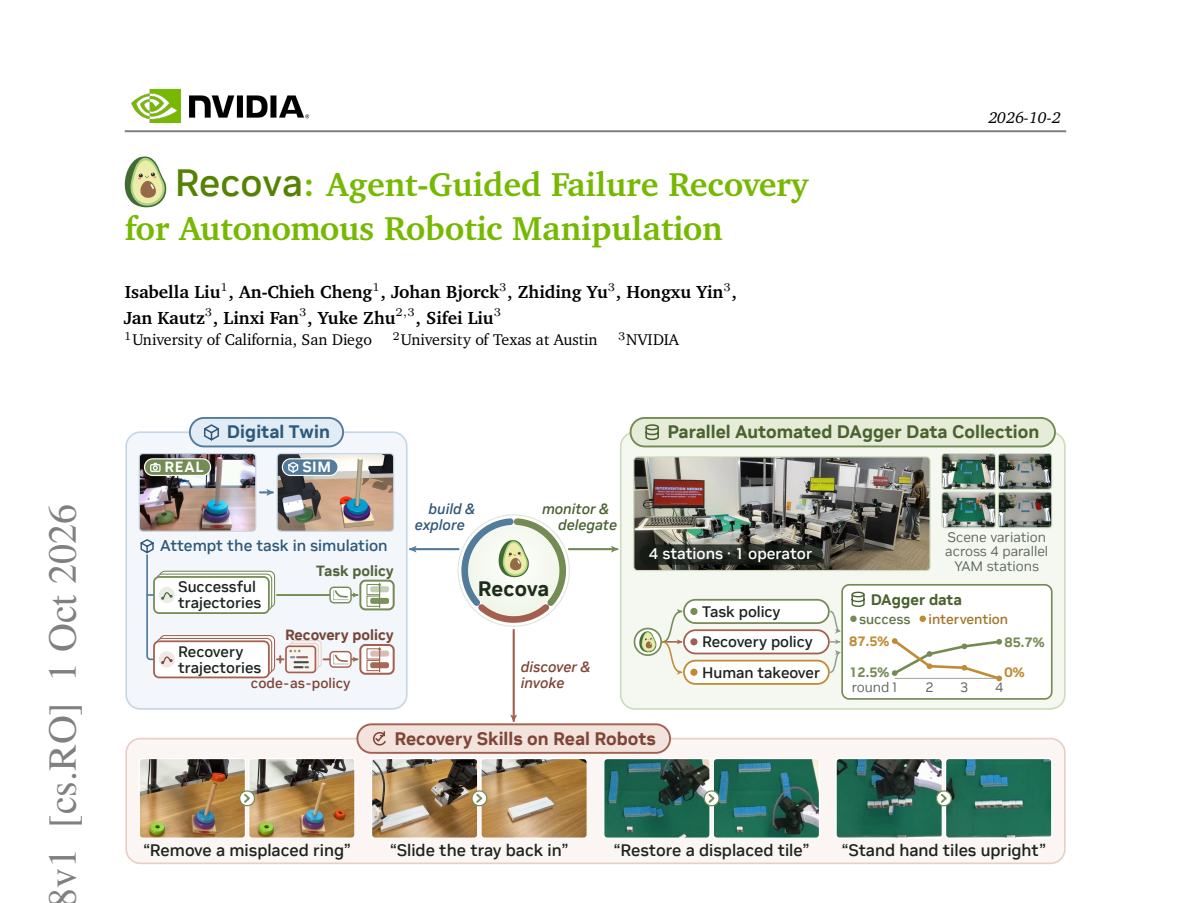
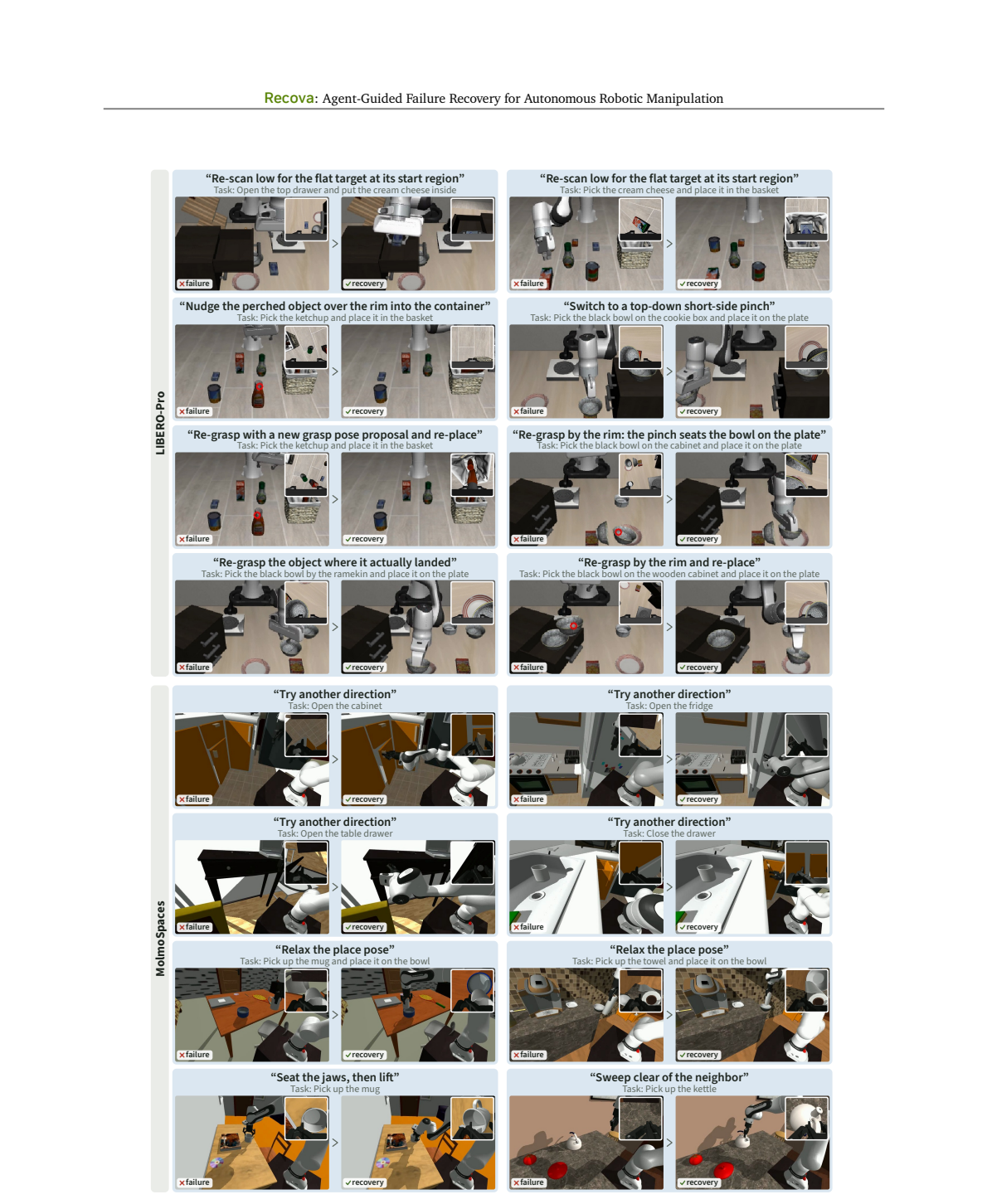
We present Recova, an agent-guided framework that jointly develops task execution and recovery in a reconstructed digital twin, then verifies and refines both through real-world experience. In the twin, the agent diagnoses failures, tests corrective programs, and collects successful task and recovery rollouts for separate policies. During deployment, it monitors progress, invokes a learned or programmatic recovery, verifies scene restoration, and resumes execution. When no suitable recovery is available, a human demonstration resolves the failure and enters the learning loop, allowing the system to expand its recovery capabilities. Physical rollouts and human demonstrations are routed to the corresponding policy for DAgger training. Across six LIBERO-Pro settings and four MolmoSpaces categories, Recova achieves 78.8% and 64.9% mean success, compared with 71.7% and 38.0% for the strongest baselines. With parallel collection across four real-robot workstations, DAgger fine-tuning raises mean success from 23.8% to 77.5%, and recovery skills further raise it to 87.5%. Over four collection rounds on one task, observed human intervention falls from 87.5% to 0%. Together, these results show how agent-guided recovery turns failures into reusable capabilities, improving robustness while progressively reducing human intervention. Project page: https://www.liuisabella.com/Recova
from the abstract
Pith says
Machine review · deepseek-v4-flash · 2 Oct 2026 · what was read was not recorded · not checked by a person
It can be wrong. Challenge this review or reply to it.
Holds up, with conditions. A genuinely solid systems paper whose headline claim about falling human intervention rests on one task with seven to eight episodes per round, scored by the authors' own operator, with a prunable denominator. This line is wrong
4 major objections · 4 minor
How often objections from reviews like this one are right: not yet measured
Not checked: figures, code, what the 72 references say.
The paper says, at §4.2 'DAgger rounds' and Fig. 4 (right panel)
The review did not quote this passage.
Pith says: Objection 1 of 4 · major
The headline claim that human intervention falls from 87.5% to 0% (Abstract, b11; §1) rests on a single task (draw a mahjong tile), four rounds, and seven or eight episodes per round, with the denominator excluding operator-discarded episodes and the authors' unblinded operator as backstop.
more of objection 1
At n≈8, moving from 7/8 to 0/7 is a difference of a single episode: one relabeled or re-included episode turns the fourth-round rate from 0% to roughly 14%. The exclusion rule and the operator's authority to discard segments and relabel before saving are stated in the paper (C.2), so this is acknowledged protocol detail rather than hidden behavior, but the 0% figure is not robust as reported. I recommend reporting the rate with discarded episodes included, adding confidence intervals or exact tests, and at minimum replicating the trend on a second task or providing an independent blinded relabeling of the recorded sessions.
The paper says, at Table 3 and §4.2 'Task success'
The review did not quote this passage.
Pith says: Objection 2 of 4 · major
The recovery increment (77.5% to 87.5%, 10 points) is computed over 20 trials per cell, judged by a single operator against Table 4 criteria (C.4), with no variance reported and no statement of whether DAgger and +Recovery trials were interleaved or matched.
more of objection 2
The two 15-point single-task gains (ring stacking, pencil box) are within binomial noise at n=20: the 95% confidence intervals for 15/20 and 18/20 overlap substantially. Since the recovery-policy increment is the paper's central real-robot claim that 'recovery skills work,' the paper should report confidence intervals or exact two-proportion tests per task and state the trial-ordering protocol.
The paper says, at §4.1, Tables 1 and 2
The review did not quote this passage.
Pith says: Objection 3 of 4 · major
All baseline numbers are reproduced from prior publications and were obtained under their own protocols, while Recova is evaluated in-house with its own benchmark implementation, and recovery is allowed to complete the task ('including cases where the recovery program completes the task').
more of objection 3
The strongest baselines (ASPIRE on LIBERO-Pro; RATs and CaP-Agent0 on MolmoSpaces) come from teams with substantial author overlap with this paper's author list (Linxi Fan, Yuke Zhu, and others appear on both sides), so the 7.1-point and 26.9-point gaps could reflect protocol differences rather than capability differences. I recommend re-running at least one baseline (ideally ASPIRE on LIBERO-Pro) under the Recova evaluation harness, or providing a table that itemizes every protocol difference (evaluation seeds, episode budget, whether recovery programs may complete the task).
The paper says, at §3.3, Algorithm 1, §C.2 (monitor as training-data gate)
The review did not quote this passage.
Pith says: Objection 4 of 4 · major
Monitor verdicts route trajectories into S_k, E_k, R_k, and A_k (Eq. 1), so M_res and M_done act as training-data gates whose quality directly affects the recovered-policy training set. The restoration check accepts any 'equivalently workable' state rather than exact poses (b107), runs at a median 5.5s latency against a four-camera composite, and is never validated against human relabeling.
more of objection 4
Since C.2 already gives the operator the authority to relabel before saving, the paper could cheaply report a monitor-versus-human agreement rate on a held-out episode set; without such a measurement, the quality of the recovery dataset is unquantified and the +Recovery increment in Table 3 cannot be separated from monitor leniency. I raise this as a data-contamination risk, not as evidence of failure: the headline success numbers in Table 3 are operator-judged and takeovers are physically recorded, so the monitor does not directly score those numbers.
4 minor objections
The paper says, at Table 2
Pith says: minor objection 1 of 4
The π0 row reports exactly 0.0% in all six LIBERO-Pro settings; a uniform zero across every perturbation is more consistent with a protocol mismatch (e.g., the checkpoint was not configured for this benchmark) than with a genuine null result, and a footnote explaining the evaluation condition would prevent misreading.
The paper says, at §4.2 and Appendix D
Pith says: minor objection 2 of 4
The text states that the agent developed 'six or seven recovery skills, 25 in total (Sec. D),' but Figs. 8 and 9 show exactly six skills per task for all four tasks, i.e., 24 panels. Please reconcile the count or state which task has a seventh skill.
show 2 more
The paper says, at §4.2 'Setup'
Pith says: minor objection 3 of 4
The monitor model 'Gemini 3.8 Flash' is named without a citation or version detail, and the monitor is a load-bearing component; adding a reference or a note on how the choice affects verdict behavior would improve reproducibility.
The paper says, at Abstract / §1 / §4.2
Pith says: minor objection 4 of 4
The same three result triples (78.8/71.7, 64.9/38.0, 23.8/77.5/87.5) appear verbatim in the abstract, the introduction, and the experiments; trimming the repetition in §1 would tighten the narrative.
What would settle it
Use the documented provenance (C.5: session logs store acting controller, episode boundaries, outcomes, images, prompts, verdicts, timestamps) to have two annotators, blind to round order and to the monitor's JSON verdicts, independently label every draw-a-tile episode across the four DAgger rounds and the 20-trial evaluation cells: (1) did a human physically take control, and (2) did the attempt satisfy the Tab. 4 criterion. Recompute the intervention rate twice — with and without operator-discarded episodes in the denominator — and recompute the Tab. 3 cells. If a blinded judge finds any intervention in round 4, or if discarded episodes are predominantly failures, or if any Tab. 3 cell shifts by more than 10 points, the supervision-reduction claim needs a stated reservation; if blinded rates and success match the report, the concern is settled.
from the skeptic's reading
How the review went
4 readings by deepseek-v4-flash · 2 Oct 2026
- Reader holds up, with conditions
- Skeptic partly agrees
- Editor wrote the verdict above
- Referee major revision: 4 major objections, 4 minor
Not run on this paper: the simulated authors' defence.
Pith did not check this review's objections against the paper.
The review in full
The review in brief, machine-written
Worth your time. The package is real: an agent-built MuJoCo twin that explores failures, separate task and recovery policies, and a parallel four-station DAgger harness where a vision-language monitor gates handoffs and routes experience to the right policy. That assembly is not in the prior work it cites, and the provenance discipline is genuinely good — failed prefixes are logged but excluded from training, every monitor verdict is auditable, and the paper states plainly where the twin cannot anticipate contact dynamics (b99) and that restoration admits slack matches (b107). The writing is honest about scope.
The simulation margins come from reproduced published baselines with overlapping authors on the strongest rows; that is standard practice in this field, not a fatal flaw. The real soft spot is the real-robot claim. The "87.5% to 0%" intervention drop is one task, four rounds, seven or eight episodes per round (b180, b181), judged by the authors' operator with operator-discarded episodes excluded from the rate — a prunable denominator, unblinded. The recovery increment from 77.5% to 87.5% is 20 trials per cell with no variance; the 15-point single-task gains sit inside binomial noise. The stress test is partly wrong about the monitor: Tab. 3 success is operator-judged and takeovers are physically recorded, so the monitor does not directly score those numbers. But the monitor's verdicts do route data into the recovery dataset, and a lenient restoration query (which the slack criterion permits) can contaminate labels. So the reader's monitor worry is real, just aimed one step away from the headline.
None of this kills the work. The paper scopes the intervention claim to one task honestly; the mismatch is that the abstract leans on it harder than the evidence carries. A referee should ask for variance on the robot trials, a second task's intervention curve, and ideally blinded relabeling of a subset of episodes. The framework deserves serious scrutiny, and the evaluation is fixable without changing the method.
Send it to review. With those experimental questions answered it becomes a strong systems contribution.
The strongest objection
The distinctive claim is that the loop "progressively reduces human intervention" (b12). The entire support is Fig. 4's right panel: one task (draw a mahjong tile), four DAgger rounds, 7–8 episodes per round, takeovers falling from 7/8 to 0/7 (b180, b181). Sec. 4.2 defines the intervention rate as the fraction of collection episodes involving human takeover, "excluding operator-discarded episodes," and C.2 gives the operator authority to discard rounds/segments and to relabel before saving. With a single unblinded authors' operator as backstop and a prunable denominator, the 0% figure is not adversarially established. The +10-point recovery increment (77.5% to 87.5%, Tab. 3) is no more secure: 20 trials per cell, no variance, judged by the same operator against Tab. 4 criteria (C.4); a 15-point single-task recovery gain sits inside binomial noise. The reader's monitor-as-ground-truth worry is only partly on target: Tab. 3 success is Operator-judged and takeover is physically recorded, so the monitor does not directly score those numbers. But the monitor's verdicts do route data into S_k and A_k (Alg. 1, M_done/M_res), so a lenient restoration query contaminates the recovery dataset, and restoration need not match exact poses (b107) widens that slack. The twin's contact-dynamics gap is acknowledged (b99); what remains unresolved is that all headline supervision metrics are self-assessed at small N.
The simulation wins (78.8/64.9) rest on published baseline numbers from partly the same groups (ASPIRE, RATs) under a protocol where success includes the recovery program completing the task; that is a real but secondary comparability issue. The least secure load-bearing claim is the supervision-reduction metric and the recovery increment, because measurement runs entirely inside the authors' loop: an unblinded operator judges success (C.4), may relabel and discard (C.2), and the intervention denominator excludes discarded episodes (Sec. 4.2), all at 7–8 episodes per round on one task. I partially agree with the reader's monitor weak point: the monitor does not directly score Tab. 3 or the takeover count, so the mechanism differs, but the monitor's verdicts shape the training datasets (S_k, A_k), so a lenient monitor is a real data-integrity risk in the same direction. The concern is testable because the paper documents full provenance (C.5) and monitor prompts (Fig. 6), which I credit as genuine support. It does not rise to REJECT — the claimed magnitudes are large and the protocol is auditable — so CONDITIONAL stands, with a specific blinded-relabeling condition added.
The referee's report
If the results hold, the paper makes a genuinely useful contribution: decoupling task execution from scene recovery, with a reusable recovery-skill library and a supervision loop that demonstrably shrinks. The system is unusually complete and well documented — Algorithm 1 gives the full orchestration, Fig. 6 exposes the monitor prompts, C.5 specifies trajectory provenance, and the paper reports not just success but human-intervention rate, which is more informative than success alone. The appendices give enough detail that the protocol is largely reproducible. The strongest empirical claims, however, rest on small-N, self-assessed real-robot measurements and on cross-paper simulation comparisons whose strongest baselines come from teams with substantial author overlap; those claims need reinforcement before the framework's headline conclusions are established.
Pith's reading of the paper (a machine's summary, not the authors')
The paper tries to establish that a robot can be taught not just to perform a task but to recover from its own failures, and that this recovery ability can grow autonomously while human supervision shrinks. Recova treats scene recovery as a separate capability from task execution: a coding agent develops recovery skills in a simulated copy of the real workstation, then a real-robot loop watches the task policy, triggers a recovery when it stalls, verifies the scene is usable again, and asks a human only when no recovery works. The evidence is that on two simulation benchmarks the framework beats the strongest baseline by 7.1 points on LIBERO-Pro and 26.9 points on MolmoSpaces, and on four real tasks DAgger fine-tuning plus recovery skills raises mean success from 23.8% to 87.5%. On one task, observed human intervention fell from 87.5% in the first collection round to 0% in the fourth, the central demonstration that failures can be converted into reusable capabilities.
What carries the argument. The carrying mechanism is the decoupling of task execution from scene recovery, connected by an orchestration loop. A task policy π_θ acts on the instruction g, while a separate recovery policy ρ_φ acts on a recovery instruction z drawn from a skill set K, so a skill learned for one task can be reused wherever the same failure recurs. A vision-language monitor implements the loop with four queries: a requirement query that turns the instruction into an explicit completion condition, plus completion, intervention, and restoration queries; the restoration check accepts any arrangement equivalent to the initial workable state rather than exact poses. A coding agent builds the digital twin by fitting object poses and contact parameters so that replaying recorded trajectories matches the real camera views, and writes recovery programs in the code-as-policy style. Keeping task data and recovery data in separate pipelines lets each policy specialize, and human demonstrations enter only at failure handoffs.
Core claim. The central claim is that failure recovery can be developed jointly with task execution by keeping the two separate and letting an agent coordinate both through a real-to-sim-to-real loop. In the digital twin, the agent attempts tasks, diagnoses failures, names each with a recovery instruction, and produces both a programmatic recovery skill and recovery demonstrations; during deployment a vision-language monitor decides when to intervene, invokes a learned or programmatic recovery, verifies that the scene is workable again, and routes every successful rollout and human demonstration to whichever policy it teaches under DAgger. Conditioning the recovery policy on the recovery instruction rather than the task instruction is what makes a skill reusable wherever the same failure recurs. Reported results are 78.8% versus 71.7% on LIBERO-Pro and 64.9% versus 38.0% on MolmoSpaces against the strongest baselines; real-robot success rising from 23.8% with the base task policy to 77.5% after DAgger fine-tuning and to 87.5% with recovery skills enabled; and human intervention falling from 87.5% to 0% over four collection rounds on one task.
The premise it rests on. The vision-language monitor's verdicts — completion, intervention, and restoration — are accepted as ground truth both for measuring success and for routing each trajectory to the task or recovery policy, with the paper's own operator as backstop, so a systematically lenient or over-eager monitor would inflate the gains and mislabel the training data.
If the paper is right (Pith's inferences, not the authors')
If correct, a deployed robot can expand its own recovery repertoire over time, because each new failure mode yields a recovery instruction and demonstration that become training data for the recovery policy.
One operator can supervise several workstations at once, since human help is requested only at failure handoffs; the four-station session shows the task policy completing 22 of 31 episodes.
Recovery skills transfer across tasks because they are conditioned on the recovery instruction rather than the task instruction, so a skill like pushing a stuck ring down applies wherever the same obstruction recurs.
The 10-point gain from recovery skills on top of DAgger fine-tuning indicates that many remaining task-policy errors are scene-restoration problems rather than pure action errors.
The decline in human intervention over rounds supports treating recovery as a learnable capability that complements task execution, rather than as a fixed hand-coded fallback.
The framework suggests a general recipe for self-improving robots: classify a failure, name a corrective skill, verify restoration, and feed the result back; this recipe may carry beyond rigid manipulation to navigation or dexterous-hand tasks.
A testable extension the paper argues for but does not directly evaluate across tasks is whether a skill learned on one task actually transfers to a different task in which the same failure recurs.
The reported drop in human intervention rests on the monitor staying equally strict across rounds; an independent judge re-scoring the same episodes would confirm whether the decrease is real or partly a consequence of the monitor's own verdicts.
The separation of recovery from task data implies failure modes are the scarce resource; systems that actively stage or provoke failures in the twin could accelerate skill acquisition beyond the passive failures encountered here.
Check this review
Pith stored no record of this review's passes and took no fingerprint of it. Reviews made by code from 13 Nov 2026 on carry both.
How often reviews like this one are right
Reviews like this one: written by deepseek-v4-flash, where what was read was not recorded.
How often objections from reviews like this one are right: not yet measured
Reviews by people
This review was written by a machine. No person has reviewed this paper on Pith yet. A scientist listed on Pith can review it for a fee, and their review is published here whatever it concludes.
The paper
Abstract
Manipulation failures can leave scenes in states from which a task policy cannot recover. Learning corrective behaviors requires scalable failure exploration and physical grounding. We present Recova, an agent-guided framework that jointly develops task execution and recovery in a reconstructed digital twin, then verifies and refines both through real-world experience. In the twin, the agent diagnoses failures, tests corrective programs, and collects successful task and recovery rollouts for separate policies. During deployment, it monitors progress, invokes a learned or programmatic recovery, verifies scene restoration, and resumes execution. When no suitable recovery is available, a human demonstration resolves the failure and enters the learning loop, allowing the system to expand its recovery capabilities. Physical rollouts and human demonstrations are routed to the corresponding policy for DAgger training. Across six LIBERO-Pro settings and four MolmoSpaces categories, Recova achieves 78.8% and 64.9% mean success, compared with 71.7% and 38.0% for the strongest baselines. With parallel collection across four real-robot workstations, DAgger fine-tuning raises mean success from 23.8% to 77.5%, and recovery skills further raise it to 87.5%. Over four collection rounds on one task, observed human intervention falls from 87.5% to 0%. Together, these results show how agent-guided recovery turns failures into reusable capabilities, improving robustness while progressively reducing human intervention. Project page: https://www.liuisabella.com/Recova
The paper's own sentences, arranged, kept beside the review and separate from it. Each label is drawn from a closed vocabulary; the number beside it is the probability the classifier gave that label. No sentence in this record was written by a model.
abstract compiled · 2026-10-02
The authors' main claim, as the classifier picked it out 1.00
“Together, these results show how agent-guided recovery turns failures into reusable capabilities, improving robustness while progressively reducing human intervention.”
How the main claim is stated: asserted 1.00
What the abstract itself states, as probabilities: claims first 0.04 · states limitation 0.20 · human participants 0.60 · controlled comparison 0.95 · randomized assignment 0.02 · states quantitative result 0.99 · compares with prior results 0.98 · mentions code or data availability 0.30
The abstract, sentence by sentence
This table labels the abstract only (arXiv listing abstract v1). The number is the probability the classifier gave the label.
| Sentence | Role | The authors' own work | States the main conclusion | Strength |
|---|---|---|---|---|
| Manipulation failures can leave scenes in states from which a task policy cannot recover. | background 0.97 | 0.08 | 0.03 | asserted 0.78 |
| Learning corrective behaviors requires scalable failure exploration and physical grounding. | background 0.59 | 0.07 | 0.03 | asserted 0.99 |
| We present Recova, an agent-guided framework that jointly develops task execution and recovery in a reconstructed digital twin, then verifies and refines both through real-world experience. | contribution 0.96 | 0.92 | 0.11 | asserted 1.00 |
| In the twin, the agent diagnoses failures, tests corrective programs, and collects successful task and recovery rollouts for separate policies. | method 0.99 | 0.81 | 0.03 | asserted 0.99 |
| During deployment, it monitors progress, invokes a learned or programmatic recovery, verifies scene restoration, and resumes execution. | method 0.99 | 0.63 | 0.04 | asserted 0.99 |
| When no suitable recovery is available, a human demonstration resolves the failure and enters the learning loop, allowing the system to expand its recovery capabilities. | method 0.99 | 0.62 | 0.06 | asserted 1.00 |
| Physical rollouts and human demonstrations are routed to the corresponding policy for DAgger training. | method 1.00 | 0.84 | 0.03 | asserted 0.99 |
| Across six LIBERO-Pro settings and four MolmoSpaces categories, Recova achieves 78.8% and 64.9% mean success, compared with 71.7% and 38.0% for the strongest baselines. | result 1.00 | 0.96 | 0.12 | asserted 1.00 |
| With parallel collection across four real-robot workstations, DAgger fine-tuning raises mean success from 23.8% to 77.5%, and recovery skills further raise it to 87.5%. | result 1.00 | 0.96 | 0.08 | asserted 1.00 |
| Over four collection rounds on one task, observed human intervention falls from 87.5% to 0%. | result 1.00 | 0.95 | 0.06 | asserted 1.00 |
| Together, these results show how agent-guided recovery turns failures into reusable capabilities, improving robustness while progressively reducing human intervention. | interpretation 1.00 | 0.82 | 0.91 | asserted 1.00 |
| Project page: https://www.liuisabella.com/Recova | future work 0.62 | 0.22 | 0.07 | asserted 0.84 |
What kind of paper the classifier reports this is: method or tool 1.00 · evidence from observation or experiment 1.00
What was examined, and what was not
Sources read
- arXiv listing abstract v1
Not examined
- full text
- figures and tables
- references and citing sentences
- relations to other papers
Levels run
- P abstract
Not run
- S sections
- T body sentences
- C citations
- R cross-paper relations
How the labels were made
Compiled by classifier-1.13.0 via TypeSafe API, question bank abstract-p1-20260923, 2026-10-02: 1 request, 8,811 input tokens.
Every quoted sentence on this record is the authors'. Every label is from Pith's closed vocabulary, with the probability shown beside it. This record as JSON
Figures (10)


Figures are the authors', reproduced from the paper.
References (72)
- [1] Michael Ahn, Anthony Brohan, Noah Brown, Yevgen Chebotar, Omar Cortes, Byron David, Chelsea Finn, Chuyuan Fu, Keerthana Gopalakrishnan, Karol Hausman, et al. Do As I Can, Not As I Say: Grounding Language in Robotic Affordances. InConference on Robot Learning, 2022. 3 on Pith
- [2] Anthropic. System Card: Claude Opus 5.5. System card, Anthropic, September 2026. URLhttps: //www.anthropic.com/claude-opus-5-5-system-card. 2 on Pith
- [3] Kevin Black, Noah Brown, James Darpinian, Karan Dhabalia, Danny Driess, Adnan Esmail, Michael Equi, Chelsea Finn, Niccolo Fusai, Manuel Y. Galliker, Dibya Ghosh, Lachy Groom, Karol Hausman, Brian Ichter, Szymon Jakubczak, Tim Jones, Liyiming Ke, Devin LeBlanc, Sergey Levine, A... on Pith
- [4] Kevin Black, Noah Brown, Danny Driess, Adnan Esmail, Michael Equi, Chelsea Finn, Niccolo Fusai, Lachy Groom, Karol Hausman, Brian Ichter, Szymon Jakubczak, Tim Jones, Liyiming Ke, Sergey Levine, Adrian Li-Bell, Mohith Mothukuri, Suraj Nair, Karl Pertsch, Lucy Xiaoyang Shi, Jam... on Pith
- [5] Konstantinos Bousmalis, Giulia Vezzani, Dushyant Rao, Coline Devin, Alex X. Lee, Maria Bauza, Todor Davchev, Yuxiang Zhou, Agrim Gupta, Akhil Raju, et al. RoboCat: A Self-Improving Generalist Agent for Robotic Manipulation.Transactions on Machine Learning Research, 2024. 3 on Pith
- [6] Anthony Brohan, Noah Brown, Justice Carbajal, Yevgen Chebotar, Xi Chen, Krzysztof Choromanski, Tianli Ding, Danny Driess, Avinava Dubey, Chelsea Finn, et al. RT-2: Vision-Language-Action Models Transfer Web Knowledge to Robotic Control. InConference on Robot Learning, 2023. 2, 3 on Pith
- [7] Anthony Brohan, Noah Brown, Justice Carbajal, Yevgen Chebotar, Joseph Dabis, Chelsea Finn, Keerthana Gopalakrishnan, Karol Hausman, Alex Herzog, Jasmine Hsu, et al. RT-1: Robotics Transformer for Real-World Control at Scale. InRobotics: Science and Systems, 2023. 3 on Pith
- [8] Xiongyi Cai, Ri-Zhao Qiu, Geng Chen, Lai Wei, Isabella Liu, Tianshu Huang, Xuxin Cheng, and Xiaolong Wang. In-N-On: Scaling Egocentric Manipulation with in-the-wild and on-task Data.arXiv preprint arXiv:2511.15704, 2025. 3 on PitharXiv
- [9] Zoey Chen, Aaron Walsman, Marius Memmel, Kaichun Mo, Alex Fang, Dieter Fox, and Abhishek Gupta. URDFormer: A Pipeline for Constructing Articulated Simulation Environments from Real-World Images. InRobotics: Science and Systems, 2024. 3 on Pith
- [10] Cheng Chi, Siyuan Feng, Yilun Du, Zhenjia Xu, Eric Cousineau, Benjamin Burchfiel, and Shuran Song. Diffusion Policy: Visuomotor Policy Learning via Action Diffusion. InRobotics: Science and Systems, 2023. 3 on Pith
- [11] Cristina Cornelio and Mohammed Diab. Recover: A Neuro-Symbolic Framework for Failure Detection and Recovery. InIEEE/RSJ International Conference on Intelligent Robots and Systems, 2024. 3 on Pith
- [12] Tianyuan Dai, Josiah Wong, Yunfan Jiang, Chen Wang, Cem Gokmen, Ruohan Zhang, Jiajun Wu, and Li Fei-Fei. Automated Creation of Digital Cousins for Robust Policy Learning. InConference on Robot Learning, 2024. 3 on Pith
- [13] Yinpei Dai, Jayjun Lee, Nima Fazeli, and Joyce Chai. RACER: Rich Language-Guided Failure Recovery Policies for Imitation Learning. InIEEE International Conference on Robotics and Automation, 2025. 3 11 Recova: Agent-Guided Failure Recovery for Autonomous Robotic Manipulation on Pith
- [14] Jiafei Duan, Wilbert Pumacay, Nishanth Kumar, Yi Ru Wang, Shulin Tian, Wentao Yuan, Ranjay Krishna, Dieter Fox, Ajay Mandlekar, and Yijie Guo. AHA: A Vision-Language-Model for Detecting and Reasoning Over Failures in Robotic Manipulation. InInternational Conference on Learning... on Pith
- [15] Haoquan Fang, Jiafei Duan, Donovan Clay, Sam Wang, Shuo Liu, Weikai Huang, Xiang Fan, Wei-Chuan Tsai, Shirui Chen, Yi Ru Wang, Shanli Xing, Jaemin Cho, Jae Sung Park, Ainaz Eftekhar, Peter Sushko, Karen Farley, Angad Wadhwa, Cole Harrison, Winson Han, Ying-Chun Lee, Eli Vander... on PithPith's reviewarXiv
- [16] Letian Fu, Justin Yu, Karim El-Refai, Ethan Kou, Haoru Xue, Huang Huang, Wenli Xiao, Fei-Fei Li, Guanya Shi, Jiajun Wu, Shankar Sastry, Yuke Zhu, Ken Goldberg, and Linxi Fan. CaP-X: A Framework for Benchmarking and Improving Coding Agents for Robot Manipulation. InInternationa... on Pith
- [17] Seyed Kamyar Seyed Ghasemipour, Ayzaan Wahid, Jonathan Tompson, Pannag Sanketi, and Igor Mor- datch. Self-Improving Embodied Foundation Models. InAdvances in Neural Information Processing Systems, on Pith
- [18] Qiao Gu, Yuanliang Ju, Shengxiang Sun, Igor Gilitschenski, Haruki Nishimura, Masha Itkina, and Florian Shkurti. SAFE: Multitask Failure Detection for Vision-Language-Action Models. InAdvances in Neural Information Processing Systems, 2025. 3 on Pith
- [19] Yanjiang Guo, Yen-Jen Wang, Lihan Zha, and Jianyu Chen. DoReMi: Grounding Language Model by Detecting and Recovering from Plan-Execution Misalignment. InIEEE/RSJ International Conference on Intelligent Robots and Systems, 2024. 3 on Pith
- [20] Ryan Hoque, Ashwin Balakrishna, Ellen Novoseller, Albert Wilcox, Daniel S. Brown, and Ken Goldberg. ThriftyDAgger: Budget-Aware Novelty and Risk Gating for Interactive Imitation Learning. InConference on Robot Learning, 2021. 3 on Pith
show 52 more
- [21] Ryan Hoque, Ashwin Balakrishna, Carl Putterman, Michael Luo, Daniel S. Brown, Daniel Seita, Brijen Thananjeyan, Ellen Novoseller, and Ken Goldberg. LazyDAgger: Reducing Context Switching in Interactive Imitation Learning. InIEEE International Conference on Automation Science a... on Pith
- [22] Ryan Hoque, Lawrence Yunliang Chen, Satvik Sharma, Karthik Dharmarajan, Brijen Thananjeyan, Pieter Abbeel, and Ken Goldberg. Fleet-DAgger: Interactive Robot Fleet Learning with Scalable Human Supervision. InConference on Robot Learning, 2022. 3 on Pith
- [23] Wenlong Huang, Fei Xia, Ted Xiao, Harris Chan, Jacky Liang, Pete Florence, Andy Zeng, Jonathan Tompson, Igor Mordatch, Yevgen Chebotar, et al. Inner Monologue: Embodied Reasoning through Planning with Language Models. InConference on Robot Learning, 2022. 3 on Pith
- [24] Wenlong Huang, Chen Wang, Ruohan Zhang, Yunzhu Li, Jiajun Wu, and Li Fei-Fei. VoxPoser: Composable 3D Value Maps for Robotic Manipulation with Language Models. InConference on Robot Learning, 2023. 3 on Pith
- [25] Michael Kelly, Chelsea Sidrane, Katherine Driggs-Campbell, and Mykel J. Kochenderfer. HG-DAgger: Interactive Imitation Learning with Human Experts. InIEEE International Conference on Robotics and Automation, 2019. 3 on Pith
- [26] Moo Jin Kim, Karl Pertsch, Siddharth Karamcheti, Ted Xiao, Ashwin Balakrishna, Suraj Nair, Rafael Rafailov, Ethan Foster, Pannag Sanketi, Quan Vuong, et al. OpenVLA: An Open-Source Vision-Language- Action Model. InConference on Robot Learning, 2024. 2, 3 12 Recova: Agent-Guide... on Pith
- [27] Yejin Kim, Wilbert Pumacay, Omar Rayyan, Max Argus, Winson Han, Eli VanderBilt, Jordi Salvador, Abhay Deshpande, Rose Hendrix, Snehal Jauhri, Shuo Liu, Nur Muhammad Mahi Shafiullah, Maya Guru, Ainaz Eftekhar, Karen Farley, Donovan Clay, Jiafei Duan, Arjun Guru, Piper Wolters, ... on PitharXiv
- [28] Bowen Li, Mayank Mishra, Y. Isabel Liu, Stone Tao, Nishanth Kumar, Alexander G. Gray, Ruwan Wickra- marachchi, Jonathan Francis, Sebastian Scherer, and Tom Silver. Recover, Discover, Plan: Learning Skills and Concepts from Robot Failures. InConference on Robot Learning, 2026. 3 on Pith
- [29] Huanyu Li, Kun Lei, Sheng Zang, Kaizhe Hu, Yongyuan Liang, Bo An, Xiaoli Li, and Huazhe Xu. Failure- Aware RL: Reliable Offline-to-Online Reinforcement Learning with Self-Recovery for Real-World Manipu- lation.arXiv preprint arXiv:2601.07821, 2026. 2, 3 on PitharXiv
- [30] Xuanlin Li, Kyle Hsu, Jiayuan Gu, Karl Pertsch, Oier Mees, Homer Rich Walke, Chuyuan Fu, Ishikaa Lunawat,IsabelSieh,SeanKirmani,etal. EvaluatingReal-WorldRobotManipulationPoliciesinSimulation. InConference on Robot Learning, 2024. 3 on Pith
- [31] Jacky Liang, Wenlong Huang, Fei Xia, Peng Xu, Karol Hausman, Brian Ichter, Pete Florence, and Andy Zeng. Code as Policies: Language Model Programs for Embodied Control. InIEEE International Conference on Robotics and Automation, 2023. 2, 3, 4 on Pith
- [32] Zijun Lin, Jiafei Duan, Haoquan Fang, Dieter Fox, Ranjay Krishna, Cheston Tan, and Bihan Wen. FailSafe: Reasoning and Recovery from Failures in Vision-Language-Action Models. InIEEE/RSJ International Conference on Intelligent Robots and Systems, 2026. 3 on Pith
- [33] Bo Liu, Yifeng Zhu, Chongkai Gao, Yihao Feng, Qiang Liu, Yuke Zhu, and Peter Stone. LIBERO: Bench- marking Knowledge Transfer for Lifelong Robot Learning. InAdvances in Neural Information Processing Systems, 2023. 3 on Pith
- [34] Huihan Liu, Alice Chen, Yuke Zhu, Adith Swaminathan, Andrey Kolobov, and Ching-An Cheng. Interactive Robot Learning from Verbal Correction.arXiv preprint arXiv:2310.17555, 2023. 3 on PithPith's reviewarXiv
- [35] Huihan Liu, Soroush Nasiriany, Lance Zhang, Zhiyao Bao, and Yuke Zhu. Robot Learning on the Job: Human-in-the-Loop Autonomy and Learning During Deployment. InRobotics: Science and Systems, 2023. 2, 3 on Pith
- [36] Huihan Liu, Shivin Dass, Roberto Martín-Martín, and Yuke Zhu. Model-Based Runtime Monitoring with Interactive Imitation Learning. InIEEE International Conference on Robotics and Automation, 2024. 3 on Pith
- [37] Huihan Liu, Yu Zhang, Vaarij Betala, Evan Zhang, James Liu, Crystal Ding, and Yuke Zhu. Multi-Task Interactive Robot Fleet Learning with Visual World Models. InConference on Robot Learning, 2024. 3 on Pith
- [38] Isabella Liu, An-Chieh Cheng, Rui Yan, Geng Chen, Ri-Zhao Qiu, Xueyan Zou, Sha Yi, Hongxu Yin, Xiaolong Wang, and Sifei Liu. Long-Horizon Manipulation via Trace-Conditioned VLA Planning.arXiv preprint arXiv:2604.21924, 2026. 3 on PithPith's reviewarXiv
- [39] Lin Liu, Zhicheng Bao, Lu Zhang, Ziying Song, Wu Yang, Yuzheng Zhuang, Shuai Tao, Wulong Liu, Caiyan Jia, and Huchuan Lu. LIBERO-RECOVER: Beyond Task Success Towards Failure Recovery in Robotic Manipulation Models.arXiv preprint arXiv:2609.05178, 2026. 2, 3 on PithPith's reviewarXiv
- [40] Zeyi Liu, Arpit Bahety, and Shuran Song. REFLECT: Summarizing Robot Experiences for Failure Explana- tion and Correction. InConference on Robot Learning, 2023. 2, 3 on Pith
- [41] Runyu Lu, Yubo Wu, Ethan Kou, Letian Fu, Wenli Xiao, Ajay Mandlekar, Yinzhen Xu, Guanya Shi, Ken Goldberg, Ang Chen, Mosharaf Chowdhury, Yuke Zhu, Linxi Fan, and Guanzhi Wang. ASPIRE: Agentic /Skills Discovery for Robotics.arXiv preprint arXiv:2607.00272, 2026. 2, 3, 7 13 Reco... on PithPith's reviewarXiv
- [42] Jianlan Luo, Charles Xu, Jeffrey Wu, and Sergey Levine. Precise and Dexterous Robotic Manipulation via Human-in-the-Loop Reinforcement Learning.Science Robotics, 10(105):eads5033, 2025. 3 on Pith
- [43] Yecheng Jason Ma, William Liang, Guanzhi Wang, De-An Huang, Osbert Bastani, Dinesh Jayaraman, Yuke Zhu, Linxi Fan, and Anima Anandkumar. Eureka: Human-Level Reward Design via Coding Large Language Models. InInternational Conference on Learning Representations, 2024. 3 on Pith
- [44] Zhao Mandi, Yijia Weng, Dominik Bauer, and Shuran Song. Real2Code: Reconstruct Articulated Objects via Code Generation. InInternational Conference on Learning Representations, 2025. 3 on Pith
- [45] Ajay Mandlekar, Danfei Xu, Roberto Martín-Martín, Yuke Zhu, Li Fei-Fei, and Silvio Savarese. Human- in-the-Loop Imitation Learning using Remote Teleoperation.arXiv preprint arXiv:2012.06733, 2020. 3 on PithPith's reviewarXiv
- [46] Ajay Mandlekar, Soroush Nasiriany, Bowen Wen, Iretiayo Akinola, Yashraj Narang, Linxi Fan, Yuke Zhu, and Dieter Fox. MimicGen: A Data Generation System for Scalable Robot Learning using Human Demonstrations. InConference on Robot Learning, 2023. 3 on Pith
- [47] Kunal Menda, Katherine Driggs-Campbell, and Mykel J. Kochenderfer. EnsembleDAgger: A Bayesian Approach to Safe Imitation Learning. InIEEE/RSJ International Conference on Intelligent Robots and Systems, 2019. 3 on Pith
- [48] NVIDIA, Johan Bjorck, Fernando Castañeda, Nikita Cherniadev, Xingye Da, Runyu Ding, Linxi Fan, Yu Fang, Dieter Fox, Fengyuan Hu, et al. GR00T N1: An Open Foundation Model for Generalist Humanoid Robots.arXiv preprint arXiv:2503.14734, 2025. 2, 3 on PithPith's reviewarXiv
- [49] Octo Model Team, Dibya Ghosh, Homer Walke, Karl Pertsch, Kevin Black, Oier Mees, Sudeep Dasari, Joey Hejna, Tobias Kreiman, Charles Xu, et al. Octo: An Open-Source Generalist Robot Policy. InRobotics: Science and Systems, 2024. 3 on Pith
- [50] Open X-Embodiment Collaboration, Abby O’Neill, Abdul Rehman, Abhinav Gupta, Abhiram Maddukuri, Abhishek Gupta, Abhishek Padalkar, Abraham Lee, Acorn Pooley, Agrim Gupta, et al. Open X-Embodiment: Robotic Learning Datasets and RT-X Models. InIEEE International Conference on Rob... on Pith
- [51] OpenAI. GPT-6 Astra System Card. System card, OpenAI, September 2026. URL https:// deploymentsafety.openai.com/gpt-6-astra. 2 on Pith
- [52] Karl Pertsch, Kyle Stachowicz, Brian Ichter, Danny Driess, Suraj Nair, Quan Vuong, Oier Mees, Chelsea Finn, and Sergey Levine. FAST: Efficient Action Tokenization for Vision-Language-Action Models. In Robotics: Science and Systems, 2025. 3, 6, 8 on Pith
- [53] Stéphane Ross, Geoffrey Gordon, and Drew Bagnell. A Reduction of Imitation Learning and Structured Prediction to No-Regret Online Learning. InInternational Conference on Artificial Intelligence and Statistics, on Pith
- [54] Lucy Xiaoyang Shi, Zheyuan Hu, Tony Z. Zhao, Archit Sharma, Karl Pertsch, Jianlan Luo, Sergey Levine, and Chelsea Finn. Yell At Your Robot: Improving On-the-Fly from Language Corrections. InRobotics: Science and Systems, 2024. 3 on Pith
- [55] Ishika Singh, Valts Blukis, Arsalan Mousavian, Ankit Goyal, Danfei Xu, Jonathan Tremblay, Dieter Fox, Jesse Thomason, and Animesh Garg. ProgPrompt: Generating Situated Robot Task Plans using Large Language Models. InIEEE International Conference on Robotics and Automation, 2023. 3 on Pith
- [56] Brijen Thananjeyan, Ashwin Balakrishna, Suraj Nair, Michael Luo, Krishnan Srinivasan, Minho Hwang, Joseph E. Gonzalez, Julian Ibarz, Chelsea Finn, and Ken Goldberg. Recovery RL: Safe Reinforcement Learning with Learned Recovery Zones.IEEE Robotics and Automation Letters, 6(3):... on Pith
- [57] Emanuel Todorov, Tom Erez, and Yuval Tassa. MuJoCo: A Physics Engine for Model-Based Control. In IEEE/RSJ International Conference on Intelligent Robots and Systems, 2012. 5 on Pith
- [58] Marcel Torne, Anthony Simeonov, Zechu Li, April Chan, Tao Chen, Abhishek Gupta, and Pulkit Agrawal. Reconciling Reality through Simulation: A Real-to-Sim-to-Real Approach for Robust Manipulation. In Robotics: Science and Systems, 2024. 2, 3 on Pith
- [59] Shivam Vats, Devesh K. Jha, Maxim Likhachev, Oliver Kroemer, and Diego Romeres. RecoveryChaining: Learning Local Recovery Policies for Robust Manipulation. InIEEE/RSJ International Conference on Intelligent Robots and Systems, 2025. 3 on Pith
- [60] Guanzhi Wang, Yuqi Xie, Yunfan Jiang, Ajay Mandlekar, Chaowei Xiao, Yuke Zhu, Linxi Fan, and Anima Anandkumar. Voyager: An Open-Ended Embodied Agent with Large Language Models.Transactions on Machine Learning Research, 2024. 3 on Pith
- [61] Lirui Wang, Yiyang Ling, Zhecheng Yuan, Mohit Shridhar, Chen Bao, Yuzhe Qin, Bailin Wang, Huazhe Xu, and Xiaolong Wang. GenSim: Generating Robotic Simulation Tasks via Large Language Models. In International Conference on Learning Representations, 2024. 3 on Pith
- [62] YufeiWang, ZhouXian, FengChen, Tsun-HsuanWang, YianWang, KaterinaFragkiadaki, ZackoryErickson, David Held, and Chuang Gan. RoboGen: Towards Unleashing Infinite Data for Automated Robot Learning via Generative Simulation. InInternational Conference on Machine Learning, 2024. 3 on Pith
- [63] Yilin Wu, Ran Tian, Gokul Swamy, and Andrea Bajcsy. From Foresight to Forethought: VLM-In-the-Loop Policy Steering via Latent Alignment. InRobotics: Science and Systems, 2025. 3 on Pith
- [64] Wenli Xiao, Jia Xie, Tonghe Zhang, Haotian Lin, Letian Fu, Haoru Xue, Jalen Lu, Yi Yang, Cunxi Dai, Zi Wang, Jimmy Wu, Guanzhi Wang, S. Shankar Sastry, Ken Goldberg, Linxi Fan, Yuke Zhu, and Guanya Shi. ENPIRE: Agentic Robot Policy Self-Improvement in the Real World. InConfere... on Pith
- [65] Chen Xu, Tony Khuong Nguyen, Emma Dixon, Christopher Rodriguez, Patrick Miller, Robert Lee, Paarth Shah, Rares Ambrus, Haruki Nishimura, and Masha Itkina. Can We Detect Failures Without Failure Data? Uncertainty-Aware Runtime Failure Detection for Imitation Learning Policies. ... on Pith
- [66] Zewei Ye, Weifeng Lu, Minghao Ye, Tao Lin, Shuo Yang, Junchi Yan, and Bo Zhao. RoboFAC: A Compre- hensive Framework for Robotic Failure Analysis and Correction.arXiv preprint arXiv:2505.12224, 2025. 3 on PithPith's reviewarXiv
- [67] Junyi Zhang, Jiaxin Ge, Hanjun Yoo, Letian Fu, Zihan Yang, Yaowei Liu, Raj Saravanan, Shaofeng Yin, Justin Yu, Dantong Niu, Zirui Wang, Roei Herzig, Ken Goldberg, Yutong Bai, David M. Chan, Ion Stoica, Angjoo Kanazawa, Jiahui Lei, Haiwen Feng, and Trevor Darrell. Playful Agent... on Pith
- [68] Tony Z. Zhao, Vikash Kumar, Sergey Levine, and Chelsea Finn. Learning Fine-Grained Bimanual Manipu- lation with Low-Cost Hardware. InRobotics: Science and Systems, 2023. 3 on Pith
- [69] Enshen Zhou, Qi Su, Cheng Chi, Zhizheng Zhang, Zhongyuan Wang, Tiejun Huang, Lu Sheng, and He Wang. Code-as-Monitor: Constraint-aware Visual Programming for Reactive and Proactive Robotic Failure Detection. InIEEE/CVF Conference on Computer Vision and Pattern Recognition, 2025. 3 on Pith
- [70] Xueyang Zhou, Yangming Xu, Guiyao Tie, Yongchao Chen, Guowen Zhang, Duanfeng Chu, Pan Zhou, and Lichao Sun. LIBERO-PRO: Towards Robust and Fair Evaluation of Vision-Language-Action Models Beyond Memorization.arXiv preprint arXiv:2510.03827, 2025. 2, 3, 7 on PithPith's reviewarXiv
- [71] Zhiyuan Zhou, Pranav Atreya, Abraham Lee, Homer Walke, Oier Mees, and Sergey Levine. Autonomous Improvement of Instruction Following Skills via Foundation Models. InConference on Robot Learning, on Pith
- [2024] 3 15 Recova: Agent-Guided Failure Recovery for Autonomous Robotic Manipulation Appendix Table of Contents A Real-Robot Orchestration 16 B Monitor Prompts and Example Verdicts 16 C Implementation and Evaluation Details 18 C.1 Hardware and Tasks . . . . . . . . . . . . . . . . .... on Pith
Cited by 4 Pith papers
Reviewed papers on Pith that cite this one. The full citation record
- RegHarness: Regulating What Code-as-Policy Agents Keep from Steps to Skills cs.RO · Nov 2026
- What Can a VLA Learn from the Agent That Calls It? Task-Level Experience Distillation for Embodied Navigation cs.RO · Nov 2026
- DiMuRe: Diagnosis-Guided Multilevel Recovery for Robotic Task Execution cs.RO · Nov 2026
- RoboDuo: Attempt, Check and Atomic Recovery through Code for Vision-Language-Action Models cs.RO · Oct 2026
Challenges and discussion
Disagree with the review, or know something it missed? Leave a comment, or challenge this review formally: a challenge becomes a permanent entry in this paper's record, and its decision is published here.
Come back by email
A short list of the week's newly reviewed papers. Nothing is sent until you confirm from your inbox, and every email has a link that stops it. No account.
No comments yet.
Sign in to comment