Robotics · arXiv:2610.28109 v1 · submitted 20 Oct 2026 · 17 references
FIT-MAC: A Closed-Loop Multi-Agent Framework for Robust Vision-Language-Action Models
The paper says
“Vision-language-action (VLA) models have achieved strong performance on standard robotic manipulation benchmarks. However, their reliability can degrade substantially when task conditions deviate from the nominal setting. Perturbations in object positions and task instructions may lead to complete task failure.”
more of the abstract
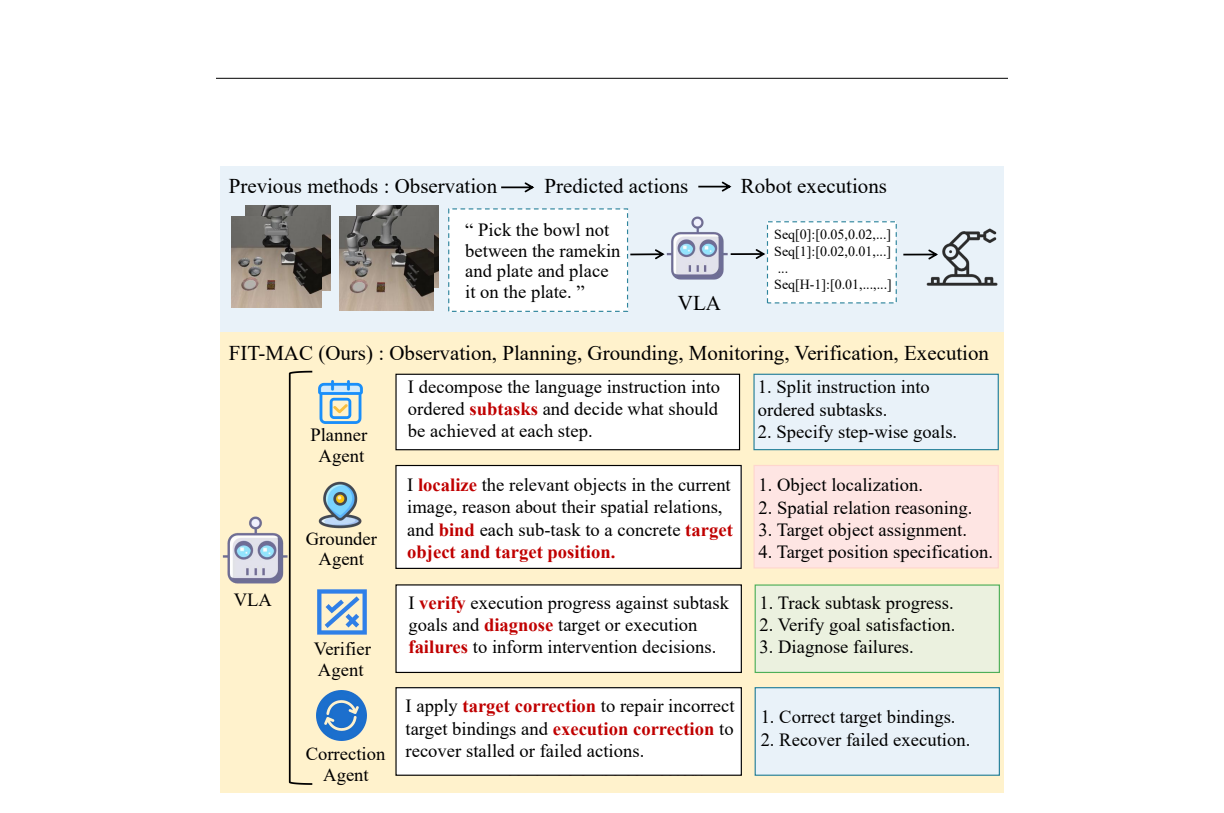
Existing VLA policies generally lack an explicit runtime mechanism for distinguishing these failure modes and selecting an appropriate recovery strategy. To systematically mitigate this issue, we propose FIT-MAC, a failure-aware, closed-loop multi-agent control framework for improving the robustness of VLA policies at inference time. FIT-MAC augments a VLA policy with an inference-time control layer. First, the Planner Agent parses the language instruction into a structured task specification that captures the manipulation goal and spatial constraints, and the Grounder Agent resolves each instruction-level reference to a visual target. Next, the Verifier Agent tracks phase-specific execution progress, distinguishes target-binding errors from local execution failures, and determines whether intervention is warranted. The Correction Agent then routes permitted interventions to target rebinding or bounded grasping or placement recovery, depending on the failure type. When no intervention is required, the pretrained VLA remains the default action generator. Extensive experiments on LIBERO-PRO demonstrate that FIT-MAC improves robustness across multiple VLA backbones, consistently increasing success rates and achieving state-of-the-art performance under diverse perturbations.
from the abstract
Pith says
Machine review · deepseek-v4-flash · 21 Oct 2026 · what was read was not recorded · not checked by a person
It can be wrong. Challenge this review or reply to it.
Holds up, with conditions. A solid, well-documented recovery-layer system whose headline claim about improving VLA robustness outruns its own ablation data: the biggest gains are the hand-coded controllers working almost alone. This line is wrong
3 major objections · 5 minor
How often objections from reviews like this one are right: not yet measured
Not checked: figures, code, what the 17 references say.
The paper says, at §4.2, Tables 2 and 9–10
The review did not quote this passage.
Pith says: Objection 1 of 3 · major
The central claim that FIT-MAC 'improves the robustness of VLA policies at inference time' is not supported in the settings that drive the headline average, because the gains come from near-total override by the hand-crafted recovery controller rather than from any change in the frozen policy's behavior.
more of objection 1
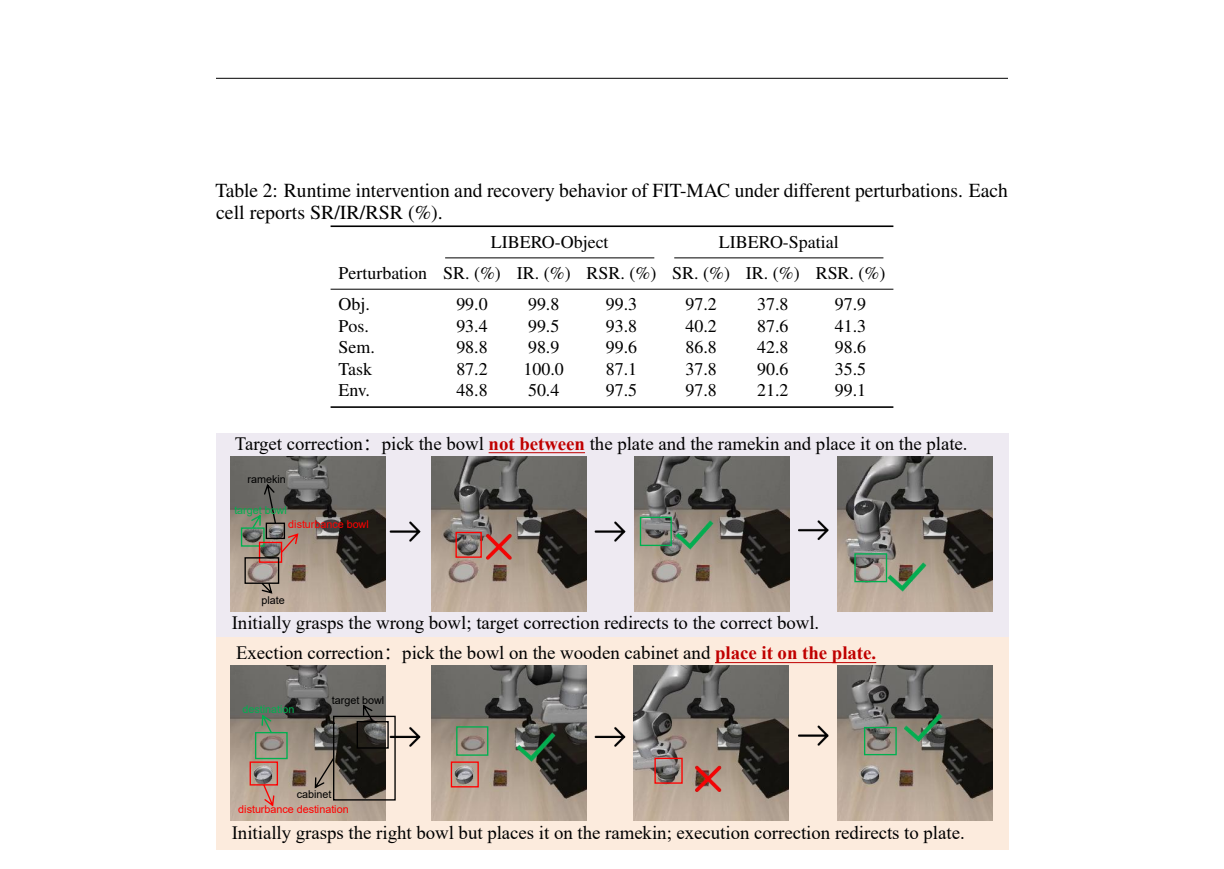
Under Task and Pos perturbations on LIBERO-Object, IR is 100.0% and 99.5%; under Task/Pos on LIBERO-Spatial it is 90.6% and 87.6% (Table 2). The module ablations (Appendix A.4) show that removing the execution corrector or hard pick collapses LIBERO-Object Task SR from 86.0% to 0.0% and Pos from 94.0% to 4.0%, in both cases with IR=0.0%, meaning the frozen VLA alone cannot complete these episodes and does not even advance far enough to trigger corrective routing. The same pattern appears for π0.5. The abstract and contribution statements ('improves the robustness of VLA policies at inference time', 'consistently increasing success rates') are not qualified to reflect that, in the winning regime, the policy's own actions are almost entirely replaced by a controller that already knows the grounded target and destination positions. The 'selective intervention' description is also undercut by IR=99.8% on Object-Obj, where the OpenVLA baseline already reaches 98%. I recommend (i) reframing the headline as a system-level inference-time recovery layer whose task knowledge is supplied by the scripted controllers and the grounding modules, and (ii) adding an attribution analysis, e.g., the share of successful episodes whose terminal behavior was executed under VLA control after rebinding versus completed by the recovery controller.
The paper says, at Table 1 and §4.2
The review did not quote this passage.
Pith says: Objection 2 of 3 · major
The 'state-of-the-art' claim and the 78.7% versus 45.9% comparison are computed only against OpenVLA. The table footnote states that the overall average is reported only for methods evaluated on all ten settings; among the compared methods, only OpenVLA and FIT-MAC satisfy this, because MolmoAct, NORA, X-VLA, AtomVLA, CaP-Agent, and RATs omit the Env setting (and some omit Obj or Sem).
more of objection 2
The aggregate comparison therefore does not measure FIT-MAC against the strongest methods on the settings it targets. The abstract's unqualified 'achieving state-of-the-art performance under diverse perturbations' is further weakened by the paper's own disclosure that it does not rank first under semantic perturbations (Object Sem: AtomVLA 99.0 versus FIT-MAC 98.8; Spatial Sem: X-VLA 96.0 versus FIT-MAC 86.8). Please qualify the claim to 'state-of-the-art among the compared methods on the settings evaluated' and add per-setting best-method comparisons.
The paper says, at §3.4–3.5, Eqs. (2)–(4), (7)
The review did not quote this passage.
Pith says: Objection 3 of 3 · major
The paper never states where the 3D quantities p_tgt, p_obj, and p_dst are obtained. Grounding DINO outputs 2D candidate boxes and the VLM resolver selects among them, but the Verifier's distance-based progress and stall detection and the recovery controller's waypoint computation consume 3D positions.
more of objection 3
Because the recovery controller supplies essentially all of the measured gain in the settings highlighted in the abstract (IR ≈ 100%), this is load-bearing rather than an implementation detail: if these positions come from simulator state, the 'inference-time' framing and any implication for deployed policies are unsupported and must be stated; if they come from a perception module (e.g., depth estimation plus object tracking), that pipeline needs to be described and validated. The paper should also state how object lift and post-release stability are sensed, since 'target lifted' and 'release stable' are used as gating evidence.
5 minor objections
The paper says, at §4.1
Pith says: minor objection 1 of 5
There is a stray character in 'Appendix A.3.s'; the sentence should read 'Appendix A.3'.
The paper says, at Tables 1–2 vs. Appendix A.3
Pith says: minor objection 2 of 5
Section 4.1 says the controlled OpenVLA comparison is averaged over the five seeds {7,11,13,17,23}, but the per-seed means in Tables 7–8 do not reproduce Table 1 (e.g., Task-Object is 87.2 in Table 1 versus a mean of 86.6 from 87/86/87/86/87; Spatial-Pos is 40.2 versus 38.0; Object-Sem is 98.8 versus 97.8). Please clarify whether the main tables are the multi-seed means or a separate 50-episode-per-task run, and align the numbers.
show 3 more
The paper says, at Table 1
Pith says: minor objection 3 of 5
In the X-VLA row for LIBERO-Spatial, the entries render as '0.096.00.0' with missing column separators; the row should read '97.0 0.0 96.0 0.0 –'.
The paper says, at §4.4 vs. Table 10
Pith says: minor objection 4 of 5
The statement that 'Target correction provides smaller but consistent gains' holds only on average; per-setting, removing the target corrector improves Spatial-Task SR from 38 to 41 for OpenVLA and from 25 to 27 for π0.5. The appendix discloses this, but the main text should carry the same qualifier.
The paper says, at Figure 4 and Table 5
Pith says: minor objection 5 of 5
The claim that FIT-MAC 'consistently improves average SR' holds at the suite-average level, but per-setting it reduces SR for π0 and π0.5 under semantic perturbations (Object Sem 90→87 and 96→89; Spatial Sem 97→83 and 97→93). Consider stating the per-setting exceptions in the main text.
What would settle it
Run a controller-only ablation: remove the frozen VLA entirely (skip all calls to pi(ell, o_t)) and let the Correction Agent's pick/place controllers execute every episode from the grounded target and destination positions under Pos and Task perturbations on both suites, keeping all gating thresholds identical, and report SR against FIT-MAC's 93.4%/87.2% (Object) and 40.2%/37.8% (Spatial). If controller-only SR matches FIT-MAC within error, the improvement is produced by the scripted recovery layer, and the central claim must be scoped to 'system-level robustness via scripted recovery' with the VLA's marginal contribution reported separately.
from the skeptic's reading
How the review went
4 readings by deepseek-v4-flash · 21 Oct 2026
- Reader holds up, with conditions
- Skeptic partly agrees
- Editor wrote the verdict above
- Referee major revision: 3 major objections, 5 minor
Not run on this paper: the simulated authors' defence.
Pith did not check this review's objections against the paper.
The review in full
The review in brief, machine-written
Quick take: this is a real system, honestly reported in most places, but the central claim is too strong. The paper wraps frozen VLA policies in a planner/grounder/verifier/correction layer and shows large success-rate gains on LIBERO-PRO, especially under position and task perturbations where the backbone is at 0%. What the tables show, though, is that in exactly those winning settings the scripted recovery controllers run nearly every episode (IR 87.6–100%, Table 2), and the ablation says the VLA without them gets roughly 0%. So the contribution is a recovery layer that replaces the policy when it fails, not a VLA whose robustness is improved. The authors do disclose IR and RSR and acknowledge residual limits on grounding and grasp execution (B.3) and on destination complexity (C.1), so this is a framing problem more than a fraud problem.
The target-binding vs execution-failure taxonomy, with routing to rebinding versus bounded recovery, is a plausible refinement over the cited recovery literature, and I do not know of it as a single coherent scheme elsewhere. The implementation is careful: phase-specific verification, persistent target locks, bounded controllers with explicit fallback, and honest failure cases. The ablations are a real strength because they isolate which components carry the gains. Code is available. That earns credit.
Soft spots, in order. (1) Attribution. The abstract and contribution bullets say FIT-MAC “improves the robustness of VLA policies at inference time.” A fairer statement is: a recovery layer that, given grounded object and destination positions, rescues or overrides the policy. The ablation data are decisive and the paper should claim what they show. (2) The perception dependency is unstated. Equation 2 needs p_objt and p_dstt at every step, and nothing says where those come from; if they are simulator state, the portability claim is unsupported. (3) Table 1's state-of-the-art claim rests on competitors evaluated on subsets of settings, and the average is computed against OpenVLA alone. That is a weak comparison. (4) The multi-seed rows in Tables 7 and 8 look suspiciously identical for LIBERO-Object; with 100 episodes per condition it is possible by quantization, but the paper should explain it rather than leave the reader to assume.
Who this is for: people building inference-time recovery for VLAs and groups evaluating closed-loop robustness on LIBERO-PRO. I would send it to review; it deserves referee time, and the framing issue plus the position-source question are exactly what reviewers should push on. If the authors re-scope the claim and clarify the perception assumption, this becomes a useful systems paper.
The strongest objection
The central claim is that FIT-MAC 'improves the robustness of frozen VLA policies at inference time,' with the largest gains under position and task perturbations where the backbone is at 0% (Table 1, Section 4.2). The paper's own data show those gains come from the hand-crafted recovery layer replacing the VLA almost completely, not from making the VLA robust. On LIBERO-Object, Task SR is 87.2% at IR = 100.0%; on LIBERO-Spatial, Task and Pos SR of 37.8%/40.2% occur at IR 90.6%/87.6% (Table 2). The module ablation (Section A.4, Tables 9-10) is decisive: removing the execution corrector or hard pick drops LIBERO-Object Task SR from 86.0% to 0.0% with IR = 0.0%, and Pos SR from 94.0% to 4.0%. This means the frozen VLA, run alone, achieves nothing in these settings and does not even advance far enough to trigger corrective routing; the measured 'robustness' is the robustness of a scripted pick/place controller operating on grounded target and destination positions (Eqs. 2, 7). This is a legitimate system-level result and the authors disclose IR and RSR transparently, but the abstract and contribution statements — 'improves the robustness of VLA policies at inference time,' 'consistently increasing success rates' — do not qualify that under the winning conditions the policy's own actions are near-fully overridden. The burden is on the paper to show what share of the claimed +32.8 pp improvement is attributable to the frozen policy's behavior rather than to task knowledge already encoded in the recovery controllers. This concern also intersects (but does not require) the reader's weakest assumption: the controllers' waypoints derive from p_objt and p_dstt in Eq. 2, whose source (simulator ground truth versus perception) is undisclosed, so the controller-side contribution may itself not be portable.
The reader's verdict is CONDITIONAL and I keep that. My most load-bearing concern is the attribution of the headline gains, which is answerable entirely from the paper's own tables and does not depend on speculation about deployment. Tables 2, 5, and 9-10 show that in the settings of the largest claimed gains (Task and Pos, where the backbone is 0%) intervention is near-universal (IR 87.6-100%) and the ablation collapses SR to 0% once the execution corrector or hard pick is removed, with IR falling to 0.0% — meaning the frozen VLA neither succeeds nor progresses enough to trigger routing. The claimed +32.8 pp average therefore measures a system in which the VLA is largely bypassed, so the claim 'improves the robustness of VLA policies at inference time' is not supported as worded for exactly the settings that carry the result. I credit the authors for transparently reporting intervention rates and for self-acknowledging residual limits in spatial grounding and grasp execution (Section B.3, [b386]) and the direct-anchor scope restriction (Section C.1, [b460]-[b461]); those are not my concern. The reader's weakest_assumption (privileged dependency of Eq. 2's p_objt and p_dstt on undisclosed simulator state) is real and related — the recovery controllers are scripted around those positions — but it is a portability gap for deployment, whereas the attribution gap I raise undercuts the interpretation of the in-simulation numbers themselves. This is an interpretive and scoping issue, not a data-integrity or fabrication charge; the multi-seed zero-variance oddity in Appendix A.3 (identical rows across seeds, population SD 0.1%) is a separate statistical concern I noted but do not treat as load-bearing for the central claim. Verdict remains CONDITIONAL: the framework works as a closed-loop recovery system, but the magnitude and phrasing of the robustness claim should be re-qualified and the position-source disclosed before the result is relied upon.
The referee's report
If the results hold, the system-level contribution is real and unusually transparent: the paper ships multi-seed results, an artifact link, per-setting IR/RSR, and module ablations that include cases where removing a component improves performance (e.g., Appendix A.4). The cross-backbone evaluation with frozen parameters is a strength, as is the event-level runtime trace in Appendix C.2. The central concern is claim calibration rather than fabrication: the headline gains are produced by near-total override with the scripted recovery controllers, the 'state-of-the-art' average is computed against OpenVLA alone, and the source of the 3D state quantities consumed by the verifier and recovery controller is never stated. These are fixable within the manuscript's scope, so the appropriate outcome is major revision rather than rejection.
Pith's reading of the paper (a machine's summary, not the authors')
FIT-MAC claims that a large share of VLA robot-policy failures under perturbation can be prevented at inference time without touching the policy: the paper wraps frozen OpenVLA, p0, and p0.5 models in a four-agent control loop that monitors execution, classifies the failure, and applies the matching correction. The key distinction is between target-binding errors, where the policy locks onto the wrong object, and local execution failures, where the right object is grasped, lifted, or placed incorrectly, with target rebinding used for the first and bounded grasping and placement recovery for the second. On the LIBERO-PRO benchmark this raises OpenVLA's average success rate from 45.9% to 78.7%, and in position- and task-perturbation settings where the bare backbone scores 0% on LIBERO-Object, FIT-MAC reaches 93.4% and 87.2%. The framework matters because it offers a policy-agnostic robustness layer that could be wrapped around any current or future VLA model.
What carries the argument. The machinery that carries the argument is the target-instance lock plus the phase-indexed verification and correction loop. The Grounder Agent scores candidate detections by geometric proximity to the end effector, restricted to instruction-compatible candidates, selects one instance, and locks it for the whole subtask so monitoring tracks one consistent object. The Verifier Agent computes progress from the distances $d^{\text{tgt}}_t = \|p^{\text{ee}}_t - p^{\text{tgt}}_t\|_2$ and $d^{\text{dst}}_t = \|p^{\text{obj}}_t - p^{\text{dst}}_t\|_2$, declares a stall when no progress accumulates across a patience window, imposes phase timeouts, and emits a diagnosis in which target failures take precedence over pick and place failures. The Correction Agent then issues clipped translational recovery commands $u^{\text{rec}}_t = \mathrm{clip}((p^*_t - p^{\text{ee}}_t) \oslash s, -1, 1)$ with zero rotation and a gripper command, through bounded pick and place routines that verify lift and release. An adaptive intervention gate requires persistent, high-confidence failure evidence before any correction overrides the backbone, and an execution-horizon parameter sets how often the loop queries the policy.
Core claim. FIT-MAC's central claim is that runtime failure diagnosis, not better training, is the missing ingredient for robust VLA manipulation. The paper argues that perturbations induce two separable failure modes, namely target failures, where the language instruction is bound to the wrong object instance, and execution failures, where the correct target is selected but approach, grasp, lift, transport, or placement goes wrong, and that each mode needs a distinct remedy rather than a generic retry. The Verifier Agent decides which mode is occurring from phase-specific progress signals such as end-effector-to-target and object-to-destination distances, gripper closure, object motion, and stall detection over a patience window, and the Correction Agent routes the case to target rebinding or to bounded local pick and place controllers. The pretrained VLA remains the default action generator and is never retrained or modified. On LIBERO-PRO the framework reports the highest success rate in eight of ten perturbation settings and an average of 78.7% versus 45.9% for OpenVLA; the largest gains occur where the backbone alone never succeeds, with position and task perturbations on LIBERO-Object rising to 93.4% and 87.2%. The same loop improves p0 and p0.5, with average gains on LIBERO-Object of 35.8 and 22.4 percentage points.
The premise it rests on. The entire verification and recovery system assumes that accurate estimates of the object position $p^{\text{obj}}_t$, the destination position $p^{\text{dst}}_t$, and the validity of the locked target are available at every step, yet the paper does not state where a deployed robot would obtain them, so the robustness claim is contingent on real perception supplying those quantities with simulator-like accuracy.
If the paper is right (Pith's inferences, not the authors')
Adding FIT-MAC to a frozen VLA policy can produce state-of-the-art perturbation robustness without any retraining, post-training, or modification of the policy.
The two-mode failure taxonomy, target-binding versus execution, supports targeted correction: rebinding for wrong objects, bounded local controllers for stalls and misplacements, and no intervention when the backbone is already succeeding.
The gains transfer across at least three VLA families, OpenVLA, p0, and p0.5, suggesting the control loop is backbone-agnostic.
Intervention is selective: on settings where the backbone already succeeds, intervention rates stay low at 21-43% while recovered success exceeds 97% of intervened episodes, so nominal behavior is largely preserved.
Ablations attribute the largest share of the gain to execution correction, whose removal drops average success from 78.7% to 54.7%, with hard pick dominating LIBERO-Object and hard place dominating LIBERO-Spatial.
A natural next test the paper leaves implicit is replacing the simulator-supplied object and destination coordinates in the verifier with onboard perception estimates, to see whether the recovery gains survive real-world pose error.
The target-versus-execution failure dichotomy gives other runtime monitors a diagnostic vocabulary; one testable extension is reusing the same verifier to detect mid-episode instruction or goal changes, where rebinding could re-plan rather than retry.
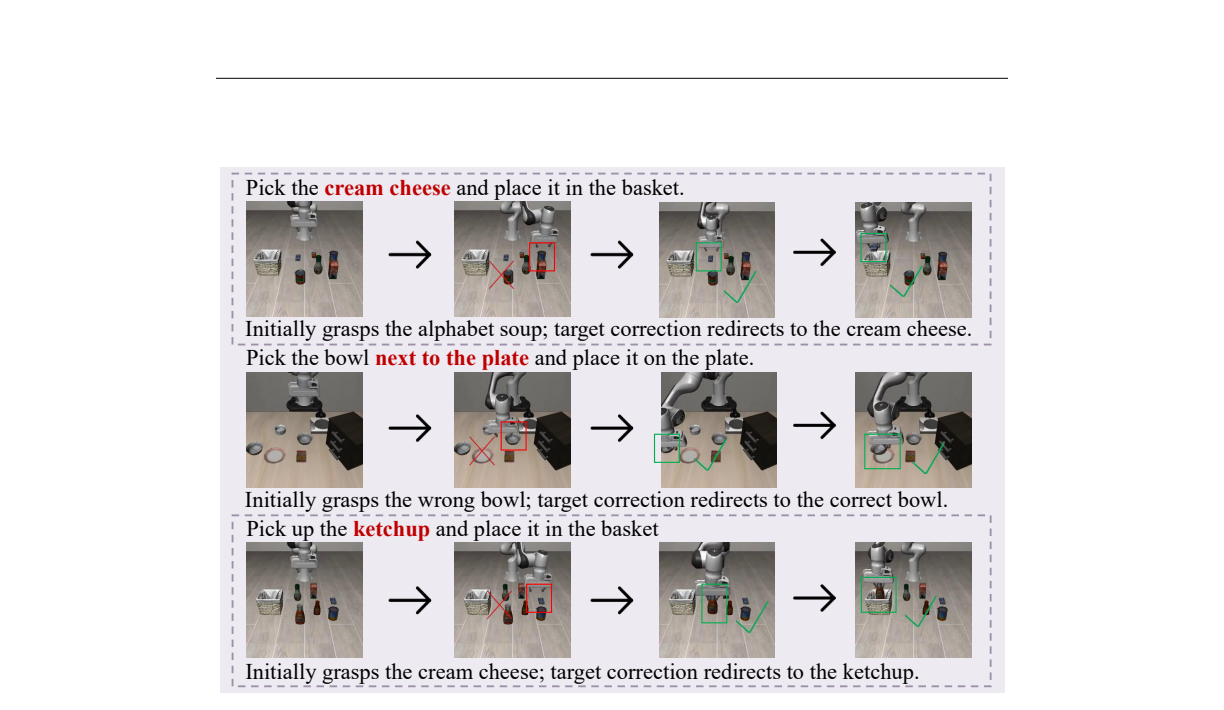
The two bottlenecks the paper itself documents, the VLM resolver occasionally picking the wrong bowl under negated spatial relations and repeated grasp stalls on correctly identified targets, suggest future gains will come from stronger grounding and grasp control rather than from the recovery loop itself.
Check this review
Pith stored no record of this review's passes and took no fingerprint of it. Reviews made by code from 13 Nov 2026 on carry both.
How often reviews like this one are right
Reviews like this one: written by deepseek-v4-flash, where what was read was not recorded.
How often objections from reviews like this one are right: not yet measured
Reviews by people
This review was written by a machine. No person has reviewed this paper on Pith yet. A scientist listed on Pith can review it for a fee, and their review is published here whatever it concludes.
The paper
Abstract
Vision-language-action (VLA) models have achieved strong performance on standard robotic manipulation benchmarks. However, their reliability can degrade substantially when task conditions deviate from the nominal setting. Perturbations in object positions and task instructions may lead to complete task failure. Existing VLA policies generally lack an explicit runtime mechanism for distinguishing these failure modes and selecting an appropriate recovery strategy. To systematically mitigate this issue, we propose FIT-MAC, a failure-aware, closed-loop multi-agent control framework for improving the robustness of VLA policies at inference time. FIT-MAC augments a VLA policy with an inference-time control layer. First, the Planner Agent parses the language instruction into a structured task specification that captures the manipulation goal and spatial constraints, and the Grounder Agent resolves each instruction-level reference to a visual target. Next, the Verifier Agent tracks phase-specific execution progress, distinguishes target-binding errors from local execution failures, and determines whether intervention is warranted. The Correction Agent then routes permitted interventions to target rebinding or bounded grasping or placement recovery, depending on the failure type. When no intervention is required, the pretrained VLA remains the default action generator. Extensive experiments on LIBERO-PRO demonstrate that FIT-MAC improves robustness across multiple VLA backbones, consistently increasing success rates and achieving state-of-the-art performance under diverse perturbations.
The paper's own sentences, arranged, kept beside the review and separate from it. Each label is drawn from a closed vocabulary; the number beside it is the probability the classifier gave that label. No sentence in this record was written by a model.
abstract compiled · 2026-10-21
The authors' main claim, as the classifier picked it out 1.00
“Extensive experiments on LIBERO-PRO demonstrate that FIT-MAC improves robustness across multiple VLA backbones, consistently increasing success rates and achieving state-of-the-art performance under diverse perturbations.”
How the main claim is stated: asserted 1.00
What the abstract itself states, as probabilities: claims first 0.09 · states limitation 0.10 · human participants 0.03 · controlled comparison 0.43 · randomized assignment 0.01 · states quantitative result 0.09 · compares with prior results 0.77 · mentions code or data availability 0.02
The abstract, sentence by sentence
This table labels the abstract only (arXiv listing abstract v1). The number is the probability the classifier gave the label.
| Sentence | Role | The authors' own work | States the main conclusion | Strength |
|---|---|---|---|---|
| Vision-language-action (VLA) models have achieved strong performance on standard robotic manipulation benchmarks. | background 1.00 | 0.07 | 0.02 | asserted 1.00 |
| However, their reliability can degrade substantially when task conditions deviate from the nominal setting. | background 0.93 | 0.12 | 0.02 | asserted 0.57 |
| Perturbations in object positions and task instructions may lead to complete task failure. | background 0.99 | 0.10 | 0.02 | hedged possibility 0.99 |
| Existing VLA policies generally lack an explicit runtime mechanism for distinguishing these failure modes and selecting an appropriate recovery strategy. | gap 0.99 | 0.07 | 0.03 | asserted 0.99 |
| To systematically mitigate this issue, we propose FIT-MAC, a failure-aware, closed-loop multi-agent control framework for improving the robustness of VLA policies at inference time. | contribution 1.00 | 0.83 | 0.20 | asserted 0.98 |
| FIT-MAC augments a VLA policy with an inference-time control layer. | method 0.76 | 0.84 | 0.04 | asserted 1.00 |
| First, the Planner Agent parses the language instruction into a structured task specification that captures the manipulation goal and spatial constraints, and the Grounder Agent resolves each instruction-level reference to a visual target. | method 0.99 | 0.71 | 0.02 | asserted 1.00 |
| Next, the Verifier Agent tracks phase-specific execution progress, distinguishes target-binding errors from local execution failures, and determines whether intervention is warranted. | method 0.99 | 0.71 | 0.04 | asserted 0.99 |
| The Correction Agent then routes permitted interventions to target rebinding or bounded grasping or placement recovery, depending on the failure type. | method 0.99 | 0.76 | 0.04 | asserted 1.00 |
| When no intervention is required, the pretrained VLA remains the default action generator. | method 1.00 | 0.42 | 0.04 | asserted 1.00 |
| Extensive experiments on LIBERO-PRO demonstrate that FIT-MAC improves robustness across multiple VLA backbones, consistently increasing success rates and achieving state-of-the-art performance under diverse perturbations. | result 1.00 | 0.97 | 0.86 | asserted 1.00 |
What kind of paper the classifier reports this is: method or tool 1.00 · evidence from observation or experiment 0.99
What was examined, and what was not
Sources read
- arXiv listing abstract v1
Not examined
- full text
- figures and tables
- references and citing sentences
- relations to other papers
Levels run
- P abstract
Not run
- S sections
- T body sentences
- C citations
- R cross-paper relations
How the labels were made
Compiled by classifier-1.13.0 via TypeSafe API, question bank abstract-p1-20260923, 2026-10-21: 1 request, 8,094 input tokens.
Every quoted sentence on this record is the authors'. Every label is from Pith's closed vocabulary, with the probability shown beside it. This record as JSON
Figures (7)




Figures are the authors', reproduced from the paper.
References (17)
- [1] Kevin Black, Noah Brown, Danny Driess, Adnan Esmail, Michael Equi, Chelsea Finn, Niccolo Fusai, Lachy Groom, Karol Hausman, Brian Ichter, et al. π0: A vision-language-action flow model for general robot control.arXiv preprint arXiv:2410.24164, on PithPith's reviewarXiv
- [3] Jisheng Dang, Xudong Wu, Haowen Yan, Huicheng Zheng, Wei-Shi Zheng, Jianhuang Lai, Bin Hu, and Tat-Seng Chua. Decoupled seg tokens make stronger reasoning video segmenter and grounder. IEEE Transactions on Pattern Analysis and Machine Intelligence, 2026a. Jisheng Dang, Huichen... on PithPith's reviewarXiv
- [6] Chia-Yu Hung, Qi Sun, Pengfei Hong, Amir Zadeh, Chuan Li, U Tan, Navonil Majumder, Soujanya Poria, et al. Nora: A small open-sourced generalist vision language action model for embodied tasks.arXiv preprint arXiv:2504.19854, on PithPith's reviewarXiv
- [7] Physical Intelligence, Kevin Black, Noah Brown, James Darpinian, Karan Dhabalia, Danny Driess, Adnan Esmail, Michael Equi, Chelsea Finn, Niccolo Fusai, et al. π0.5: a vision-language-action model with open-world generalization.arXiv preprint arXiv:2504.16054, on PithPith's reviewarXiv
- [8] 10 Md Tanvir Islam, Sai Navaneet Peddapalli, Sangmoon Lee, and Sangtae Ahn. Sureflow: State- space uncertainty-aware residual flow matching for robust robot manipulation.arXiv preprint arXiv:2607.10504, on PithPith's reviewarXiv
- [9] Moo Jin Kim, Karl Pertsch, Siddharth Karamcheti, Ted Xiao, Ashwin Balakrishna, Suraj Nair, Rafael Rafailov, Ethan Foster, Grace Lam, Pannag Sanketi, et al. Openvla: An open-source vision-language-action model.arXiv preprint arXiv:2406.09246, on PithPith's reviewarXiv
- [10] Jason Lee, Jiafei Duan, Haoquan Fang, Yuquan Deng, Shuo Liu, Boyang Li, Bohan Fang, Jieyu Zhang, Yi Ru Wang, Sangho Lee, et al. Molmoact: Action reasoning models that can reason in space.arXiv preprint arXiv:2508.07917, on PithPith's reviewarXiv
- [11] Yiran Ling, Qing Lian, Jinghang Li, Qing Jiang, Tianming Zhang, Xiaoke Jiang, Chuanxiu Liu, Jie Liu, and Lei Zhang. Guide, think, act: Interactive embodied reasoning in vision-language-action models.arXiv preprint arXiv:2605.13632, on PithPith's reviewarXiv
- [13] Xiaoquan Sun, Zetian Xu, Chen Cao, Zonghe Liu, Yihan Sun, Jingrui Pang, Ruijian Zhang, Zhen Yang, Kang Pang, Dingxin He, et al. Atomvla: Scalable post-training for robotic manipulation via predictive latent world models.arXiv preprint arXiv:2603.08519, on PitharXiv
- [14] Guodong Wang, Chenkai Zhang, Qingjie Liu, Jinjin Zhang, Jiancheng Cai, Junjie Liu, and Xinmin Liu. Libero-x: Robustness litmus for vision-language-action models.arXiv preprint arXiv:2602.06556, 2026a. Taowen Wang, Cheng Han, James Liang, Wenhao Yang, Dongfang Liu, Luna Xinyu Z... on PitharXiv
- [15] 11 Sihyung Yoon, Minjong Yoo, Sanghyun Ahn, Seojeong Choi, and Honguk Woo. Robobridge: A modular framework for bridging policies to robust real-world robotic agents.arXiv preprint arXiv:2607.27881, on PithPith's reviewarXiv
- [16] Hongyin Zhang, Shuo Zhang, Junxi Jin, Qixin Zeng, Runze Li, and Donglin Wang. Robustvla: Robustness-aware reinforcement post-training for vision-language-action models.arXiv preprint arXiv:2511.01331, 2025a. Jianke Zhang, Yanjiang Guo, Yucheng Hu, Xiaoyu Chen, Xiang Zhu, and J... on PitharXiv
- [17] Xueyang Zhou, Yangming Xu, Guiyao Tie, Yongchao Chen, Guowen Zhang, Duanfeng Chu, Pan Zhou, and Lichao Sun. Libero-pro: Towards robust and fair evaluation of vision-language-action models beyond memorization.arXiv preprint arXiv:2510.03827, on PithPith's reviewarXiv
- [2023] Lin Liu, Zhicheng Bao, Lu Zhang, Ziying Song, Wu Yang, Shuai Tao, Wulong Liu, and Huchuan Lu. Libero-recover: Beyond task success towards failure recovery in robotic manipulation models. arXiv preprint arXiv:2609.05178, 2026a. Shuo Liu, Ishneet Sukhvinder Singh, Yiqing Xu, Jia... on PithPith's reviewarXiv
- [2024] Hongyi Chen, Yunchao Yao, Ruixuan Liu, Changliu Liu, and Jeffrey Ichnowski. Robot failure recovery using vision-language models with optimized prompts. In2025 American Control Conference (ACC), pp. 1983–1988. IEEE, on Pith
- [2025] Letian Fu, Justin Yu, Karim El-Refai, Ethan Kou, Haoru Xue, Huang Huang, Wenli Xiao, Guanzhi Wang, Dantong Niu, Fei-Fei Li, et al. Cap-x: A framework for benchmarking and improving coding agents for robot manipulation.arXiv preprint arXiv:2603.22435, on PithPith's reviewarXiv
- [2026] Jianing Guo, Zhenhong Wu, Chang Tu, Yiyao Ma, Xiangqi Kong, Zhiqian Liu, Jiaming Ji, Shuning Zhang, Yuanpei Chen, Kai Chen, et al. On robustness of vision-language-action model against multi-modal perturbations. InInternational Conference on Learning Representations, volume 20... on Pith
Challenges and discussion
Disagree with the review, or know something it missed? Leave a comment, or challenge this review formally: a challenge becomes a permanent entry in this paper's record, and its decision is published here.
Come back by email
A short list of the week's newly reviewed papers. Nothing is sent until you confirm from your inbox, and every email has a link that stops it. No account.
No comments yet.
Sign in to comment