Robotics · arXiv:2611.09376 v1 · submitted 6 Nov 2026 · 27 references
Can LLMs Debug Robots by Editing Their Weights?
The paper says
“A language model can repair a robot policy's lexical instruction grounding by editing just 65 token-embedding rows.”
more of the abstract
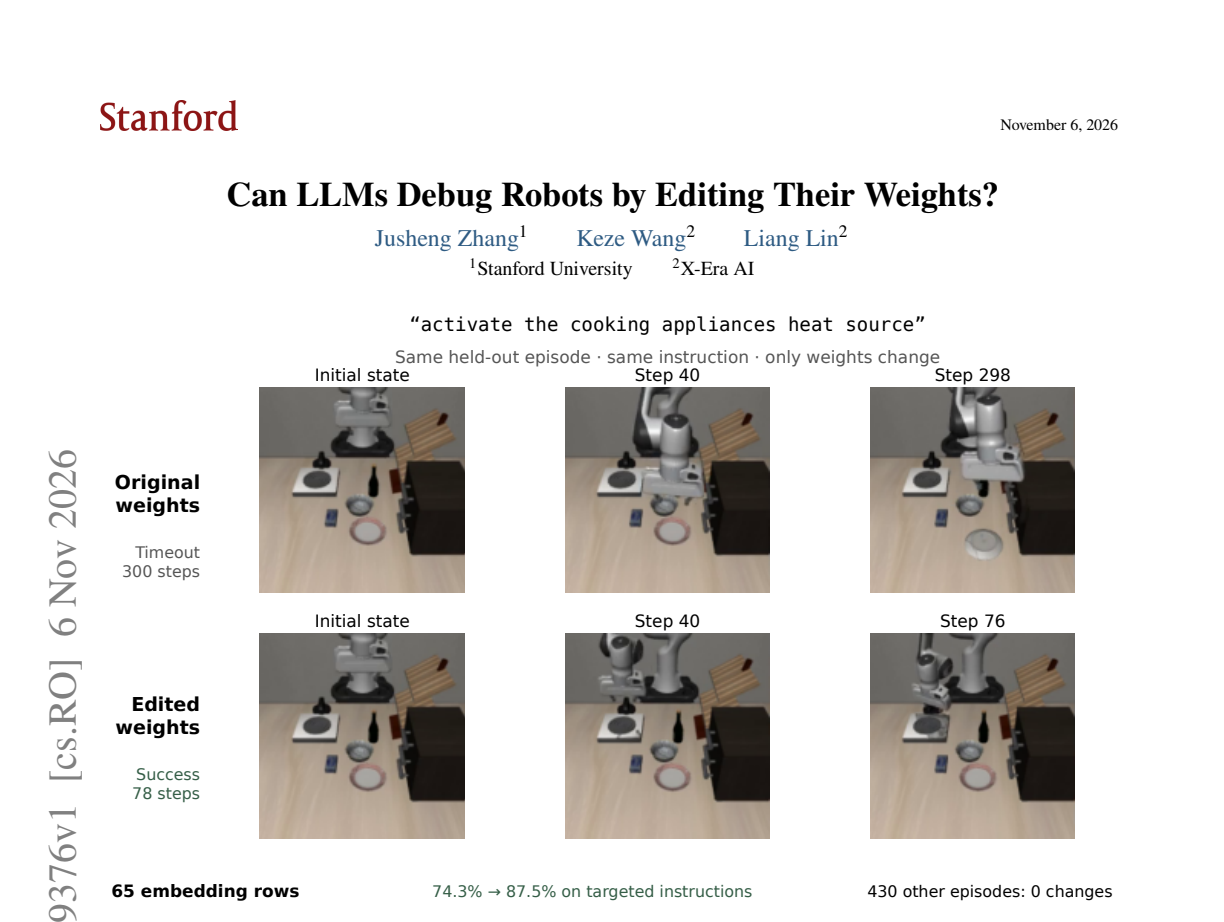
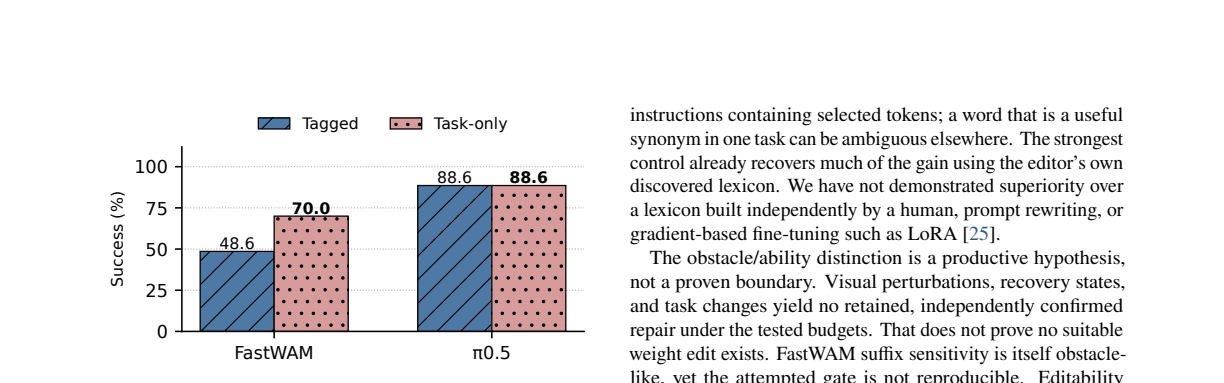
We bring weight-space programming to robot foundation policies: GPT-6 Astra reads weights and uses a CPU workspace and budgeted simulator feedback, without gradient updates or new demonstrations. Three independent sessions on π0.5 all improve success on 765 held-out paraphrases; the best raises success from 86.3% to 92.0% (48 repairs, four regressions; exact paired p = 1.31 × 10⁻¹⁰). Among the 335 instructions containing edited tokens, success rises from 74.3% to 87.5%; the other 430 episodes have zero outcome changes. Matched random-direction edits do not help. Full replacement using the editor's own lexicon explains much of the gain but produces more regressions; its direct difference from the editor is not significant at 0.05. Across 13 further robot sessions, the editor declines 12 candidates; the sole retained edit does not show a significant held-out gain. Separately, benchmark metadata lowers FastWAM success from 70.0% to 48.6%, while the evaluated VLA's aggregate rate is unchanged. The evidence supports precise lexical repair, not general acquisition of missing robot capabilities.
from the abstract
Pith says
Machine review · deepseek-v4-flash · 9 Nov 2026 · what was read was not recorded · not checked by a person
It can be wrong. Challenge this review or reply to it.
Holds up, with conditions. A careful, honest study of LLM weight-editing for robot policies: the 65-row lexical repair looks real within a single simulation seed, but the headline numbers rest on one draw and the artifacts are not out yet. This line is wrong
3 major objections · 3 minor
How often objections from reviews like this one are right: not yet measured
Not checked: figures, code, what the 27 references say.
The paper says, at Section 3.6, Table 5
The review did not quote this passage.
A classifier read this sentence of the paper as acknowledging the concern (probability 0.63):
“The positive language resultrequiresbotharetainededitandanindependentlypositive held-out effect.”
Pith says: Objection 1 of 3 · major
The headline gain for run C rests on seed 7 only, and no multi-seed held-out check exists for run C. The paper's own Table 5 documents, for run B, a frozen edit ranging from +2.7 pp to -0.5 pp across seeds, and the same seed-7 draw is shared by all three sessions.
more of objection 1
A single additional held-out evaluation of run C on a small set of alternative seeds would directly calibrate the headline 48/4 discordance against the seed sensitivity the paper itself documents.
The paper says, at Section 3.3, Table 2
The review did not quote this passage.
Pith says: Objection 2 of 3 · major
The zero-change record on the 430 untouched instructions is a single-draw closed-loop observation, not a tight bound. The paper acknowledges in Section 3.3 and Appendix A that paired renders differ by 1-16 channel entries and that runs A and B each flip one untouched episode in the 360-episode sample; at that rate ~1.2 expected flips would be expected on the 430 episodes, so observing zero is consistent with render noise.
more of objection 2
Reporting the discordance counts from the other two runs on the same 430 episodes would strengthen the locality claim.
The paper says, at Section 3.4, Table 3
The review did not quote this passage.
A classifier read this sentence of the paper as acknowledging the concern (probability 0.91):
“We have not demonstrated superiority over a lexicon built independently by a human, prompt rewriting, or gradient-based fine-tuning such as LoRA [25].”
Pith says: Objection 3 of 3 · major
The full-replacement control is a reasonable within-mechanism control, but the paper does not compare the editor's discovered lexicon against a human-supplied synonym list or against simple rule-based lexical replacement, so the claim that the editor's diagnosis and construction is the contribution is supported only by the absence of such baselines. Adding a cheap dictionary-only baseline would materially strengthen the central claim about the LLM's diagnostic ability.
3 minor objections
The paper says, at Section 2
Pith says: minor objection 1 of 3
The sentence 'Thus no additional demonstrations does not mean no observations or feedback' is grammatically awkward; consider rephrasing to 'Thus, no additional demonstrations does not mean there are no observations or feedback.'
The paper says, at Section 5, Table 6
Pith says: minor objection 2 of 3
The dash entries in Table 6 are explained in the caption, but a footnote in the table itself would improve readability.
show 1 more
The paper says, at References
Pith says: minor objection 3 of 3
Reference [1] is dated 'Nov. 2026' and is described as a blog and released logs; the manuscript should flag explicitly that this is a non-archival source, since the reproduction claims in Section 2.1 depend on it.
What would settle it
With the released harness and the frozen 65-row C candidate (no editor, no retraining), re-run the full 765-variant held-out evaluation pairing original and edited weights at the five Table 5 practice seeds (23, 37, 61, 67, 73) plus one fresh seed, and tabulate discordances split by edited-token membership. If C's gain stays significant (very roughly ≥20 repairs with ≤10 regressions per seed) and untouched-430 flips stay near the ~1/360 noise floor, the headline magnitude and locality claim are robust. If the gain shrinks toward B's practice average (~1.3 pp) at several seeds, or untouched episodes flip at higher rates, the 48/4 and 0/0 counts are single-draw artifacts and the abstract should report a seed-averaged effect.
from the skeptic's reading
How the review went
4 readings by deepseek-v4-flash · 9 Nov 2026
- Reader holds up, with conditions
- Skeptic agrees
- Editor wrote the verdict above
- Referee minor revision: 3 major objections, 3 minor
Not run on this paper: the simulated authors' defence.
Pith did not check this review's objections against the paper.
The review in full
The review in brief, machine-written
Short version: the paper does something genuinely useful and reports it with unusual discipline. The central claim—an LLM editor repairs pi0.5's lexical grounding by rewriting 65 embedding rows—is supported by the internal statistics, which I rechecked and found consistent with the reported discordance counts. Three independent sessions all improve held-out paraphrases, discordances concentrate in the edited-token subset, the random-direction control fails, and the paper publishes its own negative evidence: the non-significant 200-episode check, a negative practice seed, render variability, failed cleanup runs, the four regressions, and a 12/13 decline record across other robot sessions. That reporting discipline is the paper's best feature. The separate FastWAM result—instruction metadata dropping success from 70.0% to 48.6%, while the VLA's aggregate is unchanged—is a clean, citable benchmark observation in its own right.
The soft spots are real, but the authors point to most of them. The headline 48/4 gain and the 0/0 locality record are a single closed-loop draw at seed 7. Run B's own practice validation shows the same frozen edit ranging from +2.7 pp to -0.5 pp across seeds, and run C has no comparable multi-seed check. The zero-change record on the 430 untouched episodes is roughly a 30% event under the paper's measured flip rate, not a tight bound. That does not kill the qualitative claim—48/4 is far beyond what render noise could fabricate—but it means the point estimates are probably optimistic and "zero outcome changes" is doing more work than the evidence supports. Since the authors disclose all of this, it is a calibration gap, not concealment. Second, the editor is proprietary and the transcripts and artifact package are promised but not released, so the core capability cannot yet be independently verified. Third, the editor's blended edit is not significantly better than full replacement of the same rows (p = 0.0614); the mechanism's headline detail is unresolved, though the authors openly credit the dictionary control with much of the gain.
Who is this for: people working on VLA debugging, model editing, and benchmark methodology. The counts, p-values, and row inventory are reproducible from the tables themselves. My recommendation: send it to peer review. A serious referee should push for the artifact release and a multi-seed held-out evaluation before final acceptance, but the scoped claim is well-built and honestly bounded.
The strongest objection
The central claim reduces to the paired discordance table: run C produces 48 repairs and 4 regressions (exact p = 1.31e-10, which I re-derived and matches) on the 335 edited-token instructions and 0/0 on the 430 untouched instructions. For the abstract's numbers to be robust, these discordances must reflect the edit's causal effect rather than the particular closed-loop draw, and two pieces of the paper's own evidence show the draw matters.
Table 5 (run B's practice validation, 1,533 trials, five rollout seeds) shows the same frozen edit gaining +2.7 pp (seed 23), +1.2, +1.5, +1.6, and losing 0.5 pp (seed 73) — a spread comparable to B's entire seed-7 held-out gain of +1.7 pp. For run B the held-out seed sits near the practice average, which is reassuring; for run C, the headline, no multi-seed check exists anywhere in the paper, and its +5.75 pp and 48/4 pattern are uncalibrated against the seed sensitivity the authors themselves document. Because all three sessions are evaluated on the same 765 variants at seed 7, the three-session agreement does not diversify the draw.
The locality record shares the same single-draw status. Eq. 2 is a fixed-input guarantee, and the paper honestly separates it from closed-loop identity: paired renders differ by 1-16 channel entries, and runs A and B each flip the same untouched episode in the 360-episode sample. At that rate the 430 untouched episodes carry about 1.2 expected flips, so observing zero is a roughly 30% event rather than a tight bound. The 48/4 asymmetry is far too large for noise alone, so the qualitative claim survives; what is fragile is the point estimate and the 'zero outcome changes' phrasing.
The paper discloses the single seed, the negative practice seed, and the render variability, so this is a calibration gap, not concealment. The load-bearing and untested assumption is that seed 7 is representative for run C's gain and for the untouched-430 flip rate.
I re-derived the three McNemar p-values (1.31e-10, 1.82e-4, 0.0106) from the reported discordance counts; they are correct, and the Holm adjustments follow. The reporting is genuinely careful: the non-significant 200-episode sample (Table S1), the negative practice seed (Table 5, seed 73), render variability (1-16 channel entries), and the cleanup failures (Appendix D) are all disclosed. The random-direction control, the editor-informed full-replacement control, and the replay-based direction/norm split (Table 4) triangulate the mechanism: the gain is directional and lexical rather than a norm artifact.
I considered and rejected three alternatives as less load-bearing. (a) The blend-vs-full-replacement comparison (p = 0.0614) leaves the interpolation detail unresolved, but the authors explicitly scope this, and the central claim only requires the edit to help, not that blending beats replacement. (b) Repair clustering by edited token could inflate McNemar significance, yet even a heavily clustered 20/4 pattern would remain significant, so the qualitative claim stands. (c) The proprietary editor and promised-but-unreleased transcripts block independent replication, but that is a verifiability gap already covered by the reader's CONDITIONAL and does not bear on the internal argument.
The load-bearing spot is calibration of the headline numbers: all three sessions are evaluated on the same 765 variants at seed 7, and the only multi-seed evidence for any language edit (Table 5, run B) shows a ~3 pp spread across seeds. Run C's much larger +5.75 pp has no multi-seed counterpart, and the 0/0-on-430 locality record is a single closed-loop draw consistent with ~1.2 expected render flips. This does not threaten the existence of a repair — the 48/4 asymmetry and the directional controls rule out noise as the sole cause — but it means the abstract's precise counts are uncalibrated point estimates from one draw, and for a paper whose headline is exactly those counts, that is the most load-bearing assumption.
The verdict stays CONDITIONAL, which is why I mark UNCHANGED: the concern justifies the reader's condition (multi-seed corroboration and artifact release) rather than moving the verdict. The concrete multi-seed re-run is feasible without the proprietary editor and settles the question directly.
The referee's report
If the result holds, the paper provides one of the first reproducible demonstrations of weight-space programming for a modern VLA: a small, inspectable, sparse weight edit that repairs instruction grounding without retraining. The statistical discipline is unusually strong: paired episodes, exact two-sided McNemar tests, Holm correction within the stated three-candidate family, a disclosed weaker 200-episode check, elementwise verification of changed rows, archived transcripts, and reported regressions as well as repairs. The paper also honestly delineates the boundary by archiving declined candidates and failed attempts, which helps the community calibrate the method's scope.
Pith's reading of the paper (a machine's summary, not the authors')
An LLM can repair a robot policy's failures to follow paraphrased instructions by directly editing the policy's weights, without gradient updates or new demonstrations. The strongest result changes 65 token-embedding rows, raising success on 335 held-out instructions containing an edited token from 74.3% to 87.5% while the 430 untouched instructions keep exactly their original outcomes. The manipulation skills already exist; the edit reroutes paraphrased wording to the correct task representation rather than creating new behavior. Three independent editing sessions converge on the same kind of fix, and the same editor declines 12 of 13 repair attempts on other failure modes, so the paper argues for precise lexical repair rather than general capability acquisition.
What carries the argument. The carrying object is the row-level embedding interpolation of Eq. 1, $E'_i = (1-\alpha_i)E_i + \alpha_i \bar{E}_{T_i}$, where the destination is the centroid of task-anchor token embeddings and strengths range from 0.5 to 1.0 across 65 rows of the 257,152-row table. Its companion structural guarantee, Eq. 2, states that if an instruction reads none of the edited rows, the output action is identical under deterministic execution, which is what explains the zero outcome changes on the 430 untouched episodes. The paired McNemar tests over the fixed 765-variant held-out population supply the statistical backbone, and the editor's process — inspecting tensor weights, running budgeted simulator rollouts and replay probes from a persistent CPU workspace, with gradients and training loops forbidden — is what makes the repair reproducible and inspectable.
Core claim. The central claim is that weight-space editing can repair a VLA policy's lexical instruction grounding: the best of three independent sessions changes 65 embedding rows of π0.5 (0.00367% of exported parameters), raising success from 86.3% to 92.0% across all 765 held-out paraphrases — 48 repairs and four regressions, with exact paired p = 1.31×$10^{{-10}}$ — with the entire gain concentrated in the 335 instructions that read an edited token. The failure being repaired is a wording-to-behavior mismatch, not a missing motor skill: the policy already knows how to turn a stove, but 'activate the cooking appliances heat source' selects the wrong task representation. The edit is a per-row interpolation toward task-anchor embeddings, matched random-direction edits do not help, and full replacement toward the editor's own discovered destinations explains much of the gain but produces more regressions. The paper frames the result as evidence for precise lexical repair: across 13 further sessions on other benchmarks, the editor declines 12 candidates, and the sole retained edit shows no significant held-out gain.
The premise it rests on. The load-bearing premise is that the measured closed-loop outcome changes are caused by the weight edit and not by simulator render noise or a favorable seed: the fixed-input locality guarantee of Eq. 2 holds only under deterministic execution, the simulator's paired renders differ by 1–16 channel entries, runs A and B each flip one untouched episode on the 360-episode sample, and the 765-episode held-out evaluation uses a single seed (seed 7) while the editor's own practice validation already shows a negative seed (seed 73).
If the paper is right (Pith's inferences, not the authors')
A reproducible, inspectable, localized repair is demonstrated: 65 rows and 0.00367% of parameters, with the full source–destination–strength recipe published so the fix can be audited and re-applied.
Independence across three sessions means the gain is not an artifact of one optimization trajectory; the editor converges on sparse lexical remapping each time.
The 12-of-13 decline record delimits the technique: the editor will not claim recovery, position, or task-change repairs under its budget, so this is lexical repair and not general capability synthesis.
Benchmark instruction metadata matters: keeping reference metadata in the instruction lowers FastWAM success from 70.0% to 48.6%, so evaluation reports should state the exact instruction-construction procedure.
Read diagnostically, the result offers a way to separate two failure classes: if a sparse embedding edit restores success, the skill was present and the obstacle was representational; if it does not, the capability is likely absent — a test that could generalize beyond this checkpoint.
The editor's own practice data includes a negative seed (seed 73), so the one-seed held-out gain may not survive seed variation; a multi-seed re-evaluation would either confirm the repair as reproducible or shrink it to a favorable-draw effect.
Because the edit is context-insensitive and does not rewrite instruction strings, it could compose with prompt rewriting or gradient fine-tuning, which the paper explicitly does not claim to beat; the practical boundary between weight-space editing and those alternatives is left open.
Check this review
Pith stored no record of this review's passes and took no fingerprint of it. Reviews made by code from 13 Nov 2026 on carry both.
How often reviews like this one are right
Reviews like this one: written by deepseek-v4-flash, where what was read was not recorded.
How often objections from reviews like this one are right: not yet measured
Reviews by people
This review was written by a machine. No person has reviewed this paper on Pith yet. A scientist listed on Pith can review it for a fee, and their review is published here whatever it concludes.
The paper
Abstract
A language model can repair a robot policy's lexical instruction grounding by editing just 65 token-embedding rows. We bring weight-space programming to robot foundation policies: GPT-6 Astra reads weights and uses a CPU workspace and budgeted simulator feedback, without gradient updates or new demonstrations. Three independent sessions on π0.5 all improve success on 765 held-out paraphrases; the best raises success from 86.3% to 92.0% (48 repairs, four regressions; exact paired p = 1.31 × 10⁻¹⁰). Among the 335 instructions containing edited tokens, success rises from 74.3% to 87.5%; the other 430 episodes have zero outcome changes. Matched random-direction edits do not help. Full replacement using the editor's own lexicon explains much of the gain but produces more regressions; its direct difference from the editor is not significant at 0.05. Across 13 further robot sessions, the editor declines 12 candidates; the sole retained edit does not show a significant held-out gain. Separately, benchmark metadata lowers FastWAM success from 70.0% to 48.6%, while the evaluated VLA's aggregate rate is unchanged. The evidence supports precise lexical repair, not general acquisition of missing robot capabilities.
The paper's own sentences, arranged, kept beside the review and separate from it. Each label is drawn from a closed vocabulary; the number beside it is the probability the classifier gave that label. No sentence in this record was written by a model.
abstract compiled · 2026-11-09
The authors' main claim, as the classifier picked it out 0.99
“The evidence supports precise lexical repair, not general acquisition of missing robot capabilities.”
How the main claim is stated: asserted 0.91
What the abstract itself states, as probabilities: claims first 0.10 · states limitation 0.94 · human participants 0.04 · controlled comparison 0.93 · randomized assignment 0.05 · states quantitative result 0.99 · compares with prior results 0.89 · mentions code or data availability 0.03
The abstract, sentence by sentence
This table labels the abstract only (arXiv listing abstract v1). The number is the probability the classifier gave the label.
| Sentence | Role | The authors' own work | States the main conclusion | Strength |
|---|---|---|---|---|
| A language model can repair a robot policy's lexical instruction grounding by editing just 65 token-embedding rows. | result 0.66 | 0.81 | 0.35 | asserted 0.96 |
| We bring weight-space programming to robot foundation policies: GPT-6 Astra reads weights and uses a CPU workspace and budgeted simulator feedback, without gradient updates or new demonstrations. | method 0.77 | 0.88 | 0.11 | asserted 1.00 |
| Three independent sessions on $\pi_{0.5}$ all improve success on 765 held-out paraphrases; the best raises success from 86.3\% to 92.0\% (48 repairs, four regressions; exact paired $p=1.31\times10^{-10}$). | result 1.00 | 0.95 | 0.16 | asserted 1.00 |
| Among the 335 instructions containing edited tokens, success rises from 74.3\% to 87.5\%; the other 430 episodes have zero outcome changes. | result 1.00 | 0.94 | 0.08 | asserted 1.00 |
| Matched random-direction edits do not help. | result 1.00 | 0.90 | 0.04 | asserted 1.00 |
| Full replacement using the editor's own lexicon explains much of the gain but produces more regressions; its direct difference from the editor is not significant at 0.05. | result 0.89 | 0.91 | 0.07 | asserted 0.92 |
| Across 13 further robot sessions, the editor declines 12 candidates; the sole retained edit does not show a significant held-out gain. | result 0.83 | 0.93 | 0.04 | asserted 1.00 |
| Separately, benchmark metadata lowers FastWAM success from 70.0\% to 48.6\%, while the evaluated VLA's aggregate rate is unchanged. | result 0.94 | 0.82 | 0.03 | asserted 1.00 |
| The evidence supports precise lexical repair, not general acquisition of missing robot capabilities. | interpretation 1.00 | 0.85 | 0.89 | asserted 0.91 |
What kind of paper the classifier reports this is: empirical study 0.50 · evidence from observation or experiment 0.88
What was examined, and what was not
Sources read
- arXiv listing abstract v1
Not examined
- full text
- figures and tables
- references and citing sentences
- relations to other papers
Levels run
- P abstract
Not run
- S sections
- T body sentences
- C citations
- R cross-paper relations
How the labels were made
Compiled by classifier-1.13.0 via TypeSafe API, question bank abstract-p1-20260923, 2026-11-09: 1 request, 7,002 input tokens.
Every quoted sentence on this record is the authors'. Every label is from Pith's closed vocabulary, with the probability shown beside it. This record as JSON
Figures (5)


Figures are the authors', reproduced from the paper.
References (27)
- [1] R.Takehi,J.Teoh,A.Zhang,andO.Khattab,“SparksofWeight- Space Programming: LLMs can natively read and write neural network weights,” Research blog and released experiment logs, Nov. 2026 on Pith
- [2] Physical Intelligence, K. Black, N. Brown, J. Darpinianet al., “𝜋0.5: a Vision-Language-Action Model with Open-World Gen- eralization,”arXiv preprint arXiv:2504.16054, 2025 on PithPith's reviewarXiv
- [3] T. Yuan, Z. Dong, Y. Liu, and H. Zhao, “Fast-WAM: Do World Action Models Need Test-time Future Imagination?”arXiv preprint arXiv:2603.16666, 2026 on PithPith's reviewarXiv
- [4] S.Fei,S.Wang,J.Shiet al.,“LIBERO-Plus: In-depthRobustness Analysis of Vision-Language-Action Models,”arXiv preprint arXiv:2510.13626, 2025 on PithPith's reviewarXiv
- [5] X. Zhou, Y. Xu, G. Tieet al., “LIBERO-PRO: Towards Robust and Fair Evaluation of Vision-Language-Action Models Beyond Memorization,”arXiv preprint arXiv:2510.03827, 2025 on PithPith's reviewarXiv
- [6] L. Liu, Z. Bao, L. Zhanget al., “LIBERO-RECOVER: Beyond TaskSuccessTowardsFailureRecoveryinRoboticManipulation Models,”arXiv preprint arXiv:2609.05178, 2026 on PithPith's reviewarXiv
- [7] NVIDIA, “GR00T N1: An Open Foundation Model for General- ist Humanoid Robots,” NVIDIA, Tech. Rep., 2025 on Pith
- [8] Q. McNemar, “Note on the sampling error of the difference between correlated proportions or percentages,”Psychometrika, vol. 12, pp. 153–157, 1947 on Pith
- [9] X. Zhai, B. Mustafa, A. Kolesnikov, and L. Beyer, “Sig- moid Loss for Language Image Pre-Training,”arXiv preprint arXiv:2303.15343, 2023 on PithPith's reviewarXiv
- [10] L. Beyer, A. Steiner, A. S. Pintoet al., “PaliGemma: A versatile 3B VLM for transfer,”arXiv preprint arXiv:2407.07726, 2024 on PithPith's reviewarXiv
- [11] A.Brohan,N.Brown,J.Carbajalet al.,“RT-2: Vision-Language- Action Models Transfer Web Knowledge to Robotic Control,” arXiv preprint arXiv:2307.15818, 2023 on PithPith's reviewarXiv
- [12] M. J. Kim, K. Pertsch, S. Karamchetiet al., “OpenVLA: An Open-Source Vision-Language-Action Model,”arXiv preprint arXiv:2406.09246, 2024 on PithPith's reviewarXiv
- [13] Octo Model Team, D. Ghosh, H. Walke, K. Pertschet al., “Octo: AnOpen-SourceGeneralistRobotPolicy,”arXiv preprint arXiv:2405.12213, 2024 on PithPith's reviewarXiv
- [14] K. Black, N. Brown, D. Driesset al., “𝜋0: A Vision-Language- Action Flow Model for General Robot Control,”arXiv preprint arXiv:2410.24164, 2024 on PithPith's reviewarXiv
- [15] C. Chi, Z. Xu, S. Fenget al., “Diffusion Policy: Visuo- motor Policy Learning via Action Diffusion,”arXiv preprint arXiv:2303.04137, 2023 on PithPith's reviewarXiv
- [16] Y. Lipman, R. T. Q. Chen, H. Ben-Hamu, M. Nickel, and M.Le,“FlowMatchingforGenerativeModeling,”arXiv preprint arXiv:2210.02747, 2022 on PithPith's reviewarXiv
- [17] S.Ye,Y.Ge,K.Zhenget al.,“Worldactionmodelsarezero-shot policies,”arXiv preprint arXiv:2602.15922, 2026 on PithPith's reviewarXiv
- [18] X-Era AI Lab Team, J. Lai, Z. Zhan, Z. Liaoet al., “E0.5: From Reconstructive to Future-Predictive 3D Foundations for Robotic World-Action Modeling,”arXiv preprint arXiv:2610.36011, 2026 on PithPith's reviewarXiv
- [19] K. Meng, D. Bau, A. Andonian, and Y. Belinkov, “Locat- ing and Editing Factual Associations in GPT,”arXiv preprint arXiv:2202.05262, 2022 on PithPith's reviewarXiv
- [20] K. Meng, A. S. Sharma, A. Andonian, Y. Belinkov, and D.Bau,“Mass-EditingMemoryinaTransformer,”arXiv preprint arXiv:2210.07229, 2022 on PithPith's reviewarXiv
show 7 more
- [21] E. Mitchell, C. Lin, A. Bosselut, C. Finn, and C. D. Manning, “Fast Model Editing at Scale,”arXiv preprint arXiv:2110.11309, 2021 on PithPith's reviewarXiv
- [22] N. Belrose, D. Schneider-Joseph, S. Ravfogel, R. Cotterell, E. Raff, and S. Biderman, “LEACE: Perfect linear concept erasure in closed form,”arXiv preprint arXiv:2306.03819, 2023 on PithPith's reviewarXiv
- [23] K. Li, O. Patel, F. Viégas, H. Pfister, and M. Wattenberg, “Inference-Time Intervention: Eliciting Truthful Answers from a Language Model,”arXiv preprint arXiv:2306.03341, 2023 on PithPith's reviewarXiv
- [24] T. Mikolov, Q. V. Le, and I. Sutskever, “Exploiting Similarities among Languages for Machine Translation,”arXiv preprint arXiv:1309.4168, 2013 on PithPith's reviewarXiv
- [25] E. J. Hu, Y. Shen, P. Walliset al., “LoRA: Low-Rank Adaptation of Large Language Models,”arXiv preprint arXiv:2106.09685, 2021 on PithPith's reviewarXiv
- [26] Z. Zhan, Y. Chen, J. Zhouet al., “Stable language guidance for vision–language–action models,” inProceedings of the 64th Annual Meeting of the Association for Computational Linguistics (Volume 1: Long Papers), M. Liakata, V. P. Moreira, J. Zhang, and D. Jurgens, Eds. San Diego... on Pith
- [27] B. Liu, Y. Zhu, C. Gaoet al., “LIBERO: Benchmarking Knowl- edge Transfer for Lifelong Robot Learning,”arXiv preprint arXiv:2306.03310, 2023. 9 Contents and purpose. Material Evidence added to the main paper A Sampling, statistics, and replay audit Defines paired intervals and ... on PithPith's reviewarXiv
Cited by 8 Pith papers
Reviewed papers on Pith that cite this one. The full citation record
- Recursive Self-Editing: LLMs Program Their Own Weight Edits for Self-Improvement cs.LG · Nov 2026
- Kolpona: An Agentic Framework with Gradient-Free Neuron Programming for RTL Generation cs.LG · Nov 2026
- Self-Upgrading Embodied Agents cs.AI · Nov 2026
- Weight Space Programming for Vision Language Model Repair cs.CV · Nov 2026
- Weight-space programming for tractor guidance controller: large language models natively write neural network weights that steer a real tractor cs.LG · Nov 2026
- Temporal Weight Surgery: Repairing Video Grounding with LLM Editors cs.CV · Nov 2026
- Sparks of Weight-Space Programming for Robot Foundation Models cs.RO · Nov 2026
- GUI-WEdit and GUI-SkillEvo: Gradient-Free Adaptation of Small GUI Agents cs.CV · Nov 2026
Challenges and discussion
Disagree with the review, or know something it missed? Leave a comment, or challenge this review formally: a challenge becomes a permanent entry in this paper's record, and its decision is published here.
Come back by email
A short list of the week's newly reviewed papers. Nothing is sent until you confirm from your inbox, and every email has a link that stops it. No account.
No comments yet.
Sign in to comment