Machine Learning · arXiv:2611.33973 v1 · submitted 25 Nov 2026 · 57 references
Kolpona: An Agentic Framework with Gradient-Free Neuron Programming for RTL Generation
The paper says
“Open-weight large language models (LLMs) for register-transfer level (RTL) design are usually improved by fine-tuning on curated Verilog corpora, which needs large sets of verified designs and GPU training.”
more of the abstract
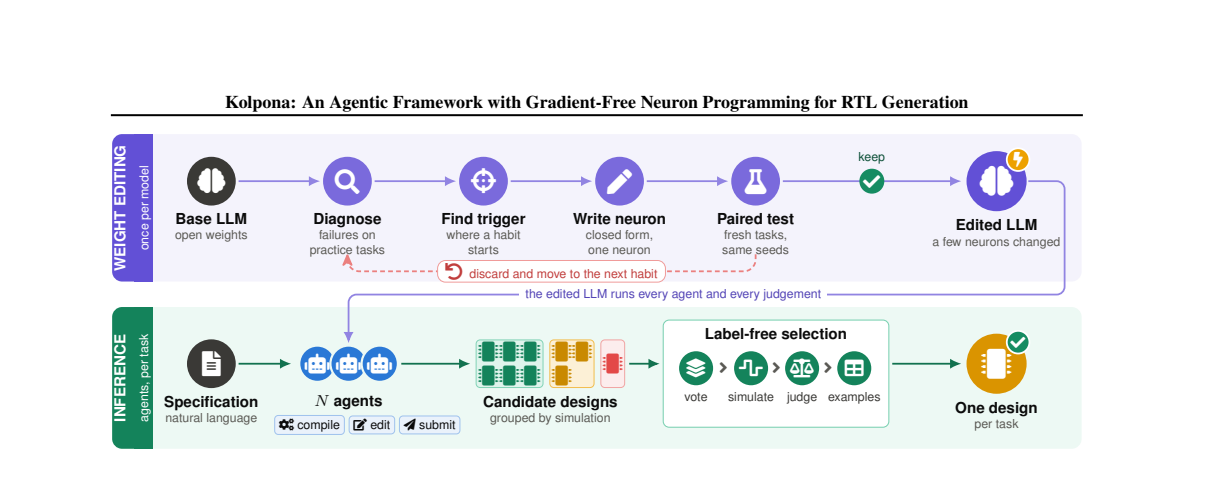
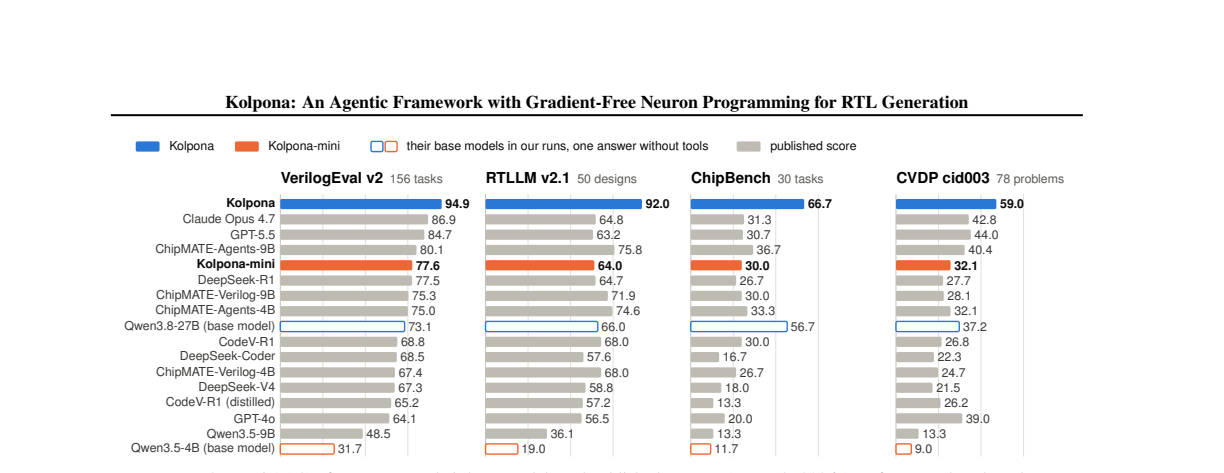
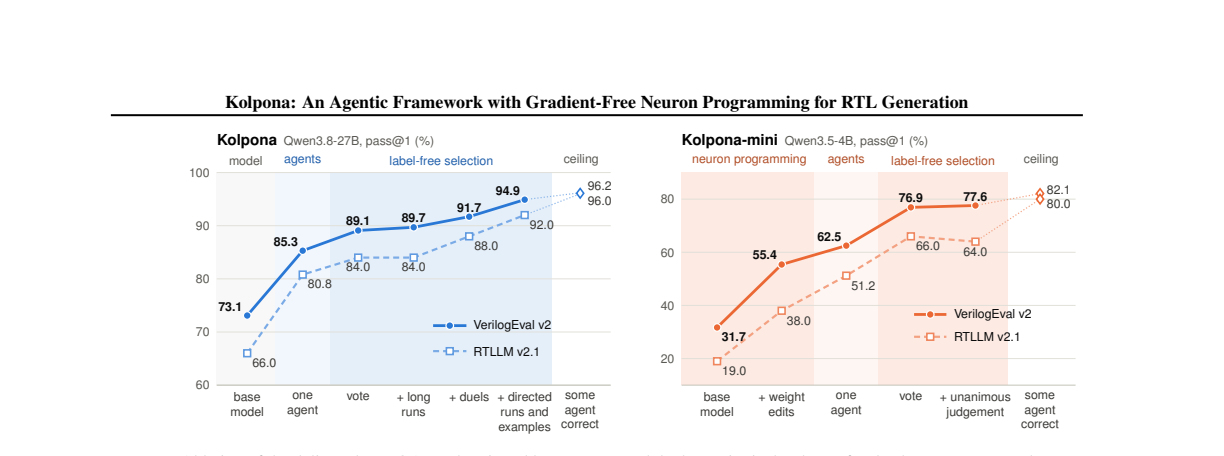
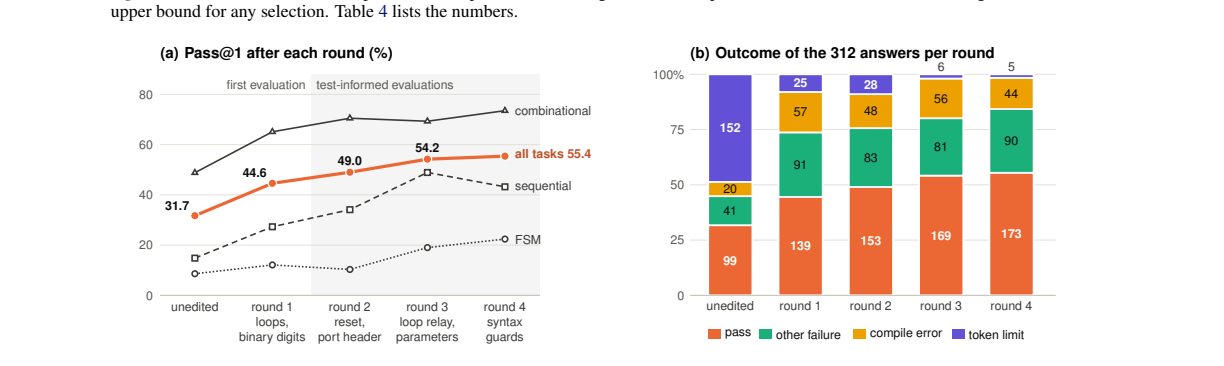
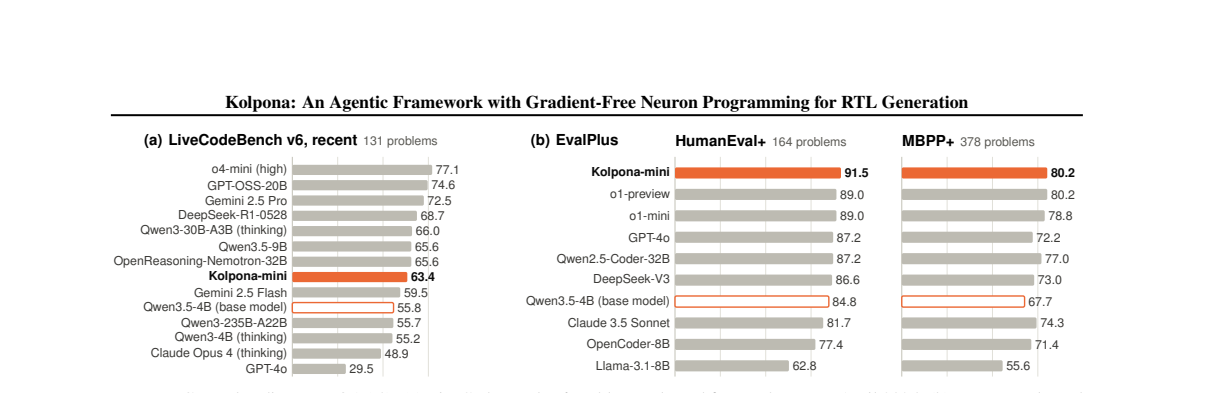
We present Kolpona, an agentic framework that improves such models without gradient training. Its first component is neuron programming, a new form of weight-space programming (WSP) that writes single neurons in closed form into the weights to remove failure habits found on practice tasks, and keeps each edit only when testbench results on fresh tasks favour it. At inference time, tool-using agents propose designs, and a label-free selection stage delivers one design per task from the specification, the candidates and their simulations alone. On Qwen3.5-4B, edits to 16 neurons raise the VerilogEval v2 pass@1 of the model alone from 31.7% to 55.4%, and the full framework reaches 77.6%. On Qwen3.8-27B, Kolpona lifts pass@1 from 73.1% to 94.9% on VerilogEval v2 and from 66.0% to 92.0% on RTLLM v2.1 on a single 32 GB GPU, above every published system in our comparison. The RTL edits also carry over to Python and raise the pass@1 of the 4B model alone from 84.8% to 91.5% on HumanEval+ and from 67.7% to 77.5% on MBPP+.
from the abstract
Pith says
Machine review · deepseek-v4-flash · 26 Nov 2026 · read the full text (80,294 characters) · not checked by a person
It can be wrong. Challenge this review or reply to it.
Holds up, with conditions. Kolpona introduces neuron programming, a closed-form weight-space editing method that lifts a 27B model to state-of-the-art RTL generation results on a single GPU, with the caveat that the programs are written under human supervision and one benchmark stage was tuned on its own outputs. This line is wrong
3 minor · 1 open question
How often objections from reviews like this one are right: not yet measured
The paper, first character to last
The reviewer was given the whole text, 80,294 characters. Not checked: figures, code, what the 57 references say.
3 minor objections
The paper says, at Section 3.1, Eq. (3)
Pith says: minor objection 1 of 3
In Section 3.1, Equation (3) defines the trigger, but the choice of threshold tau and gain gamma is not fully specified. The paper says 'the threshold tau lies above a high quantile of d^T x on X_0' but does not give the quantile or how it is determined. Clarifying this would improve reproducibility.
The paper says, at Section 5, Eq. (8)
Pith says: minor objection 2 of 3
Table 1 labels a column 'Single agent' but the metric defined in Eq. (8) is the average over agents. Consider renaming it to 'Average agent' or 'Per-agent' to avoid confusion with the single-agent baseline.
show 1 more
The paper says, at Section 5, Eq. (7)
Pith says: minor objection 3 of 3
The paper uses 'pass@1' for both the framework (Eq. 7) and the base model (unbiased estimator). While both are standard, the difference in definition could be noted explicitly to avoid confusion.
Open questions (1)
Pith raised these and could not confirm them against the text of the paper it read. They are questions for the authors, not findings.
- Section 3.5 Can the authors release the exact prompts used for the LLM and describe the diagnostic procedure for identifying failure habits and writing triggers in sufficient detail for independent replication?
What would settle it
An independent replication applying the same neuron programming method to a different model or benchmark where the failure habits are not linearly separable or not localized to single tokens, and the method fails to improve performance, would falsify the claim that the method generalizes. More specifically, if the method is applied to a model where the trigger separation (Eq. 3) cannot find a linear discriminant for any frequent failure class, and no improvement is observed, that would contradict the paper's central claim.
from Pith's summary of the paper
How the review went
5 passes by deepseek-v4-flash · 26 Nov 2026
- Reader holds up, with conditions
- Skeptic concern withdrawn: the paper already says this
- Referee 3 minor
- Check against the paper kept 0 of 3 objections
- Editor wrote the verdict above
Not run on this paper: the simulated authors' defence.
Pith's passes raised 3 objections. A check against the paper's text kept 0, withdrew 2 (2 the paper already says) and left 1 as a question.
The review in full
The review in brief, machine-written
This paper presents Kolpona, an agentic framework that improves open-weight LLMs for RTL generation without gradient training. The core novelty is neuron programming: each edit writes a single MLP neuron in closed form (trigger, read, write vectors) to remove a failure habit identified on practice tasks, and an edit is kept only if a paired testbench comparison on fresh tasks favours it. At inference time, tool-using agents propose designs and a label-free selection stage delivers one design per task by grouping candidates by simulated behaviour, running long simulations, and using same-model judgement and example replay. The results are strong. On Qwen3.8-27B, Kolpona reaches 94.9% pass@1 on VerilogEval v2 and 92.0% on RTLLM v2.1, above every published system in the comparison, on a single 32 GB GPU. On Qwen3.5-4B, the weight edits alone add 23.7 points, and the full framework reaches 77.6%. The edits also transfer to Python code generation, raising HumanEval+ from 84.8% to 91.5% on the 4B model alone. The paper provides mathematical propositions for the effect of edits and a statistical acceptance test, and it reports results with confidence intervals and ablations. The limitations are honestly stated. The neuron programs were written by an LLM under human supervision (Section 3.5), which limits reproducibility. The last selection stage for the 27B system was developed with VerilogEval v2 outputs in view, making that benchmark a development set for that stage; the paper acknowledges this. The base model already scores 73.1% on VerilogEval v2, so much of the result rests on the base model's strength. Code and data are not released. These are real concerns, but the paper is transparent about them and the core method is novel and well-motivated. The paper deserves a serious referee. I would send it to peer review.
The stress test's concern
Withdrawn: the paper already says this.
The paper says
“The last stage of \sys{}, which adds the constant-directed stimulus and the example replay, was developed with VerilogEval v2 outputs in view, so VerilogEval is a development set for that stage.”
The referee's report
Not published. Pith's referee wrote this assessment before its objections were checked against the paper, and 2 of its 2 major objections did not survive that check.
Pith's reading of the paper (a machine's summary, not the authors')
The paper tries to establish that open-weight LLMs for RTL (Verilog) code generation can be substantially improved without any gradient training, by directly editing a few neurons to remove failure habits and then using a multi-agent selection process that does not need testbenches. This matters because it avoids the need for large training datasets and GPU training, and achieves state-of-the-art results on standard benchmarks. The paper also shows that the weight edits transfer to Python code generation, suggesting the method captures language-agnostic habits.
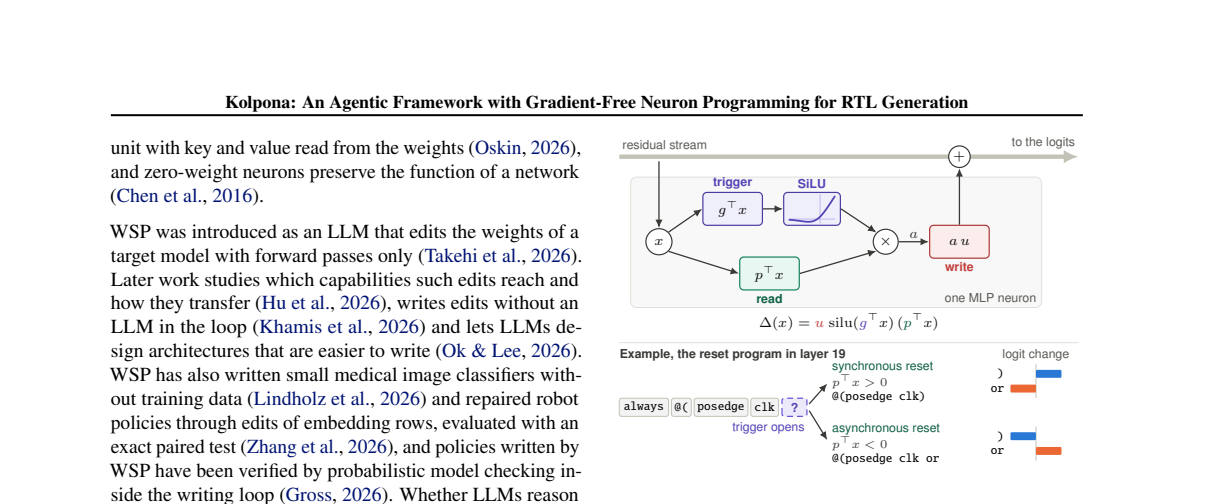
What carries the argument. The central object is the 'neuron program': a single MLP neuron with hand-written trigger, read, and write vectors (g, p, u) that is inserted into the model's weights to remove a specific failure habit. The trigger is computed from the mean difference between states where the habit starts and ordinary states (Eq. 3), the read vector measures a signal the model already computes, and the write vector is the shortest vector that moves target token logits by a desired amount while leaving protected tokens unchanged (Eq. 5). The acceptance test uses a paired McNemar test on practice tasks (Proposition 3.3).
Core claim. The paper claims that neuron programming, a form of weight-space programming where single MLP neurons are written in closed form to remove failure habits, combined with a label-free agentic selection framework, can substantially improve RTL generation performance of open-weight LLMs without any gradient training. The method uses practice tasks with testbenches for diagnosis and acceptance, and at inference time uses tool-using agents and a selection process that groups designs by simulation behaviour, resolves disagreements with long simulations, same-model judgement, and example replay. The paper reports that on Qwen3.8-27B, Kolpona achieves 94.9% pass@1 on VerilogEval v2 and 92.0% on RTLLM v2.1, above published systems, and that the weight edits also improve Python code generation.
The premise it rests on. The method assumes that each failure habit can be detected by a linear discriminant between states where the habit starts and ordinary states, and that the habit manifests at a single token position where a neuron can act. If a habit is not linearly separable or not localized to a single token, the method cannot fix it.
If the paper is right (Pith's inferences, not the authors')
Open-weight models can be improved for domain-specific code generation without fine-tuning, reducing the need for curated datasets and GPU training.
The neuron programming method may be applicable to other domains where outputs can be checked by execution, such as other hardware description languages or formal verification tasks.
The label-free selection method could be used in other code generation tasks where testbenches are unavailable, relying only on simulation or execution outputs.
The transfer of RTL edits to Python suggests that some failure habits are language-agnostic, and weight-space programming might improve general coding abilities.
The reliance on human supervision for diagnosing failure habits and writing triggers may limit scalability; automating this diagnosis could be a natural next step.
The method's success on RTL generation, where simulation provides a strong signal, suggests it may work well in other domains with executable specifications, such as formal verification or test generation.
The fact that the 27B model required only one program while the 4B model needed 25 suggests that larger models have fewer systematic failure habits, which may inform how weight-space programming scales with model size.
Check this review
What was read
The passes were given all 80,294 characters of the paper's LaTeX source.
Fingerprint of that text (SHA-256): db20f1b316903d0346246001910341fffa5022135372e7e4a0cab81a95d438a8
Pith does not keep that text. Rebuilt from the paper's source or PDF by the same code, it has this fingerprint if it is the same text. From a copy of Pith's code:
PYTHONPATH=. python scripts/review_input_check.py 2611.33973
The passes, in the order they ran
- Reader deepseek-v4-flash · medium effort · $0.0035 · instructions of the Reader, fingerprint f9ead7300382…
- Skeptic deepseek-v4-flash · medium effort · $0.0033 · instructions of the Skeptic, fingerprint 8f88c0f61488…
- Referee deepseek-v4-flash · medium effort · $0.0030 · instructions of the Referee, fingerprint a852d99aea0d…
- Check against the paper deepseek-v4-flash · medium effort · $0.0029 · instructions of the Check against the paper, fingerprint 6c7a6883d551…
- Editor deepseek-v4-flash · medium effort · $0.0025 · instructions of the Editor, fingerprint e7211f6a3d27…
- Circularity check deepseek-v4-flash · medium effort · $0.0026 · instructions of the Circularity check, fingerprint e9946e39d67b…
- Summary for the page deepseek-v4-flash · medium effort · temperature 0.2 · $0.0028 · instructions of the Summary for the page, fingerprint e4f56bf568e7…
The passes cost $0.021 in model calls together.
Version stamped on this review: pith-pipeline@v1.4.1-daily-deepseek-or-medium+deepseek/deepseek-v4-flash+p.d60f54226f00
Each link opens a pass's instructions as plain text, the exact bytes its fingerprint was taken over. Every stored set of instructions.
curl -s https://pith.science/methodology/prompts/f9ead730038216984cfb56d7cb34332bdf691828296a1de4245f3d6667d4bf56 | sha256sum
prints the fingerprint of the reader's instructions. The same works for every pass.
The receipt
The review's fingerprint was taken on 26 Nov 2026. The review you are reading still matches it.
Fingerprint of the review (SHA-256): 64a0f2f13a94a4f9d81a2e41d606a00b13264b565409c4728e5b973e57792db2
curl -s 'https://pith.science/api/v1/verdicts/2611.33973?form=canonical' | sha256sum
prints the fingerprint of the review as it stands now. The rule, in four steps.
A matching fingerprint shows the review has not changed since that date. It does not show that the review is right.
How often reviews like this one are right
Reviews like this one: written by deepseek-v4-flash, from the paper's LaTeX source.
How often objections from reviews like this one are right: not yet measured
Reviews by people
This review was written by a machine. No person has reviewed this paper on Pith yet. A scientist listed on Pith can review it for a fee, and their review is published here whatever it concludes.
The paper
Abstract
Open-weight large language models (LLMs) for register-transfer level (RTL) design are usually improved by fine-tuning on curated Verilog corpora, which needs large sets of verified designs and GPU training. We present Kolpona, an agentic framework that improves such models without gradient training. Its first component is neuron programming, a new form of weight-space programming (WSP) that writes single neurons in closed form into the weights to remove failure habits found on practice tasks, and keeps each edit only when testbench results on fresh tasks favour it. At inference time, tool-using agents propose designs, and a label-free selection stage delivers one design per task from the specification, the candidates and their simulations alone. On Qwen3.5-4B, edits to 16 neurons raise the VerilogEval v2 pass@1 of the model alone from 31.7% to 55.4%, and the full framework reaches 77.6%. On Qwen3.8-27B, Kolpona lifts pass@1 from 73.1% to 94.9% on VerilogEval v2 and from 66.0% to 92.0% on RTLLM v2.1 on a single 32 GB GPU, above every published system in our comparison. The RTL edits also carry over to Python and raise the pass@1 of the 4B model alone from 84.8% to 91.5% on HumanEval+ and from 67.7% to 77.5% on MBPP+.
The paper's own sentences, arranged, kept beside the review and separate from it. Each label is drawn from a closed vocabulary; the number beside it is the probability the classifier gave that label. No sentence in this record was written by a model.
abstract compiled · 2026-11-26
The authors' main claim, as the classifier picked it out 0.88
“On Qwen3.8-27B, Kolpona lifts pass@1 from 73.1% to 94.9% on VerilogEval v2 and from 66.0% to 92.0% on RTLLM v2.1 on a single 32 GB GPU, above every published system in our comparison.”
How the main claim is stated: asserted 1.00
What the abstract itself states, as probabilities: claims first 0.16 · states limitation 0.15 · human participants 0.03 · controlled comparison 0.89 · randomized assignment 0.02 · states quantitative result 0.99 · compares with prior results 0.97 · mentions code or data availability 0.05
The abstract, sentence by sentence
This table labels the abstract only (arXiv listing abstract v1). The number is the probability the classifier gave the label.
| Sentence | Role | The authors' own work | States the main conclusion | Strength |
|---|---|---|---|---|
| Open-weight large language models (LLMs) for register-transfer level (RTL) design are usually improved by fine-tuning on curated Verilog corpora, which needs large sets of verified designs and GPU training. | background 0.99 | 0.06 | 0.02 | asserted 0.99 |
| We present Kolpona, an agentic framework that improves such models without gradient training. | contribution 1.00 | 0.85 | 0.18 | asserted 1.00 |
| Its first component is neuron programming, a new form of weight-space programming (WSP) that writes single neurons in closed form into the weights to remove failure habits found on practice tasks, and keeps each edit only when testbench results on fresh tasks favour it. | method 0.93 | 0.89 | 0.08 | asserted 1.00 |
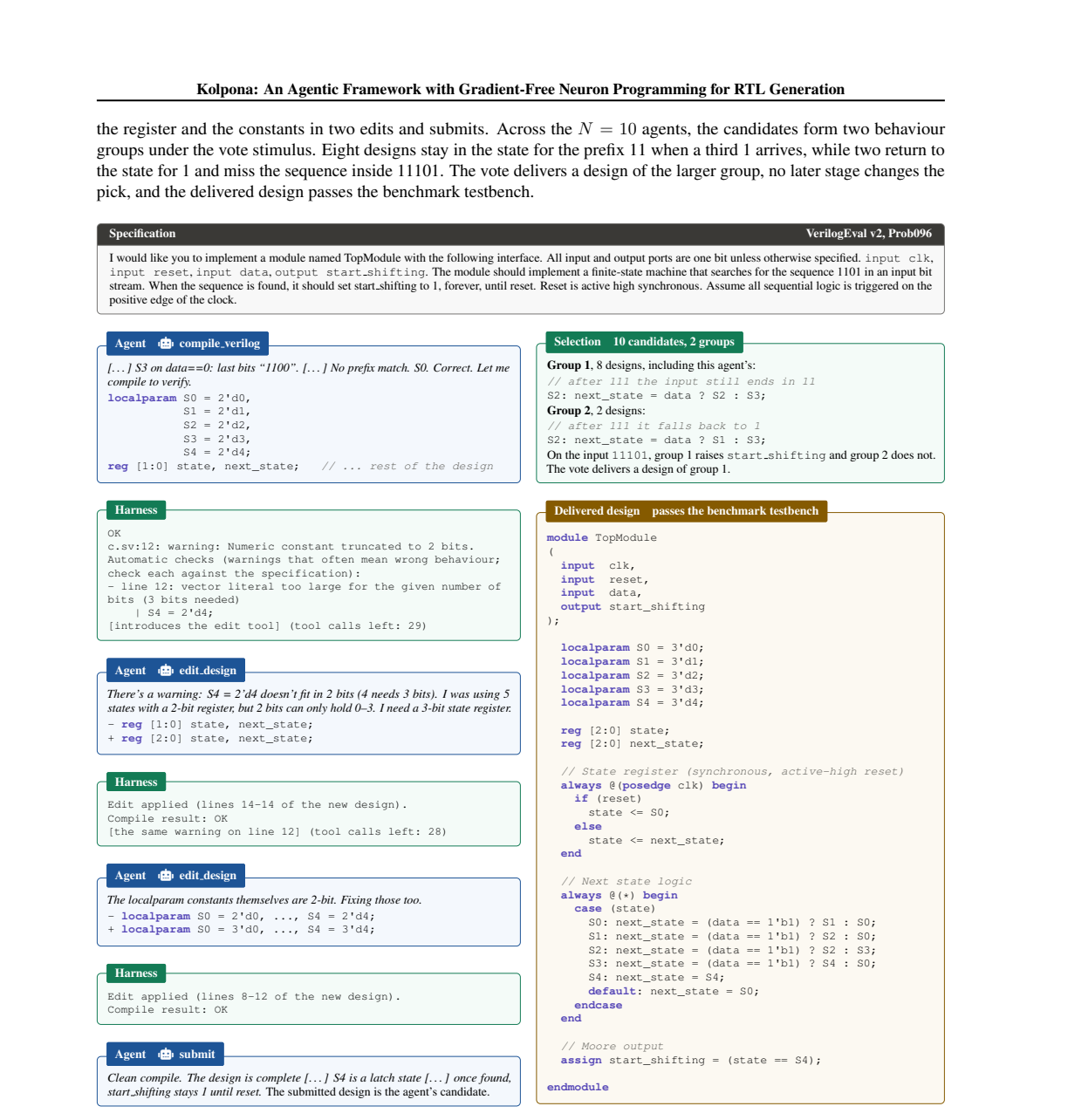
| At inference time, tool-using agents propose designs, and a label-free selection stage delivers one design per task from the specification, the candidates and their simulations alone. | method 0.98 | 0.87 | 0.05 | asserted 1.00 |
| On Qwen3.5-4B, edits to 16 neurons raise the VerilogEval v2 pass@1 of the model alone from 31.7% to 55.4%, and the full framework reaches 77.6%. | result 1.00 | 0.96 | 0.18 | asserted 1.00 |
| On Qwen3.8-27B, Kolpona lifts pass@1 from 73.1% to 94.9% on VerilogEval v2 and from 66.0% to 92.0% on RTLLM v2.1 on a single 32 GB GPU, above every published system in our comparison. | result 1.00 | 0.96 | 0.43 | asserted 1.00 |
| The RTL edits also carry over to Python and raise the pass@1 of the 4B model alone from 84.8% to 91.5% on HumanEval+ and from 67.7% to 77.5% on MBPP+. | result 0.99 | 0.94 | 0.11 | asserted 1.00 |
What kind of paper the classifier reports this is: method or tool 1.00 · evidence from observation or experiment 0.81
What was examined, and what was not
Sources read
- arXiv listing abstract v1
Not examined
- full text
- figures and tables
- references and citing sentences
- relations to other papers
Levels run
- P abstract
Not run
- S sections
- T body sentences
- C citations
- R cross-paper relations
How the labels were made
Compiled by classifier-1.13.0 via TypeSafe API, question bank abstract-p1-20260923, 2026-11-26: 1 request, 5,971 input tokens.
Every quoted sentence on this record is the authors'. Every label is from Pith's closed vocabulary, with the probability shown beside it. This record as JSON
Figures (8)

Figures are the authors', reproduced from the paper.
References (57)
- [1] Ahmed, N. S. Can an LLM actually reason and program about neural network's weights or is it just memorization on steroids? E xploring ``weight-space programming''. arXiv preprint arXiv:2611.08070, 2026 on PithPith's reviewarXiv
- [2] Arditi, A., Obeso, O., Syed, A., Paleka, D., Panickssery, N., Gurnee, W., and Nanda, N. Refusal in language models is mediated by a single direction. In Advances in Neural Information Processing Systems, 2024. doi:10.52202/079017-4322 on Pithdoi:10.52202/079017-4322
- [3] Austin, J., Odena, A., Nye, M., Bosma, M., Michalewski, H., Dohan, D., Jiang, E., Cai, C., Terry, M., Le, Q., and Sutton, C. Program synthesis with large language models. arXiv preprint arXiv:2108.07732, 2021 on PithPith's reviewarXiv
- [4] Chen, B., Zhang, F., Nguyen, A., Zan, D., Lin, Z., Lou, J.-G., and Chen, W. CodeT : Code generation with generated tests. In International Conference on Learning Representations, 2023 on Pith
- [5] Chen, M., Tworek, J., Jun, H., Yuan, Q., Pinto, H. P. d. O., Kaplan, J., Edwards, H., Burda, Y., Joseph, N., Brockman, G., et al. Evaluating large language models trained on code. arXiv preprint arXiv:2107.03374, 2021 on PithPith's reviewarXiv
- [6] Chen, T., Goodfellow, I., and Shlens, J. Net2Net : Accelerating learning via knowledge transfer. In International Conference on Learning Representations, 2016 on Pith
- [7] Cui, F., Yin, C., Zhou, K., Xiao, Y., Sun, G., Xu, Q., Guo, Q., Liang, Y., Zhang, X., Song, D., and Lin, D. OriGen : Enhancing RTL code generation with code-to-code augmentation and self-reflection. In IEEE/ACM International Conference on Computer-Aided Design (ICCAD), 2024. d... on Pithdoi:10.1145/3676536.3676830
- [8] Fang, J., Jiang, H., Wang, K., Ma, Y., Jie, S., Wang, X., He, X., and Chua, T.-S. AlphaEdit : Null-space constrained knowledge editing for language models. In International Conference on Learning Representations, 2025 on Pith
- [9] Geva, M., Schuster, R., Berant, J., and Levy, O. Transformer feed-forward layers are key-value memories. In Conference on Empirical Methods in Natural Language Processing (EMNLP), 2021. doi:10.18653/v1/2021.emnlp-main.446 on PithPith's reviewdoi:10.18653/v1/2021.emnlp-main.446
- [10] Geva, M., Caciularu, A., Wang, K. R., and Goldberg, Y. Transformer feed-forward layers build predictions by promoting concepts in the vocabulary space. In Conference on Empirical Methods in Natural Language Processing (EMNLP), 2022. doi:10.18653/v1/2022.emnlp-main.3 on Pithdoi:10.18653/v1/2022.emnlp-main.3
- [11] Gross, D. Weight-space programming of policies and their verification via model checking. arXiv preprint arXiv:2611.11604, 2026 on PithPith's reviewarXiv
- [12] Gu, J., Aleti, A., Chen, C., and Zhang, H. Neuron patching: Semantic-based neuron-level language model repair for code generation. arXiv preprint arXiv:2312.05356, 2023 on PithPith's reviewarXiv
- [13] Ho, C.-T., Ren, H., and Khailany, B. VerilogCoder : Autonomous Verilog coding agents with graph-based planning and abstract syntax tree ( AST )-based waveform tracing tool. In AAAI Conference on Artificial Intelligence, 2025. doi:10.1609/aaai.v39i1.32007 on Pithdoi:10.1609/aaai.v39i1.32007
- [14] Hu, E. J., Shen, Y., Wallis, P., Allen-Zhu, Z., Li, Y., Wang, S., Wang, L., and Chen, W. LoRA : Low-rank adaptation of large language models. In International Conference on Learning Representations, 2022 on Pith
- [15] Hu, J., Tang, C., Li, W., Zhu, H., Feng, C.-M., Zhang, Q., Chen, Y., and Hu, M. Exploring weight-space programming: Capabilities, generalization, and limitations. arXiv preprint arXiv:2611.09382, 2026 on PithPith's reviewarXiv
- [16] Ilharco, G., Ribeiro, M. T., Wortsman, M., Gururangan, S., Schmidt, L., Hajishirzi, H., and Farhadi, A. Editing models with task arithmetic. In International Conference on Learning Representations, 2023 on Pith
- [17] Jain, N., Han, K., Gu, A., Li, W.-D., Yan, F., Zhang, T., Wang, S., Solar-Lezama, A., Sen, K., and Stoica, I. LiveCodeBench : Holistic and contamination free evaluation of large language models for code. In International Conference on Learning Representations, 2025 on Pith
- [18] Khamis, A., Tutunov, R., and Bou Ammar, H. Who needs an LLM to program an LLM ? I ntroducing AHA ! Blog post, November 2026. URL https://haithamb.github.io/aha/ on Pith
- [19] Li, Y., Choi, D., Chung, J., Kushman, N., Schrittwieser, J., Leblond, R., Eccles, T., Keeling, J., Gimeno, F., Dal Lago, A., et al. Competition-level code generation with AlphaCode . Science, 378 0 (6624): 0 1092--1097, 2022. doi:10.1126/science.abq1158 on Pithdoi:10.1126/science.abq1158
- [20] Lindholz, M., Ruppel, R., Milnik, A., Halskov, S., Eminovic, S., Hamm, C. A., et al. Weight-space programming for medical imaging: Do we still need training data? arXiv preprint arXiv:2611.12066, 2026 on PithPith's reviewarXiv
show 37 more
- [21] Lindner, D., Kram \'a r, J., Farquhar, S., Rahtz, M., McGrath, T., and Mikulik, V. Tracr: Compiled transformers as a laboratory for interpretability. In Advances in Neural Information Processing Systems, 2023. doi:10.52202/075280-1649 on Pithdoi:10.52202/075280-1649
- [22] Liu, J., Xia, C. S., Wang, Y., and Zhang, L. Is your code generated by ChatGPT really correct? R igorous evaluation of large language models for code generation. In Advances in Neural Information Processing Systems, 2023 a . doi:10.52202/075280-0943 on Pithdoi:10.52202/075280-0943
- [23] Liu, M., Pinckney, N., Khailany, B., and Ren, H. VerilogEval : Evaluating large language models for Verilog code generation. In IEEE/ACM International Conference on Computer Aided Design (ICCAD), 2023 b . doi:10.1109/ICCAD57390.2023.10323812 on Pithdoi:10.1109/iccad57390.2023.10323812
- [24] Liu, M., Tsai, Y.-D., Zhou, W., and Ren, H. CraftRTL : High-quality synthetic data generation for Verilog code models with correct-by-construction non-textual representations and targeted code repair. In International Conference on Learning Representations, 2025 a on Pith
- [25] Liu, S., Lu, Y., Fang, W., Li, M., and Xie, Z. OpenLLM-RTL : Open dataset and benchmark for LLM -aided design RTL generation. In IEEE/ACM International Conference on Computer-Aided Design (ICCAD), 2024. doi:10.1145/3676536.3697118 on Pithdoi:10.1145/3676536.3697118
- [26] Liu, S., Fang, W., Lu, Y., Wang, J., Zhang, Q., Zhang, H., and Xie, Z. RTLCoder : Fully open-source and efficient LLM -assisted RTL code generation technique. IEEE Transactions on Computer-Aided Design of Integrated Circuits and Systems, 2025 b . doi:10.1109/TCAD.2024.3483089 on Pithdoi:10.1109/tcad.2024.3483089
- [27] Lu, Y., Liu, S., Zhang, Q., and Xie, Z. RTLLM : An open-source benchmark for design RTL generation with large language model. In Asia and South Pacific Design Automation Conference (ASP-DAC), 2024. doi:10.1109/ASP-DAC58780.2024.10473904 on Pithdoi:10.1109/asp-dac58780.2024.10473904
- [28] McNemar, Q. Note on the sampling error of the difference between correlated proportions or percentages. Psychometrika, 12 0 (2): 0 153--157, 1947. doi:10.1007/BF02295996 on Pithdoi:10.1007/bf02295996
- [29] Meng, K., Bau, D., Andonian, A., and Belinkov, Y. Locating and editing factual associations in GPT . In Advances in Neural Information Processing Systems, 2022. doi:10.52202/068431-1262 on Pithdoi:10.52202/068431-1262
- [30] Meng, K., Sharma, A. S., Andonian, A. J., Belinkov, Y., and Bau, D. Mass-editing memory in a transformer. In International Conference on Learning Representations, 2023 on Pith
- [31] Mitchell, E., Lin, C., Bosselut, A., Finn, C., and Manning, C. D. Fast model editing at scale. In International Conference on Learning Representations, 2022 on Pith
- [32] Ok, H. and Lee, J. Weight-space programming doesn't need transformers. arXiv preprint arXiv:2611.22055, 2026 on PithPith's reviewarXiv
- [33] Oskin, M. Through the looking glass: Directly reading and writing transformers. arXiv preprint arXiv:2609.10210, 2026 on PithPith's reviewarXiv
- [34] Pei, Z., Zhen, H.-L., Yuan, M., Huang, Y., and Yu, B. BetterV : Controlled Verilog generation with discriminative guidance. In International Conference on Machine Learning, 2024 on Pith
- [35] Pinckney, N., Batten, C., Liu, M., Ren, H., and Khailany, B. Revisiting VerilogEval : A year of improvements in large-language models for hardware code generation. ACM Transactions on Design Automation of Electronic Systems, 2025 a . doi:10.1145/3718088 on Pithdoi:10.1145/3718088
- [36] Pinckney, N., Deng, C., Ho, C.-T., Tsai, Y.-D., Liu, M., Zhou, W., Khailany, B., and Ren, H. Comprehensive Verilog design problems: A next-generation benchmark dataset for evaluating large language models and agents on RTL design and verification. arXiv preprint arXiv:2506.140... on PithPith's reviewarXiv
- [37] Qwen Team . Qwen3.5-4B . Model card, revision 851bf6e8, 2026 a . URL https://huggingface.co/Qwen/Qwen3.5-4B on Pith
- [38] Qwen Team . Qwen3.8-27B . Model card, 2026 b . URL https://huggingface.co/Qwen/Qwen3.8-27B on Pith
- [39] Red Hat AI . Qwen3.8-27B-INT4 . Model card (W4A16 checkpoint), 2026. URL https://huggingface.co/RedHatAI/Qwen3.8-27B-INT4 on Pith
- [40] Rimsky, N., Gabrieli, N., Schulz, J., Tong, M., Hubinger, E., and Turner, A. M. Steering Llama 2 via contrastive activation addition. In Annual Meeting of the Association for Computational Linguistics (ACL), 2024. doi:10.18653/v1/2024.acl-long.828 on Pithdoi:10.18653/v1/2024.acl-long.828
- [41] Shazeer, N. GLU variants improve transformer. arXiv preprint arXiv:2002.05202, 2020 on PithPith's reviewarXiv
- [42] Shi, F., Fried, D., Ghazvininejad, M., Zettlemoyer, L., and Wang, S. I. Natural language to code translation with execution. In Conference on Empirical Methods in Natural Language Processing (EMNLP), 2022. doi:10.18653/v1/2022.emnlp-main.231 on Pithdoi:10.18653/v1/2022.emnlp-main.231
- [43] Snyder, W. Verilator. Software, 2026. URL https://www.veripool.org/verilator/ on Pith
- [44] Takehi, R., Teoh, J., Zhang, A., and Khattab, O. Sparks of weight-space programming: LLMs can natively read & write neural network weights. Blog post, November 2026. URL https://rikiyat.github.io/blog/weight-space-programming/ on Pith
- [45] Turner, A. M., Thiergart, L., Leech, G., Udell, D., Vazquez, J. J., Mini, U., and MacDiarmid, M. Steering language models with activation engineering. arXiv preprint arXiv:2308.10248, 2023 on PithPith's reviewarXiv
- [46] Wan, W., Lao, Q., Xie, Z., Wu, H., Lin, R., Lin, L., et al. Massive editing for large language models based on dynamic weight generation. In International Conference on Learning Representations, 2026 on Pith
- [47] Wang, X., Wei, J., Schuurmans, D., Le, Q., Chi, E., Narang, S., Chowdhery, A., and Zhou, D. Self-consistency improves chain of thought reasoning in language models. In International Conference on Learning Representations, 2023 on Pith
- [48] Weiss, G., Goldberg, Y., and Yahav, E. Thinking like transformers. In International Conference on Machine Learning, 2021 on Pith
- [49] Williams, S. Icarus Verilog . Software, 2026. URL https://github.com/steveicarus/iverilog on Pith
- [50] Wilson, E. B. Probable inference, the law of succession, and statistical inference. Journal of the American Statistical Association, 22 0 (158): 0 209--212, 1927. doi:10.1080/01621459.1927.10502953 on Pithdoi:10.1080/01621459.1927.10502953
- [51] Yao, S., Zhao, J., Yu, D., Du, N., Shafran, I., Narasimhan, K., and Cao, Y. ReAct : Synergizing reasoning and acting in language models. In International Conference on Learning Representations, 2023 on Pith
- [52] Yu, Z., Lin, Y., Zhou, C., Zhang, Y., Zhou, K., Cui, J., Ye, H., Hu, Z., et al. ChipMATE : Multi-agent training via reinforcement learning for enhanced RTL generation. arXiv preprint arXiv:2605.12857, 2026 a on PithPith's reviewarXiv
- [53] Yu, Z., Zhou, C., Lin, Y., Zhang, H., Ye, H., Cui, J., Pan, Z., Zhao, J., et al. ChipBench : A next-step benchmark for evaluating LLM performance in AI -aided chip design. arXiv preprint arXiv:2601.21448, 2026 b on PitharXiv
- [54] Zhang, J., Wang, K., and Lin, L. Can LLMs debug robots by editing their weights? arXiv preprint arXiv:2611.09376, 2026 on PithPith's reviewarXiv
- [55] Zhao, Y., Zhang, H., Huang, H., Yu, Z., and Zhao, J. MAGE : A multi-agent engine for automated RTL code generation. In ACM/IEEE Design Automation Conference (DAC), 2025. doi:10.1109/DAC63849.2025.11133191 on Pithdoi:10.1109/dac63849.2025.11133191
- [56] Zhu, Y., Huang, D., Lyu, H., Zhang, X., Li, C., Shi, W., Wu, Y., Mu, J., et al. QiMeng-CodeV-R1 : Reasoning-enhanced Verilog generation. arXiv preprint arXiv:2505.24183, 2025 on PitharXiv
- [57] Zou, A., Phan, L., Chen, S., Campbell, J., Guo, P., Ren, R., Pan, A., Yin, X., Mazeika, M., Dombrowski, A.-K., et al. Representation engineering: A top-down approach to AI transparency. arXiv preprint arXiv:2310.01405, 2023 on PithPith's reviewarXiv
Challenges and discussion
Disagree with the review, or know something it missed? Leave a comment, or challenge this review formally: a challenge becomes a permanent entry in this paper's record, and its decision is published here.
Come back by email
A short list of the week's newly reviewed papers. Nothing is sent until you confirm from your inbox, and every email has a link that stops it. No account.
No comments yet.
Sign in to comment