Machine Learning · arXiv:2611.22055 v1 · submitted 17 Nov 2026 · 29 references
Weight-Space Programming Doesn't Need Transformers
The paper says
“Standard neural architectures such as the Transformer were chosen because they train well with gradient descent and run fast on GPUs.”
more of the abstract
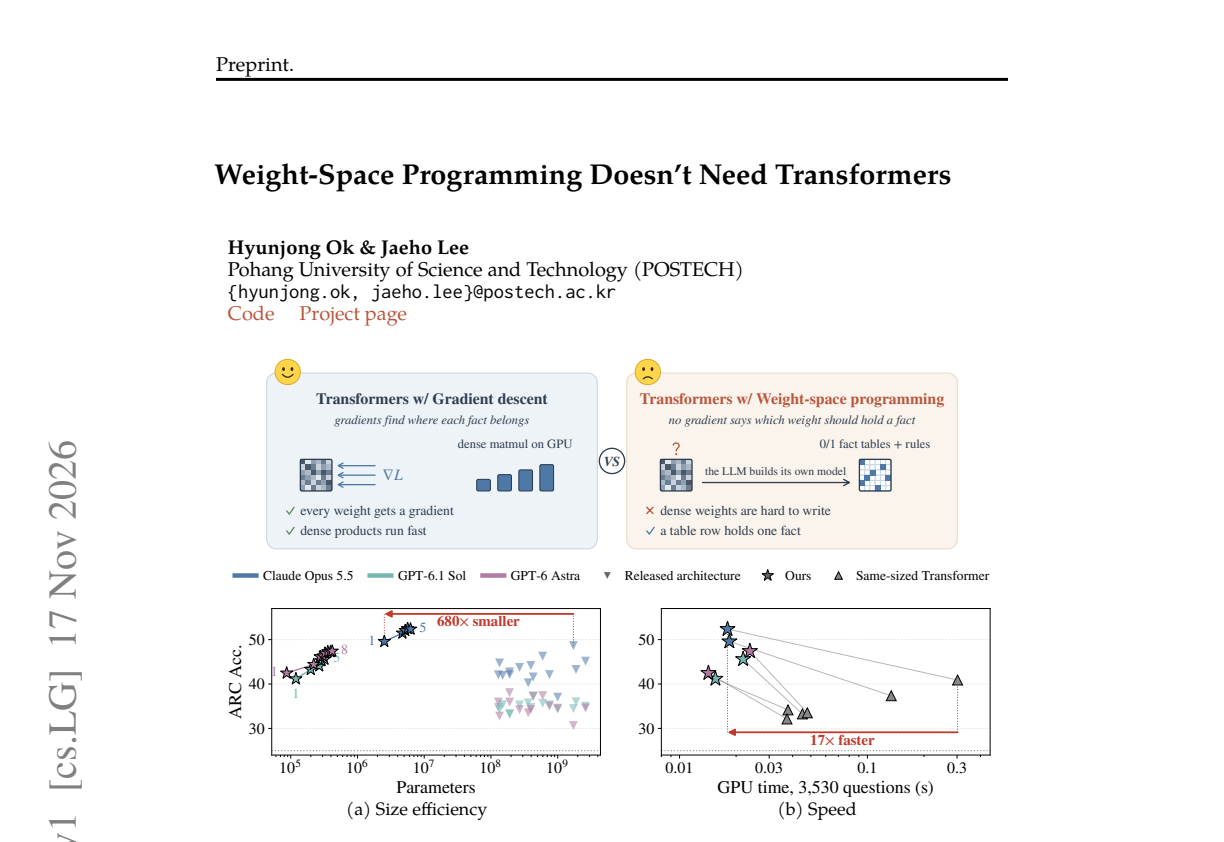
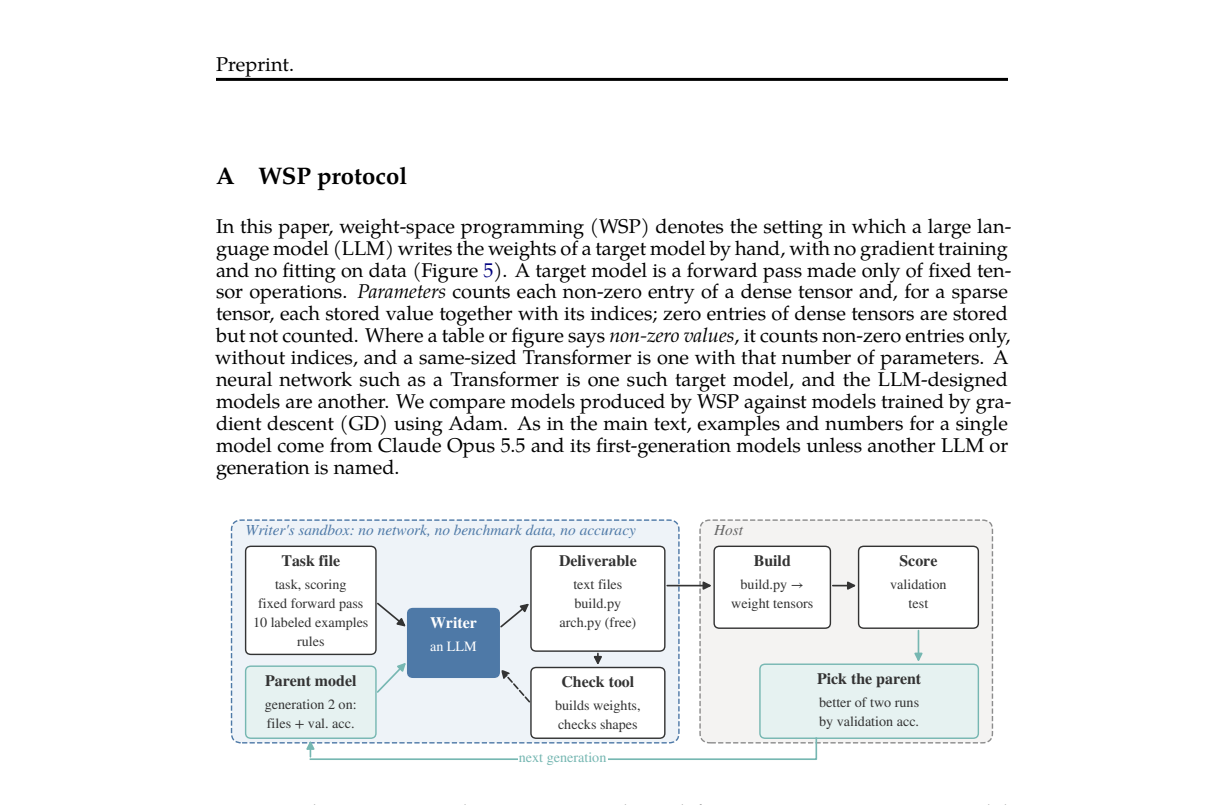
In weight-space programming, a large language model (LLM) writes target weights by hand without gradient-based training, so those reasons no longer apply. Should we keep the Transformer? Given minimal guidance, ten labeled examples, and a sandbox, mainly on multiple-choice questions, we task three frontier LLMs with either generating the weights of a fixed architecture or designing the architecture themselves. When free to design, all three compile plain-text facts into a sparse table queried by a fixed procedure, reaching up to 54.4% test accuracy. An LLM-designed model achieves higher test accuracy than the most accurate released Transformer that the same LLM wrote while using about 1,800x fewer parameters. Without gradients, they choose a table, in which the LLM can state what each weight means and can find and rewrite a wrong one. Each wrong answer points to one row, and removing a row changes about one other answer. From this, we propose an associative-memory-based model up to 17x faster on GPUs than a same-sized Transformer. We also test pretrained weights, other benchmarks, and tasks where models generate answers. Pretrained LLMs remain more accurate; the claim concerns which structure to build when writing weights.
from the abstract
Pith says
Machine review · deepseek-v4-flash · 18 Nov 2026 · read the full text (141,812 characters) · not checked by a person
It can be wrong. Challenge this review or reply to it.
Holds up, with conditions. When frontier LLMs write weights by hand, they consistently choose sparse associative-memory tables over Transformers—a clean empirical finding that challenges the default assumption that Transformers are always the right architecture for weight-space programming. This line is wrong
10 minor · 2 open questions
How often objections from reviews like this one are right: not yet measured
The paper, first character to last
The reviewer was given the whole text, 141,812 characters. Not checked: figures, code, what the 29 references say.
10 minor objections
The paper says, at §1, Table 1
Pith says: minor objection 1 of 10
Table 1 compares gradient descent and weight-space programming. The row 'ARC accuracy in a written table (%)' shows a range of 49.6-54.4, but it is unclear whether this refers to the LLM-designed model or the associative-memory-based model. The caption says 'the written-table range 49.6 to 54.4 covers its LLM-designed model and ours, generations 1 and 5', but this should be clarified in the table itself or the caption.
The paper says, at §3.4, Figure 3
Pith says: minor objection 2 of 10
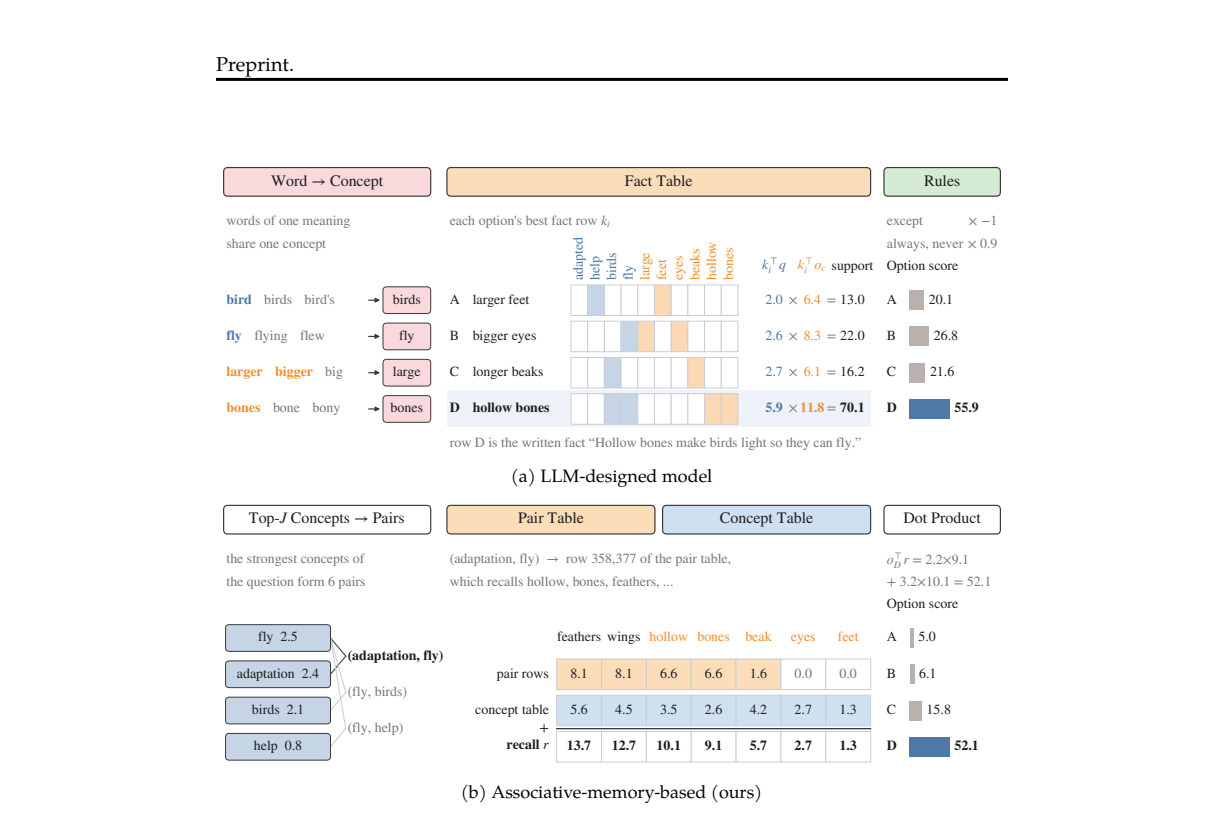
Figure 3 is described in detail but the actual figure is not visible in the manuscript text provided. The caption and description are sufficient for understanding, but the paper should ensure that the figure is legible and that the color coding (blue for question, orange for option) is accessible to color-blind readers.
show 8 more
The paper says, at §5.3, Table 5
Pith says: minor objection 3 of 10
Table 5 reports the line ablation study. The column 'Weights changed' has a dash for some models, with the note '-- marks a model that renumbers its table columns when a line is removed, so its changed weights cannot be counted.' This is a limitation of the analysis. The paper should explain why renumbering occurs and whether this affects the validity of the comparison.
The paper says, at §6.1, Table 6
Pith says: minor objection 4 of 10
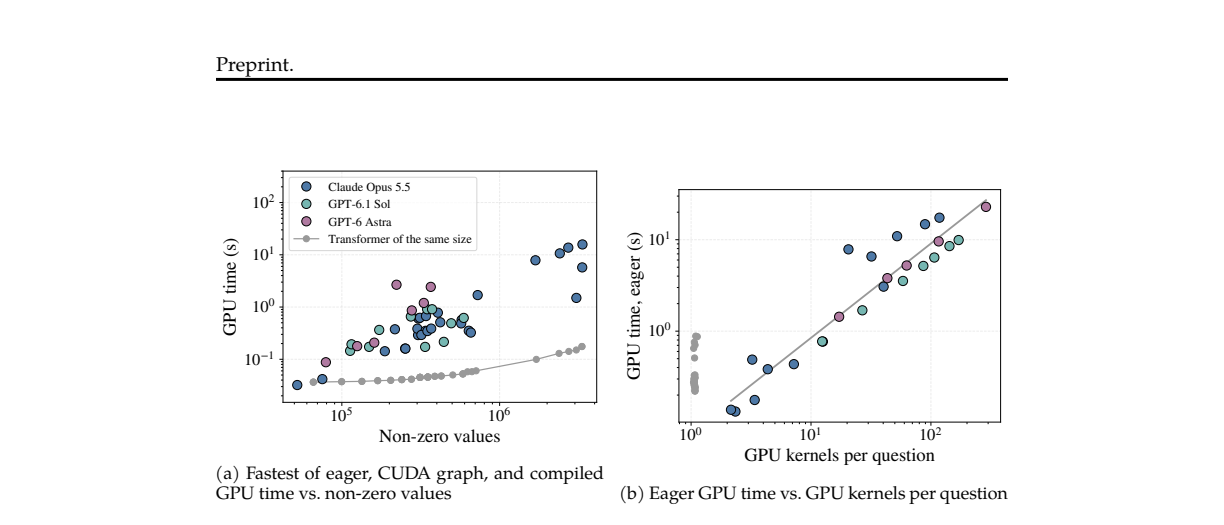
Table 6 reports GPU time for the associative-memory-based model and same-sized Transformers. The caption says 'GPU time is for the 3,530 ARC test questions on one RTX 3090.' However, the paper does not specify whether the GPU time includes data loading, tokenization, and other overhead, or whether it is purely forward-pass time. This should be clarified.
The paper says, at §7.1, Table 7
Pith says: minor objection 5 of 10
Table 7 reports accuracy on other benchmarks (SciQ, OpenBookQA, MMLU) for models written for ARC. The paper states that accuracy on MMLU is near chance (25%). However, the table shows MMLU Science at 26.5% and MMLU Other at 25.7% for the generation 1 model. The paper should clarify whether these are statistically significantly above chance, and if so, whether this indicates some transfer of knowledge.
The paper says, at §8, Limitations
Pith says: minor objection 6 of 10
The limitations section is thorough and honest. However, the paper could add a discussion of the computational cost of the LLM writers themselves. The cost column in Table 2 shows that LLM-designed models cost $29-$490 in API fees, which is substantial. The paper should discuss whether this cost is justified by the performance gains, and whether the approach is practical for real-world applications.
The paper says, at §A, Appendix
Pith says: minor objection 7 of 10
The appendix is extensive and well-organized. However, some of the tables (e.g., Table 13, Table 14) are very wide and may be difficult to read in print. The paper should consider splitting these into multiple tables or using a landscape format.
The paper says, at §2, §A.1
Pith says: minor objection 8 of 10
The paper uses the term 'writer' to refer to the LLM that writes weights, and 'host' to refer to the evaluator. This terminology is clear but could be defined earlier in the paper. The first use of 'writer' in §2 should be explicitly defined.
The paper says, at §5.4
Pith says: minor objection 9 of 10
The control experiment where the LLM is forbidden from writing practice questions (Table 3) shows that accuracy drops by about one point. The paper should clarify whether this drop is statistically significant, and whether the practice questions are used for debugging or for actually learning new facts.
The paper says, at §7.4, Table 9
Pith says: minor objection 10 of 10
Table 9 reports results for a single model that handles several tasks at once. The paper states that 'A single model written by Claude Opus 5.5 reaches 45.0% on ARC, every other multiple-choice score stays within seven points of chance.' The paper should clarify whether this model was designed specifically for multi-task performance, or whether it is the same ARC-focused model run on other tasks.
Open questions (2)
Pith raised these and could not confirm them against the text of the paper it read. They are questions for the authors, not findings.
- §5.4, §6 Pith raised a concern here that it could not check against the text of the paper it was given, so it is not published as an objection.
- §3.4, Figure 3 Pith raised a concern here that it could not check against the text of the paper it was given, so it is not published as an objection.
What would settle it
If a future frontier LLM, given the same minimal guidance and sandbox, designs a Transformer-based architecture for weight-space programming that matches or exceeds the accuracy of the sparse table models reported here, the paper's central claim would be weakened. Alternatively, if a written Transformer could be shown to match or exceed BM25 over its own text on ARC, the paper's argument about interference in dense keys would be undermined.
from Pith's summary of the paper
How the review went
5 passes by deepseek-v4-flash · 18 Nov 2026
- Reader holds up, with conditions
- Skeptic concern withdrawn: Pith's reviewer misread the paper
- Referee 10 minor
- Check against the paper kept 0 of 5 objections
- Editor wrote the verdict above
Not run on this paper: the simulated authors' defence.
Pith's passes raised 5 objections. A check against the paper's text kept 0, withdrew 3 (1 the paper already says; 2 Pith's reviewer misread the paper) and left 2 as questions.
The review in full
The review in brief, machine-written
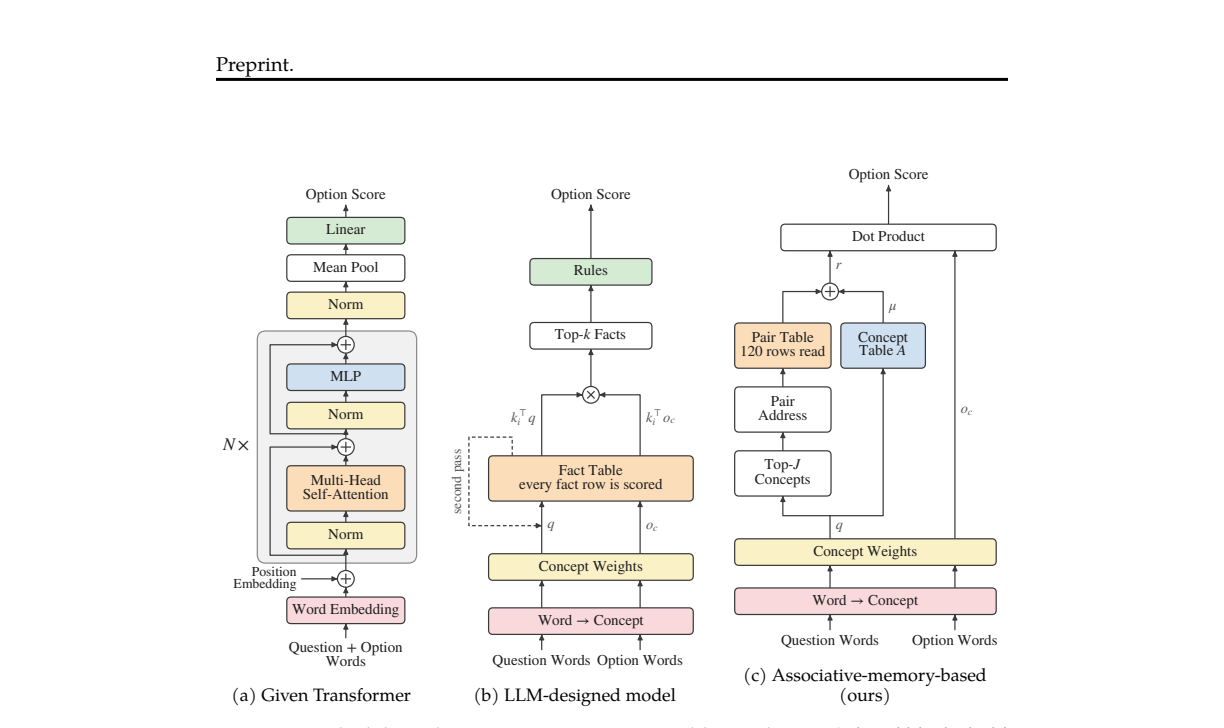
This paper asks a simple question: if an LLM writes a model's weights line by line without gradient descent, should it still use a Transformer? The answer, tested across three frontier LLMs and multiple controls, is no. When free to design the architecture, all three LLMs build sparse fact tables queried by a fixed procedure, not Transformers. The LLM-designed models reach higher accuracy on ARC science questions than any Transformer the same LLM wrote, using far fewer parameters. The paper then distills the LLMs' designs into an associative-memory-based model that runs up to 17× faster on a GPU than a same-sized Transformer while staying within a few points of the LLM-designed accuracy.
The empirical work is thorough. The authors test for data leakage, compare against BM25 over the written text, measure how many answers change when a single line is removed, and run controls that forbid practice questions or fact rows. The limitations are stated honestly: the finding applies to current LLMs writing weights from random initialization, the LLMs' choice may reflect familiarity with retrieval rather than inherent suitability, and the models cannot chain facts or learn representations. The paper also tests pretrained weights, text generation, and image tasks, showing where WSP works and where it does not.
The main soft spot is that the comparison against Transformers is asymmetric: the Transformers were written by the same LLM, not designed by humans for WSP. A human-designed Transformer for WSP might do better, though the paper's BM25 control suggests the issue is structural interference in dense keys, not just poor writing. The 1,800× parameter reduction, while real, compares against a 1.7B-parameter released architecture that the LLM wrote from random initialization, not against a Transformer optimized for the task. The paper acknowledges this scope in its limitations section.
This paper is for researchers in weight-space programming, model interpretability, and anyone who thinks about what architectures are good for when gradients are not available. It deserves a serious referee. The claims are specific, the evidence is substantial, and the limitations are clearly marked. A reviewer should check the reproducibility constraints (the LLMs are proprietary) and whether the associative-memory model's speed advantage holds at larger concept counts, but the core empirical finding is solid and worth engaging with.
The stress test's concern
Withdrawn: Pith's reviewer misread the paper.
The paper says
“An LLM-designed model achieves higher test accuracy than the most accurate released Transformer that the same LLM wrote while using about 1,800$\times$ fewer parameters.”
The referee's report
Not published. Pith's referee wrote this assessment before its objections were checked against the paper, and 4 of its 4 major objections did not survive that check.
Pith's reading of the paper (a machine's summary, not the authors')
The paper investigates whether the Transformer architecture remains the right choice for weight-space programming (WSP), where a large language model writes a target model's weights directly without gradient descent. Given minimal guidance and only ten labeled examples, three frontier LLMs (Claude Opus 5.5, GPT-6.1 Sol, GPT-6 Astra) were asked either to write weights for a fixed architecture or to design the architecture themselves. When free to design, all three LLMs independently converged on the same structure: a sparse table of plain-text facts queried by a fixed lookup procedure, not a Transformer. The resulting LLM-designed models achieved higher accuracy on ARC science questions than the most accurate Transformer the same LLM wrote, while using about 1,800x fewer parameters. The paper argues that this structure is better suited to WSP because each weight has a nameable meaning, predictions trace to specific rows, and edits stay local. The authors propose their own associative-memory-based model that preserves these properties while running up to 17x faster on a GPU than a same-sized Transformer.
What carries the argument. The central object is the sparse fact table, where each row stores one plain-text fact as a sparse concept vector. The LLM writes facts as sentences, a build script compiles them into rows, and a fixed lookup procedure matches question and option tokens against rows to select the highest-scoring answer. The paper also introduces an associative-memory-based model that uses a hash-addressed pair table and a concept table to read only a fixed number of rows per question, keeping per-question cost independent of the number of stored facts.
Core claim. The paper claims that when frontier LLMs are free to design their own architecture for weight-space programming, they do not build Transformers. Instead, they compile plain-text facts into a sparse table queried by a fixed procedure. An LLM-designed model achieves higher ARC test accuracy than the most accurate released Transformer that the same LLM wrote while using about 1,800x fewer parameters. The paper further claims that this structure is inherently better suited to writing weights without gradients because every weight has a nameable meaning, predictions trace to specific rows, and editing a row changes only the predictions that depend on it.
The premise it rests on. The central claim rests on the assumption that the three LLM writers (Claude Opus 5.5, GPT-6.1 Sol, GPT-6 Astra) are representative of frontier LLMs and that their architectural choices reflect the inherent suitability of sparse tables for weight-space programming, rather than being influenced by the LLMs' familiarity with retrieval-augmented generation or other biases.
If the paper is right (Pith's inferences, not the authors')
If the paper is right, weight-space programming should abandon the Transformer in favor of sparse table architectures that allow line-by-line writing, traceable predictions, and local edits.
The associative-memory-based model proposed by the authors could serve as a practical starting point for future WSP systems, offering a fixed forward pass that is faster on GPUs than same-sized Transformers.
The paper's finding that written Transformers underperform plain BM25 search over their own text suggests that dense overlapping keys cause interference, which would be a general problem for writing facts into any dense architecture.
The lineage protocol, where each generation refines the prior generation's best model using only validation accuracy, provides a template for automated WSP without gradient descent.
The paper's results suggest that the Transformer's dominance in deep learning may be partly an artifact of its co-evolution with GPU hardware and gradient descent, not a universal architectural advantage. If WSP becomes more widely used, the optimal architecture for a given task may depend on whether weights are written or learned.
The fact that all three LLMs independently converged on the same sparse-table design, despite having different training data and architectures, hints that this structure may be a natural solution to the problem of writing knowledge into weights without gradients, rather than a quirk of any one LLM.
The paper's associative-memory-based model, with its hash-addressed pair table, could be adapted to other settings where knowledge must be stored and retrieved without gradient training, such as continual learning or few-shot adaptation in resource-constrained environments.
Check this review
What was read
The passes were given all 141,812 characters of the paper's LaTeX source.
Fingerprint of that text (SHA-256): bbcf1fbd193e6974f24652a912794b421d6553a396bb3bb8329cd97cf4b82e0e
Pith does not keep that text. Rebuilt from the paper's source or PDF by the same code, it has this fingerprint if it is the same text. From a copy of Pith's code:
PYTHONPATH=. python scripts/review_input_check.py 2611.22055
The passes, in the order they ran
- Reader deepseek-v4-flash · medium effort · $0.0050 · instructions of the Reader, fingerprint f9ead7300382…
- Skeptic deepseek-v4-flash · medium effort · $0.0044 · instructions of the Skeptic, fingerprint 8f88c0f61488…
- Referee deepseek-v4-flash · medium effort · $0.0047 · instructions of the Referee, fingerprint a852d99aea0d…
- Check against the paper deepseek-v4-flash · medium effort · $0.0063 · instructions of the Check against the paper, fingerprint 6c7a6883d551…
- Editor deepseek-v4-flash · medium effort · $0.0044 · instructions of the Editor, fingerprint e7211f6a3d27…
- Summary for the page deepseek-v4-flash · medium effort · temperature 0.2 · $0.0046 · instructions of the Summary for the page, fingerprint e4f56bf568e7…
The passes cost $0.029 in model calls together.
Version stamped on this review: pith-pipeline@v1.4.1-daily-deepseek-or-medium+deepseek/deepseek-v4-flash+p.0ef1a750a3e3
Each link opens a pass's instructions as plain text, the exact bytes its fingerprint was taken over. Every stored set of instructions.
curl -s https://pith.science/methodology/prompts/f9ead730038216984cfb56d7cb34332bdf691828296a1de4245f3d6667d4bf56 | sha256sum
prints the fingerprint of the reader's instructions. The same works for every pass.
The receipt
The review's fingerprint was taken on 18 Nov 2026. The review you are reading still matches it.
Fingerprint of the review (SHA-256): d340a7c2dd2d169b4596a8d0767818404bcc8dc9983ace159630c21f4b460f2f
curl -s 'https://pith.science/api/v1/verdicts/2611.22055?form=canonical' | sha256sum
prints the fingerprint of the review as it stands now. The rule, in four steps.
A matching fingerprint shows the review has not changed since that date. It does not show that the review is right.
How often reviews like this one are right
Reviews like this one: written by deepseek-v4-flash, from the paper's LaTeX source.
How often objections from reviews like this one are right: not yet measured
Reviews by people
This review was written by a machine. No person has reviewed this paper on Pith yet. A scientist listed on Pith can review it for a fee, and their review is published here whatever it concludes.
The paper
Abstract
Standard neural architectures such as the Transformer were chosen because they train well with gradient descent and run fast on GPUs. In weight-space programming, a large language model (LLM) writes target weights by hand without gradient-based training, so those reasons no longer apply. Should we keep the Transformer? Given minimal guidance, ten labeled examples, and a sandbox, mainly on multiple-choice questions, we task three frontier LLMs with either generating the weights of a fixed architecture or designing the architecture themselves. When free to design, all three compile plain-text facts into a sparse table queried by a fixed procedure, reaching up to 54.4% test accuracy. An LLM-designed model achieves higher test accuracy than the most accurate released Transformer that the same LLM wrote while using about 1,800x fewer parameters. Without gradients, they choose a table, in which the LLM can state what each weight means and can find and rewrite a wrong one. Each wrong answer points to one row, and removing a row changes about one other answer. From this, we propose an associative-memory-based model up to 17x faster on GPUs than a same-sized Transformer. We also test pretrained weights, other benchmarks, and tasks where models generate answers. Pretrained LLMs remain more accurate; the claim concerns which structure to build when writing weights.
The paper's own sentences, arranged, kept beside the review and separate from it. Each label is drawn from a closed vocabulary; the number beside it is the probability the classifier gave that label. No sentence in this record was written by a model.
abstract compiled · 2026-11-18
The authors' main claim, as the classifier picked it out 0.52
“From this, we propose an associative-memory-based model up to 17x faster on GPUs than a same-sized Transformer.”
How the main claim is stated: asserted 0.84
What the abstract itself states, as probabilities: claims first 0.07 · states limitation 0.91 · human participants 0.05 · controlled comparison 0.83 · randomized assignment 0.02 · states quantitative result 0.98 · compares with prior results 0.96 · mentions code or data availability 0.05
The abstract, sentence by sentence
This table labels the abstract only (arXiv listing abstract v1). The number is the probability the classifier gave the label.
| Sentence | Role | The authors' own work | States the main conclusion | Strength |
|---|---|---|---|---|
| Standard neural architectures such as the Transformer were chosen because they train well with gradient descent and run fast on GPUs. | background 1.00 | 0.06 | 0.02 | asserted 1.00 |
| In weight-space programming, a large language model (LLM) writes target weights by hand without gradient-based training, so those reasons no longer apply. | background 0.86 | 0.14 | 0.16 | asserted 1.00 |
| Should we keep the Transformer? | gap 0.54 | 0.06 | 0.03 | unclear 0.98 |
| Given minimal guidance, ten labeled examples, and a sandbox, mainly on multiple-choice questions, we task three frontier LLMs with either generating the weights of a fixed architecture or designing the architecture themselves. | method 0.94 | 0.93 | 0.03 | asserted 0.80 |
| When free to design, all three compile plain-text facts into a sparse table queried by a fixed procedure, reaching up to 54.4% test accuracy. | result 1.00 | 0.94 | 0.20 | asserted 0.99 |
| An LLM-designed model achieves higher test accuracy than the most accurate released Transformer that the same LLM wrote while using about 1,800x fewer parameters. | result 1.00 | 0.92 | 0.45 | asserted 1.00 |
| Without gradients, they choose a table, in which the LLM can state what each weight means and can find and rewrite a wrong one. | interpretation 0.88 | 0.83 | 0.25 | asserted 1.00 |
| Each wrong answer points to one row, and removing a row changes about one other answer. | result 0.62 | 0.86 | 0.05 | asserted 0.99 |
| From this, we propose an associative-memory-based model up to 17x faster on GPUs than a same-sized Transformer. | contribution 0.56 | 0.89 | 0.32 | asserted 0.84 |
| We also test pretrained weights, other benchmarks, and tasks where models generate answers. | method 0.61 | 0.93 | 0.04 | asserted 0.82 |
| Pretrained LLMs remain more accurate; the claim concerns which structure to build when writing weights. | interpretation 0.54 | 0.77 | 0.15 | asserted 1.00 |
What kind of paper the classifier reports this is: empirical study 0.84 · evidence from observation or experiment 0.94
What was examined, and what was not
Sources read
- arXiv listing abstract v1
Not examined
- full text
- figures and tables
- references and citing sentences
- relations to other papers
Levels run
- P abstract
Not run
- S sections
- T body sentences
- C citations
- R cross-paper relations
How the labels were made
Compiled by classifier-1.13.0 via TypeSafe API, question bank abstract-p1-20260923, 2026-11-18: 1 request, 8,062 input tokens.
Every quoted sentence on this record is the authors'. Every label is from Pith's closed vocabulary, with the probability shown beside it. This record as JSON
Figures (7)


Figures are the authors', reproduced from the paper.
References (29)
- [1] Loubna Ben Allal, Anton Lozhkov, Elie Bakouch, Gabriel Martín Blázquez, Guilherme Penedo, et al. SmolLM2: When smol goes big – data-centric training of a small language model. arXiv preprint arXiv:2502.02737, on PithPith's reviewarXiv
- [5] fixed 120 pair reads plus one product with A LLM GPU rewrites remain slow 6–33× slower than same-sized Transformer fixed forward pass replayed as CUDA graph (18 ms) Table 18: Each design choice in our associative-memory-based model addresses an em- pirical observation from WSP... on Pith
- [8] Gemma Team, Aishwarya Kamath, Johan Ferret, Shreya Pathak, Nino Vieillard, et al. Gemma 3 technical report.arXiv preprint arXiv:2503.19786, on PithPith's reviewarXiv
- [9] Suriya Gunasekar, Yi Zhang, Jyoti Aneja, Caio César Teodoro Mendes, Allie Del Giorno, Sivakanth Gopi, et al. Textbooks are all you need.arXiv preprint arXiv:2306.11644, on PithPith's reviewarXiv
- [11] doi: 10.1145/3467017. Edward J. Hu, Yelong Shen, Phillip Wallis, Zeyuan Allen-Zhu, Yuanzhi Li, Shean Wang, Lu Wang, and Weizhu Chen. LoRA: Low-rank adaptation of large language models. In International Conference on Learning Representations, on Pithdoi:10.1145/3467017
- [12] LiuKe,UditGupta,BenjaminYoungjaeCho,DavidBrooks,VikasChandra,UtkuDiril,etal. RecNMP: Accelerating personalized recommendation with near-memory processing. In 2020 ACM/IEEE 47th Annual International Symposium on Computer Architecture (ISCA),pp. 790–803, on Pith
- [13] doi: 10.1109/ISCA45697.2020.00070. Alex Krizhevsky. Learning multiple layers of features from tiny images. Techni- cal report, University of Toronto, on Pithdoi:10.1109/isca45697.2020.00070
- [15] Hongwei Liu, Zilong Zheng, Yuxuan Qiao, Haodong Duan, Zhiwei Fei, Fengzhe Zhou, Wenwei Zhang, Songyang Zhang, Dahua Lin, and Kai Chen. MathBench: Evaluating the theory and application proficiency of LLMs with a hierarchical mathematics bench- mark. InFindings of the Associatio... on Pith
- [16] Todor Mihaylov, Peter Clark, Tushar Khot, and Ashish Sabharwal. Can a suit of armor conductelectricity? anewdatasetforopenbookquestionanswering. In Proceedings of the 2018 Conference on Empirical Methods in Natural Language Processing , pp. 2381–2391, on Pith
- [17] doi: 10.1145/3638529.3654017. Kai Ni, Xunzhao Yin, Ann Franchesca Laguna, Siddharth Joshi, Stefan Dünkel, Martin Trentzsch,JohannesMüller,SvenBeyer,MichaelNiemier,XiaoboSharonHu,andSuman Datta. Ferroelectric ternary content-addressable memory for one-shot learning.Nature Elect... on Pithdoi:10.1145/3638529.3654017
- [19] Jungwoo Park, Taewhoo Lee, and Jaewoo Kang. UltraBERT: Beyond the limit of BERT pre- training. arXiv preprint arXiv:2610.15028, on PithPith's reviewarXiv
- [20] Bo Peng, Ruichong Zhang, Daniel Goldstein, Eric Alcaide, Xingjian Du, et al. RWKV-7 “goose” with expressive dynamic state evolution.arXiv preprint arXiv:2503.14456, on PithPith's reviewarXiv
- [21] Model cards: https://huggingface.co/Qwen/Qwen3.5-0.8B and https://huggingface.co/Qwen/Qwen3.5-2B. Pranav Rajpurkar, Jian Zhang, Konstantin Lopyrev, and Percy Liang. SQuAD: 100,000+ questions for machine comprehension of text. In Proceedings of the 2016 Conference on Empirical ... on Pith
- [22] doi: 10.1038/s41586-023-06924-6. Imanol Schlag, Kazuki Irie, and Jürgen Schmidhuber. Linear transformers are secretly fast weightprogrammers. InProceedings of the 38th International Conference on Machine Learning, volume 139 ofProceedings of Machine Learning Research, pp. 9355–9366, on Pithdoi:10.1038/s41586-023-06924-6
- [26] An Yang, Anfeng Li, Baosong Yang, Beichen Zhang, Binyuan Hui, et al. Qwen3 technical report. arXiv preprint arXiv:2505.09388, on PithPith's reviewarXiv
- [28] RNN 191M 3 3 3 – 3 Table 10:Fifteen released architectures span Transformer decoders and encoders, a state- space model, and an RNN.Checkmarks and dashes show where each architecture is used across WSP from random initialization or a pretrained base checkpoint, ARC fine-tuning... on Pith
- [1990] doi: 10.1207/s15516709cog1402_1. Gemma Team, Morgane Riviere, Shreya Pathak, Pier Giuseppe Sessa, Cassidy Hardin, et al. Gemma 2: Improving open language models at a practical size. arXiv preprint arXiv:2408.00118, on PithPith's reviewarXiv
- [1992] doi: 10.1162/neco.1992.4.1 on Pithdoi:10.1162/neco.1992.4.1
- [2009] URL https://www.cs.toronto.edu/~kriz/ learning-features-2009-TR.pdf. Guillaume Lample, Alexandre Sablayrolles, Marc’Aurelio Ranzato, Ludovic Denoyer, and Hervé Jégou. Large memory layers with product keys.arXiv preprint arXiv:1907.05242, on PithPith's reviewarXiv
- [2015] Shu Zhong, Mingyu Xu, Tenglong Ao, and Guang Shi. Understanding transformer from the perspective of associative memory.arXiv preprint arXiv:2505.19488, on PithPith's reviewarXiv
show 9 more
- [2017] Aaditya K. Singh, Muhammed Yusuf Kocyigit, Andrew Poulton, David Esiobu, Maria Lomeli, Gergely Szilvasy, et al. Evaluation data contamination in LLMs: how do we measure it and (when) does it matter?arXiv preprint arXiv:2411.03923, on PithPith's reviewarXiv
- [2019] doi: 10.1038/s41928-019-0321-3. OpenAI. AddendumtoGPT-6Astrasystemcard: GPT-6.1Sol. https://deploymentsafety. openai.com/gpt-6-1-sol, 2026a. September 29, on Pithdoi:10.1038/s41928-019-0321-3
- [2020] Xin Cheng, Rui Tian, Wangding Zeng, Damai Dai, Qinyu Chen, Bingxuan Wang, Zhenda Xie, Kezhao Huang, Xingkai Yu, Chengqi Deng, Shangyan Zhou, Chenggang Zhao, Zhewen Hao, Yukun Li, Han Zhang, Zhengyan Zhang, Yixu Wei, M. Y Xu, Huishuai Zhang, Dongyan Zhao, and Wenfeng Liang. Con... on PithPith's reviewarXiv
- [2021] TomB.Brown,BenjaminMann,NickRyder,MelanieSubbiah,JaredKaplan,PrafullaDhari- wal, et al. Language models are few-shot learners.arXiv preprint arXiv:2005.14165, on PithPith's reviewarXiv
- [2022] Peter Clark, Isaac Cowhey, Oren Etzioni, Tushar Khot, Ashish Sabharwal, Carissa Schoenick, and Oyvind Tafjord. Think you have solved question answering? try ARC, the AI2 reasoning challenge.arXiv preprint arXiv:1803.05457, on PithPith's reviewarXiv
- [2023] David Ha, Andrew Dai, and Quoc V. Le. HyperNetworks.arXiv preprint arXiv:1609.09106, on PithPith's reviewarXiv
- [2024] 14 Preprint. Owen Dugan, Roberto Garcia, Ronny Junkins, Jerry Liu, Dylan Zinsley, Sabri Eyuboglu, AtriRudra,andChrisRé. Constructingefficientfact-storingMLPsfortransformers. arXiv preprint arXiv:2512.00207, on PitharXiv
- [2025] doi: 10.18653/v1/2025.acl-long.127. Gail Weiss, Yoav Goldberg, and Eran Yahav. Thinking like transformers. InProceedings of the 38th International Conference on Machine Learning, volume 139 ofProceedings of Machine Learning Research, pp. 11080–11090, on Pithdoi:10.18653/v1/2025.acl-long.127
- [2026] Aakanksha Chowdhery, Sharan Narang, Jacob Devlin, Maarten Bosma, Gaurav Mishra, Adam Roberts, et al. PaLM: Scaling language modeling with pathways.arXiv preprint arXiv:2204.02311, on PithPith's reviewarXiv
Cited by 3 Pith papers
Reviewed papers on Pith that cite this one. The full citation record
- Kolpona: An Agentic Framework with Gradient-Free Neuron Programming for RTL Generation cs.LG · Nov 2026
- Do We Really Need an LLM for Weight-Space Programming? A Deterministic Forward-Only Paradigm and Its Capability Boundaries cs.AI · Nov 2026
- Fine-Tuning Without Gradients? Closed-Form, LLM-Written Classifiers on a Frozen Encoder cs.CL · Nov 2026
Challenges and discussion
Disagree with the review, or know something it missed? Leave a comment, or challenge this review formally: a challenge becomes a permanent entry in this paper's record, and its decision is published here.
Come back by email
A short list of the week's newly reviewed papers. Nothing is sent until you confirm from your inbox, and every email has a link that stops it. No account.
No comments yet.
Sign in to comment