Artificial Intelligence · arXiv:2611.34612 v1 · submitted 25 Nov 2026 · 69 references
Do We Really Need an LLM for Weight-Space Programming? A Deterministic Forward-Only Paradigm and Its Capability Boundaries
The paper says
“Recent work on Weight-Space Programming uses LLMs to edit neural weights with forward passes only, conflating LLM scripting with the underlying algebra of forward-only editing.”
more of the abstract
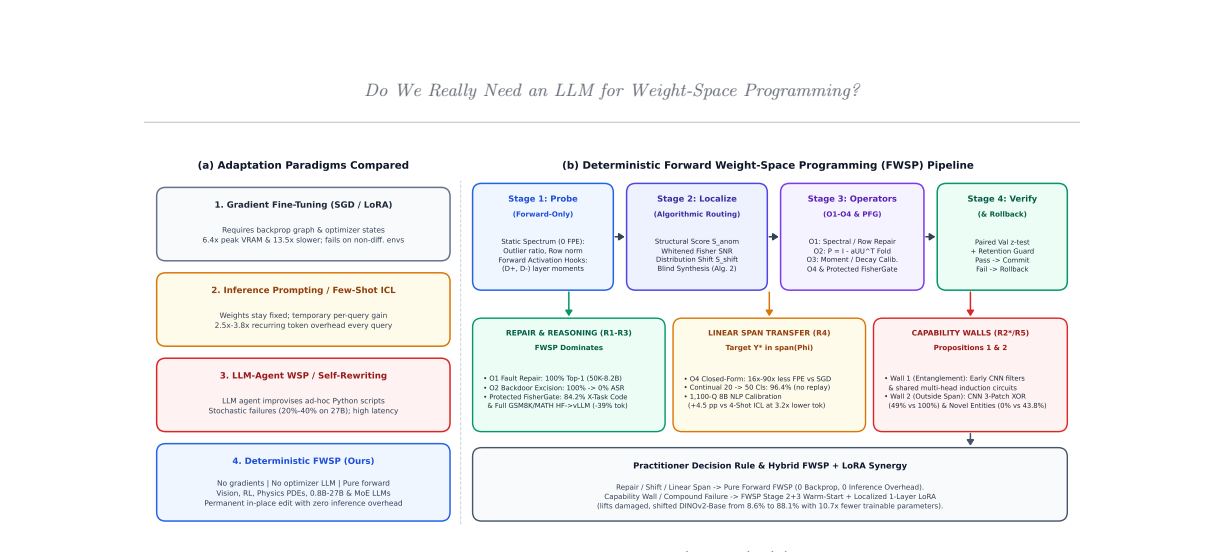
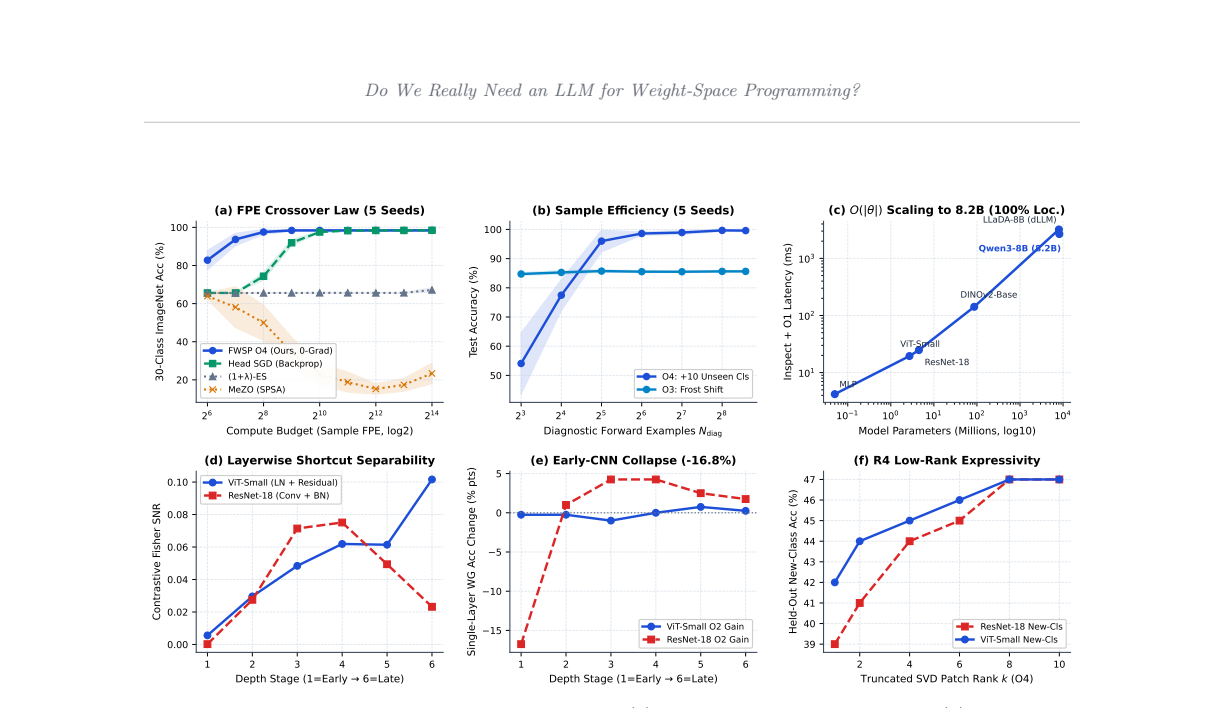
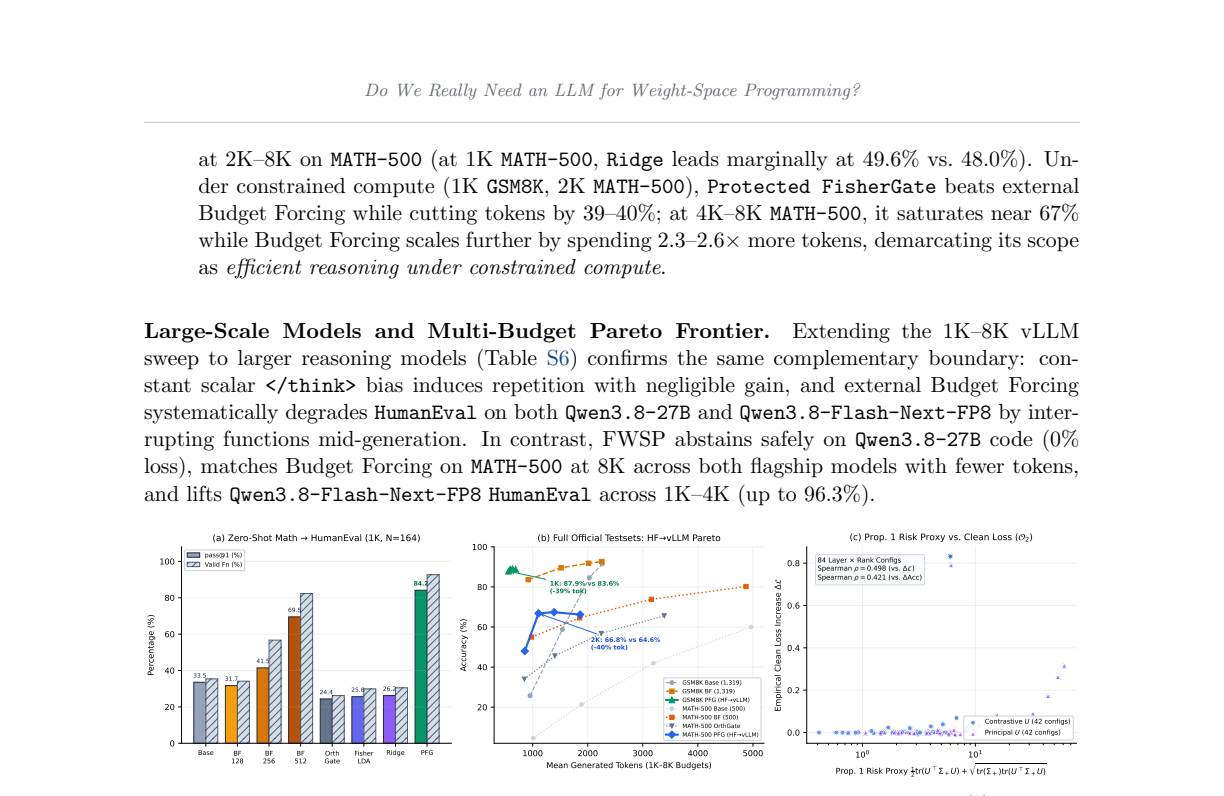
We show that for core structured editing regimes, an LLM optimizer is unnecessary, and introduce Forward Weight-Space Programming (FWSP): a deterministic pipeline combining probing, localization, stratified operators (O1-O4), automatic blind routing (83.3% vs. 33.3% for a 27B LLM with the same tool library), and paired verification with zero additional per-token computation. For reasoning LLMs, we propose Protected FisherGate, a closed-form covariance-whitened readout edit orthogonal to normal-reasoning states: on DeepSeek-R1-0528-8B, a single frozen math-calibrated patch achieves 84.2% HumanEval pass@1 (1K budget; 75.4 +/- 9.4% across 3/5 Stage-4-passing subsets), beating 512-token-reserved budget forcing by +14.6 pp (-23.4% tokens) while transferring across HF-to-vLLM backends on full GSM8K and MATH-500. Across five modalities and thirteen models (50K to 27B dense and FP8 MoE), we further prove and verify two operator boundaries, subspace entanglement and frozen representation span, where FWSP-localized LoRA bridges forward-only and gradient adaptation.
from the abstract
Pith says
Machine review · deepseek-v4-flash · 26 Nov 2026 · read the full text (127,564 characters) · not checked by a person
It can be wrong. Challenge this review or reply to it.
Holds up, with conditions. This paper shows that a deterministic forward-only pipeline can replace LLM-based weight editing for structured fault repair and reasoning calibration, with extensive empirical validation across modalities. This line is wrong
4 minor
How often objections from reviews like this one are right: not yet measured
The paper, first character to last
The reviewer was given the whole text, 127,564 characters. Not checked: figures, code, what the 69 references say.
4 minor objections
The paper says, at Algorithm 2
Pith says: minor objection 1 of 4
The blind routing thresholds (τ_anom=4.0, τ_Fisher=0.05, τ_shift=0.08, τ_H=0.95) in Algorithm 2 are presented as fixed, but their origin is not explained. The paper should clarify whether these values were chosen based on a development set, are heuristics, or were tuned on a specific architecture, and discuss the sensitivity of the pipeline to these choices.
The paper says, at Appendix C (Reproducibility)
Pith says: minor objection 2 of 4
The default hyperparameters listed at the end of Appendix C include ranges (e.g., τ_clip ∈ {6,10,14}, r ∈ {1,2,4,8}) but are described as 'shared across all architectures without per-dataset tuning'. The paper should clarify whether these ranges are searched over or whether a single value from each range is used uniformly, and if any selection procedure was applied.
show 2 more
The paper says, at Table 1(b)
Pith says: minor objection 3 of 4
Table 1(b) reports latency for the 27B+Tools condition as 4,443ms. It would be helpful to clarify whether this includes the LLM inference time for generating routing decisions or only the tool execution time, to aid reproducibility.
The paper says, at Abstract
Pith says: minor objection 4 of 4
The abstract states 'zero additional per-token computation', which is accurate for the committed weight edits. However, the verification stage (Stage 4) requires forward passes on validation data. The paper should explicitly note that this is a one-time cost incurred during editing, not per inference token, to avoid any misinterpretation.
What would settle it
A concrete falsifier would be to construct a structured editing task (e.g., a compound fault involving both a localized bit-flip and a diffuse distribution shift on a novel architecture not tested) where the automatic blind router's fixed thresholds fail to select the correct operator sequence, causing FWSP to underperform a simple baseline like MeZO or a 27B LLM agent with the same tool library. The paper already shows one such case (compound bit-flip + ImageNet-C shift on ResNet-18 requires O3 before O1, which the greedy router misses), but a systematic sweep across architectures and fault combinations could reveal a regime where FWSP's deterministic routing is consistently worse than an LLM agent's adaptive selection.
from Pith's summary of the paper
How the review went
5 passes by deepseek-v4-flash · 26 Nov 2026
- Reader holds up, with conditions
- Skeptic concern withdrawn: Pith's reviewer misread the paper
- Referee 4 minor
- Check against the paper kept 0 of 1 objection
- Editor wrote the verdict above
Not run on this paper: the simulated authors' defence.
Pith's passes raised 1 objection. A check against the paper's text kept 0 and withdrew 1 (1 Pith's reviewer misread the paper).
The review in full
The review in brief, machine-written
The paper asks a pointed question—do we really need an LLM to edit neural weights?—and answers it with a clear empirical and theoretical case. The central claim is that for core structured editing regimes (fault repair, backdoor excision, distribution shift, reasoning overthinking), an LLM optimizer is unnecessary. The authors introduce Forward Weight-Space Programming (FWSP), a deterministic pipeline that combines probing, localization, stratified operators, automatic routing, and paired verification. They also propose Protected FisherGate, a closed-form constrained Fisher discriminant for reasoning calibration that enables zero-shot cross-task transfer and backend-agnostic deployment. Two capability boundaries (subspace entanglement and frozen representation span) are formalized and verified, with FWSP-localized LoRA bridging the gap to gradient methods when needed. The experimental scope is unusually broad: five modalities, thirteen models from 50K to 27B parameters, with confidence intervals and bootstrap significance tests throughout. The paper is transparent about its limitations—the LLM comparison uses open 8B and 27B agents rather than frontier closed-source models, some routing thresholds are hand-set, and the Protected FisherGate gain estimator can collapse on small calibration subsets (caught by Stage-4 verification). These are acknowledged honestly and do not undermine the main result. The paper is a substantial contribution to forward-only weight editing. It deserves a serious referee and will be of practical value to researchers working on model editing, robustness, and efficient reasoning.
The stress test's concern
Withdrawn: Pith's reviewer misread the paper.
The paper says
“We show that for core structured editing regimes, an LLM optimizer is unnecessary”
The referee's report
If the results hold, this paper makes a strong case that deterministic forward-only operators can replace LLM-based weight-space programming for a well-defined class of structured editing tasks (fault repair, backdoor excision, distribution shift calibration, reasoning overthinking suppression). The empirical evaluation is unusually broad (five modalities, thirteen models, 50K to 27B parameters) and includes careful resource accounting (FPE, VRAM, wall time) and bootstrap significance tests. The theoretical propositions on subspace entanglement and frozen representation span provide formal boundaries that are experimentally verified. The Protected FisherGate method for reasoning LLMs is a clean combination of classical linear algebra (constrained Fisher discriminant) with a practical application, and the cross-task and cross-backend transfer results are striking. The paper is likely to influence how practitioners think about forward-only model editing and where gradient-based methods remain necessary.
Pith's reading of the paper (a machine's summary, not the authors')
The paper argues that the recent trend of using LLMs to edit neural network weights conflates two separate things: the underlying algebra of forward-only editing and the LLM agent that scripts it. For a range of structured editing tasks—repairing hardware faults, excising backdoors, calibrating for distribution shifts, and suppressing overthinking in reasoning models—the authors show that an LLM optimizer is unnecessary. They introduce Forward Weight-Space Programming (FWSP), a deterministic pipeline that uses probing, localization, and closed-form linear-algebraic operators (O1–O4) to edit weights with only forward passes. Across five modalities and thirteen models up to 27B parameters, FWSP matches or outperforms LLM-based weight-space programming in reliability, latency, and resource efficiency, while also identifying capability boundaries where gradient-based methods remain necessary.
What carries the argument. The central machinery is the four-stage deterministic pipeline (FWSP) and its stratified operators: O1 (spectral outlier clipping and row rescaling), O2 (orthogonal subspace projection with positive-mean bias alignment), O3 (unlabeled moment recalibration), and O4 (closed-form Woodbury ridge patching). For reasoning LLMs, the key addition is Protected FisherGate, a closed-form covariance-whitened readout edit that enforces exact orthogonality to a protected subspace of normal-reasoning states (Q_keep^T d = 0), computed from 8 practice rollouts. The automatic blind router (Algorithm 2) selects among operators using fixed thresholds on anomaly scores, Fisher separation, and distribution shift metrics.
Core claim. The central claim is that the algebra of forward-only weight editing—spectral repair, subspace projection, moment recalibration, and closed-form ridge patching—can be decoupled from the LLM agent that scripts it, and that a deterministic pipeline (FWSP) suffices for the core structured editing regimes that prior work attributed to LLM intelligence. The paper demonstrates this by building FWSP from four operator classes (O1–O4) and a constrained Fisher discriminant (Protected FisherGate) for reasoning models, and by showing that FWSP outperforms interactive 8B and 27B LLM agents (even when the agent is given the exact same operator library) on fault repair, backdoor excision, distribution shift calibration, and reasoning overthinking suppression. The paper further proves and verifies two capability boundaries—subspace entanglement and frozen representation span—where forward-only operators hit fundamental limits and hybrid FWSP+LoRA or backpropagation takes over.
The premise it rests on. The weakest assumption is that the structured editing regimes tested (bit-flips, row outliers, backdoors, distribution shifts, reasoning overthinking) are representative of the core use cases for weight-space programming, and that the fixed thresholds in the automatic blind router (τ_anom=4.0, τ_Fisher=0.05, τ_shift=0.08, τ_H=0.95) transfer to all architectures and fault types without retuning.
If the paper is right (Pith's inferences, not the authors')
FWSP provides a drop-in replacement for LLM-based weight-space programming on structured editing tasks, eliminating the latency, cost, and brittleness of LLM agent loops.
Protected FisherGate enables single-checkpoint zero-shot transfer from math to code reasoning, and from HuggingFace to vLLM backends, without recalibration.
The capability boundaries (subspace entanglement, frozen representation span) give practitioners a decision rule: use pure FWSP for localized faults and readout edits, and switch to FWSP+LoRA or backpropagation when upstream representations must be reshaped or when tasks require multi-layer credit assignment.
The Stage-4 paired verification with retention guard provides a safety mechanism that prevents silent degradation, abstaining on tokenization boundaries (e.g., multi-token response tags) and on calibration subsets where the gain estimator collapses.
The paper's decoupling of editing algebra from LLM scripting suggests that many 'emergent' capabilities attributed to LLM agents in weight-space programming may actually be properties of the underlying linear-algebraic operators, not the LLM's reasoning.
The Protected FisherGate result—that a single rank-1 readout edit can transfer zero-shot across tasks and backends—raises the question of whether other reasoning pathologies (e.g., sycophancy, refusal) might be correctable by similar constrained analytic edits without gradient-based fine-tuning.
The automatic blind router's fixed thresholds (τ_anom=4.0, etc.) were set by hand and shown to transfer across architectures, but the paper does not provide a principled method for setting them; a future extension could learn these thresholds from data or derive them from the theory of random matrices.
Check this review
What was read
The passes were given all 127,564 characters of the paper's LaTeX source.
Fingerprint of that text (SHA-256): 7732c73b3e32bc6929f5d848cd73b5e904a94f815c272c87e5ad7536faad3a27
Pith does not keep that text. Rebuilt from the paper's source or PDF by the same code, it has this fingerprint if it is the same text. From a copy of Pith's code:
PYTHONPATH=. python scripts/review_input_check.py 2611.34612
The passes, in the order they ran
- Reader deepseek-v4-flash · medium effort · $0.0051 · instructions of the Reader, fingerprint f9ead7300382…
- Skeptic deepseek-v4-flash · medium effort · $0.019 · instructions of the Skeptic, fingerprint 8f88c0f61488…
- Referee deepseek-v4-flash · medium effort · $0.0044 · instructions of the Referee, fingerprint a852d99aea0d…
- Check against the paper deepseek-v4-flash · medium effort · $0.0042 · instructions of the Check against the paper, fingerprint 6c7a6883d551…
- Editor deepseek-v4-flash · medium effort · $0.0040 · instructions of the Editor, fingerprint e7211f6a3d27…
- Circularity check deepseek-v4-flash · medium effort · $0.0040 · instructions of the Circularity check, fingerprint e9946e39d67b…
- Summary for the page deepseek-v4-flash · medium effort · temperature 0.2 · $0.0047 · instructions of the Summary for the page, fingerprint e4f56bf568e7…
The passes cost $0.045 in model calls together.
Version stamped on this review: pith-pipeline@v1.4.1-daily-deepseek-or-medium+deepseek/deepseek-v4-flash+p.d60f54226f00
Each link opens a pass's instructions as plain text, the exact bytes its fingerprint was taken over. Every stored set of instructions.
curl -s https://pith.science/methodology/prompts/f9ead730038216984cfb56d7cb34332bdf691828296a1de4245f3d6667d4bf56 | sha256sum
prints the fingerprint of the reader's instructions. The same works for every pass.
The receipt
The review's fingerprint was taken on 26 Nov 2026. The review you are reading still matches it.
Fingerprint of the review (SHA-256): a6a8e637c03e9d8c628dac2ebbde450192f56dd1ef588885749ff18723589a07
curl -s 'https://pith.science/api/v1/verdicts/2611.34612?form=canonical' | sha256sum
prints the fingerprint of the review as it stands now. The rule, in four steps.
A matching fingerprint shows the review has not changed since that date. It does not show that the review is right.
How often reviews like this one are right
Reviews like this one: written by deepseek-v4-flash, from the paper's LaTeX source.
How often objections from reviews like this one are right: not yet measured
Reviews by people
This review was written by a machine. No person has reviewed this paper on Pith yet. A scientist listed on Pith can review it for a fee, and their review is published here whatever it concludes.
The paper
Abstract
Recent work on Weight-Space Programming uses LLMs to edit neural weights with forward passes only, conflating LLM scripting with the underlying algebra of forward-only editing. We show that for core structured editing regimes, an LLM optimizer is unnecessary, and introduce Forward Weight-Space Programming (FWSP): a deterministic pipeline combining probing, localization, stratified operators (O1-O4), automatic blind routing (83.3% vs. 33.3% for a 27B LLM with the same tool library), and paired verification with zero additional per-token computation. For reasoning LLMs, we propose Protected FisherGate, a closed-form covariance-whitened readout edit orthogonal to normal-reasoning states: on DeepSeek-R1-0528-8B, a single frozen math-calibrated patch achieves 84.2% HumanEval pass@1 (1K budget; 75.4 +/- 9.4% across 3/5 Stage-4-passing subsets), beating 512-token-reserved budget forcing by +14.6 pp (-23.4% tokens) while transferring across HF-to-vLLM backends on full GSM8K and MATH-500. Across five modalities and thirteen models (50K to 27B dense and FP8 MoE), we further prove and verify two operator boundaries, subspace entanglement and frozen representation span, where FWSP-localized LoRA bridges forward-only and gradient adaptation.
The paper's own sentences, arranged, kept beside the review and separate from it. Each label is drawn from a closed vocabulary; the number beside it is the probability the classifier gave that label. No sentence in this record was written by a model.
abstract compiled · 2026-11-26
The authors' main claim, as the classifier picked it out 1.00
“We show that for core structured editing regimes, an LLM optimizer is unnecessary, and introduce Forward Weight-Space Programming (FWSP): a deterministic pipeline combining probing, localization, stratified operators (O1-O4), automatic blind routing (83.3% vs. 33.3% for a 27B LLM with the same tool library), and paired verification with zero additional per-token computation.”
How the main claim is stated: asserted 1.00
What the abstract itself states, as probabilities: claims first 0.08 · states limitation 0.35 · human participants 0.06 · controlled comparison 0.91 · randomized assignment 0.02 · states quantitative result 0.99 · compares with prior results 0.96 · mentions code or data availability 0.04
The abstract, sentence by sentence
This table labels the abstract only (arXiv listing abstract v1). The number is the probability the classifier gave the label.
| Sentence | Role | The authors' own work | States the main conclusion | Strength |
|---|---|---|---|---|
| Recent work on Weight-Space Programming uses LLMs to edit neural weights with forward passes only, conflating LLM scripting with the underlying algebra of forward-only editing. | background 0.89 | 0.07 | 0.05 | asserted 1.00 |
| We show that for core structured editing regimes, an LLM optimizer is unnecessary, and introduce Forward Weight-Space Programming (FWSP): a deterministic pipeline combining probing, localization, stratified operators (O1-O4), automatic blind routing (83.3% vs. 33.3% for a 27B LLM with the same tool library), and paired verification with zero additional per-token computation. | contribution 0.94 | 0.96 | 0.82 | asserted 1.00 |
| For reasoning LLMs, we propose Protected FisherGate, a closed-form covariance-whitened readout edit orthogonal to normal-reasoning states: on DeepSeek-R1-0528-8B, a single frozen math-calibrated patch achieves 84.2% HumanEval pass@1 (1K budget; 75.4 +/- 9.4% across 3/5 Stage-4-passing subsets), beating 512-token-reserved budget forcing by +14.6 pp (-23.4% tokens) while transferring across HF-to-vLLM backends on full GSM8K and MATH-500. | result 0.49 | 0.92 | 0.17 | asserted 0.98 |
| Across five modalities and thirteen models (50K to 27B dense and FP8 MoE), we further prove and verify two operator boundaries, subspace entanglement and frozen representation span, where FWSP-localized LoRA bridges forward-only and gradient adaptation. | contribution 0.51 | 0.92 | 0.13 | asserted 1.00 |
What kind of paper the classifier reports this is: method or tool 1.00 · evidence from observation or experiment 0.93
What was examined, and what was not
Sources read
- arXiv listing abstract v1
Not examined
- full text
- figures and tables
- references and citing sentences
- relations to other papers
Levels run
- P abstract
Not run
- S sections
- T body sentences
- C citations
- R cross-paper relations
How the labels were made
Compiled by classifier-1.13.0 via TypeSafe API, question bank abstract-p1-20260923, 2026-11-26: 1 request, 4,114 input tokens.
Every quoted sentence on this record is the authors'. Every label is from Pith's closed vocabulary, with the probability shown beside it. This record as JSON
Figures (5)


Figures are the authors', reproduced from the paper.
References (69)
- [1] Abubakar Abid, Martin J. Zhang, Vivek K. Bagaria, and James Zou. Exploring patterns enriched in a dataset with contrastive principal component analysis.Nature Communications, 9(1):2134, 2018 on Pith
- [2] Nazmus Sakib Ahmed. Can an LLM actually reason and program about neural network’s weights or is it just memorization on steroids? exploring “weight-space programming”.arXiv preprint arXiv:2611.08070, 2026 on PithPith's reviewarXiv
- [3] Andy Arditi, Oscar Obeso, Aaquib Syed, Daniel Paleka, Nina Panickssery, Wes Gurnee, and Neel Nanda. Refusal in language models is mediated by a single direction. InAdvances in Neural Information Processing Systems (NeurIPS), 2024 on Pith
- [4] Jacob Austin, Augustus Odena, Maxwell Nye, Maarten Bosma, Henryk Michalewski, David Dohan, Ellen Jiang, Carrie Cai, Michael Terry, Quoc Le, and Charles Sutton. Program syn- thesis with large language models.arXiv preprint arXiv:2108.07732, 2021 on PithPith's reviewarXiv
- [5] Atılım G¨ une¸ s Baydin, Barak A Pearlmutter, Don Syme, Frank Wood, and Philip Torr. Gra- dients without backpropagation. InarXiv preprint arXiv:2202.08587, 2022 on PithPith's reviewarXiv
- [6] Nora Belrose, David Schneider-Joseph, Shauli Ravfogel, Ryan Cotterell, Edward Raff, and Stella Biderman. LEACE: Perfect linear concept erasure in closed form. InAdvances in Neural Information Processing Systems (NeurIPS), 2023 on Pith
- [7] Tom Brown, Benjamin Mann, Nick Ryder, Melanie Subbiah, Jared D Kaplan, Prafulla Dhari- wal, Arvind Neelakantan, Pranav Shyam, Girish Sastry, Amanda Askell, et al. Language mod- els are few-shot learners. InAdvances in Neural Information Processing Systems (NeurIPS), 2020 on Pith
- [8] Mark Chen, Jerry Tworek, Heewoo Jun, Qiming Yuan, Henrique Ponde de Oliveira Pinto, Jared Kaplan, Harri Edwards, Yuri Burda, Nicholas Joseph, Greg Brockman, et al. Evaluating large language models trained on code.arXiv preprint arXiv:2107.03374, 2021 on PithPith's reviewarXiv
- [9] Xingyu Chen, Jiahao Xu, Tian Liang, Zhiwei He, Jianhui Pang, Dian Yu, Linfeng Song, Qiuzhi Liu, Mengfei Zhou, Zhuosheng Zhang, Rui Wang, Zhaopeng Tu, Haitao Mi, and Dong Yu. Do not think that much for 2+3=? on the overthinking of o1-like llms.arXiv preprint arXiv:2412.21187, 2024 on PithPith's reviewarXiv
- [10] Karl Cobbe, Vineet Kosaraju, Mohammad Bavarian, Mark Chen, Heewoo Jun, Lukasz Kaiser, Matthias Plappert, Jerry Tworek, Jacob Hilton, Reiichiro Nakano, Christopher Hesse, and John Schulman. Training verifiers to solve math word problems.arXiv preprint arXiv:2110.14168, 2021 on PithPith's reviewarXiv
- [11] Jia Deng, Wei Dong, Richard Socher, Li-Jia Li, Kai Li, and Li Fei-Fei. Imagenet: A large- scale hierarchical image database. InProceedings of the IEEE/CVF Conference on Computer Vision and Pattern Recognition (CVPR), pages 248–255, 2009 on Pith
- [12] Tim Dettmers, Mike Lewis, Younes Belkada, and Luke Zettlemoyer. GPT3.int8(): 8-bit matrix multiplication for transformers at scale. InAdvances in Neural Information Processing Systems (NeurIPS), 2022. 17 Do We Really Need an LLM for Weight-Space Programming? on Pith
- [13] Alexey Dosovitskiy, Lucas Beyer, Alexander Kolesnikov, Dirk Weissenborn, Xiaohua Zhai, Thomas Unterthiner, Mostafa Dehghani, Matthias Minderer, Georg Heigold, Sylvain Gelly, et al. An image is worth 16x16 words: Transformers for image recognition at scale. In International Con... on Pith
- [14] DoubleAI Research. Can llms redesign themselves as they train?https://www.doubleai. com/research/can-llms-redesign-themselves-as-they-train, 2026 on Pith
- [15] Bradley Efron and Robert J. Tibshirani.An Introduction to the Bootstrap. Chapman and Hall/CRC, 1993 on Pith
- [16] Jiajun Fan, Neil He, Changyi Yang, Andy Mao, Xi Zhu, Chaoran Cheng, Kaiqu Liang, Shuaike Shen, Zetian Li, Ruihan Guo, and Ge Liu. Language models can rewrite their own weights. arXiv preprint arXiv:2611.21885, 2026 on PithPith's reviewarXiv
- [17] Ronald A. Fisher. The use of multiple measurements in taxonomic problems.Annals of Eugenics, 7(2):179–188, 1936 on Pith
- [18] Tianyu Gu, Kang Liu, Brendan Dolan-Gavitt, and Siddharth Garg. BadNets: Evaluating backdooring attacks on deep neural networks. InIEEE Access, volume 7, pages 47230–47244, 2019 on Pith
- [19] Daya Guo, Dejian Yang, Haowei Zhang, Junxiao Song, Ruoyu Zhang, Runxin Xu, Qihao Zhu, Shirong Ma, Peiyi Wang, Xiao Bi, et al. DeepSeek-R1: Incentivizing reasoning capability in LLMs via reinforcement learning.Nature, 645:633–638, 2025 on Pith
- [20] Kaiming He, Xiangyu Zhang, Shaoqing Ren, and Jian Sun. Deep residual learning for image recognition. InIEEE/CVF Conference on Computer Vision and Pattern Recognition (CVPR), 2016 on Pith
show 49 more
- [21] Dan Hendrycks, Collin Burns, Saurav Kadavath, Akul Arora, Steven Basart, Eric Tang, Dawn Song, and Jacob Steinhardt. Measuring mathematical problem solving with the MATH dataset. InAdvances in Neural Information Processing Systems (NeurIPS) Track on Datasets and Benchmarks, 2021 on Pith
- [22] Dan Hendrycks and Thomas Dietterich. Benchmarking neural network robustness to com- mon corruptions and perturbations. InInternational Conference on Learning Representations (ICLR), 2019 on Pith
- [23] Geoffrey Hinton. The forward-forward algorithm: Some preliminary investigations.arXiv preprint arXiv:2212.13345, 2022 on PithPith's reviewarXiv
- [24] Arthur E. Hoerl and Robert W. Kennard. Ridge regression: Biased estimation for nonorthog- onal problems.Technometrics, 12(1):55–67, 1970 on Pith
- [25] Edward J Hu, Yelong Shen, Phillip Wallis, Zeyuan Allen-Zhu, Yuanzhi Li, Shean Wang, Lu Wang, and Weizhu Chen. LoRA: Low-rank adaptation of large language models. In International Conference on Learning Representations (ICLR), 2022 on Pith
- [26] Gabriel Ilharco, Marco Tulio Ribeiro, Mitchell Wortsman, Suchin Gururangan, Ludwig Schmidt, Hannaneh Hajishirzi, and Ali Farhadi. Editing models with task arithmetic. In International Conference on Learning Representations (ICLR), 2023. 18 Do We Really Need an LLM for Weight-S... on Pith
- [27] Polina Kirichenko, Pavel Izmailov, and Andrew Gordon Wilson. Last layer re-training is sufficient for robustness to spurious correlations. InInternational Conference on Learning Representations (ICLR), 2023 on Pith
- [28] Dong-Hyun Lee, Saizheng Zhang, Asja Fischer, and Yoshua Bengio. Difference target prop- agation. InJoint European Conference on Machine Learning and Knowledge Discovery in Databases (ECML-PKDD), pages 498–515, 2015 on Pith
- [29] Bo Li, Taoyong Cui, Bob Zhang, Mengran Li, Chengyang Zhang, Yang Zhang, Pheng Ann Heng, Wanli Ouyang, Zhenfei Yin, Yingcheng Wu, and Ling Yang. WeightCode: In- stalling new capabilities into neural networks via weight-space programming.arXiv preprint arXiv:2611.25476, 2026 on PithPith's reviewarXiv
- [30] Junyan Li, Wenshuo Zhao, Yang Zhang, and Chuang Gan. Steering llm thinking with budget guidance.arXiv preprint arXiv:2506.13752, 2025 on PithPith's reviewarXiv
- [31] Yanghao Li, Naiyan Wang, Jianping Shi, Xiaodi Hou, and Jiaying Liu. Adaptive batch nor- malization for practical domain adaptation.Pattern Recognition, 80:109–117, 2018 on Pith
- [32] Zongyi Li, Nikola Kovachki, Kamyar Azizzadenesheli, Burigede Liu, Kaushik Bhattacharya, Andrew Stuart, and Anima Anandkumar. Fourier neural operator for parametric partial differential equations. InInternational Conference on Learning Representations (ICLR), 2021 on Pith
- [33] Timothy P Lillicrap, Daniel Cownden, Douglas B Tweed, and Colin J Akerman. Random synaptic feedback weights support error backpropagation for deep learning.Nature Commu- nications, 7:13276, 2016 on Pith
- [34] Kang Liu, Brendan Dolan-Gavitt, and Siddharth Garg. Fine-pruning: Defending against backdooring attacks on deep neural networks. InInternational Symposium on Research in Attacks, Intrusions, and Defenses (RAID), 2018 on Pith
- [35] Sadhika Malladi, Tianyu Gao, Eshaan Nichani, Alex Damian, Jason D Lee, Danqi Chen, and Sanjeev Arora. Fine-tuning language models with just forward passes. InAdvances in Neural Information Processing Systems (NeurIPS), 2023 on Pith
- [36] Kevin Meng, David Bau, Alex Andonian, and Yonatan Belinkov. Locating and editing factual associations in GPT. InAdvances in Neural Information Processing Systems (NeurIPS), 2022 on Pith
- [37] Kevin Meng, Arnab Sen Sharma, Alex Andonian, Yonatan Belinkov, and David Bau. Mass- editing memory in a transformer. InInternational Conference on Learning Representations (ICLR), 2023 on Pith
- [38] Thomas Mensink, Jakob Verbeek, Florent Perronnin, and Gabriela Csurka. Distance-based image classification: Generalizing to new classes at near-zero cost.IEEE Transactions on Pattern Analysis and Machine Intelligence (TPAMI), 35(11):2624–2637, 2013 on Pith
- [39] Eric Mitchell, Charles Lin, Antoine Bosselut, Chelsea Finn, and Christopher D Manning. Fast model editing at scale. InInternational Conference on Learning Representations (ICLR), 2022 on Pith
- [40] Niklas Muennighoff, Zitong Yang, Weijia Shi, Xiang Lisa Li, Li Fei-Fei, Hannaneh Hajishirzi, Luke Zettlemoyer, Percy Liang, Emmanuel Cand` es, and Tatsunori Hashimoto. s1: Simple test-time scaling.arXiv preprint arXiv:2501.19393, 2025. 19 Do We Really Need an LLM for Weight-Sp... on PithPith's reviewarXiv
- [41] Shen Nie, Fengqi Zhu, Zebin You, Xiaolu Zhang, Jingyang Ou, Jun Hu, Jun Zhou, Yankai Lin, Ji-Rong Wen, and Chongxuan Li. Large language diffusion models.arXiv preprint arXiv:2502.09992, 2025 on PithPith's reviewarXiv
- [42] Shuaicheng Niu, Jiaxiang Wu, Yifan Zhang, Yaofo Chen, Shijian Zheng, Peilin Zhao, and Mingkui Tan. Efficient test-time model adaptation without forgetting. InInternational Con- ference on Machine Learning (ICML), 2022 on Pith
- [43] Shuaicheng Niu, Jiaxiang Wu, Yifan Zhang, Zhiquan Wen, Yaofo Chen, Peilin Zhao, and Mingkui Tan. Towards stable test-time adaptation in dynamic wild world. InInternational Conference on Learning Representations (ICLR), 2023 on Pith
- [44] Arild Nøkland. Direct feedback alignment provides learning in deep neural networks. In Advances in Neural Information Processing Systems (NeurIPS), 2016 on Pith
- [45] Hyunjong Ok and Jaeho Lee. Weight-space programming doesn’t need transformers.arXiv preprint arXiv:2611.22055, 2026 on PithPith's reviewarXiv
- [46] Catherine Olsson, Nelson Elhage, Neel Nanda, Nicholas Joseph, Nova DasSarma, Tom Henighan, Ben Mann, Amanda Askell, Yuntao Bai, Anna Chen, et al. In-context learning and induction heads.Transformer Circuits Thread, 2022 on Pith
- [47] Maxime Oquab, Timoth´ ee Darcet, Th´ eo Moutakanni, Huy Vo, Marc Szafraniec, Vasil Khali- dov, Pierre Fernandez, Daniel Haziza, Francisco Massa, Alaaeldin El-Nouby, et al. DINOv2: Learning robust visual features without supervision. InTransactions on Machine Learning Research ... on Pith
- [48] Ofir Press and Lior Wolf. Using the output embedding to improve language models. In Proceedings of the Conference of the European Chapter of the Association for Computational Linguistics (EACL), pages 157–163, 2017 on Pith
- [49] Adnan Siraj Rakin, Zhezhi He, and Deliang Fan. Bit-flip attack: Crushing neural network with progressive bit search. InIEEE/CVF International Conference on Computer Vision (ICCV), 2019 on Pith
- [50] Shauli Ravfogel, Yanai Elazar, Hila Gonen, Michael Twiton, and Yoav Goldberg. Null it out: Guarding protected attributes by iterative nullspace projection. InProceedings of the Annual Meeting of the Association for Computational Linguistics (ACL), pages 7237–7256, 2020 on Pith
- [51] Nina Rimsky, Nick Gabrieli, Julian Schulz, Meg Tong, Evan Hubinger, and Alexander Matt Turner. Steering llama 2 via contrastive activation addition. InProceedings of the 62nd Annual Meeting of the Association for Computational Linguistics (ACL), 2024 on Pith
- [52] Shiori Sagawa, Pang Wei Koh, Tatsunori B Hashimoto, and Percy Liang. Distributionally robust neural networks for group shifts: On the importance of regularization for worst-case generalization. InInternational Conference on Learning Representations (ICLR), 2020 on Pith
- [53] Tim Salimans, Jonathan Ho, Xi Chen, Szymon Sidor, and Ilya Sutskever. Evolution strategies as a scalable alternative to reinforcement learning. InarXiv preprint arXiv:1703.03864, 2017 on PithPith's reviewarXiv
- [54] Steffen Schneider, Evgenia Rusak, Luisa Eck, Oliver Bringmann, Wieland Brendel, and Matthias Bethge. Improving robustness against common corruptions by covariate shift adap- tation. InAdvances in Neural Information Processing Systems (NeurIPS), 2020. 20 Do We Really Need an LL... on Pith
- [55] Richard Socher, Alex Perelygin, Jean Wu, Jason Chuang, Christopher D. Manning, Andrew Ng, and Christopher Potts. Recursive deep models for semantic compositionality over a senti- ment treebank. InProceedings of the Conference on Empirical Methods in Natural Language Processing... on Pith
- [56] James C Spall. Multivariate stochastic approximation using a simultaneous perturbation gra- dient approximation.IEEE Transactions on Automatic Control, 37(3):332–341, 1992 on Pith
- [57] Chung-En Sun, Ge Yan, and Tsui-Wei Weng. Thinkedit: Interpretable weight editing to mitigate overly short thinking in reasoning models.arXiv preprint arXiv:2503.22048, 2025 on PitharXiv
- [58] Rikiya Takehi, Jayden Teoh, Alex Zhang, and Omar Khattab. Sparks of weight-space program- ming: LLMs can natively read & write neural network weights.https://rikiyat.github. io/blog/weight-space-programming/, Nov 2026. MIT CSAIL Research Blog on Pith
- [59] Team GLM, Aohan Zeng, Bin Xu, Bowen Wang, Chenhui Zhang, Da Yin, Dan Zhang, Diego Rojas, Guanyu Feng, Hanlin Zhao, et al. ChatGLM: A family of large language models from GLM-130B to GLM-4 all tools.arXiv preprint arXiv:2406.12793, 2024 on PithPith's reviewarXiv
- [60] Mark Towers, Ariel Kwiatkowski, Jordan Terry, John U. Balis, Gianluca De Cola, Tristan Deleu, Manuel Goul˜ ao, Andreas Kallinteris, Markus Krimmel, Arjun KG, et al. Gymnasium: A standard interface for reinforcement learning environments.arXiv preprint arXiv:2407.17032, 2024 on PithPith's reviewarXiv
- [61] Alexander Matt Turner, Lisa Thiergart, Gavin Leech, David Udell, Juan J. Vazquez, Ulisse Mini, and Monte MacDiarmid. Activation addition: Steering language models without opti- mization.arXiv preprint arXiv:2308.10248, 2023 on PithPith's reviewarXiv
- [62] Bolun Wang, Yuanshun Yao, Shawn Shan, Huiying Li, Bimal Viswanath, Haitao Zheng, and Ben Y Zhao. Neural cleanse: Identifying and mitigating backdoor attacks in neural networks. InIEEE Symposium on Security and Privacy (S&P), 2019 on Pith
- [63] Dequan Wang, Evan Shelhamer, Shaoteng Liu, Bruno Olshausen, and Trevor Darrell. Tent: Fully test-time adaptation by entropy minimization. InInternational Conference on Learning Representations (ICLR), 2021 on Pith
- [64] Adina Williams, Nikita Nangia, and Samuel Bowman. A broad-coverage challenge corpus for sentence understanding through inference. InProceedings of the North American Chapter of the Association for Computational Linguistics (NAACL-HLT), pages 1112–1122, 2018 on Pith
- [65] An Yang, Anfeng Li, Baosong Yang, Beichen Zhang, Binyuan Hui, Bo Zheng, Bowen Yu, Chang Gao, Chengen Huang, Chenxu Lv, et al. Qwen3 technical report.arXiv preprint arXiv:2505.09388, 2025 on PithPith's reviewarXiv
- [66] Songlin Yang, Jan Kautz, and Ali Hatamizadeh. Gated delta networks: Improving Mamba2 with delta rule. InInternational Conference on Learning Representations (ICLR), 2025 on Pith
- [67] Xiang Zhang, Junbo Zhao, and Yann LeCun. Character-level convolutional networks for text classification. InAdvances in Neural Information Processing Systems (NeurIPS), 2015 on Pith
- [68] Huiping Zhuang, Zhenyu Weng, Hongxin Wei, Renchunzi Xie, Kar-Ann Toh, and Zhiping Lin. ACIL: Analytic class-incremental learning with absolute memorization and privacy protection. InAdvances in Neural Information Processing Systems (NeurIPS), 2022. 21 Do We Really Need an LLM ... on Pith
- [69] Andy Zou, Long Phan, Sarah Chen, James Campbell, Phillip Guo, Richard Ren, Alexander Pan, Xuwang Yin, Mantas Mazeika, Ann-Kathrin Dombrowski, et al. Representation engi- neering: A top-down approach to AI transparency.arXiv preprint arXiv:2310.01405, 2023. 22 Do We Really Need... on PithPith's reviewarXiv
Challenges and discussion
Disagree with the review, or know something it missed? Leave a comment, or challenge this review formally: a challenge becomes a permanent entry in this paper's record, and its decision is published here.
Come back by email
A short list of the week's newly reviewed papers. Nothing is sent until you confirm from your inbox, and every email has a link that stops it. No account.
No comments yet.
Sign in to comment