Machine Learning · arXiv:2611.25476 v1 · submitted 19 Nov 2026 · 49 references
WeightCode: Installing New Capabilities into Neural Networks via Weight-Space Programming
The paper says
“Neural networks encode learned capabilities in their weights, yet extending those capabilities with explicit task knowledge remains a fundamental challenge.”
more of the abstract
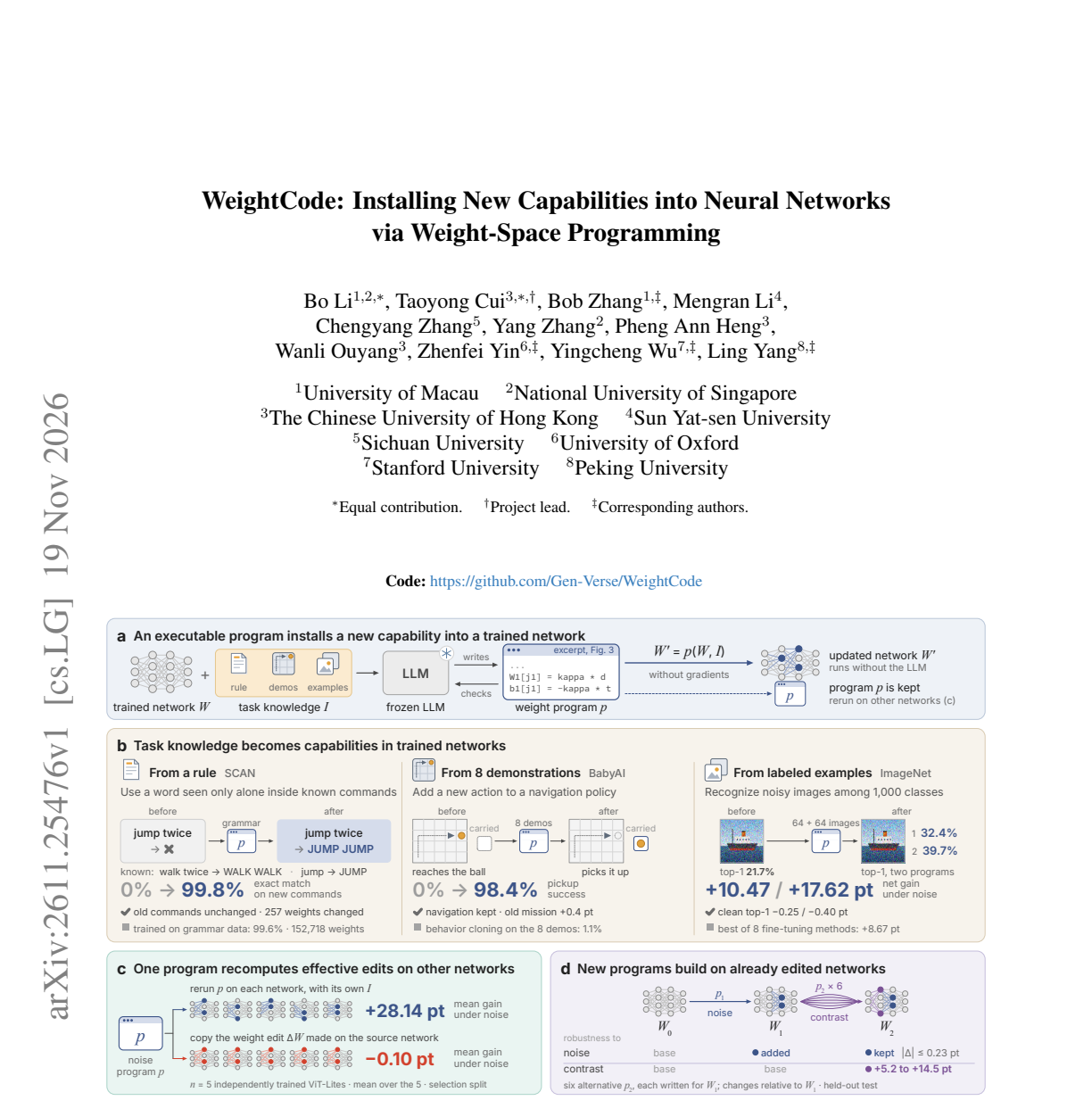
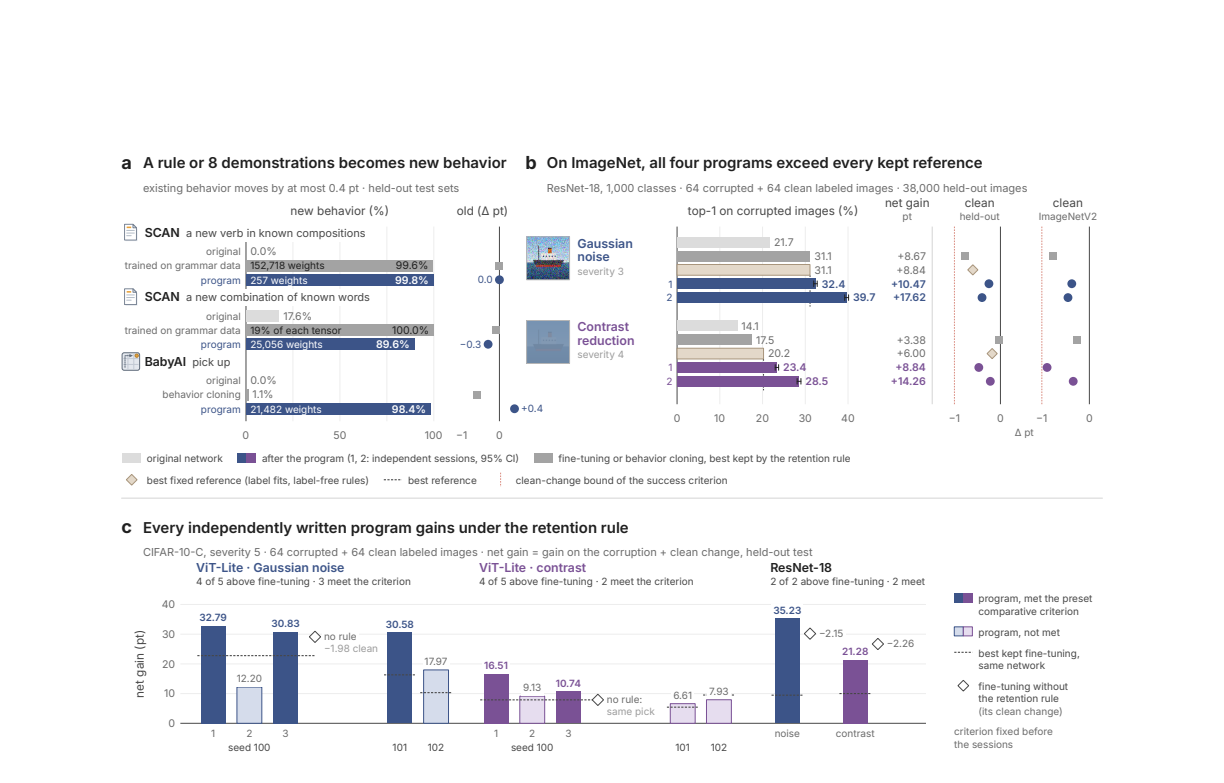
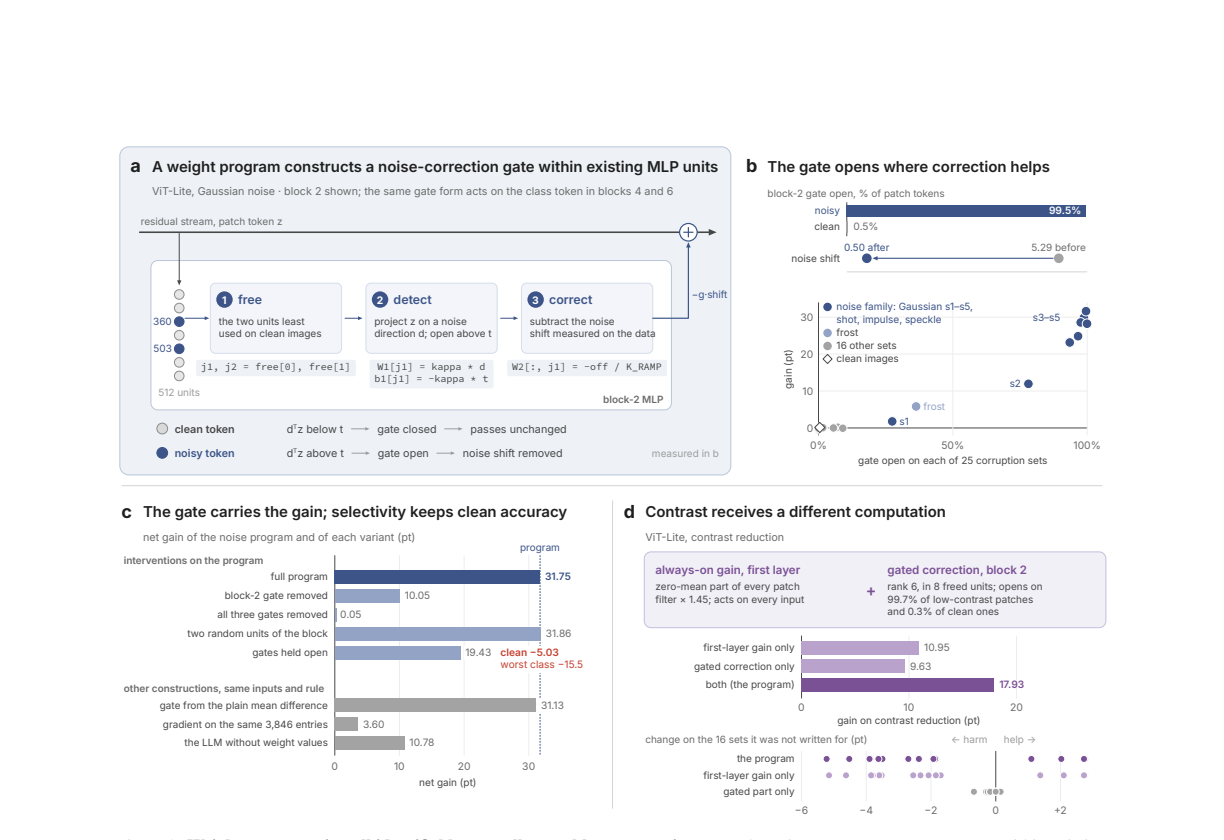
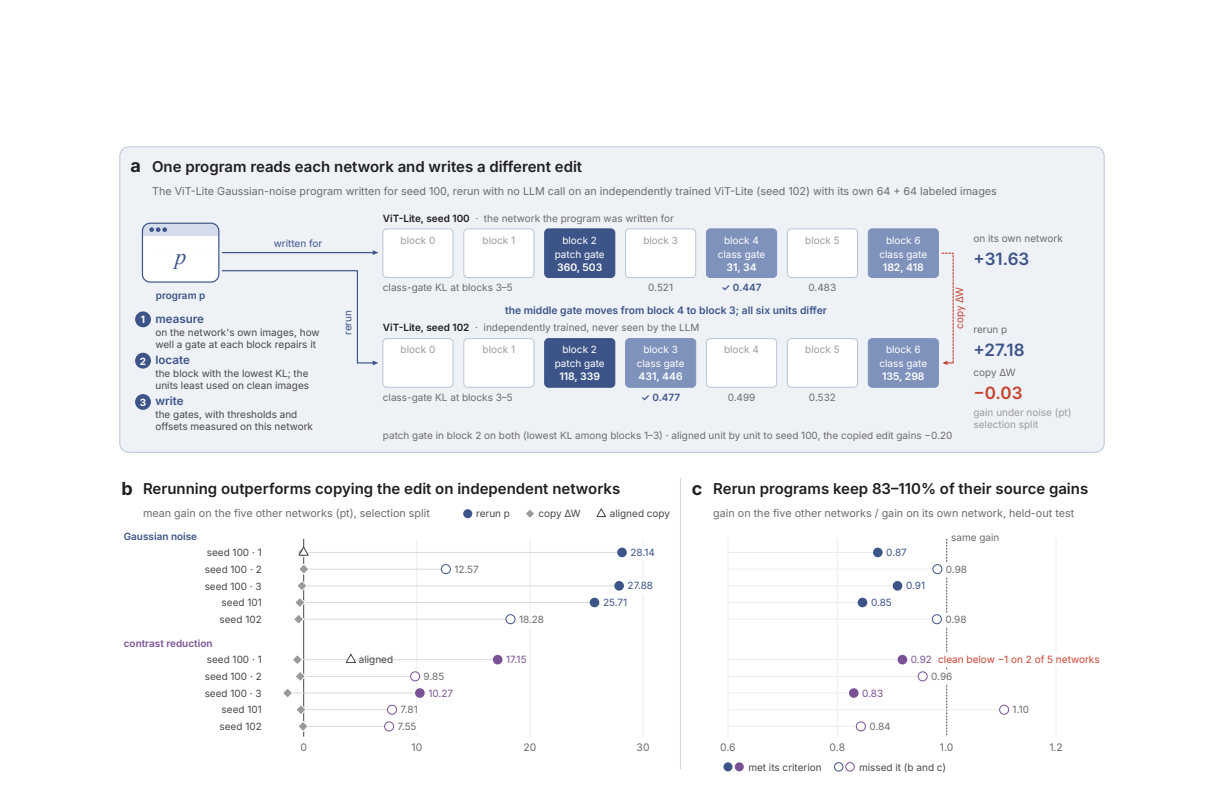
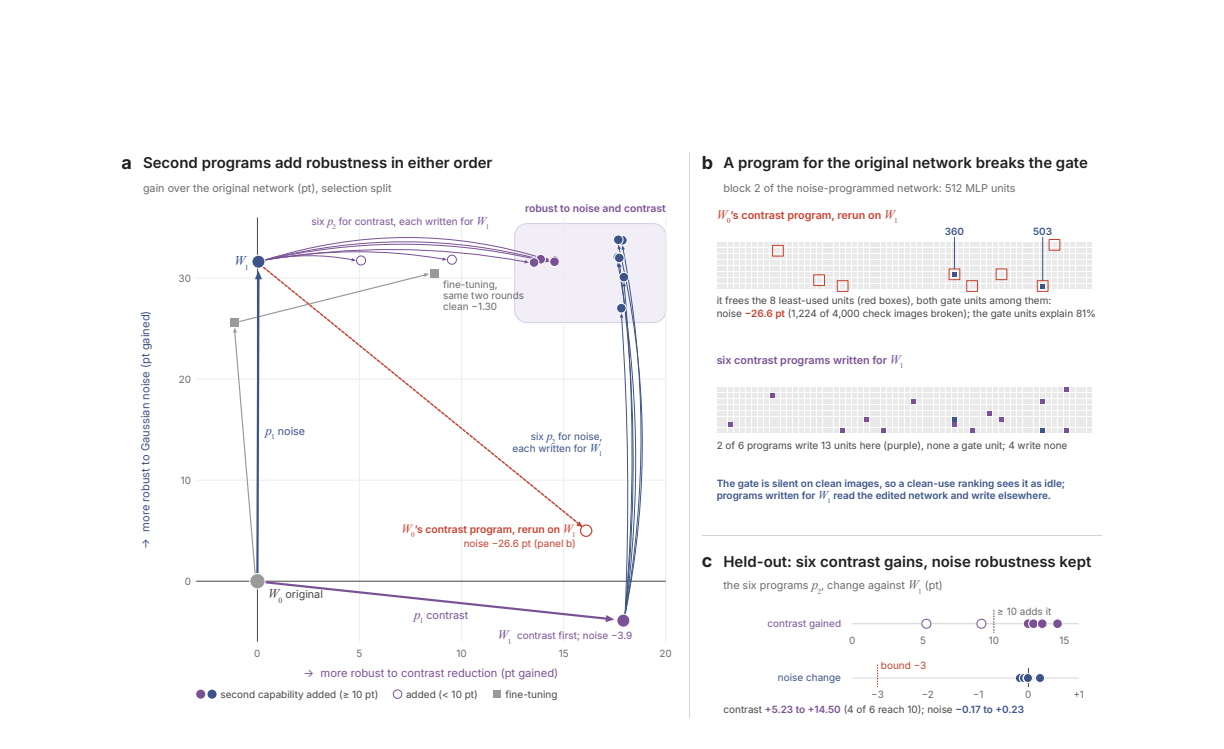
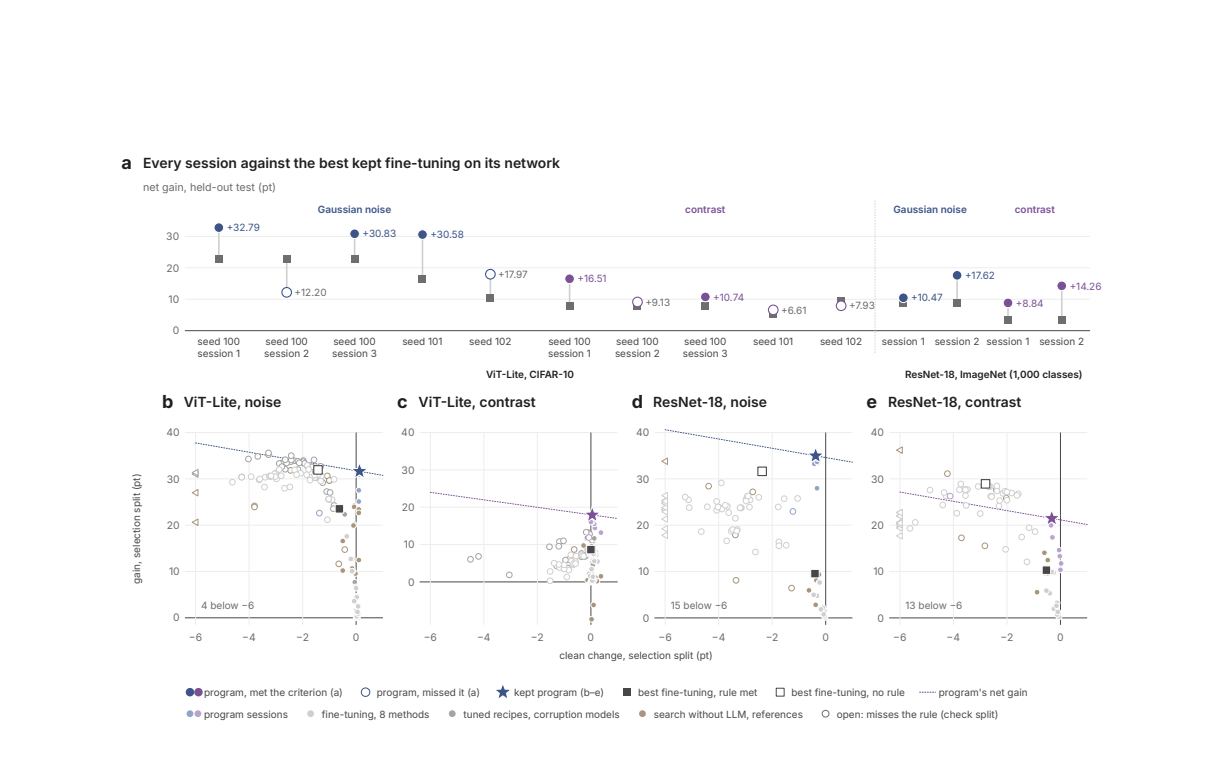
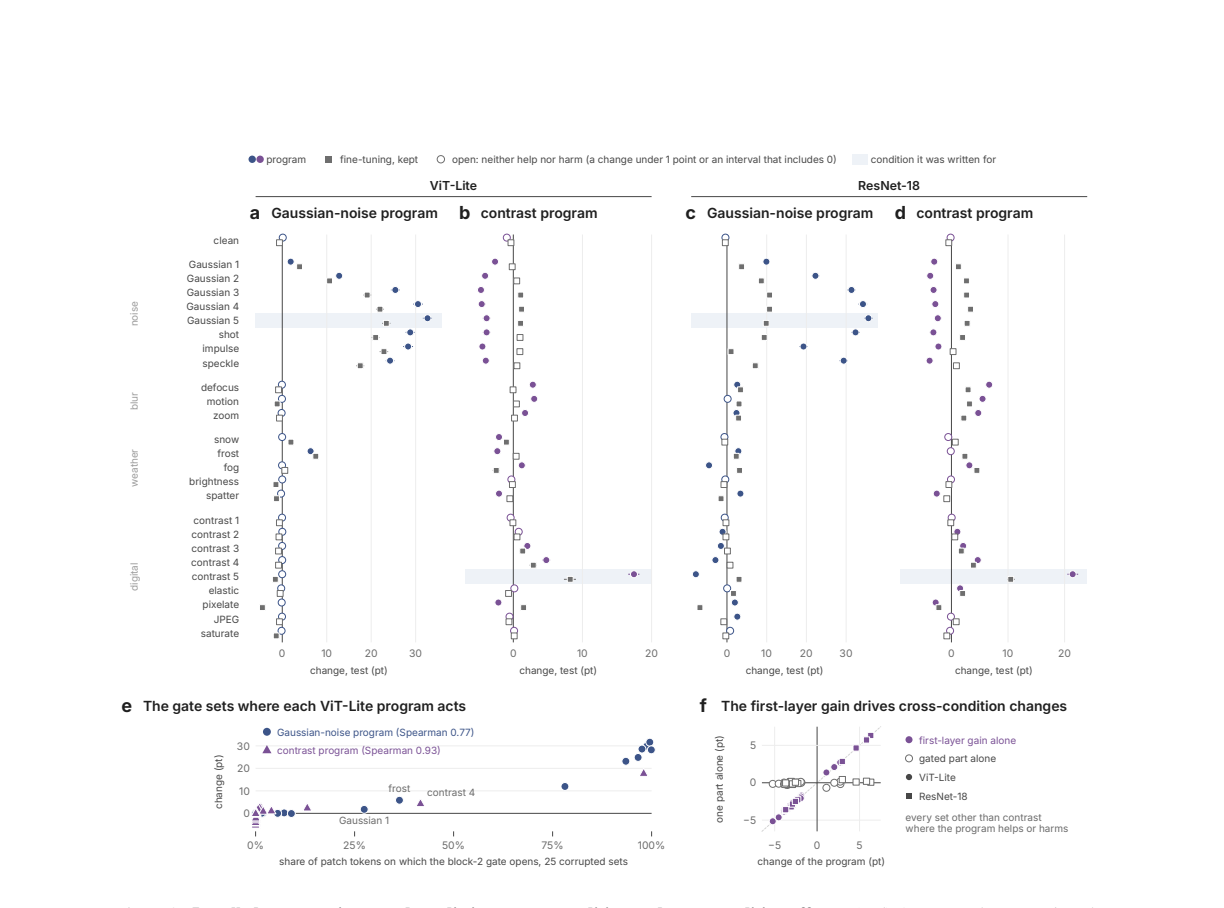
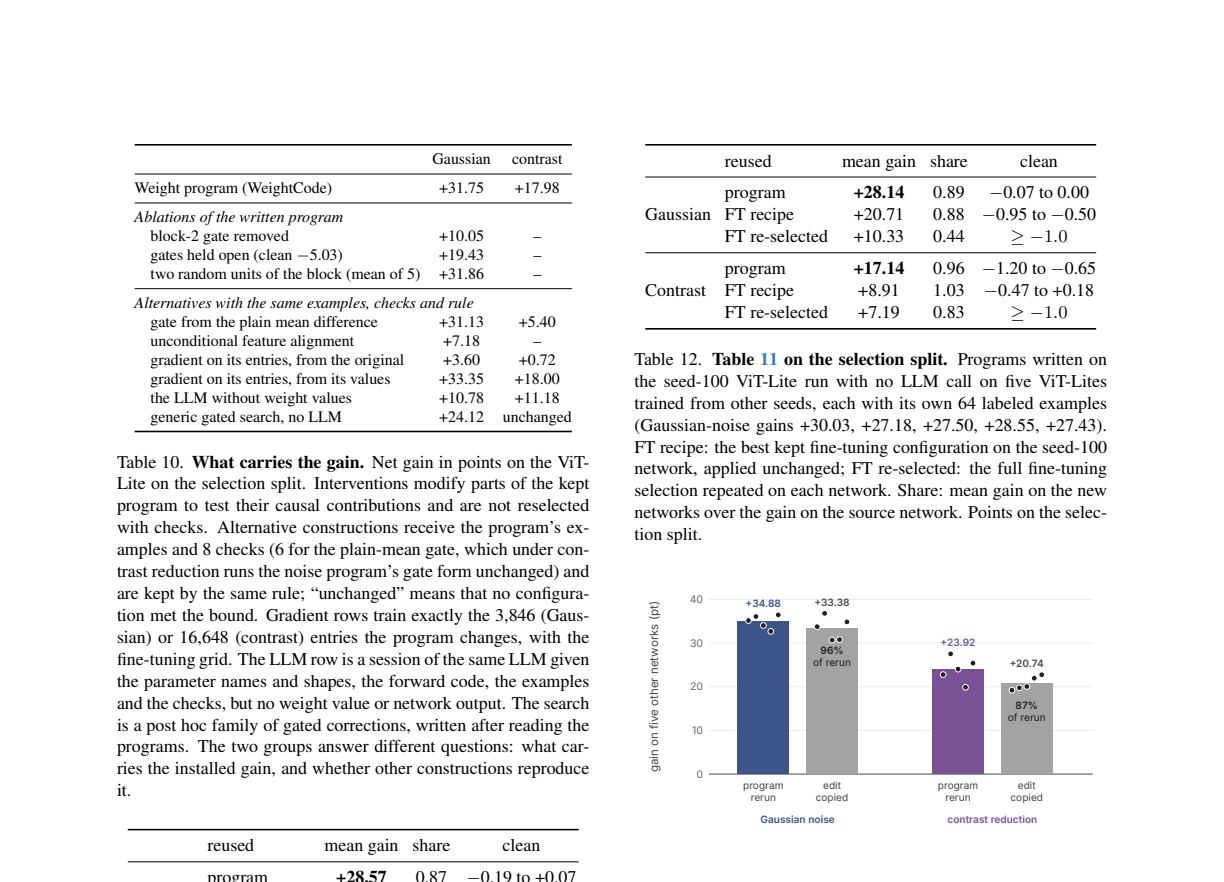
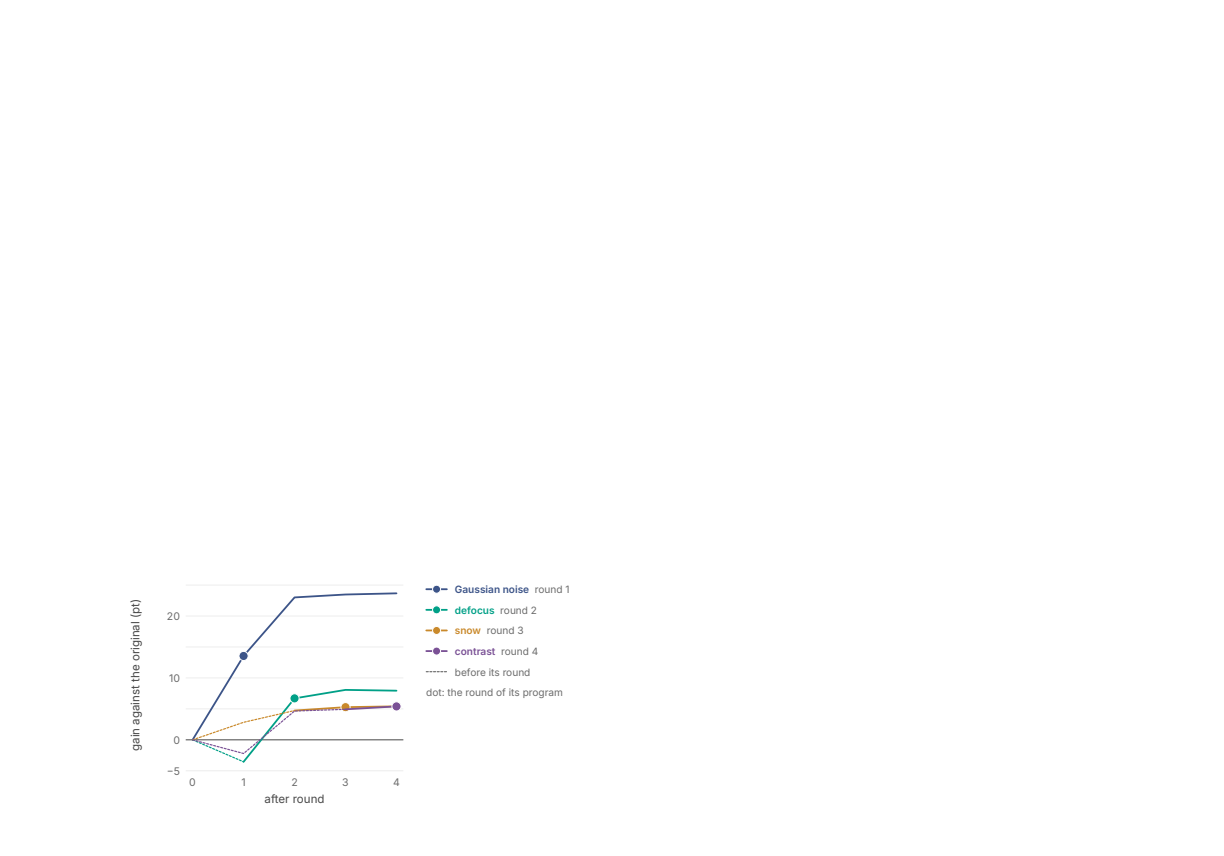
Here we show that Weight-Space Programming (WSP), in which executable programs read, construct or modify a network's weights directly, can install new capabilities within trained neural networks. WeightCode, a WSP framework, uses a frozen language model to write executable weight programs that install new computations into trained neural networks using task knowledge and their existing weights, without gradient-based training. Once installed, the new capabilities run independently of the language model. Given a grammar or eight demonstrations, weight programs enable previously unseen command compositions (0% to 99.8% exact match) and a new pickup action (0% to 98.4% success), while preserving the original command and navigation capabilities. On ImageNet, four weight programs achieve net gains of 8.84-17.62 points while preserving clean accuracy, outperforming the best of eight fine-tuning methods under matched examples, checks, and retention constraints. In a Vision Transformer, causal interventions show that installed noise-correction gates drive robustness gains, while their selective activation preserves clean accuracy. Rerun on five independently trained Vision Transformers without further language model calls, ten weight programs retain 83-110% of their source-network gains on average, whereas copying their fixed weight edits yields negligible gains. Six programs written for an already edited network add 5.23-14.50 points of contrast robustness while retaining the previously installed noise gain. Together, these results establish WSP as a new route to acquiring and accumulating capabilities in trained neural networks through reusable weight programs.
from the abstract
Pith says
Machine review · deepseek-v4-flash · 20 Nov 2026 · read the full text (129,944 characters) · not checked by a person
It can be wrong. Challenge this review or reply to it.
Holds up, with conditions. WeightCode shows that a frozen LLM can write executable programs that install new capabilities into trained neural networks by directly modifying their weights, and that those programs can be reused across independently trained networks and stacked in sequence. This line is wrong
20 minor · 2 open questions
How often objections from reviews like this one are right: not yet measured
The paper, first character to last
The reviewer was given the whole text, 129,944 characters. Not checked: figures, code, what the 49 references say.
20 minor objections
The paper says, at §1
Pith says: minor objection 1 of 20
The paper uses the term 'Weight-Space Programming' but does not provide a formal definition of what constitutes a weight program versus other forms of weight modification. The definition in §3.1 ('A weight program p is code that takes a trained network's weights W and task knowledge I... and returns new weights') is broad enough to include many forms of weight modification.
more of objection 1
The paper should clarify what distinguishes a weight program from, e.g., a hand-crafted weight update rule or a learned optimizer.
The paper says, at §3.1
Pith says: minor objection 2 of 20
The paper states that 'the LLM proposes candidate computations and weight modifications from the network's weights, its activations and the task knowledge, and evaluation feedback determines which candidate is kept.' This description is vague about how the LLM generates candidates. The paper should provide more detail about the prompting strategy, the format of the LLM's output, and how the LLM is guided to produce executable code.
show 18 more
The paper says, at §3.3
Pith says: minor objection 3 of 20
The paper states that 'the LLM receives the same condition images and the network's predictions but not their labels, and no statement of how they were chosen.' However, the images are selected based on labels (16 misclassified, 48 random). The paper should clarify whether the LLM is told that the images were selected in this way, or whether it only sees the images and predictions without any selection information.
The paper says, at §4.1, Table 1
Pith says: minor objection 4 of 20
The paper reports that the Gaussian-noise program for the ViT-Lite changes 3,846 weights (0.10% of the network) while the ImageNet noise program changes 2,152,928 weights (18% of the network). This large variation in edit size is not discussed. The paper should comment on why some programs require many more weight changes than others and whether this affects the interpretability or reusability of the programs.
The paper says, at §4.2
Pith says: minor objection 5 of 20
The paper describes the mechanism of the noise program in detail but does not provide a similar level of mechanistic analysis for the contrast program or the ImageNet programs. The contrast program analysis in Figure 3d is described but the paper does not provide intervention results for the ImageNet programs. The paper should either provide mechanistic analysis for all programs or explain why it is only provided for a subset.
The paper says, at §5.1
Pith says: minor objection 6 of 20
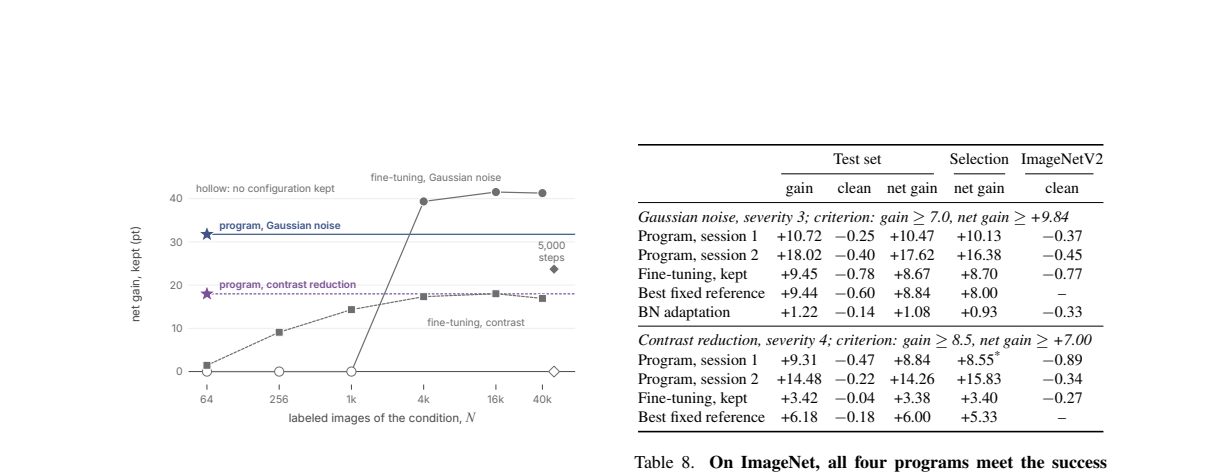
The paper reports that on the ViT-Lite under Gaussian noise, full fine-tuning first matches the program's net gain within the retention rule at 4,096 labeled corrupted images and as many clean ones, compared with 64 of each for the program.
more of objection 6
This is an important result that demonstrates the data efficiency of weight programs. However, this analysis is only presented in the supplementary material (§5.1) and not in the main text. The paper should consider moving this analysis to the main text or at least referencing it more prominently.
The paper says, at §5.2
Pith says: minor objection 7 of 20
The paper reports that on ImageNet, full fine-tuning on 31 times the labeled images (2,000 of each kind) keeps no configuration within the bound. This is mentioned in the supplementary material but not in the main comparison. The paper should clarify whether this comparison was conducted under the same protocol (8 checks, retention rule) and whether the fine-tuning methods were given additional tuning budget for the larger dataset.
The paper says, at §5.4
Pith says: minor objection 8 of 20
The paper reports that the new operation experiment on the synthetic sequence task achieves 100% exact match on inputs of length 4-8 but only 92.75% on inputs of length 9-12. The paper does not discuss why the program fails to generalize to longer sequences or whether this is a limitation of the approach. The paper should comment on this failure mode.
The paper says, at §5.5
Pith says: minor objection 9 of 20
The paper reports that the few-shot class-incremental learning experiment on CIFAR-100 did not meet the prespecified criterion. The paper states that 'the generated programs stay within a prototype-based update family and do not reach the criterion fixed before the session.'
more of objection 9
This is an honest reporting of failure, but the paper does not analyze why the approach failed in this setting. The paper should discuss the limitations of the approach for tasks that require learning new classes rather than modifying existing computations.
The paper says, at §5.6
Pith says: minor objection 10 of 20
The paper reports that the exploratory ResNet-20 stream used finite differences and that the round-1 program 'also reads the wall clock and stops its sweep over units after 220s.' This means the program's behavior depends on the runtime environment, which is a significant implementation concern. The paper should discuss whether this is a general issue with weight programs that depend on runtime measurements.
The paper says, at §3.1
Pith says: minor objection 11 of 20
The paper states that 'a session has 8 checks' but does not specify what constitutes a check. From the context, a check appears to be an evaluation of a candidate program on the check split. The paper should define 'check' more precisely.
The paper says, at §3.1
Pith says: minor objection 12 of 20
The paper states that 'the kept program is the checked candidate with the highest S_new + S_old among those with S_old >= -20.' The paper should clarify whether S_new and S_old are computed on the check split or on some other split, and whether the selection is done automatically or manually.
The paper says, at §3.3
Pith says: minor objection 13 of 20
The paper states that 'the held-out images form three disjoint splits per condition: the condition images of I are drawn from an evidence split (2,000 images), the checks use a check split (4,000) and analyses are read on a selection split (4,000).' The paper should clarify whether these splits are fixed across all experiments or vary per condition.
The paper says, at §4.1
Pith says: minor objection 14 of 20
The paper reports that 'the program raises exact match on them from 0.0% to 99.8% by changing 257 weights.' The paper should clarify whether the 0.0% baseline is on the test set or on some other split, and whether the 99.8% result is on the same split.
The paper says, at §4.2
Pith says: minor objection 15 of 20
The paper describes the gate function as g(z) = GELU(k(d^T z - t)) - GELU(k(d^T z - t) - K). The paper should define the parameters k, t, and K and explain how they are set by the program.
The paper says, at §4.4
Pith says: minor objection 16 of 20
The paper reports that 'copied edits transfer where networks share coordinates: when ResNet-18s share a pretrained initialization, they keep 96% and 87% of the rerun gain.' This is an important observation that should be discussed in the main text, not just in the supplementary material.
The paper says, at §5.1
Pith says: minor objection 17 of 20
The paper reports that 'the best fine-tuning recipe reaches +20.79 and +8.09' when reused on other networks. The paper should clarify whether this is the same fine-tuning recipe applied unchanged or whether it was re-tuned on each target network.
The paper says, at §5.2
Pith says: minor objection 18 of 20
The paper reports that 'the programs also keep clean accuracy within 0.89 points of the original network on ImageNetV2.' The paper should clarify whether this is the change in accuracy on ImageNetV2 or the absolute accuracy.
The paper says, at §5.3
Pith says: minor objection 19 of 20
The paper reports that 'the block-2 gate opens on 99.5% of noisy and 0.5% of clean patch tokens.' The paper should clarify whether these percentages are computed on the test set or on some other split.
The paper says, at §5.4
Pith says: minor objection 20 of 20
The paper reports that 'the program writes the rule directly into 25,056 weights, as rank-one edits of attention values along the network's own right-minus-left turn direction.' The paper should clarify what 'rank-one edits of attention values' means and how they are computed.
Open questions (2)
Pith raised these and could not confirm them against the text of the paper it read. They are questions for the authors, not findings.
- §3.3, §4.1, Table 1 Pith raised a concern here that it could not check against the text of the paper it was given, so it is not published as an objection.
- §4.1, Table 1, §5.1 Pith raised a concern here that it could not check against the text of the paper it was given, so it is not published as an objection.
What would settle it
Independently reproduce the SCAN add-primitive result: given the same grammar, 64 old commands, and the jump row, run a session with a different frontier LLM (e.g., GPT-5 or Gemini 3) and verify that the resulting weight program achieves >95% exact match on unseen compositions while changing fewer than 500 weights. This tests whether the result depends on the specific LLM or generalizes across models.
from the skeptic's reading
How the review went
5 passes by deepseek-v4-flash · 20 Nov 2026
- Reader holds up, with conditions
- Skeptic partly agrees
- Referee 20 minor
- Check against the paper kept 0 of 6 objections
- Editor wrote the verdict above
Not run on this paper: the simulated authors' defence.
Pith's passes raised 6 objections. A check against the paper's text kept 0, withdrew 4 (4 Pith's reviewer misread the paper) and left 2 as questions.
The review in full
The review in brief, machine-written
This paper introduces Weight-Space Programming (WSP) via WeightCode, where a frozen LLM writes executable programs that read, construct, or modify a neural network's weights to install new capabilities without gradient-based training. The central finding is that these weight programs can turn rules, demonstrations, or labeled examples into new computations—raising SCAN command composition from 0% to 99.8% exact match with 257 weight changes, enabling a new pickup action in BabyAI with 98.4% success from 8 demonstrations, and achieving net gains of 8.84–17.62 points on ImageNet corruptions while preserving clean accuracy, outperforming matched fine-tuning methods under the same retention constraints.
The paper does several things well. The experimental design is thorough: matched comparisons with fine-tuning, held-out test sets, prespecified criteria, and reporting of all sessions including failures. The mechanistic analyses are a strength—causal interventions show that installed noise-correction gates drive robustness gains while selective activation preserves clean accuracy. The reuse experiments are convincing: rerunning the same program on independently trained networks retains 83–110% of source-network gains, whereas copying fixed weight edits yields negligible gains. Successive stacking also works, with second-round programs adding contrast robustness while preserving previously installed noise gains.
The soft spots are real but not fatal. The method relies on a proprietary, closed LLM (Claude Opus 5.5) whose capabilities are not controlled or characterized—this is an acknowledged limitation. The scale of experiments (networks up to 11.7M weights) is modest relative to the paradigm claim. Three exploratory sessions that violated the protocol's exclusion of finite-difference methods were detected only by post-hoc code inspection, which raises questions about protocol enforcement. The weight programs and LLM interaction logs are not released, limiting reproducibility. These concerns do not invalidate the central claims but suggest that further validation, protocol hardening, and scaling demonstrations are needed.
This paper is for researchers interested in model editing, continual learning, and weight-space methods. It deserves a serious referee. The core idea is novel, the experiments are carefully designed, and the results are impressive across multiple domains. The main recommendation is to engage with the work critically—the claims are substantial and the evidence is strong, but the reliance on a black-box LLM and the modest scale warrant scrutiny. I would send this to peer review.
The strongest objection
The paper presents a well-executed empirical demonstration of Weight-Space Programming (WSP) via WeightCode. The central claim is that a frozen LLM can write executable weight programs that install new capabilities into trained neural networks, that these programs are reusable across independently trained networks, and that they can be stacked. The evidence is substantial: multiple tasks (SCAN, BabyAI, ImageNet, CIFAR-10), multiple architectures (ViT-Lite, ResNet-18, ResNet-20, Transformer, BabyAI policy), controlled comparisons with fine-tuning under matched data and retention constraints, causal intervention analyses, reuse experiments across independently trained networks, and successive stacking experiments. The paper acknowledges its limitations: reliance on a proprietary LLM (Claude Opus 5.5), the discovery of three exploratory sessions that violated protocol (finite-difference methods), limited scale (networks up to 11.7M weights), and the lack of released weight programs or LLM interaction logs. The reader's weakest_assumption—that the LLM can reliably write correct and effective weight programs—is addressed empirically: the paper reports all sessions (including failures), shows that 8 of 10 ViT-Lite programs exceed the best kept fine-tuning, and provides mechanistic evidence of what the programs write. The protocol's 8-check limit is a design choice, not a flaw; it matches the fine-tuning comparison. The concern about proprietary LLM is acknowledged by the authors and is a limitation of the current study, not an internal inconsistency. The paper does not claim formal guarantees; it claims empirical demonstration, which it provides. No load-bearing concern undermines the central claim as stated.
The reader's verdict is CONDITIONAL with HIGH confidence, citing concerns about proprietary LLM, protocol violations, limited scale, and reproducibility. I find that these concerns are either acknowledged by the authors (proprietary LLM, protocol violations in exploratory sessions) or are limitations that do not undermine the central empirical claim (scale, reproducibility). The paper provides extensive evidence across multiple domains, architectures, and controlled comparisons. The protocol violations were detected by the authors themselves and reported transparently; they affect three exploratory sessions that are excluded from the main claims. The reliance on a proprietary LLM is a practical limitation but not a logical flaw—the paper demonstrates what is possible with current frontier models, and the method does not depend on any specific LLM architecture. The scale concern (networks up to 11.7M weights) is valid but the paper does not claim scalability to billion-parameter models; it claims a proof of concept. The reproducibility concern is mitigated by the detailed protocol description and the release of code. I agree with the reader that the paper is strong but not definitive; however, I do not see a load-bearing concern that would justify a CONDITIONAL verdict over ACCEPT. The paper's claims are appropriately scoped, the evidence is substantial, and the limitations are transparently discussed. I recommend UNCHANGED because the reader's CONDITIONAL verdict is already reasonable and my analysis does not identify a new concern that would change it.
The referee's report
Not published. Pith's referee wrote this assessment before its objections were checked against the paper, and 6 of its 6 major objections did not survive that check.
Pith's reading of the paper (a machine's summary, not the authors')
The paper introduces WeightCode, a framework for Weight-Space Programming (WSP) in which a frozen large language model writes executable programs that directly read, construct, or modify a neural network's weights to install new capabilities. The central claim is that these weight programs can translate task knowledge—rules, demonstrations, or labeled examples—into new computations within trained networks without gradient-based training, while preserving existing capabilities. The authors argue that the programs themselves become reusable artifacts: the same program can be rerun on independently trained networks to construct effective edits, and successive programs can extend already edited networks while retaining earlier gains. If true, this would establish a new paradigm for extending neural networks after deployment, where capabilities are programmed, inspected, and accumulated through executable procedures rather than through continued training.
What carries the argument. The central object is the executable weight program $p$, which takes a network's weights $W$ and task knowledge $I$ and returns updated weights $W' = p(W, I)$. The program is written by a frozen LLM (Claude Opus 5.5) in a single session with at most 8 candidate evaluations, using network inspection (weight and activation statistics, SVD, PCA, forward passes) and closed-form computations rather than gradient-based optimization. The program retains the procedure for constructing the update, not just the numerical weight changes. This procedural retention is what enables reuse: rerunning the same program on another network recomputes a network-specific edit, whereas copying the fixed weight edit does not transfer.
Core claim. The paper claims that Weight-Space Programming (WSP), realized through the WeightCode framework, enables a frozen LLM to write executable weight programs that install new capabilities into trained neural networks. A weight program $p$ takes a network's weights $W$ and task knowledge $I$ and returns updated weights $W' = p(W, I)$. The program is constructed in a single LLM session with at most 8 candidate evaluations, using network inspection, forward passes, and closed-form computations rather than gradient-based optimization. The updated network runs independently of the LLM at inference. The paper reports that across language (SCAN), navigation (BabyAI), and vision (CIFAR-10, ImageNet) tasks, these programs achieve substantial gains on new conditions while preserving existing behavior, often exceeding fine-tuning baselines under matched data and retention constraints. The programs produce identifiable, causally testable internal computations (e.g., gated corrections in little-used MLP units). Crucially, the paper claims that the same program, when rerun on independently trained networks without further LLM calls, retains 83–110% of its source-network gains on average, whereas copying the fixed weight edit yields negligible gains. Successive programs written for already edited networks can add new capabilities while preserving earlier ones.
The premise it rests on. The central claim depends on the assumption that a frontier LLM (Claude Opus 5.5) can reliably write correct and effective weight programs for diverse networks and tasks, given only task knowledge and network inspection, and the paper does not provide a formal guarantee or systematic analysis of when the LLM will succeed or fail.
If the paper is right (Pith's inferences, not the authors')
If WSP works as claimed, neural network capabilities could be extended after deployment by writing weight programs that translate explicit task knowledge into new computations, without requiring gradient-based training or access to the original training data.
Weight programs could serve as reusable, inspectable specifications of capabilities: the same program can be rerun on independently trained networks to construct effective edits, enabling capability transfer across models without additional LLM calls.
Successive weight programs could accumulate capabilities in a single network, with each new program written to account for and preserve earlier installed computations, potentially enabling long sequences of capability updates.
The mechanistic interpretability of weight programs—each program produces identifiable, causally testable internal computations—could make it possible to verify and understand what capability was installed and why existing behavior is preserved.
The paper's results suggest that many capabilities a network lacks may be installable by reusing and reorganizing computations the network already performs, rather than learning them from data. This could imply that the bottleneck for capability acquisition is not just data and compute, but also the ability to identify and repurpose existing representational capacity.
If weight programs can be written for frontier LLMs themselves, WSP could enable post-deployment capability updates without retraining or fine-tuning, with the program serving as an auditable record of what changed and why.
The paper's protocol restricts the LLM to at most 8 candidate evaluations per session, which is a severe constraint. If this constraint were relaxed, the success rate and complexity of installable capabilities might increase substantially, but the paper does not explore this trade-off.
The paper's reliance on a frontier LLM (Claude Opus 5.5) to write effective weight programs raises the question of whether weaker LLMs could also perform WSP, or whether the capability to write weight programs is itself a frontier capability that may not generalize to smaller models.
Check this review
What was read
The passes were given all 129,944 characters of the paper's LaTeX source.
Fingerprint of that text (SHA-256): 518b097233b7c997d520b08acf1f9bfe9e94fc81bbc2e4a3359879fa2e66d5ac
Pith does not keep that text. Rebuilt from the paper's source or PDF by the same code, it has this fingerprint if it is the same text. From a copy of Pith's code:
PYTHONPATH=. python scripts/review_input_check.py 2611.25476
The passes, in the order they ran
- Reader deepseek-v4-flash · medium effort · $0.0042 · instructions of the Reader, fingerprint f9ead7300382…
- Skeptic deepseek-v4-flash · medium effort · $0.0036 · instructions of the Skeptic, fingerprint 8f88c0f61488…
- Referee deepseek-v4-flash · medium effort · $0.0043 · instructions of the Referee, fingerprint a852d99aea0d…
- Check against the paper deepseek-v4-flash · medium effort · $0.0041 · instructions of the Check against the paper, fingerprint 6c7a6883d551…
- Editor deepseek-v4-flash · medium effort · $0.0036 · instructions of the Editor, fingerprint e7211f6a3d27…
- Circularity check deepseek-v4-flash · medium effort · $0.0044 · instructions of the Circularity check, fingerprint e9946e39d67b…
- Summary for the page deepseek-v4-flash · medium effort · temperature 0.2 · $0.0040 · instructions of the Summary for the page, fingerprint e4f56bf568e7…
The passes cost $0.028 in model calls together.
Version stamped on this review: pith-pipeline@v1.4.1-daily-deepseek-or-medium+deepseek/deepseek-v4-flash+p.d60f54226f00
Each link opens a pass's instructions as plain text, the exact bytes its fingerprint was taken over. Every stored set of instructions.
curl -s https://pith.science/methodology/prompts/f9ead730038216984cfb56d7cb34332bdf691828296a1de4245f3d6667d4bf56 | sha256sum
prints the fingerprint of the reader's instructions. The same works for every pass.
The receipt
The review's fingerprint was taken on 20 Nov 2026. The review you are reading still matches it.
Fingerprint of the review (SHA-256): 566757738fe511f947423453f84d3065944a0fa10e39bfb582af5a6b4b903f86
curl -s 'https://pith.science/api/v1/verdicts/2611.25476?form=canonical' | sha256sum
prints the fingerprint of the review as it stands now. The rule, in four steps.
A matching fingerprint shows the review has not changed since that date. It does not show that the review is right.
How often reviews like this one are right
Reviews like this one: written by deepseek-v4-flash, from the paper's LaTeX source.
How often objections from reviews like this one are right: not yet measured
Reviews by people
This review was written by a machine. No person has reviewed this paper on Pith yet. A scientist listed on Pith can review it for a fee, and their review is published here whatever it concludes.
The paper
Abstract
Neural networks encode learned capabilities in their weights, yet extending those capabilities with explicit task knowledge remains a fundamental challenge. Here we show that Weight-Space Programming (WSP), in which executable programs read, construct or modify a network's weights directly, can install new capabilities within trained neural networks. WeightCode, a WSP framework, uses a frozen language model to write executable weight programs that install new computations into trained neural networks using task knowledge and their existing weights, without gradient-based training. Once installed, the new capabilities run independently of the language model. Given a grammar or eight demonstrations, weight programs enable previously unseen command compositions (0% to 99.8% exact match) and a new pickup action (0% to 98.4% success), while preserving the original command and navigation capabilities. On ImageNet, four weight programs achieve net gains of 8.84-17.62 points while preserving clean accuracy, outperforming the best of eight fine-tuning methods under matched examples, checks, and retention constraints. In a Vision Transformer, causal interventions show that installed noise-correction gates drive robustness gains, while their selective activation preserves clean accuracy. Rerun on five independently trained Vision Transformers without further language model calls, ten weight programs retain 83-110% of their source-network gains on average, whereas copying their fixed weight edits yields negligible gains. Six programs written for an already edited network add 5.23-14.50 points of contrast robustness while retaining the previously installed noise gain. Together, these results establish WSP as a new route to acquiring and accumulating capabilities in trained neural networks through reusable weight programs.
The paper's own sentences, arranged, kept beside the review and separate from it. Each label is drawn from a closed vocabulary; the number beside it is the probability the classifier gave that label. No sentence in this record was written by a model.
abstract compiled · 2026-11-20
The authors' main claim, as the classifier picked it out 0.98
“Together, these results establish WSP as a new route to acquiring and accumulating capabilities in trained neural networks through reusable weight programs.”
How the main claim is stated: asserted 1.00
What the abstract itself states, as probabilities: claims first 0.10 · states limitation 0.17 · human participants 0.04 · controlled comparison 0.89 · randomized assignment 0.02 · states quantitative result 0.99 · compares with prior results 0.96 · mentions code or data availability 0.05
The abstract, sentence by sentence
This table labels the abstract only (arXiv listing abstract v1). The number is the probability the classifier gave the label.
| Sentence | Role | The authors' own work | States the main conclusion | Strength |
|---|---|---|---|---|
| Neural networks encode learned capabilities in their weights, yet extending those capabilities with explicit task knowledge remains a fundamental challenge. | background 0.63 | 0.06 | 0.03 | asserted 1.00 |
| Here we show that Weight-Space Programming (WSP), in which executable programs read, construct or modify a network's weights directly, can install new capabilities within trained neural networks. | contribution 0.99 | 0.91 | 0.48 | asserted 1.00 |
| WeightCode, a WSP framework, uses a frozen language model to write executable weight programs that install new computations into trained neural networks using task knowledge and their existing weights, without gradient-based training. | method 0.79 | 0.83 | 0.15 | asserted 1.00 |
| Once installed, the new capabilities run independently of the language model. | method 0.68 | 0.64 | 0.06 | asserted 1.00 |
| Given a grammar or eight demonstrations, weight programs enable previously unseen command compositions (0% to 99.8% exact match) and a new pickup action (0% to 98.4% success), while preserving the original command and navigation capabilities. | result 1.00 | 0.94 | 0.08 | asserted 1.00 |
| On ImageNet, four weight programs achieve net gains of 8.84-17.62 points while preserving clean accuracy, outperforming the best of eight fine-tuning methods under matched examples, checks, and retention constraints. | result 1.00 | 0.95 | 0.09 | asserted 1.00 |
| In a Vision Transformer, causal interventions show that installed noise-correction gates drive robustness gains, while their selective activation preserves clean accuracy. | result 0.80 | 0.94 | 0.04 | asserted 1.00 |
| Rerun on five independently trained Vision Transformers without further language model calls, ten weight programs retain 83-110% of their source-network gains on average, whereas copying their fixed weight edits yields negligible gains. | result 1.00 | 0.95 | 0.06 | asserted 1.00 |
| Six programs written for an already edited network add 5.23-14.50 points of contrast robustness while retaining the previously installed noise gain. | result 1.00 | 0.94 | 0.05 | asserted 1.00 |
| Together, these results establish WSP as a new route to acquiring and accumulating capabilities in trained neural networks through reusable weight programs. | interpretation 0.99 | 0.78 | 0.94 | asserted 1.00 |
What kind of paper the classifier reports this is: method or tool 1.00 · evidence from observation or experiment 0.92
What was examined, and what was not
Sources read
- arXiv listing abstract v1
Not examined
- full text
- figures and tables
- references and citing sentences
- relations to other papers
Levels run
- P abstract
Not run
- S sections
- T body sentences
- C citations
- R cross-paper relations
How the labels were made
Compiled by classifier-1.13.0 via TypeSafe API, question bank abstract-p1-20260923, 2026-11-20: 1 request, 7,721 input tokens.
Every quoted sentence on this record is the authors'. Every label is from Pith's closed vocabulary, with the probability shown beside it. This record as JSON
Figures (11)
Figures are the authors', reproduced from the paper.
References (49)
- [1] Rikiya Takehi, Jayden Teoh, Alex Zhang, and Omar Khat- tab. Sparks of Weight-Space Programming: LLMs can na- tively read & write neural network weights. Blog post, https : / / rikiyat . github . io / blog / weight - space- programming/, 2026. Published November 2, on Pith
- [2] Mengran Li, Bo Li, Weijing Zhao, Chengyang Zhang, Boyu Zhang, Jinfeng Xu, Zelin Zang, Victor C. M. Leung, and Stan Z. Li. WeightLoop: Weight-Space Programming with Experimental Feedback.arXiv preprint arXiv:2611.07319, on PithPith's reviewarXiv
- [3] Edward J. Hu, Yelong Shen, Phillip Wallis, Zeyuan Allen- Zhu, Yuanzhi Li, Shean Wang, Lu Wang, and Weizhu Chen. LoRA: Low-Rank Adaptation of Large Language Models. InInternational Conference on Learning Representations (ICLR), 2022. 2, 3, 5 on Pith
- [4] Zhizhong Li and Derek Hoiem. Learning without forgetting. IEEE Transactions on Pattern Analysis and Machine Intelli- gence, 40(12):2935–2947, 2018. 2, 3, 5 on Pith
- [5] Kevin Meng, David Bau, Alex Andonian, and Yonatan Belinkov. Locating and Editing Factual Associations in GPT. InAdvances in Neural Information Processing Sys- tems (NeurIPS), 2022. 2, 3 on Pith
- [6] Kevin Meng, Arnab Sen Sharma, Alex Andonian, Yonatan Belinkov, and David Bau. Mass-Editing Memory in a Trans- former. InInternational Conference on Learning Represen- tations (ICLR), 2023. 2, 3 on Pith
- [7] Steffen Schneider, Evgenia Rusak, Luisa Eck, Oliver Bring- mann, Wieland Brendel, and Matthias Bethge. Improving robustness against common corruptions by covariate shift adaptation. InAdvances in Neural Information Processing Systems (NeurIPS), 2020. 2, 3, 5 on Pith
- [8] Dequan Wang, Evan Shelhamer, Shaoteng Liu, Bruno Ol- shausen, and Trevor Darrell. Tent: Fully Test-time Adapta- tion by Entropy Minimization. InInternational Conference on Learning Representations (ICLR), 2021. 2, 3, 5, 20 on Pith
- [9] Bernardino Romera-Paredes, Mohammadamin Barekatain, Alexander Novikov, Matej Balog, M. Pawan Kumar, Emi- lien Dupont, Francisco J. R. Ruiz, Jordan S. Ellenberg, Peng- ming Wang, Omar Fawzi, Pushmeet Kohli, and Alhussein Fawzi. Mathematical discoveries from program search with ... on Pith
- [10] Alexander Novikov, Ng ˆan V˜u, Marvin Eisenberger, Emilien Dupont, Po-Sen Huang, Adam Zsolt Wagner, Sergey Shi- robokov, Borislav Kozlovskii, Francisco J. R. Ruiz, Abbas Mehrabian, M. Pawan Kumar, Abigail See, Swarat Chaud- huri, George Holland, Alex Davies, Sebastian Nowozin,... on PithPith's reviewarXiv
- [11] Neil Houlsby, Andrei Giurgiu, Stanislaw Jastrzebski, Bruna Morrone, Quentin de Laroussilhe, Andrea Gesmundo, Mona Attariyan, and Sylvain Gelly. Parameter-Efficient Transfer Learning for NLP. InInternational Conference on Machine Learning (ICML), 2019. 3 on Pith
- [12] Xuhong Li, Yves Grandvalet, and Franck Davoine. Ex- plicit Inductive Bias for Transfer Learning with Convolu- tional Networks. InInternational Conference on Machine Learning (ICML), 2018. 3, 5 on Pith
- [13] Michael McCloskey and Neal J. Cohen.Catastrophic Inter- ference in Connectionist Networks: The Sequential Learning Problem, pages 109–165. Elsevier, 1989. 3 on Pith
- [14] R French. Catastrophic forgetting in connectionist networks. Trends in Cognitive Sciences, 3(4):128–135, 1999. 3 on Pith
- [15] James Kirkpatrick, Razvan Pascanu, Neil Rabinowitz, Joel Veness, Guillaume Desjardins, Andrei A. Rusu, Kieran Milan, John Quan, Tiago Ramalho, Agnieszka Grabska- Barwinska, Demis Hassabis, Claudia Clopath, Dharshan Ku- maran, and Raia Hadsell. Overcoming catastrophic for- gett... on Pith
- [16] Arslan Chaudhry, Marcus Rohrbach, Mohamed Elho- seiny, Thalaiyasingam Ajanthan, Puneet K. Dokania, Philip H. S. Torr, and Marc’Aurelio Ranzato. On Tiny Episodic Memories in Continual Learning.arXiv preprint arXiv:1902.10486, 2019. 3 on PithPith's reviewarXiv
- [17] Shuaicheng Niu, Jiaxiang Wu, Yifan Zhang, Zhiquan Wen, Yaofo Chen, Peilin Zhao, and Mingkui Tan. Towards Sta- ble Test-Time Adaptation in Dynamic Wild World. InIn- ternational Conference on Learning Representations (ICLR), on Pith
- [18] Yu Sun, Xiaolong Wang, Zhuang Liu, John Miller, Alexei A. Efros, and Moritz Hardt. Test-Time Training with Self- Supervision for Generalization under Distribution Shifts. InInternational Conference on Machine Learning (ICML), on Pith
- [19] Anton Sinitsin, Vsevolod Plokhotnyuk, Dmitriy Pyrkin, Sergei Popov, and Artem Babenko. Editable Neural Net- works. InInternational Conference on Learning Represen- tations (ICLR), 2020. 3 on Pith
- [20] Eric Mitchell, Charles Lin, Antoine Bosselut, Chelsea Finn, and Christopher D. Manning. Fast Model Editing at Scale. InInternational Conference on Learning Representations (ICLR), 2022. 3 on Pith
show 29 more
- [21] David Bau, Steven Liu, Tongzhou Wang, Jun-Yan Zhu, and Antonio Torralba.Rewriting a Deep Generative Model, pages 351–369. Springer International Publishing, 2020. 3 on Pith
- [22] Shibani Santurkar, Dimitris Tsipras, Mahalaxmi Elango, David Bau, Antonio Torralba, and Aleksander Madry. Edit- ing a classifier by rewriting its prediction rules. InAdvances in Neural Information Processing Systems (NeurIPS), 2021. 3 on Pith
- [23] Thomas Hartvigsen, Swami Sankaranarayanan, Hamid Palangi, Yoon Kim, and Marzyeh Ghassemi. Aging with GRACE: Lifelong Model Editing with Discrete Key-Value Adaptors. InAdvances in Neural Information Processing Systems (NeurIPS), 2023. 3 on Pith
- [24] Gabriel Ilharco, Marco Tulio Ribeiro, Mitchell Wortsman, Suchin Gururangan, Ludwig Schmidt, Hannaneh Hajishirzi, and Ali Farhadi. Editing Models with Task Arithmetic. InIn- ternational Conference on Learning Representations (ICLR), on Pith
- [25] Prateek Yadav, Derek Tam, Leshem Choshen, Colin Raffel, and Mohit Bansal. TIES-Merging: Resolving Interference When Merging Models. InAdvances in Neural Information Processing Systems (NeurIPS), 2023. 3 on Pith
- [26] Samuel K. Ainsworth, Jonathan Hayase, and Siddhartha Srinivasa. Git Re-Basin: Merging Models modulo Permu- tation Symmetries. InInternational Conference on Learning Representations (ICLR), 2023. 3, 4 on Pith
- [27] Yecheng Jason Ma, William Liang, Guanzhi Wang, De-An Huang, Osbert Bastani, Dinesh Jayaraman, Yuke Zhu, Linxi Fan, and Anima Anandkumar. Eureka: Human-Level Re- ward Design via Coding Large Language Models. InIn- ternational Conference on Learning Representations (ICLR), on Pith
- [28] Jacky Liang, Wenlong Huang, Fei Xia, Peng Xu, Karol Hausman, Brian Ichter, Pete Florence, and Andy Zeng. Code as policies: Language model programs for embodied control. In2023 IEEE International Conference on Robotics and Au- tomation (ICRA), pages 9493–9500. IEEE, 2023 on Pith
- [29] Guanzhi Wang, Yuqi Xie, Yunfan Jiang, Ajay Mandlekar, Chaowei Xiao, Yuke Zhu, Linxi Fan, and Anima Anandku- mar. V oyager: An Open-Ended Embodied Agent with Large Language Models.Transactions on Machine Learning Re- search (TMLR), 2024 on Pith
- [30] Chris Lu, Samuel Holt, Claudio Fanconi, Alex J. Chan, Jakob Foerster, Mihaela van der Schaar, and Robert Tjarko Lange. Discovering Preference Optimization Algorithms with and for Large Language Models. InAdvances in Neural Information Processing Systems (NeurIPS), 2024. 3 on Pith
- [31] Xiangning Chen, Chen Liang, Da Huang, Esteban Real, Kaiyuan Wang, Yao Liu, Hieu Pham, Xuanyi Dong, Thang Luong, Cho-Jui Hsieh, Yifeng Lu, and Quoc V . Le. Sym- bolic Discovery of Optimization Algorithms. InAdvances in Neural Information Processing Systems (NeurIPS), 2023. 3 on Pith
- [32] Marcin Andrychowicz, Misha Denil, Sergio Gomez, Matthew W. Hoffman, David Pfau, Tom Schaul, Brendan Shillingford, and Nando de Freitas. Learning to learn by gradient descent by gradient descent. InAdvances in Neural Information Processing Systems (NeurIPS), 2016. 3 on Pith
- [33] David Ha, Andrew Dai, and Quoc V . Le. HyperNetworks. InInternational Conference on Learning Representations (ICLR), 2017. 3 on Pith
- [34] Aviv Navon, Aviv Shamsian, Idan Achituve, Ethan Fetaya, Gal Chechik, and Haggai Maron. Equivariant Architectures for Learning in Deep Weight Spaces. InInternational Con- ference on Machine Learning (ICML), 2023 on Pith
- [35] Allan Zhou, Kaien Yang, Kaylee Burns, Adriano Cardace, Yiding Jiang, Samuel Sokota, J. Zico Kolter, and Chelsea Finn. Permutation Equivariant Neural Functionals. InAd- vances in Neural Information Processing Systems (NeurIPS), 2023 on Pith
- [36] Konstantin Sch ¨urholt, Dimche Kostadinov, and Damian Borth. Hyper-Representations: Self-Supervised Representa- tion Learning on Neural Network Weights for Model Charac- teristic Prediction. InAdvances in Neural Information Pro- cessing Systems (NeurIPS), 2021 on Pith
- [37] Gail Weiss, Yoav Goldberg, and Eran Yahav. Thinking Like Transformers. InInternational Conference on Machine Learning (ICML), 2021 on Pith
- [38] David Lindner, J ´anos Kram´ar, Sebastian Farquhar, Matthew Rahtz, Thomas McGrath, and Vladimir Mikulik. Tracr: Compiled Transformers as a Laboratory for Interpretabil- ity. InAdvances in Neural Information Processing Systems (NeurIPS), 2023 on Pith
- [39] Dan Friedman, Alexander Wettig, and Danqi Chen. Learning Transformer Programs. InAdvances in Neural Information Processing Systems (NeurIPS), 2023. 3 on Pith
- [40] Alexey Dosovitskiy, Lucas Beyer, Alexander Kolesnikov, Dirk Weissenborn, Xiaohua Zhai, Thomas Unterthiner, Mostafa Dehghani, Matthias Minderer, Georg Heigold, Syl- vain Gelly, Jakob Uszkoreit, and Neil Houlsby. An Image is Worth 16x16 Words: Transformers for Image Recognition ... on Pith
- [41] Ali Hassani, Steven Walton, Nikhil Shah, Abulikemu Abuduweili, Jiachen Li, and Humphrey Shi. Escaping the Big Data Paradigm with Compact Transformers.arXiv preprint arXiv:2104.05704, 2021. 4 on PithPith's reviewarXiv
- [42] Kaiming He, Xiangyu Zhang, Shaoqing Ren, and Jian Sun. Deep residual learning for image recognition. In2016 IEEE Conference on Computer Vision and Pattern Recognition (CVPR), pages 770–778. IEEE, 2016. 4 on Pith
- [43] Olga Russakovsky, Jia Deng, Hao Su, Jonathan Krause, San- jeev Satheesh, Sean Ma, Zhiheng Huang, Andrej Karpathy, Aditya Khosla, Michael Bernstein, Alexander C. Berg, and Li Fei-Fei. ImageNet large scale visual recognition chal- lenge.International Journal of Computer Vision, ... on Pith
- [44] Brenden M. Lake and Marco Baroni. Generalization without systematicity: On the compositional skills of sequence-to- sequence recurrent networks. InInternational Conference on Machine Learning (ICML), 2018. 4, 5 on Pith
- [45] Jo ˜ao Loula, Marco Baroni, and Brenden Lake. Rearranging the familiar: Testing compositional generalization in recur- rent networks. InProceedings of the 2018 EMNLP Work- shop BlackboxNLP: Analyzing and Interpreting Neural Net- works for NLP, pages 108–114. Association for Co... on Pith
- [46] Dan Hendrycks and Thomas Dietterich. Benchmarking Neu- ral Network Robustness to Common Corruptions and Pertur- bations. InInternational Conference on Learning Represen- tations (ICLR), 2019. 4 on Pith
- [47] Maxime Chevalier-Boisvert, Dzmitry Bahdanau, Salem Lahlou, Lucas Willems, Chitwan Saharia, Thien Huu Nguyen, and Yoshua Bengio. BabyAI: A Platform to Study the Sample Efficiency of Grounded Language Learning. InInternational Conference on Learning Representations (ICLR), 2019. 5 on Pith
- [48] Benjamin Recht, Rebecca Roelofs, Ludwig Schmidt, and Vaishaal Shankar. Do ImageNet Classifiers Generalize to ImageNet? InInternational Conference on Machine Learn- ing (ICML), pages 5389–5400, 2019. 6, 19 on Pith
- [49] Chi Zhang, Nan Song, Guosheng Lin, Yun Zheng, Pan Pan, and Yinghui Xu. Few-shot incremental learning with con- tinually evolved classifiers. In2021 IEEE/CVF Conference on Computer Vision and Pattern Recognition (CVPR), pages 12450–12459. IEEE, 2021. 23 13 A. Supplementary mate... on Pith
Cited by 1 Pith paper
Reviewed papers on Pith that cite this one. The full citation record
Challenges and discussion
Disagree with the review, or know something it missed? Leave a comment, or challenge this review formally: a challenge becomes a permanent entry in this paper's record, and its decision is published here.
Come back by email
A short list of the week's newly reviewed papers. Nothing is sent until you confirm from your inbox, and every email has a link that stops it. No account.
No comments yet.
Sign in to comment