Computation and Language · arXiv:2611.33972 v1 · submitted 25 Nov 2026 · 58 references
Fine-Tuning Without Gradients? Closed-Form, LLM-Written Classifiers on a Frozen Encoder
The paper says
“Can a classifier computed in closed form on a frozen encoder match gradient fine-tuning?”
more of the abstract
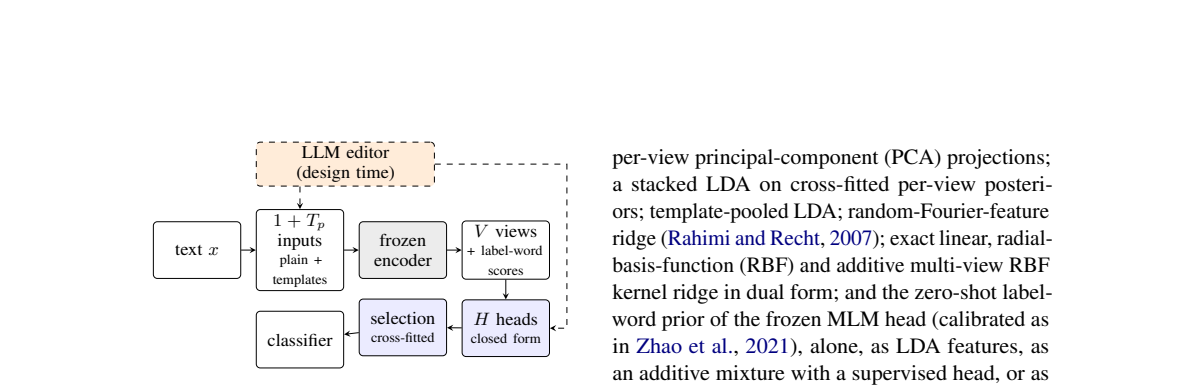
We present closed-form weight-space programming (WSP): a large language model (LLM), used as a design assistant, writes programs that read a frozen masked language model through cloze-style prompt templates at several layers, fit closed-form heads (shrinkage discriminant analysis, kernel ridge regression and the encoder's label-word prior) on labelled data, and select among a pool of candidate heads by cross-fitting. No gradient is computed and no encoder weight changes. We instantiate the framework on RoBERTa-large. On 11 development datasets with 512 to 8,192 training labels, WSP is ahead of full fine-tuning (FT) and LoRA at every label budget (by 0.3 to 0.6 points on average; the registered non-inferiority tests pass) and within 0.5 points of prompt-based fine-tuning (PFT); these datasets also shaped the recipe. With fewer labels its lead over FT and LoRA grows: 1.2 to 3.5 points with 64 and 128 labels, and 3.8 to 5.3 points in the few-shot setting of 16 labels per class, where WSP is again within half a point of PFT on the development datasets. On six held-out datasets, WSP stays ahead of LoRA and within half a point of FT on average, although with six datasets no registered test passes, and PFT is ahead, by 1.30 points with 8,192 labels. WSP never collapses and is deterministic, but it needs one encoder pass per template (17 here). We report all eight recipe versions, every decision that saw test results, and 27 ideas that did not help.
from the abstract
Pith says
Machine review · deepseek-v4-flash · 26 Nov 2026 · read the full text (182,480 characters) · not checked by a person
It can be wrong. Challenge this review or reply to it.
Holds up. Closed-form classifiers on a frozen encoder match fine-tuning on development datasets but lag behind prompt-based fine-tuning on new tasks, in a transparently reported study. This line is wrong
5 minor
How often objections from reviews like this one are right: not yet measured
The paper, first character to last
The reviewer was given the whole text, 182,480 characters. Not checked: figures, code, what the 58 references say.
5 minor objections
The paper says, at §7 (Conclusion)
Pith says: minor objection 1 of 5
The held-out check has low power (6 datasets) and shows that PFT is ahead by 1.30 points at 8,192 labels, with the entire 90% interval below -0.5 (Table 4). The conclusion states 'within about half a point of FT on average' but at 8,192 labels WSP is behind FT by 0.39 points.
more of objection 1
The phrasing should be more precise: the average difference against FT is +0.53 at 512 labels and -0.39 at 8,192 labels. The authors should explicitly state these averages in the conclusion to avoid overstatement.
The paper says, at §6.2 (What mattered, and what did not)
Pith says: minor objection 2 of 5
Table 13 (negative results) lists 26 entries, but the text says '27 ideas that did not help'. Please check the count and correct if necessary.
show 3 more
The paper says, at Abstract
Pith says: minor objection 3 of 5
The abstract states 'WSP never collapses' without qualification. The paper later clarifies that this applies to the method's optimization-free nature, but the editor rounds are not deterministic. Consider adding a brief qualifier in the abstract.
The paper says, at §4.1 (Development datasets)
Pith says: minor objection 4 of 5
The paper uses many LaTeX macros for numerical values (e.g., `nWspDevA`). While this is fine for the source, it makes the text hard to follow in the arXiv version. Consider ensuring the rendered output is clear.
The paper says, at Table 1 caption
Pith says: minor objection 5 of 5
In Table 1, the row for '10 development' at 2,048 labels is missing BBC News because its pool is smaller. This is explained in the caption, but it would be clearer to mark the missing dataset explicitly in the table (e.g., with a footnote).
What would settle it
Run WSP and the baselines on a larger, diverse set of held-out tasks (e.g., 20+ datasets) with sufficient statistical power. If WSP consistently falls behind PFT by more than 0.5 points on average, the claim of competitiveness with PFT on new tasks would be weakened.
from Pith's summary of the paper
How the review went
5 passes by deepseek-v4-flash · 26 Nov 2026
- Reader holds up
- Skeptic concern withdrawn: the paper already says this
- Referee 5 minor
- Check against the paper kept 0 of 4 objections
- Editor wrote the verdict above
Not run on this paper: the simulated authors' defence.
Pith's passes raised 4 objections. A check against the paper's text kept 0, withdrew 3 (3 the paper already says) and moved 1 to the minor objections.
The review in full
The review in brief, machine-written
This paper asks whether a classifier computed in closed form on a frozen RoBERTa-large encoder can match gradient fine-tuning. The answer, on 11 development datasets, is yes: WSP (closed-form weight-space programming) is ahead of full fine-tuning and LoRA at every label budget and within half a point of prompt-based fine-tuning (PFT). On six held-out datasets the picture shifts: WSP stays ahead of LoRA and within half a point of FT on average, but PFT is ahead by 0.5 to 1.3 points, and every trained baseline leads on CoLA. The method never collapses and is deterministic for a fixed program, but it needs 17 encoder passes per input and its kernel heads can store gigabytes at 8,192 labels. The paper's real strength is its methodology: every recipe version, every decision that saw test results, and 27 ideas that did not help are reported. The registered non-inferiority tests are a welcome step. The limitations are stated plainly: the development datasets shaped the recipe, the held-out check has only six datasets, the comparison with PFT confounds many prompts against one, and the LLM-written programs were not compared with human-written templates. The central claim—that a closed-form readout of a frozen encoder can match gradient fine-tuning on the tasks that informed the recipe—is supported. The gap to PFT on new tasks is real and acknowledged. This paper is for readers interested in efficient fine-tuning, gradient-free adaptation, and transparent empirical methodology. It deserves a serious referee; the authors have done the work to make that review productive.
The stress test's concern
Withdrawn: the paper already says this.
The paper says
“\section*{Limitations} \begin{itemize} \item \textbf{Development results.} The comparisons on the 11 development datasets informed the recipe (Appendix~\ref{app:prereg}); they are development results, not confirmatory ones.”
The referee's report
Not published. Pith's referee wrote this assessment before its objections were checked against the paper, and 2 of its 3 major objections did not survive that check.
Pith's reading of the paper (a machine's summary, not the authors')
The paper asks whether a classifier computed in closed form on a frozen encoder can match gradient-based fine-tuning. It presents closed-form weight-space programming (WSP): an LLM writes a program that reads a frozen masked language model through cloze-style prompt templates at several layers, fits closed-form heads (shrinkage discriminant analysis, kernel ridge regression, and the encoder's label-word prior) on labelled data, and selects among candidate heads by cross-fitting. No gradient is computed and no encoder weight changes. On 11 development datasets with 512 to 8,192 training labels, WSP is ahead of full fine-tuning (FT) and LoRA at every label budget (by 0.3 to 0.6 points on average; the registered non-inferiority tests pass) and within 0.5 points of prompt-based fine-tuning (PFT). With fewer labels its lead over FT and LoRA grows. On six held-out datasets, WSP stays ahead of LoRA and within half a point of FT on average, but PFT is ahead by 1.30 points with 8,192 labels. The method never collapses and is deterministic, but it needs one encoder pass per template (17 here) and its kernel heads store gigabytes at larger budgets.
What carries the argument. The central object is closed-form weight-space programming (WSP): an LLM writes a program that specifies cloze-style prompt templates, which views (hidden states at various layers and token positions) to read from a frozen masked language model, which closed-form heads (shrinkage LDA, kernel ridge regression, label-word prior) to fit on labelled data, and how to select among them via cross-fitting. No gradients are computed; the classifier weights are solved exactly.
Core claim. The paper claims that closed-form weight-space programming (WSP) on a frozen RoBERTa-large encoder, where an LLM writes the program specifying cloze templates, views, closed-form heads (shrinkage LDA, kernel ridge regression, label-word prior), and selection via cross-fitting, outperforms full fine-tuning (FT) and LoRA on 11 development datasets at every label budget from 512 to 8,192 labels (by 0.3 to 0.6 points on average, with registered non-inferiority tests passing) and stays within 0.5 points of prompt-based fine-tuning (PFT). With fewer labels (64, 128, 16 per class) the lead over FT and LoRA grows to 1.2–5.3 points. On six held-out datasets, WSP stays ahead of LoRA and within about half a point of FT on average, but PFT is ahead by 1.30 points with 8,192 labels. The method is deterministic, never collapses, but requires 17 encoder passes per input and stores large kernel features.
The premise it rests on. The development datasets shaped the recipe, so the results on those datasets are development results, not confirmatory; the held-out check has little power and shows a different task mix where PFT is ahead. The assumption that the development results generalize to new tasks is the weakest.
If the paper is right (Pith's inferences, not the authors')
Gradient-free adaptation of frozen encoders can serve as a practical alternative to fine-tuning for many classification tasks, especially when per-task gradient training is costly or unavailable.
The gap between frozen encoders and fine-tuning is largely a readout gap that can be closed with appropriate closed-form heads and selection, at least on some task distributions.
The method provides deterministic, reproducible classifiers with no risk of collapse, at the cost of multiple encoder passes per input and large storage for kernel heads.
On new tasks, prompt-based fine-tuning still holds an advantage, suggesting that representation adaptation via gradients provides additional benefit that closed-form readouts cannot capture.
The paper's careful separation of development and held-out results, and its transparent reporting of recipe versions and negative results, sets a high standard for empirical work in this area.
The finding that the label-word prior and cross-fitted selection matter most suggests that future work on frozen-encoder adaptation should focus on better integration of the encoder's own knowledge and robust model selection, rather than on more complex heads.
The gap to PFT on held-out datasets (especially CoLA) may indicate that tasks requiring deep syntactic or semantic understanding benefit more from representation adaptation than from readout engineering.
The method's cost (17 passes, large storage) may limit its applicability to settings where inference latency and memory are constrained, but its determinism and stability could be valuable in high-stakes applications.
Check this review
What was read
The passes were given all 182,480 characters of the paper's LaTeX source.
Fingerprint of that text (SHA-256): 75ef028b58822b6eb32ecdef868c6988b1ccd21cd3e14a5844c023d36643b33b
Pith does not keep that text. Rebuilt from the paper's source or PDF by the same code, it has this fingerprint if it is the same text. From a copy of Pith's code:
PYTHONPATH=. python scripts/review_input_check.py 2611.33972
The passes, in the order they ran
- Reader deepseek-v4-flash · medium effort · $0.0062 · instructions of the Reader, fingerprint f9ead7300382…
- Skeptic deepseek-v4-flash · medium effort · $0.013 · instructions of the Skeptic, fingerprint 8f88c0f61488…
- Referee deepseek-v4-flash · medium effort · $0.0058 · instructions of the Referee, fingerprint a852d99aea0d…
- Check against the paper deepseek-v4-flash · medium effort · $0.0063 · instructions of the Check against the paper, fingerprint 6c7a6883d551…
- Editor deepseek-v4-flash · medium effort · $0.0055 · instructions of the Editor, fingerprint e7211f6a3d27…
- Circularity check deepseek-v4-flash · medium effort · $0.0055 · instructions of the Circularity check, fingerprint e9946e39d67b…
- Summary for the page deepseek-v4-flash · medium effort · temperature 0.2 · $0.0059 · instructions of the Summary for the page, fingerprint e4f56bf568e7…
The passes cost $0.049 in model calls together.
Version stamped on this review: pith-pipeline@v1.4.1-daily-deepseek-or-medium+deepseek/deepseek-v4-flash+p.d60f54226f00
Each link opens a pass's instructions as plain text, the exact bytes its fingerprint was taken over. Every stored set of instructions.
curl -s https://pith.science/methodology/prompts/f9ead730038216984cfb56d7cb34332bdf691828296a1de4245f3d6667d4bf56 | sha256sum
prints the fingerprint of the reader's instructions. The same works for every pass.
The receipt
The review's fingerprint was taken on 26 Nov 2026. The review you are reading still matches it.
Fingerprint of the review (SHA-256): 116c1adc31e987f4dbc3705b0e9894a64478d91f88515f6f40ce6cbee4aa8968
curl -s 'https://pith.science/api/v1/verdicts/2611.33972?form=canonical' | sha256sum
prints the fingerprint of the review as it stands now. The rule, in four steps.
A matching fingerprint shows the review has not changed since that date. It does not show that the review is right.
How often reviews like this one are right
Reviews like this one: written by deepseek-v4-flash, from the paper's LaTeX source.
How often objections from reviews like this one are right: not yet measured
Reviews by people
This review was written by a machine. No person has reviewed this paper on Pith yet. A scientist listed on Pith can review it for a fee, and their review is published here whatever it concludes.
The paper
Abstract
Can a classifier computed in closed form on a frozen encoder match gradient fine-tuning? We present closed-form weight-space programming (WSP): a large language model (LLM), used as a design assistant, writes programs that read a frozen masked language model through cloze-style prompt templates at several layers, fit closed-form heads (shrinkage discriminant analysis, kernel ridge regression and the encoder's label-word prior) on labelled data, and select among a pool of candidate heads by cross-fitting. No gradient is computed and no encoder weight changes. We instantiate the framework on RoBERTa-large. On 11 development datasets with 512 to 8,192 training labels, WSP is ahead of full fine-tuning (FT) and LoRA at every label budget (by 0.3 to 0.6 points on average; the registered non-inferiority tests pass) and within 0.5 points of prompt-based fine-tuning (PFT); these datasets also shaped the recipe. With fewer labels its lead over FT and LoRA grows: 1.2 to 3.5 points with 64 and 128 labels, and 3.8 to 5.3 points in the few-shot setting of 16 labels per class, where WSP is again within half a point of PFT on the development datasets. On six held-out datasets, WSP stays ahead of LoRA and within half a point of FT on average, although with six datasets no registered test passes, and PFT is ahead, by 1.30 points with 8,192 labels. WSP never collapses and is deterministic, but it needs one encoder pass per template (17 here). We report all eight recipe versions, every decision that saw test results, and 27 ideas that did not help.
The paper's own sentences, arranged, kept beside the review and separate from it. Each label is drawn from a closed vocabulary; the number beside it is the probability the classifier gave that label. No sentence in this record was written by a model.
abstract compiled · 2026-11-26
The authors' main claim, as the classifier picked it out 0.96
“On 11 development datasets with 512 to 8,192 training labels, WSP is ahead of full fine-tuning (FT) and LoRA at every label budget (by 0.3 to 0.6 points on average; the registered non-inferiority tests pass) and within 0.5 points of prompt-based fine-tuning (PFT); these datasets also shaped the recipe.”
How the main claim is stated: asserted 1.00
What the abstract itself states, as probabilities: claims first 0.05 · states limitation 0.96 · human participants 0.04 · controlled comparison 0.94 · randomized assignment 0.02 · states quantitative result 0.99 · compares with prior results 0.98 · mentions code or data availability 0.23
The abstract, sentence by sentence
This table labels the abstract only (arXiv listing abstract v1). The number is the probability the classifier gave the label.
| Sentence | Role | The authors' own work | States the main conclusion | Strength |
|---|---|---|---|---|
| Can a classifier computed in closed form on a frozen encoder match gradient fine-tuning? | background 0.58 | 0.06 | 0.04 | unclear 0.71 |
| We present closed-form weight-space programming (WSP): a large language model (LLM), used as a design assistant, writes programs that read a frozen masked language model through cloze-style prompt templates at several layers, fit closed-form heads (shrinkage discriminant analysis, kernel ridge regression and the encoder's label-word prior) on labelled data, and select among a pool of candidate heads by cross-fitting. | method 0.70 | 0.90 | 0.07 | asserted 0.99 |
| No gradient is computed and no encoder weight changes. | method 0.94 | 0.84 | 0.07 | asserted 1.00 |
| We instantiate the framework on RoBERTa-large. | method 0.97 | 0.92 | 0.02 | asserted 0.99 |
| On 11 development datasets with 512 to 8,192 training labels, WSP is ahead of full fine-tuning (FT) and LoRA at every label budget (by 0.3 to 0.6 points on average; the registered non-inferiority tests pass) and within 0.5 points of prompt-based fine-tuning (PFT); these datasets also shaped the recipe. | result 1.00 | 0.97 | 0.42 | asserted 1.00 |
| With fewer labels its lead over FT and LoRA grows: 1.2 to 3.5 points with 64 and 128 labels, and 3.8 to 5.3 points in the few-shot setting of 16 labels per class, where WSP is again within half a point of PFT on the development datasets. | result 1.00 | 0.96 | 0.20 | asserted 1.00 |
| On six held-out datasets, WSP stays ahead of LoRA and within half a point of FT on average, although with six datasets no registered test passes, and PFT is ahead, by 1.30 points with 8,192 labels. | result 0.99 | 0.96 | 0.15 | asserted 1.00 |
| WSP never collapses and is deterministic, but it needs one encoder pass per template (17 here). | limitation 0.89 | 0.93 | 0.06 | asserted 1.00 |
| We report all eight recipe versions, every decision that saw test results, and 27 ideas that did not help. | contribution 0.94 | 0.95 | 0.03 | asserted 0.99 |
What kind of paper the classifier reports this is: method or tool 1.00 · evidence from observation or experiment 0.95
What was examined, and what was not
Sources read
- arXiv listing abstract v1
Not examined
- full text
- figures and tables
- references and citing sentences
- relations to other papers
Levels run
- P abstract
Not run
- S sections
- T body sentences
- C citations
- R cross-paper relations
How the labels were made
Compiled by classifier-1.13.0 via TypeSafe API, question bank abstract-p1-20260923, 2026-11-26: 1 request, 7,227 input tokens.
Every quoted sentence on this record is the authors'. Every label is from Pith's closed vocabulary, with the probability shown beside it. This record as JSON
Figures (1)
Figures are the authors', reproduced from the paper.
References (58)
- [1] Elad Ben Zaken, Yoav Goldberg, and Shauli Ravfogel. 2022. https://doi.org/10.18653/v1/2022.acl-short.1 BitFit : Simple parameter-efficient fine-tuning for transformer-based masked language-models . In Proceedings of the 60th Annual Meeting of the Association for Computational ... on Pithdoi:10.18653/v1/2022.acl-short.1
- [2] Luca Bertinetto, Jo \ a o F. Henriques, Philip H. S. Torr, and Andrea Vedaldi. 2019. Meta-learning with differentiable closed-form solvers. In International Conference on Learning Representations on Pith
- [3] Leo Breiman, Jerome H. Friedman, Richard A. Olshen, and Charles J. Stone. 1984. Classification and Regression Trees. Wadsworth on Pith
- [4] Tom Brown, Benjamin Mann, Nick Ryder, Melanie Subbiah, Jared D. Kaplan, Prafulla Dhariwal, Arvind Neelakantan, Pranav Shyam, Girish Sastry, Amanda Askell, et al. 2020. Language models are few-shot learners. In Advances in Neural Information Processing Systems on Pith
- [5] Rich Caruana, Alexandru Niculescu-Mizil, Geoff Crew, and Alex Ksikes. 2004. https://doi.org/10.1145/1015330.1015432 Ensemble selection from libraries of models . In Proceedings of the 21st International Conference on Machine Learning on Pithdoi:10.1145/1015330.1015432
- [6] Hyunsoo Cho, Hyuhng Joon Kim, Junyeob Kim, Sang-Woo Lee, Sang-goo Lee, Kang Min Yoo, and Taeuk Kim. 2023. Prompt-augmented linear probing: Scaling beyond the limit of few-shot in-context learners. In Proceedings of the AAAI Conference on Artificial Intelligence, volume 37 on Pith
- [7] Alexis Conneau and Douwe Kiela. 2018. https://aclanthology.org/L18-1269 SentEval : An evaluation toolkit for universal sentence representations . In Proceedings of the Eleventh International Conference on Language Resources and Evaluation ( LREC 2018) on Pith
- [8] Jacob Devlin, Ming-Wei Chang, Kenton Lee, and Kristina Toutanova. 2019. https://doi.org/10.18653/v1/N19-1423 BERT : Pre-training of deep bidirectional transformers for language understanding . In Proceedings of the 2019 Conference of the North A merican Chapter of the Associat... on Pithdoi:10.18653/v1/n19-1423
- [9] Jesse Dodge, Gabriel Ilharco, Roy Schwartz, Ali Farhadi, Hannaneh Hajishirzi, and Noah Smith. 2020. Fine-tuning pretrained language models: Weight initializations, data orders, and early stopping. arXiv preprint arXiv:2002.06305 on PithPith's reviewarXiv
- [10] Jerome H. Friedman. 1989. https://doi.org/10.1080/01621459.1989.10478752 Regularized discriminant analysis . Journal of the American Statistical Association, 84(405):165--175 on Pithdoi:10.1080/01621459.1989.10478752
- [11] Tianyu Gao, Adam Fisch, and Danqi Chen. 2021. https://doi.org/10.18653/v1/2021.acl-long.295 Making pre-trained language models better few-shot learners . In Proceedings of the 59th Annual Meeting of the Association for Computational Linguistics and the 11th International Joint... on Pithdoi:10.18653/v1/2021.acl-long.295
- [12] Derek Greene and P \'a draig Cunningham. 2006. Practical solutions to the problem of diagonal dominance in kernel document clustering. In Proceedings of the 23rd International Conference on Machine Learning on Pith
- [13] Bairu Hou, Joe O'Connor, Jacob Andreas, Shiyu Chang, and Yang Zhang. 2023. PromptBoosting : Black-box text classification with ten forward passes. In Proceedings of the 40th International Conference on Machine Learning on Pith
- [14] Neil Houlsby, Andrei Giurgiu, Stanislaw Jastrzebski, Bruna Morrone, Quentin de Laroussilhe, Andrea Gesmundo, Mona Attariyan, and Sylvain Gelly. 2019. Parameter-efficient transfer learning for NLP . In Proceedings of the 36th International Conference on Machine Learning on Pith
- [15] Edward J. Hu, Yelong Shen, Phillip Wallis, Zeyuan Allen-Zhu, Yuanzhi Li, Shean Wang, Lu Wang, and Weizhu Chen. 2022 a . https://openreview.net/forum?id=nZeVKeeFYf9 LoRA : Low-rank adaptation of large language models . In International Conference on Learning Representations on Pith
- [16] Minqing Hu and Bing Liu. 2004. https://doi.org/10.1145/1014052.1014073 Mining and summarizing customer reviews . In Proceedings of the Tenth ACM SIGKDD International Conference on Knowledge Discovery and Data Mining on Pithdoi:10.1145/1014052.1014073
- [17] Shengding Hu, Ning Ding, Huadong Wang, Zhiyuan Liu, Jingang Wang, Juanzi Li, Wei Wu, and Maosong Sun. 2022 b . Knowledgeable prompt-tuning: Incorporating knowledge into prompt verbalizer for text classification. In Proceedings of the 60th Annual Meeting of the Association for ... on Pith
- [18] Frank Hutter, Lars Kotthoff, and Joaquin Vanschoren, editors. 2019. https://doi.org/10.1007/978-3-030-05318-5 Automated Machine Learning: Methods, Systems, Challenges . Springer on Pithdoi:10.1007/978-3-030-05318-5
- [19] Ting Jiang, Jian Jiao, Shaohan Huang, Zihan Zhang, Deqing Wang, Fuzhen Zhuang, Furu Wei, Haizhen Huang, Denvy Deng, and Qi Zhang. 2022. PromptBERT : Improving BERT sentence embeddings with prompts. In Proceedings of the 2022 Conference on Empirical Methods in Natural Language ... on Pith
- [20] Zhengbao Jiang, Frank F. Xu, Jun Araki, and Graham Neubig. 2020. https://doi.org/10.1162/tacl_a_00324 How can we know what language models know? Transactions of the Association for Computational Linguistics, 8:423--438 on Pithdoi:10.1162/tacl_a_00324
show 38 more
- [21] Ananya Kumar, Aditi Raghunathan, Robbie Jones, Tengyu Ma, and Percy Liang. 2022. Fine-tuning can distort pretrained features and underperform out-of-distribution. In International Conference on Learning Representations on Pith
- [22] Olivier Ledoit and Michael Wolf. 2004. https://doi.org/10.1016/S0047-259X(03)00096-4 A well-conditioned estimator for large-dimensional covariance matrices . Journal of Multivariate Analysis, 88(2):365--411 on Pithdoi:10.1016/s0047-259x(03)00096-4
- [23] Brian Lester, Rami Al-Rfou, and Noah Constant. 2021. https://doi.org/10.18653/v1/2021.emnlp-main.243 The power of scale for parameter-efficient prompt tuning . In Proceedings of the 2021 Conference on Empirical Methods in Natural Language Processing on Pithdoi:10.18653/v1/2021.emnlp-main.243
- [24] Xin Li and Dan Roth. 2002. https://aclanthology.org/C02-1150 Learning question classifiers . In COLING 2002: The 19th International Conference on Computational Linguistics on Pith
- [25] Yinhan Liu, Myle Ott, Naman Goyal, Jingfei Du, Mandar Joshi, Danqi Chen, Omer Levy, Mike Lewis, Luke Zettlemoyer, and Veselin Stoyanov. 2019. RoBERTa : A robustly optimized BERT pretraining approach. arXiv preprint arXiv:1907.11692 on PithPith's reviewarXiv
- [26] Andrew L. Maas, Raymond E. Daly, Peter T. Pham, Dan Huang, Andrew Y. Ng, and Christopher Potts. 2011. https://aclanthology.org/P11-1015 Learning word vectors for sentiment analysis . In Proceedings of the 49th Annual Meeting of the Association for Computational Linguistics: Hu... on Pith
- [27] David Madigan and Adrian E. Raftery. 1994. https://doi.org/10.1080/01621459.1994.10476894 Model selection and accounting for model uncertainty in graphical models using O ccam's window . Journal of the American Statistical Association, 89(428):1535--1546 on Pithdoi:10.1080/01621459.1994.10476894
- [28] Sadhika Malladi, Alexander Wettig, Dingli Yu, Danqi Chen, and Sanjeev Arora. 2023. A kernel-based view of language model fine-tuning. In Proceedings of the 40th International Conference on Machine Learning on Pith
- [29] Mark D. McDonnell, Dong Gong, Amin Parvaneh, Ehsan Abbasnejad, and Anton van den Hengel. 2023. RanPAC : Random projections and pre-trained models for continual learning. In Advances in Neural Information Processing Systems on Pith
- [30] Kevin Meng, David Bau, Alex Andonian, and Yonatan Belinkov. 2022. Locating and editing factual associations in GPT . In Advances in Neural Information Processing Systems on Pith
- [31] Kevin Meng, Arnab Sen Sharma, Alex Andonian, Yonatan Belinkov, and David Bau. 2023. Mass-editing memory in a transformer. In International Conference on Learning Representations on Pith
- [32] Sachit Menon and Carl Vondrick. 2023. Visual classification via description from large language models. In International Conference on Learning Representations on Pith
- [33] Marius Mosbach, Maksym Andriushchenko, and Dietrich Klakow. 2021. On the stability of fine-tuning BERT : Misconceptions, explanations, and strong baselines. In International Conference on Learning Representations on Pith
- [34] Hyunjong Ok and Jaeho Lee. 2026. https://arxiv.org/abs/2611.22055 Weight-space programming doesn't need transformers . arXiv preprint arXiv:2611.22055 on PithPith's reviewarXiv
- [35] Bo Pang and Lillian Lee. 2004. https://aclanthology.org/P04-1035 A sentimental education: Sentiment analysis using subjectivity summarization based on minimum cuts . In Proceedings of the 42nd Annual Meeting of the Association for Computational Linguistics on Pith
- [36] Bo Pang and Lillian Lee. 2005. https://aclanthology.org/P05-1015 Seeing stars: Exploiting class relationships for sentiment categorization with respect to rating scales . In Proceedings of the 43rd Annual Meeting of the Association for Computational Linguistics on Pith
- [37] Matthew E. Peters, Sebastian Ruder, and Noah A. Smith. 2019. https://doi.org/10.18653/v1/W19-4302 To tune or not to tune? A dapting pretrained representations to diverse tasks . In Proceedings of the 4th Workshop on Representation Learning for NLP (RepL4NLP-2019), pages 7--14 on Pithdoi:10.18653/v1/w19-4302
- [38] Sarah Pratt, Ian Covert, Rosanne Liu, and Ali Farhadi. 2023. What does a platypus look like? G enerating customized prompts for zero-shot image classification. In Proceedings of the IEEE/CVF International Conference on Computer Vision on Pith
- [39] Ali Rahimi and Benjamin Recht. 2007. Random features for large-scale kernel machines. In Advances in Neural Information Processing Systems on Pith
- [40] Bernardino Romera-Paredes, Mohammadamin Barekatain, Alexander Novikov, Matej Balog, M. Pawan Kumar, Emilien Dupont, Francisco J. R. Ruiz, Jordan S. Ellenberg, Pengming Wang, Omar Fawzi, Pushmeet Kohli, and Alhussein Fawzi. 2024. https://doi.org/10.1038/s41586-023-06924-6 Mathe... on Pithdoi:10.1038/s41586-023-06924-6
- [41] Timo Schick, Helmut Schmid, and Hinrich Sch \"u tze. 2020. Automatically identifying words that can serve as labels for few-shot text classification. In Proceedings of the 28th International Conference on Computational Linguistics on Pith
- [42] Timo Schick and Hinrich Sch \"u tze. 2021. https://doi.org/10.18653/v1/2021.eacl-main.20 Exploiting cloze-questions for few-shot text classification and natural language inference . In Proceedings of the 16th Conference of the European Chapter of the Association for Computatio... on Pithdoi:10.18653/v1/2021.eacl-main.20
- [43] Taylor Shin, Yasaman Razeghi, Robert L. Logan IV, Eric Wallace, and Sameer Singh. 2020. https://doi.org/10.18653/v1/2020.emnlp-main.346 AutoPrompt : Eliciting knowledge from language models with automatically generated prompts . In Proceedings of the 2020 Conference on Empiric... on Pithdoi:10.18653/v1/2020.emnlp-main.346
- [44] Richard Socher, Alex Perelygin, Jean Wu, Jason Chuang, Christopher D. Manning, Andrew Ng, and Christopher Potts. 2013. https://aclanthology.org/D13-1170 Recursive deep models for semantic compositionality over a sentiment treebank . In Proceedings of the 2013 Conference on Emp... on Pith
- [45] Mervyn Stone. 1974. https://doi.org/10.1111/j.2517-6161.1974.tb00994.x Cross-validatory choice and assessment of statistical predictions . Journal of the Royal Statistical Society: Series B (Methodological), 36(2):111--147 on Pithdoi:10.1111/j.2517-6161.1974.tb00994.x
- [46] Tianxiang Sun, Zhengfu He, Hong Qian, Yunhua Zhou, Xuanjing Huang, and Xipeng Qiu. 2022 a . BBTv2 : Towards a gradient-free future with large language models. In Proceedings of the 2022 Conference on Empirical Methods in Natural Language Processing on Pith
- [47] Tianxiang Sun, Yunfan Shao, Hong Qian, Xuanjing Huang, and Xipeng Qiu. 2022 b . Black-box tuning for language-model-as-a-service. In Proceedings of the 39th International Conference on Machine Learning on Pith
- [48] Rikiya Takehi, Jayden Teoh, Alex Zhang, and Omar Khattab. 2026. https://rikiyat.github.io/blog/weight-space-programming/ Sparks of weight-space programming: LLMs can natively read & write neural network weights . Blog post, MIT CSAIL, 2 November 2026 on Pith
- [49] Zhengbo Wang, Jian Liang, Lijun Sheng, Ran He, Zilei Wang, and Tieniu Tan. 2024. A hard-to-beat baseline for training-free CLIP -based adaptation. In International Conference on Learning Representations on Pith
- [50] Alex Warstadt, Amanpreet Singh, and Samuel R. Bowman. 2019. https://doi.org/10.1162/tacl_a_00290 Neural network acceptability judgments . Transactions of the Association for Computational Linguistics, 7:625--641 on Pithdoi:10.1162/tacl_a_00290
- [51] Janyce Wiebe, Theresa Wilson, and Claire Cardie. 2005. https://doi.org/10.1007/s10579-005-7880-9 Annotating expressions of opinions and emotions in language . Language Resources and Evaluation, 39:165--210 on Pithdoi:10.1007/s10579-005-7880-9
- [52] Benfeng Xu, Quan Wang, Zhendong Mao, Yajuan Lyu, Qiaoqiao She, and Yongdong Zhang. 2023. https://arxiv.org/abs/2303.13824 kNN prompting: Beyond-context learning with calibration-free nearest neighbor inference . In International Conference on Learning Representations on PithPith's reviewarXiv
- [53] Chengrun Yang, Xuezhi Wang, Yifeng Lu, Hanxiao Liu, Quoc V. Le, Denny Zhou, and Xinyun Chen. 2024. https://arxiv.org/abs/2309.03409 Large language models as optimizers . In International Conference on Learning Representations on PithPith's reviewarXiv
- [54] Renrui Zhang, Wei Zhang, Rongyao Fang, Peng Gao, Kunchang Li, Jifeng Dai, Yu Qiao, and Hongsheng Li. 2022. Tip-Adapter : Training-free adaption of CLIP for few-shot classification. In Computer Vision -- ECCV 2022 on Pith
- [55] Tianyi Zhang, Felix Wu, Arzoo Katiyar, Kilian Q. Weinberger, and Yoav Artzi. 2021. Revisiting few-sample BERT fine-tuning. In International Conference on Learning Representations on Pith
- [56] Xiang Zhang, Junbo Zhao, and Yann LeCun. 2015. Character-level convolutional networks for text classification. In Advances in Neural Information Processing Systems on Pith
- [57] Zihao Zhao, Eric Wallace, Shi Feng, Dan Klein, and Sameer Singh. 2021. Calibrate before use: Improving few-shot performance of language models. In Proceedings of the 38th International Conference on Machine Learning on Pith
- [58] Yongchao Zhou, Andrei Ioan Muresanu, Ziwen Han, Keiran Paster, Silviu Pitis, Harris Chan, and Jimmy Ba. 2023. Large language models are human-level prompt engineers. In International Conference on Learning Representations on Pith
Challenges and discussion
Disagree with the review, or know something it missed? Leave a comment, or challenge this review formally: a challenge becomes a permanent entry in this paper's record, and its decision is published here.
Come back by email
A short list of the week's newly reviewed papers. Nothing is sent until you confirm from your inbox, and every email has a link that stops it. No account.
No comments yet.
Sign in to comment