Computer Vision and Pattern Recognition · arXiv:2611.12066 v1 · submitted 9 Nov 2026 · 53 references
Weight-Space Programming for Medical Imaging: Do We Still Need Training Data?
The paper says
“Can a large language model (LLM) write the parameters of a medical image classifier from medical knowledge alone, without any training data? Such classifiers normally require labelled images, which are costly and often unavailable.”
more of the abstract
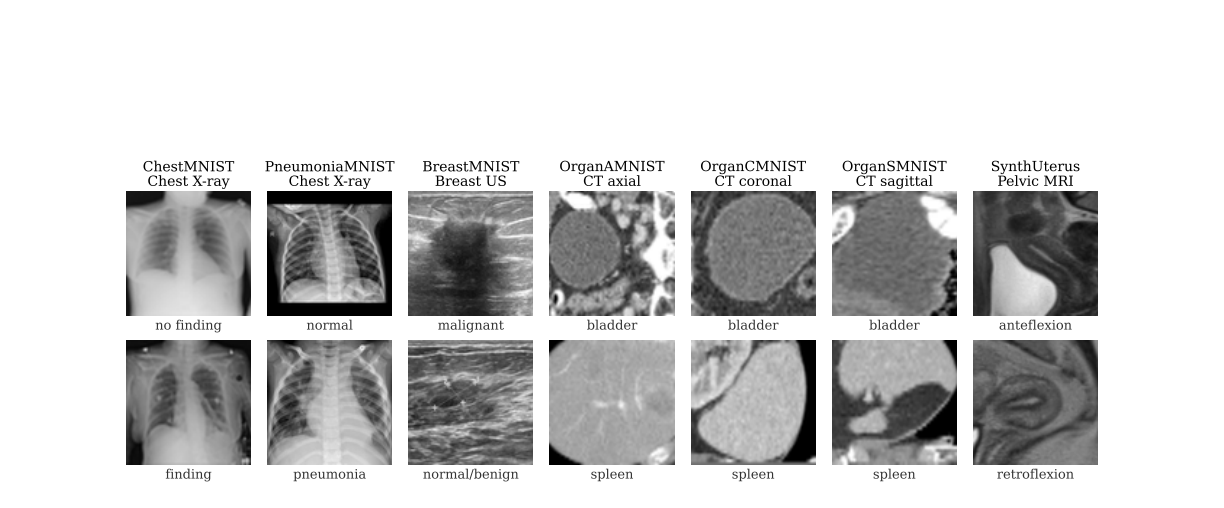
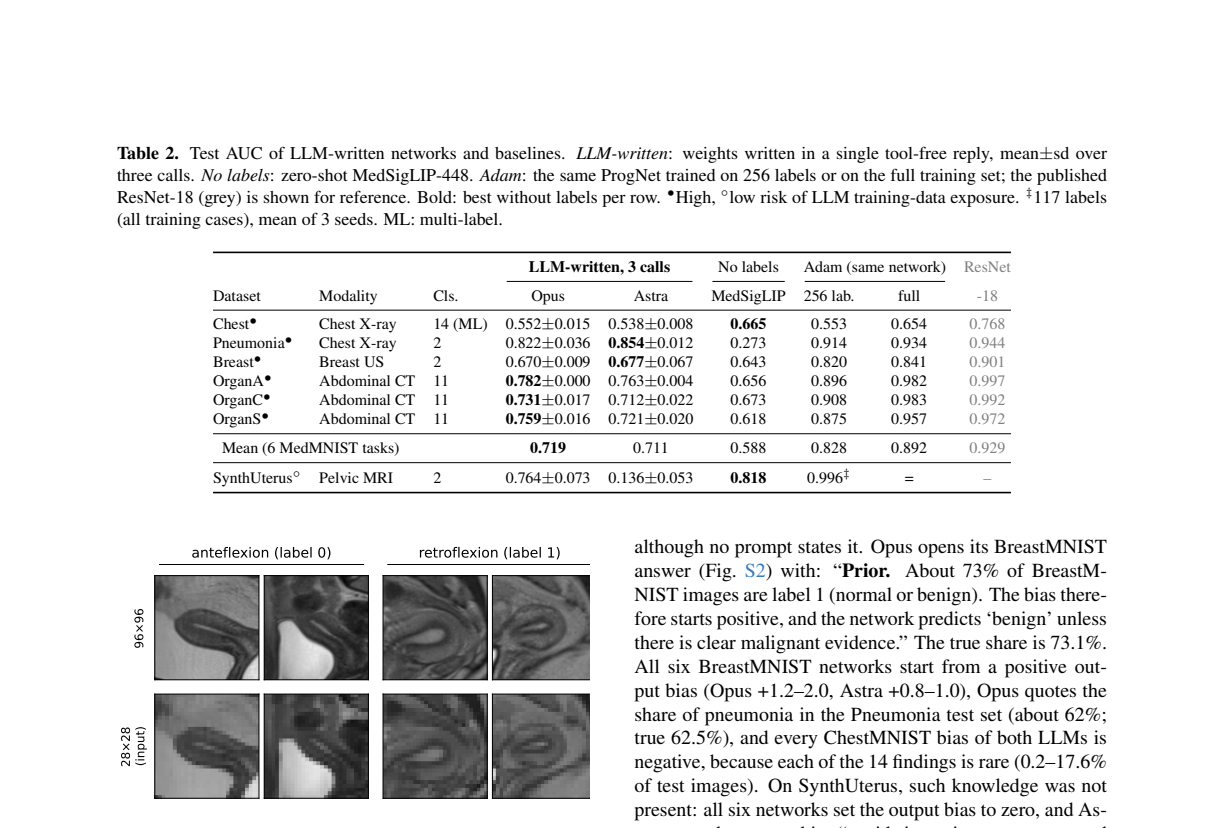
We investigate this question through weight-space programming (WSP), in which an LLM writes or adapts the weights and biases of a neural network directly, without optimisation on training data. Claude Opus 5.5 and GPT-6 Astra each generate the parameters of a small LeNet-style CNN in a single reply, without tool use and without access to any image. We compare these networks against zero-shot MedSigLIP and against the same architecture trained on labels using the Adam optimiser, across 7 classification tasks in four modalities: chest X-ray, breast ultrasound and abdominal CT (all from MedMNIST), and pelvic MRI (SynthUterus). The LLM-written networks perform above chance on all six MedMNIST tasks, with a mean test AUC of 0.719 for Opus and 0.711 for Astra. Both models outperform MedSigLIP on 5 of 6 tasks while using more than 10,000 times fewer parameters. However, the same network trained with Adam on only 256 labelled images achieves a higher AUC on every MedMNIST task (mean AUC 0.828). On SynthUterus, Opus attains an AUC of 0.764, whereas Astra falls below chance (AUC 0.136) owing to a systematic error. These results show that LLMs can write functional medical classifiers, but that they do not yet replace training data. We release the protocol, logs and all generated weights at https://github.com/MaximilianLindholz/weight-space-programming-medical.
from the abstract
Pith says
Machine review · deepseek-v4-flash · 10 Nov 2026 · what was read was not recorded · not checked by a person
It can be wrong. Challenge this review or reply to it.
Holds up. Solid empirical study of weight-space programming in medical imaging—honest about limitations, but the contamination-controlled test is less decisive than advertised. This line is wrong
4 minor
How often objections from reviews like this one are right: not yet measured
Not checked: figures, code, what the 53 references say.
4 minor objections
The paper says, at Section 4.1, Table 2
Pith says: minor objection 1 of 4
The header '256 lab.' should be spelled out as '256 labels' for clarity.
The paper says, at Section 4.1, SynthUIerus results
Pith says: minor objection 2 of 4
The paper acknowledges the prompt layout ambiguity (Section 5), but could state more explicitly that this ambiguity makes the SynthUIerus test a combination of medical knowledge and layout inference, not a pure test of the former. Consider adding a sentence in Section 4.1 or 5 to clarify this caveat.
show 2 more
The paper says, at Figure 3 caption
Pith says: minor objection 3 of 4
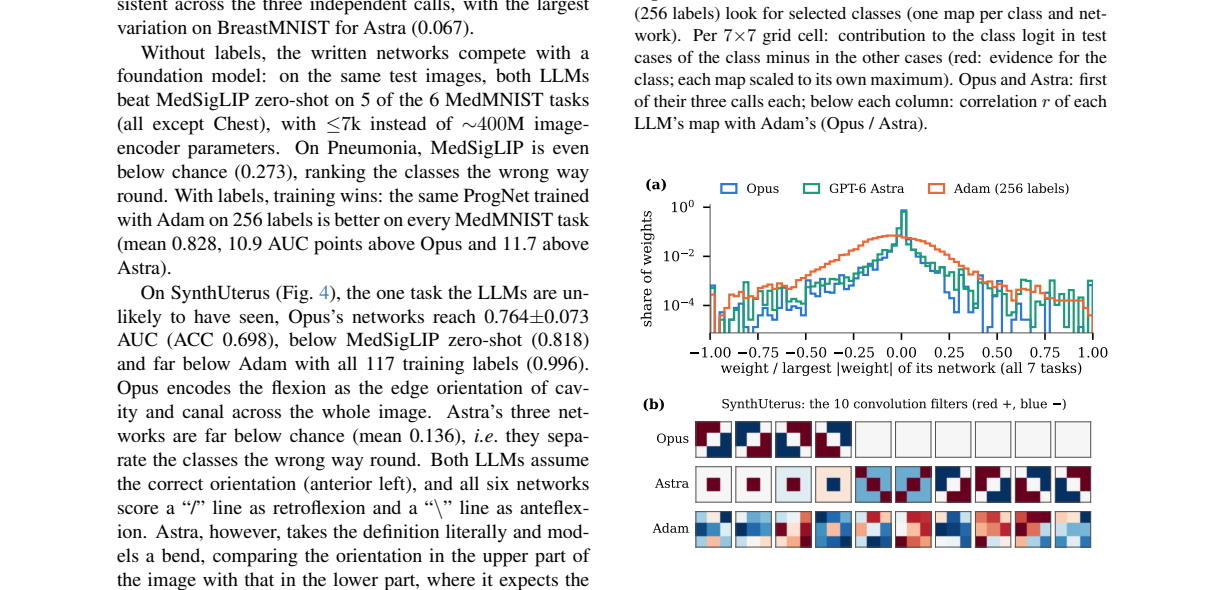
The phrase 'weight / largest |weight| of its network' is ambiguous; clarify that the denominator is the max absolute weight across all tasks pooled.
The paper says, at General
Pith says: minor objection 4 of 4
Minor typographical: in the abstract, 'more than 10 4 times' should be 'more than 10^4 times' (format the exponent).
What would settle it
Re-run the three Astra calls for SynthUterus with one added sentence in the prompt: 'The images are region-of-interest crops centered on the uterine cavity; they may not show the cervical canal in the lower part of the image.' If the mean AUC rises above 0.6 (e.g., from the current 0.136 to >0.6), the original failure is attributable to the omitted layout description, not to lack of anatomical knowledge. If AUC remains near chance, the claim that the LLM lacks the necessary knowledge for this task is confirmed.
from the skeptic's reading
How the review went
4 readings by deepseek-v4-flash · 10 Nov 2026
- Reader holds up
- Skeptic partly agrees
- Editor wrote the verdict above
- Referee minor revision: 4 minor
Not run on this paper: the simulated authors' defence.
Pith did not check this review's objections against the paper.
The review in full
The review in brief, machine-written
Here's my reading of this paper.
What's new: first application of weight-space programming to medical imaging, with a clean experimental protocol. Three independent calls per task, comparison to both MedSigLIP and gradient-trained networks, and a dedicated effort to control for data contamination via SynthUterus. The authors release code, logs, and weights. They also provide a weight-level analysis showing LLM-written networks are sparse and use textbook filters. The paper is remarkably candid about its limitations—they flag MedMNIST contamination, note the SynthUterus prompt ambiguity, and state that training data still beats them.
What it does well: the protocol is transparent and reproducible. The analysis of Astra's failure on SynthUterus (liturgical layout guess) is informative. The evidence maps help show where written networks look versus trained ones. The honesty about bias setting from class prior, which leaks dataset knowledge, is a strength.
Soft spots: the stress-test note is on point—the SynthUterus task's prompt omission means success depends on guessing the crop layout, not just medical knowledge. Opus guessed right, Astra guessed wrong; this undercuts the claim that SynthUterus cleanly tests knowledge alone. The authors themselves hint at this but could be more explicit. The MedMNIST results, while above chance, are almost certainly contaminated; the paper admits this, but the central claim rests heavily on the six MedMNIST tasks. Also, the network is tiny (28x28, 7k params)—scaling to clinically realistic resolutions is untested.
Who it's for: WSP researchers, anyone working on zero-shot medical classification, and those studying what LLMs actually know about visual medical concepts. A supervised reader will still learn from the methodology and failure modes.
Bottom line: this paper deserves a serious referee. It's a careful empirical contribution with appropriate scope. I would accept with minor revision—ask the authors to clarify the ambiguity of the SynthUterus test and perhaps run a prompt variation that specifies the crop layout to isolate medical knowledge.
The strongest objection
The paper's strongest evidence against contamination is the SynthUterus task, a held-out dataset. However, the prompt for SynthUterus omits a critical piece of information: the images are region-of-interest crops centered on the uterine cavity and may not show the cervical canal in the lower part of the image. The paper states: 'What the prompt leaves unstated about the images, the LLM has to guess.' Opus guessed correctly and achieved AUC 0.764; Astra guessed differently and fell to 0.136. This asymmetry shows that the prompt ambiguity directly determines whether the LLM succeeds. The test therefore does not purely measure whether the LLM has the medical knowledge to write a classifier—it measures whether the LLM can infer the unstated crop layout. A radiologist given the same prompt would also need that layout information to write accurate weights. Consequently, the one contamination-free dataset does not provide an unambiguous test of the central claim. Meanwhile, the MedMNIST tasks remain suspect due to likely training-data exposure, as the paper acknowledges. The overall evidentiary basis for 'LLMs can write functional medical classifiers from medical knowledge alone' is therefore less robust than the raw AUC across six tasks suggests.
The reader correctly identified data contamination and generalization to pixel-level rules as the weakest assumption. This attack deepens that concern by showing that the intended clean test (SynthUterus) itself suffers from an unresolved confound: the prompt omits a layout detail that is necessary for a correct classifier, and the LLM's success or failure hinges on its ability to guess that detail. This does not invalidate the paper—the authors are transparent about the ambiguity—but it means the central claim rests more heavily on the contaminated MedMNIST tasks than the paper's structure suggests. The paper is still valuable as an empirical exploration; the verdict should remain unchanged because the authors explicitly acknowledge the limitation and the paper does not overclaim. However, the concern is load-bearing because if the SynthUterus confound is resolved in favor of 'Astra lacked knowledge,' then the only positive evidence from a held-out dataset is Opus's single AUC of 0.764 with high variance, which is thin ground for a general claim. The concrete test would settle which interpretation holds.
The referee's report
If the results hold, they demonstrate a novel capability: LLMs can encode radiological knowledge into network weights, offering a new paradigm for label-free classifier creation with full auditability. This is the first systematic application of weight-space programming to medical imaging, with controlled experiments, weight-level comparisons, and explicit handling of data contamination. The findings are relevant to settings where labelled data are scarce, such as rare diseases. However, the significance is tempered by the small network scale (<=7k parameters), the likely training-data contamination of the MedMNIST tasks, and the prompt ambiguity that confounds the contamination-free test, as the paper acknowledges.
Pith's reading of the paper (a machine's summary, not the authors')
The paper investigates whether large language models can generate the weights of a small convolutional neural network for medical image classification without any training data. The authors show that Claude Opus 5.5 and GPT-6 Astra can each produce functional classifiers in a single tool-free reply, achieving above-chance performance on six MedMNIST tasks (mean AUC 0.719 and 0.711) and beating a 400M-parameter zero-shot vision-language model on five of six tasks. However, the same architecture trained on just 256 labelled images outperforms the written networks on every task (mean AUC 0.828). The paper demonstrates that LLMs encode enough medical radiological knowledge to write working pixel-level classifiers, but that this knowledge cannot yet substitute for even modest amounts of labelled training data.
What carries the argument. Weight-space programming (WSP): an LLM writes or adapts the weights and biases of a neural network directly, without optimisation on training data. The specific architecture is ProgNet, a LeNet-style CNN with one convolutional stage (10 filters of size 3×3), ReLU activation, 4×4 average pooling, and a linear read-out layer. Every weight has a direct interpretation as a filter, an image region, or a class evidence map. The LLM generates all parameters in a single textual reply using an edit-based syntax, with no tools, no code execution, and no access to any images.
Core claim. The paper establishes that frontier LLMs can write the weights of a small convolutional neural network (ProgNet, a LeNet-style CNN with ≤7k parameters) from scratch, using only medical knowledge encoded in their parameters, without seeing any training images, running any code, or performing any forward passes. The LLM-written networks achieve above-chance AUC on all six MedMNIST tasks (mean 0.719 for Opus, 0.711 for Astra) and outperform the zero-shot medical vision-language model MedSigLIP on five of six tasks while using over 10,000 times fewer parameters. However, the same ProgNet trained with Adam on just 256 labelled images beats the written networks on every task (mean AUC 0.828). On SynthUterus, a task unlikely to be in the LLMs' training data, Opus reaches AUC 0.764 while Astra falls to 0.136 due to a systematic misinterpretation of the image layout.
The premise it rests on. The LLMs have sufficient and accurate medical radiological knowledge encoded in their parameters from pretraining to write network weights that generalise correctly to pixel-level classification rules at 28×28 resolution, and this knowledge is not merely memorisation of the specific datasets.
If the paper is right (Pith's inferences, not the authors')
LLMs can produce functional medical image classifiers from radiological knowledge alone, enabling classification before any labelled images are collected.
Written networks are fully auditable: every weight carries a stated rationale that a radiologist can review, unlike learned models whose decisions must be explained post hoc.
The gap between written and trained networks (mean AUC 0.719 vs 0.828 on MedMNIST) quantifies how much performance is currently lost by relying on textbook knowledge instead of data-driven optimisation.
For rare diseases with too few cases to train on, a written network could turn a case report description into a reviewable classifier on the day it is published.
The approach reveals what medical knowledge LLMs actually encode: they know class priors for public datasets (e.g., 73% benign in BreastMNIST) and can translate textbook rules into pixel-level filters, but fail when the image layout differs from what they assume.
The SynthUterus failure mode (Astra AUC 0.136) suggests that LLMs have brittle spatial reasoning: Astra correctly identified the diagnostic sign (a bend) but expected it in the wrong grid location, inverting the classification. This implies that WSP performance is highly sensitive to how the prompt describes the image coordinate system and crop extent.
The sparsity and discreteness of written weights (22–94% exactly zero, 8–145 distinct values) compared to trained weights (none zero, 554–2865 distinct values) suggests that LLMs default to textbook templates rather than smooth, distributed representations. This could be a fundamental limitation or a feature for interpretability, depending on the application.
The fact that both LLMs independently set output biases from correct class priors (which the prompt did not state) confirms that MedMNIST performance is partly driven by dataset contamination rather than pure radiological reasoning. Future WSP evaluations should prioritise held-out tasks like SynthUterus.
Combining WSP with a small amount of labelled data (e.g., using written weights as initialisation for fine-tuning) could combine the interpretability of written networks with the performance of trained ones, though the paper does not test this.
Check this review
Pith stored no record of this review's passes and took no fingerprint of it. Reviews made by code from 13 Nov 2026 on carry both.
How often reviews like this one are right
Reviews like this one: written by deepseek-v4-flash, where what was read was not recorded.
How often objections from reviews like this one are right: not yet measured
Reviews by people
This review was written by a machine. No person has reviewed this paper on Pith yet. A scientist listed on Pith can review it for a fee, and their review is published here whatever it concludes.
The paper
Abstract
Can a large language model (LLM) write the parameters of a medical image classifier from medical knowledge alone, without any training data? Such classifiers normally require labelled images, which are costly and often unavailable. We investigate this question through weight-space programming (WSP), in which an LLM writes or adapts the weights and biases of a neural network directly, without optimisation on training data. Claude Opus 5.5 and GPT-6 Astra each generate the parameters of a small LeNet-style CNN in a single reply, without tool use and without access to any image. We compare these networks against zero-shot MedSigLIP and against the same architecture trained on labels using the Adam optimiser, across 7 classification tasks in four modalities: chest X-ray, breast ultrasound and abdominal CT (all from MedMNIST), and pelvic MRI (SynthUterus). The LLM-written networks perform above chance on all six MedMNIST tasks, with a mean test AUC of 0.719 for Opus and 0.711 for Astra. Both models outperform MedSigLIP on 5 of 6 tasks while using more than 10,000 times fewer parameters. However, the same network trained with Adam on only 256 labelled images achieves a higher AUC on every MedMNIST task (mean AUC 0.828). On SynthUterus, Opus attains an AUC of 0.764, whereas Astra falls below chance (AUC 0.136) owing to a systematic error. These results show that LLMs can write functional medical classifiers, but that they do not yet replace training data. We release the protocol, logs and all generated weights at https://github.com/MaximilianLindholz/weight-space-programming-medical.
The paper's own sentences, arranged, kept beside the review and separate from it. Each label is drawn from a closed vocabulary; the number beside it is the probability the classifier gave that label. No sentence in this record was written by a model.
abstract compiled · 2026-11-10
The authors' main claim, as the classifier picked it out 1.00
“These results show that LLMs can write functional medical classifiers, but that they do not yet replace training data.”
How the main claim is stated: asserted 1.00
What the abstract itself states, as probabilities: claims first 0.04 · states limitation 0.97 · human participants 0.11 · controlled comparison 0.97 · randomized assignment 0.02 · states quantitative result 0.99 · compares with prior results 0.98 · mentions code or data availability 0.98
The abstract, sentence by sentence
This table labels the abstract only (arXiv listing abstract v1). The number is the probability the classifier gave the label.
| Sentence | Role | The authors' own work | States the main conclusion | Strength |
|---|---|---|---|---|
| Can a large language model (LLM) write the parameters of a medical image classifier from medical knowledge alone, without any training data? | gap 0.51 | 0.08 | 0.03 | unclear 0.65 |
| Such classifiers normally require labelled images, which are costly and often unavailable. | background 0.99 | 0.04 | 0.02 | asserted 1.00 |
| We investigate this question through weight-space programming (WSP), in which an LLM writes or adapts the weights and biases of a neural network directly, without optimisation on training data. | method 0.79 | 0.68 | 0.03 | asserted 0.75 |
| Claude Opus 5.5 and GPT-6 Astra each generate the parameters of a small LeNet-style CNN in a single reply, without tool use and without access to any image. | method 0.95 | 0.92 | 0.02 | asserted 1.00 |
| We compare these networks against zero-shot MedSigLIP and against the same architecture trained on labels using the Adam optimiser, across 7 classification tasks in four modalities: chest X-ray, breast ultrasound and abdominal CT (all from MedMNIST), and pelvic MRI (SynthUterus). | method 0.97 | 0.92 | 0.02 | asserted 0.96 |
| The LLM-written networks perform above chance on all six MedMNIST tasks, with a mean test AUC of 0.719 for Opus and 0.711 for Astra. | result 1.00 | 0.96 | 0.08 | asserted 1.00 |
| Both models outperform MedSigLIP on 5 of 6 tasks while using more than 10,000 times fewer parameters. | result 1.00 | 0.95 | 0.06 | asserted 1.00 |
| However, the same network trained with Adam on only 256 labelled images achieves a higher AUC on every MedMNIST task (mean AUC 0.828). | result 0.90 | 0.95 | 0.12 | asserted 1.00 |
| On SynthUterus, Opus attains an AUC of 0.764, whereas Astra falls below chance (AUC 0.136) owing to a systematic error. | result 1.00 | 0.96 | 0.05 | asserted 1.00 |
| These results show that LLMs can write functional medical classifiers, but that they do not yet replace training data. | interpretation 1.00 | 0.90 | 0.96 | asserted 1.00 |
| We release the protocol, logs and all generated weights at https://github.com/MaximilianLindholz/weight-space-programming-medical. | contribution 0.96 | 0.83 | 0.03 | asserted 0.86 |
What kind of paper the classifier reports this is: empirical study 0.98 · evidence from observation or experiment 0.91
What was examined, and what was not
Sources read
- arXiv listing abstract v1
Not examined
- full text
- figures and tables
- references and citing sentences
- relations to other papers
Levels run
- P abstract
Not run
- S sections
- T body sentences
- C citations
- R cross-paper relations
How the labels were made
Compiled by classifier-1.13.0 via TypeSafe API, question bank abstract-p1-20260923, 2026-11-10: 1 request, 8,417 input tokens.
Every quoted sentence on this record is the authors'. Every label is from Pith's closed vocabulary, with the probability shown beside it. This record as JSON
Figures (4)

Figures are the authors', reproduced from the paper.
References (53)
- [1] Walid Al-Dhabyani, Mohammed Gomaa, Hussien Khaled, and Aly Fahmy. Dataset of breast ultrasound images.Data in Brief, 28:104863, 2020. 3 on Pith
- [2] Muhammad Atif Ameer and Diana C Peterson. Anatomy, abdomen and pelvis: uterus. InStatPearls [Internet]. Stat- Pearls Publishing, 2025. 1 on Pith
- [3] Patrick Bilic, Patrick Christ, et al. The liver tumor segmenta- tion benchmark (LiTS).Medical Image Analysis, 84:102680, on Pith
- [4] Samuel Budd, Emma C. Robinson, and Bernhard Kainz. A survey on active learning and human-in-the-loop deep learn- ing for medical image analysis.Medical Image Analysis, 71: 102062, 2021. 7 on Pith
- [5] Vinod Kumar Chauhan, Jiandong Zhou, Ping Lu, Soheila Molaei, and David A. Clifton. A brief review of hypernet- works in deep learning.Artificial Intelligence Review, 57(9): 250, 2024. 2, 7 on Pith
- [6] Chaofan Chen, Oscar Li, Chaofan Tao, Alina Jade Barnett, Jonathan Su, and Cynthia Rudin. This looks like that: Deep learning for interpretable image recognition. InAdvances in Neural Information Processing Systems, pages 8928–8939, on Pith
- [7] Alex J. DeGrave, Joseph D. Janizek, and Su-In Lee. AI for radiographic COVID-19 detection selects shortcuts over sig- nal.Nature Machine Intelligence, 3(7):610–619, 2021. 7 on Pith
- [8] Tom Fawcett. An introduction to ROC analysis.Pattern Recognition Letters, 27(8):861–874, 2006. 7 on Pith
- [9] Robert Geirhos, J ¨orn-Henrik Jacobsen, Claudio Michaelis, Richard Zemel, Wieland Brendel, Matthias Bethge, and Fe- lix A. Wichmann. Shortcut learning in deep neural networks. Nature Machine Intelligence, 2(11):665–673, 2020. 7 on Pith
- [10] Sean Goedecke. LLMs are not superhuman at reading and writing neural network weights. Blog post, 3 November 2026,https : / / www . seangoedecke . com / llms - are - not-superhuman-at-reading-and-writing-neural- network-weights/, 2026. 3 on Pith
- [11] Shahriar Golchin and Mihai Surdeanu. Time travel in LLMs: Tracing data contamination in large language models. InIn- ternational Conference on Learning Representations (ICLR), on Pith
- [12] David Ha, Andrew M. Dai, and Quoc V . Le. HyperNet- works. InInternational Conference on Learning Represen- tations (ICLR), 2017. 1, 2 on Pith
- [13] Kaiming He, Xiangyu Zhang, Shaoqing Ren, and Jian Sun. Deep residual learning for image recognition. InIEEE Conference on Computer Vision and Pattern Recognition (CVPR), 2016. 3 on Pith
- [14] Matthew Honnibal. The “Astra can read and write weights to improve Qwen” post is misleading. Blog post, 3 Novem- ber 2026,https://honnibal.dev/blog/astra-read- write-misleading, 2026. 3 on Pith
- [15] Gabriel Ilharco, Marco Tulio Ribeiro, Mitchell Wortsman, Suchin Gururangan, Ludwig Schmidt, Hannaneh Hajishirzi, and Ali Farhadi. Editing models with task arithmetic. InIn- ternational Conference on Learning Representations (ICLR), on Pith
- [16] Xu Jia, Bert De Brabandere, Tinne Tuytelaars, and Luc Van Gool. Dynamic filter networks. InAdvances in Neu- ral Information Processing Systems (NeurIPS), 2016. 2 on Pith
- [17] Daniel S. Kermany, Michael Goldbaum, Wenjia Cai, et al. Identifying medical diagnoses and treatable diseases by image-based deep learning.Cell, 172(5):1122–1131, 2018. 3 on Pith
- [18] Diederik P. Kingma and Jimmy Ba. Adam: A method for stochastic optimization. InInternational Conference on Learning Representations (ICLR), 2015. 4 on Pith
- [19] Boris Knyazev, Michal Drozdzal, Graham W. Taylor, and Adriana Romero Soriano. Parameter prediction for unseen deep architectures. InAdvances in Neural Information Pro- cessing Systems (NeurIPS), 2021. 1, 2, 7 on Pith
- [20] Yann LeCun, L ´eon Bottou, Yoshua Bengio, and Patrick Haffner. Gradient-based learning applied to document recog- nition.Proceedings of the IEEE, 86(11):2278–2324, 1998. 3 on Pith
show 33 more
- [21] Yann LeCun, Yoshua Bengio, and Geoffrey Hinton. Deep learning.Nature, 521(7553):436–444, 2015. 1 on Pith
- [22] David Lindner, J ´anos Kram´ar, Sebastian Farquhar, Matthew Rahtz, Thomas McGrath, and Vladimir Mikulik. Tracr: 8 Compiled transformers as a laboratory for interpretabil- ity. InAdvances in Neural Information Processing Systems (NeurIPS), 2023. 3 on Pith
- [23] Kevin Meng, David Bau, Alex Andonian, and Yonatan Belinkov. Locating and editing factual associations in GPT. InAdvances in Neural Information Processing Sys- tems (NeurIPS), 2022. 3 on Pith
- [24] Johanna P. M ¨uller, Anika Knupfer, Pedro Bl¨oss, Edoardo Be- rardi Vittur, Bernhard Kainz, and Jana Hutter. Diffusing the blind spot: Uterine MRI synthesis with diffusion models. In Skin Image Analysis, and Computer-Aided Pelvic Imaging for Female Health, pages 93–102. Spring... on Pith
- [25] Johanna P. M ¨uller, Anika Knupfer, Maximilian Lindholz, Robin Schmidt, Bernhard Kainz, and Jana Hutter. Synthetic uterus MRI dataset with uterine orientation labels. Zen- odo, version 2,https://doi.org/10.5281/zenodo. 18587285, 2026. IEEE International Symposium on Biomedical... on Pithdoi:10.5281/zenodo
- [26] Tsendsuren Munkhdalai and Hong Yu. Meta networks. InIn- ternational Conference on Machine Learning (ICML), pages 2554–2563, 2017. 2 on Pith
- [27] Aviv Navon, Aviv Shamsian, Idan Achituve, Ethan Fetaya, Gal Chechik, and Haggai Maron. Equivariant architectures for learning in deep weight spaces. InInternational Confer- ence on Machine Learning (ICML), 2023. 2 on Pith
- [28] St ´ephanie Nguengang Wakap, Deborah M. Lambert, Annie Olry, Charlotte Rodwell, Charlotte Gueydan, Val ´erie Lan- neau, Daniel Murphy, Yann Le Cam, and Ana Rath. Esti- mating cumulative point prevalence of rare diseases: analy- sis of the Orphanet database.European Journal of ... on Pith
- [29] Alec Radford, Jong Wook Kim, Chris Hallacy, et al. Learn- ing transferable visual models from natural language super- vision. InInternational Conference on Machine Learning (ICML), 2021. 3 on Pith
- [30] Cynthia Rudin. Stop explaining black box machine learn- ing models for high stakes decisions and use interpretable models instead.Nature Machine Intelligence, 1(5):206–215, on Pith
- [31] Nataniel Ruiz, Yuanzhen Li, Varun Jampani, Wei Wei, Tingbo Hou, Yael Pritch, Neal Wadhwa, Michael Rubinstein, and Kfir Aberman. HyperDreamBooth: HyperNetworks for fast personalization of text-to-image models. InIEEE/CVF Conference on Computer Vision and Pattern Recognition (CV... on Pith
- [32] Marco Saerens, Patrice Latinne, and Christine Decaestecker. Adjusting the outputs of a classifier to new a priori probabili- ties: A simple procedure.Neural Computation, 14(1):21–41, on Pith
- [33] Oscar Sainz, Jon Ander Campos, Iker Garc ´ıa-Ferrero, Julen Etxaniz, Oier Lopez de Lacalle, and Eneko Agirre. NLP evaluation in trouble: On the need to measure LLM data contamination for each benchmark. InFindings of the Asso- ciation for Computational Linguistics: EMNLP 2023,... on Pith
- [34] J ¨urgen Schmidhuber. Learning to control fast-weight mem- ories: An alternative to dynamic recurrent networks.Neural Computation, 4(1):131–139, 1992. 2 on Pith
- [35] Konstantin Sch ¨urholt, Dimche Kostadinov, and Damian Borth. Self-supervised representation learning on neural net- work weights for model characteristic prediction. InAd- vances in Neural Information Processing Systems (NeurIPS), on Pith
- [36] Andrew Sellergren, Sahar Kazemzadeh, Fereshteh Mahvar, Atilla Kiraly, Madeleine Traverse, et al. An open vision- language model for diverse medical applications.Nature Medicine, 32(10):3695–3704, 2026. MedGemma and Med- SigLIP; preprint arXiv:2507.05201 (“MedGemma Technical Re... on PithPith's reviewarXiv
- [37] Chandan Singh. Weight-space programming from scratch on simple tasks. Report, 2 November 2026, https : / / csinva . io / weight - space - programming - autoresearch/analyze/toy_examples/report.html, on Pith
- [38] Karan Singhal, Shekoofeh Azizi, Tao Tu, S. Sara Mahdavi, Jason Wei, Hyung Won Chung, Nathan Scales, Ajay Tan- wani, Heather Cole-Lewis, Stephen Pfohl, et al. Large language models encode clinical knowledge.Nature, 620 (7972):172–180, 2023. 6 on Pith
- [39] Rikiya Takehi, Jayden Teoh, Alex Zhang, and Omar Khat- tab. Sparks of weight-space programming: LLMs can na- tively read & write neural network weights. MIT CSAIL blog post, 2 November 2026,https://rikiyat.github. io/blog/weight-space-programming/; logs athttps: //github.com/R... on Pith
- [40] Ekin Tiu, Ellie Talius, Pujan Patel, Curtis P. Langlotz, An- drew Y . Ng, and Pranav Rajpurkar. Expert-level detection of pathologies from unannotated chest X-ray images via self- supervised learning.Nature Biomedical Engineering, 6: 1399–1406, 2022. 6 on Pith
- [41] Thomas Unterthiner, Daniel Keysers, Sylvain Gelly, Olivier Bousquet, and Ilya Tolstikhin. Predicting neural network accuracy from weights.arXiv preprint arXiv:2002.11448, on PithPith's reviewarXiv
- [42] Johannes von Oswald, Christian Henning, Benjamin F. Grewe, and Jo ˜ao Sacramento. Continual learning with hy- pernetworks. InInternational Conference on Learning Rep- resentations (ICLR), 2020. 2 on Pith
- [43] Xiaosong Wang, Yifan Peng, Le Lu, Zhiyong Lu, Mo- hammadhadi Bagheri, and Ronald M. Summers. ChestX- ray8: Hospital-scale chest x-ray database and benchmarks on weakly-supervised classification and localization of com- mon thorax diseases. InIEEE Conference on Computer Vi- sio... on Pith
- [44] Martin J. Willemink, Wojciech A. Koszek, Cailin Hardell, Jie Wu, Dominik Fleischmann, Hugh Harvey, Les R. Folio, Ronald M. Summers, Daniel L. Rubin, and Matthew P. Lun- gren. Preparing medical imaging data for machine learning. Radiology, 295(1):4–15, 2020. 7 on Pith
- [45] Mitchell Wortsman, Gabriel Ilharco, Samir Yitzhak Gadre, et al. Model soups: Averaging weights of multiple fine- 9 tuned models improves accuracy without increasing infer- ence time. InInternational Conference on Machine Learning (ICML), 2022. 3 on Pith
- [46] Xuanang Xu, Fugen Zhou, Bo Liu, Dongshan Fu, and Xi- angzhi Bai. Efficient multiple organ localization in CT im- age using 3D region proposal network.IEEE Transactions on Medical Imaging, 38(8):1885–1898, 2019. 3 on Pith
- [47] Jiancheng Yang, Rui Shi, and Bingbing Ni. MedMNIST classification decathlon: A lightweight AutoML benchmark for medical image analysis. InIEEE International Sympo- sium on Biomedical Imaging (ISBI), 2021. 3, 7 on Pith
- [48] Jiancheng Yang, Rui Shi, Donglai Wei, Zequan Liu, Lin Zhao, Bilian Ke, Hanspeter Pfister, and Bingbing Ni. MedM- NIST v2 – a large-scale lightweight benchmark for 2D and 3D biomedical image classification.Scientific Data, 10(1): 41, 2023. 2, 3, 4, 7 on Pith
- [49] John R. Zech, Marcus A. Badgeley, Manway Liu, An- thony B. Costa, Joseph J. Titano, and Eric Karl Oer- mann. Variable generalization performance of a deep learn- ing model to detect pneumonia in chest radiographs: A cross-sectional study.PLOS Medicine, 15(11):e1002683, on Pith
- [50] Chris Zhang, Mengye Ren, and Raquel Urtasun. Graph Hy- perNetworks for neural architecture search. InInternational Conference on Learning Representations (ICLR), 2019. 2 on Pith
- [51] Sheng Zhang, Yanbo Xu, Naoto Usuyama, et al. A multi- modal biomedical foundation model trained from fifteen mil- lion image–text pairs.NEJM AI, 2(1), 2025. BiomedCLIP; preprint arXiv:2303.00915. 3 on PithPith's reviewarXiv
- [52] Allan Zhou, Kaien Yang, Kaylee Burns, Adriano Cardace, Yiding Jiang, Samuel Sokota, J. Zico Kolter, and Chelsea Finn. Permutation equivariant neural functionals. InAd- vances in Neural Information Processing Systems (NeurIPS), on Pith
- [2023] 2 10 Supplementary material S1. The prompt.Figure S1 shows the complete prompt for SynthUterus, the only user message of each call (Sec. 3.3 describes the protocol). The prompts of the other six tasks differ only in the task-specific lines (dataset, of- ficial description, cla... on Pith
Cited by 4 Pith papers
Reviewed papers on Pith that cite this one. The full citation record
- Kolpona: An Agentic Framework with Gradient-Free Neuron Programming for RTL Generation cs.LG · Nov 2026
- Weight Space Programming for Vision Language Model Repair cs.CV · Nov 2026
- Owned Edits to a Shared Decision Rule: Learning Private Exceptions as Typed, Gated, Withdrawable Weight Edits cs.LG · Nov 2026
- Temporal Weight Surgery: Repairing Video Grounding with LLM Editors cs.CV · Nov 2026
Challenges and discussion
Disagree with the review, or know something it missed? Leave a comment, or challenge this review formally: a challenge becomes a permanent entry in this paper's record, and its decision is published here.
Come back by email
A short list of the week's newly reviewed papers. Nothing is sent until you confirm from your inbox, and every email has a link that stops it. No account.
No comments yet.
Sign in to comment