Computer Vision and Pattern Recognition · arXiv:2611.23615 v2 · submitted 17 Nov 2026 · 23 references
Weight Space Programming for Vision Language Model Repair
The paper says
“In weight-space programming, a language model edits a network's weights directly, without gradients. We ask what a successful repair of this kind relies on.”
more of the abstract
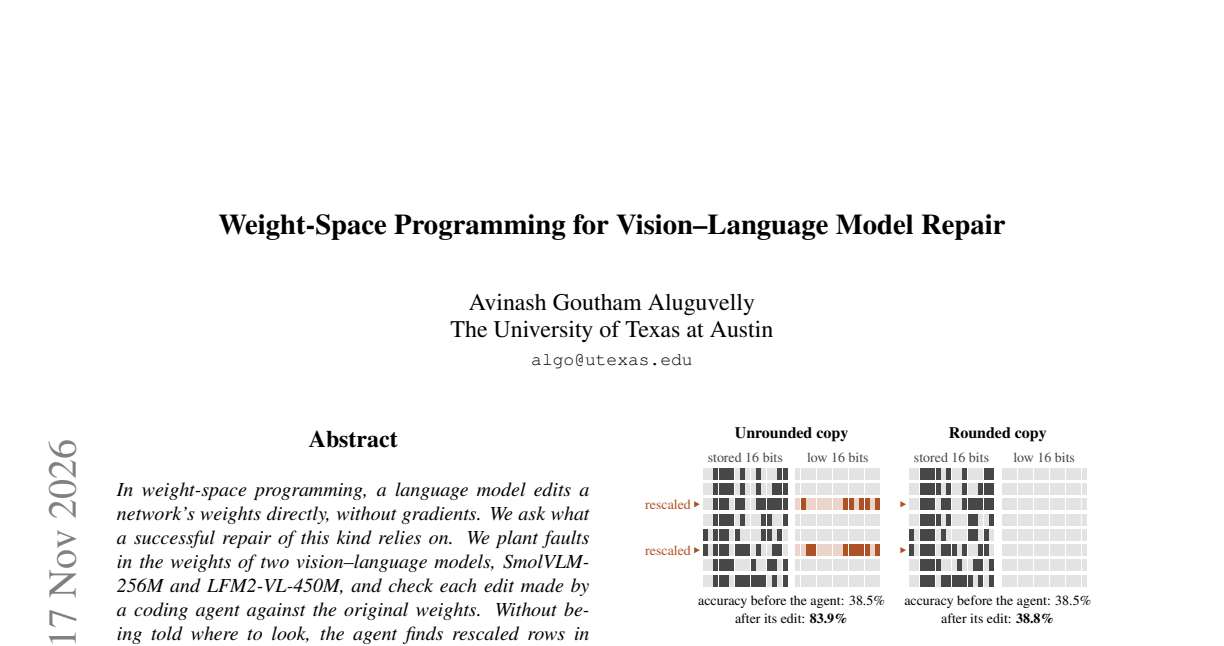
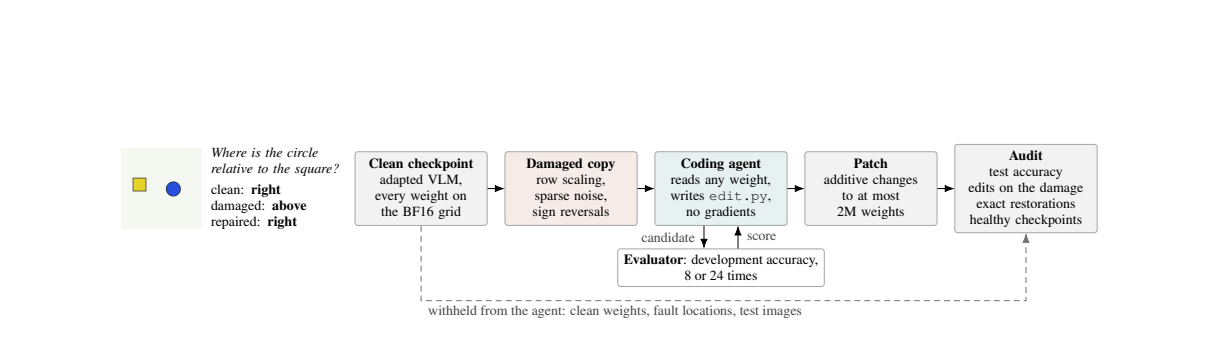
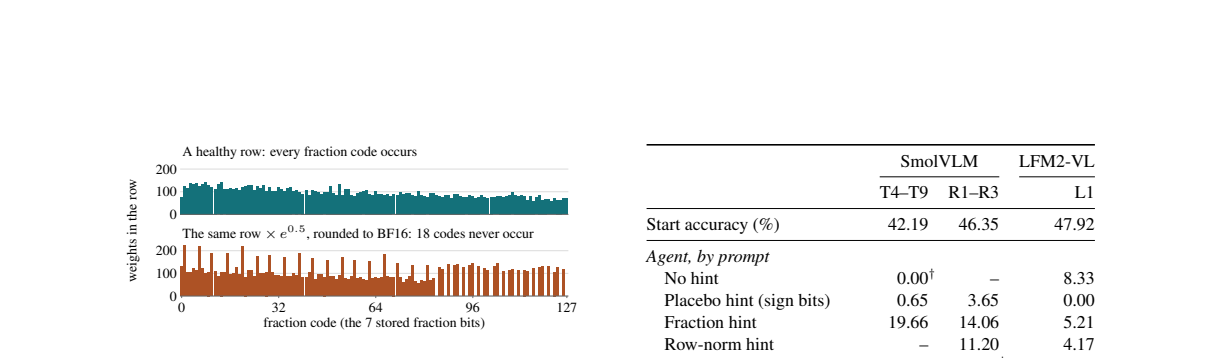
We plant faults in the weights of two vision-language models, SmolVLM-256M and LFM2-VL-450M, and check each edit made by a coding agent against the original weights. Without being told where to look, the agent finds rescaled projector rows and noise in the vision encoder, infers the unknown scale factors, and returns most or all of the rescaled weights to their exact original values and accuracy to near its original level. These repairs depend on a trace of how the faults were computed. The original weights have 16-bit precision, and faults computed in 32-bit arithmetic leave low bits that only the damaged weights carry, a cue that a real failure need not leave. When we round those bits away, each model answers our test questions as before, but the agent, unaided, no longer repairs either model: on LFM2-VL accuracy recovers by about 4 points, against 17 from the unrounded weights. Marking the damaged weights again in their low bits brings the edits back to them. Rounded weights still hold statistical evidence of the rescaling. On SmolVLM the agent uses it once a sentence in the prompt, which we wrote knowing the fault, names such a statistic; on LFM2-VL, whose scale factors are larger, most sessions find the rescaled rows unaided, but none finds the noise. Swapped rows or columns, which keep the set of stored values, are not found unaided on either model within our budgets. We recommend that studies of weight repair report the number format of the weights and include a rounded control.
from the abstract
Pith says
Machine review · deepseek-v4-flash · 20 Nov 2026 · read the full text (55,353 characters) · not checked by a person
It can be wrong. Challenge this review or reply to it.
Holds up. A careful measurement study showing that weight-space program repair of these VLMs succeeds because planted float32 faults leave low-bit traces in BF16 checkpoints—a cue real 16-bit failures need not leave—and fails when those traces are rounded away. This line is wrong
no objections raised
How often objections from reviews like this one are right: not yet measured
The paper, first character to last
The reviewer was given the whole text, 55,353 characters. Not checked: figures, code, what the 23 references say.
What would settle it
Re-run the central comparison (rounded vs. unrounded combined fault) on a third VLM family (e.g., LLaVA-NeXT-7B) with the same protocol; if the agent again repairs only the unrounded copy, the precision-dependence claim generalizes beyond the two tested models.
from the skeptic's reading
How the review went
5 passes by deepseek-v4-flash · 20 Nov 2026
- Reader holds up
- Skeptic agrees
- Referee no objections raised
- Check against the paper
- Editor wrote the verdict above
Not run on this paper: the simulated authors' defence.
Pith checked this review's objections against the text of the paper it read.
The review in full
The review in brief, machine-written
This paper asks what a weight-space programming agent actually relies on when it repairs a damaged vision-language model. The answer is concrete and well supported: the agent succeeds because the planted faults, computed in float32, leave nonzero low bits in a BF16 checkpoint. When those bits are rounded away, the damage remains and the model gives the same answers, but the agent no longer repairs it. The central comparison—unrounded versus rounded copies with identical test answers—is cleanly controlled, and the paper checks its finding with placebo hints, decoy marks, random low bits, and fixed scripts that reproduce the agent's gains without the agent.
The paper is unusually honest about its limitations. It studies two models, one agent, synthetic scenes, and one family of questions. The fraction hint was written after inspecting the data. The audit depends on a clean reference, which real failures lack. A bit flip in a BF16 checkpoint stays on the grid, like the rounded faults that the agent cannot fix. The authors state all of this themselves.
The soft spots are real but bounded. The exact-restoration result assumes that projector rows have similar norms, which the paper acknowledges. The LFM2-VL results are mostly single sessions, and the answer-bias sensitivity of a yes/no task means that a few answers can shift the headline numbers. The two testbeds differ in scale factors and budgets, so differences between them cannot be assigned to a single cause. None of these undermines the precision-dependence claim, which is the paper's main finding.
Who this is for: researchers working on weight-space programming, model editing, or numerical forensics. The paper deserves a serious referee. It ships a reproducible finding, states its assumptions, and does not overclaim. The recommendation is to engage with it.
The strongest objection
The paper's central claim—that successful weight-space repair of these VLMs depends on low-bit traces that planted float32 faults leave on BF16 checkpoints—is well supported by controlled comparisons (rounded vs. unrounded copies with identical test answers, placebo hints, decoy marks, random low bits, and fixed scripts independent of the agent). The authors candidly acknowledge the limitations: two models, one proprietary agent, synthetic scenes, mostly single sessions on LFM2-VL, answer-bias sensitivity, post hoc analyses, and dependence on a clean reference that real failures lack. The weakest assumption identified by the reader (that exact restoration assumes similar row norms) is stated by the authors themselves in [b133] and does not undermine the precision-dependence claim, which is the main finding. No internal inconsistency or unacknowledged vulnerability was found in the argument as presented. The paper's honesty about its own limitations and the controlled nature of the experiments make it a solid contribution.
The reader's verdict is ACCEPT with MODERATE confidence, and the weakest assumption they identify (similar row norms for exact restoration) is indeed stated by the authors in [b133]. The paper's main finding is about precision dependence, not about exact restoration being universal. The reader's concern does not threaten the central claim. The paper is unusually careful: it includes controls (rounded copies, placebo hints, decoy marks, random low bits), acknowledges limitations candidly, and separates the precision-dependence result from the exact-restoration result. No load-bearing concern beyond what the authors already acknowledge was identified. The concrete test proposed would strengthen generalizability but is not required to accept the current claim.
The referee's report
If the result holds, it is significant for the weight-space programming community because it demonstrates that successful repairs can depend on numerical artifacts of how faults are computed rather than on functional properties of the weights. The paper's recommendation to report number format and include a rounded control is sensible. The study is thorough in its controls and audits, and the central comparison (unrounded vs rounded) is well controlled.
Pith's reading of the paper (a machine's summary, not the authors')
The paper investigates what enables a language-model-based coding agent to repair damaged vision-language models by directly editing weights. The authors plant faults in two VLMs and find that the agent successfully repairs the models when the faults leave low-bit traces in the 32-bit float representation of the weights, which are normally stored in 16-bit bfloat16. When those low bits are rounded away, the agent fails to repair the models, even though the damage remains and the models' outputs are unchanged. The paper argues that successful weight-space programming depends on numerical precision artifacts that real failures may not produce, and recommends that studies report number formats and include rounded controls.
What carries the argument. The central mechanism is the bfloat16 (BF16) numerical format and its interaction with 32-bit float arithmetic. Clean weights stored in BF16 have zero low 16 bits when loaded as float32. Faults computed in float32 arithmetic fill those low bits, creating a detectable trace that only damaged weights carry. The agent uses this trace to locate damage and recover scale factors. Rounding the damaged weights back to BF16 removes this trace while preserving the damage, and the agent then fails to repair the models.
Core claim. The paper's central claim is that successful weight-space programming repair of vision-language models depends on numerical precision traces left by faults computed in 32-bit arithmetic on weights normally stored in 16-bit bfloat16. The agent locates and repairs damage by exploiting that clean weights have zero low bits while damaged weights have nonzero low bits. When those low bits are rounded away, the agent no longer repairs the models unaided, even though the damage remains and model outputs are unchanged. The paper demonstrates this through controlled experiments with two VLMs, showing that the agent's ability to find and fix faults relies on these precision artifacts rather than on understanding the weights' function.
The premise it rests on. The exact restoration of rescaled weights assumes that the rows of the weight matrix have similar norms, because the scale factor can only be recovered up to a power of two and the agent chooses the power that brings the row's norm closest to the others.
If the paper is right (Pith's inferences, not the authors')
If the paper is correct, claims of weight-space programming capability must be interpreted in light of the numerical format of the weights and the traces that specific faults leave.
Studies of weight repair should report the number format of the weights and include a rounded control to distinguish genuine understanding from exploitation of precision artifacts.
Natural failures (e.g., bit flips in BF16 storage) may not leave the low-bit traces that the agent exploits, so weight-space programming may be less effective for real-world faults than for planted faults computed in higher precision.
The agent's ability to restore exact clean values depends on the assumption that rows of the weight matrix have similar norms, which may not hold in general.
Gradient-based fine-tuning recovers more accuracy than the agent on rounded weights, but does so by changing nearly all weights rather than identifying and correcting the specific damage.
The paper's findings suggest that weight-space programming agents may be exploiting statistical artifacts of the numerical representation rather than understanding the functional role of weights. This parallels findings in interpretability where models exploit superficial cues.
The reliance on low-bit traces implies that weight-space programming may be more applicable to debugging during development (where weights are in float32) than to repairing deployed models stored in low-precision formats.
The paper's recommendation to include rounded controls could become a standard methodological requirement for weight-space programming studies, analogous to controlling for dataset leakage in machine learning.
The fact that the agent uses four distinct kinds of numerical evidence (low bits, histogram anomalies, structural redundancy, cross-layer statistics) suggests that weight-space programming may be a collection of heuristics rather than a unified capability.
Check this review
What was read
The passes were given all 55,353 characters of the paper's LaTeX source.
Fingerprint of that text (SHA-256): 9db8fb067bffc7c4970c02421f391798926e1e4ad21f03145f28335466b16c8d
Pith does not keep that text. Rebuilt from the paper's source or PDF by the same code, it has this fingerprint if it is the same text. From a copy of Pith's code:
PYTHONPATH=. python scripts/review_input_check.py 2611.23615
The passes, in the order they ran
- Reader deepseek-v4-flash · medium effort · $0.0073 · instructions of the Reader, fingerprint f9ead7300382…
- Skeptic deepseek-v4-flash · medium effort · $0.0019 · instructions of the Skeptic, fingerprint 8f88c0f61488…
- Referee deepseek-v4-flash · medium effort · $0.0019 · instructions of the Referee, fingerprint a852d99aea0d…
- Editor deepseek-v4-flash · medium effort · $0.0019 · instructions of the Editor, fingerprint e7211f6a3d27…
- Circularity check deepseek-v4-flash · medium effort · $0.0031 · instructions of the Circularity check, fingerprint e9946e39d67b…
- Summary for the page deepseek-v4-flash · medium effort · temperature 0.2 · $0.0022 · instructions of the Summary for the page, fingerprint e4f56bf568e7…
The passes cost $0.018 in model calls together.
Version stamped on this review: pith-pipeline@v1.4.1-daily-deepseek-or-medium+deepseek/deepseek-v4-flash+p.505d180dcaef
Each link opens a pass's instructions as plain text, the exact bytes its fingerprint was taken over. Every stored set of instructions.
curl -s https://pith.science/methodology/prompts/f9ead730038216984cfb56d7cb34332bdf691828296a1de4245f3d6667d4bf56 | sha256sum
prints the fingerprint of the reader's instructions. The same works for every pass.
The receipt
The review's fingerprint was taken on 20 Nov 2026. The review you are reading still matches it.
Fingerprint of the review (SHA-256): f7280c50798d26c6a731869e7bcd48464eb7efb116c0d6a137c1b767543184b0
curl -s 'https://pith.science/api/v1/verdicts/2611.23615?form=canonical' | sha256sum
prints the fingerprint of the review as it stands now. The rule, in four steps.
A matching fingerprint shows the review has not changed since that date. It does not show that the review is right.
How often reviews like this one are right
Reviews like this one: written by deepseek-v4-flash, from the paper's LaTeX source.
How often objections from reviews like this one are right: not yet measured
Reviews by people
This review was written by a machine. No person has reviewed this paper on Pith yet. A scientist listed on Pith can review it for a fee, and their review is published here whatever it concludes.
How Pith checks papers · The full audit of this paper · Review history (3 versions)
The paper
Abstract
In weight-space programming, a language model edits a network's weights directly, without gradients. We ask what a successful repair of this kind relies on. We plant faults in the weights of two vision-language models, SmolVLM-256M and LFM2-VL-450M, and check each edit made by a coding agent against the original weights. Without being told where to look, the agent finds rescaled projector rows and noise in the vision encoder, infers the unknown scale factors, and returns most or all of the rescaled weights to their exact original values and accuracy to near its original level. These repairs depend on a trace of how the faults were computed. The original weights have 16-bit precision, and faults computed in 32-bit arithmetic leave low bits that only the damaged weights carry, a cue that a real failure need not leave. When we round those bits away, each model answers our test questions as before, but the agent, unaided, no longer repairs either model: on LFM2-VL accuracy recovers by about 4 points, against 17 from the unrounded weights. Marking the damaged weights again in their low bits brings the edits back to them. Rounded weights still hold statistical evidence of the rescaling. On SmolVLM the agent uses it once a sentence in the prompt, which we wrote knowing the fault, names such a statistic; on LFM2-VL, whose scale factors are larger, most sessions find the rescaled rows unaided, but none finds the noise. Swapped rows or columns, which keep the set of stored values, are not found unaided on either model within our budgets. We recommend that studies of weight repair report the number format of the weights and include a rounded control.
The paper's own sentences, arranged, kept beside the review and separate from it. Each label is drawn from a closed vocabulary; the number beside it is the probability the classifier gave that label. No sentence in this record was written by a model.
abstract compiled · 2026-11-19
The authors' main claim, as the classifier picked it out 0.92
“These repairs depend on a trace of how the faults were computed.”
How the main claim is stated: asserted 1.00
What the abstract itself states, as probabilities: claims first 0.04 · states limitation 0.91 · human participants 0.03 · controlled comparison 0.86 · randomized assignment 0.02 · states quantitative result 0.57 · compares with prior results 0.24 · mentions code or data availability 0.04
The abstract, sentence by sentence
This table labels the abstract only (arXiv listing abstract v1). The number is the probability the classifier gave the label.
| Sentence | Role | The authors' own work | States the main conclusion | Strength |
|---|---|---|---|---|
| In weight-space programming, a language model edits a network's weights directly, without gradients. | background 1.00 | 0.06 | 0.02 | asserted 1.00 |
| We ask what a successful repair of this kind relies on. | gap 0.71 | 0.27 | 0.02 | unclear 0.98 |
| We plant faults in the weights of two vision-language models, SmolVLM-256M and LFM2-VL-450M, and check each edit made by a coding agent against the original weights. | method 0.92 | 0.96 | 0.03 | asserted 0.96 |
| Without being told where to look, the agent finds rescaled rows in the projector and noise in the vision encoder of both models, infers the unknown scale factors, restores most or all of the rescaled weights to their exact original values, and returns accuracy to near its original level; programs that it writes from such weights repair unseen checkpoints of the same model without feedback. | result 0.99 | 0.89 | 0.34 | asserted 1.00 |
| These repairs depend on a trace of how the faults were computed. | result 0.54 | 0.73 | 0.43 | asserted 1.00 |
| The original weights have 16-bit precision, and faults computed in 32-bit arithmetic leave low bits that only the damaged weights carry. | interpretation 0.57 | 0.73 | 0.16 | asserted 1.00 |
| Rounding those bits away leaves each model's answers to our test questions unchanged, and the agent, unaided, then restores no weight exactly: on SmolVLM it no longer finds the damage, and in a single session on LFM2-VL its only gain comes from rescaling answer-token embeddings, which changes how often the model answers yes. | result 0.99 | 0.94 | 0.18 | asserted 1.00 |
| Marking the damaged weights again in their low bits brings the edits back to them. | result 0.88 | 0.87 | 0.11 | asserted 1.00 |
| Rounded weights still hold statistical evidence of the rescaling, in the distribution of stored values and in row norms, and one sentence in the prompt that names such a statistic directs the agent's edits to the damaged rows on both models. | result 0.94 | 0.93 | 0.13 | asserted 1.00 |
| Swapped rows or columns, which leave the set of stored values unchanged, are not found unaided on either model within our session budgets. | result 0.93 | 0.95 | 0.06 | asserted 1.00 |
| We recommend that studies of weight repair report the number format of the weights and include a rounded control. | future work 1.00 | 0.19 | 0.33 | asserted 0.62 |
What kind of paper the classifier reports this is: empirical study 1.00 · evidence from observation or experiment 0.96
What was examined, and what was not
Sources read
- arXiv listing abstract v1
Not examined
- full text
- figures and tables
- references and citing sentences
- relations to other papers
Levels run
- P abstract
Not run
- S sections
- T body sentences
- C citations
- R cross-paper relations
How the labels were made
Compiled by classifier-1.13.0 via TypeSafe API, question bank abstract-p1-20260923, 2026-11-19: 1 request, 8,346 input tokens.
Every quoted sentence on this record is the authors'. Every label is from Pith's closed vocabulary, with the probability shown beside it. This record as JSON
Figures (3)
Figures are the authors', reproduced from the paper.
References (23)
- [1] Nazmus Sakib Ahmed. Can an LLM actually reason and pro- gram about neural network’s weights or is it just memoriza- tion on steroids? exploring “weight-space programming”. arXiv preprint arXiv:2611.08070, 2026. 2 on PithPith's reviewarXiv
- [2] Alexander Amini, Anna Banaszak, Harold Benoit, Arthur B¨o¨ok, Tarek Dakhran, Song Duong, Alfred Eng, Fer- nando Fernandes, Marc H¨ark¨onen, Anne Harrington, Ramin Hasani, Saniya Karwa, Yuri Khrustalev, Maxime Labonne, Mathias Lechner, Valentine Lechner, Simon Lee, Zetian Li, N... on PitharXiv
- [3] Dennis Gross. Weight-space programming of policies and their verification via model checking.arXiv preprint arXiv:2611.11604, 2026. 2 on PithPith's reviewarXiv
- [4] Sanghyun Hong, Pietro Frigo, Yi ˘gitcan Kaya, Cristiano Giuffrida, and Tudor Dumitras ¸. Terminal brain damage: Ex- posing the graceless degradation in deep neural networks un- der hardware fault attacks. InUSENIX Security Symposium, pages 497–514, 2019. 9 on Pith
- [5] Edward J. Hu, Yelong Shen, Phillip Wallis, Zeyuan Allen- Zhu, Yuanzhi Li, Shean Wang, Lu Wang, and Weizhu Chen. LoRA: Low-rank adaptation of large language models. InIn- ternational Conference on Learning Representations, 2022. 7 on Pith
- [6] Junru Hu, Cheng Tang, Wei Li, Hongze Zhu, Chun-Mei Feng, Qi Zhang, Yirong Chen, and Ming Hu. Explor- ing weight-space programming: Capabilities, generalization, and limitations.arXiv preprint arXiv:2611.09382, 2026. 2 on PithPith's reviewarXiv
- [7] Drew A. Hudson and Christopher D. Manning. GQA: A new dataset for real-world visual reasoning and compositional question answering. InIEEE/CVF Conference on Computer Vision and Pattern Recognition (CVPR), 2019. 1 on Pith
- [8] Gabriel Ilharco, Marco Tulio Ribeiro, Mitchell Wortsman, Suchin Gururangan, Ludwig Schmidt, Hannaneh Hajishirzi, and Ali Farhadi. Editing models with task arithmetic. InIn- ternational Conference on Learning Representations, 2023. 2 on Pith
- [9] Dhiraj Kalamkar, Dheevatsa Mudigere, Naveen Mellem- pudi, Dipankar Das, Kunal Banerjee, Sasikanth Avan- cha, Dharma Teja V ooturi, Nataraj Jammalamadaka, Jianyu Huang, Hector Yuen, Jiyan Yang, Jongsoo Park, Alexander Heinecke, Evangelos Georganas, Sudarshan Srinivasan, Ab- his... on PithPith's reviewarXiv
- [10] Diederik P. Kingma and Jimmy Ba. Adam: A method for stochastic optimization. InInternational Conference on Learning Representations, 2015. 7 on Pith
- [11] Mengran Li, Bo Li, Weijing Zhao, Chengyang Zhang, Boyu Zhang, Jinfeng Xu, Zelin Zang, Victor C. M. Leung, and Stan Z. Li. WeightLoop: Weight-space programming with experimental feedback.arXiv preprint arXiv:2611.07319, on PithPith's reviewarXiv
- [12] Maximilian Lindholz, Richard Ruppel, Annette Milnik, Se- bastian Halskov, Semil Eminovic, Charlie A. Hamm, Robin Schmidt, Anika Knupfer, Jana Hutter, Johanna P. M ¨uller, Carolina Dominguez Aleixo, Jawed Nawabi, Jens V ogel- Claussen, and Tobias Penzkofer. Weight-space program... on PithPith's reviewarXiv
- [13] Liquid AI. LFM2-VL-450M model card.https:// huggingface.co/LiquidAI/LFM2-VL-450M. Ac- cessed November 17, 2026. 1 on Pith
- [14] Jan Luk ´aˇs and Jessica Fridrich. Estimation of primary quan- tization matrix in double compressed JPEG images. InDig- ital Forensic Research Workshop, 2003. 2 on Pith
- [15] Andr ´es Marafioti, Orr Zohar, Miquel Farr ´e, Merve Noyan, Elie Bakouch, Pedro Cuenca, Cyril Zakka, Loubna Ben Allal, Anton Lozhkov, Nouamane Tazi, Vaibhav Srivastav, Joshua Lochner, Hugo Larcher, Mathieu Morlon, Lewis Tun- stall, Leandro von Werra, and Thomas Wolf. SmolVLM: ... on PithPith's reviewarXiv
- [16] Kevin Meng, David Bau, Alex Andonian, and Yonatan Be- linkov. Locating and editing factual associations in GPT. In Advances in Neural Information Processing Systems, 2022. 2 on Pith
- [17] Humza Nusrat and Omar Nusrat. Weight-space program- ming for auditing clinical decision networks.arXiv preprint arXiv:2611.05341, 2026. 2 on PithPith's reviewarXiv
- [18] Alin C. Popescu and Hany Farid. Statistical tools for digital forensics. InInternational Workshop on Information Hiding, on Pith
- [19] Adnan Siraj Rakin, Zhezhi He, and Deliang Fan. Bit-flip attack: Crushing neural network with progressive bit search. InProceedings of the IEEE/CVF International Conference on Computer Vision, pages 1211–1220, 2019. 9 on Pith
- [20] Shibani Santurkar, Dimitris Tsipras, Mahalaxmi Elango, David Bau, Antonio Torralba, and Aleksander Madry. Edit- ing a classifier by rewriting its prediction rules. InAdvances in Neural Information Processing Systems, 2021. 2 9 on Pith
show 3 more
- [21] Rikiya Takehi, Jayden Teoh, Alex Zhang, and Omar Khat- tab. Sparks of weight-space programming: LLMs can natively read & write neural network weights.https: //rikiyat.github.io/blog/weight- space- programming/, 2026. Blog post, November 2. 1, 2 on Pith
- [22] Muhammad Usman, Divya Gopinath, Youcheng Sun, Yan- nic Noller, and Corina S. P ˘as˘areanu. NNrepair: Constraint- based repair of neural network classifiers. InComputer Aided Verification (CAV), pages 3–25, 2021. 2 on Pith
- [23] Jusheng Zhang, Keze Wang, and Liang Lin. Can LLMs debug robots by editing their weights?arXiv preprint arXiv:2611.09376, 2026. 2 10 on PithPith's reviewarXiv
Challenges and discussion
Disagree with the review, or know something it missed? Leave a comment, or challenge this review formally: a challenge becomes a permanent entry in this paper's record, and its decision is published here.
Come back by email
A short list of the week's newly reviewed papers. Nothing is sent until you confirm from your inbox, and every email has a link that stops it. No account.
No comments yet.
Sign in to comment