Medical Physics · arXiv:2611.05341 v1 · submitted 3 Nov 2026 · 28 references
Weight-space programming for auditing clinical decision networks
The paper says
“Machine learning models in radiotherapy are commissioned by testing them on cases with known answers, which may not reveal a shortcut that the test cases share with the training data.”
more of the abstract
Frontier language models have recently been reported to read and write the raw weights of small neural networks, an ability called weight-space programming. The purpose of this study was to determine whether such a model, given only a clinical protocol and a network's weights, can audit and repair the network. Networks with 433 to 4,801 parameters were trained to screen head-and-neck planning requests against four rules. Flaws were planted through the training data: confounds that hid each rule, a 3 Gy shift in the cord threshold, and a hidden trigger. Claude Opus 5.5 audited each network blind, without tools, data or code execution, and every claim and repair was tested on about 420,000 requests. The language model named the broken rule in 16 of 18 flawed networks (95% CI 67% to 97%), including all 15 with a confound or a threshold shift. It repaired each of the 16 by changing a median of 3 parameters. Fine-tuning on protocol-labeled requests also repaired every network, but changed nearly every parameter. Each confound and shift it found was visible in single units, and a simple statistic chosen for each flaw type found the same flaws. It cleared 2 of 5 healthy networks without being forced and found 1 of 3 triggers. Testing against the protocol detected every flaw, and black-box testing found the confounds and the shift faster. The results indicate that, in small networks, weight-space programming can locate and repair flaws that silence an input or shift a threshold, but cannot yet certify that a network is correct.
from the abstract
Pith says
Machine review · deepseek-v4-flash · 4 Nov 2026 · what was read was not recorded · not checked by a person
It can be wrong. Challenge this review or reply to it.
Holds up, with conditions. A carefully controlled known-answer study of weight-space auditing on tiny clinical networks; the repair result holds up, the certification claim is weaker than the abstract's phrasing. This line is wrong
3 major objections · 8 minor
How often objections from reviews like this one are right: not yet measured
Not checked: figures, code, what the 28 references say.
The paper says, at §III C, Table II (healthy row), Abstract, §IV
The review did not quote this passage.
A classifier read this sentence of the paper as acknowledging the concern (probability 0.64):
“The output limit per reply differed between them, so this comparison mixes model and budget.”
Pith says: Objection 1 of 3 · major
The negative half of the conclusion in [b9] rests on five healthy networks, and the failures recorded there are not independent of the interface. By the authors' own account in §III C and [b328], safety-classifier interruptions occurred in 5 of 8 healthy-network audits against 1 of 23 audits of confound, drift and larger networks; one clearance required about 275,000 output …
more of objection 1
… tokens, above the roughly 128,000-token per-reply cap, and succeeded only because a classifier interruption was not counted against the limit; and a third clearance came from a verdict the model itself introduced as "a tentative reading of the weights, not a checked result." Clearing is an exhaustive task in a way that detection is not, since a partial pass can report a flaw but cannot report that none exists, so these two mechanisms penalise clearance preferentially and 2 of 5 cannot be read as a capability limit. The Discussion says as much, but the Abstract and §V still state the limit without that condition. Because the authors themselves say this result "matters most for commissioning," I would ask for (i) a Wilson interval on 2 of 5 alongside the interval for 16 of 18, (ii) a re-audit of the healthy networks under matched conditions, with the per-reply budget extended so that continuation is not binding and with classifier interruptions handled as they were for the 275,000-token clearance, and (iii) failing that, explicit conditioning of the abstract claim on the interface used.
The paper says, at §IV, paragraph beginning "The diagnoses came from the weights"
The review did not quote this passage.
A classifier read this sentence of the paper as acknowledging the concern (probability 0.88):
“Fifth, no person judged the language model’s written descriptions of the net- works, and only its verdicts, claimed regions and edits were scored.”
Pith says: Objection 2 of 3 · major
The paper names two things that weight-space programming adds over testing and over the weight statistics: a small repair, and "a written account of the mechanism: which units carried each rule, and which units then the network did not use."
more of objection 2
The repair is measured thoroughly; the account is not measured at all. §IV states that the accounts were not scored and that the units they named were not checked by switching them off, and limitation [b327] repeats this. Since the written account is precisely the contribution that neither the column-norm statistic nor black-box testing supplies, this is load-bearing for the paper's answer to "what does the language model add." I would recommend a post-hoc ablation on the 16 repairs: zero the named first- and second-layer units, or their outgoing weights, and confirm that the specific rule fails while the others survive. This is inexpensive with the released networks and converts an assertion into a measurement. If the named units do not survive ablation, the account claim should be removed from §IV rather than softened, since as written it is the one advantage the paper claims but does not demonstrate.
The paper says, at §III B, Table II (trigger rows), Abstract
The review did not quote this passage.
A classifier read this sentence of the paper as acknowledging the concern (probability 0.60):
“Seventh, the trigger results de- pended on the request pool, because one trigger network fired almost only when no mandible lay inside the PTV, and the black-box detection depended on dense sampling of the win- dow.”
Pith says: Objection 3 of 3 · major
"Found 1 of 3 triggers" is presented as a capability limit, but §III B reports that the trigger networks did not learn the intended clean window: the first failed 99.2% of the time without mandible in the PTV and 1.6% otherwise, the second failed 99.95% and 91.2% in the window regardless of mandible volume, and the third failed 96.5% against 68.5%.
more of objection 3
The one network that was detected is the second, whose failure is nearly uniform across the window; its claimed window was 4.5 times wider than the trigger. Two of the three networks therefore do not contain a localized trigger for the audit to find, and for those the single-unit statistics could not have seen anything by construction. As written, the reader cannot tell whether 1 of 3 reflects a failure to find localized triggers or the fact that only one of the three networks contains one. I would ask the authors to state the condition actually learned by each trigger network, classify each as localized or distributed, and restrict the trigger claim to the localized case, or carry the caveat into the Abstract sentence rather than leaving it in §III B and limitation [b331].
8 minor objections
The paper says, at §III A, last paragraph, and §III C
Pith says: minor objection 1 of 8
The §III A "clean pilot network" (2,742 errors, 51-parameter edit that made one correct decision wrong) appears from the error counts not to be one of the five healthy networks of §III C, whose pilots made 7 and 5 errors. Saying so explicitly would prevent a reader from double-counting it among the healthy audits or among the false alarms.
The paper says, at Table II and Fig. 3
Pith says: minor objection 2 of 8
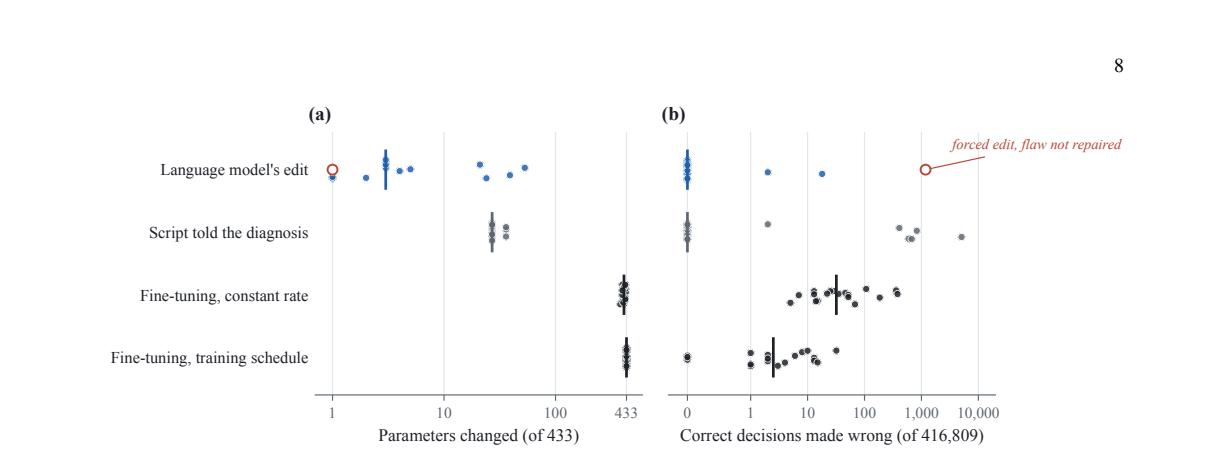
The table does not distinguish, for the trigger rows, an edit made after a forced and false verdict from an edit made after a detection; this matters because the first trigger network's one-parameter edit broke 1,181 correct decisions and is correctly excluded from the 16 repairs, but a reader cannot see that from the row alone. A footnote to the row, matching the open dot in Fig. 3, would remove the ambiguity.
show 6 more
The paper says, at Table III
Pith says: minor objection 3 of 8
Sonnet 5.5's healthy-network entry is "Cleared (forced)" while Table II reports "2/3 cleared (1 forced)" for the panel healthy networks. Please state the convention once and apply it identically across the two tables, so that the cross-model comparison does not treat a forced clearance differently from a first-round one.
The paper says, at §II E and Abstract
Pith says: minor objection 4 of 8
The "about 420,000 requests" figure, the 416,809 of Fig. 3b, and the 399,528 of §III E are used for different counts without a mapping. A short sentence in §II E giving the pool sizes, the number excluded near thresholds, and which pool each quoted error count refers to would let the reader check totals such as the 2,018 decisions broken by the healthy-network false alarm.
The paper says, at §II C
Pith says: minor objection 5 of 8
Because the forced, tentative and interrupted audits carry much of the argument, a per-audit summary table in the manuscript (output tokens, wall-clock, output-limit hits, classifier interruptions, and whether the verdict was forced) would help; at present these must be reconstructed from the prose and the released files, and the eight healthy audits in particular are hard to assemble.
The paper says, at Introduction and Discussion
Pith says: minor objection 6 of 8
Reference [13] is a blog post with experiment records and reference [26] is an X post, which the text labels "an informal online post." The Introduction's characterization of what a frontier model could do rests on [13]. Labelling each as non-peer-reviewed at first citation, rather than only at the foot of the reference list, would be appropriate since these sources motivate the study.
The paper says, at §II D and §IV
Pith says: minor objection 7 of 8
Limitation [b333] concedes that the switch-on statistic and some comparisons were defined after the flaw types were known. Please also state that both statistics were applied per network without knowledge of that network's seed or condition, which is what makes the comparison informative rather than circular.
The paper says, at Fig. 2
Pith says: minor objection 8 of 8
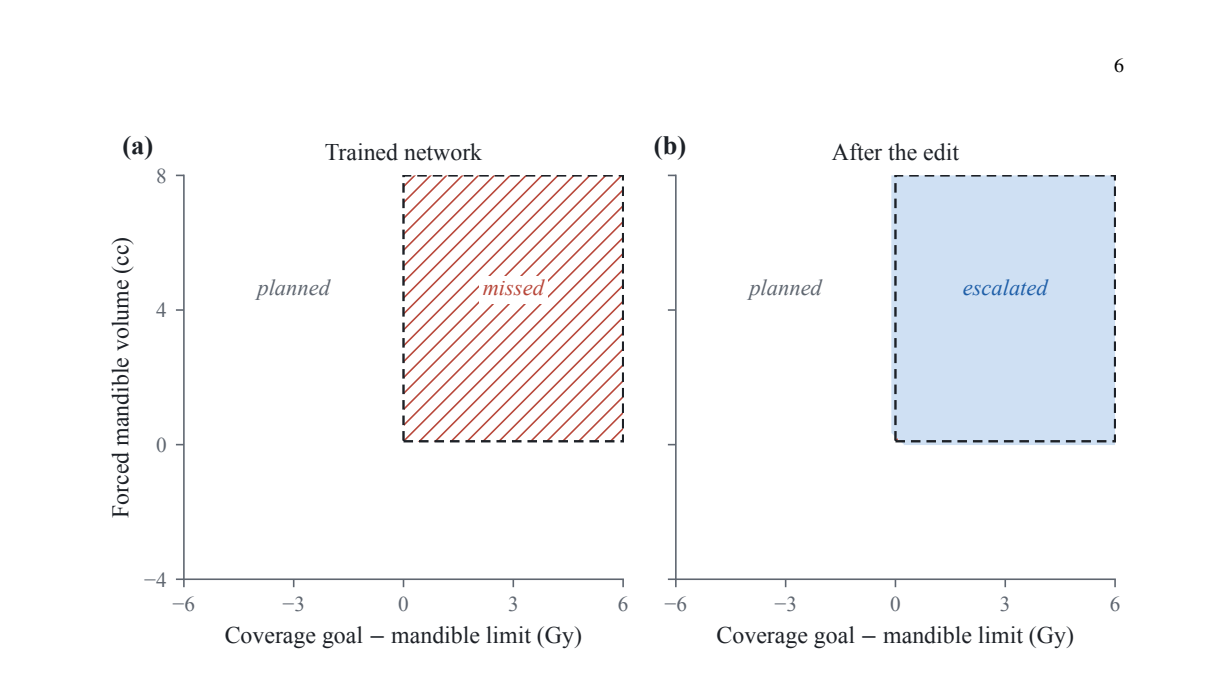
The edit sets the rule-B boundaries at 0.25 Gy and 0.35 cc rather than at 0 and 0.1 cc; this is inside the stated 0.3 tolerance and the Fig. 1 caption says so, but a sentence in §III D tying the figure's offsets to the tolerance would preempt a reader's objection that the repaired network approximates rather than implements the protocol.
What would settle it
Re-run all five healthy networks (two pilot, three panel) five times each with a matched total output budget of about 300,000 tokens, granted as first-round continuations that do not count against the 128,000 per-reply cap, at the same 'high' effort setting and with interruption status logged per audit. Score clearance-without-forcing as in §II E. If clearance rises to 4/5 networks or better once budget is matched and uninterrupted audits are the majority, the abstract's 'cannot yet certify that a network is correct' is an interface artifact of the tested harness and must be reworded; if it stays at roughly 2/5 in uninterrupted, full-budget audits, the capability claim stands as written.
from the skeptic's reading
How the review went
4 readings by deepseek-v4-flash · 4 Nov 2026
- Reader holds up, with conditions
- Skeptic agrees
- Editor wrote the verdict above
- Referee major revision: 3 major objections, 8 minor
Not run on this paper: the simulated authors' defence.
Pith did not check this review's objections against the paper.
The review in full
The review in brief, machine-written
Worth your time, with one caveat about how the headline is worded.
The real contribution is small and honest: this is the first test of weight-space programming on a clinical decision network. Four-rule head-and-neck screening networks of 433 to 4,801 parameters, flaws planted through the training data, and a language model given only the protocol and the raw weights. The authors don't oversell it. They say plainly that the core capability was already reported by Takehi et al., and that testing against the protocol found every flaw faster and in under a second.
The design is the strongest part. Known-answer planting, healthy controls, scoring rules fixed before any panel answer was read, and every claim and every edit checked on about 420,000 requests. There's a no-weights control that predicts the wrong direction on the rule-B confound, random edits of matched size that leave 51% error, a scripted repair told the diagnosis that broke correct decisions in 6 of 18 networks, and fine-tuning that repaired everything but rewrote nearly every parameter. They also tested edits in 16-bit arithmetic and found that repairs writing weights of 1e5 or more silently sent every request to planning. That last check is the kind of thing most groups skip. All weights, instructions, model answers and scripts are released.
Where it's soft. First, the 'cannot yet certify' half of the conclusion at [b9] is a conjunction and the two halves are not equally supported. Certification rests on five healthy networks, and those audits took most of the safety-classifier interruptions and one budget overrun. The authors name this themselves in Section III C [b328] and work through it in the Discussion, so the problem is editorial, not concealment: the abstract should say 'did not clear healthy networks within a 128,000-token budget in an interface that interrupted most of them', which is a statement about the harness as much as the model. Second, the confound and drift diagnoses were all reachable by simple statistics the authors chose with the flaw types known, and they say so. What the language model adds is generality across flaw types plus a small readable repair, not insight no one else can get. Third, three networks per condition and one audit each is thin; the intervals describe networks, not kinds of flaw. The trigger result is partly a training artifact, which they also concede.
Who it's for: medical physicists thinking about commissioning and QA of clinical AI, and anyone who wants a clean worked example of a known-answer evaluation with the right controls. Machine learning people will find the setting toy, correctly.
Send it out. The claim is hedged to the regime tested, the artifacts are there, and the referees will have something concrete to push on: the certification wording and the small healthy-network n.
The strongest objection
The conclusion at [b9] is a conjunction, and the two conjuncts have very unequal support. The positive conjunct (locate and repair confounds and a threshold shift) survives several independent controls: the no-weights comparison predicted the wrong direction on rule B, the column-norm and switch-on statistics show the LLM was not the only route to the diagnosis, and the LLM's edits beat both the scripted repair (which broke 6 of 18) and random edits of the same size. The negative conjunct rests on five networks and fails for a structural reason, not just a small n.
Clearing a network is an exhaustive task: the only sound basis for 'follows' is checking every rule and every relevant unit configuration against the stated ranges. Finding a flaw is not: a partial pass can terminate successfully. The two interface mechanisms that disturbed the healthy audits therefore penalise clearance preferentially. (i) Safety-classifier interruptions hit 5 of 8 healthy audits against 1 of 23 confound/drift/larger audits (§III C, limitation [b328]); the withheld reasoning is never seen or scored, and the model is told not to reproduce it. (ii) The one unforced clearance needed about 275,000 output tokens, above the 128,000 per-reply cap, and only succeeded because a classifier interruption did not count toward the limit (§III C). A third clearance came from a verdict the model itself labelled 'a tentative reading of the weights, not a checked result.'
So the failures are not a random sample of audits; they concentrate on the task variant where the budget is genetically insufficient. The abstract nevertheless states 'cannot yet certify that a network is correct' as a result. What the data license is narrower: 'did not clear healthy networks within a 128,000-token per-reply budget in an interface that interrupted most of those audits.' That is a statement about the harness as much as the model.
I reach the same load-bearing concern as the reader's weakest_assumption, and I would keep CONDITIONAL. My addition is that the healthy-network result is not merely underpowered but directionally biased: the two disturbance mechanisms (classifier truncation, per-reply output cap) fall on precisely the task variant that cannot succeed on a partial pass, because 'follows' requires exhausting the rule and unit space while 'deviates' can terminate early. The detection rate is therefore robust to the same disturbances by construction, and the two halves of [b9] should not be read as equally evidenced.
I did not find a load-bearing problem in the positive half. The controls are unusually good for this genre: scoring rules fixed before the panel answers were read (§II E); independent pools of about 420,000 and, per repair, about 20 million further requests; a no-weights control that predicted the opposite of the planted failure; the informative negative comparisons (scripted repair with the diagnosis supplied broke correct decisions in 6 of 18 networks, versus 2 of 16 for the LLM's edits; random edits of matched size left 51% mean error in the planted region); and disclosure that several repairs wrote weights above 1e5 and collapse to 24.8% accuracy in 16-bit arithmetic, with the failure falling on the unsafe side. The authors also state unaided the points a critic would otherwise raise: every confound and drift was visible in single units and matched by a simple statistic chosen with the flaw types known [b7], testing against the protocol separated all 21 panel networks in 0.4 s, the trigger networks did not learn the intended clean window [b331], each network carried one planted flaw [b326], and the study was not preregistered [b333]. I take these as acknowledged, not as new findings.
Two checks I ran before writing this. The Wilson intervals reproduce: 16/18 gives 67% to 97% and 15/15 gives 80% to 100%. The healthy-network accounting is internally consistent between Table II ('2/3 cleared (1 forced)') and §III C (three of five cleared overall, two without forcing, one false alarm with a 2,018-decision collateral edit, one with no verdict). So the arithmetic and the bookkeeping are not where the soft spot is; the soft spot is the interpretation of the clearance failures.
The reason I do not move the verdict is that the reader's CONDITIONAL already carries this concern, and the fix is editorial plus one follow-up experiment rather than a change in the paper's standing. If the matched-budget rerun clears 4 of 5 healthy networks, the appropriate revision is to soften the second half of [b9] and the abstract's closing sentence to describe a harness limit; the detection and repair claims, which are hedged to exactly the regime tested, would be unaffected.
The referee's report
This is, as far as I am aware, the first controlled test of weight-space programming on clinical decision networks, and the design is unusually disciplined for this literature: known-answer planting with healthy controls, scoring rules fixed before any panel answer was read, every claimed deviation and every edit tested on roughly 420,000 requests rather than taken on trust, two pre-specified sensitivity analyses, and a no-weights control that rules out protocol-only guessing. The paper also gives credit where it costs the authors: it reports that single-unit weight statistics found the same confounds and drifts, that testing against the protocol was faster and separated every flawed from every healthy network, and that fine-tuning repaired all 18 networks, which limits the practical novelty of the positive result to repair minimality and auditability. The 16-bit overflow finding is a useful safety observation, the full release of weights, instructions, answers, settings and scripts makes every number checkable, and the claims are falsifiable. If it holds, a three-parameter, human-readable repair of a commissioned network with no retraining is a genuinely new option.
Pith's reading of the paper (a machine's summary, not the authors')
This paper tests whether a frontier language model, given only a clinical protocol and the raw weights of a small neural network, can audit and repair the network without data, training, or code execution. Across networks of 433 to 4,801 parameters screening head-and-neck planning requests, the model named the broken rule in 16 of 18 networks with planted flaws, including all 15 with a confound or a 3 Gy threshold shift, and repaired each by changing a median of 3 parameters, with 14 of 16 repairs making no correct decision wrong on about 420,000 test requests. The intended use is commissioning, where testing on known-answer cases cannot reveal a shortcut the test cases share with the training data, whereas reading the weights can expose and, here, repair the flaw. The paper is equally explicit about the boundary: the model cleared only 2 of 5 healthy networks without being forced and found 1 of 3 hidden triggers, so it cannot yet certify that a network is correct.
What carries the argument. Weight-space programming, in which the language model reads the raw weights of a small ReLU network, identifies which inputs each unit reads, computes each unit's switch-on point from its bias and weights, and checks the network's output by hand at chosen requests. For a first-layer unit driven mainly by the cord limit and cord floor with weights of opposite signs, the switch-on point is a cord deficit of $-10b/w$ Gy, where $b$ is the bias and $w$ the cord-floor weight. Flaws were visible in single units: a silenced rule leaves weak first-layer weights on its inputs, which a column-norm statistic finds, and a shifted threshold moves the cord units' switch-on point, which a switch-on statistic finds. Repairs were written either by moving one to three biases (for the drift) or by writing new detectors into the least-active first- and second-layer units and adding a large escalate vote (for the confounds). Every claimed deviation and repair was then tested on about 420,000 requests rather than trusted.
Core claim. The central claim is that, in small decision networks, weight-space programming can locate and repair flaws that silence an input group or shift a threshold, but cannot yet certify that a network is correct. Concretely, the language model named the broken rule in 16 of 18 flawed networks (95% CI 67% to 97%) — all 15 carrying a confound or a cord-threshold drift, plus one of three trigger networks — and every named flaw was repaired by changing a median of 3 parameters (range 1 to 53), with 14 of 16 repairs leaving no previously correct decision wrong on roughly 420,000 test requests. The repairs were narrow enough to be read and checked by a physicist, in contrast to fine-tuning, which repaired every network but changed nearly all 433 parameters. Every confound and drift the model found was visible in single units, and a simple weight statistic chosen for each flaw type found the same flaws; the model's added value was that it was not told which kind of flaw to look for, chose a check suited to each network, and wrote a repair. The second half of the claim is the fragile one: the model cleared only 2 of 5 healthy networks without being forced and found only 1 of 3 hidden triggers, and the authors state that the certification result matters most for commissioning.
The premise it rests on. The 'cannot yet certify' half of the conclusion rests on only five healthy networks, and most of those audits were disturbed by the interface's safety classifier, output limits, or a monitoring fault, so the failures may reflect the test harness rather than the model's ability.
If the paper is right (Pith's inferences, not the authors')
A repair that changes three parameters can be read and checked by a physicist, and the rest of the commissioned network is left untouched, unlike fine-tuning, which repaired every network but changed nearly every parameter.
Weight-space programming adds a written account of mechanism — which units carry each rule and which are unused — while testing against the protocol detects every flaw in under a second and black-box testing finds the confounds and drift faster.
Repairs that write weights of $10^5$ or more fail in 16-bit floating point and send every request to automated planning, so any repair must be tested in the arithmetic in which it will run.
The approach worked at 4,801 parameters as quickly as at 433, but clinical models are orders of magnitude larger, and hidden triggers can be built so that no efficient inspection of the weights reveals them.
The certification half of the conclusion is under-tested: only five healthy networks were audited, and the authors record that safety-classifier interruptions hit 5 of the 8 healthy audits against 1 of 23 confound and drift audits, one audit was cut by a monitoring fault, and one clearance needed about 275,000 output tokens, more than a first-round audit can use; the paper cannot separate model in
A testable extension would audit the same healthy networks with a matched reasoning budget, no safety-classifier interruptions, and a workspace for calculation; if clearances rose markedly, the 'cannot certify' result would be attributable to the harness rather than to the model.
Because a simple single-unit statistic found every confound and drift, the detection result may owe little to deep reasoning; the language model's distinctive contributions are choosing the right check per network and writing a narrow, inspectable repair.
The natural next test is a planning agent built on a language model, whose intended behavior cannot be written as four rules — the setting where reading weights, rather than testing against an exact protocol, would add the most.
Check this review
Pith stored no record of this review's passes and took no fingerprint of it. Reviews made by code from 13 Nov 2026 on carry both.
How often reviews like this one are right
Reviews like this one: written by deepseek-v4-flash, where what was read was not recorded.
How often objections from reviews like this one are right: not yet measured
Reviews by people
This review was written by a machine. No person has reviewed this paper on Pith yet. A scientist listed on Pith can review it for a fee, and their review is published here whatever it concludes.
The paper
Abstract
Machine learning models in radiotherapy are commissioned by testing them on cases with known answers, which may not reveal a shortcut that the test cases share with the training data. Frontier language models have recently been reported to read and write the raw weights of small neural networks, an ability called weight-space programming. The purpose of this study was to determine whether such a model, given only a clinical protocol and a network's weights, can audit and repair the network. Networks with 433 to 4,801 parameters were trained to screen head-and-neck planning requests against four rules. Flaws were planted through the training data: confounds that hid each rule, a 3 Gy shift in the cord threshold, and a hidden trigger. Claude Opus 5.5 audited each network blind, without tools, data or code execution, and every claim and repair was tested on about 420,000 requests. The language model named the broken rule in 16 of 18 flawed networks (95% CI 67% to 97%), including all 15 with a confound or a threshold shift. It repaired each of the 16 by changing a median of 3 parameters. Fine-tuning on protocol-labeled requests also repaired every network, but changed nearly every parameter. Each confound and shift it found was visible in single units, and a simple statistic chosen for each flaw type found the same flaws. It cleared 2 of 5 healthy networks without being forced and found 1 of 3 triggers. Testing against the protocol detected every flaw, and black-box testing found the confounds and the shift faster. The results indicate that, in small networks, weight-space programming can locate and repair flaws that silence an input or shift a threshold, but cannot yet certify that a network is correct.
The paper's own sentences, arranged, kept beside the review and separate from it. Each label is drawn from a closed vocabulary; the number beside it is the probability the classifier gave that label. No sentence in this record was written by a model.
abstract compiled · 2026-11-04
The authors' main claim, as the classifier picked it out 1.00
“The results indicate that, in small networks, weight-space programming can locate and repair flaws that silence an input or shift a threshold, but cannot yet certify that a network is correct.”
How the main claim is stated: hedged possibility 0.97
What the abstract itself states, as probabilities: claims first 0.06 · states limitation 0.97 · human participants 0.12 · controlled comparison 0.73 · randomized assignment 0.02 · states quantitative result 0.99 · compares with prior results 0.92 · mentions code or data availability 0.03
The abstract, sentence by sentence
This table labels the abstract only (arXiv listing abstract v1). The number is the probability the classifier gave the label.
| Sentence | Role | The authors' own work | States the main conclusion | Strength |
|---|---|---|---|---|
| Machine learning models in radiotherapy are commissioned by testing them on cases with known answers, which may not reveal a shortcut that the test cases share with the training data. | background 0.88 | 0.06 | 0.02 | hedged possibility 0.97 |
| Frontier language models have recently been reported to read and write the raw weights of small neural networks, an ability called weight-space programming. | background 1.00 | 0.04 | 0.02 | asserted 0.91 |
| The purpose of this study was to determine whether such a model, given only a clinical protocol and a network's weights, can audit and repair the network. | contribution 0.94 | 0.41 | 0.03 | unclear 0.45 |
| Networks with 433 to 4,801 parameters were trained to screen head-and-neck planning requests against four rules. | method 0.98 | 0.93 | 0.02 | asserted 1.00 |
| Flaws were planted through the training data: confounds that hid each rule, a 3 Gy shift in the cord threshold, and a hidden trigger. | method 0.98 | 0.93 | 0.02 | asserted 1.00 |
| Claude Opus 5.5 audited each network blind, without tools, data or code execution, and every claim and repair was tested on about 420,000 requests. | method 0.99 | 0.90 | 0.03 | asserted 1.00 |
| The language model named the broken rule in 16 of 18 flawed networks (95% CI 67% to 97%), including all 15 with a confound or a threshold shift. | result 1.00 | 0.92 | 0.10 | asserted 1.00 |
| It repaired each of the 16 by changing a median of 3 parameters. | result 1.00 | 0.92 | 0.05 | asserted 1.00 |
| Fine-tuning on protocol-labeled requests also repaired every network, but changed nearly every parameter. | result 0.99 | 0.91 | 0.03 | asserted 1.00 |
| Each confound and shift it found was visible in single units, and a simple statistic chosen for each flaw type found the same flaws. | result 0.99 | 0.84 | 0.04 | asserted 1.00 |
| It cleared 2 of 5 healthy networks without being forced and found 1 of 3 triggers. | result 0.97 | 0.89 | 0.04 | asserted 1.00 |
| Testing against the protocol detected every flaw, and black-box testing found the confounds and the shift faster. | result 1.00 | 0.90 | 0.06 | asserted 1.00 |
| The results indicate that, in small networks, weight-space programming can locate and repair flaws that silence an input or shift a threshold, but cannot yet certify that a network is correct. | interpretation 0.99 | 0.92 | 0.96 | hedged possibility 0.97 |
What kind of paper the classifier reports this is: empirical study 0.96 · evidence from observation or experiment 0.67
What was examined, and what was not
Sources read
- arXiv listing abstract v1
Not examined
- full text
- figures and tables
- references and citing sentences
- relations to other papers
Levels run
- P abstract
Not run
- S sections
- T body sentences
- C citations
- R cross-paper relations
How the labels were made
Compiled by classifier-1.13.0 via TypeSafe API, question bank abstract-p1-20260923, 2026-11-04: 1 request, 9,545 input tokens.
Every quoted sentence on this record is the authors'. Every label is from Pith's closed vocabulary, with the probability shown beside it. This record as JSON
Figures (3)

Figures are the authors', reproduced from the paper.
References (28)
- [1] L. Vandewinckele, M. Claessens, A. Dinkla,et al., Overview of artificial intelligence-based applications in radiotherapy: recommendations for implementation and quality assur- ance, Radiother. Oncol.153, 55–66 (2020), doi:10.1016/ j.radonc.2020.09.008 on Pith
- [2] A. M. Kalet, J. H. Gennari, E. C. Ford, and M. H. Phillips, Bayesian network models for error detection in radiotherapy plans, Phys. Med. Biol.60, 2735–2749 (2015), doi:10.1088/ 0031-9155/60/7/2735 on Pith
- [3] S. M. H. Luk, J. Meyer, L. A. Young,et al., Characterization of a Bayesian network-based radiotherapy plan verification model, Med. Phys.46, 2006–2014 (2019), doi:10.1002/mp.13515 on Pithdoi:10.1002/mp.13515
- [4] G. Mahadevaiah, P. Rv, I. Bermejo, D. Jaffray, A. Dekker, and L.Wee,Artificialintelligence-basedclinicaldecisionsupportin modernmedicalphysics:selection,acceptance,commissioning, and quality assurance, Med. Phys.47, e228–e235 (2020), doi:10.1002/mp.13562 on Pithdoi:10.1002/mp.13562
- [5] C. Hurkmans, J. E. Bibault, K. K. Brock,et al., A joint ESTRO and AAPM guideline for development, clinical validation and reporting of artificial intelligence models in radiation therapy, Radiother. Oncol.197, 110345 (2024), doi:10.1016/j.radonc.2024.110345 on Pithdoi:10.1016/j.radonc.2024.110345
- [6] R. Geirhos, J. H. Jacobsen, C. Michaelis,et al., Shortcut learningindeepneuralnetworks,Nat.Mach.Intell.2,665–673 (2020), doi:10.1038/s42256-020-00257-z on Pithdoi:10.1038/s42256-020-00257-z
- [7] J. R. Zech, M. A. Badgeley, M. Liu, A. B. Costa, J. J. Titano, and E. K. Oermann, Variable generalization performance of a deep learning model to detect pneumonia in chest radiographs: a cross-sectional study, PLoS Med.15, e1002683 (2018), doi:10.1371/journal.pmed.1002683 on Pithdoi:10.1371/journal.pmed.1002683
- [8] A. J. DeGrave, J. D. Janizek, and S. I. Lee, AI for radiographic COVID-19 detection selects shortcuts over signal, Nat. Mach. Intell.3, 610–619 (2021), doi:10.1038/s42256-021-00338-7 on Pithdoi:10.1038/s42256-021-00338-7
- [9] N. Elhage, N. Nanda, C. Olsson,et al., A mathematical frame- work for transformer circuits, Transformer Circuits Thread (2021), https://transformer-circuits.pub/2021/framework/ index.html on Pith
- [10] N. Nanda, L. Chan, T. Lieberum, J. Smith, and J. Steinhardt, Progressmeasuresforgrokkingviamechanisticinterpretability, inInternational Conference on Learning Representations (2023), arXiv:2301.05217 on PithPith's reviewarXiv
- [11] S. Schwettmann, T. Rott Shaham, J. Materzynska,et al., FIND: afunctiondescriptionbenchmarkforevaluatinginterpretability methods,inAdvancesinNeuralInformationProcessingSystems, Vol. 36 (2023) pp. 75688–75715, doi:10.52202/075280-3308 on Pithdoi:10.52202/075280-3308
- [12] A. Conmy, A. N. Mavor-Parker, A. Lynch, S. Heimersheim, and A. Garriga-Alonso, Towards automated circuit discovery for mechanistic interpretability, inAdvances in Neural Infor- mation Processing Systems, Vol. 36 (2023) pp. 16318–16352, doi:10.52202/075280-0719 on Pithdoi:10.52202/075280-0719
- [13] R. Takehi, J. Teoh, A. Zhang, and O. Khattab, Sparks of weight-space programming: LLMs can natively read and write neural network weights, Blog post (2 November 2026), https://rikiyat.github.io/blog/weight-space-programming/. Experiment records: https://github.com/RikiyaT/ lm_... on Pith
- [14] K. Kabra, C. Venhoff, and C. Schroeder de Witt, Weight oracles: reading neural network weights with language models, arXiv:2610.07334 (2026) on PithPith's reviewarXiv
- [15] T. Unterthiner, D. Keysers, S. Gelly, O. Bousquet, and I. Tol- stikhin, Predicting neural network accuracy from weights, arXiv:2002.11448 (2020) on PithPith's reviewarXiv
- [16] T. Huster, P. Lin, R. Stefanescu, E. Ekwedike, and R. Chadha, Solving trojan detection competitions with linear weight classification, arXiv:2411.03445 (2024) on PithPith's reviewarXiv
- [17] G. Katz, C. Barrett, D. L. Dill, K. Julian, and M. J. Kochen- derfer, Reluplex: an efficient SMT solver for verifying deep neural networks, inComputer Aided Verification (CAV 2017), Lecture Notes in Computer Science, Vol. 10426 (Springer, on Pith
- [18] V. Tjeng, K. Xiao, and R. Tedrake, Evaluating robustness of neural networks with mixed integer programming, inIn- ternational Conference on Learning Representations(2019), arXiv:1711.07356 on PithPith's reviewarXiv
- [19] B. Goldberger, G. Katz, Y. Adi, and J. Keshet, Minimal modifi- cations of deep neural networks using verification, inLPAR-23: 23rd International Conference on Logic for Programming, Ar- tificial Intelligence and Reasoning(EPiC Series in Computing, vol 73, 2020), doi:10.29007/699q on Pithdoi:10.29007/699q
- [20] M. Sotoudeh and A. V. Thakur, Provable repair of deep neural networks, inProceedings of the 42nd ACM SIGPLAN International Conference on Programming Language De- sign and Implementation (PLDI)(ACM, 2021) pp. 588–603, doi:10.1145/3453483.3454064 on Pithdoi:10.1145/3453483.3454064
show 8 more
- [21] H.NusratandK.Thind,OpenGray:abenchmarkforevaluating thedecisionsofradiotherapyplanningagents,arXiv:2610.37081 (2026) on PithPith's reviewarXiv
- [22] G. Weiss, Y. Goldberg, and E. Yahav, Thinking like transform- ers, inProceedings of the 38th International Conference on Machine Learning (ICML)(2021), arXiv:2106.06981 on PithPith's reviewarXiv
- [23] D. Lindner, J. Kramár, S. Farquhar, M. Rahtz, T. McGrath, and V. Mikulik, Tracr: compiled transformers as a laboratory for interpretability, inAdvances in Neural Information Processing Systems, Vol. 36 (2023), arXiv:2301.05062 on PithPith's reviewarXiv
- [24] S. Goldwasser, M. P. Kim, V. Vaikuntanathan, and O. Zamir, Planting undetectable backdoors in machine learning mod- els, in2022 IEEE 63rd Annual Symposium on Foundations of Computer Science (FOCS)(IEEE, 2022) pp. 931–942, doi:10.1109/FOCS54457.2022.00092 on Pithdoi:10.1109/focs54457.2022.00092
- [25] A. Draguns, A. Gritsevskiy, S. R. Motwani, C. Rogers-Smith, J. Ladish, and C. Schroeder de Witt, Unelicitable backdoors in language models via cryptographic transformer circuits, in Advances in Neural Information Processing Systems, Vol. 37 (2024), arXiv:2406.02619 on PithPith's reviewarXiv
- [26] A. Krentsel, Reproduction of the weight-space programming resultsacrossmodelgenerations,PostonX(2November2026), https://x.com/AlexKrentsel/status/2117376683724660898. Informal online post. 12 on Pith
- [27] P. Singh, S. Kumar, and A. Agarwal, Beyond end- point gains: a weight-delta audit of medical specializa- tion, inFindings of the Association for Computational Linguistics: EMNLP 2026(2026) pp. 25360–25378, https://aclanthology.org/2026.findings-emnlp.1200/. Appendix A: Instruc... on Pith
- [2017] pp. 97–117, doi:10.1007/978-3-319-63387-9_5 on Pithdoi:10.1007/978-3-319-63387-9_5
Cited by 8 Pith papers
Reviewed papers on Pith that cite this one. The full citation record
- When Can a Rewiring Control Test LLM Weight Readers? C2 and an Eligibility Protocol cs.LG · Nov 2026
- Weight Space Programming for Vision Language Model Repair cs.CV · Nov 2026
- Compiling Known Rules into Compact Neural Agents: Weight-Space Programming on Unseen Games cs.AI · Nov 2026
- Owned Edits to a Shared Decision Rule: Learning Private Exceptions as Typed, Gated, Withdrawable Weight Edits cs.LG · Nov 2026
- Weight-Space Programming for Materials Science cond-mat.mtrl-sci · Nov 2026
- Weight-space programming for tractor guidance controller: large language models natively write neural network weights that steer a real tractor cs.LG · Nov 2026
- Computation, not weight access: large language models as auditors of clinical prediction networks cs.LG · Nov 2026
- Temporal Weight Surgery: Repairing Video Grounding with LLM Editors cs.CV · Nov 2026
Challenges and discussion
Disagree with the review, or know something it missed? Leave a comment, or challenge this review formally: a challenge becomes a permanent entry in this paper's record, and its decision is published here.
Come back by email
A short list of the week's newly reviewed papers. Nothing is sent until you confirm from your inbox, and every email has a link that stops it. No account.
No comments yet.
Sign in to comment