Computer Vision and Pattern Recognition · arXiv:2611.33339 v1 · submitted 24 Nov 2026 · 44 references
Temporal Weight Surgery: Repairing Video Grounding with LLM Editors
The paper says
“A surgeon first finds what is wrong, then fixes only that part. We use this idea for video grounding, where video-language models often find the right moment in a long video but write its time wrong.”
more of the abstract
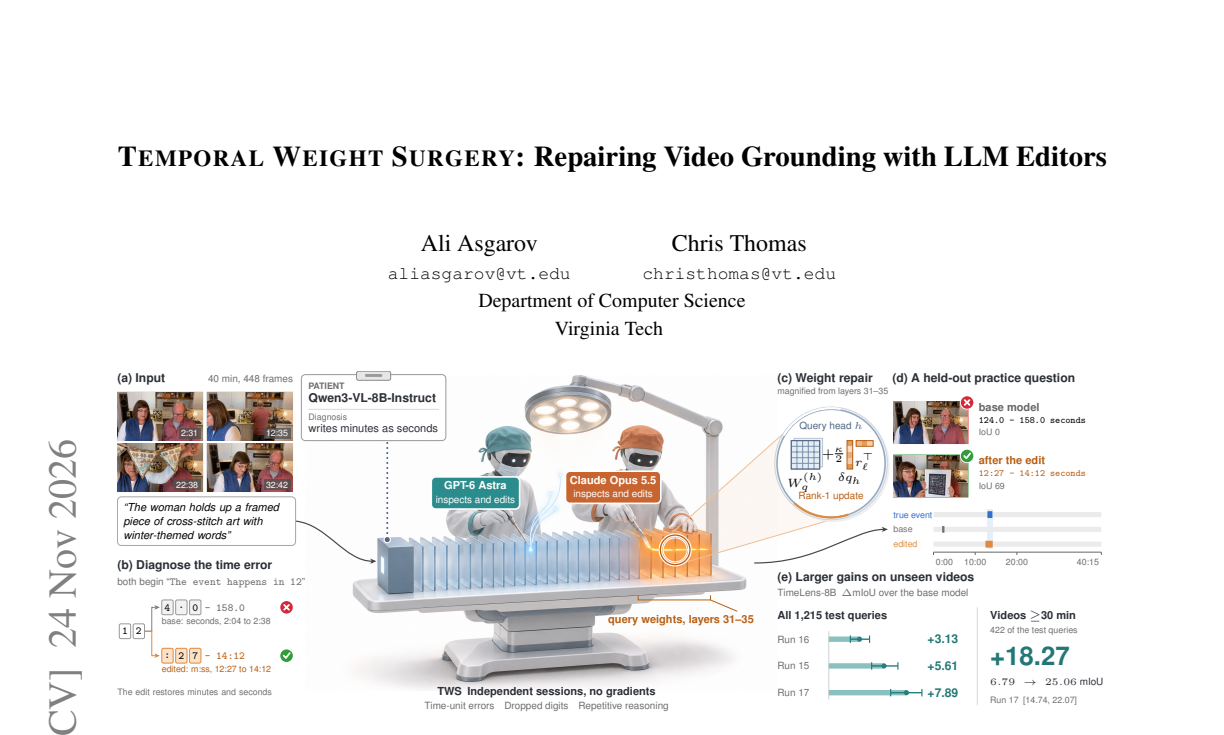
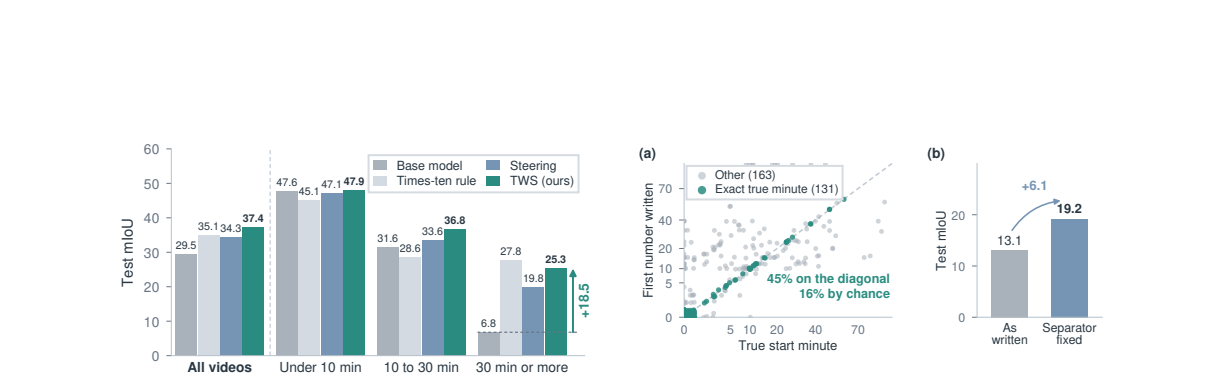
In Temporal Weight Surgery (TWS), a general-purpose LLM reads the model's weights and activations, finds where the error arises and repairs it there, without gradients. Separate sessions find the same cause, and this diagnosis of where and why the model fails is our main contribution. Three GPT-6 Astra sessions trace a dropped digit in TimeLens-8B to one MLP layer, and the largest edit gains 7.9 mIoU on 1,215 unseen questions and 18.3 on videos of 30 minutes or more. Two Claude Opus 5.5 sessions trace minutes written as seconds in Qwen3-VL-8B to the separator and gain 2.9 and 1.3. Before any edit, its answers often have the right minute and the wrong separator, and fixing only the separator lifts their mIoU from 13.1 to 19.2. Every improving edit beats a random edit of its size, and the edited models run as fast as before.
from the abstract
Pith says
Machine review · deepseek-v4-flash · 26 Nov 2026 · read the full text (178,748 characters) · not checked by a person
It can be wrong. Challenge this review or reply to it.
Holds up. Temporal Weight Surgery shows that a general-purpose LLM, without gradients, can diagnose and repair timestamp errors in video-language models by editing a few weight tensors, and independent sessions converge on the same cause. This line is wrong
7 minor
How often objections from reviews like this one are right: not yet measured
The paper, first character to last
The reviewer was given the whole text, 178,748 characters. Not checked: figures, code, what the 44 references say.
7 minor objections
The paper says, at Section 1
Pith says: minor objection 1 of 7
The editors are proprietary black-box LLMs (Claude Opus 5.5, GPT-6 Astra). The reasoning behind the edits is not transparent, and the experiments are not fully reproducible without access to these models. The paper acknowledges this limitation, but it is load-bearing for the central claim that a general-purpose LLM can diagnose and repair errors.
more of objection 1
The authors should discuss the extent to which the results depend on the specific capabilities of these models and whether similar results could be obtained with open-source LLMs.
The paper says, at Section 6
Pith says: minor objection 2 of 7
The number of successful sessions is small (8 out of 21 submitted edits improve test sets). The paper acknowledges this, but the claim that 'separate sessions find the same cause' is based on only three Astra sessions on TimeLens-8B and two Claude sessions on Qwen3-VL-8B. The authors should provide a more detailed analysis of the variability across sessions and the conditions under which the method succeeds or fails, beyond the brief discussion in the supplement.
show 5 more
The paper says, at Section 3.2
Pith says: minor objection 3 of 7
Section 3.2: The description of the forward-pass tool could be clearer. What exactly does 'teacher forcing' mean in this context? Please define explicitly.
The paper says, at Table 1 caption
Pith says: minor objection 4 of 7
Table 1: The column 'Edit vs. control' could be better explained. Is the control a random edit of the same size? Please add a footnote or clarify in the caption.
The paper says, at Figure 5 caption
Pith says: minor objection 5 of 7
Figure 5: The axes labels are small and hard to read. Please increase font size or use a different layout.
The paper says, at Section 3.1
Pith says: minor objection 6 of 7
The paper uses 'mIoU' but the scale is 0-100. Clarify in the text that mIoU is reported on a 0-100 scale, not 0-1.
The paper says, at Section 1
Pith says: minor objection 7 of 7
The reference to 'Takehi et al. 2026' is a blog post, not a peer-reviewed publication. The paper should note this explicitly when citing it as the source of the core concept.
What would settle it
Run a new session on a model with a known timestamp error not covered in the paper (e.g., a model that systematically writes times in the wrong time zone or uses a different unit format) and verify that the editor identifies the correct cause and location, and that the resulting edit improves test performance. If the editor fails to diagnose the error or the edit does not generalize, the claim that the method works for arbitrary timestamp errors would be weakened.
from the skeptic's reading
How the review went
5 passes by deepseek-v4-flash · 26 Nov 2026
- Reader holds up
- Skeptic agrees
- Referee 7 minor
- Check against the paper kept 0 of 3 objections
- Editor wrote the verdict above
Not run on this paper: the simulated authors' defence.
Pith's passes raised 3 objections. A check against the paper's text kept 0, withdrew 1 (1 the paper already says) and moved 2 to the minor objections.
The review in full
The review in brief, machine-written
This paper applies weight-space programming—having an LLM read and edit another model's weights—to temporal video grounding. The main finding is that a general-purpose LLM (Claude Opus 5.5 or GPT-6 Astra) can inspect activations and weights of a video-language model, identify where timestamp errors arise (a dropped digit in TimeLens-8B, minutes written as seconds in Qwen3-VL-8B), and repair them by editing one to five weight tensors, without gradients. Three independent Astra sessions on TimeLens-8B all trace the same error to the same MLP layer and edit along the same output direction, which is a striking demonstration of convergent diagnosis. The largest edit gains 7.9 mIoU on 1,215 unseen test questions and 18.3 on videos of 30 minutes or more. Every improving edit beats a random edit of its size, and the paper provides careful controls (steering, output rules, random edits, bootstrap intervals). The authors are honest about limitations: few sessions per setting, proprietary editors whose reasoning is not fully transparent, and modest gains compared to supervised fine-tuning (LoRA gives much larger improvements). The edits can also harm other tasks—run 17 degrades timestamped captioning on ActivityNet Captions, and run 16 drops decimal-point accuracy on text-only tests. The central claim depends on the editor's ability to diagnose correctly, and the paper does not establish that this generalizes to other error types or models without a correctable failure. The work is a solid empirical demonstration of a new paradigm for model repair. It deserves serious peer review. The main revisions should address the side effects on other tasks, provide more analysis of when the diagnosis fails, and clarify the scope of the claims.
The strongest objection
The paper provides a thorough empirical demonstration of Temporal Weight Surgery, with multiple independent sessions, random controls, steering baselines, and statistical tests. The central claim—that a general-purpose LLM can diagnose and repair timestamp errors in video-language models by inspecting weights and activations—is supported by the evidence. The editors are proprietary, but the paper mitigates this by releasing session records, edits, and scoring scripts, and by showing that independent sessions converge on the same diagnosis. The limitations (few sessions per setting, proprietary editors, limited generality) are explicitly acknowledged. I cannot identify a load-bearing concern that would change the verdict.
The reader's weakest assumption is that the editor LLM can reliably diagnose the cause of timestamp errors by inspecting weights and activations on practice questions, and that this diagnosis generalizes to unseen test videos. The paper provides strong empirical evidence for this: three independent Astra sessions on TimeLens-8B converge on the same output direction and layer; two independent Claude sessions on Qwen3-VL-8B reach the same diagnosis (minutes written as seconds) and edit the same region; all improving edits beat random edits of the same size; and the diagnosis is validated by the separator-only experiment (Section 5.3) and activation patching (Supplementary Section 7.3). The paper also shows that an editor with only answers finds the same errors but gains less, confirming that weight inspection adds value. While the editors are proprietary and the number of sessions is limited, the paper is transparent about these limitations and does not overclaim. The evidence is sufficient to support the central claim, and no internal inconsistency or missing control undermines it.
The referee's report
Not published. Pith's referee wrote this assessment before its objections were checked against the paper, and 1 of its 3 major objections did not survive that check.
Pith's reading of the paper (a machine's summary, not the authors')
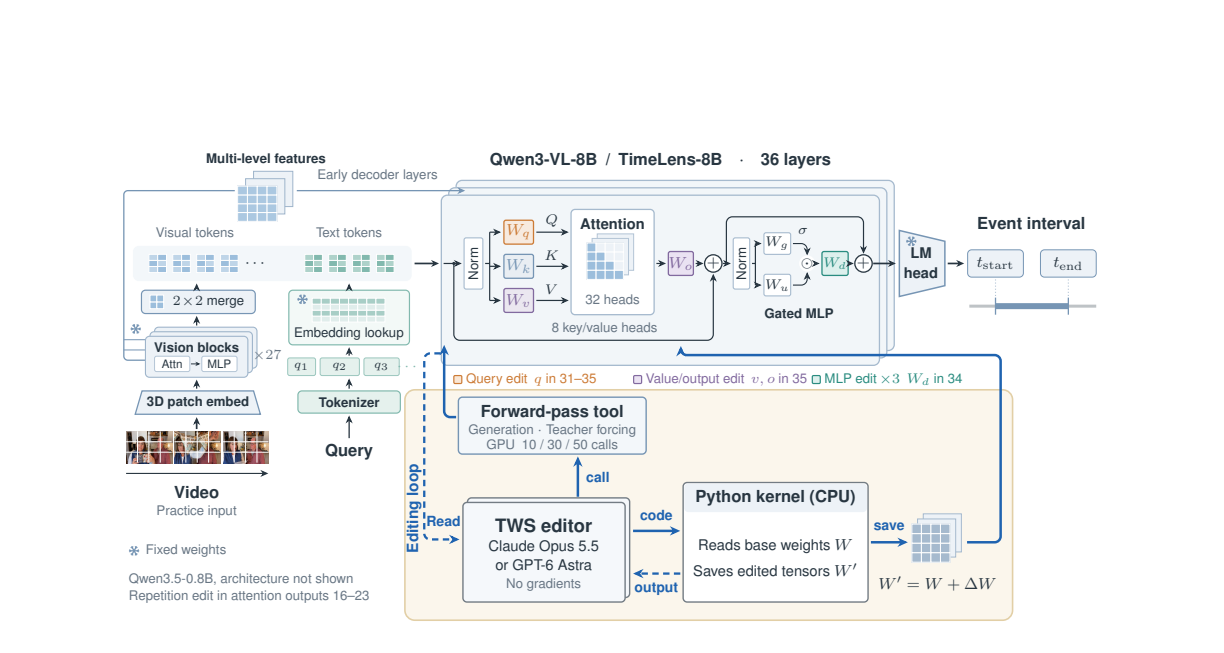
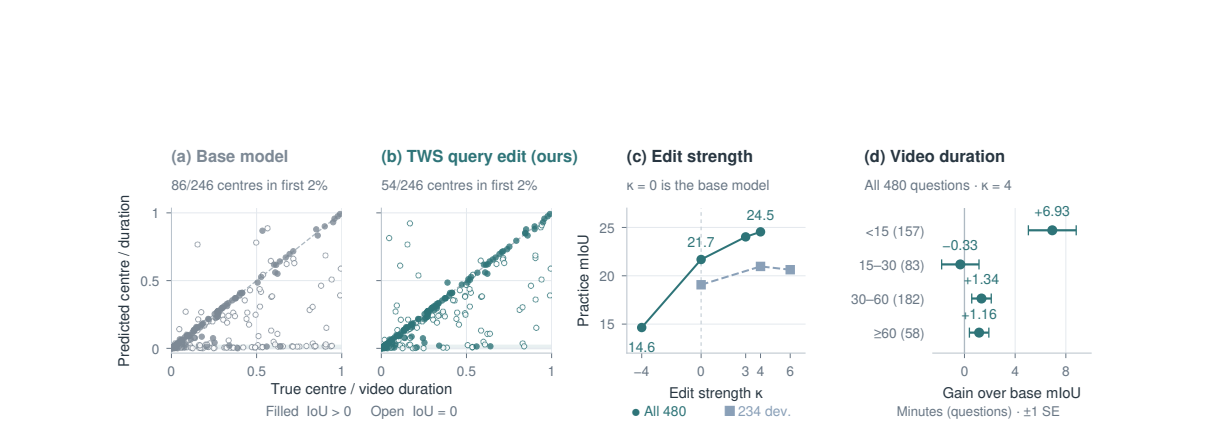
Temporal Weight Surgery (TWS) is a method in which a general-purpose LLM reads the weights and activations of a video-language model, identifies where timestamp errors arise, and repairs them by editing one to five weight tensors. The paper demonstrates this on two models: TimeLens-8B, where a dropped digit is traced to one MLP layer, and Qwen3-VL-8B, where minutes written as seconds are traced to the separator token in the last five layers. The diagnosis of where and why the model fails is the main contribution; once the failure is located, simpler repairs such as activation steering can also work. The largest edit gains 7.9 mIoU on 1,215 unseen test questions and 18.3 on videos of 30 minutes or more.
What carries the argument. The key machinery is the TWS procedure: an LLM editor (Claude Opus 5.5 or GPT-6 Astra) inspects the target model's weights and activations through two tools—a Python kernel for reading and writing tensors, and a forward-pass tool for running practice questions and returning scores and hidden states. The editor tests hypotheses on practice questions, builds a candidate weight update, and submits one edit. The edits are rank-1 updates to specific tensors, such as an MLP output projection or query projections, that change the model's decision at the error point without affecting other computations.
Core claim. The central claim is that a general-purpose LLM, without gradients, can find where in its weights a video-language model writes the time wrong, and repair it there in one to five weight tensors, at no inference cost. The paper shows that three independent GPT-6 Astra sessions trace a dropped digit in TimeLens-8B to the same MLP layer and edit the same output direction, and two Claude Opus 5.5 sessions trace minutes written as seconds in Qwen3-VL-8B to the separator choice in the last five layers. The diagnosis is the main contribution; it reveals that Qwen3-VL-8B often holds the correct minute but writes the wrong separator, and that TimeLens-8B drops a digit because its training set contains no four-digit times.
The premise it rests on. The central claim depends on the assumption that the editor LLM can reliably diagnose the cause of timestamp errors by inspecting weights and activations on practice questions, and that this diagnosis generalizes to unseen test videos.
If the paper is right (Pith's inferences, not the authors')
Timestamp errors in video grounding can be repaired without retraining or gradient computation.
The diagnosis of where and why the model fails can be reused by simpler repairs such as activation steering.
The method may generalize to other output decisions of video models, such as units, formats, and counts.
The edited models run as fast as before, with no inference overhead.
The approach provides an explanation tied to a small number of weight tensors, unlike black-box fine-tuning.
The method's reliance on proprietary LLM editors (Claude, GPT-6 Astra) whose reasoning is not fully transparent means the diagnosis may not be reproducible with open models.
The paper's screening procedure, which starts a session only if a repair could gain at least 5 mIoU, suggests the method works best when a clear, correctable error exists; models without such errors may not benefit.
The fact that the best Astra edits on TimeLens-8B and Qwen3-VL-2B exceed steering built from the same diagnosis, while Claude edits on Qwen3-VL-8B do not, suggests that the editor's ability to design the edit matters beyond locating the error.
Check this review
What was read
The passes were given all 178,748 characters of the paper's LaTeX source.
Fingerprint of that text (SHA-256): 05d50ba2a0002871c24ff5e5ce90925c038bd6a0edacf3f31164ddef73e41ce0
Pith does not keep that text. Rebuilt from the paper's source or PDF by the same code, it has this fingerprint if it is the same text. From a copy of Pith's code:
PYTHONPATH=. python scripts/review_input_check.py 2611.33339
The passes, in the order they ran
- Reader deepseek-v4-flash · medium effort · $0.0053 · instructions of the Reader, fingerprint f9ead7300382…
- Skeptic deepseek-v4-flash · medium effort · $0.0052 · instructions of the Skeptic, fingerprint 8f88c0f61488…
- Referee deepseek-v4-flash · medium effort · $0.0052 · instructions of the Referee, fingerprint a852d99aea0d…
- Check against the paper deepseek-v4-flash · medium effort · $0.0054 · instructions of the Check against the paper, fingerprint 6c7a6883d551…
- Editor deepseek-v4-flash · medium effort · $0.0049 · instructions of the Editor, fingerprint e7211f6a3d27…
- Circularity check deepseek-v4-flash · medium effort · $0.0048 · instructions of the Circularity check, fingerprint e9946e39d67b…
- Summary for the page deepseek-v4-flash · medium effort · temperature 0.2 · $0.0053 · instructions of the Summary for the page, fingerprint e4f56bf568e7…
The passes cost $0.036 in model calls together.
Version stamped on this review: pith-pipeline@v1.4.1-daily-deepseek-or-medium+deepseek/deepseek-v4-flash+p.d60f54226f00
Each link opens a pass's instructions as plain text, the exact bytes its fingerprint was taken over. Every stored set of instructions.
curl -s https://pith.science/methodology/prompts/f9ead730038216984cfb56d7cb34332bdf691828296a1de4245f3d6667d4bf56 | sha256sum
prints the fingerprint of the reader's instructions. The same works for every pass.
The receipt
The review's fingerprint was taken on 26 Nov 2026. The review you are reading still matches it.
Fingerprint of the review (SHA-256): 1c8066e849e5961f6414e2454e08d3730ac8c697739e3c80b282f63bc5c65b1d
curl -s 'https://pith.science/api/v1/verdicts/2611.33339?form=canonical' | sha256sum
prints the fingerprint of the review as it stands now. The rule, in four steps.
A matching fingerprint shows the review has not changed since that date. It does not show that the review is right.
How often reviews like this one are right
Reviews like this one: written by deepseek-v4-flash, from the paper's LaTeX source.
How often objections from reviews like this one are right: not yet measured
Reviews by people
This review was written by a machine. No person has reviewed this paper on Pith yet. A scientist listed on Pith can review it for a fee, and their review is published here whatever it concludes.
The paper
Abstract
A surgeon first finds what is wrong, then fixes only that part. We use this idea for video grounding, where video-language models often find the right moment in a long video but write its time wrong. In Temporal Weight Surgery (TWS), a general-purpose LLM reads the model's weights and activations, finds where the error arises and repairs it there, without gradients. Separate sessions find the same cause, and this diagnosis of where and why the model fails is our main contribution. Three GPT-6 Astra sessions trace a dropped digit in TimeLens-8B to one MLP layer, and the largest edit gains 7.9 mIoU on 1,215 unseen questions and 18.3 on videos of 30 minutes or more. Two Claude Opus 5.5 sessions trace minutes written as seconds in Qwen3-VL-8B to the separator and gain 2.9 and 1.3. Before any edit, its answers often have the right minute and the wrong separator, and fixing only the separator lifts their mIoU from 13.1 to 19.2. Every improving edit beats a random edit of its size, and the edited models run as fast as before.
The paper's own sentences, arranged, kept beside the review and separate from it. Each label is drawn from a closed vocabulary; the number beside it is the probability the classifier gave that label. No sentence in this record was written by a model.
abstract compiled · 2026-11-26
The authors' main claim, as the classifier picked it out 0.68
“Separate sessions find the same cause, and this diagnosis of where and why the model fails is our main contribution.”
How the main claim is stated: asserted 1.00
What the abstract itself states, as probabilities: claims first 0.07 · states limitation 0.12 · human participants 0.03 · controlled comparison 0.90 · randomized assignment 0.02 · states quantitative result 0.99 · compares with prior results 0.71 · mentions code or data availability 0.04
The abstract, sentence by sentence
This table labels the abstract only (arXiv listing abstract v1). The number is the probability the classifier gave the label.
| Sentence | Role | The authors' own work | States the main conclusion | Strength |
|---|---|---|---|---|
| A surgeon first finds what is wrong, then fixes only that part. | background 0.79 | 0.10 | 0.04 | asserted 0.98 |
| We use this idea for video grounding, where video-language models often find the right moment in a long video but write its time wrong. | background 0.97 | 0.20 | 0.05 | asserted 0.92 |
| In Temporal Weight Surgery (TWS), a general-purpose LLM reads the model's weights and activations, finds where the error arises and repairs it there, without gradients. | method 0.97 | 0.79 | 0.12 | asserted 1.00 |
| Separate sessions find the same cause, and this diagnosis of where and why the model fails is our main contribution. | contribution 1.00 | 0.89 | 0.50 | asserted 1.00 |
| Three GPT-6 Astra sessions trace a dropped digit in TimeLens-8B to one MLP layer, and the largest edit gains 7.9 mIoU on 1,215 unseen questions and 18.3 on videos of 30 minutes or more. | result 0.98 | 0.92 | 0.17 | asserted 1.00 |
| Two Claude Opus 5.5 sessions trace minutes written as seconds in Qwen3-VL-8B to the separator and gain 2.9 and 1.3. | result 0.94 | 0.90 | 0.06 | asserted 1.00 |
| Before any edit, its answers often have the right minute and the wrong separator, and fixing only the separator lifts their mIoU from 13.1 to 19.2. | result 0.99 | 0.91 | 0.09 | asserted 0.96 |
| Every improving edit beats a random edit of its size, and the edited models run as fast as before. | result 1.00 | 0.92 | 0.19 | asserted 1.00 |
What kind of paper the classifier reports this is: method or tool 0.93 · evidence from observation or experiment 0.96
What was examined, and what was not
Sources read
- arXiv listing abstract v1
Not examined
- full text
- figures and tables
- references and citing sentences
- relations to other papers
Levels run
- P abstract
Not run
- S sections
- T body sentences
- C citations
- R cross-paper relations
How the labels were made
Compiled by classifier-1.13.0 via TypeSafe API, question bank abstract-p1-20260923, 2026-11-26: 1 request, 6,300 input tokens.
Every quoted sentence on this record is the authors'. Every label is from Pith's closed vocabulary, with the probability shown beside it. This record as JSON
Figures (7)


Showing 6 of the paper's 7 figures. Figures are the authors', reproduced from the paper.
References (44)
- [1] Nazmus Sakib Ahmed. Can an LLM actually reason and pro- gram about neural network’s weights or is it just memoriza- tion on steroids? Exploring “weight-space programming”. arXiv preprint arXiv:2611.08070, 2026. 2 on PithPith's reviewarXiv
- [2] Andy Arditi, Oscar Obeso, Aaquib Syed, Daniel Paleka, Nina Panickssery, Wes Gurnee, and Neel Nanda. Refusal in language models is mediated by a single direction. InAd- vances in Neural Information Processing Systems, 2024. 2, 5 on Pith
- [3] Shuai Bai, Yuxuan Cai, Ruizhe Chen, et al. Qwen3-VL tech- nical report.arXiv preprint arXiv:2511.21631, 2025. 2, 3, 12 on PithPith's reviewarXiv
- [4] Shuai Bai, Keqin Chen, Xuejing Liu, Jialin Wang, et al. Qwen2.5-VL technical report.arXiv preprint arXiv:2502.13923, 2025. 19 on PithPith's reviewarXiv
- [5] Nora Belrose, Igor Ostrovsky, Lev McKinney, Zach Furman, Logan Smith, Danny Halawi, Stella Biderman, and Jacob 33 Steinhardt. Eliciting latent predictions from transformers with the tuned lens.arXiv preprint arXiv:2303.08112, 2023. 4 on PithPith's reviewarXiv
- [6] Rujikorn Charakorn, Edoardo Cetin, Yujin Tang, and Robert Tjarko Lange. Text-to-LoRA: Instant transformer adaption. InInternational Conference on Machine Learn- ing, 2025. 2 on Pith
- [7] Dazhao Du, Liao Duan, Jian Liu, Tao Han, Yujia Zhang, Eric Liu, Xi Chen, and Song Guo. MLLMs know when before speaking: Revealing and recovering temporal grounding via attention cues.arXiv preprint arXiv:2605.21954v2, 2026. 2, 8, 25, 33 on PithPith's reviewarXiv
- [8] Jiyang Gao, Chen Sun, Zhenheng Yang, and Ram Nevatia. TALL: Temporal activity localization via language query. In Proceedings of the IEEE International Conference on Com- puter Vision, pages 5277–5285, 2017. 7, 15 on Pith
- [9] GLM-V Team, Wenyi Hong, Wenmeng Yu, et al. GLM-4.5V and GLM-4.1V-Thinking: Towards versatile multimodal rea- soning with scalable reinforcement learning.arXiv preprint arXiv:2507.01006, 2025. 19 on PithPith's reviewarXiv
- [10] Yongxin Guo, Jingyu Liu, Mingda Li, Dingxin Cheng, Xi- aoying Tang, Dianbo Sui, Qingbin Liu, Xi Chen, and Kevin Zhao. VTG-LLM: Integrating timestamp knowledge into video LLMs for enhanced video temporal grounding. InPro- ceedings of the AAAI Conference on Artificial Intelligen... on Pith
- [11] Yongxin Guo, Jingyu Liu, Mingda Li, Qingbin Liu, Xi Chen, and Xiaoying Tang. TRACE: Temporal grounding video LLM via causal event modeling. InInternational Conference on Learning Representations, pages 89594–89618, 2025. 33 on Pith
- [12] Peter Hase, Mohit Bansal, Been Kim, and Asma Ghande- harioun. Does localization inform editing? Surprising dif- ferences in causality-based localization vs. knowledge edit- ing in language models. InAdvances in Neural Information Processing Systems, pages 17643–17668, 2023. 27 on Pith
- [13] Ari Holtzman, Jan Buys, Li Du, Maxwell Forbes, and Yejin Choi. The curious case of neural text degeneration. InIn- ternational Conference on Learning Representations, 2020. 25 on Pith
- [14] Edward J. Hu, Yelong Shen, Phillip Wallis, Zeyuan Allen- Zhu, Yuanzhi Li, Shean Wang, Lu Wang, and Weizhu Chen. LoRA: Low-rank adaptation of large language models. InIn- ternational Conference on Learning Representations, 2022. 8, 11 on Pith
- [15] Junru Hu, Cheng Tang, Wei Li, Hongze Zhu, Chun-Mei Feng, Qi Zhang, Yirong Chen, and Ming Hu. Explor- ing weight-space programming: Capabilities, generalization, and limitations.arXiv preprint arXiv:2611.09382, 2026. 2 on PithPith's reviewarXiv
- [16] Bin Huang, Xin Wang, Hong Chen, Zihan Song, and Wenwu Zhu. VTimeLLM: Empower LLM to grasp video moments. InProceedings of the IEEE/CVF Conference on Computer Vision and Pattern Recognition, pages 14271–14280, 2024. 33 on Pith
- [17] Gabriel Ilharco, Marco Tulio Ribeiro, Mitchell Wortsman, Suchin Gururangan, Ludwig Schmidt, Hannaneh Hajishirzi, and Ali Farhadi. Editing models with task arithmetic. InIn- ternational Conference on Learning Representations, 2023. 2 on Pith
- [18] Ranjay Krishna, Kenji Hata, Frederic Ren, Li Fei-Fei, and Juan Carlos Niebles. Dense-captioning events in videos. In Proceedings of the IEEE International Conference on Com- puter Vision, pages 706–715, 2017. 29 on Pith
- [19] Sicong Leng, Hang Zhang, Guanzheng Chen, Xin Li, Shijian Lu, Chunyan Miao, and Lidong Bing. Mitigating object hal- lucinations in large vision-language models through visual contrastive decoding. InProceedings of the IEEE/CVF Con- ference on Computer Vision and Pattern Recogni... on Pith
- [20] Kunchang Li, Yali Wang, Yinan He, Yizhuo Li, Yi Wang, Yi Liu, Zun Wang, Jilan Xu, Guo Chen, Ping Luo, Limin Wang, and Yu Qiao. MVBench: A comprehensive multi- modal video understanding benchmark. InProceedings of the IEEE/CVF Conference on Computer Vision and Pattern Recogniti... on Pith
show 24 more
- [21] Maximilian Lindholz, Richard Ruppel, Annette Milnik, Se- bastian Halskov, Semil Eminovic, Charlie A. Hamm, Robin Schmidt, Anika Knupfer, Jana Hutter, Johanna P. M ¨uller, Carolina Dominguez Aleixo, Jawed Nawabi, Jens V ogel- Claussen, and Tobias Penzkofer. Weight-space program... on PithPith's reviewarXiv
- [22] Nelson F. Liu, Kevin Lin, John Hewitt, Ashwin Paranjape, Michele Bevilacqua, Fabio Petroni, and Percy Liang. Lost in the middle: How language models use long contexts.Trans- actions of the Association for Computational Linguistics, 12: 157–173, 2024. 22 on Pith
- [23] Kevin Meng, David Bau, Alex Andonian, and Yonatan Be- linkov. Locating and editing factual associations in GPT. In Advances in Neural Information Processing Systems, 2022. 2 on Pith
- [24] Kevin Meng, Arnab Sen Sharma, Alex Andonian, Yonatan Belinkov, and David Bau. Mass-editing memory in a trans- former. InInternational Conference on Learning Represen- tations, 2023. 2 on Pith
- [25] Eric Mitchell, Charles Lin, Antoine Bosselut, Chelsea Finn, and Christopher D. Manning. Fast model editing at scale. InInternational Conference on Learning Representations, on Pith
- [26] Niklas Muennighoff, Zitong Yang, Weijia Shi, Xiang Lisa Li, Li Fei-Fei, Hannaneh Hajishirzi, Luke Zettlemoyer, Percy Liang, Emmanuel Cand `es, and Tatsunori Hashimoto. s1: Simple test-time scaling. InProceedings of the Confer- ence on Empirical Methods in Natural Language Proc... on Pith
- [27] nostalgebraist. interpreting GPT: the logit lens. LessWrong post, 31 August, 2020.https : / / www . lesswrong . com / posts / AcKRB8wDpdaN6v6ru / interpreting-gpt-the-logit-lens. 4 on Pith
- [28] Humza Nusrat and Omar Nusrat. Weight-space program- ming for auditing clinical decision networks.arXiv preprint arXiv:2611.05341, 2026. 2 on PithPith's reviewarXiv
- [29] Long Qian, Juncheng Li, Yu Wu, Yaobo Ye, Hao Fei, Tat-Seng Chua, Yueting Zhuang, and Siliang Tang. Mo- mentor: Advancing video large language model with fine- grained temporal reasoning. InProceedings of the 41st In- 34 ternational Conference on Machine Learning, pages 41340– ... on Pith
- [30] Qwen Team. Qwen3.5: Towards native multimodal agents. Blog post, February, 2026.https://qwen.ai/blog? id=qwen3.5. 8, 11 on Pith
- [31] Shuhuai Ren, Linli Yao, Shicheng Li, Xu Sun, and Lu Hou. TimeChat: A time-sensitive multimodal large lan- guage model for long video understanding. InProceedings of the IEEE/CVF Conference on Computer Vision and Pat- tern Recognition, pages 14313–14323, 2024. 29, 33 on Pith
- [32] Tamar Rott Shaham, Sarah Schwettmann, Franklin Wang, Achyuta Rajaram, Evan Hernandez, Jacob Andreas, and An- tonio Torralba. A multimodal automated interpretability agent. InInternational Conference on Machine Learning, on Pith
- [33] Rikiya Takehi, Jayden Teoh, Alex Zhang, and Omar Khattab. Sparks of Weight-Space Programming: LLMs can natively read & write neural network weights. Blog post, 2 Novem- ber, 2026.https://rikiyat.github.io/blog/ weight- space- programming/, logs athttps:// github.com/RikiyaT/lm... on Pith
- [34] Alexander Matt Turner, Lisa Thiergart, Gavin Leech, David Udell, Juan J. Vazquez, Ulisse Mini, and Monte MacDi- armid. Steering language models with activation engineer- ing.arXiv preprint arXiv:2308.10248, 2023. 2, 5 on PithPith's reviewarXiv
- [35] Vidi Team, Celong Liu, Chia-Wen Kuo, Dawei Du, Fan Chen, Guang Chen, Jiamin Yuan, Lingxi Zhang, Lu Guo, Lusha Li, et al. Vidi: Large multimodal models for video un- derstanding and editing.arXiv preprint arXiv:2504.15681, on PithPith's reviewarXiv
- [36] Vidi Team, Celong Liu, Chia-Wen Kuo, Chuang Huang, Dawei Du, Fan Chen, Guang Chen, Haoji Zhang, Haojun Zhao, Lingxi Zhang, et al. Vidi2: Large multimodal mod- els for video understanding and creation.arXiv preprint arXiv:2511.19529v1, 2025. 2, 3, 11 on PitharXiv
- [37] Weiyun Wang et al. InternVL3.5: Advancing open-source multimodal models in versatility, reasoning, and efficiency. arXiv preprint arXiv:2508.18265, 2025. 20 on PithPith's reviewarXiv
- [38] Yongliang Wu, Xinting Hu, Yuyang Sun, Yizhou Zhou, Wenbo Zhu, Fengyun Rao, Bernt Schiele, and Xu Yang. Number it: Temporal grounding videos like flipping manga. InProceedings of the IEEE/CVF Conference on Computer Vision and Pattern Recognition, pages 13754–13765, 2025. 33 on Pith
- [39] Xiaomi LLM-Core Team. MiMo-VL-7B-RL-2508 and MiMo-VL-7B-SFT-2508. Hugging Face model cards, August, 2025.https : / / huggingface . co / XiaomiMiMo/MiMo- VL- 7B- RL- 2508andhttps: //huggingface.co/XiaomiMiMo/MiMo- VL- 7B- SFT-2508. 20, 25 on Pith
- [40] Xiaomi LLM-Core Team, Zihao Yue, et al. MiMo-VL tech- nical report.arXiv preprint arXiv:2506.03569, 2025. 20 on PithPith's reviewarXiv
- [41] Huaying Yuan, Jian Ni, Zheng Liu, Yueze Wang, Junjie Zhou, Zhengyang Liang, Bo Zhao, Zhao Cao, Ji-Rong Wen, and Zhicheng Dou. MomentSeeker: A task-oriented bench- mark for long-video moment retrieval. InAdvances in Neu- ral Information Processing Systems, 2025. 7, 15 on Pith
- [42] Jusheng Zhang, Keze Wang, and Liang Lin. Can LLMs debug robots by editing their weights?arXiv preprint arXiv:2611.09376, 2026. 2 on PithPith's reviewarXiv
- [43] Jun Zhang, Teng Wang, Yuying Ge, Yixiao Ge, Xinhao Li, and Limin Wang. TimeLens: Rethinking video tempo- ral grounding with multimodal LLMs. InProceedings of the IEEE/CVF Conference on Computer Vision and Pattern Recognition, pages 10419–10429, 2026. 1, 2, 3, 5, 7, 11, 15, 18,... on Pith
- [44] Yuhan Zhu, Changlian Ma, Xiangyu Zeng, Xinhao Li, Zhiqiu Zhang, Songze Li, Jun Zhang, Tianxiang Jiang, Yuan- dong Yang, Ziang Yan, et al. TimeLens2: Generalist video temporal grounding with multimodal LLMs.arXiv preprint arXiv:2607.17423, 2026. 2, 3, 14, 23, 25 35 on PithPith's reviewarXiv
Challenges and discussion
Disagree with the review, or know something it missed? Leave a comment, or challenge this review formally: a challenge becomes a permanent entry in this paper's record, and its decision is published here.
Come back by email
A short list of the week's newly reviewed papers. Nothing is sent until you confirm from your inbox, and every email has a link that stops it. No account.
No comments yet.
Sign in to comment