Materials Science · arXiv:2611.22013 v1 · submitted 17 Nov 2026 · 38 references
Weight-Space Programming for Materials Science
The paper says
“A materials discovery campaign often begins with almost no measurements of the property it is searching for, and the models that rank candidates or screen the output of a generator then have to be built from those first few labels.”
more of the abstract
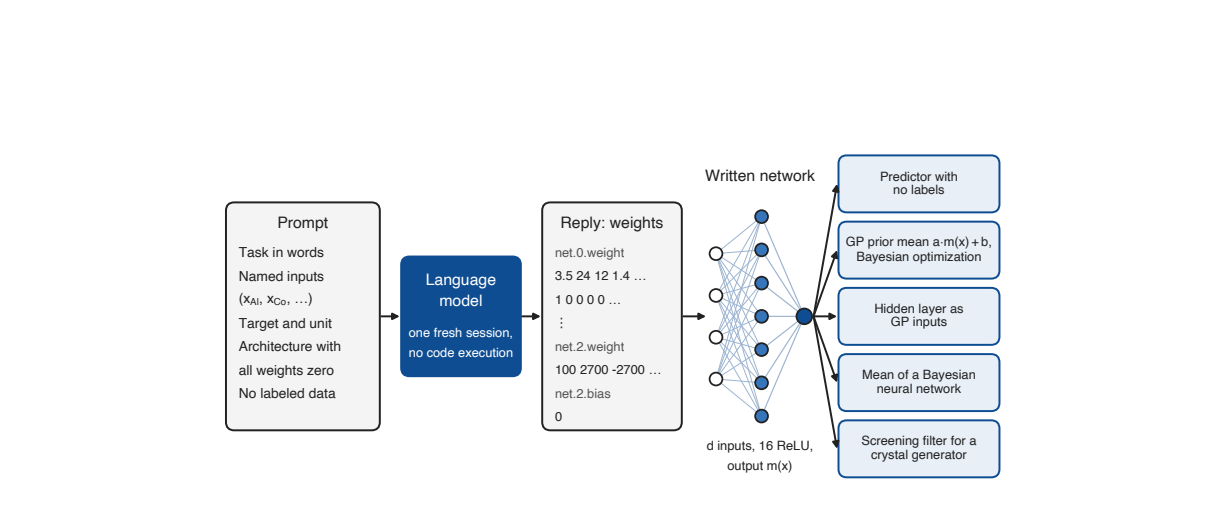
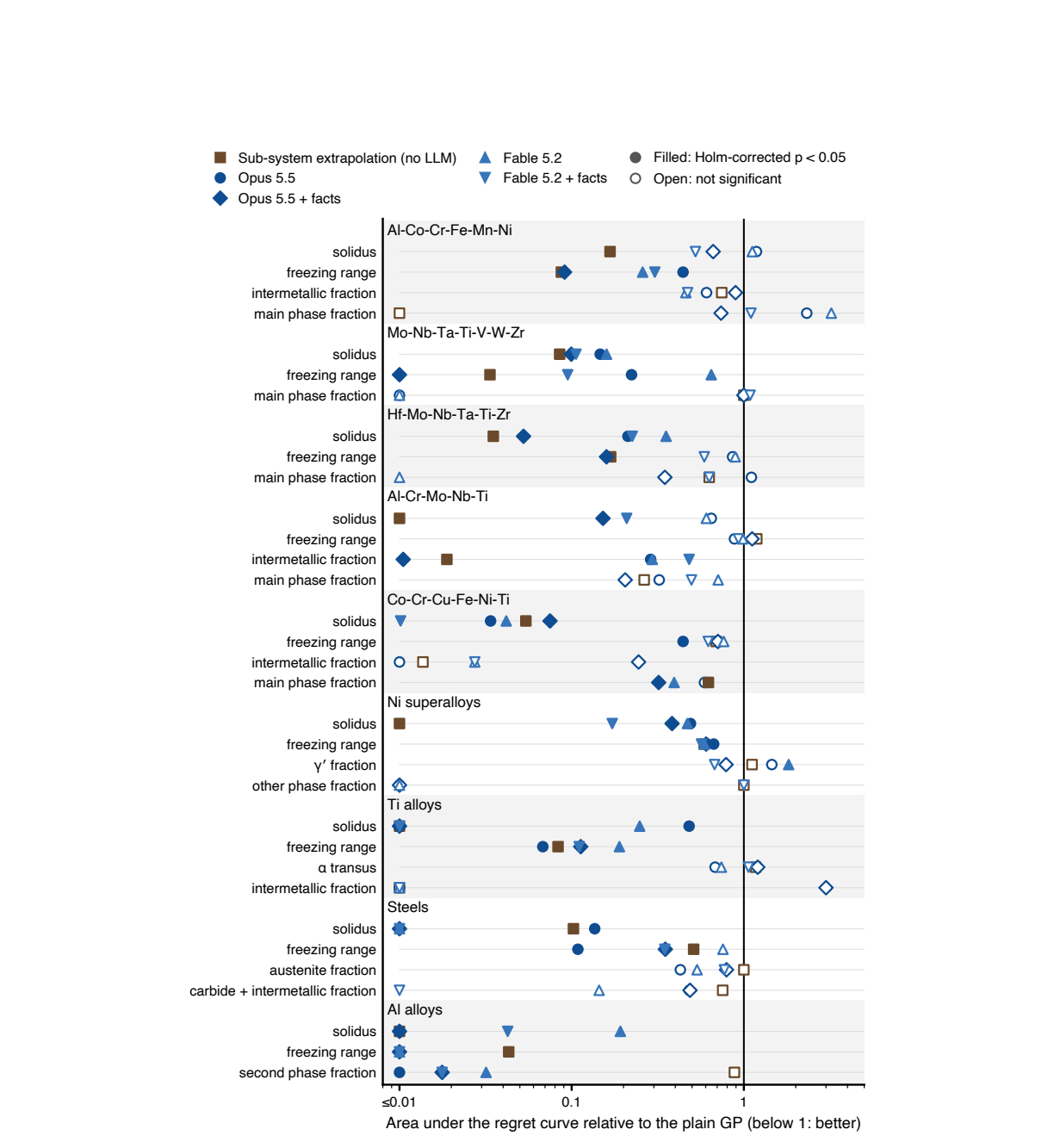
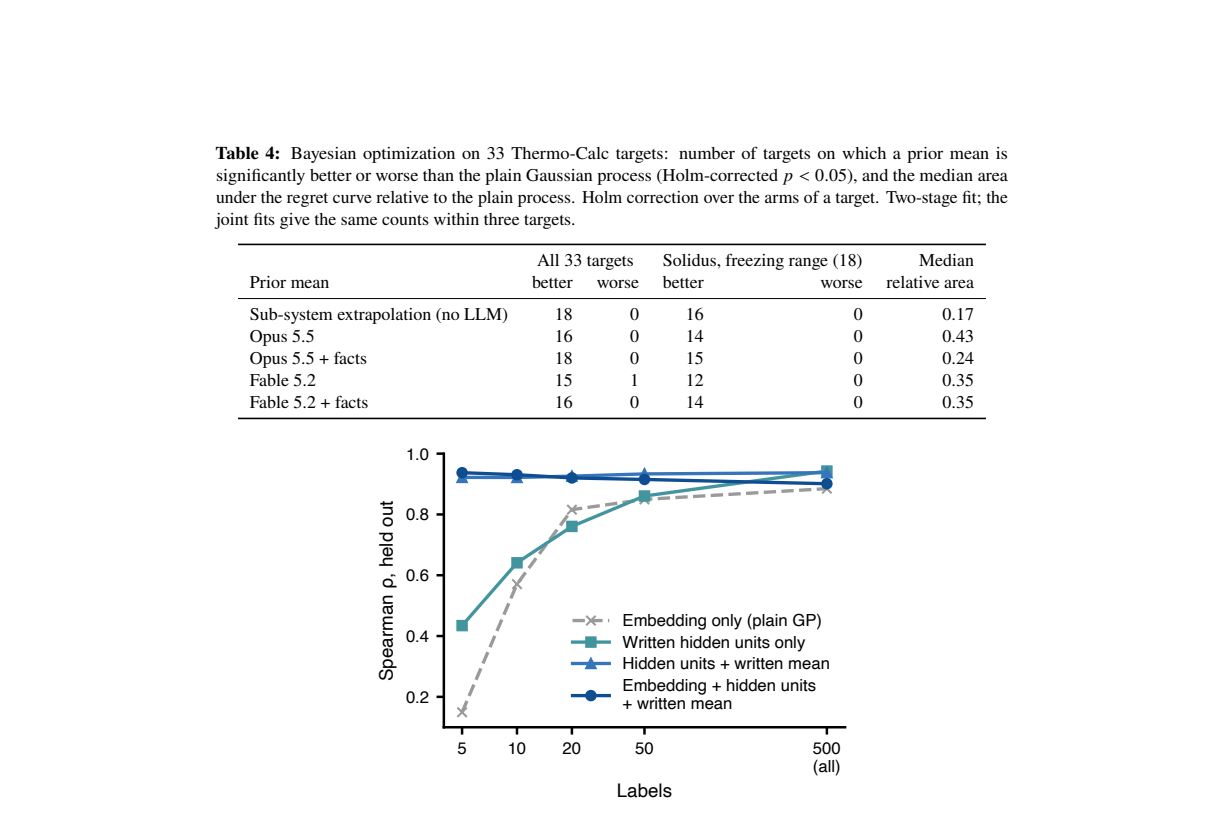
Following recent work on weight-space programming, in which a language model writes the weights of a small network directly as text, we show that a general-purpose model, given the task in words, the names of the inputs and a network of 16 hidden units with every weight set to zero, can provide this starting point by filling in all of the weights from what it has learned about materials. With no labels, the networks of the strongest model rank experimental alloys at Spearman co-efficient = 0.64 to 0.79, where the best of five simple descriptors reaches 0.47 to 0.62. They rank the bulk modulus of crystals added during generative discovery loops at 0.95, where the inverse volume per atom reaches 0.89, and 35 phase-equilibrium targets computed with Thermo-Calc at a mean of 0.67, close to the 0.70 of an extrapolation from calculated binary and ternary data. As the prior mean of a Gaussian process they raise the ranking at five labels from 0.35 to 0.69 on alloys and from 0.15 to 0.95 on crystals, and they lower the regret of Bayesian optimization significantly on 4 of 5 experimental tasks and on 13 to 16 of 33 computed targets, depending on how multiple tests are corrected, without raising it significantly on any. The same networks also serve as the mean of a Bayesian neural network and as a screen for the samples of two crystal generators, where they do as well as standard models trained on 400 labeled structures. The gain is confined to the first tens of labels and to targets that no rule or sub-system extrapolation already ranks.
from the abstract
Pith says
Machine review · deepseek-v4-flash · 18 Nov 2026 · read the full text (239,309 characters) · not checked by a person
It can be wrong. Challenge this review or reply to it.
Holds up, with conditions. A systematic evaluation of weight-space programming for materials science, showing that LLM-written networks can serve as zero-label predictors and prior means, with gains confined to the first tens of labels and to targets no simple rule already ranks. This line is wrong
10 minor
How often objections from reviews like this one are right: not yet measured
The paper, first character to last
The reviewer was given the whole text, 239,309 characters. Not checked: figures, code, what the 38 references say.
10 minor objections
The paper says, at §3.2
Pith says: minor objection 1 of 10
The description of the crystal tasks ("Crystals behind a structure embedding") states that the surrogates of a generative discovery loop see a crystal as the first 50 principal components of a pretrained graph-network embedding. The written network uses 15 named descriptors. The paper should clarify whether the 50 principal components are derived from the same ORB-v3 embedding, and whether the 15 descriptors are a subset of the information in those components or are independent.
The paper says, at §4.2, Table 2
Pith says: minor objection 2 of 10
Table 2 reports the area under the regret curve for Bayesian optimization. The units are given for each task (GPa, MPa, HV), but the values are not normalized across tasks, making it difficult to compare the relative improvement. The paper later uses relative areas (e.g., "0.69 for the two-stage fit"), which is helpful. Consider reporting relative areas in the main table as well.
show 8 more
The paper says, at §4.6
Pith says: minor objection 3 of 10
The paper states that the written network as a screening filter "does as well as standard models trained on 400 labeled structures." However, the trained models are trained on the same 15 descriptors, not on the full crystal structure. The paper should clarify that the comparison is against models trained on the same limited input representation, not against models that use the full crystal structure (e.g., graph neural networks).
The paper says, at §5
Pith says: minor objection 4 of 10
The Discussion section mentions that "the accounts the models give of their own networks support this reading" (that the networks encode materials knowledge). While the self-reports are interesting, they are not evidence of correctness. The paper should be careful not to overstate the interpretability of the written networks based on the model's own explanations.
The paper says, at §3.1
Pith says: minor objection 5 of 10
The paper states that "tool use was excluded by instruction and by an audit of every transcript rather than by a technical block, so a tool call that left no trace in the transcript would not have been detected." This is an honest acknowledgment of a limitation. However, the paper should also note that the audit was performed by the authors, and the criteria for detecting a tool call are not specified. The reader cannot independently verify the audit.
The paper says, at §4.1, Figure 1
Pith says: minor objection 6 of 10
Figure 1 shows the rank correlation for written networks and baselines. The caption says "bars are means over the replies of one model" for the experimental alloys and crystals. For the Thermo-Calc targets, "bars are means over targets and dots are single targets." The paper should clarify whether the error bars (if any) represent variation across replies or across targets. The figure is not visible to the referee, but the caption should be self-contained.
The paper says, at §4.3
Pith says: minor objection 7 of 10
The paper reports that the atomic size mismatch is a better prior mean than the written networks on titanium-alloy hardness in Bayesian optimization. The paper states that the size mismatch "was chosen after seeing the targets, which favors it." This is an important caveat, but the paper should also discuss whether the size mismatch is a generally useful prior or only happens to work well on this specific task.
The paper says, at §4.7
Pith says: minor objection 8 of 10
The paper identifies a failure case on MPEA yield strength where the written networks rank the pool well but mislead the optimizer. The paper states that "a high rank correlation over the pool is therefore not sufficient for a prior mean to help the optimizer." This is an important finding that should be highlighted more prominently, perhaps in the abstract or conclusion.
The paper says, at §3.1
Pith says: minor objection 9 of 10
The paper states that "All results come from one vendor's models." This is a significant limitation, as the results may not generalize to other language models. The paper acknowledges this in the Discussion, but it should be stated more prominently in the abstract or introduction.
The paper says, at §4.1, Table 1
Pith says: minor objection 10 of 10
Table 1 reports R² values for the written networks. The R² values for the rule of mixtures are negative on several tasks (e.g., -2.64 for Ti alloy Young's modulus, <-10 for Ti alloy hardness and MPEA hardness). The paper explains that this is because the scale is wrong. However, the R² after rescaling is also reported, which is more informative. The paper should consider reporting only the rescaled R² for the rule, as the raw R² is misleading.
What would settle it
If the written networks were tested on a set of materials properties that are not in the language model's training data (e.g., properties computed after the model's knowledge cutoff, or properties of materials that were not publicly documented), and the networks showed no ranking ability above simple baselines, then the central claim that the model holds qualitative materials knowledge would be falsified.
from Pith's summary of the paper
How the review went
5 passes by deepseek-v4-flash · 18 Nov 2026
- Reader holds up, with conditions
- Skeptic concern withdrawn: Pith's reviewer misread the paper
- Referee 10 minor
- Check against the paper kept 0 of 4 objections
- Editor wrote the verdict above
Not run on this paper: the simulated authors' defence.
Pith's passes raised 4 objections. A check against the paper's text kept 0 and withdrew 4 (1 the paper already says; 3 Pith's reviewer misread the paper).
The review in full
The review in brief, machine-written
This paper asks whether a language model, given a task description and the names of the inputs, can write the weights of a small network that is useful in a materials discovery campaign before any labels arrive. The answer, on the evidence here, is yes for the first tens of labels, on targets that no simple rule already ranks. The evaluation is thorough: five experimental alloy tasks, 35 phase-equilibrium targets computed with Thermo-Calc, two crystal properties, and comparisons against multiple label-free baselines including a strong sub-system extrapolation. The paper reports statistical significance with corrections for multiple tests and acknowledges its limitations. The code and data are promised for release.
The main finding is that a written network, used as the prior mean of a Gaussian process, lowers Bayesian optimization regret on most tasks without raising it significantly on any. The gain is real and the paper's central claim holds up. The networks also serve as a screening filter for crystal generators, matching models trained on 400 labeled crystals.
The soft spots are the ones the authors themselves name. All results come from one vendor's models. The experimental alloy results may reflect recall of published data as much as reasoning. The Thermo-Calc targets, while computed for this study, are based on thermodynamic assessments built from literature the models were trained on. The crystal tasks have limited statistical power (six runs for bulk modulus, five for heat capacity). Tool use was excluded by instruction and audit rather than by a technical block. The gains are confined to the first tens of labels and to targets that no rule already ranks.
This paper is for researchers in materials informatics who want a practical way to inject prior knowledge into a discovery loop without a physics model or transfer learning. It deserves a serious referee. The claims are well-supported, the limitations are stated, and the method is reproducible in principle. The main thing a referee should check is whether the code release matches the paper's claims and whether the audit of tool use is as thorough as stated.
The stress test's concern
Withdrawn: Pith's reviewer misread the paper.
The paper says
“All language-model results use the models of one vendor, and the two smaller models of that vendor wrote networks that are weaker on average and less even. A written network may partly reflect recall of published data, since the experimental alloy sets are public and the prompts name them, and for this reason we added targets computed for this study, although the thermodynamic assessments behind them are built from literature the models were trained on. The self-reports of the networks also show calibration against remembered values of alloys that are in the pools, so the experimental results measure recall as well as reasoning.”
The referee's report
Not published. Pith's referee wrote this assessment before its objections were checked against the paper, and 3 of its 3 major objections did not survive that check.
Pith's reading of the paper (a machine's summary, not the authors')
The paper argues that a general-purpose language model, given only a description of a materials property and the names of the inputs, can write the weights of a small neural network that ranks candidates before any measurements are made. This written network serves as a prior mean for Gaussian processes and Bayesian optimization, improving ranking and lowering regret in the first tens of labels on tasks where no simple rule already works. The authors test this on experimental alloys, computed phase equilibria, and crystal properties, comparing against label-free baselines including a sub-system extrapolation from thermodynamic databases. The central claim is that the language model holds enough qualitative materials knowledge—trends, thresholds, phase appearance—to supply the prior that a discovery campaign lacks at its start.
What carries the argument. The central object is a multilayer perceptron with one hidden layer of 16 ReLU units, whose weights are written directly as text by a language model. The network is defined by its architecture (16d + 33 weights, where d is the number of inputs) and is written from a prompt that states the task, lists the input names, and gives the architecture with every weight set to zero. The written network is then used as a predictor, as the prior mean of a Gaussian process or Bayesian neural network, as a feature map via its hidden activations, or as a screening filter for generated crystals. The key mechanism is that the language model's reasoning about materials science—trends, thresholds, phase appearance—is encoded in the weights, providing a function of the right inputs that a constant mean cannot.
Core claim. The paper claims that a frontier language model (Claude Opus 5.5, Fable 5.2) can write the weights of a 16-hidden-unit network that, with no labels, ranks experimental alloys at Spearman 0.64–0.79, crystal bulk modulus at 0.95, and 35 phase-equilibrium targets at a mean of 0.67. As the prior mean of a Gaussian process, these written networks raise ranking at five labels from 0.35 to 0.69 on alloys and from 0.15 to 0.95 on crystals, and lower Bayesian optimization regret significantly on most tasks without raising it on any. The authors argue that the networks encode genuine materials knowledge—trends, thresholds, phase appearance—that is not simply recalled from memorized datasets, though they acknowledge that the experimental alloy sets are public and the prompts name them, so the results measure recall as well as reasoning.
The premise it rests on. The language model's written weights encode genuine materials knowledge (trends, thresholds, phase appearance) that is not simply recalled from memorized datasets or coincidental correlations, and the performance reflects reasoning about materials science rather than memorization of published data.
If the paper is right (Pith's inferences, not the authors')
A written network can serve as a zero-label prior for any materials discovery campaign where the inputs are named quantities and the target is a property the language model has read about, reducing the number of labels needed to reach a given ranking.
The method is most valuable on targets that no simple rule already ranks, such as phase fractions in multicomponent alloys, and on the first tens of labels; on targets where a rule suffices (e.g., heat capacity via Dulong–Petit), the written network adds nothing.
Using the written network as a mean function is safer than using it as a weight-space prior, because a fitted slope can reduce its contribution when it is wrong, and the hidden activations can be used as features that need labels to become useful.
The approach can incorporate thermodynamic context by placing computed sub-system values in the prompt, bringing the written networks within 0.02 of a full sub-system extrapolation on smooth targets.
A written network can match the screening performance of models trained on 400 labeled crystals when used as a filter for generated crystals, without needing any labels from the generator's domain.
If the language model's written weights encode genuine materials knowledge rather than memorized correlations, then weight-space programming could be extended to other domains where a language model has read enough to write a prior, such as drug discovery or catalyst design, provided the inputs are named quantities.
The fact that the written networks are sparse (5–6 of 16 hidden units used on alloys) and that each used unit has a stated physical meaning suggests that the language model is not just interpolating memorized numbers but is constructing interpretable features, which could be extracted and reused across tasks.
The failure on the top tenth of the MPEA yield-strength pool—where a network that ranked the whole pool well still misled the optimizer—implies that the value of a prior mean should be judged on the best candidates, not on the whole pool, and that a high overall rank correlation is not sufficient for Bayesian optimization.
The comparison with the sub-system extrapolation suggests that the language model's strength is in predicting which phases form (phase fractions) rather than the level of smoothly varying quantities (solidus, freezing range), which may reflect the kind of qualitative knowledge language models absorb from reading about phase diagrams.
Check this review
What was read
The passes were given all 239,309 characters of the paper's LaTeX source.
Fingerprint of that text (SHA-256): 7feab3f6d702a4cf6c0fe5b34471fdbf7fd18534eeb2f46b1fabc1b4d689e4e1
Pith does not keep that text. Rebuilt from the paper's source or PDF by the same code, it has this fingerprint if it is the same text. From a copy of Pith's code:
PYTHONPATH=. python scripts/review_input_check.py 2611.22013
The passes, in the order they ran
- Reader deepseek-v4-flash · medium effort · $0.016 · instructions of the Reader, fingerprint f9ead7300382…
- Skeptic deepseek-v4-flash · medium effort · $0.0079 · instructions of the Skeptic, fingerprint 8f88c0f61488…
- Referee deepseek-v4-flash · medium effort · $0.0083 · instructions of the Referee, fingerprint a852d99aea0d…
- Check against the paper deepseek-v4-flash · medium effort · $0.010 · instructions of the Check against the paper, fingerprint 6c7a6883d551…
- Editor deepseek-v4-flash · medium effort · $0.0079 · instructions of the Editor, fingerprint e7211f6a3d27…
- Circularity check deepseek-v4-flash · medium effort · $0.0094 · instructions of the Circularity check, fingerprint e9946e39d67b…
- Summary for the page deepseek-v4-flash · medium effort · temperature 0.2 · $0.0083 · instructions of the Summary for the page, fingerprint e4f56bf568e7…
The passes cost $0.068 in model calls together.
Version stamped on this review: pith-pipeline@v1.4.1-daily-deepseek-or-medium+deepseek/deepseek-v4-flash+p.d60f54226f00
Each link opens a pass's instructions as plain text, the exact bytes its fingerprint was taken over. Every stored set of instructions.
curl -s https://pith.science/methodology/prompts/f9ead730038216984cfb56d7cb34332bdf691828296a1de4245f3d6667d4bf56 | sha256sum
prints the fingerprint of the reader's instructions. The same works for every pass.
The receipt
The review's fingerprint was taken on 18 Nov 2026. The review you are reading still matches it.
Fingerprint of the review (SHA-256): 69117198e74151abede47ab64c3adad593d313774baa005824a9fddd74dde18a
curl -s 'https://pith.science/api/v1/verdicts/2611.22013?form=canonical' | sha256sum
prints the fingerprint of the review as it stands now. The rule, in four steps.
A matching fingerprint shows the review has not changed since that date. It does not show that the review is right.
How often reviews like this one are right
Reviews like this one: written by deepseek-v4-flash, from the paper's LaTeX source.
How often objections from reviews like this one are right: not yet measured
Reviews by people
This review was written by a machine. No person has reviewed this paper on Pith yet. A scientist listed on Pith can review it for a fee, and their review is published here whatever it concludes.
How Pith checks papers · The full audit of this paper · Review history (2 versions)
The paper
Abstract
A materials discovery campaign often begins with almost no measurements of the property it is searching for, and the models that rank candidates or screen the output of a generator then have to be built from those first few labels. Following recent work on weight-space programming, in which a language model writes the weights of a small network directly as text, we show that a general-purpose model, given the task in words, the names of the inputs and a network of 16 hidden units with every weight set to zero, can provide this starting point by filling in all of the weights from what it has learned about materials. With no labels, the networks of the strongest model rank experimental alloys at Spearman co-efficient = 0.64 to 0.79, where the best of five simple descriptors reaches 0.47 to 0.62. They rank the bulk modulus of crystals added during generative discovery loops at 0.95, where the inverse volume per atom reaches 0.89, and 35 phase-equilibrium targets computed with Thermo-Calc at a mean of 0.67, close to the 0.70 of an extrapolation from calculated binary and ternary data. As the prior mean of a Gaussian process they raise the ranking at five labels from 0.35 to 0.69 on alloys and from 0.15 to 0.95 on crystals, and they lower the regret of Bayesian optimization significantly on 4 of 5 experimental tasks and on 13 to 16 of 33 computed targets, depending on how multiple tests are corrected, without raising it significantly on any. The same networks also serve as the mean of a Bayesian neural network and as a screen for the samples of two crystal generators, where they do as well as standard models trained on 400 labeled structures. The gain is confined to the first tens of labels and to targets that no rule or sub-system extrapolation already ranks.
The paper's own sentences, arranged, kept beside the review and separate from it. Each label is drawn from a closed vocabulary; the number beside it is the probability the classifier gave that label. No sentence in this record was written by a model.
abstract compiled · 2026-11-18
The authors' main claim, as the classifier picked it out 0.82
“Following recent work on weight-space programming, in which a language model writes the weights of a small network directly as text, we show that a general-purpose model, given the task in words, the names of the inputs and a network of 16 hidden units with every weight set to zero, can provide this starting point by filling in all of the weights from what it has learned about materials.”
How the main claim is stated: asserted 0.99
What the abstract itself states, as probabilities: claims first 0.08 · states limitation 0.96 · human participants 0.03 · controlled comparison 0.94 · randomized assignment 0.02 · states quantitative result 0.99 · compares with prior results 0.98 · mentions code or data availability 0.03
The abstract, sentence by sentence
This table labels the abstract only (arXiv listing abstract v1). The number is the probability the classifier gave the label.
| Sentence | Role | The authors' own work | States the main conclusion | Strength |
|---|---|---|---|---|
| A materials discovery campaign often begins with almost no measurements of the property it is searching for, and the models that rank candidates or screen the output of a generator then have to be built from those first few labels. | background 0.95 | 0.10 | 0.03 | asserted 0.94 |
| Following recent work on weight-space programming, in which a language model writes the weights of a small network directly as text, we show that a general-purpose model, given the task in words, the names of the inputs and a network of 16 hidden units with every weight set to zero, can provide this starting point by filling in all of the weights from what it has learned about materials. | contribution 0.72 | 0.89 | 0.31 | asserted 0.99 |
| With no labels, the networks of the strongest model rank experimental alloys at Spearman co-efficient = 0.64 to 0.79, where the best of five simple descriptors reaches 0.47 to 0.62. | result 1.00 | 0.94 | 0.17 | asserted 1.00 |
| They rank the bulk modulus of crystals added during generative discovery loops at 0.95, where the inverse volume per atom reaches 0.89, and 35 phase-equilibrium targets computed with Thermo-Calc at a mean of 0.67, close to the 0.70 of an extrapolation from calculated binary and ternary data. | result 1.00 | 0.91 | 0.11 | asserted 1.00 |
| As the prior mean of a Gaussian process they raise the ranking at five labels from 0.35 to 0.69 on alloys and from 0.15 to 0.95 on crystals, and they lower the regret of Bayesian optimization significantly on 4 of 5 experimental tasks and on 13 to 16 of 33 computed targets, depending on how multiple tests are corrected, without raising it significantly on any. | result 1.00 | 0.92 | 0.23 | asserted 1.00 |
| The same networks also serve as the mean of a Bayesian neural network and as a screen for the samples of two crystal generators, where they do as well as standard models trained on 400 labeled structures. | result 0.99 | 0.92 | 0.15 | asserted 1.00 |
| The gain is confined to the first tens of labels and to targets that no rule or sub-system extrapolation already ranks. | limitation 0.94 | 0.89 | 0.34 | asserted 1.00 |
What kind of paper the classifier reports this is: method or tool 0.95 · evidence from simulation or computation 0.84
What was examined, and what was not
Sources read
- arXiv listing abstract v1
Not examined
- full text
- figures and tables
- references and citing sentences
- relations to other papers
Levels run
- P abstract
Not run
- S sections
- T body sentences
- C citations
- R cross-paper relations
How the labels were made
Compiled by classifier-1.13.0 via TypeSafe API, question bank abstract-p1-20260923, 2026-11-18: 1 request, 6,131 input tokens.
Every quoted sentence on this record is the authors'. Every label is from Pith's closed vocabulary, with the probability shown beside it. This record as JSON
Figures (7)



Figures are the authors', reproduced from the paper.
References (38)
- [1] Rikiya Takehi, Jayden Teoh, Alex Zhang, and Omar Khattab. Sparks of weight-space program- ming: LLMs can natively read & write neural network weights. Blog post, 2 November, 2026. URLhttps://rikiyat.github.io/blog/weight-space-programming/ on Pith
- [2] Junru Hu, Cheng Tang, Wei Li, Hongze Zhu, Chun-Mei Feng, Qi Zhang, Yirong Chen, and Ming Hu. Exploring weight-space programming: Capabilities, generalization, and limitations, on Pith
- [3] Nazmus Sakib Ahmed. Can an LLM actually reason and program about neural network’s weights or is it just memorization on steroids? exploring “weight-space programming”, 2026. arXiv:2611.08070 on PithPith's reviewarXiv
- [4] Humza Nusrat and Omar Nusrat. Weight-space programming for auditing clinical decision networks, 2026. arXiv:2611.05341 on PithPith's reviewarXiv
- [5] Mengran Li, Bo Li, Weijing Zhao, Chengyang Zhang, Boyu Zhang, Jinfeng Xu, Zelin Zang, VictorC.M.Leung,andStanZ.Li. WeightLoop: Weight-spaceprogrammingwithexperimental feedback, 2026. arXiv:2611.07319 on PithPith's reviewarXiv
- [6] RenanButkeraites. Canalanguagemodelwritetheweights? anempiricalstudyofLLM-written scoring networks for column generation and MILP branching, with a bus-driver scheduling application, 2026. arXiv:2611.09559 on PithPith's reviewarXiv
- [7] GabrielIlharco,MarcoTulioRibeiro,MitchellWortsman,SuchinGururangan,LudwigSchmidt, Hannaneh Hajishirzi, and Ali Farhadi. Editing models with task arithmetic. InInternational Conference on Learning Representations, 2023 on Pith
- [8] Parth Verma, Parv P. Singh, Vipul Garg, Ishita Thakre, N. M. Anoop Krishnan, and Sayan Ranu. GFFMERGE:Efficientmergingofgraphneuralforcefieldsandbeyond,2026. arXiv:2606.03232 on PithPith's reviewarXiv
- [9] Maxim A. Ziatdinov, Ayana Ghosh, and Sergei V. Kalinin. Physics makes the difference: Bayesian optimization and active learning via augmented Gaussian process.Machine Learning: Science and Technology, 3:015003, 2022. doi: 10.1088/2632-2153/ac4baa on Pithdoi:10.1088/2632-2153/ac4baa
- [10] Marc C. Kennedy and Anthony O’Hagan. Predicting the output from a complex computer code when fast approximations are available.Biometrika, 87(1):1–13, 2000. doi: 10.1093/biomet/87. 1.1 on Pithdoi:10.1093/biomet/87
- [11] Danial Khatamsaz, Abhilash Molkeri, Richard Couperthwaite, Jaylen James, Raymundo Arróyave, Douglas Allaire, and Ankit Srivastava. Efficiently exploiting process-structure- property relationships in material design by multi-information source fusion.Acta Materialia, 206:116619... on Pithdoi:10.1016/j.actamat.2020.116619
- [12] Kevin Swersky, Jasper Snoek, and Ryan P. Adams. Multi-task Bayesian optimization. In Advances in Neural Information Processing Systems, volume 26, 2013 on Pith
- [13] J.-O. Andersson, Thomas Helander, Lars Höglund, Pingfang Shi, and Bo Sundman. Thermo- Calc & DICTRA, computational tools for materials science.Calphad, 26(2):273–312, 2002. doi: 10.1016/S0364-5916(02)00037-8 on Pithdoi:10.1016/s0364-5916(02)00037-8
- [14] Donald R. Jones, Matthias Schonlau, and William J. Welch. Efficient global optimization of expensive black-box functions.Journal of Global Optimization, 13(4):455–492, 1998. doi: 10.1023/A:1008306431147 on Pithdoi:10.1023/a:1008306431147
- [15] Maximilian Balandat, Brian Karrer, Daniel R. Jiang, Samuel Daulton, Benjamin Letham, Andrew Gordon Wilson, and Eytan Bakshy. BoTorch: A framework for efficient Monte-Carlo Bayesian optimization. InAdvances in Neural Information Processing Systems, volume 33, pages 21524–21538,... on Pith
- [16] Yarin Gal and Zoubin Ghahramani. Dropout as a Bayesian approximation: Representing model uncertainty in deep learning. InProceedings of the 33rd International Conference on Machine Learning, volume 48 ofProceedings of Machine Learning Research, pages 1050–1059. PMLR, 2016 on Pith
- [17] Balaji Lakshminarayanan, Alexander Pritzel, and Charles Blundell. Simple and scalable predictive uncertainty estimation using deep ensembles. InAdvances in Neural Information Processing Systems, volume 30, pages 6402–6413, 2017 on Pith
- [18] YucenLilyLi,TimG.J.Rudner,andAndrewGordonWilson.AstudyofBayesianneuralnetwork surrogates for Bayesian optimization. InInternational Conference on Learning Representations, 2024 on Pith
- [19] Claudio Zeni, Robert Pinsler, Daniel Zügner, Andrew Fowler, Matthew Horton, Xiang Fu, Zilong Wang, Aliaksandra Shysheya, Jonathan Crabbé, Shoko Ueda, Roberto Sordillo, Lixin Sun, Jake Smith, Bichlien Nguyen, Hannes Schulz, Sarah Lewis, Chin-Wei Huang, Ziheng Lu, Yichi Zhou, Ha... on Pithdoi:10.1038/s41586-025-08628-5
- [20] Xiaoshan Luo, Zhenyu Wang, Qingchang Wang, Xuechen Shao, Jian Lv, Lei Wang, Yanchao Wang, and Yanming Ma. CrystalFlow: a flow-based generative model for crystalline materials. Nature Communications, 16:9267, 2025. doi: 10.1038/s41467-025-64364-4 on Pithdoi:10.1038/s41467-025-64364-4
show 18 more
- [21] Junwu Chen, Jeff Guo, Edvin Fako, and Philippe Schwaller. Accelerating inverse materials design using generative diffusion models with reinforcement learning, 2025. arXiv:2511.03112 on PitharXiv
- [22] CamiloA.F.Salvador,EloaL.Maia,FernandoH.Costa,JulianD.Escobar,andJoãoP.Oliveira. A compilation of experimental data on the mechanical properties and microstructural features of Ti-alloys.Scientific Data, 9:188, 2022. doi: 10.1038/s41597-022-01283-9 on Pithdoi:10.1038/s41597-022-01283-9
- [23] ChristopherK.H.Borg,CarolinaFrey,JasperMoh,TresaM.Pollock,StéphaneGorsse,DanielB. Miracle, Oleg N. Senkov, Bryce Meredig, and James E. Saal. Expanded dataset of mechanical properties and observed phases of multi-principal element alloys.Scientific Data, 7(1):430, on Pith
- [24] Benjamin Rhodes, Sander Vandenhaute, Vaidotas Šimkus, James Gin, Jonathan Godwin, Tim Duignan, and Mark Neumann. Orb-v3: atomistic simulation at scale, 2025. arXiv:2504.06231 on PithPith's reviewarXiv
- [25] MaartendeJong, WeiChen,ThomasAngsten, AnubhavJain,RandyNotestine, AnthonyGamst, Marcel Sluiter, Chaitanya Krishna Ande, Sybrand van der Zwaag, Jose J. Plata, Cormac Toher, Stefano Curtarolo, Gerbrand Ceder, Kristin A. Persson, and Mark Asta. Charting the complete elastic prope... on Pithdoi:10.1038/sdata.2015.9
- [26] XiangFu,BrandonM.Wood,LuisBarroso-Luque,DanielS.Levine,MengGao,MiskoDzamba, and C. Lawrence Zitnick. Learning smooth and expressive interatomic potentials for physical property prediction. InProceedings of the 42nd International Conference on Machine Learning, volume 267 ofPro... on Pith
- [27] Yong Zhang, Yun Jun Zhou, Jun Pin Lin, Guo Liang Chen, and Peter K. Liaw. Solid-solution phase formation rules for multi-component alloys.Advanced Engineering Materials, 10(6): 534–538, 2008. doi: 10.1002/adem.200700240 on Pithdoi:10.1002/adem.200700240
- [28] Anubhav Jain, Shyue Ping Ong, Geoffroy Hautier, Wei Chen, William Davidson Richards, Stephen Dacek, Shreyas Cholia, Dan Gunter, David Skinner, Gerbrand Ceder, and Kristin A. Persson. Commentary: The Materials Project: A materials genome approach to accelerating materials innov... on Pithdoi:10.1063/1.4812323
- [29] Alexander Dunn, Qi Wang, Alex Ganose, Daniel Dopp, and Anubhav Jain. Benchmarking materials property prediction methods: the Matbench test set and Automatminer reference algorithm.npj Computational Materials, 6(1):138, 2020. doi: 10.1038/s41524-020-00406-3 on Pithdoi:10.1038/s41524-020-00406-3
- [30] Ilyes Batatia, Dávid Péter Kovács, Gregor N. C. Simm, Christoph Ortner, and Gábor Csányi. MACE: Higher order equivariant message passing neural networks for fast and accurate force fields. InAdvances in Neural Information Processing Systems, volume 35, pages 11423–11436, on Pith
- [31] Ilyes Batatia, Philipp Benner, Yuan Chiang, Alin M. Elena, Dávid P. Kovács, Janosh Riebesell, Xavier R. Advincula, Mark Asta, Matthew Avaylon, William J. Baldwin, Fabian Berger, Noam Bernstein, Arghya Bhowmik, Filippo Bigi, Samuel M. Blau, Vlad Cărare, Michele Ceriotti, Sanggy... on Pith
- [32] Luis Barroso-Luque, Muhammed Shuaibi, Xiang Fu, Brandon M. Wood, Misko Dzamba, Meng Gao, Ammar Rizvi, Matt Uyttendaele, C. Lawrence Zitnick, and Zachary W. Ulissi. The open materials 2024 (OMat24) inorganic materials dataset and models.Nature Computational Science, 6(6):642–65... on Pithdoi:10.1038/s43588-026-00996-w
- [33] Anton Bochkarev, Yury Lysogorskiy, and Ralf Drautz. Graph atomic cluster expansion for semilocal interactions beyond equivariant message passing.Physical Review X, 14(2):021036, on Pith
- [34] Logan Ward, Alexander Dunn, Alireza Faghaninia, Nils E. R. Zimmermann, Saurabh Bajaj, Qi Wang, Joseph Montoya, Jiming Chen, Kyle Bystrom, Maxwell Dylla, Kyle Chard, Mark Asta, Kristin A. Persson, G. Jeffrey Snyder, Ian Foster, and Anubhav Jain. Matminer: An open source toolkit... on Pithdoi:10.1016/j.commatsci.2018.05.018
- [35] J. C. Spall. Multivariate stochastic approximation using a simultaneous perturbation gradient approximation.IEEE Transactions on Automatic Control, 37(3):332–341, 1992. doi: 10.1109/9. 119632. 18 Supplementary material Every language-model run in this paper is a folder in the ... on Pithdoi:10.1109/9
- [2020] doi: 10.1038/s41597-020-00768-9 on Pithdoi:10.1038/s41597-020-00768-9
- [2022] doi: 10.52202/068431-0830 on Pithdoi:10.52202/068431-0830
- [2024] doi: 10.1103/PhysRevX.14.021036 on Pithdoi:10.1103/physrevx.14.021036
Challenges and discussion
Disagree with the review, or know something it missed? Leave a comment, or challenge this review formally: a challenge becomes a permanent entry in this paper's record, and its decision is published here.
Come back by email
A short list of the week's newly reviewed papers. Nothing is sent until you confirm from your inbox, and every email has a link that stops it. No account.
No comments yet.
Sign in to comment