Optimization and Control · arXiv:2611.09559 v1 · submitted 6 Nov 2026 · 21 references
Can a Language Model Write the Weights? An Empirical Study of LLM-Written Scoring Networks for Column Generation and MILP Branching, with a Bus-Driver Scheduling Application
The paper says
“This paper was generated by an AI model (Claude Opus 5.5, Anthropic) under the author's direction; all results come from computations run on the author's machine, and every reference was checked.”
more of the abstract
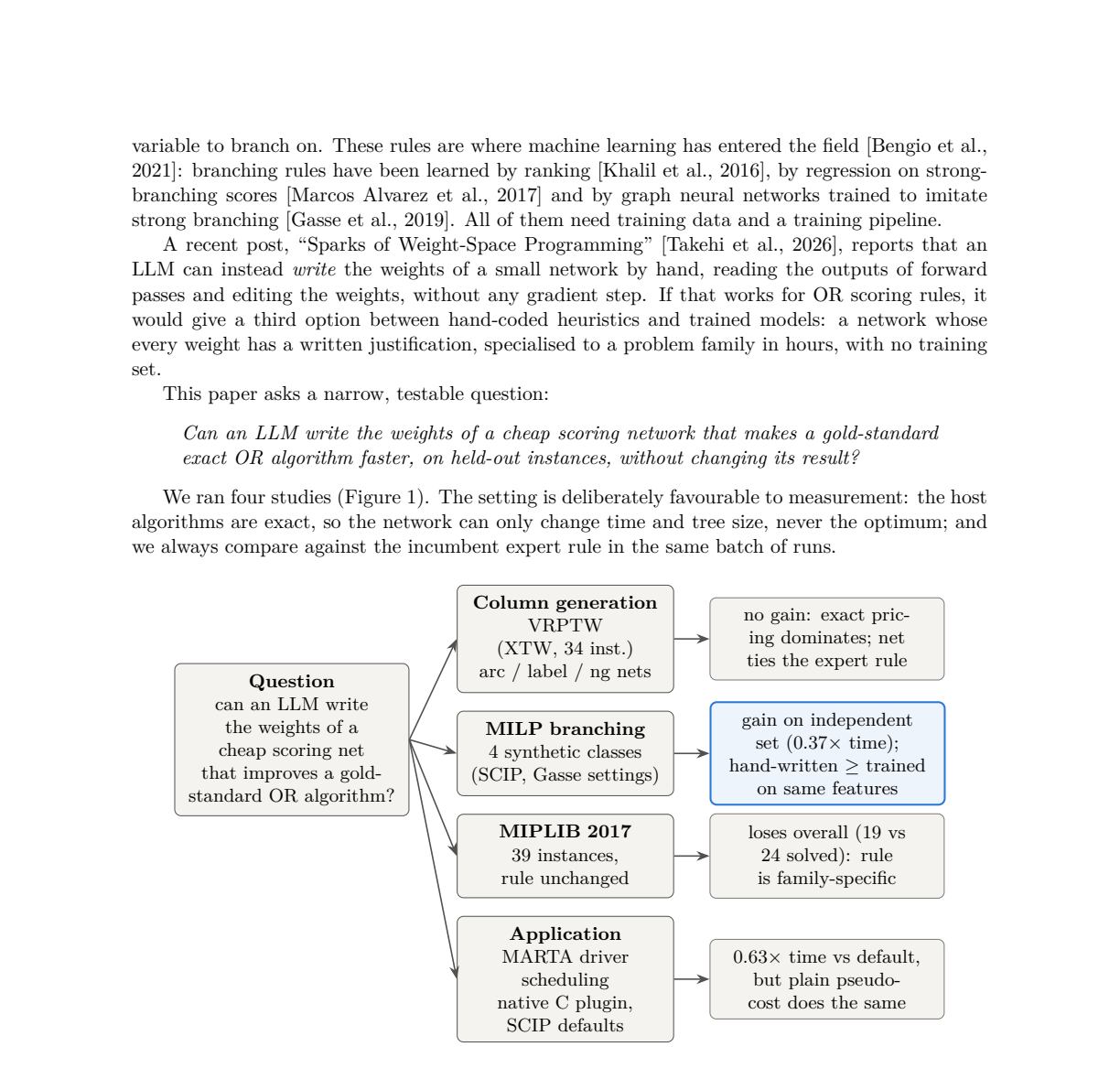
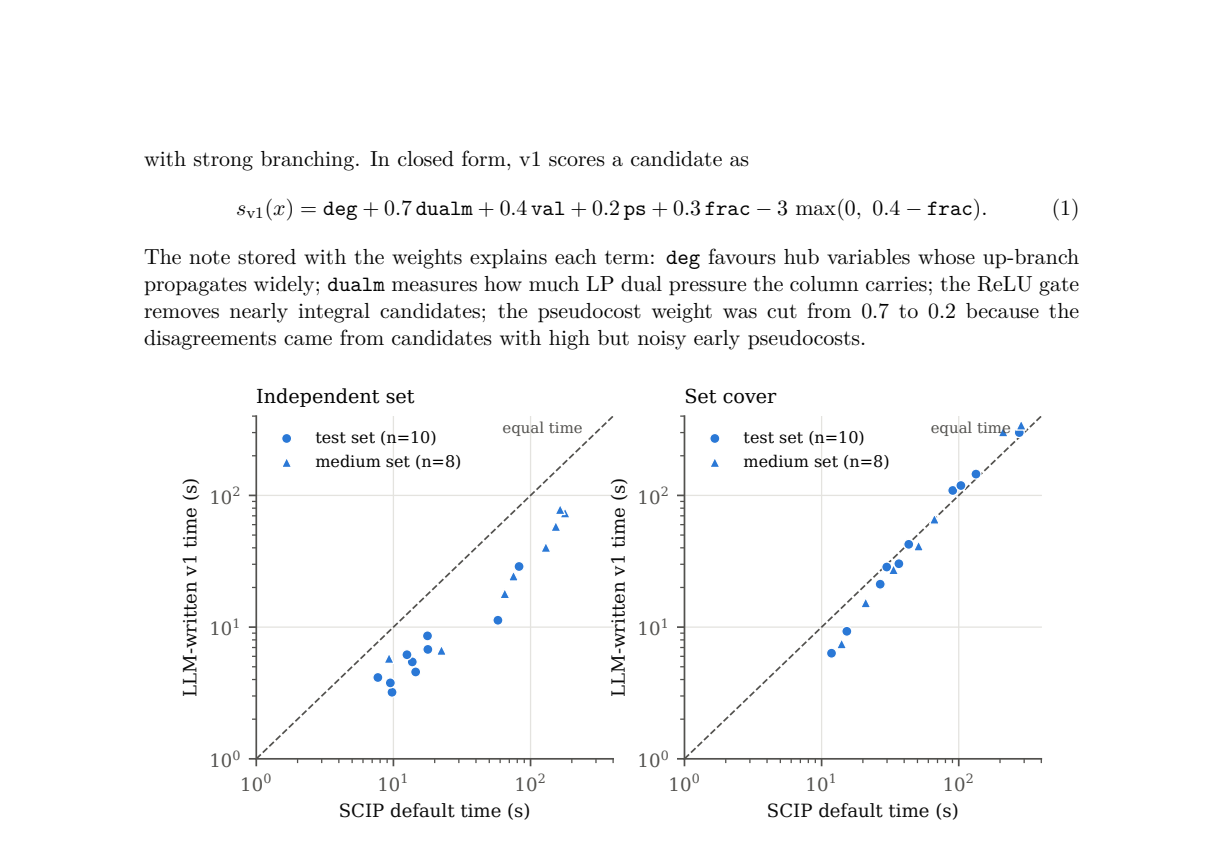
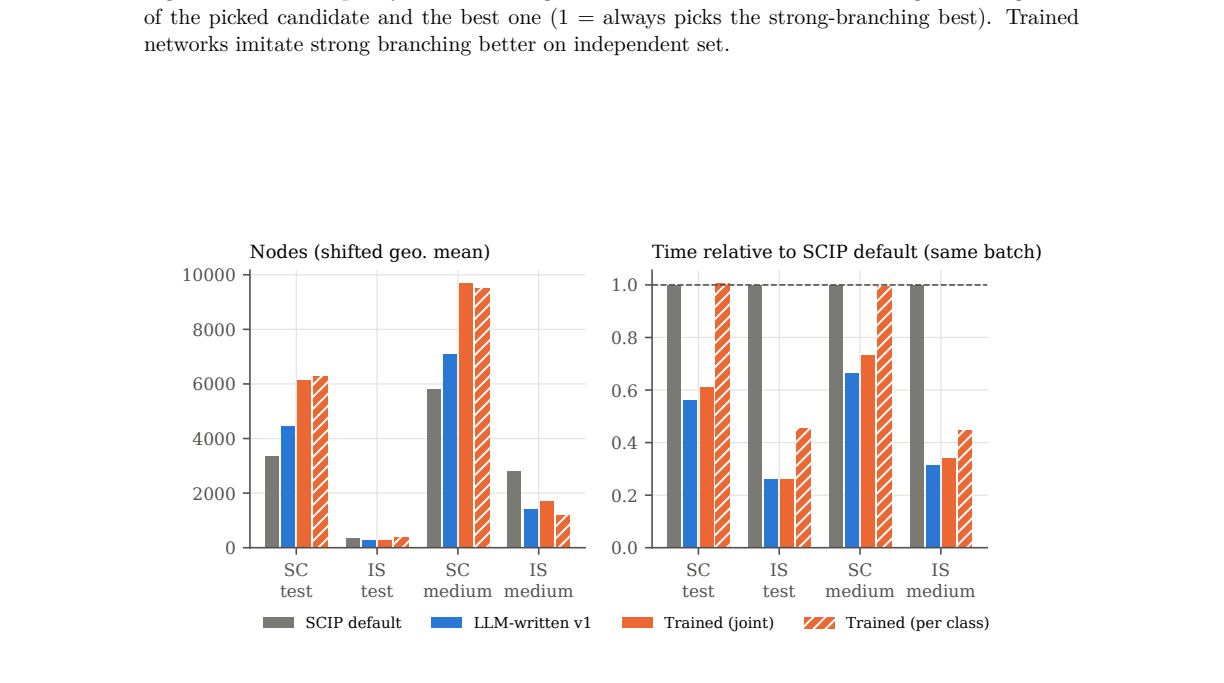
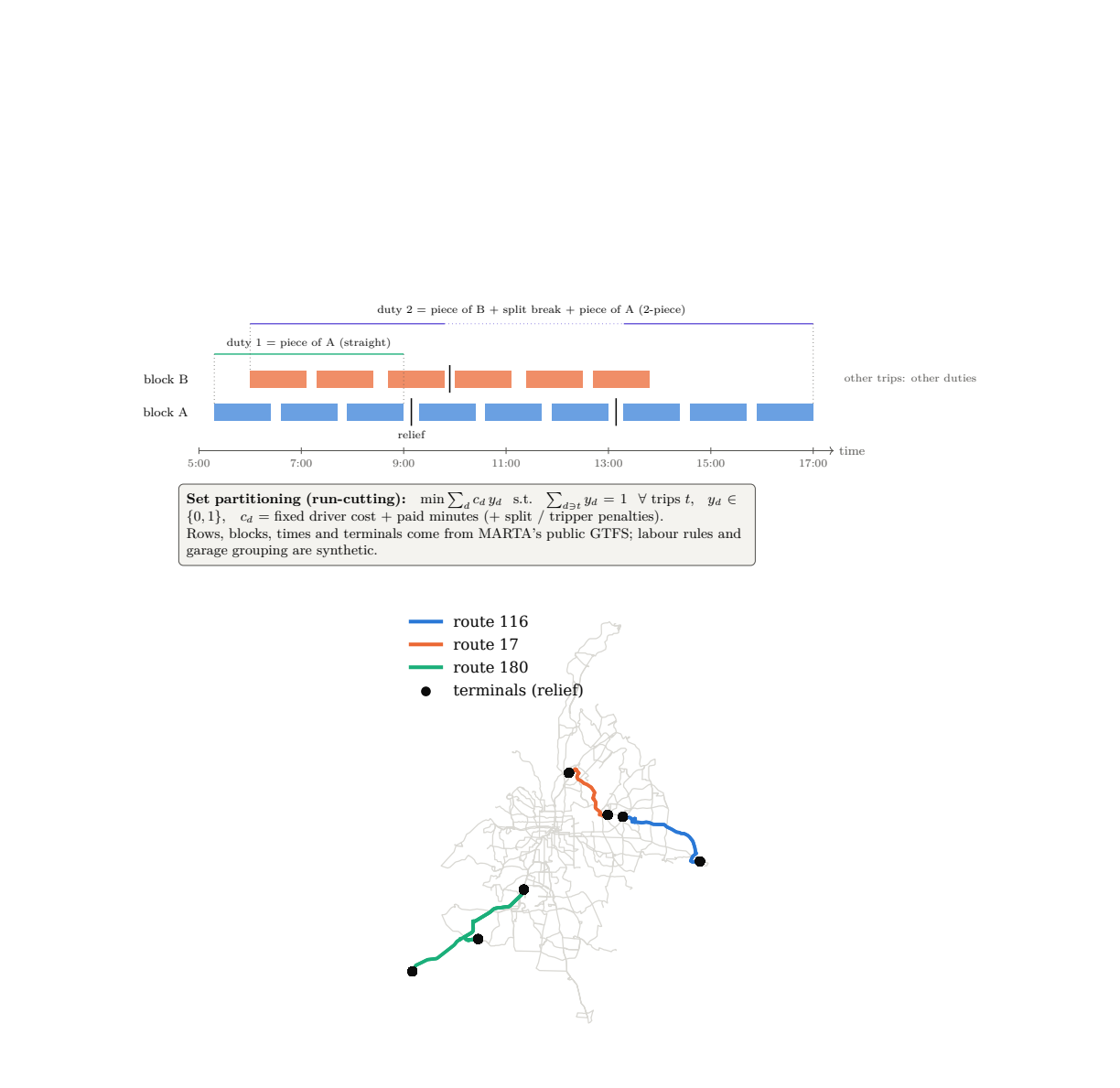
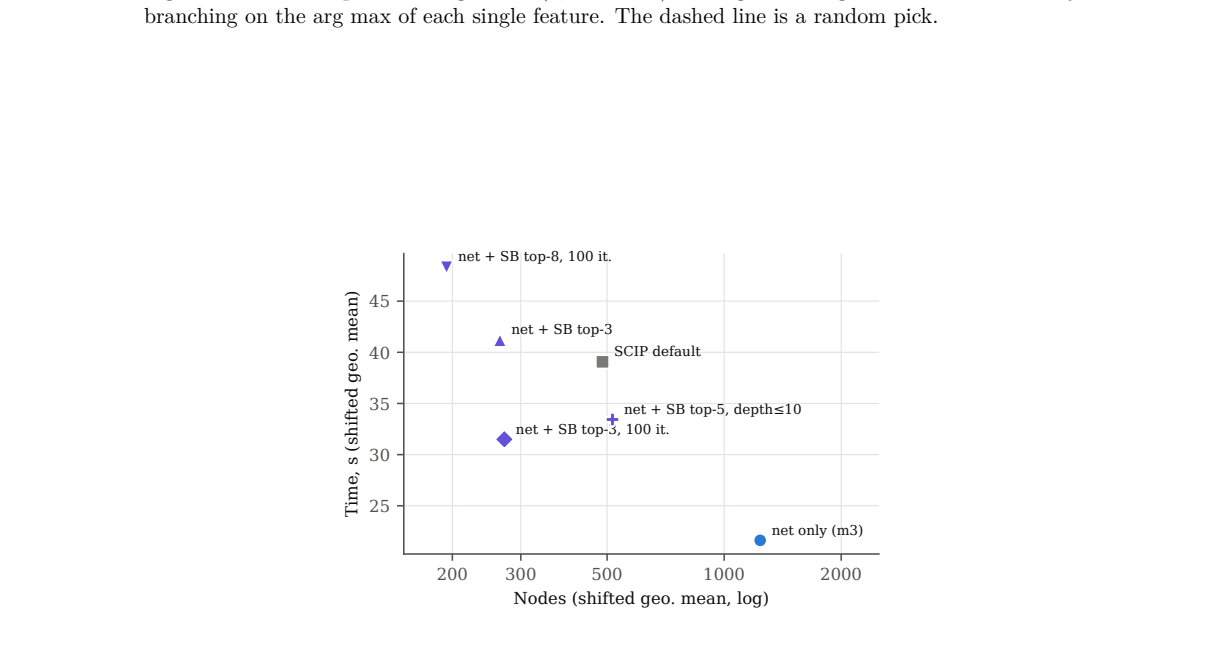
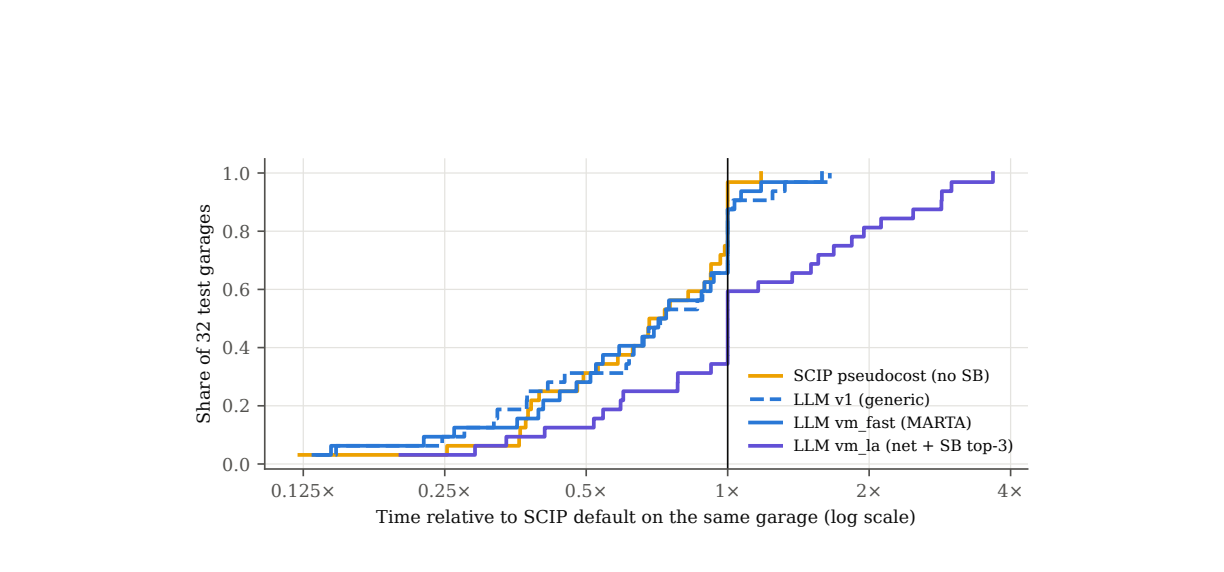
Weight-space programming (WSP) is the idea that a large language model (LLM) can write the weights of a small neural network directly, guided only by reading forward-pass outputs, with no gradient training. We test whether WSP can improve exact operations research algorithms where they rely on cheap scoring rules. In four studies, an LLM wrote small multilayer perceptrons that (i) select arcs, labels and ng-neighbourhoods inside column generation for the vehicle routing problem with time windows, and (ii) choose branching variables in SCIP's branch-and-bound. The algorithms stay exact whatever the weights; a bad network only costs time. In column generation, no lever gave a material gain. In branching on synthetic classes, a hand-written network solved independent-set instances in 0.37x the time of SCIP's default rule (18 paired instances, Wilcoxon p < 10−5) and matched or beat networks trained by imitation of strong branching, but on 39 MIPLIB 2017 instances it solved 19 versus 24. In an application built from the real GTFS feed of Atlanta's transit agency (MARTA), a crew scheduling set-partitioning model solved by a native C plugin with SCIP's factory settings, the LLM-written rules took 0.63x the default's time on 32 held-out instances (p < 10−4), but SCIP's plain pseudocost rule did exactly as well (ratio 0.99, p = 0.19). In these settings, the gains came from being cheap, not from what the LLM wrote. All code, logs and the numbers behind every figure are released.
from the abstract
Pith says
Machine review · deepseek-v4-flash · 9 Nov 2026 · what was read was not recorded · not checked by a person
It can be wrong. Challenge this review or reply to it.
Holds up, with conditions. Careful, honest negative-result study whose cheapness conclusion is well anchored by the MARTA pseudocost control; its one positive carve-out (independent set) rests on a cross-batch comparison its own protocol forbids, so the abstract needs re-scoping plus one cheap confirmatory run. This line is wrong
2 major objections · 6 minor
How often objections from reviews like this one are right: not yet measured
Not checked: figures, code, what the 21 references say.
The paper says, at §8, Fig. 5–6, protocol rule 3 (§3)
The review did not quote this passage.
Pith says: Objection 1 of 2 · major
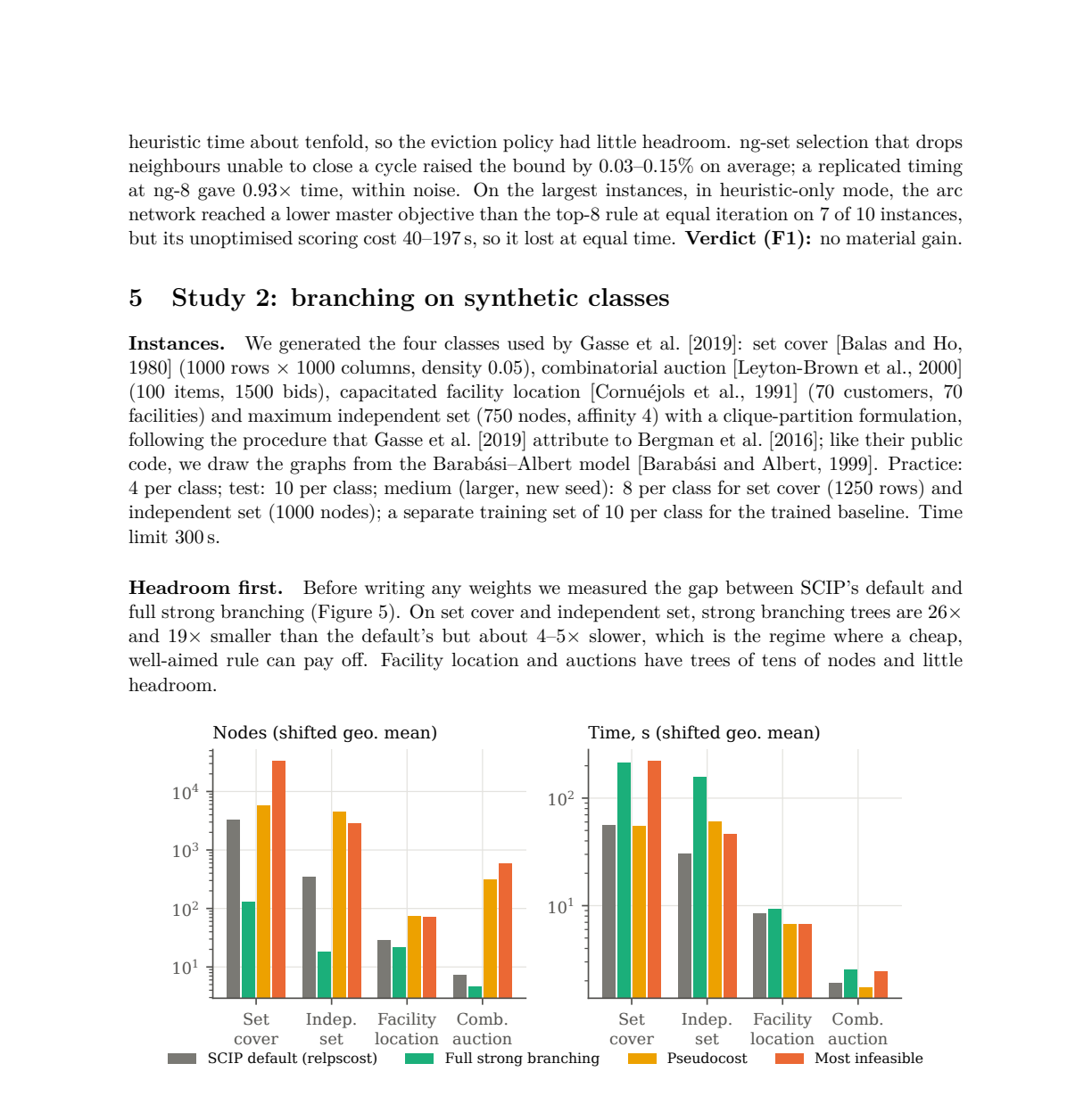
The paper's one acknowledged exception to its central conclusion — F2, the independent-set speedup called 'one clear, attributable gain' in Section 8 — is established by a time comparison that the paper's own protocol forbids. Section 8 says v1 'beat both SCIP's default and SCIP's pseudocost rule (Figure 5: pseudocost is 2× slower than the default there, v1 is 2.7× faster; different batches)'.
more of objection 1
Protocol rule 3 (§3) states that time is only compared within a batch, and the parenthetical concedes that the pseudocost and v1 legs come from different batches; the two legs also cover different instance sets (the 10-instance headroom set of Figure 5 versus the 18-instance test-plus-medium set of Figure 6). Within a batch the paper establishes only v1 versus the default (0.37×, 18 of 18 faster). Since v1's score already contains the pseudocost feature (ps, weight 0.2 in Eq. (1)) and performs no strong branching, the observed speedup is equally consistent with the 'skip strong branching' mechanism that explains the MARTA results (F5) and with genuinely better decisions from the written weights; the comparison that separates these hypotheses, v1 versus pure pseudocost within one batch on the same 18 instances, is not reported, and pseudocost tree sizes on independent set (deterministic across batches) are not given. Because Section 8's attribution of F2 is load-bearing for the scope of the abstract's conclusion, I ask the authors to run the missing paired batch (SCIP default, pure pseudocost, and v1, preferably with the native C port for time fairness) on the independent-set test and medium instances, and to restate the F2 attribution and the abstract according to the outcome.
The paper says, at Abstract and §9
The review did not quote this passage.
Pith says: Objection 2 of 2 · major
The abstract's final sentence — 'in these settings, the gains came from being cheap, not from what the LLM wrote' — is stated without qualification, yet the Discussion identifies F2 as 'one clear, attributable gain', i.e., a gain attributed to the written weights.
more of objection 2
As printed, the abstract reports the 0.37× independent-set result and then concludes that the gains came from cheapness, which a reader can only reconcile with Section 8 by inferring a caveat that is never stated. Whichever way the F2 evidence resolves after the within-batch control of the previous comment, the abstract, the 'Findings at a glance' list, and Section 8 must state the same scope for the conclusion: either the independent-set exception is made explicit, or the 'attributable' wording is withdrawn.
6 minor objections
The paper says, at Eq. (1) and Table 1
Pith says: minor objection 1 of 6
The closed-form score in Eq. (1) uses the symbol 'frac', while Table 1 defines only 'frac2 = min(f_j, 1−f_j)'; the accompanying note says the ReLU gate 'removes nearly integral candidates', which is the behaviour of frac2, so please align the notation by defining 'frac' in Table 1 or renaming it in Eq. (1).
The paper says, at §6 (MIPLIB 2017)
Pith says: minor objection 2 of 6
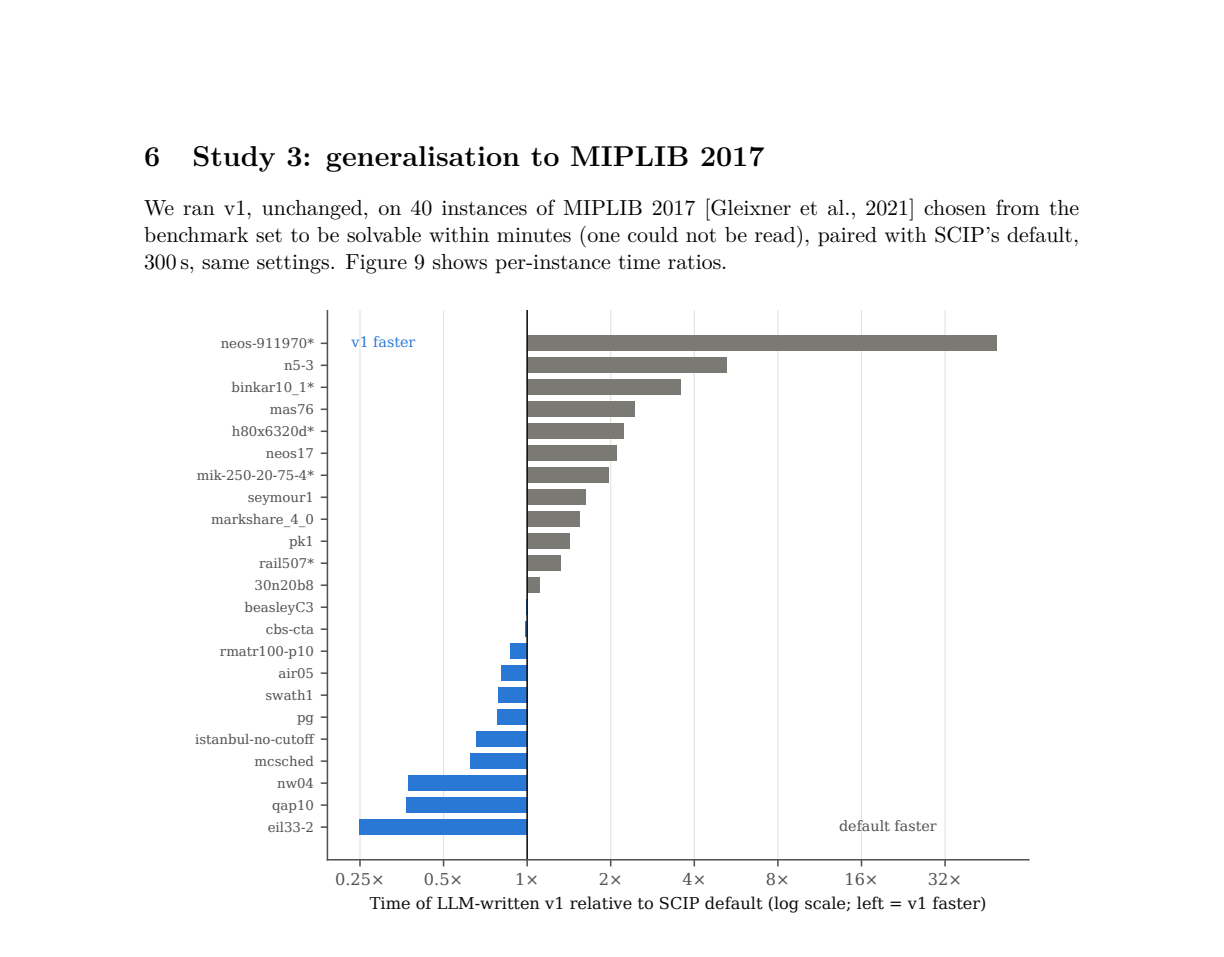
Please state the exact selection criterion for the 40 MIPLIB instances ('chosen from the benchmark set to be solvable within minutes') and name the instance that could not be read, so that readers can assess the generality of the 19-versus-24 result.
show 4 more
The paper says, at Figure 9
Pith says: minor objection 3 of 6
The caption says that instances where both rules hit the time limit or both finish within 10 seconds are omitted; please also report how many instances fall into each omission category, since the text's solved-count comparison (19 vs 24) is otherwise not directly readable from the figure.
The paper says, at §4 (column generation)
Pith says: minor objection 4 of 6
Only the arc lever has a figure; the label-eviction and ng-selection results appear as single sentences, so a small table with the time ratios and bound changes for all three levers would make the F1 null verdict checkable per lever.
The paper says, at §5.1
Pith says: minor objection 5 of 6
Please clarify whether the 20% held-out fraction in the imitation training was used for early stopping or only for evaluating the reported imitation-quality numbers, since this affects how the Figure 7 comparisons should be read.
The paper says, at §7 (MARTA instances)
Pith says: minor objection 6 of 6
The sentence 'instances above 12,000 duties are discarded' is not quantified; please state how many garages were discarded by this rule and confirm that the discard happened before the practice/test split, since this bears on the representativeness of the 32 test garages.
What would settle it
Run v1, SCIP's pseudocost rule, and SCIP's default (relpscost) as paired runs in a single batch on the same 18 independent-set instances (test seed 2 and medium seed 3, Gasse settings as in Section 5), and recompute the within-batch shifted geometric-mean time ratios and paired Wilcoxon p-values exactly per protocol rule 3. If the within-batch v1/pseudocost ratio is about 1.0 and not significantly below 1, the independent-set gain is a cheapness effect: the F2 attribution to the written weights fails, b8 holds without exception, and the Section 8 carve-out should be withdrawn. If v1 is materially faster than pseudocost within the same batch, the carve-out stands and b8's 'not from what the LLM wrote' must explicitly exempt independent set.
from the skeptic's reading
How the review went
4 readings by deepseek-v4-flash · 9 Nov 2026
- Reader holds up, with conditions
- Skeptic partly agrees
- Editor wrote the verdict above
- Referee major revision: 2 major objections, 6 minor
Not run on this paper: the simulated authors' defence.
Pith did not check this review's objections against the paper.
The review in full
The review in brief, machine-written
Quick take: this is the first systematic test of LLM-written weights inside exact OR solvers, and it is more disciplined than most of the ML4CO literature. The MARTA result is the key piece — the LLM-written network's 0.63x speedup is fully reproduced by SCIP's plain pseudocost rule (ratio 0.99, p=0.19) — and the 'gains came from being cheap' conclusion is anchored by exactly the right control.
What is genuinely new: the decisive pseudocost control, the MIPLIB non-transfer (19 vs 24 solved), the hand-written versus imitation-trained comparison on identical features, and the clean negative results in the column-generation study. The protocol is strong: exactness preserved by construction, weights frozen before seed-separated test sets, paired within-batch comparisons, and every number in the paper regenerated from released JSONL logs by a single script. The practitioner lesson — test the solver's cheapest built-in rule before crediting anything learned or written — is the right kind of calibration result for the field.
Soft spots, in proportion. The abstract's conclusion [b8] overgeneralizes against the paper's own F2, which Section 8 calls 'one clear, attributable gain'; as written, the abstract contradicts its own carve-out. More substantively, the carve-out itself rests on a comparison the paper's own protocol rule 3 forbids: the claim that v1 beats pseudocost on independent set comes from Figure 5's pseudocost numbers and the 0.37x v1 result, in different batches (Section 8 says so explicitly). Since v1's features include the pseudocost score and it skips strong branching exactly as pseudocost does, 'better decisions rather than cheapness' is not separated within any single batch. The fix is cheap and decisive: one paired run of pseudocost versus v1 on the 18 independent-set instances. If pseudocost ties, the carve-out collapses and the conclusion holds without exception; if v1 wins, the abstract must exempt independent set. The MARTA conclusion is untouched, since its control is within one batch. The remaining concerns — 8-40 instances per comparison, synthetic labour rules and garage grouping — are real but disclosed, and they limit generalizability, not internal logic.
Who this is for: anyone working on learned branching, LLM-generated solver components, or ML4CO baselines. It deserves a serious referee. I would send it out asking for the within-batch pseudocost run and a re-scoped abstract; both are small changes, and the paper's core claim will survive whichever way the confirmatory run lands.
The strongest objection
The central claim (b8), 'the gains came from being cheap, not from what the LLM wrote', has exactly one acknowledged exception: F2, the 0.37x independent-set speedup, which Section 8 calls 'one clear, attributable gain'. That exception sets the scope of b8: without it, cheapness explains every measured gain; with it, the written weights matter in at least one family. Establishing the exception requires showing that a cheap built-in rule cannot reproduce the speedup. The paper's evidence is the Section 8 sentence: 'v1 beat both SCIP's default and SCIP's pseudocost rule (Figure 5: pseudocost is 2×slower than the default there, v1 is 2.7×faster; different batches)'. This compares times across batches, and partly across instance sets (Figure 5 is the 10-instance headroom set; the 0.37x ratio is over 18 test-plus-medium instances), in tension with protocol rule 3: 'time is noisy across batches, so time is only compared within a batch'. Within a batch the paper only establishes v1 versus default (0.37x, n=18, p=7.6e-6, 18 of 18 faster) and v1 versus a deliberately small trained baseline (Figure 8). Since v1 is itself a cheap rule whose features include the pseudocost score (feature ps) and it skips strong branching exactly as pseudocost does, its speedup over the default is consistent both with the MARTA mechanism (skip strong branching) and with better decisions; the comparison that separates these hypotheses, v1 versus pseudocost on independent set, is the one that violates the protocol. The MARTA control (Table 2, one batch, ratio 0.99, p=0.19) is unaffected. The unresolved question is the scope of b8: if a within-batch run shows pseudocost about ties v1 on independent set, the carve-out collapses, b8 holds without exception, and the paper loses its only positive WSP data point; if the run confirms the cross-batch numbers, b8 must explicitly exempt independent set. Either resolution changes the abstract's conclusion as currently worded.
The reader's CONDITIONAL verdict and soundness-7 deduction already mention the Section 8 cross-batch comparisons, but the reader's weakest assumption is dataset representativeness; my concern is different and sharper: the cross-batch comparison is load-bearing for the scope of the central claim itself. Confirmed strengths: the MARTA decisive control is internally valid (Table 2's first four rows share one batch, factory settings, native C plugin, pseudocost matching at ratio 0.99, p=0.19), directly evidencing cheapness in the application; the F2 kernel (0.37x versus default, n=18, p=7.6e-6, 18 of 18 faster, smaller trees on the medium set) is within-batch and tree sizes are deterministic per the paper's own rule; the MIPLIB generalization test (19 vs 24 solved) and the lookahead overfitting (1.05x, p=0.51) are reported as negatives; released logs, weight files, and a single regeneration script support reproducibility. The gap: the paper's one 'clear, attributable gain' (the F2 independent-set carve-out) is justified by the Section 8 assertion that v1 beat SCIP pseudocost on independent set, drawn from Figure 5 headroom runs in different batches and partly different instance sets than the 18-instance 0.37x measurement. Because v1's features include the pseudocost score and v1, like pseudocost, skips strong branching, cheapness alone is a live alternative explanation for the independent-set speedup; the same logic that made pseudocost the decisive control in MARTA requires that control in Study 2, where it has not been run within a batch. Resolving this does not threaten the negative results or the MARTA control; it determines whether b8 is accurate as stated or needs its independent-set exception, and whether the paper retains its one positive WSP data point. I therefore keep CONDITIONAL, attaching a concrete condition: a within-batch paired v1-versus-pseudocost run on the 18 independent-set instances, regenerable from released code, or a rescoped conclusion that does not assert the carve-out on cross-batch timings.
The referee's report
The paper delivers a well-scoped, largely negative empirical result on a timely question: in the settings examined, LLM-written scoring networks did not outperform the solver's own cheap rules once those rules were actually tried. The experimental protocol is a model for this kind of study — exactness is preserved by construction, weights are frozen before seed-separated test sets, all comparisons are paired within batches, and the decisive control (plain pseudocost on MARTA, Table 2) is run explicitly. The reproducibility package is a genuine strength: every number is regenerated from released logs by one script, the AI-generation and circularity concerns are disclosed in unusual detail, and negative results (column generation, MIPLIB, the lookahead variant) are reported without spin. The main weakness is that the paper's one positive, 'attributable' result (F2) rests on a cross-batch time comparison that the paper's own protocol forbids, leaving the scope of the headline conclusion not fully supported; the missing control is a single additional batch, and the surrounding evidence suggests the paper's substantive message would survive the fix in either direction.
Pith's reading of the paper (a machine's summary, not the authors')
The paper asks a narrow, testable question: can a large language model write the weights of a small scoring network — reading only forward-pass outputs, with no gradient training — so that a gold-standard exact optimization algorithm runs faster on held-out instances without changing its results? Using SCIP, a standard open-source solver for mixed-integer programming, as the host, the studies found a real gain in exactly one place: an LLM-written branching rule solved maximum-independent-set instances in $0.37\times$ the default's time ($p<10^{-5}$) and beat imitation-trained networks on the same features, but the unchanged rule solved 19 versus 24 MIPLIB 2017 instances. In column generation for vehicle routing no lever gave a material gain, and in a bus-driver scheduling application built from Atlanta transit data the written rules took $0.63\times$ the default's time on 32 held-out garages — while SCIP's own plain pseudocost rule did exactly as well (ratio 0.99, $p=0.19$). The paper's conclusion is that in these settings the gains came from being cheap — skipping strong branching — not from what the LLM wrote, and that practitioners should test the solver's cheapest built-in rule before attributing a speedup to any learned or written rule. The paper is itself AI-generated and flags the circularity that the same model wrote the weights and the text; every number is regenerated from released logs.
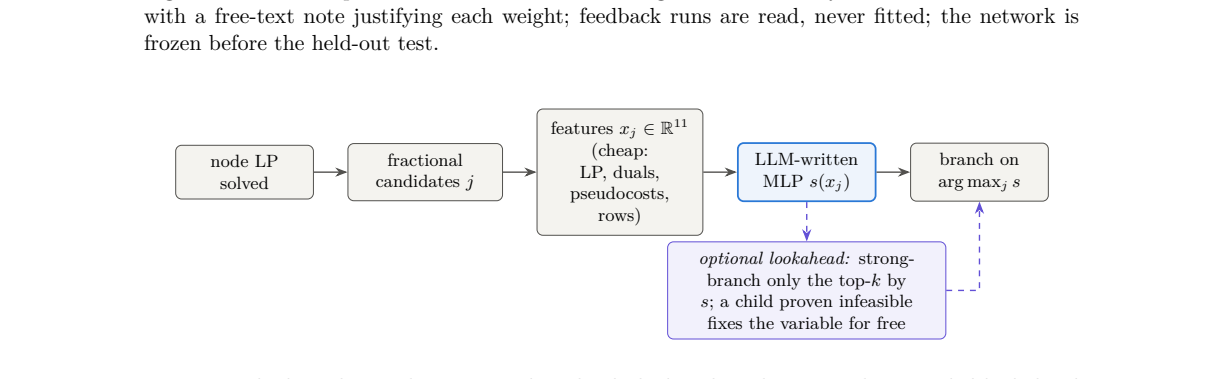
What carries the argument. The central object is the LLM-written scoring network: a small multilayer perceptron (one linear layer or one ReLU layer of width 6) stored as JSON, with each weight accompanied by a written justification, produced by a weight-space-programming loop in which the LLM reads forward-pass diagnostics — strong-branching rank of the network's pick, per-feature agreement with strong branching, tree sizes — and edits the weights by hand on practice instances, frozen before any seed-separated test run. What carries the argument is the protocol around that object: paired within-batch comparisons so all rules share machine load, exactness of the host algorithm so the network can only change time and tree size, and the control rules SCIP already ships, above all plain pseudocost branching, which is what makes the 'cheap, not smart' attribution testable. The named identity at the centre of the branching study is the closed-form v1 score $s_{v1}(x)=\deg + 0.7\,\mathrm{dualm} + 0.4\,\mathrm{val} + 0.2\,\mathrm{ps} + 0.3\,\mathrm{frac} - 3\max(0,0.4-\mathrm{frac})$, whose written notes justify each term (hub variables propagate on the up-branch; the ReLU gate removes nearly integral candidates). For the application, the written rule m3 was ported to a native C SCIP plugin so that its Python-versus-C feature-computation disadvantage did not bias the comparison.
Core claim. On the paper's own terms, the discovery is that an LLM can write the weights of a small multilayer perceptron — reading only forward-pass diagnostics, with no gradient step — that serves as an exact-safe scoring rule inside column generation and branch-and-bound: a bad network only costs time, never the optimum, so the network can only change time and tree size. The strongest attributable gain is on maximum independent set, where the written rule with score $s_{v1}(x)=\deg + 0.7\,\mathrm{dualm} + 0.4\,\mathrm{val} + 0.2\,\mathrm{ps} + 0.3\,\mathrm{frac} - 3\max(0,0.4-\mathrm{frac})$ solved 18 of 18 paired instances in $0.37\times$ the time of SCIP's default ($p=7.6\times10^{-6}$) and beat trained networks on the same seven features even though it imitated strong branching less well. The same rule solved 19 of 39 MIPLIB 2017 instances against 24 for the default, showing the gain was family-specific. In the MARTA application, the written rules ran at $0.63\times$ the default's time on 32 held-out garages ($p<10^{-4}$), but SCIP's plain pseudocost rule, a one-line configuration change, matched them exactly (ratio 0.99, $p=0.19$). From this the paper concludes that in these settings the gains came from being cheap, not from what the LLM wrote.
The premise it rests on. The load-bearing premise is that the small, partly synthetic testbed — a few dozen instances per comparison, with the MARTA labour rules and garage groupings constructed by the author because the public transit feed does not say which garages serve which routes — is representative enough of real integer programs that the measured time ratios, and the attribution of the gains to cheapness rather than to the written weights, carry over to practice.
If the paper is right (Pith's inferences, not the authors')
Practitioners should benchmark the solver's cheapest built-in rule — in SCIP, plain pseudocost is a one-line configuration change — before attributing any measured speedup to a learned or LLM-written rule; in the MARTA application that baseline reproduced the entire observed gain (ratio 0.99, $p=0.19$).
LLM-written scoring networks are exact-safe: since the host algorithm stays exact whatever the weights, a bad network costs only time, never a wrong optimum, so such rules can be trialled without correctness risk.
Written branching rules are family-specific: the rule specialised to independent set and set cover solved 19 of 39 MIPLIB 2017 instances versus 24 for the default, so a per-family rule should not be expected to transfer to unrelated integer programs.
Better imitation of strong branching is not a reliable proxy for better branching: trained networks imitated strong branching more closely on independent set, yet built larger trees and were never faster than the hand-written weights on the same features.
In column generation for VRPTW, exact pricing dominates runtime, so improving heuristic arc or label scoring — by an LLM-written network or by classical rules — has little headroom to save wall-clock time.
My inference: the paper's control design suggests a reporting norm for the field — any learned or LLM-generated branching rule should be reported against the solver's own cheap-rule switch (plain pseudocost), not just against the default configuration, or a reported 'speedup' may be cheapness in disguise.
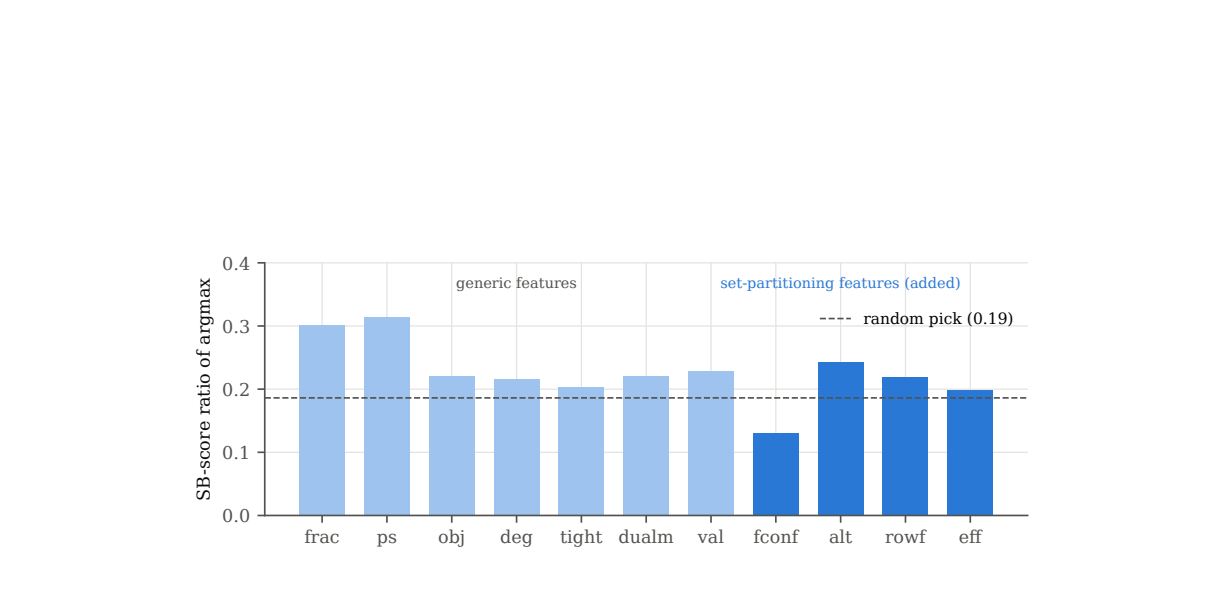
My inference: the diagnosis that the valuable decision in set-partitioning models — which variable's branching fixes something for free — is invisible to cheap node features points toward written or learned policies for when to spend strong branching (selective lookahead) rather than better static scoring; the paper's own top-k lookahead halved practice trees before overfitting on the test set.
My inference: the interpretability of written weights — every weight carries a stored justification — could matter independently of speed in regulated crew-scheduling contexts where solver decisions must be auditable.
My inference: whether gradient-trained networks can beat hand-written ones at equal engineering cost on set partitioning remains untested, since the trained baseline here is deliberately small (seven features, about two thousand labelled nodes).
Check this review
Pith stored no record of this review's passes and took no fingerprint of it. Reviews made by code from 13 Nov 2026 on carry both.
How often reviews like this one are right
Reviews like this one: written by deepseek-v4-flash, where what was read was not recorded.
How often objections from reviews like this one are right: not yet measured
Reviews by people
This review was written by a machine. No person has reviewed this paper on Pith yet. A scientist listed on Pith can review it for a fee, and their review is published here whatever it concludes.
The paper
Abstract
This paper was generated by an AI model (Claude Opus 5.5, Anthropic) under the author's direction; all results come from computations run on the author's machine, and every reference was checked. Weight-space programming (WSP) is the idea that a large language model (LLM) can write the weights of a small neural network directly, guided only by reading forward-pass outputs, with no gradient training. We test whether WSP can improve exact operations research algorithms where they rely on cheap scoring rules. In four studies, an LLM wrote small multilayer perceptrons that (i) select arcs, labels and ng-neighbourhoods inside column generation for the vehicle routing problem with time windows, and (ii) choose branching variables in SCIP's branch-and-bound. The algorithms stay exact whatever the weights; a bad network only costs time. In column generation, no lever gave a material gain. In branching on synthetic classes, a hand-written network solved independent-set instances in 0.37x the time of SCIP's default rule (18 paired instances, Wilcoxon p < 10−5) and matched or beat networks trained by imitation of strong branching, but on 39 MIPLIB 2017 instances it solved 19 versus 24. In an application built from the real GTFS feed of Atlanta's transit agency (MARTA), a crew scheduling set-partitioning model solved by a native C plugin with SCIP's factory settings, the LLM-written rules took 0.63x the default's time on 32 held-out instances (p < 10−4), but SCIP's plain pseudocost rule did exactly as well (ratio 0.99, p = 0.19). In these settings, the gains came from being cheap, not from what the LLM wrote. All code, logs and the numbers behind every figure are released.
The paper's own sentences, arranged, kept beside the review and separate from it. Each label is drawn from a closed vocabulary; the number beside it is the probability the classifier gave that label. No sentence in this record was written by a model.
abstract compiled · 2026-11-09
The authors' main claim, as the classifier picked it out 1.00
“In these settings, the gains came from being cheap, not from what the LLM wrote.”
How the main claim is stated: asserted 1.00
What the abstract itself states, as probabilities: claims first 0.05 · states limitation 0.94 · human participants 0.04 · controlled comparison 0.95 · randomized assignment 0.02 · states quantitative result 0.99 · compares with prior results 0.97 · mentions code or data availability 0.99
The abstract, sentence by sentence
This table labels the abstract only (arXiv listing abstract v1). The number is the probability the classifier gave the label.
| Sentence | Role | The authors' own work | States the main conclusion | Strength |
|---|---|---|---|---|
| This paper was generated by an AI model (Claude Opus 5.5, Anthropic) under the author's direction; all results come from computations run on the author's machine, and every reference was checked. | limitation 0.45 | 0.53 | 0.02 | asserted 1.00 |
| Weight-space programming (WSP) is the idea that a large language model (LLM) can write the weights of a small neural network directly, guided only by reading forward-pass outputs, with no gradient training. | background 0.97 | 0.07 | 0.03 | asserted 0.83 |
| We test whether WSP can improve exact operations research algorithms where they rely on cheap scoring rules. | contribution 0.92 | 0.53 | 0.03 | hedged possibility 0.47 |
| In four studies, an LLM wrote small multilayer perceptrons that (i) select arcs, labels and ng-neighbourhoods inside column generation for the vehicle routing problem with time windows, and (ii) choose branching variables in SCIP's branch-and-bound. | contribution 0.61 | 0.92 | 0.04 | asserted 1.00 |
| The algorithms stay exact whatever the weights; a bad network only costs time. | method 0.31 | 0.47 | 0.07 | asserted 1.00 |
| In column generation, no lever gave a material gain. | result 1.00 | 0.94 | 0.18 | asserted 1.00 |
| In branching on synthetic classes, a hand-written network solved independent-set instances in 0.37x the time of SCIP's default rule (18 paired instances, Wilcoxon $p<10^{-5}$) and matched or beat networks trained by imitation of strong branching, but on 39 MIPLIB 2017 instances it solved 19 versus 24. | result 1.00 | 0.93 | 0.09 | asserted 1.00 |
| In an application built from the real GTFS feed of Atlanta's transit agency (MARTA), a crew scheduling set-partitioning model solved by a native C plugin with SCIP's factory settings, the LLM-written rules took 0.63x the default's time on 32 held-out instances ($p<10^{-4}$), but SCIP's plain pseudocost rule did exactly as well (ratio 0.99, $p=0.19$). | result 1.00 | 0.95 | 0.10 | asserted 1.00 |
| In these settings, the gains came from being cheap, not from what the LLM wrote. | interpretation 1.00 | 0.90 | 0.74 | asserted 1.00 |
| All code, logs and the numbers behind every figure are released. | contribution 0.85 | 0.76 | 0.03 | asserted 1.00 |
What kind of paper the classifier reports this is: empirical study 1.00 · evidence from simulation or computation 0.87
What was examined, and what was not
Sources read
- arXiv listing abstract v1
Not examined
- full text
- figures and tables
- references and citing sentences
- relations to other papers
Levels run
- P abstract
Not run
- S sections
- T body sentences
- C citations
- R cross-paper relations
How the labels were made
Compiled by classifier-1.13.0 via TypeSafe API, question bank abstract-p1-20260923, 2026-11-09: 1 request, 7,865 input tokens.
Every quoted sentence on this record is the authors'. Every label is from Pith's closed vocabulary, with the probability shown beside it. This record as JSON
Figures (13)



Figures are the authors', reproduced from the paper.
References (21)
- [9] doi: 10.1007/b135457. Martin Desrochers, Jacques Desrosiers, and Marius Solomon. A new optimization algorithm for the vehicle routing problem with time windows.Operations Research, 40(2):342–354, on Pithdoi:10.1007/b135457
- [15] doi: 10.1609/aaai.v30i1.10080. Kevin Leyton-Brown, Mark Pearson, and Yoav Shoham. Towards a universal test suite for combi- natorial auction algorithms. InProceedings of the 2nd ACM Conference on Electronic Commerce, pages 66–76. ACM, on Pithdoi:10.1609/aaai.v30i1.10080
- [17] doi: 10.1287/opre.1050.0234. Stephen Maher, Matthias Miltenberger, João Pedro Pedroso, Daniel Rehfeldt, Robert Schwarz, and Felipe Serrano. PySCIPOpt: Mathematical programming in Python with the SCIP Optimization Suite. In Gert-Martin Greuel, Thorsten Koch, Peter Paule, and An... on Pithdoi:10.1287/opre.1050.0234
- [18] Springer International Publishing. doi: 10.1007/978-3-319-42432-3_37. 15 Alejandro Marcos Alvarez, Quentin Louveaux, and Louis Wehenkel. A machine learning-based approximation of strong branching.INFORMS Journal on Computing, 29(1):185–195, on Pithdoi:10.1007/978-3-319-42432-3_37
- [1980] doi: 10.1007/BFb0120886. Roberto Baldacci, Aristide Mingozzi, and Roberto Roberti. New route relaxation and pricing strategies for the vehicle routing problem.Operations Research, 59(5):1269–1283, on Pithdoi:10.1007/bfb0120886
- [1991] doi: 10.1016/0377-2217(91)90261-S. Guy Desaulniers, Jacques Desrosiers, and Marius M. Solomon, editors.Column Generation. Springer US, on Pithdoi:10.1016/0377-2217(91)90261-s
- [1992] doi: 10.1287/opre.40.2.342. Maxime Gasse, Didier Chételat, Nicola Ferroni, Laurent Charlin, and Andrea Lodi. Exact combi- natorial optimization with graph convolutional neural networks. InAdvances in Neural Informa- tion Processing Systems, volume on Pithdoi:10.1287/opre.40.2.342
- [1995] doi: 10.1007/978-3-642-57762-8_12. A Reproducibility •Synthetic instances:gen.py OUTDIR N SEED [medium](seeds: practice 1, test 2, medium 3, training 4). •Built-in rules:run_builtin.py OUT TLIMIT WORKERS RULES INSTANCES. •Network rules:run_net.py OUT TLIMIT WORKERS NETS [–diag... on Pithdoi:10.1007/978-3-642-57762-8_12
- [1997] doi: 10.1111/j.1475-3995. 1997.tb00071.x. Anthony Wren and Jean-Marc Rousseau. Bus driver scheduling — an overview. In Joachim R. Daduna, Isabel Branco, and José M. Pinto Paixão, editors,Computer-Aided Transit Scheduling, volume 430 ofLecture Notes in Economics and Mathematica... on Pithdoi:10.1111/j.1475-3995
- [1999] doi: 10.1126/science.286.5439.509. Yoshua Bengio, Andrea Lodi, and Antoine Prouvost. Machine learning for combinatorial opti- mization: A methodological tour d’horizon.European Journal of Operational Research, 290(2): 405–421, on Pithdoi:10.1126/science.286.5439.509
- [2000] doi: 10.1145/352871.352879. Marco E. Lübbecke and Jacques Desrosiers. Selected topics in column generation.Operations Research, 53(6):1007–1023, on Pithdoi:10.1145/352871.352879
- [2005] doi: 10.1016/j.orl.2004.04.002. Egon Balas and Andrew Ho. Set covering algorithms using cutting planes, heuristics, and subgradi- entoptimization: Acomputationalstudy. InM.W.Padberg, editor,Combinatorial Optimization, volume 12 ofMathematical Programming Studies, pages 37–60. ... on Pithdoi:10.1016/j.orl.2004.04.002
- [2009] doi: 10.1007/s12532-008-0001-1. Tobias Achterberg, Thorsten Koch, and Alexander Martin. Branching rules revisited.Operations Research Letters, 33(1):42–54, on Pithdoi:10.1007/s12532-008-0001-1
- [2011] doi: 10.1287/opre.1110.0975. Albert-László Barabási and Réka Albert. Emergence of scaling in random networks.Science, 286 (5439):509–512, on Pithdoi:10.1287/opre.1110.0975
- [2016] doi: 10.1007/978-3-319-42849-9. 14 Gérard Cornuéjols, Ramaswami Sridharan, and Jean-Michel Thizy. A comparison of heuristics and relaxations for the capacitated plant location problem.European Journal of Operational Research, 50(3):280–297, on Pithdoi:10.1007/978-3-319-42849-9
- [2017] doi: 10.1287/ijoc.2016.0723. Metropolitan Atlanta Rapid Transit Authority (MARTA). MARTA GTFS static feed.https: //www.itsmarta.com/app-developer-resources.aspx, on Pithdoi:10.1287/ijoc.2016.0723
- [2018] doi: 10.1007/s12532-017-0130-5. Elias B. Khalil, Pierre Le Bodic, Le Song, George L. Nemhauser, and Bistra Dilkina. Learning to branch in mixed integer programming. InProceedings of the AAAI Conference on Artificial Intelligence, volume 30, pages 724–731, on Pithdoi:10.1007/s12532-017-0130-5
- [2019] URLhttps://proceedings. neurips.cc/paper/2019/hash/d14c2267d848abeb81fd590f371d39bd-Abstract.html. Ambros Gleixner, Gregor Hendel, Gerald Gamrath, Tobias Achterberg, Michael Bastubbe, Timo Berthold, Philipp Christophel, Kati Jarck, Thorsten Koch, Jeff Linderoth, Marco Lübbecke... on Pith
- [2021] doi: 10.1016/j.ejor.2020.07.063. David Bergman, Andre A. Cire, Willem-Jan van Hoeve, and John Hooker.Decision Diagrams for Optimization. Artificial Intelligence: Foundations, Theory, and Algorithms. Springer Interna- tional Publishing, Cham, on Pithdoi:10.1016/j.ejor.2020.07.063
- [2025] URLhttps: //arxiv.org/abs/2511.18580. Q. Huangfu and J. A. J. Hall. Parallelizing the dual revised simplex method.Mathematical Programming Computation, 10(1):119–142, on PitharXiv
show 1 more
- [2026] Feed filehttps://itsmarta. com/google_transit_feed/google_transit.zip, effective 2026-08-22, accessed 2026-11-04. D. M. Ryan and B. A. Foster. An integer programming approach to scheduling. In Anthony Wren, editor,Computer Scheduling of Public Transport: Urban Passenger Vehicl... on Pith
Cited by 1 Pith paper
Reviewed papers on Pith that cite this one. The full citation record
- Weight-Space Programming for Materials Science cond-mat.mtrl-sci · Nov 2026
Challenges and discussion
Disagree with the review, or know something it missed? Leave a comment, or challenge this review formally: a challenge becomes a permanent entry in this paper's record, and its decision is published here.
Come back by email
A short list of the week's newly reviewed papers. Nothing is sent until you confirm from your inbox, and every email has a link that stops it. No account.
No comments yet.
Sign in to comment