Machine Learning · arXiv:2611.07847 v2 · submitted 5 Nov 2026
Computation, not weight access: large language models as auditors of clinical prediction networks
The paper says
“Frontier large language models (LLMs) have been reported to read, edit and write the weights of small neural networks, raising the prospect of auditing clinical prediction models from their files alone.”
more of the abstract
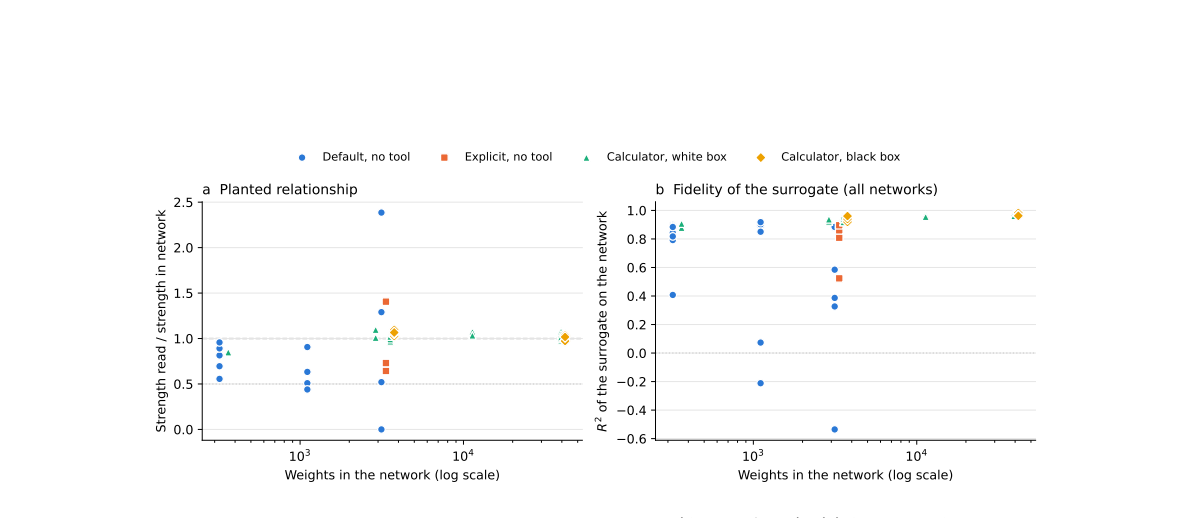
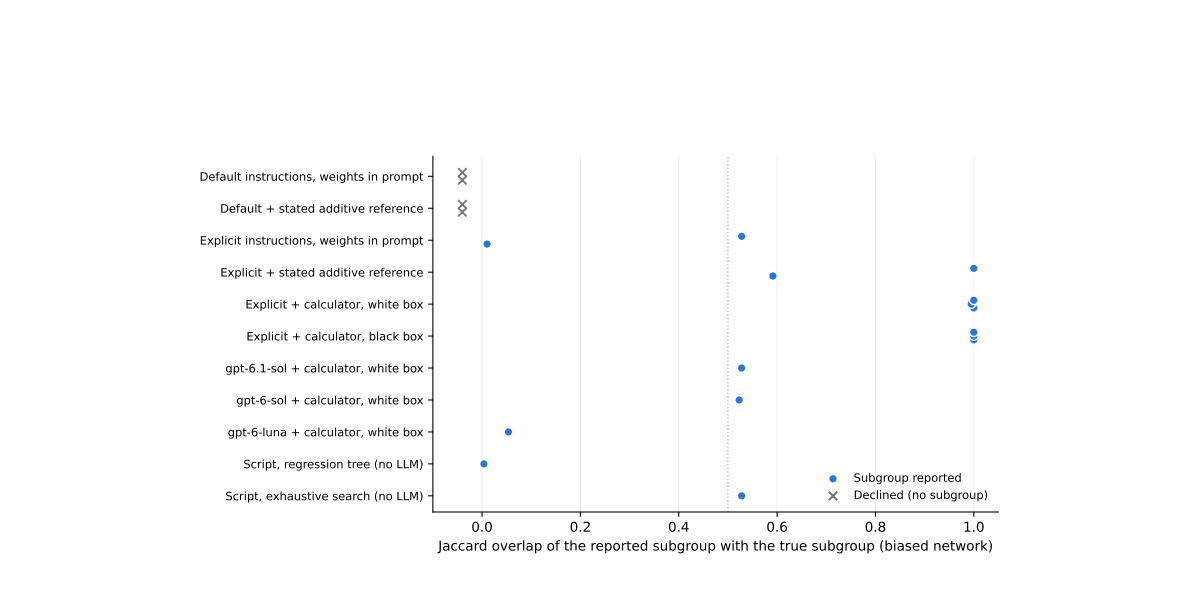
Public demonstrations, however, mixed reading raw weights with running code. We separated these conditions in internally pre-specified simulation experiments. Tanh networks of 105 to 38,401 weights were trained on simulated cohorts of patients with subarachnoid haemorrhage, each with a planted relationship or none, and one network was trained on labels that under-recorded deaths in a subgroup. GPT-6 Astra and four other GPT models answered single prompts under a default or an explicit system instruction, either with the weights in the prompt and no tools, or with a calculation-only tool that exposed the weights (white box) or only the network's predictions (black box). Without tools, Astra recovered planted relationships in 353-weight networks but became unreliable at 3,457 weights, and under the default instruction it declined 17 of 21 audit and repair tasks as unidentifiable; the explicit instruction removed these refusals. With the tool, it recovered the planted relationship in all 39 runs on networks of up to 38,401 weights, raised no false alarm in 21 runs on null networks, and found the biased subgroup in 6 of 6 runs. Black-box access performed as well as white-box access, and other GPT-6 models read as accurately. A well-designed script matched the comparator models on the audit and the best LLM repair. For auditing these networks, what mattered was computation and elicitation, not access to the weights.
from the abstract
Pith says
Machine review · deepseek-v4-flash · 6 Nov 2026 · of version 1 of the paper; version 2 is newer · what was read was not recorded · not checked by a person
It can be wrong. Challenge this review or reply to it.
Holds up. A clean dissection of LLM weight-reading claims: computation and elicitation matter, weight access does not, for small tanh networks on simulated data. This line is wrong
4 minor
How often objections from reviews like this one are right: not yet measured
Not checked: figures, code, what the references say.
4 minor objections
The paper says, at Table 4
Pith says: minor objection 1 of 4
The label 'E8 repair' is used without definition; please either define 'E8' in the caption or replace it with a descriptive name (e.g., 'repair, subgroup not given').
The paper says, at Table 5
Pith says: minor objection 2 of 4
The experiment references 'E13' and 'E19' are not explained in the table or its caption; add a brief description (e.g., '105-weight networks without tools' and 'calculator, white box, 3,457- and 38,401-weight networks') for clarity.
show 2 more
The paper says, at §4.7
Pith says: minor objection 3 of 4
The observation about systematic negative interactions between l3 and other inputs is interesting but left dangling. Consider a brief discussion of how this relates to faithful reporting vs. trustworthy findings, or note it as a training artefact that the LLM correctly captured.
The paper says, at Figure 2 caption
Pith says: minor objection 4 of 4
The caption already states that rows without a model name are GPT-6 Astra, which is helpful. Confirm that the figure legend itself also makes this clear, as readers may rely solely on the legend.
What would settle it
Replicate the calculator-based audit (same prompt, same tool) on a real-world clinical prediction model trained on actual patient data, e.g., a logistic regression or MLP from MIMIC, with a known but subtle labelling bias in a demographic subgroup. If the LLM fails to identify the bias or raises false alarms, the scope of the central claim would need to be restricted to simulated tanh MLPs with simple planted relationships.
from the skeptic's reading
How the review went
4 readings by deepseek-v4-flash · 6 Nov 2026
- Reader holds up
- Skeptic partly agrees
- Editor wrote the verdict above
- Referee minor revision: 4 minor
Not run on this paper: the simulated authors' defence.
Pith did not check this review's objections against the paper.
The review in full
The review in brief, machine-written
This paper separates two confounded conditions in the "LLMs can read neural network weights" debate: having the weights in the prompt vs. having a calculation tool. The authors run a tight factorial design with pre-specified rules, negative controls, and repeats. The headline result is that for small tanh networks (up to 38k weights), what determines audit success is whether the LLM can compute, not whether it sees the weights. That is a clean finding within its stated scope.
What is good: the experimental design is unusually careful. They commit their plan before each experiment, vary instruction and access, include null and unbiased networks as controls, and compare against non-LLM scripts. The instruction effect—11 of 12 audit/repair runs declined under default, zero under explicit—is a concrete lesson for anyone benchmarking LLMs. The black-box condition performing as well as white-box is the sharpest claim, and the data support it across 29 runs with a planted relationship. Repeats agree tightly, strength ratios cluster near 1.0, and the models' noise and training artefacts are reported faithfully, not hidden.
The soft spots are all stated by the authors: simulated data, tanh MLPs only, one model family (GPT), limited runs in some cells, and the scripted audit's search space designed with knowledge of the planted subgroup form. These are real limits. The paper would be stronger with tests on gradient-boosted trees or deeper nets, on data with unknown ground truth, and with at least one non-GPT model. But the authors are upfront about them and do not overclaim.
Who this is for: researchers evaluating LLM agents, people working on LLM-based interpretability, and anyone following the weight-space programming debate. The paper is a solid extension within its subfield, not a revolution.
Recommendation: I would send this to peer review. The experimental discipline is high enough that reviewers can evaluate the claims fairly, and the limitations are openly stated. The paper will likely need a major revision to discuss generalization, but the core experiment is worth refereeing.
The strongest objection
No significant objection identified. The paper is internally consistent, with all major limitations acknowledged in §5.5. The central claim is well-supported by the data within the stated scope. The experimental design separates conditions cleanly, metrics are pre-specified, and the results are clear. Generalization to real clinical models or other architectures is explicitly deferred, so it is not a flaw in the paper's argument.
The reader's weakest assumption (that simulated networks represent real clinical models) is correctly identified as a limitation, and the paper acknowledges it transparently. However, this limitation does not undermine the paper's internal validity or the strength of its experimental results within its stated scope. The paper's claim is explicitly about 'these networks' and the conditions tested. Therefore, no adjustment to the verdict is needed.
The referee's report
If the results hold, they resolve a key ambiguity in the weight-space programming debate by showing that the observed auditing capability comes from automated experimentation, not from reading raw weight patterns. The finding that black-box access (predictions only) performs as well as white-box access has practical implications for model governance: an auditor need not obtain the model file to evaluate it. The study is methodologically careful—pre-specified rules, negative controls, multiple repeats, and clean separation of conditions—and the limitations are stated clearly, so the contribution is well-bounded and reproducible.
Pith's reading of the paper (a machine's summary, not the authors')
This paper tests whether large language models (LLMs) can audit clinical prediction networks by reading raw weights alone, with a calculation tool, or with black-box queries. It finds that without any tool, LLMs reliably read only very small networks (up to about 350 weights) and become unreliable at a few thousand weights, with high variability. With a simple calculator tool that runs code on the network’s predictions, LLMs accurately recover planted relationships and biases in networks of up to 38,401 weights, and they perform equally well whether or not the tool exposes the weights. A one-paragraph explicit system instruction eliminates the model’s tendency to refuse audit and repair tasks, while the default instruction led to 11 of 12 refusals. Well-designed scripts match the LLM’s audit performance, which suggests that the LLM’s added value lies in autonomously designing and carrying out the search and reporting the findings in plain language.
What carries the argument. Two mechanisms jointly carry the argument: a calculation-only tool (run_python) that lets the LLM run NumPy code to query network predictions (and optionally inspect weights), and an explicit system instruction that tells the model to choose defensible options, deliver the closest approximation, and avoid disclaimers. The tool provides the computational capacity that raw weight reading lacks, enabling the model to fit surrogate models and search for systematic departures. The instruction overcomes the model’s default tendency to refuse tasks that have ambiguous or multiple defensible answers, which would otherwise dominate the audit and repair conditions.
Core claim. The central claim is that for auditing clinical prediction networks with LLMs, what matters is computational access and elicitation, not direct access to the model weights. The authors demonstrate that GPT-6 Astra with a calculation-only tool (run_python) consistently recovers planted relationships and biased subgroups in networks spanning 105 to 38,401 weights, in all 29 positive trials and without false alarms in 15 null trials. Black-box access (predictions only) and white-box access (weights plus predictions) yield indistinguishable accuracy and stability. Without the tool, the model succeeds only on the smallest networks (353 weights) and its performance is unreliable and slow. The study further shows that the default single-reply instruction causes the model to decline most audit and repair tasks as infeasible; an explicit instruction that resolves open choices removes all refusals without increasing false alarms in the controls.
The premise it rests on. The paper assumes that the simulated tanh MLPs with hand-set parameters and simple planted relationships (thresholds, interactions, a subgroup label bias) are representative of real-world clinical prediction models and their potential biases, and that the LLM's performance on these synthetic problems generalizes to more complex architectures (e.g., gradient-boosted trees, deep nets) and to real data where ground truth is unknown.
If the paper is right (Pith's inferences, not the authors')
Clinical model auditors may not need access to model weights; query-level access (predictions) suffices for the types of bias tested, which could lower the barrier for independent audits.
LLM-based audit performance depends critically on the tools (e.g., a code execution sandbox) and prompts provided, not merely on the base model’s ability to read weight arrays.
Simple scripts can match LLM audit accuracy when the form of the problem is known in advance, but the LLM’s advantage lies in autonomously designing the search procedure and communicating results in natural language.
Evaluations of LLM capabilities must separate refusals from wrong answers and report the instruction, tools, and elicitation method used, as these factors can reverse conclusions.
Repair (editing weights) remains the weakest capability in this study: the LLM struggled with shape constraints and tolerance settings, and a simple scripted gate outperformed it on the tested metric.
If this finding generalizes to larger, non-tanh architectures (e.g., gradient-boosted trees or deep nets), it would shift the practical bottleneck in model auditing from weight access to designing query-efficient probes and robust elicitation protocols.
The strong dependence on system instruction suggests that many earlier evaluations of LLM ‘abilities’ may have underestimated models by using default instructions that elicit refusal; a standardised ‘resolve ambiguity’ instruction should be considered in future benchmarks.
Because the LLM faithfully reported training noise and artefactual correlations as ‘unexpected’ findings, an auditor relying on the LLM’s output without independent verification could mistake noise for signal, reinforcing the need for null controls and effect-size thresholds.
The paper’s adaptive design (later conditions designed after earlier results) is a limitation for formal statistical inference, as noted by the authors; direct replications with pre-registered protocols on real clinical data would strengthen the claim.
Check this review
Pith stored no record of this review's passes and took no fingerprint of it. Reviews made by code from 13 Nov 2026 on carry both.
How often reviews like this one are right
Reviews like this one: written by deepseek-v4-flash, where what was read was not recorded.
How often objections from reviews like this one are right: not yet measured
Reviews by people
This review was written by a machine. No person has reviewed this paper on Pith yet. A scientist listed on Pith can review it for a fee, and their review is published here whatever it concludes.
The paper
Abstract
Frontier large language models (LLMs) have been reported to read, edit and write the weights of small neural networks, raising the prospect of auditing clinical prediction models from their files alone. Public demonstrations, however, mixed reading raw weights with running code. We separated these conditions in internally pre-specified simulation experiments. Tanh networks of 105 to 38,401 weights were trained on simulated cohorts of patients with subarachnoid haemorrhage, each with a planted relationship or none, and one network was trained on labels that under-recorded deaths in a subgroup. GPT-6 Astra and four other GPT models answered single prompts under a default or an explicit system instruction, either with the weights in the prompt and no tools, or with a calculation-only tool that exposed the weights (white box) or only the network's predictions (black box). Without tools, Astra recovered planted relationships in 353-weight networks but became unreliable at 3,457 weights, and under the default instruction it declined 17 of 21 audit and repair tasks as unidentifiable; the explicit instruction removed these refusals. With the tool, it recovered the planted relationship in all 39 runs on networks of up to 38,401 weights, raised no false alarm in 21 runs on null networks, and found the biased subgroup in 6 of 6 runs. Black-box access performed as well as white-box access, and other GPT-6 models read as accurately. A well-designed script matched the comparator models on the audit and the best LLM repair. For auditing these networks, what mattered was computation and elicitation, not access to the weights.
The paper's own sentences, arranged, kept beside the review and separate from it. Each label is drawn from a closed vocabulary; the number beside it is the probability the classifier gave that label. No sentence in this record was written by a model.
abstract compiled · 2026-11-06
The authors' main claim, as the classifier picked it out 1.00
“For auditing these networks, what mattered was computation and elicitation, not access to the weights.”
How the main claim is stated: asserted 1.00
What the abstract itself states, as probabilities: claims first 0.06 · states limitation 0.42 · human participants 0.12 · controlled comparison 0.91 · randomized assignment 0.07 · states quantitative result 0.98 · compares with prior results 0.95 · mentions code or data availability 0.05
The abstract, sentence by sentence
This table labels the abstract only (arXiv listing abstract v1). The number is the probability the classifier gave the label.
| Sentence | Role | The authors' own work | States the main conclusion | Strength |
|---|---|---|---|---|
| Frontier large language models (LLMs) have been reported to read, edit and write the weights of small neural networks, raising the prospect of auditing clinical prediction models from their files alone. | background 1.00 | 0.05 | 0.03 | hedged possibility 0.75 |
| Public demonstrations, however, mixed reading raw weights with running code. | gap 0.64 | 0.07 | 0.02 | asserted 0.99 |
| We separated these conditions in internally pre-specified simulation experiments. | method 0.68 | 0.92 | 0.02 | asserted 0.91 |
| Tanh networks of 105 to 38,401 weights were trained on simulated cohorts of patients with subarachnoid haemorrhage, each with a planted relationship or none, and one network was trained on labels that under-recorded deaths in a subgroup. | method 1.00 | 0.92 | 0.02 | asserted 0.91 |
| GPT-6 Astra and four other GPT models answered single prompts under a default or an explicit system instruction, either with the weights in the prompt and no tools, or with a calculation-only tool that exposed the weights (white box) or only the network's predictions (black box). | method 1.00 | 0.89 | 0.02 | asserted 0.93 |
| Without tools, Astra recovered planted relationships in 353-weight networks but became unreliable at 3,457 weights, and under the default instruction it declined 11 of 12 audit and repair tasks as unidentifiable; the explicit instruction removed these refusals. | result 1.00 | 0.94 | 0.07 | asserted 1.00 |
| With the tool, it recovered the planted relationship in all 29 runs on networks of up to 38,401 weights, raised no false alarm in 15 runs on null networks, and found the biased subgroup in 6 of 6 runs. | result 1.00 | 0.94 | 0.10 | asserted 1.00 |
| Black-box access performed as well as white-box access, and other GPT-6 models read as accurately. | result 1.00 | 0.90 | 0.07 | asserted 1.00 |
| A well-designed script matched the comparator models on the audit and the best LLM repair. | result 0.98 | 0.80 | 0.06 | asserted 1.00 |
| For auditing these networks, what mattered was computation and elicitation, not access to the weights. | interpretation 0.98 | 0.87 | 0.96 | asserted 1.00 |
What kind of paper the classifier reports this is: simulation study 0.86 · evidence from simulation or computation 0.83
What was examined, and what was not
Sources read
- arXiv listing abstract v1
Not examined
- full text
- figures and tables
- references and citing sentences
- relations to other papers
Levels run
- P abstract
Not run
- S sections
- T body sentences
- C citations
- R cross-paper relations
How the labels were made
Compiled by classifier-1.13.0 via TypeSafe API, question bank abstract-p1-20260923, 2026-11-06: 1 request, 7,734 input tokens.
Every quoted sentence on this record is the authors'. Every label is from Pith's closed vocabulary, with the probability shown beside it. This record as JSON
Figures (2)
Figures are the authors', reproduced from the paper.
Cited by 3 Pith papers
Reviewed papers on Pith that cite this one. The full citation record
- When Can a Rewiring Control Test LLM Weight Readers? C2 and an Eligibility Protocol cs.LG · Nov 2026
- TowerBridge: Bridging the Dual-Encoder Modality Gap via Weight-Space Programming cs.CV · Nov 2026
- Weight-space programming for tractor guidance controller: large language models natively write neural network weights that steer a real tractor cs.LG · Nov 2026
Challenges and discussion
Disagree with the review, or know something it missed? Leave a comment, or challenge this review formally: a challenge becomes a permanent entry in this paper's record, and its decision is published here.
Come back by email
A short list of the week's newly reviewed papers. Nothing is sent until you confirm from your inbox, and every email has a link that stops it. No account.
No comments yet.
Sign in to comment