Machine Learning · arXiv:2611.21958 v1 · submitted 16 Nov 2026 · 49 references
Weight-space programming for tractor guidance controller: large language models natively write neural network weights that steer a real tractor
The paper says
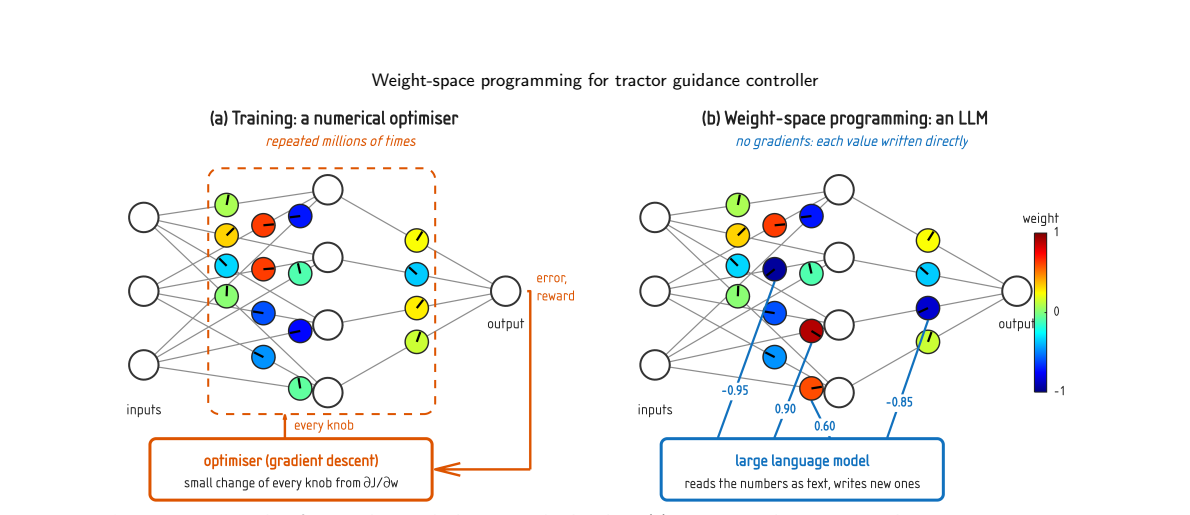
“Weight-space programming is a process where a large language model reads and writes the weights of a neural network directly, guided by a natural language specification, without an optimiser or gradient descent.”
more of the abstract
This study applies it to automatic tractor guidance, where a 253-parameter neural network steers along paths of lines and arcs and must be adapted when the machine changes, such as a slower steering actuator. GPT-6 Astra and Claude Fable 5.1 (also 5.2) edited the network for our research tractor using a small budget of simulated evaluations to repair a network trained for another tractor and write a controller into a network with zero weights. We compared them with an evolution strategy, gradient descent and pure pursuit in simulation and on the real tractor. Both models read the network and analysed the closed loop with control theory correctly, and Fable's repair without simulation succeeded only occasionally. With simulated feedback, both models repaired the trained network in single sessions and wrote a working controller from zero weights, whereas from zero the evolution strategy found none. The controllers written from zero were sparse and in a classical cascaded structure; one model edited the trained network while the other replaced it. Gradient descent reached higher accuracy with far more simulation, and all language model controllers steered the real tractor without intervention, with errors of the same order as pure pursuit. Language models can program the weights of a neural controller directly, much as control engineers design one. We call this Weight-Space Engineering.
from the abstract
Pith says
Machine review · deepseek-v4-flash · 18 Nov 2026 · read the full text (147,037 characters) · not checked by a person
It can be wrong. Challenge this review or reply to it.
Holds up, with conditions. This paper demonstrates that frontier LLMs can directly write and repair the weights of a small neural steering controller for a real tractor, using only 25 simulated evaluations and no gradient descent. This line is wrong
10 minor
How often objections from reviews like this one are right: not yet measured
The paper, first character to last
The reviewer was given the whole text, 147,037 characters. Not checked: figures, code, what the 49 references say.
10 minor objections
The paper says, at Section 1.3
Pith says: minor objection 1 of 10
The term 'Weight-Space Engineering' is introduced, but its definition is somewhat vague. The paper should clarify how it differs from 'weight-space programming' beyond the analogy to software engineering.
The paper says, at Section 3.2
Pith says: minor objection 2 of 10
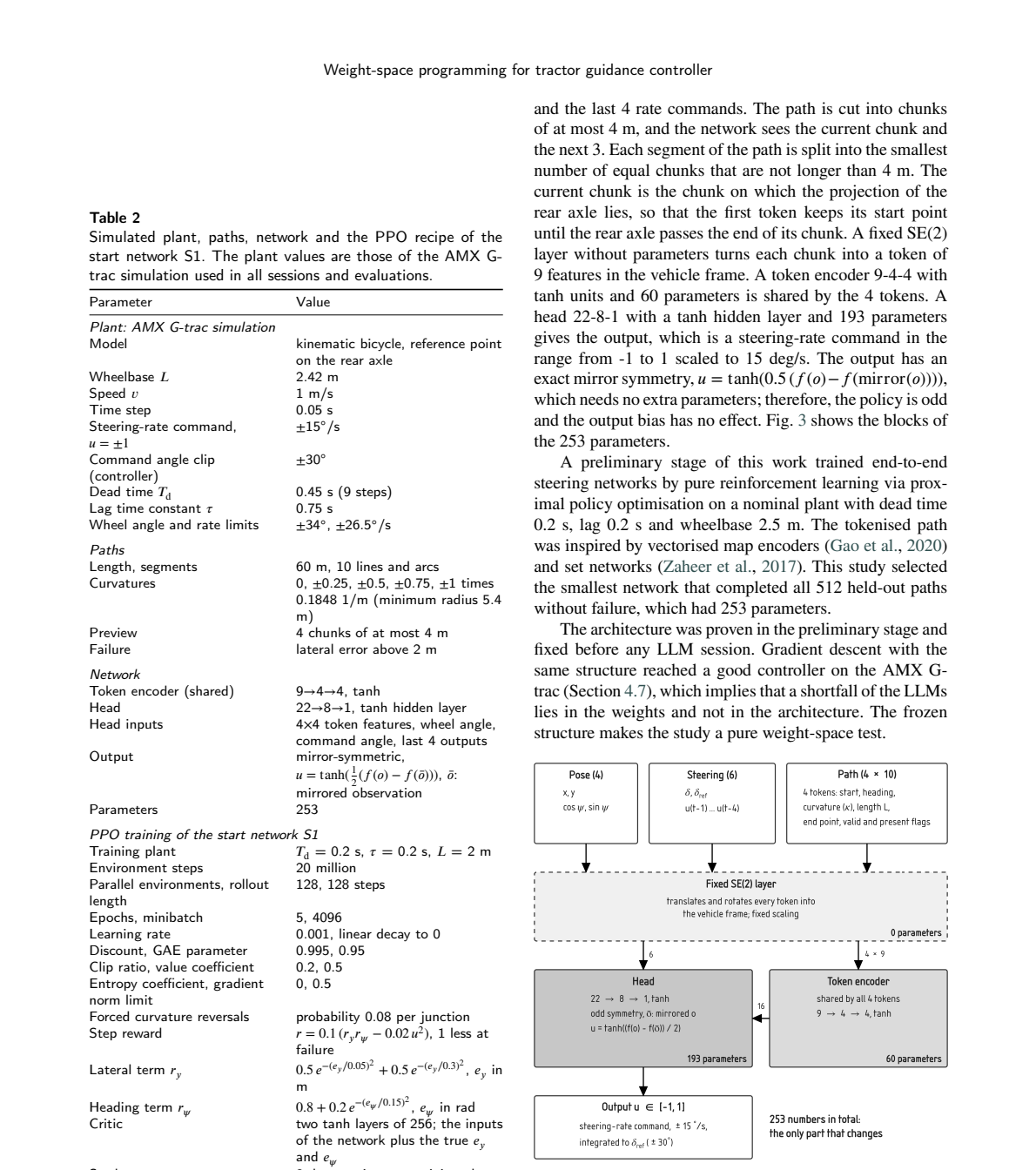
The network architecture is described, but the rationale for choosing 253 parameters is not fully explained. The paper states it was the smallest network that completed all held-out paths, but it would be helpful to know how this was determined.
show 8 more
The paper says, at Section 4.5
Pith says: minor objection 3 of 10
The paper mentions that the prompt for the zero-shot test (RQ1) omitted the control-theory framing, but the system prompt of its agents still asked them to reason analytically. This is a potential confound, as the agents may still have used control-theoretic reasoning. The paper should discuss this.
The paper says, at Section 5.5
Pith says: minor objection 4 of 10
The paper states that the study developed the prompt in pilot sessions on S1 and froze it afterwards. However, the pilot sessions were also the S1 case study. This is a potential source of overfitting, as acknowledged. The paper should provide more details on the prompt development process.
The paper says, at Section 7.2
Pith says: minor objection 5 of 10
The paper acknowledges that the transfer to larger networks remains open. This is a significant limitation, as the 253-parameter network is very small. The paper should discuss whether the approach is likely to scale to larger networks.
The paper says, at Section 7.2
Pith says: minor objection 6 of 10
The paper states that the simulation plant comes from system identification, and the study covered one tractor, one speed, one test path and one field. This limits the generalizability of the results.
The paper says, at Section 7.2
Pith says: minor objection 7 of 10
The paper acknowledges that the study compared the controllers only with pure pursuit as the classic guidance baseline, not with nonlinear model predictive control or other state-of-the-art guidance controllers. This is a limitation, but it is by design.
The paper says, at Section 5.5
Pith says: minor objection 8 of 10
The paper mentions that the APIs return summaries of the hidden reasoning, but these summaries are written by the provider with an undisclosed method. This means the reasoning summaries may not be accurate or complete. The paper should discuss this limitation.
The paper says, at Section 5.5
Pith says: minor objection 9 of 10
The paper states that the models had no tools, including no code execution, no file access and no web search. This is a strength, but it also means the models could not perform any numerical computation. The paper should discuss whether this is a realistic constraint for engineering applications.
The paper says, at Section 5.5
Pith says: minor objection 10 of 10
The paper mentions that the study saved all requests and responses verbatim. This is good for reproducibility, but the paper does not provide a link to the data or code. The paper should state whether the data and code are available.
What would settle it
A controlled experiment that separates prompt development from evaluation (e.g., holding out one tractor configuration or actuator delay for final testing) could determine whether the prompt overfits to the S1 case. Showing that the same approach works on a different vehicle, with a larger network, or with a fully held-out evaluation set would strengthen the claim.
from Pith's summary of the paper
How the review went
5 passes by deepseek-v4-flash · 18 Nov 2026
- Reader holds up, with conditions
- Skeptic concern withdrawn: the paper already says this
- Referee 10 minor
- Check against the paper kept 0 of 6 objections
- Editor wrote the verdict above
Not run on this paper: the simulated authors' defence.
Pith's passes raised 6 objections. A check against the paper's text kept 0 and withdrew 6 (6 the paper already says).
The review in full
The review in brief, machine-written
This paper takes weight-space programming—where an LLM reads and writes neural network weights directly from a natural-language specification—and applies it to a physical feedback control problem: steering a real tractor along a path. The authors show that GPT-6 Astra and Claude Fable 5.1 can both repair a trained network (to adapt to a slower steering actuator) and write a working controller into an all-zero network, using only 25 simulated evaluations. The resulting controllers are sparse, cascaded, and readable; they steer a real AMX G-trac tractor without intervention, with errors in the same range as pure pursuit. The paper is the first to validate weight-space programming on a physical machine with actuator dynamics, and it introduces the term Weight-Space Engineering as a systematic methodology.
The paper is well-structured, with clear baselines (evolution strategy, gain grid, gradient descent), separate test sets, and an honest discussion of limitations. The field test is a genuine demonstration that the weights transfer from simulation to a real vehicle. The control-theory analysis (reading the network, computing gains, checking stability) is thorough and shows that the LLMs reasoned about the closed loop correctly.
That said, the main results come from single sessions per model and start point, and the repair sessions were also used for prompt development. This limits the strength of the conclusions—there are no statistical tests, and the prompts may be partly tuned to the specific failure mode. The study uses a small network (253 parameters) and a modest evaluation budget (25 simulations); transfer to larger networks or more complex dynamics remains open. The comparison baseline is pure pursuit, not state-of-the-art controllers like nonlinear MPC, which the authors explicitly state is out of scope. The closed models (GPT-6 Astra, Claude Fable 5.1) may not persist, so exact reproducibility is uncertain.
This paper is for readers interested in alternative paradigms for controller design, LLM-based engineering, and agricultural robotics. It is a novel and honest demonstration, not a breakthrough in tracking accuracy. The claims are appropriately bounded, and the methodology is sound enough to warrant a serious peer review, even though the results are preliminary.
Recommendation: This paper deserves a serious referee. The authors have laid out a clear methodology, acknowledged the key limitations, and provided real-world validation. Peer review should focus on the robustness of the prompt design, the single-session caveat, and the generalizability to larger networks and more challenging control tasks.
The stress test's concern
Withdrawn: the paper already says this.
The paper says
“This study conducted one session per model and start point without performing statistical tests; furthermore, the repair sessions were the sessions in which the prompt was developed.”
The referee's report
Not published. Pith's referee wrote this assessment before its objections were checked against the paper, and 5 of its 5 major objections did not survive that check.
Pith's reading of the paper (a machine's summary, not the authors')
The paper claims that large language models can engineer a neural network controller by reading and writing its weights directly, guided by control theory and a small budget of simulated evaluations. The authors test this on a tractor guidance task: a 253-parameter network must steer along paths of lines and arcs, and must be adapted when the steering actuator becomes slower. Both GPT-6 Astra and Claude Fable 5.1 succeeded in repairing a trained network for the slower actuator and in writing a working controller from all-zero weights, with errors on the real tractor comparable to the classic pure pursuit controller. The study introduces the term 'Weight-Space Engineering' to describe this process and positions it as a complement to gradient-based training.
What carries the argument. The central object is a fixed-architecture 253-parameter neural network with a shared token encoder and a head, whose 253 weights are the only degrees of freedom. The key mechanism is that the LLM reads the weights as text, applies control-theory reasoning (linearisation about straight driving, feedback gains, closed-loop poles and damping) to decide which weights to change, and writes new weight values directly. The process is guided by simulated feedback after each proposal, using an evaluation budget of 25 simulations, and the paper shows that the stated control laws of the LLMs match the measured gains to within a few percent.
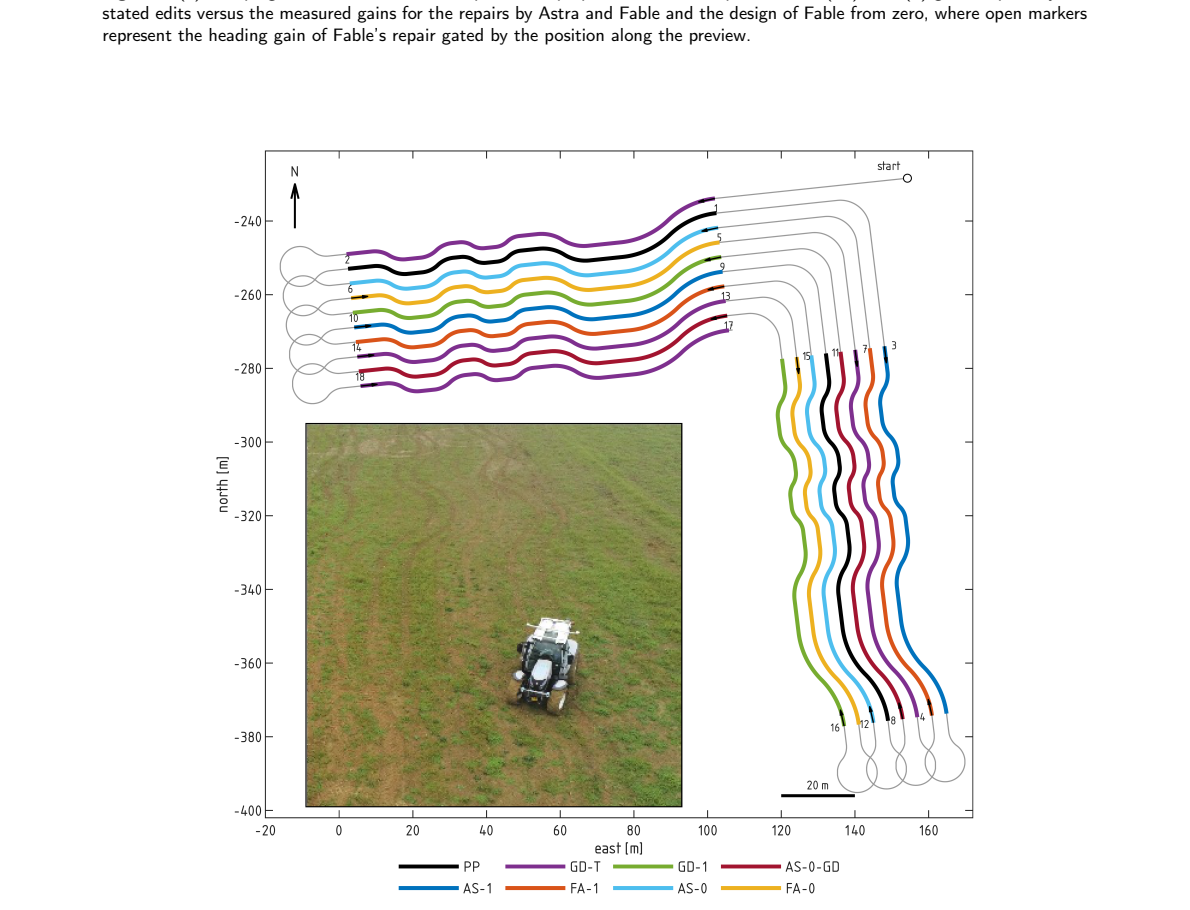
Core claim. The central discovery is that frontier LLMs can act as control engineers for a neural steering network: they read the network's weights, reason about the closed-loop dynamics using linearisation, gains, and stability analysis, then edit the weights directly to achieve stable, accurate steering on a real tractor. With a budget of 25 simulated evaluations, both models repaired an unstable trained network (failed on 352 of 512 paths) into a stable one that completed all test paths, and they wrote a cascaded steering law into a network whose weights were initially all zero. The resulting controllers were sparse, readable, and transferred to the real AMX G-trac, where all four LLM-written controllers steered the full 2.8 km test path without intervention.
The premise it rests on. The repair sessions (S1) were also used to develop the prompt, so the prompt may be optimized for the specific failure mode of S1, and the study did not control for this; additionally, the closed, versioned API models may not remain available or behave consistently.
If the paper is right (Pith's inferences, not the authors')
Neural network controllers could be adapted to new hardware (e.g., a slower steering actuator) without retraining, by having an LLM edit the weights in place.
LLMs can produce sparse, readable controllers with a classical cascaded structure, offering explainability that dense trained networks lack.
Weight-space engineering provides a good initialization for gradient descent: PPO started from the LLM's design achieved lower error than PPO from random noise.
The method could generalise to other engineering domains with feedback dynamics, by providing the LLM with the plant model, limits, and field knowledge.
The success from zero weights suggests that frontier LLMs can embed engineering knowledge (e.g., cascaded control structure) into network weights, outperforming black-box search methods on small budgets.
The study's limitation to 253 parameters raises the open question of scalability: it is unknown whether the same approach works for networks with millions of weights or more complex architectures.
The reliance on two closed, versioned API models (GPT-6 Astra and Claude Fable 5.1) makes exact reproduction contingent on the vendors keeping those models available and unchanged.
The prompt was developed on the repair sessions themselves, so the results may overfit to the specific failure mode of S1; a separate hold-out evaluation would be needed to confirm robustness.
Check this review
What was read
The passes were given all 147,037 characters of the paper's LaTeX source.
Fingerprint of that text (SHA-256): f4ad4c27fdf10fd9ea9781954c3b89e562448ee478c46359a23632410dd0b5f2
Pith does not keep that text. Rebuilt from the paper's source or PDF by the same code, it has this fingerprint if it is the same text. From a copy of Pith's code:
PYTHONPATH=. python scripts/review_input_check.py 2611.21958
The passes, in the order they ran
- Reader deepseek-v4-flash · medium effort · $0.0034 · instructions of the Reader, fingerprint f9ead7300382…
- Skeptic deepseek-v4-flash · medium effort · $0.0027 · instructions of the Skeptic, fingerprint 8f88c0f61488…
- Referee deepseek-v4-flash · medium effort · $0.0050 · instructions of the Referee, fingerprint a852d99aea0d…
- Check against the paper deepseek-v4-flash · medium effort · $0.0050 · instructions of the Check against the paper, fingerprint 6c7a6883d551…
- Editor deepseek-v4-flash · medium effort · $0.0026 · instructions of the Editor, fingerprint e7211f6a3d27…
- Circularity check deepseek-v4-flash · medium effort · $0.0026 · instructions of the Circularity check, fingerprint e9946e39d67b…
- Summary for the page deepseek-v4-flash · medium effort · temperature 0.2 · $0.0029 · instructions of the Summary for the page, fingerprint e4f56bf568e7…
The passes cost $0.024 in model calls together.
Version stamped on this review: pith-pipeline@v1.4.1-daily-deepseek-or-medium+deepseek/deepseek-v4-flash+p.d60f54226f00
Each link opens a pass's instructions as plain text, the exact bytes its fingerprint was taken over. Every stored set of instructions.
curl -s https://pith.science/methodology/prompts/f9ead730038216984cfb56d7cb34332bdf691828296a1de4245f3d6667d4bf56 | sha256sum
prints the fingerprint of the reader's instructions. The same works for every pass.
The receipt
The review's fingerprint was taken on 18 Nov 2026. The review you are reading still matches it.
Fingerprint of the review (SHA-256): d2066f0a72e079bbfc99856e69d4fe7c072327903aede0b666f64c221f77eb5e
curl -s 'https://pith.science/api/v1/verdicts/2611.21958?form=canonical' | sha256sum
prints the fingerprint of the review as it stands now. The rule, in four steps.
A matching fingerprint shows the review has not changed since that date. It does not show that the review is right.
How often reviews like this one are right
Reviews like this one: written by deepseek-v4-flash, from the paper's LaTeX source.
How often objections from reviews like this one are right: not yet measured
Reviews by people
This review was written by a machine. No person has reviewed this paper on Pith yet. A scientist listed on Pith can review it for a fee, and their review is published here whatever it concludes.
The paper
Abstract
Weight-space programming is a process where a large language model reads and writes the weights of a neural network directly, guided by a natural language specification, without an optimiser or gradient descent. This study applies it to automatic tractor guidance, where a 253-parameter neural network steers along paths of lines and arcs and must be adapted when the machine changes, such as a slower steering actuator. GPT-6 Astra and Claude Fable 5.1 (also 5.2) edited the network for our research tractor using a small budget of simulated evaluations to repair a network trained for another tractor and write a controller into a network with zero weights. We compared them with an evolution strategy, gradient descent and pure pursuit in simulation and on the real tractor. Both models read the network and analysed the closed loop with control theory correctly, and Fable's repair without simulation succeeded only occasionally. With simulated feedback, both models repaired the trained network in single sessions and wrote a working controller from zero weights, whereas from zero the evolution strategy found none. The controllers written from zero were sparse and in a classical cascaded structure; one model edited the trained network while the other replaced it. Gradient descent reached higher accuracy with far more simulation, and all language model controllers steered the real tractor without intervention, with errors of the same order as pure pursuit. Language models can program the weights of a neural controller directly, much as control engineers design one. We call this Weight-Space Engineering.
The paper's own sentences, arranged, kept beside the review and separate from it. Each label is drawn from a closed vocabulary; the number beside it is the probability the classifier gave that label. No sentence in this record was written by a model.
abstract compiled · 2026-11-18
The authors' main claim, as the classifier picked it out 0.99
“Language models can program the weights of a neural controller directly, much as control engineers design one.”
How the main claim is stated: asserted 0.73
What the abstract itself states, as probabilities: claims first 0.07 · states limitation 0.88 · human participants 0.07 · controlled comparison 0.94 · randomized assignment 0.02 · states quantitative result 0.88 · compares with prior results 0.97 · mentions code or data availability 0.03
The abstract, sentence by sentence
This table labels the abstract only (arXiv listing abstract v1). The number is the probability the classifier gave the label.
| Sentence | Role | The authors' own work | States the main conclusion | Strength |
|---|---|---|---|---|
| Weight-space programming is a process where a large language model reads and writes the weights of a neural network directly, guided by a natural language specification, without an optimiser or gradient descent. | background 0.84 | 0.10 | 0.07 | asserted 0.99 |
| This study applies it to automatic tractor guidance, where a 253-parameter neural network steers along paths of lines and arcs and must be adapted when the machine changes, such as a slower steering actuator. | contribution 0.72 | 0.75 | 0.04 | asserted 1.00 |
| GPT-6 Astra and Claude Fable 5.1 (also 5.2) edited the network for our research tractor using a small budget of simulated evaluations to repair a network trained for another tractor and write a controller into a network with zero weights. | method 0.88 | 0.90 | 0.07 | asserted 1.00 |
| We compared them with an evolution strategy, gradient descent and pure pursuit in simulation and on the real tractor. | method 0.96 | 0.93 | 0.03 | asserted 0.98 |
| Both models read the network and analysed the closed loop with control theory correctly, and Fable's repair without simulation succeeded only occasionally. | result 1.00 | 0.91 | 0.08 | asserted 1.00 |
| With simulated feedback, both models repaired the trained network in single sessions and wrote a working controller from zero weights, whereas from zero the evolution strategy found none. | result 1.00 | 0.96 | 0.24 | asserted 1.00 |
| The controllers written from zero were sparse and in a classical cascaded structure; one model edited the trained network while the other replaced it. | result 0.98 | 0.90 | 0.07 | asserted 1.00 |
| Gradient descent reached higher accuracy with far more simulation, and all language model controllers steered the real tractor without intervention, with errors of the same order as pure pursuit. | result 1.00 | 0.95 | 0.24 | asserted 1.00 |
| Language models can program the weights of a neural controller directly, much as control engineers design one. | interpretation 0.96 | 0.74 | 0.78 | asserted 0.73 |
| We call this Weight-Space Engineering. | interpretation 0.59 | 0.54 | 0.32 | asserted 0.84 |
What kind of paper the classifier reports this is: empirical study 0.68 · evidence from observation or experiment 0.97
What was examined, and what was not
Sources read
- arXiv listing abstract v1
Not examined
- full text
- figures and tables
- references and citing sentences
- relations to other papers
Levels run
- P abstract
Not run
- S sections
- T body sentences
- C citations
- R cross-paper relations
How the labels were made
Compiled by classifier-1.13.0 via TypeSafe API, question bank abstract-p1-20260923, 2026-11-18: 1 request, 7,577 input tokens.
Every quoted sentence on this record is the authors'. Every label is from Pith's closed vocabulary, with the probability shown beside it. This record as JSON
Figures (8)




Figures are the authors', reproduced from the paper.
References (49)
- [1] author Ahmed, N.S. , year 2026 . title Can an LLM actually reason and program about neural network's weights or is it just memorization on steroids? E xploring ``weight-space programming'' . :10.48550/arXiv.2611.08070, arXiv:2611.08070 http://arxiv.org/abs/2611.08070. note Preprint on PithPith's reviewarXivdoi:10.48550/arxiv.2611.08070
- [2] author Andrychowicz, M. , author Raichuk, A. , author Sta \'n czyk, P. , author Orsini, M. , author Girgin, S. , author Marinier, R. , author Hussenot, L. , author Geist, M. , author Pietquin, O. , author Michalski, M. , author Gelly, S. , author Bachem, O. , year 2021 . title... on Pith
- [3] author Baby, T. , author Gohil, M.K. , author Bhattacharya, B. , year 2024 . title Autonomous navigation of 4WIS4WID agricultural field mobile robot using deep reinforcement learning . :10.48550/arXiv.2412.18865, arXiv:2412.18865 http://arxiv.org/abs/2412.18865. note Preprint on PithPith's reviewarXivdoi:10.48550/arxiv.2412.18865
- [4] author Backman, J. , author Oksanen, T. , author Visala, A. , year 2011 . title Semi-automatic tuning of NMPC based trajectory control system in agricultural machine , in: booktitle Proceedings of the 18th World Congress of the International Federation of Automatic Control , p... on Pithdoi:10.3182/20110828-6-it-1002.00601
- [5] author Backman, J. , author Oksanen, T. , author Visala, A. , year 2012 . title Navigation system for agricultural machines: Nonlinear model predictive path tracking . journal Computers and Electronics in Agriculture volume 82 , pages 32--43 . :10.1016/j.compag.2011.12.009 on Pithdoi:10.1016/j.compag.2011.12.009
- [6] author Bosio, C. , author Mueller, M.W. , year 2024 . title Synthesizing interpretable control policies through large language model guided search . :10.48550/arXiv.2410.05406, arXiv:2410.05406 http://arxiv.org/abs/2410.05406. note Preprint on Pithdoi:10.48550/arxiv.2410.05406
- [7] author Bouteiller, Y. , author Ramstedt, S. , author Beltrame, G. , author Pal, C. , author Binas, J. , year 2021 . title Reinforcement learning with random delays , in: booktitle International Conference on Learning Representations (ICLR 2021) . https://openreview.net/forum?i... on Pith
- [8] author Caponio, C. , author Stano, P. , author Carli, R. , author Olivieri, I. , author Ragone, D. , author Sorniotti, A. , author Gruber, P. , author Montanaro, U. , year 2025 . title Modeling, positioning, and deep reinforcement learning path following control of scaled robo... on Pithdoi:10.1109/tase.2024.3513701
- [9] author Chen, B. , author Xu, M. , author Li, L. , author Zhao, D. , year 2021 . title Delay-aware model-based reinforcement learning for continuous control . journal Neurocomputing volume 450 , pages 119--128 . :10.1016/j.neucom.2021.04.015 on Pithdoi:10.1016/j.neucom.2021.04.015
- [10] author Coulter, R.C. , year 1992 . title Implementation of the Pure Pursuit Path Tracking Algorithm . type Technical Report number CMU-RI-TR-92-01 . The Robotics Institute, Carnegie Mellon University. address Pittsburgh, Pennsylvania on Pith
- [11] author D \"o ring, K. , author Hefele, R. , author Maier, M. , author Oksanen, T. , year 2024 . title Terrain compensation for off-road vehicles using inertial measurements in a multi-body system , in: booktitle 2024 IEEE 20th International Conference on Automation Science and... on Pithdoi:10.1109/case59546.2024.10711670
- [12] author Folkers, A. , author Rick, M. , author B \"u skens, C. , year 2019 . title Controlling an autonomous vehicle with deep reinforcement learning , in: booktitle 2019 IEEE Intelligent Vehicles Symposium (IV) , pp. pages 2025--2031 . :10.1109/IVS.2019.8814124 on Pithdoi:10.1109/ivs.2019.8814124
- [13] author Gao, J. , author Sun, C. , author Zhao, H. , author Shen, Y. , author Anguelov, D. , author Li, C. , author Schmid, C. , year 2020 . title VectorNet : Encoding HD maps and agent dynamics from vectorized representation , in: booktitle Proc. IEEE/CVF Conf. Computer Vision... on Pithdoi:10.1109/cvpr42600.2020.01154
- [14] author Gross, D. , year 2026 . title Weight-space programming of policies and their verification via model checking . :10.48550/arXiv.2611.11604, arXiv:2611.11604 http://arxiv.org/abs/2611.11604. note Preprint on PithPith's reviewarXivdoi:10.48550/arxiv.2611.11604
- [15] author Guo, X. , author Keivan, D. , author Syed, U. , author Qin, L. , author Zhang, H. , author Dullerud, G. , author Seiler, P. , author Hu, B. , year 2024 . title ControlAgent : Automating control system design via novel integration of LLM agents and domain expertise . :10... on PithPith's reviewarXivdoi:10.48550/arxiv.2410.19811
- [16] author Hefele, R. , author Burth, J. , author Maier, M. , author Oksanen, T. , year 2024 . title Control of rear-wheel steering for a four-wheel steered agricultural standard tractor , in: booktitle 14th International Fluid Power Conference (14. IFK ) , publisher River Publish... on Pithdoi:10.13052/rp-9788770042222c24
- [17] author Hefele, R. , author Oksanen, T. , year 2025 . title Advanced path tracking controller for follow trails-of-tractor guidance objective without GNSS , in: booktitle 2025 IEEE 21st International Conference on Automation Science and Engineering ( CASE ) , publisher IEEE , a... on Pithdoi:10.1109/case58245.2025.11163808
- [18] author Heraud, J.A. , author Lange, A.F. , year 2009 . title Agricultural automatic vehicle guidance from horses to GPS : How we got here, and where we are going . howpublished Agricultural Equipment Technology Conference, Louisville, Kentucky, USA, 9--12 February 2009 . note ... on Pith
- [19] author Jose, J. , author Alam, M.S. , author Somayajula, A.S. , year 2023 . title Navigating the ocean with DRL : Path following for marine vessels . :10.48550/arXiv.2310.14932, arXiv:2310.14932 http://arxiv.org/abs/2310.14932. note Preprint on PithPith's reviewarXivdoi:10.48550/arxiv.2310.14932
- [20] author Kayacan, E. , author Saeys, W. , author Ramon, H. , author Belta, C. , author Peschel, J.M. , year 2018 . title Experimental validation of linear and nonlinear MPC on an articulated unmanned ground vehicle . journal IEEE/ASME Transactions on Mechatronics volume 23 , pag... on Pithdoi:10.1109/tmech.2018.2854877
show 29 more
- [21] author Kevian, D. , author Syed, U. , author Guo, X. , author Havens, A. , author Dullerud, G. , author Seiler, P. , author Qin, L. , author Hu, B. , year 2024 . title Capabilities of large language models in control engineering: A benchmark study on GPT-4 , Claude 3 Opus , an... on PithPith's reviewarXivdoi:10.48550/arxiv.2404.03647
- [22] author Lehmann, J. , year 2026 . title Compiling known rules into compact neural agents: Weight-space programming on unseen games . :10.48550/arXiv.2611.16981, arXiv:2611.16981 http://arxiv.org/abs/2611.16981. note Preprint on PithPith's reviewarXivdoi:10.48550/arxiv.2611.16981
- [23] author Lindner, D. , author Kram \'a r, J. , author Farquhar, S. , author Rahtz, M. , author McGrath, T. , author Mikulik, V. , year 2023 . title Tracr: Compiled transformers as a laboratory for interpretability , in: booktitle Advances in Neural Information Processing Systems... on Pithdoi:10.52202/075280-1649
- [24] author Liu, Z. , author Yang, X. , year 2026 . title Computation, not weight access: large language models as auditors of clinical prediction networks . :10.48550/arXiv.2611.07847, arXiv:2611.07847 http://arxiv.org/abs/2611.07847. note Preprint on PithPith's reviewarXivdoi:10.48550/arxiv.2611.07847
- [25] author Mania, H. , author Guy, A. , author Recht, B. , year 2018 . title Simple random search of static linear policies is competitive for reinforcement learning , in: booktitle Advances in Neural Information Processing Systems 31 (NeurIPS 2018) . https://proceedings.neurips.c... on Pith
- [26] author Merton, H. , author Delamore, T. , author Stol, K. , author Williams, H. , year 2024 . title Deep reinforcement learning for local path following of an autonomous Formula SAE vehicle . :10.48550/arXiv.2401.02903, arXiv:2401.02903 http://arxiv.org/abs/2401.02903. note Preprint on PithPith's reviewarXivdoi:10.48550/arxiv.2401.02903
- [27] author Meyer, E. , author Robinson, H. , author Rasheed, A. , author San, O. , year 2020 . title Taming an autonomous surface vehicle for path following and collision avoidance using deep reinforcement learning . journal IEEE Access volume 8 , pages 41466--41481 . :10.1109/ACC... on Pithdoi:10.1109/access.2020.2976586
- [28] author Mittal, M. , author Rudin, N. , author Klemm, V. , author Allshire, A. , author Hutter, M. , year 2024 . title Symmetry considerations for learning task symmetric robot policies , in: booktitle Proc. IEEE Int. Conf. Robotics and Automation ( ICRA ) , pp. pages 7433--743... on Pithdoi:10.1109/icra57147.2024.10611493
- [29] author Moll, M. , author Oksanen, T. , year 2026 . title Multi-reference path tracking control for an agricultural tractor with nonlinear model predictive control . :10.48550/arXiv.2610.00057, arXiv:2610.00057 http://arxiv.org/abs/2610.00057. note Preprint , accepted to the IF... on PithPith's reviewarXivdoi:10.48550/arxiv.2610.00057
- [30] author Narimani, M. , author Tavakoli, A. , author Emami, S.A. , year 2027 . title AgenticControl : An automated control design framework using large language models . journal Robotics and Autonomous Systems volume 208 , pages 105828 . :10.1016/j.robot.2026.105828 on Pithdoi:10.1016/j.robot.2026.105828
- [31] author Nath, S. , author Baranwal, M. , author Khadilkar, H. , year 2021 . title Revisiting state augmentation methods for reinforcement learning with stochastic delays , in: booktitle Proceedings of the 30th ACM International Conference on Information and Knowledge Management... on Pithdoi:10.1145/3459637.3482386
- [32] author Nusrat, H. , author Nusrat, O. , year 2026 . title Weight-space programming for auditing clinical decision networks . :10.48550/arXiv.2611.05341, arXiv:2611.05341 http://arxiv.org/abs/2611.05341. note Preprint on PithPith's reviewarXivdoi:10.48550/arxiv.2611.05341
- [33] author O'Connor, M.L. , year 1997 . title Carrier-Phase Differential GPS for Automatic Control of Land Vehicles . Ph.D. thesis. Department of Aeronautics and Astronautics, Stanford University on Pith
- [34] author Peng, X.B. , author Andrychowicz, M. , author Zaremba, W. , author Abbeel, P. , year 2018 . title Sim-to-real transfer of robotic control with dynamics randomization , in: booktitle 2018 IEEE International Conference on Robotics and Automation (ICRA) , pp. pages 3803--3... on Pithdoi:10.1109/icra.2018.8460528
- [35] author Pindl, L. , author Soitinaho, R. , author Behr, P. , author Oksanen, T. , year 2024 . title Reinforcement learning for autonomous headland turns , in: booktitle Proceedings of the 21st International Conference on Informatics in Control, Automation and Robotics ( ICINCO ... on Pithdoi:10.5220/0012944700003822
- [36] author van der Pol, E. , author Worrall, D.E. , author van Hoof, H. , author Oliehoek, F.A. , author Welling, M. , year 2020 . title MDP homomorphic networks: Group symmetries in reinforcement learning , in: booktitle Advances in Neural Information Processing Systems 33 ( Neur... on Pith
- [37] author Rajeswaran, A. , author Lowrey, K. , author Todorov, E. , author Kakade, S. , year 2017 . title Towards generalization and simplicity in continuous control , in: booktitle Advances in Neural Information Processing Systems 30 ( NIPS 2017) , pp. pages 6550--6561 on Pith
- [38] author Salloum, H. , author Ali, A. , year 2026 . title Tree-Ising : Repairing language models with bit-level Ising edits . :10.48550/arXiv.2611.14210, arXiv:2611.14210 http://arxiv.org/abs/2611.14210. note Preprint on PithPith's reviewarXivdoi:10.48550/arxiv.2611.14210
- [39] author Sato, S. , author Shimada, T. , author Murasaki, K. , author Sano, T. , year 2026 . title Physics2Weight : Direct neural network architecture and weight generation from physical laws using large language models . :10.48550/arXiv.2611.12954, arXiv:2611.12954 http://arxiv... on PithPith's reviewarXivdoi:10.48550/arxiv.2611.12954
- [40] author Schulman, J. , author Wolski, F. , author Dhariwal, P. , author Radford, A. , author Klimov, O. , year 2017 . title Proximal policy optimization algorithms . :10.48550/arXiv.1707.06347, arXiv:1707.06347 http://arxiv.org/abs/1707.06347. note Preprint on PithPith's reviewarXivdoi:10.48550/arxiv.1707.06347
- [41] author Snider, J.M. , year 2009 . title Automatic Steering Methods for Autonomous Automobile Path Tracking . type Technical Report number CMU-RI-TR-09-08 . Robotics Institute, Carnegie Mellon University. address Pittsburgh, PA on Pith
- [42] author Soitinaho, R. , author Oksanen, T. , year 2023 . title Local navigation and obstacle avoidance for an agricultural tractor with nonlinear model predictive control . journal IEEE Transactions on Control Systems Technology volume 31 , pages 2043--2054 . :10.1109/TCST.2023.3291533 on Pithdoi:10.1109/tcst.2023.3291533
- [43] author Soitinaho, R. , author Oksanen, T. , year 2026 . title Identification of the steering and speed systems of a four-wheel-steering tractor for optimal control . :10.48550/arXiv.2610.00059, arXiv:2610.00059 http://arxiv.org/abs/2610.00059. note Preprint , accepted to the I... on PithPith's reviewarXivdoi:10.48550/arxiv.2610.00059
- [44] author Takehi, R. , author Teoh, J. , author Zhang, A. , author Khattab, O. , year 2026 . title Sparks of weight-space programming: LLMs can natively read & write neural network weights . howpublished https://rikiyat.github.io/blog/weight-space-programming/ . note Blog post, M... on Pith
- [45] author Wang, D. , author Walters, R. , author Platt, R. , year 2022 . title SO (2)-equivariant reinforcement learning , in: booktitle International Conference on Learning Representations ( ICLR ) . https://openreview.net/forum?id=7F9cOhdvfk_ on Pith
- [46] author Weyrer, S. , author Manzl, P. , author Schwab, A.L. , author Gerstmayr, J. , year 2026 . title Path following and stabilization of a bicycle model using a reinforcement learning approach . journal Multibody System Dynamics volume 67 , pages 775--810 . :10.1007/s11044-02... on Pithdoi:10.1007/s11044-026-10144-x
- [47] author Yang, C. , author Wang, X. , author Lu, Y. , author Liu, H. , author Le, Q.V. , author Zhou, D. , author Chen, X. , year 2024 . title Large language models as optimizers , in: booktitle International Conference on Learning Representations (ICLR 2024) on Pith
- [48] author Zaheer, M. , author Kottur, S. , author Ravanbakhsh, S. , author P \'o czos, B. , author Salakhutdinov, R. , author Smola, A.J. , year 2017 . title Deep sets , in: booktitle Advances in Neural Information Processing Systems 30 ( NIPS 2017) on Pith
- [49] author Zhang, J. , author Wang, K. , author Lin, L. , year 2026 . title Can LLMs debug robots by editing their weights? :10.48550/arXiv.2611.09376, arXiv:2611.09376 http://arxiv.org/abs/2611.09376. note Preprint on PithPith's reviewarXivdoi:10.48550/arxiv.2611.09376
Challenges and discussion
Disagree with the review, or know something it missed? Leave a comment, or challenge this review formally: a challenge becomes a permanent entry in this paper's record, and its decision is published here.
Come back by email
A short list of the week's newly reviewed papers. Nothing is sent until you confirm from your inbox, and every email has a link that stops it. No account.
No comments yet.
Sign in to comment