Computer Vision and Pattern Recognition · arXiv:2611.31233 v1 · submitted 23 Nov 2026 · 66 references
TowerBridge: Bridging the Dual-Encoder Modality Gap via Weight-Space Programming
The paper says
“CLIP-style dual encoders map images and text through two separate towers into a shared embedding space, where the two modalities occupy distinct regions separated by a modality gap.”
more of the abstract
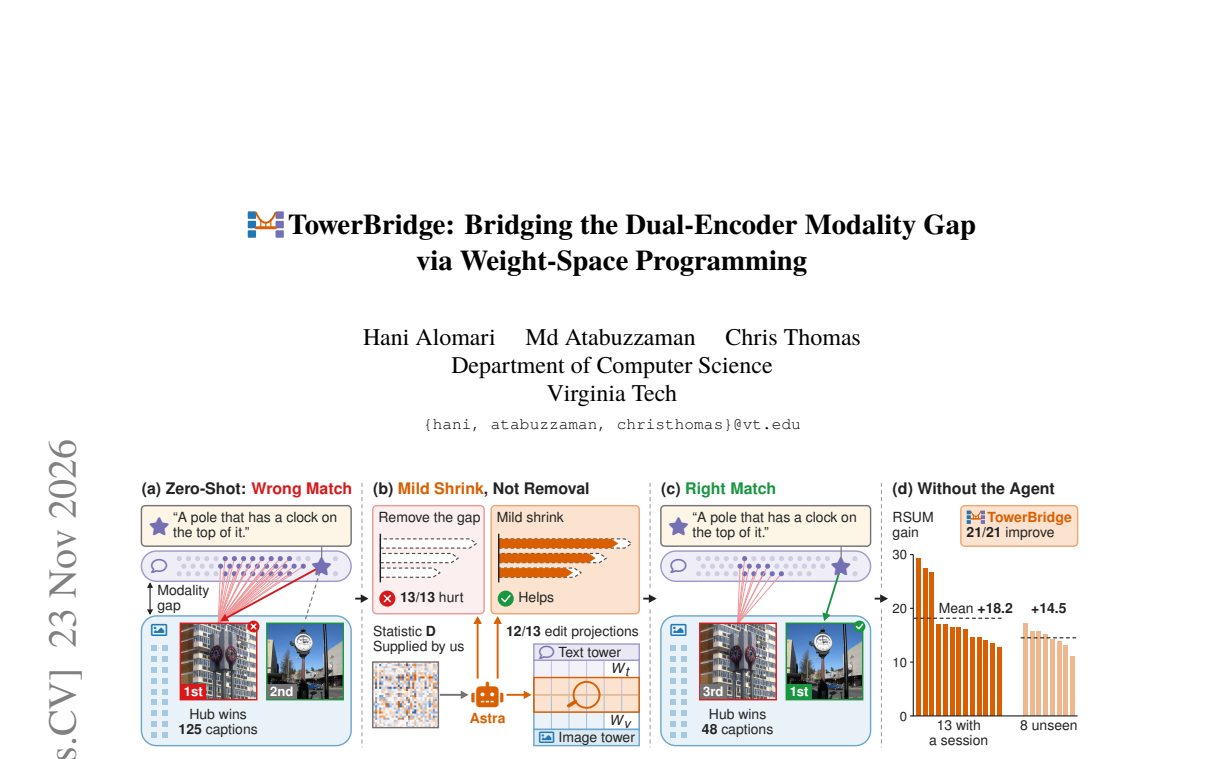
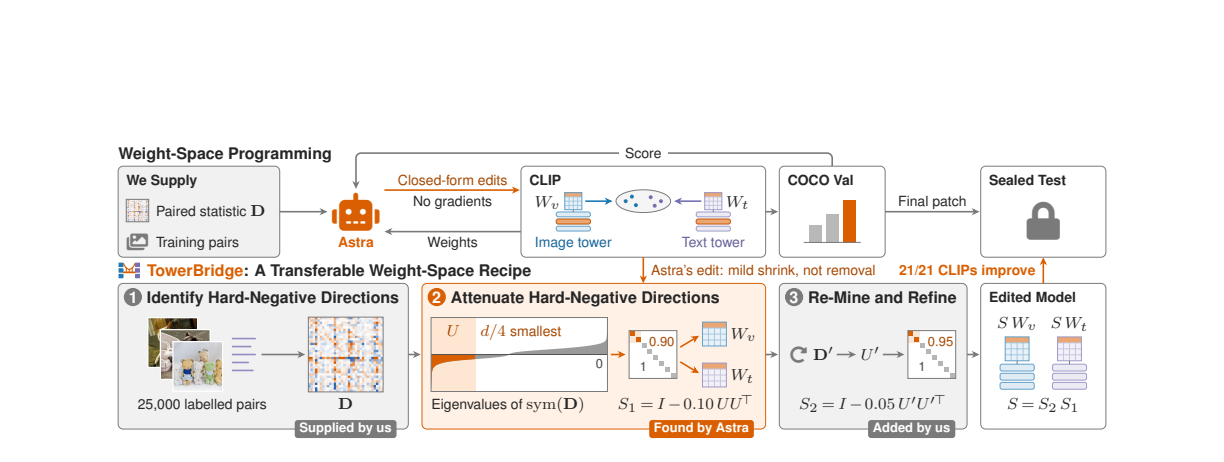
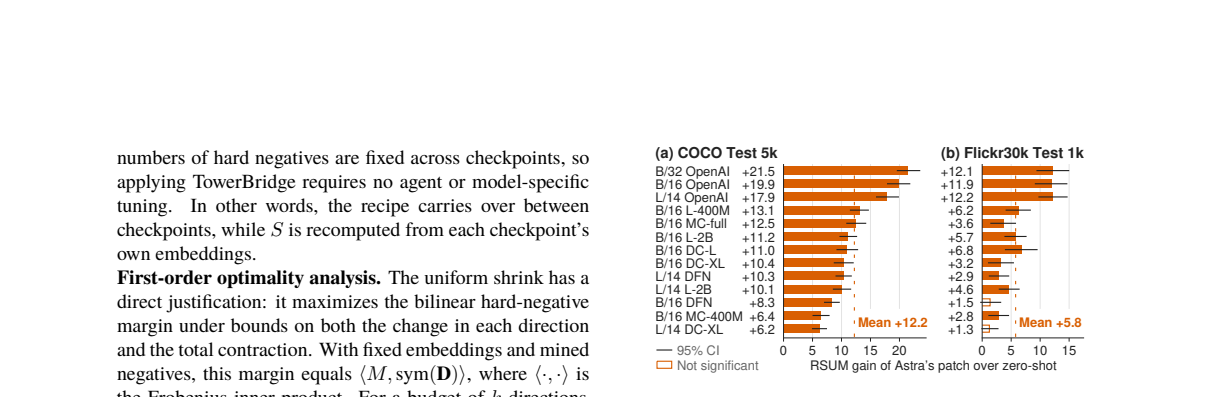
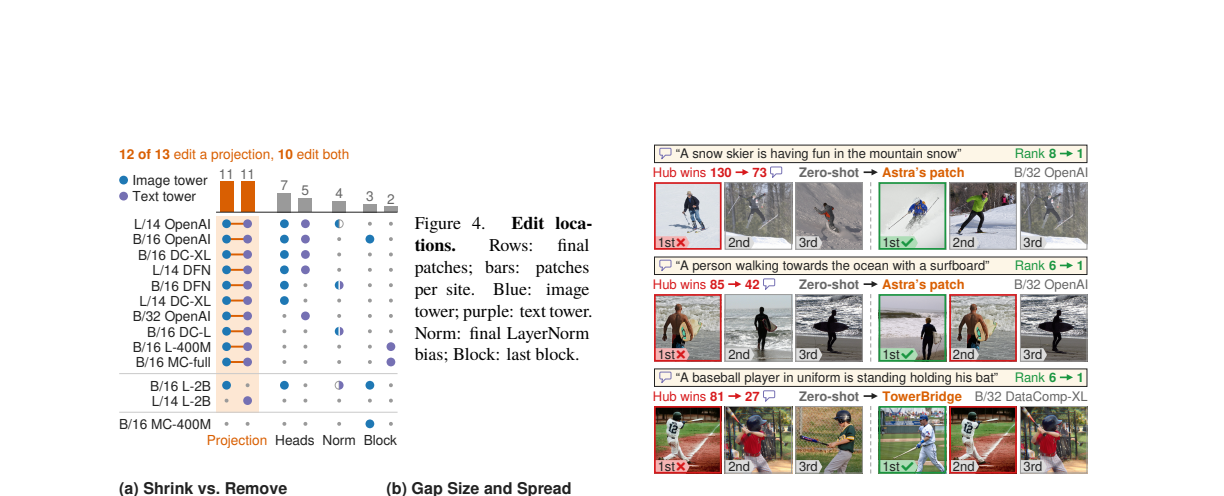
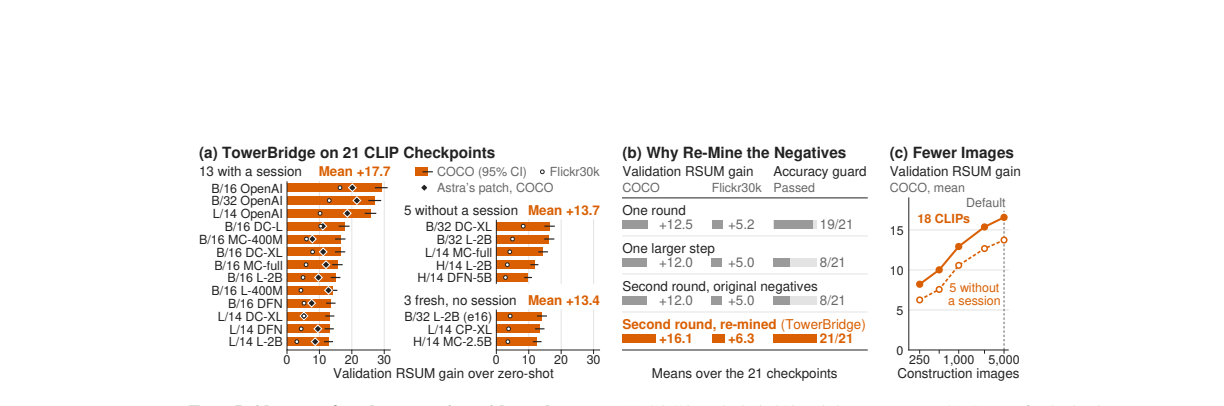
Retrieval fails when wrong matches, or hard negatives, outrank the correct one, and the gap is the usual suspect. Yet removing it post hoc degrades retrieval on every CLIP checkpoint we test. We introduce a paired statistic that identifies directions where the two towers agree more on hard negatives than on matched pairs. Mildly attenuating these directions improves retrieval while largely preserving the gap. We arrive at this correction through weight-space programming: guided by the statistic, an LLM agent inspects both towers and writes closed-form weight edits without backpropagation. Free to edit any component, the agent improves COCO test retrieval on all 13 CLIP checkpoints and edits an output projection in 12 of the 13. We distill and refine its recurring correction into TowerBridge, a closed-form recipe motivated by a first-order analysis of the hard-negative margin. Computed in seconds from 25,000 labelled pairs, it requires no model-specific tuning and leaves the architecture and inference cost unchanged. TowerBridge improves COCO test retrieval by 16.8 RSUM and Flickr30k test retrieval by 6.6 on average across all 21 evaluated CLIP checkpoints, including 8 unseen by the agent, while limiting any drop in ImageNet zero-shot accuracy to 0.5 points. It also reduces hubness on all 21 checkpoints and improves retrieval on 4 of 5 dual encoders from other families.
from the abstract
Pith says
Machine review · deepseek-v4-flash · 24 Nov 2026 · read the full text (247,442 characters) · not checked by a person
It can be wrong. Challenge this review or reply to it.
Holds up. TowerBridge provides a simple, zero-cost, closed-form correction that improves CLIP retrieval on all tested checkpoints by mildly attenuating hard-negative directions rather than removing the modality gap. This line is wrong
3 minor
How often objections from reviews like this one are right: not yet measured
The paper, first character to last
The reviewer was given the whole text, 247,442 characters. Not checked: figures, code, what the 66 references say.
3 minor objections
The paper says, at 3.1
Pith says: minor objection 1 of 3
Section 3.1, Eq. (1): The definition of the paired statistic D could be clarified by explicitly stating that the expectations are over the respective sets of matched pairs and hard negatives, and that the weighting is equal across the two retrieval directions. The current notation is clear but a brief explanatory sentence would help readers unfamiliar with the setup.
The paper says, at Abstract
Pith says: minor objection 2 of 3
The term 'RSUM' is used in the abstract and early sections before it is defined. It is defined in Section 4.1 as 'the sum of recall at 1, 5 and 10 in both retrieval directions'. Consider defining it at first use in the abstract or introduction to avoid confusion.
show 1 more
The paper says, at 3.3
Pith says: minor objection 3 of 3
Section 3.3: The optimality analysis is for a bilinear surrogate, but the method is evaluated under cosine retrieval. The paper acknowledges this and provides empirical support (uniform shrinkage outperforms eigenvalue-weighted shrinkage). It would strengthen the paper to briefly discuss the relationship between the bilinear margin and cosine margin, perhaps referencing the derivative analysis in the supplement (Sec. S8.4).
What would settle it
Recompute the TowerBridge recipe with 10 hard negatives per caption and 50 per image instead of 5 and 25, and measure COCO val RSUM change on 5 checkpoints (e.g., B/16 OpenAI, L/14 DFN-2B, B/32 LAION-2B, H/14 DFN-5B, B/16 DataComp-XL). If the mean gain drops by more than 2 RSUM relative to the default, the choice of negative count is more influential than reported and the method's robustness to this parameter should be documented.
from the skeptic's reading
How the review went
5 passes by deepseek-v4-flash · 24 Nov 2026
- Reader holds up
- Skeptic agrees
- Referee 3 minor
- Check against the paper
- Editor wrote the verdict above
Not run on this paper: the simulated authors' defence.
Pith checked this review's objections against the text of the paper it read.
The review in full
The review in brief, machine-written
TowerBridge shows that the directions in CLIP's shared embedding space that favor hard negatives should be mildly attenuated, not removed. The paper introduces a paired statistic D that identifies these directions from a modest number of labelled image-text pairs, then applies a uniform 10% shrink to the quarter of directions with the most negative eigenvalues. The result is a closed-form weight edit that improves COCO test retrieval by 16.8 RSUM on average across 21 CLIP checkpoints, with minimal impact on ImageNet zero-shot accuracy and no change to inference cost. The paper is thorough. It evaluates 21 CLIP checkpoints, 5 other dual encoders, multiple datasets, confidence intervals, ablations, and comparisons to baselines. The discovery process—using an LLM agent to explore weight edits and then distilling the recurring correction into a fixed recipe—is novel and well-documented. The central finding that mild attenuation outperforms removal is clearly supported. The soft spots are minor and acknowledged. The recipe requires labelled pairs (25,000) and currently targets dual encoders. Trained maps and test-time re-rankers can achieve larger gains, but TowerBridge offers a zero-cost alternative that complements them. The optimality analysis is for a bilinear surrogate, but the paper tests the resulting edit under cosine retrieval and finds it works. This paper is for researchers working on cross-modal retrieval or CLIP-based systems who want a simple, plug-and-play improvement. It deserves a serious referee and is ready for peer review.
The strongest objection
The paper is thorough and the central claim is well-supported. The reader's weakest assumption (stability of the paired statistic D across samples) is directly tested and found robust. The method's reliance on a specific number of hard negatives (5 per caption, 25 per image) is not ablated, but this does not undermine the central claim that the recipe works with those fixed numbers. All other potential concerns (bilinear surrogate vs. cosine retrieval, generalization to unseen checkpoints, preservation of ImageNet accuracy) are addressed empirically. No load-bearing flaw remains.
The paper provides extensive empirical validation across 21 CLIP checkpoints and 5 other dual encoders, tests stability of the paired statistic across construction samples, and addresses the reader's weakest assumption directly. The central claim that mild attenuation of hard-negative directions improves retrieval while preserving the modality gap and ImageNet accuracy is convincingly supported. The theoretical justification for the uniform shrink is provided for a bilinear surrogate, and the paper tests the resulting edit under cosine retrieval, finding it outperforms alternatives. The method's limitations (requires labelled pairs, targets dual encoders) are acknowledged. No significant objection that would change the verdict is identified.
The referee's report
The paper provides a principled approach to modifying pretrained dual encoders for cross-modal retrieval, with a clear theoretical motivation and extensive empirical validation. The key insight—that mild attenuation, rather than removal, of hard-negative directions improves retrieval while preserving the modality gap—is well supported. The distilled recipe (TowerBridge) is simple, fast, and transferable across many CLIP checkpoints and other dual encoders, making it practical for deployment. The experiments are thorough, covering 21 CLIP checkpoints, multiple datasets, ablations, and comparisons to baselines, with proper statistical significance reporting.
Pith's reading of the paper (a machine's summary, not the authors')
The paper aims to establish which directions in CLIP's shared embedding space should be changed to improve cross-modal retrieval, and how. It introduces a paired statistic that identifies directions where the two towers agree more on hard negatives than on matched pairs. The authors show that removing these directions (which align with the common mean and the modality gap) degrades retrieval, whereas mildly attenuating them by 10% improves retrieval on every tested checkpoint while largely preserving the gap. An LLM agent (Astra) discovers this correction via weight-space programming, and the authors distill it into TowerBridge, a closed-form recipe that requires no agent, no gradient-based optimization, and no model-specific tuning. TowerBridge improves COCO test retrieval by 16.8 RSUM and Flickr30k test retrieval by 6.6 on average across 21 CLIP checkpoints, including 8 unseen by the agent, while limiting ImageNet accuracy loss to 0.5 points.
What carries the argument. The paired statistic D (Eq. 1) compares the mean outer product of normalized embeddings on matched pairs with that on hard negatives (the five hardest wrong images per caption and 25 hardest wrong captions per image). Its symmetric part's eigenvalues decompose the margin between matched and hard-negative agreement along orthogonal directions; negative eigenvalues identify directions where hard negatives agree more than matched pairs. The correction applies a uniform 10% shrink to the quarter of directions with the most negative eigenvalues in both output projections (S = I - 0.10 UU^T), then re-mines hard negatives on the edited embeddings and applies a second 5% shrink. This is motivated by a first-order analysis showing that the uniform shrink maximizes the bilinear hard-negative margin under per-direction and total contraction constraints.
Core claim. The central claim is that the directions in CLIP's shared embedding space where the two towers agree more on hard negatives than on matched pairs—identified by a new paired statistic D—should be mildly attenuated (by about 10%) rather than removed. Removing these directions, which align with the common mean and the modality gap, degrades retrieval on every tested checkpoint, whereas a mild shrink improves retrieval while largely preserving the gap's size and ImageNet accuracy. This correction was discovered by an LLM agent (Astra) that inspects both towers and writes closed-form weight edits without backpropagation, and was distilled into a transferable recipe called TowerBridge that requires no agent or model-specific tuning.
The premise it rests on. The directions that favor hard negatives, as identified by the paired statistic D computed from 5,000 training images, are stable across different samples and generalize to the test distribution. The paper tests this by using multiple construction samples and held-out pairs, finding that the leading directions retain negative sign and the gains are stable.
If the paper is right (Pith's inferences, not the authors')
The modality gap is not the primary cause of retrieval errors; hard-negative directions are, and they should be mildly attenuated rather than removed.
Weight-space programming with an LLM agent can discover transferable corrections that generalize to unseen checkpoints and model families.
The TowerBridge recipe can be applied to any CLIP checkpoint in seconds without hyperparameter tuning, gradient-based optimization, or added inference cost.
The correction reduces hubness on all tested checkpoints, lowering the median share of text-to-image misses landing on hubs from 28% to 19%.
The recipe complements test-time re-ranking methods, adding 2–5 RSUM when combined with CSLS, NNN, QB-Norm, or DN.
The paired statistic D could be applied to other dual-encoder tasks beyond retrieval, such as zero-shot classification or visual question answering, to identify directions that cause cross-modal agreement on incorrect pairs.
The finding that mild attenuation beats removal suggests a trade-off: the leading hard-negative directions carry both misleading agreement and useful content; a small shrink retains the content while reducing the misleading signal.
The success of the LLM agent in discovering a transferable correction suggests that weight-space programming may be a viable paradigm for other model editing problems where the goal is to adjust a pretrained model's behavior without retraining.
The recipe's transfer to unseen checkpoints and other dual-encoder families (EVA02, MobileCLIP, CoCa, SigLIP) indicates that the hard-negative directions are a general property of contrastively trained dual encoders, not an artifact of a specific architecture or pretraining dataset.
Check this review
What was read
The passes were given all 247,442 characters of the paper's LaTeX source.
Fingerprint of that text (SHA-256): fd13463624d2a2fff990f3a972d3f9890defd7953ebc89c30ecbd7abc920a4d5
Pith does not keep that text. Rebuilt from the paper's source or PDF by the same code, it has this fingerprint if it is the same text. From a copy of Pith's code:
PYTHONPATH=. python scripts/review_input_check.py 2611.31233
The passes, in the order they ran
- Reader deepseek-v4-flash · medium effort · $0.0072 · instructions of the Reader, fingerprint f9ead7300382…
- Skeptic deepseek-v4-flash · medium effort · $0.0070 · instructions of the Skeptic, fingerprint 8f88c0f61488…
- Referee deepseek-v4-flash · medium effort · $0.0068 · instructions of the Referee, fingerprint a852d99aea0d…
- Editor deepseek-v4-flash · medium effort · $0.0067 · instructions of the Editor, fingerprint e7211f6a3d27…
- Circularity check deepseek-v4-flash · medium effort · $0.0067 · instructions of the Circularity check, fingerprint e9946e39d67b…
- Summary for the page deepseek-v4-flash · medium effort · temperature 0.2 · $0.0070 · instructions of the Summary for the page, fingerprint e4f56bf568e7…
The passes cost $0.041 in model calls together.
Version stamped on this review: pith-pipeline@v1.4.1-daily-deepseek-or-medium+deepseek/deepseek-v4-flash+p.505d180dcaef
Each link opens a pass's instructions as plain text, the exact bytes its fingerprint was taken over. Every stored set of instructions.
curl -s https://pith.science/methodology/prompts/f9ead730038216984cfb56d7cb34332bdf691828296a1de4245f3d6667d4bf56 | sha256sum
prints the fingerprint of the reader's instructions. The same works for every pass.
The receipt
The review's fingerprint was taken on 24 Nov 2026. The review you are reading still matches it.
Fingerprint of the review (SHA-256): a15e78bf5c53ca2ad096b0dd61826185e0b86998baa7f1e839237a9e006c2e97
curl -s 'https://pith.science/api/v1/verdicts/2611.31233?form=canonical' | sha256sum
prints the fingerprint of the review as it stands now. The rule, in four steps.
A matching fingerprint shows the review has not changed since that date. It does not show that the review is right.
How often reviews like this one are right
Reviews like this one: written by deepseek-v4-flash, from the paper's LaTeX source.
How often objections from reviews like this one are right: not yet measured
Reviews by people
This review was written by a machine. No person has reviewed this paper on Pith yet. A scientist listed on Pith can review it for a fee, and their review is published here whatever it concludes.
The paper
Abstract
CLIP-style dual encoders map images and text through two separate towers into a shared embedding space, where the two modalities occupy distinct regions separated by a modality gap. Retrieval fails when wrong matches, or hard negatives, outrank the correct one, and the gap is the usual suspect. Yet removing it post hoc degrades retrieval on every CLIP checkpoint we test. We introduce a paired statistic that identifies directions where the two towers agree more on hard negatives than on matched pairs. Mildly attenuating these directions improves retrieval while largely preserving the gap. We arrive at this correction through weight-space programming: guided by the statistic, an LLM agent inspects both towers and writes closed-form weight edits without backpropagation. Free to edit any component, the agent improves COCO test retrieval on all 13 CLIP checkpoints and edits an output projection in 12 of the 13. We distill and refine its recurring correction into TowerBridge, a closed-form recipe motivated by a first-order analysis of the hard-negative margin. Computed in seconds from 25,000 labelled pairs, it requires no model-specific tuning and leaves the architecture and inference cost unchanged. TowerBridge improves COCO test retrieval by 16.8 RSUM and Flickr30k test retrieval by 6.6 on average across all 21 evaluated CLIP checkpoints, including 8 unseen by the agent, while limiting any drop in ImageNet zero-shot accuracy to 0.5 points. It also reduces hubness on all 21 checkpoints and improves retrieval on 4 of 5 dual encoders from other families.
The paper's own sentences, arranged, kept beside the review and separate from it. Each label is drawn from a closed vocabulary; the number beside it is the probability the classifier gave that label. No sentence in this record was written by a model.
abstract compiled · 2026-11-25
The authors' main claim, as the classifier picked it out 0.96
“TowerBridge improves COCO test retrieval by 16.8 RSUM and Flickr30k test retrieval by 6.6 on average across all 21 evaluated CLIP checkpoints, including 8 unseen by the agent, while limiting any drop in ImageNet zero-shot accuracy to 0.5 points.”
How the main claim is stated: asserted 1.00
What the abstract itself states, as probabilities: claims first 0.07 · states limitation 0.66 · human participants 0.03 · controlled comparison 0.79 · randomized assignment 0.01 · states quantitative result 0.99 · compares with prior results 0.83 · mentions code or data availability 0.05
The abstract, sentence by sentence
This table labels the abstract only (arXiv listing abstract v1). The number is the probability the classifier gave the label.
| Sentence | Role | The authors' own work | States the main conclusion | Strength |
|---|---|---|---|---|
| CLIP-style dual encoders map images and text through two separate towers into a shared embedding space, where the two modalities occupy distinct regions separated by a modality gap. | background 1.00 | 0.06 | 0.02 | asserted 1.00 |
| Retrieval fails when wrong matches, or hard negatives, outrank the correct one, and the gap is the usual suspect. | background 0.98 | 0.11 | 0.03 | asserted 0.90 |
| Yet removing it post hoc degrades retrieval on every CLIP checkpoint we test. | result 0.69 | 0.88 | 0.06 | asserted 1.00 |
| We introduce a paired statistic that identifies directions where the two towers agree more on hard negatives than on matched pairs. | method 0.61 | 0.93 | 0.06 | asserted 0.99 |
| Mildly attenuating these directions improves retrieval while largely preserving the gap. | result 0.88 | 0.93 | 0.16 | asserted 0.99 |
| We arrive at this correction through weight-space programming: guided by the statistic, an LLM agent inspects both towers and writes closed-form weight edits without backpropagation. | method 0.98 | 0.92 | 0.09 | asserted 1.00 |
| Free to edit any component, the agent improves COCO test retrieval on all 13 CLIP checkpoints and edits an output projection in 12 of the 13. | result 0.94 | 0.95 | 0.11 | asserted 1.00 |
| We distill and refine its recurring correction into TowerBridge, a closed-form recipe motivated by a first-order analysis of the hard-negative margin. | method 0.52 | 0.96 | 0.16 | asserted 1.00 |
| Computed in seconds from 25,000 labelled pairs, it requires no model-specific tuning and leaves the architecture and inference cost unchanged. | method 0.92 | 0.93 | 0.06 | asserted 1.00 |
| TowerBridge improves COCO test retrieval by 16.8 RSUM and Flickr30k test retrieval by 6.6 on average across all 21 evaluated CLIP checkpoints, including 8 unseen by the agent, while limiting any drop in ImageNet zero-shot accuracy to 0.5 points. | result 1.00 | 0.96 | 0.68 | asserted 1.00 |
| It also reduces hubness on all 21 checkpoints and improves retrieval on 4 of 5 dual encoders from other families. | result 1.00 | 0.95 | 0.21 | asserted 1.00 |
What kind of paper the classifier reports this is: method or tool 1.00 · evidence from observation or experiment 0.97
What was examined, and what was not
Sources read
- arXiv listing abstract v1
Not examined
- full text
- figures and tables
- references and citing sentences
- relations to other papers
Levels run
- P abstract
Not run
- S sections
- T body sentences
- C citations
- R cross-paper relations
How the labels were made
Compiled by classifier-1.13.0 via TypeSafe API, question bank abstract-p1-20260923, 2026-11-25: 1 request, 8,283 input tokens.
Every quoted sentence on this record is the authors'. Every label is from Pith's closed vocabulary, with the probability shown beside it. This record as JSON
Figures (7)

Showing 6 of the paper's 7 figures. Figures are the authors', reproduced from the paper.
References (66)
- [1] Nazmus Sakib Ahmed. Can an LLM actually reason and program about neural network’s weights or is it just memo- rization on steroids? exploring “weight-space programming”. arXiv preprint arXiv:2611.08070, 2026. 3 on PithPith's reviewarXiv
- [2] Hani Alomari, Anushka Sivakumar, Andrew Zhang, and Chris Thomas. Maximal matching matters: Preventing rep- resentation collapse for robust cross-modal retrieval. In Pro- ceedings of the 63rd Annual Meeting of the Association for Computational Linguistics (ACL) (Volume 1: Long ... on Pith
- [3] Na Min An, Eunki Kim, James Thorne, and Hyunjung Shim. I0T: Embedding standardization method towards zero modal- ity gap. In Proceedings of the 63rd Annual Meeting of the Association for Computational Linguistics (ACL) (Volume 1: Long Papers), pages 27182–27199. Association fo... on Pith
- [4] Steven Bills, Nick Cammarata, Dan Mossing, Henk Till- man, Leo Gao, Gabriel Goh, Ilya Sutskever, Jan Leike, Jeff Wu, and William Saunders. Language models can explain neurons in language models. OpenAI blog post, https: //openaipublic.blob.core.windows.net/neuron- explainer/pa... on Pith
- [5] Simion-Vlad Bogolin, Ioana Croitoru, Hailin Jin, Y ang Liu, and Samuel Albanie. Cross modal retrieval with querybank normalisation. In Proceedings of the IEEE/CVF Conference on Computer Vision and Pattern Recognition (CVPR) , pages 5194–5205, 2022. 1, 2, 8 on Pith
- [6] Mehdi Cherti, Romain Beaumont, Ross Wightman, Mitchell Wortsman, Gabriel Ilharco, Cade Gordon, Christoph Schuh- mann, Ludwig Schmidt, and Jenia Jitsev. Reproducible scal- ing laws for contrastive language-image learning. InProceed- ings of the IEEE/CVF Conference on Computer V... on Pith
- [7] Neil Chowdhury, Franklin Wang, Sumedh Shenoy, Douwe Kiela, Sarah Schwettmann, and Tristan Thrush. Nearest neighbor normalization improves multimodal retrieval. In Proceedings of the 2024 Conference on Empirical Methods in Natural Language Processing (EMNLP) , pages 22571– 2258... on Pith
- [8] Arthur Conmy, Augustine N. Mavor-Parker, Aengus Lynch, Stefan Heimersheim, and Adrià Garriga-Alonso. Towards automated circuit discovery for mechanistic interpretabil- ity. In Advances in Neural Information Processing Systems (NeurIPS), pages 16318–16352, 2023. 3 on Pith
- [9] Alexis Conneau, Guillaume Lample, Marc’ Aurelio Ranzato, Ludovic Denoyer, and Hervé Jégou. Word translation with- out parallel data. In International Conference on Learning Representations (ICLR), 2018. 2, 8 on Pith
- [10] Timothée Darcet, Maxime Oquab, Julien Mairal, and Piotr Bojanowski. Vision transformers need registers. In Inter- national Conference on Learning Representations (ICLR) , on Pith
- [11] Jia Deng, Wei Dong, Richard Socher, Li-Jia Li, Kai Li, and Li Fei-Fei. ImageNet: A large-scale hierarchical image database. In Proceedings of the IEEE Conference on Computer Vision and Pattern Recognition (CVPR), pages 248–255, 2009. 5 on Pith
- [12] Georgiana Dinu, Angeliki Lazaridou, and Marco Baroni. Im- proving zero-shot learning by mitigating the hubness prob- lem. In International Conference on Learning Representa- tions (ICLR), Workshop Track, 2015. 2 on Pith
- [13] Alexey Dosovitskiy, Lucas Beyer, Alexander Kolesnikov, Dirk Weissenborn, Xiaohua Zhai, Thomas Unterthiner, Mostafa Dehghani, Matthias Minderer, Georg Heigold, Syl- vain Gelly, Jakob Uszkoreit, and Neil Houlsby. An image is worth 16x16 words: Transformers for image recognition ... on Pith
- [14] Nelson Elhage, Neel Nanda, Catherine Olsson, Tom Henighan, Nicholas Joseph, Ben Mann, Amanda Askell, Yun- tao Bai, Anna Chen, Tom Conerly, Nova DasSarma, Dawn Drain, Deep Ganguli, Zac Hatfield-Dodds, Danny Hernan- dez, Andy Jones, Jackson Kernion, Liane Lovitt, Kamal Ndousse, ... on Pith
- [15] Fartash Faghri, David J. Fleet, Jamie Ryan Kiros, and Sanja Fidler. VSE++: Improving visual-semantic embeddings with hard negatives. In Proceedings of the British Machine Vision Conference (BMVC), 2018. 3, S11 on Pith
- [16] Ky Fan. On a theorem of Weyl concerning eigenvalues of lin- ear transformations I. Proceedings of the National Academy of Sciences of the United States of America , 35(11):652–655, on Pith
- [17] Alex Fang, Albin Madappally Jose, Amit Jain, Ludwig Schmidt, Alexander Toshev, and Vaishaal Shankar. Data fil- tering networks. In International Conference on Learning Representations (ICLR), 2024. 5 on Pith
- [18] Roman Feldbauer and Arthur Flexer. A comprehensive em- pirical comparison of hubness reduction in high-dimensional spaces. Knowledge and Information Systems, 59(1):137–166, on Pith
- [19] Roman Feldbauer, Maximilian Leodolter, Claudia Plant, and Arthur Flexer. Fast approximate hubness reduction for large high-dimensional data. In IEEE International Conference on Big Knowledge (ICBK), pages 358–367, 2018. S11 on Pith
- [20] Samir Yitzhak Gadre, Gabriel Ilharco, Alex Fang, Jonathan Hayase, Georgios Smyrnis, Thao Nguyen, Ryan Marten, Mitchell Wortsman, Dhruba Ghosh, Jieyu Zhang, Eyal Or- gad, Rahim Entezari, Giannis Daras, Sarah Pratt, Vivek Ramanujan, Y onatan Bitton, Kalyani Marathe, Stephen Muss... on Pith
show 46 more
- [21] Y ossi Gandelsman, Alexei A. Efros, and Jacob Steinhardt. In- terpreting CLIP’s image representation via text-based decom- position. In International Conference on Learning Represen- tations (ICLR), 2024. 3 on Pith
- [22] Y ossi Gandelsman, Alexei A. Efros, and Jacob Steinhardt. In- terpreting the second-order effects of neurons in CLIP . In In- ternational Conference on Learning Representations (ICLR), on Pith
- [23] Francesco Gentile, Nicola Dall’ Asen, Francesco Tonini, Mas- similiano Mancini, Lorenzo Vaquero, and Elisa Ricci. From weights to concepts: Data-free interpretability of CLIP via singular vector decomposition. In Proceedings of the IEEE/CVF Conference on Computer Vision and Pa... on Pith
- [24] Eleonora Grassucci, Giordano Cicchetti, Emanuele Frasca, Aurelio Uncini, and Danilo Comminiello. Closing the modal- ity gap aligns group-wise semantics. In International Confer- ence on Learning Representations (ICLR) , 2026. 1, 2 on Pith
- [25] Cheng- Yu Hsieh, Jieyu Zhang, Zixian Ma, Aniruddha Kem- bhavi, and Ranjay Krishna. SugarCrepe: Fixing hackable benchmarks for vision-language compositionality. In Ad- vances in Neural Information Processing Systems (NeurIPS), Datasets and Benchmarks Track, pages 31096–31116, 2023. 5 on Pith
- [26] Edward J. Hu, Y elong Shen, Phillip Wallis, Zeyuan Allen- Zhu, Yuanzhi Li, Shean Wang, Lu Wang, and Weizhu Chen. LoRA: Low-rank adaptation of large language models. In In- ternational Conference on Learning Representations (ICLR), on Pith
- [27] Junru Hu, Cheng Tang, Wei Li, Hongze Zhu, Chun-Mei Feng, Qi Zhang, Yirong Chen, and Ming Hu. Exploring weight- space programming: Capabilities, generalization, and limita- tions. arXiv preprint arXiv:2611.09382, 2026. 3 on PithPith's reviewarXiv
- [28] Gabriel Ilharco, Marco Tulio Ribeiro, Mitchell Wortsman, Suchin Gururangan, Ludwig Schmidt, Hannaneh Hajishirzi, and Ali Farhadi. Editing models with task arithmetic. In In- ternational Conference on Learning Representations (ICLR), on Pith
- [29] Nicholas Jiang, Amil Dravid, Alexei A. Efros, and Y ossi Gandelsman. Vision transformers don’t need trained regis- ters. In Advances in Neural Information Processing Systems (NeurIPS), pages 56557–56595, 2025. 3 on Pith
- [30] Andrej Karpathy and Li Fei-Fei. Deep visual-semantic align- ments for generating image descriptions. In Proceedings of the IEEE Conference on Computer Vision and Pattern Recog- nition (CVPR), pages 3128–3137, 2015. 4, 5 on Pith
- [31] Martin Köstinger, Martin Hirzer, Paul Wohlhart, Peter M. Roth, and Horst Bischof. Large scale metric learning from equivalence constraints. In Proceedings of the IEEE Confer- ence on Computer Vision and Pattern Recognition (CVPR) , pages 2288–2295, 2012. 3, 8, S13 on Pith
- [32] Mengran Li, Bo Li, Weijing Zhao, Chengyang Zhang, Boyu Zhang, Jinfeng Xu, Zelin Zang, Victor C. M. Leung, and Stan Z. Li. WeightLoop: Weight-space programming with ex- perimental feedback. arXiv preprint arXiv:2611.07319, 2026. 2 on PithPith's reviewarXiv
- [33] Weixin Liang, Yuhui Zhang, Y ongchan Kwon, Serena Y eung, and James Zou. Mind the gap: Understanding the modality gap in multi-modal contrastive representation learning. InAd- vances in Neural Information Processing Systems (NeurIPS), pages 17612–17625, 2022. 1, 2, 6 on Pith
- [34] Tsung- Yi Lin, Michael Maire, Serge Belongie, James Hays, Pietro Perona, Deva Ramanan, Piotr Dollár, and C. Lawrence Zitnick. Microsoft COCO: Common objects in context. In Proceedings of the European Conference on Computer Vision (ECCV), pages 740–755. Springer, 2014. 4, 5 on Pith
- [35] Zhiyu Liu and Xinyu Y ang. Computation, not weight access: large language models as auditors of clinical prediction net- works. arXiv preprint arXiv:2611.07847, 2026. 3 on PithPith's reviewarXiv
- [36] Chris Lu, Cong Lu, Robert Tjarko Lange, Jakob Foerster, Jeff Clune, and David Ha. The AI scientist: Towards fully automated open-ended scientific discovery. arXiv preprint arXiv:2408.06292, 2024. 2 on PithPith's reviewarXiv
- [37] Simone Magistri, Dipam Goswami, Marco Mistretta, Bartłomiej T wardowski, Joost van de Weijer, and Andrew D. Bagdanov. IsoCLIP: Decomposing CLIP projectors for efficient intra-modal alignment. In Proceedings of the IEEE/CVF Conference on Computer Vision and Pattern Recognition (... on Pith
- [38] Kevin Meng, David Bau, Alex Andonian, and Y onatan Belinkov. Locating and editing factual associations in GPT. In Advances in Neural Information Processing Systems (NeurIPS), pages 17359–17372, 2022. 3 on Pith
- [39] Kevin Meng, Arnab Sen Sharma, Alex Andonian, Y onatan Belinkov, and David Bau. Mass-editing memory in a trans- former. In International Conference on Learning Represen- tations (ICLR), 2023. 3 on Pith
- [40] Jiaqi Mu and Pramod Viswanath. All-but-the-top: Simple and effective postprocessing for word representations. In In- ternational Conference on Learning Representations (ICLR), on Pith
- [41] Alec Radford, Jong Wook Kim, Chris Hallacy, Aditya Ramesh, Gabriel Goh, Sandhini Agarwal, Girish Sastry, Amanda Askell, Pamela Mishkin, Jack Clark, Gretchen Krueger, and Ilya Sutskever. Learning transferable visual models from natural language supervision. In Proceedings of th... on Pith
- [42] Miloš Radovanović, Alexandros Nanopoulos, and Mirjana Ivanović. Hubs in space: Popular nearest neighbors in high- dimensional data. Journal of Machine Learning Research, 11 (86):2487–2531, 2010. 1, 2, S11 on Pith
- [43] Bernardino Romera-Paredes, Mohammadamin Barekatain, Alexander Novikov, Matej Balog, M. Pawan Kumar, Emi- lien Dupont, Francisco J. R. Ruiz, Jordan S. Ellenberg, Peng- ming Wang, Omar Fawzi, Pushmeet Kohli, and Alhussein Fawzi. Mathematical discoveries from program search with ... on Pith
- [44] Tamar Rott Shaham, Sarah Schwettmann, Franklin Wang, Achyuta Rajaram, Evan Hernandez, Jacob Andreas, and An- tonio Torralba. A multimodal automated interpretability agent. In Proceedings of the 41st International Conference on Machine Learning (ICML) , pages 44293–44321. PMLR, on Pith
- [45] Shibani Santurkar, Dimitris Tsipras, Mahalaxmi Elango, David Bau, Antonio Torralba, and Aleksander Madry. Edit- ing a classifier by rewriting its prediction rules. In Advances in Neural Information Processing Systems (NeurIPS) , pages 23359–23373, 2021. 3 on Pith
- [46] Shota Sato, Hajime Kiyama, Tosho Hirasawa, and Mamoru Komachi. When modality gap reduction fails: Prediction- level hubness in CLIP . In Proceedings of the 2026 Confer- ence on Empirical Methods in Natural Language Process- ing (EMNLP), pages 23060–23083. Association for Compu... on Pith
- [47] Simon Schrodi, David T. Hoffmann, Max Argus, Volker Fis- cher, and Thomas Brox. T wo effects, one trigger: On the modality gap, object bias, and information imbalance in con- trastive vision-language models. In International Conference on Learning Representations (ICLR) , 2025. 2 on Pith
- [48] Christoph Schuhmann, Richard Vencu, Romain Beaumont, Robert Kaczmarczyk, Clayton Mullis, Aarush Katta, Theo Coombes, Jenia Jitsev, and Aran Komatsuzaki. LAION- 400M: Open dataset of CLIP-filtered 400 million image-text pairs. arXiv preprint arXiv:2111.02114, 2021. Short versio... on PithPith's reviewarXiv
- [49] Christoph Schuhmann, Romain Beaumont, Richard Vencu, Cade Gordon, Ross Wightman, Mehdi Cherti, Theo Coombes, Aarush Katta, Clayton Mullis, Mitchell Wortsman, Patrick Schramowski, Srivatsa Kundurthy, Katherine Crow- son, Ludwig Schmidt, Robert Kaczmarczyk, and Jenia Jit- sev. L... on Pith
- [50] Piyush Sharma, Nan Ding, Sebastian Goodman, and Radu Soricut. Conceptual captions: A cleaned, hypernymed, im- age alt-text dataset for automatic image captioning. In Pro- ceedings of the 56th Annual Meeting of the Association for Computational Linguistics (ACL) (Volume 1: Long... on Pith
- [51] Samuel L. Smith, David H. P . Turban, Steven Hamblin, and Nils Y . Hammerla. Offline bilingual word vectors, orthogonal transformations and the inverted softmax. In International Conference on Learning Representations (ICLR) , 2017. 2 on Pith
- [52] Quan Sun, Yuxin Fang, Ledell Wu, Xinlong Wang, and Yue Cao. EV A-CLIP: Improved training techniques for CLIP at scale. arXiv preprint arXiv:2303.15389, 2023. 7, S4 on PithPith's reviewarXiv
- [53] Ikumi Suzuki, Kazuo Hara, Masashi Shimbo, Marco Saerens, and Kenji Fukumizu. Centering similarity measures to reduce hubs. In Proceedings of the 2013 Conference on Empirical Methods in Natural Language Processing (EMNLP) , pages 613–623, 2013. 2, 6, S8 on Pith
- [54] Rikiya Takehi, Jayden Teoh, Alex Zhang, and Omar Khattab. Sparks of weight-space programming: LLMs can natively read & write neural network weights. https://rikiyat. github . io / blog / weight - space - programming/ , on Pith
- [55] Christopher Thomas and Adriana Kovashka. Preserving se- mantic neighborhoods for robust cross-modal retrieval. In Proceedings of the European Conference on Computer Vi- sion (ECCV), pages 317–335. Springer, 2020. 3 on Pith
- [56] Michael Tschannen, Alexey Gritsenko, Xiao Wang, Muham- mad Ferjad Naeem, Ibrahim Alabdulmohsin, Nikhil Parthasarathy, Talfan Evans, Lucas Beyer, Y e Xia, Basil Mustafa, Olivier Hénaff, Jeremiah Harmsen, Andreas Steiner, and Xiaohua Zhai. SigLIP 2: Multilingual vision-language ... on PithPith's reviewarXiv
- [57] Pavan Kumar Anasosalu Vasu, Hadi Pouransari, Fartash Faghri, Raviteja Vemulapalli, and Oncel Tuzel. MobileCLIP: Fast image-text models through multi-modal reinforced train- ing. In Proceedings of the IEEE/CVF Conference on Com- puter Vision and Pattern Recognition (CVPR), page... on Pith
- [58] Yimu Wang, Xiangru Jian, and Bo Xue. Balance act: Mitigat- ing hubness in cross-modal retrieval with query and gallery banks. In Proceedings of the 2023 Conference on Empir- ical Methods in Natural Language Processing (EMNLP) , pages 10542–10567. Association for Computational ... on Pith
- [59] Hu Xu, Saining Xie, Xiaoqing Ellen Tan, Po- Y ao Huang, Russell Howes, Vasu Sharma, Shang-Wen Li, Gargi Ghosh, Luke Zettlemoyer, and Christoph Feichtenhofer. Demystify- ing CLIP data. In International Conference on Learning Rep- resentations (ICLR), 2024. 5 on Pith
- [60] Peter Y oung, Alice Lai, Micah Hodosh, and Julia Hocken- maier. From image descriptions to visual denotations: New similarity metrics for semantic inference over event descrip- tions. Transactions of the Association for Computational Lin- guistics, 2:67–78, 2014. 4, 5 on Pith
- [61] Jiahui Yu, Zirui Wang, Vijay Vasudevan, Legg Y eung, Mo- jtaba Seyedhosseini, and Y onghui Wu. CoCa: Contrastive captioners are image-text foundation models. Transactions on Machine Learning Research, 2022. 7 on Pith
- [62] Mert Yuksekgonul, Federico Bianchi, Pratyusha Kalluri, Dan Jurafsky, and James Zou. When and why vision-language models behave like bags-of-words, and what to do about it? In International Conference on Learning Representations (ICLR), 2023. S15 on Pith
- [63] Xiaohua Zhai, Basil Mustafa, Alexander Kolesnikov, and Lu- cas Beyer. Sigmoid loss for language image pre-training. In Proceedings of the IEEE/CVF International Conference on Computer Vision (ICCV), pages 11975–11986, 2023. 7 on Pith
- [64] Yifei Zhou, Juntao Ren, Fengyu Li, Ramin Zabih, and Ser- Nam Lim. Test-time distribution normalization for con- trastively learned visual-language models. In Advances in Neural Information Processing Systems (NeurIPS) , pages 47105–47123, 2023. 2, 8 13 TowerBridge: Bridging th... on Pith
- [102] Its paired advantage over hinge has an interval above zero on seven sets, including all three ImageNet shifts, and below zero on Caltech-101 and Pets. B.3. Extending the Correction to Caption-Foil Dis- tinctions The default edit changes overall SugarCrepe accuracy by +0.06 [0.... on PithPith's reviewarXiv
- [2026] Blog post, November 2, 2026. 2 on Pith
Challenges and discussion
Disagree with the review, or know something it missed? Leave a comment, or challenge this review formally: a challenge becomes a permanent entry in this paper's record, and its decision is published here.
Come back by email
A short list of the week's newly reviewed papers. Nothing is sent until you confirm from your inbox, and every email has a link that stops it. No account.
No comments yet.
Sign in to comment