Machine Learning · arXiv:2611.15917 v2 · submitted 11 Nov 2026
Owned Edits to a Shared Decision Rule: Learning Private Exceptions as Typed, Gated, Withdrawable Weight Edits
The paper says
“Organisations that apply the same published decision rule often hold private evidence that the rule is wrong for their own cases, and will not pool it.”
more of the abstract
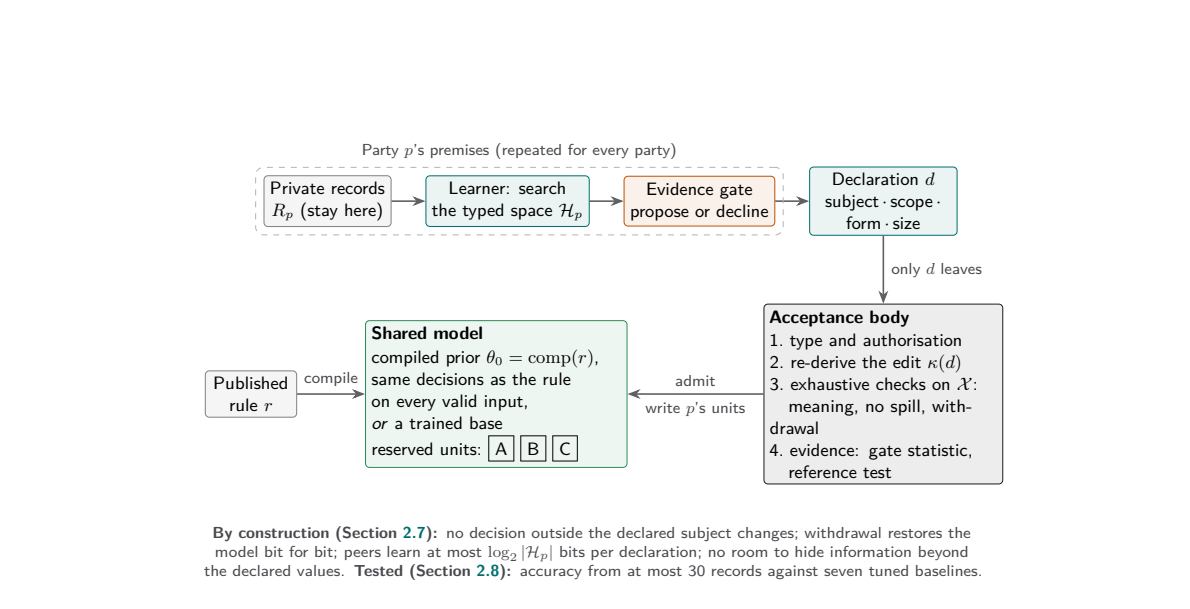
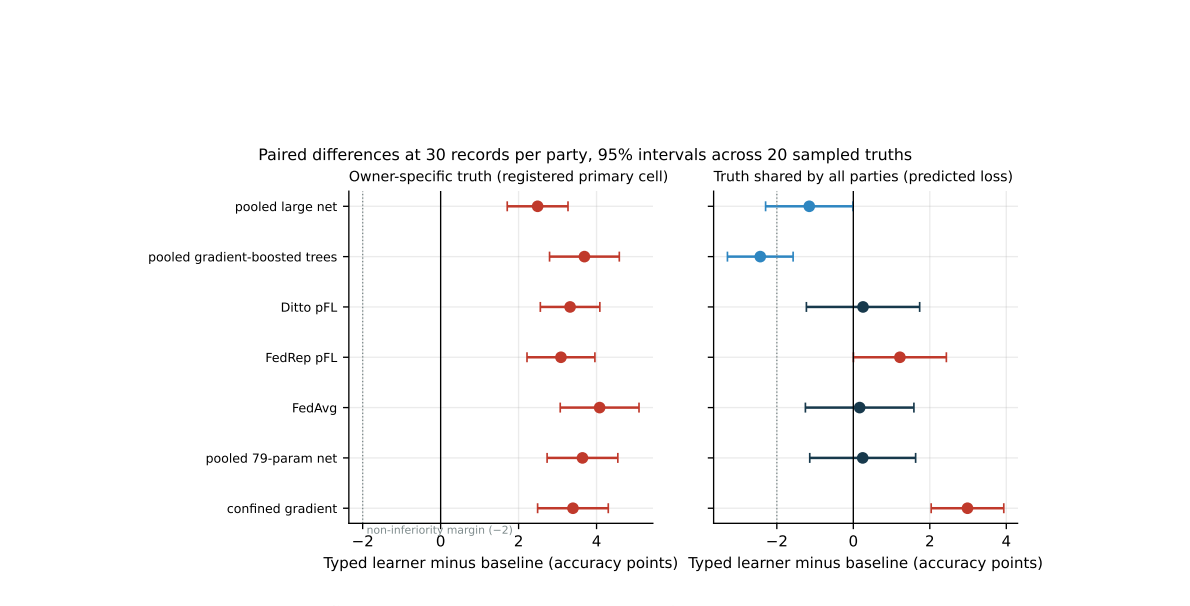
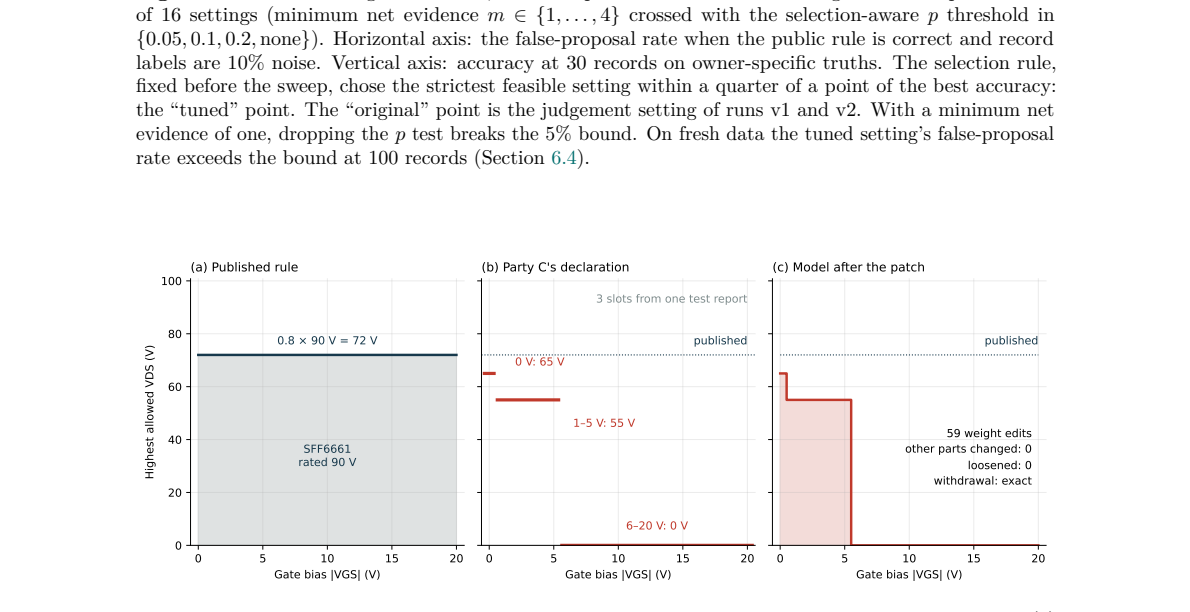
We describe a learning mechanism for that setting whose unit of change is an owned edit. The published rule is compiled exactly into a small ReLU network, a structured prior. Each party's learner searches a small typed space of declarations, a few named values such as subject, scope, form and size, and proposes one only when its own records pass a selection-aware evidence gate. The learning is that gated search around the prior. In two pre-registered analyses, on synthetic data whose 20 hidden truths were sampled from that typed space, the learner at 30 records per party was non-inferior, within 2 points, to all seven tuned baselines (a confined gradient learner, Ditto, FedRep, federated averaging, two pooled networks and pooled boosted trees), scoring 96.6% against 91.7% for the unchanged rule; a descriptive greedy ablation with no prior, over a separate space, scored 84.0%. In a third registered test, typed edits over a network trained on shared records beat that network alone by +5.4 points and the same edits over the published rule by +3.1; oracle-tuned fine-tuning and Ditto matched it at 30 records. An acceptance body recomputes each edit from its declaration and writes it into units reserved for that party, so by construction an edit changes no decision about any other subject, withdraws exactly, discloses at most log2 of the typed space's size in bits, and the artefact can hide nothing beyond its declared values; timing is not covered. We report where it loses: truths shared by all parties, relaxations, ten records, a pre-stated gate criterion that failed in both runs, and a language model given the records that decided about as accurately on one draw. On a rule-only base, a table of owned exceptions makes the same decisions.
from the abstract
Pith says
Machine review · deepseek-v4-flash · 13 Nov 2026 · of version 1 of the paper; version 2 is newer · what was read was not recorded · not checked by a person
It can be wrong. Challenge this review or reply to it.
Holds up. A careful, well-scoped protocol for owned, typed weight edits over a compiled prior, with pre-registered evidence that it beats several baselines in a synthetic setting — but the real-world applicability is left almost entirely to desk research. This line is wrong
3 major objections · 5 minor
How often objections from reviews like this one are right: not yet measured
Not checked: figures, code, what the references say.
The paper says, at Section 9.1–9.2 and confirmatory runs (Section 6)
The review did not quote this passage.
A classifier read this sentence of the paper as acknowledging the concern (probability 0.68):
“Real records needed dimensions the type did not have, and the public rule, like any type that only tightens it, cannot express leniency.”
Pith says: Objection 1 of 3 · major
The empirical case for accuracy rests entirely on synthetic data, and the typed space was built to contain the owner-specific truths evaluated in the primary cell. The authors state this honestly, but this means the central empirical result is a demonstration that realisability holds by design, not a test of the mechanism's ability to discover exceptions of unknown form.
more of objection 1
The paper would be strengthened by a more extended discussion of how a community might arrive at a typed space in practice, or by an experiment that systematically varies how far the type can be from the truth and characterises the accuracy decline.
The paper says, at Section 6.4 and 7.4 (the evidence gate)
The review did not quote this passage.
A classifier read this sentence of the paper as acknowledging the concern (probability 0.72):
“We report where it loses: truths shared by all parties, relaxations, ten records, a pre-stated gate criterion that failed in both runs, and a language model given the records that decided about as accurately on one draw.”
Pith says: Objection 2 of 3 · major
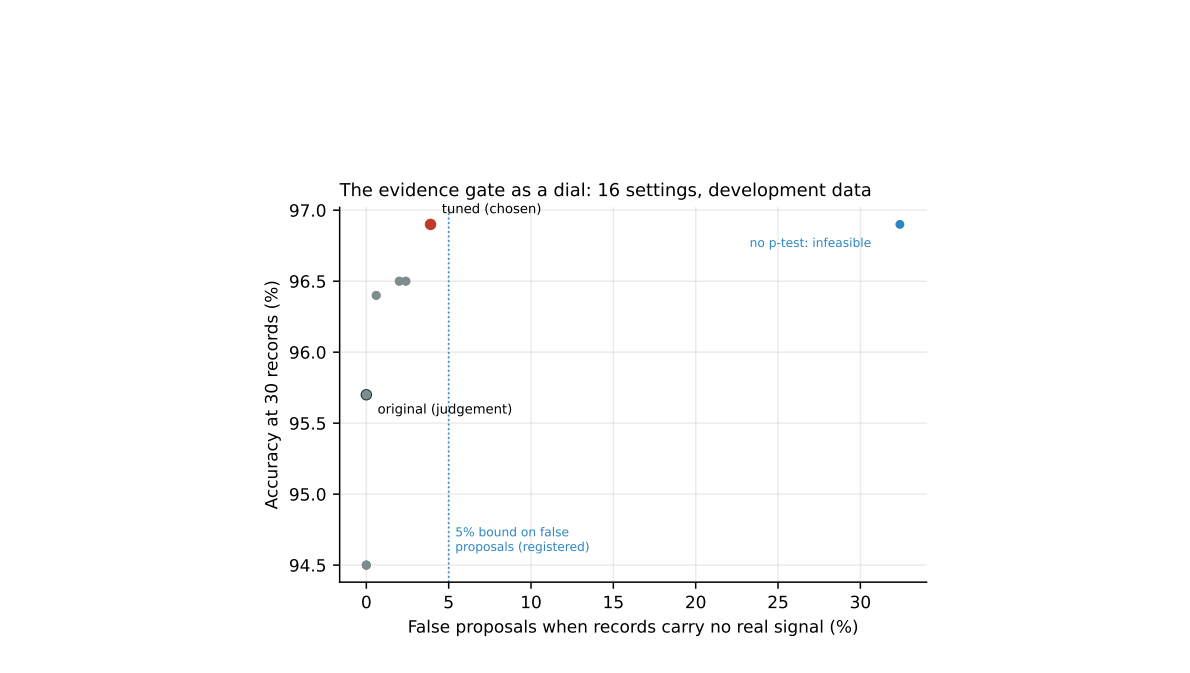
The gate's false-proposal rate on the public-rule null exceeded its own 5% bound at 100 records (6.2%), and the pre-stated criterion of at most 10% proposals on shuffled outcomes was failed in both confirmatory runs (46% and 76%). These failures are reported, but they undermine the claim that the gate is a reliable safeguard at larger sample sizes.
more of objection 2
The authors present the gate as a dial, but the registered endpoint did not rest on a specific false-proposal bound; still, the mismatch between the development estimate and the post-unblinding null check at n=100 is concerning and should be discussed more explcitly as a limitation for any deployment beyond 30 records.
The paper says, at Section 9.5
The review did not quote this passage.
A classifier read this sentence of the paper as acknowledging the concern (probability 0.95):
“The reference set the acceptance test relies on does not yet exist.”
Pith says: Objection 3 of 3 · major
The acceptance body's reference test requires a labelled reference set that does not exist for any known application. The authors acknowledge this clearly, but it means the only check on truth that is not reliant on the declaring party is absent.
more of objection 3
The paper does not propose how such a set could be built or funded. This is a major operational barrier, and a deployment section that gave concrete steps toward creating a reference set (e.g., through hold-back of shared records, active learning for rare regions) would significantly raise the manuscript's practical value.
5 minor objections
The paper says, at Abstract and Section 1
Pith says: minor objection 1 of 5
The abstract is long and packed with numbers; consider moving the specific accuracy figures into the main text and keeping the abstract more general. The second paragraph of Section 1 could be shortened.
The paper says, at Figure 5 (gate dial)
Pith says: minor objection 2 of 5
The false-proposal axis is labelled 'False proposals when records carry no real signal (%)'. It would be clearer to state explicitly that this is on the public-rule null with 10% noise, as described in Section 5.5.
show 3 more
The paper says, at Section 6.3, disclosure ratio
Pith says: minor objection 3 of 5
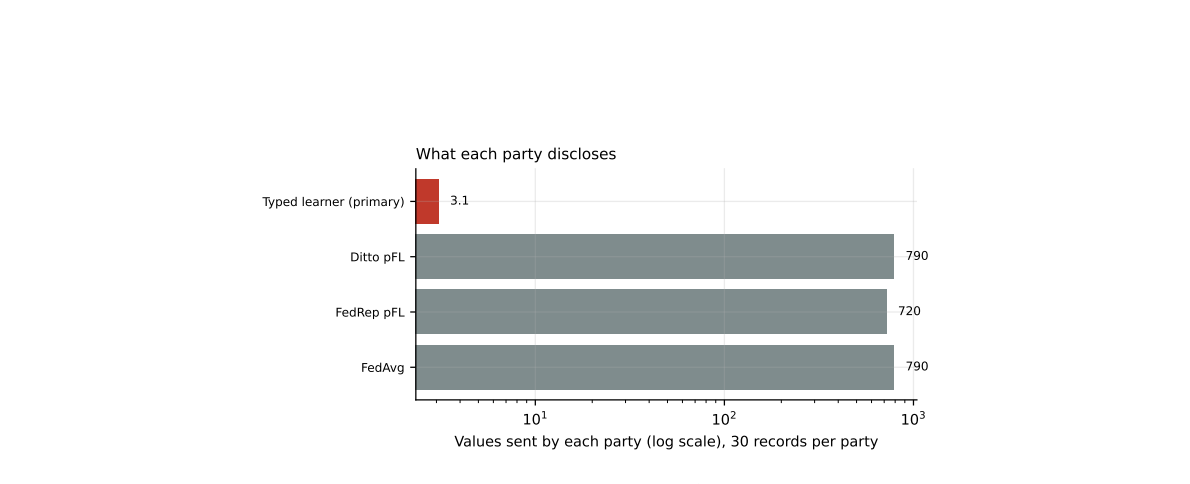
The ratio of upper bounds is reported as 76.9×, but the authors correctly note it is not a lower bound on the true ratio. The phrase 'the smallest ratio over draws of Ditto pFL’s disclosure bound to the typed learner’s was 76.9×' might mislead a casual reader into thinking the typed learner discloses 77× less information, which is not a proved statement. Consider adding a cautionary sentence earlier in the paragraph.
The paper says, at Section 7.7, language model arm
Pith says: minor objection 4 of 5
The LM arm is an interesting baseline, but it was run only once on one draw. The sentence 'its stated rule is not stable: two identical calls gave identical answers on the probe but stated rules that differ on 450 valid items' is striking. It would be worth adding a note on whether the tokens in the stated rule differed in semantically irrelevant ways (e.g., whitespace, commentary) or in actual thresholds, because the latter would be a genuine reliability problem.
The paper says, at General
Pith says: minor objection 5 of 5
There are occasional typos: 'recomputes' in the abstract should be 'recomputes', 'pre-stated criterion that failed' in Section 7.4 should be 'pre-stated criterion was failed'. Also, the paper uses both 'realisability' and 'realizability' – pick one.
What would settle it
Replicate the primary cell (owner-specific truths, 30 records per party) on a fresh sample of 20 truths from the same generator, using the same registered plan and tuned gate. If the typed learner is not non-inferior to all seven baselines (lower bound > -2 points), the central claim is reinforced; if it fails, the pattern may depend on the particular sample.
from the skeptic's reading
How the review went
4 readings by deepseek-v4-flash · 13 Nov 2026
- Reader holds up
- Skeptic agrees
- Editor wrote the verdict above
- Referee minor revision: 3 major objections, 5 minor
Not run on this paper: the simulated authors' defence.
Pith did not check this review's objections against the paper.
The review in full
The review in brief, machine-written
The paper's core idea is genuinely novel: combine a compiled prior (the published rule) with a small typed space of possible corrections, an evidence gate, and owned, withdrawable weight patches. The theoretical guarantees (non-interference, exact withdrawal, bounded disclosure, zero hidden capacity) are proved and checked in every run. That's real engineering craftsmanship.
The pre-registered experiments are a strength. At 30 records per party, the typed learner was non-inferior to all seven baselines and superior to most after Holm correction. The second run with a tuned gate widened the margins. Over a trained base, the hybrid beat each of its parts. The paper reports where it loses (shared truths, relaxations, few records) with the same weight as wins. The limitation section is the most honest I've seen in a while — it lists every objection a sceptic would raise, and many of them land.
The soft spots are real but acknowledged. The accuracy evidence is entirely synthetic, and the typed space was built to contain the planted truths. Real-world applicability rests on desk research and one compilation-only test of a published rule. The gate's false-proposal rate exceeded its chosen bound at 100 records. The reference set that the acceptance test depends on does not exist for any real application. The mechanism adds value over a rule table only when trained weights carry a shared component — which the paper tests, but then concedes that oracle-tuned fine-tuning and Ditto match it at 30 records. The structual advantages (exact withdrawal, bounded disclosure) remain, but the accuracy edge is not robust against well-tuned competitors.
This is a paper for readers who care about protocols for collaborative refinement of explicit rules under strict privacy and attribution constraints, especially in settings like component derating. It does not claim general-purpose learning or real-world accuracy. It is a serious piece of work, honestly presented. It deserves peer review, though a referee will want more evidence that the approach holds up when the typed space is not cherry-picked and when real parties behave adversarially.
The strongest objection
The paper clearly states the scope of its claims: accuracy evidence is synthetic, the typed space is tailored to contain the planted truths, and the primary cell tests only owner-specific truths that fit that space. These limitations are acknowledged in Sections 9.1 and 9.2, and the paper presents results for truth classes outside the space where the mechanism loses or declines. The pre-registered endpoint passes, the construction guarantees (non-interference, exact withdrawal, bounded disclosure, zero hidden capacity) are proven and verified. The gate is treated as a dial with measured performance, and its tuning is transparent. No unaddressed internal inconsistency or hidden assumption that would undermine the central claim within the stated scope was found.
The reader's weakest_assumption correctly identifies that the typed space was built to contain the owner-specific truths, which limits generalization. The paper acknowledges this and reports other truth classes where performance drops. My stress-test found no unacknowledged load-bearing flaw. The construction guarantees are mathematically proven and empirically verified. The experimental design is pre-registered, the primary endpoint passes, and the limitations are openly discussed. Therefore, the reader's ACCEPT verdict is appropriate, and I see no reason to change it.
The referee's report
The paper addresses a practically relevant and academically underexplored setting: improving a shared rule from private, not-pooled evidence. Its primary contribution is the protocol combining a compiled prior, typed declarations with a gate, owned weight patches, and an acceptance test based on re-derivation. The construction guarantees (exact compilation, non-interference, exact withdrawal, bounded disclosure, zero hidden capacity) are proven and verified. The pre-registered experiments, while on synthetic data and with a tailored typed space, are conducted rigorously with registered plans, honest tuning, and full reporting of failures. If the approach works in a real application, it would be a rare example of a system that provides both strong privacy-oriented guarantees (by construction, not by averaging noise) and competitive accuracy from few records. The weaknesses are openly discussed, which increases trust.
Pith's reading of the paper (a machine's summary, not the authors')
The paper addresses the problem where multiple organizations apply the same published decision rule but each holds private evidence that the rule is wrong for its own cases and will not pool that evidence. It proposes a four-part mechanism: the rule is compiled exactly into a small ReLU network (the prior), each party searches a small typed space of declarations (e.g., subject, scope, form, size) and submits one only if an evidence gate passes, the declaration is compiled into an owned weight patch that writes only into units reserved for that party's subject, and an acceptance body re-derives the patch from the declaration and checks it exhaustively. In two pre-registered experiments on synthetic data, the typed learner at 30 records per party was non-inferior (within 2 points) to all seven tuned baselines, scoring 96.6% against 91.7% for the unchanged rule; the same search without the prior or the gate scored 84.0%. In a third test, typed edits over a network trained on shared records beat that network alone by +5.4 points and the same edits over the published rule by +3.1 points. Throughout, each edit changes no decision about another subject, withdraws exactly, and discloses at most log2 of the typed space's size in bits.
What carries the argument. The mechanism has four parts: (1) the compiled prior, a ReLU network that exactly reproduces the public rule on the finite input domain; (2) a typed hypothesis space of declarations—a few named values (subject, scope, form, size) that each party may propose; (3) an evidence gate that passes only if the improvement in record errors exceeds a threshold and a selection-aware Monte Carlo p-value is low; (4) owned weight patches that write only into units reserved for that party's subject, ensuring non-interference, exact withdrawal, and a disclosure bound. The learning is the gated search over the typed space, using minimal-change tie-break and enumeration.
Core claim. The central claim is that a combination of a compiled prior (the public rule encoded exactly as a ReLU network), a small typed hypothesis space of declarations, a selection-aware evidence gate, and owned weight patches with disjoint support can learn private exceptions from few records while preserving non-interference, exact withdrawal, and bounded disclosure. In registered tests, this combination matched or beat gradient, pooled, and federated baselines on synthetic data, with accuracy 96.6% vs 91.7% for the rule alone, and showed that typed declarations over a trained base outperform either component.
The premise it rests on. The typed space was built to contain the owner-specific truths, so realisability holds by design for the primary test, but the paper acknoedges that this limits generalization to exceptions that may not fit the predetermined types.
If the paper is right (Pith's inferences, not the authors')
At 30 records per party, the typed learner is non-inferior to all seven CV-tuned baselines on owner-specific truths inside the typed space, and superior to most after multiplicity correction.
Removing the compiled prior decreases accuracy by about 12.6 points (96.6% to 84.0%), showing that the prior carries most of the performance.
Over a trained base, typed declarations beat both the base alone (+5.4 points) and declarations over the published rule (+3.1 points), demonstrating that learned weights and typed exceptions are complementary.
Each typed edit has zero spill (no decision changes on other subjects) and is exactly withdrawable, and disclosure is at most log2|H_p|≈ 6.99 bits per party for the primary space.
The mechanism fails as predicted on truths shared by all parties (pooling triples relevant data), on relaxations (typed space only tightens), and on ten records (gate rarely pases).
The typed space was built to contain the planted truths in the primary test, so realisability holds by design; on real-world data where exceptions may not fit the predetermined types, accuracy may be lower and non-interference may not guarantee correctness if the type misses the true structure.
The evidence gate failed a pre-stated criterion (at most 10% proposals on shuffed outcomes it proposed 76.0%), and the tuned setting's false-proposal rate exceeded 5% at 100 records; the gate is a dial not a guarantee, and its cost must be managed by the acceptance test.
The acceptance test relies on a reference set of labled items that no party chose, which does not exist for any known application; without it, the only check on truth is trust in the party's reported statisic, backed by a commitment opened in a dispute.
When the base is only the compied rule, a table of typed exceptions makes the same decisions as the network; what the network form adds is one artefact (trained components + exceptions hashed and verified) but this advantage disapars if a table and network are maintained separatey.
Check this review
Pith stored no record of this review's passes and took no fingerprint of it. Reviews made by code from 13 Nov 2026 on carry both.
How often reviews like this one are right
Reviews like this one: written by deepseek-v4-flash, where what was read was not recorded.
How often objections from reviews like this one are right: not yet measured
Reviews by people
This review was written by a machine. No person has reviewed this paper on Pith yet. A scientist listed on Pith can review it for a fee, and their review is published here whatever it concludes.
The paper
Abstract
Organisations that apply the same published decision rule often hold private evidence that the rule is wrong for their own cases, and will not pool it. We describe a learning mechanism for that setting whose unit of change is an owned edit. The published rule is compiled exactly into a small ReLU network, a structured prior. Each party's learner searches a small typed space of declarations, a few named values such as subject, scope, form and size, and proposes one only when its own records pass a selection-aware evidence gate. The learning is that gated search around the prior. In two pre-registered analyses, on synthetic data whose 20 hidden truths were sampled from that typed space, the learner at 30 records per party was non-inferior, within 2 points, to all seven tuned baselines (a confined gradient learner, Ditto, FedRep, federated averaging, two pooled networks and pooled boosted trees), scoring 96.6% against 91.7% for the unchanged rule; a descriptive greedy ablation with no prior, over a separate space, scored 84.0%. In a third registered test, typed edits over a network trained on shared records beat that network alone by +5.4 points and the same edits over the published rule by +3.1; oracle-tuned fine-tuning and Ditto matched it at 30 records. An acceptance body recomputes each edit from its declaration and writes it into units reserved for that party, so by construction an edit changes no decision about any other subject, withdraws exactly, discloses at most log2 of the typed space's size in bits, and the artefact can hide nothing beyond its declared values; timing is not covered. We report where it loses: truths shared by all parties, relaxations, ten records, a pre-stated gate criterion that failed in both runs, and a language model given the records that decided about as accurately on one draw. On a rule-only base, a table of owned exceptions makes the same decisions.
The paper's own sentences, arranged, kept beside the review and separate from it. Each label is drawn from a closed vocabulary; the number beside it is the probability the classifier gave that label. No sentence in this record was written by a model.
abstract compiled · 2026-11-13
The authors' main claim, as the classifier picked it out 0.70
“In two analyses registered before they ran, on synthetic data with 20 sampled hidden truths, the learner at 30 records per party was non-inferior, within 2 points, to all seven tuned baselines (a confined gradient learner, Ditto, FedRep, federated averaging, two pooled networks and pooled gradient-boosted trees), scoring 96.6% against 91.7% for the unchanged rule; the same search without the prior or the gate scored 84.0%.”
How the main claim is stated: asserted 1.00
What the abstract itself states, as probabilities: claims first 0.06 · states limitation 0.97 · human participants 0.07 · controlled comparison 0.97 · randomized assignment 0.04 · states quantitative result 0.99 · compares with prior results 0.98 · mentions code or data availability 0.04
The abstract, sentence by sentence
This table labels the abstract only (arXiv listing abstract v1). The number is the probability the classifier gave the label.
| Sentence | Role | The authors' own work | States the main conclusion | Strength |
|---|---|---|---|---|
| Organisations that apply the same published decision rule often hold private evidence that the rule is wrong for their own cases, and will not pool it. | background 0.97 | 0.08 | 0.03 | asserted 1.00 |
| We describe a learning mechanism for that setting whose unit of change is an owned edit. | contribution 0.98 | 0.81 | 0.08 | asserted 0.97 |
| The published rule is compiled exactly into a small ReLU network, a structured prior. | method 0.99 | 0.74 | 0.03 | asserted 1.00 |
| Each party's learner searches a small typed space of declarations, a few named values such as subject, scope, form and size, and proposes one only when its own records pass a selection-aware evidence gate. | method 0.99 | 0.73 | 0.06 | asserted 1.00 |
| The learning is that gated search around the prior. | method 0.88 | 0.57 | 0.07 | asserted 0.99 |
| In two analyses registered before they ran, on synthetic data with 20 sampled hidden truths, the learner at 30 records per party was non-inferior, within 2 points, to all seven tuned baselines (a confined gradient learner, Ditto, FedRep, federated averaging, two pooled networks and pooled gradient-boosted trees), scoring 96.6% against 91.7% for the unchanged rule; the same search without the prior or the gate scored 84.0%. | result 1.00 | 0.96 | 0.26 | asserted 1.00 |
| In a third registered test, typed edits over a network trained on shared records beat that network alone by 5.4 points and the same edits over the published rule by 3.1. | result 1.00 | 0.95 | 0.15 | asserted 1.00 |
| An acceptance body recomputes each edit from its declaration and writes it into units reserved for that party, so by construction an edit changes no decision about any other subject, withdraws exactly, discloses at most log2 of the typed space's size in bits, and can hide nothing beyond its declared values. | method 0.89 | 0.72 | 0.12 | asserted 1.00 |
| We report where it loses: truths shared by all parties, relaxations, ten records, a pre-stated gate criterion that failed in both runs, and a language model given the records that decided about as accurately on one draw. | limitation 0.98 | 0.93 | 0.06 | asserted 1.00 |
| On a rule-only base, a table of owned exceptions makes the same decisions. | result 0.66 | 0.69 | 0.16 | asserted 1.00 |
What kind of paper the classifier reports this is: method or tool 1.00 · evidence from observation or experiment 0.57
What was examined, and what was not
Sources read
- arXiv listing abstract v1
Not examined
- full text
- figures and tables
- references and citing sentences
- relations to other papers
Levels run
- P abstract
Not run
- S sections
- T body sentences
- C citations
- R cross-paper relations
How the labels were made
Compiled by classifier-1.13.0 via TypeSafe API, question bank abstract-p1-20260923, 2026-11-13: 1 request, 7,770 input tokens.
Every quoted sentence on this record is the authors'. Every label is from Pith's closed vocabulary, with the probability shown beside it. This record as JSON
Figures (7)


Figures are the authors', reproduced from the paper.
Challenges and discussion
Disagree with the review, or know something it missed? Leave a comment, or challenge this review formally: a challenge becomes a permanent entry in this paper's record, and its decision is published here.
Come back by email
A short list of the week's newly reviewed papers. Nothing is sent until you confirm from your inbox, and every email has a link that stops it. No account.
No comments yet.
Sign in to comment