Artificial Intelligence · arXiv:2610.37081 v1 · submitted 27 Oct 2026 · 17 references
OpenGray: a benchmark for evaluating the decisions of radiotherapy planning agents
The paper says
“Background and purpose: Radiotherapy planning agents based on large language models (LLMs) decide when to submit a plan or request review but are evaluated mainly by dose. This study developed OpenGray, a benchmark of planning tasks with known correct decisions.”
more of the abstract
Materials and methods: OpenGray adds tasks with known answers to the OpenKBP-Opt head-and-neck dataset, including two contradictions with dose goals proven incompatible and a feasible control with a stored plan meeting every hard goal. Four systems, from a rule-based planning script to a full LLM agent, were evaluated on 30 patients, the LLM-based ones with a commercial (Terra) and a local (Ministral 3 8B) LLM. Decisions, achieved dose, problem recognition, and technical failures were recorded and also read from logs of 39 stereotactic radiosurgery runs of SAGE, a clinical LLM agent. Results: With Terra, the script preceded by an LLM review and the full agent had decision accuracies of 95.4% and 92.1%, respectively, yet escalated only 50% (95% confidence interval, 25-75%) and 25% (10-40%) of overlap contradictions, which required arithmetic on the anatomy. All four systems submitted every feasible control, but 24% of these plans missed a hard goal that the stored plan had met. In four SAGE runs, one goal failed at every attempt; the agent identified it in every reply but had no action for stopping. Conclusions: Favorable aggregate scores concealed specific decision failures. Planning agents should be evaluated on their decisions as well as their dose and given an explicit action for stopping and requesting review.
from the abstract
Pith says
Machine review · deepseek-v4-flash · 28 Oct 2026 · what was read was not recorded · not checked by a person
It can be wrong. Challenge this review or reply to it.
Holds up, with conditions. OpenGray does real work on decision-level evaluation and the benchmark finding holds; the SAGE "no means of stopping" claim needs to be narrowed before the conclusion stands. This line is wrong
2 major objections · 3 minor
How often objections from reviews like this one are right: not yet measured
Not checked: figures, code, what the 17 references say.
The paper says, at §3.3 and §S7.1
The review did not quote this passage.
A classifier read this sentence of the paper as acknowledging the concern (probability 0.63):
“Finally, the log audit covered one agent at one institution and relied on the dose calculated by the planning system, and because no verified answer exists for a clinical case, it cannot show whether the four unresolved runs could have met their goals.”
Pith says: Objection 1 of 2 · major
The conclusion that SAGE 'had no means of stopping' is inferred from the absence of a recorded stop, escalation, or manual action in four logs, but Section S7.1 also states that the clinical logs and patient-to-plan linkage records are retained privately.
more of objection 1
Absence in a private log is not sufficient evidence that no stopping capability existed or that no operator acted outside the logged channel, because an external reviewer cannot check whether the logging system captures every available action. This is load-bearing for the clinical half of the headline conclusion. The claim should be narrowed to what the evidence supports, for example 'no stopping action was offered in the recorded instructions and none was observed in the logs,' and the private-log limitation should be stated in the main limitations paragraph.
The paper says, at §3.3 and §S7.2
The review did not quote this passage.
Pith says: Objection 2 of 2 · major
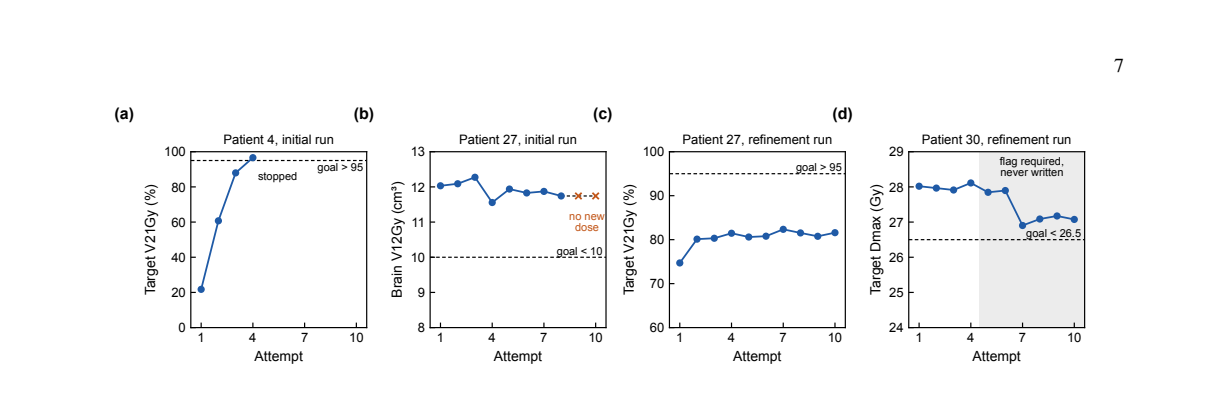
Even within the logged evidence, the statement that there was 'no action for stopping' is stronger than what is shown. Section S7.2 reports that the Patient 30 refinement instructions defined the flag 'not feasible with priorities' for a goal that still failed after four attempts, and that the flag was never written because the model was never shown the attempt number.
more of objection 2
The precise finding is therefore that the one defined flag was unusable and that no other stop action was offered, not that no stop-related action existed at all. This distinction matters because the recommendation for an explicit stopping action is justified by the stronger reading, and the current wording of Section 3.3 and the abstract should be adjusted accordingly.
3 minor objections
The paper says, at Abstract and §3.2
Pith says: minor objection 1 of 3
The paper uses 'decision failure' to cover both a wrong action on a scored task and a dose-goal shortfall on a feasible control that was, under the paper's own scoring rule, submitted with a correct decision. Section 3.2 explicitly says deficient feasible-control submissions 'counted as a correct decision,' so the headline phrase 'two decision failures' should be defined or reworded to distinguish an action-level failure (overlap escalation) from a plan-quality failure (feasible-control dose shortfall).
The paper says, at §2.2 and Table S15
Pith says: minor objection 2 of 3
The claim that the feasible-control witness was found 'with the same optimizer and budget' should be qualified. Table S15 shows that the witness search used a different objective template and priorities (hard-goal terms at priority 1,000, soft terms at 1, no normalization) from the controller-based systems (all priorities 1, with back-off and normalization).
more of objection 2
This does not affect the existence proof, but the phrase should be precise so that the comparison supports the intended conclusion that the controller's objective choices, not the optimizer or iteration budget, limited the plans.
show 1 more
The paper says, at Figure 4(d)
Pith says: minor objection 3 of 3
The shaded region in Figure 4(d) is labeled 'flag required, never written,' but the requirement applies only after the target maximum dose still fails after four attempts. A brief legend note stating the four-attempt condition would prevent readers from inferring that the flag was required at every shaded attempt.
What would settle it
Release, with IRB-compatible redactions, the SAGE prompt templates, the agent's action schema, the log-parsing audit script, and the redacted run logs; alternatively, have an independent auditor with IRB access verify three things: (1) the agent's action space contained no stop or escalation function; (2) no prompt in any of the 94 attempts contained the attempt number; (3) no manual intervention appears in any Eclipse or workbook audit trail for the four unresolved runs. If the action space did contain an escalation path, or if any prompt included the attempt count, the 'no means of stopping' claim must be revised to 'no effective use of the available flag,' and the abstract and conclusion should be reworded accordingly.
from the skeptic's reading
How the review went
4 readings by deepseek-v4-flash · 28 Oct 2026
- Reader holds up, with conditions
- Skeptic partly agrees
- Editor wrote the verdict above
- Referee major revision: 2 major objections, 3 minor
Not run on this paper: the simulated authors' defence.
Pith did not check this review's objections against the paper.
The review in full
The review in brief, machine-written
The benchmark half is solid and the clinical half needs a wording fix. The genuinely new thing is decision-level tasks with known answers: infeasibility proofs for two contradiction types, feasible controls with stored witnesses that meet every hard goal, independent dose reconstruction (discrepancy around 4e-13 Gy), a private checksum freeze, and patient-bootstrap confidence intervals. That is real, reproducible work. The empirical finding is useful and credible: Terra systems score 92–95% aggregate accuracy but escalate only 50% and 25% of overlap contradictions, every system submits all feasible controls, and 24% of those submissions miss a hard goal the stored witness met. This is exactly the kind of failure aggregate dose scores hide, and the paper earns the point.
The soft spot is the SAGE conclusion. The paper says the agent had no means of stopping, based on absence in the logs and instructions. Those logs and the patient-to-plan linkage records are private, so absence in logs cannot by itself establish absence of capability. More importantly, the paper itself reports that a stop-related flag, "not feasible with priorities," existed in the Patient 30 refinement instructions but was never written because the model was never shown the attempt count. So the accurate claim is not "no action existed" but "no usable stopping action was taken; the one defined flag was unusable and the instructions offered no other route." The stress-test note lands here. The authors disclose related limitations, one agent, one institution, no verified clinical answers, but the conclusion sentence still states the stronger reading and should be narrowed.
Minor items: only 10 overlap-contradiction patients, and the confidence intervals honestly show the uncertainty. The hosted Terra model versions cannot be independently verified; a public commit hash for the evaluation would help. The development-comparison caveats around withheld rules are disclosed rather than hidden. None of this shakes the benchmark findings, which stand independently of the SAGE audit.
Bottom line: this paper deserves a serious referee. I would send it out and ask for a revised SAGE claim plus whatever public reproducibility details can be provided. If I worked on planning agents or safety-critical agent evaluation, I would cite the benchmark half.
The strongest objection
The benchmark half is solid: certificates are proved and independently reconstructed (Section S5), feasible-control witnesses are verified, doses are recomputed from stored fluences, confidence intervals are patient-bootstrapped, and a checksum manifest was committed before evaluation. The load-bearing weak point is the SAGE conclusion. Section S7.1 states that 'none of the four logs recorded a stopping reason, an escalation, or a manual action, and the instructions offered none', and the paper concludes from this absence that the agent 'had no means of stopping.' Two things make that inference insecure. First, the clinical logs and patient-to-plan linkage records are retained privately, so an external reviewer cannot check that the logging channel captures every possible stop, escalation, or manual action, or that no operator acted outside the logged channel. Second, the paper itself reports a stop-related flag: the Patient 30 refinement instructions asked for 'not feasible with priorities' if the target maximum dose still failed after four attempts (Section S7.2), so the accurate claim is not 'no action existed' but rather 'the one defined flag was unusable because the attempt count was never shown to the model.' That distinction matters because the headline conclusion and the recommendation for an explicit stopping action depend on the stronger reading. The benchmark results do not depend on this concern; only the clinical-agent claim does.
The reader's CONDITIONAL verdict is appropriate. I looked for a deeper internal problem in the benchmark itself: the overlap certificates are conservative sufficient conditions with independent reconstruction; the feasible-control witnesses are verified with margins; the 24% hard-goal shortfall is reproduced at 2,000 and 5,000 iterations; the bootstrap intervals are wide on the overlap task but the qualitative failure is large (15 of 20 misses for the full agent); and the weighting choices and limitations are disclosed. The semantic point that a deficient feasible-control submission is still scored as a correct decision is acknowledged by the authors, and it actually supports their recommendation to evaluate dose alongside decisions. The only claim that is both load-bearing and insufficiently supported is the SAGE 'no means of stopping' inference. It is load-bearing because the recommendation for an explicit stopping action is grounded mainly in that clinical observation. It is insufficiently supported for two reasons: the evidence is an absence in private logs, and the paper itself contains a flag definition that complicates the plain 'no action' wording. An independent check on the released prompt and action schema, or an auditor's confirmation that the logs capture every action and that no manual intervention occurred, would settle the point. If the logs cannot be shared, the SAGE conclusion should be presented as conditional on the completeness of the private audit trail. The benchmark findings stand regardless, so the reader's CONDITIONAL verdict need not change.
The referee's report
The benchmark half of the paper is a solid methodological contribution. The certificate proofs are stated with conservative allowances and were independently reconstructed; the 327 submitted routine and feasible-control plans and all stored witnesses were recomputed from stored fluences with a maximum discrepancy of 4.41e-13 Gy; a private checksum manifest was committed before evaluation; confidence intervals are patient-bootstrapped; and technical failures are reported rather than discarded. The stated limitations on deliverability, task coverage, and the single dataset are also acknowledged. These practices make the overlap-contradiction and feasible-control findings credible as measured. The SAGE audit is a useful observational extension, and the four-run recognition result is clearly reported, but the claim that the agent 'had no means of stopping' goes beyond what the private logs can establish without additional evidence about the logging channel and the action schema. With that claim narrowed, the paper's substantive recommendation that planning agents be evaluated on decisions and be given an explicit stop/review action remains well supported for the benchmark systems.
Pith's reading of the paper (a machine's summary, not the authors')
OpenGray is a benchmark that attaches known-correct decisions to real head-and-neck radiotherapy cases, so that a planner's choices, not just its dose, can be scored. The paper uses it to argue that LLM-based planning agents can post excellent aggregate scores while failing at exactly the decisions that matter most: on 30 patients, the best systems scored 95.4% and 92.1% decision accuracy yet escalated only 50% and 25% of the overlap contradiction, which required arithmetic on shared voxels, and every system submitted plans that missed a hard goal on 24% of the feasible controls. An audit of 39 clinical runs of a separate planning agent found it named its failing goal in all 88 replies but had no action for stopping or requesting review. If the paper is right, planning agents must be judged on their decisions on tasks with known answers, and given an explicit escalation action.
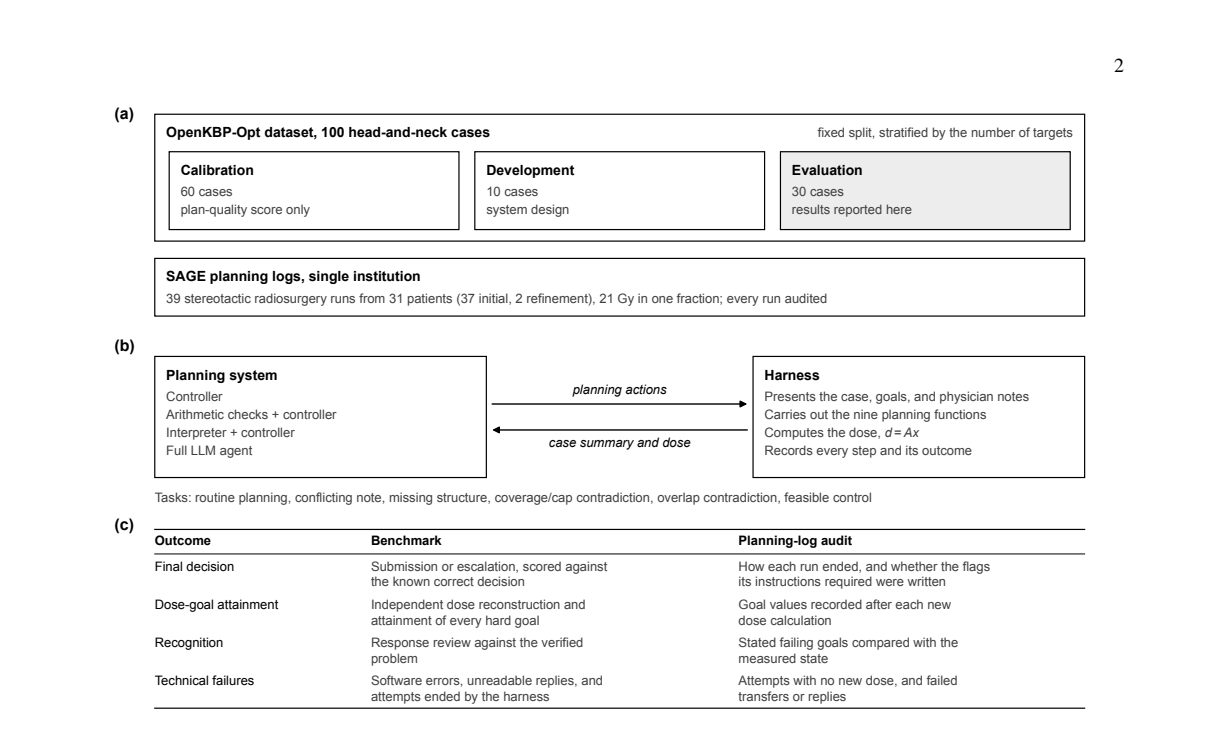
What carries the argument. The load-bearing object is OpenGray itself: a harness that turns 30 head-and-neck cases from the public OpenKBP-Opt dataset into planning tasks with known correct decisions, mediates every system's access to nine planning functions, recomputes every submitted dose as d = Ax from the stored fluence x and the dose-influence matrix A, and records four outcomes per attempt: the final decision, dose-goal attainment, problem recognition, and technical failures. The decisive construction is the overlap contradiction, in which a high target dose is required inside voxels shared with the mandible; when O voxels are shared and the goals tolerate at most m underdosed target voxels and n overdosed organ voxels, the inequality O > m+n proves that no plan can satisfy both goals. Because this proof is verified by independent dose reconstruction, a submission on such a task is a wrong decision regardless of the dose it achieves. The feasible-control task supplies the complementary control: a tightened spinal-cord limit that a stored plan, found with the same optimizer and budget, met together with every other hard goal, so a submitted plan that misses a hard goal reveals an objective-selection or decision failure rather than an impossible request.
Core claim. The paper's central claim is that favorable aggregate scores concealed two persistent decision failures, and that a clinical agent recognized a failing goal but had no means of stopping. On the OpenGray benchmark, with a large commercial LLM, the interpreter and the full agent reached decision accuracies of 95.4% and 92.1%, yet escalated only half and a quarter of the overlap-contradiction tasks, the ones that required counting shared voxels against the goals' allowances; even the nine tasks whose shared-voxel excess was at least 20 voxels were missed by the full agent in all nine cases. Every system submitted all 25 feasible controls, but only 76% of those plans met every hard goal, the same six deficient plans stayed deficient when the optimization budget was raised to 5,000 iterations, and a second, smaller local model missed the same contradictions. In the clinical logs of 39 stereotactic radiosurgery runs, four runs ended with one goal failing at every attempt; the agent correctly named the failing goal in all 88 replies, but its instructions offered no stop or escalation action and none was recorded, and a flag designed for such runs went unwritten partly because the agent was never shown its attempt number. Stated as the authors state it: planning agents should be evaluated on their decisions as well as their dose, on tasks with known answers before clinical use and through planning logs afterward, and given an explicit action for stopping and requesting review.
The premise it rests on. The claim that the clinical agent had no means of stopping rests on treating its planning logs and instructions as complete records of every available action, and since those records are retained privately, a reader cannot verify that no stop, escalation, or manual intervention occurred outside the logged channel; the benchmark half of the paper does not depend on this assumption.
If the paper is right (Pith's inferences, not the authors')
Decision accuracy must be reported by task and alongside achieved dose; a single aggregate score can hide that the easy tasks carry most of the weight, as when missing-structure and feasible-control tasks made up 60% of the score and the overlap contradictions only 9%.
Agents need an explicit stop-and-escalation action with a rule for when to take it and the information the rule depends on; the clinical flag went unwritten because the agent was never shown its attempt number.
Recognizing a problem is not the same as acting on it: the LLM-based systems listed their unmet goals when submitting on contradictions, and the clinical agent named its failing goal in every reply, yet neither stopped.
The same four outcomes can be read from the planning logs of any agent that records its proposals, their transfer to the planning system, and the resulting dose, extending decision-level auditing to clinical agents that cannot be rerun on a benchmark.
Static checks catch only anticipated conflicts, so future benchmark versions must withhold conflict types from developers to remain meaningful once the tasks are public.
The paper's prescription generalizes beyond radiotherapy: any autonomous system that decides when to keep working versus stop and call a human, in clinical, industrial, or software settings, should be tested on known-answer tasks that include provably impossible requests and be given an explicit escalation channel.
The overlap-contradiction result suggests a cheap screening test for planning agents: the case summary already contained the voxel counts and overlap fractions, so a system that cannot do the one-step arithmetic establishing O > m+n will fail exactly the tasks where a wrong decision is most consequential.
Because the same six feasible controls stayed deficient across budgets and across the systems that share the controller's objective template, the bottleneck appears to be the objective-selection template rather than optimization effort; a testable extension would be to seed the controller with the stored plan's objective choices and see whether those controls then pass.
The clinical half of the study is not independently checkable while the logs and patient-to-plan linkage records are retained privately; future log audits would be stronger if redacted logs and instruction files were deposited alongside the benchmark.
Check this review
Pith stored no record of this review's passes and took no fingerprint of it. Reviews made by code from 13 Nov 2026 on carry both.
How often reviews like this one are right
Reviews like this one: written by deepseek-v4-flash, where what was read was not recorded.
How often objections from reviews like this one are right: not yet measured
Reviews by people
This review was written by a machine. No person has reviewed this paper on Pith yet. A scientist listed on Pith can review it for a fee, and their review is published here whatever it concludes.
The paper
Abstract
Background and purpose: Radiotherapy planning agents based on large language models (LLMs) decide when to submit a plan or request review but are evaluated mainly by dose. This study developed OpenGray, a benchmark of planning tasks with known correct decisions. Materials and methods: OpenGray adds tasks with known answers to the OpenKBP-Opt head-and-neck dataset, including two contradictions with dose goals proven incompatible and a feasible control with a stored plan meeting every hard goal. Four systems, from a rule-based planning script to a full LLM agent, were evaluated on 30 patients, the LLM-based ones with a commercial (Terra) and a local (Ministral 3 8B) LLM. Decisions, achieved dose, problem recognition, and technical failures were recorded and also read from logs of 39 stereotactic radiosurgery runs of SAGE, a clinical LLM agent. Results: With Terra, the script preceded by an LLM review and the full agent had decision accuracies of 95.4% and 92.1%, respectively, yet escalated only 50% (95% confidence interval, 25-75%) and 25% (10-40%) of overlap contradictions, which required arithmetic on the anatomy. All four systems submitted every feasible control, but 24% of these plans missed a hard goal that the stored plan had met. In four SAGE runs, one goal failed at every attempt; the agent identified it in every reply but had no action for stopping. Conclusions: Favorable aggregate scores concealed specific decision failures. Planning agents should be evaluated on their decisions as well as their dose and given an explicit action for stopping and requesting review.
The paper's own sentences, arranged, kept beside the review and separate from it. Each label is drawn from a closed vocabulary; the number beside it is the probability the classifier gave that label. No sentence in this record was written by a model.
abstract compiled · 2026-10-28
The authors' main claim, as the classifier picked it out 0.62
“Conclusions: Favorable aggregate scores concealed specific decision failures.”
How the main claim is stated: asserted 1.00
What the abstract itself states, as probabilities: claims first 0.08 · states limitation 0.65 · human participants 0.83 · controlled comparison 0.87 · randomized assignment 0.02 · states quantitative result 0.99 · compares with prior results 0.89 · mentions code or data availability 0.16
The abstract, sentence by sentence
This table labels the abstract only (arXiv listing abstract v1). The number is the probability the classifier gave the label.
| Sentence | Role | The authors' own work | States the main conclusion | Strength |
|---|---|---|---|---|
| Background and purpose: Radiotherapy planning agents based on large language models (LLMs) decide when to submit a plan or request review but are evaluated mainly by dose. | background 0.81 | 0.06 | 0.02 | asserted 1.00 |
| This study developed OpenGray, a benchmark of planning tasks with known correct decisions. | contribution 1.00 | 0.96 | 0.03 | asserted 1.00 |
| Materials and methods: OpenGray adds tasks with known answers to the OpenKBP-Opt head-and-neck dataset, including two contradictions with dose goals proven incompatible and a feasible control with a stored plan meeting every hard goal. | method 0.85 | 0.94 | 0.02 | asserted 1.00 |
| Four systems, from a rule-based planning script to a full LLM agent, were evaluated on 30 patients, the LLM-based ones with a commercial (Terra) and a local (Ministral 3 8B) LLM. | method 1.00 | 0.89 | 0.01 | asserted 0.99 |
| Decisions, achieved dose, problem recognition, and technical failures were recorded and also read from logs of 39 stereotactic radiosurgery runs of SAGE, a clinical LLM agent. | method 1.00 | 0.88 | 0.02 | asserted 1.00 |
| Results: With Terra, the script preceded by an LLM review and the full agent had decision accuracies of 95.4% and 92.1%, respectively, yet escalated only 50% (95% confidence interval, 25-75%) and 25% (10-40%) of overlap contradictions, which required arithmetic on the anatomy. | result 1.00 | 0.96 | 0.05 | asserted 1.00 |
| All four systems submitted every feasible control, but 24% of these plans missed a hard goal that the stored plan had met. | result 1.00 | 0.95 | 0.04 | asserted 1.00 |
| In four SAGE runs, one goal failed at every attempt; the agent identified it in every reply but had no action for stopping. | result 1.00 | 0.88 | 0.03 | asserted 1.00 |
| Conclusions: Favorable aggregate scores concealed specific decision failures. | interpretation 0.98 | 0.77 | 0.58 | asserted 1.00 |
| Planning agents should be evaluated on their decisions as well as their dose and given an explicit action for stopping and requesting review. | future work 0.93 | 0.08 | 0.55 | asserted 0.88 |
What kind of paper the classifier reports this is: dataset or benchmark 1.00 · evidence from observation or experiment 0.96
What was examined, and what was not
Sources read
- arXiv listing abstract v1
Not examined
- full text
- figures and tables
- references and citing sentences
- relations to other papers
Levels run
- P abstract
Not run
- S sections
- T body sentences
- C citations
- R cross-paper relations
How the labels were made
Compiled by classifier-1.13.0 via TypeSafe API, question bank abstract-p1-20260923, 2026-10-28: 1 request, 7,771 input tokens.
Every quoted sentence on this record is the authors'. Every label is from Pith's closed vocabulary, with the probability shown beside it. This record as JSON
Figures (4)


Figures are the authors', reproduced from the paper.
References (17)
- [1] Craft DL, Hong TS, Shih HA, Bortfeld TR. Improved planning time and plan quality through multicriteria optimization for intensity-modulated radiotherapy. Int J Radiat Oncol Biol Phys 2012;82:e83–90. https://doi.org/10.1016/j.ijrobp.2010.12.007 on Pithdoi:10.1016/j.ijrobp.2010.12.007
- [2] Voet PWJ, Dirkx MLP, Breedveld S, Fransen D, Levendag PC, Heijmen BJM. Toward fully automated multicriterial plan generation: a prospective clinical study. Int J Radiat Oncol Biol Phys 2013;85:866–72. https://doi.org/10.1016/j.ijrobp.2012.04. 015. 7 1 4 7 10 Attempt 0 20 40 60... on Pithdoi:10.1016/j.ijrobp.2012.04
- [3] Tsang DS, Tsui G, Santiago AT, Keller H, Purdie T, McIntosh C, et al. A prospective study of machine learning-assisted radiation therapy planning for patients receiving 54 Gy to the brain. Int J Radiat Oncol Biol Phys 2024;119:1429–36. https://doi.org/10. 1016/j.ijrobp.2024.02.022 on Pith
- [4] Liu S, Pastor-Serrano O, Chen Y, Gopaulchan M, Liang W, Buyyounouski M, et al. Automated radiotherapy treatment plan- ning guided by GPT-4Vision. Phys Med Biol 2025;70:155002. https://doi.org/10.1088/1361-6560/adf02c on Pithdoi:10.1088/1361-6560/adf02c
- [5] Wang Q, Wang Z, Li M, Ni X, Tan R, Zhang W, et al. A feasibility study of automating radiotherapy planning with large language model agents. Phys Med Biol 2025;70:075007. https: //doi.org/10.1088/1361-6560/adbff1 on Pithdoi:10.1088/1361-6560/adbff1
- [6] Nusrat H, Luo B, Bagher-Ebadian H, Hall R, Kim J, Doemer A, et al. Local large language model-guided optimization for prostateradiotherapyplanning.MedPhys2026;53:e70654.https: //doi.org/10.1002/mp.70654 on Pithdoi:10.1002/mp.70654
- [7] Yang D, Wu X, Xie Y, Li X, Wu Q, Wu QJ, et al. Reference-free large language model agents for physician-guided radiotherapy treatment planning. Med Phys 2026;53:e70592. https://doi.org/ 10.1002/mp.70592 on Pithdoi:10.1002/mp.70592
- [8] Stuhr D, Zhou Y, Pham H, Xiong JP, Liu S, Mechalakos JG, et al. Automated plan checking software demonstrates continuous and sustained improvements in safety and quality: a 3-year longitudinal analysis. Pract Radiat Oncol 2022;12:163–9. https: //doi.org/10.1016/j.prro.2021.09.014 on Pithdoi:10.1016/j.prro.2021.09.014
- [9] GuoH,WangZ,KunkyabT,LeiY,SamsteinR,RosenzweigKE, et al. PlanningCopilot: an agentic framework integrating ESAPI modulesforautonomoustreatmentplanninginlungradiotherapy. Med Phys 2026;53:e70665. https://doi.org/10.1002/mp.70665 on Pithdoi:10.1002/mp.70665
- [10] Wang D, Hu Z, Li Y, Xu D, Yang R, Zhuge C. MARTP: a multi- agent simulation framework for automated radiation therapy planningbasedonLLMs.PhysMedBiol2026;71:125037.https: //doi.org/10.1088/1361-6560/ae6af6 on Pithdoi:10.1088/1361-6560/ae6af6
- [11] CensorY,Ben-IsraelA,XiaoY,GalvinJM.Onlinearinfeasibility arisinginintensity-modulatedradiationtherapyinverseplanning. LinearAlgebraAppl2008;428:1406–20.https://doi.org/10.1016/ j.laa.2007.11.001 on Pith
- [12] Babier A, Zhang B, Mahmood R, Moore KL, Purdie TG, Mc- Niven AL, et al. OpenKBP: the open-access knowledge-based planning grand challenge and dataset. Med Phys 2021;48:5549– on Pith
- [13] Babier A, Mahmood R, Zhang B, Alves VGL, Barragán- Montero AM, Beaudry J, et al. OpenKBP-Opt: an interna- tional and reproducible evaluation of 76 knowledge-based planning pipelines. Phys Med Biol 2022;67:185012. https: //doi.org/10.1088/1361-6560/ac8044 on Pithdoi:10.1088/1361-6560/ac8044
- [14] Schmidgall S, Ziaei R, Harris C, Kim JW, Reis EP, Jopling J, et al. AgentClinic: a multimodal benchmark for tool-using clinical AI agents. NPJ Digit Med 2026;9:499. https://doi.org/10.1038/ s41746-026-02674-7 on Pith
- [15] Nusrat H, Francisco L, Luo B, Bagher-Ebadian H, Kim J, Chin- Snyder K, et al. Automated stereotactic radiosurgery planning using a human-in-the-loop reasoning large language model agent. arXiv [Preprint] 2025. https://doi.org/10.48550/arXiv. 2512.20586 on Pithdoi:10.48550/arxiv.2512.20586
- [16] Shen C, Chen L, Gonzalez Y, Jia X. Improving efficiency of training a virtual treatment planner network via knowledge- guided deep reinforcement learning for intelligent automatic treatment planning of radiotherapy. Med Phys 2021;48:1909–20. https://doi.org/10.1002/mp.14712. 8... on Pithdoi:10.1002/mp.14712
- [61] https://doi.org/10.1002/mp.14845 on Pithdoi:10.1002/mp.14845
Cited by 2 Pith papers
Reviewed papers on Pith that cite this one. The full citation record
- MedPhysBench: A Benchmark for Evaluating Language Models on Medical Physics Calculations and Error Detection physics.med-ph · Nov 2026
- Weight-space programming for auditing clinical decision networks physics.med-ph · Nov 2026
Challenges and discussion
Disagree with the review, or know something it missed? Leave a comment, or challenge this review formally: a challenge becomes a permanent entry in this paper's record, and its decision is published here.
Come back by email
A short list of the week's newly reviewed papers. Nothing is sent until you confirm from your inbox, and every email has a link that stops it. No account.
No comments yet.
Sign in to comment