Medical Physics · arXiv:2611.05340 v1 · submitted 3 Nov 2026 · 70 references
MedPhysBench: A Benchmark for Evaluating Language Models on Medical Physics Calculations and Error Detection
The paper says
“Medical physicists turn a prescription into a delivered dose and check one another's calculations, because one error in a beam calibration or a monitor-unit (MU) calculation can affect every patient treated with it.”
more of the abstract
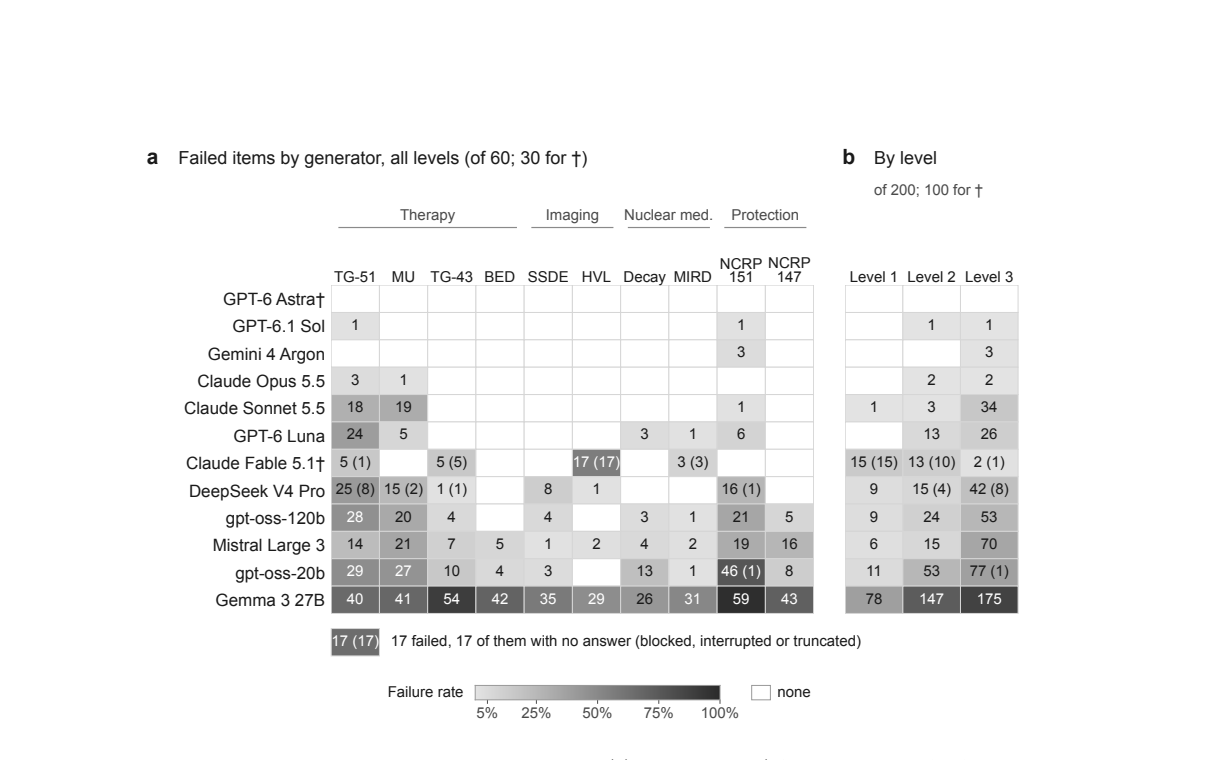
MedPhysBench has ten seeded generators of calculation items in radiation therapy, diagnostic imaging, nuclear medicine and radiation protection, up to clinical tasks such as a TG-51 calibration worksheet. Reference answers come from code implementing the governing protocols, and a grader converts units and applies tolerance bands. From the same inputs, separate checking items test error detection, showing a colleague's worksheet or only the colleague's result, half correct and half with one planted error. On a held-out test split of 1,200 items (half for two models), 12 models scored 33.3 to 100.0% on calculation. Of the nine answers graded incorrect for the four best (99.3-100.0%), five contained model errors and four followed NCRP Report 151 on points our items misstate or leave open. Below them, most models did worst on level-3 clinical tasks, and Claude Sonnet 5.5 omitted the inverse-square correction in 19 of 20 isocentric MU items. Five models detected at least 96.7% of mostly large planted errors with at most 4% false alarms; for four of the other seven, checking only the result raised false alarms significantly. In an exploratory targeted test with 20 public cases of an omitted inverse-square correction, the three best models tested caught it in every worksheet, and three weaker models accepted 16 to 18 of 20 planted worksheets, one of them while applying the correction in most of its own calculations. Claude Opus 5.5 accepted 6 of 20 wrong results, although it applied the correction in all 20 of its own. We report the effect of two problems in our shielding items, found after the runs, and release the code, per-item outcomes and targeted-test responses.
from the abstract
Pith says
Machine review · deepseek-v4-flash · 4 Nov 2026 · what was read was not recorded · not checked by a person
It can be wrong. Challenge this review or reply to it.
Holds up, with conditions. A well-built, unusually candid benchmark whose measured findings are useful and whose ground truth is anchored for only four of ten generators — which the author says outright. This line is wrong
2 major objections · 7 minor
How often objections from reviews like this one are right: not yet measured
Not checked: figures, code, what the 70 references say.
The paper says, at §4.1–4.2, Table 4, §8
The review did not quote this passage.
A classifier read this sentence of the paper as acknowledging the concern (probability 0.83):
“The other generators’ items have not been read against their documents in the same way.”
Pith says: Objection 1 of 2 · major
The external validation of the reference answers covers only four of the ten generators (TG-51, MU, NCRP 151, SSDE), and for TG-51 and SSDE only parts of the calculation (lead-foil coefficients and conversion factors). The remaining six generators (TG-43, BED/EQD2, HVL, Decay, MIRD, NCRP 147) have no published worked-example anchor, and the manuscript states that the items and reference answers have not been reviewed by medical physicists.
more of objection 1
The manuscript acknowledges this in §4.1 and §8, but the gap is load-bearing for the claim that reference answers come from code implementing the governing protocols and for the 99.3–100.0% ceiling: a specification error shared by the generator and the reference would be invisible, while a model that follows the document rather than the specification would be scored wrong. The NCRP 151 audit in §4.2 demonstrates that such errors occur and can move scores. Concrete request: for each of the six generators, identify and run a published worked example, table, or explicit equation set from the governing document or a secondary source; where no such anchor exists, obtain a blinded review by independent medical physicists of a stratified sample of items and report per-generator agreement. Until then, the Abstract, §6.1, and §10 should say 'within the benchmark's specification' and label the ceiling provisional.
The paper says, at §4.2, Table 6, Table 16, §6.1–6.2
The review did not quote this passage.
Pith says: Objection 2 of 2 · major
The level-3 NCRP 151 items knowingly grade a two-source rule that differs from NCRP 151 and leave the patient-scatter use factor unstated, so four of the nine ceiling misses are report-following answers rather than model errors. The manuscript is transparent about this and gives a regrade, but the primary Table 2 still counts those answers as errors and the released v1.0 test split retains the affected items; the regrade is secondary.
more of objection 2
The same ambiguity may contaminate the checking metrics: Table 6 lists 'NCRP 151 primary use factor U = 1/4 applied to leakage and scatter' as a named error mode, while §4.2 accepts that the report's worked examples use U = 1/4 for patient scatter at 30°, and the manuscript does not report how many NCRP 151 checking items plant this convention or whether a report-following verdict is scored as a miss. Because NCRP 151 is one of five checking generators, this is load-bearing for the detection and false-alarm claims. Concrete request: make the corrected or regraded analysis co-primary, report NCRP 151 checking results separately by error mode and by whether the planted error is defensible under the report, and either correct the affected items before the v1.0 scores are used in the headline claims or exclude them from confirmatory comparisons.
7 minor objections
The paper says, at Abstract, §7, §10
Pith says: minor objection 1 of 7
Phrases such as 'computed the quantities almost without error' and 'calculation ceiling' should be tied explicitly to the grader's tolerance band. §4.4 and Figure 5 show that omissions such as Ppol and Pelec are never rejected by final-answer grading, and §G shows a passing TG-51 answer with two offsetting errors; 'within tolerance' is the measured claim, while 'without error' is stronger than the instrument supports.
The paper says, at Abstract bullet and §6.1
Pith says: minor objection 2 of 7
GPT-6 Astra's 100.0% is on the 300-item stratified half, and its pairwise comparisons with the other ceiling models use only 300 shared items. The table marks this with †, but the abstract bullet should repeat it, and §6.1 should note that the failure to separate the four ceiling models is an absence of evidence at these sample sizes rather than evidence of equivalence.
show 5 more
The paper says, at §4.2 and Table 4
Pith says: minor objection 3 of 7
The text says the NCRP 151 code reproduced 'all 20 transmissions, numbers of tenth-value layers and barrier thicknesses in four examples' of IAEA SRS-47, while Table 4 shows 10 SRS-47 rows and omits the transmissions and TVL counts. Clarify which 20 quantities are meant and whether the omitted rows are in the release.
The paper says, at §5 and Table 15
Pith says: minor objection 4 of 7
Seven result-check items change the reported quantity, and the primary analysis includes them. The abstract's detection range and the 'five models at least 96.7%' claim should either use the excluding-them values or state that the range includes these seven items; Table 15 already gives the sensitivity.
The paper says, at §4.4 and Table 5
Pith says: minor objection 5 of 7
The TG-43 band was widened by hand from the derived 1% to 2%, and the bands set the ceiling. Add a short sensitivity table of the four ceiling models' calculation scores under the adjacent bands (for example 0.5%, 1%, and 2%) so readers can see whether the ceiling depends on the band choice.
The paper says, at References
Pith says: minor objection 6 of 7
References [26] and [28] are cited without a venue, and several benchmark references ([27], [32], [55], [57], [60], [63], [64]) are arXiv or preprint citations. Update publication status where available.
The paper says, at Running text and table headings
Pith says: minor objection 7 of 7
Typographical issues recur: 'W orksheet' and 'T able' appear with a space in the running text and table headings, and expressions such as '1/r law in place of1/r2' need spacing. These are cosmetic but should be corrected before publication.
What would settle it
Run the same document-versus-item audit that found the NCRP 151 discrepancy on a blinded sample of 10 level-3 items from each of the six unchecked generators (60 items total), with the NCRP 151 items included as a positive control. An independent medical physicist solves each item from the prompt under the cited protocol without seeing the stored reference or model outputs. For every generator-level cell where the independent answer differs from the reference by more than the item's band, regrade the four ceiling models on that cell and recompute their overall calculation scores. If no reference moves outside the band, the ceiling is externally anchored for the sample; if one does, report the revised ceiling and the affected items.
from the skeptic's reading
How the review went
4 readings by deepseek-v4-flash · 4 Nov 2026
- Reader holds up, with conditions
- Skeptic agrees
- Editor wrote the verdict above
- Referee major revision: 2 major objections, 7 minor
Not run on this paper: the simulated authors' defence.
Pith did not check this review's objections against the paper.
The review in full
The review in brief, machine-written
Two things worth knowing. First, the measured findings are real and specific: four models at 99.3–100% on the calculation split, Sonnet 5.5 skipping the isocentric inverse-square correction in 19 of 20 MU items, and the compute-versus-check asymmetry — Opus 5.5 applying the correction in all 20 of its own calculations and then accepting 6 of 20 wrong results that left it out. That last observation is the most useful thing in the paper, and no exam-question benchmark would have surfaced it.
Second, what is new is the instrument rather than a theory: ten seeded generators, reference answers from code, deterministic grading, secret test seeds with SHA-256 commitments, per-item release, exact intervals, Holm-adjusted McNemar. Verification is above par for this literature: 60,000-item cross-implementation agreement, published examples reproduced for TG-71, SRS-47, Report 204 and TG-51, a mutation analysis over 97 named error modes, and a constant-answer floor per cell.
The soft spot is the one the stress test names, and the author states it plainly (b330, b331). Ground truth rests on one specification implemented by one author with an AI coding assistant; the second implementation is written from the same specification, so it shows only that the code matches the spec, and only four of ten generators are anchored to published examples. The NCRP 151 defect makes that concrete: it accounts for four of the nine ceiling-model misses. So the 99.3–100% figure is a statement about MedPhysBench, and Section 8 says so, but the abstract invites the stronger reading. Related: the MU depth-dose tables are admitted to be physically wrong at shallow and large depths, so a perfect MU score means the model can invert a bad table, not that it can do a clinical MU calculation.
I would push back on one thing in the framing. The defect did not move the pairwise groups, the nine ceiling misses were read in full, and a spec error would have to be shared by reference and model to stay hidden. This is a disclosed limitation with a stated fix, not a load-bearing failure. The unaudited six generators cap how much weight the ceiling carries; they do not sink the paper.
Who it's for: anyone in the field weighing a model to draft or second-check calculations, and the eval crowd wanting a judge-free numeric benchmark with a real error-detection task.
Send it to review. Ask the referee to press on the six unanchored generators and on whether an outside party can re-derive the anchors — responses to test items aren't released (b353), so that matters. I'd cite it.
The strongest objection
The central claim is a measured statement about scores on MedPhysBench, so its load-bearing premise is that each reference answer implements the governing document. The paper is explicit that the generators, the second implementation and the specification were written from one specification, and that the second implementation shows only that the code computes what the specification says (Section 4.1). Published worked examples anchor four generators: TG-51, MU, NCRP 151 and SSDE (Table 4). The other six—TG-43, BED/EQD2, HVL, Decay, MIRD and NCRP 147—have no external anchor. This is not a hypothetical risk: reading NCRP Report 151 showed that the level-3 two-source rule in the items departs from the report and that the patient-scatter use factor is left open (Section 4.2). That defect accounts for four of the nine graded misses of the four ceiling models; accepting the report-following answers raises Gemini 4 Argon to 100.0% and GPT-6.1 Sol to 99.8% (Section 4.2, Table 16). The paper regrades only NCRP 151. For the six unchecked generators, no equivalent audit exists, and the ceiling models' passing answers were not read—only their nine failures were (Section 6.1). A specification error that the reference and a model share would therefore be invisible, and a specification error that a model does not share would count as a model error. The paper acknowledges this (Sections 4.1, 8) and plans review, but until the six generators are checked, the exact 99.3–100.0% ceiling is not externally anchored.
The paper is unusually well documented: ten seeded generators, a second implementation, 60,000 cross-checks, negative controls, exact intervals, Holm-adjusted paired tests, repeat runs for five models, and release of code and per-item outcomes. The checking half of the headline is comparatively well supported: the five strongest models' result-check detection remains 96.7–100% without worksheet cues, and the paper provides a no-calculation baseline of 37% at 5% false alarms (Section 6.2). The calculation half is where the soft spot lies. The reference answers are the instrument, and the instrument has been checked against published documents for only four of ten generators. The NCRP 151 episode is the proof of concept that this check matters: the specification was wrong on a convention, four of nine ceiling misses were report-following answers, and the regrade moved scores (Section 4.2). The paper discloses the limitation and plans a blinded physicist review, but the six unchecked generators remain unquantified. The reader's weakest_assumption identifies exactly this point, so I agree. I would keep CONDITIONAL rather than ACCEPT: the empirical findings are credible as benchmark results, but the exact ceiling and the attribution of errors are not yet anchored to the governing documents across the full generator set. The proposed blind audit with regrading would settle whether the concern lands; if the six generators' references hold, the paper's main claim is well supported.
The referee's report
If the reference answers are valid, the benchmark fills a real gap: free-response numerical medical physics calculations with unit-aware, judge-free grading and paired error-detection tasks. The verification effort is above the norm for an LLM benchmark: a second implementation agreeing to 1.3e-15 over 60,000 draws, published worked examples for four generators, a mutation and sensitivity analysis of 97 named error modes, deterministic grading, released code and per-item outcomes, SHA-256 commitments, and falsifiable model-level findings. The NCRP 151 audit and the targeted inverse-square test are exemplary in their transparency. The central caveat is that the instrument's validity rests on a specification written by the author, and the manuscript itself shows that such a specification can depart from the governing document.
Pith's reading of the paper (a machine's summary, not the authors')
Medical physicists compute the numbers that turn a prescription into a delivered dose, and they check each other's numbers, because a calibration slip or an omitted correction propagates to every patient treated on that beam. MedPhysBench asks whether a language model can do both: compute clinical quantities from printed inputs (a TG-51 absorbed dose, monitor units for a blocked and wedged isocentric field, a brachytherapy dwell time, a CT patient dose, a vault barrier thickness), and catch an error in a colleague's version of the same calculation. The author builds ten seeded generators, computes every reference answer with code that implements the governing protocol, and grades with unit conversion and a tolerance band derived from the items themselves, so neither a human rater nor a model judge sits in the loop. From one parameter draw the benchmark builds three items — the calculation, a check of a colleague's worksheet, and a check of the colleague's bare result — which lets it compare a model's own arithmetic against its verdict on someone else's arithmetic over identical numbers. On 1,200 held-out items the answer is that calculation is close to solved for the strongest models and checking is not: four models land within tolerance on at least $99.3\%$ of calculations, five catch at least $96.7\%$ of planted errors with at most $4\%$ false alarms, and for several weaker checkers seeing only the result rather than the working raises false alarms without improving discrimination.
What carries the argument. The load-bearing device is the three-item construction from a single parameter draw. Each of the ten seeded generators samples a clinical scenario, rounds every input to the precision at which it is printed, and computes the reference answer with code implementing the governing document — AAPM TG-51 for photon calibration, TG-71 for monitor units, TG-43U1 for brachytherapy, the MIRD schema for organ dose, NCRP 151 and 147 for shielding, and so on. Because the same draw also produces a colleague's worksheet and the colleague's bare result — half correct, half carrying exactly one planted error chosen from a catalogue of 97 named error modes written before any pilot run — the benchmark measures computing and checking on identical numbers and can compare a model's own answer with its verdict on a colleague's. Two further pieces carry weight. The tolerance band is derived empirically per generator: every decimal input is perturbed by up to $\pm 0.05\%$, the 99th percentile of the resulting change in the answer is taken, final-answer rounding is added, and the tightest value in $\{0.2, 0.5, 1, 2, 5\}\%$ that covers the sum is chosen. The grader is deterministic: it reads the last boxed expression, normalizes LaTeX and Unicode, converts units with pint, and passes an answer only inside the band.
Core claim. The claim is a two-part measurement made with one instrument. First, given every input, frontier models compute clinical medical physics quantities essentially without error: on 600 test items, GPT-6 Astra reached $100.0\%$ within tolerance, GPT-6.1 Sol $99.7\%$, Gemini 4 Argon $99.5\%$ and Claude Opus 5.5 $99.3\%$. The author read all nine graded-incorrect answers of these four in full and found five genuine model errors (three tenfold decimal slips in a TG-51 dose, one omitted isocentric inverse-square correction, one 20 °C reference temperature where TG-51 specifies 22 °C) and four that followed NCRP Report 151 on two points where the items misstate the report or leave a factor open — a defect of the items, not of the models. Second, checking is not simply a read-out of calculating. Five models flag at least $96.7\%$ of planted errors with at most $4\%$ false alarms in both formats, but a checker that does no calculation at all already flags $37\%$ at a $5\%$ false-alarm rate, and most planted errors were large ($85\%$ moved the result by $5\%$ or more). For four of the other seven models, showing only the colleague's result rather than the worksheet significantly raised false alarms, and in result checks essentially all of those alarms came with a corrected value outside the band, so acting on one would have replaced a correct number with a wrong one. The sharpest evidence is a targeted test of a single error: Claude Opus 5.5 applied the isocentric inverse-square correction in all 20 of its own calculations and still accepted 6 of 20 wrong results that omitted it, while Claude Sonnet 5.5, which omitted the correction in 20 of 20 of its own isocentric calculations, accepted all 20 of the wrong results.
The premise it rests on. The load-bearing premise is that the author's written specification, and therefore the code that produces every reference answer, faithfully implements the governing protocols; agreement between two independent implementations shows only that both compute what the specification says, and published worked examples were reproduced for four of the ten generators.
If the paper is right (Pith's inferences, not the authors')
Calculation is saturated for the four strongest models, so the remaining headroom lies outside what this version measures: inputs that must be found in a clinical record, data a model must look up, checks of work with more than one error, and checks of treatment plans.
Aggregate accuracy hides systematic failures: Claude Sonnet 5.5's $93.7\%$ overall includes an error it made in 19 of 20 isocentric monitor-unit items, which would have delivered 3.0 to 6.5 percent more dose than prescribed on every isocentric field, so a department should test a model on its own clinical task forms rather than trust a headline score.
A result-only check is a weak second reader for several models: it raised false alarms without improving discrimination, and the alarms carried wrong corrections, so acting on one would have introduced the error it was meant to catch.
Detection figures are measured against a low baseline, since a rule that flags any result outside the central 95 percent of correct values for its generator and level already catches 37 percent of these mostly large planted errors.
Correcting the shielding items to follow NCRP Report 151 rather than the stated rule would raise six models' calculation scores, taking Gemini 4 Argon to $100.0\%$, without changing which models the pairwise tests separate.
The gap between computing and checking looks like a distinct phenomenon rather than noise, and it is directly testable: ask a model to compute the item first and judge the planted result second, then check whether its verdict tracks its own arithmetic. The paper's own Opus 5.5 case — correction applied in 20 of 20 of its own calculations, accepted in 6 of 20 results — is the natural place to look.
The worksheet format may be partly earned by surface cues rather than physics. The author's own audit finds that a rule flagging worksheets shorter than 99 percent of correct ones for their cell would catch 38 percent of planted errors at under 2 percent false alarms, which suggests the worksheet-check accuracy of weaker models could be inflated relative to the result check that carries no such cu
The reusable contribution is the generator-plus-secret-seed design: a code reference, a documented tolerance band, and a key that yields a fresh split mean the same environment can be regenerated, hidden from training corpora, and used as a reinforcement-learning reward. That pattern transfers to any domain where a written protocol fixes the computation, from clinical dosimetry to metrology and sh
The paper's most deployment-relevant number is buried in a hypothetical: at a 1 percent real error rate, at most 9 percent of the weaker models' result-check alarms would point at a real error. In a clinic the errors are rarer and smaller than the planted ones, which pushes the predictive value of an alarm lower still — worth stating explicitly in any adoption argument.
Check this review
Pith stored no record of this review's passes and took no fingerprint of it. Reviews made by code from 13 Nov 2026 on carry both.
How often reviews like this one are right
Reviews like this one: written by deepseek-v4-flash, where what was read was not recorded.
How often objections from reviews like this one are right: not yet measured
Reviews by people
This review was written by a machine. No person has reviewed this paper on Pith yet. A scientist listed on Pith can review it for a fee, and their review is published here whatever it concludes.
The paper
Abstract
Medical physicists turn a prescription into a delivered dose and check one another's calculations, because one error in a beam calibration or a monitor-unit (MU) calculation can affect every patient treated with it. MedPhysBench has ten seeded generators of calculation items in radiation therapy, diagnostic imaging, nuclear medicine and radiation protection, up to clinical tasks such as a TG-51 calibration worksheet. Reference answers come from code implementing the governing protocols, and a grader converts units and applies tolerance bands. From the same inputs, separate checking items test error detection, showing a colleague's worksheet or only the colleague's result, half correct and half with one planted error. On a held-out test split of 1,200 items (half for two models), 12 models scored 33.3 to 100.0% on calculation. Of the nine answers graded incorrect for the four best (99.3-100.0%), five contained model errors and four followed NCRP Report 151 on points our items misstate or leave open. Below them, most models did worst on level-3 clinical tasks, and Claude Sonnet 5.5 omitted the inverse-square correction in 19 of 20 isocentric MU items. Five models detected at least 96.7% of mostly large planted errors with at most 4% false alarms; for four of the other seven, checking only the result raised false alarms significantly. In an exploratory targeted test with 20 public cases of an omitted inverse-square correction, the three best models tested caught it in every worksheet, and three weaker models accepted 16 to 18 of 20 planted worksheets, one of them while applying the correction in most of its own calculations. Claude Opus 5.5 accepted 6 of 20 wrong results, although it applied the correction in all 20 of its own. We report the effect of two problems in our shielding items, found after the runs, and release the code, per-item outcomes and targeted-test responses.
The paper's own sentences, arranged, kept beside the review and separate from it. Each label is drawn from a closed vocabulary; the number beside it is the probability the classifier gave that label. No sentence in this record was written by a model.
abstract compiled · 2026-11-04
The authors' main claim, as the classifier picked it out 0.37
“On a held-out test split of 1,200 items (half for two models), 12 models scored 33.3 to 100.0% on calculation.”
How the main claim is stated: asserted 1.00
What the abstract itself states, as probabilities: claims first 0.06 · states limitation 0.93 · human participants 0.16 · controlled comparison 0.16 · randomized assignment 0.12 · states quantitative result 0.99 · compares with prior results 0.31 · mentions code or data availability 0.98
The abstract, sentence by sentence
This table labels the abstract only (arXiv listing abstract v1). The number is the probability the classifier gave the label.
| Sentence | Role | The authors' own work | States the main conclusion | Strength |
|---|---|---|---|---|
| Medical physicists turn a prescription into a delivered dose and check one another's calculations, because one error in a beam calibration or a monitor-unit (MU) calculation can affect every patient treated with it. | background 1.00 | 0.05 | 0.02 | asserted 0.97 |
| MedPhysBench has ten seeded generators of calculation items in radiation therapy, diagnostic imaging, nuclear medicine and radiation protection, up to clinical tasks such as a TG-51 calibration worksheet. | method 0.53 | 0.84 | 0.04 | asserted 1.00 |
| Reference answers come from code implementing the governing protocols, and a grader converts units and applies tolerance bands. | method 1.00 | 0.81 | 0.03 | asserted 1.00 |
| From the same inputs, separate checking items test error detection, showing a colleague's worksheet or only the colleague's result, half correct and half with one planted error. | method 0.97 | 0.89 | 0.03 | asserted 0.98 |
| On a held-out test split of 1,200 items (half for two models), 12 models scored 33.3 to 100.0% on calculation. | result 0.99 | 0.95 | 0.14 | asserted 1.00 |
| Of the nine answers graded incorrect for the four best (99.3-100.0%), five contained model errors and four followed NCRP Report 151 on points our items misstate or leave open. | result 0.86 | 0.91 | 0.14 | asserted 0.99 |
| Below them, most models did worst on level-3 clinical tasks, and Claude Sonnet 5.5 omitted the inverse-square correction in 19 of 20 isocentric MU items. | result 1.00 | 0.93 | 0.12 | asserted 1.00 |
| Five models detected at least 96.7% of mostly large planted errors with at most 4% false alarms; for four of the other seven, checking only the result raised false alarms significantly. | result 1.00 | 0.94 | 0.13 | asserted 1.00 |
| In an exploratory targeted test with 20 public cases of an omitted inverse-square correction, the three best models tested caught it in every worksheet, and three weaker models accepted 16 to 18 of 20 planted worksheets, one of them while applying the correction in most of its own calculations. | result 0.96 | 0.95 | 0.10 | asserted 1.00 |
| Claude Opus 5.5 accepted 6 of 20 wrong results, although it applied the correction in all 20 of its own. | result 1.00 | 0.92 | 0.04 | asserted 1.00 |
| We report the effect of two problems in our shielding items, found after the runs, and release the code, per-item outcomes and targeted-test responses. | contribution 0.57 | 0.95 | 0.05 | asserted 1.00 |
What kind of paper the classifier reports this is: dataset or benchmark 1.00 · evidence from observation or experiment 0.72
What was examined, and what was not
Sources read
- arXiv listing abstract v1
Not examined
- full text
- figures and tables
- references and citing sentences
- relations to other papers
Levels run
- P abstract
Not run
- S sections
- T body sentences
- C citations
- R cross-paper relations
How the labels were made
Compiled by classifier-1.13.0 via TypeSafe API, question bank abstract-p1-20260923, 2026-11-04: 1 request, 8,542 input tokens.
Every quoted sentence on this record is the authors'. Every label is from Pith's closed vocabulary, with the probability shown beside it. This record as JSON
Figures (9)




Figures are the authors', reproduced from the paper.
References (70)
- [1] Ergun E. Ahunbay, Ying Zhang, Xiaojian Chen, Xinfeng Chen, Eenas Omari, and Eric S. Paul- son. Interactive large language model-assistant for flexible workflow automation in radiotherapy. Machine Learning: Health, 2026. doi: 10.1088/3049-477X/ae3c18 on Pithdoi:10.1088/3049-477x/ae3c18
- [2] Peter R. Almond, Peter J. Biggs, Bert M. Coursey, William F. Hanson, M. Saiful Huq, Ravinder Nath, and D. W. O. Rogers. AAPM’s TG-51 protocol for clinical reference dosimetry of high-energy photon and electron beams.Medical Physics, 26(9):1847–1870, 1999. doi: 10.1118/1.598691 on Pithdoi:10.1118/1.598691
- [3] Benjamin R. Archer, John I. Thornby, and Stewart C. Bushong. Diagnostic x-ray shielding design based on an empirical model of photon attenuation.Health Physics, 44(5):507–517, 1983. doi: 10.1097/00004032-198305000-00005 on Pithdoi:10.1097/00004032-198305000-00005
- [4] Rifat Atun, David A. Jaffray, Michael B. Barton, Freddie Bray, Michael Baumann, Bhadrasain Vikram, Timothy P. Hanna, Felicia M. Knaul, Yolande Lievens, Tracey Y. M. Lui, Michael Milosevic, Brian O’Sullivan, Danielle L. Rodin, Eduardo Rosenblatt, Jacob Van Dyk, Mei Ling Yap, Ed... on Pithdoi:10.1016/s1470-2045(15)00222-3
- [5] Asma Ben Abacha, Wen-wai Yim, Yujuan Fu, et al. MEDEC: A benchmark for medical error detection and correction in clinical notes. InFindings of the Association for Computational Linguistics: ACL 2025, pages 22539–22550, 2025. doi: 10.18653/v1/2025.findings-acl.1159 on Pithdoi:10.18653/v1/2025.findings-acl.1159
- [6] Søren M. Bentzen, Wolfgang Dörr, Reinhard Gahbauer, et al. Bioeffect modeling and equieffec- tive dose concepts in radiation oncology: Terminology, quantities and units.Radiotherapy and Oncology, 105(2):266–268, 2012. doi: 10.1016/j.radonc.2012.10.006 on Pithdoi:10.1016/j.radonc.2012.10.006
- [7] Avinav Bharati, Deepsekhar Das, Susama Rani Mandal, et al. Applicability of artificial intelligence-enabled chatbots in medical physics.Cureus, 18(6):e110649, 2026. doi: 10.7759/ cureus.110649 on Pith
- [8] Wesley E. Bolch, Keith F. Eckerman, George Sgouros, and Stephen R. Thomas. MIRD Pamphlet No. 21: A generalized schema for radiopharmaceutical dosimetry—standardization of nomenclature.Journal of Nuclear Medicine, 50(3):477–484, 2009. doi: 10.2967/jnumed.108. 056036 on Pithdoi:10.2967/jnumed.108
- [9] John M. Boone, Keith J. Strauss, Dianna D. Cody, Cynthia H. McCollough, Michael F. McNitt- Gray, Marilyn J. Goske, and Donald P. Frush. Size-specific dose estimates (SSDE) in pediatric and adult body CT examinations. AAPM Report 204, American Association of Physicists in Medic... on Pith
- [10] C. J. Clopper and E. S. Pearson. The use of confidence or fiducial limits illustrated in the case of the binomial.Biometrika, 26(4):404–413, 1934. doi: 10.1093/biomet/26.4.404. 21 on Pithdoi:10.1093/biomet/26.4.404
- [11] Indra J. Das, Chee-Wai Cheng, Ronald J. Watts, Anders Ahnesjö, John Gibbons, X. Allen Li, Jessica Lowenstein, Raj K. Mitra, William E. Simon, and Timothy C. Zhu. Accelerator beam data commissioning equipment and procedures: Report of the TG-106 of the Therapy Physics Committee... on Pithdoi:10.1118/1.2969070
- [12] Eric Ford, Leigh Conroy, Lei Dong, Luis Fong de los Santos, Anne Greener, Grace Gwe-Ya Kim, Jennifer Johnson, Perry Johnson, James G. Mechalakos, Brian Napolitano, Stephanie Parker, Deborah Schofield, Koren Smith, Ellen Yorke, and Michelle Wells. Strategies for effective physi... on Pithdoi:10.1002/mp.14030
- [13] J. F. Fowler. The linear-quadratic formula and progress in fractionated radiotherapy.British Journal of Radiology, 62(740):679–694, 1989. doi: 10.1259/0007-1285-62-740-679 on Pithdoi:10.1259/0007-1285-62-740-679
- [14] Timnit Gebru, Jamie Morgenstern, Briana Vecchione, Jennifer Wortman Vaughan, Hanna Wallach, Hal Daumé III, and Kate Crawford. Datasheets for datasets.Communications of the ACM, 64(12):86–92, 2021. doi: 10.1145/3458723 on Pithdoi:10.1145/3458723
- [15] John P. Gibbons, John A. Antolak, David S. Followill, et al. Monitor unit calculations for external photon and electron beams: Report of the AAPM therapy physics committee task group no. 71.Medical Physics, 41(3):031501, 2014. doi: 10.1118/1.4864244 on Pithdoi:10.1118/1.4864244
- [16] Kate Goddard, Abdul Roudsari, and Jeremy C. Wyatt. Automation bias: a systematic review of frequency, effect mediators, and mitigators.Journal of the American Medical Informatics Association, 19(1):121–127, 2012. doi: 10.1136/amiajnl-2011-000089 on Pithdoi:10.1136/amiajnl-2011-000089
- [17] Olga Gopan, Jing Zeng, Avrey Novak, Matthew Nyflot, and Eric Ford. The effectiveness of pretreatment physics plan review for detecting errors in radiation therapy.Medical Physics, 43 (9):5181–5187, 2016. doi: 10.1118/1.4961010 on Pithdoi:10.1118/1.4961010
- [18] Sture Holm. A simple sequentially rejective multiple test procedure.Scandinavian Journal of Statistics, 6(2):65–70, 1979 on Pith
- [19] Ola Holmberg. Accident prevention in radiotherapy.Biomedical Imaging and Intervention Journal, 3(2):e27, 2007. doi: 10.2349/biij.3.2.e27 on Pithdoi:10.2349/biij.3.2.e27
- [20] Jason Holmes, Zhengliang Liu, Lian Zhang, Yuzhen Ding, Terence T. Sio, Lisa A. McGee, Jonathan B. Ashman, Xiang Li, Tianming Liu, Jiajian Shen, and Wei Liu. Evaluating large language models on a highly-specialized topic, radiation oncology physics.Frontiers in Oncology, 13:121... on Pithdoi:10.3389/fonc.2023.1219326
show 50 more
- [21] Jason Holmes, Lian Zhang, Yuzhen Ding, et al. Benchmarking a foundation large language model on its ability to relabel structure names in accordance with the American Association of Physicists in Medicine Task Group-263 report.Practical Radiation Oncology, 14(6):e515–e521, on Pith
- [22] International Atomic Energy Agency.Absorbed Dose Determination in External Beam Ra- diotherapy: An International Code of Practice for Dosimetry Based on Standards of Absorbed Dose to Water. Technical Reports Series No. 398. IAEA, Vienna, 2000 on Pith
- [23] International Atomic Energy Agency. Radiation protection in the design of radiotherapy facilities. Safety Reports Series 47, IAEA, Vienna, 2006. URLhttps://www-pub.iaea.org/ MTCD/Publications/PDF/Pub1223_web.pdf. 22 on Pith
- [24] International Commission on Radiological Protection. Case histories of major accidental exposures in radiotherapy.Annals of the ICRP, 30(3):23–29, 2000. doi: 10.1016/S0146-6453(01) 00039-2. In: Prevention of accidental exposures to patients undergoing radiation therapy, ICRP P... on Pithdoi:10.1016/s0146-6453(01
- [25] Noriyuki Kadoya, Kazuhiro Arai, Shohei Tanaka, Yuto Kimura, Ryota Tozuka, Keisuke Yasui, N. Hayashi, Yoshiyuki Katsuta, Haruna Takahashi, Koki Inoue, and Keiichi Jingu. Assessing knowledge about medical physics in language-generative AI with large language model: Using the med... on Pithdoi:10.1007/s12194-024-00838-2
- [26] Ryo Kamoi, Sarkar Snigdha Sarathi Das, Renze Lou, Jihyun Janice Ahn, Yilun Zhao, Xiaoxin Lu, Yusen Zhang, Ranran Haoran Zhang, Sujeeth Reddy Vummanthala, Salika Dave, Shaobo Qin, Arman Cohan, Wenpeng Yin, and Rui Zhang. Evaluating LLMs at detecting errors in LLM responses, 2024 on Pith
- [27] Nikhil Khandekar, Qiao Jin, Guangzhi Xiong, et al. MedCalc-Bench: Evaluating large language models for medical calculations. arXiv:2406.12036, 2024 on PithPith's reviewarXiv
- [28] Xiang Lisa Li, Vaishnavi Shrivastava, Siyan Li, Tatsunori Hashimoto, and Percy Liang. Bench- marking and improving generator-validator consistency of language models, 2023 on Pith
- [29] Mark T. Madsen, Jon A. Anderson, James R. Halama, Jeff Kleck, Douglas J. Simpkin, John R. Votaw, Richard E. Wendt, Lawrence E. Williams, and Michael V. Yester. AAPM Task Group 108: PET and PET/CT shielding requirements.Medical Physics, 33(1):4–15, 2006. doi: 10.1118/1.2135911.... on Pithdoi:10.1118/1.2135911
- [30] Geetha Mahadevaiah, Prasad Rv, Iñigo Bermejo, et al. Artificial intelligence-based clinical decision support in modern medical physics: Selection, acceptance, commissioning, and quality assurance.Medical Physics, 47(5), 2020. doi: 10.1002/mp.13562 on Pithdoi:10.1002/mp.13562
- [31] Nathan Mantel and William Haenszel. Statistical aspects of the analysis of data from retro- spective studies of disease.Journal of the National Cancer Institute, 22(4):719–748, 1959. doi: 10.1093/jnci/22.4.719 on Pithdoi:10.1093/jnci/22.4.719
- [32] Kangkun Mao, Jiayuan Chen, Ruiyao Chen, et al. MedCalc-Eval and MedCalc-Env: Advancing medical calculation capabilities of large language models. arXiv:2510.27267, 2025 on PitharXiv
- [33] Cynthia H. McCollough, Donovan Bakalyar, Maryam Bostani, Samuel L. Brady, Kristen Boedeker, John M. Boone, Huaiyu H. Chen-Mayer, Olav I. Christianson, Shuai Leng, Michael F. McNitt-Gray, Mark P. Supanich, and Jia Wang. Use of water equivalent diameter for calculating patient s... on Pith
- [34] Quinn McNemar. Note on the sampling error of the difference between correlated proportions or percentages.Psychometrika, 12(2):153–157, 1947. doi: 10.1007/BF02295996 on Pithdoi:10.1007/bf02295996
- [35] Evan Miller. Adding error bars to evals: A statistical approach to language model evaluations. arXiv:2411.00640, 2024 on PithPith's reviewarXiv
- [36] Iman Mirzadeh, Keivan Alizadeh, Hooman Shahrokhi, Oncel Tuzel, Samy Bengio, and Mehrdad Farajtabar. GSM-Symbolic: Understanding the limitations of mathematical reasoning in large language models. arXiv:2410.05229, 2024. 23 on PithPith's reviewarXiv
- [37] Bryan Muir, Stephen Davis, et al. AAPM WGTG51 Report 385: Addendum to the AAPM’s TG-51 protocol for clinical reference dosimetry of high-energy electron beams.Medical Physics, 51(9):5840–5857, 2024. doi: 10.1002/mp.17277 on Pithdoi:10.1002/mp.17277
- [38] Saurabh S. Nair, Laurence Court, Raphael Douglas, et al. Use of large language models to enhance failure mode and effects analysis: A case study.Advances in Radiation Oncology, 11 (8):102060, 2026. doi: 10.1016/j.adro.2026.102060 on Pithdoi:10.1016/j.adro.2026.102060
- [39] National Council on Radiation Protection and Measurements.Structural Shielding Design for Medical X-Ray Imaging Facilities. NCRP Report No. 147. NCRP, Bethesda, MD, 2004 on Pith
- [40] National Council on Radiation Protection and Measurements.Structural Shielding Design and Evaluation for Megavoltage X- and Gamma-Ray Radiotherapy Facilities. NCRP Report No. 151. NCRP, Bethesda, MD, 2005 on Pith
- [41] Robert G. Newcombe. Interval estimation for the difference between independent proportions: comparison of eleven methods.Statistics in Medicine, 17(8):873–890, 1998. doi: 10.1002/(SICI) 1097-0258(19980430)17:8<873::AID-SIM779>3.0.CO;2-I on Pithdoi:10.1002/(sici
- [42] Robert G. Newcombe. Improved confidence intervals for the difference between binomial proportions based on paired data.Statistics in Medicine, 17(22):2635–2650, 1998. doi: 10.1002/ (SICI)1097-0258(19981130)17:22<2635::AID-SIM954>3.0.CO;2-C on Pith
- [43] Stanley A. Norris, Tomas Kron, Maeve Masterson, and Mohamed K. Badawy. An Australasian survey on the use of ChatGPT and other large language models in medical physics.Physical and Engineering Sciences in Medicine, 48(3):1145–1153, 2025. doi: 10.1007/s13246-025-01571-9 on Pithdoi:10.1007/s13246-025-01571-9
- [44] Humza Nusrat and Kundan Thind. OpenGray: A benchmark for evaluating the decisions of radiotherapy planning agents. arXiv:2610.37081, 2026 on PithPith's reviewarXiv
- [45] Hans-Peter Piepho. An algorithm for a letter-based representation of all-pairwise com- parisons.Journal of Computational and Graphical Statistics, 13(2):456–466, 2004. doi: 10.1198/1061860043515 on Pithdoi:10.1198/1061860043515
- [46] Pint developers. Pint: Physical quantities and units in Python.https://github.com/hgrecco/ pint, 2026. Version 0.25.3 on Pith
- [47] Prime Intellect. verifiers: Environments for LLM evaluation and reinforcement learning. https://github.com/PrimeIntellect-ai/verifiers, 2026. Version 0.2.0 on Pith
- [48] Mark J. Rivard, Bert M. Coursey, Larry A. DeWerd, William F. Hanson, M. Saiful Huq, Geoffrey S. Ibbott, Michael G. Mitch, Ravinder Nath, and Jeffrey F. Williamson. Update of AAPM Task Group No. 43 Report: A revised AAPM protocol for brachytherapy dose calculations.Medical Phys... on Pithdoi:10.1118/1.1646040
- [49] Robin L. Stern, Robert Heaton, Martin W. Fraser, S. Murty Goddu, Thomas H. Kirby, Kwok Leung Lam, Andrea Molineu, and Timothy C. Zhu. Verification of monitor unit calculations for non-IMRT clinical radiotherapy: Report of AAPM Task Group 114.Medical Physics, 38(1):504–530, 201... on Pithdoi:10.1118/1.3521473
- [50] Slavik Tabakov and Magdalena Stoeva. Collaborative networking and support for medical physics development in low and middle income (LMI) countries.Health and Technology, 11(5): 963–969, 2021. doi: 10.1007/s12553-021-00591-1. 24 on Pithdoi:10.1007/s12553-021-00591-1
- [51] Gladys Tyen, Hassan Mansoor, Victor Cărbune, et al. LLMs cannot find reasoning errors, but can correct them given the error location. InFindings of the Association for Computational Linguistics: ACL 2024, pages 13894–13908, 2024. doi: 10.18653/v1/2024.findings-acl.826 on Pithdoi:10.18653/v1/2024.findings-acl.826
- [52] Liesbeth Vandewinckele, Michaël Claessens, Anna M. Dinkla, et al. Overview of artificial intelligence-based applications in radiotherapy: Recommendations for implementation and quality assurance.Radiotherapy and Oncology, 153:55–66, 2020. doi: 10.1016/j.radonc.2020.09. 008 on Pithdoi:10.1016/j.radonc.2020.09
- [53] Dongzhao Wang, Zeyun Hu, Yang Li, Dachuan Xu, Ruijie Yang, and Changjing Zhuge. MARTP: A multi-agent simulation framework for automated radiation therapy planning based on LLMs. Physics in Medicine and Biology, 2026. doi: 10.1088/1361-6560/ae6af6 on Pithdoi:10.1088/1361-6560/ae6af6
- [54] Peilong Wang, Jason Holmes, Zhengliang Liu, et al. A recent evaluation on the performance of LLMs on radiation oncology physics using questions of randomly shuffled options.Frontiers in Oncology, 15:1557064, 2025. doi: 10.3389/fonc.2025.1557064 on Pithdoi:10.3389/fonc.2025.1557064
- [55] Xiaoxuan Wang, Ziniu Hu, et al. SciBench: Evaluating college-level scientific problem-solving abilities of large language models. arXiv:2307.10635, 2023 on PithPith's reviewarXiv
- [56] Shuoyang Wei, Zhiqun Wang, Xiangyin Meng, Lang Yu, Bo Yang, and Jie Qiu. RTPhy-ChatBot: A RAG-based intelligent assistant for radiotherapy physics using LLaMA3 and AAPM reports. Journal of Applied Clinical Medical Physics, 2025. doi: 10.1002/acm2.70263 on Pithdoi:10.1002/acm2.70263
- [57] Colin White, Samuel Dooley, Manley Roberts, Arka Pal, Ben Feuer, et al. LiveBench: A challenging, contamination-limited LLM benchmark. arXiv:2406.19314, 2024 on PithPith's reviewarXiv
- [58] Edwin B. Wilson. Probable inference, the law of succession, and statistical inference.Journal of the American Statistical Association, 22(158):209–212, 1927. doi: 10.1080/01621459.1927. 10502953 on Pithdoi:10.1080/01621459.1927
- [59] Kayvon Yazdanbakhsh, Golnaz Lotfian, Keyur Parekh, Sumeet Virmani, Alex Tegeler, and Pokhraj P. Suthar. Evaluating ChatGPT 4.0 as a tool for nuclear medicine board preparation. Cureus, 2025. doi: 10.7759/cureus.92721 on Pithdoi:10.7759/cureus.92721
- [60] Junze Ye, Daniel Tawfik, Alex J. Goodell, Nikhil V. Kotha, Mark K. Buyyounouski, and Mohsen Bayati. Scalable stewardship of an LLM-assisted clinical benchmark with physician oversight. arXiv:2512.19691, 2025 on PithPith's reviewarXiv
- [61] W. J. Youden. Index for rating diagnostic tests.Cancer, 3(1):32–35, 1950. doi: 10.1002/ 1097-0142(1950)3:1<32::AID-CNCR2820030106>3.0.CO;2-3 on Pith
- [62] Yeochan Youn, Joseph B. Schulz, Ethan D. Stolen, et al. Linear accelerator (linac) downtime analysis assisted with a large language model (LLM).Journal of Applied Clinical Medical Physics, 26(12), 2025. doi: 10.1002/acm2.70400 on Pithdoi:10.1002/acm2.70400
- [63] Hugh Zhang, Jeff Da, et al. A careful examination of large language model performance on grade school arithmetic. arXiv:2405.00332, 2024 on PithPith's reviewarXiv
- [64] Chujie Zheng, Zhenru Zhang, Beichen Zhang, Runji Lin, Keming Lu, Bowen Yu, Dayiheng Liu, Jingren Zhou, and Junyang Lin. ProcessBench: Identifying process errors in mathematical reasoning. InProceedings of the 63rd Annual Meeting of the Association for Computational Linguistics... on Pithdoi:10.18653/v1/2025.acl-long.50
- [65] Heling Zhu, Yongguang Liang, Xinyu Long, Yanchen Liu, Tingtian Pang, Wenbo Li, Bo Yang, and Lin Yao. Benchmarking large language models on a Chinese radiation oncology technology examination-preparation question set: Accuracy, consensus, and efficiency for AI assisted educatio... on Pithdoi:10.3389/fonc.2026.1946351
- [66] Kaijie Zhu, Jiaao Chen, Jindong Wang, Neil Zhenqiang Gong, Diyi Yang, and Xing Xie. DyVal: Dynamic evaluation of large language models for reasoning tasks. arXiv:2309.17167, 2023 on PithPith's reviewarXiv
- [67] Timothy C. Zhu, Sotirios Stathakis, et al. Report of AAPM Task Group 219 on independent calculation-based dose/MU verification for IMRT.Medical Physics, 48(10):e808–e829, 2021. doi: 10.1002/mp.15069 on Pithdoi:10.1002/mp.15069
- [68] Guangyong Zou and Allan Donner. Construction of confidence limits about effect measures: a general approach.Statistics in Medicine, 27(10):1693–1702, 2008. doi: 10.1002/sim.3095. 26 A Generator specifications T able 3:What each level asks. “Not stated”: the formula or conventi... on Pithdoi:10.1002/sim.3095
- [220] AAPM Report 220, American Association of Physicists in Medicine, 2014 on Pith
- [2024] doi: 10.1016/j.prro.2024.04.017 on Pithdoi:10.1016/j.prro.2024.04.017
Challenges and discussion
Disagree with the review, or know something it missed? Leave a comment, or challenge this review formally: a challenge becomes a permanent entry in this paper's record, and its decision is published here.
Come back by email
A short list of the week's newly reviewed papers. Nothing is sent until you confirm from your inbox, and every email has a link that stops it. No account.
No comments yet.
Sign in to comment