Machine Learning · arXiv:2611.29513 v1 · submitted 22 Nov 2026 · 51 references
Recursive Self-Editing: LLMs Program Their Own Weight Edits for Self-Improvement
The paper says
“Recursive self-improvement asks a system to improve the very system that improves it. Today's language models improve themselves through data, training recipes or scaffolds. Whenever their weights change, gradient descent writes the update, not the model.”
more of the abstract
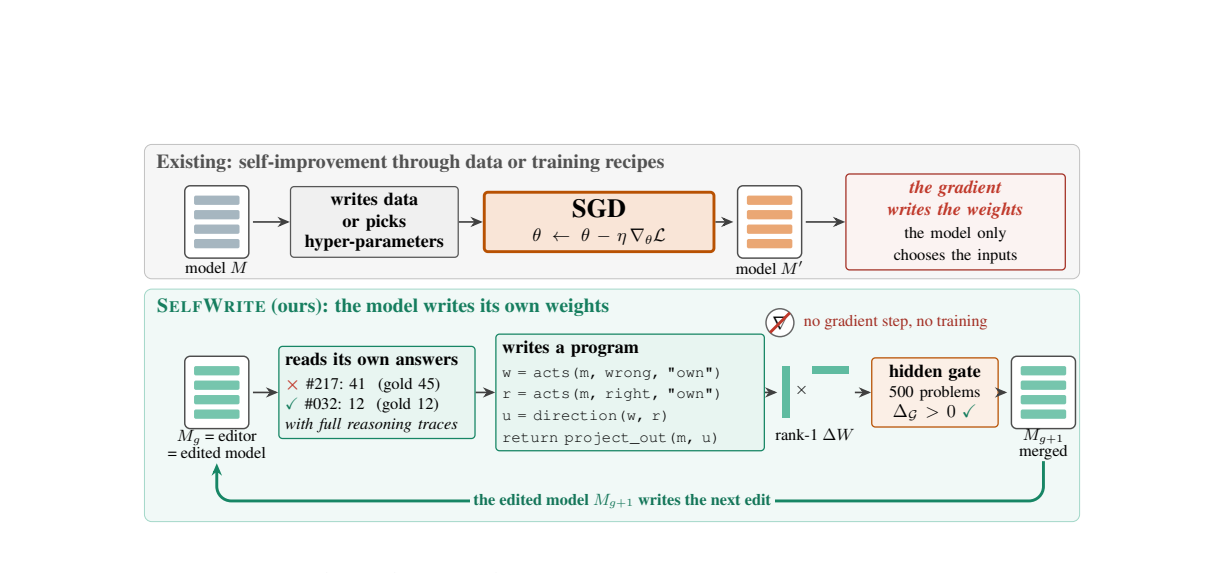
We let the model write its own weights. In SELFWRITE, each generation the current model studies its own reasoning on fresh training problems, inspects its own weights and activations in a persistent Python session, and writes a program that constructs a low-rank weight edit for itself from white-box primitives (singular directions, activation contrasts between its right and wrong answers, rank-one projections, tensor computations), with no training or gradient tool. Every candidate is graded once on a hidden gate set against the current model; the best strictly improving edit is merged into the weights, and the edited model writes the next edit. On Qwen3.8-27B and math problems from DAPO-Math, five generations of SELFWRITE raise gate accuracy from 73.95% to 76.45% and accuracy on a held-out test split that the loop never sees from 76.30% to 77.75% (avg@4) and from 82.60% to 84.80% (pass@4), without a single gradient step. A language model can author useful changes to its own weights without gradients, and the edited model keeps writing useful edits.
from the abstract
Pith says
Machine review · deepseek-v4-flash · 24 Nov 2026 · read the full text (55,301 characters) · not checked by a person
It can be wrong. Challenge this review or reply to it.
SELFWRITE lets an LLM write its own low-rank weight edits without gradients, showing modest gains on math reasoning, but the results come from a single run with no error bars. This line is wrong
1 major objection · 4 minor · 2 open questions
How often objections from reviews like this one are right: not yet measured
The paper, first character to last
The reviewer was given the whole text, 55,301 characters. Not checked: figures, code, what the 51 references say.
The paper says, at 6 (Conclusion)
“\ours{} raises gate accuracy from 73.95\% for $\Mz$ to 76.45\% for the final model $M_5$, a cumulative gain of 2.50 points.”
quote found in the text Pith read
Pith says: Objection 1 of 1 · major
The results are reported from a single run with no error bars, confidence intervals, or statistical significance tests. The paper should report results from multiple seeds (e.g., 3–5 runs) or provide bootstrap confidence intervals for the test accuracy. Without this, the reliability of the claimed improvements (gate +2.50, test avg@4 +1.45, pass@4 +2.20) cannot be assessed, and the central claim that the method improves the model is not adequately supported.
What would answer it Report the 95% paired-bootstrap confidence interval for the gate gain in Table 1 or Figure 2, and provide standard errors or confidence intervals for the test accuracy (avg@4 and pass@4) based on multiple seeds or bootstrap. Location: Table 1 and Figure 2. Verification: Compute the 95% paired-bootstrap confidence interval for the gate gain as described in Section 3.1, and compute bootstrap confidence intervals for the test accuracy by resampling problems.
4 minor objections
The paper says, at 4 (Experimental Setup)
Pith says: minor objection 1 of 4
The test set contains only 500 problems. The authors should acknowledge the potential variance due to this small size and consider reporting confidence intervals.
The paper says, at 3.4 (Select: hidden gate, merge and succession)
Pith says: minor objection 2 of 4
The paper states that the loop stops after three consecutive generations without an accepted edit, but only five generations were run and all had accepted edits. This stopping condition was not exercised; the authors could clarify whether it is a design choice or a contingency.
show 2 more
The paper says, at 5 (Results)
Pith says: minor objection 3 of 4
The paper would benefit from a qualitative analysis of the edits that were actually written (e.g., which layers were edited, what operations were used, how the edits changed across generations). This would provide insight into the method's behavior beyond the aggregate numbers.
The paper says, at 1 (Introduction) and 3 (Method)
Pith says: minor objection 4 of 4
The figures are not visible in the supplied text, but the captions are clear. The authors should ensure that the figures are legible in the final version.
Open questions (2)
Pith raised these and could not confirm them against the text of the paper it read. They are questions for the authors, not findings.
- 1 (Introduction) Does the paper compare SelfWrite to any baseline method, such as supervised fine-tuning on the same training data, random low-rank edits, or existing self-improvement approaches (e.g., SEAL, MASS)?
- 8.2 (Hyper-parameters) Does the paper include an ablation study on at least one key hyperparameter (e.g., rank cap or number of sessions) to analyze sensitivity?
What would settle it
Running the same SelfWrite procedure with multiple random seeds (e.g., 5 seeds) and checking whether the reported improvements in gate and test accuracy are statistically significant (e.g., via bootstrap confidence intervals) would test whether the gains are reliable or due to chance.
from Pith's summary of the paper
How the review went
5 passes by deepseek-v4-flash · 24 Nov 2026
- Reader holds up, with conditions
- Skeptic concern not confirmed: listed as an open question
- Referee 1 major objection, 4 minor
- Check against the paper kept 1 of 4 objections
- Editor wrote the verdict above
Not run on this paper: the simulated authors' defence.
Pith's passes raised 4 objections. A check against the paper's text kept 1 and left 3 as questions.
The review in full
The review in brief, machine-written
This paper introduces gradient-free recursive self-editing, where a language model writes a program that constructs a low-rank weight edit for itself, and the edited model writes the next edit. The idea is genuinely novel: prior work had the model write data or hyperparameters while gradient descent made the weight change; here the model authors the weight change directly. The method is carefully designed, with a hidden gate set for selection, disjoint screen/gate/test splits, and a white-box toolkit that grounds edits in the model's own activations. The reported gains—2.50 points on gate accuracy and 1.45 points (avg@4) on held-out test accuracy on Qwen3.8-27B—are modest but consistent across five generations, and every accepted edit is a paired improvement over the model that wrote it. The paper is well written and the protocol is clearly described. The main weakness is that the results are from a single run with no error bars, confidence intervals, or statistical significance tests. The improvements are small enough that run-to-run variance could matter, and without multiple seeds or bootstrapped intervals the reliability of the central claim is not yet established. The paper would also benefit from comparisons to baselines such as supervised fine-tuning on the same data or random low-rank edits, and from ablation studies on key hyperparameters (e.g., rank cap, number of sessions). These are not fatal flaws—the paper is upfront about its scope—but they limit the strength of the empirical support. The paper deserves a serious referee because the idea is novel, the method is principled, and the setting (gradient-free self-editing with a hidden gate) is well motivated. I recommend accepting for peer review with a request for multiple runs or error bars to substantiate the claimed improvements.
The stress test's concern
Not confirmed. Pith could not check this concern against the text of the paper it was given; it is listed as an open question, not a finding.
The referee's report
Not published. Pith's referee wrote this assessment before its objections were checked against the paper, and 2 of its 3 major objections did not survive that check.
Pith's reading of the paper (a machine's summary, not the authors')
The paper introduces SelfWrite, a method in which a language model writes programs that construct low-rank weight edits for itself, using a white-box toolkit that includes singular value decomposition, activation contrasts, and rank-one projections. The model first answers fresh math problems, then studies its own reasoning and activations to decide how to edit its weights. Each candidate edit is evaluated on a hidden gate set, and only strictly improving edits are merged. The edited model then writes the next edit. On Qwen3.8-27B and math problems from DAPO-Math, the authors report that five generations of SelfWrite raise gate accuracy from 73.95% to 76.45% and held-out test accuracy from 76.30% to 77.75% (avg@4) and from 82.60% to 84.80% (pass@4), without any gradient step. The paper argues that a language model can author useful changes to its own weights without gradients, and that the edited model remains capable of writing further useful edits.
What carries the argument. The key machinery is the SelfWrite loop, which combines four components: (1) Observe: the model answers fresh problems and reads its own reasoning and activation statistics. (2) Write: the model acts as an agent in a persistent Python session with a white-box toolkit that includes SVD, activation contrasts, rank-one constructions, and LoRA operators, and returns a program that builds a low-rank weight edit. (3) Select: each candidate edit is evaluated on a hidden gate set against the current model using a paired gain metric; only the best strictly improving edit is accepted. (4) Merge and succeed: the accepted edit is merged into the weights, and the edited model becomes the editor for the next generation. The loop is gradient-free and uses no training tools.
Core claim. The central claim is that a language model can improve its own performance on math reasoning by writing programs that edit its own weights, without any gradient descent or external training. The method, SelfWrite, operates in a loop: the current model answers fresh problems, inspects its own weights and activations, and writes a program that constructs a low-rank weight edit (a LoRA) using white-box primitives. The edit is evaluated on a hidden gate set, and if it yields a strictly positive paired gain over the current model, it is merged into the weights. The edited model then becomes the editor for the next generation. The paper reports that over five generations on Qwen3.8-27B, this process produces cumulative gains on gate accuracy and held-out test accuracy, and that the model remains able to write effective edits after each merge.
The premise it rests on. The model's ability to write effective weight-editing programs using the white-box toolkit, guided by its own reasoning traces, is sufficient to produce consistent improvements across generations; this is tested empirically but not theoretically justified.
If the paper is right (Pith's inferences, not the authors')
If a language model can improve itself by writing its own weight edits, then self-improvement may be achievable without the computational cost of gradient-based training, relying instead on inference-time computation.
The method suggests that models can develop their own editing strategies that generalize beyond the problems used for selection, as indicated by the held-out test improvements.
The recursive nature implies that the editor improves together with the model it edits, potentially enabling long chains of self-improvement without external intervention.
The approach could be extended to other domains beyond math, such as coding or factual reasoning, by providing appropriate training problems and gate sets.
The white-box toolkit provides a foundation for exploring richer edit spaces, such as joint edits across multiple modules or higher-rank updates.
The paper's results are from a single run without error bars; replication with multiple seeds would be needed to assess the reliability of the claimed improvements.
The method's dependence on the model's ability to write effective programs using the toolkit may limit its applicability to models that are already strong reasoners and coders.
The hidden gate set is fixed; it is unclear how the method would perform if the gate set were changed or if the model overfits to the gate distribution over generations.
The paper does not compare SelfWrite to baselines such as supervised fine-tuning on the same data or random low-rank edits; such comparisons would help isolate the contribution of the self-editing mechanism.
Check this review
What was read
The passes were given all 55,301 characters of the paper's LaTeX source.
Fingerprint of that text (SHA-256): ccbf2ce435c611316c34b513ac8490afb51c34e3ed49ab8ed7bd5fe55f0740d9
Pith does not keep that text. Rebuilt from the paper's source or PDF by the same code, it has this fingerprint if it is the same text. From a copy of Pith's code:
PYTHONPATH=. python scripts/review_input_check.py 2611.29513
The passes, in the order they ran
- Reader deepseek-v4-flash · medium effort · $0.0023 · instructions of the Reader, fingerprint f9ead7300382…
- Skeptic deepseek-v4-flash · medium effort · $0.0016 · instructions of the Skeptic, fingerprint 8f88c0f61488…
- Referee deepseek-v4-flash · medium effort · $0.0019 · instructions of the Referee, fingerprint a852d99aea0d…
- Check against the paper deepseek-v4-flash · medium effort · $0.0040 · instructions of the Check against the paper, fingerprint 6c7a6883d551…
- Editor deepseek-v4-flash · medium effort · $0.0015 · instructions of the Editor, fingerprint e7211f6a3d27…
- Circularity check deepseek-v4-flash · medium effort · $0.0014 · instructions of the Circularity check, fingerprint e9946e39d67b…
- Summary for the page deepseek-v4-flash · medium effort · temperature 0.2 · $0.0020 · instructions of the Summary for the page, fingerprint e4f56bf568e7…
The passes cost $0.015 in model calls together.
Version stamped on this review: pith-pipeline@v1.4.1-daily-deepseek-or-medium+deepseek/deepseek-v4-flash+p.d60f54226f00
Each link opens a pass's instructions as plain text, the exact bytes its fingerprint was taken over. Every stored set of instructions.
curl -s https://pith.science/methodology/prompts/f9ead730038216984cfb56d7cb34332bdf691828296a1de4245f3d6667d4bf56 | sha256sum
prints the fingerprint of the reader's instructions. The same works for every pass.
The receipt
The review's fingerprint was taken on 24 Nov 2026. The review you are reading still matches it.
Fingerprint of the review (SHA-256): 8fc5bd5f64bb99fdeca4a83ff596ea61bd8db520e1baec19cd8aadaa20554dae
curl -s 'https://pith.science/api/v1/verdicts/2611.29513?form=canonical' | sha256sum
prints the fingerprint of the review as it stands now. The rule, in four steps.
A matching fingerprint shows the review has not changed since that date. It does not show that the review is right.
How often reviews like this one are right
Reviews like this one: written by deepseek-v4-flash, from the paper's LaTeX source.
How often objections from reviews like this one are right: not yet measured
Reviews by people
This review was written by a machine. No person has reviewed this paper on Pith yet. A scientist listed on Pith can review it for a fee, and their review is published here whatever it concludes.
The paper
Abstract
Recursive self-improvement asks a system to improve the very system that improves it. Today's language models improve themselves through data, training recipes or scaffolds. Whenever their weights change, gradient descent writes the update, not the model. We let the model write its own weights. In SELFWRITE, each generation the current model studies its own reasoning on fresh training problems, inspects its own weights and activations in a persistent Python session, and writes a program that constructs a low-rank weight edit for itself from white-box primitives (singular directions, activation contrasts between its right and wrong answers, rank-one projections, tensor computations), with no training or gradient tool. Every candidate is graded once on a hidden gate set against the current model; the best strictly improving edit is merged into the weights, and the edited model writes the next edit. On Qwen3.8-27B and math problems from DAPO-Math, five generations of SELFWRITE raise gate accuracy from 73.95% to 76.45% and accuracy on a held-out test split that the loop never sees from 76.30% to 77.75% (avg@4) and from 82.60% to 84.80% (pass@4), without a single gradient step. A language model can author useful changes to its own weights without gradients, and the edited model keeps writing useful edits.
The paper's own sentences, arranged, kept beside the review and separate from it. Each label is drawn from a closed vocabulary; the number beside it is the probability the classifier gave that label. No sentence in this record was written by a model.
abstract compiled · 2026-11-24
The authors' main claim, as the classifier picked it out 1.00
“A language model can author useful changes to its own weights without gradients, and the edited model keeps writing useful edits.”
How the main claim is stated: asserted 0.91
What the abstract itself states, as probabilities: claims first 0.11 · states limitation 0.25 · human participants 0.02 · controlled comparison 0.48 · randomized assignment 0.02 · states quantitative result 0.99 · compares with prior results 0.65 · mentions code or data availability 0.04
The abstract, sentence by sentence
This table labels the abstract only (arXiv listing abstract v1). The number is the probability the classifier gave the label.
| Sentence | Role | The authors' own work | States the main conclusion | Strength |
|---|---|---|---|---|
| Recursive self-improvement asks a system to improve the very system that improves it. | background 1.00 | 0.04 | 0.04 | asserted 0.96 |
| Today's language models improve themselves through data, training recipes or scaffolds. | background 1.00 | 0.05 | 0.02 | asserted 1.00 |
| Whenever their weights change, gradient descent writes the update, not the model. | background 0.77 | 0.06 | 0.03 | asserted 1.00 |
| We let the model write its own weights. | contribution 0.97 | 0.85 | 0.16 | asserted 0.99 |
| In SELFWRITE, each generation the current model studies its own reasoning on fresh training problems, inspects its own weights and activations in a persistent Python session, and writes a program that constructs a low-rank weight edit for itself from white-box primitives (singular directions, activation contrasts between its right and wrong answers, rank-one projections, tensor computations), with no training or gradient tool. | method 0.99 | 0.91 | 0.07 | asserted 0.99 |
| Every candidate is graded once on a hidden gate set against the current model; the best strictly improving edit is merged into the weights, and the edited model writes the next edit. | method 1.00 | 0.91 | 0.09 | asserted 0.99 |
| On Qwen3.8-27B and math problems from DAPO-Math, five generations of SELFWRITE raise gate accuracy from 73.95% to 76.45% and accuracy on a held-out test split that the loop never sees from 76.30% to 77.75% (avg@4) and from 82.60% to 84.80% (pass@4), without a single gradient step. | result 1.00 | 0.96 | 0.14 | asserted 1.00 |
| A language model can author useful changes to its own weights without gradients, and the edited model keeps writing useful edits. | interpretation 0.75 | 0.91 | 0.93 | asserted 0.91 |
What kind of paper the classifier reports this is: method or tool 0.99 · evidence from observation or experiment 0.93
What was examined, and what was not
Sources read
- arXiv listing abstract v1
Not examined
- full text
- figures and tables
- references and citing sentences
- relations to other papers
Levels run
- P abstract
Not run
- S sections
- T body sentences
- C citations
- R cross-paper relations
How the labels were made
Compiled by classifier-1.13.0 via TypeSafe API, question bank abstract-p1-20260923, 2026-11-24: 1 request, 6,390 input tokens.
Every quoted sentence on this record is the authors'. Every label is from Pith's closed vocabulary, with the probability shown beside it. This record as JSON
Figures (4)


Figures are the authors', reproduced from the paper.
References (51)
- [1] Emre Can Acikgoz, Cheng Qian, Heng Ji, Dilek Hakkani-Tür, and Gokhan Tur. TT-SI: Self-Improving LLM Agents with Test-Time Training. InFindings of the Association for Computational Linguistics: ACL 2026, pages 9483–9508, 2026. doi: 10.18653/v1/2026.findings-acl.462 on Pithdoi:10.18653/v1/2026.findings-acl.462
- [2] Lenny Aharon, Neta Glazer, and Lior Aharon. Audit Before You Merge: Provenance, Probing, and Continual LoRA Composition. InICML 2026 Workshop on Continual Adaptation at Scale (CATS), on Pith
- [3] Takuya Akiba, Makoto Shing, Yujin Tang, Qi Sun, and David Ha. Evolutionary Optimization of Model Merging Recipes.Nature Machine Intelligence, 7:195–204, 2025. doi: 10.1038/s42256-024-00975-8 on Pithdoi:10.1038/s42256-024-00975-8
- [4] Rujikorn Charakorn, Edoardo Cetin, Yujin Tang, and Robert Tjarko Lange. Text-to-LoRA: Instant Transformer Adaption. InInternational Conference on Machine Learning (ICML), 2025 on Pith
- [5] Tong Chen, Hao Fang, Patrick Xia, Xiaodong Liu, Benjamin Van Durme, Luke Zettlemoyer, Jianfeng Gao, and Hao Cheng. Generative Adapter: Contextualizing Language Models in Parameters with A Single Forward Pass. InInternational Conference on Learning Representations (ICLR), 2025 on Pith
- [6] Alistair Cheong, Haolin Cong, Tyler Yang, and Dustin Miao. Search over Self-Edit Strategies for LLM Adaptation.arXiv preprint arXiv:2601.14532, 2026 on PitharXiv
- [7] Irving John Good. Speculations Concerning the First Ultraintelligent Machine. InAdvances in Com- puters, volume 6, pages 31–88. Academic Press, 1966. doi: 10.1016/S0065-2458(08)60418-0 on Pithdoi:10.1016/s0065-2458(08)60418-0
- [8] Prannay Hebbar, Yogendra Manawat, Samuel Verboomen, Alesia Ivanova, Selvam Palanimalai, Kunal Bhatia, and Vignesh Baskaran. SIA: Self Improving AI with Harness & Weight Updates.arXiv preprint arXiv:2605.27276, 2026 on PithPith's reviewarXiv
- [9] Edward J. Hu, Yelong Shen, Phillip Wallis, Zeyuan Allen-Zhu, Yuanzhi Li, Shean Wang, Lu Wang, and Weizhu Chen. LoRA: Low-Rank Adaptation of Large Language Models. InInternational Conference on Learning Representations (ICLR), 2022 on Pith
- [10] Junru Hu, Cheng Tang, Wei Li, Hongze Zhu, Chun-Mei Feng, Qi Zhang, Yirong Chen, and Ming Hu. Exploring Weight-Space Programming: Capabilities, Generalization, and Limitations.arXiv preprint arXiv:2611.09382, 2026 on PithPith's reviewarXiv
- [11] Chengsong Huang, Qian Liu, Bill Yuchen Lin, Tianyu Pang, Chao Du, and Min Lin. LoraHub: Effi- cient Cross-Task Generalization via Dynamic LoRA Composition. InConference on Language Mod- eling (COLM), 2024 on Pith
- [12] Chengsong Huang, Wenhao Yu, Xiaoyang Wang, Hongming Zhang, Zongxia Li, Ruosen Li, Jiaxin Huang, Haitao Mi, and Dong Yu. R-Zero: Self-Evolving Reasoning LLM from Zero Data. InInterna- tional Conference on Learning Representations (ICLR), 2026 on Pith
- [13] Gabriel Ilharco, Marco Tulio Ribeiro, Mitchell Wortsman, Suchin Gururangan, Ludwig Schmidt, Han- naneh Hajishirzi, and Ali Farhadi. Editing Models with Task Arithmetic. InInternational Conference on Learning Representations (ICLR), 2023 on Pith
- [14] Yoichi Ishibashi, Taro Yano, and Masafumi Oyamada. Can Large Language Models Invent Algorithms to Improve Themselves?: Algorithm Discovery for Recursive Self-Improvement through Reinforce- ment Learning. InProceedings of the 2025 Conference of the Nations of the Americas Chapt... on Pith
- [15] Tao Jiang, Xinmeng Yu, Chenhao Yi, Yiling Wu, Yan Li, Ran Cheng, Dongmei Jiang, and Jianguo Zhang. EvoGM: Learning to Merge LLMs via Evolutionary Generative Optimization. InInternational Conference on Machine Learning (ICML), 2026 on Pith
- [16] Xisen Jin, Xiang Ren, Daniel Preot ,iuc-Pietro, and Pengxiang Cheng. Dataless Knowledge Fusion by Merging Weights of Language Models. InInternational Conference on Learning Representations (ICLR), 2023 on Pith
- [17] Junmo Kang, Hongyin Luo, Yada Zhu, Jacob Hansen, James Glass, David Cox, Alan Ritter, Rogerio Feris, and Leonid Karlinsky. Self-Specialization: Uncovering Latent Expertise within Large Language Models. InFindings of the Association for Computational Linguistics: ACL 2024, 2024 on Pith
- [18] Junmo Kang, Leonid Karlinsky, Hongyin Luo, Zhen Wang, Jacob Hansen, James R. Glass, David Cox, Rameswar Panda, Rogerio Feris, and Alan Ritter. Self-MoE: Towards Compositional Large Lan- guage Models with Self-Specialized Experts. InInternational Conference on Learning Represen... on Pith
- [19] Haechan Kim, Yoonho Lee, Gisang Lee, Chelsea Finn, and Kangwook Lee. WHALE: A Simple Recipe for Joint Harness-Weight Optimization.arXiv preprint arXiv:2609.00196, 2026 on PithPith's reviewarXiv
- [20] Vishnuprasadh Kumaravelu, Sunil Gupta, and P. K. Srijith. Post-Optimization Adaptive Rank Alloca- tion for LoRA.arXiv preprint arXiv:2604.27796, 2026 on PithPith's reviewarXiv
show 31 more
- [21] Woosuk Kwon, Zhuohan Li, Siyuan Zhuang, Ying Sheng, Lianmin Zheng, Cody Hao Yu, Joseph E. Gonzalez, Hao Zhang, and Ion Stoica. Efficient Memory Management for Large Language Model Serving with PagedAttention. InProceedings of the 29th Symposium on Operating Systems Principles ... on Pithdoi:10.1145/3600006.3613165
- [22] Hyunin Lee, Jinglue Xu, Jeffrey Seely, Donghyun Lee, Somayeh Sojoudi, Matei Zaharia, and Yujin Tang. Recursive Self-Improvement through Multi-Agent Self-Supervision.arXiv preprint arXiv:2610.12176, 2026 on PithPith's reviewarXiv
- [23] Mengran Li, Bo Li, Weijing Zhao, Chengyang Zhang, Boyu Zhang, Jinfeng Xu, Zelin Zang, Victor C. M. Leung, and Stan Z. Li. WeightLoop: Weight-Space Programming with Experimental Feedback. arXiv preprint arXiv:2611.07319, 2026 on PithPith's reviewarXiv
- [24] Qizheng Li, Yifei Zhang, Xiao Yang, Xu Yang, Zhuo Wang, Bowen Xian, Weiqing Liu, and Jiang Bian. FT-Dojo: Towards Autonomous LLM Fine-Tuning with Language Agents. InInternational Confer- ence on Machine Learning (ICML), pages 72523–72548, 2026. URLhttps://proceedings. mlr.pres... on Pith
- [25] Haochen Luo, Yi Huang, Sichun Luo, Fengyuan Liu, Lei Li, Zefa Hu, Junlan Feng, and Qi Liu. Harness-Aware Self-Evolving: Co-Evolving Model Weights, Harness, and Task Solutions.arXiv preprint arXiv:2607.03935, 2026 on PithPith's reviewarXiv
- [26] Fanxu Meng, Zhaohui Wang, and Muhan Zhang. PiSSA: Principal Singular Values and Singular Vectors Adaptation of Large Language Models. InAdvances in Neural Information Processing Systems (NeurIPS), 2024 on Pith
- [27] Kevin Meng, David Bau, Alex Andonian, and Yonatan Belinkov. Locating and Editing Factual Asso- ciations in GPT. InAdvances in Neural Information Processing Systems (NeurIPS), 2022. 10 on Pith
- [28] Kevin Meng, Arnab Sen Sharma, Alex Andonian, Yonatan Belinkov, and David Bau. Mass-Editing Memory in a Transformer. InInternational Conference on Learning Representations (ICLR), 2023 on Pith
- [29] Qwen Team. Qwen3.8-27B. Model card,https://huggingface.co/Qwen/Qwen3.8-27B, 2026 on Pith
- [30] Ben Rank, Hardik Bhatnagar, Ameya Prabhu, Shira Eisenberg, Karina Nguyen, Matthias Bethge, and Maksym Andriushchenko. PostTrainBench: Can LLM Agents Automate LLM Post-Training? In International Conference on Machine Learning (ICML), pages 103808–103823, 2026 on Pith
- [31] Jürgen Schmidhuber. Gödel Machines: Self-Referential Universal Problem Solvers Making Provably Optimal Self-Improvements.arXiv preprint cs/0309048, 2003 on PithPith's reviewarXiv
- [32] Reece Shuttleworth, Jacob Andreas, Antonio Torralba, and Pratyusha Sharma. LoRA vs Full Fine- tuning: An Illusion of Equivalence. InAdvances in Neural Information Processing Systems (NeurIPS), 2025 on Pith
- [33] Xinyuan Song, Zekun Cai, and Liang Zhao. When AI Reviews Its Own Code: Recursive Self-Training Collapse in Code LLMs.arXiv preprint arXiv:2606.28438, 2026 on PithPith's reviewarXiv
- [34] Dhruv Srikanth, Bingchen Zhao, Dixing Xu, Yuxiang Wu, and Zhengyao Jiang. Recursive self- improvement of AI research agents.arXiv preprint arXiv:2609.26457, 2026 on PithPith's reviewarXiv
- [35] Qi Sun, Edoardo Cetin, and Yujin Tang. Transformer-Squared: Self-adaptive LLMs. InInternational Conference on Learning Representations (ICLR), 2025 on Pith
- [36] Rikiya Takehi, Jayden Teoh, Alex Zhang, and Omar Khattab. Sparks of Weight-Space Programming: LLMs can natively read & write neural network weights. Blog post,https://rikiyat.github. io/blog/weight-space-programming/, 2026. Accessed 2026-11-21 on Pith
- [37] Zihan Tan, Leixin Sun, Zitong Shi, Yitao Liu, Jiajun Wu, Nathaniel Brooks, Jiaru Qian, Xiaoran Shang, Suyuan Huang, Yi Ding, Yangxu Liao, Mukai Li, Qiushi Sun, Shudong Liu, Xuankun Rong, Xiaohang Yu, Zhuo Chen, Hejia Geng, Chenxin Li, Aozhou Wang, Zengji Tu, Robert Tang, Yuxin... on PithPith's reviewarXiv
- [38] Huy Quoc To, Fuyi Li, Guangyan Huang, and Ming Liu. TaDA: Calibrated Probe Gating for Task- Domain LoRA Merging.arXiv preprint arXiv:2606.05016, 2026 on PithPith's reviewarXiv
- [39] Nitin Vetcha and Dianbo Liu. SOLAR: A Self-Optimizing Open-Ended Autonomous Agent for Life- long Learning and Continual Adaptation.CEUR Workshop Proceedings, 4183, 2026. AAAI-26 Bridge on Streaming Continual Learning; arXiv:2605.20189 on PithPith's reviewarXiv
- [40] Zhepei Wei, Wenlin Yao, Baolin Peng, Danqing Wang, Qianhui Wu, Hao Cheng, Yu Meng, and Jianfeng Gao. Self-Evolving Coding Agents via Harness-Policy Optimization.arXiv preprint arXiv:2610.22791, 2026 on PithPith's reviewarXiv
- [41] Prateek Yadav, Derek Tam, Leshem Choshen, Colin A. Raffel, and Mohit Bansal. TIES-Merging: Resolving Interference When Merging Models. InAdvances in Neural Information Processing Systems (NeurIPS), 2023. 11 on Pith
- [42] Lina Yang, Yusheng Liao, Yanfeng Wang, and Yu Wang. SLoRA: Balancing Plasticity and Forgetting in Large Language Models for Continual Learning. InProceedings of the 64th Annual Meeting of the Association for Computational Linguistics (V olume 1: Long Papers), pages 5437–5454, 2026 on Pith
- [43] Xunjian Yin, Xinyi Wang, Liangming Pan, Li Lin, Xiaojun Wan, and William Yang Wang. Gödel Agent: A Self-Referential Agent Framework for Recursively Self-Improvement. InProceedings of the 63rd Annual Meeting of the Association for Computational Linguistics (ACL), 2025. doi: 10.... on Pith
- [44] Le Yu, Bowen Yu, Haiyang Yu, Fei Huang, and Yongbin Li. Language Models are Super Mario: Ab- sorbing Abilities from Homologous Models as a Free Lunch. InInternational Conference on Machine Learning (ICML), 2024 on Pith
- [45] Qiying Yu, Zheng Zhang, Ruofei Zhu, Yufeng Yuan, Xiaochen Zuo, Yu Yue, Weinan Dai, Tiantian Fan, Gaohong Liu, Juncai Liu, Lingjun Liu, Xin Liu, Haibin Lin, Zhiqi Lin, Bole Ma, Guangming Sheng, Yuxuan Tong, Chi Zhang, Mofan Zhang, Ru Zhang, Wang Zhang, Hang Zhu, Jinhua Zhu, Jia... on Pith
- [46] Weizhe Yuan, Richard Yuanzhe Pang, Kyunghyun Cho, Xian Li, Sainbayar Sukhbaatar, Jing Xu, and Jason E. Weston. Self-Rewarding Language Models. InInternational Conference on Machine Learn- ing (ICML), 2024 on Pith
- [47] Eric Zelikman, Eliana Lorch, Lester Mackey, and Adam Tauman Kalai. Self-Taught Optimizer (STOP): Recursively Self-Improving Code Generation. InConference on Language Modeling (COLM), 2024 on Pith
- [48] Jenny Zhang, Shengran Hu, Cong Lu, Robert Lange, and Jeff Clune. Darwin Gödel Machine: Open- Ended Evolution of Self-Improving Agents. InInternational Conference on Learning Representations (ICLR), 2026 on Pith
- [49] Jusheng Zhang, Keze Wang, and Liang Lin. Can LLMs Debug Robots by Editing Their Weights? arXiv preprint arXiv:2611.09376, 2026 on PithPith's reviewarXiv
- [50] Andrew Zhao, Yiran Wu, Yang Yue, Tong Wu, Quentin Xu, Matthieu Lin, Shenzhi Wang, Qingyun Wu, Zilong Zheng, and Gao Huang. Absolute Zero: Reinforced Self-play Reasoning with Zero Data. InAdvances in Neural Information Processing Systems (NeurIPS), 2025. doi: 10.52202/085713-3534 on Pithdoi:10.52202/085713-3534
- [51] Adam Zweiger, Jyothish Pari, Han Guo, Yoon Kim, and Pulkit Agrawal. Self-Adapting Language Models. InAdvances in Neural Information Processing Systems (NeurIPS), 2025. doi: 10.52202/ 085713-2483. A Method Details of SELFWRITE A.1 Tools Table 3 lists the program tools with thei... on Pith
Challenges and discussion
Disagree with the review, or know something it missed? Leave a comment, or challenge this review formally: a challenge becomes a permanent entry in this paper's record, and its decision is published here.
Come back by email
A short list of the week's newly reviewed papers. Nothing is sent until you confirm from your inbox, and every email has a link that stops it. No account.
No comments yet.
Sign in to comment