Computation and Language · arXiv:2610.22791 v1 · submitted 16 Oct 2026 · 18 references
Self-Evolving Coding Agents via Harness-Policy Optimization
The paper says
“Large language model (LLM) agents have shown promising potential in coding tasks, and their performance is jointly determined by the policy model and the harness that mediates their interaction with the environment.”
more of the abstract
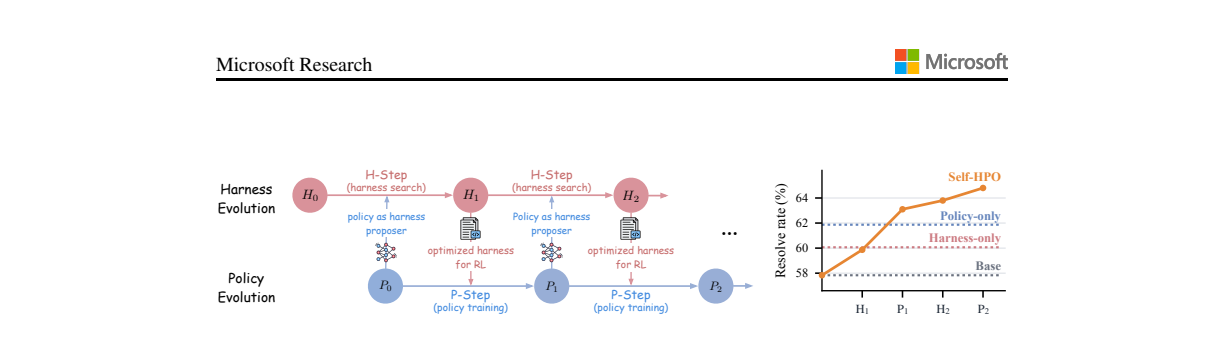
Indeed, harness and policy are mutually reinforcing and evolving only one component is suboptimal—a harness tuned for one checkpoint may not target the failure modes of an updated policy, while policy learning remains limited to the trajectories elicited by a fixed harness. In light of this, we propose Self-HPO, a recursive self-improving framework for coding agents that alternates harness and policy optimization, using the evolving policy as its own harness proposer. Specifically, in each round, the current policy first analyzes its own failures and proposes new harness candidates (H-step). The policy is then updated through reinforcement learning (RL) under the selected harness (P-step), and hard tasks identified during training form the next harness search set, keeping harness optimization targeted to the policy's evolving failure modes. Across three coding benchmarks, Self-HPO consistently outperforms harness-only and policy-only baselines, improving Qwen3.5-35B-A3B's average resolve rate from 57.8% to 64.8%, with gains generalizing to out-of-distribution settings. Further analysis shows that both optimized components retain gains even when paired with their base counterparts, while their joint gain exceeds the sum of their individual gains. Self-HPO also improves reliability (Pass@1) and expands the capability frontier (Pass@k) over the base agent. Additionally, we show that with a stronger external model (e.g., Opus 4.8) as the harness proposer, the same framework yields a further performance boost.
from the abstract
Pith says
Machine review · deepseek-v4-flash · 19 Oct 2026 · what was read was not recorded · not checked by a person
It can be wrong. Challenge this review or reply to it.
The passes disagreed. Reader: holds up. Skeptic: holds up only with conditions. Referee: major revision.
Solid empirical framework but the claimed synergy of alternating harness-policy optimization is not isolated from total optimization budget. This line is wrong
2 major objections · 4 minor
How often objections from reviews like this one are right: not yet measured
Not checked: figures, code, what the 18 references say.
The paper says, at §3.2, Table 1 and Figure 3
The review did not quote this passage.
Pith says: Objection 1 of 2 · major
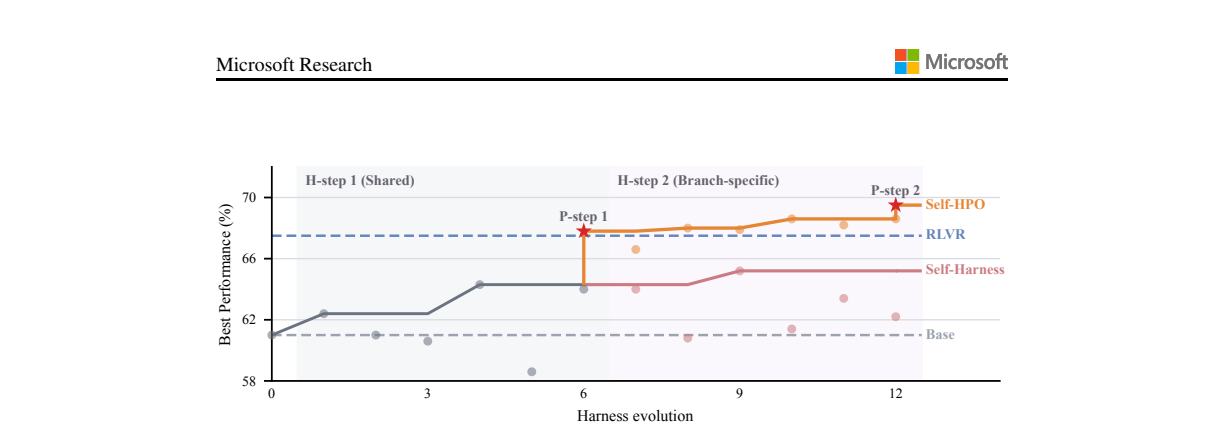
The central claim of synergy between alternating H- and P-steps is not isolated from the effect of total optimization budget. Self-HPO performs two H-steps (12 harness candidates total) and two P-steps (100 RL updates total), while the RLVR baseline receives only one P-step (50 RL updates) and Self-Harness receives one H-step (6 harness candidates).
more of objection 1
The paper does not control for the number of rounds: running two rounds of RLVR (100 RL updates) or two rounds of Self-Harness (12 harness candidates) could close or reduce the gap. Without this control, the claimed advantage of alternating updates may be confounded by more total compute. The cross-evaluation in Table 3 is consistent with synergy but does not rule out the simpler explanation. The authors should either run the two-round single-component baselines or explicitly discuss the budget asymmetry and its implications.
The paper says, at §3.1, §2.3, Appendix A
The review did not quote this passage.
Pith says: Objection 2 of 2 · major
Hyperparameter choices are given (K=6, 50 RL updates per P-step, initial search set size 300, 8 rollouts per task) but no sensitivity analysis is provided. The results may depend critically on these numbers, especially K and the number of RL updates. The paper would benefit from at least one ablation varying a key hyperparameter (e.g., K=3 or K=12, or 25 vs. 100 RL updates) to show robustness. Otherwise, the reader cannot assess how finely tuned the reported configuration is.
4 minor objections
The paper says, at §3.5, Appendix E
Pith says: minor objection 1 of 4
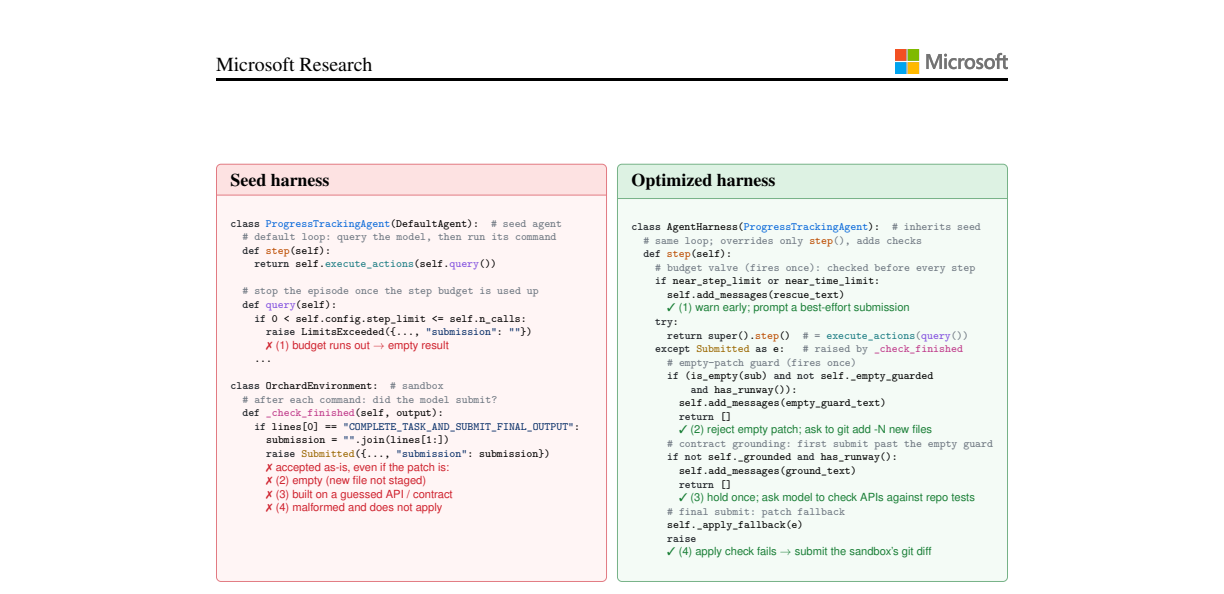
The case studies in Figures 10 and 11 are helpful but the PR-intent reminder in Figure 11 (step 3) appears to trigger on keywords from the task description that are unrelated to the actual fix. The authors should note that the harness's injected feedback can include false positives, which is acknowledged implicitly but not discussed as a potential limitation.
The paper says, at Figure 4c
Pith says: minor objection 2 of 4
The fraction of zero-success groups is plotted for the final P-step of Self-HPO versus the entire RLVR run. The comparison would be fairer if both curves covered the same number of steps (100 RL updates for RLVR if two rounds had been run, as suggested in the major comment). The current figure may exaggerate the advantage.
show 2 more
The paper says, at Algorithm 1
Pith says: minor objection 3 of 4
The stopping criterion is described as 'when the hard-task set stabilizes between rounds' but this is never quantified or shown in the experiments. The paper simply states that two rounds were used. Clarify what 'stabilizes' means or why two rounds were chosen.
The paper says, at §3.1
Pith says: minor objection 4 of 4
The training set of 2,484 tasks is constructed from three sources (SWE-rebench, SWE-rebench V2, Scale-SWE). The paper does not report how many tasks come from each source or whether any decontamination was performed against the test benchmarks. A brief statement about decontamination would strengthen confidence in the results.
What would settle it
Run a second round of RLVR: starting from the RLVR P1 checkpoint, perform another 50 RL updates (total 100) under the seed harness, and measure resolve rate on SWE-Bench Verified. Similarly, run a second round of Self-Harness: starting from its H1 checkpoint, perform another 6 harness candidates (total 12) with the base policy fixed, and evaluate. If either reaches within 1–2 points of Self-HPO's 69.5%, the alternating design's contribution is marginal. If both fall short, the synergy claim is strengthened.
from the skeptic's reading
How the review went
4 readings by deepseek-v4-flash · 19 Oct 2026
- Reader holds up
- Skeptic partly agrees: says it holds up only with conditions Self-HPO's advantage over single-component baselines may stem from more total optimization steps rather than alternating co-evolution, since baselines receive only one round of updates while Self-HPO gets two.
- Editor wrote the verdict above
- Referee major revision: 2 major objections, 4 minor
Not run on this paper: the simulated authors' defence.
Pith did not check this review's objections against the paper.
The review in full
The review in brief, machine-written
The paper introduces Self-HPO, alternating harness and policy optimization where the evolving policy proposes its own harness revisions. The experiments are well-structured: three SWE-Bench variants, appropriate baselines, consistent gains (average resolve rate 57.8% to 64.8%), and OOD transfer. The cross-evaluation in Table 3 is informative—each optimized component retains gains individually, and joint gain exceeds sum of individuals. The paper is clearly written and the method is reproducible (code and model released). Credit where due: this is a competent empirical contribution.
The main soft spot is the stress-test concern: Self-HPO receives two H-steps (12 harness candidates) and two P-steps (100 RL updates), while RLVR gets one P-step (50 updates) and Self-Harness gets one H-step (6 candidates). The paper does not control for total optimization budget. The claim that alternating gives synergy over single-component optimization is not fully isolated from the fact that Self-HPO simply runs more iterations. Running two rounds of RLVR (100 updates) or two rounds of Self-Harness (12 candidates) could close or reduce the gap. This is a load-bearing flaw for the paper's central interpretation, though the practical result—that running both steps in sequence works—remains useful. The authors should address this with a controlled experiment.
Other soft spots: no sensitivity analysis on hyperparameters (K=6, 50 RL steps, search set size 300); the self-proposer mechanism is tested empirically but its robustness across models or training stages is uncharacterized; the ablation on evolving search set shows only a modest 1.5-point gain. None are fatal, but they limit depth.
Who is this for? Researchers working on self-improving LLM agents for coding. It will be cited and discussed. The method is not a paradigm shift but a practical, well-tested combination of existing ideas.
Recommendation: accept for peer review with major revision requiring a budget-controlled comparison to isolate the effect of alternation from total compute.
The strongest objection
The central claim is that alternating harness and policy optimization (Self-HPO) consistently outperforms optimizing only one component. However, Self-HPO receives two rounds of H-step (12 harness candidates total) and two P-steps (100 RL updates total), whereas RLVR (policy-only) receives only 50 RL updates (one P-step) and Self-Harness (harness-only) receives only 6 harness candidates (one H-step). The paper does not control for total optimization budget. It is possible that simply running more iterations of a single-component baseline — e.g., two rounds of RLVR (100 RL updates) or two rounds of Self-Harness (12 harness candidates) — would close or reduce the gap to Self-HPO. Without this control, the claimed synergy of alternating updates is not empirically isolated from the effect of more total compute. The cross-evaluation in Table 3 shows that each component retains gains and that combining them gives super-additive improvement, which is consistent with synergy, but does not rule out the simpler explanation that more iterative effort on either component alone could match the combined result.
The reader's weakest assumption was the self-proposer meta-cognitive capability, which I find partially addressed by the external-proposer ablation. A more directly load-bearing concern is the missing control for total optimization steps, which threatens the core comparative claim. The paper already provides strong evidence that both components contribute and that their combination surpasses each individually, but the baselines are not given equal compute. Adding two simple controlled experiments (second-round RLVR and second-round Self-Harness) would cleanly separate the benefit of alternating from the benefit of more iterations. If those experiments confirm that single-component improvements saturate before reaching Self-HPO's level, the alternating design is validated. If not, the headline claim weakens. This test is concrete, feasible with the same infrastructure, and directly addresses the fairness of comparison. Therefore I recommend a conditional acceptance pending this control.
The referee's report
If the claims hold, Self-HPO offers a practical method for self-improving coding agents without an external proposer, where the agent itself proposes harness changes and adapts its search to evolving failure modes. The consistent gains across three benchmarks and the out-of-distribution transfer are notable, especially the finding that joint harness-policy optimization yields more than the sum of individual improvements (Table 3). The method is clearly described with a complete algorithm and reproducible code, which strengthens the contribution.
Pith's reading of the paper (a machine's summary, not the authors')
Large language model coding agents consist of a policy (the model) and a harness (the scaffold controlling context, tools, and feedback). This paper argues that optimizing both components together, rather than either alone, yields substantially better performance. It introduces Self-HPO, a recursive framework that alternates harness optimization (H-step) and policy optimization (P-step), using the evolving policy as its own harness proposer. Across three coding benchmarks, the approach raises the average resolve rate from 57.8% to 64.8% and generalizes out of distribution. If correct, the framework provides a pathway for coding agents to self-improve without external supervision.
What carries the argument. Alternating harness optimization (H-step) and policy optimization (P-step). In each H-step, the current policy analyzes its failed trajectories and proposes new harness candidates, which are evaluated on a search set of hard tasks. In each P-step, the policy is updated via group-relative policy optimization (GRPO) under the selected harness, and tasks that remain unresolved become the search set for the next H-step. The central object is this recursive loop that adapts the harness to the policy's evolving failure modes.
Core claim. The paper discovers that jointly optimizing the harness and policy through alternating rounds of harness search (H-step) and reinforcement learning on the policy (P-step) consistently outperforms optimizing only the harness or only the policy. The key innovation is that the evolving policy itself serves as the harness proposer, analyzing its own failures to propose targeted harness revisions, and the set of hard tasks for harness search is dynamically updated from unsolved tasks during policy training. This co-evolution leads to a joint gain that exceeds the sum of individual gains from optimizing each component alone.
The premise it rests on. The paper assumes that the policy can reliably analyze its own failures and propose effective harness revisions, a meta-ognitive capability that is tested empirically but not formally guaranteed, especially for weaker or earlier-stage models.
If the paper is right (Pith's inferences, not the authors')
Coding agents can achieve recursive self-improvement without external supervision, using only their own policy to drive both harness and policy updates.
The framework suggests that co-optimization of scaffold and model weights should become the default paradigm for agentic tasks, replacing single-component approaches.
Gains transfer to out-of-distribution benchmarks (different languages, longer-horizon tasks), indicating that joint optimization improves general capability rather than just memorizing training distributions.
Reliability (pass@1) improves across all difficulty levels, and the capability frontier (pass@k) expands, showing that both consistency and top performance benefit.
The method reduces reward sparsity during RL by lowering the fraction of zero-success rollout groups, which may generalize to other sparse-reward agent environments.
The self-proposer mechanism might extend beyond coding to other multi-step agent tasks such as web navigation or scientific reasoning, where the agent can reflect on its own failures to redesign its interaction protocols.
As base models improve, the quality of self-proposed harness revisions is likely to improve autonomously, potentially creating a positive feedback loop that accelerates improvement without human intervention.
The reliance on a policy that can accurately diagnose its own failures is not formally characterized; future work could explore whether meta-cognitive training or ensemble proposers would make the loop more robust for weaker models.
The framework could be combined with automatic prompt optimization or skill libraries to further amplify gains, possibly leading to open-ended self-improvement systems.
Check this review
Pith stored no record of this review's passes and took no fingerprint of it. Reviews made by code from 13 Nov 2026 on carry both.
How often reviews like this one are right
Reviews like this one: written by deepseek-v4-flash, where what was read was not recorded.
How often objections from reviews like this one are right: not yet measured
Reviews by people
This review was written by a machine. No person has reviewed this paper on Pith yet. A scientist listed on Pith can review it for a fee, and their review is published here whatever it concludes.
The paper
Abstract
Large language model (LLM) agents have shown promising potential in coding tasks, and their performance is jointly determined by the policy model and the harness that mediates their interaction with the environment. Indeed, harness and policy are mutually reinforcing and evolving only one component is suboptimal—a harness tuned for one checkpoint may not target the failure modes of an updated policy, while policy learning remains limited to the trajectories elicited by a fixed harness. In light of this, we propose Self-HPO, a recursive self-improving framework for coding agents that alternates harness and policy optimization, using the evolving policy as its own harness proposer. Specifically, in each round, the current policy first analyzes its own failures and proposes new harness candidates (H-step). The policy is then updated through reinforcement learning (RL) under the selected harness (P-step), and hard tasks identified during training form the next harness search set, keeping harness optimization targeted to the policy's evolving failure modes. Across three coding benchmarks, Self-HPO consistently outperforms harness-only and policy-only baselines, improving Qwen3.5-35B-A3B's average resolve rate from 57.8% to 64.8%, with gains generalizing to out-of-distribution settings. Further analysis shows that both optimized components retain gains even when paired with their base counterparts, while their joint gain exceeds the sum of their individual gains. Self-HPO also improves reliability (Pass@1) and expands the capability frontier (Pass@k) over the base agent. Additionally, we show that with a stronger external model (e.g., Opus 4.8) as the harness proposer, the same framework yields a further performance boost.
The paper's own sentences, arranged, kept beside the review and separate from it. Each label is drawn from a closed vocabulary; the number beside it is the probability the classifier gave that label. No sentence in this record was written by a model.
abstract compiled · 2026-10-20
The authors' main claim, as the classifier picked it out 0.97
“Across three coding benchmarks, Self-HPO consistently outperforms harness-only and policy-only baselines, improving Qwen3.5-35B-A3B's average resolve rate from 57.8% to 64.8%, with gains generalizing to out-of-distribution settings.”
How the main claim is stated: asserted 1.00
What the abstract itself states, as probabilities: claims first 0.06 · states limitation 0.25 · human participants 0.02 · controlled comparison 0.96 · randomized assignment 0.02 · states quantitative result 0.99 · compares with prior results 0.97 · mentions code or data availability 0.03
The abstract, sentence by sentence
This table labels the abstract only (arXiv listing abstract v1). The number is the probability the classifier gave the label.
| Sentence | Role | The authors' own work | States the main conclusion | Strength |
|---|---|---|---|---|
| Large language model (LLM) agents have shown promising potential in coding tasks, and their performance is jointly determined by the policy model and the harness that mediates their interaction with the environment. | background 1.00 | 0.07 | 0.03 | asserted 0.96 |
| Indeed, harness and policy are mutually reinforcing and evolving only one component is suboptimal---a harness tuned for one checkpoint may not target the failure modes of an updated policy, while policy learning remains limited to the trajectories elicited by a fixed harness. | background 0.53 | 0.11 | 0.09 | asserted 0.96 |
| In light of this, we propose Self-HPO, a recursive self-improving framework for coding agents that alternates harness and policy optimization, using the evolving policy as its own harness proposer. | contribution 0.93 | 0.77 | 0.19 | asserted 0.99 |
| Specifically, in each round, the current policy first analyzes its own failures and proposes new harness candidates (H-step). | method 1.00 | 0.79 | 0.03 | asserted 0.99 |
| The policy is then updated through reinforcement learning (RL) under the selected harness (P-step), and hard tasks identified during training form the next harness search set, keeping harness optimization targeted to the policy's evolving failure modes. | method 1.00 | 0.89 | 0.05 | asserted 1.00 |
| Across three coding benchmarks, Self-HPO consistently outperforms harness-only and policy-only baselines, improving Qwen3.5-35B-A3B's average resolve rate from 57.8% to 64.8%, with gains generalizing to out-of-distribution settings. | result 1.00 | 0.96 | 0.70 | asserted 1.00 |
| Further analysis shows that both optimized components retain gains even when paired with their base counterparts, while their joint gain exceeds the sum of their individual gains. | result 0.85 | 0.95 | 0.12 | asserted 1.00 |
| Self-HPO also improves reliability (Pass@1) and expands the capability frontier (Pass@k) over the base agent. | result 1.00 | 0.95 | 0.12 | asserted 1.00 |
| Additionally, we show that with a stronger external model (e.g., Opus 4.8) as the harness proposer, the same framework yields a further performance boost. | result 0.97 | 0.93 | 0.05 | asserted 0.99 |
What kind of paper the classifier reports this is: method or tool 1.00 · evidence from observation or experiment 0.97
What was examined, and what was not
Sources read
- arXiv listing abstract v1
Not examined
- full text
- figures and tables
- references and citing sentences
- relations to other papers
Levels run
- P abstract
Not run
- S sections
- T body sentences
- C citations
- R cross-paper relations
How the labels were made
Compiled by classifier-1.13.0 via TypeSafe API, question bank abstract-p1-20260923, 2026-10-20: 1 request, 7,149 input tokens.
Every quoted sentence on this record is the authors'. Every label is from Pith's closed vocabulary, with the probability shown beside it. This record as JSON
Figures (11)






Figures are the authors', reproduced from the paper.
References (18)
- [1] Review the experience: the earlier notes and every candidate evaluated so far. For the most recent one, read the tasks it made worse and better than the starting harness (trajectories and reference fixes), and work out why on Pith
- [2] Read several failing trajectories and compare a few with the reference fix to form your own hypothesis about the dominant failure cause on Pith
- [3] Design a mechanism with a detectable trigger in the agent's own state and a concrete action: for example, intercept a submission and return feedback so that the agent gets another turn to act on it, replace the submitted patch, or act at any step on Pith
- [4] Implement it in a copy of the parent harness. All repository access must go through the sandbox environment on Pith
- [5] Write a one-line purpose (diagnosed cause -> mechanism), append what you learned this round to the notes, and stop. The search then checks that the candidate keeps every parent method and fires on real sandbox tasks, and returns any failure to you to fix. Figure 7:Harness prop... on Pith
- [6] Decide the single most likely fix location from what you already know -- do NOT start new open-ended exploration.,→ on Pith
- [7] Make that concrete edit to the source file (the smallest change that matches the PR's literal request).,→ on Pith
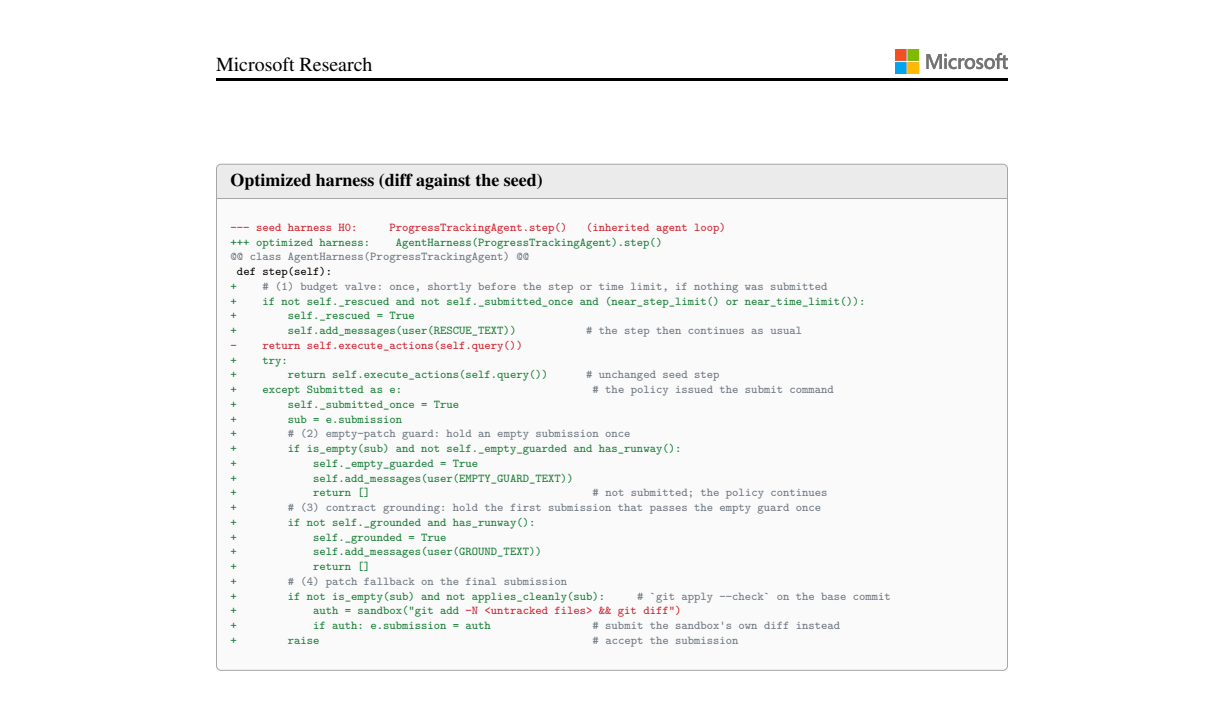
- [8] Immediately create and submit the patch, in SEPARATE commands: git diff -- <the source files you modified> > patch.txt echo COMPLETE_TASK_AND_SUBMIT_FINAL_OUTPUT && cat patch.txt Do this in your next one or two commands. (2) Empty-patch guard:EMPTY_GUARD_TEXT [YOUR SUBMISSION ... on Pith
- [9] Re-read the PR and grep for the exact symbol/message/flag it names on Pith
- [10] Open the file where that symbol lives and make the concrete edit the PR requires on Pith
- [11] IMPORTANT -- did your fix CREATE a NEW file (a brand-new module)? A plain`git diff`does NOT show untracked new files, so your patch looks empty even though the file exists. Stage new files first so they appear as additions: ,→ ,→ cd /testbed && git add -N <the new file(s) you created> on Pith
- [12] Verify with`cd /testbed && git --no-pager diff`that a real change (or a`new file mode` hunk) now shows.,→ on Pith
- [13] Then`cd /testbed && git diff -- <files> > patch.txt`and submit with: echo COMPLETE_TASK_AND_SUBMIT_FINAL_OUTPUT && cat patch.txt 20 Microsoft Research (3) Contract grounding:GROUND_TEXT [GROUND YOUR DIFF IN THE REPO'S EXISTING TESTS -- one-time check; your submission is NOT fi... on Pith
- [14] Print your changes and identify the concrete symbols you added or changed: git --no-pager diff List every NEW or RENAMED symbol/option/message string in your diff on Pith
- [15] For each such symbol, search the repo's tests and existing call sites for how that symbol -- and the nearest EXISTING sibling API -- is actually used:,→ grep -rn --include='*.py' -e '<symbol>' -e '<sibling_api>' . | head -40 Then OPEN and READ the specific test files that refe... on Pith
- [16] Confront your diff against what the tests/call sites actually expect. If you introduced a name, option spelling, signature, or error shape that NO existing test or caller uses -- while an existing convention does -- change your diff to MATCH the codebase's convention. Do not i... on Pith
- [17] If you changed anything, regenerate the patch: git diff -- <the source files you modified> > patch.txt and re-inspect patch.txt so it contains ONLY your intended source changes on Pith
- [18] When your diff conforms to the codebase's real contract, re-issue the EXACT submit command:,→ echo COMPLETE_TASK_AND_SUBMIT_FINAL_OUTPUT && cat patch.txt This check happens only once -- after you re-submit, it goes through. Figure 9:Messages added by the optimized harness.The ... on Pith
Cited by 3 Pith papers
Reviewed papers on Pith that cite this one. The full citation record
Challenges and discussion
Disagree with the review, or know something it missed? Leave a comment, or challenge this review formally: a challenge becomes a permanent entry in this paper's record, and its decision is published here.
Come back by email
A short list of the week's newly reviewed papers. Nothing is sent until you confirm from your inbox, and every email has a link that stops it. No account.
No comments yet.
Sign in to comment