Robotics · arXiv:2611.34675 v1 · submitted 25 Nov 2026 · 49 references
RoboEvo2: Recursive Robot Self-Improvement via Harness-Policy Co-Evolution
The paper says
“Robots should adapt to unfamiliar environments and acquire new skills through interaction, then execute those skills efficiently with practice.”
more of the abstract
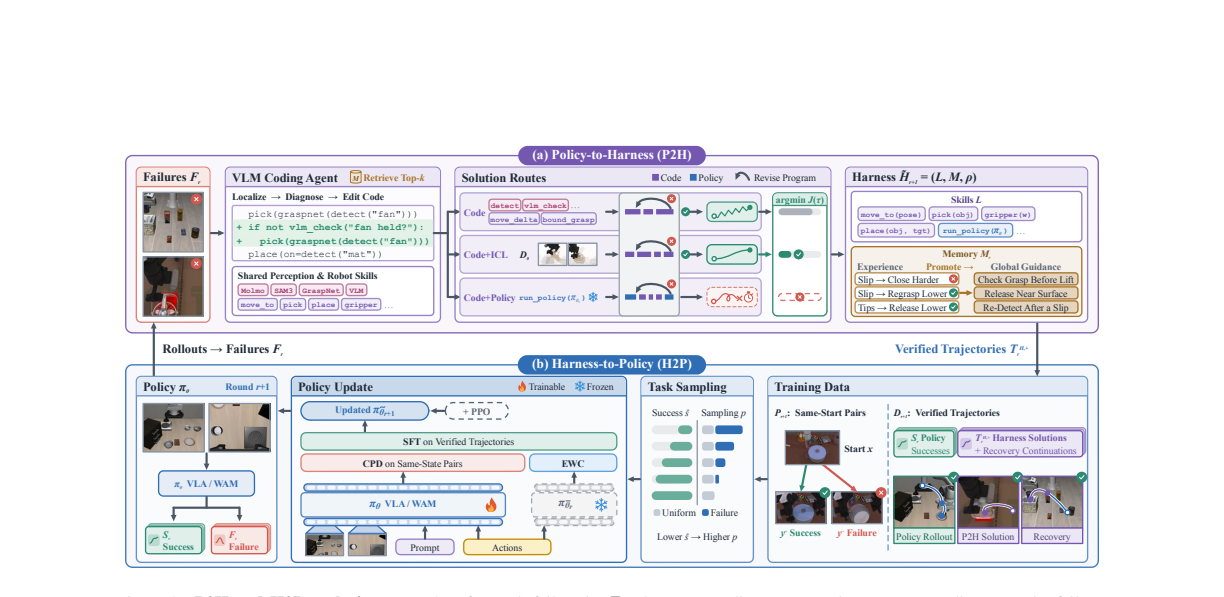
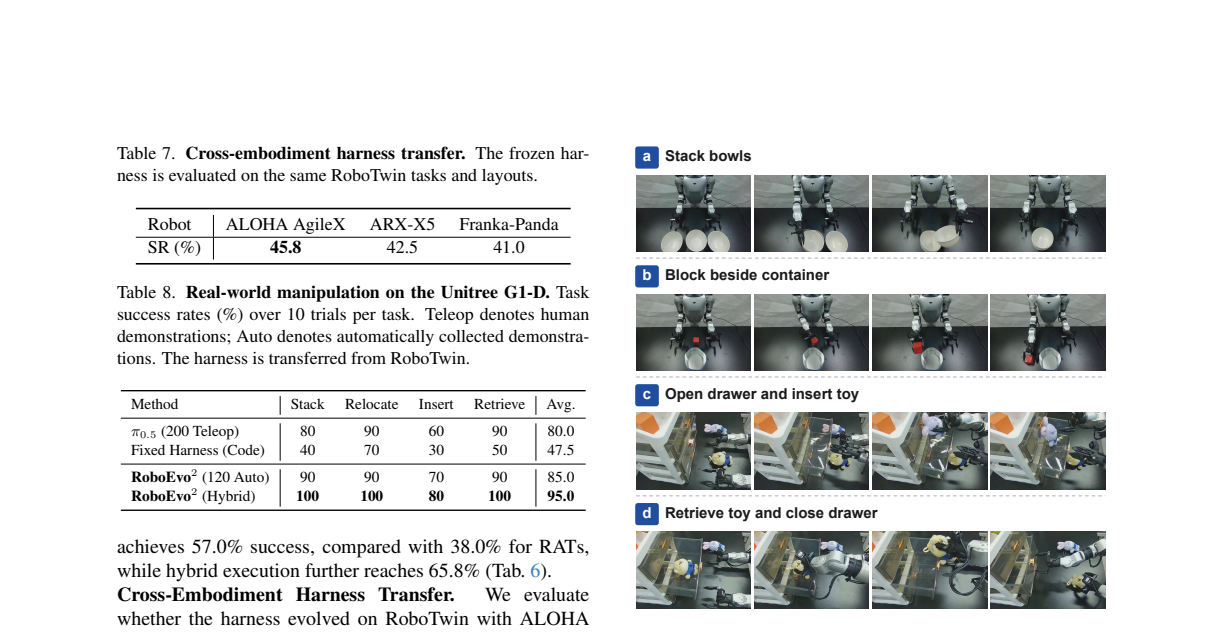
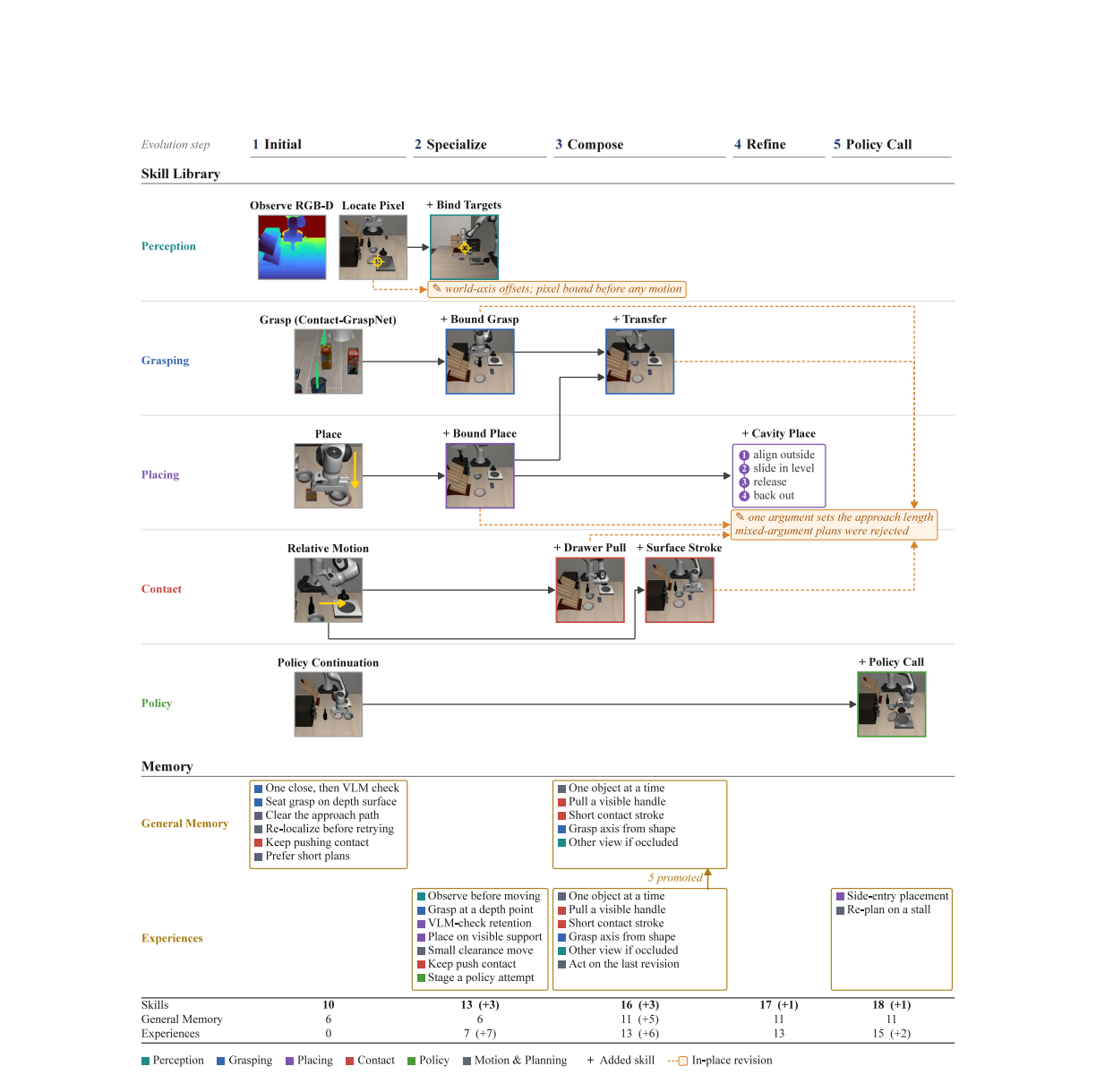
Vision-language-action policies provide efficient control, but often need additional human demonstrations to handle unfamiliar settings; reasoning agents can discover solutions using broad prior knowledge and robot-control APIs, but repeated deliberation and repair are costly. Inspired by human learning through reasoning and practice, we propose RoboEvo2, a framework for recursive harness-policy co-evolution. In Policy-to-Harness (P2H) evolution, policy failures guide a coding agent to search complementary Code, Code+ICL, and Code+Policy routes, consolidating verified solutions into reusable skills, routing strategies, and experience memory. In Harness-to-Policy (H2P) evolution, verified trajectories provide supervised training, while Counterfactual Preference Distillation (CPD) teaches the policy to favor successful corrections over failures from the same starting state. The improved policy provides stronger motor skills for subsequent search, while its remaining failures redirect harness evolution, closing the reciprocal loop. Through recursive co-evolution without additional human demonstrations, RoboEvo2 improves standalone success from 11.0% to 84.1% and hybrid success from 30.4% to 90.5% on LIBERO-PRO, with similar gains and reduced agentic costs on RoboTwin C2R. Further experiments demonstrate autonomous task acquisition, cross-embodiment harness transfer, and 95.0% hybrid success on the Unitree G1-D. Our models and code will be publicly released.
from the abstract
Pith says
Machine review · deepseek-v4-flash · 26 Nov 2026 · read the full text (93,704 characters) · not checked by a person
It can be wrong. Challenge this review or reply to it.
Holds up, with conditions. RoboEvo2 introduces a reciprocal loop between a robot's agentic harness and its neural policy, achieving large gains on standard benchmarks, but the method's dependence on a proprietary coding agent (GPT-6 Astra) raises open questions about reproducibility. This line is wrong
4 minor · 2 open questions
How often objections from reviews like this one are right: not yet measured
The paper, first character to last
The reviewer was given the whole text, 93,704 characters. Not checked: figures, code, what the 49 references say.
4 minor objections
The paper says, at References
Pith says: minor objection 1 of 4
The paper cites many works that are listed as 'arXiv preprint' or 'to appear'. While this is common in fast-moving fields, it would strengthen the paper to cite only published or publicly available works where possible, or to note the status of each citation.
The paper says, at §3.3
Pith says: minor objection 2 of 4
The definition of the per-sample training loss ℓ_θ(y|x) used in the CPD objective (Equation 2) is not explicitly stated. It would be helpful to clarify that ℓ is, for example, the mean squared error for action prediction, to make the objective self-contained.
show 2 more
The paper says, at §3.2
Pith says: minor objection 3 of 4
The normalized motion jerk J(τ) is defined in Appendix Sec. 7 but used in the main text (Equation 1). Consider including a brief definition in the main text or a forward reference to the appendix.
The paper says, at Abstract
Pith says: minor objection 4 of 4
The paper uses the term 'without additional human demonstrations' in the abstract and introduction. This is accurate for the simulation experiments, but the real-world experiment involves human resetting. Consider qualifying this claim in the abstract to avoid overstatement.
Open questions (2)
Pith raised these and could not confirm them against the text of the paper it read. They are questions for the authors, not findings.
- §4.4 How is the human resetting intervention accounted for in the real-world experiment, and could the method be made fully autonomous with automatic resetting?
- §4.1, Table 2 How do the differences in evaluation protocols between RoboEvo^2 and the prior methods compared in Table 2 affect the fairness of the comparison?
What would settle it
If a policy trained on an equal number of random successful trajectories (without corrective pairs or CPD) achieves the same success rate as the policy trained on harness-generated trajectories with CPD, then the claim that failure-driven corrective supervision is the source of improvement would be falsified. The paper's data-efficiency comparison (Table 2) already suggests this is not the case, but a direct controlled experiment with matched data quantity would settle it.
from Pith's summary of the paper
How the review went
5 passes by deepseek-v4-flash · 26 Nov 2026
- Reader holds up, with conditions
- Skeptic concern not confirmed: listed as an open question
- Referee 4 minor
- Check against the paper kept 0 of 4 objections
- Editor wrote the verdict above
Not run on this paper: the simulated authors' defence.
Pith's passes raised 4 objections. A check against the paper's text kept 0, withdrew 1 (1 the paper already says) and left 3 as questions.
The review in full
The review in brief, machine-written
This paper presents a framework for recursive co-evolution of a robot's agentic harness (skills, memory, routing) and its low-level policy. The core idea is a reciprocal loop: policy failures drive the harness to discover corrections, and those corrections then train the policy. The paper reports substantial improvements on LIBERO-PRO (standalone success from 11% to 84%) and RoboTwin C2R, with decreasing API costs over rounds. Ablations confirm that both sides of the loop contribute and that the multi-route search (Code, Code+ICL, Code+Policy) and the counterfactual preference distillation each add value. The cross-embodiment transfer and real-world results on the Unitree G1-D are encouraging, though the real-world experiment involves human scene resetting, which the paper acknowledges. The main concern is the reliance on GPT-6 Astra, a proprietary model not publicly available. The agent-backbone ablation shows a noticeable drop with an open-source model, so the headline results may not transfer to other coding agents. The paper is transparent about this limitation and about the fixed set of atomic skills. The experiments are extensive and the ablations are well-designed. This work is relevant to researchers in robot learning, continual learning, and agentic systems. It deserves a serious peer review, with particular attention to reproducibility and the sensitivity of results to the coding agent's capabilities.
The stress test's concern
Not confirmed. Pith could not check this concern against the text of the paper it was given; it is listed as an open question, not a finding.
The referee's report
Not published. Pith's referee wrote this assessment before its objections were checked against the paper, and 3 of its 3 major objections did not survive that check.
Pith's reading of the paper (a machine's summary, not the authors')
The paper tries to establish that a robot can improve its own task performance by alternating between an agentic harness that discovers solutions to policy failures and a neural policy that internalizes those solutions, forming a self-reinforcing loop. This matters because it could reduce the need for human demonstrations and enable robots to adapt to new environments autonomously. The authors report that on the LIBERO-PRO benchmark, standalone success rises from 11.0% to 84.1% and hybrid success from 30.4% to 90.5% over eight rounds, with decreasing agentic API cost. Similar gains are shown on RoboTwin C2R, along with cross-embodiment transfer and real-world results on the Unitree G1-D humanoid.
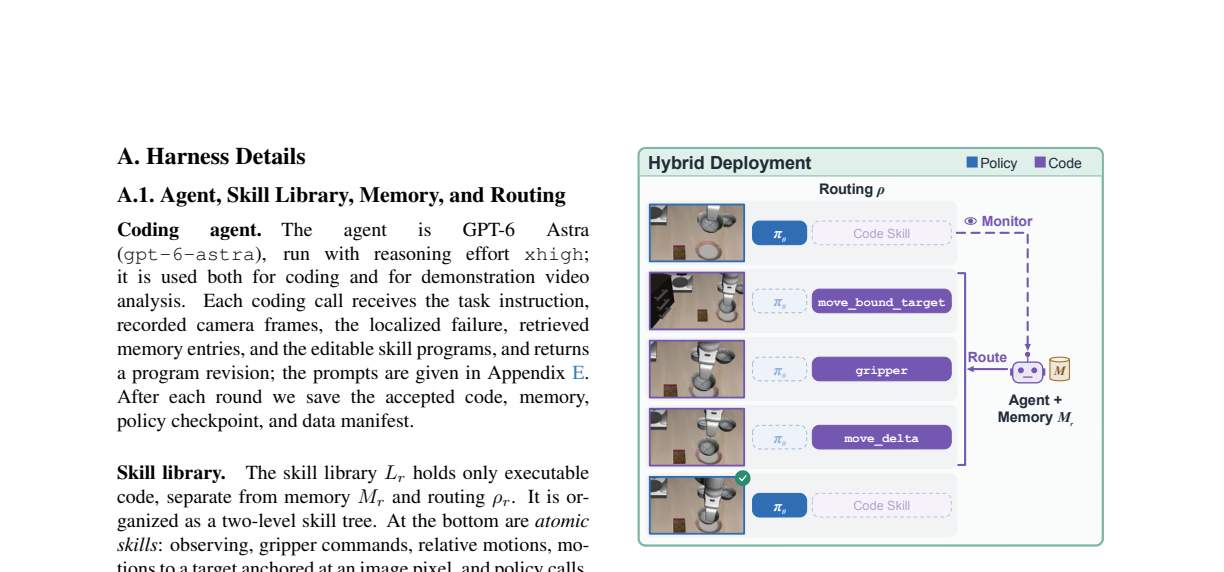
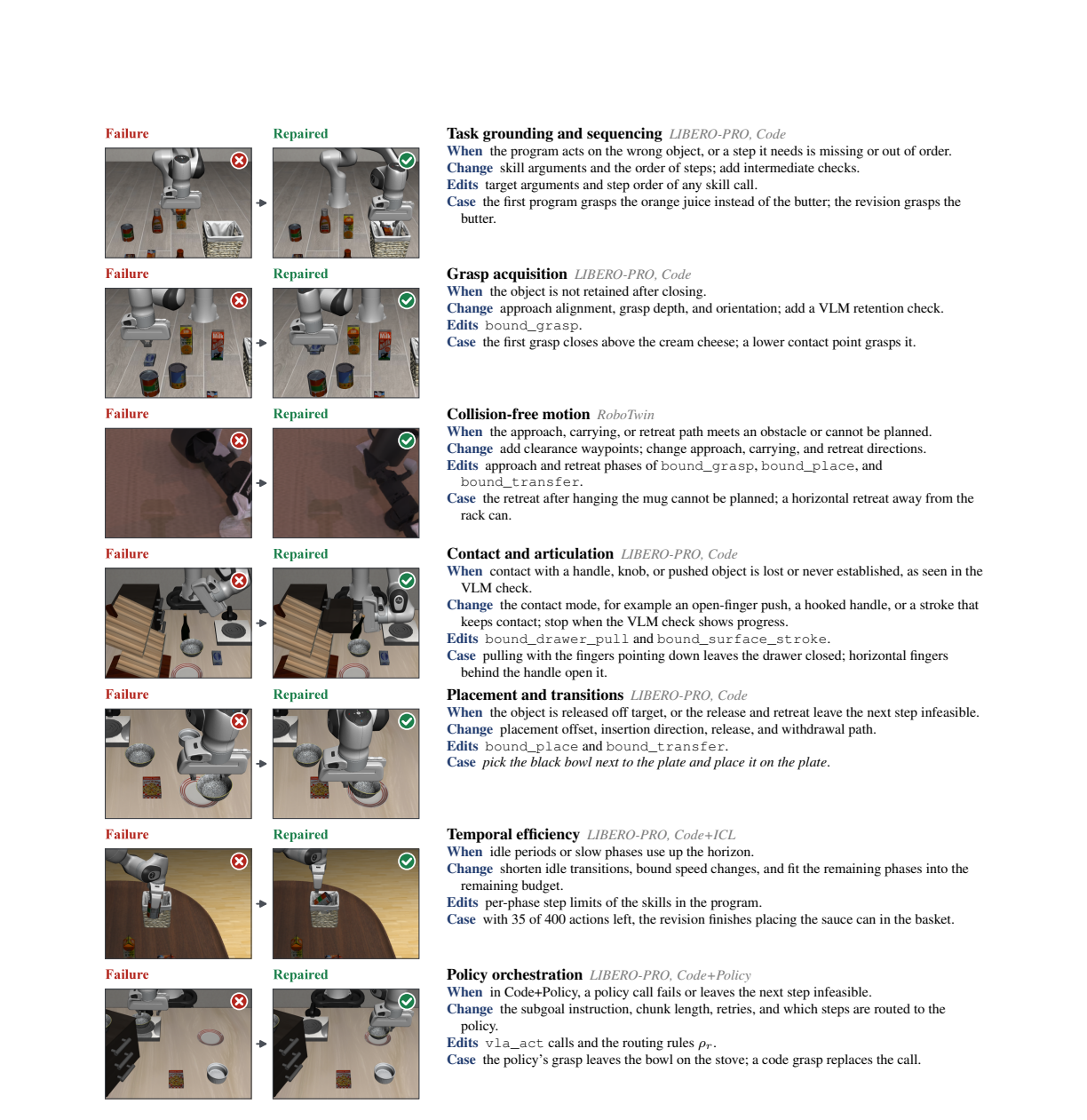
What carries the argument. The co-evolution loop: in Policy-to-Harness (P2H) evolution, a VLM coding agent (GPT-6 Astra) diagnoses each policy failure and searches three parallel solution routes—Code (refine programs), Code+ICL (incorporate a demonstration), and Code+Policy (compose programs with learned motor skills)—selecting the verified solution with the lowest normalized motion jerk. In Harness-to-Policy (H2P) evolution, verified trajectories provide supervised fine-tuning, while Counterfactual Preference Distillation (CPD) optimizes a margin between the action-prediction losses of successful and failed continuations from the same starting state, with asymmetric proximity constraints to prevent degradation. Elastic Weight Consolidation (EWC) mitigates forgetting.
Core claim. The paper's central discovery is that by alternating between Policy-to-Harness (P2H) evolution—where a coding agent diagnoses policy failures and searches three complementary solution routes (Code, Code+ICL, Code+Policy) to produce verified corrections—and Harness-to-Policy (H2P) evolution—where those corrections are used for supervised fine-tuning and Counterfactual Preference Distillation (CPD) to teach the policy to prefer successful corrections over failed alternatives—the system achieves progressive improvement in both standalone policy execution and hybrid harness-policy execution, with decreasing agentic cost over rounds. The reciprocal loop closes because the improved policy provides stronger motor primitives for subsequent search, while its remaining failures redirect harness evolution.
The premise it rests on. The coding agent (GPT-6 Astra) must be capable of diagnosing failures and generating effective repairs across diverse tasks; the paper shows that a weaker agent (Qwen3.8-27B) reduces standalone success from 84.1% to 76.0% on LIBERO-PRO, confirming that the method's success hinges on the agent's capabilities.
If the paper is right (Pith's inferences, not the authors')
Robots could autonomously acquire new skills in deployment by using policy failures to drive both harness discovery and policy internalization, reducing the need for human teleoperation.
The framework could be applied to other domains where an agentic system (e.g., a program-writing LLM) coexists with a learned policy, such as autonomous driving or surgical robotics.
The method may enable lifelong learning with minimal human intervention, as the co-evolution loop can continue as long as the policy encounters novel failures.
The progressive reduction in agentic API cost suggests that expensive reasoning can be amortized into efficient policy execution over time.
The method's performance is likely bounded by the coding agent's reasoning and coding capabilities; the agent-backbone ablation (GPT-6 Astra vs. Qwen3.8-27B) shows a 8.1-point standalone drop, suggesting that weaker agents may limit the ceiling of improvement.
The human resetting intervention in the real-world experiment (restoring the robot and scene after a failure) could be automated with a reset policy or environment, which would make the loop fully autonomous; the paper does not address this automation.
The framework might be extended to other modalities beyond vision-language-action, such as proprioceptive or tactile policies, by adapting the solution routes and the CPD objective to the new action space.
The cross-embodiment harness transfer (45.8% on ALOHA AgileX vs. 41.0% on Franka-Panda) suggests that evolved skills are partially embodiment-agnostic, but the drop indicates that some embodiment-specific tuning may still be needed.
Check this review
What was read
The passes were given all 93,704 characters of the paper's LaTeX source.
Fingerprint of that text (SHA-256): fcdd5a59bbdf2e93234c9144b83c18f153041e0c9676e9119d7604a0b13fae4b
Pith does not keep that text. Rebuilt from the paper's source or PDF by the same code, it has this fingerprint if it is the same text. From a copy of Pith's code:
PYTHONPATH=. python scripts/review_input_check.py 2611.34675
The passes, in the order they ran
- Reader deepseek-v4-flash · medium effort · $0.0033 · instructions of the Reader, fingerprint f9ead7300382…
- Skeptic deepseek-v4-flash · medium effort · $0.0030 · instructions of the Skeptic, fingerprint 8f88c0f61488…
- Referee deepseek-v4-flash · medium effort · $0.0030 · instructions of the Referee, fingerprint a852d99aea0d…
- Check against the paper deepseek-v4-flash · medium effort · $0.0048 · instructions of the Check against the paper, fingerprint 6c7a6883d551…
- Editor deepseek-v4-flash · medium effort · $0.0026 · instructions of the Editor, fingerprint e7211f6a3d27…
- Circularity check deepseek-v4-flash · medium effort · $0.0026 · instructions of the Circularity check, fingerprint e9946e39d67b…
- Summary for the page deepseek-v4-flash · medium effort · temperature 0.2 · $0.0030 · instructions of the Summary for the page, fingerprint e4f56bf568e7…
The passes cost $0.022 in model calls together.
Version stamped on this review: pith-pipeline@v1.4.1-daily-deepseek-or-medium+deepseek/deepseek-v4-flash+p.d60f54226f00
Each link opens a pass's instructions as plain text, the exact bytes its fingerprint was taken over. Every stored set of instructions.
curl -s https://pith.science/methodology/prompts/f9ead730038216984cfb56d7cb34332bdf691828296a1de4245f3d6667d4bf56 | sha256sum
prints the fingerprint of the reader's instructions. The same works for every pass.
The receipt
The review's fingerprint was taken on 26 Nov 2026. The review you are reading still matches it.
Fingerprint of the review (SHA-256): 16ecc6c019bb41aa5db676464a5ee34bd5dc4a0d900bdd4dc1d07dca04c9bfd9
curl -s 'https://pith.science/api/v1/verdicts/2611.34675?form=canonical' | sha256sum
prints the fingerprint of the review as it stands now. The rule, in four steps.
A matching fingerprint shows the review has not changed since that date. It does not show that the review is right.
How often reviews like this one are right
Reviews like this one: written by deepseek-v4-flash, from the paper's LaTeX source.
How often objections from reviews like this one are right: not yet measured
Reviews by people
This review was written by a machine. No person has reviewed this paper on Pith yet. A scientist listed on Pith can review it for a fee, and their review is published here whatever it concludes.
The paper
Abstract
Robots should adapt to unfamiliar environments and acquire new skills through interaction, then execute those skills efficiently with practice. Vision-language-action policies provide efficient control, but often need additional human demonstrations to handle unfamiliar settings; reasoning agents can discover solutions using broad prior knowledge and robot-control APIs, but repeated deliberation and repair are costly. Inspired by human learning through reasoning and practice, we propose RoboEvo2, a framework for recursive harness-policy co-evolution. In Policy-to-Harness (P2H) evolution, policy failures guide a coding agent to search complementary Code, Code+ICL, and Code+Policy routes, consolidating verified solutions into reusable skills, routing strategies, and experience memory. In Harness-to-Policy (H2P) evolution, verified trajectories provide supervised training, while Counterfactual Preference Distillation (CPD) teaches the policy to favor successful corrections over failures from the same starting state. The improved policy provides stronger motor skills for subsequent search, while its remaining failures redirect harness evolution, closing the reciprocal loop. Through recursive co-evolution without additional human demonstrations, RoboEvo2 improves standalone success from 11.0% to 84.1% and hybrid success from 30.4% to 90.5% on LIBERO-PRO, with similar gains and reduced agentic costs on RoboTwin C2R. Further experiments demonstrate autonomous task acquisition, cross-embodiment harness transfer, and 95.0% hybrid success on the Unitree G1-D. Our models and code will be publicly released.
The paper's own sentences, arranged, kept beside the review and separate from it. Each label is drawn from a closed vocabulary; the number beside it is the probability the classifier gave that label. No sentence in this record was written by a model.
abstract compiled · 2026-11-26
The authors' main claim, as the classifier picked it out 1.00
“Through recursive co-evolution without additional human demonstrations, RoboEvo$^2$ improves standalone success from 11.0% to 84.1% and hybrid success from 30.4% to 90.5% on LIBERO-PRO, with similar gains and reduced agentic costs on RoboTwin C2R.”
How the main claim is stated: asserted 1.00
What the abstract itself states, as probabilities: claims first 0.06 · states limitation 0.15 · human participants 0.07 · controlled comparison 0.60 · randomized assignment 0.02 · states quantitative result 0.99 · compares with prior results 0.65 · mentions code or data availability 0.98
The abstract, sentence by sentence
This table labels the abstract only (arXiv listing abstract v1). The number is the probability the classifier gave the label.
| Sentence | Role | The authors' own work | States the main conclusion | Strength |
|---|---|---|---|---|
| Robots should adapt to unfamiliar environments and acquire new skills through interaction, then execute those skills efficiently with practice. | background 1.00 | 0.05 | 0.03 | asserted 0.88 |
| Vision-language-action policies provide efficient control, but often need additional human demonstrations to handle unfamiliar settings; reasoning agents can discover solutions using broad prior knowledge and robot-control APIs, but repeated deliberation and repair are costly. | background 0.73 | 0.08 | 0.02 | asserted 0.91 |
| Inspired by human learning through reasoning and practice, we propose RoboEvo$^2$, a framework for recursive harness-policy co-evolution. | contribution 0.99 | 0.71 | 0.06 | asserted 0.94 |
| In Policy-to-Harness (P2H) evolution, policy failures guide a coding agent to search complementary Code, Code+ICL, and Code+Policy routes, consolidating verified solutions into reusable skills, routing strategies, and experience memory. | method 0.99 | 0.87 | 0.05 | asserted 0.99 |
| In Harness-to-Policy (H2P) evolution, verified trajectories provide supervised training, while Counterfactual Preference Distillation (CPD) teaches the policy to favor successful corrections over failures from the same starting state. | method 0.99 | 0.85 | 0.04 | asserted 1.00 |
| The improved policy provides stronger motor skills for subsequent search, while its remaining failures redirect harness evolution, closing the reciprocal loop. | method 0.98 | 0.58 | 0.08 | asserted 1.00 |
| Through recursive co-evolution without additional human demonstrations, RoboEvo$^2$ improves standalone success from 11.0% to 84.1% and hybrid success from 30.4% to 90.5% on LIBERO-PRO, with similar gains and reduced agentic costs on RoboTwin C2R. | result 1.00 | 0.97 | 0.71 | asserted 1.00 |
| Further experiments demonstrate autonomous task acquisition, cross-embodiment harness transfer, and 95.0% hybrid success on the Unitree G1-D. | result 1.00 | 0.96 | 0.13 | asserted 1.00 |
| Our models and code will be publicly released. | future work 0.82 | 0.50 | 0.03 | asserted 0.98 |
What kind of paper the classifier reports this is: method or tool 1.00 · evidence from observation or experiment 0.85
What was examined, and what was not
Sources read
- arXiv listing abstract v1
Not examined
- full text
- figures and tables
- references and citing sentences
- relations to other papers
Levels run
- P abstract
Not run
- S sections
- T body sentences
- C citations
- R cross-paper relations
How the labels were made
Compiled by classifier-1.13.0 via TypeSafe API, question bank abstract-p1-20260923, 2026-11-26: 1 request, 7,106 input tokens.
Every quoted sentence on this record is the authors'. Every label is from Pith's closed vocabulary, with the probability shown beside it. This record as JSON
Figures (8)



Figures are the authors', reproduced from the paper.
References (49)
- [1] Ali Amin, Raichelle Aniceto, Ashwin Balakrishna, Kevin Black, Ken Conley, Grace Connors, James Darpinian, Karan Dhabalia, Jared DiCarlo, Danny Driess, Michael Equi, Ad- nan Esmail, Yunhao Fang, Chelsea Finn, Catherine Glossop, Thomas Godden, Ivan Goryachev, Lachy Groom, Hunter... on Pith
- [2] Kevin Black, Noah Brown, James Darpinian, Karan Dha- balia, Danny Driess, Adnan Esmail, Michael Robert Equi, Chelsea Finn, Niccolo Fusai, Manuel Y . Galliker, Dibya Ghosh, Lachy Groom, Karol Hausman, Brian Ichter, Szy- mon Jakubczak, Tim Jones, Liyiming Ke, Devin LeBlanc, Serg... on Pith
- [3] Kevin Black, Noah Brown, Danny Driess, Adnan Esmail, Michael Equi, Chelsea Finn, Niccolo Fusai, Lachy Groom, Karol Hausman, Brian Ichter, Szymon Jakubczak, Tim Jones, Liyiming Ke, Sergey Levine, Adrian Li-Bell, Mohith Mothukuri, Suraj Nair, Karl Pertsch, Lucy Xiaoyang Shi, Jam... on Pith
- [4] Mingju Chen, Can Lv, Guibin Zhang, Heng Chang, and Shiji Zhou. HarnessForge: Joint harness and policy evolu- tion for adaptive agent systems. InConference on Empirical Methods in Natural Language Processing (EMNLP), pages 43130–43155. Association for Computational Linguistics, on Pith
- [5] Tianxing Chen, Zanxin Chen, Baijun Chen, Zijian Cai, Yibin Liu, Zixuan Li, Qiwei Liang, Xianliang Lin, Yiheng Ge, Zhenyu Gu, Weiliang Deng, Yubin Guo, Tian Nian, Xuan- bing Xie, Qiangyu Chen, Kailun Su, Tianling Xu, Guodong Liu, Mengkang Hu, Huan-ang Gao, Kaixuan Wang, Zhix- u... on Pith
- [6] Ziyang Chen, Shaoguang Wang, Weiyu Guo, Qianyi Cai, He Zhang, Pengteng Li, Yiren Zhao, and Yandong Guo. PHASER: Phase-aware and semantic experience re- play for Vision-Language-Action models.arXiv preprint arXiv:2606.03598, 2026. 3 on PithPith's reviewarXiv
- [7] Zhengyu Chen, Teng Xiao, Huaisheng Zhu, Yige Yuan, Luan Zhang, and Jingang Wang. Co-Harness: Co-evolving har- nesses and model weights for LLM agents.arXiv preprint arXiv:2607.22688, 2026. 2, 3 on PithPith's reviewarXiv
- [8] Haoyuan Deng, Jiebin Liu, Tengxiao Zhang, Langning Yan, Hongye Cao, and Ziwei Wang. DynaHarness: A dy- namic physical harness for self-evolving robot agents.arXiv preprint arXiv:2609.40306, 2026. 6, 7 on PithPith's reviewarXiv
- [9] Xin Ding, Liang Mi, Mingzhe Huang, Zixuan Wang, Chao Zhang, Zixu Hao, Fu Chen, Xiangyu Li, Yikai Zheng, Yaoyu Guo, Weijun Wang, Kun Li, Hao Wu, Yunxin Liu, and Ting Cao. Zettaζ: An efficient closed-loop embodied har- ness for self-evolving physical intelligence.arXiv preprint ... on PithPith's reviewarXiv
- [10] Letian Fu, Justin Yu, Karim El-Refai, Ethan Kou, Haoru Xue, Huang Huang, Wenli Xiao, Li Fei-Fei, Guanya Shi, Jiajun Wu, S. Shankar Sastry, Yuke Zhu, Ken Goldberg, and Linxi Fan. CaP-X: A framework for benchmarking and improving coding agents for robot manipulation. InInter- na... on Pith
- [11] Jun Guo, Qiwei Li, Peiyan Li, Zilong Chen, Nan Sun, Yifei Su, Heyun Wang, Yuan Zhang, Xinghang Li, and Huaping Liu. Unified 4D world action modeling from video priors with asynchronous denoising.arXiv preprint arXiv:2604.26694, 2026. 2 on PithPith's reviewarXiv
- [12] Huy Ha, Pete Florence, and Shuran Song. Scaling up and distilling down: Language-guided robot skill acquisition. In Conference on Robot Learning (CoRL), pages 3766–3777. PMLR, 2023. 2 9 on Pith
- [13] Wei Huang, Bohan Zhang, Chenzhi Liu, Isabella Liu, Shuai Yang, Weian Mao, Luozhou Wang, Yicheng Xiao, Weifeng Lin, Qixin Hu, Bryan Chu, Sifei Liu, Linxi Fan, Xiao- juan Qi, Song Han, and Yukang Chen. Long-W AM: Scal- ing the context of world-action models.arXiv preprint arXiv:... on PithPith's reviewarXiv
- [14] Michael Kelly, Chelsea Sidrane, Katherine Driggs- Campbell, and Mykel J. Kochenderfer. HG-DAgger: Interactive imitation learning with human experts. InIEEE International Conference on Robotics and Automation (ICRA), pages 8077–8083, 2019. 3 on Pith
- [15] Moo Jin Kim, Karl Pertsch, Siddharth Karamcheti, Ted Xiao, Ashwin Balakrishna, Suraj Nair, Rafael Rafailov, Ethan P. Foster, Pannag R. Sanketi, Quan Vuong, Thomas Kollar, Benjamin Burchfiel, Russ Tedrake, Dorsa Sadigh, Sergey Levine, Percy Liang, and Chelsea Finn. OpenVLA: An ... on Pith
- [16] Yejin Kim, Wilbert Pumacay, Omar Rayyan, Max Argus, Winson Han, Eli VanderBilt, Jordi Salvador, Abhay Desh- pande, Rose Hendrix, Snehal Jauhri, Shuo Liu, Nur Muham- mad Mahi Shafiullah, Maya Guru, Ainaz Eftekhar, Karen Farley, Donovan Clay, Jiafei Duan, Arjun Guru, Piper Wolte... on PitharXiv
- [17] James Kirkpatrick, Razvan Pascanu, Neil Rabinowitz, Joel Veness, Guillaume Desjardins, Andrei A. Rusu, Kieran Milan, John Quan, Tiago Ramalho, Agnieszka Grabska- Barwinska, Demis Hassabis, Claudia Clopath, Dharshan Ku- maran, and Raia Hadsell. Overcoming catastrophic for- gett... on Pith
- [18] Haoran Lang, Haotao Lu, Shiyu Sang, Haoyang Luo, Guo Chen, Qun Li, Jingyi Yu, Ye Shi, and Jingya Wang. EmbodiRSI: Recursive self-improvement for data-efficient robot adaptation.arXiv preprint arXiv:2609.38905, 2026. 3 on PithPith's reviewarXiv
- [19] Ge Li, Hongyi Zhou, Dominik Roth, Serge Thilges, Fabian Otto, Rudolf Lioutikov, and Gerhard Neumann. Open the black box: Step-based policy updates for temporally- correlated episodic reinforcement learning. InInternational Conference on Learning Representations (ICLR), 2024. 4 on Pith
- [20] Wenyi Li, Yizhe Chi, Youjie Zheng, Chunyu Liu, Xiao- qiu Wang, Mingju Gao, Zheng Jiang, Deyao Hong, Calvin Xiao, Kaisen Yang, and Qinhuai Na. EmbodiedEvo: Self- evolving coding agent for physical intelligence.arXiv preprint arXiv:2610.18867, 2026. 2, 3 on PithPith's reviewarXiv
show 29 more
- [21] Jacky Liang, Wenlong Huang, Fei Xia, Peng Xu, Karol Hausman, Brian Ichter, Pete Florence, and Andy Zeng. Code as policies: Language model programs for embodied control. InIEEE International Conference on Robotics and Automa- tion (ICRA), pages 9493–9500, 2023. 2, 3 on Pith
- [22] Bo Liu, Yifeng Zhu, Chongkai Gao, Yihao Feng, Qiang Liu, Yuke Zhu, and Peter Stone. LIBERO: Benchmarking knowl- edge transfer for lifelong robot learning. InAdvances in Neu- ral Information Processing Systems (NeurIPS), Datasets and Benchmarks Track, 2023. 19 on Pith
- [23] Chenzhi Liu, Yue Zhang, Jiehong Lin, Jianan Wang, Bo Wang, Zhongrui Wang, and Xiaojuan Qi. MobiAgent: Dual- loop recursive policy self-improvement for long-horizon mo- bile manipulation. InConference on Robot Learning (CoRL), on Pith
- [24] Huihan Liu, Changyeon Kim, Bo Liu, Minghuan Liu, and Yuke Zhu. Pretrained Vision-Language-Action models are surprisingly resistant to forgetting in continual learning. InInternational Conference on Machine Learning (ICML), pages 77119–77140. PMLR, 2026. 3 on Pith
- [25] Zuxin Liu, Jesse Zhang, Kavosh Asadi, Yao Liu, Ding Zhao, Shoham Sabach, and Rasool Fakoor. TAIL: Task-specific adapters for imitation learning with large pretrained mod- els. InInternational Conference on Learning Representa- tions (ICLR), 2024. 3 on Pith
- [26] Runyu Lu, Yubo Wu, Ethan Kou, Haotian Lin, Letian Fu, Wenli Xiao, Ajay Mandlekar, Yinzhen Xu, Guanya Shi, Ken Goldberg, Ang Chen, Mosharaf Chowdhury, Jan Kautz, Yuke Zhu, Linxi Fan, and Guanzhi Wang. AS- PIRE: Agentic /skills discovery for robotics.arXiv preprint arXiv:2607.00... on PithPith's reviewarXiv
- [27] Arun Mallya and Svetlana Lazebnik. PackNet: Adding multiple tasks to a single network by iterative pruning. InIEEE/CVF Conference on Computer Vision and Pattern Recognition (CVPR), pages 7765–7773, 2018. 3 on Pith
- [28] Qwen Team. Qwen3.8-27B. Hugging Face model card, https://huggingface.co/Qwen/Qwen3.8-27B, on Pith
- [29] David Rolnick, Arun Ahuja, Jonathan Schwarz, Timothy P. Lillicrap, and Greg Wayne. Experience replay for contin- ual learning. InAdvances in Neural Information Processing Systems (NeurIPS), 2019. 3 on Pith
- [30] Stéphane Ross, Geoffrey J. Gordon, and J. Andrew Bagnell. A reduction of imitation learning and structured prediction to no-regret online learning. InInternational Conference on Artificial Intelligence and Statistics (AISTATS), pages 627– 635, 2011. 2 on Pith
- [31] John Schulman, Filip Wolski, Prafulla Dhariwal, Alec Rad- ford, and Oleg Klimov. Proximal policy optimization algo- rithms.arXiv preprint arXiv:1707.06347, 2017. 5 on PithPith's reviewarXiv
- [32] Python Song, Zhixuan Liang, Kelsey Fu, Mengdi Wang, Jun- feng Yang, and Shilong Liu. EmbodiedRSI: Active contin- ual robot learning through hypothesis-guided co-evolution. arXiv preprint arXiv:2610.10498, 2026. 2, 3, 6, 7 on PithPith's reviewarXiv
- [33] Weikang Wan, Yifeng Zhu, Rutav Shah, and Yuke Zhu. LO- TUS: Continual imitation learning for robot manipulation through unsupervised skill discovery. InIEEE International Conference on Robotics and Automation (ICRA), 2024. 3 on Pith
- [34] Peidong Wang, Ying Chang, Zhiming Ma, Xiaocui Yang, Shi Feng, Daqi Liu, Yuzhe Yang, Xu Cao, Chuang Wang, Jian Su, and Daling Wang. AdaRSI: On-demand recur- sive self-improvement for embodied agents.arXiv preprint arXiv:2610.20474, 2026. 2, 3 10 on PithPith's reviewarXiv
- [35] Yen-Jen Wang, Haozhe Jiang, Shuying Deng, Haoru Xue, Weirui Ye, Rocky Duan, Nika Haghtalab, S. Shankar Sas- try, Pieter Abbeel, and Haozhi Qi. Reconstruct, practice, go real: Guided self-improvement for embodied agents.arXiv preprint arXiv:2610.02204, 2026. 2, 3 on PithPith's reviewarXiv
- [36] Zhijie Wei, Ferris Tan, Jinghui Wang, and Hao Zhou. Scale and selection: What makes automatic harness evolu- tion work for visual-interface robot agents.arXiv preprint arXiv:2609.39304, 2026. 2 on PithPith's reviewarXiv
- [37] Zhepei Wei, Wenlin Yao, Baolin Peng, Danqing Wang, Qianhui Wu, Hao Cheng, Yu Meng, and Jianfeng Gao. Self-evolving coding agents via harness-policy optimization. arXiv preprint arXiv:2610.22791, 2026. 3 on PithPith's reviewarXiv
- [38] Yihao Wu, He Zhang, Junbo Tan, Xueqian Wang, and Zhengyou Zhang. FlowPRO: Reward-free reinforced fine- tuning of flow-matching VLAs via proximalized preference optimization.arXiv preprint arXiv:2606.05468, 2026. 3 on PithPith's reviewarXiv
- [39] Wenke Xia, Yichu Yang, Hongtao Wu, Xiao Ma, Tao Kong, and Di Hu. Human-assisted robotic policy refinement via action preference optimization. InAdvances in Neural Infor- mation Processing Systems (NeurIPS), 2025. 3 on Pith
- [40] Wenli Xiao, Jia Xie, Tonghe Zhang, Haotian Lin, Letian Max Fu, Haoru Xue, Jalen Lu, Yi Yang, Cunxi Dai, Zi Wang, Jimmy Wu, Guanzhi Wang, S. Shankar Sastry, Ken Gold- berg, Linxi Jim Fan, Yuke Zhu, and Guanya Shi. ENPIRE: Agentic robot policy self-improvement in the real world.... on Pith
- [41] Tianyuan Yuan, Zibin Dong, Yicheng Liu, and Hang Zhao. Fast-W AM: Do world action models need test-time future imagination? InAdvances in Neural Information Processing Systems (NeurIPS), 2026. 2 on Pith
- [42] Qixin Zeng, Shuo Zhang, Hongyin Zhang, Renjie Wang, Han Zhao, Libang Zhao, Runze Li, Donglin Wang, and Chao Huang. CRL-VLA: Continual Vision-Language-Action learning.arXiv preprint arXiv:2602.03445, 2026. 3 on PitharXiv
- [43] Junyi Zhang, Jiaxin Ge, Hanjun Yoo, Letian Fu, Zihan Yang, Yaowei Liu, Raj Saravanan, Shaofeng Yin, Justin Yu, Dan- tong Niu, Zirui Wang, Roei Herzig, Ken Goldberg, Yutong Bai, David M. Chan, Ion Stoica, Angjoo Kanazawa, Jiahui Lei, Haiwen Feng, and Trevor Darrell. Playful age... on Pith
- [44] Yixian Zhang, Huanming Zhang, Feng Gao, Xiao Li, Zhihao Liu, Yi Nie, Chunyang Zhu, Jiaxing Qiu, Yuchen Yan, Jiyuan Liu, Wenhao Tang, Jiaji Rao, Zhengru Fang, Changxu Wei, Yu Wang, Wenbo Ding, and Chao Yu. Harness VLA: Steer- ing frozen VLAs into reliable manipulation primitive... on PithPith's reviewarXiv
- [45] Jinliang Zheng, Jianxiong Li, Zhihao Wang, Dongxiu Liu, Xirui Kang, Yuchun Feng, Yinan Zheng, Jiayin Zou, Yilun Chen, Jia Zeng, Ya-Qin Zhang, Jiangmiao Pang, Jingjing Liu, Tai Wang, and Xianyuan Zhan. X-VLA: Soft-prompted transformer as scalable cross-embodiment vision-languag... on Pith
- [46] Xueyang Zhou, Yangming Xu, Guiyao Tie, Yongchao Chen, Guowen Zhang, Duanfeng Chu, Pan Zhou, and Lichao Sun. LIBERO-PRO: Towards robust and fair evaluation of vision-language-action models beyond memorization.arXiv preprint arXiv:2510.03827, 2025. 2, 5, 6 on PithPith's reviewarXiv
- [47] Zhiyuan Zhou, Pranav Atreya, Abraham Lee, Homer Walke, Oier Mees, and Sergey Levine. Autonomous improvement of instruction following skills via foundation models. In Conference on Robot Learning (CoRL), pages 4805–4825. PMLR, 2024. 2, 3 on Pith
- [48] Jiarun Zhu, Yijun Hong, Xiaoquan Sun, Zetian Xu, Qijun He, Haijier Chen, Zhiyong Wang, Mingqi Yuan, Wenjun Zeng, and Jiayu Chen. Can Vision-Language-Action models learn from real-world data continually without forgetting? arXiv preprint arXiv:2605.26820, 2026. 3 11 Contents A ... on PithPith's reviewarXiv
- [2026] Accessed November 14, 2026. 18 on Pith
Challenges and discussion
Disagree with the review, or know something it missed? Leave a comment, or challenge this review formally: a challenge becomes a permanent entry in this paper's record, and its decision is published here.
Come back by email
A short list of the week's newly reviewed papers. Nothing is sent until you confirm from your inbox, and every email has a link that stops it. No account.
No comments yet.
Sign in to comment