Robotics · arXiv:2611.31715 v1 · submitted 24 Nov 2026 · 7 references
Sparks of Weight-Space Programming for Robot Foundation Models
The paper says
“This paper demonstrates an approach for correcting failures of robot foundation models (RFMs) without additional data collection, demonstrations, or training.”
more of the abstract
We apply weight-space programming (WSP), in which a language-model agent directly reads and writes a neural network's parameters, to a large, pre-trained vision-language-action policy. The idea is simple: many policy failures are not random but repeatedly land in the same recognizable stuck state, so if that state is visible in the model's internal activations, a small edit could trigger a corrective movement while leaving the rest of the model's parameters unchanged. A core design choice is where to write the edit: repurposing a few near-silent neurons in the action expert lets the edit switch on in situations associated with the failure and produce a corrective movement, such as lowering the gripper toward the target, that is specified directly rather than learned through training. Empirically, when applied to the pi0.5 policy in simulation, we find that edits to roughly 0.0002% of the parameters can improve success on recurring failures, including for a policy that was already fine-tuned on its task. Reversed and random edits indicate that the gains come from the intended behavior, and the approach works best when the failure situation is recognizable and a simple correction can address it.
from the abstract
Pith says
Machine review · deepseek-v4-flash · 25 Nov 2026 · read the full text (12,243 characters) · not checked by a person
It can be wrong. Challenge this review or reply to it.
Small weight edits (0.0002% of parameters) improve success on recurring failures of a Pi0.5 robot policy in simulation, with controls supporting the effect, but missing confidence intervals and procedural details leave the reliability unquantified. This line is wrong
3 major objections · 3 minor
How often objections from reviews like this one are right: not yet measured
The paper, first character to last
The reviewer was given the whole text, 12,243 characters. Not checked: figures, code, what the 7 references say.
The paper says, at Results
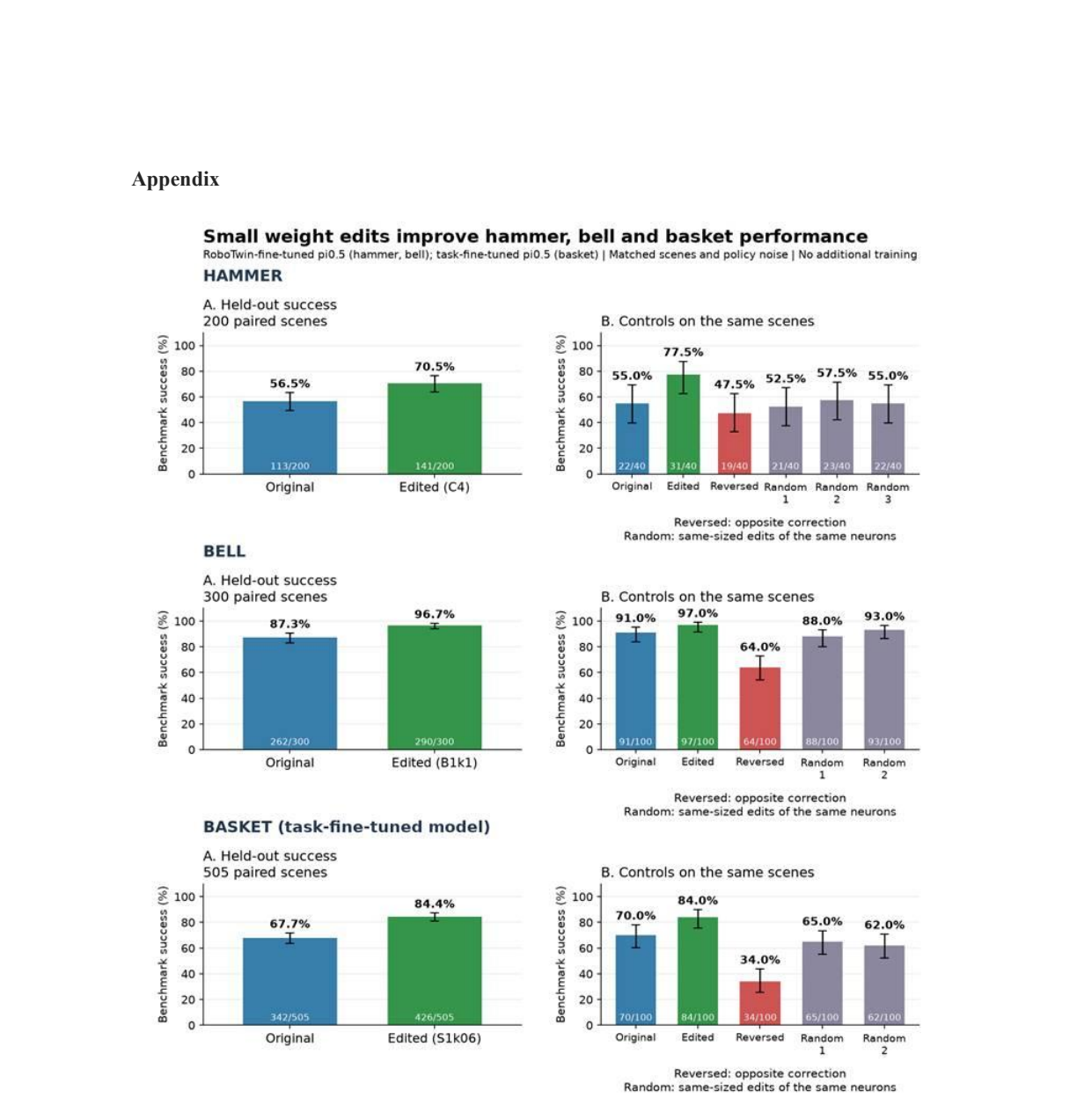
“On the hammer task, success rose from 56.5% to 70.5% across 200 new scenes: the edit fixed 41 scenes but broke 13.”
quote found in the text Pith read
Pith says: Objection 1 of 3 · major
The paper reports success-rate improvements for the three main tasks (hammer, bell, basket) but provides no confidence intervals or statistical significance tests. Without such measures, it is unclear whether the observed gains are reliable beyond sampling variation. The paper does mention that the move_can_pot improvement was 'not statistically significant,' implying that some test was used, but the test, threshold, and results for the main tasks are not reported. Provide confidence intervals or p-values for all held-out evaluations.
What would answer it In the Results section, add 95% confidence intervals (e.g., bootstrap intervals) for the success-rate improvements on the hammer, bell, and basket tasks, and report the statistical test used for the move_can_pot comparison. The author can verify the fix by checking that the intervals are computed from the held-out scene counts and do not overlap zero for the main tasks.
The paper says, at Target Failure Modes and Edit Procedure
“In the base model, a survey of all 73,728 neurons in the module’s action expert found only six that were essentially never active on the tasks checked, all in its final layer.”
quote found in the text Pith read
Pith says: Objection 2 of 3 · major
The edit procedure is described at a high level, but key details needed for reproducibility are missing. The criteria for identifying 'near-silent' neurons (activation threshold), the method by which the agent finds a pattern marking the stuck state, and the exact weight changes written are not specified. Without these details, other researchers cannot replicate the edits or assess the generality of the approach.
What would answer it In the 'Target Failure Modes and Edit Procedure' section, specify the activation threshold used to classify a neuron as near-silent (e.g., maximum activation < 0.01 over all tasks), describe the pattern-matching algorithm (e.g., threshold on activation values, clustering, or manual inspection), and provide the exact weight changes written (e.g., the delta values or the new connection weights). The author can verify the fix by ensuring that a researcher can replicate the edits from the description.
The paper says, at Results
“the edit fixed 41 scenes but broke 13.”
quote found in the text Pith read
Pith says: Objection 3 of 3 · major
The edits broke a non-negligible number of scenes (13 of 200 for hammer, 37 of 505 for basket). The paper does not analyze these broken scenes: are they concentrated in particular scene configurations, object types, or failure modes? Understanding the conditions under which the edit introduces new failures is important for assessing the method's reliability and for guiding future improvements.
What would answer it In the Results section, add an analysis of the broken scenes: report whether they are concentrated in specific object types, scene configurations, or failure modes, and discuss possible reasons. The author can verify the fix by checking that the analysis is based on the held-out scene logs.
3 minor objections
The paper says, at Results
Pith says: minor objection 1 of 3
Typo: 'playin g cards' should be 'playing cards'.
The paper says, at Target Failure Modes and Edit Procedure
Pith says: minor objection 2 of 3
The number of edit iterations is reported only for the hammer task (four iterations). For completeness, report the iteration count for the other tasks that reached held-out testing.
show 1 more
The paper says, at References
Pith says: minor objection 3 of 3
Several references are given as URLs (e.g., [1], [2], [4]). For stability, consider adding DOIs or arXiv IDs where available.
What would settle it
An independent replication using the same procedure on the same Pi0.5 policy and RoboTwin simulator that fails to reproduce the reported success improvements (e.g., hammer success does not increase beyond sampling variation) would falsify the claim. More specifically, if the edit procedure is applied to a failure mode that is not stably represented in activations, no improvement should be observed.
from Pith's summary of the paper
How the review went
5 passes by deepseek-v4-flash · 25 Nov 2026
- Reader holds up, with conditions
- Skeptic concern withdrawn: Pith's reviewer misread the paper
- Referee 3 major objections, 3 minor
- Check against the paper kept 3 of 4 objections
- Editor wrote the verdict above
Not run on this paper: the simulated authors' defence.
Pith's passes raised 4 objections. A check against the paper's text kept 3 and withdrew 1 (1 Pith's reviewer misread the paper).
The review in full
The review in brief, machine-written
This paper demonstrates that direct weight editing of a large vision-language-action policy (Pi0.5) can improve success on three of five recurring failure tasks in simulation, without new data or training. The protocol is stronger than typical for this kind of work: edits were locked and tested on held-out scenes with pre-set pass marks, and reversed-edit and random-edit controls argue the gains are directional, not perturbation artifacts. The improvements—13 to 17 percentage points on hammer, bell, and basket tasks—are real but modest. The paper also shows the approach can improve a policy already fine-tuned on its task, and it acknowledges that the method works best when failures are recognizable and simply correctable. The soft spots are in the reporting. First, the paper provides no confidence intervals or statistical significance tests for the main results. It mentions that one task's improvement was 'not statistically significant' but does not report the test or its threshold for the others. Without these, it is unclear whether the observed gains are reliable beyond sampling variation. Second, key procedural details needed for reproducibility are missing: the criteria for identifying 'near-silent' neurons, the method by which the agent finds a pattern marking the stuck state, and the exact weight changes written. Third, the edits broke a non-negligible number of scenes (13 of 200 for hammer, 37 of 505 for basket), but the paper does not analyze these broken scenes—whether they concentrate in particular configurations or failure modes. Understanding when the edit introduces new failures is important for assessing reliability. The paper is a short empirical demonstration with a defensible central claim. It deserves peer review because the idea is interesting and the protocol is better than typical, but the missing statistical measures and procedural details should be addressed before publication. Researchers interested in weight-space editing for robotics will find this paper worth engaging with.
The stress test's concern
Withdrawn: Pith's reviewer misread the paper.
The paper says
“Each fix followed the same procedure. The agent identified each failure from the simulator’s exact measurements, then recorded the internal activity of Pi0.5’s action expert (which translates the model’s visual understanding of the scene into movements) to find a pattern that marks the stuck state.”
The referee's report
If the results hold, this work demonstrates a novel paradigm for robot policy repair that bypasses data collection and retraining. The ability to directly write corrective movements into near-silent neurons of a pre-trained model could enable rapid debugging of deployed policies. The paper is early-stage but opens a new direction. The use of held-out scenes, random-edit and reversed-edit controls strengthens the evidence, though the lack of statistical inference tempers the conclusions.
Pith's reading of the paper (a machine's summary, not the authors')
The paper tries to establish that weight-space programming (direct weight editing by an LLM) can fix recurring failures of a large robot foundation model (Pi0.5) by writing corrective movements into near-silent neurons, without new data or training. This matters because it suggests a new way to adapt robot policies without expensive data collection or fine-tuning, potentially making robot models more transparent and easier to debug. The authors report improvements on three tasks but acknowledge the approach works only for recognizable failures with simple corrections, and they do not provide confidence intervals or statistical tests for the main results. The paper also notes that some scenes were broken by the edits (e.g., 13 of 200 for hammer) and does not analyze these failures in detail.
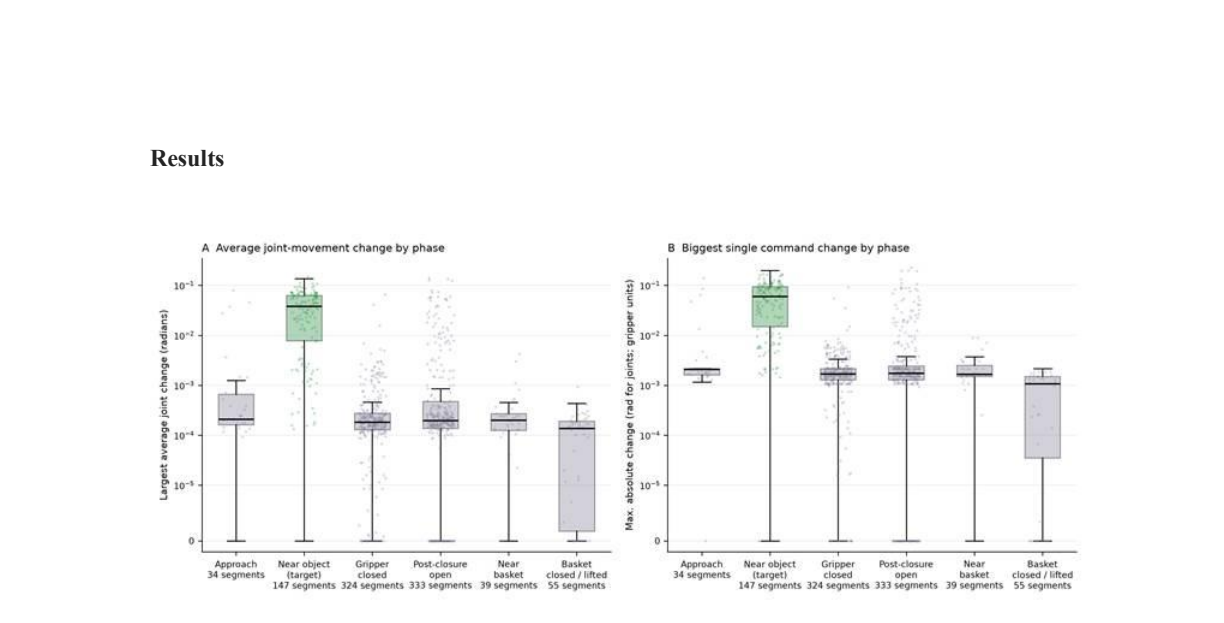
What carries the argument. The central object is the 'near-silent neuron' in the action expert's final layer. The paper identifies neurons that are essentially never active on the tasks checked (six in the base model, two in the fine-tuned checkpoint). The edit rewrites connections to these neurons so that they activate in the diagnosed failure state and produce a corrective movement (e.g., lowering the gripper). This allows the correction to be situation-specific without affecting other behaviors.
Core claim. The paper claims that small, targeted edits to about 6,000 of 3.35 billion parameters (0.0002%) of a Pi0.5 robot policy, written by a language-model agent (Claude Opus 5.5), improved success rates on held-out scenes for three recurring failure modes: hammer (56.5% to 70.5%), bell (87.3% to 96.7%), and basket (67.7% to 84.4% on an already fine-tuned policy). Control experiments with random or reversed edits did not produce gains, supporting that the effect came from the intended correction. The approach did not work for two other tasks (move_can_pot, turn_switch) where the failure was less recognizable or the correction insufficient.
The premise it rests on. The method assumes that a recurring failure state is stably recognizable in the model's internal activations and that a language-model agent can detect it and write a corrective movement into near-silent neurons without disturbing other behaviors.
If the paper is right (Pith's inferences, not the authors')
Robot foundation models could be debugged by directly editing weights rather than collecting new data or fine-tuning.
The method could be applied to other recurring failure modes that are stably represented in internal activations.
Weight-space programming might make robot policies more transparent by linking specific neurons to behaviors.
The approach could be combined with fine-tuning to further improve already specialized policies.
The technique may scale to other large models if near-silent neurons exist.
If near-silent neurons are a general property of overparameterized models, then weight-space programming could be applied to many large models beyond robotics.
The requirement that failures be 'recognizable' in activations suggests that the method may not work for failures that are not consistently represented, limiting its scope to systematic errors.
The paper's use of a frontier LLM to write edits raises questions about whether smaller models could perform similar edits, or whether the approach depends on the LLM's capabilities.
The lack of statistical significance testing for the main results means that the observed improvements should be interpreted cautiously until replicated with proper confidence intervals.
Check this review
What was read
The passes were given all 12,243 characters of the text of the paper's PDF.
Fingerprint of that text (SHA-256): 03dddc638ac75445bb1df374e9cb63dad5899472e02b3eb1f3512cb262df45c0
Pith does not keep that text. Rebuilt from the paper's source or PDF by the same code, it has this fingerprint if it is the same text. From a copy of Pith's code:
PYTHONPATH=. python scripts/review_input_check.py 2611.31715
The passes, in the order they ran
- Reader deepseek-v4-flash · medium effort · $0.0044 · instructions of the Reader, fingerprint f9ead7300382…
- Skeptic deepseek-v4-flash · medium effort · $0.0008 · instructions of the Skeptic, fingerprint 8f88c0f61488…
- Referee deepseek-v4-flash · medium effort · $0.0009 · instructions of the Referee, fingerprint a852d99aea0d…
- Check against the paper deepseek-v4-flash · medium effort · $0.0024 · instructions of the Check against the paper, fingerprint 6c7a6883d551…
- Editor deepseek-v4-flash · medium effort · $0.0007 · instructions of the Editor, fingerprint e7211f6a3d27…
- Circularity check deepseek-v4-flash · medium effort · $0.0004 · instructions of the Circularity check, fingerprint e9946e39d67b…
- Summary for the page deepseek-v4-flash · medium effort · temperature 0.2 · $0.0009 · instructions of the Summary for the page, fingerprint e4f56bf568e7…
The passes cost $0.011 in model calls together.
Version stamped on this review: pith-pipeline@v1.4.1-daily-deepseek-or-medium+deepseek/deepseek-v4-flash+p.d60f54226f00
Each link opens a pass's instructions as plain text, the exact bytes its fingerprint was taken over. Every stored set of instructions.
curl -s https://pith.science/methodology/prompts/f9ead730038216984cfb56d7cb34332bdf691828296a1de4245f3d6667d4bf56 | sha256sum
prints the fingerprint of the reader's instructions. The same works for every pass.
The receipt
The review's fingerprint was taken on 25 Nov 2026. The review you are reading still matches it.
Fingerprint of the review (SHA-256): c2cba40e8a6277403ef015905efa16e37451819e755b44307619f7fd4c51eea0
curl -s 'https://pith.science/api/v1/verdicts/2611.31715?form=canonical' | sha256sum
prints the fingerprint of the review as it stands now. The rule, in four steps.
A matching fingerprint shows the review has not changed since that date. It does not show that the review is right.
How often reviews like this one are right
Reviews like this one: written by deepseek-v4-flash, from the text of the paper's PDF.
How often objections from reviews like this one are right: not yet measured
Reviews by people
This review was written by a machine. No person has reviewed this paper on Pith yet. A scientist listed on Pith can review it for a fee, and their review is published here whatever it concludes.
The paper
Abstract
This paper demonstrates an approach for correcting failures of robot foundation models (RFMs) without additional data collection, demonstrations, or training. We apply weight-space programming (WSP), in which a language-model agent directly reads and writes a neural network's parameters, to a large, pre-trained vision-language-action policy. The idea is simple: many policy failures are not random but repeatedly land in the same recognizable stuck state, so if that state is visible in the model's internal activations, a small edit could trigger a corrective movement while leaving the rest of the model's parameters unchanged. A core design choice is where to write the edit: repurposing a few near-silent neurons in the action expert lets the edit switch on in situations associated with the failure and produce a corrective movement, such as lowering the gripper toward the target, that is specified directly rather than learned through training. Empirically, when applied to the pi0.5 policy in simulation, we find that edits to roughly 0.0002% of the parameters can improve success on recurring failures, including for a policy that was already fine-tuned on its task. Reversed and random edits indicate that the gains come from the intended behavior, and the approach works best when the failure situation is recognizable and a simple correction can address it.
The paper's own sentences, arranged, kept beside the review and separate from it. Each label is drawn from a closed vocabulary; the number beside it is the probability the classifier gave that label. No sentence in this record was written by a model.
abstract compiled · 2026-11-25
The authors' main claim, as the classifier picked it out 0.52
“This paper demonstrates an approach for correcting failures of robot foundation models (RFMs) without additional data collection, demonstrations, or training.”
How the main claim is stated: asserted 1.00
What the abstract itself states, as probabilities: claims first 0.05 · states limitation 0.87 · human participants 0.03 · controlled comparison 0.65 · randomized assignment 0.04 · states quantitative result 0.98 · compares with prior results 0.26 · mentions code or data availability 0.03
The abstract, sentence by sentence
This table labels the abstract only (arXiv listing abstract v1). The number is the probability the classifier gave the label.
| Sentence | Role | The authors' own work | States the main conclusion | Strength |
|---|---|---|---|---|
| This paper demonstrates an approach for correcting failures of robot foundation models (RFMs) without additional data collection, demonstrations, or training. | contribution 1.00 | 0.90 | 0.61 | asserted 1.00 |
| We apply weight-space programming (WSP), in which a language-model agent directly reads and writes a neural network's parameters, to a large, pre-trained vision-language-action policy. | method 0.78 | 0.93 | 0.07 | asserted 1.00 |
| The idea is simple: many policy failures are not random but repeatedly land in the same recognizable stuck state, so if that state is visible in the model's internal activations, a small edit could trigger a corrective movement while leaving the rest of the model's parameters unchanged. | method 0.78 | 0.21 | 0.09 | hedged possibility 0.53 |
| A core design choice is where to write the edit: repurposing a few near-silent neurons in the action expert lets the edit switch on in situations associated with the failure and produce a corrective movement, such as lowering the gripper toward the target, that is specified directly rather than learned through training. | method 0.99 | 0.63 | 0.07 | asserted 0.92 |
| Empirically, when applied to the pi0.5 policy in simulation, we find that edits to roughly 0.0002% of the parameters can improve success on recurring failures, including for a policy that was already fine-tuned on its task. | result 1.00 | 0.97 | 0.32 | asserted 1.00 |
| Reversed and random edits indicate that the gains come from the intended behavior, and the approach works best when the failure situation is recognizable and a simple correction can address it. | result 0.63 | 0.93 | 0.22 | asserted 0.82 |
What kind of paper the classifier reports this is: method or tool 1.00 · evidence from simulation or computation 0.67
What was examined, and what was not
Sources read
- arXiv listing abstract v1
Not examined
- full text
- figures and tables
- references and citing sentences
- relations to other papers
Levels run
- P abstract
Not run
- S sections
- T body sentences
- C citations
- R cross-paper relations
How the labels were made
Compiled by classifier-1.13.0 via TypeSafe API, question bank abstract-p1-20260923, 2026-11-25: 1 request, 5,174 input tokens.
Every quoted sentence on this record is the authors'. Every label is from Pith's closed vocabulary, with the probability shown beside it. This record as JSON
Figures (5)


Showing 4 of the paper's 5 figures. Figures are the authors', reproduced from the paper.
References (7)
- [1] Rikiya Takehi, Jayden Teoh, Alex Zhang, and Omar Khattab. “Sparks of Weight-Space Programming: LLMs can natively read & write neural network weights.” November 2026. https://rikiyat.github.io/blog/weight-space-programming/ on Pith
- [2] Jannick Stranghöner, Philipp Hartmann, Felix Störck, Barbara Hammer, and Klaus Neumann. “Repairing Robot Policies with Weight Space Programming.” November 2026. https://jstranghoener.github.io/blog/robotic-weight-space-programming/ on Pith
- [3] Physical Intelligence, Kevin Black, Noah Brown, James Darpinian, Karan Dhabalia, Danny Driess, Adnan Esmail, Michael Equi, Chelsea Finn, Niccolo Fusai, et al. π0.5: A vision-language-action model with open-world generalization. arXiv preprint arXiv:2504.16054, 2025 on PithPith's reviewarXiv
- [4] Ziyang Gong, Kaifeng Zheng, Yingrui Huang, Wendi Chen, Jiaguo Tian, Junkai Yang, Minghuan Liu, and Zhenjie Yang. “We Asked Opus-5.5 to Edit π0.5’s Weights. AutoResearch Made It Happen.” November 2026. https://cuzyoung.github.io/robotics-weight-editing/en/ on Pith
- [5] Jusheng Zhang, Keze Wang, and Liang Lin. “Can LLMs Debug Robots by Editing Their Weights?” arXiv preprint arXiv:2611.09376, 2026. https://arxiv.org/abs/2611.09376 on PithPith's reviewarXiv
- [6] Ali-Adeeb Abbas and Esmaeil Seraj. “Distilling Instructions into Weights: Closed-Form Edits Fix a Robot Policy’s Misreading.” arXiv preprint arXiv:2611.11894, 2026. https://arxiv.org/abs/2611.11894 on PithPith's reviewarXiv
- [7] Tianxing Chen, Zanxin Chen, Baijun Chen, Zijian Cai, Yibin Liu, Zixuan Li, Qiwei Liang, Xianliang Lin, Yiheng Ge, Zhenyu Gu, et al. RoboTwin 2.0: A scalable data generator and benchmark with strong domain randomization for robust bimanual robotic manipulation. arXiv preprint a... on PithPith's reviewarXiv
Challenges and discussion
Disagree with the review, or know something it missed? Leave a comment, or challenge this review formally: a challenge becomes a permanent entry in this paper's record, and its decision is published here.
Come back by email
A short list of the week's newly reviewed papers. Nothing is sent until you confirm from your inbox, and every email has a link that stops it. No account.
No comments yet.
Sign in to comment