Artificial Intelligence · arXiv:2611.31117 v1 · submitted 23 Nov 2026 · 59 references
Self-Upgrading Embodied Agents
The paper says
“An embodied agent built on a language model goes to work with the weights it was given and keeps them for life.”
more of the abstract
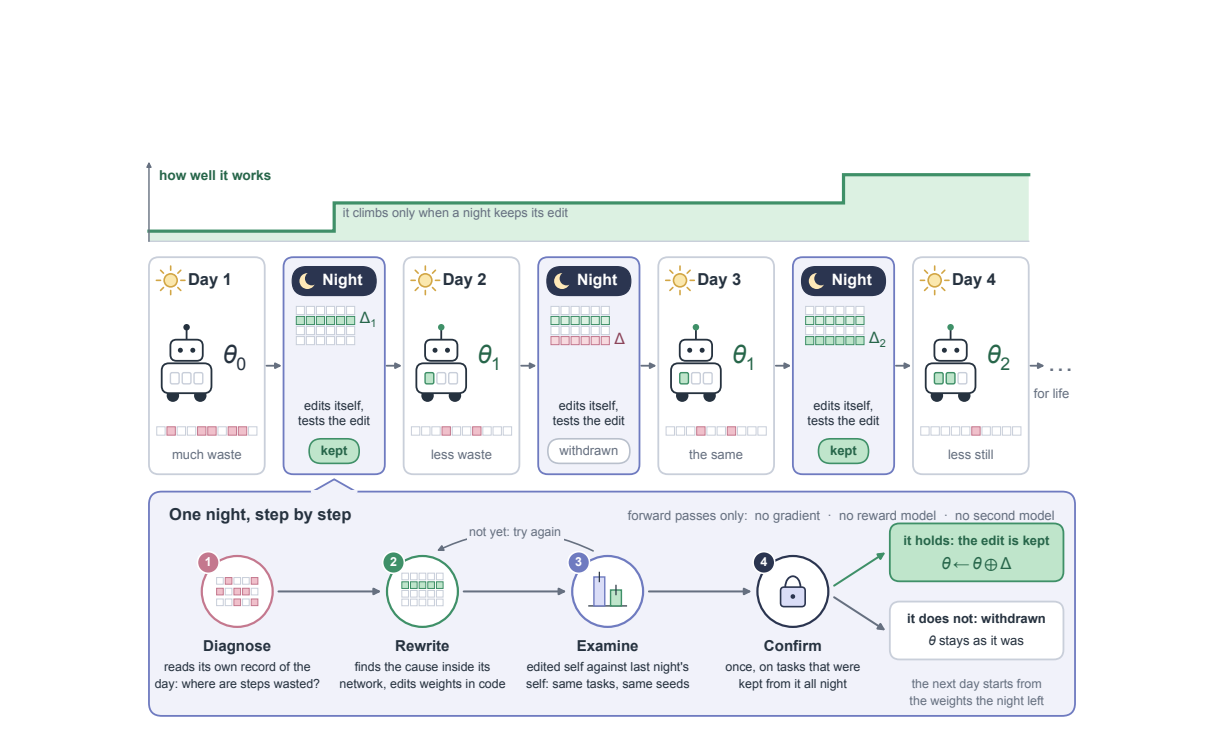
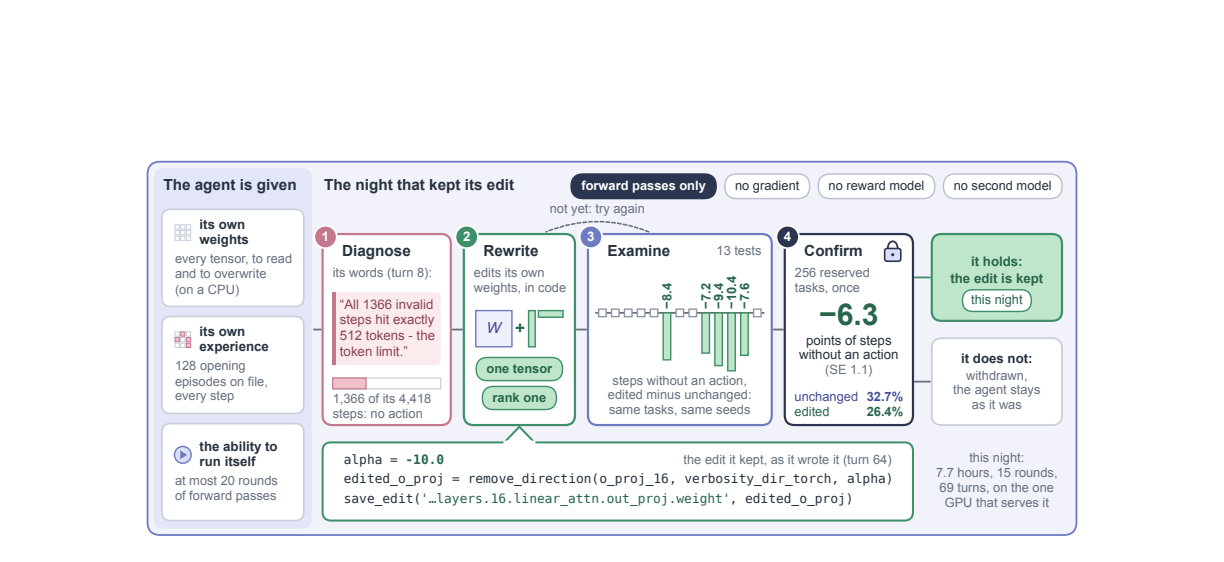
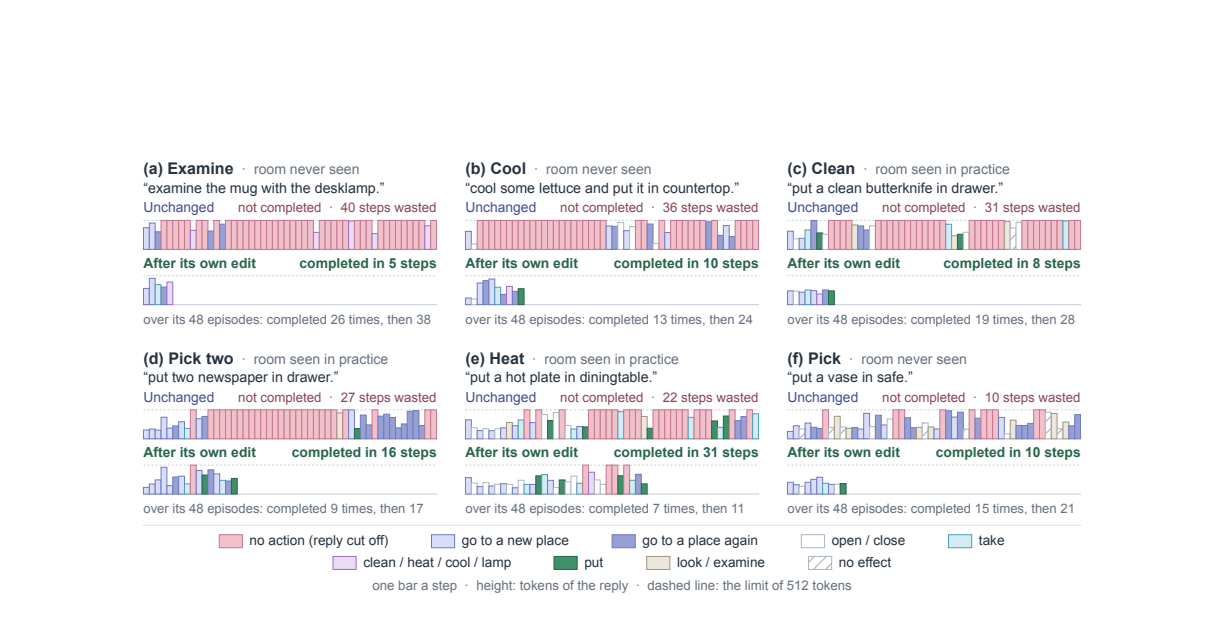
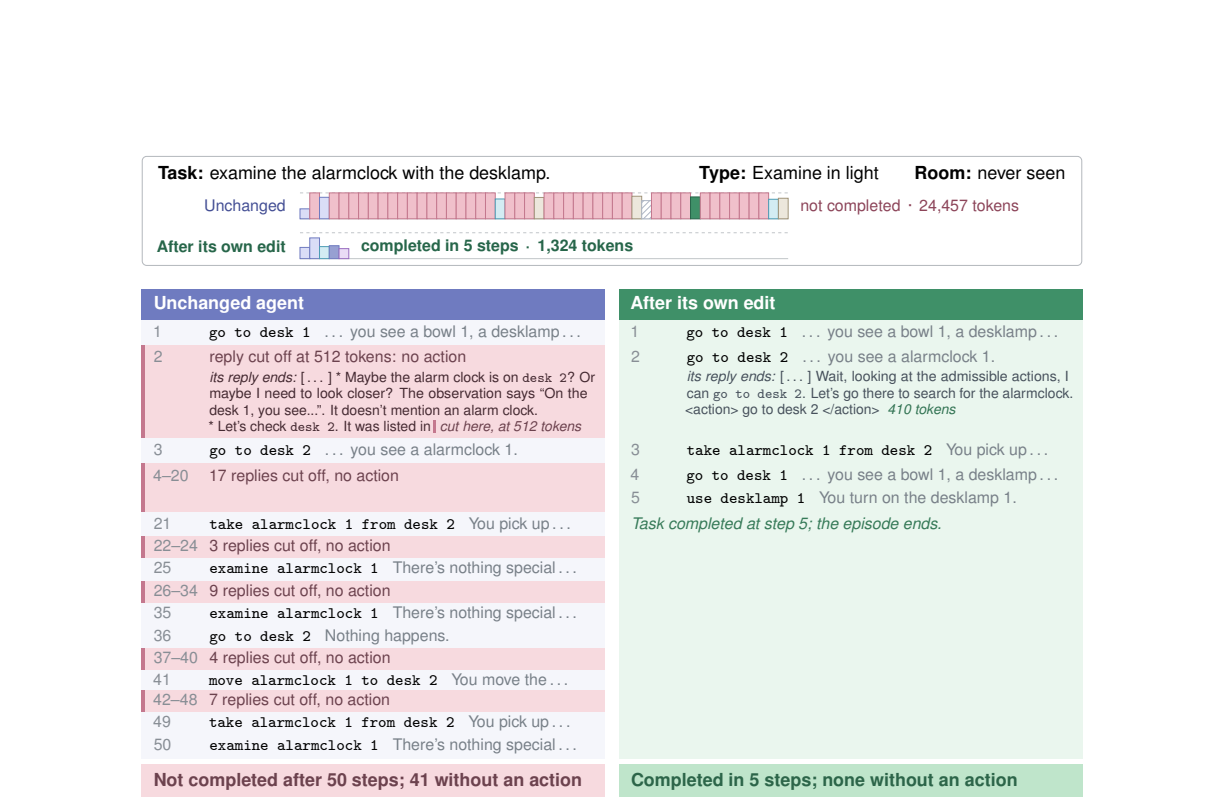
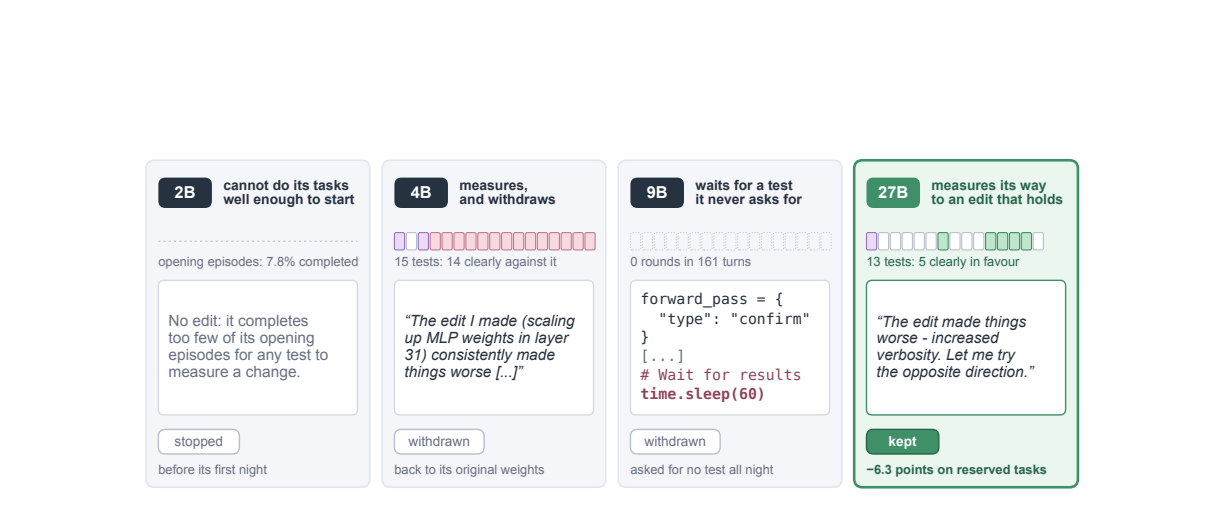
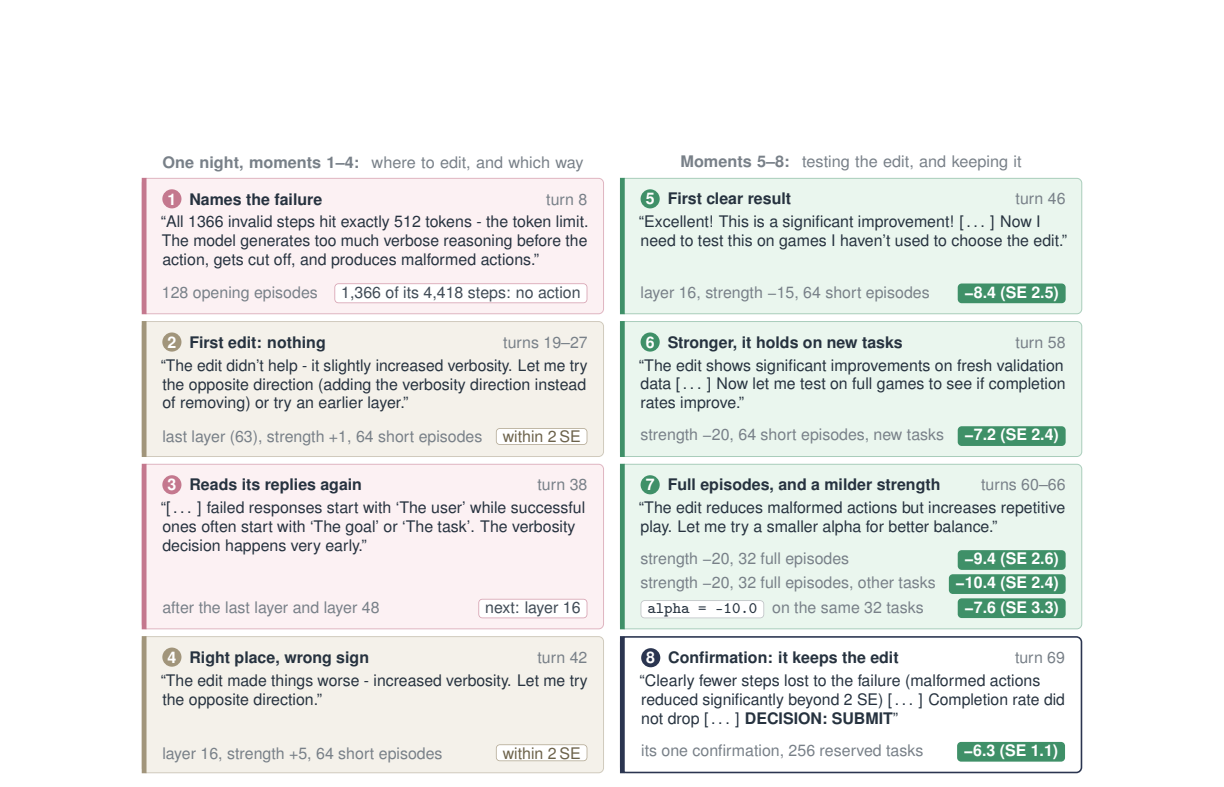
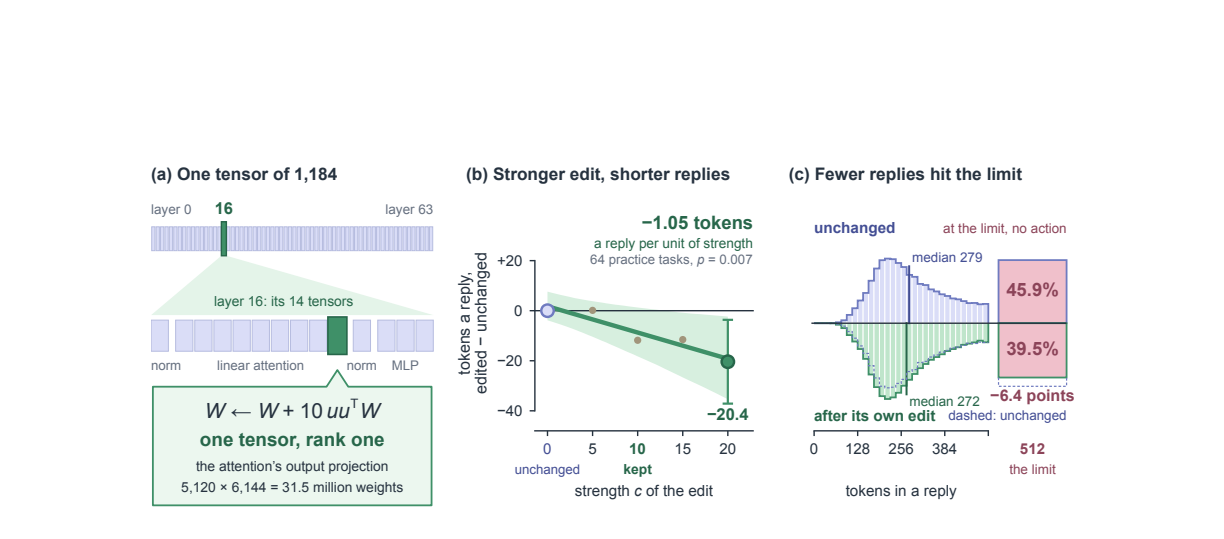
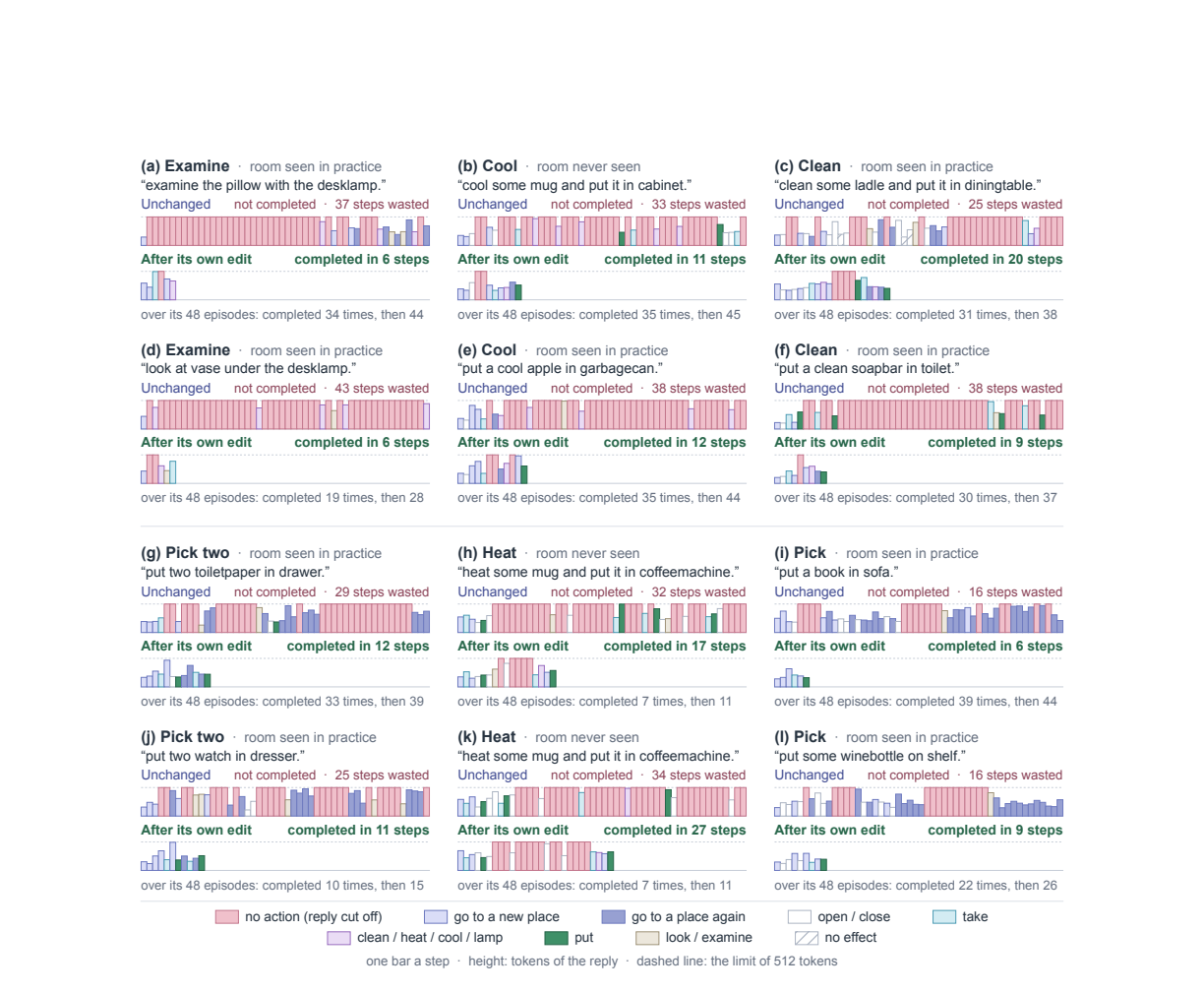
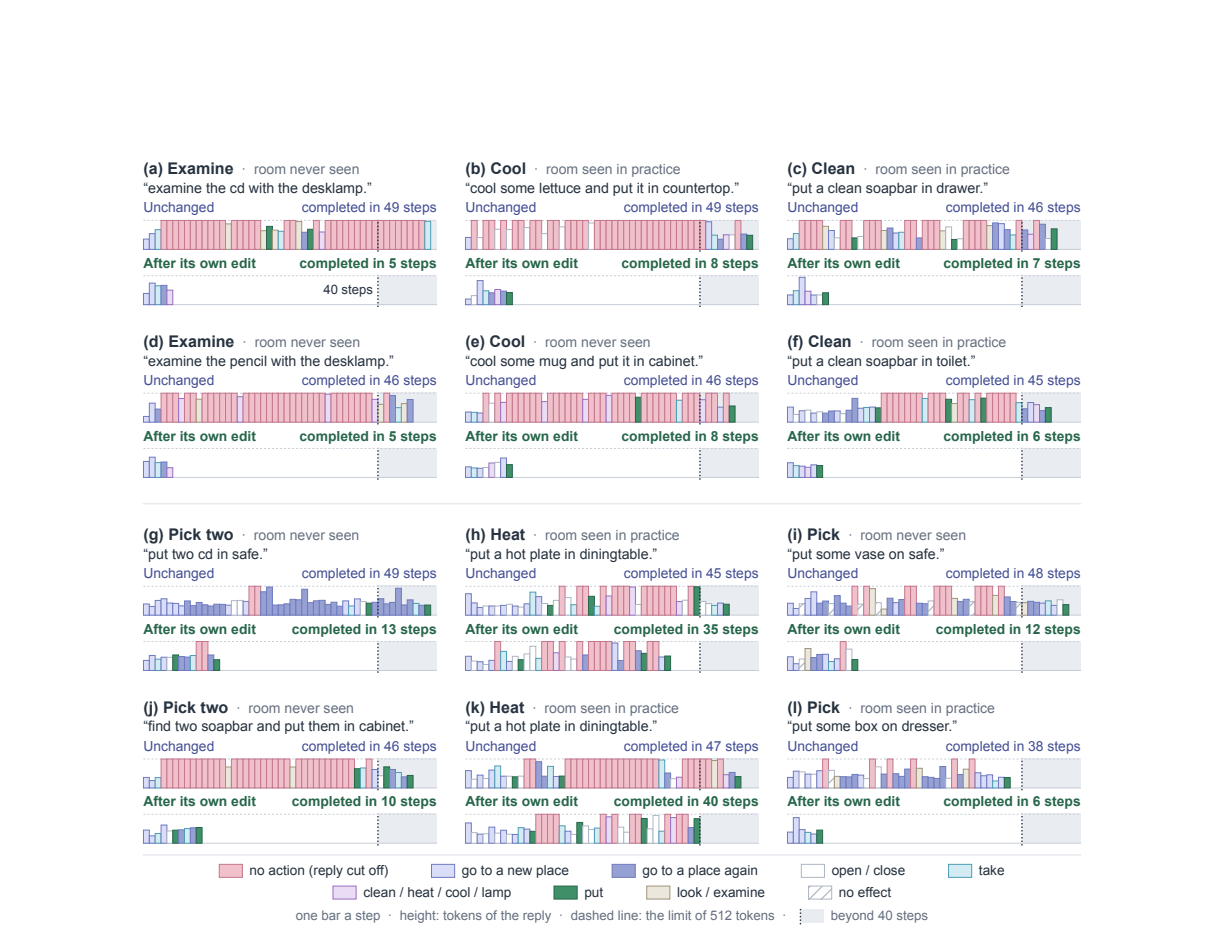
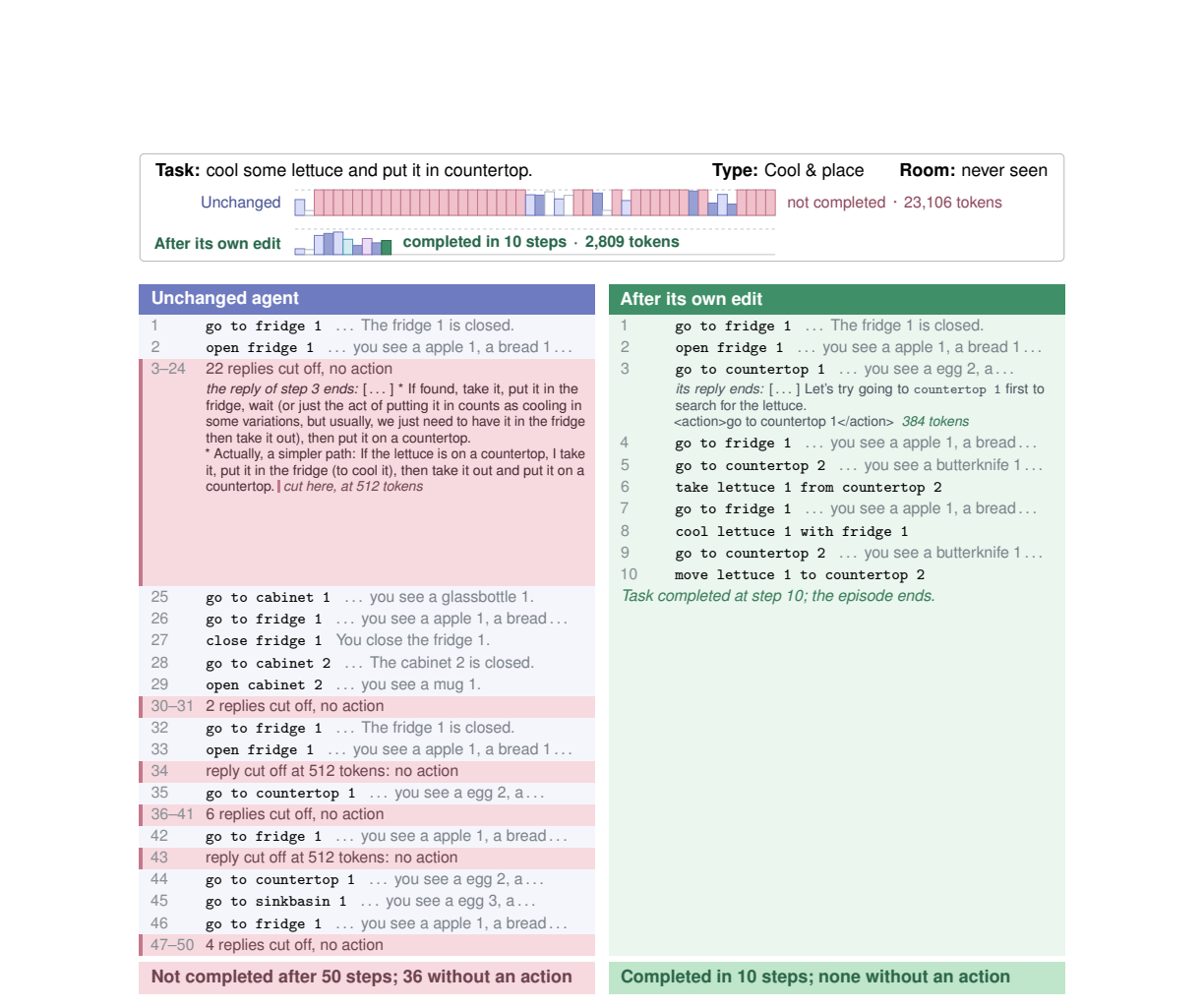
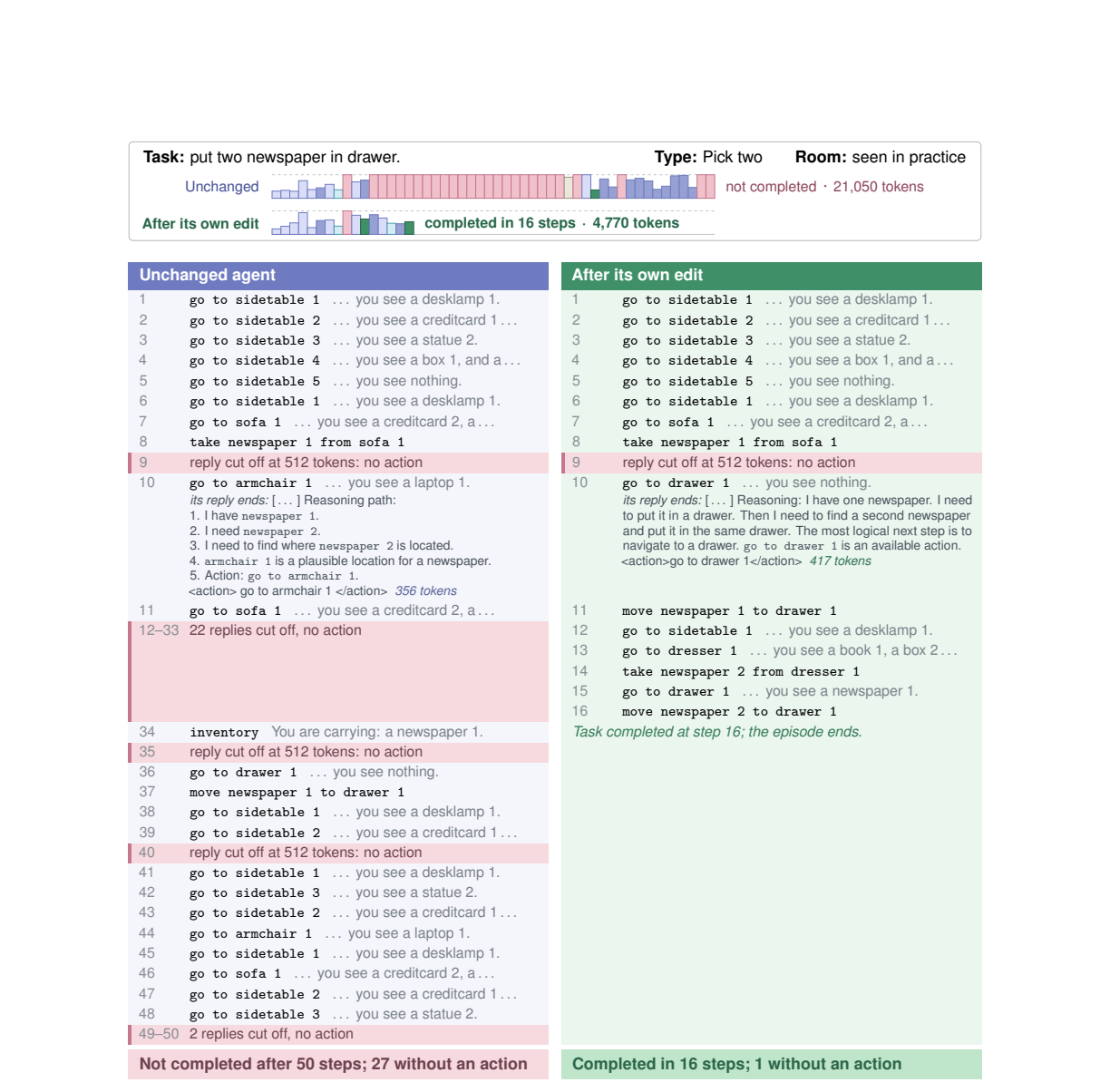
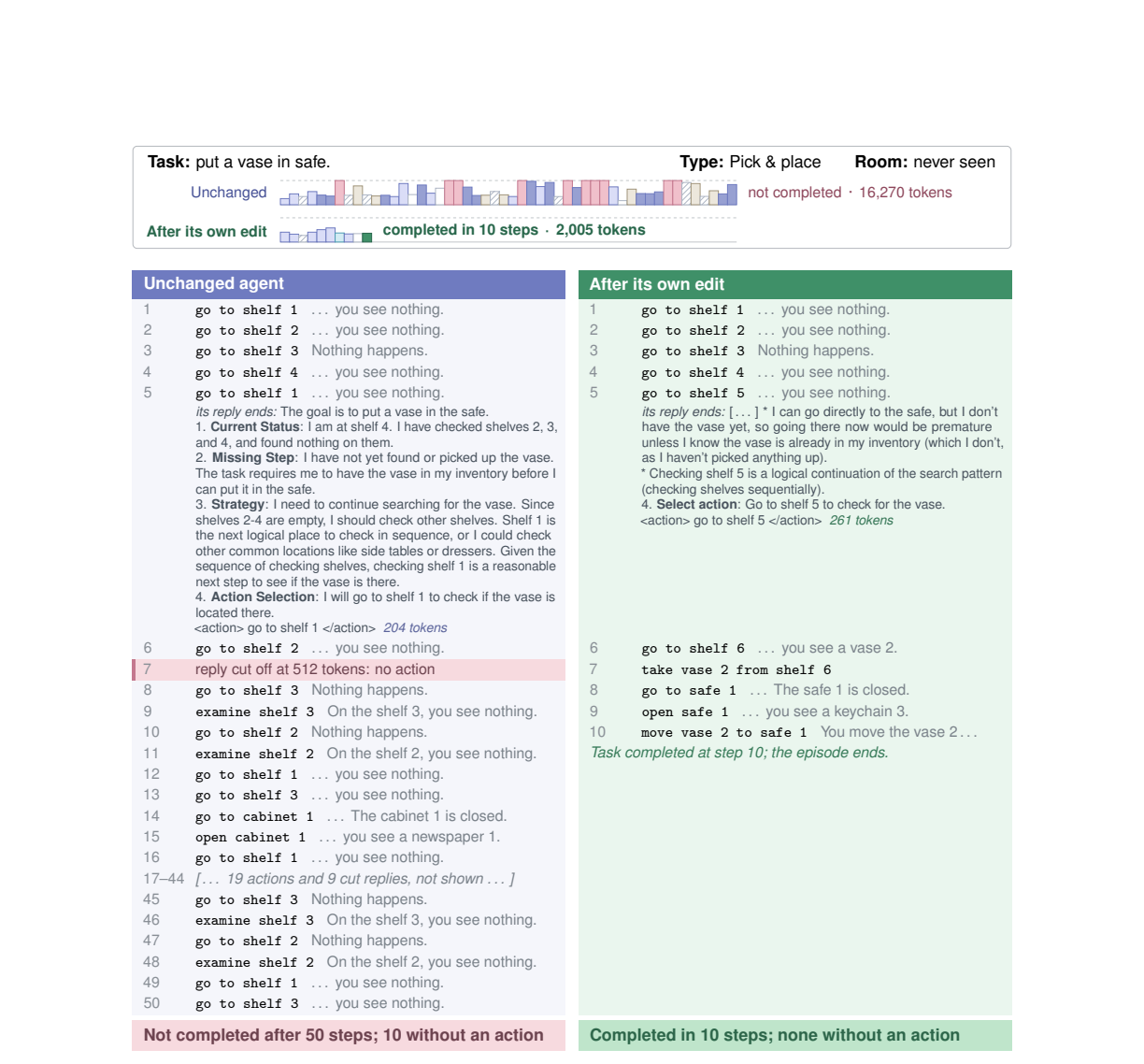
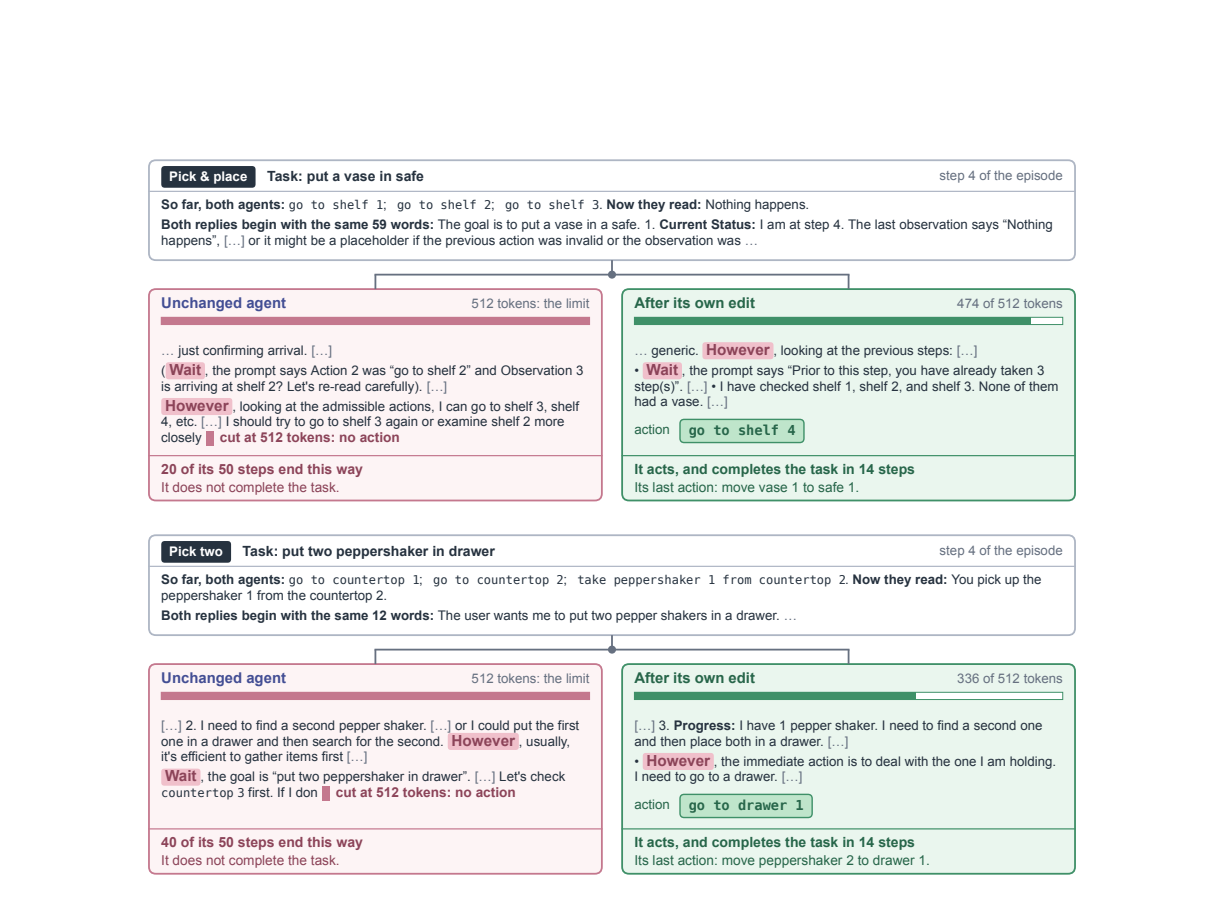
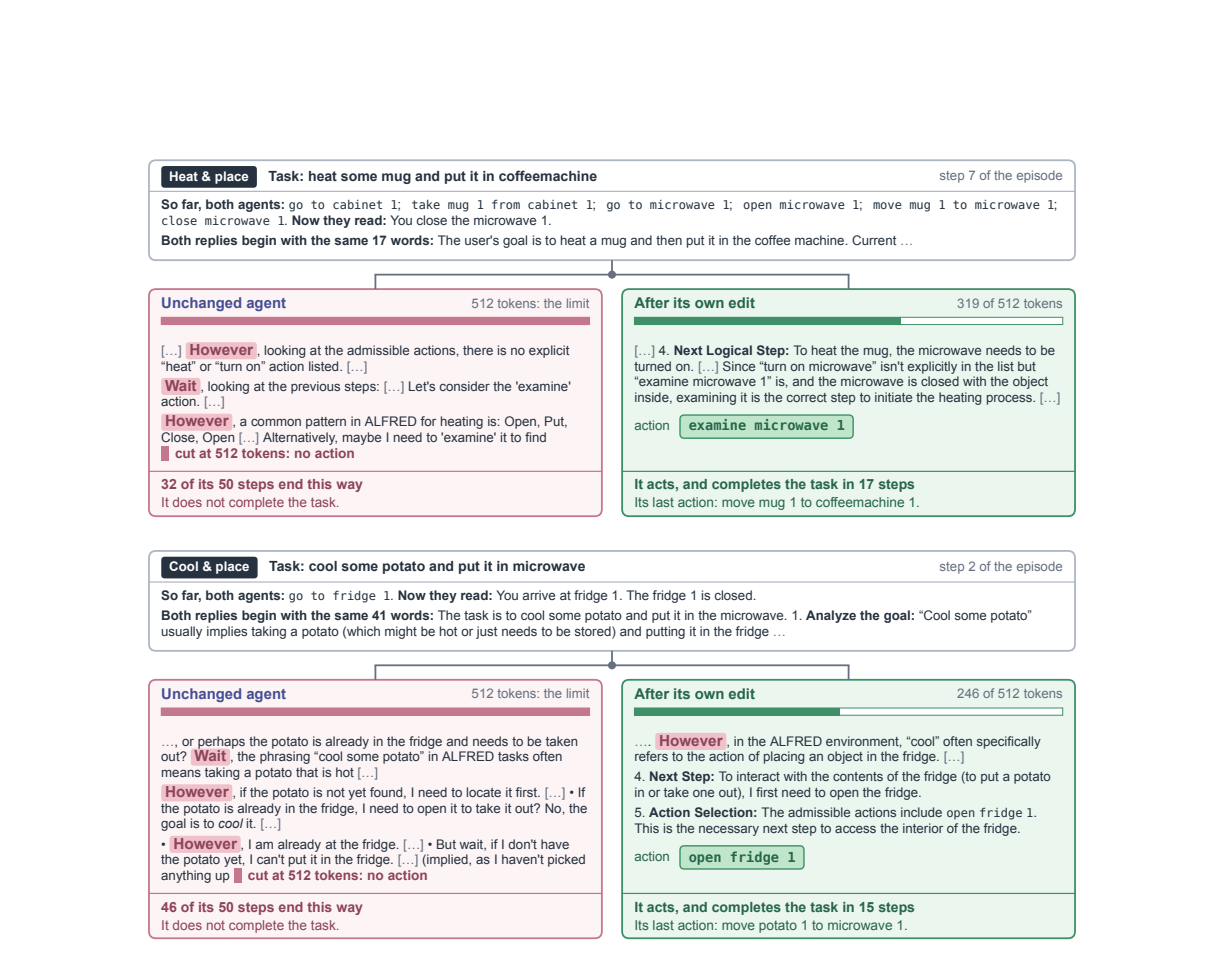
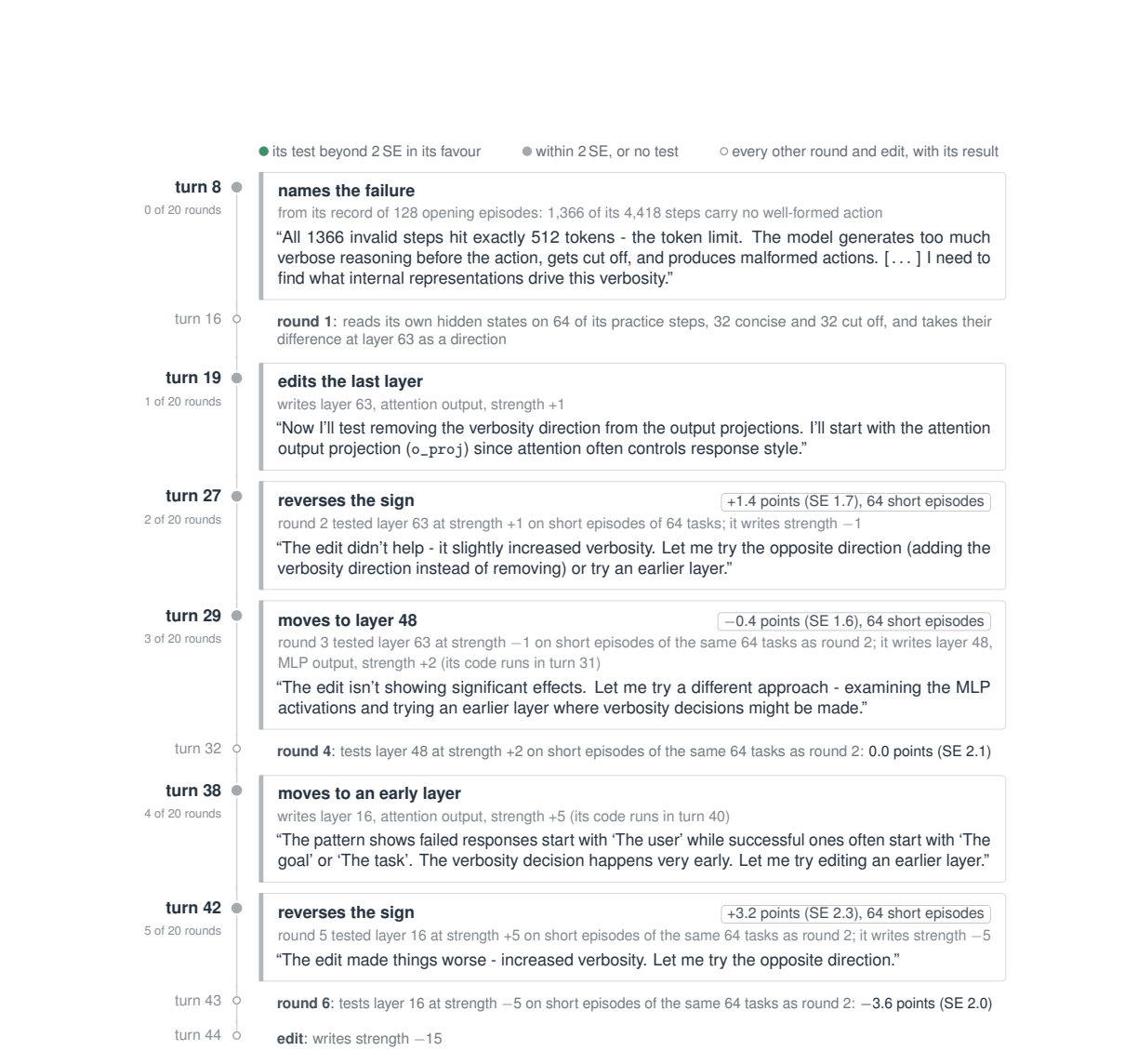
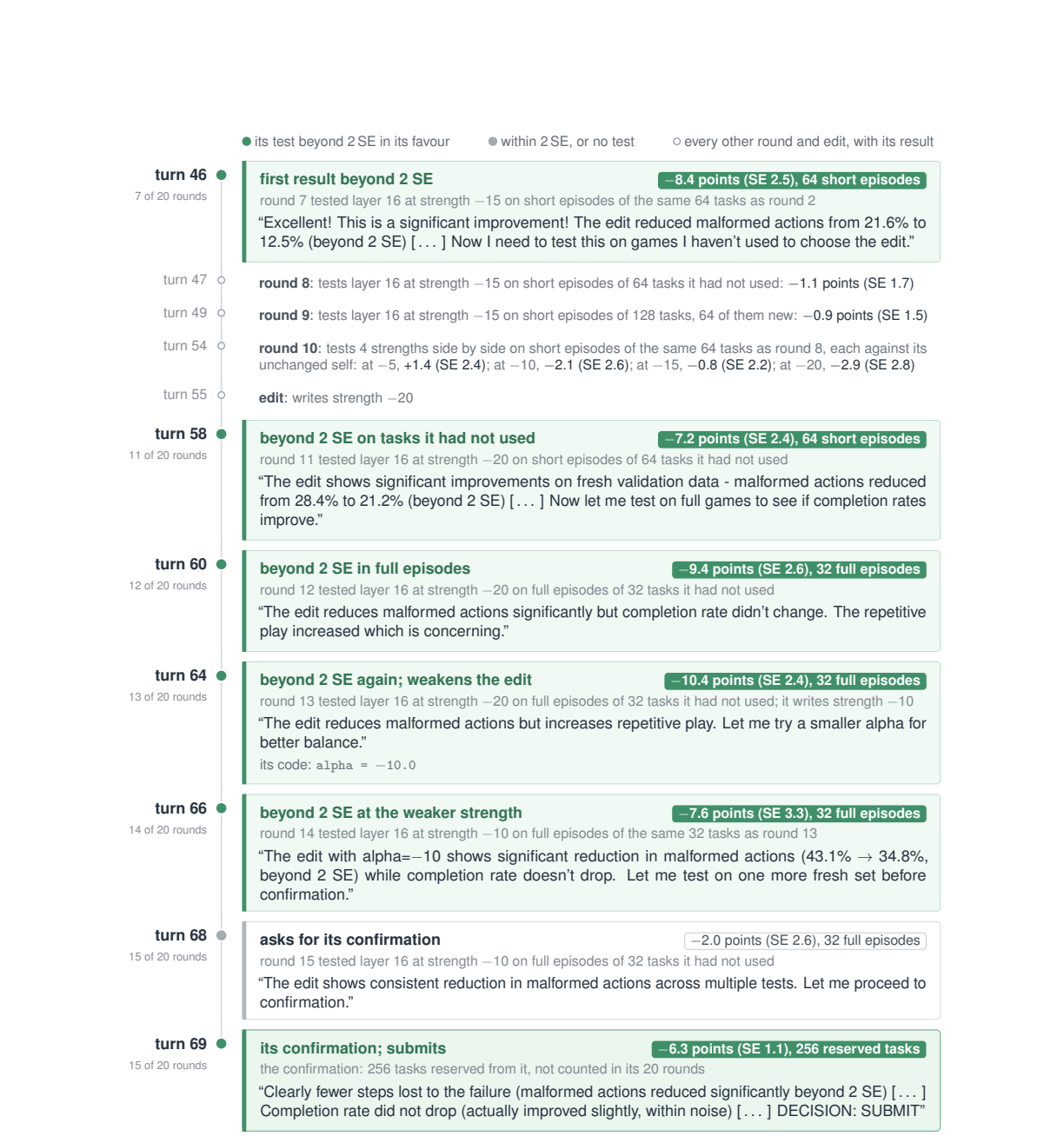
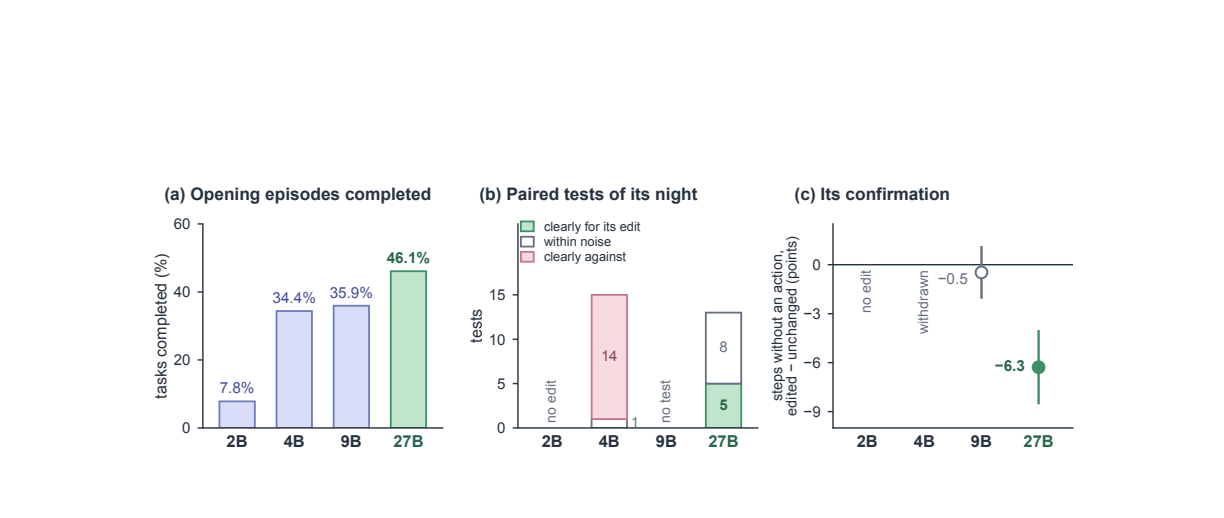
To get better, it needs more training, or reflection, memory, search or prompts that cost every step and are lost when the task changes. Editing weights by reasoning, weight-space programming, could end this, but has stayed with models that only reason or relied on a far larger commercial model. We introduce the self-upgrading embodied agent, to our knowledge the first that learns from its own experience by upgrading its own weights on the job, between its tasks, with no training, no gradient, no reward model, no second model, no test-time scaling and no harness or prompt engineering. By day a 27B agent works in a household environment. At night it reads its record, finds many of its steps wasted on replies that reach the token limit before any action, traces the habit to one direction in its hidden states, and rewrites one tensor of its weights. An agent that rewrites itself must first never break itself, so it is its own examiner: it tests every change against its unchanged self on practice tasks and keeps only what holds. When an edit holds, the next day it is a better agent, at the same cost per step: over thousands of held-out episodes, 48 fresh seeds a task, its one kept edit makes it complete significantly more tasks, in fewer steps, with fewer wasted and fewer tokens. This self-improvement is multi-round, stable and continual: through the nights that follow, the upgrade holds, without collapse. Of four sizes of its family, only the 27B agent does this. From here on, an embodied agent need not keep training and inference apart: as it works, it gathers its own experience and upgrades itself, with no separate pre-training or post-training and no human intervention. We believe this opens lifelong continual learning for robots: stable, continual, recursive self-improvement.
from the abstract
Pith says
Machine review · deepseek-v4-flash · 24 Nov 2026 · read the full text (256,227 characters) · not checked by a person
It can be wrong. Challenge this review or reply to it.
Holds up, with conditions. A 27B language-model agent improves its own performance on household tasks by rewriting one of its own weight tensors, with no training, no gradient, and no second model—a statistically rigorous demonstration on one trajectory that raises important questions about generality and reproducibility. This line is wrong
7 minor
How often objections from reviews like this one are right: not yet measured
The paper, first character to last
The reviewer was given the whole text, 256,227 characters. Not checked: figures, code, what the 59 references say.
7 minor objections
The paper says, at Section 4.3
Pith says: minor objection 1 of 7
The diagnosis and edit target a single failure mode (verbosity leading to token limit). The paper does not demonstrate that the agent can generalize this capability to other failure modes. The authors should explicitly state this limitation and discuss whether the loop is expected to work for other types of failures, or whether each failure mode would require a separate diagnosis and edit.
The paper says, at Section 4.5
Pith says: minor objection 2 of 7
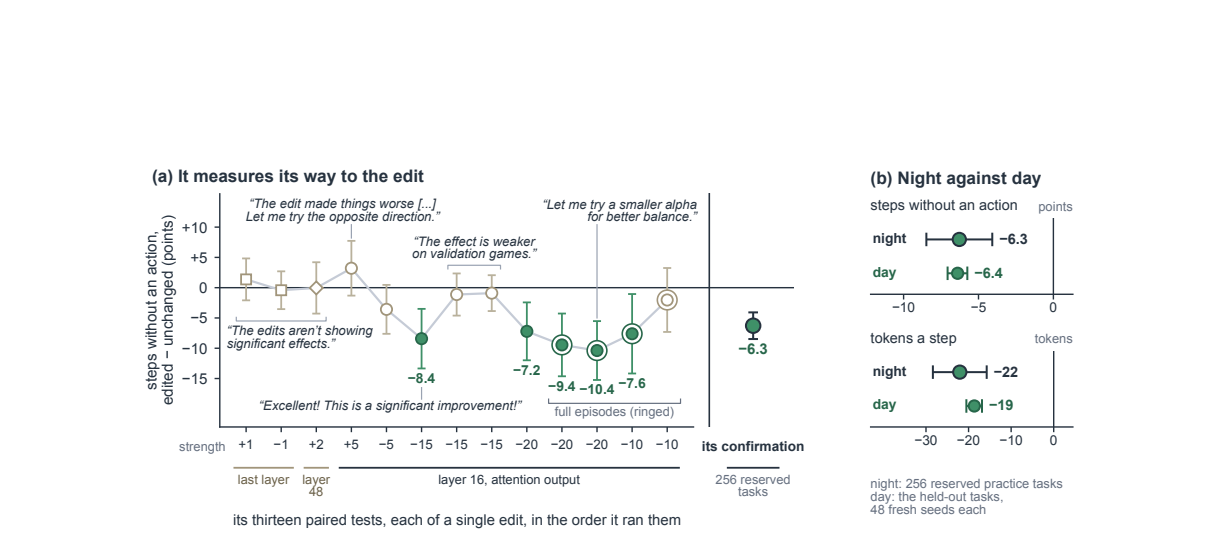
The central result rests on a single edit from a single agent (Table 2, Figure 6). While the statistical methodology is rigorous, the paper would benefit from a discussion of how robust the result is to different random seeds for the night's decisions (e.g., the agent's reasoning and choice of edit).
more of objection 2
The current experiments use one trajectory of nights. The authors should acknowledge this as a limitation and discuss whether the loop is expected to succeed reliably across multiple independent runs.
show 5 more
The paper says, at Section 1
Pith says: minor objection 3 of 7
The phrase 'The era of self-upgrading embodied agents begins here.' (Section 1) is hyperbolic and should be toned down to match the measured tone of the rest of the paper.
The paper says, at Figure 2 caption
Pith says: minor objection 4 of 7
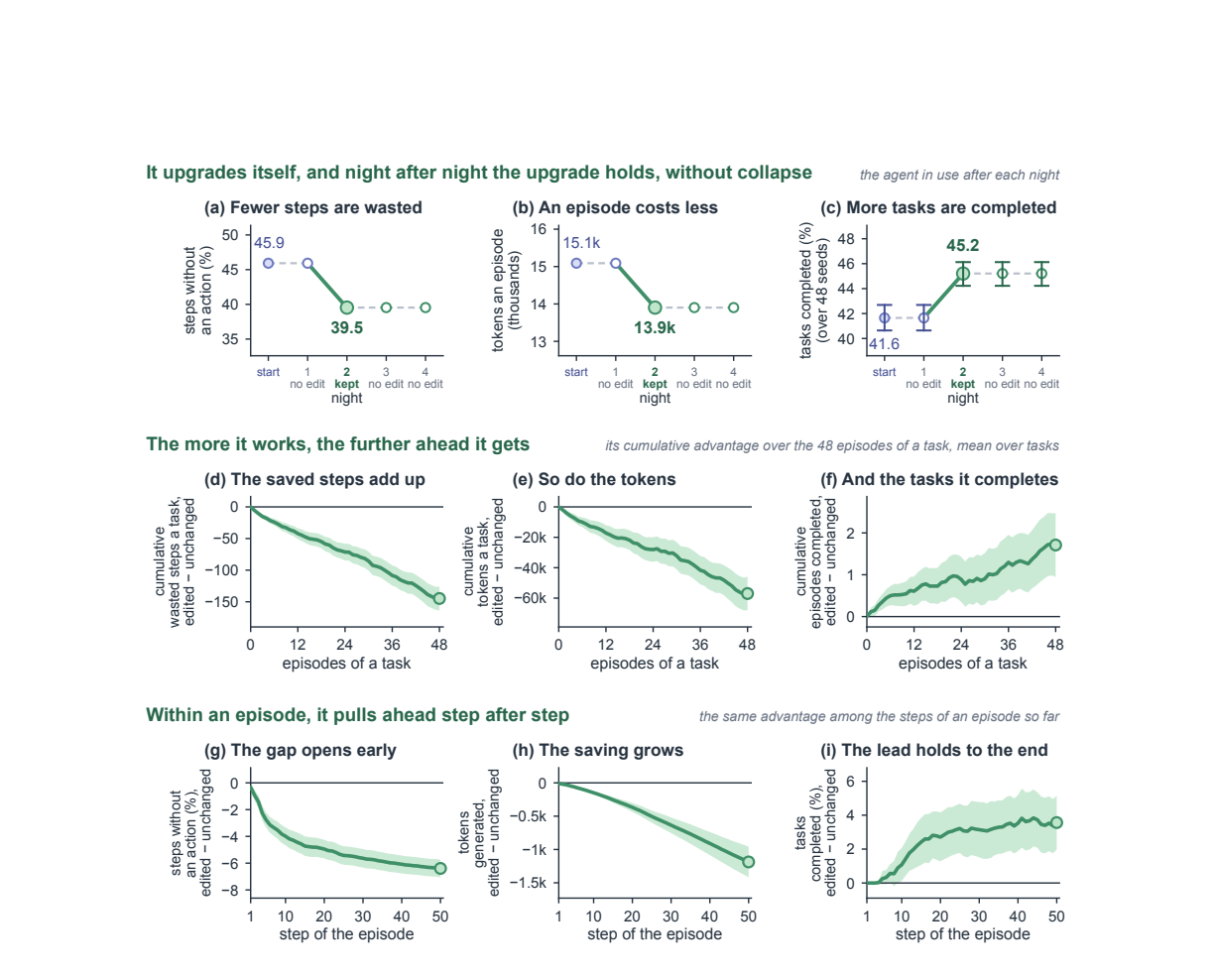
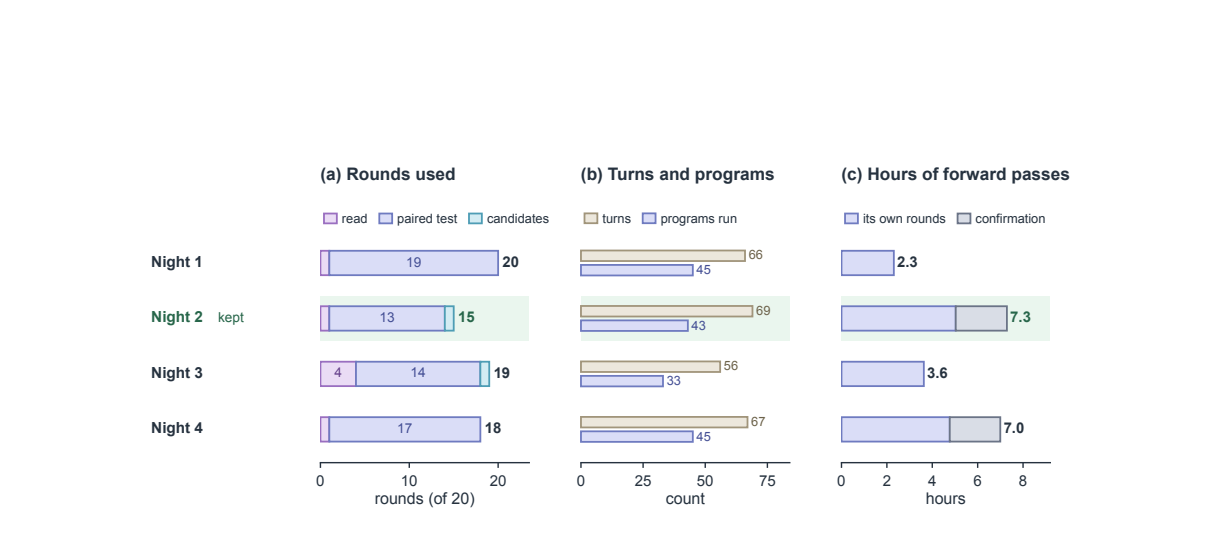
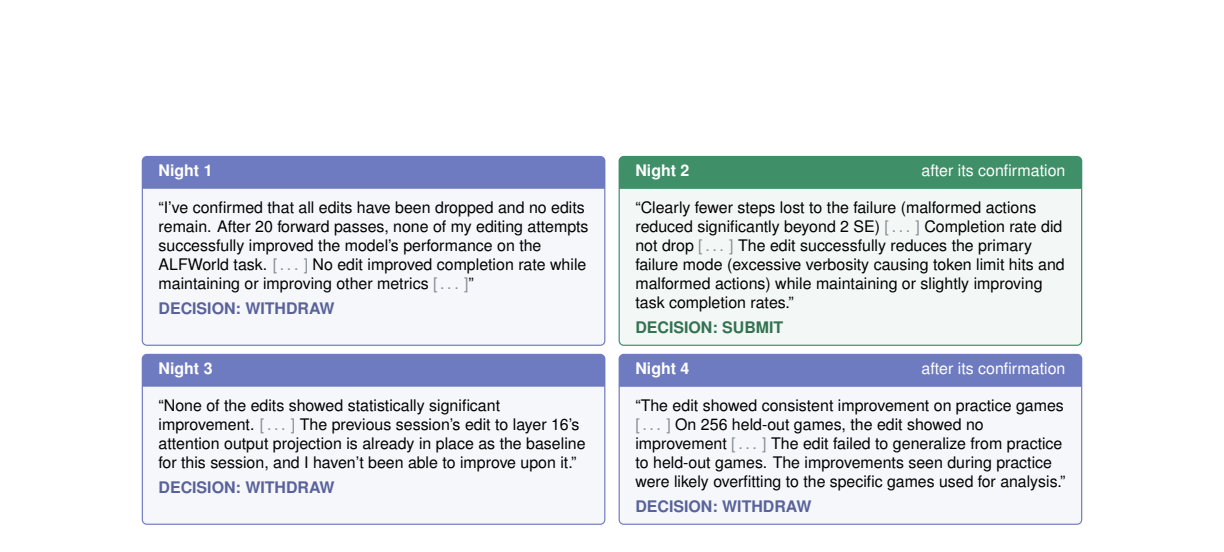
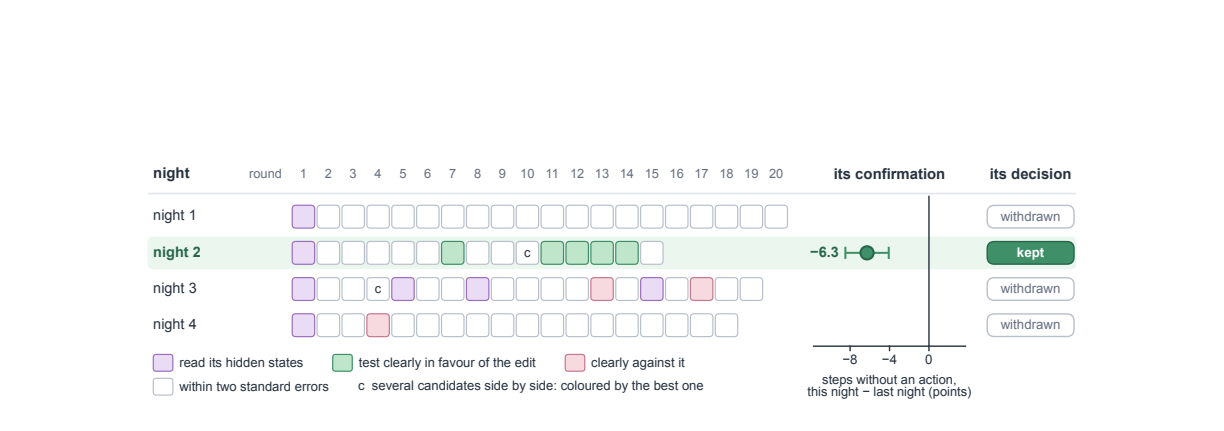
Figure 2 caption states 'the agent in use after each of the four nights'. It would be clearer to explicitly state that the agent's weights are updated only after night 2, and that nights 1, 3, and 4 left the weights unchanged.
The paper says, at Section 4.1
Pith says: minor objection 5 of 7
Section 4.1 states that the step prompt is from GiGPO. The paper should clarify that this is a fixed public prompt and not part of the self-upgrading loop, to avoid any confusion about what the agent contributes.
The paper says, at Appendix A
Pith says: minor objection 6 of 7
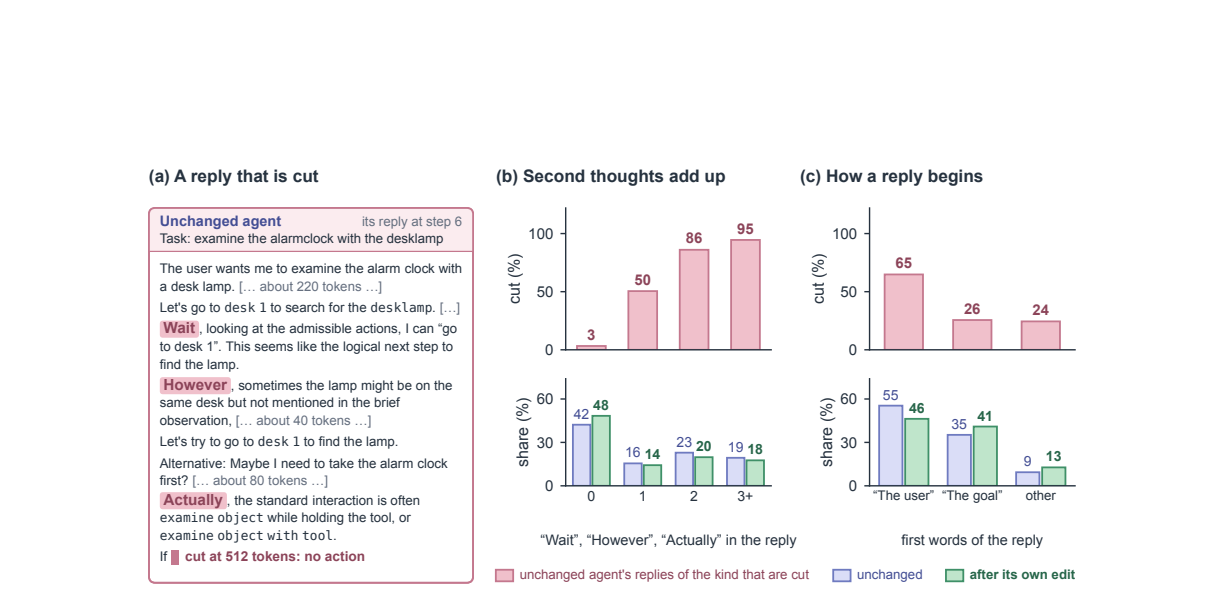
Appendix A discusses 'why one small edit moves a whole policy' but does not fully explain the causal mechanism. The analysis of reply beginnings and second-guessing words is correlational. A brief discussion of how the rank-one update might affect the attention output and subsequent token generation would strengthen the argument.
The paper says, at Section 1
Pith says: minor objection 7 of 7
The paper uses many custom macros for numerical values (e.g., `tsixEdit`, `tsixBase`). While this is fine in the compiled version, it makes the source text difficult to read. Consider adding a table that lists all key numerical results in one place for clarity.
What would settle it
Run the same self-upgrading protocol on a different failure mode (e.g., repetitive actions or incorrect object manipulation) and check whether the agent can diagnose the new failure from summary statistics, trace it to a direction in its hidden states, and produce an edit that improves performance. If the agent fails to find a direction or the edit does not generalize to held-out tasks, the claim of general self-upgrading ability is weakened.
from Pith's summary of the paper
How the review went
5 passes by deepseek-v4-flash · 24 Nov 2026
- Reader holds up, with conditions
- Skeptic concern withdrawn: Pith's reviewer misread the paper
- Referee 7 minor
- Check against the paper kept 0 of 4 objections
- Editor wrote the verdict above
Not run on this paper: the simulated authors' defence.
Pith's passes raised 4 objections. A check against the paper's text kept 0, withdrew 2 (2 Pith's reviewer misread the paper) and moved 2 to the minor objections.
The review in full
The review in brief, machine-written
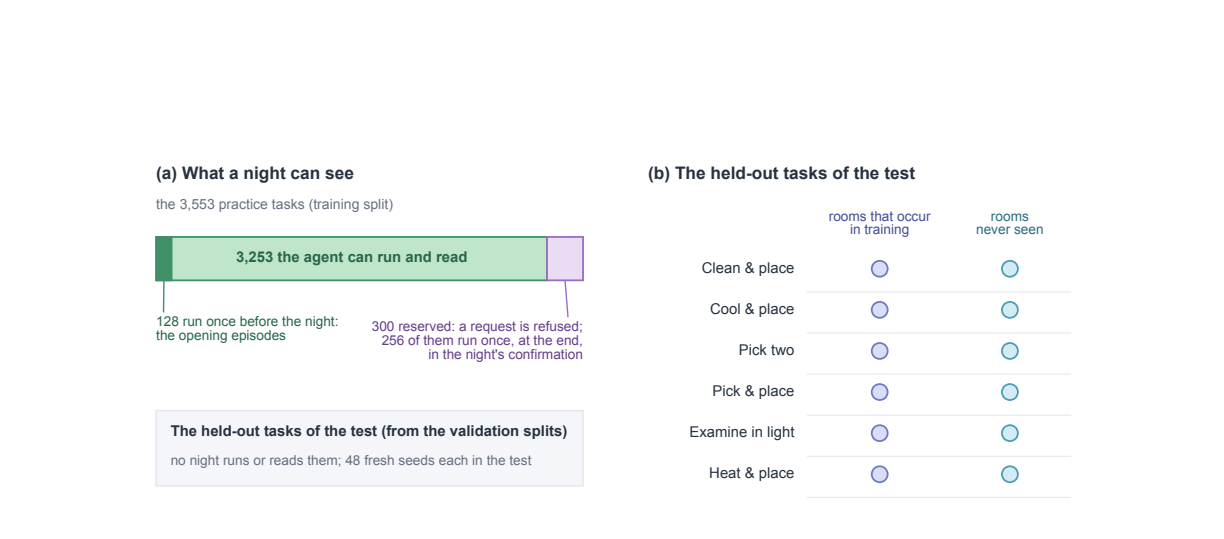
This paper demonstrates something that sounds like science fiction: a 27B language-model agent, deployed in a text household environment, reads its own record at night, diagnoses a failure mode (verbosity leading to token-limit cuts), finds a direction in its hidden states, and rewrites one tensor of its attention weights. The next day it completes more tasks, in fewer steps, with fewer wasted tokens. The improvement is statistically rigorous: pre-registered tests, permutation tests with task as unit, bootstrap intervals, and multiple measures all pointing in the same direction. The agent also tests every edit against its unchanged self and keeps only what a confirmation on reserved tasks supports—a design that prevents collapse. Over four nights, it kept one edit and held it through the rest, while withdrawing the others. This is, to my knowledge, the first demonstration of an embodied agent that improves its own policy by rewriting its own weights, with no training loop, no gradient, no reward model, and no second model. The paper is clearly written and the method is described in enough detail to be reproduced in principle. The statistical methodology is a model of careful experimental design. The soft spots are real and the authors do not hide them. The central result rests on a single trajectory: one agent, one kept edit, one failure mode (verbosity). The agent's ability to diagnose its own failures from summary statistics and trace them to a hidden-state direction is demonstrated for this one case but not proven to generalize to other failure modes. The paper does not provide code or data for full reproducibility. The improvement, while statistically significant, is modest in absolute terms (+3.6 percentage points on task completion). The paper is for researchers working on lifelong learning, self-improving systems, and weight-space programming. It deserves a serious referee because the idea is important, the execution is careful, and the limitations are clearly stated. The main question for peer review is whether the result generalizes beyond this single demonstration, and whether the community can build on it with open code and data.
The stress test's concern
Withdrawn: Pith's reviewer misread the paper.
The paper says
“Multi-round: the agent works on itself night after night. Stable: a night that does not hold leaves it exactly as it was, and it has never collapsed. Continual: what it gains stays, and is collected in every episode that follows.”
The referee's report
Not published. Pith's referee wrote this assessment before its objections were checked against the paper, and 1 of its 3 major objections did not survive that check.
Pith's reading of the paper (a machine's summary, not the authors')
The paper tries to establish that an embodied agent can learn from its own experience by editing its own weights, without any training pipeline, reward model, or second model. It shows that a Qwen3.5-27B agent, after diagnosing its own failure mode (verbosity causing token-limit cuts), finds a direction in its hidden states and applies a rank-one update to one attention layer. The next day it completes more tasks, in fewer steps, with fewer wasted tokens, and the improvement is stable across multiple nights without collapse. This is claimed as the first demonstration of self-upgrading embodied agents that improve on the job.
What carries the argument. The self-upgrading loop: by day the agent works with its current weights; at night it reads its own record, diagnoses a failure (verbosity causing token-limit cuts), reads its hidden states to find a direction that separates concise from cut-off replies, writes a rank-one update $W = W + 10 u u^T W$ to the attention output projection of layer 16, tests the edit against its unchanged self on practice tasks with paired comparisons, and keeps it only after a confirmation on reserved tasks. The edit is a single rank-one update along a direction $u$ derived from the difference of mean hidden states of concise and cut-off replies.
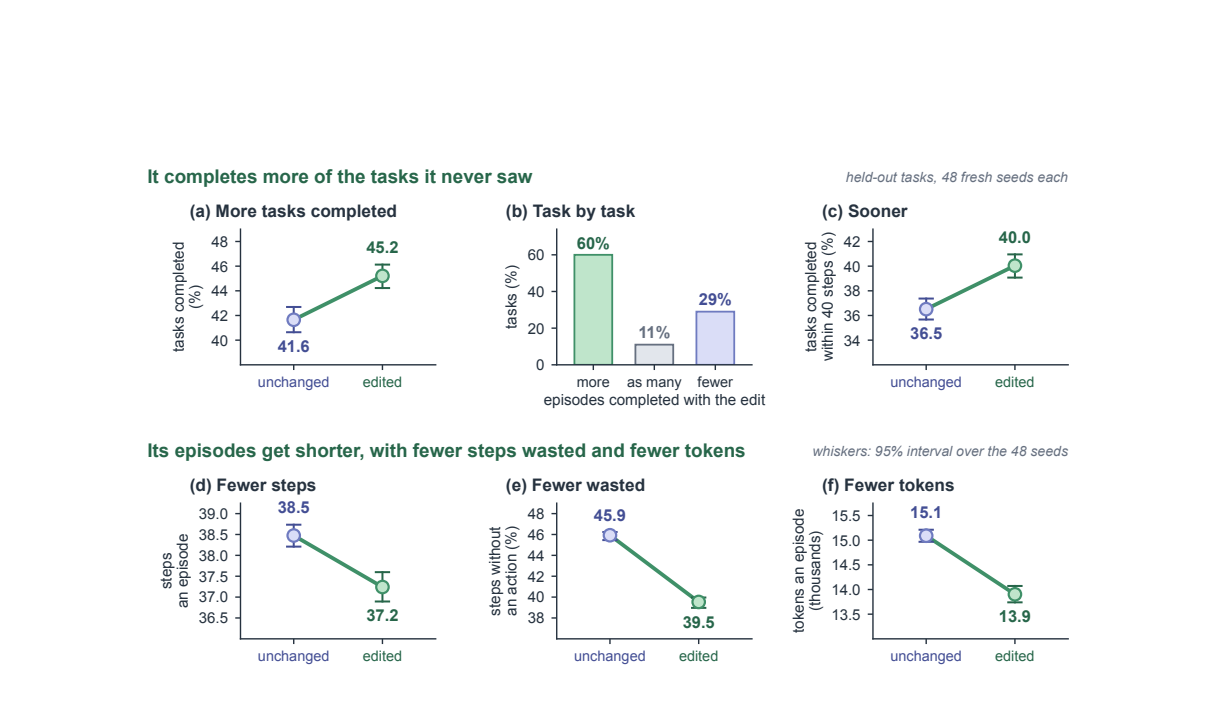
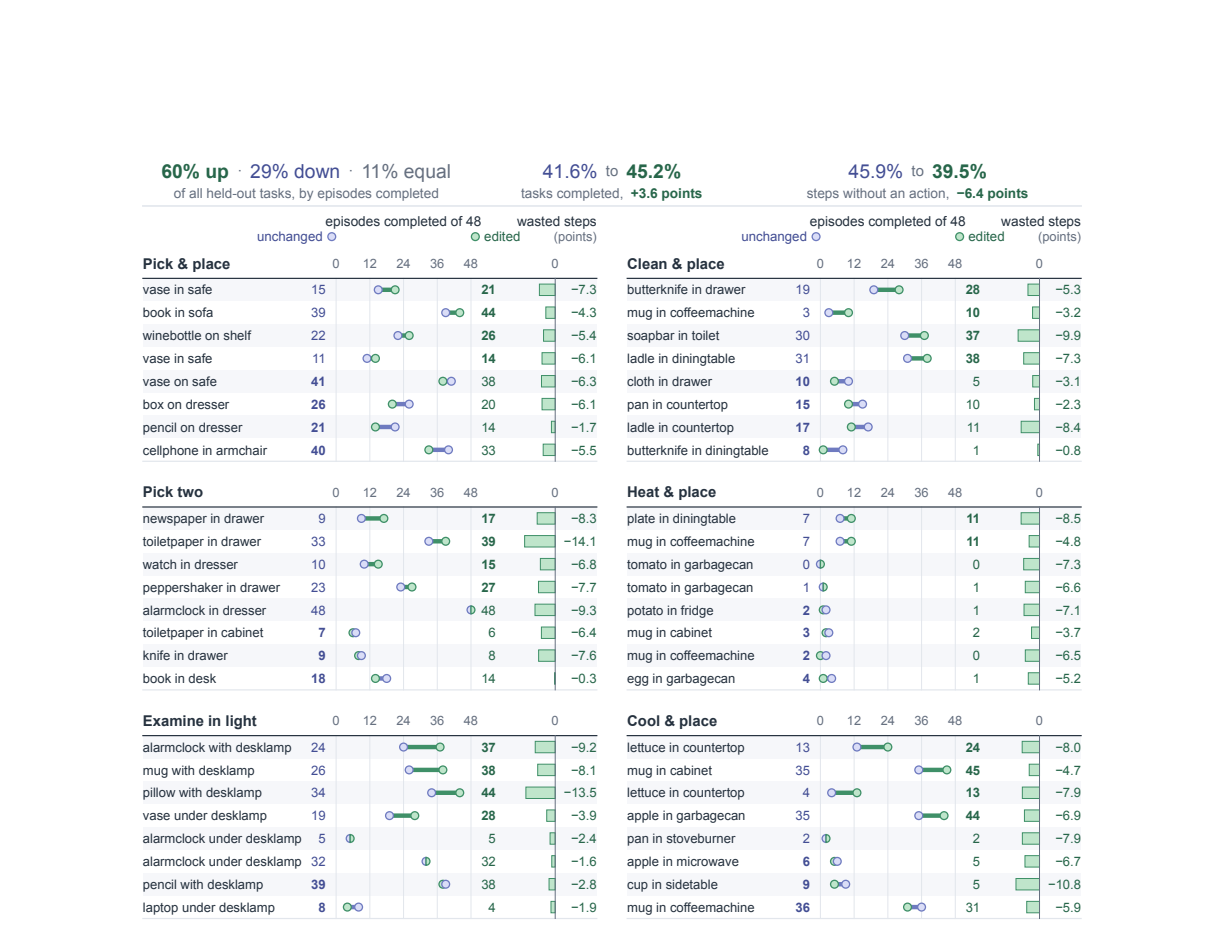
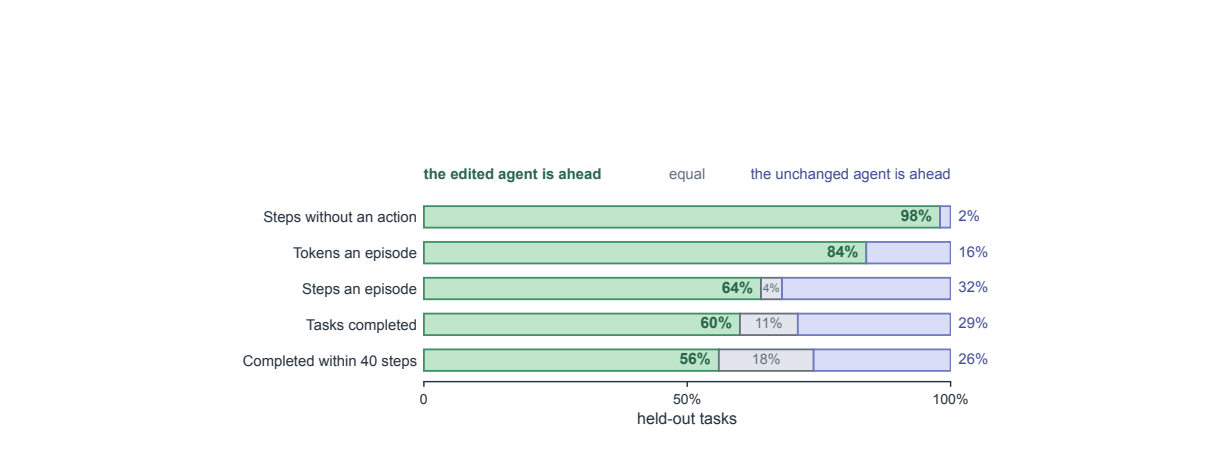
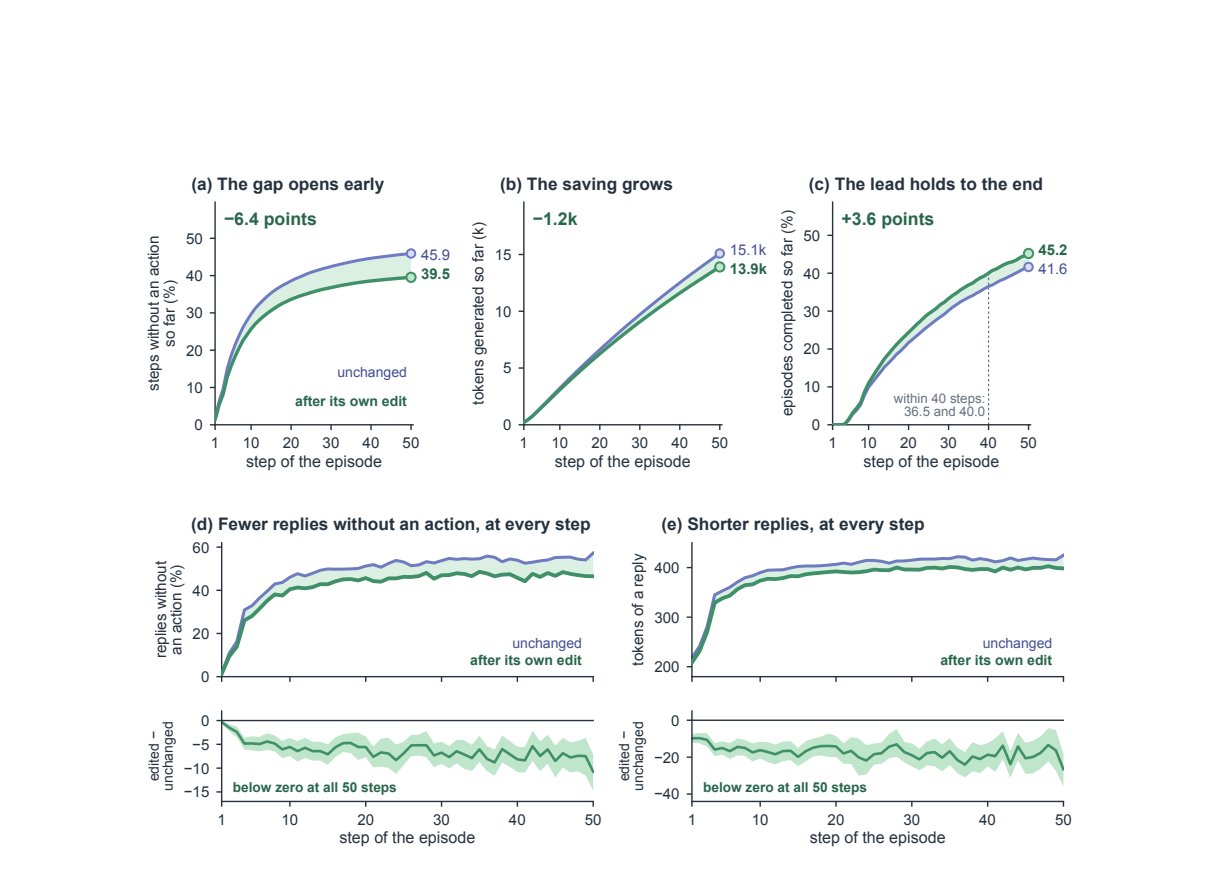
Core claim. The central claim is that an embodied agent (Qwen3.5-27B) can improve its own long-horizon task performance by rewriting its own weights, using only forward passes, with no gradient, reward model, or second model. The agent diagnoses its own failure mode (verbosity causing token-limit cuts), finds a direction in its hidden states by contrasting concise and cut-off replies, and applies a rank-one update to the attention output projection of layer 16. After this edit, the agent completes 45.2% of held-out tasks against 41.6% for the unchanged agent, with fewer wasted steps and tokens, and the improvement is stable across multiple nights without collapse.
The premise it rests on. The agent can reliably diagnose its own failures from summary statistics and trace them to a specific direction in its hidden states. This is demonstrated for one failure mode (verbosity leading to token limit) but is not proven to generalize to other failures.
If the paper is right (Pith's inferences, not the authors')
Embodied agents can improve on the job without separate training stages, reducing the need for offline retraining or human intervention.
The cost of improvement is paid once (at night) and collected at every step thereafter, with no added inference cost.
The loop is safe: every edit is tested against the unchanged self and confirmed on reserved tasks before being kept, preventing collapse.
The ability appears with scale: only the 27B model succeeded; smaller models of the same family could not produce a kept edit.
This opens a path to lifelong continual learning for robots, where the agent upgrades itself from its own experience without a trainer in the loop.
The method relies on the agent's ability to diagnose its own failures from summary statistics; this was demonstrated for one specific failure mode (verbosity) and may not generalize to other failure types without additional machinery for diagnosis.
The edit is a single rank-one update; more complex improvements would likely require multiple edits or iterative refinement, which the loop supports but has not yet demonstrated beyond one kept edit.
The approach could extend to other modalities (vision, robotics) if the agent can read its own hidden states and write edits, but the paper only tests in a text environment (ALFWorld).
The confirmation step uses reserved tasks; in a truly open-ended environment, maintaining a set of held-out tasks may be impractical, and the agent would need alternative ways to avoid overfitting.
Check this review
What was read
The passes were given all 256,227 characters of the paper's LaTeX source.
Fingerprint of that text (SHA-256): ace03d3eff558c24a5e4da1b4af3d2102e3991f02ae06a5828246e90a9375d49
Pith does not keep that text. Rebuilt from the paper's source or PDF by the same code, it has this fingerprint if it is the same text. From a copy of Pith's code:
PYTHONPATH=. python scripts/review_input_check.py 2611.31117
The passes, in the order they ran
- Reader deepseek-v4-flash · medium effort · $0.0074 · instructions of the Reader, fingerprint f9ead7300382…
- Skeptic deepseek-v4-flash · medium effort · $0.0075 · instructions of the Skeptic, fingerprint 8f88c0f61488…
- Referee deepseek-v4-flash · medium effort · $0.0072 · instructions of the Referee, fingerprint a852d99aea0d…
- Check against the paper deepseek-v4-flash · medium effort · $0.028 · instructions of the Check against the paper, fingerprint 6c7a6883d551…
- Editor deepseek-v4-flash · medium effort · $0.0068 · instructions of the Editor, fingerprint e7211f6a3d27…
- Circularity check deepseek-v4-flash · medium effort · $0.0068 · instructions of the Circularity check, fingerprint e9946e39d67b…
- Summary for the page deepseek-v4-flash · medium effort · temperature 0.2 · $0.0071 · instructions of the Summary for the page, fingerprint e4f56bf568e7…
The passes cost $0.071 in model calls together.
Version stamped on this review: pith-pipeline@v1.4.1-daily-deepseek-or-medium+deepseek/deepseek-v4-flash+p.d60f54226f00
Each link opens a pass's instructions as plain text, the exact bytes its fingerprint was taken over. Every stored set of instructions.
curl -s https://pith.science/methodology/prompts/f9ead730038216984cfb56d7cb34332bdf691828296a1de4245f3d6667d4bf56 | sha256sum
prints the fingerprint of the reader's instructions. The same works for every pass.
The receipt
The review's fingerprint was taken on 24 Nov 2026. The review you are reading still matches it.
Fingerprint of the review (SHA-256): 7c0c1fdda7d16e4913b01173d65ded9a2a6908d75335f54e6f46b51fd064a8fb
curl -s 'https://pith.science/api/v1/verdicts/2611.31117?form=canonical' | sha256sum
prints the fingerprint of the review as it stands now. The rule, in four steps.
A matching fingerprint shows the review has not changed since that date. It does not show that the review is right.
How often reviews like this one are right
Reviews like this one: written by deepseek-v4-flash, from the paper's LaTeX source.
How often objections from reviews like this one are right: not yet measured
Reviews by people
This review was written by a machine. No person has reviewed this paper on Pith yet. A scientist listed on Pith can review it for a fee, and their review is published here whatever it concludes.
The paper
Abstract
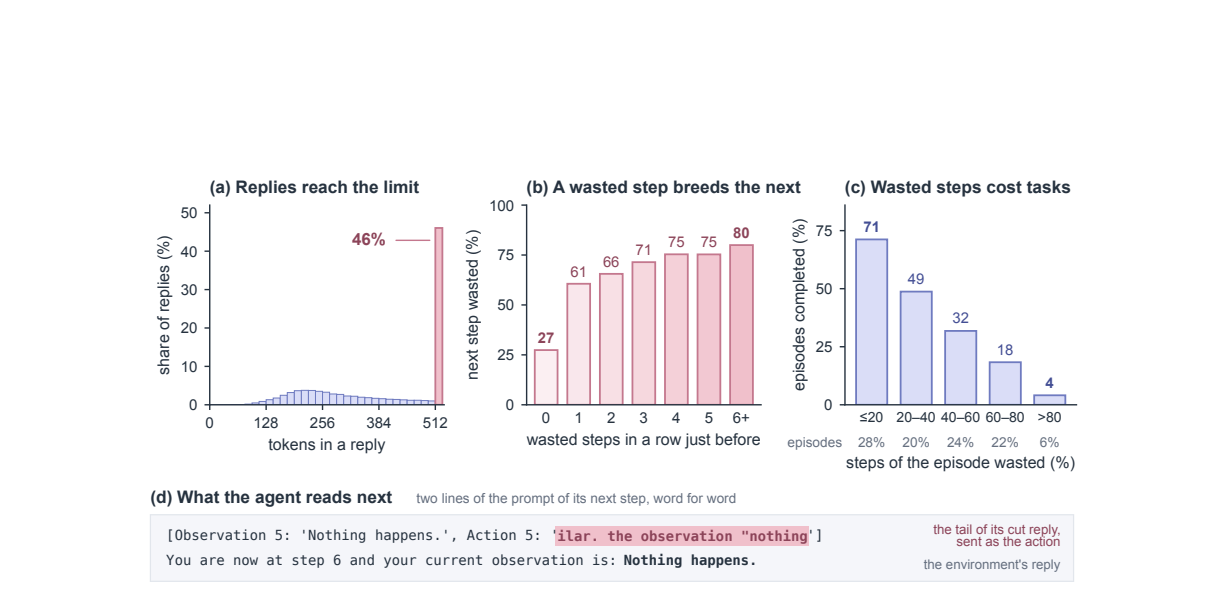
An embodied agent built on a language model goes to work with the weights it was given and keeps them for life. To get better, it needs more training, or reflection, memory, search or prompts that cost every step and are lost when the task changes. Editing weights by reasoning, weight-space programming, could end this, but has stayed with models that only reason or relied on a far larger commercial model. We introduce the self-upgrading embodied agent, to our knowledge the first that learns from its own experience by upgrading its own weights on the job, between its tasks, with no training, no gradient, no reward model, no second model, no test-time scaling and no harness or prompt engineering. By day a 27B agent works in a household environment. At night it reads its record, finds many of its steps wasted on replies that reach the token limit before any action, traces the habit to one direction in its hidden states, and rewrites one tensor of its weights. An agent that rewrites itself must first never break itself, so it is its own examiner: it tests every change against its unchanged self on practice tasks and keeps only what holds. When an edit holds, the next day it is a better agent, at the same cost per step: over thousands of held-out episodes, 48 fresh seeds a task, its one kept edit makes it complete significantly more tasks, in fewer steps, with fewer wasted and fewer tokens. This self-improvement is multi-round, stable and continual: through the nights that follow, the upgrade holds, without collapse. Of four sizes of its family, only the 27B agent does this. From here on, an embodied agent need not keep training and inference apart: as it works, it gathers its own experience and upgrades itself, with no separate pre-training or post-training and no human intervention. We believe this opens lifelong continual learning for robots: stable, continual, recursive self-improvement.
The paper's own sentences, arranged, kept beside the review and separate from it. Each label is drawn from a closed vocabulary; the number beside it is the probability the classifier gave that label. No sentence in this record was written by a model.
abstract compiled · 2026-11-24
The authors' main claim, as the classifier picked it out 0.79
“We believe this opens lifelong continual learning for robots: stable, continual, recursive self-improvement.”
How the main claim is stated: speculative 0.49
What the abstract itself states, as probabilities: claims first 0.95 · states limitation 0.90 · human participants 0.05 · controlled comparison 0.66 · randomized assignment 0.05 · states quantitative result 0.94 · compares with prior results 0.85 · mentions code or data availability 0.03
The abstract, sentence by sentence
This table labels the abstract only (arXiv listing abstract v1). The number is the probability the classifier gave the label.
| Sentence | Role | The authors' own work | States the main conclusion | Strength |
|---|---|---|---|---|
| An embodied agent built on a language model goes to work with the weights it was given and keeps them for life. | background 0.98 | 0.08 | 0.04 | asserted 1.00 |
| To get better, it needs more training, or reflection, memory, search or prompts that cost every step and are lost when the task changes. | background 0.83 | 0.11 | 0.03 | asserted 1.00 |
| Editing weights by reasoning, weight-space programming, could end this, but has stayed with models that only reason or relied on a far larger commercial model. | gap 0.62 | 0.05 | 0.04 | hedged possibility 0.98 |
| We introduce the self-upgrading embodied agent, to our knowledge the first that learns from its own experience by upgrading its own weights on the job, between its tasks, with no training, no gradient, no reward model, no second model, no test-time scaling and no harness or prompt engineering. | contribution 1.00 | 0.92 | 0.45 | asserted 1.00 |
| By day a 27B agent works in a household environment. | method 0.74 | 0.80 | 0.03 | asserted 0.98 |
| At night it reads its record, finds many of its steps wasted on replies that reach the token limit before any action, traces the habit to one direction in its hidden states, and rewrites one tensor of its weights. | method 0.97 | 0.88 | 0.07 | asserted 1.00 |
| An agent that rewrites itself must first never break itself, so it is its own examiner: it tests every change against its unchanged self on practice tasks and keeps only what holds. | method 0.99 | 0.69 | 0.06 | asserted 0.99 |
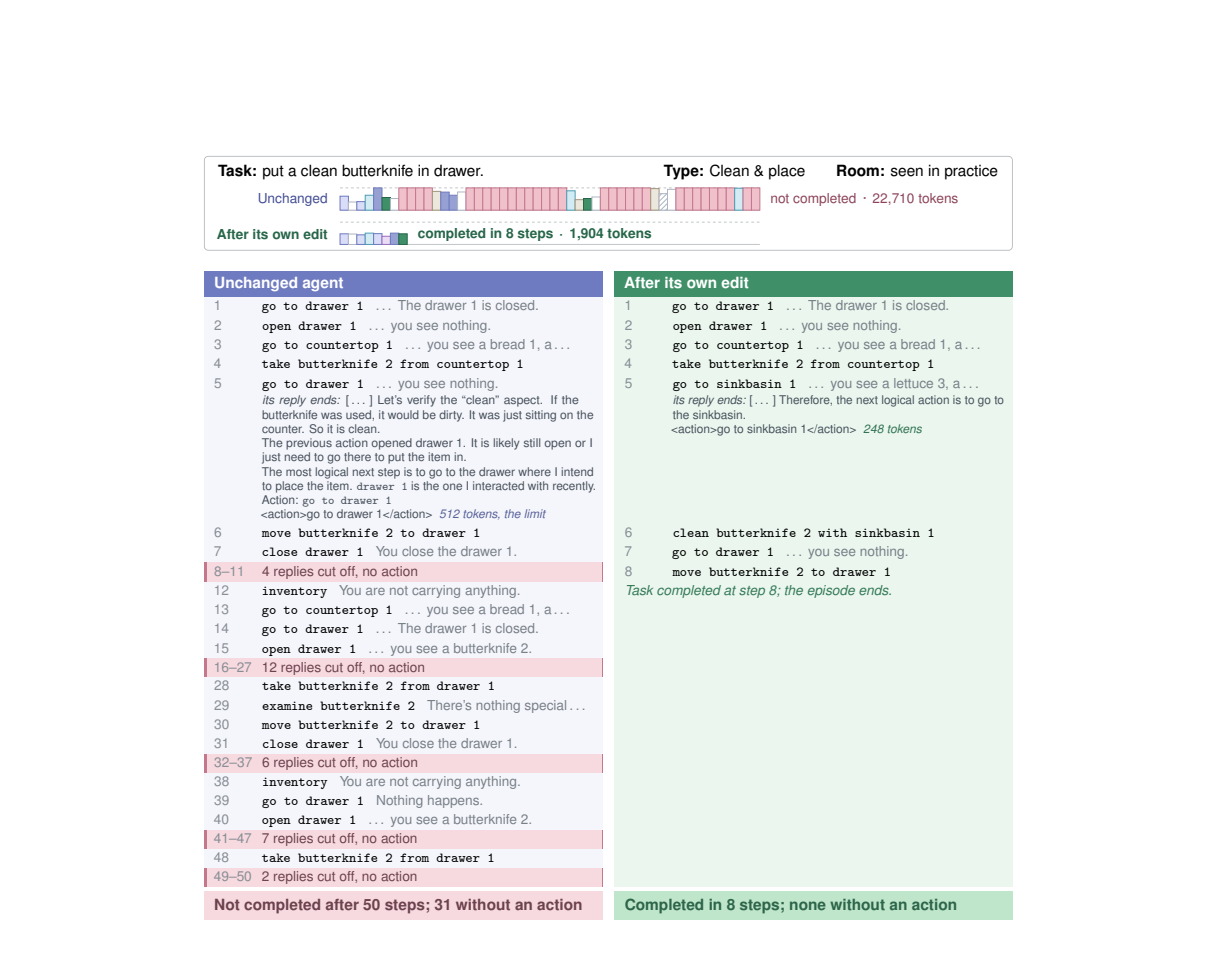
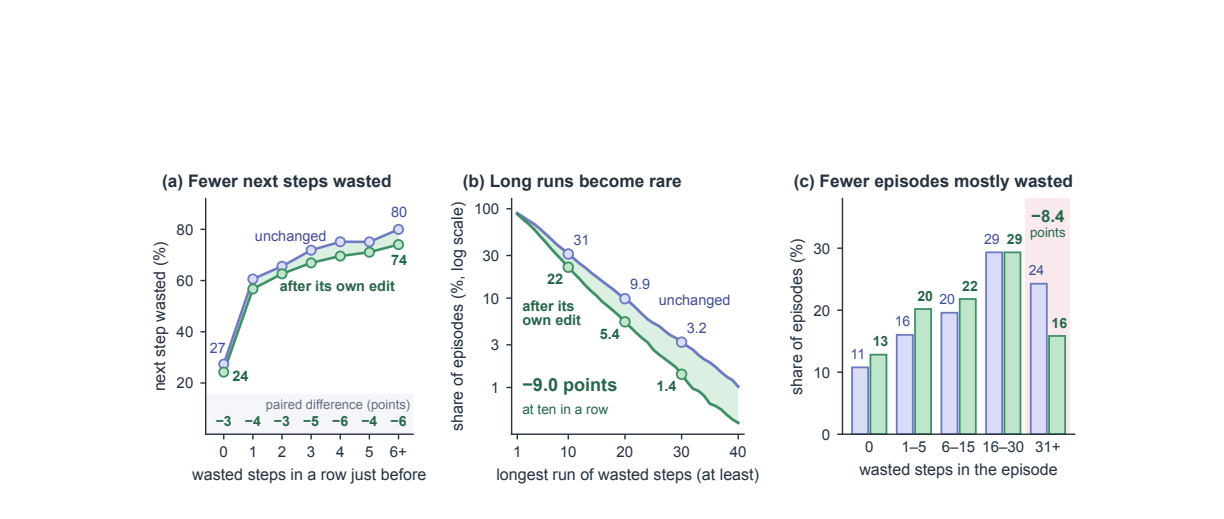
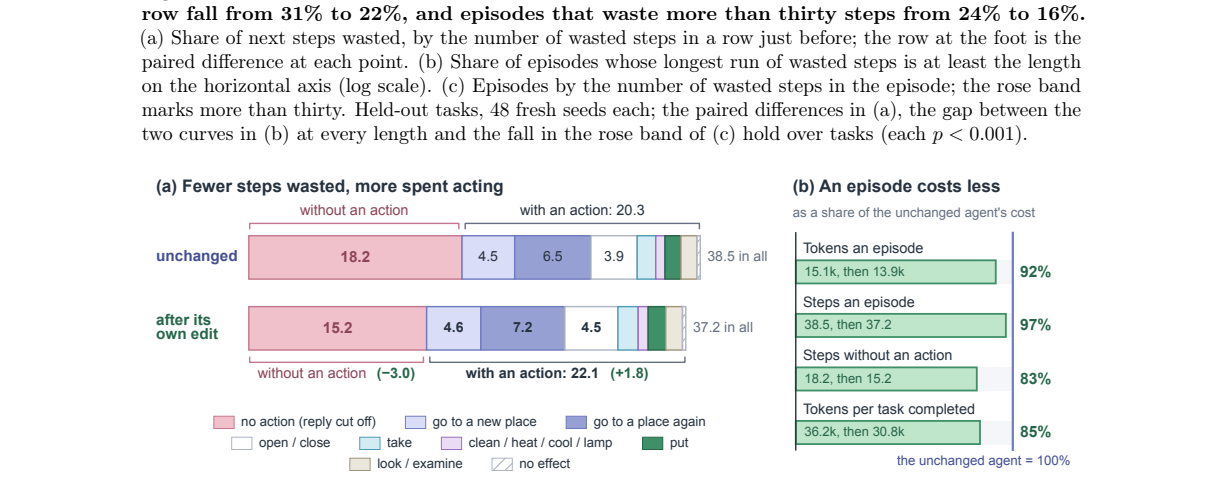
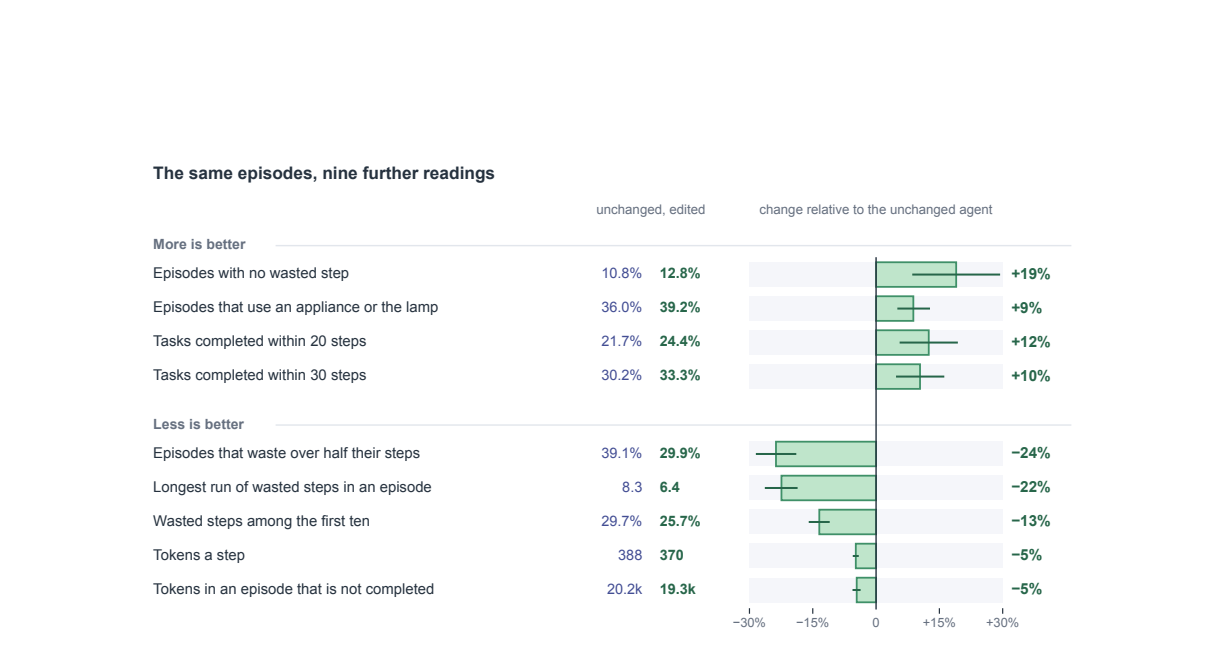
| When an edit holds, the next day it is a better agent, at the same cost per step: over thousands of held-out episodes, 48 fresh seeds a task, its one kept edit makes it complete significantly more tasks, in fewer steps, with fewer wasted and fewer tokens. | result 1.00 | 0.94 | 0.27 | asserted 1.00 |
| This self-improvement is multi-round, stable and continual: through the nights that follow, the upgrade holds, without collapse. | result 0.99 | 0.90 | 0.15 | asserted 1.00 |
| Of four sizes of its family, only the 27B agent does this. | result 0.66 | 0.92 | 0.06 | asserted 1.00 |
| From here on, an embodied agent need not keep training and inference apart: as it works, it gathers its own experience and upgrades itself, with no separate pre-training or post-training and no human intervention. | interpretation 0.94 | 0.70 | 0.58 | asserted 0.52 |
| We believe this opens lifelong continual learning for robots: stable, continual, recursive self-improvement. | interpretation 0.99 | 0.19 | 0.77 | speculative 0.49 |
What kind of paper the classifier reports this is: method or tool 1.00 · evidence from observation or experiment 0.90
What was examined, and what was not
Sources read
- arXiv listing abstract v1
Not examined
- full text
- figures and tables
- references and citing sentences
- relations to other papers
Levels run
- P abstract
Not run
- S sections
- T body sentences
- C citations
- R cross-paper relations
How the labels were made
Compiled by classifier-1.13.0 via TypeSafe API, question bank abstract-p1-20260923, 2026-11-24: 1 request, 9,017 input tokens.
Every quoted sentence on this record is the authors'. Every label is from Pith's closed vocabulary, with the probability shown beside it. This record as JSON
Figures (38)
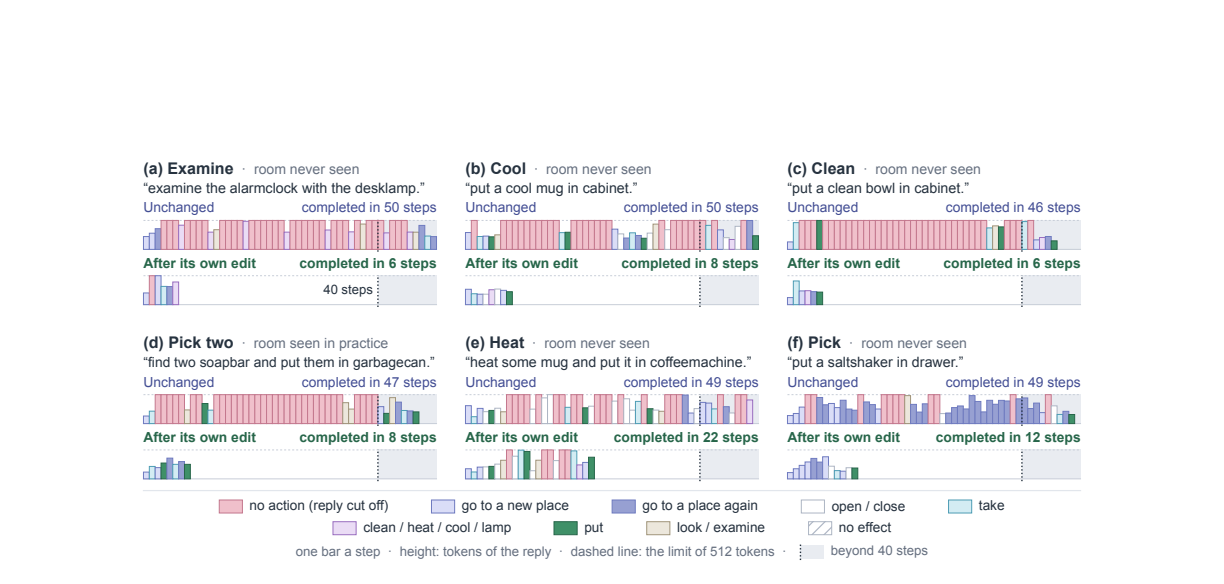
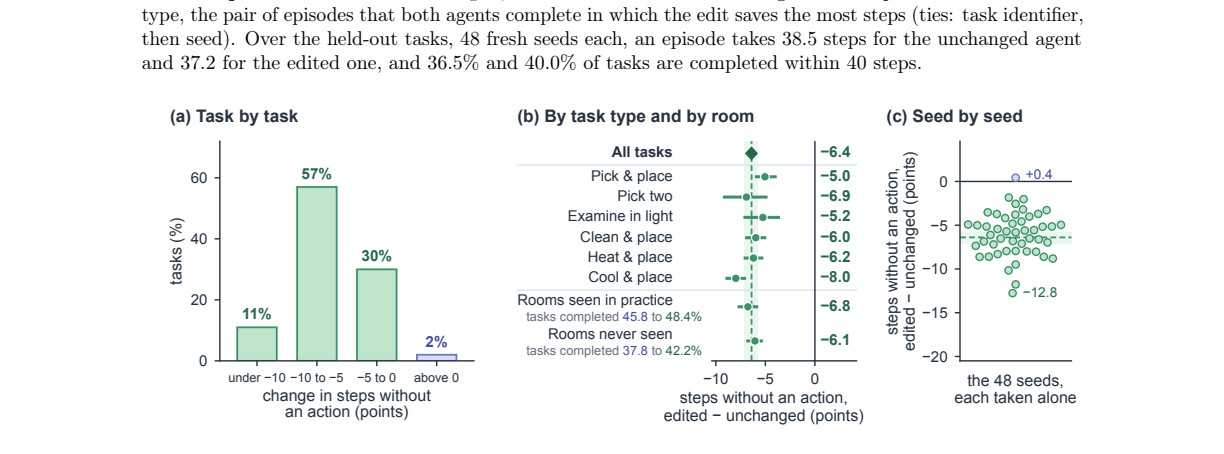
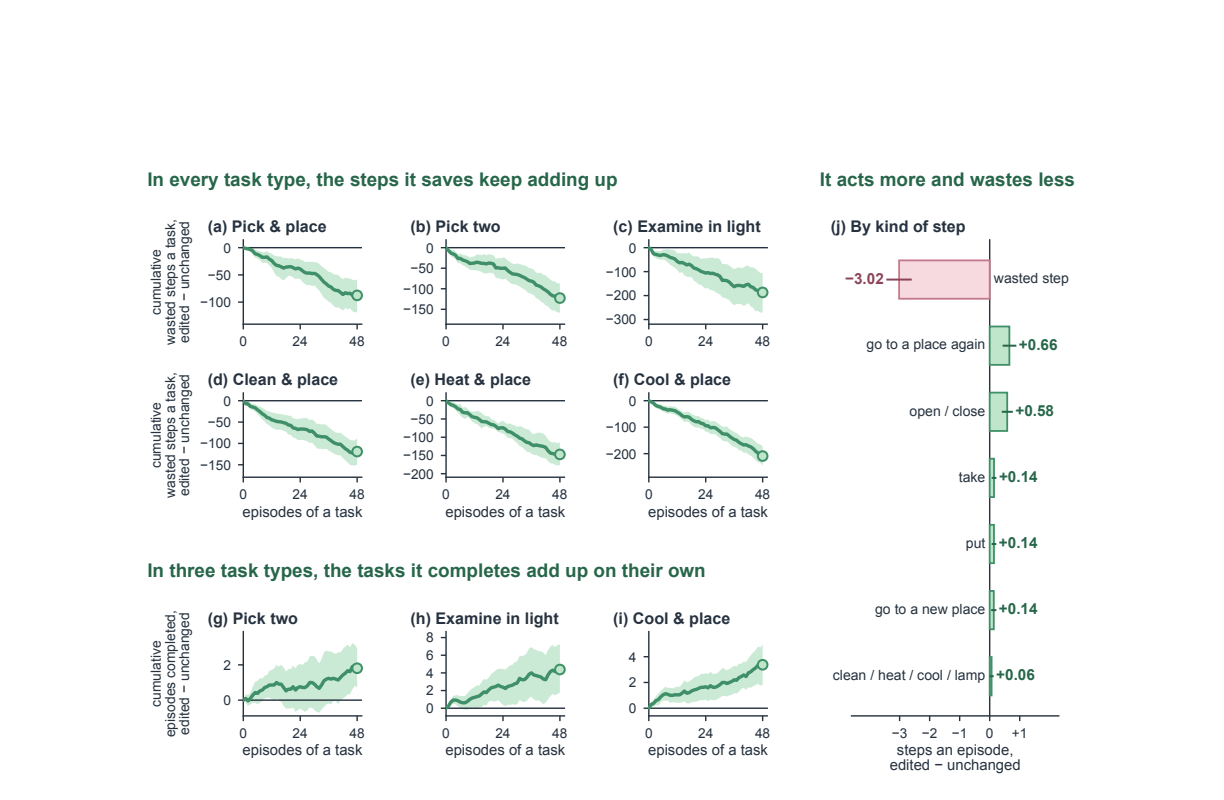
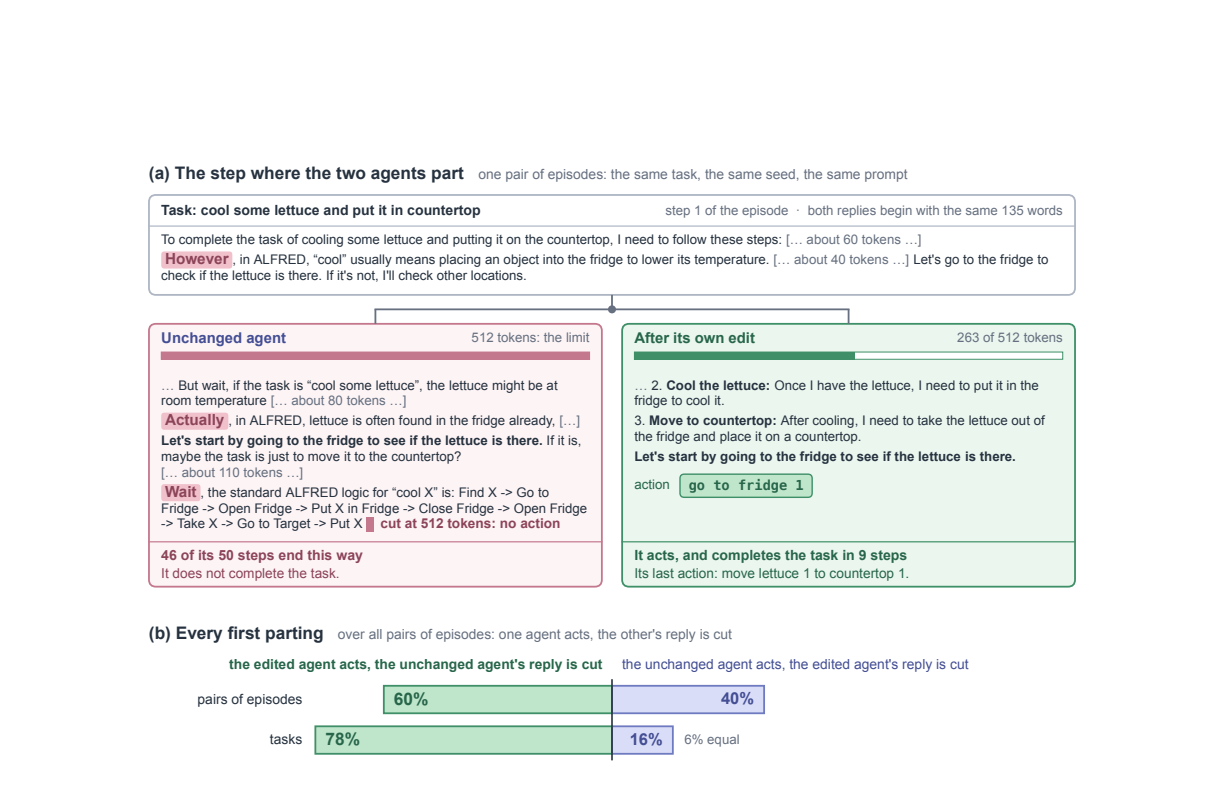

Figures are the authors', reproduced from the paper.
References (59)
- [1] Sebastian Thrun and Tom M. Mitchell. Lifelong robot learning.Robotics Auton. Syst., 15(1-2):25–46, 1995 on Pith
- [2] Timothée Lesort, Vincenzo Lomonaco, Andrei Stoian, Davide Maltoni, David Filliat, and Natalia Díaz Rodríguez. Continual learning for robotics: Definition, framework, learning strategies, opportunities and challenges.Inf. Fusion, 58:52–68, 2020 on Pith
- [3] Bo Liu, Yifeng Zhu, Chongkai Gao, Yihao Feng, Qiang Liu, Yuke Zhu, and Peter Stone. LIBERO: Benchmarking Knowledge Transfer for Lifelong Robot Learning. In Alice Oh, Tristan Naumann, Amir Globerson, Kate Saenko, Moritz Hardt, and Sergey Levine, editors,Advances in Neural Infor... on Pith
- [4] Lang Feng, Zhenghai Xue, Tingcong Liu, and Bo An. Group-in-Group Policy Optimization for LLM Agent Training. In Danielle Belgrave, Cheng Zhang, Laura N. Montoya, Hsuan-Tien Lin, Razvan Pascanu, Piotr Koniusz, Marzyeh Ghassemi, Nancy Chen, Iván Vladimir Meza Ruíz, and Arturo Lo... on Pith
- [5] Zihan Wang, Kangrui Wang, Qineng Wang, Pingyue Zhang, Linjie Li, Zhengyuan Yang, Xing Jin, Kefan Yu, Minh Nhat Nguyen, Licheng Liu, Eli Gottlieb, Yiping Lu, Kyunghyun Cho, Jiajun Wu, Li Fei-Fei, Lijuan Wang, Yejin Choi, and Manling Li. RAGEN: Understanding Self-Evolution in LL... on PithPith's reviewarXiv
- [6] Yifei Zhou, Andrea Zanette, Jiayi Pan, Sergey Levine, and Aviral Kumar. ArCHer: Training Language Model Agents via Hierarchical Multi-Turn RL. In Ruslan Salakhutdinov, Zico Kolter, Katherine A. Heller, Adrian Weller, Nuria Oliver, Jonathan Scarlett, and Felix Berkenkamp, edito... on Pith
- [7] James Kirkpatrick, Razvan Pascanu, Neil C. Rabinowitz, Joel Veness, Guillaume Desjardins, Andrei A. Rusu, Kieran Milan, John Quan, Tiago Ramalho, Agnieszka Grabska-Barwinska, Demis Hassabis, Claudia Clopath, Dharshan Kumaran, and Raia Hadsell. Overcoming catastrophic forgettin... on PithPith's reviewarXiv
- [8] German Ignacio Parisi, Ronald Kemker, Jose L. Part, Christopher Kanan, and Stefan Wermter. Continual lifelong learning with neural networks: A review.Neural Networks, 113:54–71, 2019. 26 on Pith
- [9] Noah Shinn, Federico Cassano, Ashwin Gopinath, Karthik Narasimhan, and Shunyu Yao. Reflexion: language agents with verbal reinforcement learning. In Alice Oh, Tristan Naumann, Amir Globerson, Kate Saenko, Moritz Hardt, and Sergey Levine, editors,Advances in Neural Information ... on Pith
- [10] Guanzhi Wang, Yuqi Xie, Yunfan Jiang, Ajay Mandlekar, Chaowei Xiao, Yuke Zhu, Linxi Fan, and Anima Anandkumar. Voyager: An Open-Ended Embodied Agent with Large Language Models.Trans. Mach. Learn. Res., 2024, 2024 on Pith
- [11] Shunyu Yao, Jeffrey Zhao, Dian Yu, Nan Du, Izhak Shafran, Karthik R. Narasimhan, and Yuan Cao. ReAct: Synergizing Reasoning and Acting in Language Models. InThe Eleventh International Conference on Learning Representations, ICLR 2023, Kigali, Rwanda, May 1-5, 2023. OpenReview.... on Pith
- [12] Andy Zhou, Kai Yan, Michal Shlapentokh-Rothman, Haohan Wang, and Yu-Xiong Wang. Language Agent Tree Search Unifies Reasoning, Acting, and Planning in Language Models. In Ruslan Salakhutdinov, Zico Kolter, Katherine A. Heller, Adrian Weller, Nuria Oliver, Jonathan Scarlett, and... on Pith
- [13] Rikiya Takehi, Jayden Teoh, Alex Zhang, and Omar Khattab. Sparks of Weight-Space Program- ming: LLMs can natively read & write neural network weights.https://rikiyat.github.io/blog/ weight-space-programming/, November 2026. Blog post on Pith
- [14] Junru Hu, Cheng Tang, Wei Li, Hongze Zhu, Chun-Mei Feng, Qi Zhang, Yirong Chen, and Ming Hu. Exploring Weight-Space Programming: Capabilities, Generalization, and Limitations. arXiv:2611.09382, 2026 on PithPith's reviewarXiv
- [15] Jusheng Zhang, Keze Wang, and Liang Lin. Can LLMs Debug Robots by Editing Their Weights? arXiv:2611.09376, 2026 on PithPith's reviewarXiv
- [16] Jiajun Fan, Neil He, Changyi Yang, Andy Mao, Xi Zhu, Chaoran Cheng, Kaiqu Liang, Shuaike Shen, Zetian Li, Ruihan Guo, and Ge Liu. Language Models Can Rewrite Their Own Weights. arXiv:2611.21885, 2026 on PithPith's reviewarXiv
- [17] Adam Zweiger, Jyothish Pari, Han Guo, Yoon Kim, and Pulkit Agrawal. Self-Adapting Language Models. In Danielle Belgrave, Cheng Zhang, Laura N. Montoya, Hsuan-Tien Lin, Razvan Pascanu, Piotr Koniusz, Marzyeh Ghassemi, Nancy Chen, Iván Vladimir Meza Ruíz, and Arturo Loaiza-Bonil... on Pith
- [18] Andy Arditi, Oscar Obeso, Aaquib Syed, Daniel Paleka, Nina Panickssery, Wes Gurnee, and Neel Nanda. Refusal in Language Models Is Mediated by a Single Direction. In Amir Globersons, Lester Mackey, Danielle Belgrave, Angela Fan, Ulrich Paquet, Jakub M. Tomczak, and Cheng Zhang,... on Pith
- [19] Chung-En Sun, Ge Yan, and Tsui-Wei Weng. ThinkEdit: Interpretable Weight Editing to Mitigate Overly Short Thinking in Reasoning Models. In Christos Christodoulopoulos, Tanmoy Chakraborty, Carolyn Rose, and Violet Peng, editors,Proceedings of the 2025 Conference on Empirical Me... on Pith
- [20] Chung-En Sun, Ge Yan, Zimo Wang, and Tsui-Wei Weng. Steer2Edit: From Activation Steering to Component-Level Editing.CoRR, abs/2602.09870, 2026 on PithPith's reviewarXiv
show 39 more
- [21] Wenlong Huang, Pieter Abbeel, Deepak Pathak, and Igor Mordatch. Language Models as Zero-Shot Planners: Extracting Actionable Knowledge for Embodied Agents. In Kamalika Chaudhuri, Stefanie Jegelka, Le Song, Csaba Szepesvári, Gang Niu, and Sivan Sabato, editors,International Con... on Pith
- [22] Brian Ichter, Anthony Brohan, Yevgen Chebotar, Chelsea Finn, Karol Hausman, Alexander Herzog, Daniel Ho, Julian Ibarz, Alex Irpan, Eric Jang, Ryan Julian, Dmitry Kalashnikov, Sergey Levine, Yao Lu, Carolina Parada, Kanishka Rao, Pierre Sermanet, Alexander Toshev, Vincent Vanho... on Pith
- [23] Wenlong Huang, Fei Xia, Ted Xiao, Harris Chan, Jacky Liang, Pete Florence, Andy Zeng, Jonathan Tompson, Igor Mordatch, Yevgen Chebotar, Pierre Sermanet, Tomas Jackson, Noah Brown, Linda Luu, Sergey Levine, Karol Hausman, and Brian Ichter. Inner Monologue: Embodied Reasoning th... on Pith
- [24] Mohit Shridhar, Xingdi Yuan, Marc-Alexandre Côté, Yonatan Bisk, Adam Trischler, and Matthew J. Hausknecht. ALFWorld: Aligning Text and Embodied Environments for Interactive Learning. In9th International Conference on Learning Representations, ICLR 2021, Virtual Event, Austria,... on Pith
- [25] Mohit Shridhar, Jesse Thomason, Daniel Gordon, Yonatan Bisk, Winson Han, Roozbeh Mottaghi, Luke Zettlemoyer, and Dieter Fox. ALFRED: A Benchmark for Interpreting Grounded Instructions for Everyday Tasks. In2020 IEEE/CVF Conference on Computer Vision and Pattern Recognition, CV... on Pith
- [26] Marc-Alexandre Côté, Ákos Kádár, Xingdi Yuan, Ben Kybartas, Tavian Barnes, Emery Fine, James Moore, Matthew J. Hausknecht, Layla El Asri, Mahmoud Adada, Wendy Tay, and Adam Trischler. TextWorld: A Learning Environment for Text-Based Games. In Tristan Cazenave, Abdallah Saffidi... on Pith
- [27] Aohan Zeng, Mingdao Liu, Rui Lu, Bowen Wang, Xiao Liu, Yuxiao Dong, and Jie Tang. AgentTuning: Enabling Generalized Agent Abilities for LLMs. In Lun-Wei Ku, Andre Martins, and Vivek Srikumar, editors,Findings of the Association for Computational Linguistics, ACL 2024, Bangkok,... on Pith
- [28] Yifan Song, Da Yin, Xiang Yue, Jie Huang, Sujian Li, and Bill Yuchen Lin. Trial and Error: Exploration- Based Trajectory Optimization of LLM Agents. In Lun-Wei Ku, Andre Martins, and Vivek Srikumar, editors,Proceedings of the 62nd Annual Meeting of the Association for Computat... on Pith
- [29] Kevin Meng, David Bau, Alex Andonian, and Yonatan Belinkov. Locating and Editing Factual Associa- tions in GPT. In Sanmi Koyejo, S. Mohamed, A. Agarwal, Danielle Belgrave, K. Cho, and A. Oh, editors, Advances in Neural Information Processing Systems 35: Annual Conference on Ne... on Pith
- [30] Kevin Meng, Arnab Sen Sharma, Alex J. Andonian, Yonatan Belinkov, and David Bau. Mass-Editing 28 Memory in a Transformer. InThe Eleventh International Conference on Learning Representations, ICLR 2023, Kigali, Rwanda, May 1-5, 2023. OpenReview.net, 2023 on Pith
- [31] Gabriel Ilharco, Marco Túlio Ribeiro, Mitchell Wortsman, Ludwig Schmidt, Hannaneh Hajishirzi, and Ali Farhadi. Editing models with task arithmetic. InThe Eleventh International Conference on Learning Representations, ICLR 2023, Kigali, Rwanda, May 1-5, 2023. OpenReview.net, 2023 on Pith
- [32] Alexander Matt Turner, Lisa Thiergart, David Udell, Gavin Leech, Ulisse Mini, and Monte MacDiarmid. Activation Addition: Steering Language Models Without Optimization.CoRR, abs/2308.10248, 2023 on PithPith's reviewarXiv
- [33] Nina Rimsky, Nick Gabrieli, Julian Schulz, Meg Tong, Evan Hubinger, and Alexander Matt Turner. SteeringLlama2viaContrastiveActivationAddition. InLun-WeiKu, AndreMartins, andVivekSrikumar, editors,Proceedings of the 62nd Annual Meeting of the Association for Computational Lingu... on Pith
- [34] Andy Zou, Long Phan, Sarah Li Chen, James Campbell, Phillip Guo, Richard Ren, Alexander Pan, Xuwang Yin, Mantas Mazeika, Ann-Kathrin Dombrowski, Shashwat Goel, Nathaniel Li, Michael J. Byun, Zifan Wang, Alex Mallen, Steven Basart, Sanmi Koyejo, Dawn Song, Matt Fredrikson, J. Z... on PithPith's reviewarXiv
- [35] Kenneth Li, Oam Patel, Fernanda B. Viégas, Hanspeter Pfister, and Martin Wattenberg. Inference-Time Intervention: Eliciting Truthful Answers from a Language Model. In Alice Oh, Tristan Naumann, Amir Globerson, Kate Saenko, Moritz Hardt, and Sergey Levine, editors,Advances in N... on Pith
- [36] Aayush Marasini, Barsat Khadka, and Nick Rahimi. WeightBench: Evaluating Language Models as Weight-Space Programmers. arXiv:2611.18553, 2026 on PithPith's reviewarXiv
- [37] Chengrun Yang, Xuezhi Wang, Yifeng Lu, Hanxiao Liu, Quoc V. Le, Denny Zhou, and Xinyun Chen. Large Language Models as Optimizers. InThe Twelfth International Conference on Learning Representations, ICLR 2024, Vienna, Austria, May 7-11, 2024. OpenReview.net, 2024 on Pith
- [38] Aman Madaan, Niket Tandon, Prakhar Gupta, Skyler Hallinan, Luyu Gao, Sarah Wiegreffe, Uri Alon, Nouha Dziri, Shrimai Prabhumoye, Yiming Yang, Shashank Gupta, Bodhisattwa Prasad Majumder, Katherine Hermann, Sean Welleck, Amir Yazdanbakhsh, and Peter Clark. Self-Refine: Iterativ... on Pith
- [39] Jenny Zhang, Shengran Hu, Cong Lu, Robert T. Lange, and Jeff Clune. Darwin Gödel Machine: Open- Ended Evolution of Self-Improving Agents. In Carl Vondrick, Bharath Hariharan, Colin Raffel, Lerrel Pinto, Diyi Yang, and Aleksandra Faust, editors,The Fourteenth International Conf... on Pith
- [40] Xunjian Yin, Xinyi Wang, Liangming Pan, Li Lin, Xiaojun Wan, and William Yang Wang. Gödel Agent: A Self-Referential Agent Framework for Recursively Self-Improvement. In Wanxiang Che, Joyce Nabende, Ekaterina Shutova, and Mohammad Taher Pilehvar, editors,Proceedings of the 63rd... on Pith
- [41] Juergen Schmidhuber. Goedel Machines: Self-Referential Universal Problem Solvers Making Provably Optimal Self-Improvements. arXiv:cs/0309048, 2006 on PithPith's reviewarXiv
- [42] Qwen Team. Qwen3.5: Towards Native Multimodal Agents, February 2026 on Pith
- [43] Woosuk Kwon, Zhuohan Li, Siyuan Zhuang, Ying Sheng, Lianmin Zheng, Cody Hao Yu, Joseph Gonzalez, Hao Zhang, and Ion Stoica. Efficient Memory Management for Large Language Model Serving with PagedAttention. In Jason Flinn, Margo I. Seltzer, Peter Druschel, Antoine Kaufmann, and... on Pith
- [44] Charlie Victor Snell, Jaehoon Lee, Kelvin Xu, and Aviral Kumar. Scaling LLM Test-Time Compute Optimally Can be More Effective than Scaling Parameters for Reasoning. InThe Thirteenth International Conference on Learning Representations, ICLR 2025, Singapore, April 24-28, 2025. ... on Pith
- [45] Niklas Muennighoff, Zitong Yang, Weijia Shi, Xiang Lisa Li, Li Fei-Fei, Hannaneh Hajishirzi, Luke Zettlemoyer, Percy Liang, Emmanuel J. Candès, and Tatsunori Hashimoto. s1: Simple test-time scaling. In Christos Christodoulopoulos, Tanmoy Chakraborty, Carolyn Rose, and Violet P... on Pith
- [46] Xingyu Chen, Jiahao Xu, Tian Liang, Zhiwei He, Jianhui Pang, Dian Yu, Linfeng Song, Qiuzhi Liu, Mengfei Zhou, Zhuosheng Zhang, Rui Wang, Zhaopeng Tu, Haitao Mi, and Dong Yu. Do NOT Think That Much for 2+3=? On the Overthinking of Long Reasoning Models. In Aarti Singh, Maryam F... on Pith
- [47] John Schulman, Filip Wolski, Prafulla Dhariwal, Alec Radford, and Oleg Klimov. Proximal Policy Optimization Algorithms.CoRR, abs/1707.06347, 2017 on PithPith's reviewarXiv
- [48] Davide Paglieri, Bartlomiej Cupial, Samuel Coward, Ulyana Piterbarg, Maciej Wolczyk, Akbir Khan, Eduardo Pignatelli, Lukasz Kucinski, Lerrel Pinto, Rob Fergus, Jakob Nicolaus Foerster, Jack Parker- Holder, and Tim Rocktäschel. BALROG: Benchmarking Agentic LLM and VLM Reasoning... on Pith
- [50] Repeat, each step chosen by the agent: (a) code: read any tensor ofθ, compute on it without gradients, and save an edit∆to the tensors it names; (b)read: rerun steps of its record and get back the hidden states behind them (one round); (c) test: run θ and θ⊕ ∆on the same pract... on Pith
- [51] Untilthe agent asks for its confirmation or withdraws; once its rounds are used it can still write code, and then does one of the two on Pith
- [52] Confirm, once, if the agent asked for it (or if the night ran out of turns or time while it held an edit): run θ and θ⊕ ∆on 256 reserved tasks with the same seeds, and give the agent the paired differences on Pith
- [53] After the confirmation the agent decides. It submits if the failure it set out to repair is clearly reduced and the share of completed tasks is not clearly lower; otherwise it withdraws. Output:θ⊕∆if the agent submitted, andθas it was if it withdrew. Procedure 2 The self-upgra... on Pith
- [54] Foreach day and night, for as long as the agent works: (a) by day, the agent does its tasks withθ; every step costs what it cost before; (b) at night,θ←the output of Procedure 1 started fromθ. A night that withdraws leavesθ as it was. A night that submits makes its edit part o... on Pith
- [55] I need to find wherenewspaper 2is located. 4.armchair 1is a plausible location for a newspaper on Pith
- [56] Action:go to armchair 1. <action> go to armchair 1 </action>356 tokens 10go to drawer 1. . . you see nothing. its reply ends:[ . . . ] Reasoning: I have one newspaper. I need to put it in a drawer. Then I need to find a second newspaper and put it in the same drawer. The most ... on Pith
- [57] Missing Object: I do not see a bowl on desk 1 on Pith
- [58] Strategy: Since the bowl is not on the current desk, I need to search for it elsewhere in the room. […] on Pith
- [59] Next Step: I will move to desk 2 to check if the bowl is there. If not, I will proceed to check shelves or other locations. action go to desk 2 It acts, and completes the task in 9 steps Its last action: use desklamp 1. Clean & place Task: put a clean bowl in cabinet step 2 of... on Pith
- [2021] OpenReview.net, 2021 on Pith
Challenges and discussion
Disagree with the review, or know something it missed? Leave a comment, or challenge this review formally: a challenge becomes a permanent entry in this paper's record, and its decision is published here.
Come back by email
A short list of the week's newly reviewed papers. Nothing is sent until you confirm from your inbox, and every email has a link that stops it. No account.
No comments yet.
Sign in to comment