Robotics · arXiv:2610.36011 v1 · submitted 26 Oct 2026 · 26 references
E0.5: From Reconstructive to Future-Predictive 3D Foundations for Robotic World-Action Modeling
The paper says
“World-action models (WAMs) offer a promising framework for embodied intelligence, yet mainstream approaches remain centered on video foundation models or vision-language models.”
more of the abstract
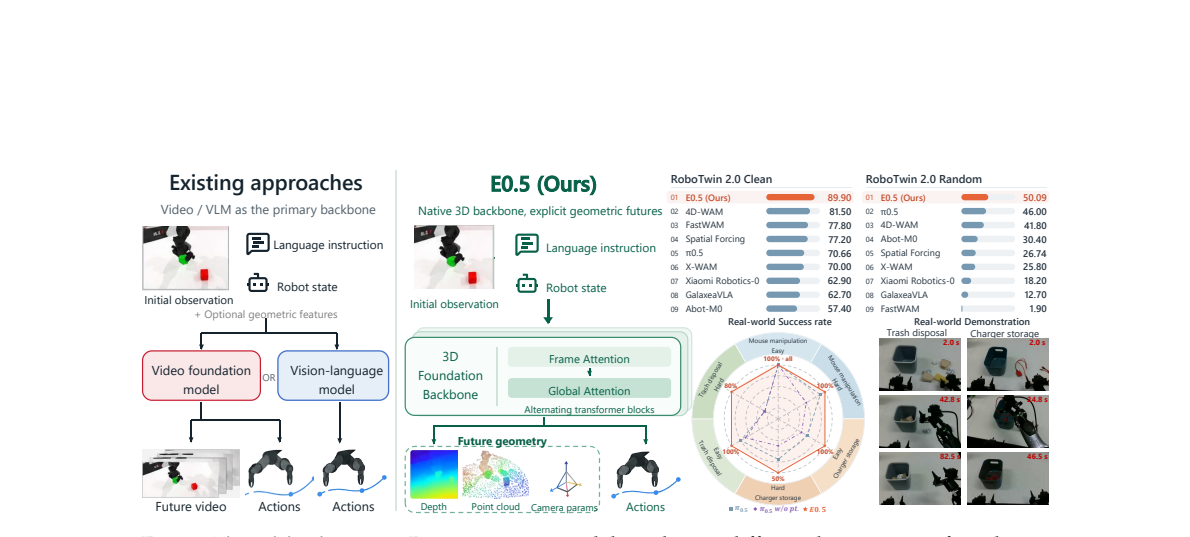
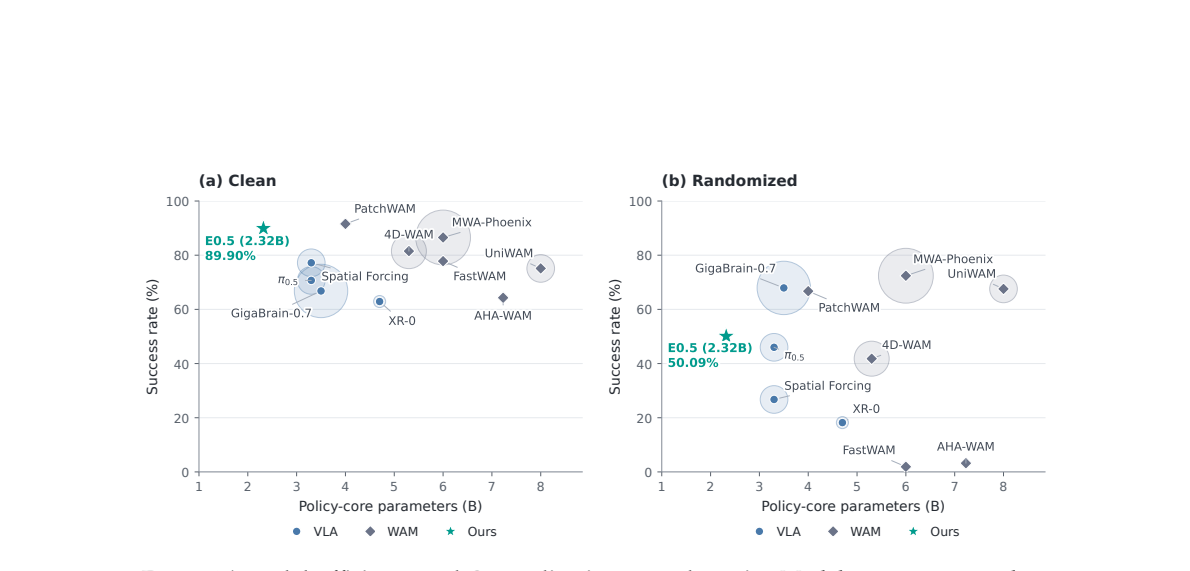
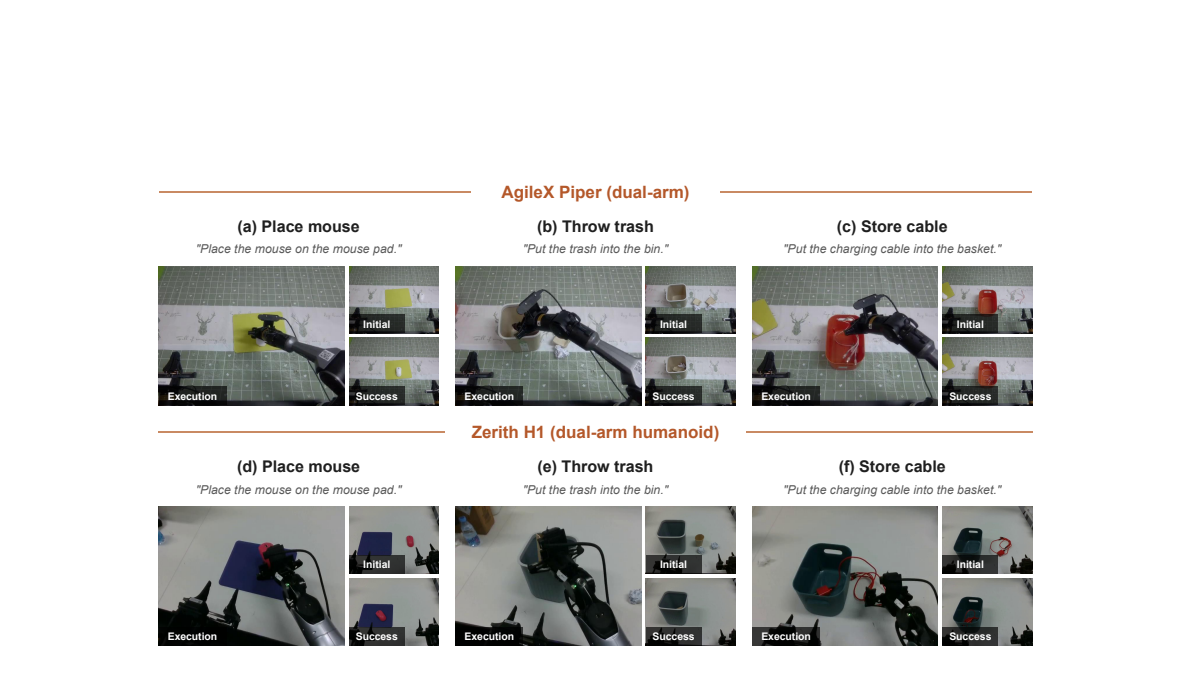
Even when geometric features extracted by 3D models such as VGGT are incorporated, they are typically passed into a video model or VLM that serves as the primary backbone, leaving 3D geometry as an auxiliary input or prediction target rather than the native foundation for world modeling. We present E0.5, a geometry-native world-action model built directly on 3D foundation models. E0.5 introduces two key innovations. First, it adopts a 3D foundation model as the primary backbone, making 3D geometry the native representation for both world modeling and action prediction. Second, it explicitly predicts future 3D states together with actions, enabling the model to capture geometric world dynamics beyond action-only modeling or future video prediction. Experiments on RoboTwin 2.0 first demonstrate the effectiveness of E0.5 without embodied-data pretraining, achieving success rates of 89.90% and 50.09% under clean and randomized settings, respectively. Building on these results, we further pretrain E0.5 on more than 160k robot trajectories from AgiBotWorld-Beta, jointly learning robot actions and future geometry within the pretrained 3D foundation. This embodied pretraining improves mean real-world manipulation success rates by approximately 15 and 7 percentage points on AgileX Piper and Zerith H1, respectively. Together, these results demonstrate the potential of geometry-native foundations to acquire robot interaction knowledge and transfer it to physical manipulation. E0.5 embodies this geometry-native approach as a member of the VWA family of world-action models.
from the abstract
Pith says
Machine review · deepseek-v4-flash · 28 Oct 2026 · what was read was not recorded · not checked by a person
It can be wrong. Challenge this review or reply to it.
The passes disagreed. Reader: holds up. Skeptic: holds up only with conditions. Referee: major revision.
Solid systems paper with strong empirical evidence for geometry-native world-action modeling, but the introduction contains an unsupported quantitative claim (30x accuracy) that needs correction. This line is wrong
2 major objections · 5 minor
How often objections from reviews like this one are right: not yet measured
Not checked: figures, code, what the 26 references say.
The paper says, at §1 Introduction, sentence beginning 'The advantage is especially pronounced...'
The review did not quote this passage.
Pith says: Objection 1 of 2 · major
The claim that 'E0.5 achieves approximately 30 times the accuracy of the video-prediction-based WAM baselines' in an OOD setting is not supported by any experiment reported in §4. The OOD evaluations are the RoboTwin Randomized setting (Table 1) and the real-world HARD tasks (Table 3).
more of objection 1
In Table 1, E0.5 achieves 50.09% vs. the next best 46.00% (π0.5)—not 30×. In Table 3, improvements over π0.5 are at most ~30 percentage points, not 30× accuracy. A specific, striking quantitative claim in the introduction must be backed by a clear experiment; the absence of supporting results undermines the credibility of the generalization argument. This should be corrected or removed.
The paper says, at §4.3 'Large-Scale Embodied Pretraining' and Appendix A.1
The review did not quote this passage.
A classifier read this sentence of the paper as acknowledging the concern (probability 0.65):
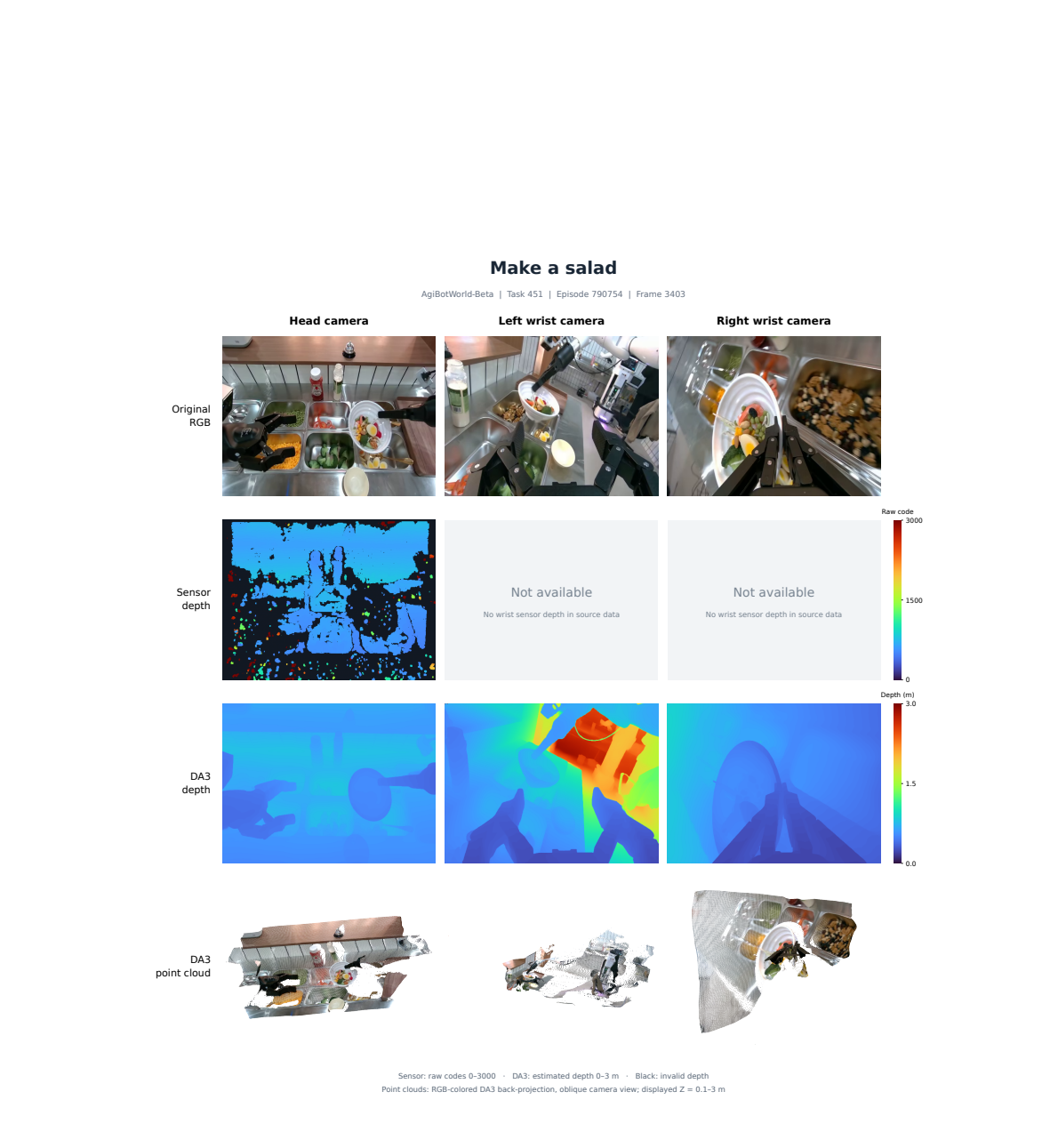
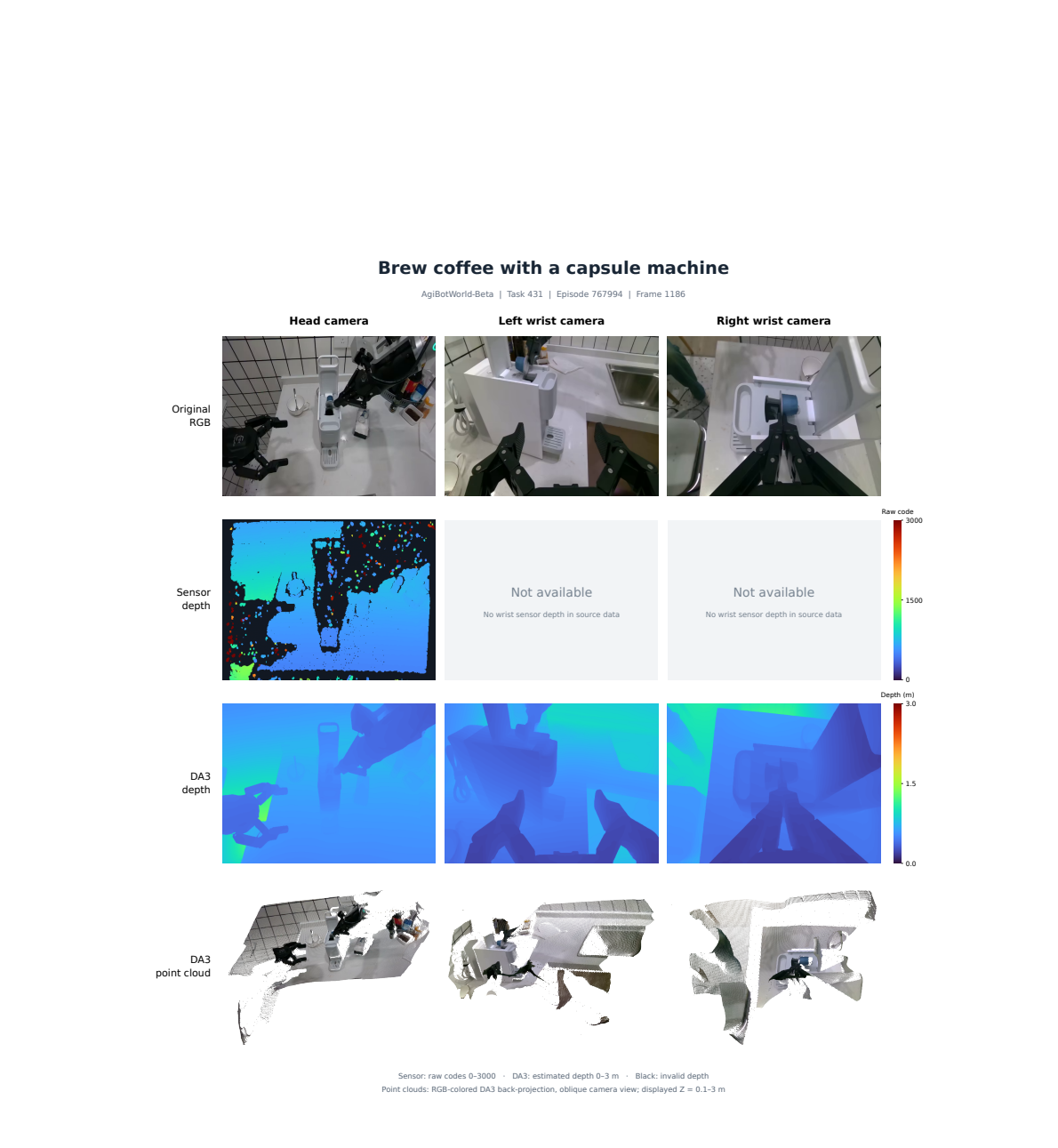
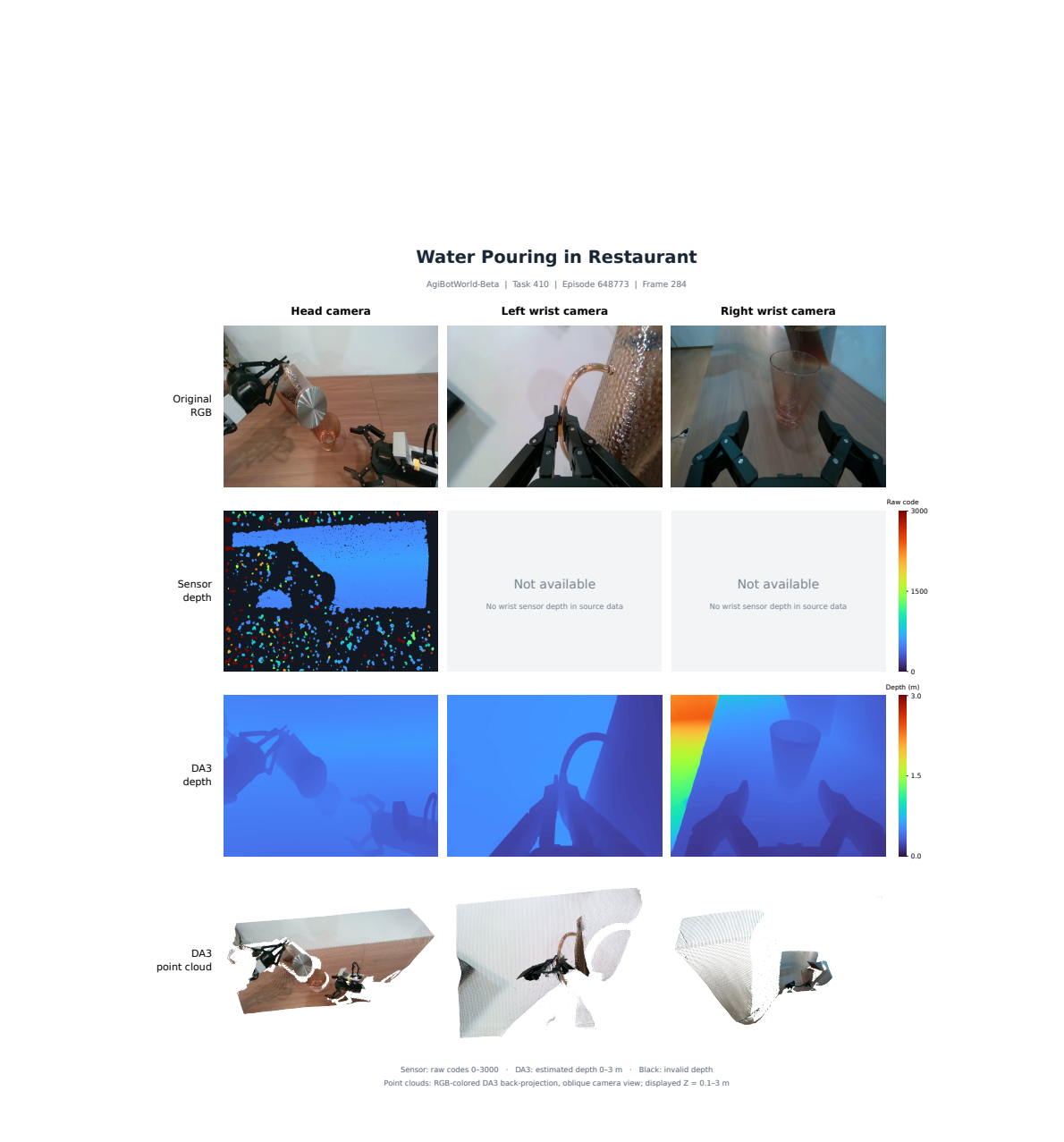
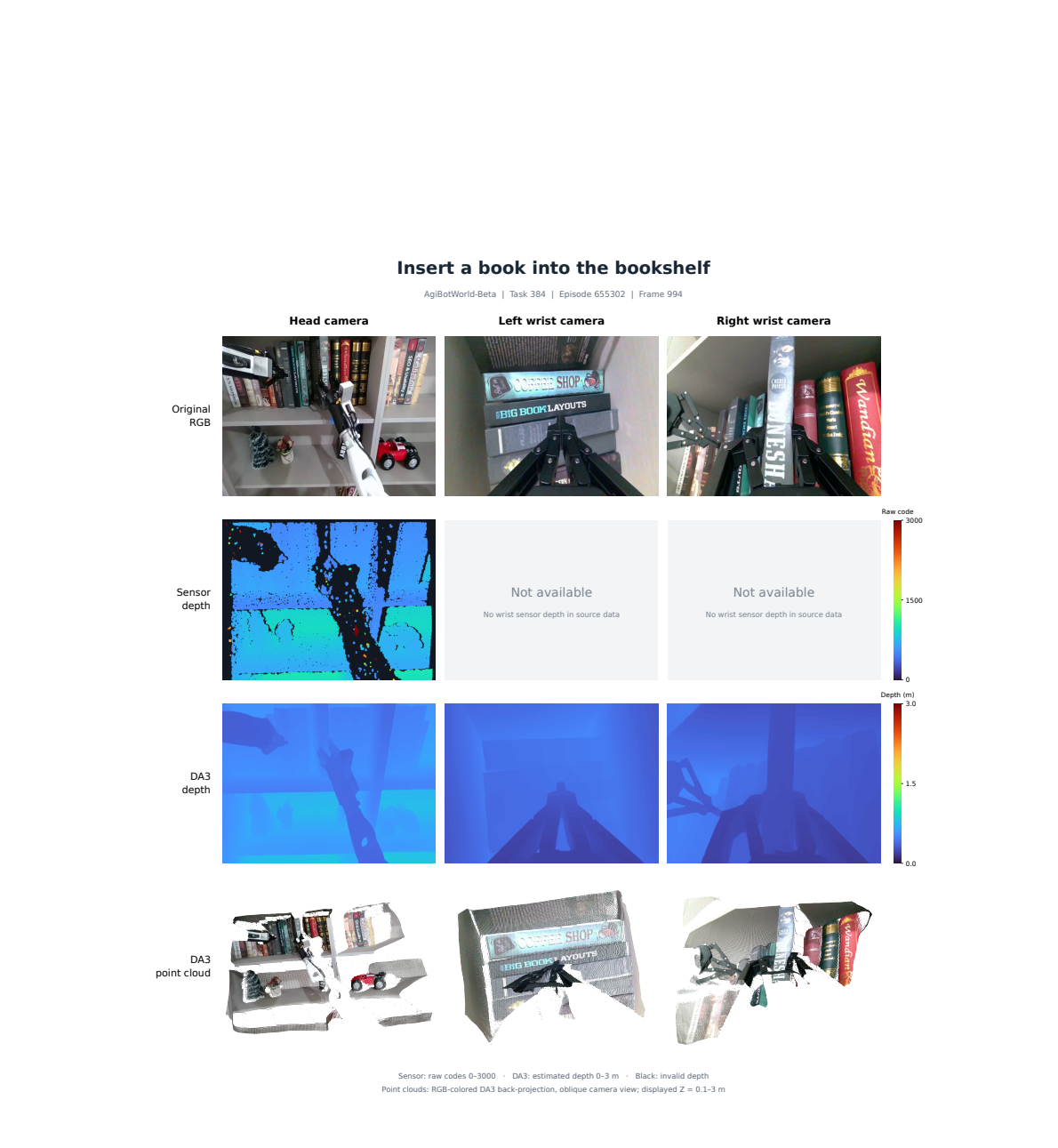
“Moreover, the available head-camera depth maps contain substantial holes and noisy measurements, including missing regions around the robot arms, leaving manipulation-relevant areas without valid geometric supervision.”
Pith says: Objection 2 of 2 · major
The entire large-scale pretraining relies on depth pseudo-labels generated by Depth Anything 3 (DA3) for all camera views, as wrist cameras lack sensor depth and head depth has holes. The paper acknowledges this (Appendix A.1), but the impact on pretrained representations is not directly evaluated.
more of objection 2
No analysis is provided on the quality of DA3 depth in manipulation-relevant regions (e.g., around grippers, cables, occluded objects) or on whether errors in the geometric supervision systematically bias the backbone. Since the geometric supervision is central to the method, a sensitivity study or at least a discussion of potential failure modes would strengthen the paper.
5 minor objections
The paper says, at §4.2 header
Pith says: minor objection 1 of 5
Typo: 'Disscussion on Future Geometry' should be 'Discussion on Future Geometry'.
The paper says, at §1 'approximately30 times'
Pith says: minor objection 2 of 5
Missing space: 'approximately30 times' should read 'approximately 30 times'.
show 3 more
The paper says, at Table 2 footnote
Pith says: minor objection 3 of 5
The table notes that '𝛿_k is the percentage of valid pixels satisfying max(ˆd/d,d/ˆd) < 1.25^k'. This is the standard 𝛿_1 metric for depth accuracy; the formulation is correct but the exponent notation (1.25^k) is unusual—consider stating '1.25, 1.25^2, 1.25^3' explicitly.
The paper says, at Appendix A.1
Pith says: minor objection 4 of 5
'DA3METRIC-LARGE' should be formatted as 'DA3-METRIC-LARGE' for consistency.
The paper says, at Table 8 caption
Pith says: minor objection 5 of 5
Tasks marked with † have fewer than 100 Random evaluation episodes. The rationale for the reduced sample size is unclear; a brief explanation (e.g., simulation instability or timeout) would improve transparency.
What would settle it
Request that the authors provide the exact OOD benchmark, metric definition, baseline results, and E0.5 result that produce the 'approximately 30 times the accuracy' ratio. If no such experiment exists, the claim should be retracted in a revision. Without this, the claim remains unverifiable.
from the skeptic's reading
How the review went
4 readings by deepseek-v4-flash · 28 Oct 2026
- Reader holds up
- Skeptic disagrees: says it holds up only with conditions Unsubstantiated quantitative OOD claim (30x accuracy) lacks supporting experiment.
- Editor wrote the verdict above
- Referee major revision: 2 major objections, 5 minor
Not run on this paper: the simulated authors' defence.
Pith did not check this review's objections against the paper.
The review in full
The review in brief, machine-written
You should know two things about this paper. First, it is a well-executed systems contribution that shows a trainable 3D foundation backbone (VGGT-Omega) can serve as the primary backbone for world-action modeling, with future geometry prediction as supervision. The experimental suite is thorough: RoboTwin 2.0, real-world robot evaluations on two platforms, and careful ablations. The results are practically meaningful—roughly 10-percentage-point gains over current-state reconstruction and clear improvements on physical robots.
Second, the introduction contains a claim that does not hold up. Sentence b49 states that E0.5 'achieves approximately 30 times the accuracy of the video-prediction-based WAM baselines' in an OOD setting. No experiment in Section 4 supports that ratio. The closest numbers are the Randomized RoboTwin setting (50.09% vs. 46.00%, not a 30x ratio) and the real-world HARD results (~30 percentage points, not 30x accuracy). The claim is hyperbolic and unsupported. It weakens the credibility of the generalization argument at the very point where the authors need to be most careful.
What the paper does well: it makes a clear architectural choice and evaluates it honestly. The ablation on reconstruction target (Table 6) directly validates the core idea—future geometry beats current-state reconstruction. The authors state their own limitations throughout, including the reliance on DA3 depth pseudo-labels (Appendix A.1), the acknowledged trade-off between action learning and geometry prediction (b167), and the hypothesis-nature of some interpretations (b252). This is good practice.
The soft spots beyond the 30x claim are minor. The depth pseudo-label dependency is a real limitation but is transparently discussed and mitigated by the evaluation with and without pretraining. The OOD evaluation is modest in scope (three tasks, 10 trials each), but the pattern is consistent across both robots and settings. The paper does not overclaim beyond what the data supports—except for that one sentence.
Who this is for: researchers working on world-action models, geometric deep learning for robotics, and foundation-model architectures for manipulation. The paper will be read and cited for its empirical demonstration that a full-parameter 3D backbone can be adapted for predictive world-action modeling.
Recommendation: this deserves a serious referee. The central contribution is sound, the experiments are strong, and the writing is clear. The referee should ask the authors to substantiate or remove the 30x accuracy claim. If the authors correct that, the paper is ready.
The strongest objection
The introduction states: 'The advantage is especially pronounced under distribution shifts: in our evaluated out-of-distribution (OOD) setting, E0.5 achieves approximately 30 times the accuracy of the video-prediction-based WAM baselines' (b49). This is a specific, striking numerical claim about the central OOD advantage of future geometry prediction. However, no experiment, dataset, metric definition, baseline list, or result table anywhere in Section 4 supports this claim. The only OOD evaluations are the Randomized RoboTwin setting (Table 1) and the HARD real-world tasks (Table 3). In the Randomized setting, E0.5 achieves 50.09% vs. the next best at 46.00% (π0.5), which is not 30x. In real-world HARD, the gains over π0.5 are at most ~30 percentage points, not 30x accuracy. The paper provides no OOD experiment where a ratio of 30x applies. Because this claim is used in the introduction to motivate the core contribution of predictive geometry, its lack of support undermines the credibility of the generalization argument. The paper's own results are strong, but this specific unsupported quantitative claim should be corrected or removed.
The reader's verdict identified the depth pseudo-label reliance as the weakest assumption and accepted the paper with high confidence. While that concern is valid and transparently acknowledged, a more critical issue is an unsupported quantitative claim in the introduction. The claim that E0.5 achieves 'approximately 30 times the accuracy' in an OOD setting is presented as a key piece of evidence for the advantage of future geometry prediction, yet no experimental results in the paper verify this. This is not a minor rhetorical flourish; it is a specific, falsifiable assertion about the central contribution. Without supporting data, the paper's argument for strong OOD generalization is not fully substantiated. However, the paper's other contributions—competitive simulation results without pretraining and significant real-world improvements with pretraining—are well-documented and standalone. Therefore, a CONDITIONAL verdict is appropriate: the authors should either provide the supporting experiment or remove the unverified claim. This does not invalidate the paper's overall merit but ensures scientific integrity of the claims made.
The referee's report
If the results hold, E0.5 demonstrates a compelling alternative to video- or VLM-centered world-action models, showing that a native 3D backbone with explicit future-geometry prediction can achieve competitive or superior manipulation performance and OOD generalization. The work provides thorough ablations (reconstruction target, loss weight, adapter depth, auxiliary depth DiT) and includes both simulation and real-robot evaluations across multiple embodiments. The paper's central contribution—making geometry the primary computational foundation rather than an auxiliary input—is clearly articulated and empirically supported.
Pith's reading of the paper (a machine's summary, not the authors')
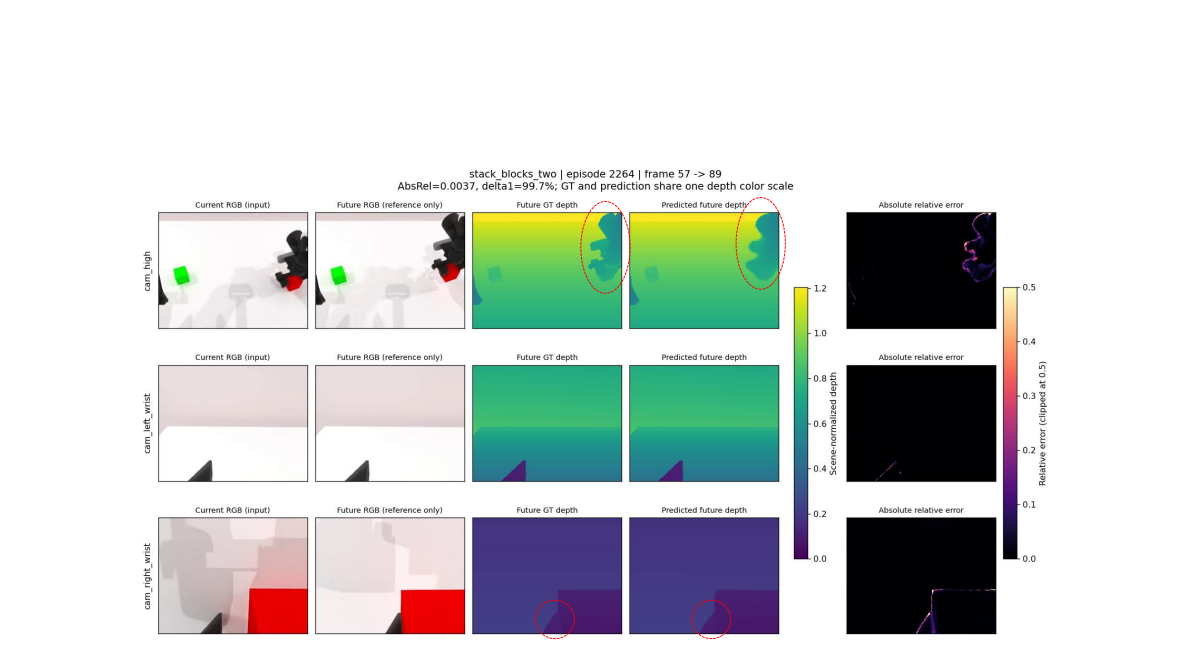
E0.5 is a world-action model built on a 3D foundation backbone rather than a video or vision-language model. It predicts future 3D states (depth, point maps, camera parameters) together with robot actions, jointly optimizing the geometry backbone. Without any large-scale robot data pretraining, it achieves $89.90\%$ and $50.09\%$ success rates on the RoboTwin 2.0 benchmark in clean and randomized settings. After pretraining on 160k robot trajectories, real-world manipulation success improves by approximately $15$ and $7$ percentage points on two different robot platforms. The key insight is that explicitly modeling how geometry changes under actions provides a learning signal that transfers well to new environments and objects.
What carries the argument. A language-conditioned VGGT-$\Omega$ 3D foundation backbone that processes multi-view RGB images and language instructions, producing geometric features that condition a flow-matching action decoder. The backbone is jointly optimized with two objectives: predicting future depth, point maps, and camera parameters at the final step of the action chunk, and generating the action sequence. This couples geometric world modeling directly with action generation within a single trainable 3D network.
Core claim. The paper demonstrates that making a 3D foundation model the primary trainable backbone for a world-action model, and supervising it to predict future 3D geometry at the end of an action chunk, yields substantially better generalization than either using video prediction or reconstructing only current geometry. The advantage is especially large under distribution shifts, where E0.5 achieves roughly $30\times$ the accuracy of video-prediction-based baselines. This challenges the prevailing approach of using video or vision-language models as the core representation for robot learning.
The premise it rests on. All depth targets for large-scale pretraining come from Depth Anything 3 pseudo-labels, not from real depth sensors; if DA3 introduces systematic biases or fails in manipulation-critical regions, the geometric supervision could misdirect the backbone representations.
If the paper is right (Pith's inferences, not the authors')
If correct, 3D foundation models can replace video-centered backbones as the primary representation for robot world-action modeling.
Future geometry prediction provides a stronger generalization signal than current-state reconstruction, especially under visual distribution shifts.
Large-scale embodied pretraining effectively transfers geometric knowledge across robot embodiments, reducing the need for per-robot large datasets.
The same framework may extend to predicting multiple future time steps, enabling longer-horizon planning.
Geometry-native world-action models may be more sample-efficient than video-prediction alternatives since they avoid modeling irrelevant appearance details.
The reliance on Depth Anything 3 pseudo-labels for wrist cameras means the pretraining quality is bounded by the accuracy of monocular depth estimation; using ground-truth depth sensors could further improve performance.
The observed 15-point real-world gain suggests that explicit geometric future prediction may be particularly beneficial for tasks requiring precise spatial reasoning, such as cable manipulation.
This architecture could be adapted to other modalities like tactile sensing by replacing the geometric heads appropriately.
The approach opens a path toward unsupervised geometric world models if future 3D states can be predicted from actions without action labels.
Check this review
Pith stored no record of this review's passes and took no fingerprint of it. Reviews made by code from 13 Nov 2026 on carry both.
How often reviews like this one are right
Reviews like this one: written by deepseek-v4-flash, where what was read was not recorded.
How often objections from reviews like this one are right: not yet measured
Reviews by people
This review was written by a machine. No person has reviewed this paper on Pith yet. A scientist listed on Pith can review it for a fee, and their review is published here whatever it concludes.
The paper
Abstract
World-action models (WAMs) offer a promising framework for embodied intelligence, yet mainstream approaches remain centered on video foundation models or vision-language models. Even when geometric features extracted by 3D models such as VGGT are incorporated, they are typically passed into a video model or VLM that serves as the primary backbone, leaving 3D geometry as an auxiliary input or prediction target rather than the native foundation for world modeling. We present E0.5, a geometry-native world-action model built directly on 3D foundation models. E0.5 introduces two key innovations. First, it adopts a 3D foundation model as the primary backbone, making 3D geometry the native representation for both world modeling and action prediction. Second, it explicitly predicts future 3D states together with actions, enabling the model to capture geometric world dynamics beyond action-only modeling or future video prediction. Experiments on RoboTwin 2.0 first demonstrate the effectiveness of E0.5 without embodied-data pretraining, achieving success rates of 89.90% and 50.09% under clean and randomized settings, respectively. Building on these results, we further pretrain E0.5 on more than 160k robot trajectories from AgiBotWorld-Beta, jointly learning robot actions and future geometry within the pretrained 3D foundation. This embodied pretraining improves mean real-world manipulation success rates by approximately 15 and 7 percentage points on AgileX Piper and Zerith H1, respectively. Together, these results demonstrate the potential of geometry-native foundations to acquire robot interaction knowledge and transfer it to physical manipulation. E0.5 embodies this geometry-native approach as a member of the VWA family of world-action models.
The paper's own sentences, arranged, kept beside the review and separate from it. Each label is drawn from a closed vocabulary; the number beside it is the probability the classifier gave that label. No sentence in this record was written by a model.
abstract compiled · 2026-10-28
The authors' main claim, as the classifier picked it out 1.00
“Together, these results demonstrate the potential of geometry-native foundations to acquire robot interaction knowledge and transfer it to physical manipulation.”
How the main claim is stated: asserted 0.86
What the abstract itself states, as probabilities: claims first 0.18 · states limitation 0.25 · human participants 0.03 · controlled comparison 0.44 · randomized assignment 0.16 · states quantitative result 0.99 · compares with prior results 0.41 · mentions code or data availability 0.03
The abstract, sentence by sentence
This table labels the abstract only (arXiv listing abstract v1). The number is the probability the classifier gave the label.
| Sentence | Role | The authors' own work | States the main conclusion | Strength |
|---|---|---|---|---|
| World-action models (WAMs) offer a promising framework for embodied intelligence, yet mainstream approaches remain centered on video foundation models or vision-language models. | background 0.83 | 0.05 | 0.03 | asserted 0.75 |
| Even when geometric features extracted by 3D models such as VGGT are incorporated, they are typically passed into a video model or VLM that serves as the primary backbone, leaving 3D geometry as an auxiliary input or prediction target rather than the native foundation for world modeling. | gap 0.75 | 0.05 | 0.04 | asserted 0.97 |
| We present E0.5, a geometry-native world-action model built directly on 3D foundation models. | contribution 0.99 | 0.90 | 0.18 | asserted 1.00 |
| E0.5 introduces two key innovations. | contribution 0.96 | 0.61 | 0.02 | asserted 0.88 |
| First, it adopts a 3D foundation model as the primary backbone, making 3D geometry the native representation for both world modeling and action prediction. | contribution 0.55 | 0.87 | 0.10 | asserted 1.00 |
| Second, it explicitly predicts future 3D states together with actions, enabling the model to capture geometric world dynamics beyond action-only modeling or future video prediction. | contribution 0.82 | 0.85 | 0.12 | asserted 0.97 |
| Experiments on RoboTwin 2.0 first demonstrate the effectiveness of E0.5 without embodied-data pretraining, achieving success rates of 89.90\% and 50.09\% under clean and randomized settings, respectively. | result 1.00 | 0.96 | 0.10 | asserted 1.00 |
| Building on these results, we further pretrain E0.5 on more than 160k robot trajectories from AgiBotWorld-Beta, jointly learning robot actions and future geometry within the pretrained 3D foundation. | method 0.89 | 0.96 | 0.05 | asserted 0.98 |
| This embodied pretraining improves mean real-world manipulation success rates by approximately 15 and 7 percentage points on AgileX Piper and Zerith H1, respectively. | result 1.00 | 0.96 | 0.10 | asserted 1.00 |
| Together, these results demonstrate the potential of geometry-native foundations to acquire robot interaction knowledge and transfer it to physical manipulation. | interpretation 1.00 | 0.81 | 0.69 | asserted 0.86 |
| E0.5 embodies this geometry-native approach as a member of the VWA family of world-action models. | contribution 0.38 | 0.40 | 0.10 | asserted 1.00 |
What kind of paper the classifier reports this is: method or tool 1.00 · evidence from observation or experiment 0.99
What was examined, and what was not
Sources read
- arXiv listing abstract v1
Not examined
- full text
- figures and tables
- references and citing sentences
- relations to other papers
Levels run
- P abstract
Not run
- S sections
- T body sentences
- C citations
- R cross-paper relations
How the labels were made
Compiled by classifier-1.13.0 via TypeSafe API, question bank abstract-p1-20260923, 2026-10-28: 1 request, 8,362 input tokens.
Every quoted sentence on this record is the authors'. Every label is from Pith's closed vocabulary, with the probability shown beside it. This record as JSON
Figures (10)


Figures are the authors', reproduced from the paper.
References (26)
- [3] Y. Chen, Z. Zhan, X. Lin, Z. Song, H. Liu, Q. Lyu, Y. Zu, X. Chen, Z. Liu, T. Pu, et al. Radar: Bench- marking vision-language-action generalization via real-world dynamics, spatial-physical intelligence, and autonomous evaluation.arXiv preprint arXiv:2602.10980, 2026c. H. W. ... on PitharXiv
- [5] 18 H. Feng, X. Chen, J. Liu, J. Tang, G. Wu, B. Chen, J. Lai, and G. Wang. Objfiller3d: Scaling 3d object inpainting to dense multi-view consistency.arXiv preprint arXiv:2508.18271, on PithPith's reviewarXiv
- [6] J. Guo, Q. Li, P . Li, Z. Chen, N. Sun, Y. Su, H. Wang, Y. Zhang, X. Li, and H. Liu. Unified 4d world action modeling from video priors with asynchronous denoising.arXiv preprint arXiv:2604.26694, 2026a. J. Guo, Q. Li, P . Li, Z. Chen, N. Sun, Y. Su, H. Wang, Y. Zhang, X. Li, ... on PithPith's reviewarXiv
- [7] Z. He, R. Liu, Y. Wang, W. Zhong, H. Yuan, K. Gai, G. Wang, and G. Li. Sceneexpander: Expanding 3d scenes with free-form inserted views.arXiv preprint arXiv:2603.27084, on PithPith's reviewarXiv
- [8] P . Intelligence, K. Black, N. Brown, J. Darpinian, K. Dhabalia, D. Driess, A. Esmail, M. Equi, C. Finn, N. Fusai, et al. 𝜋0.5:: a vision-language-action model with open-world generalization. arXiv preprint arXiv:2504.16054, on PithPith's reviewarXiv
- [9] M. J. Kim, K. Pertsch, S. Karamcheti, T. Xiao, A. Balakrishna, S. Nair, R. Rafailov, E. Foster, G. Lam, P . Sanketi, et al. Openvla: An open-source vision-language-action model.arXiv preprint arXiv:2406.09246, on PithPith's reviewarXiv
- [11] URL https://arxiv. org/abs/2503.00200. W. Li, Q. Zhang, R. Zhai, L. Lin, and G. Wang. Vla models are more generalizable than you think: Revisiting physical and spatial modeling. InProceedings of the IEEE/CVF Conference on Computer Vision and Pattern Recognition, pages 35025–35... on PithPith's reviewarXiv
- [12] H. Lin, S. Chen, J. Liew, D. Y. Chen, Z. Li, G. Shi, J. Feng, and B. Kang. Depth anything 3: Recovering the visual space from any views.arXiv preprint arXiv:2511.10647, on PithPith's reviewarXiv
- [13] I. Loshchilov and F. Hutter. Decoupled weight decay regularization.arXiv preprint arXiv:1711.05101, on PithPith's reviewarXiv
- [15] 19 Z. Song, S. Qin, T. Chen, L. Lin, and G. Wang. Physical autoregressive model for robotic manipulation without action pretraining.arXiv preprint arXiv:2508.09822, on PithPith's reviewarXiv
- [16] Z. Song, Q. Li, S. Qin, Y. Chen, T. Chen, L. Lin, and G. Wang. Learning physics from pretrained video models: A multimodal continuous and sequential world interaction models for robotic manipulation. InProceedings of the 2026 International Conference on Multimedia Retrieval, p... on PithPith's reviewarXiv
- [17] Team Wan, A. Wang, B. Ai, B. Wen, C. Mao, C.-W. Xie, D. Chen, F. Yu, H. Zhao, J. Yang, J. Zeng, J. Wang, J. Zhang, J. Zhou, J. Wang, J. Chen, K. Zhu, K. Zhao, K. Yan, L. Huang, M. Feng, N. Zhang, P . Li, P . Wu, R. Chu, R. Feng, S. Zhang, S. Sun, T. Fang, T. Wang, T. Gui, T. W... on PithPith's reviewarXiv
- [18] doi: 10.48550/arXiv.2503.20314. URLhttps://arxiv.org/abs/2503.20314. G. Wang, Z. Chen, C. C. Loy, and Z. Liu. Sparsenerf: Distilling depth ranking for few-shot novel view synthesis. In2023 IEEE/CVF International Conference on Computer Vision (ICCV), pages 9031–9042. IEEE, on PithPith's reviewarXivdoi:10.48550/arxiv.2503.20314
- [19] J. Wang, M. Chen, S. Zhang, N. Karaev, J. Schönberger, P . Labatut, P . Bojanowski, D. Novotny, A. Vedaldi, and C. Rupprecht. VGGT-Ω. InProceedings of the IEEE/CVF Conference on Computer Vision and Pattern Recognition (CVPR), 2026a. S. Wang, V . Leroy, Y. Cabon, B. Chidlovskii... on PithPith's reviewarXiv
- [20] G. Yang, Z. Tu, Y. Yang, S. Mao, J. Dong, T. Chen, J. Peng, J. Xiong, J. Cao, J. Dai, et al. Eventvla: Event-driven visual evidence memory for long-horizon vision-language-action policies.arXiv preprint arXiv:2606.20092, 2026a. 20 L. Yang, W. Song, X. Wang, P . Sheng, Z. Fang,... on PithPith's reviewarXiv
- [21] T. Yuan, Z. Dong, Y. Liu, and H. Zhao. Fast-wam: Do world action models need test-time future imagination?arXiv preprint arXiv:2603.16666, on PithPith's reviewarXiv
- [22] Z. Zhan, Y. Chen, J. Zhou, Q. Lyu, H. Liu, K. Wang, L. Lin, and G. Wang. Stable language guidance for vision–language–action models. InProceedings of the 64th Annual Meeting of the Association for Computational Linguistics (Volume 1: Long Papers), pages 4137–4159, 2026a. Z. Zh... on PithPith's reviewarXiv
- [23] H. Zhen, X. Qiu, P . Chen, J. Yang, X. Yan, Y. Du, Y. Hong, and C. Gan. 3d-vla: A 3d vision- language-action generative world model.arXiv preprint arXiv:2403.09631, on PithPith's reviewarXiv
- [24] J. Zhou, Z. Zhan, R. Zhai, Q. Lyu, H. Liu, K. Wang, L. Lin, and G. Wang. Tag: Target-agnostic guidance for stable object-centric inference in vision-language-action models.arXiv preprint arXiv:2603.24584, on PitharXiv
- [25] A. Pretraining Settings A.1. Dataset and Preprocessing We pretrain on AgiBotWorld-Beta (Bu et al., 2025), a large-scale dataset of real-world robot manipulation demonstrations collected using mobile dual-arm robots. The dataset covers diverse objects and environments, with tas... on Pith
show 6 more
- [2017] with𝛽1 = 0.9,𝛽2 = 0.95, weight decay of 0.01, and gradient-norm clipping at 1.0. Both the action-related and VGGT parameter groups use a peak learning rate of 1 × 10⁻⁴. A linear warmup over the first 2000 optimizer updates is followed by cosine decay to 1×10 −6. The pretrainin... on Pith
- [2020] Q. Shen and G. Wang. Geometry aware 3d generation from in-the-wild images in imagenet. arXiv preprint arXiv:2402.00225, on PithPith's reviewarXiv
- [2023] S. Community. Starvla: A lego-like codebase for vision-language-action model developing. arXiv preprint arXiv:2604.05014, on PithPith's reviewarXiv
- [2024] F. Li, W. Song, H. Zhao, J. Wang, P . Ding, D. Wang, L. Zeng, and H. Li. Spatial forcing: Implicit spatial representation alignment for vision-language-action model. InInternational Conference on Learning Representations, volume 2026, pages 132324–132345, 2026a. S. Li, Y. Gao,... on Pith
- [2025] J. Cai, L. Ling, S. Chu, Z. Liu, J. Kang, Z. Liang, W. Xu, Y. Mao, W. Zhang, X. Yang, et al. Aha-wam: Asynchronous horizon-adaptive world-action modeling with observation-guided context routing.arXiv preprint arXiv:2606.09811, 2026a. R. Cai, J. Guo, X. He, P . Jin, J. Li, B. L... on PithPith's reviewarXiv
- [2026] URL https://openphoenix-team.github.io/Phoeni x-pages. Blog post. Q. Bu, J. Cai, L. Chen, X. Cui, Y. Ding, S. Feng, S. Gao, X. He, X. Hu, X. Huang, et al. Agibot world colosseo: A large-scale manipulation platform for scalable and intelligent embodied systems.arXiv preprint ar... on PithPith's reviewarXiv
Cited by 3 Pith papers
Reviewed papers on Pith that cite this one. The full citation record
- Hi3R-VLA: Grounding Semantics and Actions in 3D cs.RO · Nov 2026
- Can LLMs Debug Robots by Editing Their Weights? cs.RO · Nov 2026
- ZERITH V2.5: From Predictive Power to Policy Learnability cs.RO · Nov 2026
Challenges and discussion
Disagree with the review, or know something it missed? Leave a comment, or challenge this review formally: a challenge becomes a permanent entry in this paper's record, and its decision is published here.
Come back by email
A short list of the week's newly reviewed papers. Nothing is sent until you confirm from your inbox, and every email has a link that stops it. No account.
No comments yet.
Sign in to comment