Robotics · arXiv:2611.31535 v1 · submitted 23 Nov 2026 · 75 references
Hi3R-VLA: Grounding Semantics and Actions in 3D
The paper says
“While recent vision-language-action (VLA) models increasingly incorporate 3D geometry, how to effectively exploit it for precise and generalizable action prediction remains a central challenge.”
more of the abstract
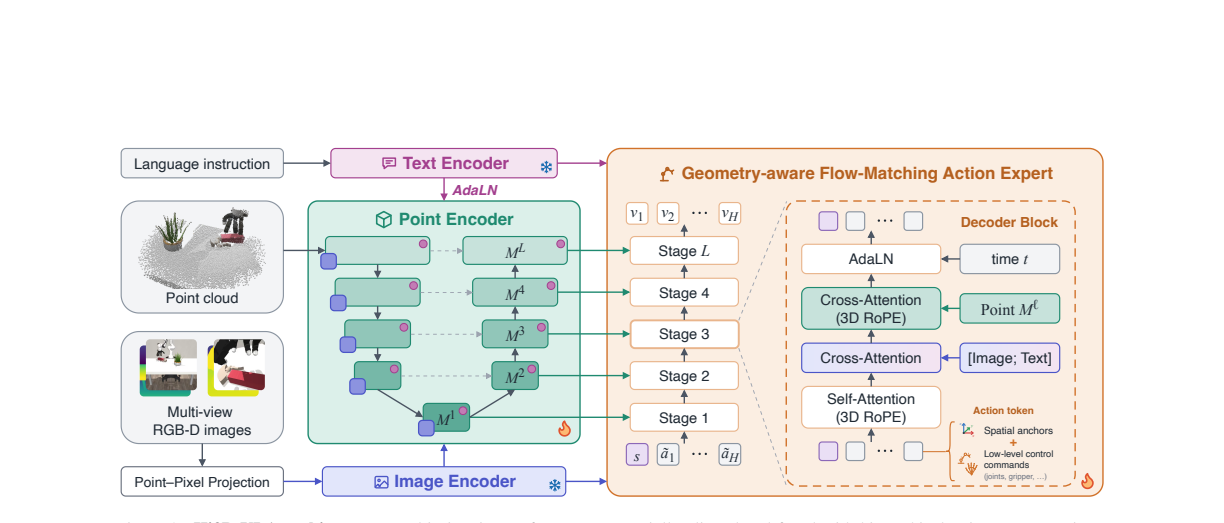
We introduce Hi3R-VLA, a 3D policy that grounds heterogeneous modalities - vision, language, and action - in explicit 3D geometry for robotic manipulation. Our model integrates spatially-aligned visual features and language conditioning into point cloud representations, enriching scene geometry with fine-grained, task-relevant semantics. It then anchors low-level control commands in the same 3D coordinate frame and uses 3D-RoPE enhanced action-to-point attention over coarse-to-fine point features to model geometric relationships between action targets and observed points. Our analysis demonstrates the importance of semantic fusion within 3D and spatial alignment between observations and actions. With fewer than 250M trainable parameters, Hi3R-VLA achieves state-of-the-art performance on RoboCasa, RLBench, RoboTwin2, DexJoCo and DexSuite across diverse manipulation tasks and embodiments, from single-arm and dual-arm grippers to dexterous hands. Real-robot evaluations further demonstrate its effectiveness in the physical world. The model, code and dataset are publicly released at https://cshizhe.github.io/projects/hi3r_vla.html.
from the abstract
Pith says
Machine review · deepseek-v4-flash · 25 Nov 2026 · read the full text (150,491 characters) · not checked by a person
It can be wrong. Challenge this review or reply to it.
Holds up. Hi3R-VLA grounds vision, language, and action in explicit 3D geometry and achieves state-of-the-art results across five simulation benchmarks and real-robot tasks with fewer than 250M trainable parameters. This line is wrong
4 minor
How often objections from reviews like this one are right: not yet measured
The paper, first character to last
The reviewer was given the whole text, 150,491 characters. Not checked: figures, code, what the 75 references say.
4 minor objections
The paper says, at 1
Pith says: minor objection 1 of 4
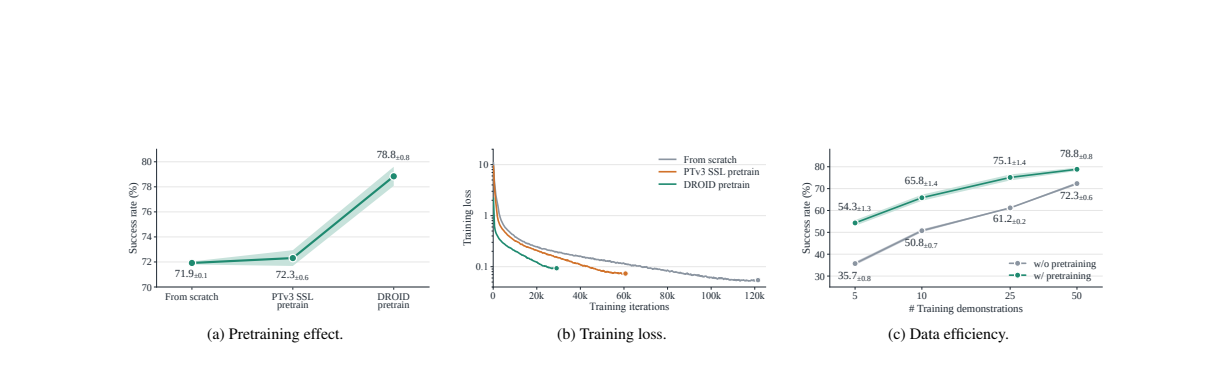
The introduction states that Hi3R-VLA achieves state-of-the-art performance 'even without pretraining on large-scale real-robot data' (paragraph 3). The final model reported in Table 1 uses DROID pretraining, and the ablation in Figure 7 shows that pretraining provides a substantial gain (72.3% → 78.8%). The phrasing could mislead a reader into thinking the SOTA numbers in Table 1 were obtained without any real-robot pretraining. Please clarify the sentence to distinguish the ablation result from the final evaluation.
The paper says, at 5.6
Pith says: minor objection 2 of 4
The real-robot evaluation (Section 5.6) is conducted on 5 tasks with 10 trials each. While the results are positive, the small number of trials and tasks limits the statistical strength of the comparison. The paper acknowledges this implicitly through the limitation discussion, but a brief note in the evaluation section itself would help readers calibrate the evidence.
show 2 more
The paper says, at 5
Pith says: minor objection 3 of 4
Table 1 (RoboCasa24) lists model sizes for baselines but does not always specify whether those sizes refer to trainable parameters or total parameters. For consistency with the paper's own reporting, please add a footnote or column header clarification.
The paper says, at 1
Pith says: minor objection 4 of 4
The paper uses the macro 'Cref' for cross-references, which is non-standard in many LaTeX styles. While this is a formatting choice, it may cause issues if the paper is compiled with a different class. Consider using standard 'ref' or ensuring compatibility.
What would settle it
A sensitivity analysis varying voxel size (e.g., 2 cm, 5 cm) and point count (e.g., 1024, 2048) on a benchmark like RoboCasa24 would reveal whether the preprocessing choices are critical. If performance degrades significantly with coarser voxelization or fewer points, the claim of robustness to sensor quality would be weakened. Additionally, failure on a task requiring sub-centimeter precision (e.g., peg insertion) would indicate that the 1 cm voxelization is insufficient for fine manipulation.
from Pith's summary of the paper
How the review went
5 passes by deepseek-v4-flash · 25 Nov 2026
- Reader holds up
- Skeptic concern not confirmed: listed as an open question
- Referee 4 minor
- Check against the paper kept 0 of 1 objection
- Editor wrote the verdict above
Not run on this paper: the simulated authors' defence.
Pith's passes raised 1 objection. A check against the paper's text kept 0 and left 1 as a question.
The review in full
The review in brief, machine-written
This paper asks a concrete question: what makes explicit 3D geometry effective for action prediction, and how robust are those design choices across different manipulation settings? The answer is Hi3R-VLA, a 3D policy that fuses spatially-aligned image features and language conditioning into hierarchical point cloud representations, then uses spatial anchors and 3D RoPE to connect action tokens to scene points in a shared metric frame. The architecture is a sensible integration of known components (PTv3, flow matching, 3D RoPE), but the paper's contribution is in the careful design and thorough evaluation: the ablations on RoboCasa24 and DexJoCo isolate the value of each design choice, and the comparisons span five simulation benchmarks plus real-robot experiments covering grippers, bimanual arms, and dexterous hands. The results are consistent and the model is compact—under 250M trainable parameters, an order of magnitude smaller than many competing VLAs—yet it matches or exceeds their performance. The authors also release code, models, and a cleaned DROID pretraining dataset, which is a practical contribution. The soft spots are acknowledged by the authors themselves: the point cloud preprocessing pipeline (1 cm voxelization, 4096-point sampling) is not validated for sensitivity to coarser parameters or realistic depth noise; real-robot evaluation is limited to five tasks with ten trials each; and pretraining uses only a subset of DROID. These are honest limitations, not fatal flaws. The paper is well-executed, the claims are supported by the evidence, and the design insights are useful for the community. It deserves a serious peer review.
The stress test's concern
Not confirmed. Pith could not check this concern against the text of the paper it was given; it is listed as an open question, not a finding.
The referee's report
The paper makes a compelling case for explicit 3D geometry in vision-language-action models. The key contributions—spatial anchors, 3D RoPE in action-to-point attention, and multi-stage image-point fusion—are clearly motivated and ablated. The empirical results are strong: Hi3R-VLA achieves state-of-the-art on five diverse simulation benchmarks (RoboCasa24, RLBench, RoboTwin2, DexJoCo, DexSuite) and on a real-robot setup, all with fewer than 250M trainable parameters. The ablations on RoboCasa24 and DexJoCo provide practical guidance for designing 3D policies. The release of model, code, and data further increases the impact.
Pith's reading of the paper (a machine's summary, not the authors')
The paper introduces Hi3R-VLA, a robotic manipulation policy that uses explicit 3D point clouds as a common coordinate frame for vision, language, and action. It fuses spatially-aligned image features and language conditioning into hierarchical point representations, and uses spatial anchors (3D end-effector positions) with 3D rotary positional encoding to connect action predictions to scene geometry. The authors claim that this design enables precise and generalizable action prediction across diverse tasks and robot embodiments, from single-arm grippers to bimanual dexterous hands, while using over ten times fewer trainable parameters than competing models. Extensive experiments on five simulation benchmarks and real-world tasks are reported to support the claim.
What carries the argument. The core of Hi3R-VLA is a multimodal point encoder built on Point Transformer v3 (PTv3) that integrates spatially-aligned image features and language conditioning (via adaptive layer normalization) into hierarchical point representations. The action expert uses a flow-matching transformer with coarse-to-fine attention to multi-scale point features. Spatial anchors—3D end-effector positions—are added to action tokens, and 3D rotary positional encoding (3D RoPE) is applied in action self-attention and action-to-point cross-attention to capture relative spatial displacements. This allows the model to reason about geometric relationships between action targets and observed scene points.
Core claim. The central claim is that grounding heterogeneous modalities—vision, language, and action—in explicit 3D geometry via a multimodal point encoder and a geometry-aware action expert with spatial anchors and 3D RoPE is the key to effective and efficient robotic manipulation. The paper argues that aligning action targets with scene geometry in a shared metric frame, and fusing visual and language features into point representations at multiple scales, allows a compact model to outperform larger 2D-based and 3D-aware methods.
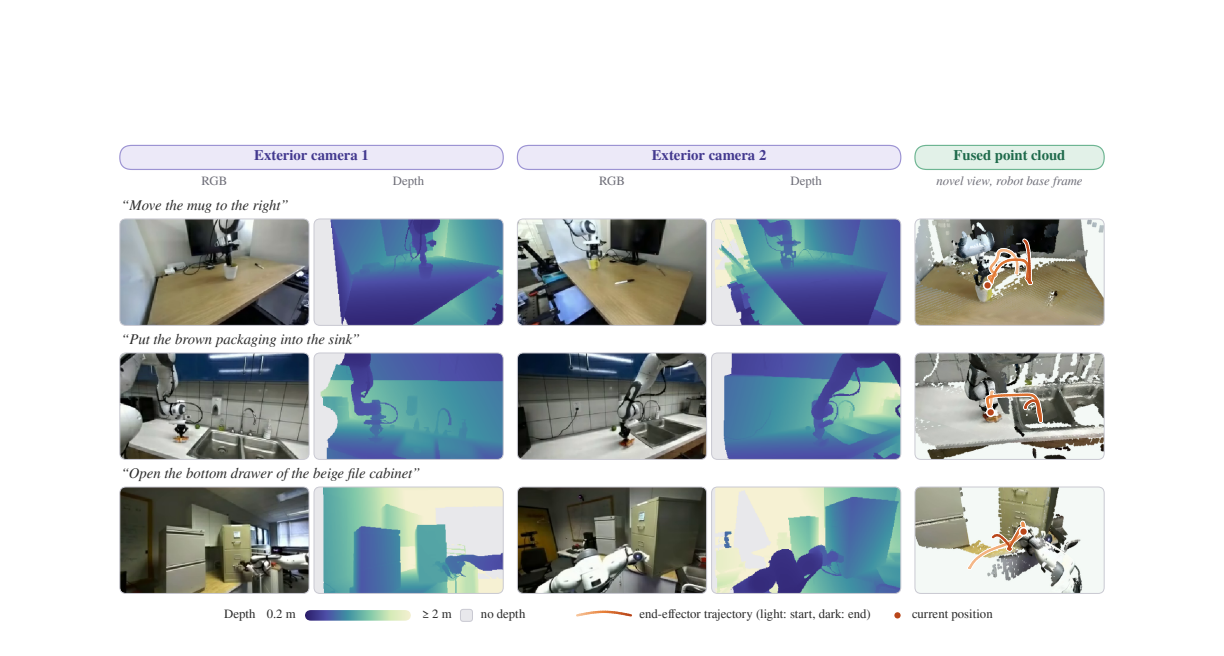
The premise it rests on. The point cloud preprocessing pipeline (1 cm voxelization, random sampling to 4096 points, and centering) preserves sufficient geometric detail for precise manipulation across diverse tasks and embodiments. This is assumed without explicit validation of information loss, and failures due to noisy depth (acknowledged in limitations) suggest this assumption can be fragile.
If the paper is right (Pith's inferences, not the authors')
Explicit 3D geometry can serve as a common coordinate frame for multimodal fusion and action generation, reducing reliance on large 2D-based models.
Spatial anchors and 3D RoPE provide a principled way to connect action representations to scene geometry, improving precision.
The approach generalizes across different robot embodiments (single-arm, bimanual, dexterous hands) without embodiment-specific modifications.
Pretraining on real-world data (DROID) further improves performance and data efficiency, especially in low-data regimes.
The coarse-to-fine attention schedule suggests that hierarchical spatial reasoning is beneficial for action prediction.
The reliance on calibrated RGB-D cameras and point cloud preprocessing (1 cm voxelization, 4096 points) may limit applicability in settings with noisy or sparse depth data, as acknowledged by the authors.
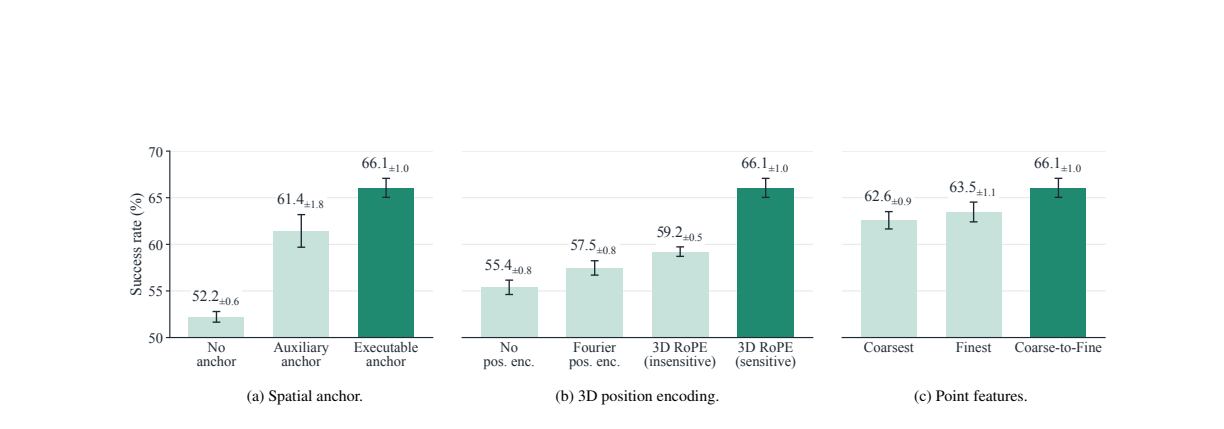
The use of auxiliary anchors (predicting end-effector positions even when not directly executed) indicates that explicit spatial grounding aids learning even when the action space is relative, which could inspire similar designs in other domains.
The significant gains on bimanual and dexterous tasks suggest that 3D grounding is particularly beneficial for high-dimensional control spaces where spatial reasoning is critical.
The paper's ablations show that multi-stage image-point fusion and language conditioning via AdaLN are more effective than action-level conditioning alone, providing practical design guidance for future 3D policies.
Check this review
What was read
The passes were given all 150,491 characters of the paper's LaTeX source.
Fingerprint of that text (SHA-256): f55b1827159b519fb0534c1537ff0a13b9587c43200a9c2e4a80b2d1280318e0
Pith does not keep that text. Rebuilt from the paper's source or PDF by the same code, it has this fingerprint if it is the same text. From a copy of Pith's code:
PYTHONPATH=. python scripts/review_input_check.py 2611.31535
The passes, in the order they ran
- Reader deepseek-v4-flash · medium effort · $0.0038 · instructions of the Reader, fingerprint f9ead7300382…
- Skeptic deepseek-v4-flash · medium effort · $0.0036 · instructions of the Skeptic, fingerprint 8f88c0f61488…
- Referee deepseek-v4-flash · medium effort · $0.0035 · instructions of the Referee, fingerprint a852d99aea0d…
- Check against the paper deepseek-v4-flash · medium effort · $0.0034 · instructions of the Check against the paper, fingerprint 6c7a6883d551…
- Editor deepseek-v4-flash · medium effort · $0.0032 · instructions of the Editor, fingerprint e7211f6a3d27…
- Circularity check deepseek-v4-flash · medium effort · $0.0032 · instructions of the Circularity check, fingerprint e9946e39d67b…
- Summary for the page deepseek-v4-flash · medium effort · temperature 0.2 · $0.0038 · instructions of the Summary for the page, fingerprint e4f56bf568e7…
The passes cost $0.025 in model calls together.
Version stamped on this review: pith-pipeline@v1.4.1-daily-deepseek-or-medium+deepseek/deepseek-v4-flash+p.d60f54226f00
Each link opens a pass's instructions as plain text, the exact bytes its fingerprint was taken over. Every stored set of instructions.
curl -s https://pith.science/methodology/prompts/f9ead730038216984cfb56d7cb34332bdf691828296a1de4245f3d6667d4bf56 | sha256sum
prints the fingerprint of the reader's instructions. The same works for every pass.
The receipt
The review's fingerprint was taken on 25 Nov 2026. The review you are reading still matches it.
Fingerprint of the review (SHA-256): 95b1f358c87c79cec261c5784482b9db02f68a74d0ea3a1ba0a7da5bcad9eb42
curl -s 'https://pith.science/api/v1/verdicts/2611.31535?form=canonical' | sha256sum
prints the fingerprint of the review as it stands now. The rule, in four steps.
A matching fingerprint shows the review has not changed since that date. It does not show that the review is right.
How often reviews like this one are right
Reviews like this one: written by deepseek-v4-flash, from the paper's LaTeX source.
How often objections from reviews like this one are right: not yet measured
Reviews by people
This review was written by a machine. No person has reviewed this paper on Pith yet. A scientist listed on Pith can review it for a fee, and their review is published here whatever it concludes.
The paper
Abstract
While recent vision-language-action (VLA) models increasingly incorporate 3D geometry, how to effectively exploit it for precise and generalizable action prediction remains a central challenge. We introduce Hi3R-VLA, a 3D policy that grounds heterogeneous modalities - vision, language, and action - in explicit 3D geometry for robotic manipulation. Our model integrates spatially-aligned visual features and language conditioning into point cloud representations, enriching scene geometry with fine-grained, task-relevant semantics. It then anchors low-level control commands in the same 3D coordinate frame and uses 3D-RoPE enhanced action-to-point attention over coarse-to-fine point features to model geometric relationships between action targets and observed points. Our analysis demonstrates the importance of semantic fusion within 3D and spatial alignment between observations and actions. With fewer than 250M trainable parameters, Hi3R-VLA achieves state-of-the-art performance on RoboCasa, RLBench, RoboTwin2, DexJoCo and DexSuite across diverse manipulation tasks and embodiments, from single-arm and dual-arm grippers to dexterous hands. Real-robot evaluations further demonstrate its effectiveness in the physical world. The model, code and dataset are publicly released at https://cshizhe.github.io/projects/hi3r_vla.html.
The paper's own sentences, arranged, kept beside the review and separate from it. Each label is drawn from a closed vocabulary; the number beside it is the probability the classifier gave that label. No sentence in this record was written by a model.
abstract compiled · 2026-11-25
The authors' main claim, as the classifier picked it out 0.53
“Our analysis demonstrates the importance of semantic fusion within 3D and spatial alignment between observations and actions.”
How the main claim is stated: asserted 1.00
What the abstract itself states, as probabilities: claims first 0.05 · states limitation 0.11 · human participants 0.07 · controlled comparison 0.16 · randomized assignment 0.01 · states quantitative result 0.92 · compares with prior results 0.66 · mentions code or data availability 0.99
The abstract, sentence by sentence
This table labels the abstract only (arXiv listing abstract v1). The number is the probability the classifier gave the label.
| Sentence | Role | The authors' own work | States the main conclusion | Strength |
|---|---|---|---|---|
| While recent vision-language-action (VLA) models increasingly incorporate 3D geometry, how to effectively exploit it for precise and generalizable action prediction remains a central challenge. | gap 0.54 | 0.04 | 0.03 | asserted 0.99 |
| We introduce Hi3R-VLA, a 3D policy that grounds heterogeneous modalities - vision, language, and action - in explicit 3D geometry for robotic manipulation. | contribution 0.98 | 0.91 | 0.10 | asserted 1.00 |
| Our model integrates spatially-aligned visual features and language conditioning into point cloud representations, enriching scene geometry with fine-grained, task-relevant semantics. | method 0.97 | 0.91 | 0.07 | asserted 1.00 |
| It then anchors low-level control commands in the same 3D coordinate frame and uses 3D-RoPE enhanced action-to-point attention over coarse-to-fine point features to model geometric relationships between action targets and observed points. | method 1.00 | 0.89 | 0.07 | asserted 1.00 |
| Our analysis demonstrates the importance of semantic fusion within 3D and spatial alignment between observations and actions. | interpretation 0.73 | 0.93 | 0.55 | asserted 1.00 |
| With fewer than 250M trainable parameters, Hi3R-VLA achieves state-of-the-art performance on RoboCasa, RLBench, RoboTwin2, DexJoCo and DexSuite across diverse manipulation tasks and embodiments, from single-arm and dual-arm grippers to dexterous hands. | result 1.00 | 0.95 | 0.40 | asserted 1.00 |
| Real-robot evaluations further demonstrate its effectiveness in the physical world. | result 1.00 | 0.93 | 0.17 | asserted 1.00 |
| The model, code and dataset are publicly released at https://cshizhe.github.io/projects/hi3r_vla.html. | contribution 0.89 | 0.63 | 0.02 | asserted 0.99 |
What kind of paper the classifier reports this is: method or tool 1.00 · evidence from observation or experiment 0.94
What was examined, and what was not
Sources read
- arXiv listing abstract v1
Not examined
- full text
- figures and tables
- references and citing sentences
- relations to other papers
Levels run
- P abstract
Not run
- S sections
- T body sentences
- C citations
- R cross-paper relations
How the labels were made
Compiled by classifier-1.13.0 via TypeSafe API, question bank abstract-p1-20260923, 2026-11-25: 1 request, 6,360 input tokens.
Every quoted sentence on this record is the authors'. Every label is from Pith's closed vocabulary, with the probability shown beside it. This record as JSON
Figures (13)






Showing 12 of the paper's 13 figures. Figures are the authors', reproduced from the paper.
References (75)
- [1] Niket Agarwal, Arslan Ali, Jon Allen, Martin Antolini, Ade- line Aubame, Alisson Azzolini, Junjie Bai, Maciej Bala, Yo- gesh Balaji, Josh Bapst, et al. Cosmos 3: Omnimodal world models for physical ai.arXiv preprint arXiv:2606.02800, on PithPith's reviewarXiv
- [2] Shuai Bai, Yuxuan Cai, Ruizhe Chen, Keqin Chen, Xionghui Chen, Zesen Cheng, Lianghao Deng, Wei Ding, Chang Gao, Chunjiang Ge, et al. Qwen3-vl technical report.arXiv preprint arXiv:2511.21631, 2025. 2 on PithPith's reviewarXiv
- [3] Lucas Beyer, Andreas Steiner, Andr ´e Susano Pinto, Alexan- der Kolesnikov, Xiao Wang, Daniel Salz, Maxim Neumann, Ibrahim Alabdulmohsin, Michael Tschannen, Emanuele Bugliarello, et al. Paligemma: A versatile 3b vlm for trans- fer.arXiv preprint arXiv:2407.07726, 2024. 2 on PithPith's reviewarXiv
- [4] Johan Bjorck, Fernando Casta ˜neda, Nikita Cherniadev, Xingye Da, Runyu Ding, Linxi Fan, Yu Fang, Dieter Fox, Fengyuan Hu, Spencer Huang, et al. Gr00t n1: An open foundation model for generalist humanoid robots.arXiv preprint arXiv:2503.14734, 2025. 1, 2, 6, 7, 11 on PithPith's reviewarXiv
- [5] Kevin Black, Noah Brown, Danny Driess, Adnan Esmail, Michael Equi, Chelsea Finn, Niccolo Fusai, Lachy Groom, Karol Hausman, Brian Ichter, et al.π 0: A vision-language- action flow model for general robot control.arXiv preprint arXiv:2410.24164, 2024. 6, 7, 8, 4, 11 on PithPith's reviewarXiv
- [6] Anthony Brohan, Noah Brown, Justice Carbajal, Yevgen Chebotar, Xi Chen, Krzysztof Choromanski, Tianli Ding, Danny Driess, Avinava Dubey, Chelsea Finn, et al. Rt-2: Vision-language-action models transfer web knowledge to robotic control.arXiv preprint arXiv:2307.15818, 2023. 2 on PithPith's reviewarXiv
- [7] Rui Cai, Jun Guo, Xinze He, Piaopiao Jin, Jie Li, Bingxuan Lin, Futeng Liu, Wei Liu, Fei Ma, Kun Ma, et al. Xiaomi- robotics-0: An open-sourced vision-language-action model with real-time execution.arXiv preprint arXiv:2602.12684, on PitharXiv
- [8] Shizhe Chen, Ricardo Garcia, Cordelia Schmid, and Ivan Laptev. Polarnet: 3d point clouds for language-guided robotic manipulation.CoRL, 2023. 3 on Pith
- [9] Shizhe Chen, Paul Pacaud, and Cordelia Schmid. PointACT: Vision-language-action models with multi-scale point-action interaction.RSS, 2026. 1, 2, 3, 7, 6, 11 on Pith
- [10] Tianxing Chen, Zanxin Chen, Baijun Chen, Zijian Cai, Yibin Liu, Zixuan Li, Qiwei Liang, Xianliang Lin, Yiheng Ge, Zhenyu Gu, et al. Robotwin 2.0: A scalable data gen- erator and benchmark with strong domain randomization for robust bimanual robotic manipulation.arXiv preprint ... on PithPith's reviewarXiv
- [11] Xinzhe Chen, Sihua Ren, Liqi Huang, Haowen Sun, Mingyang Li, Xingyu Chen, Zeyang Liu, and Xuguang Lan. Oasis: Observation-action space alignment via se (3) trajec- tory prediction for robotic manipulation.NeurIPS, 2026. 2 on Pith
- [12] Cheng Chi, Zhenjia Xu, Siyuan Feng, Eric Cousineau, Yilun Du, Benjamin Burchfiel, Russ Tedrake, and Shuran Song. Diffusion policy: Visuomotor policy learning via action dif- fusion.The International Journal of Robotics Research, 44 (10-11):1684–1704, 2025. 7, 8, 11 on Pith
- [13] Xianzhe Fan, Shengliang Deng, Xiaoyang Wu, Yuxiang Lu, Zhuoling Li, Mi Yan, Yujia Zhang, Zhizheng Zhang, He Wang, and Hengshuang Zhao. Any3d-vla: Enhancing vla robustness via diverse point clouds.ICML, 2026. 1, 2, 3 on Pith
- [14] Ricardo Garcia, Shizhe Chen, and Cordelia Schmid. To- wards generalizable vision-language robotic manipulation: A benchmark and llm-guided 3d policy. In2025 IEEE In- ternational Conference on Robotics and Automation (ICRA), pages 8996–9002. IEEE, 2025. 3 on Pith
- [15] Theophile Gervet, Zhou Xian, Nikolaos Gkanatsios, and Ka- terina Fragkiadaki. Act3d: 3d feature field transformers for multi-task robotic manipulation.CoRL, 2023. 1, 3, 4, 7, 11 on Pith
- [16] Nikolaos Gkanatsios, Jiahe Xu, Matthew Bronars, Arsalan Mousavian, Tsung-Wei Ke, and Katerina Fragkiadaki. 3d flowmatch actor: Unified 3d policy for single-and dual-arm manipulation.IROS, 2026. 3 on Pith
- [17] Javier Alejandro Lopetegui Gonzalez, Paul Pacaud, and Cordelia Schmid. Spatially aware world action model via geometric latent diffusion.arXiv preprint arXiv:2609.02531, on PithPith's reviewarXiv
- [18] Ankit Goyal, Jie Xu, Yijie Guo, Valts Blukis, Yu-Wei Chao, and Dieter Fox. Rvt: Robotic view transformer for 3d object manipulation. InConference on Robot Learning, pages 694– on Pith
- [19] Ankit Goyal, Valts Blukis, Jie Xu, Yijie Guo, Yu-Wei Chao, and Dieter Fox. Rvt-2: Learning precise manipulation from few demonstrations.RSS, 2024. 2 on Pith
- [20] Pierre-Louis Guhur, Shizhe Chen, Ricardo Garcia Pinel, Makarand Tapaswi, Ivan Laptev, and Cordelia Schmid. Instruction-driven history-aware policies for robotic manip- ulations. InConference on Robot Learning, pages 175–187. PMLR, 2023. 1 on Pith
show 55 more
- [21] Jun Guo, Qiwei Li, Peiyan Li, Zilong Chen, Nan Sun, Yifei Su, Heyun Wang, Yuan Zhang, Xinghang Li, and Huaping Liu. Unified 4d world action modeling from video priors with asynchronous denoising.arXiv preprint arXiv:2604.26694, 2026. 7 on PithPith's reviewarXiv
- [22] Anas Houssaini, Hugo He, Junming Shi, Amin Abyaneh, Ricardo Chahine, Shuo Wen, Mohamad H Danesh, Charles- ´Etienne Fr´echette, Mariana Sosa Guzman, Mathias Desrochers, et al. Dexsuite: An all-in-one framework for dexterous manipulation across arms, hands, and tasks.arXiv prepr... on PithPith's reviewarXiv
- [23] Wenlong Huang, Yu-Wei Chao, Arsalan Mousavian, Ming- Yu Liu, Dieter Fox, Kaichun Mo, and Li Fei-Fei. Pointworld: Scaling 3d world models for in-the-wild robotic manipula- tion.arXiv preprint arXiv:2601.03782, 2026. 4, 5, 2 on PitharXiv
- [24] Physical Intelligence, Kevin Black, Noah Brown, James Darpinian, Karan Dhabalia, Danny Driess, Adnan Esmail, Michael Equi, Chelsea Finn, Niccolo Fusai, et al.π 0.5: a vision-language-action model with open-world generaliza- tion.RSS, 2025. 1, 2, 6, 7, 8, 11, 12 on Pith
- [25] Physical Intelligence, Bo Ai, Ali Amin, Raichelle Aniceto, Ashwin Balakrishna, Greg Balke, Kevin Black, George Bokinsky, Shihao Cao, Thomas Charbonnier, et al.π 0.7: a steerable generalist robotic foundation model with emergent capabilities.arXiv preprint arXiv:2604.15483, 2026. 2 on PithPith's reviewarXiv
- [26] Stephen James, Zicong Ma, David Rovick Arrojo, and An- drew J Davison. Rlbench: The robot learning benchmark & learning environment.IEEE Robotics and Automation Let- ters, 5(2):3019–3026, 2020. 2, 7, 6 on Pith
- [27] Xiaogang Jia, Qian Wang, Anrui Wang, Han Wang, Bal ´azs Gyenes, Emiliyan Gospodinov, Xinkai Jiang, Ge Li, Hongyi Zhou, Weiran Liao, et al. Pointmappolicy: Structured point cloud processing for multi-modal imitation learning. NeurIPS, 38:160188–160216, 2025. 2 on Pith
- [28] Tsung-Wei Ke, Nikolaos Gkanatsios, and Katerina Fragki- adaki. 3d diffuser actor: Policy diffusion with 3d scene rep- resentations.CoRL, 2024. 1, 3 on Pith
- [29] Alexander Khazatsky, Karl Pertsch, Suraj Nair, Ash- win Balakrishna, Sudeep Dasari, Siddharth Karamcheti, Soroush Nasiriany, Mohan Kumar Srirama, Lawrence Yun- liang Chen, Kirsty Ellis, et al. Droid: A large-scale in-the-wild robot manipulation dataset.arXiv preprint arXiv:240... on PithPith's reviewarXiv
- [30] Jisoo Kim, Jungbin Cho, Sanghyeok Chu, Ananya Bal, Jin- hyung Kim, Gunhee Lee, Sihaeng Lee, Seung Hwan Kim, Bohyung Han, Hyunmin Lee, et al. Pri4r: Learning world dynamics for vision-language-action models with privileged 4d representation.arXiv preprint arXiv:2603.01549, 2026. 2, 6 on PitharXiv
- [31] Moo Jin Kim, Karl Pertsch, Siddharth Karamcheti, Ted Xiao, Ashwin Balakrishna, Suraj Nair, Rafael Rafailov, Ethan Foster, Grace Lam, Pannag Sanketi, et al. Openvla: An open-source vision-language-action model.arXiv preprint arXiv:2406.09246, 2024. 2, 7, 11 on PithPith's reviewarXiv
- [32] Moo Jin Kim, Chelsea Finn, and Percy Liang. Fine-tuning vision-language-action models: Optimizing speed and suc- cess.arXiv preprint arXiv:2502.19645, 2025. 2 on PithPith's reviewarXiv
- [33] Moo Jin Kim, Yihuai Gao, Tsung-Yi Lin, Yen-Chen Lin, Yunhao Ge, Grace Lam, Percy Liang, Shuran Song, Ming- Yu Liu, Chelsea Finn, et al. Cosmos policy: Fine-tuning video models for visuomotor control and planning.arXiv preprint arXiv:2601.16163, 2026. 2, 5, 6, 7, 10 on PithPith's reviewarXiv
- [34] Myungkyu Koo, Daewon Choi, Taeyoung Kim, Kyungmin Lee, Changyeon Kim, Younggyo Seo, and Jinwoo Shin. Hamlet: Switch your vision-language-action model into a history-aware policy. InInternational Conference on Learn- ing Representations, pages 101537–101558, 2026. 6 on Pith
- [35] Byungkun Lee, Dongyoon Hwang, Dongjin Kim, Hojoon Lee, Minho Park, and Jaegul Choo. See like a robot: Robot- centric pointmaps for vision-language-action models.arXiv preprint arXiv:2607.11498, 2026. 2, 6 on PithPith's reviewarXiv
- [36] Chengmeng Li, Junjie Wen, Yaxin Peng, Yan Peng, and Yichen Zhu. Pointvla: Injecting the 3d world into vision- language-action models.IEEE Robotics and Automation Letters, 11(3):2506–2513, 2026. 3, 6 on Pith
- [37] Fuhao Li, Wenxuan Song, Han Zhao, Jingbo Wang, Pengxi- ang Ding, Donglin Wang, Long Zeng, and Haoang Li. Spa- tial forcing: Implicit spatial representation alignment for vision-language-action model. InInternational Conference on Learning Representations, pages 132324–132345, ... on Pith
- [38] Hao Li, Ziqin Wang, Zi-han Ding, Shuai Yang, Yilun Chen, Yang Tian, Xiaolin Hu, Tai Wang, Dahua Lin, Feng Zhao, Si Liu, and Jiangmiao Pang. Robointer: A holistic intermedi- ate representation suite towards robotic manipulation.arXiv preprint arXiv:2602.09973, 2026. 5 on PitharXiv
- [39] Haoxuan Li, Sixu Yan, Lianghui Zhu, Xuanlai Tang, Shikang Wang, and Xinggang Wang. Bridge3d: Enabling vision- language-action models to see and act in 3d.arXiv preprint arXiv:2609.24525, 2026. 3 on PithPith's reviewarXiv
- [40] Lin Li, Qihang Zhang, Yiming Luo, Shuai Yang, Ruilin Wang, Fei Han, Mingrui Yu, Zelin Gao, Nan Xue, Xing Zhu, et al. Causal world modeling for robot control.arXiv preprint arXiv:2601.21998, 2026. 7 on PithPith's reviewarXiv
- [41] Peiyan Li, Yixiang Chen, Hongtao Wu, Xiao Ma, Xiangnan Wu, Yan Huang, Liang Wang, Tao Kong, and Tieniu Tan. Bridgevla: Input-output alignment for efficient 3d manipu- lation learning with vision-language models.NeurIPS, 38: 63635–63673, 2025. 2 on Pith
- [42] Qixiu Li, Yaobo Liang, Zeyu Wang, Lin Luo, Xi Chen, Mozheng Liao, Fangyun Wei, Yu Deng, Sicheng Xu, Yizhong Zhang, et al. Cogact: A foundational vision- language-action model for synergizing cognition and action 10 in robotic manipulation.arXiv preprint arXiv:2411.19650, on PithPith's reviewarXiv
- [43] Xiaoqi Li, Mingxu Zhang, Yiran Geng, Haoran Geng, Yux- ing Long, Yan Shen, Renrui Zhang, Jiaming Liu, and Hao Dong. Manipllm: Embodied multimodal large language model for object-centric robotic manipulation. In2024 IEEE/CVF Conference on Computer Vision and Pattern Recognition... on Pith
- [44] Junbang Liang, Pavel Tokmakov, Ruoshi Liu, Sruthi Sud- hakar, Paarth Shah, Rares Ambrus, and Carl V ondrick. Video generators are robot policies.arXiv preprint arXiv:2508.00795, 2025. 6 on PithPith's reviewarXiv
- [45] Haitao Lin, Hanyang Yu, Jingshun Huang, He Zhang, Yonggen Ling, Ping Tan, Xiangyang Xue, and Yanwei Fu. Universal pose pretraining for generalizable vision- language-action policies.RSS, 2026. 2 on Pith
- [46] Jiaming Liu, Hao Chen, Pengju An, Zhuoyang Liu, Ren- rui Zhang, Chenyang Gu, Xiaoqi Li, Ziyu Guo, Sixiang Chen, Mengzhen Liu, et al. Hybridvla: Collaborative diffu- sion and autoregression in a unified vision-language-action model.arXiv preprint arXiv:2503.10631, 2025. 7, 6, 11 on PithPith's reviewarXiv
- [47] Soroush Nasiriany, Abhiram Maddukuri, Lance Zhang, Adeet Parikh, Aaron Lo, Abhishek Joshi, Ajay Man- dlekar, and Yuke Zhu. Robocasa: Large-scale simula- tion of everyday tasks for generalist robots.arXiv preprint arXiv:2406.02523, 2024. 2, 5, 7, 6 on PithPith's reviewarXiv
- [48] Nikolay Nikolov, Giuliano Albanese, Sombit Dey, Aleksan- dar Yanev, Luc Van Gool, Jan-Nico Zaech, and Danda Pani Paudel. Spear-1: Scaling beyond robot demonstrations via 3d understanding. InProceedings of the IEEE/CVF Con- ference on Computer Vision and Pattern Recognition, pa... on Pith
- [49] Chunghyun Park, Beomjun Kim, Seungcheol Park, Heese- ung Kwon, Yashu Shukla, Seunghoon Sim, Jinwoo Shin, and Minsu Cho. Pointwam: 3d world action modeling for dexter- ous robotic manipulation.arXiv preprint arXiv:2610.02840, on PithPith's reviewarXiv
- [50] William Peebles and Saining Xie. Scalable diffusion models with transformers. InICCV, pages 4172–4182. IEEE, 2023. 4, 6 on Pith
- [51] Charles R Qi, Hao Su, Kaichun Mo, and Leonidas J Guibas. Pointnet: Deep learning on point sets for 3d classification and segmentation. InProceedings of the IEEE conference on computer vision and pattern recognition, pages 652–660, on Pith
- [52] Delin Qu, Haoming Song, Qizhi Chen, Zhaoqing Chen, Xi- anqiang Gao, Dong Wang, Xinyi Ye, Qi Lv, Modi Shi, Guanghui Ren, et al. Eo-1: An open unified embodied foundation model for general robot control.arXiv preprint arXiv:2508.21112, 2025. 7, 11 on PitharXiv
- [53] Delin Qu, Haoming Song, Qizhi Chen, Yuanqi Yao, Xinyi Ye, Yan Ding, Zhigang Wang, JiaYuan Gu, Bin Zhao, Dong Wang, et al. Spatialvla: Exploring spatial representations for visual-language-action model.RSS, 2025. 1, 2 on Pith
- [54] Jianlin Su, Murtadha Ahmed, Yu Lu, Shengfeng Pan, Wen Bo, and Yunfeng Liu. Roformer: Enhanced transformer with rotary position embedding.Neurocomputing, 568:127063, on Pith
- [55] Lin Sun, Bin Xie, Yingfei Liu, Hao Shi, Tiancai Wang, and Jiale Cao. Geovla: Empowering 3d representations in vision- language-action models.IROS, 2026. 1, 2, 3, 6 on Pith
- [56] Era AI Lab Team, Jianhao Lai, Zhihao Zhan, Zhiquan Liao, Qichang Li, Shubin Chen, Zhiyuan Liu, Hongsen Lei, Jian- man Lin, Xiaoxin Lin, et al. E0. 5: From reconstructive to future-predictive 3d foundations for robotic world-action modeling.arXiv preprint arXiv:2610.36011, 2026. 2 on PithPith's reviewarXiv
- [57] Michael Tschannen, Alexey Gritsenko, Xiao Wang, Muham- mad Ferjad Naeem, Ibrahim Alabdulmohsin, Nikhil Parthasarathy, Talfan Evans, Lucas Beyer, Ye Xia, Basil Mustafa, et al. Siglip 2: Multilingual vision-language en- coders with improved semantic understanding, localization, ... on PithPith's reviewarXiv
- [58] Chenxi Wang, Hongjie Fang, Hao-Shu Fang, and Cewu Lu. Rise: 3d perception makes real-world robot imitation simple and effective. InIROS, pages 2870–2877. IEEE, 2024. 3 on Pith
- [59] Hanwen Wang, Weizhi Zhao, Xiangyu Wang, Siyuan Huang, He Lin, Boyuan Zheng, Rongtao Xu, Gang Wang, Yao Mu, He Wang, et al. Dexjoco: A benchmark and toolkit for task- oriented dexterous manipulation on mujoco.arXiv preprint arXiv:2605.16257, 2026. 2, 5, 7, 6 on PithPith's reviewarXiv
- [60] Jianyuan Wang, Minghao Chen, Nikita Karaev, Andrea Vedaldi, Christian Rupprecht, and David Novotny. Vggt: Visual geometry grounded transformer. In2025 IEEE/CVF Conference on Computer Vision and Pattern Recognition (CVPR), pages 5294–5306. IEEE, 2025. 2 on Pith
- [61] Xinkai Wang, Chenyi Wang, Yifu Xu, Mingzhe Ye, Fucheng Zhang, Jialin Tian, Xinyu Zhan, Lifeng Zhu, Cewu Lu, and Lixin Yang. Lamp: Learning vision-language-action policy with 3d scene flow as la tent m otion p rior. InECCV, pages 227–244. Springer, 2026. 2 on Pith
- [62] Yuran Wang, Siqiao Huang, Mingleyang Li, Chenhao Zhang, Jiaqi Liang, Weiyang Jin, Yue Chen, Xuemin Chi, Dong- hao Zhou, Qize Yu, et al. Openwam: An open, modular exploration towards systematic world-action model pretrain- ing.arXiv preprint arXiv:2609.07398, 2026. 2 on PithPith's reviewarXiv
- [63] Bowen Wen, Matthew Trepte, Joseph Aribido, Jan Kautz, Orazio Gallo, and Stan Birchfield. Foundationstereo: Zero- shot stereo matching.arXiv, 2025. 5 on Pith
- [64] Xiaoyang Wu, Li Jiang, Peng-Shuai Wang, Zhijian Liu, Xi- hui Liu, Yu Qiao, Wanli Ouyang, Tong He, and Hengshuang Zhao. Point transformer v3: Simpler, faster, stronger. In 2024 IEEE/CVF Conference on Computer Vision and Pat- tern Recognition (CVPR), pages 4840–4851. IEEE, 2024. 1, 3 on Pith
- [65] Xiao-Ming Wu, Bin Fan, Kang Liao, Jian-Jian Jiang, Runze Yang, Yihang Luo, Zhonghua Wu, Wei-Shi Zheng, and Chen Change Loy. Vlanext: Recipes for building strong vla models. InForty-third International Conference on Machine Learning, 2026. 2 on Pith
- [66] Ziyin Xiong, Nikos Gkanatsios, Moritz Reuss, and Katerina Fragkiadaki. Geomvla: Unifying scene, motion, and action in 3d.arXiv preprint arXiv:2609.13812, 2026. 1, 3 11 on PithPith's reviewarXiv
- [67] Lishan Yang, Wenxuan Song, Xi Wang, Pingyue Sheng, Zheng Fang, Ziyang Zhou, Junjie He, Haodong Yan, Jiayi Chen, Nan Sun, et al. 4d-wam: Infusing spatiotemporal awareness into world action models through trajectory fields. arXiv preprint arXiv:2608.08023, 2026. 7, 12 on PithPith's reviewarXiv
- [68] Rujia Yang, Geng Chen, Chuan Wen, and Yang Gao. Fp3: A 3d foundation policy for robotic manipulation. In2026 IEEE International Conference on Robotics and Automation (ICRA), pages 3720–3727. IEEE, 2026. 2, 3, 6 on Pith
- [69] Yandan Yang, Shuang Zeng, Tong Lin, Xinyuan Chang, Dekang Qi, Junjin Xiao, Haoyun Liu, Ronghan Chen, Yuzhi Chen, Dongjie Huo, et al. Abot-m0: Vla foundation model for robotic manipulation with action manifold learn- ing.arXiv preprint arXiv:2602.11236, 2026. 7 on PithPith's reviewarXiv
- [70] Seonghyeon Ye, Yunhao Ge, Kaiyuan Zheng, Shenyuan Gao, Sihyun Yu, George Kurian, Suneel Indupuru, You Liang Tan, Chuning Zhu, Jiannan Xiang, et al. World action models are zero-shot policies.arXiv preprint arXiv:2602.15922, 2026. 2 on PithPith's reviewarXiv
- [71] Tianyuan Yuan, Zibin Dong, Yicheng Liu, and Hang Zhao. Fast-wam: Do world action models need test-time future imagination?arXiv preprint arXiv:2603.16666, 2026. 7, 11 on PithPith's reviewarXiv
- [72] Yanjie Ze, Gu Zhang, Kangning Zhang, Chenyuan Hu, Muhan Wang, and Huazhe Xu. 3d diffusion policy: Gen- eralizable visuomotor policy learning via simple 3d repre- sentations.RSS, 2024. 3 on Pith
- [73] Yujia Zhang, Xiaoyang Wu, Yunhan Yang, Xianzhe Fan, Han Li, Yuechen Zhang, Zehao Huang, Naiyan Wang, and Hengshuang Zhao. Utonia: Toward one encoder for all point clouds.arXiv preprint arXiv:2603.03283, 2026. 1, 3, 5, 6, 9 on PithPith's reviewarXiv
- [74] Tony Z Zhao, Vikash Kumar, Sergey Levine, and Chelsea Finn. Learning fine-grained bimanual manipulation with low-cost hardware.arXiv preprint arXiv:2304.13705, 2023. 8 on PithPith's reviewarXiv
- [75] Jinliang Zheng, Jianxiong Li, Zhihao Wang, Dongxiu Liu, Xirui Kang, Yuchun Feng, Yinan Zheng, Jiayin Zou, Yilun Chen, Jia Zeng, et al. X-vla: Soft-prompted transformer as scalable cross-embodiment vision-language-action model. InInternational Conference on Learning Representat... on Pith
Challenges and discussion
Disagree with the review, or know something it missed? Leave a comment, or challenge this review formally: a challenge becomes a permanent entry in this paper's record, and its decision is published here.
Come back by email
A short list of the week's newly reviewed papers. Nothing is sent until you confirm from your inbox, and every email has a link that stops it. No account.
No comments yet.
Sign in to comment