Robotics · arXiv:2611.23746 v1 · submitted 18 Nov 2026 · 105 references
ZERITH V2.5: From Predictive Power to Policy Learnability
The paper says
“When humans learn to manipulate an unfamiliar object, they may already be able to anticipate how its state will change while still being unable to control it skillfully.”
more of the abstract
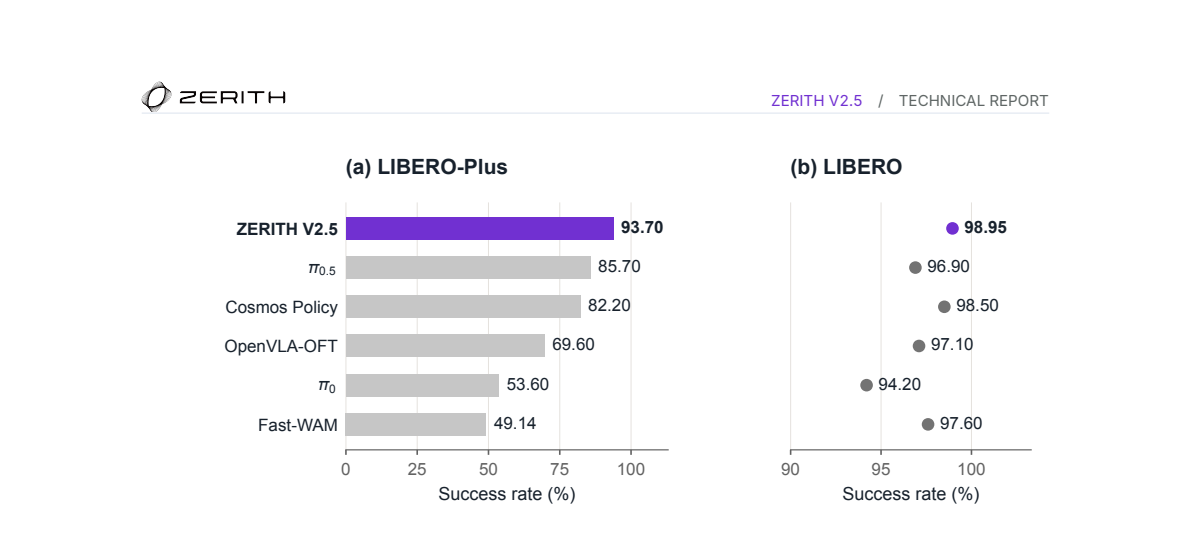
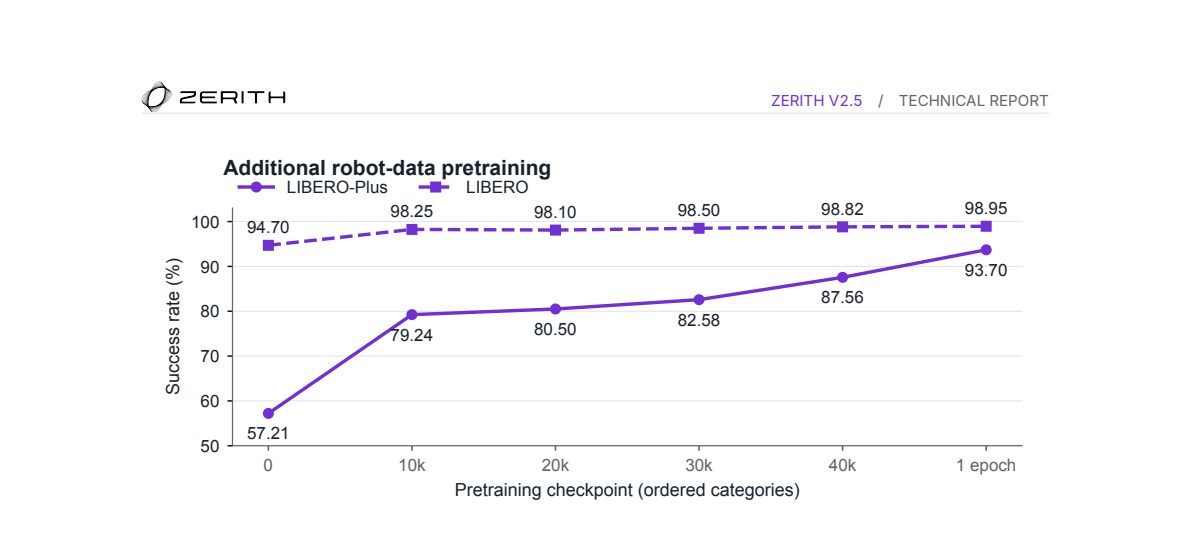
This gap between prediction and control motivates us to study how the priors acquired by video generation models can be used effectively by an action policy. We present ZERITH V2.5, a video-action model (VAM) in which the action policy reads intermediate features of a video generation model, and use it to study, under fixed demonstrations and a fixed total number of updates, what kind of predictive training improves subsequent action learning. We find that the way video predictive training is supervised affects subsequent action learning. In our experiments, adapting at many noise levels yields a large gain, while adapting only at the noise level used at deployment yields none. Weight-transfer experiments further show that the gain stays with the adapted weights when they remain in the video generation model and disappears when they are used only to initialize the action policy. Initial loss and gradient measurements at the start of joint training indicate that target-domain predictive training gives the video model a better starting state, making subsequent joint learning of prediction and action easier. Under matched data and training budgets, predictive adaptation improves control. We evaluate the complete policy on LIBERO, LIBERO-Plus, Meta-World MT50, and real-robot tasks.
from the abstract
Pith says
Machine review · deepseek-v4-flash · 19 Nov 2026 · read the full text (204,154 characters) · not checked by a person
It can be wrong. Challenge this review or reply to it.
Holds up, with conditions.
13 minor · 1 open question
How often objections from reviews like this one are right: not yet measured
The paper, first character to last
The reviewer was given the whole text, 204,154 characters. Not checked: figures, code, what the 105 references say.
13 minor objections
The paper says, at §1 (Introduction)
Pith says: minor objection 1 of 13
The introduction states "We present ZERITH V2.5... and use differences in performance across training conditions to study how video priors transfer to action ability." The paper would benefit from a clearer separation between the system (ZERITH V2.5) and the controlled experiments that study the training recipe. The system-level results include additional robot-data pretraining, while the controlled experiments start from pretrained Wan weights. This distinction is made in §5.2 but could be stated earlier.
The paper says, at §3.1 (sec:system)
Pith says: minor objection 2 of 13
The description of the video generation model's attention mask in §3.1 says "tokens in the current frame attend only to the current frame, while tokens in each future slot attend to their own frame and all preceding frames." This is clear, but the paper could benefit from a diagram or pseudocode showing the mask structure, as it is central to the architecture.
show 11 more
The paper says, at §4.3 (sec:method)
Pith says: minor objection 3 of 13
The gradient routing schedule in §4.3 uses a piecewise linear function of normalized S2 progress. The paper states "we set $\beta=0$ until $p=0.05$, increase it linearly to one by $p=0.10$, and hold it at one thereafter." This is a design choice that is not ablated.
more of objection 3
The paper acknowledges this in §8.2 ("The length of the $\beta=0$ interval and the ramp of the routing schedule are fixed by design, and we do not measure when the policy begins to produce useful gradients.") This is acceptable for a technical report but limits the generality of the recipe.
The paper says, at §5.2, Table 2 (tab:comparison)
Pith says: minor objection 4 of 13
Table 2 compares ZERITH V2.5 with several baselines. The paper notes that "Baseline scores in \cref{tab:comparison} are reported numbers, each from its own evaluation protocol." However, the table does not indicate which baselines use the same evaluation protocol (e.g., number of episodes, seeds). Adding a column or footnote with evaluation details would improve clarity.
The paper says, at §6.1 (sec:res-static)
Pith says: minor objection 5 of 13
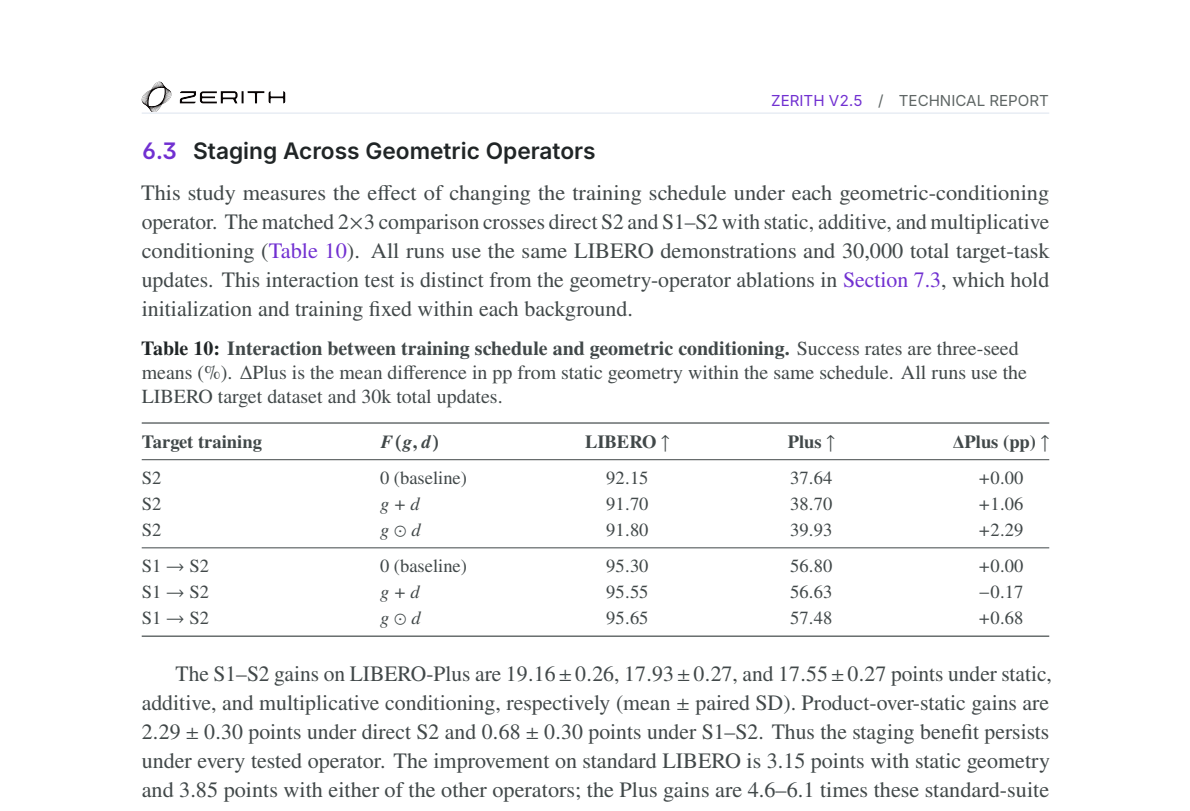
Table 3 (tab:staging-static) reports the staging effect with static geometry. The paper states "S1--S2 raises LIBERO-Plus success from 37.64% to 56.80%. The paired gain is $19.16\pm0.26$ points (mean $\pm$ SD)." This is a clear and well-reported result. However, the paper does not report the individual seed scores, only the mean and SD of differences. Reporting the three seed scores would allow readers to assess variability directly.
The paper says, at §6.4 (sec:res-crossover)
Pith says: minor objection 6 of 13
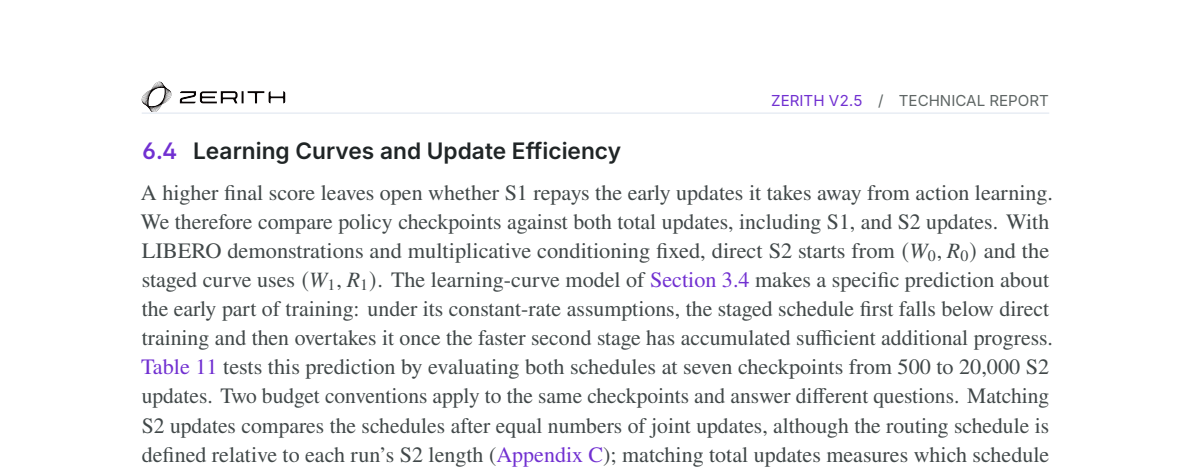
Table 5 (tab:early) reports learning curve checkpoints. The paper states "At matched S2 updates, the staged-minus-direct differences are $+0.55$, $-1.44$, and $+0.05$ points at 500, 1,000, and 2,000 updates, during which both schedules remain below 5% success." The negative difference at 1,000 S2 updates is interesting but the paper does not discuss it. A brief comment on why the staged schedule might temporarily underperform would be helpful.
The paper says, at §7.2 (sec:res-attention)
Pith says: minor objection 7 of 13
Table 10 (tab:attention) reports attention statistics under broad-noise vs. fixed-noise S1. The paper states "The two runs may differ in more than the S1 noise schedule." This is an important caveat. The attention statistics are interesting but the paper should be clearer that they are descriptive, not causal, and that the differences may reflect other training dynamics.
The paper says, at §8.1 (sec:conclusion)
Pith says: minor objection 8 of 13
The conclusion states "For the setting we evaluated, the findings suggest three practical guidelines for video--action policies." This is appropriately cautious. However, the paper could strengthen the conclusion by explicitly stating the scope of the guidelines (e.g., "for Wan2.2-based VAMs on LIBERO-like tasks with 30k updates").
The paper says, at §A.1 (sec:theory-noise)
Pith says: minor objection 9 of 13
The noise-level analysis in Appendix A.1 uses a simple example with two distributions P and Q that have the same mean but different higher moments. The paper states "The endpoint optimum depends on the target distribution through its conditional mean." This is correct but the example is somewhat contrived. The paper could note that in practice, the conditional mean may still capture useful information, and the benefit of broad-noise training may depend on the task.
The paper says, at §A.6 (sec:theory-tau)
Pith says: minor objection 10 of 13
The optimal adaptation length model in Appendix A.6 assumes an exponential decay of error with a rate that depends on adaptation length. The paper states "The experiments evaluate a 3,000-update stage but do not fit or validate this optimal-length curve." This is an honest acknowledgment. However, the model's prediction that "above $T_{\mathrm{crit}}$ a strictly positive adaptation stage is optimal" is not tested. The paper should note that the model is purely illustrative.
The paper says, at §B (app:data)
Pith says: minor objection 11 of 13
Appendix B provides details on data cleaning and selection. The paper states "The selected data volumes do not identify which data each checkpoint consumed, and the effect of individual repair operations on policy success is unmeasured." This is a limitation but acceptable for a technical report. However, the paper could note whether the same data splits are used across all experiments.
The paper says, at §C (sec:practice)
Pith says: minor objection 12 of 13
Appendix C describes implementation details. The paper states "The routing schedule is defined relative to the S2 update count, so its absolute length scales with the stage." This is important: the 1,500-update ramp in a 30k S2 run becomes 1,350 updates in a 27k S2 run. The paper should note whether this difference could affect comparisons between direct and staged training at matched S2 updates.
The paper says, at §E (app:limitations)
Pith says: minor objection 13 of 13
Appendix E provides an extensive and honest discussion of limitations. The paper states "The staging, dataset, and geometry-operator studies report three-seed means, and their principal paired comparisons report the sample SD of seed-wise differences. SD bars describe variability across seeds.
more of objection 13
The branch-initialization, noise-control, learning-curve, budget-sweep, attention, and pretraining results are single runs: they carry scenario-level sampling error, but we have no estimate of their seed-to-seed variation." This is a clear statement of the statistical limitations. The paper should consider adding seed-to-seed variation for at least the key single-run comparisons (e.g., branch-initialization) in a revision.
Open questions (1)
Pith raised these and could not confirm them against the text of the paper it read. They are questions for the authors, not findings.
- §6.4, Table 5 (tab:early) Pith raised a concern here that it could not check against the text of the paper it was given, so it is not published as an objection.
What would settle it
A direct replication attempt using a different video backbone (e.g., Cosmos-Predict2 or Stable Video Diffusion) on the same LIBERO-Plus benchmark, with the same staged vs. direct comparison at 30,000 updates, would test whether the claimed 17–19 percentage point gain is specific to Wan2.2 or generalizes.
from Pith's summary of the paper
How the review went
4 passes by deepseek-v4-flash · 19 Nov 2026
- Reader holds up, with conditions
- Skeptic concern withdrawn: Pith's reviewer misread the paper
- Referee 13 minor
- Check against the paper kept 0 of 5 objections
Not run on this paper: the editor, the simulated authors' defence.
Pith's passes raised 5 objections. A check against the paper's text kept 0, withdrew 4 (3 the paper already says; 1 Pith's reviewer misread the paper) and left 1 as a question.
The review in full
The stress test's concern
Withdrawn: Pith's reviewer misread the paper.
The paper says
“All controlled comparisons use one video generation model (Wan2.2-TI2V-5B), one adaptation length ($\tau=3{,}000$ updates), and the LIBERO benchmark family. Whether the gain carries over to other backbones, task domains, or adaptation lengths is untested, so the guidelines above apply to this setting.”
The referee's report
Not published. Pith's referee wrote this assessment before its objections were checked against the paper, and 4 of its 4 major objections did not survive that check.
Pith's reading of the paper (a machine's summary, not the authors')
The paper investigates how to best transfer the predictive priors of a video generation model to an action policy for robot control. It presents ZERITH V2.5, a video-action model where the policy reads intermediate features of a video model. The central finding is that, with a fixed total number of training updates, dedicating the first 3,000 updates to video-model-only adaptation across a broad range of noise levels (Stage 1) before joint video-action training (Stage 2) significantly improves downstream task success compared to training both objectives jointly from the start. The gain is attributed to the adapted video-model weights, not the policy initialization, and is linked to a better optimization starting point for joint training.
What carries the argument. The central mechanism is a two-stage training procedure for a video-action model (VAM). Stage 1 adapts the video generation model (Wan2.2-TI2V-5B) alone on target-domain video using a broad noise schedule (σ_w from 0 to 1). Stage 2 attaches a flow-matching action policy that reads intermediate keys and values from the adapted video model, and trains both jointly. The action policy's transformer blocks are structurally identical to the video model's blocks, allowing independent initialization from either the original pretrained weights (R_0) or the Stage-1-adapted weights (R_1). This decoupling enables the branch-initialization study that isolates the source of the gain.
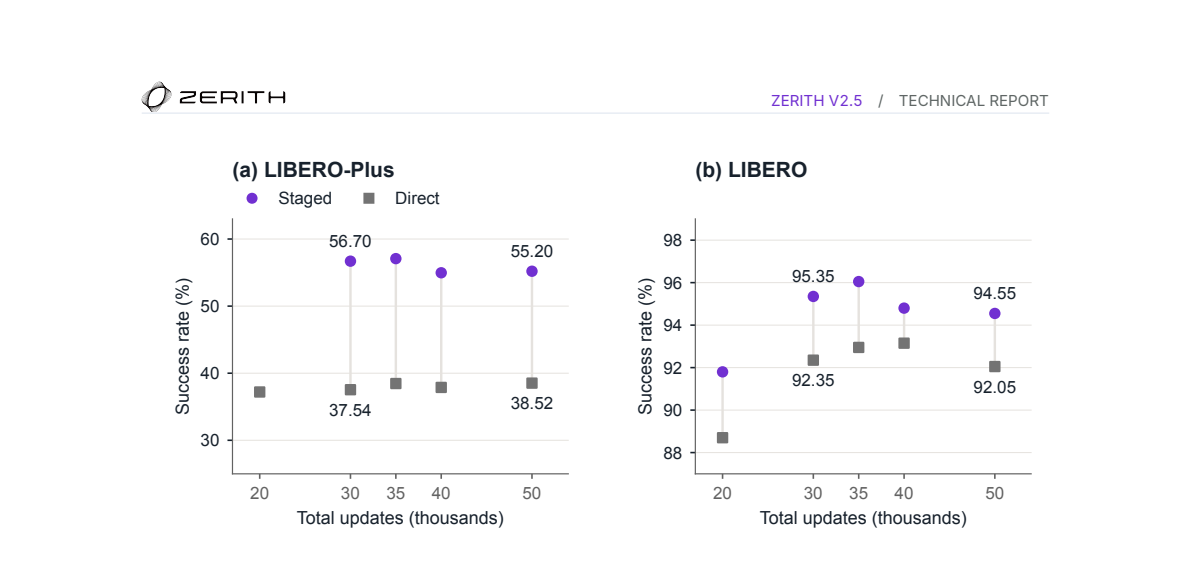
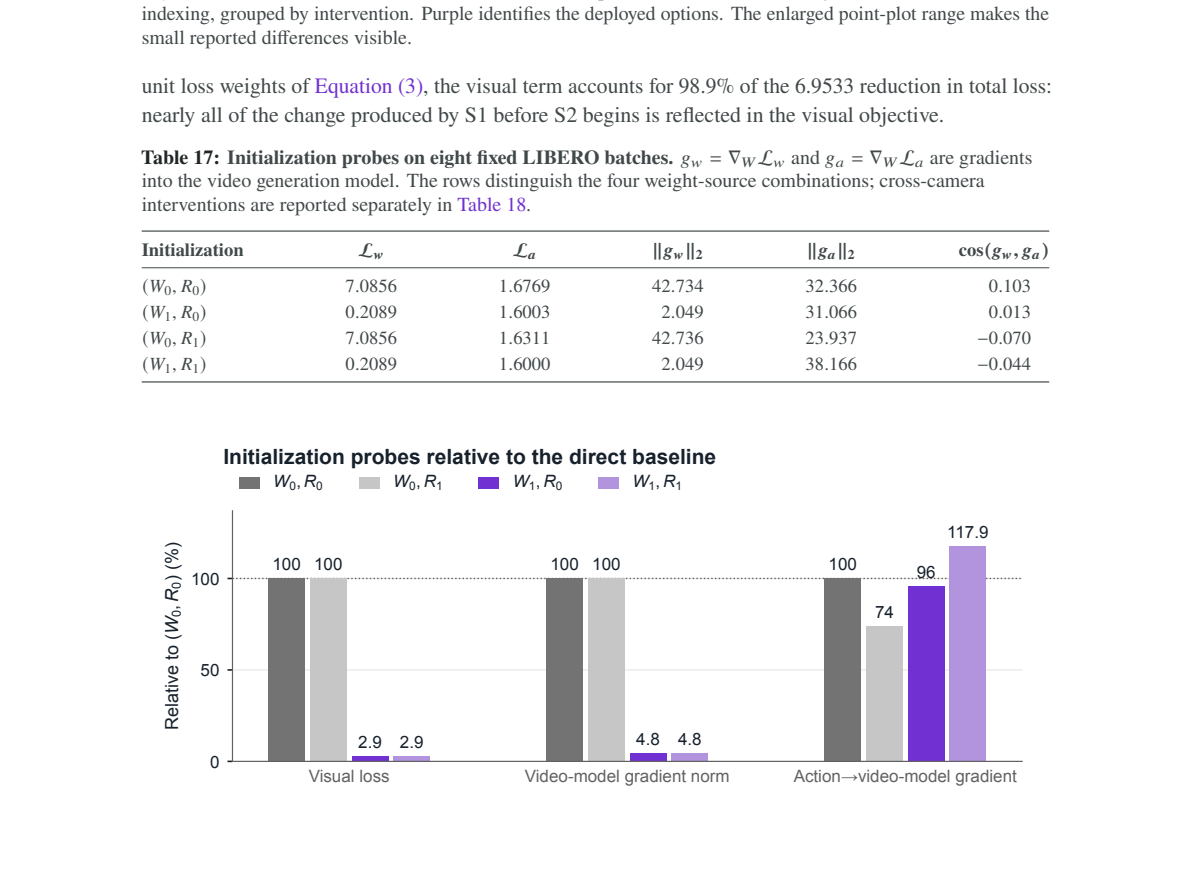
Core claim. The paper claims that the way predictive video training is supervised determines how well an action policy can later use the learned representations. In controlled experiments on the LIBERO-Plus benchmark, a staged training recipe—first adapting the video generation model alone on target-domain video across many noise levels, then jointly training the video model and action policy—raises success by 17.55 to 19.16 percentage points over direct joint training, across three geometric-conditioning settings. The gain follows the adapted video-model weights: transferring them to the video model alone improves success by 19.67 points, while copying them into the policy alone reduces success by 3.94 points. The authors argue that this staged approach provides a better starting state for joint learning, as evidenced by a 33.9-fold reduction in visual loss and a 95.2% reduction in its gradient norm at the start of Stage 2, while the action-loss gradient into the video model retains 96.0% of its magnitude.
The premise it rests on. The controlled experiments use only one video generation model (Wan2.2-TI2V-5B), one adaptation length (3,000 updates), and the LIBERO benchmark family; whether the gain carries over to other backbones, task domains, or adaptation lengths is untested, as the paper acknowledges.
If the paper is right (Pith's inferences, not the authors')
If the staged recipe generalizes, it could become a standard practice for training video-action models, suggesting that predictive adaptation should precede policy learning.
The finding that the gain resides in the video-model weights, not the policy initialization, implies that a single adapted video model could serve as a reusable foundation for multiple downstream policies.
The result that broad-noise adaptation outperforms endpoint-only adaptation suggests that the noise schedule during predictive training is a critical design choice, not just a detail.
The 8–10 point advantage at matched Stage 2 updates indicates that the adapted video model provides a consistently better representation for action learning throughout training, not just at the final checkpoint.
The paper's controlled experiments use only one video backbone (Wan2.2) and one adaptation length (3,000 updates). Testing whether the staged recipe transfers to other video models (e.g., Cosmos, Stable Video Diffusion) and task domains (e.g., mobile manipulation, dexterous manipulation) would establish its generality.
The 20.80-point gap between broad-noise and fixed-noise Stage 1 suggests that the noise schedule's role deserves deeper study. An inference is that intermediate noise levels may teach the model about multimodal futures, which could be especially valuable for tasks with high outcome uncertainty.
The branch-initialization result—adapted weights help the video model but hurt the policy—implies a functional specialization during Stage 1 that may not align with the policy's needs. This raises the question of whether a different Stage 1 objective (e.g., one that also considers the policy's gradient) could yield even larger gains.
The attention statistics show that adapted video models cause the policy to attend more to dynamic video features and less to geometry. An inference is that the adapted representation subsumes some geometric information, potentially reducing the need for explicit 3D conditioning.
Check this review
What was read
The passes were given all 204,154 characters of the paper's LaTeX source.
Fingerprint of that text (SHA-256): 1d9744139e5bdf2151214da956d2b28f7b0e67afc8b9954e935acd2fefa123eb
Pith does not keep that text. Rebuilt from the paper's source or PDF by the same code, it has this fingerprint if it is the same text. From a copy of Pith's code:
PYTHONPATH=. python scripts/review_input_check.py 2611.23746
The passes, in the order they ran
- Reader deepseek-v4-flash · medium effort · $0.0061 · instructions of the Reader, fingerprint f9ead7300382…
- Skeptic deepseek-v4-flash · medium effort · $0.0054 · instructions of the Skeptic, fingerprint 8f88c0f61488…
- Referee deepseek-v4-flash · medium effort · $0.0061 · instructions of the Referee, fingerprint a852d99aea0d…
- Check against the paper deepseek-v4-flash · medium effort · $0.0059 · instructions of the Check against the paper, fingerprint 6c7a6883d551…
- Circularity check deepseek-v4-flash · medium effort · $0.0054 · instructions of the Circularity check, fingerprint e9946e39d67b…
- Summary for the page deepseek-v4-flash · medium effort · temperature 0.2 · $0.0058 · instructions of the Summary for the page, fingerprint e4f56bf568e7…
The passes cost $0.035 in model calls together.
Version stamped on this review: pith-pipeline@v1.4.1-daily-deepseek-or-medium+deepseek/deepseek-v4-flash+p.ce10e2b95288
Each link opens a pass's instructions as plain text, the exact bytes its fingerprint was taken over. Every stored set of instructions.
curl -s https://pith.science/methodology/prompts/f9ead730038216984cfb56d7cb34332bdf691828296a1de4245f3d6667d4bf56 | sha256sum
prints the fingerprint of the reader's instructions. The same works for every pass.
The receipt
The review's fingerprint was taken on 19 Nov 2026. The review you are reading still matches it.
Fingerprint of the review (SHA-256): 675c11058e70f84c1b71b61b31ad934879fb2dbf062dbabe6d60aae0bcf08607
curl -s 'https://pith.science/api/v1/verdicts/2611.23746?form=canonical' | sha256sum
prints the fingerprint of the review as it stands now. The rule, in four steps.
A matching fingerprint shows the review has not changed since that date. It does not show that the review is right.
How often reviews like this one are right
Reviews like this one: written by deepseek-v4-flash, from the paper's LaTeX source.
How often objections from reviews like this one are right: not yet measured
Reviews by people
This review was written by a machine. No person has reviewed this paper on Pith yet. A scientist listed on Pith can review it for a fee, and their review is published here whatever it concludes.
The paper
Abstract
When humans learn to manipulate an unfamiliar object, they may already be able to anticipate how its state will change while still being unable to control it skillfully. This gap between prediction and control motivates us to study how the priors acquired by video generation models can be used effectively by an action policy. We present ZERITH V2.5, a video-action model (VAM) in which the action policy reads intermediate features of a video generation model, and use it to study, under fixed demonstrations and a fixed total number of updates, what kind of predictive training improves subsequent action learning. We find that the way video predictive training is supervised affects subsequent action learning. In our experiments, adapting at many noise levels yields a large gain, while adapting only at the noise level used at deployment yields none. Weight-transfer experiments further show that the gain stays with the adapted weights when they remain in the video generation model and disappears when they are used only to initialize the action policy. Initial loss and gradient measurements at the start of joint training indicate that target-domain predictive training gives the video model a better starting state, making subsequent joint learning of prediction and action easier. Under matched data and training budgets, predictive adaptation improves control. We evaluate the complete policy on LIBERO, LIBERO-Plus, Meta-World MT50, and real-robot tasks.
The paper's own sentences, arranged, kept beside the review and separate from it. Each label is drawn from a closed vocabulary; the number beside it is the probability the classifier gave that label. No sentence in this record was written by a model.
abstract compiled · 2026-11-19
The authors' main claim, as the classifier picked it out 0.99
“Under matched data and training budgets, predictive adaptation improves control.”
How the main claim is stated: asserted 1.00
What the abstract itself states, as probabilities: claims first 0.05 · states limitation 0.35 · human participants 0.13 · controlled comparison 0.80 · randomized assignment 0.02 · states quantitative result 0.07 · compares with prior results 0.47 · mentions code or data availability 0.03
The abstract, sentence by sentence
This table labels the abstract only (arXiv listing abstract v1). The number is the probability the classifier gave the label.
| Sentence | Role | The authors' own work | States the main conclusion | Strength |
|---|---|---|---|---|
| When humans learn to manipulate an unfamiliar object, they may already be able to anticipate how its state will change while still being unable to control it skillfully. | background 0.94 | 0.07 | 0.02 | hedged possibility 1.00 |
| This gap between prediction and control motivates us to study how the priors acquired by video generation models can be used effectively by an action policy. | background 0.50 | 0.10 | 0.04 | asserted 0.90 |
| We present ZERITH V2.5, a video-action model (VAM) in which the action policy reads intermediate features of a video generation model, and use it to study, under fixed demonstrations and a fixed total number of updates, what kind of predictive training improves subsequent action learning. | contribution 0.80 | 0.92 | 0.06 | asserted 0.96 |
| We find that the way video predictive training is supervised affects subsequent action learning. | result 1.00 | 0.95 | 0.28 | asserted 1.00 |
| In our experiments, adapting at many noise levels yields a large gain, while adapting only at the noise level used at deployment yields none. | result 1.00 | 0.96 | 0.20 | asserted 1.00 |
| Weight-transfer experiments further show that the gain stays with the adapted weights when they remain in the video generation model and disappears when they are used only to initialize the action policy. | result 0.96 | 0.95 | 0.12 | asserted 1.00 |
| Initial loss and gradient measurements at the start of joint training indicate that target-domain predictive training gives the video model a better starting state, making subsequent joint learning of prediction and action easier. | interpretation 0.84 | 0.94 | 0.15 | hedged possibility 0.64 |
| Under matched data and training budgets, predictive adaptation improves control. | result 0.97 | 0.92 | 0.74 | asserted 1.00 |
| We evaluate the complete policy on LIBERO, LIBERO-Plus, Meta-World MT50, and real-robot tasks. | method 0.78 | 0.93 | 0.04 | unclear 0.67 |
What kind of paper the classifier reports this is: method or tool 0.72 · evidence from observation or experiment 0.99
What was examined, and what was not
Sources read
- arXiv listing abstract v1
Not examined
- full text
- figures and tables
- references and citing sentences
- relations to other papers
Levels run
- P abstract
Not run
- S sections
- T body sentences
- C citations
- R cross-paper relations
How the labels were made
Compiled by classifier-1.13.0 via TypeSafe API, question bank abstract-p1-20260923, 2026-11-19: 1 request, 6,918 input tokens.
Every quoted sentence on this record is the authors'. Every label is from Pith's closed vocabulary, with the probability shown beside it. This record as JSON
Figures (17)







Figures are the authors', reproduced from the paper.
References (105)
- [1] J. R. Flanagan, P. Vetter, R. S. Johansson, and D. M. Wolpert, “Prediction precedes control in motor learning,” Current Biology, vol. 13, no. 2, pp. 146–150, 2003 on Pith
- [2] S. Li, Y. Gao, D. Sadigh, and S. Song, “Unified Video Action Model,”arXiv:2503.00200, 2025 on PithPith's reviewarXiv
- [3] C. Zhu, R. Yu, S. Feng, B. Burchfiel, P. Shah, and A. Gupta, “Unified world models: Coupling video and action diffusion for pretraining on large robotic datasets,”arXiv:2504.02792, 2025 on PithPith's reviewarXiv
- [4] Y. Shen, F. Wei, Z. Du,et al., “VideoVLA: Video generators can be generalizable robot manipulators,” inAdvances in Neural Information Processing Systems (NeurIPS), 2025 on Pith
- [5] S. Ye, Y. Ge, K. Zheng,et al., “World action models are zero-shot policies,”arXiv:2602.15922, 2026 on PithPith's reviewarXiv
- [6] Y. Hu, Y. Guo, P. Wang,et al., “Video prediction policy: A generalist robot policy with predictive visual representations,” inInternational Conference on Machine Learning (ICML), 2025 on Pith
- [7] T. Yuan, Z. Dong, Y. Liu, and H. Zhao, “Fast-WAM: Do world action models need test-time future imagination?” arXiv:2603.16666, 2026 on PithPith's reviewarXiv
- [8] J.Cai, Y.Mu, G.Yang,et al., “InternW0: Afoundationalphysicalworldmodelforefficientreal-worldinteractions,” arXiv:2609.27656, 2026 on PithPith's reviewarXiv
- [9] Y. Du, S. Yang, B. Dai,et al., “Learning universal policies via text-guided video generation,” inAdvances in Neural Information Processing Systems (NeurIPS), 2023 on Pith
- [10] J. Pai, L. Achenbach, V. Montesinos, B. Forrai, O. Mees, and E. Nava, “mimic-video: Video-action models for generalizable robot control beyond vlas,”arXiv:2512.15692, 2025 on PithPith's reviewarXiv
- [11] R. Liu, W. Zhao, Z. Yang,et al., “GE-Act 2.0: Pretraining and scaling a world-action model for robotic manipulation,”arXiv:2609.05588, 2026 on PithPith's reviewarXiv
- [12] Team Wan, A. Wang, B. Ai,et al., “Wan: Open and advanced large-scale video generative models,” arXiv:2503.20314, 2025, code: Wan2.2. [Online]. Available: https://github.com/Wan-Video/Wan2.2 on PithPith's reviewarXiv
- [13] J. Wang, M. Chen, N. Karaev, A. Vedaldi, C. Rupprecht, and D. Novotny, “VGGT: Visual geometry grounded transformer,” inProceedings of the IEEE/CVF Conference on Computer Vision and Pattern Recognition (CVPR), 2025, pp. 5294–5306. [Online]. Available: https://openaccess.thecvf.... on Pith
- [14] Y. Lipman, R. T. Q. Chen, H. Ben-Hamu, M. Nickel, and M. Le, “Flow matching for generative modeling,” in International Conference on Learning Representations, 2023 on Pith
- [15] A. Allshire, H. G. Singh, R. Singh,et al., “Scalable behavior cloning with open data, training, and evaluation,” arXiv:2606.27375, 2026 on PithPith's reviewarXiv
- [16] C. Hou, K. Wu, J. Liu,et al., “RoboMIND 2.0: A multimodal, bimanual mobile manipulation dataset for generalizable embodied intelligence,”arXiv:2512.24653, 2025 on PitharXiv
- [17] AgiBot World Contributors, Q. Bu, J. Cai,et al., “AgiBot World Colosseo: A large-scale manipulation platform for scalable and intelligent embodied systems,”arXiv:2503.06669, 2025 on PithPith's reviewarXiv
- [18] A. Yakefu, B. Xie, C. Xu,et al., “RoboChallenge: Large-scale real-robot evaluation of embodied policies,” arXiv:2510.17950, 2025 on PitharXiv
- [19] B. Liu, Y. Zhu, C. Gao,et al., “LIBERO: Benchmarking knowledge transfer for lifelong robot learning,” in Advances in Neural Information Processing Systems, vol. 36, 2023, pp. 44776–44791. [Online]. Available: https://proceedings.neurips.cc/paper_files/paper/2023/hash/ 8c3c6668... on Pith
- [20] M. J. Kim, K. Pertsch, S. Karamcheti,et al., “OpenVLA: An open-source vision-language-action model,” in Proceedings of The 8th Conference on Robot Learning, ser. Proceedings of Machine Learning Research, vol. 270, 2025, pp. 2679–2713. [Online]. Available: https://proceedings.m... on Pith
show 80 more
- [21] S. Fei, S. Wang, J. Shi,et al., “LIBERO-Plus: A progressive robustness benchmark for visual-language-action models,” inProceedings of the IEEE/CVF Conference on Computer Vision and Pattern Recognition, 2026, pp. 38574–38583. [Online]. Available: https://openaccess.thecvf.com/c... on Pith
- [22] T. Yu, D. Quillen, Z. He,et al., “Meta-World: A benchmark and evaluation for multi-task and meta reinforcement learning,” inProceedings of the Conference on Robot Learning, ser. Proceedings of Machine Learning Research, vol. 100, 2020, pp. 1094–1100. [Online]. Available: https... on Pith
- [23] Farama Foundation, “Meta-World evaluation,” https://metaworld.farama.org/evaluation/evaluation/, accessed October 31, 2026. 32 ZERITH V2.5 / TECHNICAL REPORT on Pith
- [24] K. Black, N. Brown, D. Driess,et al., “𝜋0: A vision-language-action flow model for general robot control,” arXiv:2410.24164, 2024 on PithPith's reviewarXiv
- [25] Physical Intelligence, “𝜋0.5: a vision-language-action model with open-world generalization,”arXiv:2504.16054, 2025 on PithPith's reviewarXiv
- [26] M. J. Kim, C. Finn, and P. Liang, “Fine-tuning vision-language-action models: Optimizing speed and success,” arXiv:2502.19645, 2025 on PithPith's reviewarXiv
- [27] M. J. Kim, Y. Gao, T.-Y. Lin,et al., “Cosmos Policy: Fine-tuning video models for visuomotor control and planning,”arXiv:2601.16163, 2026 on PithPith's reviewarXiv
- [28] M. Shukor, D. Aubakirova, F. Capuano,et al., “SmolVLA: A vision-language-action model for affordable and efficient robotics,”arXiv:2506.01844, 2025 on PithPith's reviewarXiv
- [29] T. Lin, Y. Du, Y. Mao,et al., “LA4VLA: Learning to act without seeing via language-action pretraining,” arXiv:2606.27295, 2026 on PithPith's reviewarXiv
- [30] A. Brohan, N. Brown, J. Carbajal,et al., “RT-2: Vision-language-action models transfer web knowledge to robotic control,”arXiv:2307.15818, 2023 on PithPith's reviewarXiv
- [31] Q. Shen, S. Zhang, Y. Liao,et al., “World action models: A survey,”arXiv:2606.20781, 2026 on PithPith's reviewarXiv
- [32] D. Ha and J. Schmidhuber, “World models,”arXiv:1803.10122, 2018 on PithPith's reviewarXiv
- [33] D. Hafner, J. Pasukonis, J. Ba, and T. Lillicrap, “Mastering diverse control tasks through world models,”Nature, vol. 640, pp. 647–653, 2025. [Online]. Available: https://www.nature.com/articles/s41586-025-08744-2 on Pith
- [34] A. Dosovitskiy and V. Koltun, “Learning to act by predicting the future,” inInternational Conference on Learning Representations (ICLR), 2017 on Pith
- [35] S. Nair, A. Rajeswaran, V. Kumar, C. Finn, and A. Gupta, “R3M: A universal visual representation for robot manipulation,” inConference on Robot Learning (CoRL), 2022 on Pith
- [36] P.-C. Ko, J. Mao, Y. Du, S.-H. Sun, and J. B. Tenenbaum, “Learning to act from actionless videos through dense correspondences,”arXiv:2310.08576, 2023 on PithPith's reviewarXiv
- [37] S. Yang, Y. Du, K. Ghasemipour,et al., “Learning interactive real-world simulators,”arXiv:2310.06114, 2023 on PithPith's reviewarXiv
- [38] J. Bruce, M. Dennis, A. Edwards,et al., “Genie: Generative interactive environments,”arXiv:2402.15391, 2024 on PithPith's reviewarXiv
- [39] NVIDIA, “Cosmos world foundation model platform for physical ai,”arXiv:2501.03575, 2025 on PithPith's reviewarXiv
- [40] J. Jang, S. Ye, Z. Lin,et al., “DreamGen: Unlocking generalization in robot learning through video world models,” arXiv:2505.12705, 2025 on PithPith's reviewarXiv
- [41] H. Wu, Y. Jing, C. Cheang,et al., “Unleashing large-scale video generative pre-training for visual robot manipulation,”arXiv:2312.13139, 2023 on PithPith's reviewarXiv
- [42] C.-L. Cheang, G. Chen, Y. Jing,et al., “GR-2: A generative video-language-action model with web-scale knowledge for robot manipulation,”arXiv:2410.06158, 2024 on PithPith's reviewarXiv
- [43] L. Li, Q. Zhang, Y. Luo,et al., “Causal world modeling for robot control,”arXiv:2601.21998, 2026 on PithPith's reviewarXiv
- [44] Y. Liao, P. Zhou, S. Huang,et al., “Genie Envisioner: A unified world foundation platform for robotic manipulation,”arXiv:2508.05635, 2025 on PithPith's reviewarXiv
- [45] A. Ye, B. Wang, C. Ni,et al., “GigaWorld-Policy: An efficient action-centered world–action model,” arXiv:2603.17240, 2026 on PitharXiv
- [46] GigaWorld Team, A. Ye, A. Ma,et al., “GigaWorld-Policy-0.5: A faster and stronger wam empowered by autoresearch,”arXiv:2607.13960, 2026 on PithPith's reviewarXiv
- [47] NVIDIA, “Cosmos 3: Omnimodal world models for physical ai,”arXiv:2606.02800, 2026 on PithPith's reviewarXiv
- [48] H. Bi, H. Tan, S. Xie,et al., “Motus: A unified latent action world model,”arXiv:2512.13030, 2025 on PithPith's reviewarXiv
- [49] W. Xiang, H. Yang, D. Huang, and Y. Wang, “Denoising diffusion autoencoders are unified self-supervised learners,” inIEEE/CVF International Conference on Computer Vision (ICCV), 2023 on Pith
- [50] L. Tang, M. Jia, Q. Wang, C. P. Phoo, and B. Hariharan, “Emergent correspondence from image diffusion,” in Advances in Neural Information Processing Systems (NeurIPS), 2023 on Pith
- [51] X. Chen, Z. Liu, S. Xie, and K. He, “Deconstructing denoising diffusion models for self-supervised learning,” arXiv:2401.14404, 2024 on PithPith's reviewarXiv
- [52] S. Yu, S. Kwak, H. Jang,et al., “Representation alignment for generation: Training diffusion transformers is easier than you think,” inInternational Conference on Learning Representations (ICLR), 2025. 33 ZERITH V2.5 / TECHNICAL REPORT on Pith
- [53] S. Huang, L. Chen, P. Zhou,et al., “EnerVerse: Envisioning embodied future space for robotics manipulation,” in Advances in Neural Information Processing Systems (NeurIPS), 2025 on Pith
- [54] T. Ma, J. Zheng, Z. Wang,et al., “DiT4DiT: Jointly modeling video dynamics and actions for generalizable robot control,”arXiv:2603.10448, 2026 on PitharXiv
- [55] W. Zhao, H. Jiang, X. Shi,et al., “Faster-WAM: Efficient inference-time future conditioning for robust world action models,”arXiv:2608.04404, 2026 on PithPith's reviewarXiv
- [56] L. Ma, R. H. Yang, A. Abyaneh,et al., “Faster-WAM: Do world action models need deep action modules?” arXiv:2608.02365, 2026 on PithPith's reviewarXiv
- [57] J. Huang, Z. Wu, S. Xu,et al., “Foresight without seeing: Latent futures for world action models,” arXiv:2608.11605, 2026 on PithPith's reviewarXiv
- [58] J. Cai, L. Ling, S. Chu,et al., “AHA-WAM: Asynchronous horizon-adaptive world-action modeling with observation-guided context routing,”arXiv:2606.09811, 2026 on PithPith's reviewarXiv
- [59] J. Zhang, J. Zhu, T. Su,et al., “Learning 4D geometric priors for inference-efficient world action models,” arXiv:2607.05468, 2026 on PithPith's reviewarXiv
- [60] D. Driess, J. T. Springenberg, B. Ichter,et al., “Knowledge insulating vision-language-action models: Train fast, run fast, generalize better,”arXiv:2505.23705, 2025 on PithPith's reviewarXiv
- [61] R. Yu, P. Zhang, S. Liu,et al., “Wall-OSS-0.5 technical report,”arXiv:2605.30877, 2026 on PithPith's reviewarXiv
- [62] GigaBrain Team, “GigaBrain-0.7: Scaling embodied foundation models to emergent capabilities with a three-system architecture,”arXiv:2608.15875, 2026 on PithPith's reviewarXiv
- [63] Y. Guo, H. Yan, Z. Zhong,et al., “Video Prediction Policy 2: Predict better, act better,”arXiv:2610.10270, 2026 on PithPith's reviewarXiv
- [64] J. Liang, P. Tokmakov, R. Liu,et al., “Video generators are robot policies,”arXiv:2508.00795, 2025 on PithPith's reviewarXiv
- [65] H. Cui, Y. Li, Q. Guo,et al., “What does world modeling actually improve in robot action learning?” arXiv:2610.34593, 2026 on PithPith's reviewarXiv
- [66] J. Chun, Y. Jeong, and T. Kim, “How representational priors shape generalization in world action models,” arXiv:2610.29168, 2026 on PithPith's reviewarXiv
- [67] G. Sidorov, V. Kornilov, D. Grankin, P. Fedotova, and A. Postnikov, “GreenWAM: A world foundation model for robotics,”arXiv:2610.18774, 2026 on PithPith's reviewarXiv
- [68] J. Howard and S. Ruder, “Universal language model fine-tuning for text classification,” inProceedings of the Annual Meeting of the Association for Computational Linguistics (ACL), 2018, pp. 328–339 on Pith
- [69] S. Gururangan, A. Marasović, S. Swayamdipta,et al., “Don’t stop pretraining: Adapt language models to domains and tasks,” inProceedings of the Annual Meeting of the Association for Computational Linguistics (ACL), 2020, pp. 8342–8360 on Pith
- [70] A. Blattmann, T. Dockhorn, S. Kulal,et al., “Stable Video Diffusion: Scaling latent video diffusion models to large datasets,”arXiv:2311.15127, 2023 on PithPith's reviewarXiv
- [71] Y. Bengio, J. Louradour, R. Collobert, and J. Weston, “Curriculum learning,” inInternational Conference on Machine Learning (ICML), 2009, pp. 41–48 on Pith
- [72] J. Yosinski, J. Clune, Y. Bengio, and H. Lipson, “How transferable are features in deep neural networks?” in Advances in Neural Information Processing Systems (NeurIPS), 2014 on Pith
- [73] A. Kumar, A. Raghunathan, R. Jones, T. Ma, and P. Liang, “Fine-tuning can distort pretrained features and underperform out-of-distribution,” inInternational Conference on Learning Representations (ICLR), 2022 on Pith
- [74] L. Qiao, Y. Zhao, Z. Li, X. Qiu, J. Wu, and C. Zhang, “DeFRCN: Decoupled faster R-CNN for few-shot object detection,” inIEEE/CVF International Conference on Computer Vision (ICCV), 2021 on Pith
- [75] T. Karras, M. Aittala, T. Aila, and S. Laine, “Elucidating the design space of diffusion-based generative models,” in Advances in Neural Information Processing Systems (NeurIPS), 2022 on Pith
- [76] P. Esser, S. Kulal, A. Blattmann,et al., “Scaling rectified flow transformers for high-resolution image synthesis,” arXiv:2403.03206, 2024 on PithPith's reviewarXiv
- [77] T. Hang, S. Gu, C. Li,et al., “Efficient diffusion training via Min-SNR weighting strategy,”arXiv:2303.09556, 2023 on PithPith's reviewarXiv
- [78] J. Choi, J. Lee, C. Shin, S. Kim, H. Kim, and S. Yoon, “Perception prioritized training of diffusion models,” in IEEE/CVF Conference on Computer Vision and Pattern Recognition (CVPR), 2022 on Pith
- [79] Physical Intelligence, “𝜋0.7: a steerable generalist robotic foundation model with emergent capabilities,” arXiv:2604.15483, 2026. 34 ZERITH V2.5 / TECHNICAL REPORT on PithPith's reviewarXiv
- [80] NVIDIA, “GR00T N1: An open foundation model for generalist humanoid robots,”arXiv:2503.14734, 2025 on PithPith's reviewarXiv
- [81] C. Cheang, S. Chen, Z. Cui,et al., “GR-3 technical report,”arXiv:2507.15493, 2025 on PithPith's reviewarXiv
- [82] Gemini Robotics Team, “Gemini Robotics: Bringing ai into the physical world,”arXiv:2503.20020, 2025 on PithPith's reviewarXiv
- [83] Gemini Robotics Team, “Gemini Robotics 1.5: Pushing the frontier of generalist robots with advanced embodied reasoning, thinking, and motion transfer,”arXiv:2510.03342, 2025 on PithPith's reviewarXiv
- [84] H. Yuan, Z. Liang, A. Chen,et al., “Qwen-RobotManip technical report: Alignment unlocks scale for robotic manipulation foundation models,”arXiv:2606.17846, 2026 on PithPith's reviewarXiv
- [85] A. Brohan, N. Brown, J. Carbajal,et al., “RT-1: Robotics transformer for real-world control at scale,” arXiv:2212.06817, 2022 on PithPith's reviewarXiv
- [86] D. Ghosh, H. R. Walke, K. Pertsch,et al., “Octo: An open-source generalist robot policy,” inProceedings of Robotics: Science and Systems, 2024. [Online]. Available: https://www.roboticsproceedings.org/rss20/p090.html on Pith
- [87] S. Liu, L. Wu, B. Li,et al., “RDT-1B: a diffusion foundation model for bimanual manipulation,”arXiv:2410.07864, 2024 on PithPith's reviewarXiv
- [88] Open X-Embodiment Collaboration, “Open X-Embodiment: Robotic learning datasets and rt-x models,” arXiv:2310.08864, 2023 on PithPith's reviewarXiv
- [89] K.Pertsch, K.Stachowicz, B.Ichter,et al., “FAST:Efficientactiontokenizationforvision-language-actionmodels,” arXiv:2501.09747, 2025 on PithPith's reviewarXiv
- [90] Q. Li, Y. Liang, Z. Wang,et al., “CogACT: A foundational vision-language-action model for synergizing cognition and action in robotic manipulation,”arXiv:2411.19650, 2024 on PithPith's reviewarXiv
- [91] C. Chi, S. Feng, Y. Du,et al., “Diffusion Policy: Visuomotor policy learning via action diffusion,” inProceedings of Robotics: Science and Systems, 2023.[Online].Available: https://www.roboticsproceedings.org/rss19/p026.html on Pith
- [92] S. Ye, J. Jang, B. Jeon,et al., “Latent action pretraining from videos,” inInternational Conference on Learning Representations (ICLR), 2025 on Pith
- [93] Q. Bu, Y. Yang, J. Cai,et al., “UniVLA: Learning to act anywhere with task-centric latent actions,” inRobotics: Science and Systems (RSS), 2025 on Pith
- [94] Y. Tian, S. Yang, J. Zeng,et al., “Predictive inverse dynamics models are scalable learners for robotic manipulation,”arXiv:2412.15109, 2024 on PithPith's reviewarXiv
- [95] Q. Zhao, Y. Lu, M. J. Kim,et al., “CoT-VLA: Visual chain-of-thought reasoning for vision-language-action models,” inIEEE/CVF Conference on Computer Vision and Pattern Recognition (CVPR), 2025 on Pith
- [96] R. Zheng, J. Wang, S. Reed,et al., “FLARE: Robot learning with implicit world modeling,”arXiv:2505.15659, 2025 on PithPith's reviewarXiv
- [97] H. Ma, J. Cai, X. Xu,et al., “InternVLA-A1.5: Unifying understanding, latent foresight, and action for compositional generalization,”arXiv:2607.04988, 2026 on PithPith's reviewarXiv
- [98] W. Liang, L. Yu, L. Luo,et al., “Mixture-of-transformers: A sparse and scalable architecture for multi-modal foundation models,”Transactions on Machine Learning Research, 2025. [Online]. Available: https://arxiv.org/abs/2411.04996 on PithPith's reviewarXiv
- [99] Y. Ze, G. Zhang, K. Zhang, C. Hu, M. Wang, and H. Xu, “3D diffusion policy: Generalizable visuomotor policy learning via simple 3D representations,” inRobotics: Science and Systems (RSS), 2024 on Pith
- [100] Z. Ni, Y. He, L. Qian,et al., “VO-DP: Semantic-geometric adaptive diffusion policy for vision-only robotic manipulation,”arXiv:2510.15530, 2025 on PitharXiv
The first 100 of 105 references are listed here. All of them are in this paper's citation record.
Challenges and discussion
Disagree with the review, or know something it missed? Leave a comment, or challenge this review formally: a challenge becomes a permanent entry in this paper's record, and its decision is published here.
Come back by email
A short list of the week's newly reviewed papers. Nothing is sent until you confirm from your inbox, and every email has a link that stops it. No account.
No comments yet.
Sign in to comment