Robotics · arXiv:2610.37215 v1 · submitted 27 Oct 2026 · 51 references
Retrieve to Act: Motion Primitive Graph Retrieval for Robust VLA Execution
The paper says
“Vision-Language-Action (VLA) policies demonstrate remarkable semantic generalization, yet remain highly vulnerable to out-of-distribution (OOD) visual shifts during execution.”
more of the abstract
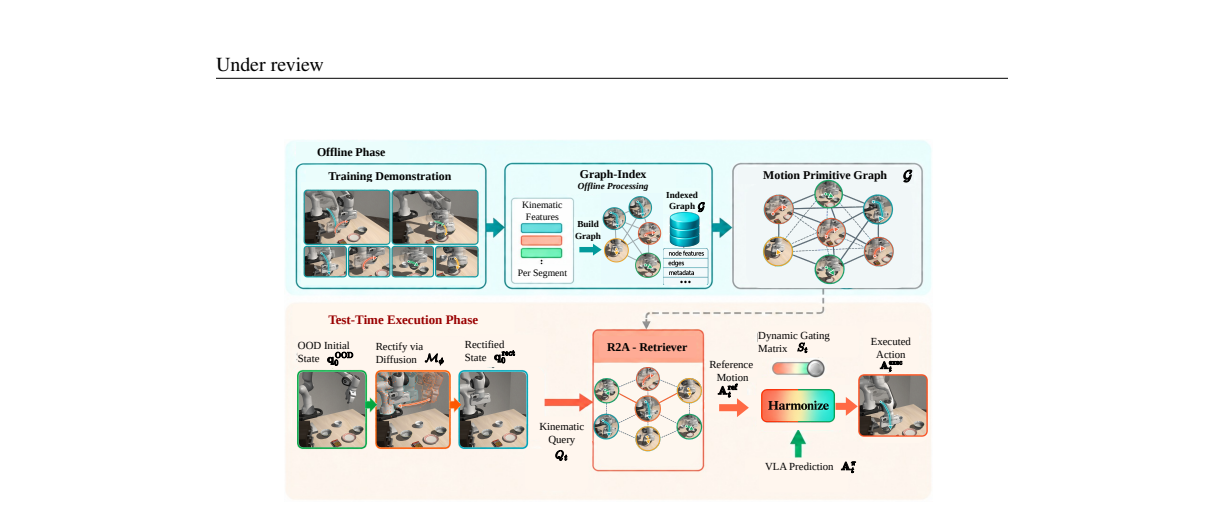
While existing test-time methods attempt to suppress spurious visual cues, they fundamentally overlook the rich, uncorrupted kinematic priors embedded in the policy's own training experience. We introduce Retrieve to Act (R2A), a test-time scaling framework that formulates OOD robustness purely as a geometric motion primitive retrieval problem. R2A bypasses fragile visual features by structuring successful training demonstrations into an offline spatiotemporal motion primitive graph. During inference, a query-dependent Graph Neural Network dynamically localizes the robot's ongoing execution within this graph, retrieving structurally compatible future motion primitives. These retrieved geometric priors are then seamlessly harmonized with the frozen VLA's predicted actions via a learned, dimension-wise gating mechanism, adaptively rectifying erroneous spatial trajectories while preserving the policy's local reactivity. Extensive experiments across three state-of-the-art VLA architectures, GR00T N1.7, π0.5, and StableVLA, demonstrate that R2A consistently and significantly enhances robustness against diverse contextual perturbations. R2A achieves absolute success rate improvements of up to +12% in simulation benchmarks (LIBERO-Plus, RoboTwin2.0-Plus) and +40% in real-world deployments, without requiring any finetuning of the base policies. Project page: https://retrieve2act.github.io/r2a/
from the abstract
Pith says
Machine review · deepseek-v4-flash · 28 Oct 2026 · what was read was not recorded · not checked by a person
It can be wrong. Challenge this review or reply to it.
Holds up, with conditions. A well-specified, honestly evaluated test-time wrapper for frozen VLAs with consistent gains across three backbones; the retriever-under-corruption premise stays unmeasured and one Section 6 claim outruns the analysis. This line is wrong
3 major objections · 5 minor
How often objections from reviews like this one are right: not yet measured
Not checked: figures, code, what the 51 references say.
The paper says, at Section 3.5 / Appendix C.1 / Section 6
The review did not quote this passage.
Pith says: Objection 1 of 3 · major
The load-bearing premise that the kinematic query Q_t remains localizable under exactly the OOD shifts R2A is meant to fix is never directly measured. Q_t concatenates A^{pi,pose}_t, the frozen VLA's pose prediction on the perturbed observation, with state/action history (Section 3.5), and both the retrieved reference A^{ref}_t and the gate S_t depend on Q_t.
more of objection 1
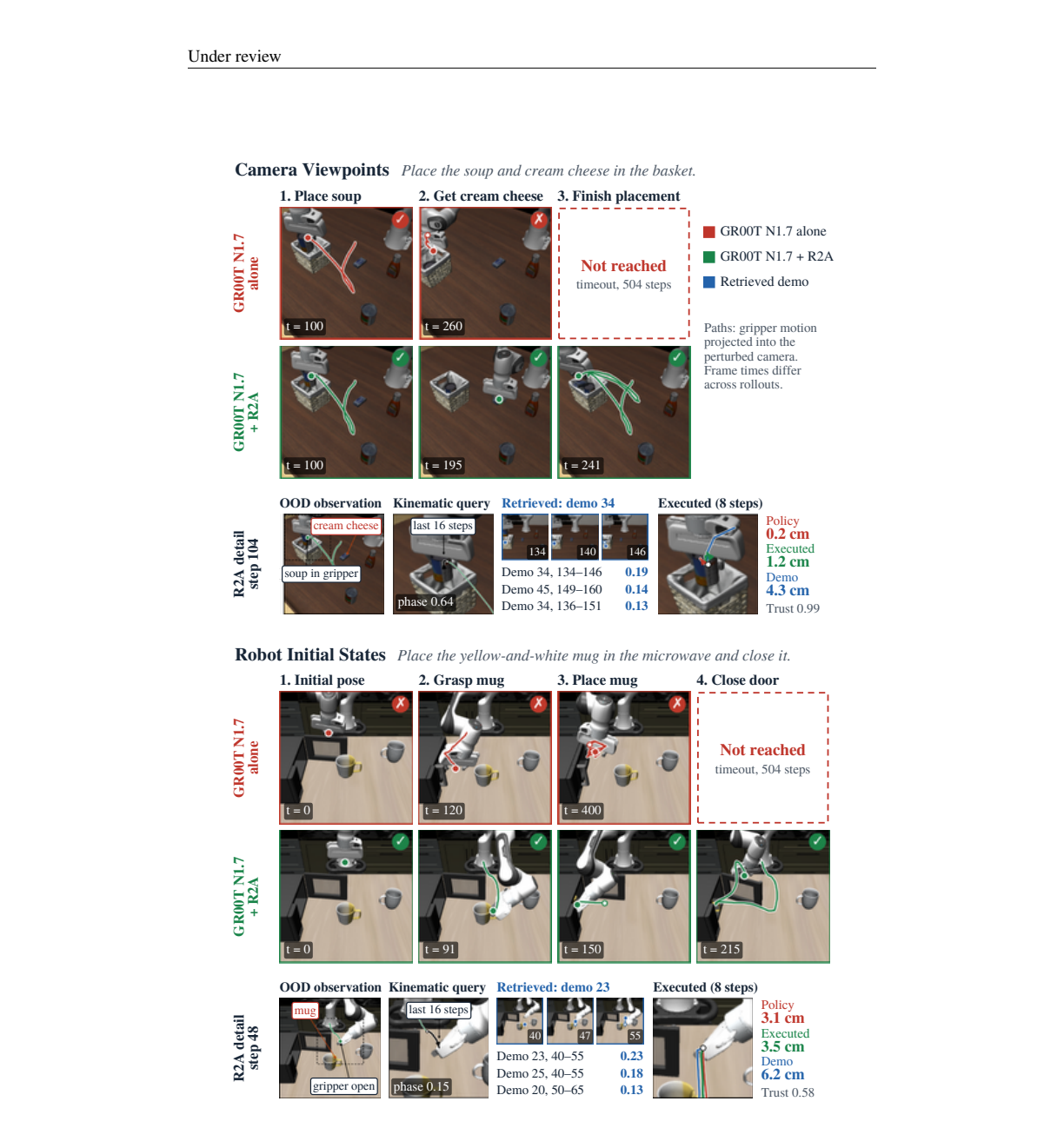
The retriever is trained on queries derived from demonstrations and clean replayed actions (Section 3.5 training objective; Appendix C.1), and the only injected perturbation is isotropic additive noise in the harmonization loss (Eq. 4). The paper's own qualitative examples (Figure 8) show VLA errors under visual OOD are coherent and structured (e.g., 'keeps pushing after placing the soup'; 'heads for the microwave with an empty gripper'), not isotropic. The authors explicitly acknowledge the harmonizer's simulated-noise gap in Section 6, but the retriever link is not similarly analyzed. Since direct replay of retrieved references alone collapses success to 1.2% (Table 5), the end-to-end gains require the reference to remain phase-correct under corrupted queries; otherwise the gate amplifies a wrong prior. I request either (i) a direct localization-stability measurement, e.g., retrieval accuracy or rank of the correct segment as a function of perturbation type and severity for OOD-corrupted versus clean queries, or (ii) an explicit argument, with supporting evidence, for why the graph topology makes the query robust to the structured errors the policy exhibits. The Section 6 sentence claiming the analysis 'separates localization stability, reference compatibility, and correction strength' is not backed by any localization-stability metric in the manuscript.
The paper says, at Table 1 / Appendix A
The review did not quote this passage.
Pith says: Objection 2 of 3 · major
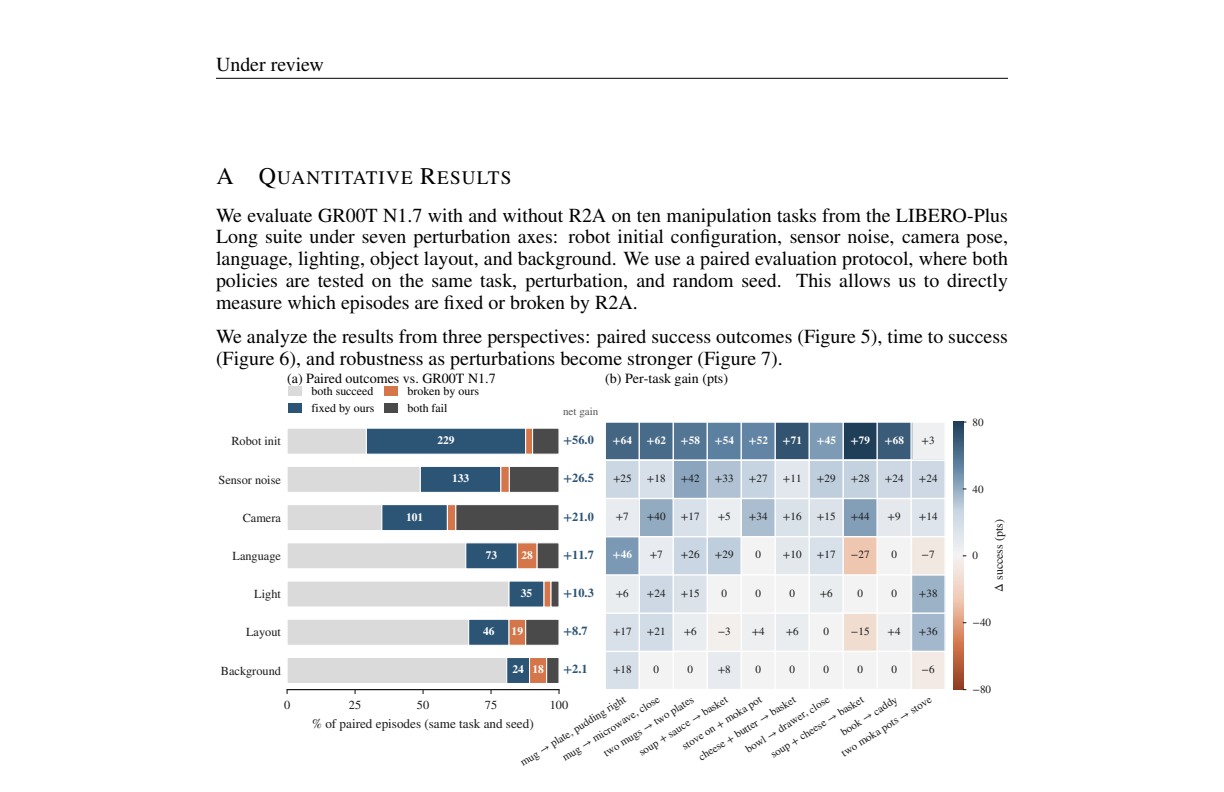
All headline results are point estimates: no confidence intervals, standard errors, or significance tests are reported anywhere for the main tables, and Appendix A's paired analysis reports net gains and fixed/broken episode counts but no test (e.g., McNemar) on the paired outcomes.
more of objection 2
Given that several reported gains are small relative to plausible trial noise (e.g., +0.8 for pi0.5 under Language; -0.1 and -0.8 negative cells; +0.6 for pi0.5 under Sensor Noise in Table 1; +2.5 points over SDN for pi0.5 in Table 3), and given that the paper uses the word 'significantly' in the abstract (sentence b9), the statistical basis for the significance claim should be made explicit. The underlying per-episode data appear to exist, since Appendix A reports paired outcomes; reporting McNemar or bootstrap intervals over the same seeds would directly address this.
The paper says, at Table 4 / Appendix B.2
The review did not quote this passage.
Pith says: Objection 3 of 3 · major
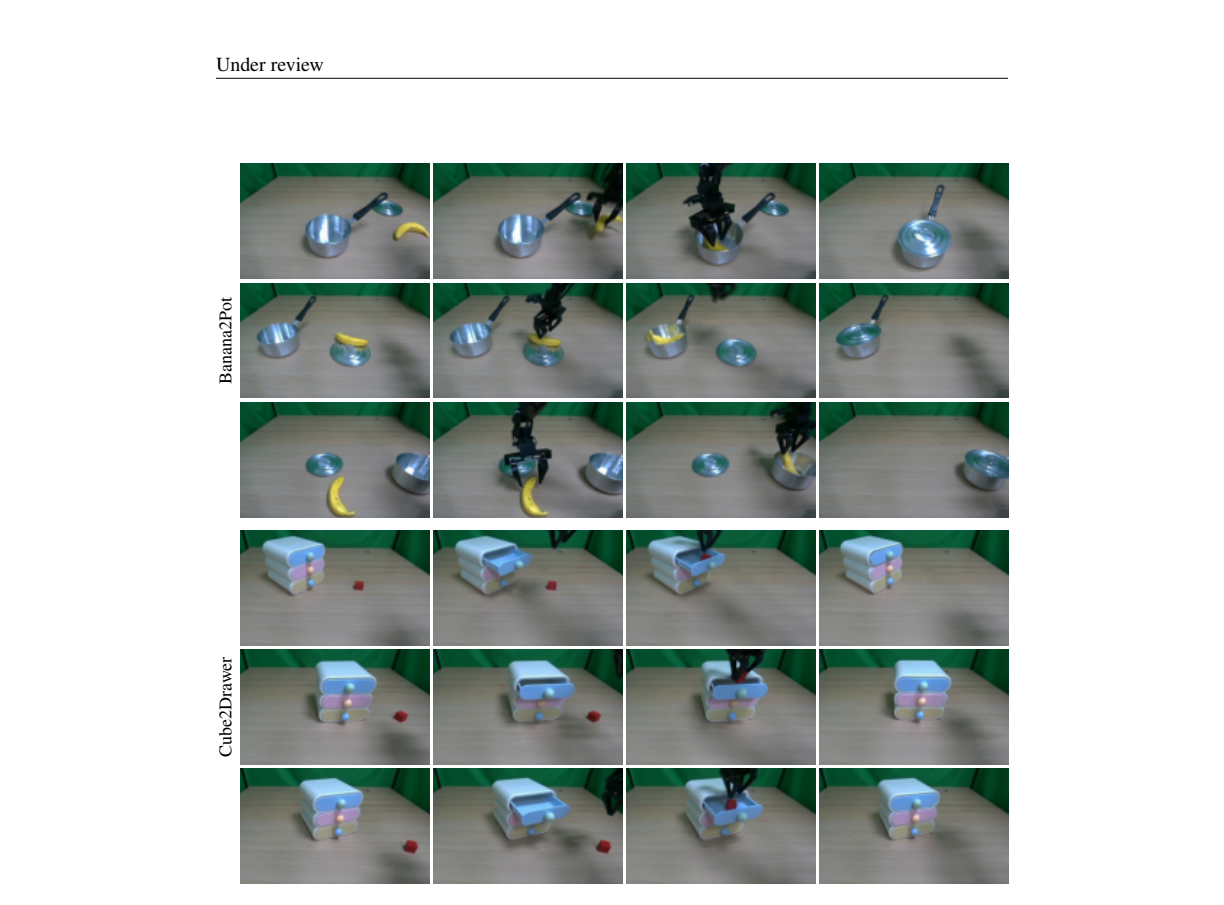
The real-world evidence, which supports the '+40% in real-world deployments' claim in the abstract, consists of 20 trials per task-condition cell (10 base, 10 perturbed per task per method, as described in Appendix B.2). For Cube2Drawer under Robot Initial States, the reported improvement is 45% vs. 10% (i.e., 4.5/10 vs. 1/10 successes if trials are n=10 per cell); for Banana2Pot Robot Initial States, 80% vs. 30%.
more of objection 3
With n=10 per cell, these differences are not statistically resolvable at conventional levels (e.g., 8/10 vs. 3/10 gives a two-sided Fisher exact p of approximately 0.07). The paper should either state the trial counts explicitly, report the test, or soften the abstract claim to reflect that the real-world evidence is indicative rather than statistically conclusive at this sample size.
5 minor objections
The paper says, at Section 3.5 / Eq. (2)-(3)
Pith says: minor objection 1 of 5
The negative set N_u is defined as 'the remaining nodes connected to u' that fail the proximity conditions. Since the graph includes spatial edges only for kinematically close nodes, the connected-negative set may be small and biased toward near-misses; the training dynamics of L_RANK should be described more precisely, and the number of negatives per anchor should be reported.
The paper says, at Section 3.3
Pith says: minor objection 2 of 5
The spatial-edge threshold is stated as 'a predefined threshold' without its value; the graph sizes (13k-28k nodes) are reported in Appendix C.1 but not the edge counts or the threshold's sensitivity. Reporting the threshold and a small sensitivity analysis would strengthen the reproducibility statement.
show 3 more
The paper says, at Table 5
Pith says: minor objection 3 of 5
The label 'R2A w/o Harmonization' reports 1.2% success, which matches direct replay of retrieved actions. The sentence describing this in Section 5 says 'directly replaying retrieved actions drops success to 1.2%', which is consistent, but the table caption should say this explicitly to avoid the impression that the ablation removes only the learned gate while keeping the residual formulation.
The paper says, at Appendix C.1
Pith says: minor objection 4 of 5
The RoboTwin2.0-Plus deployment introduces three benchmark-specific mechanisms (joint retrieval over the two arms, a pause-triggered displacement corrector with a 0.7 weighted-cosine threshold, and the post-grasp closed-loop 10/80-step query schedule). These are described clearly, but they are not ablated; a sentence stating whether the headline +9.4 average holds without any of these three mechanisms would clarify how much of the RoboTwin gain is attributable to the core R2A pipeline.
The paper says, at General
Pith says: minor objection 5 of 5
Minor typos and inconsistencies: 'R2Aw/o Ranking Loss' lacks a space in Table 5; the text refers to 'Initial State Rectification (RIS)' while the method and table use 'ISR'; Figure 7's bar labels mix perturbation categories and types in a way that makes the x-axes hard to parse; and the abstract's 'up to +12%' understates the Robot Initial States cell gains (+49.1 in Table 1), which the body correctly reports.
What would settle it
On the already-collected paired LIBERO-Plus episodes for GR00T N1.7, compute a retrieval-localization accuracy: at each correction step, mark the retrieval as correct if the top-scoring retrieved segment belongs to the episode's true task and its progress p_v is within ±0.1 of the paired clean rollout's progress at that step. Report this metric per perturbation axis for (i) the standard query and (ii) an ablative query with the VLA's pose prediction A^{π,pose}_t removed, together with the mean gate magnitude ‖S_t‖ on perturbed vs clean episodes. If localization accuracy under Camera, Lighting, and Background stays within ~5 points of the clean-episode level and is insensitive to removing the corrupted prediction, the concern is resolved; if it drops by more than ~15 points, the end-to-end gains are not attributable to geometric localization, and the central claim must be narrowed.
from the skeptic's reading
How the review went
4 readings by deepseek-v4-flash · 28 Oct 2026
- Reader holds up, with conditions
- Skeptic agrees
- Editor wrote the verdict above
- Referee major revision: 3 major objections, 5 minor
Not run on this paper: the simulated authors' defence.
Pith did not check this review's objections against the paper.
The review in full
The review in brief, machine-written
R2A is a test-time wrapper for frozen VLAs: build a kinematic motion primitive graph from the training demonstrations, retrieve plausible future motion chunks with a query-conditioned GNN, and blend them into the policy output with a learned gate. The specific combination is not in the cited prior work, and the package is well specified—equations for every component, parameter counts, training settings, and a code link.
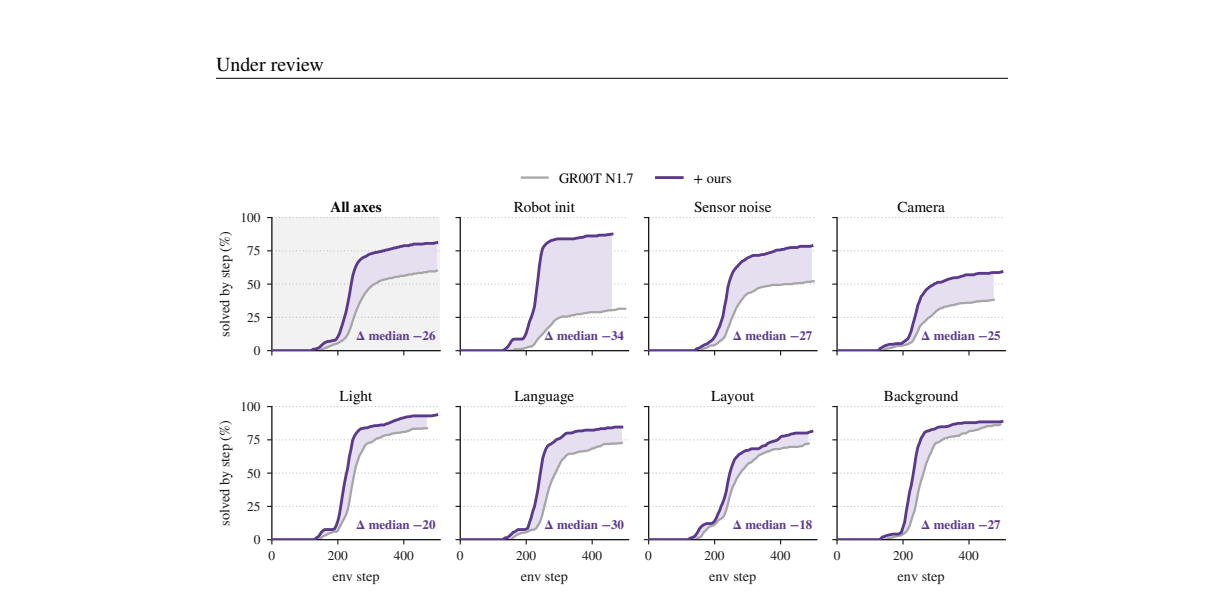
The strongest part is the evaluation, not the method. Appendix A runs a paired protocol on the same task, perturbation, and seed, with fixed-vs-broken episode counts, per-task breakdowns, time-to-success curves, and sensitivity to perturbation strength. That is the right way to report this kind of result, and it supports the headline: consistent positive gains across three backbones and seven perturbation axes, largest under robot initial states. The ablation is honest too—raw replay of retrieved actions collapses to 1.2%, so the learned gating is load-bearing, and dropping the GNN retriever costs about 13 points.
Soft spots, in proportion. First, there are no confidence intervals or significance tests anywhere; "significantly" in the abstract overstates. The paired counts compensate somewhat, but the real-world table is roughly 20 trials per cell and needs error bars. Second, the stress test is right about the load-bearing premise: the query is built partly from the perturbed VLA's own predictions, and the retriever is trained on clean queries plus isotropic noise. Whether retrieval stays phase-correct under structured OOD errors is never measured—no localization-stability metric, and the paper's own examples show structured errors ("keeps pushing after placing the soup"). The end-to-end gains suggest the mechanism mostly survives, but that is an inference, not a measurement. The authors acknowledge the harmonization-side version of this limitation; they do not acknowledge the retriever-side version. Third, Section 6 says the analysis "separates localization stability, reference compatibility, and correction strength, giving sufficient conditions"—no such derivation is present in the manuscript.
This is for anyone working on VLA robustness or test-time scaling; the method is useful and the evaluation template is worth copying. It deserves a serious referee, with a request for confidence intervals, a direct measure of retrieval accuracy under real corrupted queries, and either the promised derivation or a toned-down Section 6.
The strongest objection
The central claim requires that R2A's kinematic query survive the very OOD corruption it is meant to rectify. At each control step the query is built partly from A^{π,pose}_t, the frozen VLA's pose prediction on the perturbed observation (Section 3.5), and both the retrieved reference A^{ref}_t and the gate S_t depend on it. Because S_t ∈ [0,1] can only interpolate between the corrupted prediction and the reference (Section 4), and because direct replay of retrieved references alone collapses success to 1.2% (Table 5), the end-to-end gains (e.g., +15.3 camera, +8.0 sensor noise for GR00T N1.7) require the reference to remain phase-correct under a corrupted query; otherwise harmonization amplifies a wrong prior. That link is never measured. The retriever is trained on queries derived from demonstrations and clean replayed actions (Section 3.5, Eqs. 2-3; Appendix C.1); the only injected perturbation is isotropic additive noise in the harmonization loss (Eq. 4). Real VLA errors under visual OOD are structured and coherent, as the paper's own examples show ('keeps pushing after placing the soup'; 'heads for the microwave with an empty gripper', Figure 8). The paper acknowledges the harmonizer's simulated-noise gap (Section 6 limitations) but not the retriever link; the Section 6 assertion that the analysis 'separates localization stability, reference compatibility, and correction strength' is not backed by any localization-stability metric, theorem, or derivation in the manuscript. All reported evidence is end-to-end success without confidence intervals, so the mechanism-level premise remains unverified—the reader's conditional verdict is appropriate, pending the test below.
Reading in good faith, the paper attempts something specific and testable: make a frozen VLA robust to visual OOD shifts by retrieving kinematic future-motion priors from an offline graph of the policy's own successful demonstrations, with a learned gate blending the retrieval into the policy output. What must be true for the central claim: (1) the graph indexes useful kinematic priors; (2) the query built from the VLA's current prediction, state history, and executed actions still localizes the correct subgraph under perturbation; (3) the gate turns a correct reference into accurate correction; (4) the reported gains are real and attributable to R2A. The paper supplies real evidence for (1) (design, ablations), (3) ('w/o Harmonization' drops to 1.2% while full R2A reaches 89.0%), and indirect evidence for (4) (paired evaluation, consistent gains across three VLAs and two benchmarks, and a small real-world study). The weakest, least supported link is (2): no retrieval-localization metric under perturbation is reported anywhere, the retriever's own training objectives (Eqs. 2-3) use clean demonstration queries, and the only perturbation in training is isotropic query noise in the harmonization loss (Eq. 4), while the paper's own qualitative failures are structured coherent wrong motions (Figure 8). The Section 6 statement that the analysis 'separates localization stability, reference compatibility, and correction strength' is asserted without any derivation or metric appearing in the manuscript; this is a missing-support issue rather than an internal contradiction. Secondary issues, already noted by the reader (no confidence intervals; narrow real-world evaluation; ISR diffusion sampling uninformed by the OOD state; minor reporting slips such as attributing π0.5's single marginal decrease to Background rather than Lighting in the Table 1 discussion), reinforce but do not replace this concern. Because the concern is decisive-but-testable and the end-to-end results are internally consistent, CONDITIONAL (the reader's verdict) is the right call; the concrete test above would either resolve the concern or force the claim to be narrowed. I therefore agree with the reader that the query-under-corruption premise is the load-bearing assumption.
The referee's report
If the central claim holds, R2A would be a practically valuable result: a parameter-light, training-free-at-deployment wrapper that makes several heterogeneous VLA backbones substantially more robust to execution-context shifts, without touching the base policy. The paper's framing is appropriately modular: graph construction is per-benchmark and shared across policies, while the locator/retriever/harmonizer are trained per policy from cached demonstrations and replayed actions, requiring no robot rollouts. The empirical scope is commendable: three VLA families, seven perturbation axes, a second simulation benchmark, paired seed-matched analysis in Appendix A, perturbation-strength sweeps, a real-world deployment with 20 trials per condition, and an ablation isolating the three components. The paper also ships reproducible artifacts (code repository, model names, and per-benchmark protocols) and is unusually candid in its limitations section.
Pith's reading of the paper (a machine's summary, not the authors')
Retrieve to Act (R2A) claims that the visual fragility of vision-language-action (VLA) robot policies can be fixed without touching the policy itself: organize successful training demonstrations into a graph of purely kinematic motion segments, and at run time retrieve the segments that match the robot's ongoing motion, then blend them into the policy's next action. Because the graph stores joint poses, gripper states, and their changes, never pixels, retrieval is blind to camera angle, lighting, and background, and to the other perturbations that break VLA execution. The paper reports average gains of +11.9, +11.4, and +4.5 success-rate points for GR00T N1.7, StableVLA, and $\pi_{0.5}$ on LIBERO-Plus, +9.4 points for $\pi_{0.5}$ on RoboTwin2.0-Plus, and real-world gains from 30% to 80% on a perturbed Banana2Pot start, all with the base policies frozen. If this is right, a policy's own past successes can serve as an out-of-distribution-invariant geometric memory that re-anchors execution whenever visual grounding fails, at a latency cost small enough to sit inside the control loop.
What carries the argument. The central object is the offline motion primitive graph $G=(V,E)$, a visual-feature-free index of successful demonstrations: nodes encode kinematic geometry (normalized joint states, frame-wise displacements, gripper state, positional encoding of temporal position), temporal edges link near-future frames within a demonstration, and spatial edges connect any two nodes whose end-effector poses are geometrically close, creating cross-task shortcuts between kinematically aligned states. Three test-time modules ride on this graph. A conditional diffusion model $M_\phi$ rectifies out-of-distribution initial joint configurations by denoising a sample conditioned on the task instruction, so the queries that follow start inside the training manifold. A query-dependent GNN conditions its message passing on the kinematic query $Q_t = \mathrm{Encoder}([A^{\pi,\text{pose}}_t \parallel x_{t-H:t} \parallel A^{\text{exec}}_{t-H:t}])$, marginalizes the resulting relevance distribution over task label and progress, re-ranks by cosine similarity, and forms the reference chunk $A^{\text{ref}}_t$ as a score-weighted fusion of the top-$K$ segments. The harmonization gate $S_t$ fuses $A^{\text{ref}}_t$ with the policy's prediction dimension-wise and is trained with injected query noise, so it learns to lean on the retrieved prior exactly when the policy's own actions deviate.
Core claim. The paper's central claim, stated in its conclusion, is that by rectifying out-of-distribution initial positions, retrieving geometrically aligned motion primitives from a graph of past demonstrations, and adaptively harmonizing them with the frozen policy's predictions, R2A achieves substantial improvements in execution robustness without finetuning the base VLA. Concretely, R2A splits each demonstration into segments whose nodes encode joint configuration, joint displacement, gripper state, and temporal position, with temporal edges linking successive frames and spatial edges linking kinematically similar poses across tasks. At test time a diffusion model first projects an out-of-distribution start pose back onto the training manifold; a query-dependent graph neural network then localizes the ongoing execution by propagating the policy's current pose prediction together with recent state history, and fuses the top-$K$ matched future segments into a reference chunk $A^{\text{ref}}_t$; a learned dimension-wise gate $S_t \in [0,1]^{C\times 6}$ applies the correction $A^{\text{exec}}_t = A^{\pi}_t + S_t \odot (A^{\text{ref}}_t - A^{\pi}_t)$, leaving gripper commands untouched. Directly replaying retrieved actions instead of blending them collapses average success from 77.1% to 1.2%, so the gating mechanism is what makes prior motions usable rather than a safety detail. The paper frames its analysis as sufficient conditions for pose-action improvement, not a task-success guarantee.
The premise it rests on. The pipeline rests on the premise that a visually perturbed policy still emits actions close enough to the demonstration manifold for the query-dependent GNN to localize the correct segment, and because the harmonizer is trained only against simulated noise, real-world prediction errors outside that simulated distribution may never receive corrections.
If the paper is right (Pith's inferences, not the authors')
A deployed VLA can be made substantially more robust to camera, lighting, background, sensor-noise, layout, language, and initial-state shifts by attaching a kinematic memory built from local demonstrations, with no finetuning of the base policy.
The largest gains occur precisely where kinematics are violated: perturbed robot initial states improve by 49.1, 48.0, and 21.9 points for GR00T N1.7, StableVLA, and $\pi_{0.5}$, indicating that geometric retrieval adds the most value when visual-proprioceptive grounding breaks down.
Because the graph encodes only demonstrations, the same graph construction and start-state alignment transfer across base policies and across single-arm and bimanual settings, so indexing experience once can serve many policies.
The sufficient-condition analysis localizes robustness to three separable properties, localization stability, reference compatibility, and correction strength, implying that future robustness methods can be diagnosed by which property fails.
The overhead is small enough for real-time use, 159 ms per step versus 138 ms for the base policy and far below vision-language-model steering baselines, so robustness can be bought within the control loop.
If kinematic structure is the out-of-distribution-invariant substrate, then a single demonstration graph could serve as a shared long-term memory across any policy trained on the same task, and potentially across embodiments with matching kinematics, making robustness upgrades a matter of indexing rather than retraining.
The gate's learned magnitude (the paper's trust head, shown as 'Trust 0.99' versus '0.58' in rollouts) could be read as an interpretable out-of-distribution detector: near-zero gate values mean the policy is on its training manifold, large corrections mean it is not, a diagnostic the paper does not exploit.
R2A is a replay bound: it can only retrieve what the demonstrations contain, so episodes requiring novel corrective sequences, such as recovering a dropped object, fall outside its scope; a natural stress test is composing R2A with a failure-detection module to see whether the two mechanisms compose.
Because only 5 of 70 task-perturbation combinations regressed in the paired evaluation, the safety margin may be wide enough to run R2A unconditionally instead of behind an out-of-distribution switch, a deployment rule that is cheaper than any detection scheme but unproven outside the tested benchmarks.
Check this review
Pith stored no record of this review's passes and took no fingerprint of it. Reviews made by code from 13 Nov 2026 on carry both.
How often reviews like this one are right
Reviews like this one: written by deepseek-v4-flash, where what was read was not recorded.
How often objections from reviews like this one are right: not yet measured
Reviews by people
This review was written by a machine. No person has reviewed this paper on Pith yet. A scientist listed on Pith can review it for a fee, and their review is published here whatever it concludes.
The paper
Abstract
Vision-Language-Action (VLA) policies demonstrate remarkable semantic generalization, yet remain highly vulnerable to out-of-distribution (OOD) visual shifts during execution. While existing test-time methods attempt to suppress spurious visual cues, they fundamentally overlook the rich, uncorrupted kinematic priors embedded in the policy's own training experience. We introduce Retrieve to Act (R2A), a test-time scaling framework that formulates OOD robustness purely as a geometric motion primitive retrieval problem. R2A bypasses fragile visual features by structuring successful training demonstrations into an offline spatiotemporal motion primitive graph. During inference, a query-dependent Graph Neural Network dynamically localizes the robot's ongoing execution within this graph, retrieving structurally compatible future motion primitives. These retrieved geometric priors are then seamlessly harmonized with the frozen VLA's predicted actions via a learned, dimension-wise gating mechanism, adaptively rectifying erroneous spatial trajectories while preserving the policy's local reactivity. Extensive experiments across three state-of-the-art VLA architectures, GR00T N1.7, π0.5, and StableVLA, demonstrate that R2A consistently and significantly enhances robustness against diverse contextual perturbations. R2A achieves absolute success rate improvements of up to +12% in simulation benchmarks (LIBERO-Plus, RoboTwin2.0-Plus) and +40% in real-world deployments, without requiring any finetuning of the base policies. Project page: https://retrieve2act.github.io/r2a/
The paper's own sentences, arranged, kept beside the review and separate from it. Each label is drawn from a closed vocabulary; the number beside it is the probability the classifier gave that label. No sentence in this record was written by a model.
abstract compiled · 2026-10-28
The authors' main claim, as the classifier picked it out 0.77
“Extensive experiments across three state-of-the-art VLA architectures, GR00T N1.7, $\pi_{0.5}$, and StableVLA, demonstrate that R2A consistently and significantly enhances robustness against diverse contextual perturbations.”
How the main claim is stated: asserted 1.00
What the abstract itself states, as probabilities: claims first 0.07 · states limitation 0.10 · human participants 0.07 · controlled comparison 0.57 · randomized assignment 0.02 · states quantitative result 0.99 · compares with prior results 0.70 · mentions code or data availability 0.48
The abstract, sentence by sentence
This table labels the abstract only (arXiv listing abstract v1). The number is the probability the classifier gave the label.
| Sentence | Role | The authors' own work | States the main conclusion | Strength |
|---|---|---|---|---|
| Vision-Language-Action (VLA) policies demonstrate remarkable semantic generalization, yet remain highly vulnerable to out-of-distribution (OOD) visual shifts during execution. | background 0.99 | 0.10 | 0.03 | asserted 1.00 |
| While existing test-time methods attempt to suppress spurious visual cues, they fundamentally overlook the rich, uncorrupted kinematic priors embedded in the policy's own training experience. | gap 0.97 | 0.08 | 0.04 | asserted 1.00 |
| We introduce Retrieve to Act (R2A), a test-time scaling framework that formulates OOD robustness purely as a geometric motion primitive retrieval problem. | contribution 0.98 | 0.89 | 0.15 | asserted 1.00 |
| R2A bypasses fragile visual features by structuring successful training demonstrations into an offline spatiotemporal motion primitive graph. | method 0.96 | 0.80 | 0.05 | asserted 1.00 |
| During inference, a query-dependent Graph Neural Network dynamically localizes the robot's ongoing execution within this graph, retrieving structurally compatible future motion primitives. | method 1.00 | 0.78 | 0.05 | asserted 1.00 |
| These retrieved geometric priors are then seamlessly harmonized with the frozen VLA's predicted actions via a learned, dimension-wise gating mechanism, adaptively rectifying erroneous spatial trajectories while preserving the policy's local reactivity. | method 1.00 | 0.81 | 0.10 | asserted 1.00 |
| Extensive experiments across three state-of-the-art VLA architectures, GR00T N1.7, $\pi_{0.5}$, and StableVLA, demonstrate that R2A consistently and significantly enhances robustness against diverse contextual perturbations. | result 0.91 | 0.95 | 0.41 | asserted 1.00 |
| R2A achieves absolute success rate improvements of up to +12% in simulation benchmarks (LIBERO-Plus, RoboTwin2.0-Plus) and +40% in real-world deployments, without requiring any finetuning of the base policies. | result 1.00 | 0.96 | 0.52 | asserted 1.00 |
| Project page: https://retrieve2act.github.io/r2a/ | future work 0.39 | 0.15 | 0.02 | unclear 0.97 |
What kind of paper the classifier reports this is: method or tool 1.00 · evidence from observation or experiment 0.96
What was examined, and what was not
Sources read
- arXiv listing abstract v1
Not examined
- full text
- figures and tables
- references and citing sentences
- relations to other papers
Levels run
- P abstract
Not run
- S sections
- T body sentences
- C citations
- R cross-paper relations
How the labels were made
Compiled by classifier-1.13.0 via TypeSafe API, question bank abstract-p1-20260923, 2026-10-28: 1 request, 7,117 input tokens.
Every quoted sentence on this record is the authors'. Every label is from Pith's closed vocabulary, with the probability shown beside it. This record as JSON
Figures (9)



Figures are the authors', reproduced from the paper.
References (51)
- [1] Aijun Bai, Rolf Jagerman, Zhen Qin, Le Yan, Pratyush Kar, Bing-Rong Lin, Xuanhui Wang, Michael Bendersky, and Marc Najork. Regression compatible listwise objectives for calibrated ranking with binary relevance. In Proceedings of the 32nd ACM international conference on informa... on Pith
- [2] Johan Bjorck, Fernando Casta \ n eda, Nikita Cherniadev, Xingye Da, Runyu Ding, Linxi Fan, Yu Fang, Dieter Fox, Fengyuan Hu, Spencer Huang, et al. Gr00t n1: An open foundation model for generalist humanoid robots. arXiv preprint arXiv:2503.14734, 2025 on PithPith's reviewarXiv
- [3] Kevin Black, Noah Brown, Danny Driess, Adnan Esmail, Michael Equi, Chelsea Finn, Niccolo Fusai, Lachy Groom, Karol Hausman, Brian Ichter, et al. _ 0 : A vision-language-action flow model for general robot control. arXiv preprint arXiv:2410.24164, 2024 on PithPith's reviewarXiv
- [4] Qingwen Bu, Yanting Yang, Jisong Cai, Shenyuan Gao, Guanghui Ren, Maoqing Yao, Ping Luo, and Hongyang Li. Univla: Learning to act anywhere with task-centric latent actions. arXiv preprint arXiv:2505.06111, 2025 on PithPith's reviewarXiv
- [5] Jun Cen, Chaohui Yu, Hangjie Yuan, Yuming Jiang, Siteng Huang, Jiayan Guo, Xin Li, Yibing Song, Hao Luo, Fan Wang, et al. Worldvla: Towards autoregressive action world model. arXiv preprint arXiv:2506.21539, 2025 on PithPith's reviewarXiv
- [6] Yuxin Chen, Senqiao Yang, Zixuan Wang, Jinhui Ye, Changsheng Lu, Pengguang Chen, Shu Liu, Zhuotao Tian, and Jiaya Jia. Resettle: Robotic recovery through disagreement-triggered retrieval and efficient corrective control. arXiv preprint arXiv:2610.12185, 2026 on PithPith's reviewarXiv
- [7] Nhat Chung, Taisei Hanyu, Toan Nguyen, Huy Le, Frederick Bumgarner, Duy Minh Ho Nguyen, Khoa Vo, Kashu Yamazaki, Chase Rainwater, Tung Kieu, et al. Rethinking progression of memory state in robotic manipulation: An object-centric perspective. In Proceedings of the AAAI Confere... on Pith
- [8] Senyu Fei, Siyin Wang, Junhao Shi, Zihao Dai, Jikun Cai, Pengfang Qian, Li Ji, Xinzhe He, Shiduo Zhang, Zhaoye Fei, et al. LIBERO-Plus : In-depth robustness analysis of vision-language-action models. arXiv preprint arXiv:2510.13626, 2025 on PithPith's reviewarXiv
- [9] Yiyang Fu, Chubin Zhang, Shukai Gong, Yufan Deng, Kaiwei Sun, Qiyang Min, Qibin Hou, Yansong Tang, Jianan Wang, and Daquan Zhou. StableVLA : Towards robust vision-language-action models without extra data. arXiv preprint arXiv:2605.18287, 2026 on PithPith's reviewarXiv
- [10] Yuwei Fu, Haichao Zhang, Di Wu, Wei Xu, and Benoit Boulet. Robot policy learning with temporal optimal transport reward. Advances in Neural Information Processing Systems, 37: 0 122078--122103, 2024 on Pith
- [11] Zipeng Fu, Tony Z. Zhao, and Chelsea Finn. Mobile aloha: Learning bimanual mobile manipulation using low-cost whole-body teleoperation. In Proceedings of The 8th Conference on Robot Learning, volume 270 of Proceedings of Machine Learning Research, pp.\ 4066--4083. PMLR, 2025 on Pith
- [12] Mikhail Galkin, Xinyu Yuan, Hesham Mostafa, Jian Tang, and Zhaocheng Zhu. Towards foundation models for knowledge graph reasoning. In International Conference on Learning Representations, volume 2024, pp.\ 31598--31619, 2024 on Pith
- [13] Justin Gilmer, Samuel S Schoenholz, Patrick F Riley, Oriol Vinyals, and George E Dahl. Neural message passing for quantum chemistry. In International conference on machine learning, pp.\ 1263--1272. Pmlr, 2017 on Pith
- [14] Jianing Guo, Zhenhong Wu, Chang Tu, Yiyao Ma, Xiangqi Kong, Zhiqian Liu, Jiaming Ji, Shuning Zhang, Yuanpei Chen, Kai Chen, et al. On robustness of vision-language-action model against multi-modal perturbations. In International Conference on Learning Representations, volume 2... on Pith
- [15] Thien-Loc Ha, Quang-Tan Nguyen, Trong-Bao Ho, Long Dinh, Minh Duc Nguyen, Gia-Binh Nguyen, Pham Tri Quang, Minh N Vu, Duy MH Nguyen, An Thai Le, et al. Equivla: A general framework for rotationally equivariant vision-language-action models. arXiv preprint arXiv:2606.19784, 2026 on PithPith's reviewarXiv
- [16] Asher J Hancock, Allen Z Ren, and Anirudha Majumdar. Run-time observation interventions make vision-language-action models more visually robust. In 2025 IEEE International Conference on Robotics and Automation (ICRA), pp.\ 9499--9506. IEEE, 2025 on Pith
- [17] Taisei Hanyu, Nhat Chung, Huy Le, Toan Nguyen, Yuki Ikebe, Anthony Gunderman, Duy Nguyen Ho Minh, Khoa Vo, Tung Kieu, Kashu Yamazaki, et al. Slotvla: Towards modeling of object-relation representations in robotic manipulation. In 2026 IEEE International Conference on Robotics ... on Pith
- [18] Chia-Yu Hung, Qi Sun, Pengfei Hong, Amir Zadeh, Chuan Li, U Tan, Navonil Majumder, Soujanya Poria, et al. Nora: A small open-sourced generalist vision language action model for embodied tasks. arXiv preprint arXiv:2504.19854, 2025 on PithPith's reviewarXiv
- [19] Sanghwan Jang, Minjin Jeon, Minsoo Kim, Seongjin Choi, Dongha Kim, and Hwanjo Yu. RA-VLA : Retrieval-augmented VLA for test-time adaptation. arXiv preprint arXiv:2608.25585, 2026 on PithPith's reviewarXiv
- [20] Moo Jin Kim, Karl Pertsch, Siddharth Karamcheti, Ted Xiao, Ashwin Balakrishna, Suraj Nair, Rafael Rafailov, Ethan Foster, Grace Lam, Pannag Sanketi, et al. OpenVLA : An open-source vision-language-action model. arXiv preprint arXiv:2406.09246, 2024 on PithPith's reviewarXiv
show 31 more
- [21] Moo Jin Kim, Chelsea Finn, and Percy Liang. Fine-tuning vision-language-action models: Optimizing speed and success. arXiv preprint arXiv:2502.19645, 2025 on PithPith's reviewarXiv
- [22] Yuxuan Kuang, Junjie Ye, Haoran Geng, Jiageng Mao, Congyue Deng, Leonidas Guibas, He Wang, and Yue Wang. Ram: Retrieval-based affordance transfer for generalizable zero-shot robotic manipulation. arXiv preprint arXiv:2407.04689, 2024 on PithPith's reviewarXiv
- [23] Sung-Wook Lee, Xuhui Kang, Brandon Y. Yang, and Yen-Ling Kuo. CLASS : Contrastive learning via action sequence supervision for robot manipulation. In Proceedings of The 9th Conference on Robot Learning (CoRL), volume 305 of Proceedings of Machine Learning Research, pp.\ 4743--... on Pith
- [24] Li-Heng Lin, Yuchen Cui, Amber Xie, Tianyu Hua, and Dorsa Sadigh. Flowretrieval: Flow-guided data retrieval for few-shot imitation learning. arXiv preprint arXiv:2408.16944, 2024 a on PithPith's reviewarXiv
- [25] Zhutian Lin, Junwei Pan, Shangyu Zhang, Ximei Wang, Xi Xiao, Shudong Huang, Lei Xiao, and Jie Jiang. Understanding the ranking loss for recommendation with sparse user feedback. In Proceedings of the 30th ACM SIGKDD conference on knowledge discovery and data mining, pp.\ 5409-... on Pith
- [26] Lin Liu, Zhicheng Bao, Lu Zhang, Ziying Song, Wu Yang, Shuai Tao, Wulong Liu, and Huchuan Lu. Libero-recover: Beyond task success towards failure recovery in robotic manipulation models. arXiv preprint arXiv:2609.05178, 2026 a on PithPith's reviewarXiv
- [27] Shuo Liu, Ishneet Sukhvinder Singh, Yiqing Xu, Jiafei Duan, and Ranjay Krishna. VLS : Steering pretrained robot policies via vision-language models. arXiv preprint arXiv:2602.03973, 2026 b on PitharXiv
- [28] Linhao Luo, Zicheng Zhao, Gholamreza Haffari, Dinh Phung, Chen Gong, and Shirui Pan. GFM-RAG : Graph foundation model for retrieval augmented generation. In Advances in Neural Information Processing Systems (NeurIPS), 2025 on Pith
- [29] Tung M Luu, Tri Ton, Duc M Nguyen, Xuan Thanh Nguyen, Nguyen Gia Binh, Quang Tan Nguyen, Vu Duong, Daniel Sonntag, Duy MH Nguyen, Vien Anh Ngo, et al. Progress-guided preference generation for aligning generative control policies. Conference on Robot Learning (CoRL), 2026 on Pith
- [30] Duc Minh Nguyen, Bao-Ngoc Dao, Tung M. Luu, Binh Gia Nguyen, Vinh Tong, Anji Liu, Vu N. Duong, Dung D. Le, Daniel Sonntag, Trung Le, Ngan Le, Jan Peters, An Thai Le, Minh Nhat Vu, Mathias Niepert, Khoa D. Doan, Duy M. H. Nguyen, and Vien Anh Ngo. Self-improving VLA policies: S... on PithPith's reviewarXiv
- [31] Duc Minh Nguyen, Nghiem Tuong Diep, Binh Gia Nguyen, Trong-Bao Ho, Doanh Le, Tan Q Nguyen, Thien-Loc Ha, Nhiem Tran, Bao Thach, Nhat X Tran, et al. Foca: Future-oriented conditioning for data-efficient vision-language-action adaptation. International Conference on Machine Lear... on Pith
- [32] Truong Thanh Nguyen, Huy Hoang Nguyen, Ha Anh Nguyen, Binh Khanh Dinh, Ngo Anh Vien, Duy Nguyen Ho Minh, Minh Nhat Vu, and Ngan Le. Glovla: Let geometry move and local vla interact for robust object-centric manipulation in unstructured environments. arXiv preprint arXiv:2609.0... on PithPith's reviewarXiv
- [33] NVIDIA . GR00T-N1.7-3B model card, 2026. URL https://huggingface.co/nvidia/GR00T-N1.7-3B. Accessed September 25, 2026 on Pith
- [34] Jeongeun Park, Juhan Park, Taekyung Kim, Sungjoon Choi, Dongyoon Han, and Sangdoo Yun. Retrieve, don't retrain: Extending vision language action models to new tasks at test time. arXiv preprint arXiv:2606.15631, 2026 on PitharXiv
- [35] Karl Pertsch, Kyle Stachowicz, Brian Ichter, Danny Driess, Suraj Nair, Quan Vuong, Oier Mees, Chelsea Finn, and Sergey Levine. Fast: Efficient action tokenization for vision-language-action models. arXiv preprint arXiv:2501.09747, 2025 on PithPith's reviewarXiv
- [36] Physical Intelligence , Kevin Black, Noah Brown, James Darpinian, Karan Dhabalia, Danny Driess, Adnan Esmail, Michael Equi, Chelsea Finn, Niccolo Fusai, et al. _ 0.5 : a vision-language-action model with open-world generalization. arXiv preprint arXiv:2504.16054, 2025 on PithPith's reviewarXiv
- [37] Hao Shi, Bin Xie, Yingfei Liu, Lin Sun, Fengrong Liu, Tiancai Wang, Erjin Zhou, Haoqiang Fan, Xiangyu Zhang, and Gao Huang. Memoryvla: Perceptual-cognitive memory in vision-language-action models for robotic manipulation. In International Conference on Learning Representations... on Pith
- [38] Kaustubh Sridhar, Souradeep Dutta, Dinesh Jayaraman, and Insup Lee. RICL : Adding in-context adaptability to pre-trained vision-language-action models. arXiv preprint arXiv:2508.02062, 2025 on PithPith's reviewarXiv
- [39] Jingwen Sun, Wenyao Zhang, Zekun Qi, Shaojie Ren, Zezhi Liu, Hanxin Zhu, Guangzhong Sun, Xin Jin, and Zhibo Chen. Vla-jepa: Enhancing vision-language-action model with latent world model. In European Conference on Computer Vision, pp.\ 478--497. Springer, 2026 on Pith
- [40] Shuhan Tan, Kairan Dou, Yue Zhao, and Philipp Kr \"a henb \"u hl. Interactive post-training for vision-language-action models. arXiv preprint arXiv:2505.17016, 2025 on PithPith's reviewarXiv
- [41] Khoa Vo, Taisei Hanyu, Yuki Ikebe, Trong Thang Pham, Nhat Chung, Minh Nhat Vu, Duy Nguyen Ho Minh, Anh Nguyen, Anthony Gunderman, Chase Rainwater, et al. Clutter-resistant vision-language-action models through object-centric and geometry grounding. arXiv e-prints, pp.\ arXiv--... on Pith
- [42] Khoa Vo, Sieu Tran, Taisei Hanyu, Yuki Ikebe, Duy Nguyen, Nghi DQ Bui, Minh Vu, Anthony Gunderman, Chase Rainwater, Anh Nguyen, et al. Codegraphvlp: Code-as-planner meets semantic-graph state for non-markovian vision-language-action models. arXiv preprint arXiv:2604.22238, 2026 on PithPith's reviewarXiv
- [43] Zhijie Wang, Zhehua Zhou, Jiayang Song, Yuheng Huang, Zhan Shu, and Lei Ma. Vlatest: Testing and evaluating vision-language-action models for robotic manipulation. Proceedings of the ACM on Software Engineering, 2 0 (FSE): 0 1615--1638, 2025 on Pith
- [44] Kechun Xu, Zhenjie Zhu, Anzhe Chen, Rong Xiong, and Yue Wang. Apt: Action expert pretraining improves instruction generalization of vision-language-action policies. arXiv preprint arXiv:2606.12366, 2026 a on PithPith's reviewarXiv
- [45] Siyu Xu, Yunke Wang, Zijian Wang, Dihao Zhu, Chenghao Xia, Chengbin Du, Daochang Liu, Tao Huang, and Chang Xu. Stellavla: In-context structured demonstration for generalizable vision-language-action models. arXiv preprint arXiv:2608.11671, 2026 b on PithPith's reviewarXiv
- [46] Tao Xu, Runhao Zhang, Zhijian Huang, Jiayi Guan, Jiaxin Wang, Yifan Ding, Yong-Lu Li, Long Chen, Guang Chen, and Jinghui Lu. Univiewvla: A unified multiview vision-language-action model with world modeling. arXiv preprint arXiv:2606.21501, 2026 c on PithPith's reviewarXiv
- [47] Fan Zhang, Seongbin Park, Baharan Mirzasoleiman, Shariar Talebi, and Nader Sehatbakhsh. Probeact: Probe-guided training-free failure recovery in vision-language-action models. arXiv preprint arXiv:2606.09740, 2026 a on PithPith's reviewarXiv
- [48] Yuying Zhang, Francesco Verdoja, Wenyan Yang, and Ville Kyrki. ReGIL : Retrieval-guided imitation learning from a single demonstration. arXiv preprint arXiv:2606.09381, 2026 b on PithPith's reviewarXiv
- [49] Zhanguang Zhang, Zhiyuan Li, Behnam Rahmati, Rui Heng Yang, Yintao Ma, Amir Rasouli, Sajjad Pakdamansavoji, Yangzheng Wu, Lingfeng Zhang, Tongtong Cao, et al. Do world action models generalize better than VLAs ? a robustness study. arXiv preprint arXiv:2603.22078, 2026 c on PithPith's reviewarXiv
- [50] Xueyang Zhou, Yangming Xu, Guiyao Tie, Yongchao Chen, Guowen Zhang, Duanfeng Chu, Pan Zhou, and Lichao Sun. LIBERO-PRO : Towards robust and fair evaluation of vision-language-action models beyond memorization. arXiv preprint arXiv:2510.03827, 2025 on PithPith's reviewarXiv
- [51] Zhaocheng Zhu, Zuobai Zhang, Louis-Pascal Xhonneux, and Jian Tang. Neural bellman-ford networks: A general graph neural network framework for link prediction. Advances in neural information processing systems, 34: 0 29476--29490, 2021 on Pith
Challenges and discussion
Disagree with the review, or know something it missed? Leave a comment, or challenge this review formally: a challenge becomes a permanent entry in this paper's record, and its decision is published here.
Come back by email
A short list of the week's newly reviewed papers. Nothing is sent until you confirm from your inbox, and every email has a link that stops it. No account.
No comments yet.
Sign in to comment