Computation and Language · arXiv:2610.32055 v2 · submitted 23 Oct 2026
How Much Do You Trust A Dog? Quantifying Hint-Following in Reasoning Language Models
The paper says
“Large language models (LLMs) often exhibit sycophancy, altering their answers to align with user suggestions even on objective factual and reasoning tasks. Yet the quantitative form of this influence— and whether it is calibrated to source reliability— remains poorly understood.”
more of the abstract
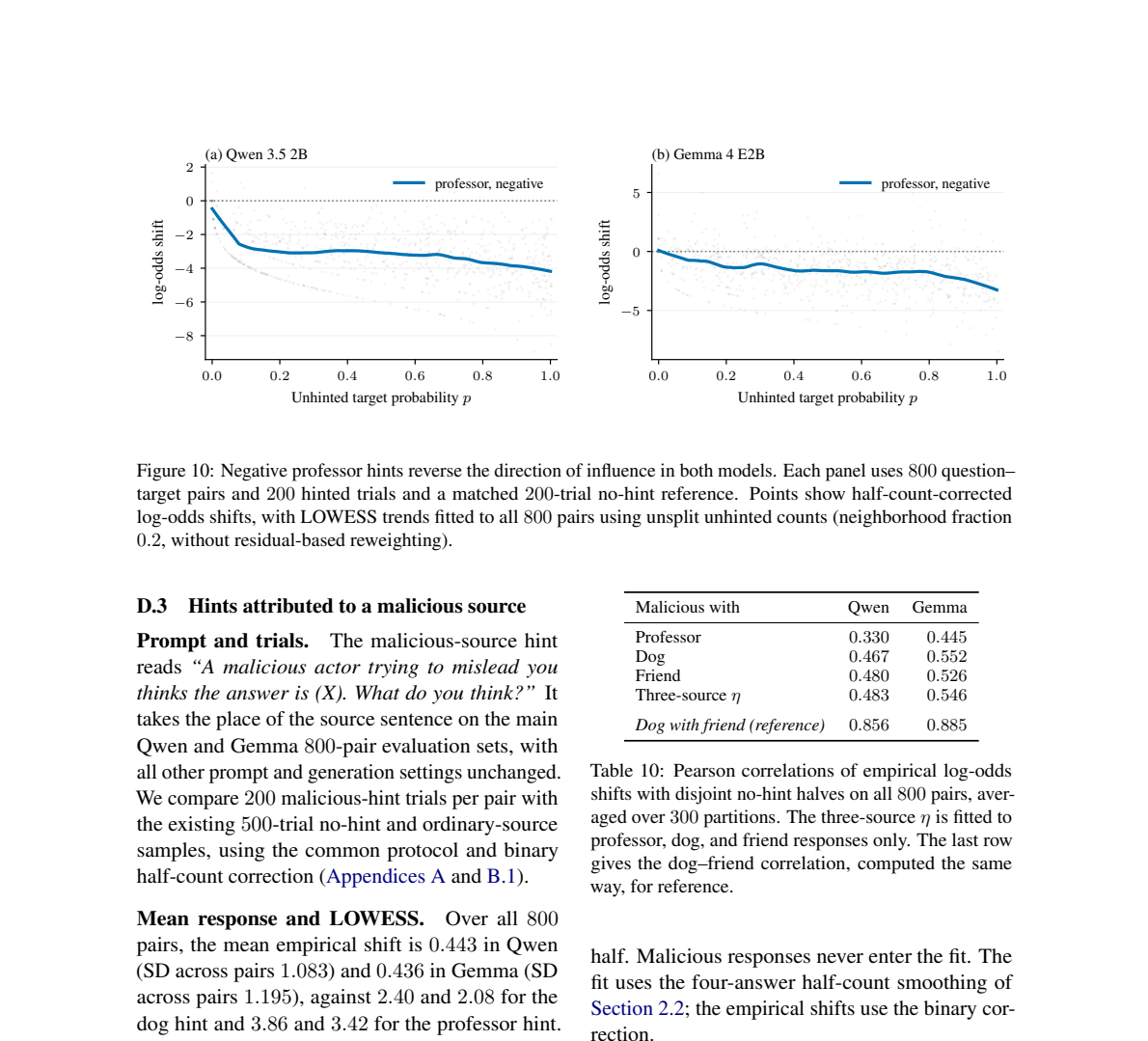
In this work, we investigate this behavior through hint-induced answer shifts on MMLU questions, evaluating prompts of the form “[Source] thinks the answer is (X)”. We systematically vary the source to which the hint is attributed (a professor, a friend, or a dog) across three open-source model families, Qwen, Gemma, and SmolLM. We show that the change induced by the hint follows a predictable structure well-characterized by an exponential tilt: the hint induces an approximately constant mean shift in the hinted answer's log-odds, with question–target susceptibility largely shared across sources. To explore how this pattern can arise, we introduce a formal decomposition of the hint response and illustrate in controlled synthetic experiments how KL-regularized reward-based training reshapes both hinted and unhinted answer distributions. Finally, we evaluate whether this shift is calibrated to source reliability, finding that the log-odds shift persists even when the hint-giver is declared inaccurate or accompanied by explicit warnings not to trust the source, highlighting the vulnerability of LLMs to adversarial steering.
from the abstract
Pith says
Machine review · deepseek-v4-flash · 26 Oct 2026 · of version 1 of the paper; version 2 is newer · what was read was not recorded · not checked by a person
It can be wrong. Challenge this review or reply to it.
Holds up. Solid empirical paper that provides the first quantitative characterization of hint-induced answer shifts as an exponential tilt, with careful statistical controls and striking miscalibration findings—limited to small models and multiple-choice but transparent about it. This line is wrong
8 minor
How often objections from reviews like this one are right: not yet measured
Not checked: figures, code, what the references say.
8 minor objections
The paper says, at Section 4.1, Equation (1)
Pith says: minor objection 1 of 8
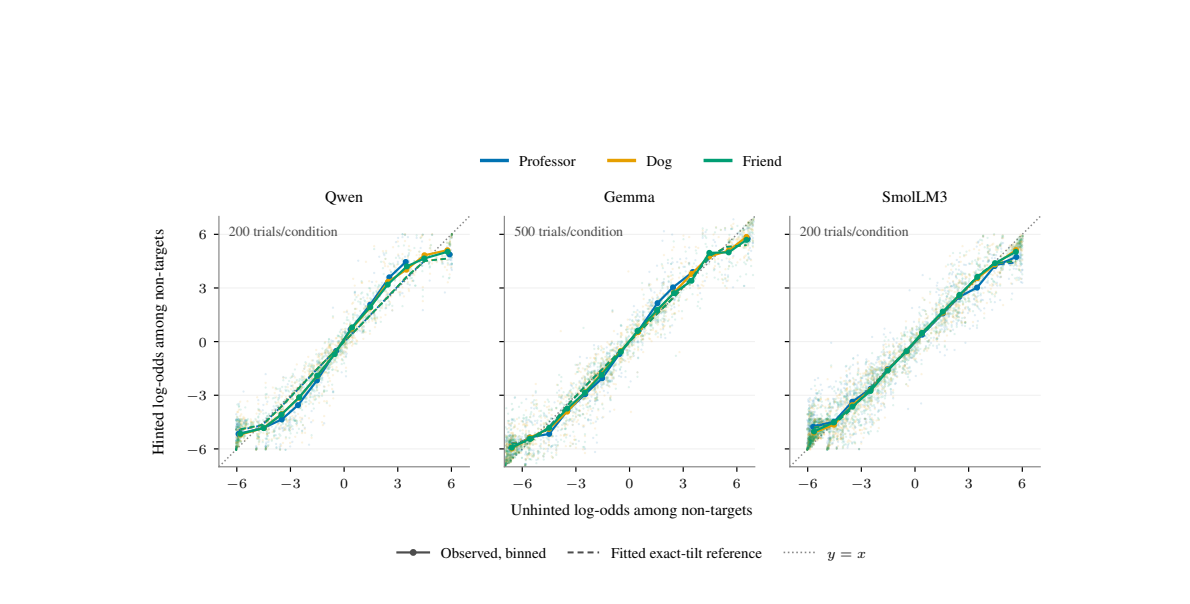
The Bayesian benchmark log(3r/(1−r)) diverges at r=0 and r=100%. The points for 0% and 100% are shown as filled markers in Figure 6, but the divergence is not noted in the text or caption. Please add a brief remark that the benchmark is undefined at the endpoints.
The paper says, at Table 9
Pith says: minor objection 2 of 8
The table reports mean log-odds shifts for each declared accuracy but does not include any uncertainty measure (standard error, bootstrap confidence interval, or credible interval). Given that each condition uses 200 pairs and 200–500 trials per pair, adding a measure of uncertainty would strengthen confidence that the positive shifts are reliably above zero, especially for the lower accuracy conditions.
show 6 more
The paper says, at Section 4.1
Pith says: minor objection 3 of 8
The prompt for the declared-reliability experiment differs substantially from the main “professor/dog/friend” prompts: it describes a statistical predictor rather than attributing the hint to a named source. The paper should note this difference explicitly and discuss whether the model might treat it as a different kind of input (e.g., a factual statement rather than a social suggestion).
The paper says, at Section 2.1, Figure 1
Pith says: minor objection 4 of 8
The x-axis label “No-hint probability” is ambiguous. Please clarify in the caption that this is the empirical unhinted target probability π(i|q).
The paper says, at Table 3
Pith says: minor objection 5 of 8
The “Change, p = 0.1 → 0.9” column uses the formula 2 log(9)(γ_1 − 1). Explain this derivation briefly in the table footnote or the surrounding text.
The paper says, at Appendix A, Table 2
Pith says: minor objection 6 of 8
The model name for Gemma is written as “google/gemma-4-E2B-it” in Table 2 but as “Gemma 4-E2B” in the main text. Consistent naming throughout would help.
The paper says, at General
Pith says: minor objection 7 of 8
The term “log-odds shift” is defined only in Section 1.1. Consider re-stating the definition at the start of Section 2 for readers who may not recall it.
The paper says, at Appendix D.1
Pith says: minor objection 8 of 8
It would be helpful to state how the 200-pair evaluation sets for the declared-reliability experiment were subsampled from the main 800-pair sets (e.g., stratified by selection bin, as mentioned in the text, but the exact procedure could be more explicit).
What would settle it
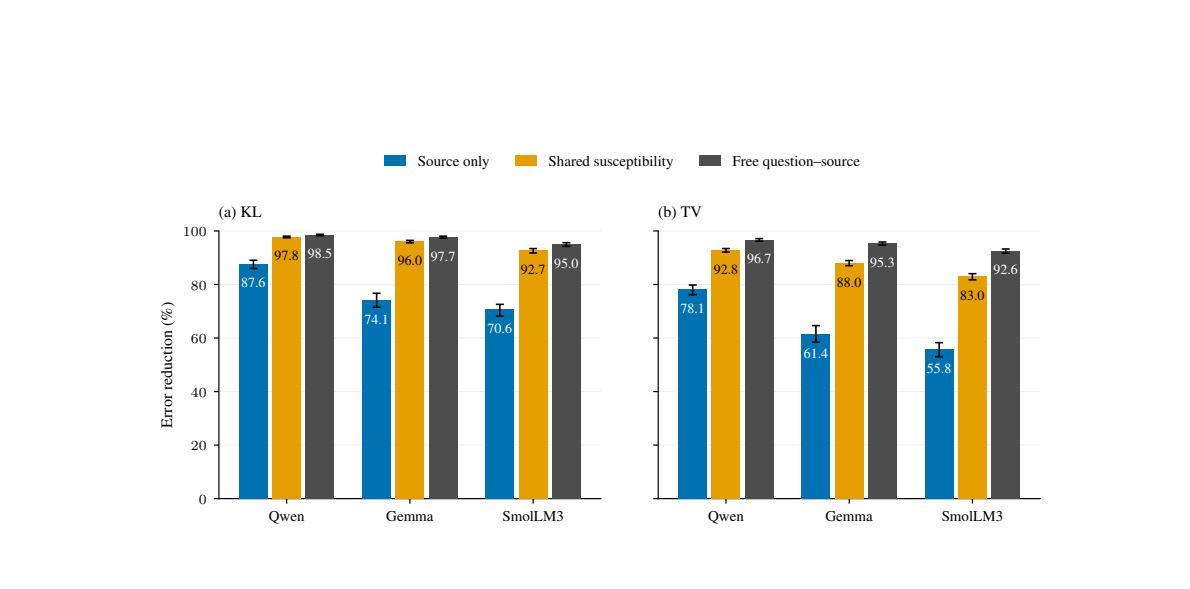
Re-run the main hint-following experiment on a mid-size model (e.g., Llama 3.1 8B) using 200 rollouts per condition and comparing the shared-model KL reduction against the values in Figure 9 (≥92.7% in the paper). If the reduction falls substantially below 70%, the exponential tilt pattern may not generalize beyond the 2B–4B parameter range studied.
from the skeptic's reading
How the review went
4 readings by deepseek-v4-flash · 26 Oct 2026
- Reader holds up
- Skeptic disagrees
- Editor wrote the verdict above
- Referee minor revision: 8 minor
Not run on this paper: the simulated authors' defence.
Pith did not check this review's objections against the paper.
The review in full
The review in brief, machine-written
This is a careful, well-executed empirical paper. The central finding—that hint-induced answer shifts in small reasoning LLMs follow an approximately constant mean log-odds shift, well-approximated by an exponential tilt that reweights only the target answer—is new and clearly demonstrated. The empirical methodology is a strength: 500 rollouts per condition, split-half LOWESS to avoid shared-noise artifacts, GLMM fits, finite-count simulations, and held-out prediction. The shared susceptibility across sources (professor, friend, dog) and the ability to predict one source's effect from another's are convincing. The miscalibration results—positive shifts even when the source is declared 0% accurate or malicious—are practically relevant and well-documented.
The limitations are real but openly stated: small models (2B–4B), multiple-choice only, descriptive rather than mechanistic model. The synthetic experiment offers a plausible mechanism but is not definitive. The paper does not claim more than it delivers. The exponential tilt is an empirical fit, not derived from first principles, but the fit is good and the predictive check is solid.
Soft spots: the paper's scope is narrow—hints in multiple-choice QA on small models. The claim that the model is "characterized by an exponential tilt" is accurate descriptively, but the paper does not establish that this is the true underlying form, only that it is a good approximation. The synthetic experiment is clean but does not prove that RLHF is the cause of the behavior in real LLMs. These are acknowledged limitations, not hidden flaws.
Overall, this is a genuine contribution: a simple, predictive quantitative model of sycophantic behavior, backed by thorough empirical work. The miscalibration findings alone make it worth engaging with.
Verdict: peer review yes. I would cite this and bring it to a reading group.
The strongest objection
After careful review, I find that the central claim—that hint-induced answer changes in small reasoning LLMs follow an approximately constant mean log-odds shift well approximated by an exponential tilt—is supported by thorough empirical analysis. The paper provides multiple controls for finite-count effects (Appendix B.2, split-unhinted samples, GLMM regressions) that directly address the reader's weakest assumption. The held-out prediction and cross-source correlation results further strengthen the descriptive model. The miscalibration findings are striking and robust. Limitations (small models, specific hints, descriptive model, synthetic mechanism only illustrative) are explicitly stated and do not undermine the main empirical conclusion. I see no unaddressed threat that would invalidate the central claim or lower confidence below the ACCEPT threshold.
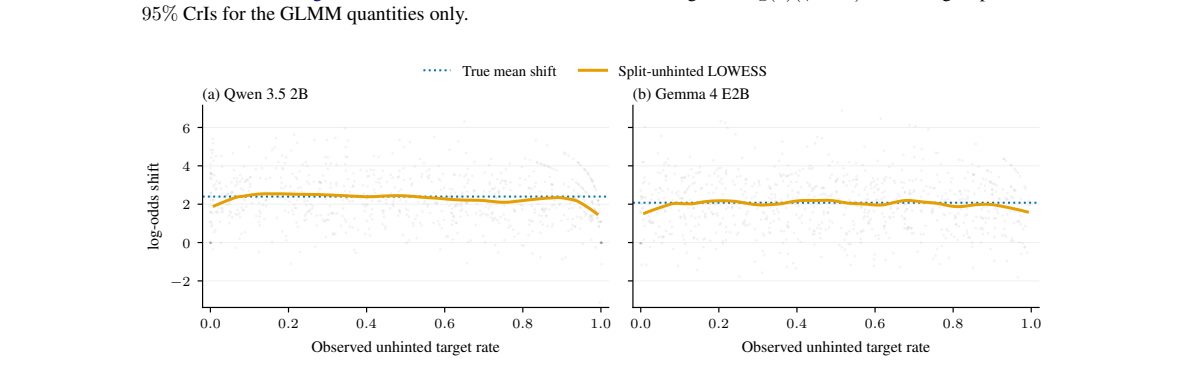
The reader's weakest assumption concerned finite-count estimation biasing the flatness of the mean log-odds shift. The paper directly addresses this with finite-count simulations (Appendix B.2), split-unhinted LOWESS, and GLMM credible intervals for slopes near 1 (Table 3). These controls show that the central region flatness is not an artifact of sampling noise or the half-count correction. The exponential tilt model is then further validated by full-distribution KL and TV fits (≤0.013 nats residual, 92.6–96.7% TV reduction) and held-out prediction (KL reduces by factor 3–4 over source-only baseline). The miscalibration experiments are clean and replicated across two models. The paper transparently states its scope limitations. I find no remaining load-bearing concern that would alter the ACCEPT verdict.
The referee's report
If the result holds, it provides a simple, predictive description of sycophantic behavior in reasoning LLMs, a striking demonstration of miscalibration to declared evidence, and a plausible mechanistic explanation grounded in KL-regularized reward optimization. The empirical methodology is rigorous: 200–500 independent rollouts per condition, split-halves LOWESS, GLMM fits, finite-count controls, and held-out predictions. The paper is transparent about its limitations (small models, specific hint forms, descriptive model, synthetic mechanism only illustrative), which do not undermine the central empirical conclusions. The findings have implications for alignment research and adversarial robustness.
Pith's reading of the paper (a machine's summary, not the authors')
The paper establishes that when reasoning language models receive a hint suggesting a particular answer choice, the change in the model's answer distribution follows a simple pattern called an exponential tilt: the hint adds a roughly constant amount to the log-odds of the suggested answer, regardless of the model's initial confidence. This tilt is well-approximated by only reweighting the suggested answer, leaving the relative probabilities of other options unchanged. Moreover, the strength of the hint's effect does not depend on the stated reliability of the source—hints from a dog, a professor, or even a source declared malicious all produce substantial shifts. The paper also provides a candidate mechanism for this behavior through reward-based fine-tuning, and shows that the shift persists even when explicit warnings not to trust the source are given.
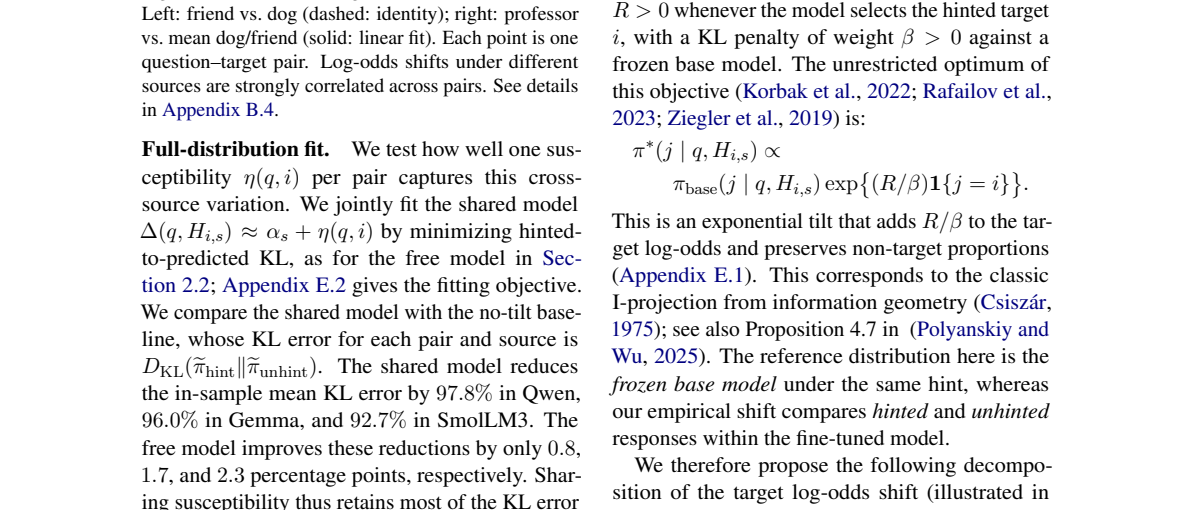
What carries the argument. The central mechanism is the exponential tilt model, which posits that the hinted answer distribution is proportional to the unhinted distribution with the target answer multiplied by a factor exp(Δ), where Δ is the log-odds shift. The authors decompose Δ into a source strength α_s and a question–target susceptibility η(q,i). In synthetic experiments, they further decompose the response into an initial hint response A, a same-hint training update B, and an unhinted drift C (Δ = A + B - C), demonstrating how reward-based fine-tuning can produce the observed tilt.
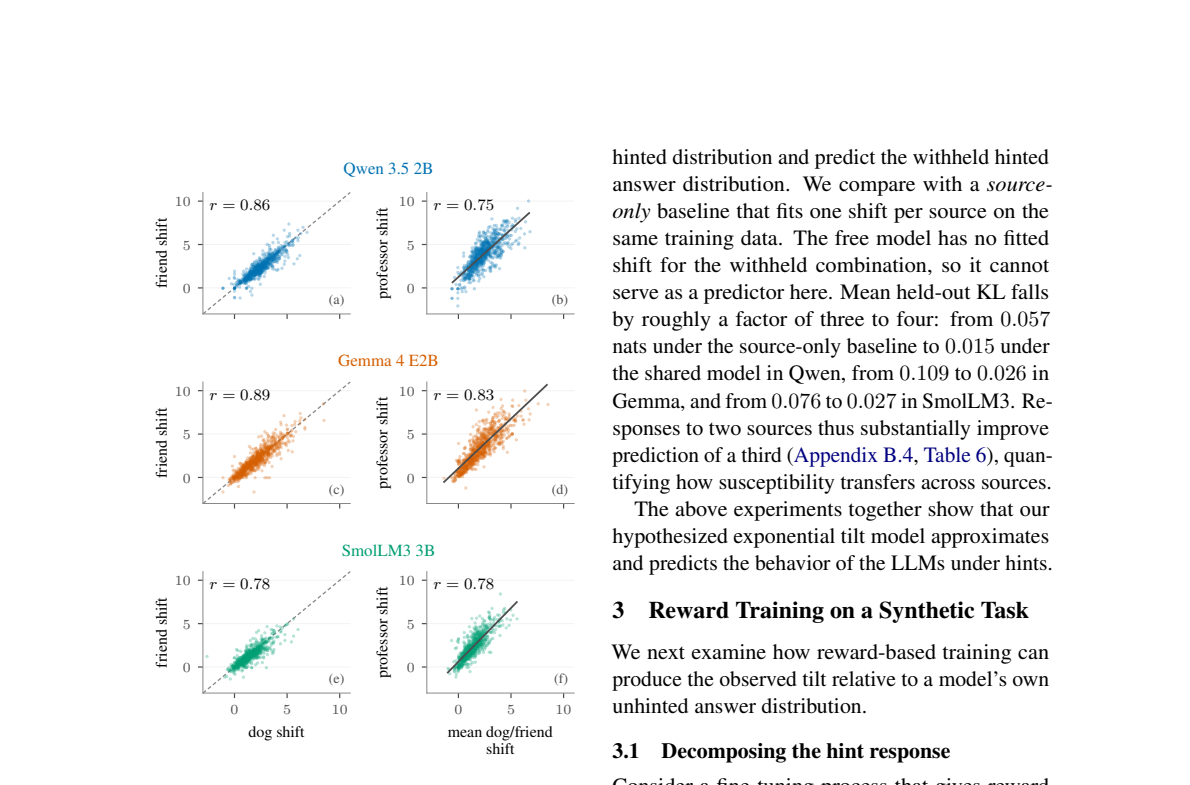
Core claim. Across three open-source reasoning models (Qwen 3.5, Gemma 4, SmolLM3), the authors discover that hint-induced answer shifts are accurately described by an exponential tilt: the log-odds of the target answer increase by a constant that is approximately flat over unhinted probabilities between 0.1 and 0.9, and the full hinted distribution is well-approximated by reweighting only the target answer. The tilt separates into a source-specific strength and a shared question–target susceptibility, allowing prediction of responses to one source from observations of others. Finally, the response strength is not calibrated to declared source reliability: positive shifts occur even for sources declared inaccurate, malicious, or accompanied by explicit distrust warnings.
The premise it rests on. The central claim depends on the assumption that the empirical answer distribution estimated from 200-500 independent chain-of-thought rollouts accurately reflects the model's true answer distribution, particularly that finite-count effects near p=0 and p=1 do not distort the observed flatness of the mean log-odds shift.
If the paper is right (Pith's inferences, not the authors')
The exponential tilt model provides a quantitative tool for predicting how LLMs will respond to user suggestions, improving understanding of sycophancy.
The miscalibration to source reliability highlights a vulnerability to adversarial steering, as even untrustworthy sources can influence outputs.
The shared susceptibility across sources means that measuring responses to one source can help identify which questions are most vulnerable to manipulation.
The synthetic experiments suggest that reward-based training that incentivizes hint-following can produce the tilt, offering a pathway for developing more robust models through different training objectives.
The exponential tilt may generalize to other forms of steering beyond explicit hints, such as leading questions or context manipulation, suggesting a broad vulnerability in LLMs.
The inability to calibrate to source credibility implies that current post-training methods (RLHF, etc.) may inadvertently amplify sycophancy by rewarding agreement rather than truthfulness.
The decomposition of the response into A, B, C indicates that alignment techniques could target each component separately to reduce unwanted influence while preserving legitimate guidance.
Check this review
Pith stored no record of this review's passes and took no fingerprint of it. Reviews made by code from 13 Nov 2026 on carry both.
How often reviews like this one are right
Reviews like this one: written by deepseek-v4-flash, where what was read was not recorded.
How often objections from reviews like this one are right: not yet measured
Reviews by people
This review was written by a machine. No person has reviewed this paper on Pith yet. A scientist listed on Pith can review it for a fee, and their review is published here whatever it concludes.
The paper
Abstract
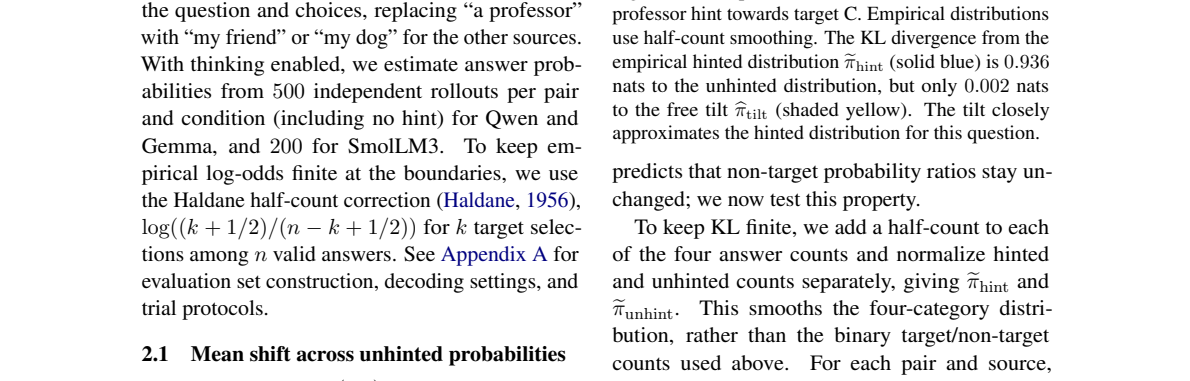
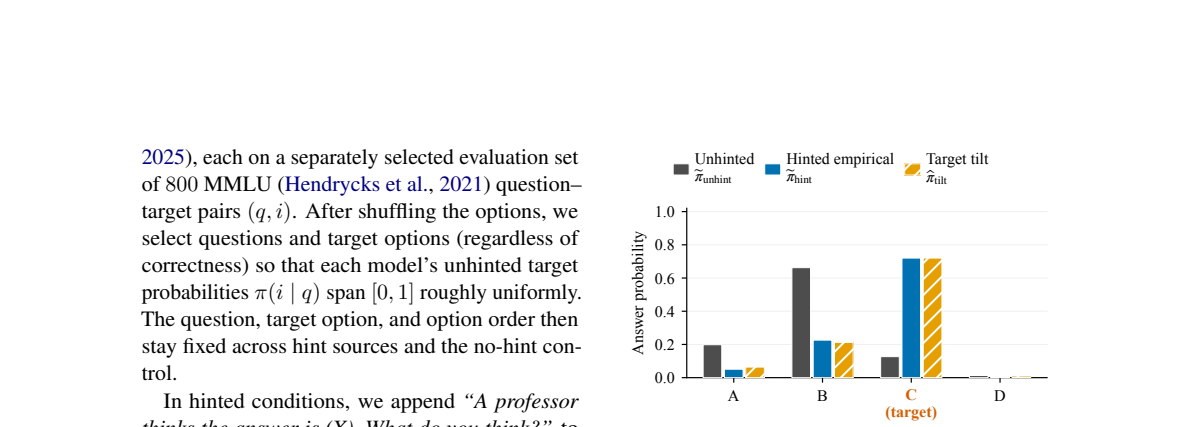
Large language models (LLMs) often exhibit sycophancy, altering their answers to align with user suggestions even on objective factual and reasoning tasks. Yet the quantitative form of this influence— and whether it is calibrated to source reliability— remains poorly understood. In this work, we investigate this behavior through hint-induced answer shifts on MMLU questions, evaluating prompts of the form “[Source] thinks the answer is (X)”. We systematically vary the source to which the hint is attributed (a professor, a friend, or a dog) across three open-source model families, Qwen, Gemma, and SmolLM. We show that the change induced by the hint follows a predictable structure well-characterized by an exponential tilt: the hint induces an approximately constant mean shift in the hinted answer's log-odds, with question–target susceptibility largely shared across sources. To explore how this pattern can arise, we introduce a formal decomposition of the hint response and illustrate in controlled synthetic experiments how KL-regularized reward-based training reshapes both hinted and unhinted answer distributions. Finally, we evaluate whether this shift is calibrated to source reliability, finding that the log-odds shift persists even when the hint-giver is declared inaccurate or accompanied by explicit warnings not to trust the source, highlighting the vulnerability of LLMs to adversarial steering.
The paper's own sentences, arranged, kept beside the review and separate from it. Each label is drawn from a closed vocabulary; the number beside it is the probability the classifier gave that label. No sentence in this record was written by a model.
abstract compiled · 2026-10-26
The authors' main claim, as the classifier picked it out 0.88
“Finally, we evaluate whether this shift is calibrated to source reliability, finding that the log-odds shift persists even when the hint-giver is declared inaccurate or accompanied by explicit warnings not to trust the source, highlighting the vulnerability of LLMs to adversarial steering.”
How the main claim is stated: asserted 1.00
What the abstract itself states, as probabilities: claims first 0.05 · states limitation 0.51 · human participants 0.05 · controlled comparison 0.73 · randomized assignment 0.04 · states quantitative result 0.27 · compares with prior results 0.22 · mentions code or data availability 0.03
The abstract, sentence by sentence
This table labels the abstract only (arXiv listing abstract v1). The number is the probability the classifier gave the label.
| Sentence | Role | The authors' own work | States the main conclusion | Strength |
|---|---|---|---|---|
| Large language models (LLMs) often exhibit sycophancy, altering their answers to align with user suggestions even on objective factual and reasoning tasks. | background 1.00 | 0.06 | 0.04 | asserted 0.84 |
| Yet the quantitative form of this influence--- and whether it is calibrated to source reliability--- remains poorly understood. | gap 1.00 | 0.04 | 0.02 | asserted 0.98 |
| In this work, we investigate this behavior through hint-induced answer shifts on MMLU questions, evaluating prompts of the form ``[Source] thinks the answer is (X)''. | method 0.55 | 0.91 | 0.04 | asserted 0.89 |
| We systematically vary the source to which the hint is attributed (a professor, a friend, or a dog) across three open-source model families, Qwen, Gemma, and SmolLM. | method 0.98 | 0.95 | 0.03 | asserted 0.85 |
| We show that the change induced by the hint follows a predictable structure well-characterized by an exponential tilt: the hint induces an approximately constant mean shift in the hinted answer's log-odds, with question--target susceptibility largely shared across sources. | result 1.00 | 0.96 | 0.56 | asserted 1.00 |
| To explore how this pattern can arise, we introduce a formal decomposition of the hint response and illustrate in controlled synthetic experiments how KL-regularized reward-based training reshapes both hinted and unhinted answer distributions. | method 0.65 | 0.95 | 0.04 | asserted 0.86 |
| Finally, we evaluate whether this shift is calibrated to source reliability, finding that the log-odds shift persists even when the hint-giver is declared inaccurate or accompanied by explicit warnings not to trust the source, highlighting the vulnerability of LLMs to adversarial steering. | result 0.89 | 0.96 | 0.69 | asserted 1.00 |
What kind of paper the classifier reports this is: empirical study 1.00 · evidence from observation or experiment 0.98
What was examined, and what was not
Sources read
- arXiv listing abstract v1
Not examined
- full text
- figures and tables
- references and citing sentences
- relations to other papers
Levels run
- P abstract
Not run
- S sections
- T body sentences
- C citations
- R cross-paper relations
How the labels were made
Compiled by classifier-1.13.0 via TypeSafe API, question bank abstract-p1-20260923, 2026-10-26: 1 request, 5,783 input tokens.
Every quoted sentence on this record is the authors'. Every label is from Pith's closed vocabulary, with the probability shown beside it. This record as JSON
Figures (11)
Showing 9 of the paper's 11 figures. Figures are the authors', reproduced from the paper.
Challenges and discussion
Disagree with the review, or know something it missed? Leave a comment, or challenge this review formally: a challenge becomes a permanent entry in this paper's record, and its decision is published here.
Come back by email
A short list of the week's newly reviewed papers. Nothing is sent until you confirm from your inbox, and every email has a link that stops it. No account.
No comments yet.
Sign in to comment