Mathematical Physics · arXiv:2610.32618 v1 · submitted 23 Oct 2026 · 31 references
The solution of the Hopfield model with Gaussian patterns
The paper says
“We prove that the free energy of the Hopfield model with Gaussian patterns has a thermodynamic limit at every load α and temperature T, and we give it as an explicit variational principle.”
more of the abstract
The Hubbard–Stratonovich transformation maps the model onto N Ising spins coupled to M = αN Gaussian hidden units, whose radius, the empirical variance of the hidden layer, is a thermodynamic variable with an entropic cost. At fixed radius the model is an Ising–spherical spin glass with Gaussian couplings, which we solve. The principle (i) reproduces the Amit-Gutfreund-Sompolinsky theory as its replica-symmetric restriction, (ii) identifies Tg = 1 + √α as the rigorous boundary of the annealed region, (iii) selects a unique spin-glass solution of the AGS equations, and (iv) gives the radius an equation of state. Moreover, (v) below Tg we prove that replica symmetry is broken throughout: the instability of the AGS solution reduces to the zero-field de Almeida-Thouless condition of the Sherrington-Kirkpatrick model.
from the abstract
Pith says
Machine review · deepseek-v4-flash · 26 Oct 2026 · what was read was not recorded · not checked by a person
It can be wrong. Challenge this review or reply to it.
Holds up, with conditions. A strong announcement whose central variational principle is explicitly deferred to a forthcoming paper; the end-matter mathematics is sound and conditional on that deferral. This line is wrong
3 major objections · 4 minor
How often objections from reviews like this one are right: not yet measured
Not checked: figures, code, what the 31 references say.
The paper says, at The Result, Eq. (3); The Mixed model, Eqs. (6)-(7)
The review did not quote this passage.
Pith says: Objection 1 of 3 · major
The central theorem is conditional on an unavailable proof. The paper states that 'detailed proofs will be given in a forthcoming paper [16]' and that 'the cavity computation for the mixed measure is the technical part of [16]', while noting that the bipartite Hamilton-Jacobi case 'was conjectured to give the limit [24,26]'.
more of objection 1
Since (3) is obtained by combining the Laplace step with (6)-(7), the convergence statement, the threshold beta_g, uniqueness of the optimal radius, the AGS upper bound (8), and the RSB inequality (11) all inherit this deferral. As the artifact stands, the main theorem is a research announcement rather than a proof.
The paper says, at Replica-symmetric restriction, sentence b68
The review did not quote this passage.
Pith says: Objection 2 of 3 · major
The claim that (8) is 'the first assumption-free derivation of the AGS functional as an upper bound' overstates what is proved here. The upper bound for the mixed model is exactly the part delegated to [16]; if that paper supplies it, the credit for this statement belongs to [16]. I recommend rewording to make the conditional provenance explicit.
The paper says, at Replica symmetry breaking, Eqs. (34)-(35) and Eq. (11)
The review did not quote this passage.
Pith says: Objection 3 of 3 · major
The replicon computation is a proof of instability within the class of paths admitted by the Hopf formula, and it does not by itself close the missing upper bound. The statement (v) in the abstract and the inequality (11) are therefore conditional on (6)-(7); they are not consequences that the end matter establishes directly for the original Hopfield Hamiltonian.
4 minor objections
The paper says, at Eq. (5)
Pith says: minor objection 1 of 4
The coefficient of the overlap integral appears inconsistent with (3) and (7): differentiating gives 1/u* = 1 - beta + (1+alpha)^2 beta/alpha times the overlap integral, whereas the printed factor is (1+alpha) 2 beta/alpha, which is too small by a factor (1+alpha)/2.
more of objection 1
The replica-symmetric expression (16) is consistent with the corrected form, so this is likely a typographical error, but it should be fixed. In addition, the integration variable in (5) should not be called u because u is already the radius.
The paper says, at End matter, Optimization of the radius
Pith says: minor objection 2 of 4
The sentence 'Both are strictly concave, since f and f_RS are convex, and Lambda tends to -infinity at both ends by Appendix' contains a missing appendix label or reference, so the cited argument cannot be checked in the present text.
show 2 more
The paper says, at Figures 1-3
Pith says: minor objection 3 of 4
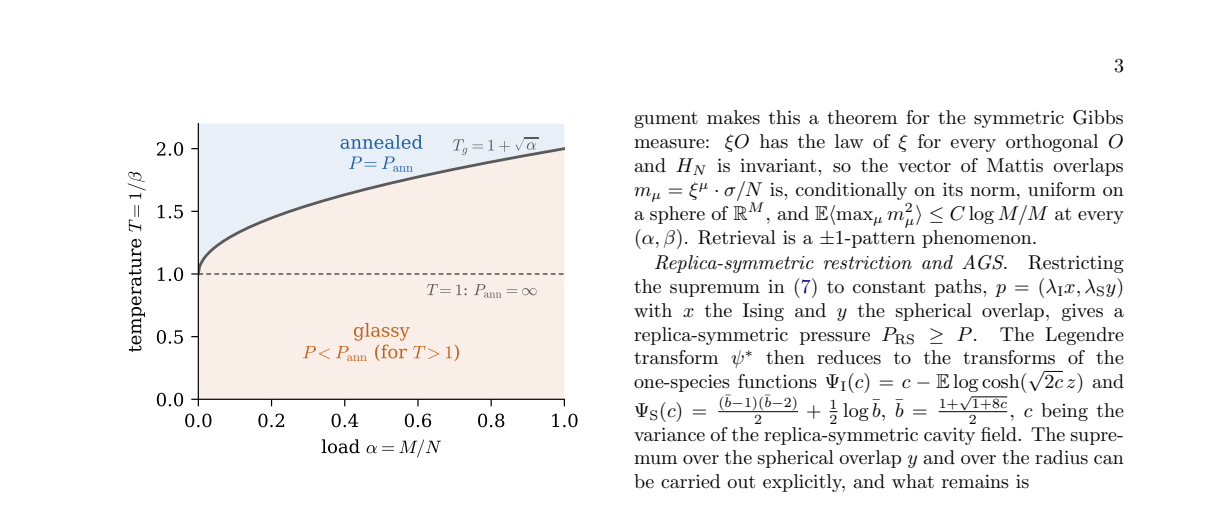
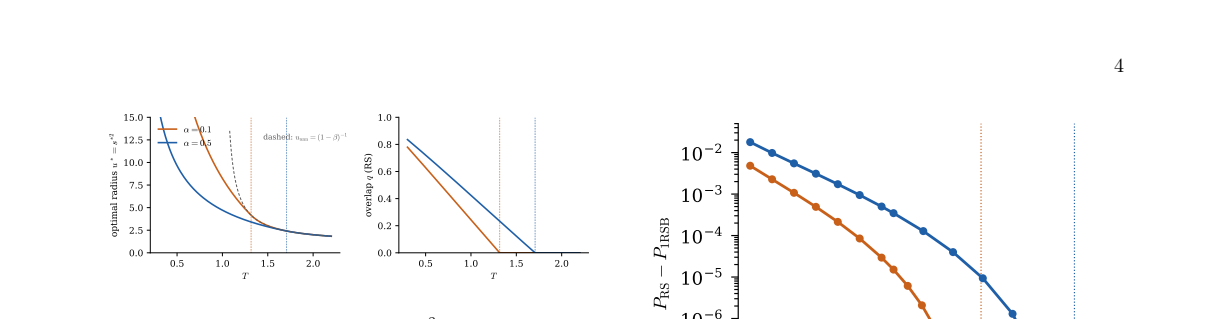
Several mathematical symbols in the figure captions and legends, such as 'u ¤', 'Pann = 1', and 'PRS ¡ P1RSB', are corrupted by font or encoding issues; the figures should be regenerated with proper math rendering.
The paper says, at Notation in Eqs. (10) and (22)-(24)
Pith says: minor objection 4 of 4
The symbol c is used both for the cavity-field variance in (10) and for the overlap/path variable in the one-step Hessian computation; this overloading makes the replicon section harder to follow, and I suggest distinguishing the two roles.
What would settle it
Independently re-derive the upper bound for the mixed Ising-spherical model: from the block cavity computation under Ghirlanda-Guerra perturbations, show that the limiting pressure is at most the Hopf value sup_p { t integral p_I p_S - psi*(p) } with 0 <= p_s <= lambda_s, and that the stationary point p = partial_pi psi(pi) at pi = (t p_S, t p_I) satisfies the required boundary conditions, with convexity of psi ruling out all other stationary points. If this derivation requires an extra hypothesis, such as a boundedness condition on overlaps or a special treatment of the spherical self-overlap, that hypothesis must be added to Theorem (3) or the theorem is not established as stated.
from the skeptic's reading
How the review went
4 readings by deepseek-v4-flash · 26 Oct 2026
- Reader holds up, with conditions
- Skeptic agrees
- Editor wrote the verdict above
- Referee major revision: 3 major objections, 4 minor
Not run on this paper: the simulated authors' defence.
Pith did not check this review's objections against the paper.
The review in full
The review in brief, machine-written
This is a real result, but it is an announcement with the load-bearing proof elsewhere. What is genuinely new: the radial decomposition of the Gaussian hidden layer into a sphere plus radius, the variational principle (3) with a unique optimal radius, the strict P < P_ann below Tg, the uniqueness theorem for the AGS spin-glass solution, and the reduction of the replicon instability to the SK de Almeida–Thouless condition. The end matter is substantive and, where I could check, correct: identity (35) is a clean sum of squares, the one-step Hessian computation is internally consistent, and the uniqueness argument via monotonicity of g(v)/v is nice. These parts deserve credit.
The soft spot is exactly where the reader put it. Equation (3) depends on the solution of the mixed Ising–spherical model, Eqs. (6)–(7), and that upper bound is deferred to the forthcoming [16]. The authors say so explicitly: "Detailed proofs will be given in a forthcoming paper [16]" and "The cavity computation for the mixed measure is the technical part of [16]." They also note that the bipartite case of the Hamilton–Jacobi method was previously conjectural ([24, 26]). So the central theorem is not established in this artifact. The end-matter consequences—the AGS upper bound and the RSB inequality (11)—are conditional on that formula. The claim (b68) that this is the "first assumption-free derivation of the AGS functional as an upper bound" is too strong for the current text; that phrasing belongs to [16] once it exists.
I see no fitted parameters and no circularity: the threshold beta_g emerges from the formula, and the AGS functional appears as the replica-symmetric restriction rather than as an input. The AI-use statement is disclosed; the delicate deferred step is exactly the one the reader cannot yet verify, so the disclosure does not rescue the deferral, but I do not read it as a red flag by itself.
Verdict: conditional, as the reader says. If [16] delivers the block cavity upper bound, this becomes a major paper. As it stands, it is a well-written letter with a strong mechanism and correct conditional mathematics, but the main theorem is borrowed. Send it to a serious referee—the claim is important and the end matter gives a referee real substance to check—but make clear that acceptance should require [16] or a proof of (6)–(7).
The strongest objection
Equation (3) is the central theorem, and it is obtained by combining the Laplace/equivalence-of-ensembles step with the claimed solution of the mixed Ising-spherical model, Eqs. (6)-(7). That solution is not proved in this artifact. The paper says 'Detailed proofs will be given in a forthcoming paper [16]' and, in the section 'The mixed model', 'The cavity computation for the mixed measure is the technical part of [16]'. It also states that the bipartite case of the Hamilton-Jacobi method 'was conjectured to give the limit [24,26]'. Since [16] is listed as forthcoming rather than published, it does not currently supply the missing upper bound. The deferral is load-bearing: (3), the AGS upper bound (8), the annealed/glassy threshold, uniqueness of the optimal radius, and the RSB inequality (11) all use (6)-(7). The end-matter replicon computation is conditional on the formula for f and does not close the gap. The reader's conditional verdict is appropriate; the only additional adjustment worth making is to the phrase 'first assumption-free derivation of the AGS functional as an upper bound', which should be attributed to [16] once it is available.
The reader's weakest assumption identifies exactly the same load-bearing gap: the mixed Ising-spherical model is declared solved by the Hopf formula (6)-(7), but the upper bound is explicitly deferred to the forthcoming [16], and the earlier literature treats the bipartite case as conjectural. I checked the parts that are checkable in the artifact: the sum-of-squares identity (35) is correct, the reduction (34) of the replicon condition to the SK-type ratio is algebraically consistent, the uniqueness argument for the AGS spin-glass solution via monotonicity of g(v)/v is coherent, and the minimax exchange leading to (8) is internally sound assuming (6)-(7). None of these supply the missing upper bound, because they all operate inside the assumed variational formula for the mixed pressure. The conditional verdict is therefore the right one: the paper's conditional mathematics is solid, but the central unconditional claim 'we prove' is not yet supported by the submitted artifact. No further independent objection is needed; the deferred block-cavity argument is the single point on which the paper stands or falls.
The referee's report
If the central formula (6)-(7) is established, this would be a substantial advance: a rigorous thermodynamic limit and explicit variational formula for the Gaussian-pattern Hopfield model at all alpha and beta, with the first proof that replica symmetry is broken throughout the spin-glass phase and that the AGS free energy is a strict upper bound. The end matter is a genuine strength: the minimax exchange (18), the uniqueness argument for the AGS solution, and the sum-of-squares identity (35) are independently checkable and, as far as I can verify, correct. The paper is also careful to introduce the hidden-layer radius as a thermodynamic variable rather than as a fitted quantity. However, the headline theorem is not proved in the artifact, and that conditional status is decisive for the present recommendation.
Pith's reading of the paper (a machine's summary, not the authors')
When the stored patterns are Gaussian, the Hopfield model is a bipartite spin glass: the Hubbard–Stratonovich transform turns it into $N$ Ising spins coupled to $M=\alpha N$ Gaussian hidden units. The paper establishes that the quenched free energy has a thermodynamic limit at every load $\alpha$ and inverse temperature $\beta$, equal to the variational principle $P(\alpha,\beta)=\sup_{s>0}\{\varphi_\alpha(\beta s^2)-I_\alpha(s)\}$, where $s$ is the radius — the empirical variance — of the hidden layer, with entropic cost $I_\alpha(s)$. At fixed radius the model becomes an Ising–spherical spin glass, which the paper solves by a Hopf-type formula of the Hamilton–Jacobi method. If correct, this settles the regime where even the existence of the thermodynamic limit was open, makes the AGS replica theory a rigorous upper bound that is strictly suboptimal below $T_g=1+\sqrt{\alpha}$, and shows that replica symmetry is broken throughout the spin-glass phase.
What carries the argument. Three mechanisms carry the argument. First, radial decomposition: a standard Gaussian vector $z\in\mathbb{R}^M$ is written $z=s\tau$ with $\tau$ uniform on $\sqrt{M}\,S^{M-1}$ and $s=|z|/\sqrt{M}$ independent of $\tau$; since the coupling is linear in $s$, the partition function is an integral over the radius of a fixed-radius Ising–spherical model, and Stirling's formula turns the radius measure into the entropic term $-I_\alpha(s)$, evaluated by a Laplace principle whose uniform control comes from convexity of $\log Z^{\mathrm{mix}}_N$ in $s$. Second, the Hopf formula: for the mixed Ising–spherical model $\varphi_\alpha(\gamma)=\frac{\alpha\gamma}{2}-(1+\alpha)f\!\left(\frac{(1+\alpha)\gamma}{2}\right)$ with $f(t)=\sup_p\{t\int_0^1 p_I(u)p_S(u)\,du-\psi^*(p)\}$, in which the covariance of the bipartite field is the product $ab$ of the two species' overlaps, a non-convex object that blocks the Guerra–Toninelli convexity argument; instead the Parisi variable $\pi$ and the overlap $p$ remain conjugate, and convexity of the entropic initial condition $\psi$ turns every stationary point into a minimizer, which is what yields the upper bound. Third, the replicon criterion: the second variation of the Hopf functional along a one-step, zero-mean perturbation is proportional to $t^2\lambda_I\lambda_S\kappa_I\kappa_S-1$, and at the spin-glass solution this reduces to $\sigma^2\mathbb{E}\operatorname{sech}^4(\sigma z)>\mathbb{E}\tanh^2(\sigma z)$, exactly the zero-field de Almeida–Thouless condition for the Sherrington–Kirkpatrick model, which holds for every $\sigma>0$ by the sum-of-squares identity (35).
Core claim. The central claim is equation (3): almost surely and in expectation, $p_N(\beta)\to P(\alpha,\beta)=\sup_{s>0}\{\varphi_\alpha(\beta s^2)-I_\alpha(s)\}$ for every $\alpha,\beta>0$. A Gaussian vector factors into a uniform spherical direction and an independent random radius, so the hidden layer contributes to the free energy only through its radius; the entropic prior $I_\alpha(s)=\frac{\alpha}{2}(s^2-1-\log s^2)$ competes with the energy's preference for large $s$, the supremum is attained at a unique $s^*$, and differentiation gives the radius an equation of state (5) in which replica correlations shrink the hidden-layer variance. The inner pressure $\varphi_\alpha$ of the mixed Ising–spherical model is itself explicit via the Hopf formula (6)–(7), a variational principle over a pair of conjugate overlap paths $p=(p_I,p_S)$. From this the paper derives: the annealed region is exactly $T\ge T_g=1+\sqrt{\alpha}$; the AGS replica-symmetric functional (8) is a rigorous upper bound at all temperatures, with a spin-glass solution that exists and is unique for $\beta>\beta_g$; and below $T_g$ the bound is never sharp, $P\le P_{1\mathrm{RSB}}<P_{\mathrm{RS}}$, because the replicon instability reduces to the zero-field de Almeida–Thouless condition of the Sherrington–Kirkpatrick model, which holds for every $\sigma>0$. A symmetry argument additionally shows there is no retrieval phase at positive load for Gaussian patterns.
The premise it rests on. Everything rests on the exact solution of the mixed Ising–spherical model by the Hopf formula (6)–(7); the upper-bound half of that solution is deferred to a forthcoming paper, and the letter itself notes that for the bipartite case the formula had previously only been conjectured to give the limit.
If the paper is right (Pith's inferences, not the authors')
Existence of the thermodynamic limit is settled for every $\alpha,\beta>0$; previously the free energy of the Gaussian-pattern model was controlled only at small load or high temperature, so the formula (3) covers regimes that were open.
The annealed region is exactly $T\ge T_g=1+\sqrt{\alpha}$: for $\beta>\beta_g$ the pressure is strictly smaller than the annealed one, which diverges at $T=1$, so the free energy stays finite at every temperature.
The AGS functional is a rigorous upper bound at all temperatures, and its spin-glass equation has a unique solution for $\beta>\beta_g$; the paper presents this as the first assumption-free derivation of the AGS upper bound.
The whole spin-glass phase is replica-symmetry-broken: $P\le P_{1\mathrm{RSB}}<P_{\mathrm{RS}}$ for every $\alpha>0$ and $\beta>\beta_g$, so the optimal overlap paths in (7) are never constant.
At positive load there is no retrieval phase for Gaussian patterns: the Mattis overlaps are at most $O(\sqrt{\log M/M})$ in the symmetric Gibbs measure.
If (3) is correct, the radius $s^*$ is a directly measurable order parameter of the hidden layer: a simulation could read off the empirical variance of the Gaussian units and watch it leave the annealed branch $(1-\beta)^{-1}$ at $T_g$ and stay finite below $T=1$, exactly as the equation of state (5) predicts.
The radial decomposition is generic — one Laplace principle per Gaussian layer — so a deep restricted Boltzmann machine with several Gaussian layers should display a chain of radii, each with its own entropic cost; testing whether the two-level structure of (3) repeats at every layer is a natural extension the paper only gestures at.
The one-step bound being strictly better at every $\beta>\beta_g$ suggests the exact overlap distribution of the bipartite model is genuinely hierarchical; extracting the optimal paths $p$ of (7) numerically would reveal the breakpoint structure and indicate whether full replica-symmetry breaking is needed, a question the authors leave open.
Check this review
Pith stored no record of this review's passes and took no fingerprint of it. Reviews made by code from 13 Nov 2026 on carry both.
How often reviews like this one are right
Reviews like this one: written by deepseek-v4-flash, where what was read was not recorded.
How often objections from reviews like this one are right: not yet measured
Reviews by people
This review was written by a machine. No person has reviewed this paper on Pith yet. A scientist listed on Pith can review it for a fee, and their review is published here whatever it concludes.
The paper
Abstract
We prove that the free energy of the Hopfield model with Gaussian patterns has a thermodynamic limit at every load α and temperature T, and we give it as an explicit variational principle. The Hubbard–Stratonovich transformation maps the model onto N Ising spins coupled to M = αN Gaussian hidden units, whose radius, the empirical variance of the hidden layer, is a thermodynamic variable with an entropic cost. At fixed radius the model is an Ising–spherical spin glass with Gaussian couplings, which we solve. The principle (i) reproduces the Amit-Gutfreund-Sompolinsky theory as its replica-symmetric restriction, (ii) identifies Tg = 1 + √α as the rigorous boundary of the annealed region, (iii) selects a unique spin-glass solution of the AGS equations, and (iv) gives the radius an equation of state. Moreover, (v) below Tg we prove that replica symmetry is broken throughout: the instability of the AGS solution reduces to the zero-field de Almeida-Thouless condition of the Sherrington-Kirkpatrick model.
The paper's own sentences, arranged, kept beside the review and separate from it. Each label is drawn from a closed vocabulary; the number beside it is the probability the classifier gave that label. No sentence in this record was written by a model.
abstract compiled · 2026-10-26
The authors' main claim, as the classifier picked it out 1.00
“We prove that the free energy of the Hopfield model with Gaussian patterns has a thermodynamic limit at every load $\alpha$ and temperature $T$, and we give it as an explicit variational principle.”
How the main claim is stated: asserted 1.00
What the abstract itself states, as probabilities: claims first 0.05 · states limitation 0.12 · human participants 0.01 · controlled comparison 0.04 · randomized assignment 0.01 · states quantitative result 0.97 · compares with prior results 0.94 · mentions code or data availability 0.02
The abstract, sentence by sentence
This table labels the abstract only (arXiv listing abstract v1). The number is the probability the classifier gave the label.
| Sentence | Role | The authors' own work | States the main conclusion | Strength |
|---|---|---|---|---|
| We prove that the free energy of the Hopfield model with Gaussian patterns has a thermodynamic limit at every load $\alpha$ and temperature $T$, and we give it as an explicit variational principle. | result 0.69 | 0.96 | 0.83 | asserted 1.00 |
| The Hubbard--Stratonovich transformation maps the model onto $N$ Ising spins coupled to $M=\alpha N$ Gaussian hidden units, whose radius, the empirical variance of the hidden layer, is a thermodynamic variable with an entropic cost. | method 0.98 | 0.77 | 0.06 | asserted 1.00 |
| At fixed radius the model is an Ising--spherical spin glass with Gaussian couplings, which we solve. | method 0.94 | 0.89 | 0.07 | asserted 1.00 |
| The principle (i) reproduces the Amit-Gutfreund-Sompolinsky theory as its replica-symmetric restriction, (ii) identifies $T_g=1+\sqrt\alpha$ as the rigorous boundary of the annealed region, (iii) selects a unique spin-glass solution of the AGS equations, and (iv) gives the radius an equation of state. | result 0.81 | 0.90 | 0.24 | asserted 1.00 |
| Moreover, (v) below $T_g$ we prove that replica symmetry is broken throughout: the instability of the AGS solution reduces to the zero-field de Almeida-Thouless condition of the Sherrington-Kirkpatrick model. | result 0.98 | 0.93 | 0.16 | asserted 1.00 |
What kind of paper the classifier reports this is: theoretical result 1.00 · evidence from proof or derivation 1.00
What was examined, and what was not
Sources read
- arXiv listing abstract v1
Not examined
- full text
- figures and tables
- references and citing sentences
- relations to other papers
Levels run
- P abstract
Not run
- S sections
- T body sentences
- C citations
- R cross-paper relations
How the labels were made
Compiled by classifier-1.13.0 via TypeSafe API, question bank abstract-p1-20260923, 2026-10-26: 1 request, 4,557 input tokens.
Every quoted sentence on this record is the authors'. Every label is from Pith's closed vocabulary, with the probability shown beside it. This record as JSON
Figures (3)

Figures are the authors', reproduced from the paper.
References (31)
- [16] F. Camilli, P. Contucci, and E. Mingione, Thermody- namic limit and variational formula for the Hopfield model with Gaussian patterns, forthcoming on Pith
- [1] J. J. Hopfield, Proc. Natl. Acad. Sci. USA79, 2554 (1982) on Pith
- [2] D. J. Amit, H. Gutfreund, and H. Sompolinsky, Phys. Rev. Lett.55, 1530 (1985) on Pith
- [3] D. J. Amit, H. Gutfreund, and H. Sompolinsky, Ann. Phys. (N.Y.)173, 30 (1987) on Pith
- [4] L. Pastur, M. Shcherbina, and B. Tirozzi, J. Stat. Phys. 74, 1161 (1994) on Pith
- [5] A. Bovier and V. Gayrard, inMathematical Aspects of Spin Glasses and Neural Networks, Progr. Probab.41 (Birkh¨ auser, 1998), p. 3 on Pith
- [6] M. Talagrand, Probab. Theory Relat. Fields110, 177 (1998) on Pith
- [7] M. Talagrand,Mean Field Models for Spin Glasses, Vol. I (Springer, 2011) on Pith
- [8] A. Barra, G. Genovese, and F. Guerra, J. Stat. Phys. 140, 784 (2010) on Pith
- [9] A. Barra and F. Guerra, J. Math. Phys.49, 125217 (2008). 5 on Pith
- [10] A. Barra, G. Genovese, F. Guerra, and D. Tantari, J. Stat. Mech. (2012) P07009 on Pith
- [11] A. Barra, G. Genovese, and F. Guerra, J. Phys. A44, 245002 (2011) on Pith
- [12] A. Barra, A. Bernacchia, E. Santucci, and P. Contucci, Neural Networks34, 1 (2012) on Pith
- [13] F. Guerra and F. L. Toninelli, Commun. Math. Phys. 230, 71 (2002) on Pith
- [14] A. Barra, P. Contucci, E. Mingione, and D. Tantari, Ann. Henri Poincar´ e16, 691 (2015) on Pith
- [15] D. Panchenko, Ann. Probab.43, 3494 (2015) on Pith
- [17] H.-B. Chen and J.-C. Mourrat, arXiv:2609.32710 on PithPith's reviewarXiv
- [18] H.-B. Chen, V. Issa, and J.-C. Mourrat, arXiv:2606.16636 on PithPith's reviewarXiv
- [19] G. Genovese and D. Tantari, Math. Phys. Anal. Geom. 18, 10 (2015) on Pith
- [20] G. Genovese and D. Tantari, J. Phys. A53, 094001 (2020) on Pith
show 11 more
- [21] H.-B. Chen, F.-H. Ho, and V. Issa, arXiv:2610.18744 on PithPith's reviewarXiv
- [22] J. Boursier and J.-C. Mourrat, arXiv:2610.18350 on PithPith's reviewarXiv
- [23] J.-C. Mourrat, Ann. H. Lebesgue4, 453 (2021) on Pith
- [24] J.-C. Mourrat, Probab. Math. Phys.2, 281 (2021) on Pith
- [25] J.-C. Mourrat, Ann. Inst. Henri Poincar´ e Probab. Stat. 59, 1143 (2023) on Pith
- [26] J.-C. Mourrat, Spin glasses and the Parisi formula, arXiv:2510.01054 on PitharXiv
- [27] H.-B. Chen and J.-C. Mourrat, Probab. Math. Phys.6, 1 (2025); arXiv:2311.08980 on PitharXiv
- [28] J. R. L. de Almeida and D. J. Thouless, J. Phys. A11, 983 (1978) on Pith
- [29] F. Guerra, Commun. Math. Phys.233, 1 (2003) on Pith
- [30] F. L. Toninelli, Europhys. Lett.60, 764 (2002) on Pith
- [31] A. Barra, G. Genovese, P. Sollich, and D. Tantari, Phys. Rev. E97, 022310 (2018). Uniqueness of the spin-glass solution We prove the replica-symmetric formula (8) and the existence and uniqueness of its physical spin-glass so- lution. Throughout,α, β >0,u=s 2, andt u = (1 +α)β... on Pith
Cited by 2 Pith papers
Reviewed papers on Pith that cite this one. The full citation record
- Free energy of the Hopfield model math.PR · Nov 2026
- Existence of the thermodynamic limit for the Hopfield model cond-mat.dis-nn · Oct 2026
Challenges and discussion
Disagree with the review, or know something it missed? Leave a comment, or challenge this review formally: a challenge becomes a permanent entry in this paper's record, and its decision is published here.
Come back by email
A short list of the week's newly reviewed papers. Nothing is sent until you confirm from your inbox, and every email has a link that stops it. No account.
No comments yet.
Sign in to comment