Multiagent Systems · arXiv:2610.34634 v1 · submitted 25 Oct 2026 · 34 references
AgentProofBench: Benchmarking Reusable Verifiers for Web Agents
The paper says
“Reusable Web-agent verification requires a rule to follow changing requirements and support subsequent execution. We introduce AgentProofBench, which connects paired tests of a frozen acceptance rule to execution from identical saved openings.”
more of the abstract
The resource spans 97 tasks, 79 families, and four Web services. Experiments with DeepSeek Flash/Pro establish two linked measurements. Across 48 families, complete-panel and decision-replay tests retain 82/96 Flash and 79/96 Pro source programs; paired reuse-rebuild BA intervals are [-5.47, 1.57] and [-10.16, 0.00] percentage points. Across 22 execution families, deployment-state panel correctness separates program assignments whose two saved openings are both delivered correctly: 32/33 assignments with error-free panels, versus 1/11 with panel errors. All reference-defined program-gate regressions and withheld deliveries occur in the latter group. Neutral continuation attains the highest correct delivery under the tested generic feedback, providing a concrete baseline for measuring the value added by a gate. Released instructions, states, programs, reference rules, and trajectories connect each test failure to its execution consequences. AgentProofBench makes reusable verification assessable at both the requirement and policy levels.
from the abstract
Pith says
Machine review · deepseek-v4-flash · 27 Oct 2026 · what was read was not recorded · not checked by a person
It can be wrong. Challenge this review or reply to it.
Holds up. Solid benchmark for reusable verifiers; the central association is real but the effect-size estimate is fragile with 22 families. This line is wrong
2 major objections · 5 minor
How often objections from reviews like this one are right: not yet measured
Not checked: figures, code, what the 34 references say.
The paper says, at Section 4.2, Figure 4
The review did not quote this passage.
Pith says: Objection 1 of 2 · major
The central claim of a strong association between deployment-state panel correctness and correct delivery (32/33 vs 1/11) is based on only 22 families with only 11 assignments in the error-panel group. The paper acknowledges the analysis as exploratory (Appendix B), but the conclusion section presents it as a key finding without a robustness check.
more of objection 1
The observed association could be partially confounded by unmeasured task difficulty: harder tasks may produce both less reliable programs (hence panel errors) and poorer actor performance (hence delivery failures). The authors should either (a) conduct a leave-one-family-out sensitivity analysis to show that no single family drives the result, or (b) discuss covariates such as task complexity and their correlation with panel errors and delivery outcomes. Without such analysis, the strength of the claim is disproportionate to the evidence.
The paper says, at Section 3.4
The review did not quote this passage.
Pith says: Objection 2 of 2 · major
The selection of 22 execution families from the 48 reuse families is based on the criterion of having at least two mutating operations. The paper should discuss how this selection might affect generalizability, and report the characteristics of excluded families (e.g., how many had fewer than two mutations and their distribution across services).
5 minor objections
The paper says, at Figure 4
Pith says: minor objection 1 of 5
The policy flow diagram is dense; consider enlarging fonts or separating the two actor cohorts into separate panels for clarity.
The paper says, at Section 4.1, paragraph on 'Bindings recoverable from the current state'
Pith says: minor objection 2 of 5
The examples of linear_44 and linear_52 are helpful but could be more clearly connected to the quantitative results in Table 1. Consider adding a sentence that maps these examples to the BA or correctness counts.
show 3 more
The paper says, at Section 4.2
Pith says: minor objection 3 of 5
The main text presents the panel-delivery association without the qualifier 'exploratory' that appears in Appendix B. Adding a brief caveat at the end of the first paragraph would improve accuracy.
The paper says, at Section 4.3, Figure 5
Pith says: minor objection 4 of 5
The acceptance profiles show large differences in false acceptance rates between B12 and API12. The paper attributes this to a 'restrictive-acceptance pattern' but does not discuss why online judges accept more invalid outcomes. A brief speculation or reference to related work (e.g., VerifierBench findings) would be helpful.
The paper says, at Table 1
Pith says: minor objection 5 of 5
The table reports BA values but does not include program agreement or witness verdict counts; consider adding these to the table or a supplementary table for completeness.
What would settle it
Perform leave-one-family-out analysis for the 22 execution families. For each excluded family, recompute (i) the number of assignments with both openings correctly delivered among those with zero panel errors, (ii) the same among those with any panel error, (iii) the difference in proportions, and (iv) a 95% family-bootstrap confidence interval for that difference. Also record whether the difference remains positive and its CI excludes zero. If excluding any single family makes the CI include zero or changes the sign, the core association depends critically on that family and is fragile.
from the skeptic's reading
How the review went
4 readings by deepseek-v4-flash · 27 Oct 2026
- Reader holds up
- Skeptic partly agrees
- Editor wrote the verdict above
- Referee minor revision: 2 major objections, 5 minor
Not run on this paper: the simulated authors' defence.
Pith did not check this review's objections against the paper.
The review in full
The review in brief, machine-written
This is a carefully built benchmark. The contribution is genuine: the paired reuse test (source-decision witnesses) and the execution-panel link add measurement dimensions that VerifierBench does not cover. The label audit (99.5% agreement) and the frozen code/states give the work real reproducibility value. The paper writes clearly about what it does and does not claim.
The 32/33 versus 1/11 separation is striking, but the stress-test note is right about task difficulty as a potential confounder. The paper acknowledges the 22-family count and calls the analysis exploratory, which is honest, but does not do a leave-one-family-out or any sensitivity test to check whether the gap is driven by one or two families. Given that the result is the headline empirical finding, that omission is a soft spot. It does not invalidate the benchmark itself—the benchmark is still useful—but it should temper how strongly the paper sells the association as a general property.
On the reuse side, the paired reuse–rebuild BA intervals include zero (both prespecified tests), so the benchmark did not detect a meaningful transfer cost with this generator. That is a null result, and the paper treats it fairly.
The paper is for researchers building or evaluating verifiers for web agents. It gives them a concrete testbed with grounded execution consequences. It deserves peer review. The central measurement needs a robustness check before publication, but that is exactly what revision is for.
The strongest objection
The central claim links deployment-state panel errors to delivery outcomes (32/33 error-free assignments correct vs 1/11 with errors). This association rests on only 22 families, with 11 assignments in the error panel. Without controlling for task difficulty—which could jointly cause panel errors (harder tasks yield less reliable programs) and poorer delivery (actors also struggle)—we cannot exclude confounding. The paper acknowledges a limited family count but provides no covariate analysis or sensitivity test. For example, the single correct-delivery assignment with panel errors (Box130) might be an unusually easy task; if excluded, the gap could shrink or become unstable. A specific leave-one-out analysis would quantify how much the result depends on any one family.
The reader's weakest assumption was representativeness of the 22 families and actors. My concern adds a more specific internal-validity threat: task-level difficulty may confound the panel–delivery association. The paper's own exploratory framing and small sample make this a legitimate stress point. However, the paper already acknowledges limitations and the result is remarkably strong (32/33 vs 1/11); a leave-one-out test would likely confirm robustness given the magnitude. Thus, the verdict should remain ACCEPT, as the concern is modest and testable. I partially agree with the reader because they highlighted external generalizability, whereas I focus on internal confounding. The concrete test would clarify whether the headline result is driven by a single family, addressing both concerns.
The referee's report
If the results hold, AgentProofBench provides a valuable resource and methodology for evaluating verifiers that must adapt to changing initial states while keeping the instruction fixed. The connection between panel correctness and execution outcomes is novel and practically important for building reliable Web agents. The released artifacts (code, states, programs) support reproducibility and further research. The label audit (99.5% agreement) and frozen-code/states design strengthen confidence in the measurements.
Pith's reading of the paper (a machine's summary, not the authors')
AgentProofBench is a benchmark that pairs tests of a frozen acceptance rule with execution from identical saved openings, measuring whether a reusable verifier recovers the current task requirement and supports subsequent execution. In a study of 22 execution families, programs with error-free deployment-state panels correctly delivered both saved openings in 32 of 33 assignments, compared with only 1 of 11 assignments whose panels contained errors. Neutral continuation—a simple feedback policy—achieved the highest correct delivery rate among generic policies, providing a baseline for measuring the added value of a gate. The resource spans 97 tasks across four web services and includes versioned reference rules, reconstructable states, programs, and action histories.
What carries the argument. The key machinery is a paired initial-state reuse test that holds the instruction and generated program fixed while changing required entity bindings or preservation conditions, combined with an execution-validity test that links the correctness of a program's deployment-state panel to the outcomes of four continuation policies. Matched terminal outcomes and shared actor openings allow the same verifier to be connected to the actions taken after its decision. The benchmark also provides complete acceptance profiles, including natural endings, typed faults, and legal alternatives, together with cost amortization measurements.
Core claim. The central empirical result is a strong association between the correctness of a verifier's test panel on the deployment state and the actual delivery outcome when that verifier's decision is used in a policy. Across 22 execution families, every reference-defined program-gate regression and withheld delivery occurred in assignments with panel errors. The paired reuse study further shows that the same frozen program often retains high balanced accuracy when the initial requirement changes, with reuse-minus-rebuild contrast intervals including zero for both Flash and Pro models, though Pro's interval extends to −10.16 percentage points. These two linked measurements—test correctness and execution consequence—make the benchmark a tool for evaluating verifier generators at both the requirement and policy levels.
The premise it rests on. The 22 execution families and their program assignments, generated by DeepSeek Flash/Pro actors with fixed parameters, are representative enough that the observed strong association between panel errors and delivery failures (32/33 vs 1/11) generalizes to other web services, actors, and task distributions.
If the paper is right (Pith's inferences, not the authors')
Developers can use deployment-state panel tests as a strong predictor of whether a verifier will cause correct delivery in practice, reducing the need for expensive execution trials.
Neutral continuation offers a cheap, effective default policy against which more complex verification gates must be compared, establishing a concrete baseline for measuring value added.
The paired reuse test exposes whether a verifier derives state-dependent requirements from runtime state or simply remembers earlier answers, guiding the design of more robust generators.
Cost amortization data show that verifier construction costs can be recouped after roughly ten uses, making reusable programs economically attractive for repeated tasks.
The benchmark's strong test–execution link suggests that automatic test generation for verifiers, focused on covering changed initial-state bindings, could be a viable path toward reliable web-agent automation.
Neutral continuation's performance implies that many verification gates may add little value over simple feedback; the benchmark should be used to measure true gate contributions, not just verifier accuracy.
The resource could be extended to other verifier types (e.g., LLM-as-a-judge) to compare their predictive power for execution outcomes, and to additional web services to test generalizability.
Check this review
Pith stored no record of this review's passes and took no fingerprint of it. Reviews made by code from 13 Nov 2026 on carry both.
How often reviews like this one are right
Reviews like this one: written by deepseek-v4-flash, where what was read was not recorded.
How often objections from reviews like this one are right: not yet measured
Reviews by people
This review was written by a machine. No person has reviewed this paper on Pith yet. A scientist listed on Pith can review it for a fee, and their review is published here whatever it concludes.
The paper
Abstract
Reusable Web-agent verification requires a rule to follow changing requirements and support subsequent execution. We introduce AgentProofBench, which connects paired tests of a frozen acceptance rule to execution from identical saved openings. The resource spans 97 tasks, 79 families, and four Web services. Experiments with DeepSeek Flash/Pro establish two linked measurements. Across 48 families, complete-panel and decision-replay tests retain 82/96 Flash and 79/96 Pro source programs; paired reuse-rebuild BA intervals are [-5.47, 1.57] and [-10.16, 0.00] percentage points. Across 22 execution families, deployment-state panel correctness separates program assignments whose two saved openings are both delivered correctly: 32/33 assignments with error-free panels, versus 1/11 with panel errors. All reference-defined program-gate regressions and withheld deliveries occur in the latter group. Neutral continuation attains the highest correct delivery under the tested generic feedback, providing a concrete baseline for measuring the value added by a gate. Released instructions, states, programs, reference rules, and trajectories connect each test failure to its execution consequences. AgentProofBench makes reusable verification assessable at both the requirement and policy levels.
The paper's own sentences, arranged, kept beside the review and separate from it. Each label is drawn from a closed vocabulary; the number beside it is the probability the classifier gave that label. No sentence in this record was written by a model.
abstract compiled · 2026-10-27
The authors' main claim, as the classifier picked it out 0.74
“AgentProofBench makes reusable verification assessable at both the requirement and policy levels.”
How the main claim is stated: asserted 1.00
What the abstract itself states, as probabilities: claims first 0.07 · states limitation 0.35 · human participants 0.05 · controlled comparison 0.91 · randomized assignment 0.03 · states quantitative result 0.99 · compares with prior results 0.81 · mentions code or data availability 0.84
The abstract, sentence by sentence
This table labels the abstract only (arXiv listing abstract v1). The number is the probability the classifier gave the label.
| Sentence | Role | The authors' own work | States the main conclusion | Strength |
|---|---|---|---|---|
| Reusable Web-agent verification requires a rule to follow changing requirements and support subsequent execution. | background 0.86 | 0.07 | 0.06 | asserted 0.98 |
| We introduce AgentProofBench, which connects paired tests of a frozen acceptance rule to execution from identical saved openings. | contribution 0.96 | 0.92 | 0.08 | asserted 1.00 |
| The resource spans 97 tasks, 79 families, and four Web services. | method 0.60 | 0.73 | 0.03 | asserted 1.00 |
| Experiments with DeepSeek Flash/Pro establish two linked measurements. | method 0.70 | 0.91 | 0.04 | asserted 1.00 |
| Across 48 families, complete-panel and decision-replay tests retain 82/96 Flash and 79/96 Pro source programs; paired reuse-rebuild BA intervals are [-5.47, 1.57] and [-10.16, 0.00] percentage points. | result 1.00 | 0.95 | 0.17 | asserted 1.00 |
| Across 22 execution families, deployment-state panel correctness separates program assignments whose two saved openings are both delivered correctly: 32/33 assignments with error-free panels, versus 1/11 with panel errors. | result 1.00 | 0.94 | 0.17 | asserted 1.00 |
| All reference-defined program-gate regressions and withheld deliveries occur in the latter group. | result 0.91 | 0.89 | 0.08 | asserted 1.00 |
| Neutral continuation attains the highest correct delivery under the tested generic feedback, providing a concrete baseline for measuring the value added by a gate. | result 0.66 | 0.89 | 0.18 | asserted 1.00 |
| Released instructions, states, programs, reference rules, and trajectories connect each test failure to its execution consequences. | contribution 0.57 | 0.77 | 0.07 | asserted 1.00 |
| AgentProofBench makes reusable verification assessable at both the requirement and policy levels. | contribution 0.59 | 0.65 | 0.43 | asserted 1.00 |
What kind of paper the classifier reports this is: dataset or benchmark 1.00 · evidence from observation or experiment 1.00
What was examined, and what was not
Sources read
- arXiv listing abstract v1
Not examined
- full text
- figures and tables
- references and citing sentences
- relations to other papers
Levels run
- P abstract
Not run
- S sections
- T body sentences
- C citations
- R cross-paper relations
How the labels were made
Compiled by classifier-1.13.0 via TypeSafe API, question bank abstract-p1-20260923, 2026-10-27: 1 request, 7,488 input tokens.
Every quoted sentence on this record is the authors'. Every label is from Pith's closed vocabulary, with the probability shown beside it. This record as JSON
Figures (9)


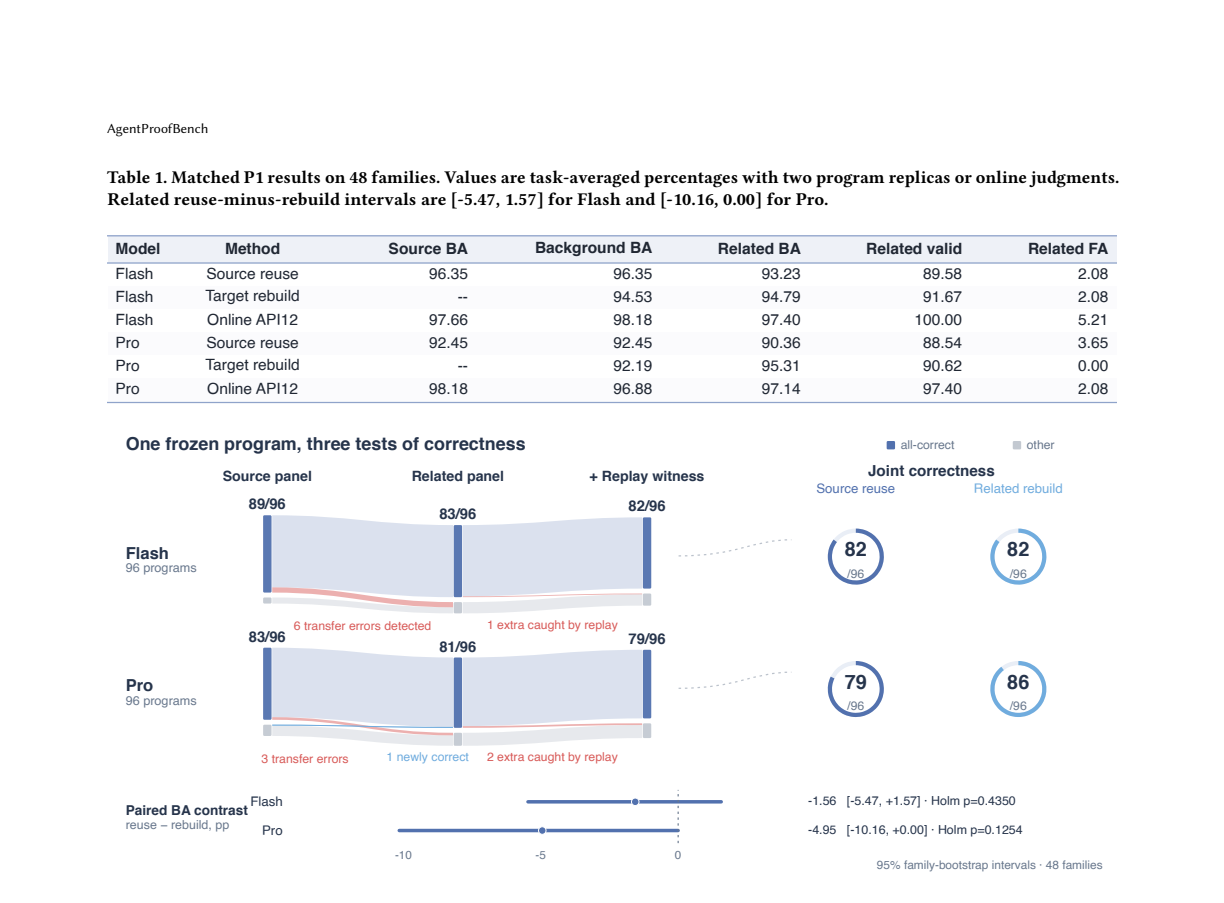


Figures are the authors', reproduced from the paper.
References (34)
- [1] Earl T. Barr, Mark Harman, Phil McMinn, Muzammil Shahbaz, and Shin Yoo. 2015. The Oracle Problem in Software Testing: A Survey.IEEE Transactions on Software Engineering41, 5 (2015), 507–525. https://doi.org/10.1109/TSE.2014.2372785 on Pithdoi:10.1109/tse.2014.2372785
- [2] Boshui Chen, Huiping Liu, and Shaolei Zhang. 2026. WebGrader: Training LLMs for Web Development with Self-Evolving Programmatic Grader. https: //doi.org/10.48550/arXiv.2608.06474 arXiv:2608.06474 on PithPith's reviewarXivdoi:10.48550/arxiv.2608.06474
- [3] Bei Chen, Fengji Zhang, Anh Nguyen, Daoguang Zan, Zeqi Lin, Jian-Guang Lou, and Weizhu Chen. 2022. CodeT: Code Generation with Generated Tests. https://doi.org/10.48550/arXiv.2207.10397 arXiv:2207.10397 on PithPith's reviewarXivdoi:10.48550/arxiv.2207.10397
- [4] Chaoqun Cui, Jing Huang, Shijing Wang, Liming Zheng, Qingchao Kong, and Zhixiong Zeng. 2026. Agentic Reward Modeling: Verifying GUI Agent via Progres- sive Trajectory-Grounded Interaction. https://doi.org/10.48550/arXiv.2602.00575 arXiv:2602.00575 on PithPith's reviewarXivdoi:10.48550/arxiv.2602.00575
- [5] Arunabh Dastidar. 2026. Where Does Agent Reliability Come From? A Cross- Benchmark Decomposition of Verification Loops, Specialist Models, and Scaffold- ing in a Production Enterprise Agent. https://doi.org/10.48550/arXiv.2607.17044 arXiv:2607.17044 on PithPith's reviewarXivdoi:10.48550/arxiv.2607.17044
- [6] Srinivasan Iyengar. 2026. Sample, Mix, or Verify? Allocating Test-Time Com- pute under Imperfect Verifiers. https://doi.org/10.48550/arXiv.2610.23255 arXiv:2610.23255 on PithPith's reviewarXivdoi:10.48550/arxiv.2610.23255
- [7] Jacky Kwok, Shulu Li, Pranav Atreya, Yuejiang Liu, Yixing Jiang, Chelsea Finn, Marco Pavone, Ion Stoica, and Azalia Mirhoseini. 2026. LLM-as-a-Verifier: A General-Purpose Verification Framework. https://doi.org/10.48550/arXiv.2607. 05391 arXiv:2607.05391 on PithPith's reviewarXivdoi:10.48550/arxiv.2607
- [8] Xing Han Lù, Amirhossein Kazemnejad, Nicholas Meade, Arkil Patel, Dongchan Shin, Alejandra Zambrano, Karolina Stańczak, Peter Shaw, Christopher J. Pal, and Siva Reddy. 2025. AgentRewardBench: Evaluating Automatic Evaluations of Web Agent Trajectories. https://doi.org/10.48550/... on Pithdoi:10.48550/arxiv.2504.08942
- [9] Yecheng Jason Ma, William Liang, Guanzhi Wang, De-An Huang, Osbert Bastani, Dinesh Jayaraman, Yuke Zhu, Linxi Fan, and Anima Anandkumar. 2023. Eureka: Human-Level Reward Design via Coding Large Language Models. https: //doi.org/10.48550/arXiv.2310.12931 arXiv:2310.12931 on PithPith's reviewarXivdoi:10.48550/arxiv.2310.12931
- [10] Jingjie Ning, Xueqi Li, Yibo Kong, and Dongting Li. 2026. ControlScope: Workflow Revision and Reliability in LLM Agents. https://doi.org/10.48550/arXiv.2609. 34313 arXiv:2609.34313 on PithPith's reviewarXivdoi:10.48550/arxiv.2609
- [11] Jingjie Ning, Xueqi Li, and Chengyu Yu. 2026. Revision or Re-Solving? Decom- posing Second-Pass Gains in Multi-LLM Pipelines. Conference on Language Modeling (COLM). https://doi.org/10.48550/arXiv.2604.01029 arXiv:2604.01029 on PithPith's reviewarXivdoi:10.48550/arxiv.2604.01029
- [12] Jingjie Ning, Guojiang Zhao, Chen Xu, Shanshan Zhong, Xiaochuan Li, Ji Zeng, and Guolin Ke. 2026. Rules to Tools: Executable Checks for LLM Agents in Sci- entific Computing. https://doi.org/10.48550/arXiv.2610.00313 arXiv:2610.00313 on PithPith's reviewarXivdoi:10.48550/arxiv.2610.00313
- [13] Jingjie Ning, Shanshan Zhong, Xiaochuan Li, and Ji Zeng. 2026. Scores Alone Do Not Prove Discovery: The Discovery Certification Protocol for Auditing AI Research Agents. https://doi.org/10.48550/arXiv.2609.09219 arXiv:2609.09219 on PithPith's reviewarXivdoi:10.48550/arxiv.2609.09219
- [14] Jingjie Ning, Shanshan Zhong, Xiaochuan Li, Ji Zeng, and Chenyan Xiong. 2026. The Implementation Lottery: Auditing Idea Reliability in Automated Research. https://doi.org/10.48550/arXiv.2607.26587 arXiv:2607.26587 on PithPith's reviewarXivdoi:10.48550/arxiv.2607.26587
- [15] Hubert M. Pyskło, Artem Zhuravel, and Patrick D. Watson. 2026. Agent-Diff: Benchmarking LLM Agents on Enterprise API Tasks via Code Execution with State-Diff-Based Evaluation. InProceedings of the 32nd ACM SIGKDD Conference on Knowledge Discovery and Data Mining. Association f... on Pithdoi:10.1145/3770855.3817555
- [16] Corby Rosset, Pratyusha Sharma, Andrew Zhao, Miguel Gonzalez-Fernandez, and Ahmed Awadallah. 2026. The Art of Building Verifiers for Computer Use Agents. https://doi.org/10.48550/arXiv.2604.06240 arXiv:2604.06240 on PithPith's reviewarXivdoi:10.48550/arxiv.2604.06240
- [17] Reza Sanayei, Razvan-Gabriel Dumitru, Sunjie Hou, MohammadHossein Rezaei, Haris Riaz, Robert Vacareanu, Minglai Yang, Ying Liu, Mihai Surdeanu, and 8 AgentProofBench Daniel Yue Zhang. 2026. Evidence-First Agentic Verification. https://doi.org/10. 48550/arXiv.2610.17724 arXiv:2... on PithPith's reviewarXivdoi:10.48550/arxiv.2610.17724
- [18] Wentao Shi, Yu Wang, Yuyang Zhao, Yuxin Chen, Fuli Feng, Xueyuan Hao, Xi Su, Qi Gu, Hui Su, Xunliang Cai, and Xiangnan He. 2026. AJ-Bench: Benchmarking Agent-as-a-Judge for Environment-Aware Evaluation. https://doi.org/10.48550/ arXiv.2604.18240 arXiv:2604.18240 on PithPith's reviewarXivdoi:10.48550/arxiv.2604.18240
- [19] Hyewon Suh, Thanh Minh Nguyen, Chih-Lun Lee, Darrow Hartman, Lizhao Liu, Xin Eric Wang, Ang Li, and Jiachen Yang. 2026. Neuro-Symbolic Computer Use: Learning Reusable Policies for Reliable and Efficient Execution. https: //doi.org/10.48550/arXiv.2609.36927 arXiv:2609.36927 on PithPith's reviewarXivdoi:10.48550/arxiv.2609.36927
- [20] Harsh Trivedi, Tushar Khot, Mareike Hartmann, Ruskin Manku, Vinty Dong, Edward Li, Shashank Gupta, Ashish Sabharwal, and Niranjan Balasubrama- nian. 2024. AppWorld: A Controllable World of Apps and People for Bench- marking Interactive Coding Agents. https://doi.org/10.48550/a... on PithPith's reviewarXivdoi:10.48550/arxiv.2407.18901
show 14 more
- [21] Jinbiao Wei, Qianran Ma, Yilun Zhao, Xiao Zhou, Kangqi Ni, Guo Gan, and Arman Cohan. 2026. OpenComputer: Verifiable Software Worlds for Computer-Use Agents. https://doi.org/10.48550/arXiv.2605.19769 arXiv:2605.19769 on PithPith's reviewarXivdoi:10.48550/arxiv.2605.19769
- [22] Tianbao Xie, Danyang Zhang, Jixuan Chen, Xiaochuan Li, Siheng Zhao, Ruisheng Cao, Toh Jing Hua, Zhoujun Cheng, Dongchan Shin, Fangyu Lei, Yitao Liu, Yiheng Xu, Shuyan Zhou, Silvio Savarese, Caiming Xiong, Victor Zhong, and Tao Yu. 2024. OSWorld: Benchmarking Multimodal Agents ... on PithPith's reviewarXivdoi:10.48550/arxiv.2404.07972
- [23] Shunyu Yao, Noah Shinn, Pedram Razavi, and Karthik Narasimhan. 2024. 𝜏- bench: A Benchmark for Tool-Agent-User Interaction in Real-World Domains. https://doi.org/10.48550/arXiv.2406.12045 arXiv:2406.12045 on PithPith's reviewarXivdoi:10.48550/arxiv.2406.12045
- [24] Jianing Yin, Ziyi Chen, Hao Wang, Yiyou Sun, Zijian Jin, Dawn Song, and Daoan Zhang. 2026. VerifierBench: Benchmarking the Generation of Executable Verifiers for LLM Agents. https://doi.org/10.48550/arXiv.2610.28679 arXiv:2610.28679 on PithPith's reviewarXivdoi:10.48550/arxiv.2610.28679
- [25] Chong Zeng, Ziqian Zhong, Kexun Zhang, Ivan Bercovich, Ivgeni Segal, Yuzhen Mao, Shashwat Saxena, and Aditi Raghunathan. 2026. Scalable Weak-to-Strong Verifier Hardening for Agent Environments. https://doi.org/10.48550/arXiv. 2610.15924 arXiv:2610.15924 on PithPith's reviewarXivdoi:10.48550/arxiv.2610.15924
- [26] Caiqi Zhang, Rujun Han, Zifeng Wang, Zoey CuiZhu, Nigel Collier, Tomas Pfister, and Chen-Yu Lee. 2026. VeriHarness: Scaling Agentic Verification for Long-Horizon Tasks. https://doi.org/10.48550/arXiv.2610.00972 arXiv:2610.00972 on PithPith's reviewarXivdoi:10.48550/arxiv.2610.00972
- [27] Jiazheng Zhang, Long Ma, Yunxian Yang, Zhiheng Xi, Zhikai Lei, Yajie Yang, Chenyang Liao, Enyu Zhou, Yang Nan, Yuchen Tian, Senjie Jin, Yibo Wang, Wei He, Boyang Liu, Jixuan Huang, Xin Guo, Shutong Jiang, Zhezheng Hao, Xinbing Liang, Zhihao Zhang, Changzhi Zhou, Wiggin Zhou, T... on PithPith's reviewarXivdoi:10.48550/arxiv.2610.04906
- [28] Yifan Zhang, Yutong Dai, Viraj Prabhu, Zhiyuan Hu, Ran Xu, and Zeyuan Chen on Pith
- [29] Shanshan Zhong, Yi Lu, Jingjie Ning, Yibing Wan, Lihan Feng, Yuyi Ao, Leonardo F. R. Ribeiro, Markus Dreyer, Sean Ammirati, and Chenyan Xiong. 2026. Skill- LearnBench: Benchmarking Continual Learning Methods for Agent Skill Gen- eration on Real-World Tasks. https://doi.org/10.... on PithPith's reviewarXivdoi:10.48550/arxiv.2604.20087
- [30] Zhiqing Zhong, Mingyu Chen, Aoyang Fang, Yuzhong Zhang, Haoye Tian, Lionel Briand, Boxi Yu, and Pinjia He. 2026. SpecGuardBench: Can Coding Agents Construct Reliable Validation Harnesses from Natural Language Specifications? https://doi.org/10.48550/arXiv.2610.16870 arXiv:2610.16870 on PithPith's reviewarXivdoi:10.48550/arxiv.2610.16870
- [31] Shuyan Zhou, Frank F. Xu, Hao Zhu, Xuhui Zhou, Robert Lo, Abishek Sridhar, Xianyi Cheng, Tianyue Ou, Yonatan Bisk, Daniel Fried, Uri Alon, and Graham Neubig. 2023. WebArena: A Realistic Web Environment for Building Autonomous Agents. https://doi.org/10.48550/arXiv.2307.13854 a... on PithPith's reviewarXivdoi:10.48550/arxiv.2307.13854
- [32] Mingchen Zhuge, Changsheng Zhao, Dylan Ashley, Wenyi Wang, Dmitrii Khizbullin, Yunyang Xiong, Zechun Liu, Ernie Chang, Raghuraman Krishnamoor- thi, Yuandong Tian, Yangyang Shi, Vikas Chandra, and Jürgen Schmidhuber on Pith
- [2024] Agent-as-a-Judge: Evaluate Agents with Agents. https://doi.org/10.48550/ arXiv.2410.10934 arXiv:2410.10934 A REPRODUCTION AND REFERENCES The environment uses Agent-Diff revision 3bb9c407. Snapshot clients expose request, get, post, and graphql; the host sup- plies authenticati... on PithPith's reviewarXivdoi:10.48550/arxiv.2410.10934
- [2026] CLIFT: Conformal Self-Verification for Web Agent Training and Test-Time Scaling. https://doi.org/10.48550/arXiv.2610.06829 arXiv:2610.06829 on PithPith's reviewarXivdoi:10.48550/arxiv.2610.06829
Challenges and discussion
Disagree with the review, or know something it missed? Leave a comment, or challenge this review formally: a challenge becomes a permanent entry in this paper's record, and its decision is published here.
Come back by email
A short list of the week's newly reviewed papers. Nothing is sent until you confirm from your inbox, and every email has a link that stops it. No account.
No comments yet.
Sign in to comment