Digital Libraries · arXiv:2610.35098 v1 · submitted 26 Oct 2026 · 38 references
Interpreting LLM Scores in Peer Review: Alignment and Divergence Across Prompts, Domains, and Manuscript Features
The paper says
“Large language model (LLM) scores are being studied as information for scholarly evaluation. Interpreting these scores requires evidence about agreement with human judgments and its variation across evaluation conditions.”
more of the abstract
Guided by an argument-based approach to validation, we compare four LLMs on 7,083 public ICLR 2024 submissions under a standard review condition and examine ten prompt conditions using DeepSeek-V3.2. We distinguish average score divergence, paper-level absolute error, and rank correlation, then examine domain differences and adjusted manuscript-feature associations. For DeepSeek-V3.2, Area Chair guidance reduces mean rating divergence from 1.460 to 0.199 points and mean absolute error from 1.577 to 0.942, while rank correlation changes from 0.377 to 0.387. Historical references combined with downward scoring instructions yield mean divergence of 0.052 and rank correlation of 0.321. Domain differences remain after global calibration. Longer titles have positive adjusted associations with rating divergence, and formula density has negative associations across all four configurations. These findings connect score interpretation to the scoring procedure, evaluation context, and manuscript information represented in the comparison. They show why aggregate alignment, manuscript ordering, and correspondence within manuscript groups require distinct evidence when evaluating LLM-generated scholarly assessment information.
from the abstract
Pith says
Machine review · deepseek-v4-flash · 27 Oct 2026 · what was read was not recorded · not checked by a person
It can be wrong. Challenge this review or reply to it.
Holds up. A thorough, well-designed empirical study showing that LLM-human score correspondence depends on which measure you look at and which condition you vary; the domain results are the softest spot because human reliability varies. This line is wrong
1 major objection · 6 minor
How often objections from reviews like this one are right: not yet measured
Not checked: figures, code, what the 38 references say.
The paper says, at Results: Correspondence Across Domains (Fig. 2, Table C1, Figure C1)
The review did not quote this passage.
Pith says: Objection 1 of 1 · major
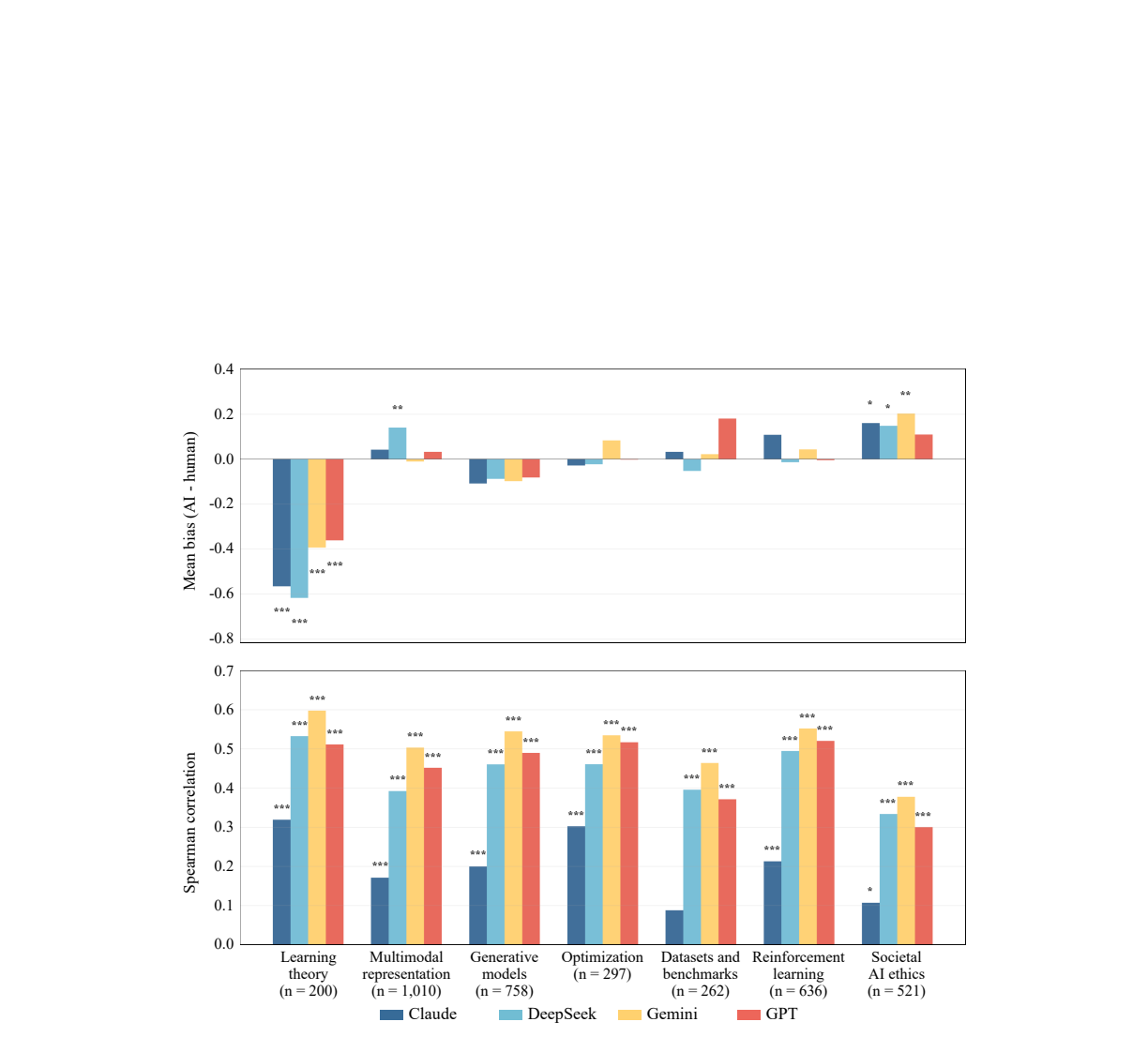
The paper reports that domain differences in mean divergence and rank correlation persist after global affine calibration (Fig. 2) and that human rating consistency (ICC) varies from 0.601 (Societal AI Ethics) to 0.725 (Generative Models). The observed domain pattern—low-ICC domains show larger divergence and weaker correlation, high-ICC domains show small divergence—is consistent with the possibility that the human reference is simply noisier in the former, rather than reflecting genuine model-domain correspondence differences.
more of objection 1
The paper acknowledges human noise generally (b329) and reports ICC descriptively, but it does not quantitatively decompose how much of the domain variation in divergence can be attributed to differential human reliability versus other factors. Because RQ2's central claim is that 'domain differences remain after global calibration,' this confound is load-bearing. I recommend adding a sensitivity analysis (e.g., adjusting domain means by ICC or comparing only domains with similar ICC) or at least a stronger caveat that the observed pattern may partly reflect the reliability of the reference rather than the model's behavior.
6 minor objections
The paper says, at Abstract
Pith says: minor objection 1 of 6
The abstract reports 'mean rating divergence from 1.460 to 0.199 points' for V4; these are prompt-specific values. Consider noting that these are for DeepSeek-V3.2 (already indicated) to avoid confusion about which model.
The paper says, at Table 5, footnote
Pith says: minor objection 2 of 6
The footnote states 'Exact denotes identical numeric scores. Its frequency depends on comparing integer model outputs with averaged human scores.' This is an important caveat—please move it to a table note or main text so readers do not misinterpret exact agreement rates.
show 4 more
The paper says, at §Prompt Comparisons and Contextual Heterogeneity
Pith says: minor objection 3 of 6
The paper correctly notes that V4 and V5 change several instructions together, so individual components cannot be isolated. This is stated, but a brief reminder in the Results section would help readers avoid attributing effects to single instructions.
The paper says, at §Adjusted Manuscript-Feature Comparisons, Table 7
Pith says: minor objection 4 of 6
Table 7 reports contrasts for 'Title length' and 'Formula density' as significant across all models. The sign and significance are robust across sensitivity specifications (Tables E1, E2). This is a strength. Minor: the table caption could note that positive estimates indicate greater AI-human divergence, consistent with the main text.
The paper says, at Appendix G, V5 description
Pith says: minor objection 5 of 6
The V5 instruction includes a preliminary rating step and then downward adjustment. It would be helpful to note explicitly that this procedure introduces a structural break in the scoring rule, not just a prompt variation.
The paper says, at General
Pith says: minor objection 6 of 6
Several sentences lack terminal punctuation (e.g., line after Table C4 note; some figure captions). A thorough copyedit is recommended.
What would settle it
Compute within each domain (with ≥200 papers) the ratio DAH/DHH (model-human disagreement over human-human disagreement) under the V1 condition. If this ratio is approximately constant across domains while |mean bias| correlates with 1/ICC, then domain differences in divergence are driven by human noise rather than model behavior. Alternatively, regress domain-level absolute divergence on domain ICC (with sample-size weighting) to test whether lower ICC predicts larger divergence. If the relationship is significant, the paper's claim that "domain differences remain after calibration" requires re-interpretation as reflecting human reference properties.
from the skeptic's reading
How the review went
4 readings by deepseek-v4-flash · 27 Oct 2026
- Reader holds up
- Skeptic partly agrees
- Editor wrote the verdict above
- Referee minor revision: 1 major objection, 6 minor
Not run on this paper: the simulated authors' defence.
Pith did not check this review's objections against the paper.
The review in full
The review in brief, machine-written
This paper does something useful that too many studies skip: it treats mean divergence, absolute error, and rank correlation as separate outcomes and shows they respond differently to prompt changes. That single finding—that V4 cuts mean divergence to 0.2 while barely moving rank correlation, while V5 gives nearly zero mean divergence but the lowest rank correlation—is a concrete demonstration that "agreement" is not one thing. The study is also methodologically careful: 7k+ papers, four models, ten prompt conditions, FDR correction, wild bootstrap, DML with cross-fitting, sensitivity analyses, and a clear limitations section. The recurring manuscript-feature associations (longer titles → more divergence, formula density → less) are genuinely new and survive multiple specifications. Credit where due: this is reproducible, well-documented work.
The softest spot is the domain comparison (RQ2). The stress-test note lands: ICC varies from 0.60 to 0.73 across domains, and the domains with lower ICC (e.g., Societal AI Ethics, 0.601) also show larger mean divergence and weaker rank correlation after calibration. The paper acknowledges human noise generally and reports domain ICC, but it does not decompose how much of the observed domain pattern reflects genuine model-domain mismatch versus noise in the human reference. The authors call the cell-level analysis exploratory, which is appropriate, but the central RQ2 claim that "domain differences remain after global calibration" would be stronger with some attempt to separate signal from measurement error. I don't think this is a fatal flaw—the descriptive evidence is still informative—but a reviewer could reasonably ask for a sensitivity analysis that conditions on human reliability or models the noise explicitly.
Other concerns are minor: prompt comparisons use only DeepSeek, so cross-model generalization for prompt effects is limited (stated). The overlapping manuscript sets across model cells in the domain analysis are flagged as exploratory.
This paper is for anyone working on AI-assisted peer review or validation of LLM-based evaluation. It deserves a serious referee; I would accept the review invitation. The core findings about prompt-specific tradeoffs and feature associations are solid. The domain claims need a bit more caution in interpretation, but that's a revision, not a rejection.
The strongest objection
The paper's RQ2 claim that "Domain differences remain after global calibration" is used to argue that correspondence varies across evaluation contexts. However, human rating consistency (ICC) varies from 0.601 (Societal AI Ethics) to 0.725 (Generative Models), as reported in Figure C1. The domain-level mean bias after affine calibration (Figure 2) aligns with these ICC differences: low-ICC domains (Societal AI Ethics, ICC=0.601) show positive divergence and weaker rank correlation, while high-ICC domains (Generative Models, RL) show small divergence. The paper does not decompose how much of this pattern reflects genuine model-domain mismatch versus noise in the human reference. If the human mean is noisier in low-ICC domains, observed divergence from that mean is inflated regardless of model behavior. The paper acknowledges human noise generally (b329) and reports ICC domain-level, but the domain comparison does not adjust for or formally separate these components. This is load-bearing because the central claim about contextual variation requires evidence that correspondence differences are not mere artifacts of human unreliability. The paper's exploratory cell-level analysis (b147) does not address this decomposition.
The reader's weakest_assumption rightly flags human noise as a limitation. The stress-test refines this to a specific load-bearing concern about domain comparisons: the paper's evidence that domain differences persist after calibration may conflate model performance with human reliability. The paper acknowledges human noise broadly but does not formally adjust for ICC in the domain analysis. This concern is concretely testable via the proposed DAH/DHH ratio decomposition. It does not overturn the paper's overall findings (which are robustly supported across multiple analyses), but it qualifies one specific interpretation. Therefore the original ACCEPT verdict stands.
The referee's report
If the findings hold, the paper makes a concrete contribution to understanding LLM-generated scores as assessment information. It moves beyond single-aggregate metrics by showing that mean alignment, paper-level error, and rank order respond differently to the same prompt changes. The domain and feature analyses reveal where aggregate correspondence may be incomplete. The study is methodologically careful, with FDR correction, wild bootstrap, DML with cross-fitting, and multiple sensitivity analyses. The transparent reporting of human-reference reliability (ICC) and the exploratory status of cell-level tests is a strength. The work connects directly to validation theory (Kane's argument-based approach) and gives practical guidance for interpreting LLM scores in evaluation contexts.
Pith's reading of the paper (a machine's summary, not the authors')
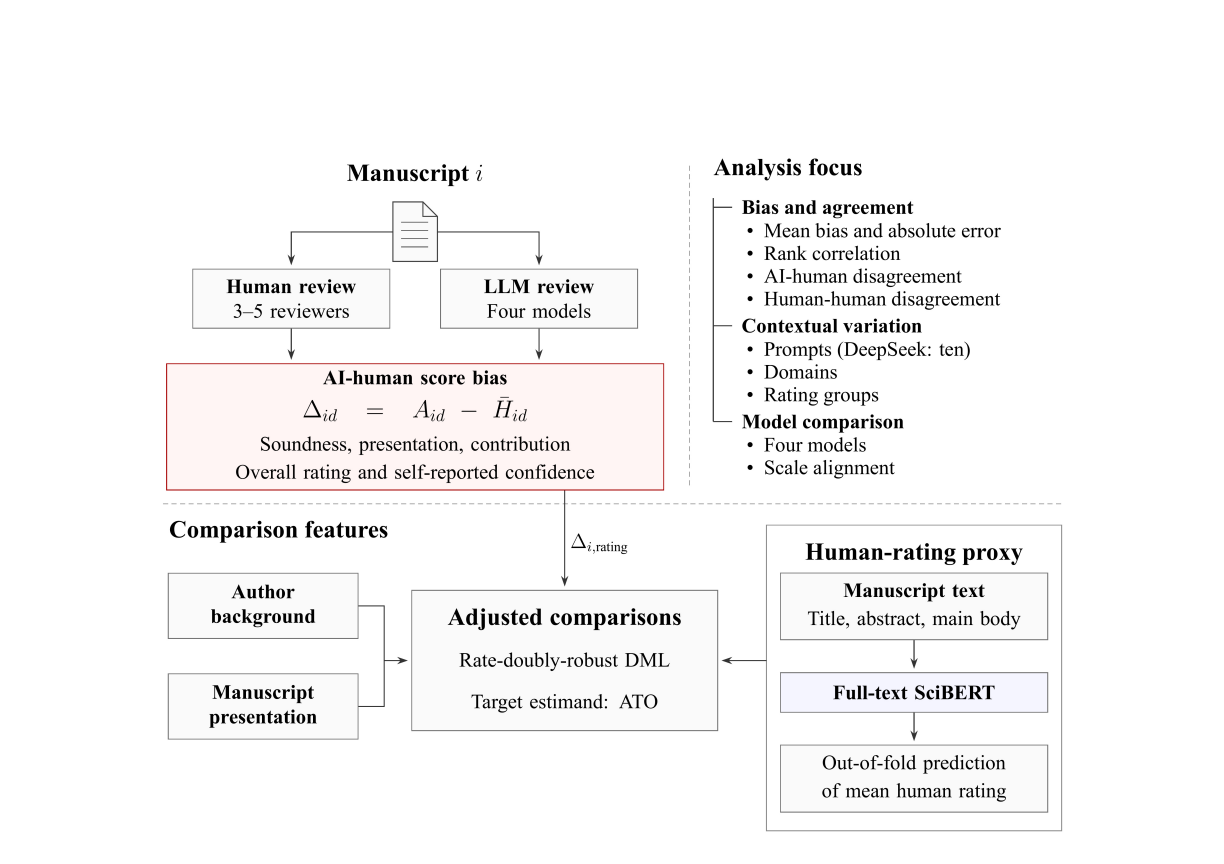
This paper tests how well LLM scores match human peer-review ratings across different prompt instructions, research areas, and manuscript characteristics. It shows that the degree of agreement depends on which aspect you measure—average score difference, paper-level absolute error, or rank ordering—and these aspects can change independently. For instance, a prompt that nearly eliminates average score divergence can lower rank correlation, while another improves both average and absolute error with little effect on ordering. Domain differences in model-human correspondence persist even after adjusting overall score scales. These findings argue that evaluating LLM-generated assessment scores requires separate evidence for each intended use.
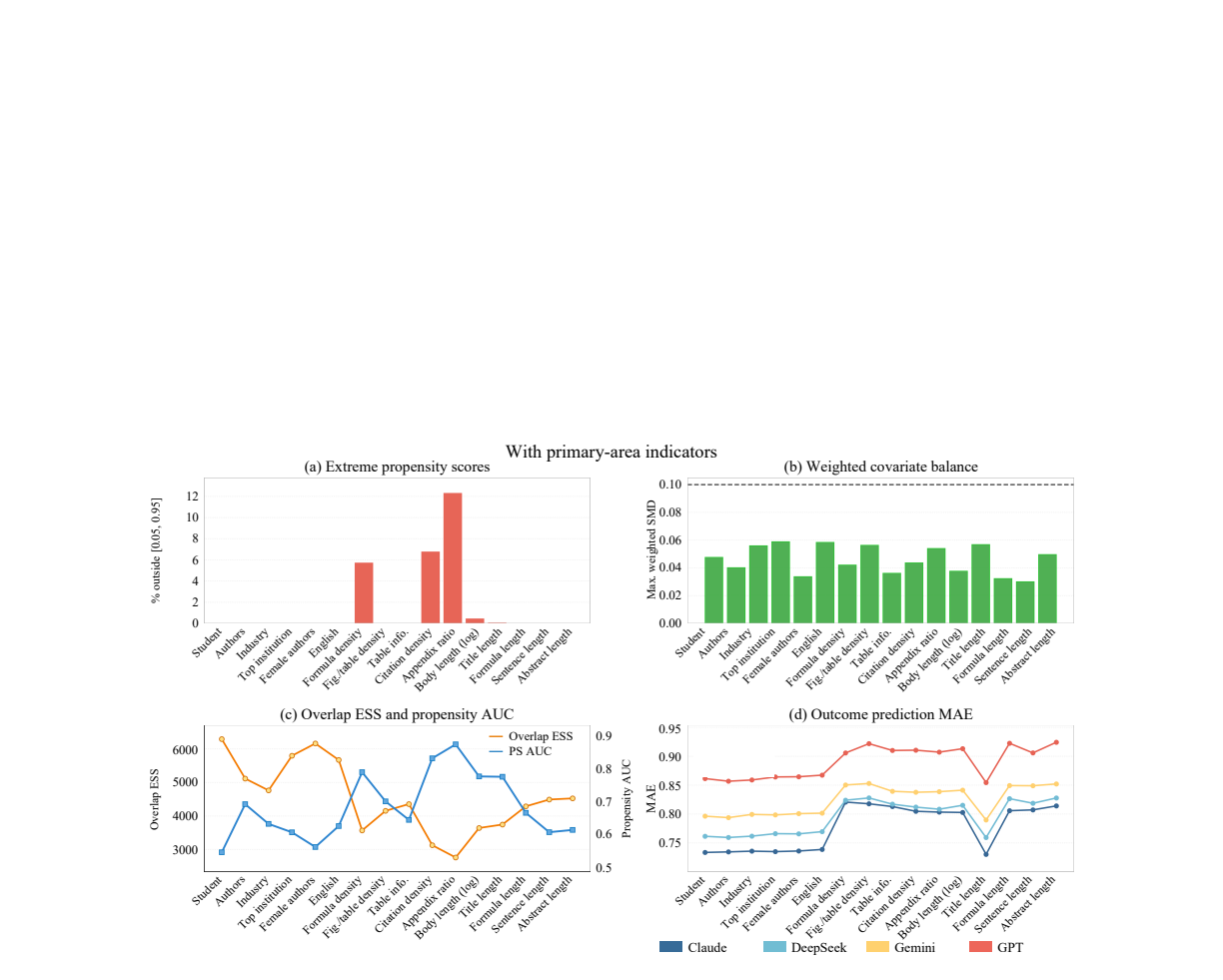
What carries the argument. Three complementary agreement measures carry the argument: mean divergence (signed difference), mean absolute error (paper-level distance), and Spearman rank correlation (ordering). They are compared across ten prompt conditions, seven research areas, and four large language models using paired paper-level comparisons. The study applies an argument-based validation framework (Kane, 2013) to link each measure to a distinct interpretive claim. For manuscript-feature associations, it uses double/debiased machine learning with overlap weighting to estimate conditional differences in signed divergence while adjusting for a full-text SciBERT-based predictor of human ratings.
Core claim. The paper discovers that LLM-human score correspondence is not a single number but a set of distinct properties that respond differently to scoring procedures. With DeepSeek-V3.2 on 7,083 ICLR 2024 submissions, Area Chair guidance reduces mean divergence from 1.460 to 0.199 and MAE from 1.577 to 0.942 with a small rank correlation change (0.377 to 0.387). Historical references with downward instructions yield mean divergence near zero (0.052) but lower rank correlation (0.321). Domain differences remain after global calibration; longer titles are consistently associated with larger score divergence, and denser formulas with smaller divergence. The paper argues that these patterns make interpretation conditional on procedure, context, and manuscript information.
The premise it rests on. The human reviewer mean scores are assumed to be the correct reference, but human ratings contain noise and systematic bias that varies across domains (ICC from 0.601 to 0.725), so the paper's conclusions about model-human correspondence partly depend on the reliability of that reference.
If the paper is right (Pith's inferences, not the authors')
Choosing an LLM scoring prompt requires specifying whether the goal is average alignment, per-paper accuracy, or ranking, because different prompts optimize different properties.
Aggregate calibration does not eliminate domain-level differences in model-human correspondence; users must check performance within specific research areas.
Manuscript features like title length and formula density are systematically associated with divergence, so summary statistics of agreement may mask bias in specific groups.
Reporting human-reviewer agreement (ICC) alongside model-human measures is necessary to avoid interpreting human noise as model disagreement.
If these patterns hold across venues and years, a pragmatic recommendation emerges: produce separate LLM scores for average quality, for screening of weak papers, and for ranking of strong papers, each with its own optimized prompt.
The recurring association of title length with divergence suggests that LLMs may be influenced by presentation signals that are not informative about paper quality; controlled experiments with artificial title variation could test this.
The negative association of formula density might imply that papers with dense technical content get more favourable evaluation from LLMs relative to human reviewers, or that human reviewers discount such content; this could be tested by comparing LLM evaluations of the same paper with formulas removed.
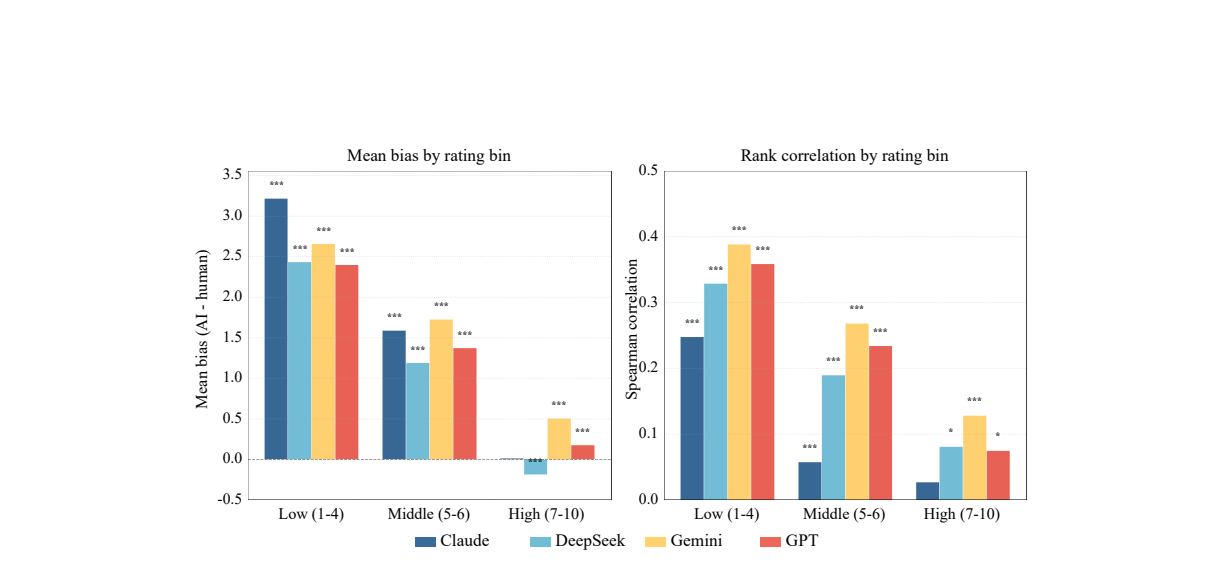
The low rank correlation for high-rated papers raises the question of whether LLM scores can usefully discriminate among accepted papers, which is the scenario most relevant for hiring and funding decisions.
Check this review
Pith stored no record of this review's passes and took no fingerprint of it. Reviews made by code from 13 Nov 2026 on carry both.
How often reviews like this one are right
Reviews like this one: written by deepseek-v4-flash, where what was read was not recorded.
How often objections from reviews like this one are right: not yet measured
Reviews by people
This review was written by a machine. No person has reviewed this paper on Pith yet. A scientist listed on Pith can review it for a fee, and their review is published here whatever it concludes.
The paper
Abstract
Large language model (LLM) scores are being studied as information for scholarly evaluation. Interpreting these scores requires evidence about agreement with human judgments and its variation across evaluation conditions. Guided by an argument-based approach to validation, we compare four LLMs on 7,083 public ICLR 2024 submissions under a standard review condition and examine ten prompt conditions using DeepSeek-V3.2. We distinguish average score divergence, paper-level absolute error, and rank correlation, then examine domain differences and adjusted manuscript-feature associations. For DeepSeek-V3.2, Area Chair guidance reduces mean rating divergence from 1.460 to 0.199 points and mean absolute error from 1.577 to 0.942, while rank correlation changes from 0.377 to 0.387. Historical references combined with downward scoring instructions yield mean divergence of 0.052 and rank correlation of 0.321. Domain differences remain after global calibration. Longer titles have positive adjusted associations with rating divergence, and formula density has negative associations across all four configurations. These findings connect score interpretation to the scoring procedure, evaluation context, and manuscript information represented in the comparison. They show why aggregate alignment, manuscript ordering, and correspondence within manuscript groups require distinct evidence when evaluating LLM-generated scholarly assessment information.
The paper's own sentences, arranged, kept beside the review and separate from it. Each label is drawn from a closed vocabulary; the number beside it is the probability the classifier gave that label. No sentence in this record was written by a model.
abstract compiled · 2026-10-27
The authors' main claim, as the classifier picked it out 0.93
“They show why aggregate alignment, manuscript ordering, and correspondence within manuscript groups require distinct evidence when evaluating LLM-generated scholarly assessment information.”
How the main claim is stated: asserted 1.00
What the abstract itself states, as probabilities: claims first 0.03 · states limitation 0.46 · human participants 0.24 · controlled comparison 0.64 · randomized assignment 0.03 · states quantitative result 0.99 · compares with prior results 0.70 · mentions code or data availability 0.03
The abstract, sentence by sentence
This table labels the abstract only (arXiv listing abstract v1). The number is the probability the classifier gave the label.
| Sentence | Role | The authors' own work | States the main conclusion | Strength |
|---|---|---|---|---|
| Large language model (LLM) scores are being studied as information for scholarly evaluation. | background 1.00 | 0.04 | 0.02 | asserted 0.99 |
| Interpreting these scores requires evidence about agreement with human judgments and its variation across evaluation conditions. | gap 0.55 | 0.05 | 0.04 | asserted 0.98 |
| Guided by an argument-based approach to validation, we compare four LLMs on 7,083 public ICLR 2024 submissions under a standard review condition and examine ten prompt conditions using DeepSeek-V3.2. | method 0.84 | 0.95 | 0.04 | asserted 0.96 |
| We distinguish average score divergence, paper-level absolute error, and rank correlation, then examine domain differences and adjusted manuscript-feature associations. | method 0.91 | 0.89 | 0.05 | asserted 0.80 |
| For DeepSeek-V3.2, Area Chair guidance reduces mean rating divergence from 1.460 to 0.199 points and mean absolute error from 1.577 to 0.942, while rank correlation changes from 0.377 to 0.387. | result 1.00 | 0.95 | 0.12 | asserted 1.00 |
| Historical references combined with downward scoring instructions yield mean divergence of 0.052 and rank correlation of 0.321. | result 1.00 | 0.87 | 0.05 | asserted 1.00 |
| Domain differences remain after global calibration. | result 1.00 | 0.87 | 0.09 | asserted 1.00 |
| Longer titles have positive adjusted associations with rating divergence, and formula density has negative associations across all four configurations. | result 1.00 | 0.93 | 0.08 | asserted 1.00 |
| These findings connect score interpretation to the scoring procedure, evaluation context, and manuscript information represented in the comparison. | interpretation 1.00 | 0.61 | 0.30 | asserted 0.99 |
| They show why aggregate alignment, manuscript ordering, and correspondence within manuscript groups require distinct evidence when evaluating LLM-generated scholarly assessment information. | interpretation 1.00 | 0.70 | 0.57 | asserted 1.00 |
What kind of paper the classifier reports this is: empirical study 1.00 · evidence from observation or experiment 0.53
What was examined, and what was not
Sources read
- arXiv listing abstract v1
Not examined
- full text
- figures and tables
- references and citing sentences
- relations to other papers
Levels run
- P abstract
Not run
- S sections
- T body sentences
- C citations
- R cross-paper relations
How the labels were made
Compiled by classifier-1.13.0 via TypeSafe API, question bank abstract-p1-20260923, 2026-10-27: 1 request, 7,548 input tokens.
Every quoted sentence on this record is the authors'. Every label is from Pith's closed vocabulary, with the probability shown beside it. This record as JSON
Figures (4)
Figures are the authors', reproduced from the paper.
References (38)
- [1] Ganapathy, Keshav and Liu, Emily and Zarger, Zain and Somepalli, Gowthami and Goldblum, Micah and Goldstein, Tom , howpublished =. An Investigation into the Role of Author Demographics in on Pith
- [2] Tran, David and Valtchanov, Alex and Ganapathy, Keshav and Feng, Raymond and Slud, Eric and Goldblum, Micah and Goldstein, Tom , howpublished=. An open review of. 2010.05137 , eprinttype= on PithPith's reviewarXiv
- [3] Drori, Iddo and Te'eni, Dov , title =. Journal of the Association for Information Systems , volume =. 2024 , doi = on Pith
- [4] Lopez, Patrice , booktitle=. 2009 , publisher= on Pith
- [5] Kankanhalli, Atreyi , title =. Journal of the Association for Information Systems , volume =. 2024 , doi = on Pith
- [6] Tomkins, Andrew and Zhang, Min and Heavlin, William D. , title =. Proceedings of the National Academy of Sciences , volume =. 2017 , doi = on Pith
- [7] D'Arcy, Mike and Hope, Tom and Birnbaum, Larry and Downey, Doug , howpublished=. 2401.04259 , eprinttype= on PithPith's reviewarXiv
- [8] Liu, Ryan and Shah, Nihar B , howpublished=. 2306.00622 , eprinttype= on PithPith's reviewarXiv
- [9] Chitnis, Soham and Patwardhan, Manasi and Srinivasan, Ashwin and Verlekar, Tanmay Tulsidas and Vig, Lovekesh and Shroff, Gautam , booktitle=. 2024 , publisher= on Pith
- [10] Beltagy, Iz and Lo, Kyle and Cohan, Arman , title =. Proceedings of the 2019 Conference on Empirical Methods in Natural Language Processing and the 9th International Joint Conference on Natural Language Processing (EMNLP-IJCNLP) , pages =. 2019 , doi = on Pith
- [11] Liu, Nelson F. and Lin, Kevin and Hewitt, John and Paranjape, Ashwin and Bevilacqua, Michele and Petroni, Fabio and Liang, Percy. Lost in the Middle: How Language Models Use Long Contexts. Transactions of the Association for Computational Linguistics. 2024. doi:10.1162/tacl_a_00638 on Pithdoi:10.1162/tacl_a_00638
- [12] Ye, Rui and Pang, Xianghe and Chai, Jingyi and Chen, Jiaao and Yin, Zhenfei and Xiang, Zhen and Dong, Xiaowen and Shao, Jing and Chen, Siheng , title =. 2024 , eprint = on Pith
- [13] Chernozhukov, Victor and Chetverikov, Denis and Demirer, Mert and Duflo, Esther and Hansen, Christian and Newey, Whitney and Robins, James , title =. The Econometrics Journal , volume =. 2018 , doi = on Pith
- [14] Benjamini, Yoav and Hochberg, Yosef , title =. Journal of the Royal Statistical Society: Series B (Methodological) , volume =. 1995 , doi = on Pith
- [15] Goodhue, Dale L. and Thompson, Ronald L. , title =. MIS Quarterly , volume =. 1995 , doi = on Pith
- [16] Does Fit Matter? The Impact of Task-Technology Fit and Appropriation on Team Performance in Repeated Tasks , author=. Information Systems Research , volume=. 2009 , publisher= on Pith
- [17] Li, Fan and Morgan, Kari Lock and Zaslavsky, Alan M. , title =. Journal of the American Statistical Association , volume =. 2018 , doi = on Pith
- [18] Wang, Yiming and Liu, Yi and Yang, Shu , title =. Journal of Causal Inference , year = on Pith
- [19] Du, Shurui , title=. Proceedings of the 5th Workshop on Evaluation and Comparison of NLP Systems , year=. doi:10.18653/v1/2025.eval4nlp-1.10 ,url= on Pithdoi:10.18653/v1/2025.eval4nlp-1.10
- [20] Vessey, Iris , title=. Decision Sciences ,year= on Pith
show 18 more
- [21] Yang, Xu and Sha, Zhizhou and Li, Junbo and Yu, Jian and Sun, Yifan and Zhao, Matthew and Fang, Jinrui and Guo, Xinyue and Wu, Yining and Hu, Xu and Luo, Yifu and Liu, Qiang and Wang, Zhangyang , title =. 2026 , eprint =. doi:10.48550/arXiv.2606.13044 , url = on PithPith's reviewarXivdoi:10.48550/arxiv.2606.13044
- [22] Thakkar, Nitya and Yuksekgonul, Mert and Silberg, Jake and Garg, Animesh and Peng, Nanyun and Sha, Fei and Yu, Rose and Vondrick, Carl and Zou, James , title =. Nature Machine Intelligence , year =. doi:10.1038/s42256-026-01188-x , url = on Pithdoi:10.1038/s42256-026-01188-x
- [23] Shmueli, Galit and Ray, Soumya , title =. Journal of the Association for Information Systems , year =. doi:10.17705/1jais.00864 , url = on Pithdoi:10.17705/1jais.00864
- [24] Schuetz, Sebastian and Venkatesh, Viswanath , title =. Journal of the Association for Information Systems , year =. doi:10.17705/1jais.00608 , url = on Pithdoi:10.17705/1jais.00608
- [25] Thelwall, Mike and Mohammadi, Ehsan , title=. Scientometrics ,year=. doi:10.1007/s11192-026-05585-2 , url= on Pithdoi:10.1007/s11192-026-05585-2
- [26] Thelwall, Mike , title=. Scientometrics ,year=. doi:10.1007/s11192-026-05552-x , url= on Pithdoi:10.1007/s11192-026-05552-x
- [27] Kane, Michael T. , title=. Journal of Educational Measurement , year= on Pith
- [28] Messick, Samuel , title=. American Psychologist , year= on Pith
- [29] Thelwall, Mike , title=. Journal of the Association for Information Science and Technology , year= on Pith
- [30] Kousha, Kayvan and Thelwall, Mike , title=. Journal of the Association for Information Science and Technology , year= on Pith
- [31] Wu, Wenqing and Zhang, Chengzhi and Zhao, Yi , title=. Journal of the Association for Information Science and Technology , year= on Pith
- [32] Zhu, Yu and Jia, Yujie and Zhu, Yumeng and Ye, Jiyuan , title=. Journal of the Association for Information Science and Technology , year= on Pith
- [33] Xie, Weixi and Jia, Pengfei and Wang, Xianwen , title=. Journal of the Association for Information Science and Technology , year= on Pith
- [34] Thelwall, Mike and Jiang, Xiaorui , title=. Journal of the Association for Information Science and Technology , year= on Pith
- [35] Zheng, Er-Te and Fu, Hui-Zhen and Thelwall, Mike and Fang, Zhichao , title=. Journal of the Association for Information Science and Technology , year= on Pith
- [36] Bland, J. Martin and Altman, Douglas G. , title=. The Lancet , year= on Pith
- [37] Bornmann, Lutz and Mutz, R\"udiger and Daniel, Hans-Dieter , title=. PLOS ONE , year= on Pith
- [38] Hicks, Diana and Wouters, Paul and Waltman, Ludo and de Rijcke, Sarah and Rafols, Ismael , title=. Nature , year= on Pith
Cited by 1 Pith paper
Reviewed papers on Pith that cite this one. The full citation record
Challenges and discussion
Disagree with the review, or know something it missed? Leave a comment, or challenge this review formally: a challenge becomes a permanent entry in this paper's record, and its decision is published here.
Come back by email
A short list of the week's newly reviewed papers. Nothing is sent until you confirm from your inbox, and every email has a link that stops it. No account.
No comments yet.
Sign in to comment