Computation and Language · arXiv:2611.20608 v1 · submitted 16 Nov 2026 · 44 references
Same Papers, Different Verdicts: Tracing Version Drift in LLM Peer Review
The paper says
“Venues and benchmarks read LLM review scores as measurements of a paper, while providers replace their models within months.”
more of the abstract
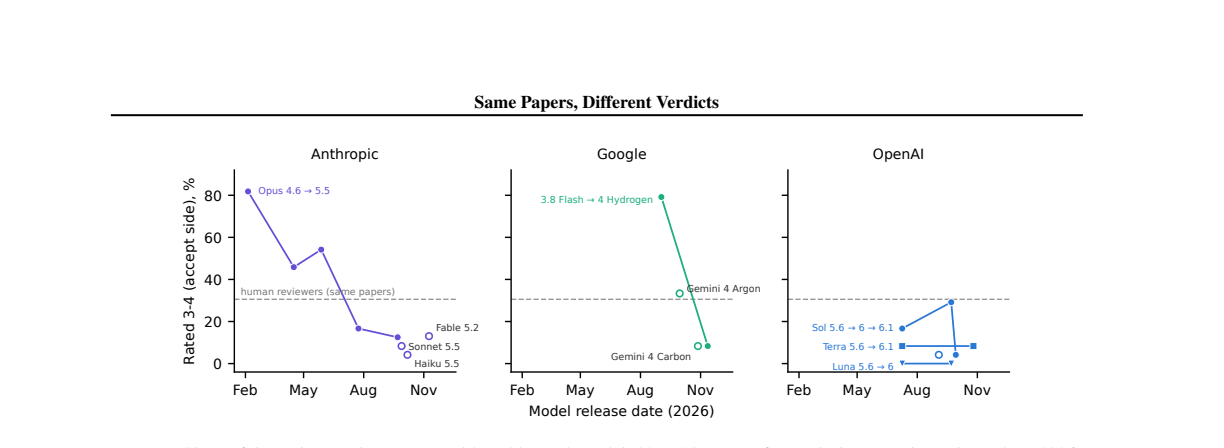
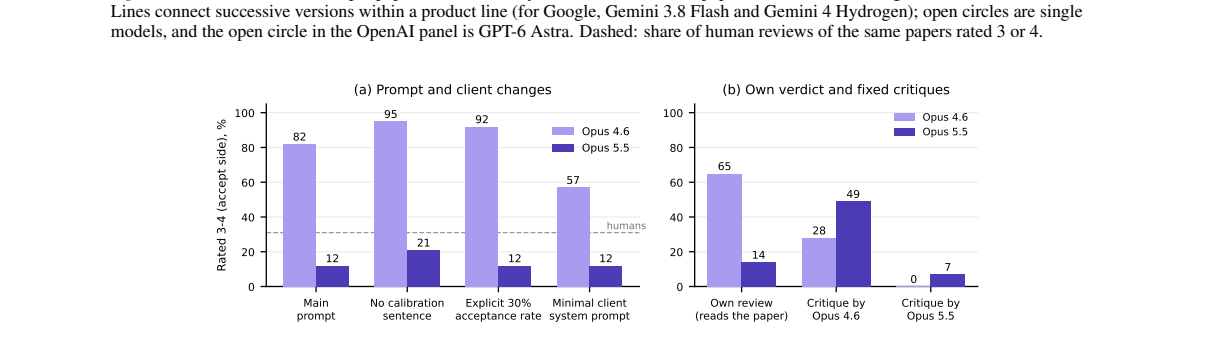
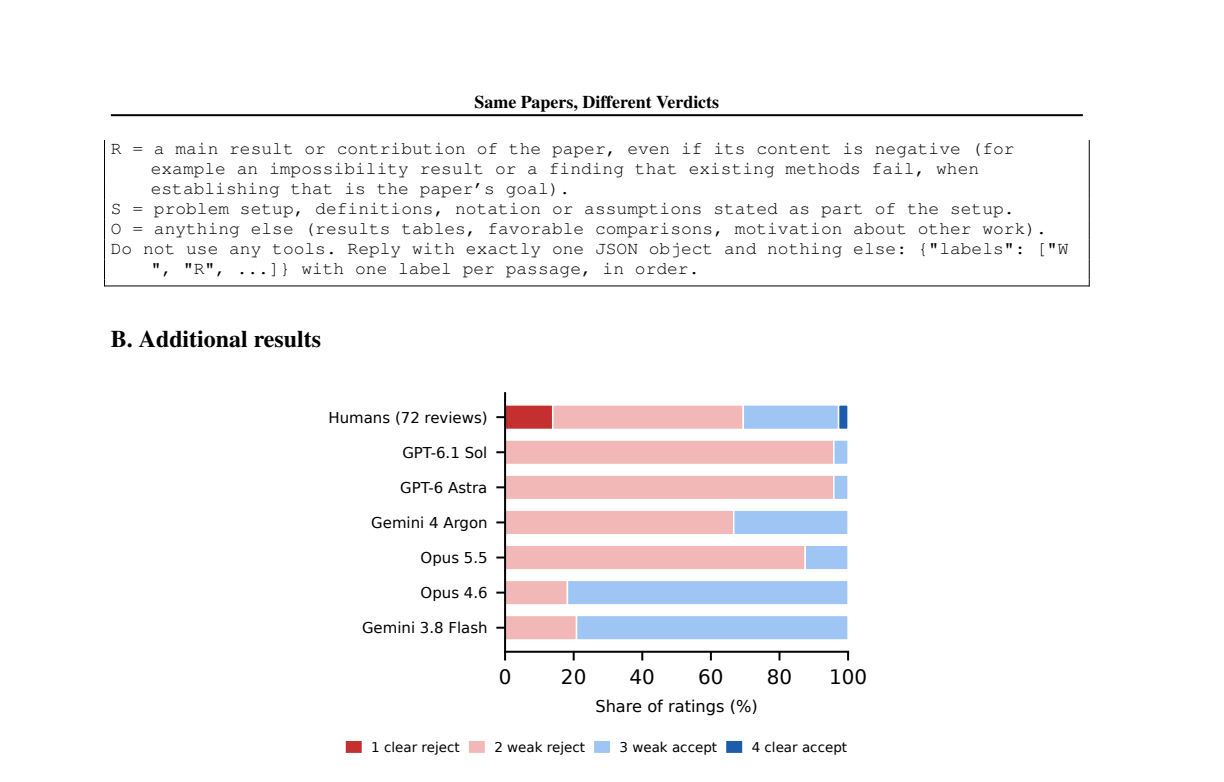
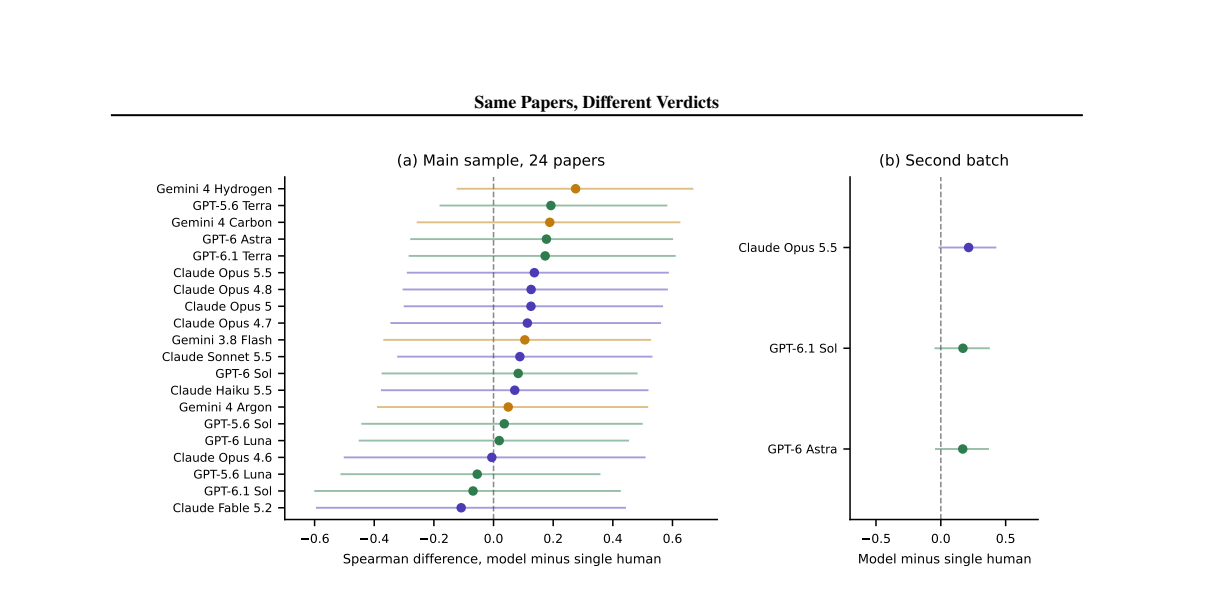
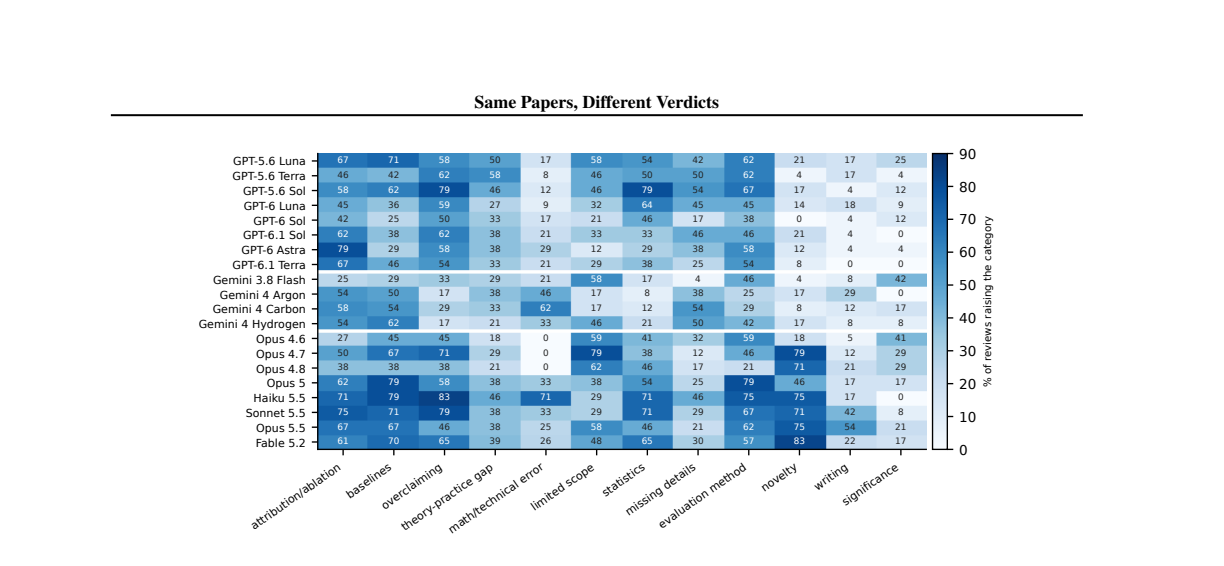
We audit twenty frontier models from OpenAI, Google and Anthropic on ICLR 2027 submissions while they were under review, with tests registered before the decisions. Between an earlier and a later version of Claude Opus and of Gemini, the share of papers placed on the accept side falls by 52 and 53 percentage points on 183 and 60 randomly drawn submissions, and by 43 to 79 points in six further paired comparisons, with no paper moving up in any of them. Stating a 30% acceptance rate in the prompt leaves a gap of 79 points between the two Opus versions. When score-stripped critiques are swapped between versions, the later critiques alone lower the accept share by 35 points for Opus and 51 for Gemini; for Opus the drop is 35 points under a third-party scorer and 24 after a rewrite that keeps each technical point and removes evaluative wording. On 57 papers, the percentiles of Opus 4.6 and 5.5 correlate at 0.73 while their accept shares differ by 44 points. On 99 to 119 submissions, the self-estimated percentiles of three models correlate with two human reviewers more strongly than a third reviewer does (point estimates 0.17 to 0.21, 95% intervals between -0.04 and +0.42). All twenty models give a 2 or a 3 in 473 of their 475 reviews, against 60 of 72 human reviews. Retrospective tests on decided papers can draw on memory. Claude Opus 5.5 names the true first author of 27 decided ICLR 2026 papers from their titles alone, with no wrong name, and Claude Opus 4.6 accepted all 11 decided papers it said it recognized, against 5 expected. Thresholds on LLM-reviewer scores therefore have to be validated against human decisions for each model version; our tests against the ICLR 2027 decisions follow on 16 December 2026.
from the abstract
Pith says
Machine review · deepseek-v4-flash · 17 Nov 2026 · read the full text (90,561 characters) · not checked by a person
It can be wrong. Challenge this review or reply to it.
Holds up. A thorough, well-designed empirical study showing that LLM peer review scores shift dramatically across model versions, with practical implications for any venue using LLM reviewers. This line is wrong
no objections raised
How often objections from reviews like this one are right: not yet measured
The paper, first character to last
The reviewer was given the whole text, 90,561 characters. Not checked: figures, code, what the 44 references say.
What would settle it
If a future study, using the same registered protocols on a different conference cycle, finds that the accept share between two consecutive versions of the same model line changes by less than 10 percentage points on a sample of 100+ papers, the claim that version drift is large and systematic would be weakened. Alternatively, if a model provider releases a version that demonstrably preserves the same accept share and ranking as its predecessor on a held-out benchmark, the claim that drift is inevitable would be qualified.
from Pith's summary of the paper
How the review went
5 passes by deepseek-v4-flash · 17 Nov 2026
- Reader holds up
- Skeptic concern withdrawn: Pith's reviewer misread the paper
- Referee no objections raised
- Check against the paper kept 0 of 1 objection
- Editor wrote the verdict above
Not run on this paper: the simulated authors' defence.
Pith's passes raised 1 objection. A check against the paper's text kept 0 and withdrew 1 (1 Pith's reviewer misread the paper).
The review in full
The review in brief, machine-written
This paper does something simple and important: it holds the papers and prompts fixed and changes only the model version, then measures how the accept share moves. The main finding—that between two versions of Claude Opus and of Gemini the share of papers rated 3 or 4 falls by 52 to 79 percentage points, with no paper moving up in any comparison—is presented clearly and supported by multiple samples, registered analysis plans, and robustness checks. The cross-scoring decomposition, which separates the drift into critique, scorer, and verdict components, is a clever design that tells you where the effect lives. The paper also documents that all twenty models collapse ratings onto the two middle points, that percentiles correlate with human reviewers about as well as a single human does, and that recent Claude models can recall decided papers and their first authors from titles alone.
The methodology is sound: the authors use stratified sampling, bootstrap confidence intervals, re-runs, multiple prompt variations, and pre-registered tests. They are transparent about limitations—small main sample, samples drawn only from submissions with an arXiv version, possible AI assistance in the human reviews used as reference. The central claims hold up under the checks they run.
The soft spots are real but not fatal. The main sample is 24 papers, though the paired replications on 57, 60, 183, and 60 random submissions for the endpoint pairs address this. The cross-scoring decomposition covers only one version pair per product line. The human reference (mean of three initial reviews) is itself noisy, as the authors acknowledge. The comparison of model rankings against a single human reviewer depends on the assumption that the mean of two human reviews is a stable reference. These are limitations the paper states; they do not undermine the drift result, which is a within-model comparison.
Who this is for: anyone using or evaluating LLM-based peer review, anyone studying model behavior across versions, and anyone designing evaluation benchmarks that rely on LLM judges. The paper deserves a serious referee. It is a solid empirical contribution that will be cited for its main result and its methodology.
Recommendation: accept after minor revision. The authors should consider adding a discussion of how their findings relate to the use of LLM scores as features in prediction models, and whether the drift they observe is specific to the peer review task or likely to generalize to other LLM-as-judge settings. The paper is ready for publication in its current form; these are suggestions for strengthening an already strong paper.
The stress test's concern
Withdrawn: Pith's reviewer misread the paper.
The paper says
“The version ladder covers up to 24 papers per model, with paired replications on 57 and 60 papers and on 183 and 60 random submissions for the Opus and Gemini endpoints. The cross-scoring decomposition covers one version pair in each of the three lines. Samples are drawn from three-review submissions with an arXiv version, which differ from the rest in rating and in area (\cref{sec:setup}), and some human reviews in the reference may be AI-assisted \citep{latona2024lottery,kim2026icml}.”
The referee's report
If the findings hold, the paper has substantial practical significance for the growing use of LLMs in peer review. It provides the first systematic audit of version drift across multiple model families on live submissions, with registered analysis plans and a clever cross-scoring decomposition. The memory results raise concrete concerns about double-blind review. The paper is methodologically strong: it uses registered analysis plans, multiple samples, bootstrap confidence intervals, and robustness checks. However, the main sample is small (24 papers), and the human review reference is itself noisy. The paper acknowledges these limitations. The significance is high for the peer-review community and for venues considering LLM-assisted review.
Pith's reading of the paper (a machine's summary, not the authors')
The paper investigates whether LLM-based peer review scores are stable across model versions, using ICLR 2027 submissions reviewed by twenty frontier models from OpenAI, Google, and Anthropic. It finds that between earlier and later versions of Claude Opus and Gemini, the share of papers rated as accept drops by 52 to 53 percentage points on random submissions, with no paper moving up in any comparison. The drift persists under prompt and client changes, and is partly located in the critique text itself. The paper argues that LLM scores cannot be treated as stable measurements of paper quality, and that any deployment must fix the model version and validate thresholds against current human decisions.
What carries the argument. The central object is the 'accept share' (fraction of reviews rated 3 or 4) and its change across model versions. The key mechanism is a cross-scoring decomposition that separates the version gap into a critique term (the effect of the critique text), a scorer term (the effect of the model scoring the critique), and a verdict term (the difference between a model's own review and its rating of its own critique). This decomposition isolates where the drift originates.
Core claim. The paper establishes that LLM reviewer scores are highly unstable across model versions: between Claude Opus 4.6 and 5.5, the accept share falls by 68 points on a stratified sample of 22 papers, and by 52 points on 183 random submissions; between Gemini 3.8 Flash and Gemini 4 Hydrogen, the drop is 71 and 53 points respectively. No paper moves up in any paired comparison. The drift is not an artifact of prompt or client changes, and is partly driven by the critique text itself: when score-stripped critiques are swapped between versions, the later critiques alone lower the accept share by 35 points for Opus and 51 for Gemini. The paper also finds that all twenty models compress ratings onto the two middle points (2 and 3), that model percentiles correlate with human reviewers as well as a third human does, and that recent Claude models can recall decided papers and their first authors from titles alone.
The premise it rests on. The human reviews used as a reference (the mean of three initial ICLR 2027 reviews) are themselves a reliable ground truth for paper quality, but the paper acknowledges that human reviews are noisy and some may be AI-assisted.
If the paper is right (Pith's inferences, not the authors')
Venues using LLM reviewers must fix and report the exact model version, client, and reasoning effort, and validate any score threshold against current human decisions for each version.
Retrospective benchmarks of LLM reviewers on decided papers are unreliable because models may recognize papers and their outcomes; evaluations should use papers whose decisions postdate the model's training cutoff.
Percentile-based cutoffs per version can re-anchor scores across versions, but the ranking signal (percentiles) is more stable than the scale (accept share).
The finding that LLM critiques themselves carry version-specific bias suggests that anchor-score methods (rating written rationales) need re-anchoring for each model version.
The compression of ratings onto 2 and 3 means that LLM scores provide little fine-grained discrimination, and models differ mainly in which middle point they favor.
The paper's results imply that any meta-analysis or aggregation of LLM review scores across studies is invalid unless the model version is controlled, since version drift can swamp the signal.
The finding that later critiques alone lower accept shares suggests that newer models are systematically more critical in their writing, not just in their scoring—a shift in reviewer personality that could affect author perceptions of fairness.
The memory results raise a practical concern for double-blind review of resubmissions: if a model recognizes a paper from its title, it may recall the previous decision, breaking the assumption of independence.
The paper's decomposition method could be applied to study other forms of drift in LLM judges, such as prompt sensitivity or training-data contamination, by isolating the critique and scorer components.
Check this review
What was read
The passes were given all 90,561 characters of the paper's LaTeX source.
Fingerprint of that text (SHA-256): d884ea6c108773a8ebcc8a47db2856a8adc6e5d7fd64d8ffa0bb563b45685691
Pith does not keep that text. Rebuilt from the paper's source or PDF by the same code, it has this fingerprint if it is the same text. From a copy of Pith's code:
PYTHONPATH=. python scripts/review_input_check.py 2611.20608
The passes, in the order they ran
- Reader deepseek-v4-flash · medium effort · $0.0039 · instructions of the Reader, fingerprint f9ead7300382…
- Skeptic deepseek-v4-flash · medium effort · $0.0031 · instructions of the Skeptic, fingerprint 8f88c0f61488…
- Referee deepseek-v4-flash · medium effort · $0.0029 · instructions of the Referee, fingerprint a852d99aea0d…
- Check against the paper deepseek-v4-flash · medium effort · $0.0030 · instructions of the Check against the paper, fingerprint 6c7a6883d551…
- Editor deepseek-v4-flash · medium effort · $0.0029 · instructions of the Editor, fingerprint e7211f6a3d27…
- Circularity check deepseek-v4-flash · medium effort · $0.0015 · instructions of the Circularity check, fingerprint e9946e39d67b…
- Summary for the page deepseek-v4-flash · medium effort · temperature 0.2 · $0.0032 · instructions of the Summary for the page, fingerprint e4f56bf568e7…
The passes cost $0.021 in model calls together.
Version stamped on this review: pith-pipeline@v1.4.1-daily-deepseek-or-medium+deepseek/deepseek-v4-flash+p.d60f54226f00
Each link opens a pass's instructions as plain text, the exact bytes its fingerprint was taken over. Every stored set of instructions.
curl -s https://pith.science/methodology/prompts/f9ead730038216984cfb56d7cb34332bdf691828296a1de4245f3d6667d4bf56 | sha256sum
prints the fingerprint of the reader's instructions. The same works for every pass.
The receipt
The review's fingerprint was taken on 17 Nov 2026. The review you are reading still matches it.
Fingerprint of the review (SHA-256): a3e555757ed21f8bf70a156b870b6b1e0fb12be6d59660638aafb014ebc7adfc
curl -s 'https://pith.science/api/v1/verdicts/2611.20608?form=canonical' | sha256sum
prints the fingerprint of the review as it stands now. The rule, in four steps.
A matching fingerprint shows the review has not changed since that date. It does not show that the review is right.
How often reviews like this one are right
Reviews like this one: written by deepseek-v4-flash, from the paper's LaTeX source.
How often objections from reviews like this one are right: not yet measured
Reviews by people
This review was written by a machine. No person has reviewed this paper on Pith yet. A scientist listed on Pith can review it for a fee, and their review is published here whatever it concludes.
The paper
Abstract
Venues and benchmarks read LLM review scores as measurements of a paper, while providers replace their models within months. We audit twenty frontier models from OpenAI, Google and Anthropic on ICLR 2027 submissions while they were under review, with tests registered before the decisions. Between an earlier and a later version of Claude Opus and of Gemini, the share of papers placed on the accept side falls by 52 and 53 percentage points on 183 and 60 randomly drawn submissions, and by 43 to 79 points in six further paired comparisons, with no paper moving up in any of them. Stating a 30% acceptance rate in the prompt leaves a gap of 79 points between the two Opus versions. When score-stripped critiques are swapped between versions, the later critiques alone lower the accept share by 35 points for Opus and 51 for Gemini; for Opus the drop is 35 points under a third-party scorer and 24 after a rewrite that keeps each technical point and removes evaluative wording. On 57 papers, the percentiles of Opus 4.6 and 5.5 correlate at 0.73 while their accept shares differ by 44 points. On 99 to 119 submissions, the self-estimated percentiles of three models correlate with two human reviewers more strongly than a third reviewer does (point estimates 0.17 to 0.21, 95% intervals between -0.04 and +0.42). All twenty models give a 2 or a 3 in 473 of their 475 reviews, against 60 of 72 human reviews. Retrospective tests on decided papers can draw on memory. Claude Opus 5.5 names the true first author of 27 decided ICLR 2026 papers from their titles alone, with no wrong name, and Claude Opus 4.6 accepted all 11 decided papers it said it recognized, against 5 expected. Thresholds on LLM-reviewer scores therefore have to be validated against human decisions for each model version; our tests against the ICLR 2027 decisions follow on 16 December 2026.
The paper's own sentences, arranged, kept beside the review and separate from it. Each label is drawn from a closed vocabulary; the number beside it is the probability the classifier gave that label. No sentence in this record was written by a model.
abstract compiled · 2026-11-17
The authors' main claim, as the classifier picked it out 0.92
“Thresholds on LLM-reviewer scores therefore have to be validated against human decisions for each model version; our tests against the ICLR 2027 decisions follow on 16 December 2026.”
How the main claim is stated: asserted 0.96
What the abstract itself states, as probabilities: claims first 0.06 · states limitation 0.74 · human participants 0.40 · controlled comparison 0.67 · randomized assignment 0.28 · states quantitative result 0.99 · compares with prior results 0.70 · mentions code or data availability 0.04
The abstract, sentence by sentence
This table labels the abstract only (arXiv listing abstract v1). The number is the probability the classifier gave the label.
| Sentence | Role | The authors' own work | States the main conclusion | Strength |
|---|---|---|---|---|
| Venues and benchmarks read LLM review scores as measurements of a paper, while providers replace their models within months. | background 0.96 | 0.06 | 0.09 | asserted 1.00 |
| We audit twenty frontier models from OpenAI, Google and Anthropic on ICLR 2027 submissions while they were under review, with tests registered before the decisions. | method 0.79 | 0.96 | 0.04 | asserted 0.99 |
| Between an earlier and a later version of Claude Opus and of Gemini, the share of papers placed on the accept side falls by 52 and 53 percentage points on 183 and 60 randomly drawn submissions, and by 43 to 79 points in six further paired comparisons, with no paper moving up in any of them. | result 1.00 | 0.95 | 0.53 | asserted 1.00 |
| Stating a 30% acceptance rate in the prompt leaves a gap of 79 points between the two Opus versions. | result 0.95 | 0.86 | 0.08 | asserted 1.00 |
| When score-stripped critiques are swapped between versions, the later critiques alone lower the accept share by 35 points for Opus and 51 for Gemini; for Opus the drop is 35 points under a third-party scorer and 24 after a rewrite that keeps each technical point and removes evaluative wording. | result 0.98 | 0.94 | 0.12 | asserted 1.00 |
| On 57 papers, the percentiles of Opus 4.6 and 5.5 correlate at 0.73 while their accept shares differ by 44 points. | result 1.00 | 0.93 | 0.09 | asserted 1.00 |
| On 99 to 119 submissions, the self-estimated percentiles of three models correlate with two human reviewers more strongly than a third reviewer does (point estimates 0.17 to 0.21, 95% intervals between -0.04 and +0.42). | result 0.99 | 0.88 | 0.05 | asserted 0.98 |
| All twenty models give a 2 or a 3 in 473 of their 475 reviews, against 60 of 72 human reviews. | result 1.00 | 0.89 | 0.07 | asserted 1.00 |
| Retrospective tests on decided papers can draw on memory. | background 0.43 | 0.12 | 0.03 | hedged possibility 0.50 |
| Claude Opus 5.5 names the true first author of 27 decided ICLR 2026 papers from their titles alone, with no wrong name, and Claude Opus 4.6 accepted all 11 decided papers it said it recognized, against 5 expected. | result 0.97 | 0.89 | 0.04 | asserted 1.00 |
| Thresholds on LLM-reviewer scores therefore have to be validated against human decisions for each model version; our tests against the ICLR 2027 decisions follow on 16 December 2026. | interpretation 0.78 | 0.78 | 0.72 | asserted 0.96 |
What kind of paper the classifier reports this is: empirical study 1.00 · evidence from observation or experiment 0.98
What was examined, and what was not
Sources read
- arXiv listing abstract v1
Not examined
- full text
- figures and tables
- references and citing sentences
- relations to other papers
Levels run
- P abstract
Not run
- S sections
- T body sentences
- C citations
- R cross-paper relations
How the labels were made
Compiled by classifier-1.13.0 via TypeSafe API, question bank abstract-p1-20260923, 2026-11-17: 1 request, 8,720 input tokens.
Every quoted sentence on this record is the authors'. Every label is from Pith's closed vocabulary, with the probability shown beside it. This record as JSON
Figures (5)
Figures are the authors', reproduced from the paper.
References (44)
- [1] Alharbi, E. Do large language models scrutinise what they review? A multimodal audit of scoring calibration, error detection, and author-identity effects. arXiv:2608.28626, on PithPith's reviewarXiv
- [2] ICLR 2026 against ICLR 2027 samples.Opus 4.6 reviewed all 40 decided ICLR 2026 papers; no probe flagged any of them, and it self-reported recognition in 11 reviews (4 orals, 3 posters, 3 borderline rejections, 1 withdrawal). Excluding those 11, its accept share is 28%; includi... on Pith
- [3] Beygelzimer, A., Dauphin, Y . N., Liang, P., and Vaughan, J. W. Has the Machine Learning Review Process Become More Arbitrary as the Field Has Grown? The NeurIPS 2021 Consistency Experiment. arXiv:2306.03262, on PithPith's reviewarXiv
- [5] Camelo-Guerrero, A. and Diaz-Rodriguez, J. How Closely Do LLM Reviews Align with Human Peer Review? arXiv:2608.03659, on PithPith's reviewarXiv
- [6] Chen, L., Zaharia, M., and Zou, J. How is ChatGPT’s behavior changing over time? arXiv:2307.09009, on PithPith's reviewarXiv
- [7] Garg, M. K., Prasad, T., Singhal, T., Kirtani, C., Mandal, M., and Kumar, D. ReviewEval: An Evaluation Framework for AI-Generated Reviews. arXiv:2502.11736, on PithPith's reviewarXiv
- [9] Gloire, B. M. and Mitra, P. Large Language Models Threaten Double-blind Review. arXiv:2608.05157, on PithPith's reviewarXiv
- [10] 9 Same Papers, Different Verdicts Golchin, S. and Surdeanu, M. Time Travel in LLMs: Tracing Data Contamination in Large Language Mod- els. arXiv:2308.08493, on PithPith's reviewarXiv
- [11] Han, S. and Kim, M. Swapping the Judge Changes the Rank- ing: A Preregistered Study of Cross-Provider Replication in LLM-Judged System Comparisons. arXiv:2611.04090, on PithPith's reviewarXiv
- [12] Huang, F. The Review Lottery: Benchmarking an Obser- vational Estimator of Peer-Review Noise (ICLR 2017– 2025). arXiv:2610.06591, on PithPith's reviewarXiv
- [13] Huang, F. and Zhou, H. Comparative Evaluation of LLM- Based Review Paradigms for Academic Paper Quality Assessment. arXiv:2610.41391, on PithPith's reviewarXiv
- [14] Jiang, Y . and Ng, A. Agentic Reviewer: Tech- nical Overview. https://paperreview.ai/ tech-overview, accessed 14 November 2026, n.d. Jin, Y ., Zhao, Q., Wang, Y ., Chen, H., Zhu, K., Xiao, Y ., and Wang, J. AgentReview: Exploring Peer Review Dynamics with LLM Agents. arXiv:2406.12708, on PithPith's reviewarXiv
- [15] Keuper, J. Prompt Injection Attacks on LLM Generated Reviews of Scientific Publications. arXiv:2509.10248, on PitharXiv
- [16] Konan, S., Liu, J., and Liu, Z. PaperScorer: How Predictable Is Paper Acceptance? arXiv:2610.31791, on PithPith's reviewarXiv
- [17] Latona, G. R., Ribeiro, M. H., Davidson, T. R., Veselovsky, V ., and West, R. The AI Review Lottery: Widespread AI-Assisted Peer Reviews Boost Paper Scores and Ac- ceptance Rates. arXiv:2405.02150, on PithPith's reviewarXiv
- [19] Li, Y . Who Drifted: the System or the Judge? Anytime-Valid Attribution in LLM Evaluation Pipelines. arXiv:2606.15474, on PitharXiv
- [20] Liang, W., Zhang, Y ., Cao, H., Wang, B., Ding, D., Yang, X., V odrahalli, K., He, S., Smith, D., Yin, Y ., McFarland, D., and Zou, J. Can large language models provide useful feedback on research papers? A large-scale empirical analysis. arXiv:2310.01783, on PithPith's reviewarXiv
- [21] Liu, R. and Shah, N. B. ReviewerGPT? An Exploratory Study on Using Large Language Models for Paper Re- viewing. arXiv:2306.00622, on PithPith's reviewarXiv
- [22] Louis, M., Vanleke, T., Ginis, V ., and Algaba, A. Rebuttals Move Peer-Review Scores, but Initial-Review Structure Bounds the Movement. arXiv:2606.22166, on PithPith's reviewarXiv
- [23] Lu, C., Lu, C., Lange, R. T., Foerster, J., Clune, J., and Ha, D. The AI Scientist: Towards Fully Automated Open- Ended Scientific Discovery. arXiv:2408.06292, on PithPith's reviewarXiv
show 24 more
- [24] Lu, J. and Yang, S. The Grade Says Little, the Score Or- ders: AI Reviewer Panels Against a Venue’s Ratings and Decisions. InNeurIPS 2026 Workshop on AI-Native Academia: Authorship, Peer Review, and Conference Governance under AI, on Pith
- [25] Mao, Z., Zhang, P., Lun, L., and Yang, H. When Critiques Do Not Change Decisions: DSAR for Threshold-Aligned LLM Reviewers. InFindings of the Association for Com- putational Linguistics: EMNLP 2026, on Pith
- [26] Preiss, J. and Yang, Y . Guiding LLM Peer Reviewers: The Impact of Score Anchors on Review Evidence and Accu- racy. arXiv:2609.01905, on PithPith's reviewarXiv
- [27] Qin, W., Jie, R., Qian, Y ., and Srifi, S. Interpreting LLM Scores in Peer Review: Alignment and Diver- gence Across Prompts, Domains, and Manuscript Fea- tures. arXiv:2610.35098, on PithPith's reviewarXiv
- [28] Sharma, V ., Joachims, T., and Dean, S. Do LLMs Favor LLMs? Quantifying Interaction Effects in Peer Review. arXiv:2601.20920, on PitharXiv
- [29] 10 Same Papers, Different Verdicts Sunkavalli, V . K. LLM Judges as Raters: A Pre-Registered Audit of Severity, Halo, Reliability, and Version In- stability in LLM Essay Scoring on Public Corpora. arXiv:2608.29517, on PithPith's reviewarXiv
- [30] Vasu, S. S. M., Joshi, S. S., Christmann, P., Sheth, I., Binkyte, R., Chowdhury, K. D., Kerkouche, R., Wang, H.-P., and Fritz, M. Style over Substance? Linguistic Bias in LLM-based Peer Review. arXiv:2610.35254, on PithPith's reviewarXiv
- [31] Yang, Z., Hou, Y ., and Yang, X. When the Judge Changes, So Does the Measurement: Auditing LLM-as-Judge Reli- ability. arXiv:2607.08535, 2026a. Yang, Z., Li, H., Wang, Z., Dobbie, G., and Liu, J. Can We Believe AI Peer Review? arXiv:2610.19339, 2026b. Yang, Z., Zhou, X., Wang,... on PithPith's reviewarXiv
- [32] Ye, R., Pang, X., Chai, J., Chen, J., Yin, Z., Xiang, Z., Dong, X., Shao, J., and Chen, S. Are We There Yet? Revealing the Risks of Utilizing Large Language Models in Scholarly Peer Review. arXiv:2412.01708, on PithPith's reviewarXiv
- [33] Yu, C., Zuccon, G., and Leelanupab, T. The Impact of Back- bone Evolution on LLM-Based Relevance Assessments. arXiv:2610.09820, on PithPith's reviewarXiv
- [34] Zhang, G. and Yang, H. LLM-as-a-Judge Version Shift: The Instrument Changed, Not the Standard. arXiv:2610.32986, on PithPith's reviewarXiv
- [35] Zhang, L. and Zhang, H. De-Anonymization at Scale via Tournament-Style Attribution. arXiv:2601.12407, on PithPith's reviewarXiv
- [36] Zhang, Y ., Zhang, H., Ji, W., Hua, T., Haber, N., Cao, H., and Liang, W. From Replication to Redesign: Explor- ing Pairwise Comparisons for LLM-Based Peer Review. arXiv:2506.11343, on PitharXiv
- [37] Zubeldia, ´I., Bolliet, B., Villaescusa-Navarro, F., Villanueva- Domingo, P., and Cranmer, M. Auditing AI peer reviewers: a benchmark on real scientific papers. arXiv:2611.17052, on PithPith's reviewarXiv
- [38] ˙Zurawicki, K., Farganus, J., Gaweł, A., Bystro ´nski, M., and Kajdanowicz, T. J. PRAIB: Peer Review AI Benchmark of Behaviour of LLM-Assisted Reviewing. arXiv:2605.29815, on PithPith's reviewarXiv
- [39] 11 Same Papers, Different Verdicts A. Prompts and clients Review prompt.The submission text follows the last line. For award papers, the first sentence reads “You are an experienced reviewer for a top-tier conference in this paper’s own field (for example ICLR, NeurIPS, CVPR, ... on Pith
- [41] Below is another reviewer’s assessment of a submission: a summary, the strengths, the weaknesses and the questions they raised. You do not see the paper. Based only on this assessment, give the overall rating it supports on the ICLR 2027 scale. Be calibrated like a typical ICL... on Pith
- [44] D. Limitation-deletion edit Candidates were the 27 public papers (15 award papers and 12 decided ICLR 2026 papers) that GPT-6.1 Sol, GPT-6 Astra and Claude Opus 5.5 had each reviewed without recognizing. GPT-6 Astra marked, by line number in the text the models see, the author... on Pith
- [58] The two samples are stratified differently, by decision and by initial human score. Version gap by paper set and posting month.On the 10 decided ICLR 2026 papers that neither Opus endpoint recognized by probe or statement, both accept none. Within ICLR 2027, the Opus gap is −5... on Pith
- [2023] Biswas, J., Schoepp, S., Vasan, G., Opipari, A., Zhang, A., Hu, Z., Joseph, S., Lease, M., Li, J. J., Stone, P., Wagstaff, K. L., Taylor, M. E., and Jenkins, O. C. AI-Assisted Peer Review at Scale: The AAAI-26 AI Review Pilot. arXiv:2604.13940, on PithPith's reviewarXiv
- [2024] Li, L., Xiong, J., Zhu, C., Yu, R., Chen, C., Wang, J., Ma, R., and Lu, Z. LLM-as-a-Reviewer: Benchmarking Their Ability, Divergence, and Prompt Injection Resistance as Paper Reviewers. arXiv:2605.25415, on PithPith's reviewarXiv
- [2025] Georgantas, C. Intelligence Is Not the Bottleneck: Val- idating an LLM First-Pass Manuscript Score Against Peer-Review Outcomes. arXiv:2606.15887, on PitharXiv
- [2026] Baumann, J., Pei, J., Koyejo, S., and Hovy, D. Stop Automating Peer Review Without Rigorous Evaluation. arXiv:2605.03202, on PithPith's reviewarXiv
- [2027] Below is the main text of a submission ( author names, affiliations, references and appendix removed). Write a review using the ICLR 2027 review form below. Be calibrated like a typical ICLR 2027 reviewer: most submissions are not accepted, so do not inflate scores, and do not... on Pith
Challenges and discussion
Disagree with the review, or know something it missed? Leave a comment, or challenge this review formally: a challenge becomes a permanent entry in this paper's record, and its decision is published here.
Come back by email
A short list of the week's newly reviewed papers. Nothing is sent until you confirm from your inbox, and every email has a link that stops it. No account.
No comments yet.
Sign in to comment