Computation and Language · arXiv:2610.41391 v1 · submitted 30 Oct 2026 · 54 references
Comparative Evaluation of LLM-Based Review Paradigms for Academic Paper Quality Assessment
The paper says
“Growing submission volumes have renewed interest in using large language models (LLMs) to support peer review. It remains unclear how such evaluation should be structured, how much the model matters, and whether LLM scores predict research impact.”
more of the abstract
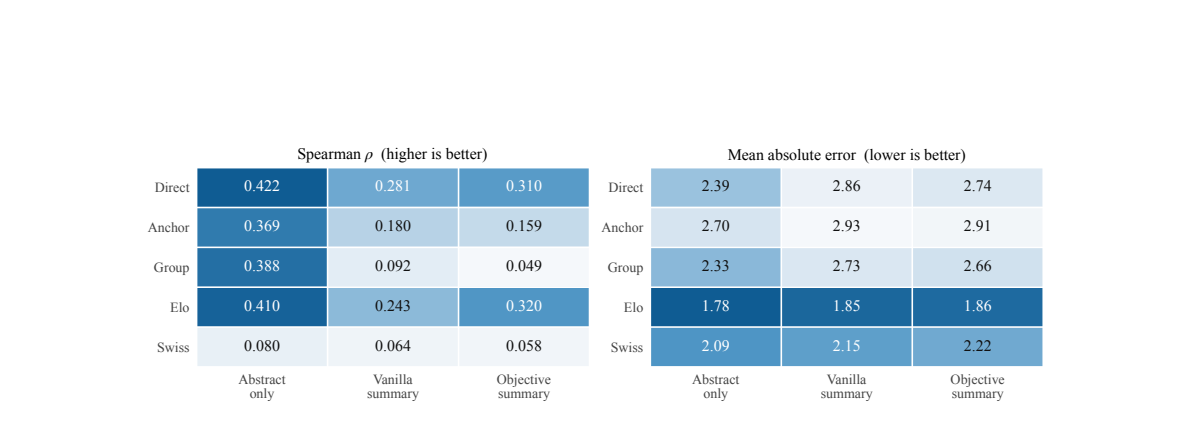
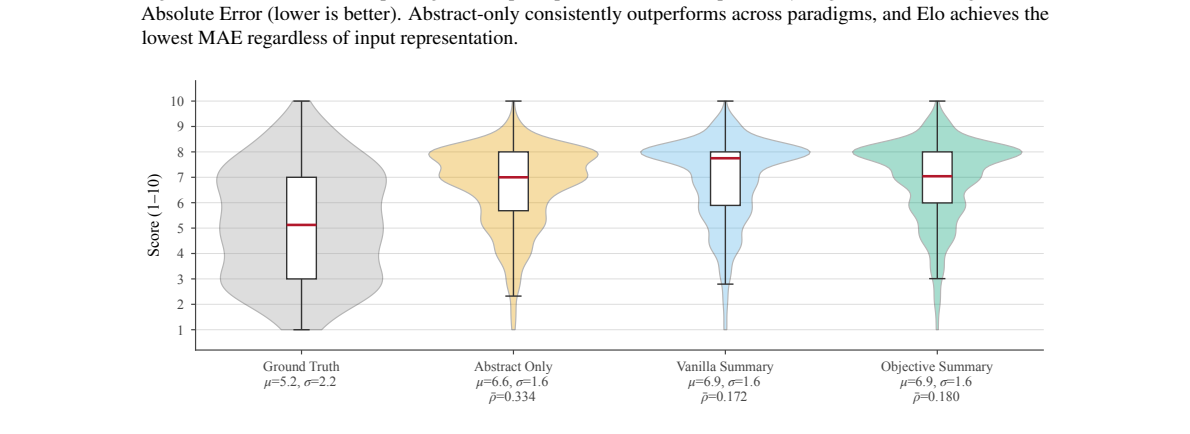
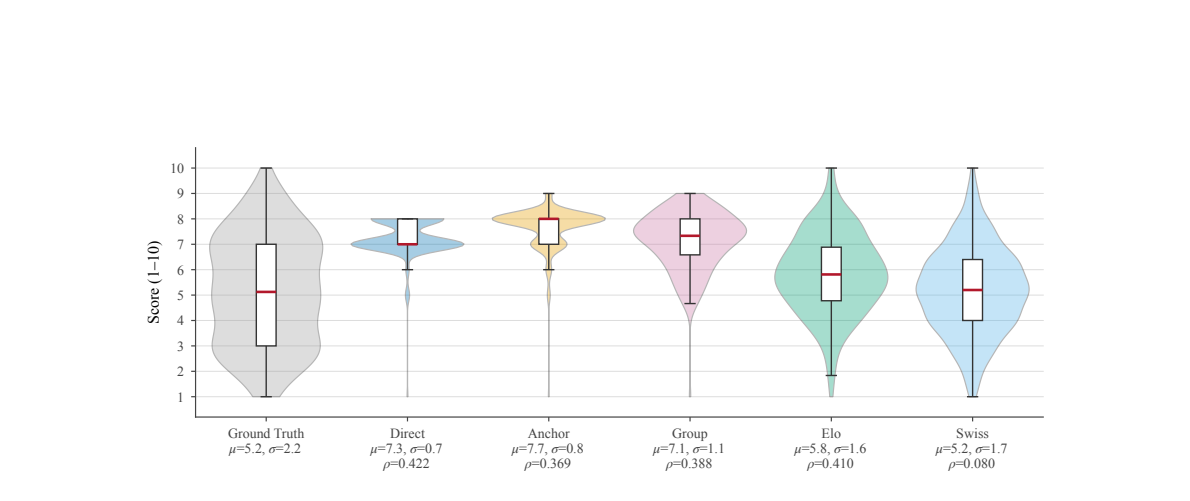
We evaluate five paradigms across three input representations and three LLMs on 232 stratified ICLR 2025 submissions. Direct absolute rating matches comparative ranking on rank correlation with human scores, yet compresses most predictions above the accept threshold, flagging almost none of the papers reviewers scored below it. A base-rate-matched recalibration control locates the cause: comparative ranking supplies placement, not better ordering, and after recalibration Direct Rating reaches higher agreement than Elo while making 24% as many API calls. Abstract-only input beats full-paper summarization, and model choice matters as much as paradigm choice. Replicating on all 11,513 scored submissions reproduces these patterns, shows absolute agreement depends on the evaluated set's score spread, and finds none beating an always-reject baseline in accuracy. Human scores track citations better than any paradigm, with one exception: Group Rating retains its citation correlation after controlling for human scores, and alone ranks within the accepted pool. Ranking quality alone cannot assess review quality; calibration, thresholds, model, and target outcome all matter.
from the abstract
Pith says
Machine review · deepseek-v4-flash · 2 Nov 2026 · what was read was not recorded · not checked by a person
It can be wrong. Challenge this review or reply to it.
Holds up, with conditions. A self-aware, useful empirical study of LLM review paradigms whose ranking-vs-placement distinction is real, but whose headline cost-advantage claim rests on a single in-sample threshold and is less robust than the surrounding prose suggests. This line is wrong
2 major objections · 5 minor
How often objections from reviews like this one are right: not yet measured
Not checked: figures, code, what the 54 references say.
The paper says, at 4.5, Table 9, Appendix K
The review did not quote this passage.
A classifier read this sentence of the paper as acknowledging the concern (probability 0.67):
“It does assume the true reject rate is known, which a deployed system would have to estimate; we use it here as a diagnostic that isolates ordering from placement, not as a deployable procedure.”
Pith says: Objection 1 of 2 · major
The headline recalibration result (Direct kappa = 0.112 vs Elo 0.079 at population scale; gap +0.032, 95% CI [+0.006,+0.058]) is computed at a single base-rate-matched threshold per paradigm, with the threshold chosen using the true reject rate on the same test set; the paper acknowledges that this makes the control a diagnostic rather than a deployable procedure, but the bootstrap interval resamples papers only, not thresholds or tie conventions.
more of objection 1
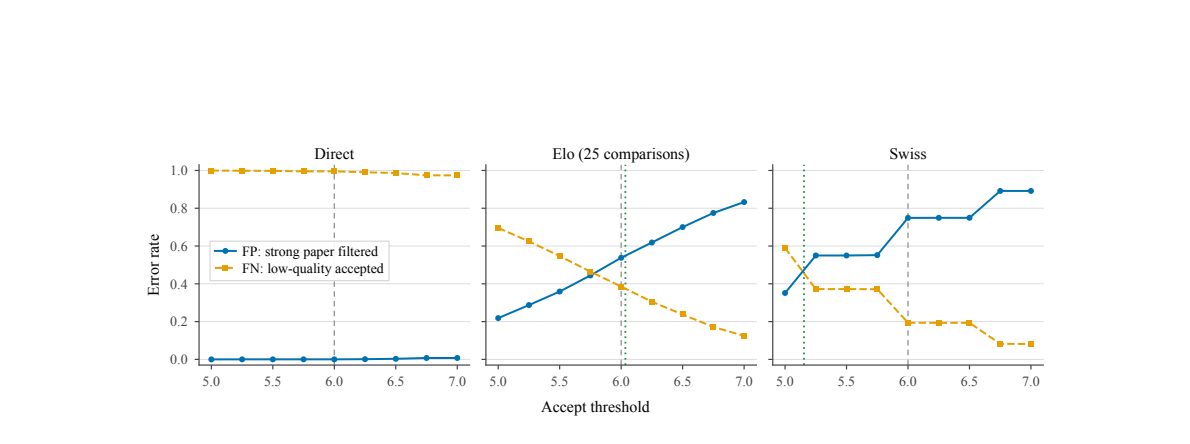
Table 9's footnote states that Direct's closest achievable predicted reject rate is 62.4% rather than the 59.5% target, because Direct's population-scale scores are means of three integer ratings on a coarse grid, so the cut falls inside a tied block whose allocation between reject and accept is an arbitrary convention (a single run would sit on an even coarser grid). Appendix K documents the analogous situation for Swiss, whose base-rate cut lands inside a clump of 1,819 papers (21% of the decision-bearing set), so the comparison includes at least two paradigms whose reported kappa depends on tie-breaking. No threshold sweep for kappa and no tie-break analysis are reported for either paradigm, and because the Direct-Elo margin is small, the practical conclusion of Section 4.5 ('we do not recommend Elo as a default') is not yet supported unless the advantage is shown to survive both tie conventions (or the expectation over random tie-breaking) across a neighborhood of thresholds around each paradigm's cut. I request a kappa-versus-threshold sweep with both tie conventions and a statement of the threshold region in which Direct's advantage holds.
The paper says, at 5, Table 8, Abstract, Limitations
The review did not quote this passage.
A classifier read this sentence of the paper as acknowledging the concern (probability 0.86):
“The open-weight runs also used condensed prompts for four of the five paradigms (Section 3), so for those paradigms prompt wording is confounded with model.”
Pith says: Objection 2 of 2 · major
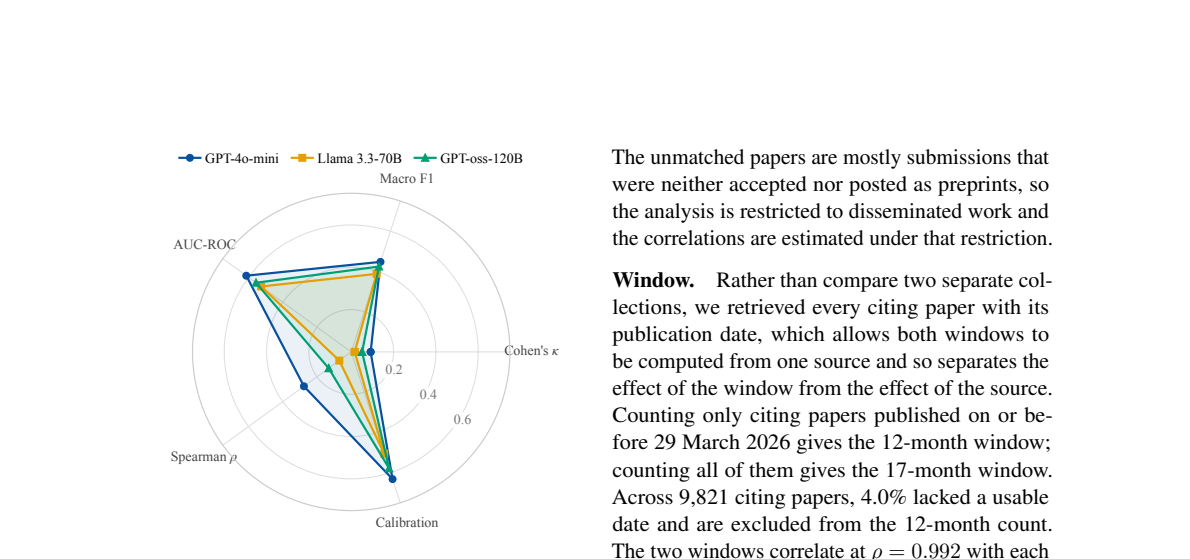
The headline that model choice matters as much as paradigm choice is supported by comparing the across-model spread in rho (0.293, averaged over paradigms) with the within-model spread across paradigms (0.267), but for Llama 3.3-70B and GPT-oss-120B four of the five paradigms ran condensed prompts, as the Limitations acknowledge, so prompt wording is confounded with model in exactly the cells that define the across-model spread, and the within-model spread for those two models is also prompt-contaminated.
more of objection 2
Section 5's 'more robust statement' is appropriately cautious, but the Abstract and Section 8 repeat the uncaveated version. I ask that the headline be aligned with the hedged statement, or that the spread comparison be recomputed on prompt-identical cells only, such as Direct across the three models together with the binary-comparison paradigms.
5 minor objections
The paper says, at Table 1, Appendix D
Pith says: minor objection 1 of 5
The Group row is a three-run mean while every other row in Table 1 is a single run, and Direct's single-run reliability is only ICC(2,1) = 0.417 (Appendix E); the main text should remind readers of this asymmetry where Group's rho = 0.388 is reported.
The paper says, at Appendix C
Pith says: minor objection 2 of 5
Package versions were not pinned; since the partial rank correlations, base-rate-matched kappa, and the ICCs come from custom implementations, a pinned environment or version snapshot would substantially strengthen reproducibility.
show 3 more
The paper says, at Table 8, Section 5
Pith says: minor objection 3 of 5
The GPT-4o-mini Group row in Table 8 uses the original score-ordered grouping (rho = 0.101) while Table 1 reports the corrected randomized-grouping mean (rho = 0.388); the caption notes this, but Section 5's narrative should include a forward pointer so the two tables are not read as contradictory.
The paper says, at Section 4.5
Pith says: minor objection 4 of 5
The sentence 'so we do not recommend Elo as a default' converts a diagnostic control that the same paragraph declares non-deployable into a deployment recommendation; the sentence should make the recommendation's dependence on the base-rate-matched operating point explicit.
The paper says, at Section 3.4
Pith says: minor objection 5 of 5
The phrase 'fixing the endpoints at 1 and 10 pulls their predictions toward the middle' is easy to misread; the mapping spreads each sample to the full 1-10 range while recentering the mean relative to that sample's own extremes, and stating that mechanism directly would clarify why inflation is not comparable across families.
What would settle it
Using the stored population-scale scores, recompute Section 4.5 across the full operating range: for each paradigm, sweep the accept threshold over the region corresponding to predicted reject rates of roughly 50–70%, recompute κ at every cut, and plot the Direct-minus-Elo difference as a function of reject rate. For Direct, handle ties at the boundary score by drawing 1,000 random tie-breaks and reporting mean κ and its spread; also report what happens when the threshold is set on a held-out split rather than using the true reject rate of the full test set. If Direct's κ exceeds Elo's across the entire sweep and under tie-break averaging, the recalibration result is robust; if the advantage inverts at adjacent cuts or vanishes under tie-break averaging, the central comparison is an artifact of one threshold choice.
from the skeptic's reading
How the review went
4 readings by deepseek-v4-flash · 2 Nov 2026
- Reader holds up, with conditions
- Skeptic partly agrees
- Editor wrote the verdict above
- Referee major revision: 2 major objections, 5 minor
Not run on this paper: the simulated authors' defence.
Pith did not check this review's objections against the paper.
The review in full
The review in brief, machine-written
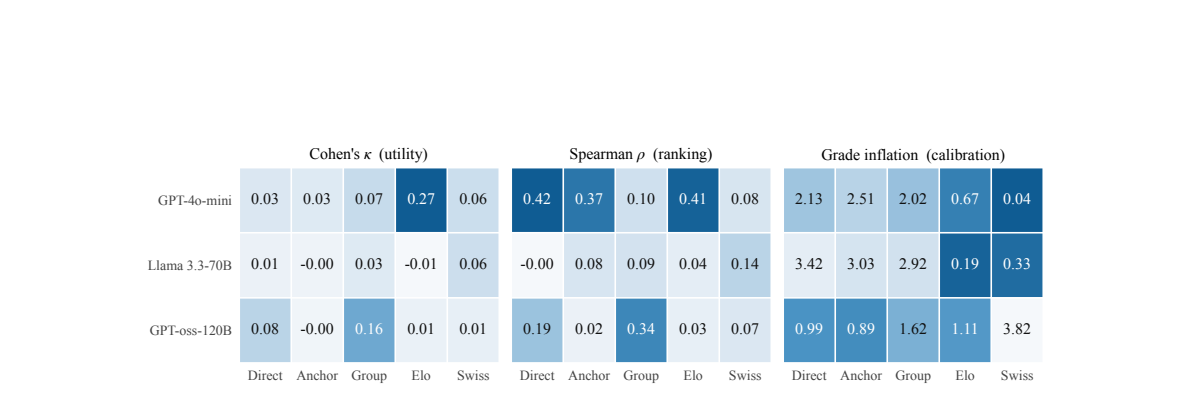
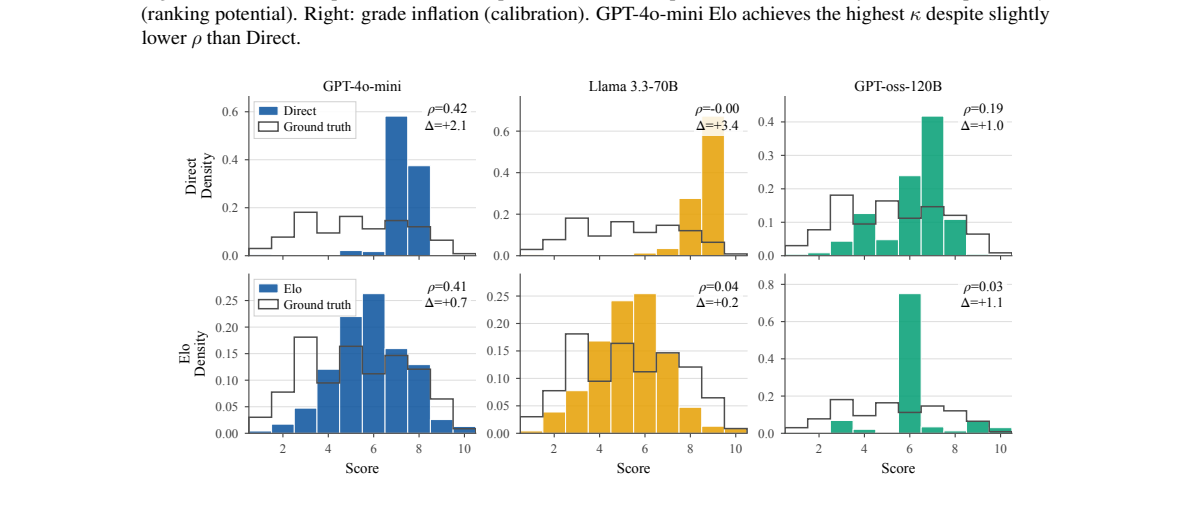
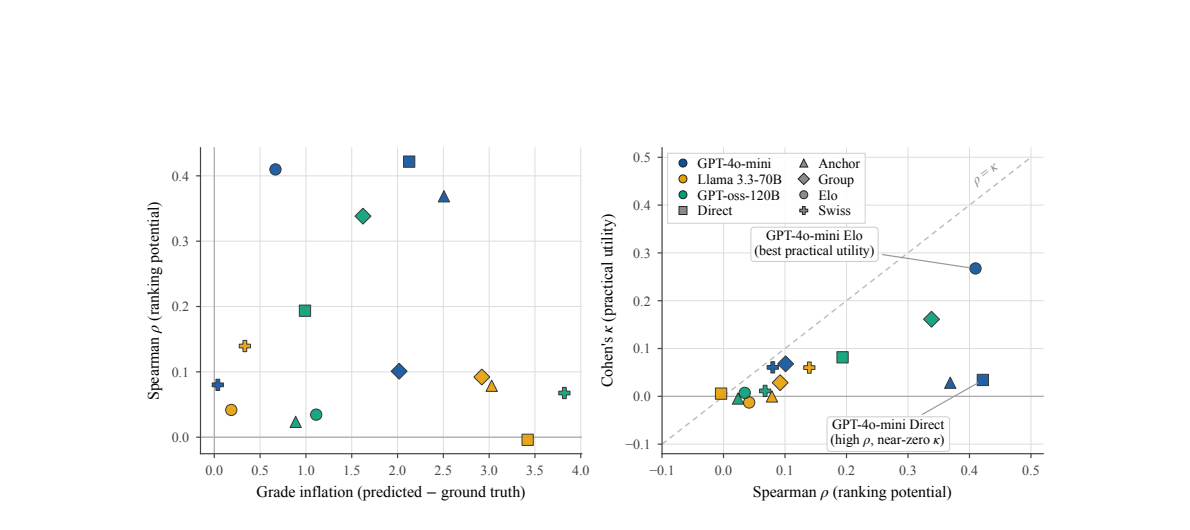
What you should know first: this is a solid empirical paper about LLM-based review paradigms, and the thing that is genuinely new in it is the separation of ranking quality from decision utility. Direct Rating and Elo rank papers similarly against human scores (rho about 0.42 vs 0.41), but at a fixed accept threshold Direct is reject-blind (4.3% reject recall vs Elo's 66.4%). Their base-rate-matched recalibration shows this is mostly placement, not ordering, and after recalibration Direct overtakes Elo while using a quarter of the API calls. That is a real result, and the population-scale replication on 11,513 papers plus the demonstration that kappa depends on score spread rather than just prevalence are worth having.
The paper is unusually self-aware. The main confounds are disclosed: the families are not scaled alike (min-max mapping for Elo/Swiss), compute is not matched, the recalibration assumes the true reject rate is known and is explicitly framed as a diagnostic, the Group Rating citation result is presented as preliminary at n=126, and the summarization comparison is against lossy summaries. I trust their numbers more because of these disclosures.
Soft spots, in proportion. The biggest is reproducibility: no code or data shipped, package versions not pinned, and Elo/Swiss raw verdicts were not retained. With a sequential Elo update and schedule dependence, that means the comparative pipeline cannot be independently reconstructed. Second, most cells are single stochastic runs, and the cross-model Group cells plus the vanilla/objective Group cells still use the biased score-ordered grouping while the headline Group row uses the corrected randomized grouping. They disclose this, but it weakens the cross-model conclusions. Third, the stress-test concern about Section 4.5 is fair but not decisive: the kappa comparison is one threshold per paradigm, selected in-sample because Direct's integer-averaged scores land at 62.4% predicted reject rate rather than 59.5%, and no threshold sweep for kappa is reported. The +0.032 gap is a single operating point, so I would not hang the cost-advantage headline on it. But the broader placement-vs-ordering claim does not depend only on that kappa gap: rank correlations are unchanged under monotone recalibration, and Direct's AUC is comparable, so the separation is supported on more than one cut. Minor: the abstract's 'none beats always-reject in accuracy' is true under the score-based rule but against the recorded ICLR decisions Direct exceeds the baseline by 0.3 points; the paper discloses this later. Also, the reference list leans heavily on the first author's own arXiv preprints; several are on-point, a couple look like padding.
Recommendation: send it to a serious referee. I would ask for artifacts and repeated runs of the headline cells and a threshold sweep around the base-rate cut before accepting, but the conceptual core is worth engaging.
The strongest objection
The central placement-versus-ordering claim is carried by the base-rate-matched recalibration in Section 4.5: Direct's κ rises from 0.004 to 0.112, above Elo's 0.079, with a gap of +0.032 whose 95% CI just excludes zero. This comparison is computed at one threshold per paradigm, and the threshold is chosen using the true reject rate on the same test set. Table 9 reports that Direct's closest achievable predicted reject rate is 62.4%, not the 59.5% target, because Direct's averaged integer scores lie on a coarse grid. Direct's prediction distribution is highly concentrated (Appendix H), so the chosen cut plausibly falls inside a large tied score block, and κ at that cut depends on an arbitrary tie convention. The paper reports no threshold sweep for κ and no tie-break analysis. The min-max rescaling confound is acknowledged and largely controlled by the recalibration; the unresolved issue is that the headline 'recalibration is the cheaper route to better decision quality' is supported by a single operating point whose margin is small and whose threshold was selected with label information. If the advantage inverts at neighboring cuts, the placement conclusion survives only as a claim about one chosen threshold, not about Decision quality generally.
The reader identified the min-max rescaling as the weakest assumption. I read that confound as explicitly acknowledged and largely neutralized by the recalibration itself, since a monotone rescaling cannot change threshold classifications once each paradigm is thresholded at its own base-rate-matched cut. The remaining load-bearing risk is the way the recalibration result is summarized: one threshold per paradigm, chosen with knowledge of the true reject rate, on a coarse score grid for Direct, with a small margin and no sensitivity analysis. That risk is concrete and testable from data the authors say they hold, but it does not undermine the paper's broader conclusion that ranking quality alone cannot assess review quality, and the authors already state that no configuration is usable as an autonomous gate. The paper deserves credit for the compute-matched control in Appendix E, the replicate-aware caveats, and the unusually explicit limitation statements. Because the concern is addressable with a supplementary analysis and the reader's verdict was already conditional, I would leave the verdict unchanged.
The referee's report
If the findings hold, the paper contributes a clean separation between ranking potential and decision utility in LLM-based review, with a concrete demonstration that a paradigm's apparent comparative advantage can be a placement effect removable by an order-preserving recalibration. The study is methodologically careful in ways worth crediting explicitly: bootstrap intervals accompany the main comparisons; correlations are read against attenuation-corrected ceilings rather than against 1; a compute-matched control (five Direct runs versus five Elo comparisons) directionally supports the cost argument; Appendix R candidly documents that an earlier citation-collection version of the analysis was invalidated by incomplete indexing; and the Group Rating citation effect is framed as hypothesis-generating given n=126 from one venue. The broader thesis, that fixed-threshold comparisons across paradigms rank the paradigms largely by score placement and that rank correlation alone is an insufficient report, is well supported.
Pith's reading of the paper (a machine's summary, not the authors')
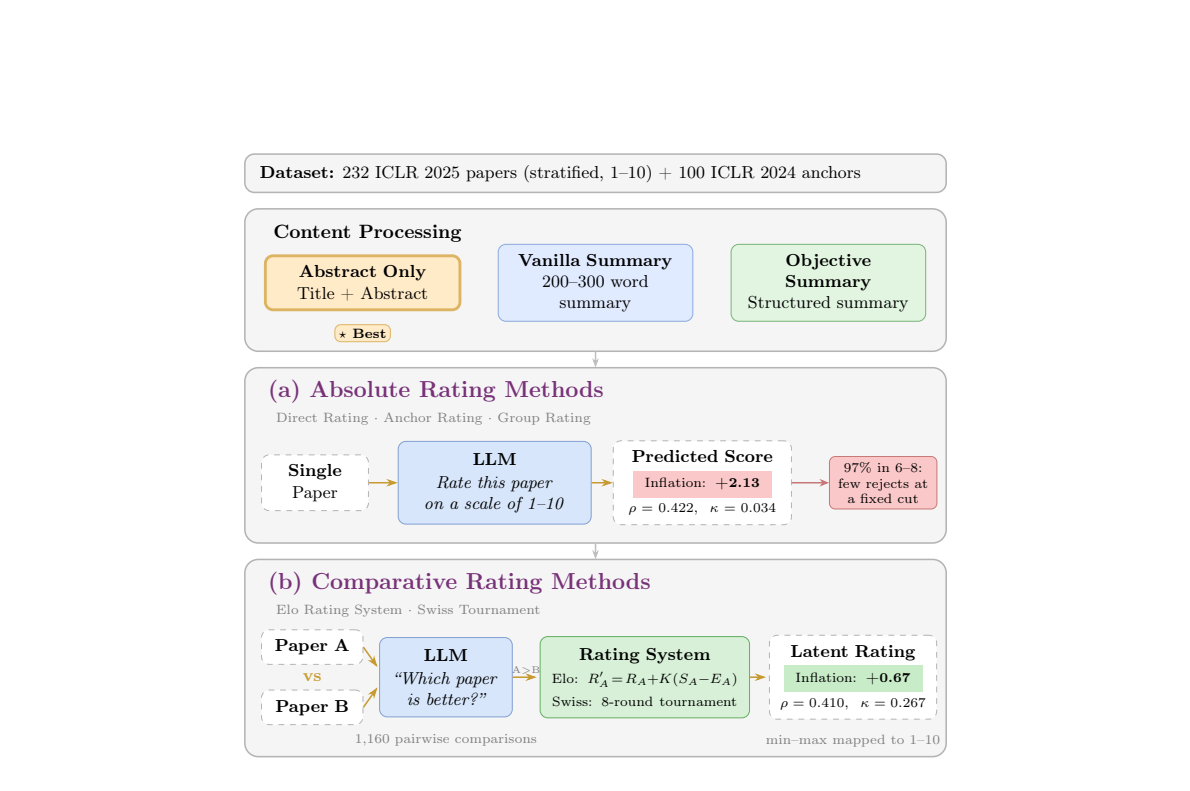
LLM-based paper review is a design space — which scoring paradigm, how much of the paper the model reads, and which model — and this paper's central claim is that these choices diverge most sharply not in how well they rank papers but in whether the scores land on the usable side of an accept/reject threshold. On 232 stratified ICLR 2025 submissions, Direct Rating and Elo rank papers against human reviewers almost identically ($\rho = 0.422$ vs. $0.410$), yet at a fixed threshold of 6, Direct flags only 4.3% of papers reviewers rejected, while Elo flags 66.4%, a failure the paper names reject blindness. A base-rate-matched recalibration control attributes the difference to placement rather than ordering: once each paradigm is cut at its own base rate, Direct Rating reaches higher agreement ($\kappa = 0.112$ vs. $0.079$) while using 24% as many API calls. The broader conclusion is that ranking quality alone cannot assess review quality — calibration, thresholds, model, and target outcome all matter — and readers should care because venues are beginning to deploy LLM reviewers at scale.
What carries the argument. The load-bearing device is a conceptual and statistical separation of ranking from placement, operationalized by the base-rate-matched recalibration control. The paper distinguishes ranking potential (Spearman $\rho$), which is invariant under any monotone transform of scores, from decision utility (Cohen's $\kappa$, reject recall, accuracy), which depends on where scores sit relative to a threshold. Because a fixed threshold credits comparative paradigms with the wider spread their latent ratings inherit from min–max mapping onto 1–10, the paper re-thresholds each paradigm at the cut where its predicted reject rate equals the true 59.5% base rate; being monotone, this transform leaves every ranking metric unchanged while isolating placement. Around this control, the Elo machinery (the logistic expected-score update with the conventional $s=400$, $K=32$) and Swiss tournament pairing ($\lceil\log_2 n\rceil$ rounds) generate the comparative family's latent ratings, and an ICC-based reviewer-noise ceiling (ICC(1,1) $= 0.327$) sets the upper bound any predictor — a second human reviewer included — could attain on this target.
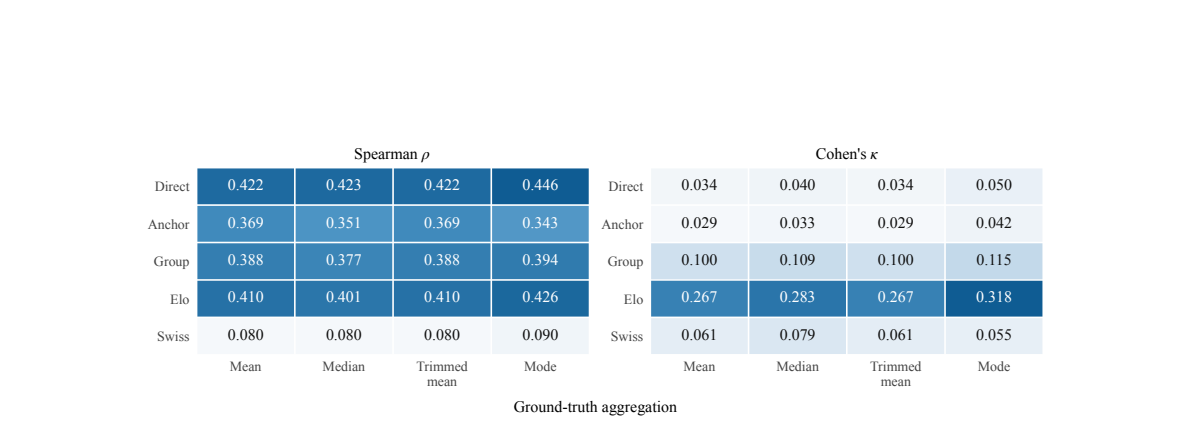
Core claim. The paper's discovery is a separation between two quantities that are often conflated: ranking potential, how well a paradigm orders papers relative to human scores, and decision utility, the accept/reject decisions a paradigm induces. Direct Rating and Elo exhibit nearly equal Spearman correlation with human scores (0.422 vs. 0.410) and nearly equal AUC-ROC (0.682 vs. 0.672), yet at a single fixed threshold $\ge 6$ Direct Rating flags just 4.3% of below-threshold papers against Elo's 66.4%. Re-running at population scale on all 11,513 scored submissions sharpens the effect (Direct flags 0.5%; Elo's $\kappa$ falls to 0.076), and the fall is traced to the spread of ground-truth scores rather than to class prevalence. The decisive control applies a base-rate-matched cut to each paradigm — the threshold at which its predicted reject rate equals the true 59.5% — which is monotone and so preserves every ranking metric; after it, Direct Rating rises to $\kappa = 0.112$, ahead of Elo's 0.079 and Swiss's 0.078, with a bootstrap confidence interval that separates Direct from Elo. The authors' reading is that what Elo supplies is placement, not better ordering, and that part of that placement follows from the min–max mapping of latent ratings onto the 1–10 scale rather than from the comparison mechanism itself.
The premise it rests on. The claim that comparative ranking supplies only placement assumes the min–max mapping of Elo and Swiss latent ratings onto the 1–10 scale is benign — if that rescaling, rather than the comparison mechanism, is what spreads the comparative scores, the recalibration control is comparing artifacts of two different scales, a confound the authors explicitly flag in their Limitations.
If the paper is right (Pith's inferences, not the authors')
Rank correlation alone is not evidence that an LLM reviewer makes usable decisions: studies reporting only $\rho$ for a review paradigm should also report thresholded, base-rate-matched decision metrics on a deployment-representative sample.
Recalibrating a cheap absolute rater is a more cost-effective route to decision quality than switching to pairwise comparison, since Direct Rating beats Elo on $\kappa$ after recalibration at 24% of the API calls.
Absolute agreement metrics like Cohen's $\kappa$ reflect the score spread of the evaluated set, not only class prevalence, so $\kappa$ values only transfer between samples whose score distributions match.
At the ICLR 2025 base rate no tested configuration beats always rejecting every paper, so the paper supports using LLM review as a triage aid rather than an autonomous accept/reject gate.
The best paradigm depends on the model running it and the target it is scored against, so single-model, single-target paradigm comparisons cannot support a general recommendation.
If placement rather than ordering is the binding constraint, the research priority shifts from building better comparison protocols to estimating each submission pool's reject base rate and threshold reliably; the paper's control assumes the 59.5% rate is known, and a deployed system would have to guess it.
The min–max mapping confound the authors explicitly flag suggests a decisive follow-up: calibrating Elo ratings to the human-score distribution by quantile matching instead of min–max could erase or amplify Elo's placement advantage, and would settle whether the comparison mechanism itself contributes anything beyond a rescaling effect.
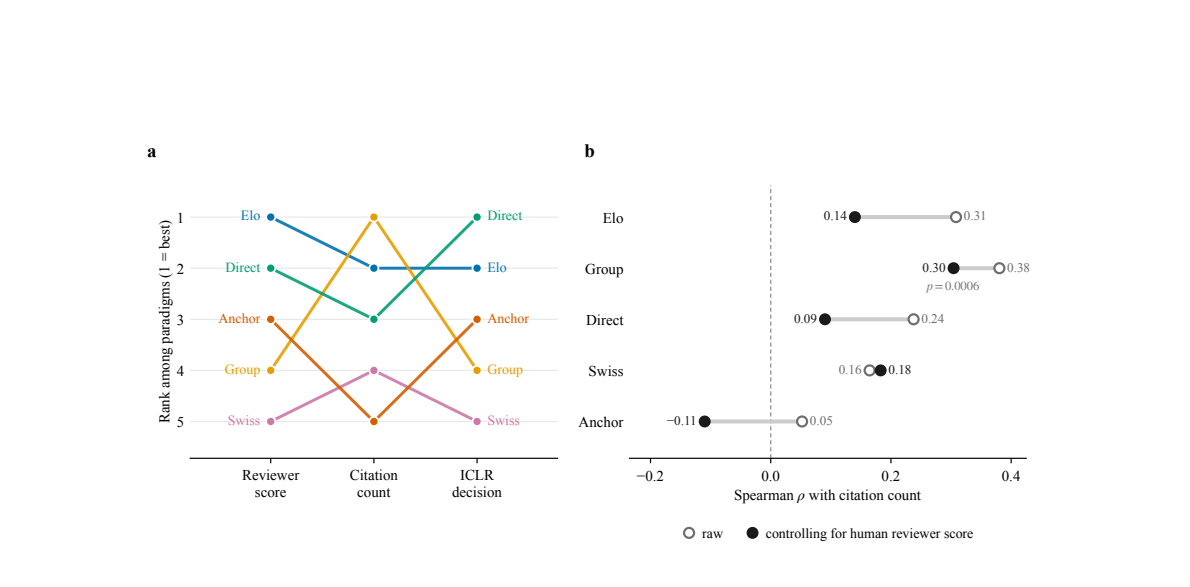
Group Rating's survival of the partial-citation correlation ($\rho = 0.304$ after controlling for human scores) hints that scoring papers in batches forces comparative judgments that surface impact-relevant signal; varying group size and venue would test whether batching, not the model, is the active ingredient.
If $\kappa$ depends on score spread as steeply as reported (0.267 stratified vs. 0.076 population at nearly identical prevalence), then many published LLM-as-judge agreement comparisons may be uninterpretable, because few prior studies matched score distributions across the systems being compared.
Check this review
Pith stored no record of this review's passes and took no fingerprint of it. Reviews made by code from 13 Nov 2026 on carry both.
How often reviews like this one are right
Reviews like this one: written by deepseek-v4-flash, where what was read was not recorded.
How often objections from reviews like this one are right: not yet measured
Reviews by people
This review was written by a machine. No person has reviewed this paper on Pith yet. A scientist listed on Pith can review it for a fee, and their review is published here whatever it concludes.
The paper
Abstract
Growing submission volumes have renewed interest in using large language models (LLMs) to support peer review. It remains unclear how such evaluation should be structured, how much the model matters, and whether LLM scores predict research impact. We evaluate five paradigms across three input representations and three LLMs on 232 stratified ICLR 2025 submissions. Direct absolute rating matches comparative ranking on rank correlation with human scores, yet compresses most predictions above the accept threshold, flagging almost none of the papers reviewers scored below it. A base-rate-matched recalibration control locates the cause: comparative ranking supplies placement, not better ordering, and after recalibration Direct Rating reaches higher agreement than Elo while making 24% as many API calls. Abstract-only input beats full-paper summarization, and model choice matters as much as paradigm choice. Replicating on all 11,513 scored submissions reproduces these patterns, shows absolute agreement depends on the evaluated set's score spread, and finds none beating an always-reject baseline in accuracy. Human scores track citations better than any paradigm, with one exception: Group Rating retains its citation correlation after controlling for human scores, and alone ranks within the accepted pool. Ranking quality alone cannot assess review quality; calibration, thresholds, model, and target outcome all matter.
The paper's own sentences, arranged, kept beside the review and separate from it. Each label is drawn from a closed vocabulary; the number beside it is the probability the classifier gave that label. No sentence in this record was written by a model.
abstract compiled · 2026-11-02
The authors' main claim, as the classifier picked it out 0.99
“Ranking quality alone cannot assess review quality; calibration, thresholds, model, and target outcome all matter.”
How the main claim is stated: asserted 1.00
What the abstract itself states, as probabilities: claims first 0.04 · states limitation 0.92 · human participants 0.26 · controlled comparison 0.97 · randomized assignment 0.04 · states quantitative result 0.99 · compares with prior results 0.96 · mentions code or data availability 0.03
The abstract, sentence by sentence
This table labels the abstract only (arXiv listing abstract v1). The number is the probability the classifier gave the label.
| Sentence | Role | The authors' own work | States the main conclusion | Strength |
|---|---|---|---|---|
| Growing submission volumes have renewed interest in using large language models (LLMs) to support peer review. | background 1.00 | 0.04 | 0.02 | asserted 1.00 |
| It remains unclear how such evaluation should be structured, how much the model matters, and whether LLM scores predict research impact. | gap 1.00 | 0.05 | 0.03 | asserted 0.73 |
| We evaluate five paradigms across three input representations and three LLMs on 232 stratified ICLR 2025 submissions. | method 0.85 | 0.97 | 0.03 | asserted 0.99 |
| Direct absolute rating matches comparative ranking on rank correlation with human scores, yet compresses most predictions above the accept threshold, flagging almost none of the papers reviewers scored below it. | result 1.00 | 0.93 | 0.11 | asserted 1.00 |
| A base-rate-matched recalibration control locates the cause: comparative ranking supplies placement, not better ordering, and after recalibration Direct Rating reaches higher agreement than Elo while making 24% as many API calls. | result 0.71 | 0.94 | 0.23 | asserted 1.00 |
| Abstract-only input beats full-paper summarization, and model choice matters as much as paradigm choice. | result 1.00 | 0.93 | 0.12 | asserted 1.00 |
| Replicating on all 11,513 scored submissions reproduces these patterns, shows absolute agreement depends on the evaluated set's score spread, and finds none beating an always-reject baseline in accuracy. | result 0.99 | 0.96 | 0.13 | asserted 1.00 |
| Human scores track citations better than any paradigm, with one exception: Group Rating retains its citation correlation after controlling for human scores, and alone ranks within the accepted pool. | result 1.00 | 0.93 | 0.17 | asserted 1.00 |
| Ranking quality alone cannot assess review quality; calibration, thresholds, model, and target outcome all matter. | interpretation 1.00 | 0.68 | 0.76 | asserted 1.00 |
What kind of paper the classifier reports this is: empirical study 1.00 · evidence from observation or experiment 0.74
What was examined, and what was not
Sources read
- arXiv listing abstract v1
Not examined
- full text
- figures and tables
- references and citing sentences
- relations to other papers
Levels run
- P abstract
Not run
- S sections
- T body sentences
- C citations
- R cross-paper relations
How the labels were made
Compiled by classifier-1.13.0 via TypeSafe API, question bank abstract-p1-20260923, 2026-11-02: 1 request, 6,941 input tokens.
Every quoted sentence on this record is the authors'. Every label is from Pith's closed vocabulary, with the probability shown beside it. This record as JSON
Figures (12)
Figures are the authors', reproduced from the paper.
References (54)
- [1] Challenges, experiments, and computational solutions in peer review , author=. Communications of the ACM , volume=. 2022 , publisher= on Pith
- [2] Checco, Alessandro and Bracciale, Lorenzo and Loreti, Pierpaolo and Pinfield, Stephen and Bianchi, Giuseppe , journal=. 2021 , publisher= on Pith
- [3] arXiv preprint arXiv:2303.08774 , year= on PithPith's reviewarXiv
- [4] Kang, Dongyeop and Ammar, Waleed and Dalvi, Bhavana and van Zuylen, Madeleine and Kohlmeier, Sebastian and Hovy, Eduard and Schwartz, Roy , booktitle=. A dataset of peer reviews (. 2018 , address= on Pith
- [5] Can we automate scientific reviewing? , author=. Journal of Artificial Intelligence Research , volume= on Pith
- [6] Liang, Weixin and Zhang, Yuhui and Cao, Hancheng and Wang, Binglu and Ding, Daisy Yi and Yang, Xinyu and Vodrahalli, Kailas and He, Siyu and Smith, Daniel Scott and Yin, Yian and McFarland, Daniel A. and Zou, James , journal=. Can large language models provide useful feedback ... on Pith
- [7] Robertson, Zachary , journal= on Pith
- [8] Zheng, Lianmin and Chiang, Wei-Lin and Sheng, Ying and Zhuang, Siyuan and Wu, Zhanghao and Zhuang, Yonghao and Lin, Zi and Li, Zhuohan and Li, Dacheng and Xing, Eric and Zhang, Hao and Gonzalez, Joseph and Stoica, Ion , booktitle=. Judging on Pith
- [9] Liu, Yuxuan and Yang, Tianchi and Huang, Shaohan and Zhang, Zihan and Huang, Haizhen and Wei, Furu and Deng, Weiwei and Sun, Feng and Zhang, Qi , booktitle=. Calibrating. 2024 , address= on Pith
- [10] Elo uncovered: Robustness and best practices in language model evaluation , author=. Advances in Neural Information Processing Systems , volume= on Pith
- [11] The rating of chessplayers, past and present , author= on Pith
- [12] Weighted matching in chess tournaments , author=. Journal of the Operational Research Society , volume=. 1990 , publisher= on Pith
- [13] Saito, Takaya and Rehmsmeier, Marc , journal=. The precision-recall plot is more informative than the. 2015 , publisher= on Pith
- [14] Intraclass correlations: uses in assessing rater reliability. , author=. Psychological Bulletin , volume=. 1979 , publisher= on Pith
- [15] A guideline of selecting and reporting intraclass correlation coefficients for reliability research , author=. Journal of Chiropractic Medicine , volume=. 2016 , publisher= on Pith
- [16] Zhang, Yaohui and Zhang, Haijing and Ji, Wenlong and Hua, Tianyu and Haber, Nick and Cao, Hancheng and Liang, Weixin , booktitle=. From replication to redesign: Exploring pairwise comparisons for on Pith
- [17] Large language models are not fair evaluators , author=. Proceedings of the 62nd Annual Meeting of the Association for Computational Linguistics (Volume 1: Long Papers) , pages=. 2024 , address= on Pith
- [18] Li, Qingquan and Dou, Shaoyu and Shao, Kailai and Chen, Chao and Hu, Haixiang , booktitle=. Evaluating scoring bias in. 2026 , publisher= on Pith
- [19] Lu, Chris and Lu, Cong and Lange, Robert Tjarko and Foerster, Jakob and Clune, Jeff and Ha, David , journal=. The on Pith
- [20] D'Arcy, Mike and Hope, Tom and Birnbaum, Larry and Downey, Doug , journal= on Pith
show 34 more
- [21] Reviewer2: Optimizing review generation through prompt generation , author=. arXiv preprint arXiv:2402.10886 , year= on PithPith's reviewarXiv
- [22] Liu, Ryan and Shah, Nihar B , journal= on Pith
- [23] Large language models for automated scholarly paper review: A survey , author=. Information Fusion , volume=. 2025 , publisher= on Pith
- [24] Wei, Qiyao and Holt, Samuel and Yang, Jing and Wulfmeier, Markus and van der Schaar, Mihaela , booktitle=. Position: The. 2026 , publisher= on Pith
- [25] Biswas, Joydeep and Schoepp, Sheila and Vasan, Gautham and Opipari, Anthony and Zhang, Arthur and Hu, Zichao and Joseph, Sebastian and Lease, Matthew and Li, Junyi Jessy and Stone, Peter and Wagstaff, Kiri L. and Taylor, Matthew E. and Jenkins, Odest Chadwicke , journal= on Pith
- [26] Position: Stop Automating Peer Review Without Rigorous Evaluation , author=. Proceedings of the 43rd International Conference on Machine Learning , series=. 2026 , publisher= on Pith
- [27] Li, Lingyao and Xiong, Junjie and Zhu, Changjia and Yu, Runlong and Chen, Chen and Wang, Junyu and Ma, Renkai and Lu, Zhicong , journal= on Pith
- [28] Thakkar, Nitya and Yuksekgonul, Mert and Silberg, Jake and Garg, Animesh and Peng, Nanyun and Sha, Fei and Yu, Rose and Vondrick, Carl and Zou, James , journal=. Can on Pith
- [29] Yu, Sungduk and Luo, Man and Madasu, Avinash and Lal, Vasudev and Howard, Phillip , booktitle=. Is your paper being reviewed by an on Pith
- [30] Rao, Vishisht Srihari and Kumar, Aounon and Lakkaraju, Himabindu and Shah, Nihar B , journal=. Detecting. 2025 , publisher= on Pith
- [31] Epstein, Elliot L and Dwaraknath, Rajat and Winnicki, John and Sornwanee, Thanawat , journal=. Allocate Marginal Reviews to Borderline Papers Using on Pith
- [32] Tong, Jingqi and Li, Mingzhe and Li, Hangcheng and Yang, Yongzhuo and Mou, Yurong and Ma, Weijie and Chen, Hongji and Liu, Xiaoran and Cheng, Qinyuan and Zhang, Ming and Chen, Qiguang and Ge, Weifeng and Guo, Qipeng and Ying, Tianlei and Sun, Tianxiang and Zheng, Yining and Xi... on Pith
- [33] Fujinuma, Yoshinari , booktitle=. Contrastive decoding mitigates score range bias in. 2026 , address= on Pith
- [34] Xu, Yi and Ruis, Laura and Rockt. Investigating non-transitivity in. Proceedings of the 42nd International Conference on Machine Learning , series=. 2025 , publisher= on Pith
- [35] Haldar, Rajarshi and Hockenmaier, Julia , booktitle=. Rating roulette: Self-inconsistency in. 2025 , address= on Pith
- [36] Norman, Justin D and Rivera, Michael U and Hughes, D Alex , journal=. Reliability without Validity: A Systematic, Large-Scale Evaluation of on Pith
- [37] Tripathi, Tuhina and Wadhwa, Manya and Durrett, Greg and Niekum, Scott , booktitle=. Pairwise or pointwise? on Pith
- [38] Liu, Zirui and Li, Jiatong and Zhuang, Yan and Liu, Qi and Shen, Shuanghong and Ouyang, Jie and Cheng, Mingyue and Wang, Shijin , booktitle=. am-. 2025 , publisher= on Pith
- [39] Rao, Delip and Callison-Burch, Chris , journal=. Agreement Metrics for on Pith
- [40] High agreement but low kappa: I. The problems of two paradoxes , author=. Journal of Clinical Epidemiology , volume=. 1990 , publisher= on Pith
- [41] Aaron Grattafiori and Abhimanyu Dubey and Abhinav Jauhri and Abhinav Pandey and Abhishek Kadian and Ahmad Al-Dahle and Aiesha Letman and Akhil Mathur and Alan Schelten and Alex Vaughan and Amy Yang and Angela Fan and Anirudh Goyal and Anthony Hartshorn and Aobo Yang and Archi ... on PithPith's reviewarXiv
- [42] gpt-oss-120b & gpt-oss-20b model card , author=. arXiv preprint arXiv:2508.10925 , year= on PithPith's reviewarXiv
- [43] Kinney, Rodney and Anastasiades, Chloe and Authur, Russell and Beltagy, Iz and Bragg, Jonathan and Buraczynski, Alexandra and Cachola, Isabel and Candra, Stefan and Chandrasekhar, Yoganand and Cohan, Arman and Crawford, Miles and Downey, Doug and Dunkelberger, Jason and Etzion... on Pith
- [44] Verma, Nitin and Landrum, Asheley R. , booktitle=. All Accept, No Reject: Evaluating. 2026 , address= on Pith
- [45] Tran, David and Valtchanov, Alex and Ganapathy, Keshav and Feng, Raymond and Slud, Eric and Goldblum, Micah and Goldstein, Tom , journal=. An Open Review of on Pith
- [46] 2024 , howpublished= on Pith
- [47] Huang, Fan and Kwak, Haewoon and Park, Kunwoo and An, Jisun , booktitle=. 2024 , address= on Pith
- [48] Huang, Fan , journal=. Catalyst Papers in Artificial Intelligence Research: A Landscape on on Pith
- [49] Huang, Fan and Zhang, Songheng and Kwak, Haewoon and An, Jisun , journal= on Pith
- [50] Huang, Fan and Kim, Minsuk and Diggans, C. Tyler and Radicchi, Filippo , journal=. Evaluating on Pith
- [51] Huang, Fan , journal= on Pith
- [52] Huang, Fan and Kim, Munjung , journal=. Can on Pith
- [53] Huang, Fan , journal=. Reasoning Topology Matters: on Pith
- [54] Yin, Lake and Huang, Fan , journal= on Pith
Cited by 1 Pith paper
Reviewed papers on Pith that cite this one. The full citation record
Challenges and discussion
Disagree with the review, or know something it missed? Leave a comment, or challenge this review formally: a challenge becomes a permanent entry in this paper's record, and its decision is published here.
Come back by email
A short list of the week's newly reviewed papers. Nothing is sent until you confirm from your inbox, and every email has a link that stops it. No account.
No comments yet.
Sign in to comment