Computation and Language · arXiv:2608.03659 v1 · submitted 4 Aug 2026 · 17 references
How Closely Do LLM Reviews Align with Human Peer Review?
The paper says
“Large language models (LLMs) are increasingly used to generate scientific reviews, yet existing evaluations rarely examine whether different providers align with both conference decisions and human reviewing priorities within the same controlled setting.”
more of the abstract
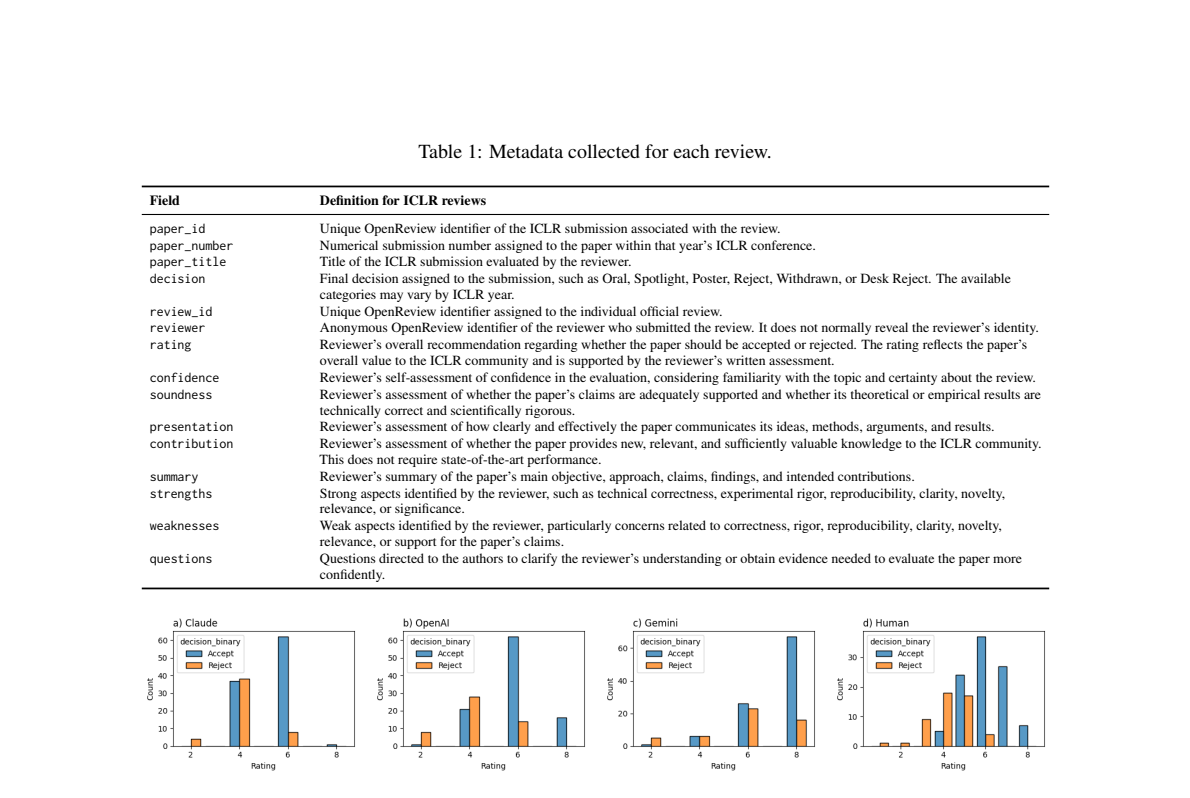
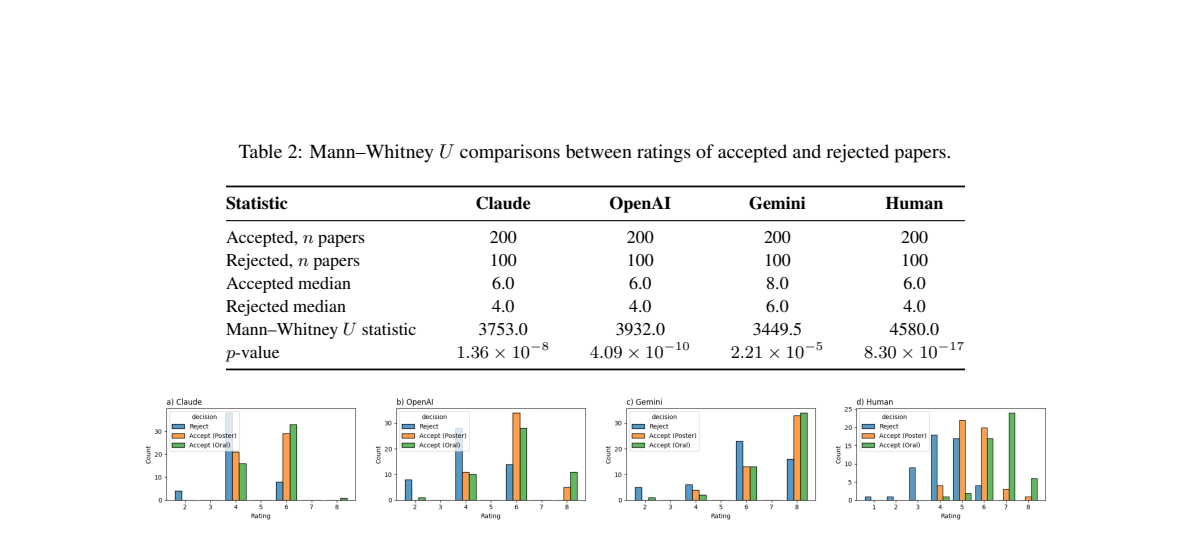
We compare reviews from OpenAI GPT-5.4, Google Gemini 3.1 Pro Preview, and Anthropic Claude Opus 4.6 with human reviews and final decisions for 300 topic-matched ICLR 2026 submissions, equally divided among oral, poster, and rejected papers. Each model reviewed every paper using identical instructions and rating scales after decision information was removed. Our study contributes a cross-provider analysis of three complementary dimensions: alignment with broad and fine-grained decision categories, differences in recommendation-scale usage, and thematic agreement in identified weaknesses. All three LLMs distinguished accepted from rejected papers, but none reproduced the oral versus poster distinction present in human ratings. Scoring patterns were provider-specific: Gemini assigned systematically higher ratings, while OpenAI and Claude were closer to humans for rejected and poster papers but more critical of oral papers. Human and LLM reviews also differed in emphasis, with LLMs more frequently identifying missing baseline comparisons and humans more often raising computational-efficiency concerns. These results show that broad decision alignment does not imply agreement with finer human judgments or reviewing priorities.
from the abstract
Pith says
Machine review · deepseek-v4-flash · 15 Aug 2026 · what was read was not recorded · not checked by a person
It can be wrong. Challenge this review or reply to it.
Holds up, with conditions. Useful empirical result on LLM review alignment, but the oral/poster claim rests on comparing averaged human ratings against single LLM ratings. This line is wrong
4 major objections · 4 minor
How often objections from reviews like this one are right: not yet measured
Not checked: figures, code, what the 17 references say.
The paper says, at §4.2, Table 3
The review did not quote this passage.
Pith says: Objection 1 of 4 · major
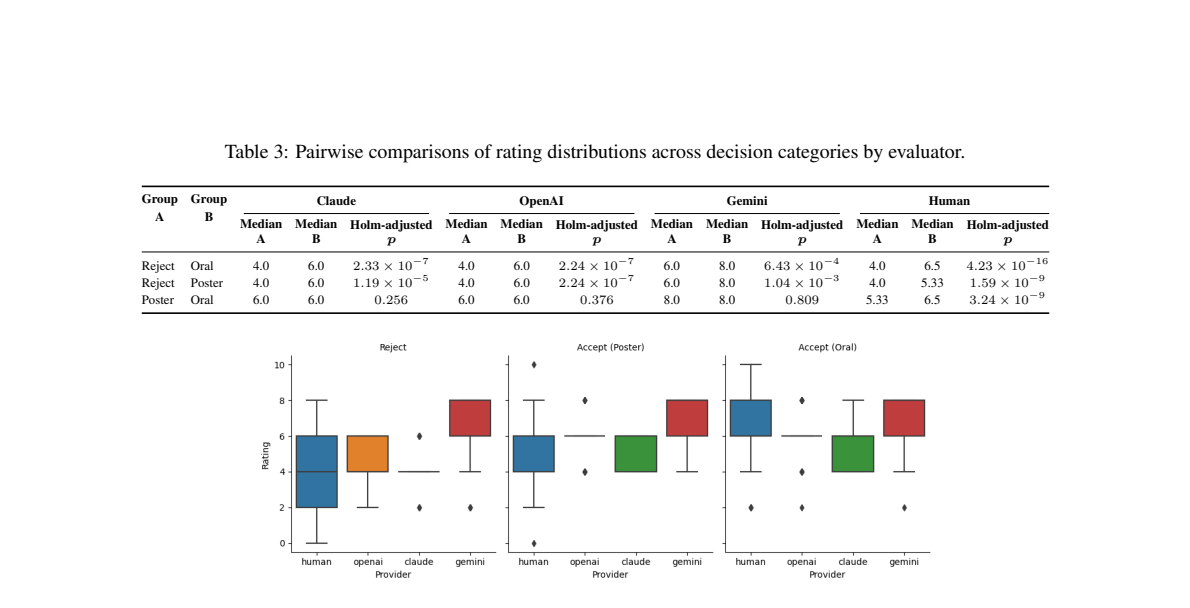
The central claim that LLMs do not reproduce the oral-versus-poster distinction rests on an asymmetric unit of analysis. Human ratings are paper-level means over multiple reviews (e.g., 5.33 vs. 6.5), whereas each LLM provides exactly one rating per paper on the coarse six-point scale; averaging independent reviews reduces within-paper noise and creates a more finely graded scale.
more of objection 1
To support the claim, the authors should compute a single-review human baseline by sampling one human review per paper (or a fixed equal number) and repeating the Mann–Whitney comparisons in Table 3; if the poster-oral separation does not survive that baseline, the headline distinction is an artifact of aggregation rather than a property of LLM judgment. Effect sizes (e.g., rank-biserial correlation) should also be reported for all pairwise comparisons.
The paper says, at §4.2, Table 3
The review did not quote this passage.
Pith says: Objection 2 of 4 · major
Interpreting the three non-significant poster-oral p-values (0.256, 0.376, 0.809) as showing that the models 'do not reproduce' the distinction conflates absence of evidence with evidence of absence. With n=100 and a coarse discrete rating scale, the tests may simply lack power; the authors should compare effect sizes across evaluators or run an equivalence-type analysis before drawing the strong negative conclusion. This is especially important because the human comparison uses averaged ratings and therefore has lower noise.
The paper says, at §4.5, Figure 5
The review did not quote this passage.
Pith says: Objection 3 of 4 · major
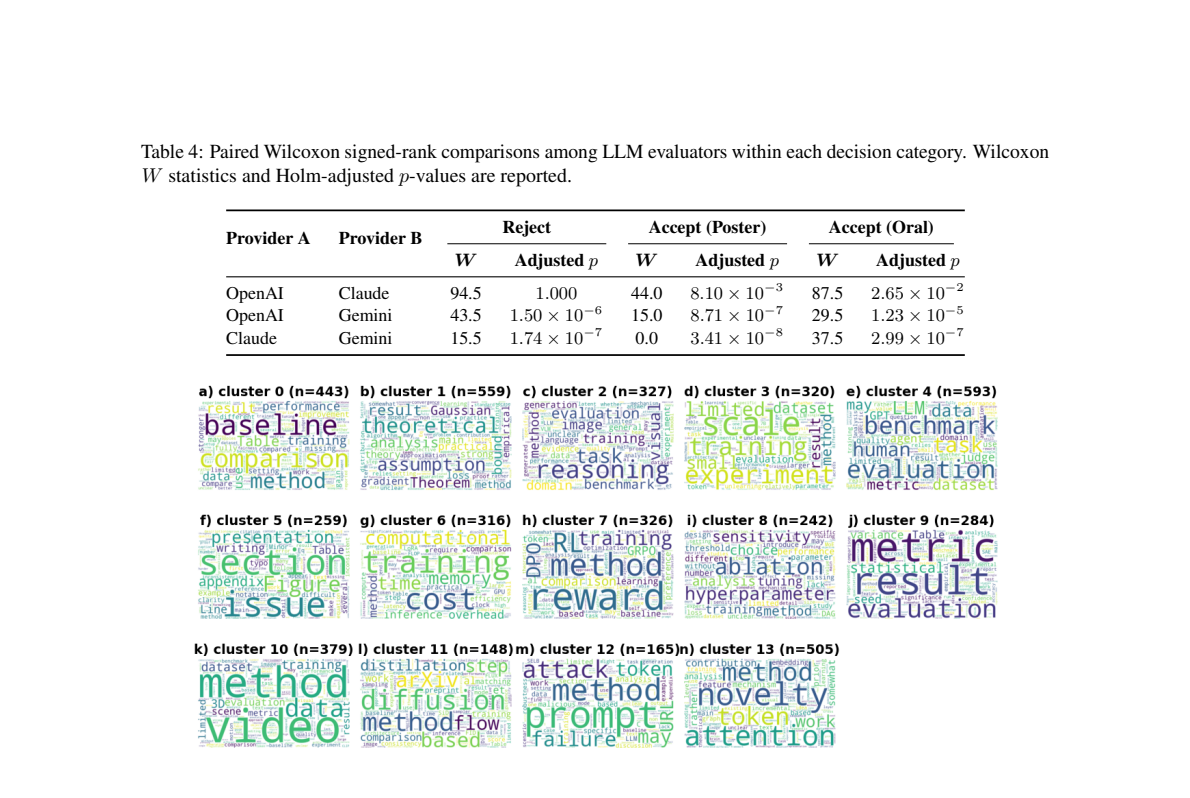
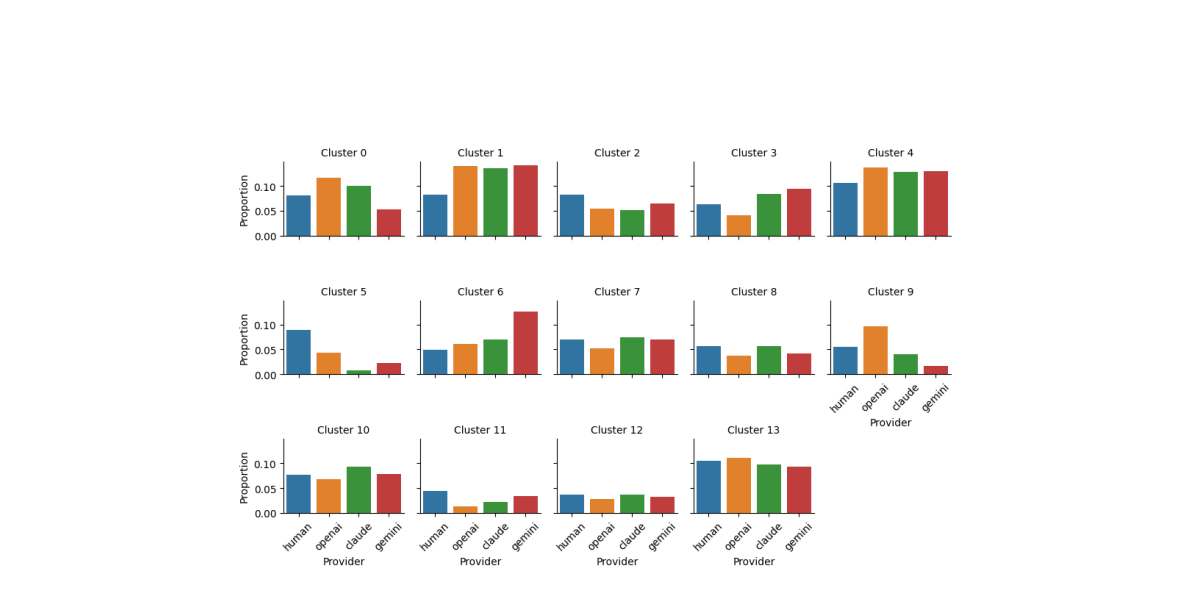
The conclusion that 'LLMs more frequently identified missing baseline comparisons and humans more often raised computational-efficiency concerns' is currently supported only by inspecting proportions from a clustering result; no significance test, confidence interval, or multiple-comparison correction is reported for the differences in cluster membership rates across reviewer types. The authors should add per-cluster tests (e.g., chi-square or bootstrap with Holm or Benjamini–Hochberg correction across the 14 clusters) or explicitly frame RQ5 as descriptive.
The paper says, at §3.2
The review did not quote this passage.
Pith says: Objection 4 of 4 · major
The load-bearing premise that the three LLMs had not encountered the evaluated papers is not verifiable from the reported information. Phrases such as 'training cutoffs predated the ICLR 2026 submission period' and 'disabling external search mitigates data leakage' are assurances, not evidence.
more of objection 4
Since data leakage could inflate especially the accept-reject alignment in RQ1, the manuscript should either provide a stronger basis for the claim (e.g., membership-inference checks or API logs showing no retrieval) or add an explicit limitation stating that the results are conditional on no prior exposure.
4 minor objections
The paper says, at §3.1
Pith says: minor objection 1 of 4
Explain how the 100 papers per category were sampled from the 224 matched papers; 'we downloaded 100 papers' does not state whether the selection was random and does not rule out selection bias.
The paper says, at Table 3
Pith says: minor objection 2 of 4
The human entries labeled 'Median' are paper-level means (e.g., 5.33, 6.5), not medians of the original review scale; rename the column or clarify that these are medians of paper-level means.
show 2 more
The paper says, at §4.5
Pith says: minor objection 3 of 4
Cluster numbering is inconsistent: the text refers to 'Clusters 1, 4, and 13' and then to 'Cluster 0' and 'Cluster 6'; clarify whether the clusters are zero-based or one-based.
The paper says, at §3.4
Pith says: minor objection 4 of 4
The cluster-count selection procedure should report the hyperparameter grid results and some measure of cluster stability (e.g., bootstrap clustering), because the inertia curve had no clear elbow and the selection is described as subjective.
What would settle it
Recompute the poster-vs-oral Mann-Whitney comparison for humans using exactly one randomly sampled human review per paper, instead of the paper-level mean, with the same Holm correction, and repeat this resampling 1,000 times. Report the distribution of p-values and median differences. If a majority of resamples are non-significant, the human fine-grained distinction used as the reference point does not exist at the single-review level, and the paper's claim that LLMs fail to reproduce it must be revised. As a complementary check, average 5-10 independent LLM reviews per paper and rerun the poster-vs-oral comparison; if oral and poster then separate, the null result is a sampling or coarseness artifact rather than an alignment finding.
from the skeptic's reading
How the review went
4 readings by deepseek-v4-flash · 15 Aug 2026
- Reader holds up, with conditions
- Skeptic partly agrees
- Editor wrote the verdict above
- Referee major revision: 4 major objections, 4 minor
Not run on this paper: the simulated authors' defence.
Pith did not check this review's objections against the paper.
The review in full
The review in brief, machine-written
Quick take: this is a clean, honest empirical study with one interesting finding—three different LLMs all separate accepted from rejected papers but none reproduce the oral/poster distinction that shows up in human ratings. That result is worth having. But the paper's central contrast is not quite fair: human ratings are averaged across multiple reviewers per paper, giving values like 5.33 and 6.5, while each LLM gives one integer rating from a six-point scale. Averaging reduces noise and creates a finer-grained measure, so the oral/poster separation in humans may be an artifact of aggregation rather than a property of human judgment that LLMs lack. The paper needs a single-reviewer human baseline before that conclusion is solid. The limitation section mentions that the number of reviews per paper complicates comparison, but it does not test whether the effect survives when human ratings are reduced to one review per paper.
What is new: the cross-provider setup with topic-matched ICLR data, identical prompts, and decision info removed is a step up from earlier single-model studies. The finding that all three providers miss the fine-grained distinction is a genuine empirical contribution, and the provider-specific scaling differences (Gemini generous, OpenAI/Claude more critical of oral papers) are useful for anyone designing automated review systems. The weakness theme analysis is suggestive, though the proportional differences are not significance-tested and the clustering choice is somewhat subjective.
Other soft spots: no released code or data, which limits independent reproduction. The leakage concern about training cutoffs is real, but the authors took reasonable precautions (disabled browsing, used post-cutoff papers); still, it is unverifiable from the manuscript. Minor: the selection of 100 papers from the 224 matched per category is not described; it should be random or explained.
Overall, the paper is honest, the methods are mostly appropriate, and the conclusion is appropriately cautious. The main flaw is the asymmetric human-vs-LLM comparison, which is fixable. If a single-reviewer baseline shows the oral/poster distinction disappears, the headline needs to change to something like 'LLMs do not reproduce the signal that emerges from averaging multiple reviewers.' If it survives, the result is stronger.
Recommendation: this deserves a serious peer review. I would accept it for review but ask for a single-review human baseline, significance tests on the weakness proportions, and a data/code release. The paper is useful for the LLM-judge community, and the authors appear to be thinking clearly.
The strongest objection
The paper's central contrast rests on an asymmetric comparison. For human ratings, the unit of analysis in RQ2 is the paper-level mean of all reviewers (Section 3.1), so the human distributions in Table 3 take values such as 5.33 and 6.5 and carry a poster-oral separation at Holm-adjusted p=3.24e-9. For each LLM, only a single rating per paper is available, drawn from the six-point scale {0,2,4,6,8,10}; Claude and OpenAI give median 6 for both poster and oral papers, and Gemini gives median 8 for both. Averaging several independent human reviews reduces within-paper noise and creates a more finely graded scale, so it is not a fair baseline against which to conclude that LLMs 'do not reproduce' a fine-grained human judgment. The same asymmetry affects RQ4 and Table 5, where a single LLM rating is paired against a mean of several human ratings. The Limitations section acknowledges that the number of reviews per paper complicates comparison, but it does not test whether the oral/poster effect survives when human ratings are reduced to one review per paper. If it does not, the headline distinction between broad and fine alignment is an artifact of averaging rather than a property of LLM judgment.
The reader's CONDITIONAL verdict is driven mainly by the unverifiable training-data leakage assumption. Leakage is a real risk, but the authors' stated training-cutoff claim, if accurate, removes it, and the manuscript's internal data cannot settle it. The aggregation asymmetry is a checkable design issue that directly affects the paper's most distinctive finding: the failure to reproduce the oral-versus-poster distinction. If the human distinction survives a one-review-per-paper resampling, the central contrast is robust and the concern does not land; if it does not, the paper's broad-versus-fine conclusion overreaches. The paper is otherwise carefully analyzed: the choice of Mann-Whitney tests, Holm correction, and paired Wilcoxon tests is appropriate for the comparisons actually performed, and the limitation statement already notes that the number of reviews per paper complicates human-LLM comparison. The recommended verdict remains CONDITIONAL, as the required check is cheap, decisive, and uses data already in the authors' possession. This is not a rejection: the other findings, such as provider-specific scale usage and weakness-theme differences, are not threatened by this concern. Agreement with the reader is partial because our identified concern is not training leakage but the single-review-versus-averaged-human baseline asymmetry.
The referee's report
If the results hold, the paper makes a useful contribution to automated-reviewing evaluation by showing that agreement with coarse decisions does not guarantee agreement with finer human judgments, and that provider choice materially changes conclusions. The design has notable strengths: a controlled cross-provider setup with identical prompts, topic matching via abstract embeddings, appropriate nonparametric tests with Holm correction, and transparent reporting of the prompt and computational cost. The central negative claim about the oral-poster distinction, however, is not yet supported because of the asymmetric comparison between averaged human ratings and single LLM ratings, and the thematic analysis lacks significance testing.
Pith's reading of the paper (a machine's summary, not the authors')
This paper asks how closely LLM-generated reviews match human peer review when both are measured against the same conference decisions. Three models (OpenAI GPT-5.4, Google Gemini 3.1 Pro Preview, Anthropic Claude Opus 4.6) each reviewed 300 topic-matched ICLR 2026 submissions, split evenly among oral, poster, and rejected papers, using identical instructions and rating scales. The central finding is that every model scores accepted papers above rejected ones, but none reproduces the finer oral-versus-poster distinction present in human ratings. The result matters because it separates broad outcome alignment from finer judgment alignment: passing the first test does not mean an automated reviewer captures the distinctions experts make.
What carries the argument. Three mechanisms carry the argument. Topic matching: abstract embeddings with one-to-one cosine-similarity matching make oral, poster, and rejected papers thematically comparable before any review is generated. Statistical comparisons: Mann–Whitney U tests for independent category differences, paired Wilcoxon signed-rank tests for evaluator differences, and Holm-adjusted p-values to control the family of pairwise tests; the decisive comparison is poster versus oral, which separates broad acceptance-signal detection from fine-grained quality discrimination. Weakness-theme analysis: embeddings of individual weakness statements, reduced with UMAP and clustered with k-means, then interpreted with word clouds, to compare which criticisms each reviewer type emphasizes.
Core claim. The paper finds a dissociation between two levels of alignment with human peer review. At the coarse level, all three LLMs assign significantly higher ratings to accepted than to rejected papers, mirroring human reviewers. At the fine level, human ratings separate oral from poster papers, with median ratings of 6.5 versus 5.33 and Holm-adjusted p = 3.24e-9, while LLM ratings do not separate them (adjusted p = 0.256 for Claude, 0.376 for OpenAI, 0.809 for Gemini). Provider-specific scale use adds a second axis of mismatch: Gemini runs high, with median 8 for accepted and 6 even for rejected papers; OpenAI and Claude track humans on rejected and poster papers but are harsher on oral papers; and no model uses the rating endpoints 0 or 10. Thematic analysis adds a third axis: LLM reviews more often flag missing baseline comparisons, human reviews more often raise computational-efficiency concerns. The paper concludes that broad decision alignment does not imply agreement with finer human judgments or reviewing priorities.
The premise it rests on. The study assumes the three LLMs had not already seen the evaluated ICLR papers or their human reviews during training, so their ratings reflect independent judgment rather than memory of known outcomes.
If the paper is right (Pith's inferences, not the authors')
Evaluations of LLM reviewers that check only accept-versus-reject discrimination will overstate alignment; fine-grained decision categories should be part of the test battery.
Provider choice materially changes conclusions: Gemini was systematically more lenient, while OpenAI and Claude were more critical of oral papers, so findings from a single model do not transfer across providers.
Thematic emphasis is a measurable axis of alignment: LLM critiques are not interchangeable with human critiques even when numerical ratings agree.
LLM reviews should be treated as supplementary feedback that can surface recurring weaknesses, not as substitutes for human peer-review judgments.
Scale compression, with no model using the 0 or 10 endpoints, means raw LLM scores are not directly comparable with human scores without recalibration.
The poster-oral blindness could stem from the coarse six-value rating scale rather than from a missing judgment; a scale with more levels might let models express an intermediate quality gap, something the paper's design cannot separate.
A natural test is to give models explicit knowledge that oral is a higher tier than poster; if ratings then separate, the result reflects prompt and scale resolution rather than an inherent LLM limit.
Conference organizers and automated-review services could use this design as a calibration check, tuning LLM scores against fine decision categories before using them for triage.
The accept-reject signal the models did detect may be a generic quality gradient rather than venue-specific norms, which would explain why ICLR's oral-poster hierarchy is invisible to them.
Check this review
Pith stored no record of this review's passes and took no fingerprint of it. Reviews made by code from 13 Nov 2026 on carry both.
How often reviews like this one are right
Reviews like this one: written by deepseek-v4-flash, where what was read was not recorded.
How often objections from reviews like this one are right: not yet measured
Reviews by people
This review was written by a machine. No person has reviewed this paper on Pith yet. A scientist listed on Pith can review it for a fee, and their review is published here whatever it concludes.
How Pith checks papers · The full audit of this paper · Review history (2 versions)
The paper
Abstract
Large language models (LLMs) are increasingly used to generate scientific reviews, yet existing evaluations rarely examine whether different providers align with both conference decisions and human reviewing priorities within the same controlled setting. We compare reviews from OpenAI GPT-5.4, Google Gemini 3.1 Pro Preview, and Anthropic Claude Opus 4.6 with human reviews and final decisions for 300 topic-matched ICLR 2026 submissions, equally divided among oral, poster, and rejected papers. Each model reviewed every paper using identical instructions and rating scales after decision information was removed. Our study contributes a cross-provider analysis of three complementary dimensions: alignment with broad and fine-grained decision categories, differences in recommendation-scale usage, and thematic agreement in identified weaknesses. All three LLMs distinguished accepted from rejected papers, but none reproduced the oral versus poster distinction present in human ratings. Scoring patterns were provider-specific: Gemini assigned systematically higher ratings, while OpenAI and Claude were closer to humans for rejected and poster papers but more critical of oral papers. Human and LLM reviews also differed in emphasis, with LLMs more frequently identifying missing baseline comparisons and humans more often raising computational-efficiency concerns. These results show that broad decision alignment does not imply agreement with finer human judgments or reviewing priorities.
The paper's own sentences, arranged, kept beside the review and separate from it. Each label is drawn from a closed vocabulary; the number beside it is the probability the classifier gave that label. No sentence in this record was written by a model.
abstract compiled · 2026-09-23
The authors' main claim, as the classifier picked it out 1.00
“These results show that broad decision alignment does not imply agreement with finer human judgments or reviewing priorities.”
How the main claim is stated: asserted 1.00
What the abstract itself states, as probabilities: claims first 0.13 · states limitation 0.64 · human participants 0.35 · controlled comparison 0.79 · randomized assignment 0.06 · states quantitative result 0.84 · compares with prior results 0.77 · mentions code or data availability 0.02
The abstract, sentence by sentence
This table labels the abstract only (arXiv listing abstract v1). The number is the probability the classifier gave the label.
| Sentence | Role | The authors' own work | States the main conclusion | Strength |
|---|---|---|---|---|
| Large language models (LLMs) are increasingly used to generate scientific reviews, yet existing evaluations rarely examine whether different providers align with both conference decisions and human reviewing priorities within the same controlled setting. | gap 0.77 | 0.05 | 0.04 | asserted 0.99 |
| We compare reviews from OpenAI GPT-5.4, Google Gemini 3.1 Pro Preview, and Anthropic Claude Opus 4.6 with human reviews and final decisions for 300 topic-matched ICLR 2026 submissions, equally divided among oral, poster, and rejected papers. | method 0.85 | 0.96 | 0.03 | asserted 0.97 |
| Each model reviewed every paper using identical instructions and rating scales after decision information was removed. | method 1.00 | 0.88 | 0.02 | asserted 0.99 |
| Our study contributes a cross-provider analysis of three complementary dimensions: alignment with broad and fine-grained decision categories, differences in recommendation-scale usage, and thematic agreement in identified weaknesses. | contribution 1.00 | 0.81 | 0.06 | asserted 0.97 |
| All three LLMs distinguished accepted from rejected papers, but none reproduced the oral versus poster distinction present in human ratings. | result 1.00 | 0.95 | 0.13 | asserted 1.00 |
| Scoring patterns were provider-specific: Gemini assigned systematically higher ratings, while OpenAI and Claude were closer to humans for rejected and poster papers but more critical of oral papers. | result 1.00 | 0.95 | 0.08 | asserted 1.00 |
| Human and LLM reviews also differed in emphasis, with LLMs more frequently identifying missing baseline comparisons and humans more often raising computational-efficiency concerns. | result 1.00 | 0.94 | 0.06 | asserted 1.00 |
| These results show that broad decision alignment does not imply agreement with finer human judgments or reviewing priorities. | interpretation 1.00 | 0.92 | 0.91 | asserted 1.00 |
What kind of paper the classifier reports this is: empirical study 1.00 · evidence from observation or experiment 0.97
What was examined, and what was not
Sources read
- arXiv listing abstract v1
Not examined
- full text
- figures and tables
- references and citing sentences
- relations to other papers
Levels run
- P abstract
Not run
- S sections
- T body sentences
- C citations
- R cross-paper relations
How the labels were made
Compiled by classifier-1.13.0 via TypeSafe API, question bank abstract-p1-20260923, 2026-09-23: 1 request, 6,328 input tokens.
Every quoted sentence on this record is the authors'. Every label is from Pith's closed vocabulary, with the probability shown beside it. This record as JSON
Figures (5)
Figures are the authors', reproduced from the paper.
References (17)
- [1] Kang, Dongyeop and Ammar, Waleed and Dalvi, Bhavana and van Zuylen, Madeleine and Kohlmeier, Sebastian and Hovy, Eduard and Schwartz, Roy , booktitle =. A Dataset of Peer Reviews (. 2018 , month = jun, doi = on Pith
- [2] Mali. Structured Peer Review: Pilot Results from 23. PeerJ , volume =. 2024 , doi = on Pith
- [3] When Reviewers Lock Horns: Finding Disagreements in Scientific Peer Reviews , author =. Proceedings of the 2023 Conference on Empirical Methods in Natural Language Processing , pages =. 2023 , month = dec, doi = on Pith
- [4] Idahl, Maximilian and Ahmadi, Zahra , booktitle =. 2025 , month = apr, doi = on Pith
- [5] Zhu, Minjun and Weng, Yixuan and Yang, Linyi and Zhang, Yue , booktitle =. 2025 , month = jul, doi = on Pith
- [6] Automatic Analysis of Substantiation in Scientific Peer Reviews , author =. Findings of the Association for Computational Linguistics: EMNLP 2023 , pages =. 2023 , month = dec, doi = on Pith
- [7] Can Large Language Models Be an Alternative to Human Evaluations? , author =. Proceedings of the 61st Annual Meeting of the Association for Computational Linguistics (Volume 1: Long Papers) , pages =. 2023 , month = jul, doi = on Pith
- [8] Liu, Yang and Iter, Dan and Xu, Yichong and Wang, Shuohang and Xu, Ruochen and Zhu, Chenguang , booktitle =. 2023 , month = dec, doi = on Pith
- [9] Bavaresco, Anna and Bernardi, Raffaella and Bertolazzi, Leonardo and Elliott, Desmond and Fern. Proceedings of the 63rd Annual Meeting of the Association for Computational Linguistics (Volume 2: Short Papers) , pages =. 2025 , month = jul, doi = on Pith
- [10] Large Language Models Are Not Fair Evaluators , author =. Proceedings of the 62nd Annual Meeting of the Association for Computational Linguistics (Volume 1: Long Papers) , pages =. 2024 , month = aug, doi = on Pith
- [11] Ou, Jiefu and Walden, William and Sanders, Kate and Jiang, Zhengping and Sun, Kaiser and Cheng, Jeffrey and Jurayj, William and Wanner, Miriam and Liang, Shaobo and Morgan, Candice and Han, Seunghoon and Wang, Weiqi and May, Chandler and Recknor, Hannah and Khashabi, Daniel an... on Pith
- [12] Chen, Zeyuan and Yang, Ziqing and Ma, Yihan and Backes, Michael and Zhang, Yang , booktitle =. 2026 , month = jul, doi = on Pith
- [13] Li, Haowen and Ishibashi, Yoichi and Oyamada, Masafumi , booktitle =. Evaluating the Impact of Reviewer Guideline Design on. 2026 , month = jul, doi = on Pith
- [14] Fay, Michael P. and Proschan, Michael A. , title =. Statistics Surveys , year =. doi:10.1214/09-SS051 , url = on Pithdoi:10.1214/09-ss051
- [15] Hart, Anna , title =. BMJ , year =. doi:10.1136/bmj.323.7309.391 , url = on Pithdoi:10.1136/bmj.323.7309.391
- [16] Holm, Sture , title =. Scandinavian Journal of Statistics , year = on Pith
- [17] Mann, Henry B. and Whitney, Donald R. , title =. The Annals of Mathematical Statistics , year =. doi:10.1214/aoms/1177730491 , url = on PitharXiv
Cited by 2 Pith papers
Reviewed papers on Pith that cite this one. The full citation record
- Same Papers, Different Verdicts: Tracing Version Drift in LLM Peer Review cs.CL · Nov 2026
- AI Reviews Are Biased Towards the Appendix cs.CL · Nov 2026
Challenges and discussion
Disagree with the review, or know something it missed? Leave a comment, or challenge this review formally: a challenge becomes a permanent entry in this paper's record, and its decision is published here.
Come back by email
A short list of the week's newly reviewed papers. Nothing is sent until you confirm from your inbox, and every email has a link that stops it. No account.
No comments yet.
Sign in to comment