Computation and Language · arXiv:2611.17811 v1 · submitted 13 Nov 2026 · 18 references
AI Reviews Are Biased Towards the Appendix
The paper says
“Large language models (LLMs) are increasingly used by reviewers to highlight weaknesses during the reviewing process, and their outputs often shape the reviews that humans submit.”
more of the abstract
Prior work studies how LLM reviews align with human ones, yet we know little about which parts of a paper these models actually criticize. In this work, we investigate 2,000 papers from ACL, EMNLP, COLM, and ICLR, and show that the latest GPT and Claude models draw about 50% or more of their review weaknesses from the appendix. This behavior holds across the API, coding-agent, and web access methods for using LLMs to review a paper. In contrast, we find that humans draw only 8.4% of their weaknesses from the appendix, and these weaknesses primarily revolve around a paper's presentation and content related to its core idea. Meanwhile, LLMs draw weaknesses from deep in the appendix that concern fine-grained technical details not central to the paper's contributions. We anticipate that our analysis will contribute to the scholarly discourse on AI reviews. Our code is publicly available at: https://github.com/cincynlp/review_appendix.
from the abstract
Pith says
Machine review · deepseek-v4-flash · 16 Nov 2026 · read the full text (54,380 characters) · not checked by a person
It can be wrong. Challenge this review or reply to it.
Holds up, with conditions. This paper provides the first systematic measurement of a real and concerning pattern—LLM reviewers draw most of their criticisms from the appendix—but the headline figure rests on an LLM-based attribution step whose accuracy is not quantified. This line is wrong
5 minor · 2 open questions
How often objections from reviews like this one are right: not yet measured
The paper, first character to last
The reviewer was given the whole text, 54,380 characters. Not checked: figures, code, what the 18 references say.
5 minor objections
The paper says, at §4.3
Pith says: minor objection 1 of 5
The paper does not state which access method (API, Codex/CLI, Web) was used for the main 800-paper experiments and the GPT-5 comparison; the access-method analysis is run only on 100 ICLR 2027 papers with GPT-6-Astra. Please state the method used in the main pipeline so readers know which interface the headline numbers come from.
The paper says, at §5, A Growing Trend in Human Reviews
Pith says: minor objection 2 of 5
The sentence asserting that reviewers 'did not suddenly start reading appendices more closely, but the tools they relied on did' is phrased as a causal explanation, which is stronger than the correlational claim the Limitations section explicitly disclaims. Please soften this to match the acknowledged evidential status.
show 3 more
The paper says, at §5, Weakness Taxonomy
Pith says: minor objection 3 of 5
The category is named 'Prompts' in the text list and the table represents it as 'Prompt'; the order of the eight categories also differs between the running text and Table 3. Please align the names and order.
The paper says, at Table 1
Pith says: minor objection 4 of 5
It is unclear whether the reported ± values are standard deviations, standard errors, or confidence intervals, and over what units (models for the LLM row, review years for the human row) they are computed. Please state the definition in the caption or text.
The paper says, at §4.1
Pith says: minor objection 5 of 5
The claim that LLM weaknesses 'peak well into the appendix rather than at its start' and 'continue even beyond page 30' rests on Figure 6, which could not be inspected in the supplied text; please ensure the figure clearly marks the main-body/appendix boundary and the page-count axis.
Open questions (2)
Pith raised these and could not confirm them against the text of the paper it read. They are questions for the authors, not findings.
- §3.1 and §5 Would the human-side appendix-related weakness share change if the same 15-page appendix inclusion rule were applied, and could the authors report both thresholds to assess the impact on the comparison?
- §Limitations and §3.2 Could the authors provide a quantified reliability check of the attributor, including sample size, human agreement rate, and per-category error rates, to allow readers to gauge the error bars around the headline figures?
What would settle it
A human-annotated sample of 100-200 reviews where annotators independently map each weakness to a section, compared against the LLM attributor's output, would reveal the error rate of the core measurement. If the LLM attributor's accuracy is below, say, 80%, the headline figures could be substantially wrong.
from Pith's summary of the paper
How the review went
5 passes by deepseek-v4-flash · 16 Nov 2026
- Reader holds up, with conditions
- Skeptic concern not confirmed: listed as an open question
- Referee 5 minor
- Check against the paper kept 0 of 3 objections
- Editor wrote the verdict above
Not run on this paper: the simulated authors' defence.
Pith's passes raised 3 objections. A check against the paper's text kept 0 and left 3 as questions.
The review in full
The review in brief, machine-written
This paper measures something worth knowing: when the latest GPT and Claude models review a paper, more than half of the weaknesses they list come from the appendix. Human reviewers, by contrast, draw fewer than 10% of their criticisms from supplementary material. The finding is timely and the scale of the study—2,000 papers across four conferences—is a real strength. The authors also show that the appendix bias is consistent across API, coding-agent, and web access methods, and that it is much weaker in earlier models like GPT-5. The temporal correlation with rising appendix-related weaknesses in human reviews after the release of these models is suggestive and worth the community's attention.
The paper's main soft spot is that the central measurement depends on an LLM (GPT-6.1-Sol) to attribute each weakness to a paper section. The authors acknowledge this limitation and say they manually reviewed a sample, but they do not report a human agreement rate or error bars on the attribution. Without that, a reader cannot gauge how much of the headline gap between humans and LLMs might be an artifact of the attributor. The human-vs-LLM comparison also mixes different years and paper sets, which the authors note but do not control for. A minor concern: the 15-page minimum appendix length for the LLM sample could select for papers with unusually long appendices, and the sensitivity to this threshold is not explored.
This paper is for anyone who uses or studies LLM-assisted peer review. It raises a genuine issue and backs it with a large dataset. The core finding is likely real, even if the exact percentages have some uncertainty. A serious referee could help tighten the attribution methodology and add the missing reliability checks. I would send this to peer review.
The stress test's concern
Not confirmed. Pith could not check this concern against the text of the paper it was given; it is listed as an open question, not a finding.
The referee's report
Not published. Pith's referee wrote this assessment before its objections were checked against the paper, and 2 of its 2 major objections did not survive that check.
Pith's reading of the paper (a machine's summary, not the authors')
The paper investigates where AI-generated reviews find their criticisms. Using 2,000 papers from recent NLP and ML conferences, the authors show that state-of-the-art GPT and Claude models derive the majority of their listed weaknesses from appendix content, whereas human reviewers overwhelmingly focus on the main body. This appendix bias is consistent across models, access methods, and venues, and appears to be a property of newer, more capable models. The authors argue that this matters because reviewers increasingly use LLMs to help write reviews, and appendix-heavy criticism can shift attention away from a paper's core contributions.
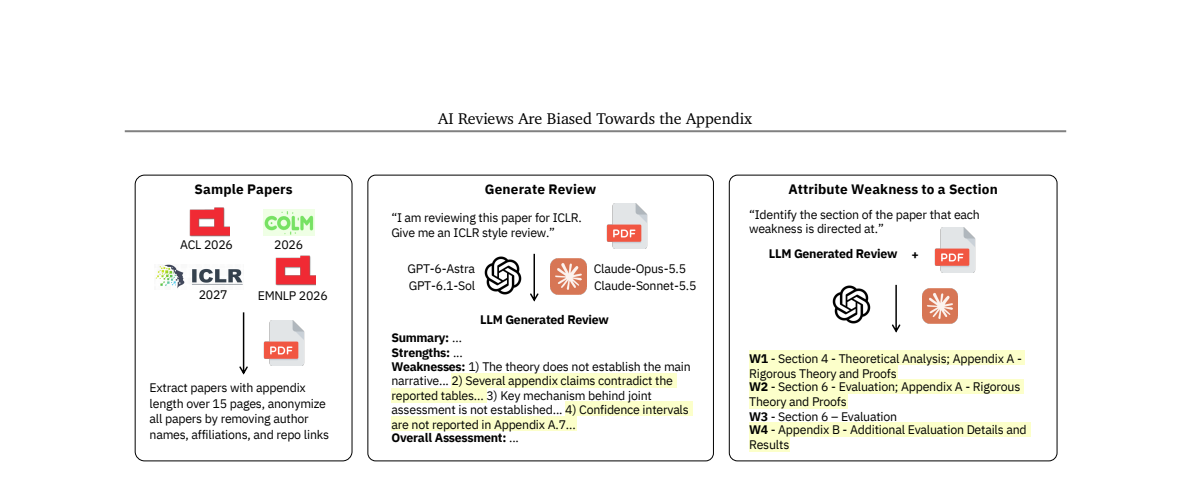
What carries the argument. The central mechanism is a two-step pipeline: (1) generate an LLM review with a minimal prompt, then (2) use the same LLM to attribute each listed weakness back to a specific section of the paper (main body vs. appendix). The attribution step is the load-bearing measurement tool.
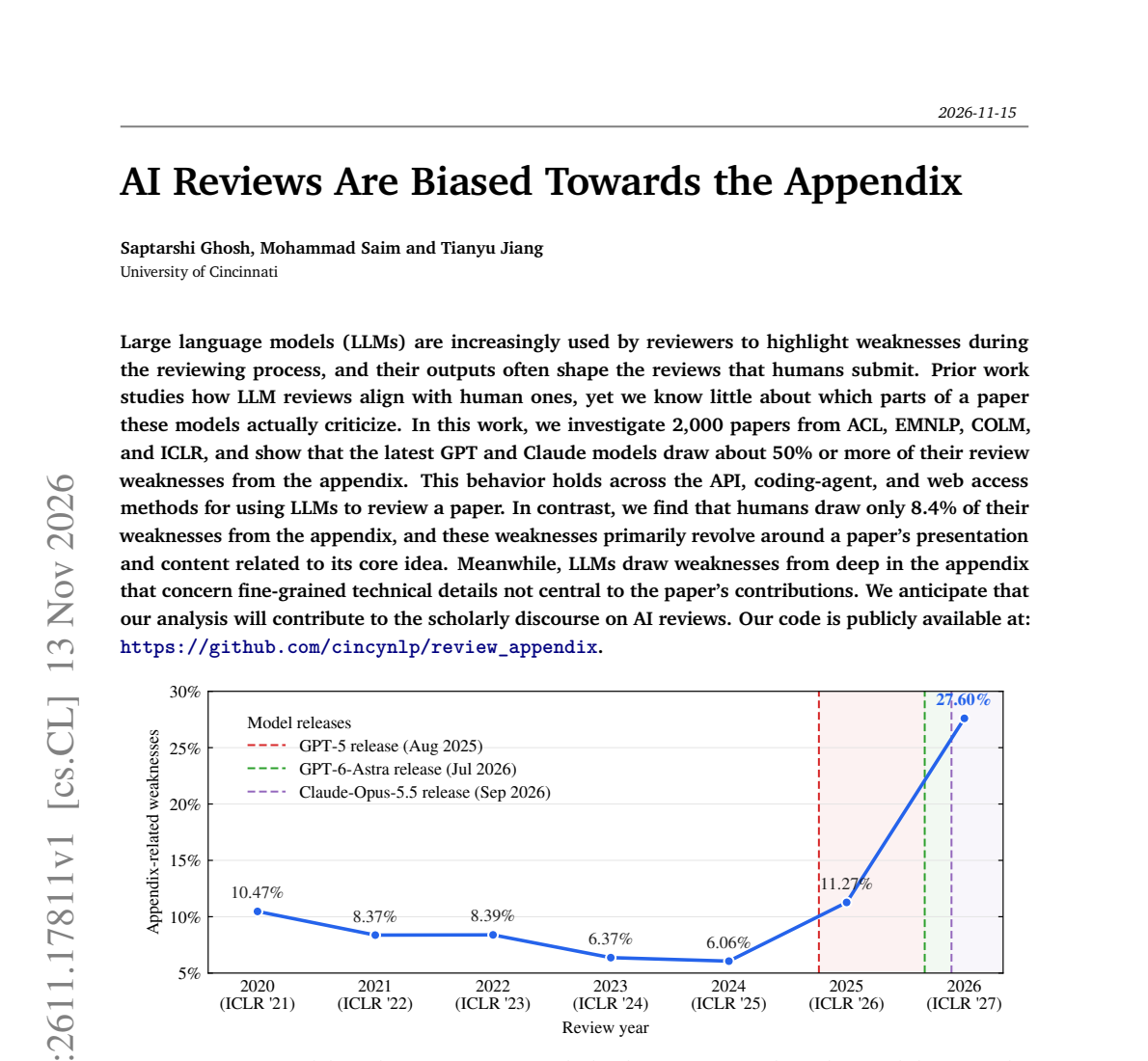
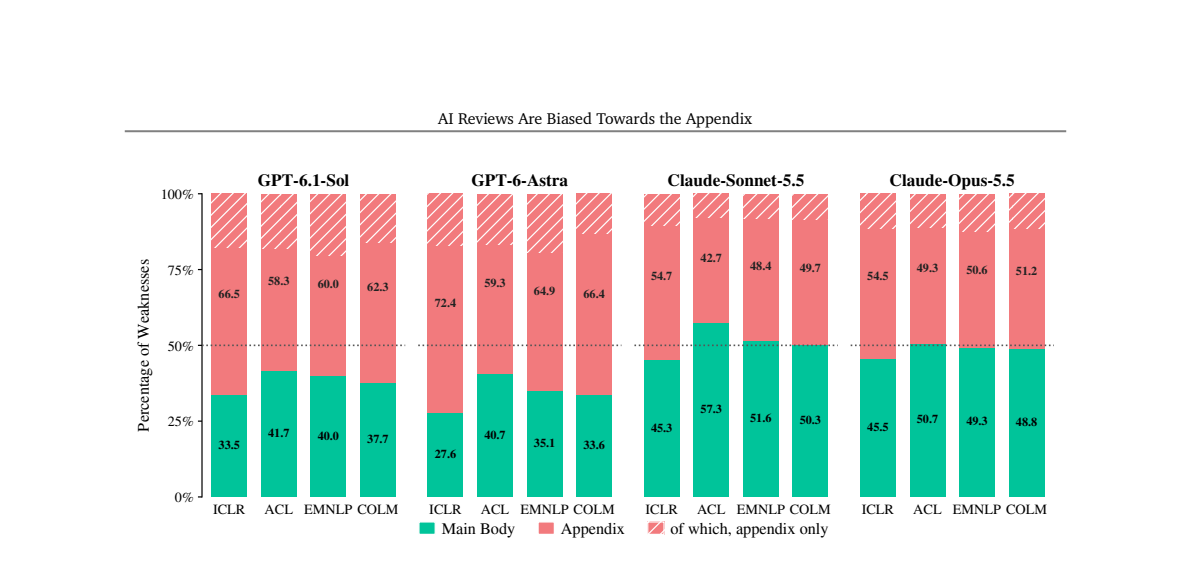
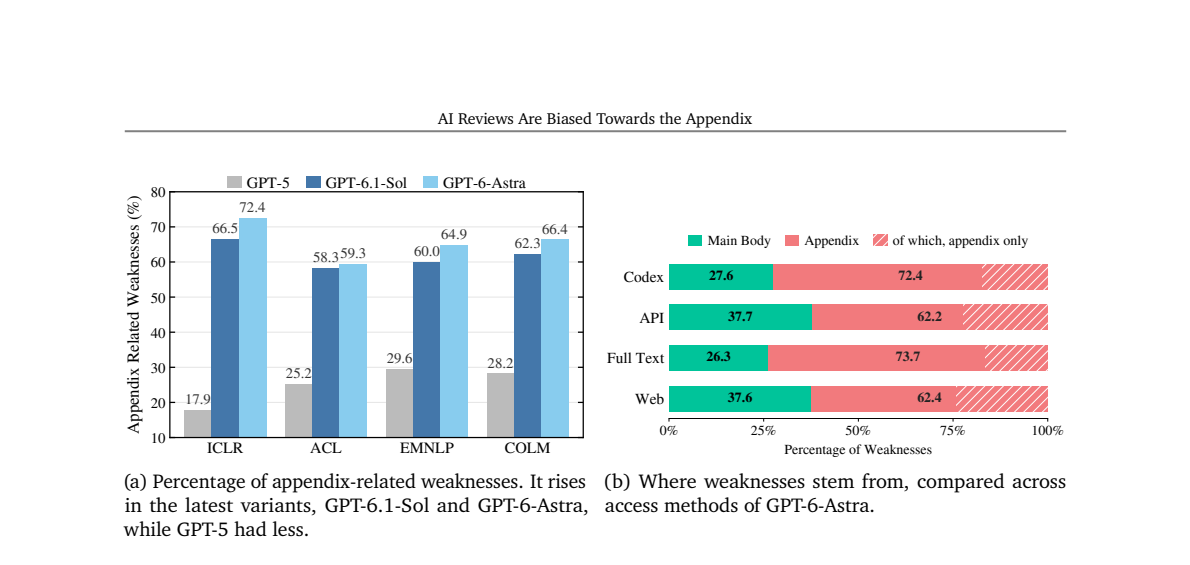
Core claim. The central claim is that the latest GPT and Claude models (GPT-6-Astra, GPT-6.1-Sol, Claude-Opus-5.5, Claude-Sonnet-5.5) draw more than 50% of their review weaknesses from the appendix, while human reviewers draw only 8.4% from the appendix. This behavior holds across API, coding-agent, and web access methods. The paper also finds that human reviewers' appendix-related weakness share has risen from ~6-10% in 2020-2024 to 27.60% in ICLR 2027 reviews, a temporal correlation the authors suggest may reflect increasing LLM use in peer review.
The premise it rests on. The LLM used to attribute each weakness to a paper section (GPT-6.1-Sol) makes accurate judgments about which section a weakness refers to, even when the weakness is vague or spans multiple sections.
If the paper is right (Pith's inferences, not the authors')
If LLM-generated reviews consistently over-weight appendix content, then papers with long appendices may receive unfairly negative reviews when assessed by LLM-assisted reviewers.
The finding that human reviewers' appendix-related weakness share has tripled since the release of GPT-5 and GPT-6-Astra suggests that LLM use in peer review may be shifting human review patterns.
Authors submitting to conferences where LLM-assisted review is common may need to treat their appendix as equally polished as the main body, since LLMs do not distinguish between the two.
The paper's taxonomy shows that LLMs criticize technical details (methodology, results, analysis) in the appendix, while humans focus on presentation and core-idea engagement, implying that LLM reviews may miss the forest for the trees.
The paper's methodology could be extended to study whether appendix bias affects the numerical scores assigned to papers, not just the qualitative weaknesses.
If appendix bias is a general property of long-context LLMs, then similar biases may appear in other document-grounded tasks (e.g., legal document review, medical record analysis) where models must weigh sections of differing importance.
The temporal correlation between model release dates and rising human appendix criticism is suggestive but not causal; a controlled experiment (e.g., comparing reviews from reviewers randomly assigned to use vs. not use LLMs) would be needed to establish causation.
The paper's reliance on LLM-based section attribution introduces potential error; a human-annotated gold standard on a random subset would allow readers to gauge the reliability of the headline figures.
Check this review
What was read
The passes were given all 54,380 characters of the paper's LaTeX source.
Fingerprint of that text (SHA-256): b35abb53cd4f9dd5ac45df8617eda5253d9d29a5d4306f8485f0a5151a51f695
Pith does not keep that text. Rebuilt from the paper's source or PDF by the same code, it has this fingerprint if it is the same text. From a copy of Pith's code:
PYTHONPATH=. python scripts/review_input_check.py 2611.17811
The passes, in the order they ran
- Reader deepseek-v4-flash · medium effort · $0.0023 · instructions of the Reader, fingerprint f9ead7300382…
- Skeptic deepseek-v4-flash · medium effort · $0.0017 · instructions of the Skeptic, fingerprint 8f88c0f61488…
- Referee deepseek-v4-flash · medium effort · $0.0049 · instructions of the Referee, fingerprint a852d99aea0d…
- Check against the paper deepseek-v4-flash · medium effort · $0.0019 · instructions of the Check against the paper, fingerprint 6c7a6883d551…
- Editor deepseek-v4-flash · medium effort · $0.0017 · instructions of the Editor, fingerprint e7211f6a3d27…
- Summary for the page deepseek-v4-flash · medium effort · temperature 0.2 · $0.0020 · instructions of the Summary for the page, fingerprint e4f56bf568e7…
The passes cost $0.015 in model calls together.
Version stamped on this review: pith-pipeline@v1.4.1-daily-deepseek-or-medium+deepseek/deepseek-v4-flash+p.0ef1a750a3e3
Each link opens a pass's instructions as plain text, the exact bytes its fingerprint was taken over. Every stored set of instructions.
curl -s https://pith.science/methodology/prompts/f9ead730038216984cfb56d7cb34332bdf691828296a1de4245f3d6667d4bf56 | sha256sum
prints the fingerprint of the reader's instructions. The same works for every pass.
The receipt
The review's fingerprint was taken on 16 Nov 2026. The review you are reading still matches it.
Fingerprint of the review (SHA-256): c5c74f5b40e8e95b2ed898b9a034fd07e5d8c0116d1f648f2bcc1a15133d2d64
curl -s 'https://pith.science/api/v1/verdicts/2611.17811?form=canonical' | sha256sum
prints the fingerprint of the review as it stands now. The rule, in four steps.
A matching fingerprint shows the review has not changed since that date. It does not show that the review is right.
How often reviews like this one are right
Reviews like this one: written by deepseek-v4-flash, from the paper's LaTeX source.
How often objections from reviews like this one are right: not yet measured
Reviews by people
This review was written by a machine. No person has reviewed this paper on Pith yet. A scientist listed on Pith can review it for a fee, and their review is published here whatever it concludes.
How Pith checks papers · The full audit of this paper · Review history (2 versions)
The paper
Abstract
Large language models (LLMs) are increasingly used by reviewers to highlight weaknesses during the reviewing process, and their outputs often shape the reviews that humans submit. Prior work studies how LLM reviews align with human ones, yet we know little about which parts of a paper these models actually criticize. In this work, we investigate 2,000 papers from ACL, EMNLP, COLM, and ICLR, and show that the latest GPT and Claude models draw about 50% or more of their review weaknesses from the appendix. This behavior holds across the API, coding-agent, and web access methods for using LLMs to review a paper. In contrast, we find that humans draw only 8.4% of their weaknesses from the appendix, and these weaknesses primarily revolve around a paper's presentation and content related to its core idea. Meanwhile, LLMs draw weaknesses from deep in the appendix that concern fine-grained technical details not central to the paper's contributions. We anticipate that our analysis will contribute to the scholarly discourse on AI reviews. Our code is publicly available at: https://github.com/cincynlp/review_appendix.
The paper's own sentences, arranged, kept beside the review and separate from it. Each label is drawn from a closed vocabulary; the number beside it is the probability the classifier gave that label. No sentence in this record was written by a model.
abstract compiled · 2026-11-16
The authors' main claim, as the classifier picked it out 1.00
“In this work, we investigate 2,000 papers from ACL, EMNLP, COLM, and ICLR, and show that the latest GPT and Claude models draw about 50% or more of their review weaknesses from the appendix.”
How the main claim is stated: asserted 1.00
What the abstract itself states, as probabilities: claims first 0.10 · states limitation 0.13 · human participants 0.17 · controlled comparison 0.62 · randomized assignment 0.02 · states quantitative result 0.99 · compares with prior results 0.86 · mentions code or data availability 0.97
The abstract, sentence by sentence
This table labels the abstract only (arXiv listing abstract v1). The number is the probability the classifier gave the label.
| Sentence | Role | The authors' own work | States the main conclusion | Strength |
|---|---|---|---|---|
| Large language models (LLMs) are increasingly used by reviewers to highlight weaknesses during the reviewing process, and their outputs often shape the reviews that humans submit. | background 1.00 | 0.05 | 0.02 | asserted 0.99 |
| Prior work studies how LLM reviews align with human ones, yet we know little about which parts of a paper these models actually criticize. | gap 0.99 | 0.06 | 0.02 | asserted 0.95 |
| In this work, we investigate 2,000 papers from ACL, EMNLP, COLM, and ICLR, and show that the latest GPT and Claude models draw about 50% or more of their review weaknesses from the appendix. | result 0.71 | 0.96 | 0.87 | asserted 1.00 |
| This behavior holds across the API, coding-agent, and web access methods for using LLMs to review a paper. | result 0.99 | 0.85 | 0.09 | asserted 1.00 |
| In contrast, we find that humans draw only 8.4% of their weaknesses from the appendix, and these weaknesses primarily revolve around a paper's presentation and content related to its core idea. | result 1.00 | 0.96 | 0.23 | asserted 1.00 |
| Meanwhile, LLMs draw weaknesses from deep in the appendix that concern fine-grained technical details not central to the paper's contributions. | result 0.91 | 0.91 | 0.17 | asserted 1.00 |
| We anticipate that our analysis will contribute to the scholarly discourse on AI reviews. | future work 0.87 | 0.09 | 0.02 | hedged possibility 0.66 |
| Our code is publicly available at: https://github.com/cincynlp/review_appendix. | contribution 0.83 | 0.44 | 0.01 | asserted 0.83 |
What kind of paper the classifier reports this is: empirical study 1.00 · evidence from observation or experiment 0.74
What was examined, and what was not
Sources read
- arXiv listing abstract v1
Not examined
- full text
- figures and tables
- references and citing sentences
- relations to other papers
Levels run
- P abstract
Not run
- S sections
- T body sentences
- C citations
- R cross-paper relations
How the labels were made
Compiled by classifier-1.13.0 via TypeSafe API, question bank abstract-p1-20260923, 2026-11-16: 1 request, 6,227 input tokens.
Every quoted sentence on this record is the authors'. Every label is from Pith's closed vocabulary, with the probability shown beside it. This record as JSON
Figures (5)
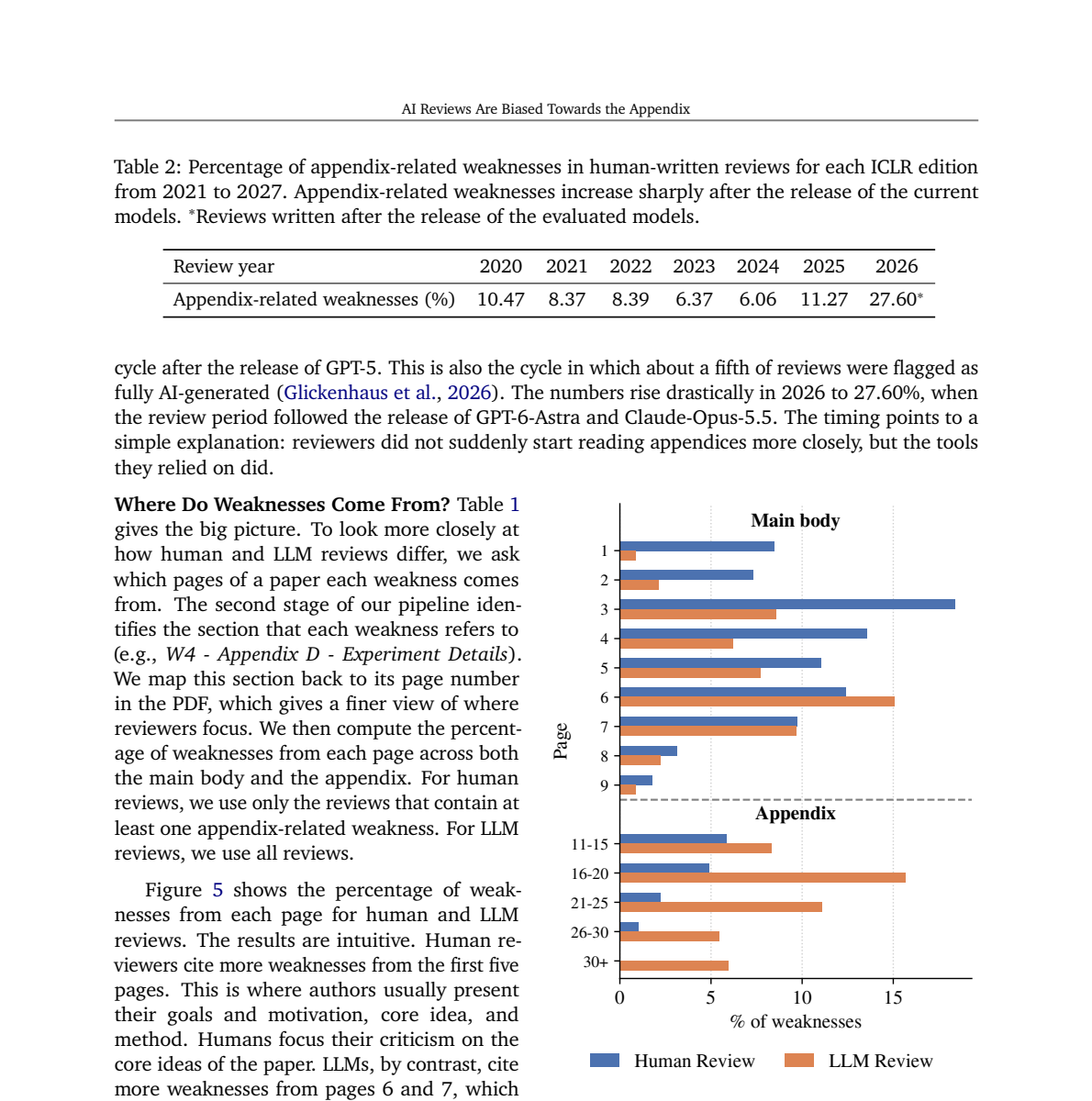
Figures are the authors', reproduced from the paper.
References (18)
- [2] doi: 10.18653/v1/ 2026.findings-acl.1170. URLhttps://aclanthology.org/2026.findings-acl.1170/. J. Du, Y. Wang, W. Zhao, Z. Deng, S. Liu, R. Lou, H. P. Zou, P. N. Venkit, N. Zhang, M. Srinath, et al. LLMs assist NLP researchers: Critique paper (meta-)reviewing. In Y. Al-Onaizan... on Pithdoi:10.18653/v1/
- [4] URLhttps://arxiv.org/ abs/2608.03581. B. Glickenhaus, K. Thai, J. Russell, E. Masrour, Y. Han, M. Spero, and B. Emi. Pangram 4 technical report, on PithPith's reviewarXiv
- [5] URLhttps://arxiv.org/abs/2607.27183. M. Kaneko. Paraphrasing adversarial attack on llm-as-a-reviewer, on PithPith's reviewarXiv
- [6] URLhttps://arxiv.org/ abs/2601.06884. S. S. Y. Kim, W. H. Deng, J. W. Vaughan, B. Su, W. Su, A. Agarwal, S. Li, M. Jaggi, D. G. Goldstein, N. B. Shah, and M. Dudík. Use and effects of llms in peer review: A randomized experiment and survey at icml 2026, on PitharXiv
- [7] URLhttps://arxiv.org/abs/2609.19420. S. Kumar, S. Garg, S. Sengupta, T. Ghosal, and A. Ekbal. MixRevDetect: Towards detecting AI- generated content in hybrid peer reviews. In L. Chiruzzo, A. Ritter, and L. Wang, editors,Proceedings of the 2025 Conference of the Nations of the ... on PithPith's reviewarXiv
- [9] URLhttps: //arxiv.org/abs/2605.25415. W. Liang, Y. Zhang, H. Cao, B. Wang, D. Y. Ding, X. Yang, K. Vodrahalli, S. He, D. S. Smith, Y. Yin, D. A. McFarland, and J. Zou. Can large language models provide useful feedback on research papers? a large-scale empirical analysis.NEJM A... on PithPith's reviewarXiv
- [10] doi: 10.1056/AIoa2400196. URLhttps://ai.nejm.org/doi/full/10.1056/AIoa2400196. W. Liang, Z. Izzo, Y. Zhang, H. Lepp, H. Cao, X. Zhao, L. Chen, H. Ye, S. Liu, Z. Huang, D. A. McFarland, and J. Y. Zou. Monitoring ai-modified content at scale: A case study on the impact of chatgp... on Pithdoi:10.1056/aioa2400196
- [11] URLhttps://arxiv.org/abs/2403.07183. 12 AI Reviews Are Biased Towards the Appendix Z. Lin. Hidden prompts in manuscripts exploit ai-assisted peer review.Commun. ACM, June on PithPith's reviewarXiv
- [12] doi: 10.1145/3779116. URLhttps://doi.org/10.1145/3779116. D. Nguyen, W. Hao, Y. Elazar, and C. Tan. Benchmarking agentic review systems. InNeurIPS 2026 Workshop on AI-Native Academia: Authorship, Peer Review, and Conference Governance under AI, on Pithdoi:10.1145/3779116
- [13] URLhttps://arxiv.org/abs/2606.25057. OpenAI. Gpt-6.1 sol, 2026a. URLhttps://openai.com/index/introducing-gpt-6-1-sol/. OpenAI. Gpt-6 astra, 2026b. URLhttps://openai.com/index/gpt-6-astra/. R. Saha, G. Juneja, D. Chaudhuri, N. Sajeevan, N. B. Shah, and D. Pruthi. Policies permi... on PithPith's reviewarXiv
- [14] URLhttps://arxiv.org/abs/2601.20920. S. Shen and K. Wang. Detecting ai-generated content in academic peer reviews, on PitharXiv
- [15] URLhttps: //arxiv.org/abs/2602.00319. R. S. Teo, Y. Yamada, S. Kotyan, Y. Imajuku, and T. Clanuwat. Beyond imitation: A framework and benchmark for LLM-assisted peer review.Transactions on Machine Learning Research, on PitharXiv
- [16] URL https://arxiv.org/abs/2610.35254. X. Yang, Z. Sha, J. Li, J. Yu, Y. Sun, M. Zhao, J. Fang, X. Guo, Y. Wu, X. Hu, Y. Luo, Q. Liu, and Z. Wang. No hidden prompts needed! you can game AI peer review with presentation-only revisions. In NeurIPS 2026 Workshop on AI-Native Acade... on PithPith's reviewarXiv
- [17] URLhttps://arxiv.org/abs/2601.09182. R. Zhou, L. Chen, and K. Yu. Is LLM a reliable reviewer? a comprehensive evaluation of LLM on automatic paper reviewing tasks. In N. Calzolari, M.-Y. Kan, V. Hoste, A. Lenci, S. Sakti, and N. Xue, editors,Proceedings of the 2024 Joint Inter... on PitharXiv
- [18] URLhttps://aclanthology.org/2024.lrec-main.816/. K. Żurawicki, J. Farganus, A. Gaweł, M. Bystroński, and T. J. Kajdanowicz. Praib: Peer review ai benchmark of behaviour of llm-assisted reviewing, on Pith
- [2024] doi: 10.18653/v1/2024.emnlp-main.292. URLhttps: //aclanthology.org/2024.emnlp-main.292/. A. M. Fichtl, L. Ellinger, J. Kelber, K. Olík, and G. Groh. Ai-assisted peer review across research communities: From reviewer ai policies to llm review quality, on Pithdoi:10.18653/v1/2024.emnlp-main.292
- [2025] doi: 10.18653/v1/2025. naacl-short.79. URLhttps://aclanthology.org/2025.naacl-short.79/. L. Li, J. Xiong, C. Zhu, R. Yu, C. Chen, J. Wang, R. Ma, and Z. Lu. Llm-as-a-reviewer: Benchmarking their ability, divergence, and prompt injection resistance as paper reviewers, on Pithdoi:10.18653/v1/2025
- [2026] URLhttps://arxiv.org/abs/2608.03659. Z. Chen, Z. Yang, Y. Ma, M. Backes, and Y. Zhang.𝑝𝑒𝑒𝑟𝑐ℎ𝑒𝑐𝑘: Enhancing LLM-generated academic reviews towards human-level quality. In M. Liakata, V. P. Moreira, J. Zhang, and D. Jurgens, editors, Findings of the Association for Computational... on PithPith's reviewarXiv
Cited by 1 Pith paper
Reviewed papers on Pith that cite this one. The full citation record
Challenges and discussion
Disagree with the review, or know something it missed? Leave a comment, or challenge this review formally: a challenge becomes a permanent entry in this paper's record, and its decision is published here.
Come back by email
A short list of the week's newly reviewed papers. Nothing is sent until you confirm from your inbox, and every email has a link that stops it. No account.
No comments yet.
Sign in to comment