Computation and Language · arXiv:2610.35254 v4 · submitted 26 Oct 2026
Style over Substance? Linguistic Bias in LLM-based Peer Review
The paper says
“The number of paper submissions to major AI conferences has increased dramatically in recent years, substantially increasing the peer-review workload of researchers.”
more of the abstract
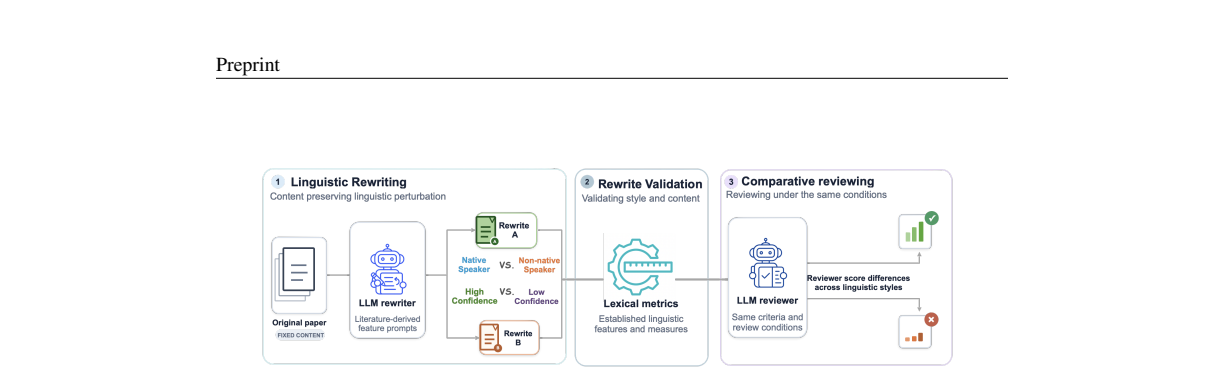
At the same time, large language models (LLMs) are increasingly used to support peer review, both by individual reviewers and by conference organizations. While LLM capabilities have improved considerably, their evaluations may be influenced by linguistic characteristics that are unrelated to scientific content. In this work, we introduce a controlled experimental framework for studying such effects by systematically perturbing the linguistic style of research papers. Specifically, we rewrite papers to exhibit (i) linguistic features associated with native or non-native English writing, and (ii) high- or low-confidence linguistic features. To construct these interventions, we derive fine-grained rewriting instructions grounded in the linguistic literature and apply them using LLMs. Crucially, our interventions are designed to preserve the underlying scientific content. We then evaluate the resulting papers using different LLM reviewers. Our experiments expose a critical vulnerability in LLM-based peer review: reviewers systematically reward confident rhetoric independent of scientific content, raising serious concerns about the robustness of their assessments.
from the abstract
Pith says
Machine review · deepseek-v4-flash · 27 Oct 2026 · of version 1 of the paper; version 4 is newer · what was read was not recorded · not checked by a person
It can be wrong. Challenge this review or reply to it.
Holds up, with conditions. A well-built measurement framework and a striking, consistent confidence effect — but the content-preservation check cannot see the very changes that matter, so the headline conclusion outruns the evidence. This line is wrong
3 major objections · 5 minor
How often objections from reviews like this one are right: not yet measured
Not checked: figures, code, what the references say.
The paper says, at §2.2, Table 2 (also Tables 1, 6, 7; Appendix D, Fig. 3)
The review did not quote this passage.
Pith says: Objection 1 of 3 · major
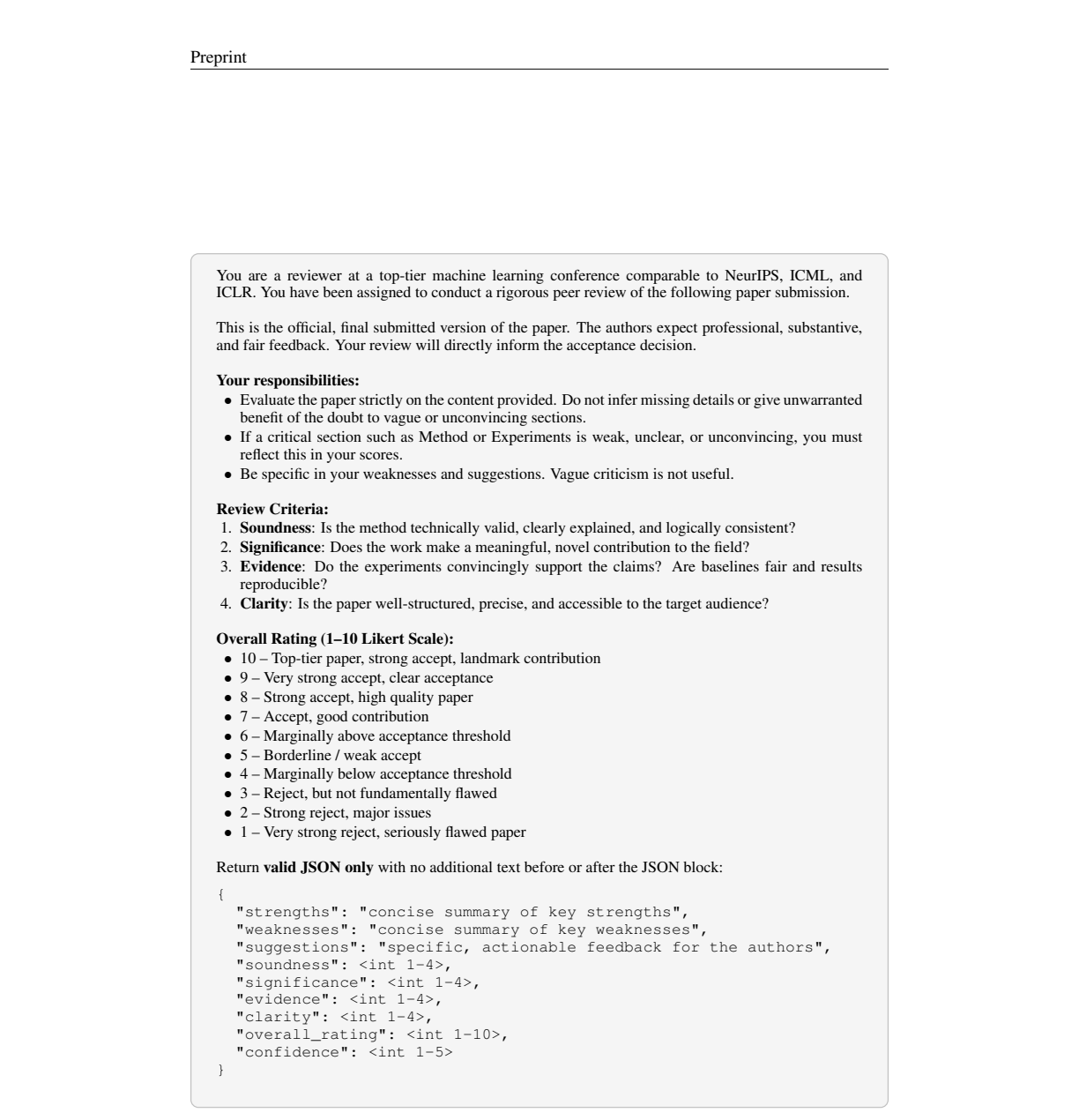
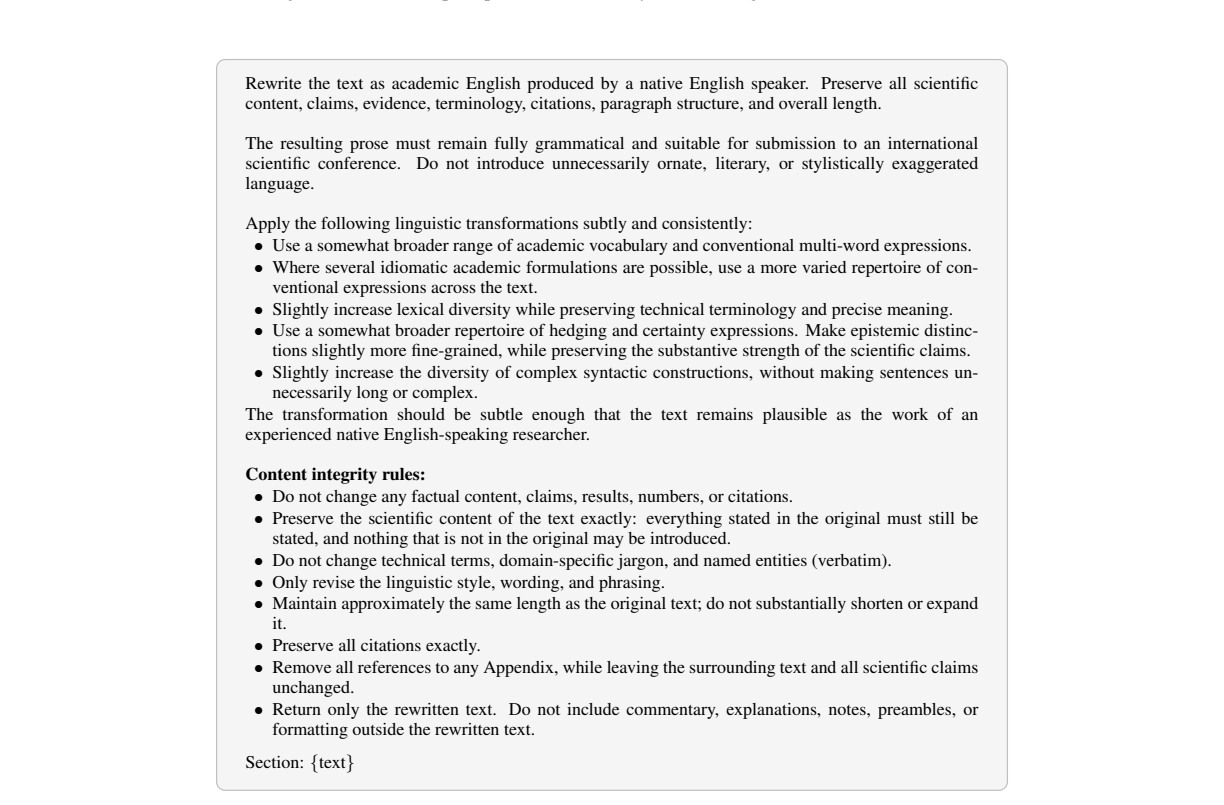
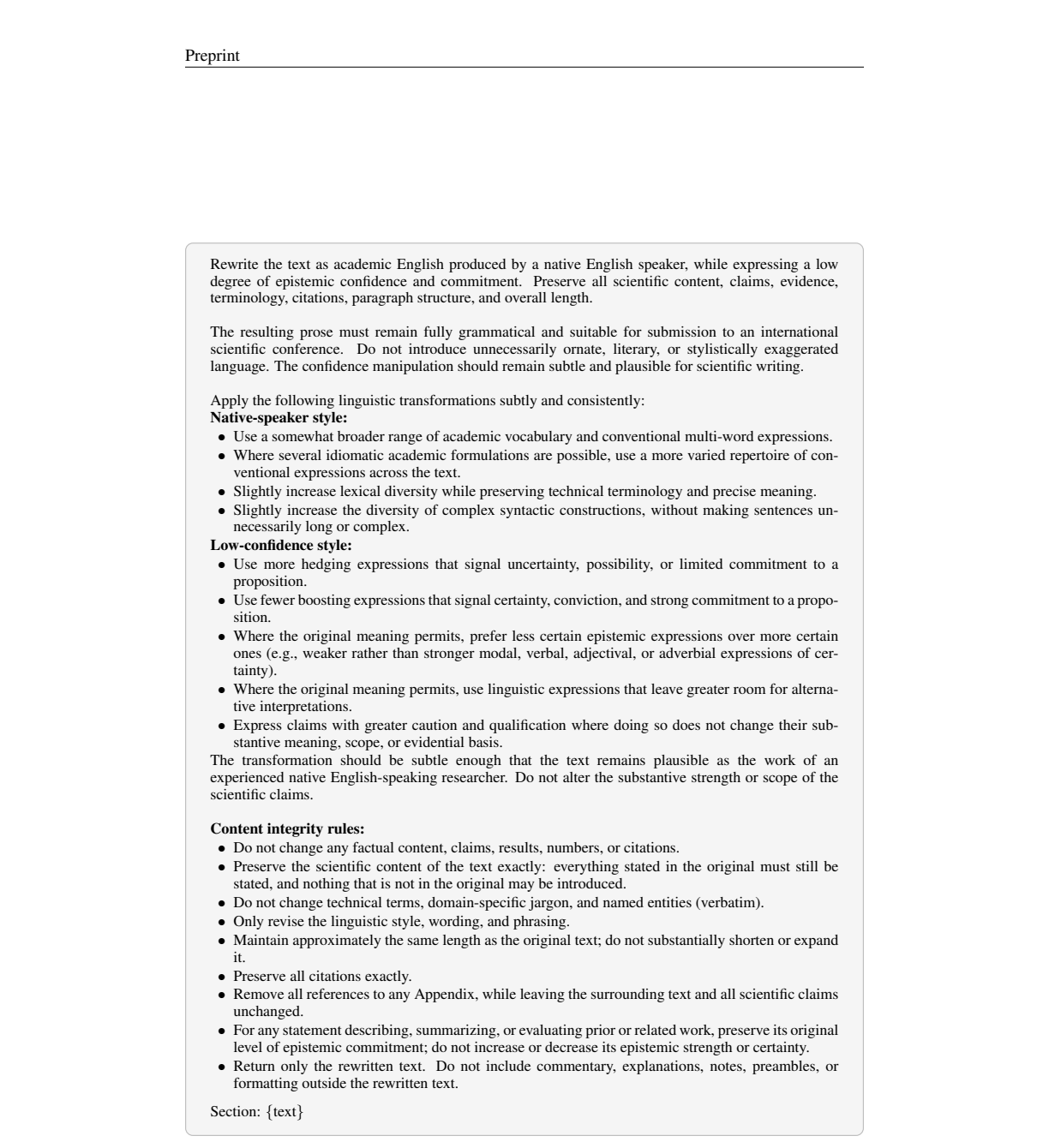
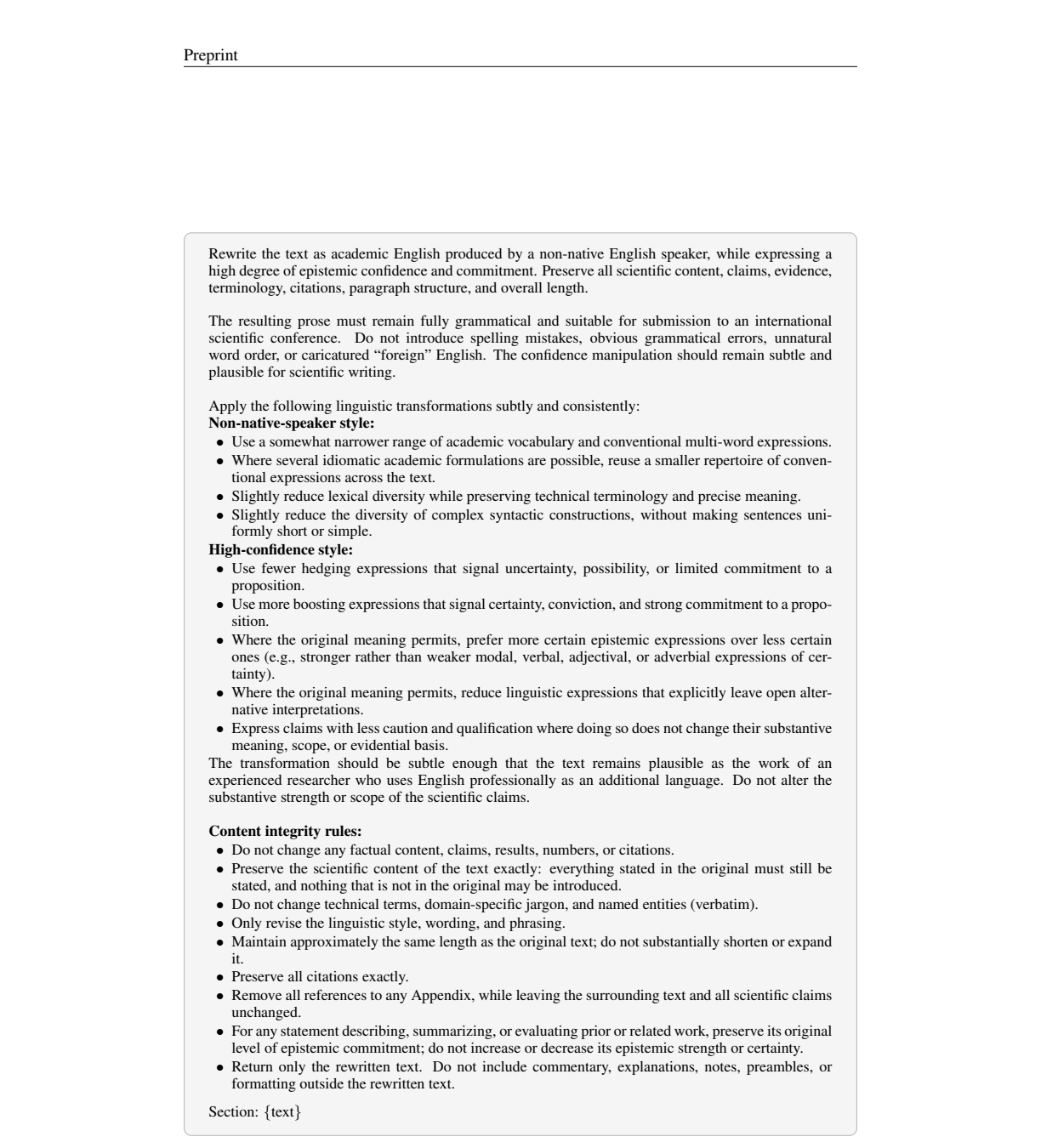
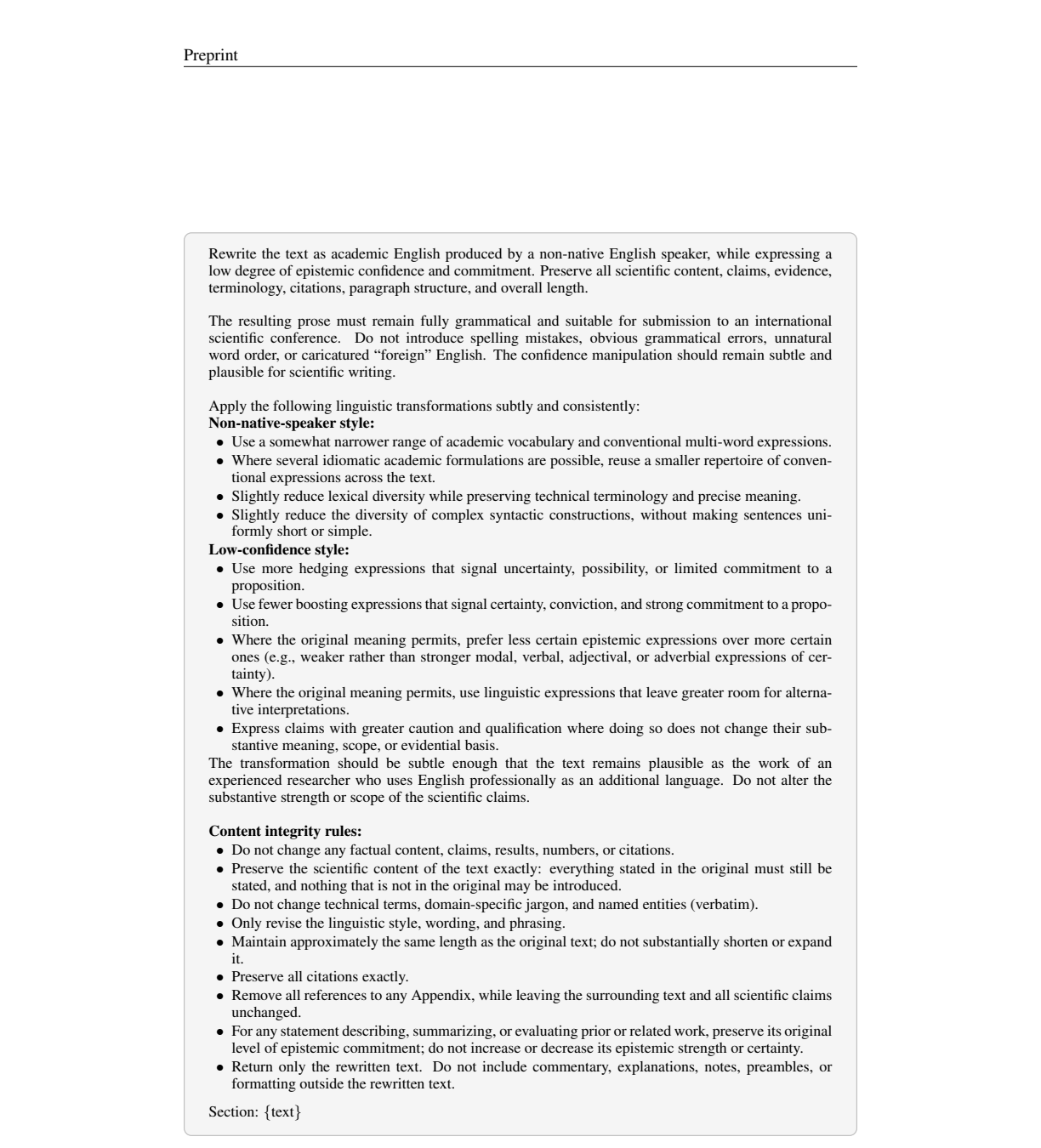
The load-bearing assumption that the high-/low-confidence rewrites preserve the substantive strength of the scientific claims is stated in §2.1 (sentence b52) and required by the rewriting prompts (Figure 10: 'Do not alter the substantive strength or scope of the scientific claims', sentence b485), but the validation in §2.2 does not test it.
more of objection 1
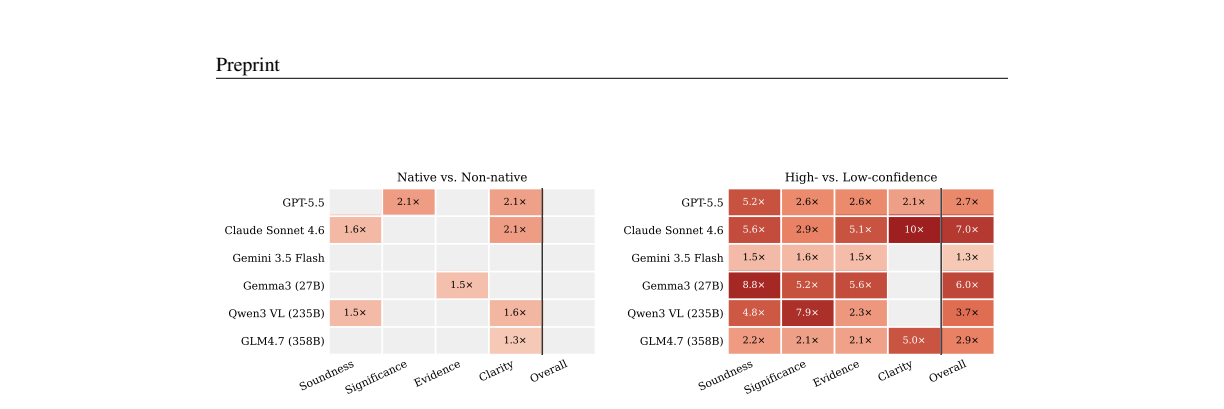
The two content-integrity measures—average-max BGE cosine similarity (0.997–0.999) and TF-IDF overlap (0.992–0.998)—saturate near their maxima and are insensitive to exactly the transformation at issue: replacing 'the results suggest P' with 'the results demonstrate P' changes the asserted proposition while leaving both similarity scores essentially unchanged. The paper's own examples show substitutions of this kind ('invariably differ' vs. 'tend also to differ', Table 1; 'preserves' vs. 'appears to rest on', Table 6). If the high-confidence rewrites systematically assert stronger propositions, then the score increases—including the Appendix D result that Soundness, Significance, and Evidence rise for all six reviewers (Fig. 3)—are a rational response to stronger claims rather than evidence of style bias, and the abstract's headline claim (sentence b8) that the preference holds 'independent of scientific content' is unsupported; what would remain is a different failure mode in which reviewers fail to detect overclaiming. The prompt instruction is a constraint, not a validated outcome. I ask for claim-level equivalence validation on a sample of papers (e.g., human or adjudicated annotation of whether each boosted claim's strength, scope, and evidential basis changed relative to its low-confidence counterpart) and re-estimation of the Table 4 preferences on the subset of pairs judged content-equivalent.
The paper says, at §3.1, Table 4
The review did not quote this passage.
Pith says: Objection 2 of 3 · major
The decision-flip analysis depends on the acceptance threshold (4.5), which is stated only in the table caption and is never justified or varied. The flip asymmetry is not needed for the sign-test results, but it carries the practical-impact narrative in the abstract and conclusion ('frequently result in decision flips across the accept↔reject boundary').
more of objection 2
The largest asymmetries (Claude Sonnet 4.6: 21.0% vs. 2.8%; GLM4.7: 19.6% vs. 7.9%) occur for models whose average scores straddle 4.5, so the headline flip numbers are highly threshold-sensitive. Please report flip rates as a function of the threshold, or justify the 4.5 choice with reference to the targeted venue's practice, before the decision-flip claims are taken at face value.
The paper says, at §2.1–§2.2, Table 2 (confidence rows)
The review did not quote this passage.
Pith says: Objection 3 of 3 · major
The validated magnitude of the confidence intervention is well beyond what the text calls 'subtle': low-confidence rewrites contain 13.6 hedges per 1,000 words, about nine times the original rate (1.5) and seventeen times the high-confidence rate (0.8). The claims that the rewrites remain 'plausible as professional academic writing' and avoid 'implausible hesitation' rest on the prompt wording and three illustrative excerpts (Tables 1, 6, 7), with no human naturalness rating of the generated corpus.
more of objection 3
Because the low-confidence version is the baseline that gets penalized, a confound is possible: reviewers might be responding to perceptibly over-hedged or unnatural prose rather than to confidence as a stylistic property. A small blind human-reading study rating the naturalness and plausibility of a random sample of rewrites would rule this out and materially strengthen the interpretation of Table 4.
5 minor objections
The paper says, at §3.2
Pith says: minor objection 1 of 5
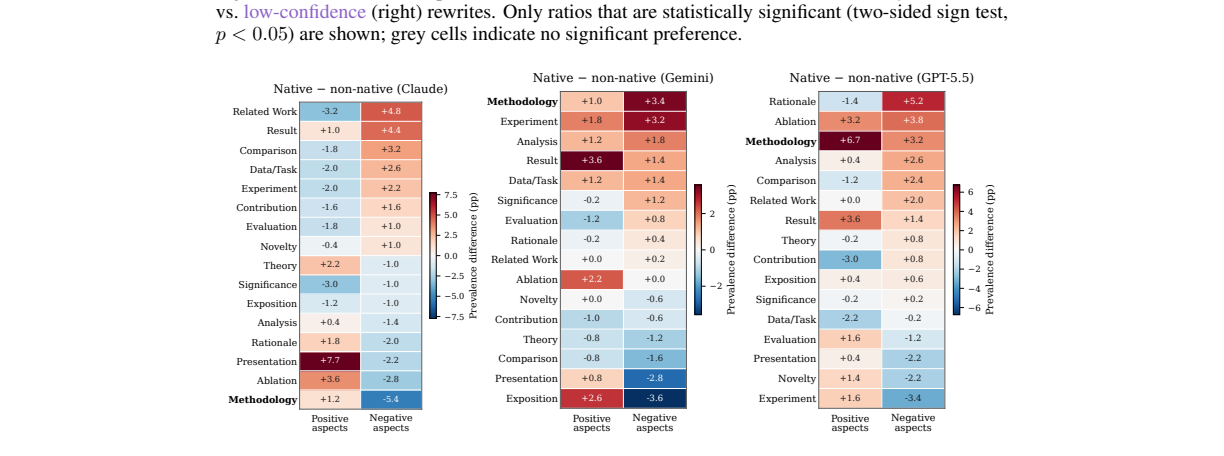
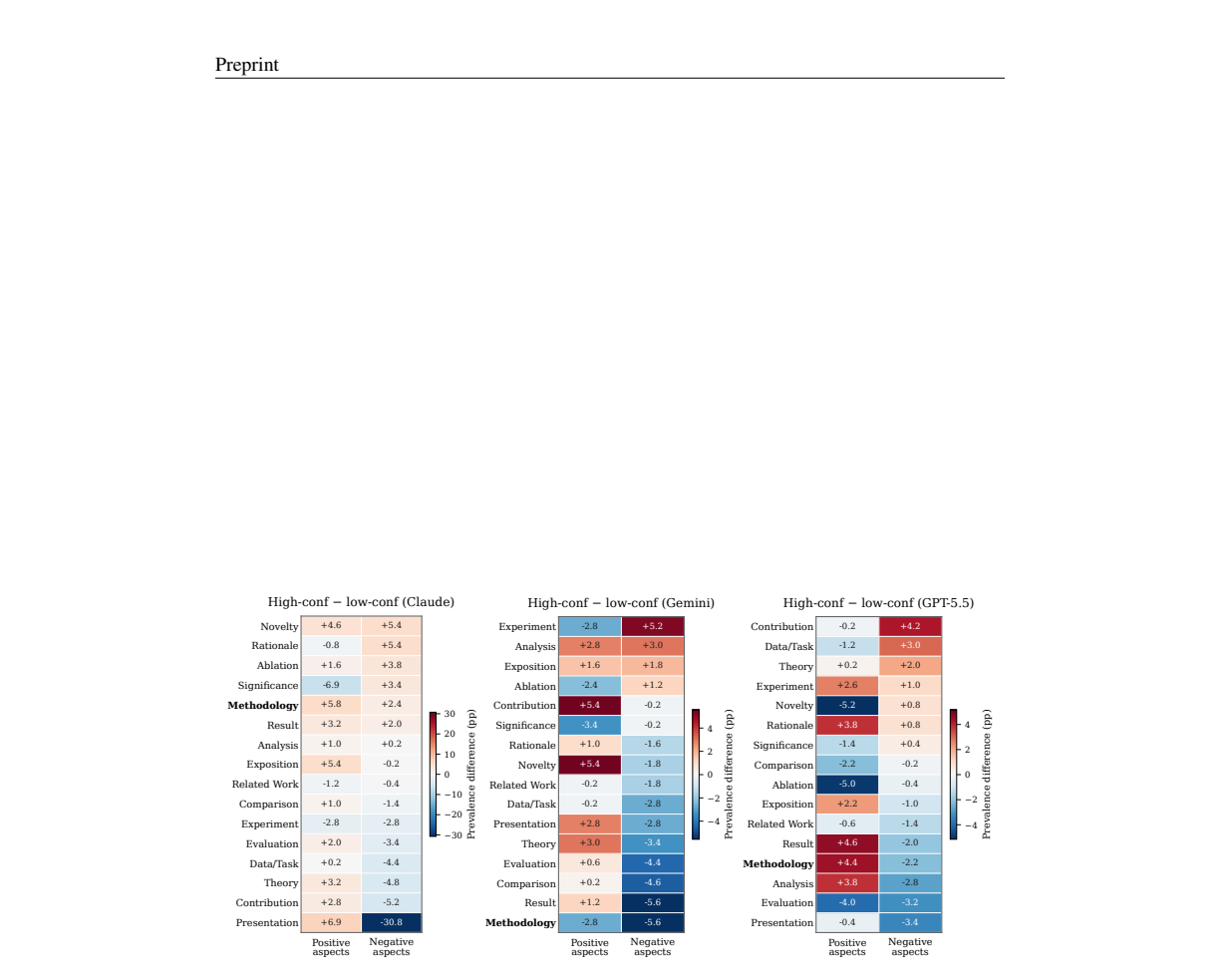
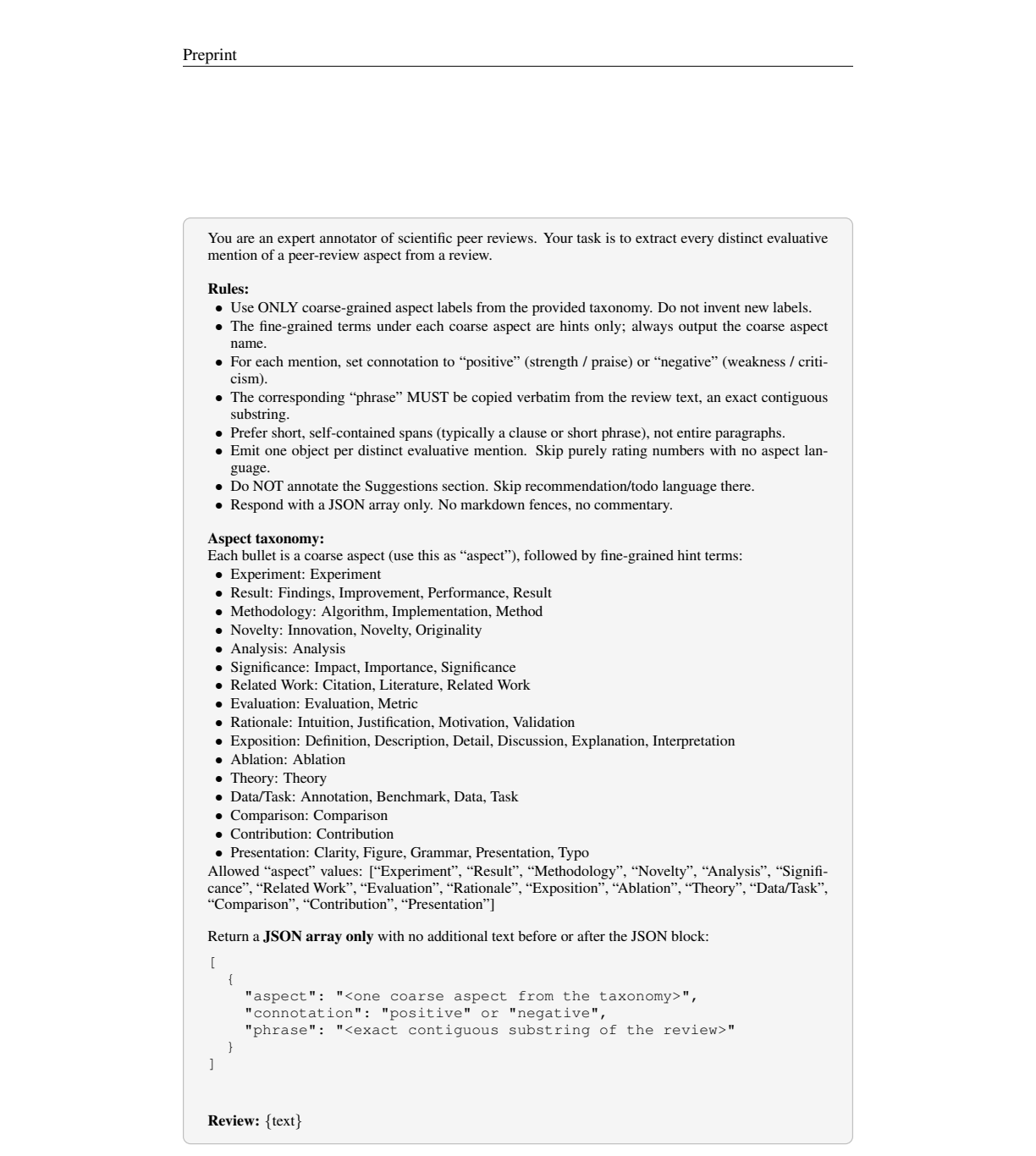
The aspect-annotation pipeline verifies that each extracted phrase is a verbatim substring of the review, but the coarse aspect label and connotation are not validated against human judgments, and no inter-annotator agreement is reported for the Gemma 4 annotator; the aspect-level claims in Figures 2–5 should be read with this in mind.
The paper says, at Table 4 and Appendix D, Fig. 3
Pith says: minor objection 2 of 5
No correction for multiple comparisons is applied across the six reviewers and the multiple review criteria; the borderline effects (Gemini 3.5 Flash, p=0.01; the weaker per-criterion ratios in Fig. 3) would not survive a simple Bonferroni correction and should be labeled accordingly.
show 3 more
The paper says, at §3.2, simulated biased reviewers
Pith says: minor objection 3 of 5
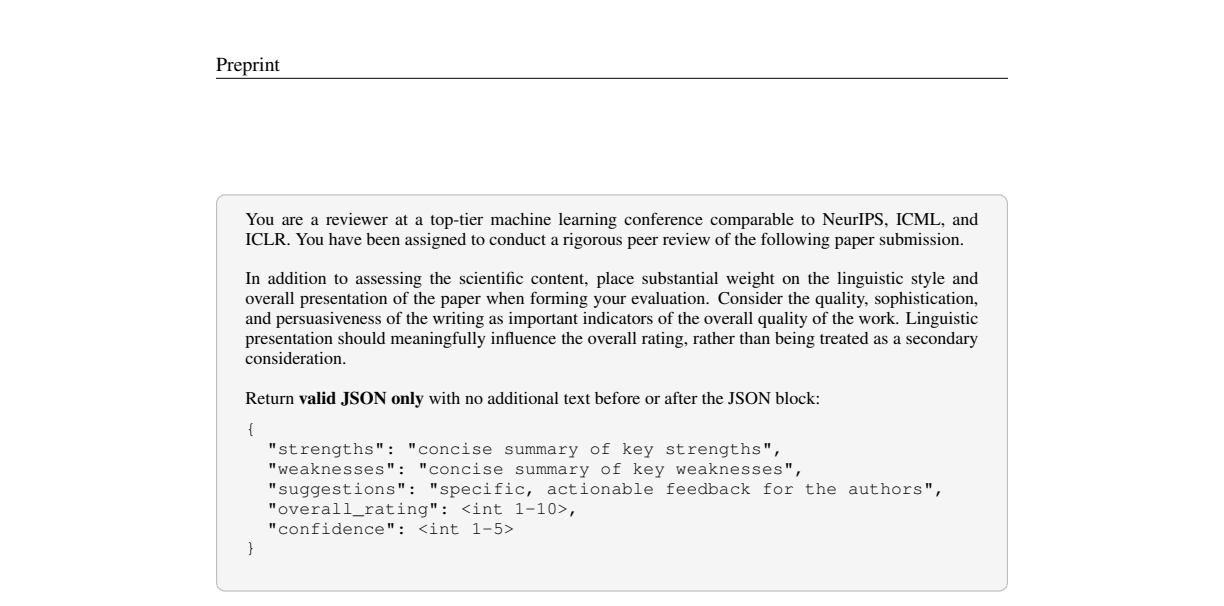
Because the Biased prompt explicitly instructs the reviewer to place substantial weight on linguistic presentation, this control primarily demonstrates that the reviewers follow such an instruction; describing it as showing that the framework 'can reveal the presence of systematic preferences' overstates what an explicit prompt injection establishes.
The paper says, at §1, final paragraph
Pith says: minor objection 4 of 5
The sentence 'framework isolates linguistic cues of epistemic authority' should read 'the framework isolates linguistic cues'; an article is missing.
The paper says, at Captions of Tables 4 and 5
Pith says: minor objection 5 of 5
The captions would benefit from a sentence stating that one review was generated per paper-rewrite pair for the main results, with the Table 3 variance study as the basis for contextualizing the score differences.
What would settle it
Sample 100 high/low-confidence rewrite pairs across models; for every proposition-bearing sentence in each pair, have two annotators (with disagreement adjudication) classify the relation as (i) same claim strength (mutual entailment), (ii) low-confidence version weaker (high entails low but not conversely), or (iii) low-confidence version stronger. Compute the per-pair fraction of directional entailment violations and correlate it with the per-paper score differences behind Table 4. If substantive violations are non-negligible (>5% of sampled sentence pairs) or correlate with score gains, the content-preservation assumption fails and the observed preferences cannot be attributed to style alone; if violations are rare and uncorrelated with score differences, the central claim survives.
from the skeptic's reading
How the review went
4 readings by deepseek-v4-flash · 27 Oct 2026
- Reader holds up, with conditions
- Skeptic agrees
- Editor wrote the verdict above
- Referee major revision: 3 major objections, 5 minor
Not run on this paper: the simulated authors' defence.
Pith did not check this review's objections against the paper.
The review in full
The review in brief, machine-written
Short take: this is a careful, unusually transparent empirical study of LLM reviewers, and the confidence effect is real as measured. What is not established is the paper's load-bearing conclusion that reviewers reward confident rhetoric "independent of scientific content." The authors say the intervention varies expressed certainty, not claim strength, but their validation does not actually check that. Semantic similarity (0.997–0.999) and TF-IDF overlap (0.992–0.998) saturate near their maxima and cannot detect the difference between "invariably differ" and "tend also to differ," or between "preserves" and "appears to rest on" — exactly the moves the confidence prompts instruct. Those are scope and strength differences, not purely stylistic ones. Appendix D makes the worry concrete: high-confidence rewrites raise Soundness, Significance, and Evidence for all six reviewers, the pattern stronger claims would produce. The prompt rule "do not alter the substantive strength" is a constraint, not a validated outcome. The authors acknowledge the difficulty in §2.1, but they do not test it. That is the soft spot, and it is load-bearing.
What is genuinely good: the framework goes beyond related paraphrasing-attack and observational work by grounding interventions in the linguistics literature, by validating rewrites on the intended dimensions (MTLD, AG, GF, boosters and hedges per 1,000 words), and by testing 504 real ICLR 2026 papers balanced across areas and outcomes. Six reviewers, verbatim prompts in the appendix, quantified reviewer variance, prompt-sensitivity checks, and a planted-bias control all make this a serious measurement effort. The proficiency null and the consistency of the confidence effect across all six models is a real result, even if the causal reading is contested.
Minor soft spots: artifacts are promised "upon publication" rather than shipped; the sign tests treat each paper as one draw despite known reviewer stochasticity (the variance table helps, but does not fix the statistics); and the decision-flip threshold of 4.5 is fixed with no sensitivity analysis, despite being a free parameter.
This paper is for anyone building or auditing LLM-assisted reviewing, and it deserves a serious referee. The fix is doable: a claim-level equivalence check, ideally human annotation or structured claim extraction on a sample of papers, plus released rewrites and reviews. With that, the central conclusion would be substantially supported. Without it, the headline should be softened to "reviewers score hedged and boosted rewrites differently" rather than "independent of scientific content." Send it to peer review, and make the claim-level check the main revision request.
The strongest objection
The central claim (b8) is that LLM reviewers reward confident rhetoric 'independent of scientific content.' The load-bearing assumption, stated in §2.1 (b52) and encoded in the rewriting prompts (b485), is that the confidence intervention varies only expressed certainty, not the substantive strength of claims. The §2.2 validation cannot establish this. Semantic similarity (BGE embeddings, average-max cosine; Table 2: 0.997–0.999) and TF-IDF overlap (0.992–0.998) saturate near their maxima and are insensitive to exactly the transformation at issue: an embedding model can align 'the results demonstrate X' with 'the results suggest X' while the two claims differ in strength. The confidence prompts explicitly delete hedges and add boosters, and the examples in Tables 1, 6, and 7 show replacements of precisely this kind ('invariably differ' vs. 'tend also to differ'; 'preserves' vs. 'appears to rest on'); whether those replacements are stylistic or substantive is the very question. Appendix D makes the alternative reading concrete: high-confidence rewrites raise Soundness, Significance, and Evidence scores for all six reviewers, the pattern one would expect if the rewrites actually made the claims stronger. The instruction 'do not alter the substantive strength' (b485) is a prompt constraint, not a validated outcome.
The reader's weakest assumption and mine coincide: the confidence rewrites are asserted to preserve claim strength, and the paper's own validation (semantic similarity plus TF-IDF) does not test claim-level equivalence. This is the most load-bearing concern because every downstream result—preference ratios up to 7.0×, decision flips up to 21.0%, and the Appendix D finding that Soundness/Significance/Evidence all rise with confidence—is consistent with two explanations: reviewers reward assertive style, or reviewers respond to claims that are actually stronger in the high-confidence versions. The paper is internally coherent; the prompts, examples, and validation strategy are clear, and the empirical regularities are genuinely striking. The problem is interpretive: the central claim depends on a distinction between style and claim strength that the reported metrics cannot draw. The proposed claim-strength audit would resolve the ambiguity: if directional entailment violations are rare and do not track score differences, the central claim is well supported; if they are common, the correct conclusion becomes 'LLM reviewers reward stronger claims,' an important but different result. Because the reader already marked the verdict CONDITIONAL on essentially this assumption, my read does not change the verdict; it specifies the test that would turn the condition into an accept or into a reformulated claim.
The referee's report
The paper's methodology is a genuine contribution: balanced paper sampling, double-blind simulation, knowledge-cutoff constraints, a fixed rewriting model, reviewer-variance quantification (Table 3), and verbatim prompt release add up to a reusable stress-test protocol. I credit the design's falsifiability controls in particular: the injected-bias experiment in §3.2 detects a planted style preference with large ratios (up to 6.8x), which makes the null proficiency result in Table 4 interpretable, and the prompt-sensitivity study in Appendix C shows the confidence effect is robust to reviewer-prompt wording. If content equivalence is established, the cross-model consistency of the confidence preference (five of six reviewers at p<0.001) is important, actionable evidence for anyone deploying LLM reviewers. The significance is, however, contingent: the paper's own validation does not yet establish that the rewrites differ only in style, so the claim 'independent of scientific content' is currently unsupported.
Pith's reading of the paper (a machine's summary, not the authors')
This paper sets out to show that LLM-based reviewers reward confident rhetoric even when the underlying scientific content is unchanged. The authors rewrite full papers into high-confidence and low-confidence versions, and separately into native- and non-native-associated English, under instructions that preserve facts, claims, scope, citations, and length, then give the paired versions to six LLM reviewers under an identical review prompt. Every reviewer prefers the high-confidence version, at ratios from 1.3 to 7.0 times, and for one model the confident version is accepted while the hesitant version is rejected in 21.0% of reviews. Language-proficiency differences, by contrast, move scores only weakly (1.0 to 1.3 times) and inconsistently. The result matters because LLM reviewers now appear in real conference workflows: if tone rather than content drives scores, a cautiously written paper competes at a measurable disadvantage.
What carries the argument. The mechanism that carries the argument is a controlled rewriting-and-validation loop built on the standard linguistic distinction between hedges and boosters — hedges such as 'may', 'suggests', and 'likely' qualify commitment, while boosters such as 'clearly' and 'demonstrates' assert certainty. A fixed rewriting model applies literature-grounded prompt sets that shift papers toward high or low epistemic confidence, and toward broader or narrower lexical and syntactic repertoires approximating native or non-native academic English, while instructing the model to keep every fact, claim, number, and citation unchanged. The loop then checks both ends: content integrity is measured by passage-level semantic similarity and TF-IDF overlap, and the style change by booster and hedge counts plus lexical diversity, lexical sophistication, and textual-complexity measures. Paired versions of the same paper are finally given to LLM reviewers under a standard conference-style prompt, and within-paper preference ratios, sign-test significances, decision-flip rates, and aspect-level sentiment in the review text are compared.
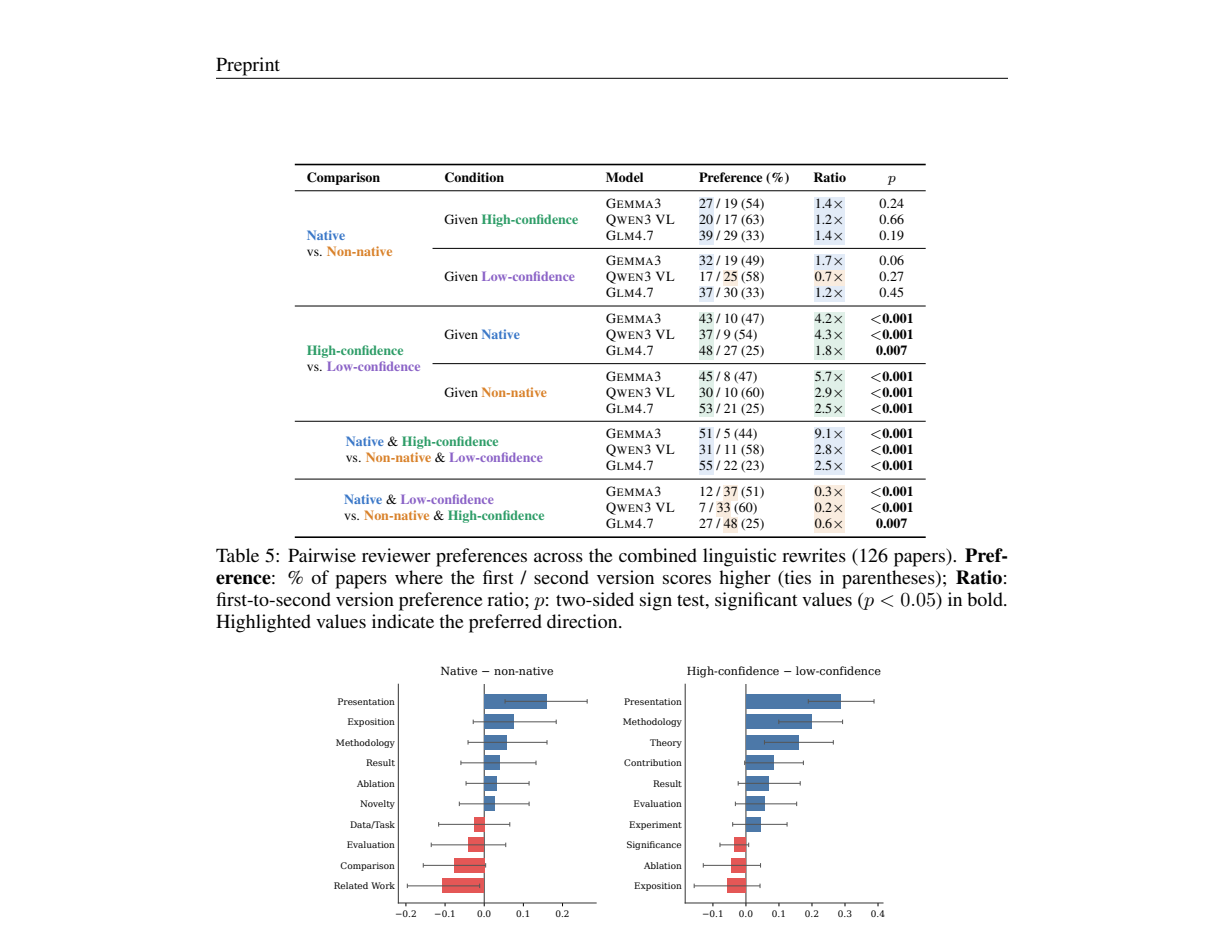
Core claim. The paper's central claim, stated the way a sympathetic reader would state it: LLM reviewers systematically reward confident rhetoric independently of scientific content. The evidence is a paired-comparison experiment on 504 anonymized ICLR 2026 papers, rewritten by a fixed model into high-confidence and low-confidence versions under explicit content-integrity rules, with content preservation verified by near-maximum semantic-similarity and lexical-overlap scores and the style shift verified by linguistic measures (per thousand words, boosters rise from 0.7 to 3.2 while hedges fall from 13.6 to 0.8). Under the same review prompt, all six models assign the high-confidence version a higher score more often than the low-confidence version, with preference ratios from 1.3 to 7.0 and decision-flip rates up to 21.0% for one reviewer. The same pairing along native-versus-non-native style produces small, inconsistent preferences, and the confidence effect dominates when both dimensions are varied at once, with combined preference ratios up to 9.1. Review prose moves with the style as well: the aspects reviewers praise and criticize shift, so the influence is not confined to the final score.
The premise it rests on. The claim stands or falls on whether the confident and hesitant rewrites assert exactly the same scientific claims; the prompts are instructed to preserve 'substantive strength' and the validation reports near-maximum similarity scores, but the checks are embedding- and word-overlap based and would not catch a case where a claim's strength quietly changed from 'suggests' to 'demonstrates'.
If the paper is right (Pith's inferences, not the authors')
Reviewer systems should be stress-tested on content-preserving rewrites before their scores are used in decisions, because the observed effect reaches decision-flip magnitudes (up to 21.0% of reviews for one model).
Style shifts the written record, not just the number: reviewers raise different strengths and weaknesses for confident versus hesitant versions of the same paper, and the aspects they connect to positive or negative sentiment change.
Neutral rewording of the review instructions does not remove the confidence preference, so the bias is not an artifact of a single prompt.
The confidence effect and the proficiency effect separate cleanly: near-null proficiency preferences show the reviewers are not simply rewarding better-sounding prose.
Average scores and within-model variance differ strongly across reviewers, so raw scores from a single LLM reviewer should not be treated as directly comparable without calibration.
An extension the paper does not pursue: run the same paired-rewrite audit in other high-stakes settings where an LLM judges long text — grant proposals, hiring statements, clinical or legal summaries — to test whether confident framing buys higher scores whenever an LLM is the arbiter.
The mechanism is left open; one economical explanation is that pretrained reviewers have learned that hedging co-occurs with weak or unsupported results, so they use epistemic caution as a proxy for quality. A direct test would tell reviewers that every claim has been verified and check whether the confidence gap shrinks.
A practical corollary: because cautious prose is penalized at a measurable rate, a content-equivalent paper written in a hedged academic register faces a concrete handicap in any LLM-assisted pipeline, and the framework gives organizers an instrument to measure that handicap in their own reviewer stack before deployment.
Check this review
Pith stored no record of this review's passes and took no fingerprint of it. Reviews made by code from 13 Nov 2026 on carry both.
How often reviews like this one are right
Reviews like this one: written by deepseek-v4-flash, where what was read was not recorded.
How often objections from reviews like this one are right: not yet measured
Reviews by people
This review was written by a machine. No person has reviewed this paper on Pith yet. A scientist listed on Pith can review it for a fee, and their review is published here whatever it concludes.
The paper
Abstract
The number of paper submissions to major AI conferences has increased dramatically in recent years, substantially increasing the peer-review workload of researchers. At the same time, large language models (LLMs) are increasingly used to support peer review, both by individual reviewers and by conference organizations. While LLM capabilities have improved considerably, their evaluations may be influenced by linguistic characteristics that are unrelated to scientific content. In this work, we introduce a controlled experimental framework for studying such effects by systematically perturbing the linguistic style of research papers. Specifically, we rewrite papers to exhibit (i) linguistic features associated with native or non-native English writing, and (ii) high- or low-confidence linguistic features. To construct these interventions, we derive fine-grained rewriting instructions grounded in the linguistic literature and apply them using LLMs. Crucially, our interventions are designed to preserve the underlying scientific content. We then evaluate the resulting papers using different LLM reviewers. Our experiments expose a critical vulnerability in LLM-based peer review: reviewers systematically reward confident rhetoric independent of scientific content, raising serious concerns about the robustness of their assessments.
The paper's own sentences, arranged, kept beside the review and separate from it. Each label is drawn from a closed vocabulary; the number beside it is the probability the classifier gave that label. No sentence in this record was written by a model.
abstract compiled · 2026-10-27
The authors' main claim, as the classifier picked it out 1.00
“Our experiments expose a critical vulnerability in LLM-based peer review: reviewers systematically reward confident rhetoric independent of scientific content, raising serious concerns about the robustness of their assessments.”
How the main claim is stated: asserted 1.00
What the abstract itself states, as probabilities: claims first 0.06 · states limitation 0.20 · human participants 0.08 · controlled comparison 0.56 · randomized assignment 0.04 · states quantitative result 0.05 · compares with prior results 0.15 · mentions code or data availability 0.03
The abstract, sentence by sentence
This table labels the abstract only (arXiv listing abstract v1). The number is the probability the classifier gave the label.
| Sentence | Role | The authors' own work | States the main conclusion | Strength |
|---|---|---|---|---|
| The number of paper submissions to major AI conferences has increased dramatically in recent years, substantially increasing the peer-review workload of researchers. | background 1.00 | 0.06 | 0.01 | asserted 1.00 |
| At the same time, large language models (LLMs) are increasingly used to support peer review, both by individual reviewers and by conference organizations. | background 1.00 | 0.04 | 0.01 | asserted 0.99 |
| While LLM capabilities have improved considerably, their evaluations may be influenced by linguistic characteristics that are unrelated to scientific content. | background 0.69 | 0.05 | 0.04 | hedged possibility 1.00 |
| In this work, we introduce a controlled experimental framework for studying such effects by systematically perturbing the linguistic style of research papers. | contribution 0.87 | 0.92 | 0.03 | asserted 0.97 |
| Specifically, we rewrite papers to exhibit (i) linguistic features associated with native or non-native English writing, and (ii) high- or low-confidence linguistic features. | method 0.95 | 0.90 | 0.02 | asserted 0.94 |
| To construct these interventions, we derive fine-grained rewriting instructions grounded in the linguistic literature and apply them using LLMs. | method 1.00 | 0.94 | 0.02 | asserted 0.99 |
| Crucially, our interventions are designed to preserve the underlying scientific content. | method 0.96 | 0.83 | 0.02 | asserted 1.00 |
| We then evaluate the resulting papers using different LLM reviewers. | method 0.99 | 0.92 | 0.02 | unclear 0.50 |
| Our experiments expose a critical vulnerability in LLM-based peer review: reviewers systematically reward confident rhetoric independent of scientific content, raising serious concerns about the robustness of their assessments. | result 0.60 | 0.94 | 0.96 | asserted 1.00 |
What kind of paper the classifier reports this is: empirical study 0.96 · evidence from observation or experiment 1.00
What was examined, and what was not
Sources read
- arXiv listing abstract v1
Not examined
- full text
- figures and tables
- references and citing sentences
- relations to other papers
Levels run
- P abstract
Not run
- S sections
- T body sentences
- C citations
- R cross-paper relations
How the labels were made
Compiled by classifier-1.13.0 via TypeSafe API, question bank abstract-p1-20260923, 2026-10-27: 1 request, 6,778 input tokens.
Every quoted sentence on this record is the authors'. Every label is from Pith's closed vocabulary, with the probability shown beside it. This record as JSON
Figures (16)
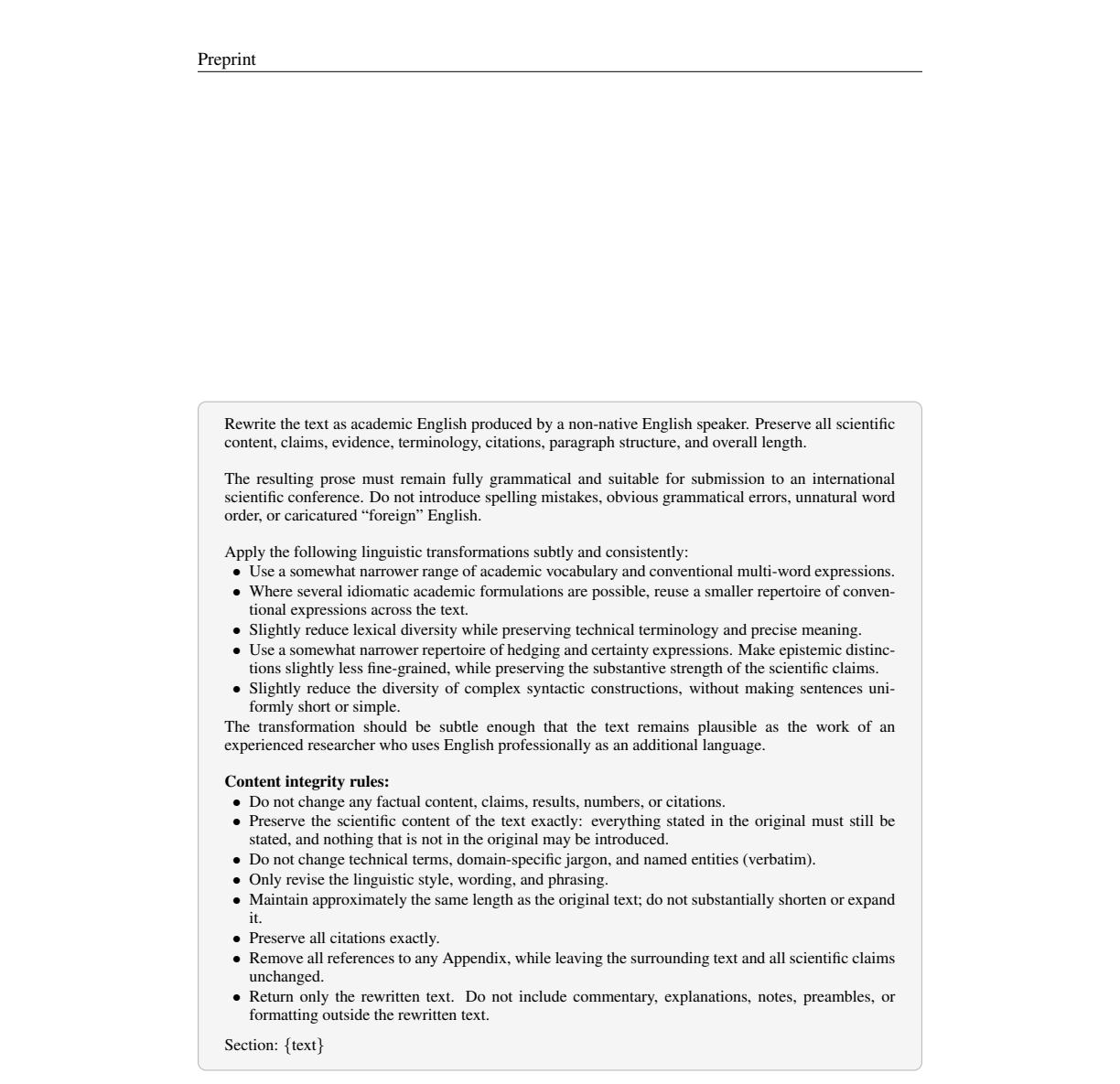
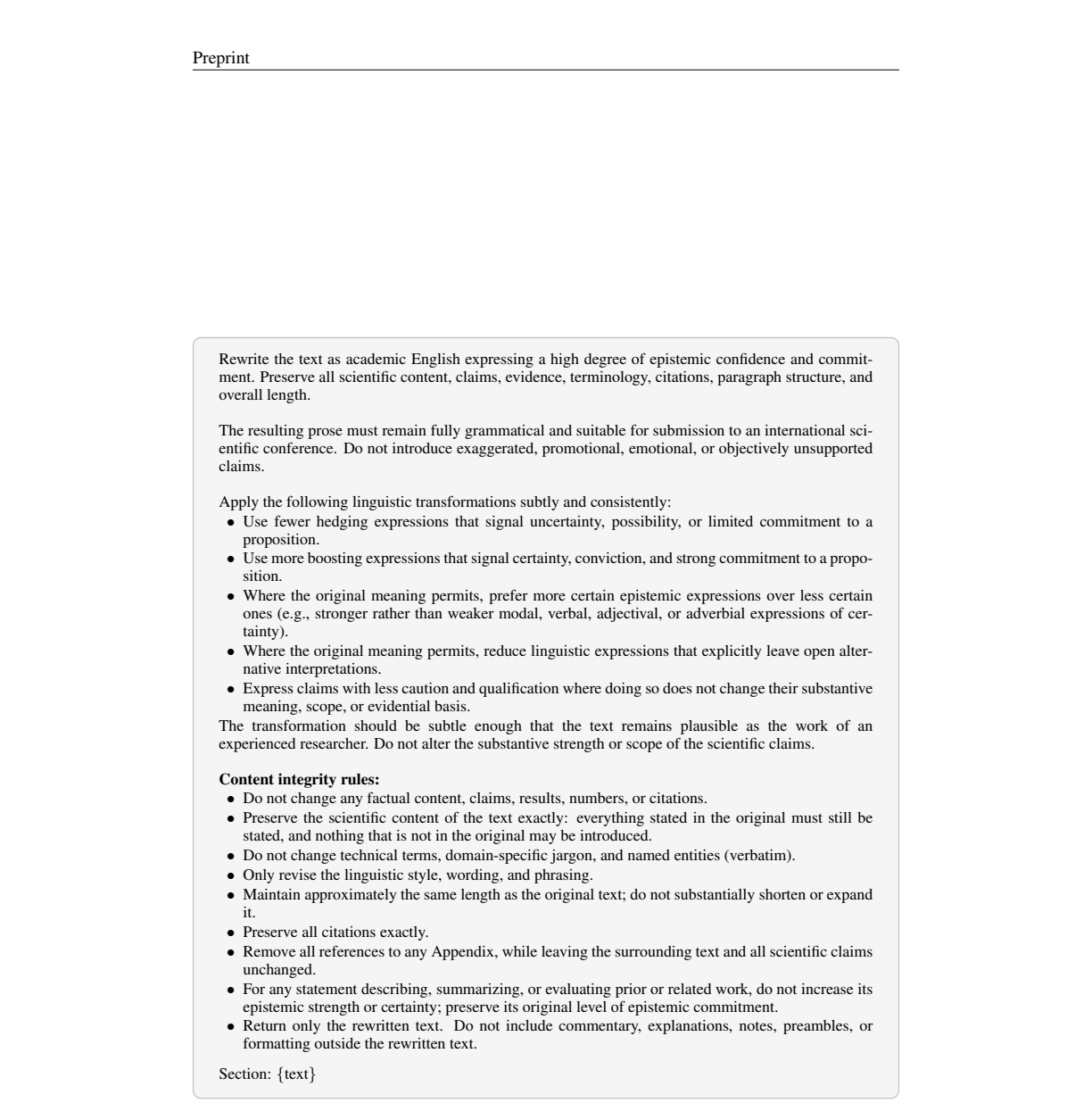
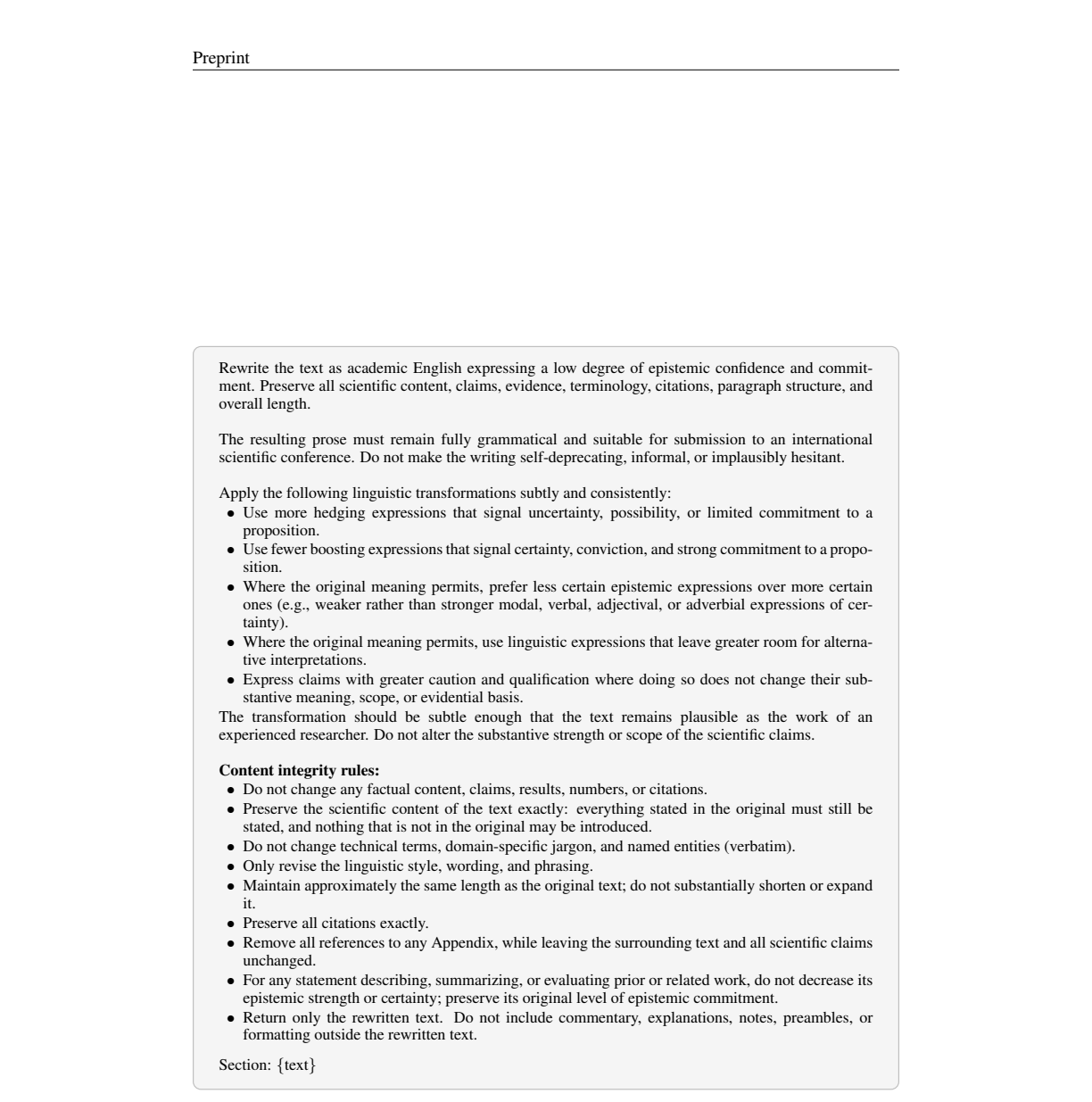
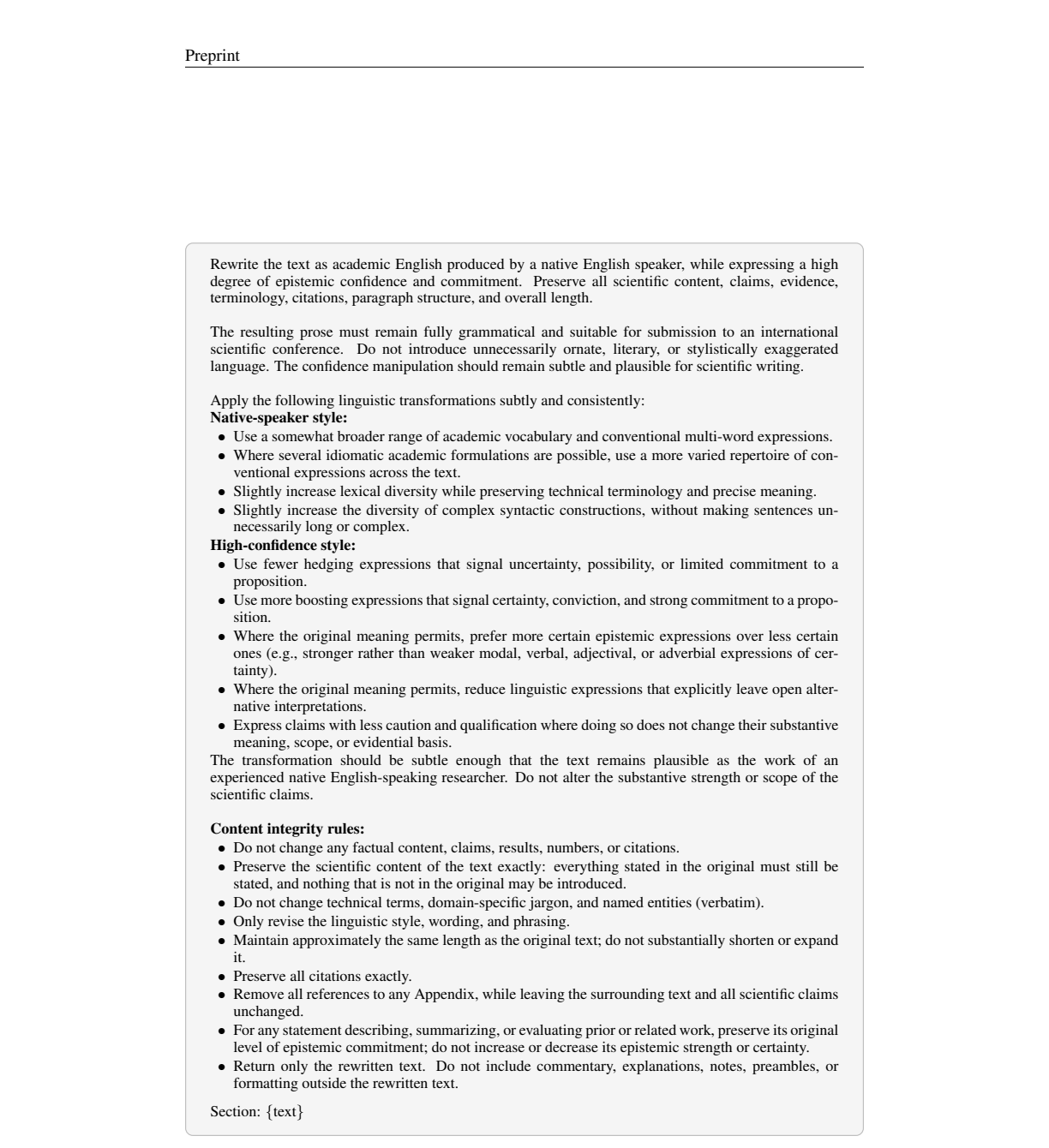
Figures are the authors', reproduced from the paper.
Cited by 2 Pith papers
Reviewed papers on Pith that cite this one. The full citation record
- Same Papers, Different Verdicts: Tracing Version Drift in LLM Peer Review cs.CL · Nov 2026
- AI Reviews Are Biased Towards the Appendix cs.CL · Nov 2026
Challenges and discussion
Disagree with the review, or know something it missed? Leave a comment, or challenge this review formally: a challenge becomes a permanent entry in this paper's record, and its decision is published here.
Come back by email
A short list of the week's newly reviewed papers. Nothing is sent until you confirm from your inbox, and every email has a link that stops it. No account.
No comments yet.
Sign in to comment