Multiagent Systems · arXiv:2610.35959 v1 · submitted 25 Oct 2026 · 37 references
AgentBaton: Efficient Model Collaboration in Agentic Tasks
The paper says
“Solving long-horizon agentic tasks requires language agents to interact with their environments over multiple steps, and reliable performance often comes from the expensive capable models available through cloud providers.”
more of the abstract
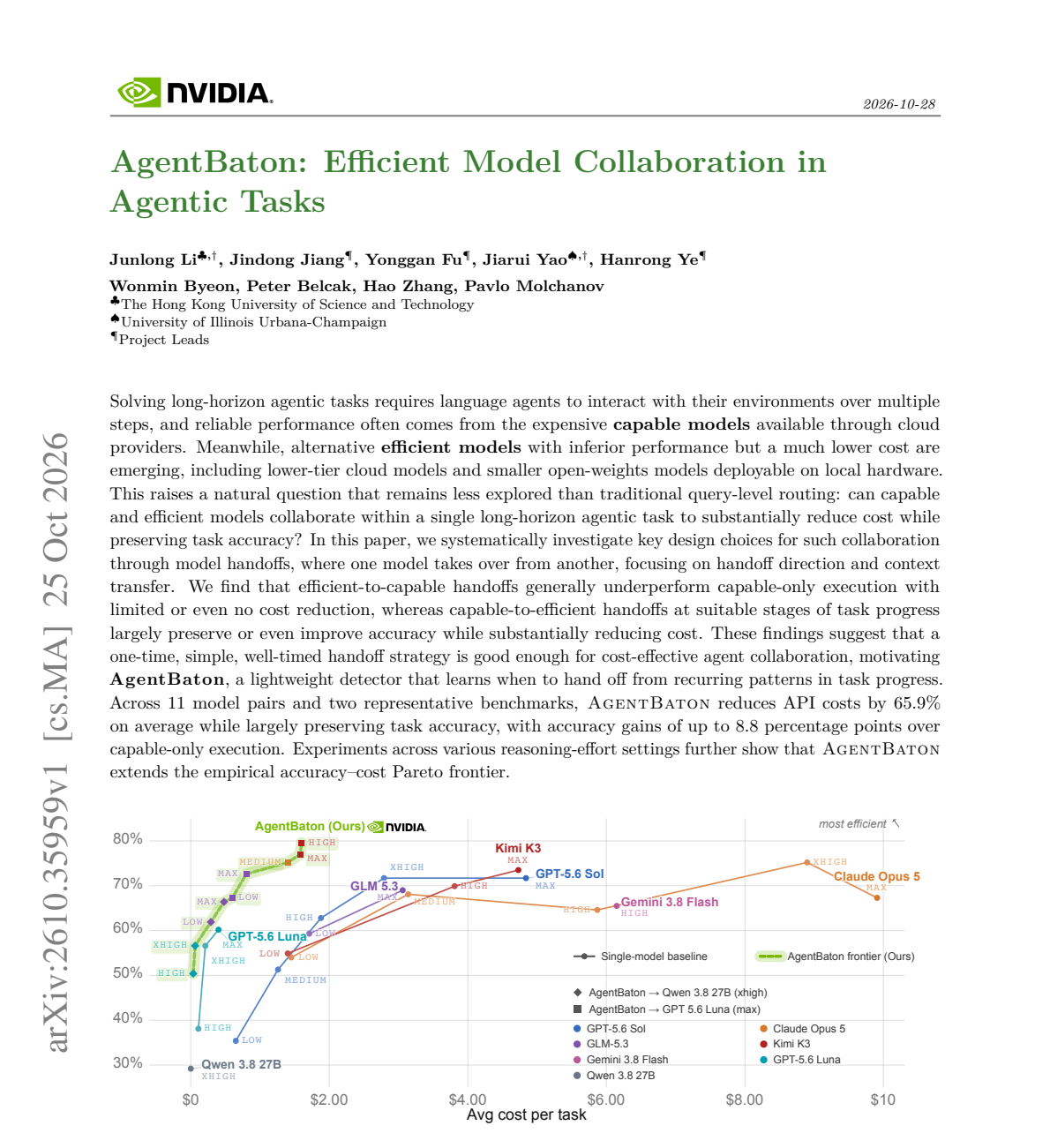
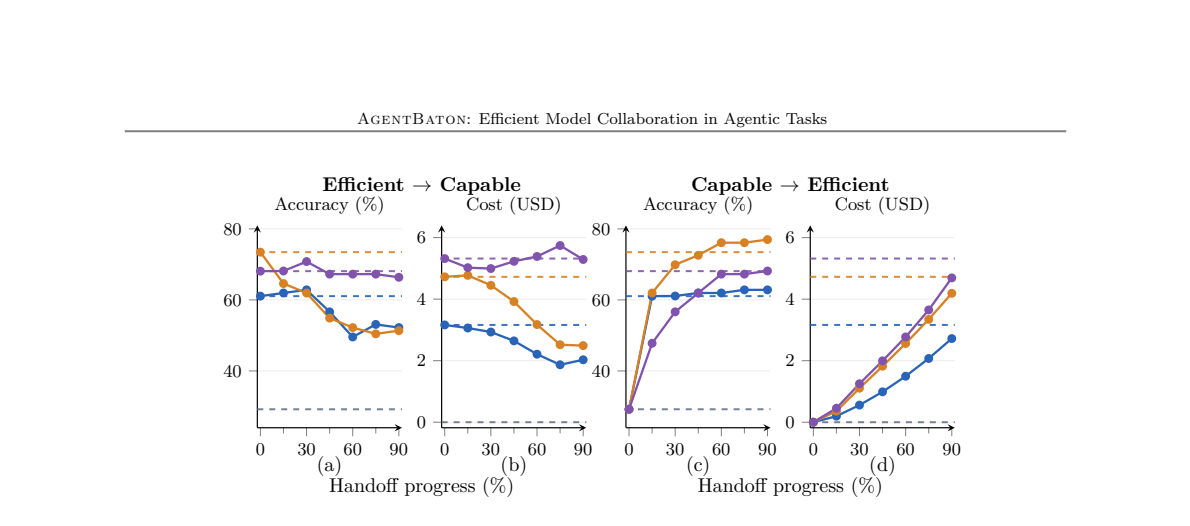
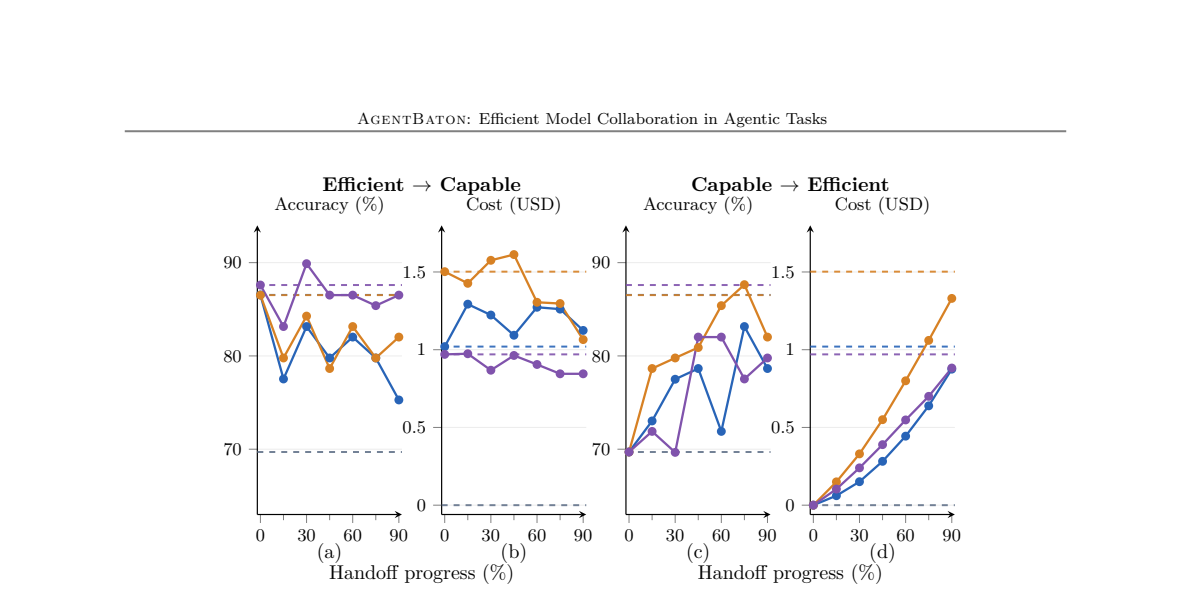
Meanwhile, alternative efficient models with inferior performance but a much lower cost are emerging, including lower-tier cloud models and smaller open-weights models deployable on local hardware. This raises a natural question that remains less explored than traditional query-level routing: can capable and efficient models collaborate within a single long-horizon agentic task to substantially reduce cost while preserving task accuracy? In this paper, we systematically investigate key design choices for such collaboration through model handoffs, where one model takes over from another, focusing on handoff direction and context transfer. We find that efficient-to-capable handoffs generally underperform capable-only execution with limited or even no cost reduction, whereas capable-to-efficient handoffs at suitable stages of task progress largely preserve or even improve accuracy while substantially reducing cost. These findings suggest that a one-time, simple, well-timed handoff strategy is good enough for cost-effective agent collaboration, motivating AgentBaton, a lightweight detector that learns when to hand off from recurring patterns in task progress. Across 11 model pairs and two representative benchmarks, AgentBaton reduces API costs by 65.9% on average while largely preserving task accuracy, with accuracy gains of up to 8.8 percentage points over capable-only execution. Experiments across various reasoning-effort settings further show that AgentBaton extends the empirical accuracy-cost Pareto frontier.
from the abstract
Pith says
Machine review · deepseek-v4-flash · 28 Oct 2026 · what was read was not recorded · not checked by a person
It can be wrong. Challenge this review or reply to it.
Holds up, with conditions. Solid empirical paper on model handoffs for cost-efficient agentic tasks; the automatic annotation concern is real but the evidence holds up better than the stress-test suggests. This line is wrong
3 major objections · 6 minor
How often objections from reviews like this one are right: not yet measured
Not checked: figures, code, what the 37 references say.
The paper says, at §4.2, Appendix B
The review did not quote this passage.
Pith says: Objection 1 of 3 · major
The training of AgentBaton relies on Codex-annotated handoff labels with no reported human validation. Although the annotation protocol is detailed, no inter-annotator agreement or human-Codex agreement statistics are provided. Systematic annotation bias (e.g., overconfidence in handoff readiness) could propagate to the detector and affect generalization, even if the downstream evaluation on separate benchmarks mitigates this concern.
more of objection 1
The paper should either (a) report a sample human evaluation of Codex annotations with agreement measures, or (b) include an ablation study that perturbs training labels to assess robustness to noise.
The paper says, at §2 (cost calculation)
The review did not quote this passage.
Pith says: Objection 2 of 3 · major
The paper assigns zero cost to locally deployable models (Qwen 3.8 27B) under its accounting convention. This is reasonable for inference-only comparisons, but it ignores hardware amortization and energy costs. The Pareto frontier plots (Figure 1) inherit this zero-cost assumption, which may overstate the cost advantage for users without dedicated hardware. The paper should acknowledge this limitation and discuss how positive local deployment costs would affect the reported trade-offs.
The paper says, at §4.3, Table 3
The review did not quote this passage.
Pith says: Objection 3 of 3 · major
The main AgentBaton evaluation uses a fixed context-transfer method per source model (logfile for GPT, in-context for others), chosen based on the limited analysis in §3.1 (two checkpoints, three capable models). While Appendix C reports both methods, the primary results do not systematically justify why one method is preferred across all receiving models and checkpoints.
more of objection 3
The paper should either (a) show that the chosen method consistently yields better accuracy-cost trade-offs for the AgentBaton setting, or (b) include both transfer methods in the main results and discuss the selection rationale more thoroughly.
6 minor objections
The paper says, at Figure 1
Pith says: minor objection 1 of 6
The figure is visually dense with many markers and labels. Consider simplifying by highlighting the Pareto-frontier configurations with a distinct marker shape or color, and reducing overlap by annotating only the frontier points directly.
The paper says, at Table 3 caption
Pith says: minor objection 2 of 6
The caption mentions color-coded subscripts (green for better, red for worse), but these are not rendered in the provided monochrome text. Ensure the final version uses color or explicit arrows (↑/↓) as in the header.
show 4 more
The paper says, at §2 (scaffold description)
Pith says: minor objection 3 of 6
The term 'linear interaction history' for mini-SWE-agent is unclear. Clarify whether this means a single chain of turns without branching or rollback.
The paper says, at Footnote 2
Pith says: minor objection 4 of 6
The statement 'Qwen 3.5 9B variant shows no clear improvement' would benefit from reporting the actual accuracy/cost numbers for this variant in an appendix, to allow readers to assess the comparison.
The paper says, at Appendix B
Pith says: minor objection 5 of 6
The annotation protocol records 'confidence level' and 'caveats' per trajectory, but the paper does not report aggregated statistics. Summarizing average confidence and common caveat types would help readers gauge annotation reliability.
The paper says, at Contribution list
Pith says: minor objection 6 of 6
The second bullet states evaluation across 'two agentic benchmarks.' The training uses SWE-rebench V2, but evaluation is on DeepSWE v1.1 and Terminal-Bench 2.1. Clarify that SWE-rebench V2 is used only for training, not for evaluation.
What would settle it
Randomly sample 200 trajectories from the SWE-rebench V2 training pool. Have two independent human annotators apply the same protocol (Appendix B) to label the earliest suitable handoff point. Compute Cohen's kappa between the two humans and between each human and Codex's labels. If human–Codex agreement (e.g., exact turn index or within ±1 turn) is high (kappa > 0.7), the concern is mitigated. If agreement is low, retrain AgentBaton on the human-consensus subset and re-evaluate on DeepSWE; if results shift materially, the original claim weakens.
from the skeptic's reading
How the review went
4 readings by deepseek-v4-flash · 28 Oct 2026
- Reader holds up, with conditions
- Skeptic agrees
- Editor wrote the verdict above
- Referee minor revision: 3 major objections, 6 minor
Not run on this paper: the simulated authors' defence.
Pith did not check this review's objections against the paper.
The review in full
The review in brief, machine-written
This paper does two things well. First, it provides a careful, systematic analysis of handoff direction and context transfer in long-horizon agentic tasks. The finding that capable-to-efficient handoffs beat efficient-to-capable ones is clean, and the pattern analysis in Section 3.3 gives a concrete characterization of when handoffs work. Second, it builds a lightweight learned detector (AgentBaton) that identifies suitable handoff points online and demonstrates consistent cost reductions across 11 model pairs and two benchmarks. The cost savings are substantial, and the accuracy preservation is decent. The Pareto frontier extension is a nice bonus.
The stress-test concern about automatic Codex annotation without human validation is valid but not as load-bearing as it sounds. The paper does not claim human-level annotations, but it evaluates the detector on held-out benchmarks (DeepSWE, Terminal-Bench) that differ from the training data (SWE-rebench V2). If Codex labels were systematically wrong, you would expect more random behavior on unseen distributions. Instead, the detector's performance is comparable to fixed-progress baselines that have access to future information, which suggests it is learning something real. The qualitative patterns in Section 3.3 also provide independent grounding. I would have liked human agreement numbers, but the empirical chain does not collapse without them.
The softer spot is the Terminal-Bench inconsistency, which the authors acknowledge. Handoffs there are less beneficial and the cost reductions are smaller. This is a domain sensitivity that limits generality but does not invalidate the main claim.
The zero-cost accounting for local models is a simplification, but it is clearly stated and the paper evaluates both cost-incurring receiving models (GPT-5.6 Luna) and free ones, so the savings are not an artifact of that choice alone.
Who benefits: anyone working on cost-efficient agent deployment, especially for SWE tasks. The systematic analysis of handoff direction is a practical contribution that stands even if you ignore the detector.
Recommendation: Send to review. The annotation methodology should be scrutinized, but the paper's evidence is stronger than the single weakest assumption suggests.
The strongest objection
The central claim of AgentBaton hinges on a detector that learns to identify suitable handoff points from trajectories annotated by Codex (Sec. 4.2). The annotation protocol (Appendix B) is well-defined but is executed entirely by an automated model with no reported human agreement or inter-annotator statistics. The paper does not quantify the reliability of these labels—e.g., by having human annotators apply the same protocol on a sample of trajectories and measuring agreement with Codex. If Codex's judgments are systematically biased (e.g., too optimistic about handoff readiness or insensitive to certain failure modes), the detector will inherit those biases, degrading its ability to generalize to unseen benchmarks. This concern is load-bearing because every evaluation of AgentBaton downstream depends on the fidelity of the training signal. The paper acknowledges no such validation and does not analyze the impact of possible label noise (e.g., via ablation or robustness tests). While the protocol criteria are grounded in qualitative patterns from Sec. 3.3, the automated annotation step remains unverified, making it the weakest premise in the empirical chain.
The reader's weakest assumption correctly identifies the lack of human validation for Codex annotations as the most fragile premise. The paper does not provide any quality metrics for these labels, and the entire detector training pipeline depends on them. Other concerns (zero-cost accounting for local models, domain sensitivity on Terminal-Bench) are either acknowledged by the authors or partially addressed by the data. The proposed concrete test is a straightforward human annotation study that would directly assess label reliability. If the labels are trustworthy, the current conditional verdict can be upgraded; if not, the central claim requires re-evaluation. The verdict remains CONDITIONAL because the paper's contributions are strong but subject to this unresolved empirical assumption.
The referee's report
If the results hold, the paper makes a practical contribution by demonstrating that a simple, one-time capable-to-efficient handoff—guided by a learned detector—can substantially reduce inference costs in agentic systems with minimal accuracy loss. The systematic analysis of handoff direction, context transfer, and progress timing is a useful empirical guide for practitioners. The Pareto-frontier extension across reasoning-effort settings is particularly valuable, as it shows that handoff and model-effort scaling are complementary. The experimental design is thorough, covering 11 model pairs, two diverse benchmarks, and multiple baselines (fixed-progress, fixed-turn, MTRouter). The release of a trained detector and annotated data would further strengthen reproducibility.
Pith's reading of the paper (a machine's summary, not the authors')
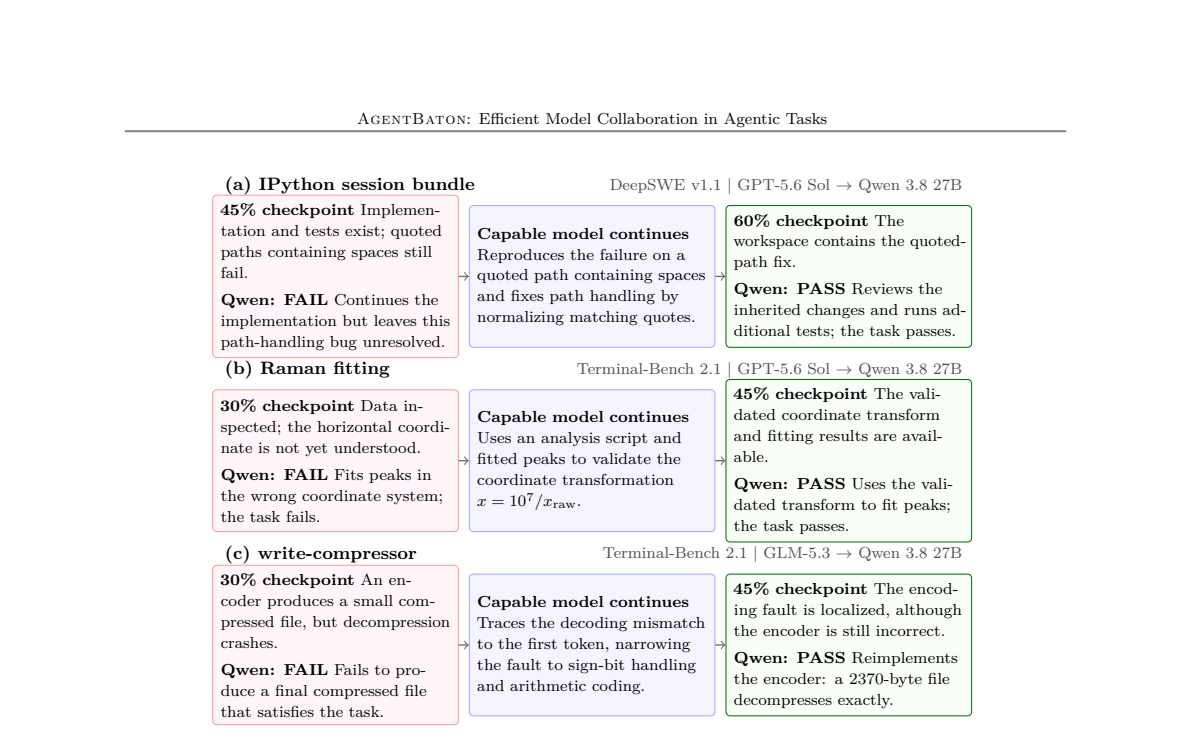
This paper shows that in long-horizon agentic tasks, a one-time handoff from a capable (expensive) language model to an efficient (cheap) model at the right stage of task progress can reduce API costs by about two-thirds on average while largely preserving task accuracy. The key insight is asymmetry: handing off from efficient to capable models generally underperforms, but capable-to-efficient handoffs succeed when the capable model has already built a substantial artifact, gathered real feedback, and narrowed the remaining work to localized refinements. Based on these recurring patterns, the authors introduce AgentBaton, a lightweight detector trained to recognize suitable handoff points during execution, which dynamically triggers the transition.
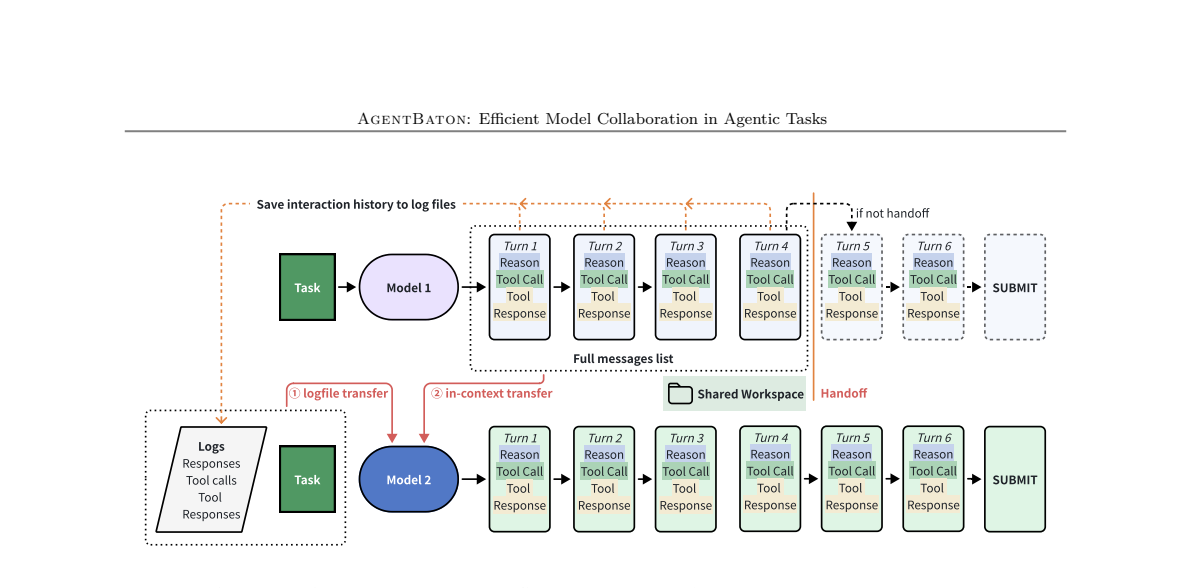
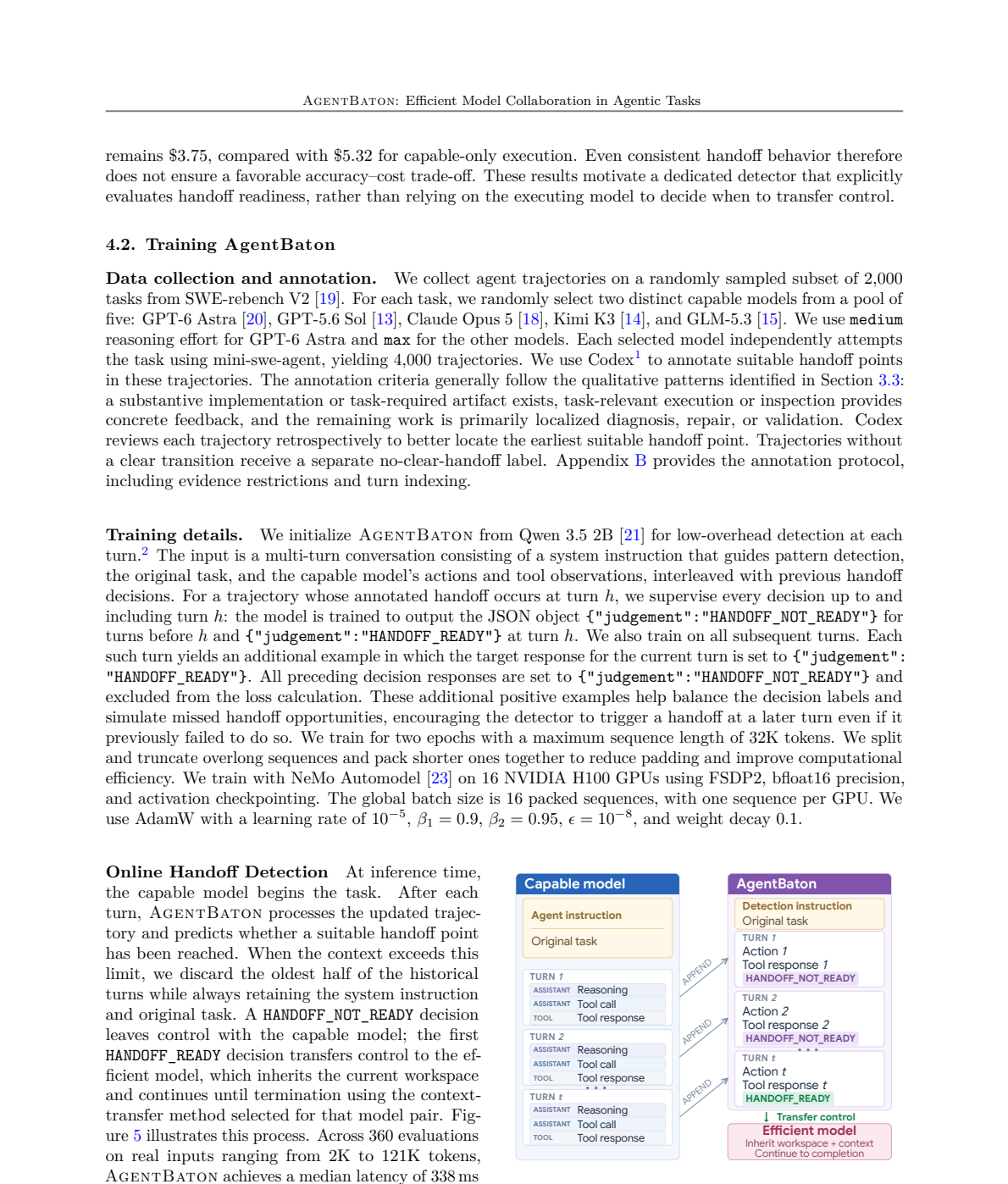
What carries the argument. AgentBaton is a lightweight transformer detector (initialized from Qwen 3.5 2B) that takes as input the capable model's trajectory so far (tool calls and responses) and outputs a binary HANDOFF_READY or HANDOFF_NOT_READY judgement each turn. It is trained on trajectories annotated by Codex using three readiness criteria: existence of a substantive artifact, receipt of real (possibly failing) feedback, and localization of remaining work. At inference, it runs after each turn of the capable model; on the first HANDOFF_READY prediction, control transfers to the efficient model via either in-context or logfile transfer of the execution history, and the efficient model continues until task termination.
Core claim. The central claim is that capable-to-efficient model handoffs in multi-step agentic tasks can achieve accuracy nearly matching the capable model alone while substantially reducing cost, provided the handoff occurs after the capable model has established concrete progress (a substantive artifact with task-relevant feedback and localized remaining work). The authors demonstrate this across 11 model pairs on Terminal-Bench 2.1 and DeepSWE v1.1, reporting an average API cost reduction of 65.9% with accuracy largely preserved and sometimes improved by up to 8.8 percentage points over capable-only execution. They further show that the handoff detector extends the empirical accuracy–cost Pareto frontier across varying reasoning efforts.
The premise it rests on. The handoff-point annotations used to train AgentBaton were generated automatically by Codex following a protocol with three criteria, without human agreement studies or inter-annotator statistics; if Codex's annotations are noisy or systematically biased, the detector's ability to generalize to unseen tasks or models may be significantly weaker than reported.
If the paper is right (Pith's inferences, not the authors')
Practitioners can deploy a single AgentBaton detector across multiple model pairs without retraining, as the paper demonstrates with 11 diverse capable–efficient combinations.
The asymmetry finding suggests that in many long-horizon agentic tasks, optimal cost–accuracy trade-offs are achieved by starting with a strong model and switching once—not by per-turn routing or constant switching.
Because the detector triggers based on task progress rather than fixed turn thresholds, it can adapt to tasks of varying difficulty, handing off only when the efficient model is likely to succeed.
The approach extends to efficient models as source models: using GPT-5.6 Luna as the source and handing off to Qwen 3.8 27B still reduces cost by 75% on DeepSWE, showing the detector generalizes beyond expensive sources.
Reasoning-effort settings and model handoffs provide complementary dimensions for cost–accuracy trade-offs, as evidenced by the expanded Pareto frontier in Figure 1.
The finding that fixed-progress handoffs (which use future information) perform similarly to online detection suggests that simpler heuristics based on a few progress indicators (e.g., number of files modified, test pass rate) might approximate AgentBaton's performance in many settings, reducing the need for a learned detector.
The asymmetry in handoff direction implies that the value of efficient models in multi-step tasks is primarily in post-processing and refinement rather than in exploration or planning, which may inform the design of hierarchical agent systems where a planner delegates execution to cheaper workers.
AgentBaton's reliance on Codex-generated annotations without human verification raises uncertainty about generalization to tasks or models with different interaction patterns than those in the training distribution (SWE-rebench V2). Future work could test whether human-annotated handoff points improve detector robustness.
Check this review
Pith stored no record of this review's passes and took no fingerprint of it. Reviews made by code from 13 Nov 2026 on carry both.
How often reviews like this one are right
Reviews like this one: written by deepseek-v4-flash, where what was read was not recorded.
How often objections from reviews like this one are right: not yet measured
Reviews by people
This review was written by a machine. No person has reviewed this paper on Pith yet. A scientist listed on Pith can review it for a fee, and their review is published here whatever it concludes.
The paper
Abstract
Solving long-horizon agentic tasks requires language agents to interact with their environments over multiple steps, and reliable performance often comes from the expensive capable models available through cloud providers. Meanwhile, alternative efficient models with inferior performance but a much lower cost are emerging, including lower-tier cloud models and smaller open-weights models deployable on local hardware. This raises a natural question that remains less explored than traditional query-level routing: can capable and efficient models collaborate within a single long-horizon agentic task to substantially reduce cost while preserving task accuracy? In this paper, we systematically investigate key design choices for such collaboration through model handoffs, where one model takes over from another, focusing on handoff direction and context transfer. We find that efficient-to-capable handoffs generally underperform capable-only execution with limited or even no cost reduction, whereas capable-to-efficient handoffs at suitable stages of task progress largely preserve or even improve accuracy while substantially reducing cost. These findings suggest that a one-time, simple, well-timed handoff strategy is good enough for cost-effective agent collaboration, motivating AgentBaton, a lightweight detector that learns when to hand off from recurring patterns in task progress. Across 11 model pairs and two representative benchmarks, AgentBaton reduces API costs by 65.9% on average while largely preserving task accuracy, with accuracy gains of up to 8.8 percentage points over capable-only execution. Experiments across various reasoning-effort settings further show that AgentBaton extends the empirical accuracy-cost Pareto frontier.
The paper's own sentences, arranged, kept beside the review and separate from it. Each label is drawn from a closed vocabulary; the number beside it is the probability the classifier gave that label. No sentence in this record was written by a model.
abstract compiled · 2026-10-28
The authors' main claim, as the classifier picked it out 0.73
“We find that efficient-to-capable handoffs generally underperform capable-only execution with limited or even no cost reduction, whereas capable-to-efficient handoffs at suitable stages of task progress largely preserve or even improve accuracy while substantially reducing cost.”
How the main claim is stated: asserted 1.00
What the abstract itself states, as probabilities: claims first 0.08 · states limitation 0.28 · human participants 0.04 · controlled comparison 0.94 · randomized assignment 0.02 · states quantitative result 0.99 · compares with prior results 0.93 · mentions code or data availability 0.03
The abstract, sentence by sentence
This table labels the abstract only (arXiv listing abstract v1). The number is the probability the classifier gave the label.
| Sentence | Role | The authors' own work | States the main conclusion | Strength |
|---|---|---|---|---|
| Solving long-horizon agentic tasks requires language agents to interact with their environments over multiple steps, and reliable performance often comes from the expensive capable models available through cloud providers. | background 1.00 | 0.05 | 0.02 | asserted 0.89 |
| Meanwhile, alternative efficient models with inferior performance but a much lower cost are emerging, including lower-tier cloud models and smaller open-weights models deployable on local hardware. | background 1.00 | 0.05 | 0.02 | asserted 1.00 |
| This raises a natural question that remains less explored than traditional query-level routing: can capable and efficient models collaborate within a single long-horizon agentic task to substantially reduce cost while preserving task accuracy? | gap 0.99 | 0.04 | 0.03 | hedged possibility 0.70 |
| In this paper, we systematically investigate key design choices for such collaboration through model handoffs, where one model takes over from another, focusing on handoff direction and context transfer. | contribution 0.84 | 0.83 | 0.04 | asserted 0.90 |
| We find that efficient-to-capable handoffs generally underperform capable-only execution with limited or even no cost reduction, whereas capable-to-efficient handoffs at suitable stages of task progress largely preserve or even improve accuracy while substantially reducing cost. | result 1.00 | 0.97 | 0.70 | asserted 1.00 |
| These findings suggest that a one-time, simple, well-timed handoff strategy is good enough for cost-effective agent collaboration, motivating AgentBaton, a lightweight detector that learns when to hand off from recurring patterns in task progress. | interpretation 0.72 | 0.78 | 0.42 | hedged possibility 0.85 |
| Across 11 model pairs and two representative benchmarks, AgentBaton reduces API costs by 65.9% on average while largely preserving task accuracy, with accuracy gains of up to 8.8 percentage points over capable-only execution. | result 1.00 | 0.96 | 0.40 | asserted 1.00 |
| Experiments across various reasoning-effort settings further show that AgentBaton extends the empirical accuracy-cost Pareto frontier. | result 0.97 | 0.95 | 0.13 | asserted 1.00 |
What kind of paper the classifier reports this is: method or tool 0.92 · evidence from observation or experiment 1.00
What was examined, and what was not
Sources read
- arXiv listing abstract v1
Not examined
- full text
- figures and tables
- references and citing sentences
- relations to other papers
Levels run
- P abstract
Not run
- S sections
- T body sentences
- C citations
- R cross-paper relations
How the labels were made
Compiled by classifier-1.13.0 via TypeSafe API, question bank abstract-p1-20260923, 2026-10-28: 1 request, 6,455 input tokens.
Every quoted sentence on this record is the authors'. Every label is from Pith's closed vocabulary, with the probability shown beside it. This record as JSON
Figures (6)
Figures are the authors', reproduced from the paper.
References (37)
- [1] Shunyu Yao, Jeffrey Zhao, Dian Yu, Nan Du, Izhak Shafran, Karthik Narasimhan, and Yuan Cao. React: Synergizing reasoning and acting in language models.arXiv preprint arXiv:2210.03629, 2022 on PithPith's reviewarXiv
- [2] John Yang, Carlos Jimenez, Alexander Wettig, Kilian Lieret, Shunyu Yao, Karthik Narasimhan, and Ofir Press. Swe-agent: Agent-computer interfaces enable automated software engineering.Advances in Neural Information Processing Systems, 37:50528–50652, 2024 on Pith
- [3] Anthropic. Introducing Claude Fable 5.1 and Claude Mythos 5.1, 2026. URLhttps://www.anthropic. com/claude-fable-and-mythos-5-1 on Pith
- [5] OpenAI. Introducing GPT-6 Sol and Luna, 2026. URL https://openai.com/index/ introducing-gpt-6-sol-and-luna/ on Pith
- [6] Qwen Team. Qwen3.8-27B, 2026. URLhttps://huggingface.co/Qwen/Qwen3.8-27B on Pith
- [7] Lingjiao Chen, Matei Zaharia, and James Zou. Frugalgpt: How to use large language models while reducing cost and improving performance.arXiv preprint arXiv:2305.05176, 2023 on PithPith's reviewarXiv
- [8] Isaac Ong, Amjad Almahairi, Vincent Wu, Wei-Lin Chiang, Tianhao Wu, Joseph E Gonzalez, Mohammed Kadous, and Ion Stoica. Routellm: Learning to route llms from preference data. InInternational Conference on Learning Representations, volume 2025, pages 34433–34448, 2025 on Pith
- [9] Shuhao Chen, Weisen Jiang, Baijiong Lin, James Kwok, and Yu Zhang. Routerdc: Query-based router by dual contrastive learning for assembling large language models.Advances in Neural Information Processing Systems, 37:66305–66328, 2024 on Pith
- [10] Qitian Jason Hu, Jacob Bieker, Xiuyu Li, Nan Jiang, Benjamin Keigwin, Gaurav Ranganath, Kurt Keutzer, and Shriyash Kaustubh Upadhyay. Routerbench: A benchmark for multi-llm routing system. arXiv preprint arXiv:2403.12031, 2024 on PithPith's reviewarXiv
- [11] Mike A Merrill, Alexander Glenn Shaw, Nicholas Carlini, Boxuan Li, Harsh Raj, Ivan Bercovich, Lin Shi, Jeong Yeon Shin, Thomas Walshe, E. Kelly Buchanan, Junhong Shen, Guanghao Ye, Haowei Lin, Jason Poulos, Maoyu Wang, Marianna Nezhurina, Di Lu, Orfeas Menis Mastromichalakis, ... on Pith
- [12] Wenqi Huang, Charley Lee, Leonard Tng, and Serena Ge. Deepswe: Measuring frontier coding agents on original, long-horizon engineering tasks, 2026. URLhttps://github.com/datacurve-ai/deep-swe on Pith
- [13] OpenAI. GPT-5.6: Frontier intelligence that scales with your ambition, 2026. URLhttps://openai. com/index/gpt-5-6/ on Pith
- [14] Moonshot AI. Kimi K3: Open Frontier Intelligence, 2026. URLhttps://www.kimi.ai/blog/kimi-k3 on Pith
- [15] Z.ai. GLM-5.3: Frontier Coding with Emergent Cyber Capabilities, 2026. URLhttps://z.ai/blog/ glm-5.3. 11 AgentBaton: Efficient Model Collaboration in Agentic Tasks on Pith
- [16] John Yang, Carlos E Jimenez, Alexander Wettig, Kilian Lieret, Shunyu Yao, Karthik R Narasimhan, and Ofir Press. SWE-agent: Agent-computer interfaces enable automated software engineering. In The Thirty-eighth Annual Conference on Neural Information Processing Systems, 2024. UR... on PithPith's reviewarXiv
- [17] DeepSeek. Introducing DeepSeek-V4.1-Flash: smarter, faster, more efficient., 2026. URL https: //www.deepseek.com/en/news/deepseek-v4-1-flash/ on Pith
- [18] Anthropic. Introducing Claude Opus 5, 2026. URLhttps://www.anthropic.com/news/claude-opus-5 on Pith
- [19] Ibragim Badertdinov, Maksim Nekrashevich, Anton Shevtsov, and Alexander Golubev. SWE-rebench v2: Language-agnostic SWE task collection at scale. InForty-third International Conference on Machine Learning, 2026. URLhttps://openreview.net/forum?id=UCAda9kS57 on Pith
- [20] OpenAI. GPT-6 Astra: A new generation of intelligence, 2026. URL https://openai.com/index/ gpt-6-astra/ on Pith
- [21] Qwen Team. Qwen3.5-2B, 2026. URLhttps://huggingface.co/Qwen/Qwen3.5-2B on Pith
show 17 more
- [22] Qwen Team. Qwen3.5-9B, 2026. URLhttps://huggingface.co/Qwen/Qwen3.5-9B on Pith
- [23] NVIDIA-Nemo. NeMo AutoModel: DTensor-native SPMD library for scalable and efficient training. https://github.com/NVIDIA-NeMo/Automodel, 2026. GitHub repository on Pith
- [24] Google DeepMind. Introducing Gemini 3.8 Flash and 3.8 Flash Cyber, 2026. URLhttps://blog.google/ innovation-and-ai/models-and-research/gemini-models/3-8-flash-and-3-8-flash-cyber/ on Pith
- [25] Yiqun Zhang, Hao Li, Zihan Wang, Shi Feng, Xiaocui Yang, Daling Wang, Bo Zhang, Lei Bai, and Shuyue Hu. Mtrouter: Cost-aware multi-turn llm routing with history–model joint embeddings. In Proceedings of the 64th Annual Meeting of the Association for Computational Linguistics (... on Pith
- [26] Jasper Dekoninck, Maximilian Baader, and Martin Vechev. A unified approach to routing and cascading for llms.arXiv preprint arXiv:2410.10347, 2024 on PithPith's reviewarXiv
- [27] Zhihong Pan, Kai Zhang, Yuze Zhao, and Yupeng Han. Route to reason: Adaptive routing for llm and reasoning strategy selection.arXiv preprint arXiv:2505.19435, 2025 on PithPith's reviewarXiv
- [28] Haozhen Zhang, Tao Feng, and Jiaxuan You. Router-r1: Teaching llms multi-round routing and aggregation via reinforcement learning.Advances in Neural Information Processing Systems, 38:141233– 141265, 2026 on Pith
- [29] Hongjin Su, Shizhe Diao, Ximing Lu, Mingjie Liu, Jiacheng Xu, Xin Dong, Yonggan Fu, Peter Belcak, Hanrong Ye, Hongxu Yin, Yi Dong, Evelina Bakhturina, Tao Yu, Yejin Choi, Jan Kautz, and Pavlo Molchanov. Toolorchestra: Elevating intelligence via efficient model and tool orchest... on PitharXiv
- [30] Jiayu Wang, Yifei Ming, Zixuan Ke, Shafiq Joty, Aws Albarghouthi, and Frederic Sala. Skillorchestra: Learning to route agents via skill transfer.arXiv preprint arXiv:2602.19672, 2026 on PitharXiv
- [31] Pengfei Zhou, Zhiwei Tang, Yixing Ma, Jiasheng Tang, Yizeng Han, Zhenglin Wan, Fanqing Meng, Wei Wang, Bohan Zhuang, Wangbo Zhao, et al. Agent-as-a-router: Agentic model routing for coding tasks. arXiv preprint arXiv:2606.22902, 2026 on PithPith's reviewarXiv
- [32] Seongho Son, Sangwoong Yoon, Jiahua Tang, Shuhan Wang, Lorenz Wolf, and Ilija Bogunovic. Swe-router: Routing in multi-turn agentic software engineering tasks.arXiv preprint arXiv:2607.00053, 2026 on PithPith's reviewarXiv
- [33] Ji’an Lei and Jian Huang. Tacit-switch: Cost-aware model escalation for llm agents from censored supervision.arXiv preprint arXiv:2608.27911, 2026 on PithPith's reviewarXiv
- [34] Roy Ganz, Mor Shpigel Nacson, Adi Kalyanpur, and Ron Litman. The handoff tax: Continuing non-native trajectories in LLM agents.arXiv preprint arXiv:2608.24358, 2026. URL https://arxiv.org/abs/ 2608.24358. 12 AgentBaton: Efficient Model Collaboration in Agentic Tasks on PithPith's reviewarXiv
- [35] Sangmook Lee, Dohyung Kim, Hyukhun Koh, Nakyeong Yang, and Kyomin Jung. Confidence-guided stepwise model routing for cost-efficient reasoning. InProceedings of the AAAI Conference on Artificial Intelligence, volume 40, pages 31483–31491, 2026 on Pith
- [36] Yash Akhauri, Anthony Fei, Chi-Chih Chang, Ahmed F AbouElhamayed, Yueying Li, and Mohamed S Abdelfattah. Splitreason: Learning to offload reasoning.arXiv preprint arXiv:2504.16379, 2025 on PithPith's reviewarXiv
- [37] Wang Yang, Xiang Yue, Vipin Chaudhary, and Xiaotian Han. Speculative thinking: Enhancing small- model reasoning with large model guidance at inference time.arXiv preprint arXiv:2504.12329, 2025 on PithPith's reviewarXiv
- [38] Jiwon Song, Yoongon Kim, and Jae-Joon Kim. Relaygen: Intra-generation model switching for efficient reasoning.arXiv preprint arXiv:2602.06454, 2026. 13 AgentBaton: Efficient Model Collaboration in Agentic Tasks 0 30 60 90 70 80 90 Accuracy (%) 0 30 60 90 0 0.5 1 1.5 Cost (USD)... on PitharXiv
Cited by 1 Pith paper
Reviewed papers on Pith that cite this one. The full citation record
- Adversarial Speculative Reasoning Improves Long Horizon Agents cs.AI · Nov 2026
Challenges and discussion
Disagree with the review, or know something it missed? Leave a comment, or challenge this review formally: a challenge becomes a permanent entry in this paper's record, and its decision is published here.
Come back by email
A short list of the week's newly reviewed papers. Nothing is sent until you confirm from your inbox, and every email has a link that stops it. No account.
No comments yet.
Sign in to comment