Artificial Intelligence · arXiv:2611.05345 v1 · submitted 3 Nov 2026 · 14 references
Adversarial Speculative Reasoning Improves Long Horizon Agents
The paper says
“Speculative decoding has been treated purely as a systems optimization that speeds up large language model decoding without changing the model behavior. Under this view, the growing effort to train better draft models has been focused solely on acceptance rate.”
more of the abstract
We argue that this view does not hold true for long-horizon agent reasoning. Measuring frontier open-weight models on complex agentic tasks with different speculative decoding approaches, we found that numerical noise grows within verification windows, and the draft acceptance results of the thinking process can change the output distribution of the model after 30 steps, thus noticeably influencing the reasoning accuracy of long-horizon agents in random directions. In this work, we improve the reasoning capability of target models by controlling such noise. While we cannot change the overall token distribution verified by the target model, we can encode critical reasoning with highest precision by training the draft model to be rejected. We identify these points in agent traces and train the draft model to favor adversarial preference. At inference the trained draft and the target part ways precisely at these decision points, verification restarts, so that critical thinking tokens are sampled from the target model and encoded under its least noisy conditions. This approach makes critical reasoning better indexed and more durable over a long horizon. On complex agentic coding benchmarks, our approach raises end-to-end success rate with no change to the target model or its output distribution. Our results recast the speculative decoding mechanism from a pure accelerator into an active allocator for context precision that improves the accuracy of long-horizon agents by training 0.06% to 0.28% of hosted parameters.
from the abstract
Pith says
Machine review · deepseek-v4-flash · 4 Nov 2026 · what was read was not recorded · not checked by a person
It can be wrong. Challenge this review or reply to it.
Holds up, with conditions. A careful, real measurement of noise growth across verify slots and a genuinely new idea (train the draft to be rejected at decision points), but the causal link between them is asserted, not measured, and the headline result rests on one significant gain out of three. This line is wrong
5 major objections · 8 minor
How often objections from reviews like this one are right: not yet measured
Not checked: figures, code, what the 14 references say.
The paper says, at Abstract; §4.1; §5.2
The review did not quote this passage.
Pith says: Objection 1 of 5 · major
The exactness argument in §4.1 is stated for a fixed target distribution p, and the rejection-sampling identity is correct conditional on that p. But §3.1–§3.3 measures that the served target's logits depend on the verify slot and vary across repeated forwards on an identical prefix; the paper itself notes that 1–2 nat shifts change nucleus membership in 12–47% of cases.
more of objection 1
Because the trained draft changes where blocks end, it changes the slot at which later tokens are verified and hence the realized p_s. The abstract states both that draft acceptance can change the output distribution after 30 steps and that the method raises success 'with no change to the target model or its output distribution,' and §5.2 states that 'Nothing in the output distribution changed' and that runs 'sample from the same targets and the same verified distribution.' That is an idealization, not a property of the deployed system, and it is in tension with the paper's own §3 measurements. Please state the exactness claim explicitly as conditional on an idealized fixed target, and either measure token-level divergence between base and adversarial serving or remove the unqualified 'same output distribution' claim.
The paper says, at §4.1–§4.2; §5.2; Figure 5(c,d)
The review did not quote this passage.
Pith says: Objection 2 of 5 · major
The central causal claim is that the adversarial draft causes rejection at labeled decision points, so those tokens are resampled and committed from slot 0. The manuscript does not report this mediating event in a live rollout: it gives no rejection rate at decision points, no distribution of commit slots for decision tokens, and no count of decision points per trajectory.
more of objection 2
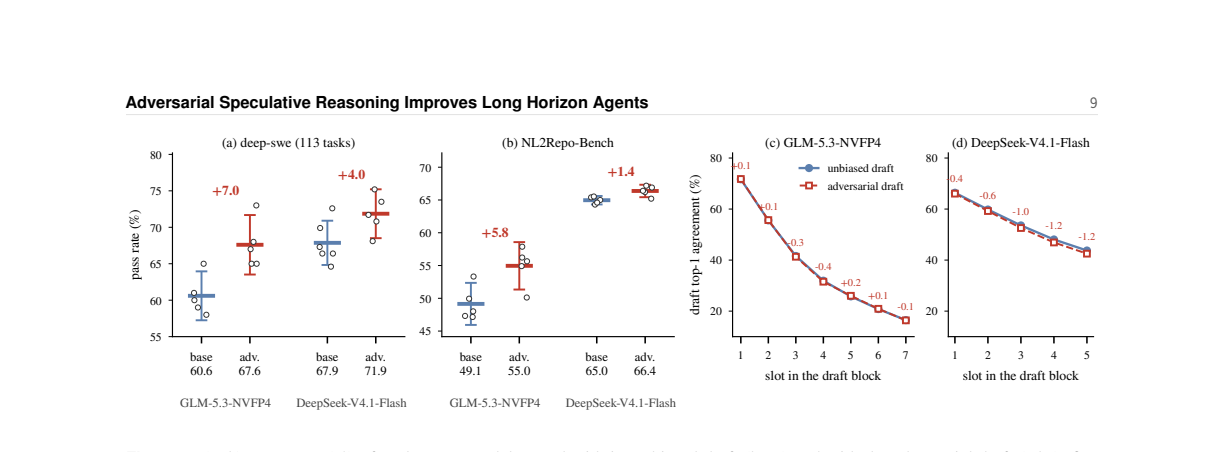
Figure 5(c,d) reports aggregate top-1 agreement teacher-forced over held-out continuations, not conditional on decision points; the changes are small (-0.4 to -1.2 points on DeepSeek-V4.1-Flash). §5.1 reports held-out preference accuracy, which shows the draft ranks the preferred side lower, not that the served sampler rejects there. Without a measurement of how often the adversarial draft actually flips a decision token to slot 0, the 7.0-point DeepSWE gain could reflect a global change in block layout or acceptance statistics rather than decision-point localization. The sentence in §5.2 that 'The gain is therefore evidence for our hypothesis' should be backed by an instrumentation experiment comparing decision-point rejection rates and slot-0 commit fractions for base and adversarial drafts in live rollouts.
The paper says, at §4.3; §5.2
The review did not quote this passage.
Pith says: Objection 3 of 5 · major
§4.3 builds fork pairs from 29 GLM-5.3 tasks and 92 DeepSeek-V4.1-Flash tasks, but the manuscript never states where those tasks come from. §5.2 evaluates on DeepSWE (113 tasks) and NL2Repo-Bench. If the fork-pair tasks are drawn from the same DeepSWE pool, the headline DeepSWE numbers are not held out at the task level.
more of objection 3
The paper must state the corpus and certify task-level disjointness between training forks and both evaluation benchmarks, or rerun with disjoint tasks. The current sentence that whole tasks are held out for preference evaluation does not address benchmark contamination. This is load-bearing for the 7.0- and 4.0-point results.
The paper says, at §5.2; Figure 5(a,b); Figure 7
The review did not quote this passage.
Pith says: Objection 4 of 5 · major
The text concludes that the adversarial draft 'raises the pass rate of both targets models on both tasks,' and the conclusion says 'significantly improved pass rate on DeepSWE and NL2Repo-Bench.' But the four cells are not uniform: DeepSeek-V4.1-Flash on DeepSWE is +4.0 points with 95% CI -1.3 to +7.3, which is not distinguishable from zero at the reported level.
more of objection 4
The DeepSeek NL2Repo gain is +1.4 points with CI 0.4 to 2.4, which is small and would not survive an obvious multiplicity correction across four benchmark cells. The pooled unrelated-draft comparison in Figure 7 also mixes groups with n=5, 7, and 15. Please prespecify or clearly label a primary endpoint, report all four cells with consistent CIs, and temper the 'both targets on both tasks' language.
The paper says, at §3.3; Observation 2; Figure 2
The review did not quote this passage.
Pith says: Objection 5 of 5 · major
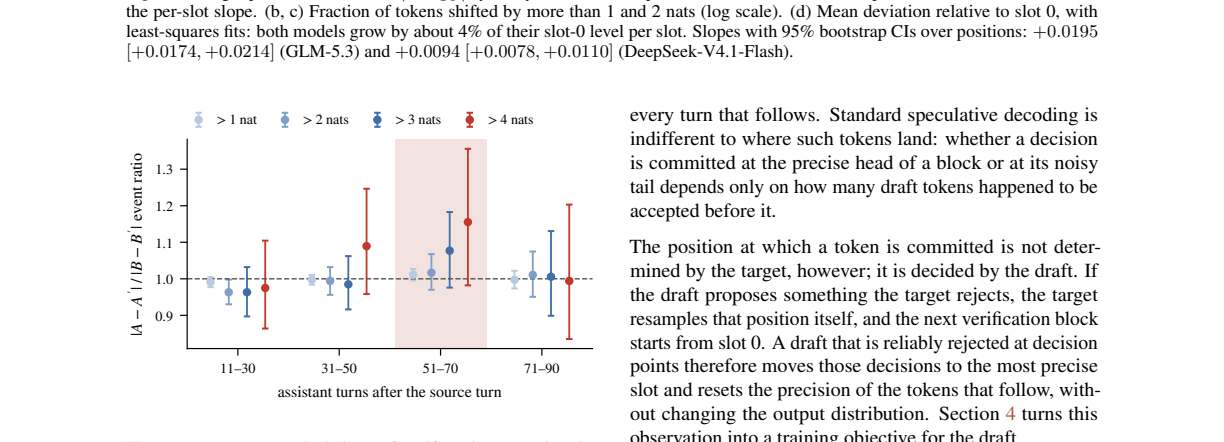
Observation 2 states that verify-written context produces 'significantly more extreme deviations beyond 4 nats' after 30 turns. The reported bins do not support that uniformly: the 31–50 bin is 1.09 with 95% CI [0.98, 1.36], which includes 1, and the 51–70 bin returns to 0.99 by turns 71–90.
more of objection 5
The independent comparison 1.20 [1.03, 1.40] and the build-to-build check 1.07 [0.91, 1.24] are directionally consistent but not a stable 10–20% excess. Because this is the only long-horizon bridge from single-pass noise to agent behavior, the manuscript should either report a pooled estimate with a clear model and CI or soften 'significantly' and present the measurement as suggestive. It should also state how the teacher-forced scoring avoids the fixed-token bias noted in the caption.
8 minor objections
The paper says, at §3.3
Pith says: minor objection 1 of 8
The sentence 'the slope is +0.0195 nats per slot with 95% confidence interval (CI), about 4% of the slot-0 level per slot' omits the interval itself; the interval appears only in the Figure 1 caption. Please insert the numerical CI for both models in the text.
The paper says, at §4.3
Pith says: minor objection 2 of 8
The task and pair counts are inconsistent: 29 tasks, 2,843 pairs from 28 tasks, and six held-out tasks. Please give a single table of total, training, and held-out tasks, forks, pairs, and samples for each model.
show 6 more
The paper says, at §4.3
Pith says: minor objection 3 of 8
The DPO objective contains the term 'αNLLθ(yw)' but NLLθ is not defined. Please define the negative log-likelihood term, its weighting, and whether the anchor is applied to the chosen continuation only.
The paper says, at §5.1; Figure 4
Pith says: minor objection 4 of 8
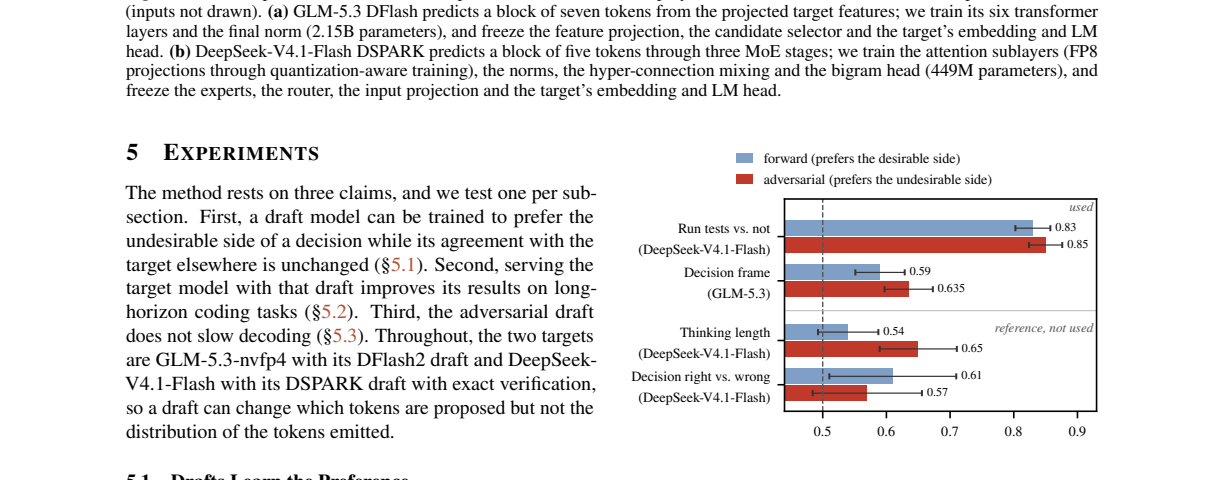
The text reports 0.85 held-out accuracy for the adversarial run-tests preference, but the deployed DeepSeek draft is 'taken after the second epoch (held-out accuracy 0.70).' Figure 4 also reports the 'best configuration per preference and direction.' Please reconcile the 0.85 and 0.70 numbers and state whether configuration or checkpoint selection used the same held-out pairs used to compute the reported accuracy.
The paper says, at §5.2
Pith says: minor objection 5 of 8
The sentence that 'the preference of the draft model is the only factor of the performance gap' is stronger than the design supports: the preferred and adversarial drafts are separately trained and differ in held-out accuracy (0.59 vs 0.635 on GLM-5.3), so direction is confounded with training strength. Please qualify the claim or add a control that matches preference strength across directions.
The paper says, at Figure 5(c,d)
Pith says: minor objection 6 of 8
The panels use a y-axis starting at 20 and show point changes as small as 0.1–1.2 points without intervals. Please add a difference panel or a table with per-slot changes and CIs so the reader can judge the claim that the acceptance curve is unchanged.
The paper says, at §4.2
Pith says: minor objection 7 of 8
The decision-frame audit reports that principle/evidence decisions are correct about 70% of the time versus 36% for likely/risk frames, but gives no sample size or interval. Please report n and uncertainty, and describe how the judge labels were validated.
The paper says, at §4.4
Pith says: minor objection 8 of 8
The DSPARK port is said to match reference kernels to within 10^-7 per expert and 3–5% per stage output. Please quantify whether the 3–5% stage discrepancy affects the deployed draft's acceptance or the claim that the exported draft computes exactly the evaluated function.
What would settle it
Instrument the GLM-5.3 DeepSWE run that produced the +7.0 result. For each decision point labeled by the §4.2 judge, log whether the next token was accepted from the draft or drawn from the residual, the slot index at which it was committed, and whether that token was the committing decision. Run the same tasks with the unbiased and adversarial drafts. The check succeeds if the adversarial draft increases the fraction of decision tokens committed via residual sampling at slot 0 by a prespecified meaningful margin (e.g., at least 5 percentage points) and the per-task pass-rate gain is concentrated in tasks with larger mediator shifts. If the mediator does not move, the decision-point mechanism is not supported even if the aggregate gain replicates.
from the skeptic's reading
How the review went
4 readings by deepseek-v4-flash · 4 Nov 2026
- Reader holds up, with conditions
- Skeptic agrees
- Editor wrote the verdict above
- Referee major revision: 5 major objections, 8 minor
Not run on this paper: the simulated authors' defence.
Pith did not check this review's objections against the paper.
The review in full
The review in brief, machine-written
Here's the short version: the measurement in Section 3 is solid and the idea in Section 4 is genuinely new, but the paper never measures the event its mechanism requires, and the performance evidence is thinner than the abstract implies.
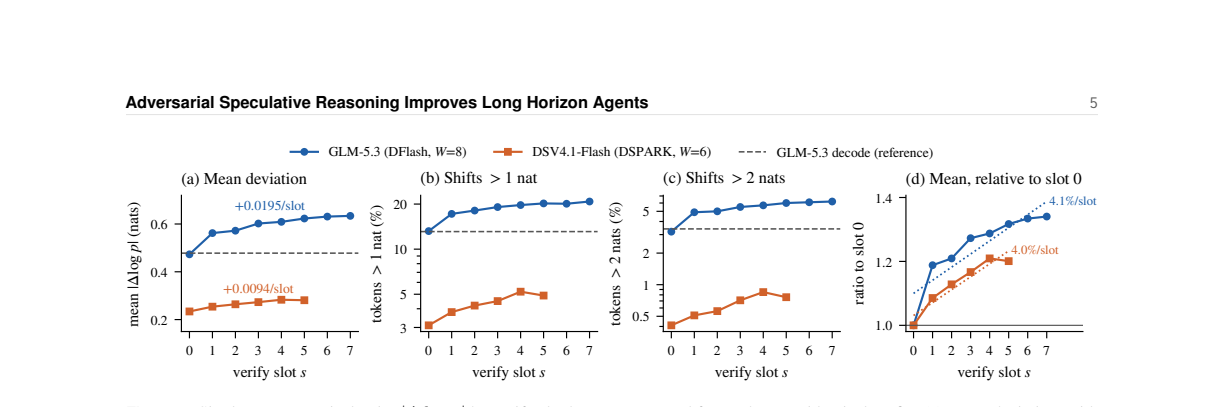
What's real. Section 3.2's design is the right one: hold the prefix in memory, repeat only the forward decode pass, so the only variance left is numerical. 1631 and 1294 positions, bootstrap CIs on the slopes (+0.0195 [+0.0174, +0.0214] on GLM-5.3, +0.0094 [+0.0078, +0.0110] on DeepSeek-V4.1-Flash), and slot 0 landing at 0.473 against 0.478 nats for single-token decoding — that near-equality is the kind of detail you don't get by accident, and it matches the stated mechanism (slot 0 reads only cached entries). Two models, two different draft architectures, same ~4%-per-slot relative growth. I believe this part.
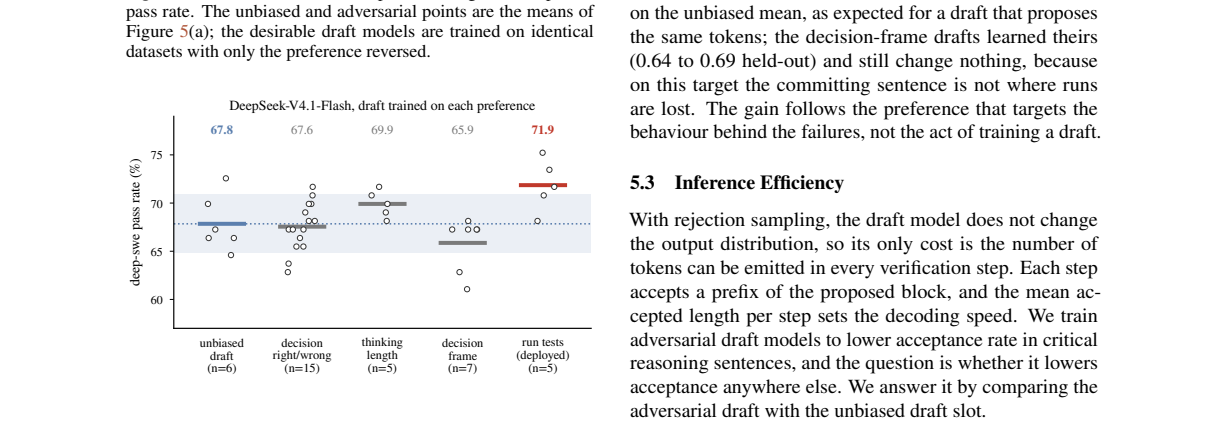
Section 4 is also a real idea. Reversing DPO on the draft so the target resamples the decision token at slot 0, leaving the verified distribution untouched, is not in the speculation literature and it is cheap. The direction-reversal control in Figure 6 and the pooled unrelated-preference control in Figure 7 are the strongest things in the experiments — Figure 7 in particular rules out the obvious "any trained draft" story.
Where it sags. The causal story has a hole in the middle. Nowhere does the paper report, in live rollouts, how often the adversarial draft actually triggers a rejection at a labeled decision point, or what fraction of decision tokens then come from slot 0. Figure 5(c,d) is teacher-forced aggregate top-1 agreement, not conditional on decision points, and the DeepSeek shifts are 0.4 to 1.2 points — consistent with either a big local effect diluted by rarity or no local effect at all. Section 5.1's 0.635 held-out accuracy shows the draft ranks the preferred side lower; it doesn't show the served sampler rejects there. So "the gain is therefore evidence for our hypothesis" is doing work the data hasn't earned. The figure-2 long-range evidence doesn't close the gap either: one bin's CI includes 1, and the caption already concedes the return to 0.99 by turns 71–90.
Two smaller things. The significance ledger is one gain at +7.0 (CI 2.6–11.4), one at +4.0 (CI −1.3–7.3) and +1.4 on NL2Repo; five runs per arm, and the forward-draft arm at 55.7 has no CI. And Figure 4's caption says "best configuration per preference and direction" — selecting the config on the held-out set inflates the reported 0.635.
None of this is fatal to the idea; the missing measurement is a cheap experiment and the paper should run it. But as written, the mechanism is a hypothesis and the result is a delta.
Who should read it: anyone working on speculative decoding, draft training, or agent reliability will get something from Section 3 alone. It deserves referees — send it out. I'd want the rejection-rate-at-decision-points measurement demanded explicitly in review.
The strongest objection
The central mechanistic claim is that training the draft to be rejected at decision points moves those decisions from noisy later slots to slot 0 via residual sampling (§4.1-4.2). The performance delta in §5.2 is measured, and the direction-reversal control in Figure 6 plus the unrelated-preference control in Figure 7 are genuine support. But the paper never reports the quantity that connects the two: in live rollouts, how often does the adversarial draft actually cause a rejection at a decision point, and what fraction of decision tokens are then committed from slot 0? Figure 5(c,d) reports only aggregate top-1 agreement per slot, teacher-forced over held-out continuations, not conditional on decision points; the changes are small (-0.4 to -1.2 points on DeepSeek-V4.1-Flash), which is consistent either with a large local effect diluted by rarity or with almost no local effect. §5.1 reports held-out preference accuracy (0.635, 0.85), which shows the draft ranks the preferred side lower, not that the served sampler rejects there. The long-range evidence in §3.3/Figure 2 is confined to >4-nat deviations beyond 30 turns, with one bin's CI including 1 and a return to 0.99 by turns 71-90, so it does not independently pin the mechanism. The gain may still be correct, but as written the 7.0-point result could arise from a global change in block layout or acceptance statistics rather than decision-point localization.
I agree with the reader's weakest_assumption and would keep the verdict at CONDITIONAL. The paper's empirical core is stronger than pure speculation: §3.1-3.3 uses repeated forwards on a fixed KV cache, per-slot slopes with bootstrap CIs, and a plausible mechanistic account; §5.1 shows the preferences are learnable; §5.2 reports five independent runs per configuration; and the direction-reversal and unrelated-preference controls are substantive. The load-bearing gap is exactly the causal join: the abstract and conclusion recast the draft as an active allocator of context precision, but the paper never measures the live rejection rate at decision points or the slot at which those decisions are actually written. The aggregate performance delta can be accepted as an empirical result, yet the paper's headline is mechanistic. A conditional verdict is therefore appropriate: the effect is measured and the controls are nontrivial, so rejection would be too strong, but acceptance would over-credit the unmeasured bridge. The proposed instrumentation uses labels and serving logs the paper already has and would either confirm or falsify the mechanism.
The referee's report
If the causal account holds, this is a meaningful reframing: the draft becomes an allocator of context precision, not only an accelerator, and the intervention is unusually parameter-efficient (0.06–0.28% of hosted parameters). The controlled repeat-forward measurement in §3.1–§3.3 is the strongest part of the paper: it holds the KV cache fixed, uses two models and architectures, and reports bootstrap CIs on the per-slot slopes. The direction-reversal and unrelated-preference controls are the right kind of evidence, and the mechanism makes a falsifiable prediction about decision-point rejection and slot-0 commits. The downstream evidence is not yet tied to that prediction, so the significance is conditional.
Pith's reading of the paper (a machine's summary, not the authors')
Speculative decoding has a theoretical guarantee: rejection sampling preserves the target model's distribution exactly. This paper argues that for real served models with quantized weights and block verification, the guarantee is lossless in distribution but not uniform in precision: numerical noise grows by about 4% per slot along a verification block, so where a token lands determines how precisely it is written into the key-value cache that later reasoning reads. The proposal is to train the draft in the reverse preference direction at decision points, making the target reject its proposal and resample, so that critical decision tokens are committed at slot 0 of a fresh block, the most precise position, while routine tokens keep normal acceleration. On two agentic coding benchmarks this raises end-to-end pass rates, for example from 60.6% to 67.6% on DeepSWE for one frontier model, while training 0.06% to 0.28% of hosted parameters and leaving the target weights and verification rule untouched. If correct, the draft model becomes an active allocator of context precision rather than just an accelerator.
What carries the argument. The central mechanism is the adversarial draft: a draft model trained with reverse-direction direct preference optimization on fork pairs whose two sides share every token up to a decision point and diverge only in how the decision is framed. The load-bearing identity is the rejection probability $\Pr[\text{reject}] = 1 - \sum_v \min(p(v), q(v)) = \mathrm{TV}(p,q)$, the total-variation distance between target and draft distributions; a draft that places its mass where the target places little is rejected, and after a rejection the target's resampled token becomes slot 0 of the next verification block, the slot measured to be as precise as single-token decoding, with noise growing by roughly 4% per later slot. The draft thus re-allocates context precision without changing which distribution produces the output.
Core claim. The paper claims that a verification block is exact in distribution but not uniform in precision: on both studied models, single-pass numerical noise grows roughly 4% per slot along the block, large deviations grow faster, and only slot 0 is as precise as single-token decoding. Because the probability that a block ends at a given position equals the total-variation distance between draft and target distributions, the draft, not the target, decides which slot commits each token. The paper trains the draft with direct preference optimization on fork pairs that share every token up to a decision point, in the reverse direction, so it proposes the undesirable framing; the target rejects it, samples its preferred continuation from the residual distribution, and the reasoning that follows is verified from the head of a fresh block. The paper reports that this raises DeepSWE pass rates by 7.0 points for GLM-5.3-nvfp4 and 4.0 points for DeepSeek-V4.1-Flash, with a further 5.8-point gain on NL2Repo-Bench for the first model, while expected accepted tokens per block are nearly unchanged. It reads these gains as evidence that decisions committed at the precise head of a block are held onto more reliably across a long horizon.
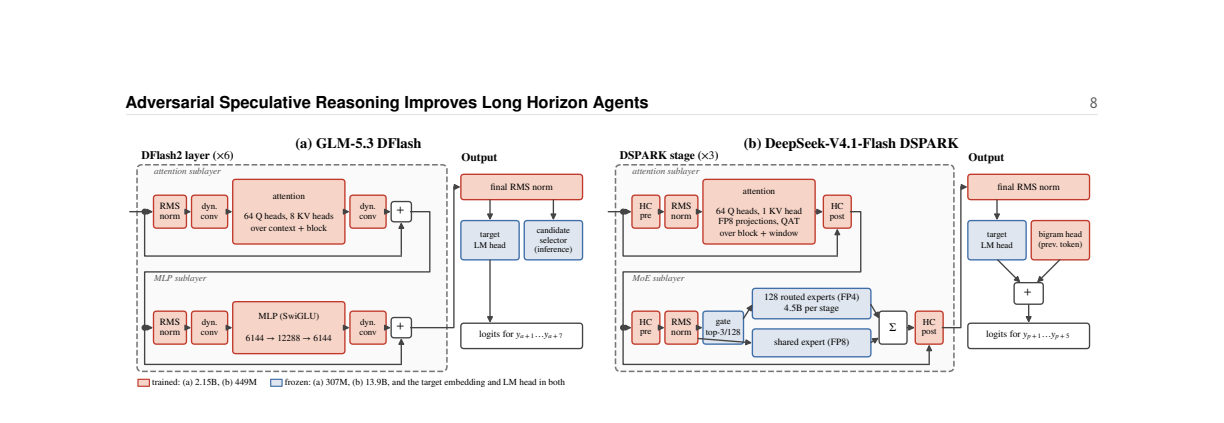
The premise it rests on. The load-bearing premise is that rejection at a decision point really does reroute the target's critical tokens into slot 0 of a fresh verification block often enough, and that the resulting extra precision in the KV cache is what drives the pass-rate gain, since the paper never directly counts how often the trained draft flips a live rollout's decision token into slot 0.
If the paper is right (Pith's inferences, not the authors')
Draft-model evaluation for speculative decoding should no longer optimize acceptance rate alone; where blocks end becomes a design variable for long-horizon reasoning accuracy.
Serving stacks can improve agent reliability by retraining well under one percent of hosted parameters, with the target weights, verification rule, and exact distribution unchanged.
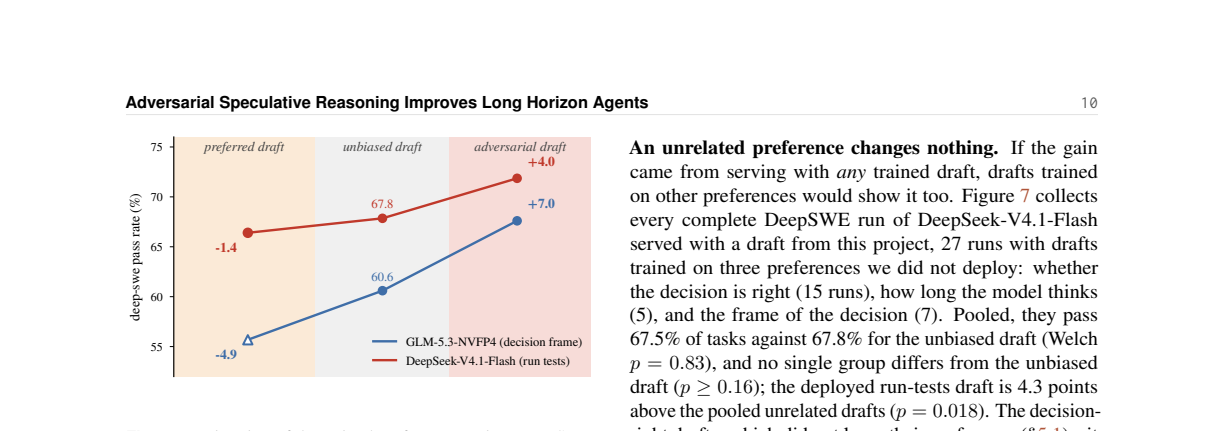
The direction of the trained preference matters: a draft trained toward the preferred side at the same decision points loses 4.9 points on GLM-5.3 and 1.4 points on DeepSeek-V4.1-Flash on DeepSWE, while the adversarial drafts gain 7.0 and 4.0 points.
Drafts trained on unrelated preferences change nothing pooled over 27 runs (67.5% vs 67.8% for the unbiased draft), so the gain tracks the relevance of the preference, not the act of training.
The approach preserves decoding speed: expected accepted tokens per block are unchanged on GLM-5.3 and within 1.8% of base on DeepSeek-V4.1-Flash.
The paper never reports a direct count of how often the trained draft flips a live decision token into slot 0, nor how many decision points a trajectory contains; instrumenting block boundaries and rejection positions would turn the end-to-end gain into a mechanism test.
If the slot-0 precision mechanism is real, it suggests a general principle: verification block boundaries are a precision resource that can be allocated toward any token that is cheap to identify and carries high downstream influence, such as high self-information, heavy reference in later turns, or high value of investigation.
The measured long-range effect sits in the far tail: a 10 to 20% excess of deviations beyond 4 nats after 30 turns, while sub-2-nat deviations are indistinguishable, so the pass-rate gain is carried by rare extreme rounding events rather than by a broad precision improvement.
A natural testable extension is to apply adversarial speculation to other long-horizon decision types, such as web navigation, tool-call timing, or planning splits, and check that the pass-rate gain again tracks the relevance of the chosen preference, mirroring the paper's unrelated-preference control.
Check this review
Pith stored no record of this review's passes and took no fingerprint of it. Reviews made by code from 13 Nov 2026 on carry both.
How often reviews like this one are right
Reviews like this one: written by deepseek-v4-flash, where what was read was not recorded.
How often objections from reviews like this one are right: not yet measured
Reviews by people
This review was written by a machine. No person has reviewed this paper on Pith yet. A scientist listed on Pith can review it for a fee, and their review is published here whatever it concludes.
The paper
Abstract
Speculative decoding has been treated purely as a systems optimization that speeds up large language model decoding without changing the model behavior. Under this view, the growing effort to train better draft models has been focused solely on acceptance rate. We argue that this view does not hold true for long-horizon agent reasoning. Measuring frontier open-weight models on complex agentic tasks with different speculative decoding approaches, we found that numerical noise grows within verification windows, and the draft acceptance results of the thinking process can change the output distribution of the model after 30 steps, thus noticeably influencing the reasoning accuracy of long-horizon agents in random directions. In this work, we improve the reasoning capability of target models by controlling such noise. While we cannot change the overall token distribution verified by the target model, we can encode critical reasoning with highest precision by training the draft model to be rejected. We identify these points in agent traces and train the draft model to favor adversarial preference. At inference the trained draft and the target part ways precisely at these decision points, verification restarts, so that critical thinking tokens are sampled from the target model and encoded under its least noisy conditions. This approach makes critical reasoning better indexed and more durable over a long horizon. On complex agentic coding benchmarks, our approach raises end-to-end success rate with no change to the target model or its output distribution. Our results recast the speculative decoding mechanism from a pure accelerator into an active allocator for context precision that improves the accuracy of long-horizon agents by training 0.06% to 0.28% of hosted parameters.
The paper's own sentences, arranged, kept beside the review and separate from it. Each label is drawn from a closed vocabulary; the number beside it is the probability the classifier gave that label. No sentence in this record was written by a model.
abstract compiled · 2026-11-04
The authors' main claim, as the classifier picked it out 1.00
“Our results recast the speculative decoding mechanism from a pure accelerator into an active allocator for context precision that improves the accuracy of long-horizon agents by training 0.06% to 0.28% of hosted parameters.”
How the main claim is stated: asserted 1.00
What the abstract itself states, as probabilities: claims first 0.07 · states limitation 0.46 · human participants 0.03 · controlled comparison 0.53 · randomized assignment 0.03 · states quantitative result 0.96 · compares with prior results 0.72 · mentions code or data availability 0.03
The abstract, sentence by sentence
This table labels the abstract only (arXiv listing abstract v1). The number is the probability the classifier gave the label.
| Sentence | Role | The authors' own work | States the main conclusion | Strength |
|---|---|---|---|---|
| Speculative decoding has been treated purely as a systems optimization that speeds up large language model decoding without changing the model behavior. | background 1.00 | 0.04 | 0.02 | asserted 1.00 |
| Under this view, the growing effort to train better draft models has been focused solely on acceptance rate. | background 0.99 | 0.05 | 0.02 | asserted 1.00 |
| We argue that this view does not hold true for long-horizon agent reasoning. | gap 0.89 | 0.10 | 0.15 | asserted 0.99 |
| Measuring frontier open-weight models on complex agentic tasks with different speculative decoding approaches, we found that numerical noise grows within verification windows, and the draft acceptance results of the thinking process can change the output distribution of the model after 30 steps, thus noticeably influencing the reasoning accuracy of long-horizon agents in random directions. | result 1.00 | 0.96 | 0.20 | asserted 1.00 |
| In this work, we improve the reasoning capability of target models by controlling such noise. | contribution 0.95 | 0.88 | 0.20 | asserted 1.00 |
| While we cannot change the overall token distribution verified by the target model, we can encode critical reasoning with highest precision by training the draft model to be rejected. | method 0.86 | 0.59 | 0.18 | asserted 0.96 |
| We identify these points in agent traces and train the draft model to favor adversarial preference. | method 0.95 | 0.92 | 0.06 | asserted 1.00 |
| At inference the trained draft and the target part ways precisely at these decision points, verification restarts, so that critical thinking tokens are sampled from the target model and encoded under its least noisy conditions. | method 1.00 | 0.80 | 0.12 | asserted 1.00 |
| This approach makes critical reasoning better indexed and more durable over a long horizon. | interpretation 0.80 | 0.72 | 0.19 | asserted 1.00 |
| On complex agentic coding benchmarks, our approach raises end-to-end success rate with no change to the target model or its output distribution. | result 1.00 | 0.96 | 0.32 | asserted 1.00 |
| Our results recast the speculative decoding mechanism from a pure accelerator into an active allocator for context precision that improves the accuracy of long-horizon agents by training 0.06% to 0.28% of hosted parameters. | interpretation 0.82 | 0.94 | 0.78 | asserted 1.00 |
What kind of paper the classifier reports this is: method or tool 1.00 · evidence from observation or experiment 1.00
What was examined, and what was not
Sources read
- arXiv listing abstract v1
Not examined
- full text
- figures and tables
- references and citing sentences
- relations to other papers
Levels run
- P abstract
Not run
- S sections
- T body sentences
- C citations
- R cross-paper relations
How the labels were made
Compiled by classifier-1.13.0 via TypeSafe API, question bank abstract-p1-20260923, 2026-11-04: 1 request, 8,195 input tokens.
Every quoted sentence on this record is the authors'. Every label is from Pith's closed vocabulary, with the probability shown beside it. This record as JSON
Figures (7)
Figures are the authors', reproduced from the paper.
References (14)
- [1] Bachmann, G., Anagnostidis, S., Pumarola, A., Georgopou- los, M., Sanakoyeu, A., Du, Y ., Schoenfeld, E., Thabet, A., and Kohler, J. Judge decoding: Faster speculative sampling requires going beyond model alignment. In Yue, Y ., Garg, A., Peng, N., Sha, F., and Yu, R. (eds.), ... on Pith
- [6] URLhttps://arxiv.org/abs/2602.15763. He, H. and Lab, T. M. Defeating nondeter- minism in llm inference.Thinking Machines Lab: Connectionism, on PithPith's reviewarXiv
- [7] doi: 10.64434/tml. 20250910. https://thinkingmachines.ai/blog/defeating- nondeterminism-in-llm-inference/. Huang, W. and Jiang, P. Deepswe v1.1: a cleaner, more reproducible benchmark for frontier coding agents, on Pithdoi:10.64434/tml
- [8] URL https://openreview.net/forum? id=VTF8yNQM66. Lai, X., Tian, Z., Chen, Y ., Yang, S., Peng, X., and Jia, J. Step-dpo: Step-wise preference optimization for long- chain reasoning of llms.CoRR, abs/2406.18629, on PithPith's reviewarXiv
- [9] URLhttps://doi.org/10.48550/arXiv.2406.18629. Leviathan, Y ., Kalman, M., and Matias, Y . Fast infer- ence from transformers via speculative decoding. In Krause, A., Brunskill, E., Cho, K., Engelhardt, B., Sabato, S., and Scarlett, J. (eds.),Proceedings of the 40th In- ternati... on PithPith's reviewarXivdoi:10.48550/arxiv.2406.18629
- [10] URL https: //arxiv.org/abs/2610.35959. Li, Y ., Wei, F., Zhang, C., and Zhang, H. EAGLE: Spec- ulative sampling requires rethinking feature uncertainty. In Salakhutdinov, R., Kolter, Z., Heller, K., Weller, A., Oliver, N., Scarlett, J., and Berkenkamp, F. (eds.),Pro- ceedings ... on PithPith's reviewarXiv
- [11] doi: 10.52202/085713-4562. Lin, Z., Liang, T., Xu, J., Liu, Q., Wang, X., Luo, R., Shi, C., Li, S., Yang, Y ., and Tu, Z. Critical tokens mat- ter: Token-level contrastive estimation enhances LLM’s reasoning capability. In Singh, A., Fazel, M., Hsu, D., Lacoste-Julien, S., Ber... on Pithdoi:10.52202/085713-4562
- [12] URL https://proceedings.mlr.press/v267/lin25j.html. Liu, A., Mei, A., Lin, B., Xue, B., Wang, B., Xu, B., Wu, B., Zhang, B., Lin, C., Dong, C., et al. Deepseek-v3. 2: Pushing the frontier of open large language models. arXiv preprint arXiv:2512.02556, on PithPith's reviewarXiv
- [13] Sinha, A., Arun, A., Goel, S., Staab, S., and Geiping, J. The illusion of diminishing returns: Measuring long horizon execution in llms. InInternational Conference on Learn- ing Representations, volume 2026, pp. 35184–35211, on Pith
- [14] Xu, A., Li, B., Lin, B., Xue, B., Xian, B., Xu, B., Wu, B., Zhang, B., Deng, B., Yu, C., et al. Deepseek-v4. 1- flash: Pushing the limits of kv cache compression.arXiv preprint arXiv:2609.19969, on PitharXiv
- [15] Zhou, Y ., Lyu, K., Rawat, A. S., Menon, A. K., Ros- tamizadeh, A., Kumar, S., Kagy, J.-F., and Agarwal, R. Distillspec: Improving speculative decoding via knowl- edge distillation. In Kim, B., Yue, Y ., Chaudhuri, S., Fragkiadaki, K., Khan, M., and Sun, Y . (eds.),Interna- ti... on Pith
- [2023] URL https://arxiv.org/ abs/2302.01318. Chen, G., Wang, D., and Hu, L. Sfad: Speculative factuality- aware decoding. InFindings of the Association for Com- putational Linguistics: EMNLP 2026, pp. 24221–24239, 2026a. Chen, J., Liang, Y ., and Liu, Z. DFlash: Block diffusion for ... on PithPith's reviewarXiv
- [2025] URL https://doi. org/10.48550/arXiv.2512.12730. GLM-5-Team, :, Zeng, A., Lv, X., Hou, Z., Du, Z., Zheng, Q., Chen, B., Yin, D., Ge, C., Huang, C., Xie, C., Zhu, C., Yin, C., Wang, C., Pan, G., Zeng, H., Zhang, H., Wang, H., Chen, H., Zhang, J., Jiao, J., Guo, J., Wang, J., Du,... on Pithdoi:10.48550/arxiv.2512.12730
- [2026] Ding, J., Long, S., Pu, C., Zhou, H., Gao, H., Gao, X., He, C., Hou, Y ., Hu, F., Li, Z., Shi, W., Wang, Z., Zan, D., Zhang, C., Zhang, X., Chen, Q., Cheng, X., Deng, B., Gu, Q., Hua, K., Lin, J., Liu, P., Li, M., Pan, X., Peng, Z., Qin, Y ., Shan, Y ., Tan, Z., Xie, W., Wang,... on PitharXiv
Challenges and discussion
Disagree with the review, or know something it missed? Leave a comment, or challenge this review formally: a challenge becomes a permanent entry in this paper's record, and its decision is published here.
Come back by email
A short list of the week's newly reviewed papers. Nothing is sent until you confirm from your inbox, and every email has a link that stops it. No account.
No comments yet.
Sign in to comment