Artificial Intelligence · arXiv:2610.36077 v2 · submitted 26 Oct 2026
The Trinity: Capability-Driven Recursive Self-Improvement for Multimodal Agents
The paper says
“Multimodal intelligence can be viewed as human-guided co-evolution between worlds and agents through interaction. However, scaling this process faces two bottlenecks: constructing heterogeneous, verifiable environments is costly, and manual Harness iteration cannot keep pace with growing task diversity and complexity.”
more of the abstract
A key insight is that tasks with different modalities and surface forms can share the same underlying capability requirements. We therefore introduce The Trinity, a recursive self-improvement framework coupling world generation with Harness evolution through three roles: Creator, Explorer, and Evolver. Drawing on verified execution trajectories, Evolver shifts the basis of task organization from surface categories to shared requirements, reorganizing the original task tree into a hierarchical capability tree. We introduce Capability-Driven Real2Sim2Real: for heterogeneous tasks at the same node, Creator abstracts their common requirements into simplified, verifiable simulated worlds for capability learning, while evaluation on original tasks measures transfer. Along this capability tree, Explorer progressively evolves reusable capability modules through selective inheritance, forming a Harness tree whose validated updates accumulate across iterations within a fixed topology. The resulting Harnesses specialize in different capabilities, motivating a Capability-Aware Harness Router that uses public task information to select compatible module configurations from the tree. Our evolved Harnesses improve mean performance by 34 points across 28 training benchmarks and 26 points across 18 unseen benchmarks, including two real-world embodied tasks.
from the abstract
Pith says
Machine review · deepseek-v4-flash · 28 Oct 2026 · of version 1 of the paper; version 2 is newer · what was read was not recorded · not checked by a person
It can be wrong. Challenge this review or reply to it.
Holds up, with conditions. Capability-driven RSI paper is empirically strong but has a fixed tree ordering issue that needs addressing. This line is wrong
2 major objections · 4 minor
How often objections from reviews like this one are right: not yet measured
Not checked: figures, code, what the references say.
The paper says, at Section 3.3 / Appendix B / Table 3
The review did not quote this passage.
Pith says: Objection 1 of 2 · major
The capability tree is constructed using a single fixed prefix order (c, d, a, b, e, f), claimed to be based on domain breadth. The order determines which capability combinations form nodes, which in turn drives selective inheritance (Section 3.5) and routing (Section 3.6).
more of objection 1
No sensitivity analysis or ablation on alternative orderings is provided. Table 3 shows that the capability tree (Sim) outperforms flat capability-domain groupings by 7.83 points on the Unseen split, but this comparison uses only one ordering. Because the Trie merges common prefixes, different orderings create different node groupings that could affect module evolution and transfer. The paper should test at least one alternative ordering (e.g., reversed, or random) to demonstrate that the benefit stems from the concept of capability combination rather than from the specific ordering chosen. Without this analysis, the central claim that capability-driven organization outperforms task-driven specialization is not fully supported.
The paper says, at Section 4.6 / Table 6
The review did not quote this passage.
A classifier read this sentence of the paper as acknowledging the concern (probability 0.96):
“These comparisons evaluate complete Harness–skill configurations and do not isolate the effects of module evolution and skill preparation.”
Pith says: Objection 2 of 2 · major
The embodied transfer experiments evaluate complete Harness–skill configurations and do not isolate the effects of module evolution from skill preparation, as the authors state in the main text. The paper should either perform an ablation that compares evolved modules with Base modules using the same skill preparation, or explicitly quantify the contribution of each component. Since the authors acknowledge the limitation, this is a request for a concrete additional experiment rather than a revelation of a hidden flaw.
4 minor objections
The paper says, at Author list
Pith says: minor objection 1 of 4
Contributors are listed without commas between names in several entries (e.g., 'Weidong Tang1,2 Ruiheng Wang3 Jingxuan Zhang4 Hexin Wang1'). Please add commas or semicolons for clarity.
The paper says, at Page 1, abstract area
Pith says: minor objection 2 of 4
The text at the top of the first page includes the string '/gl⌢beProject Page/githubGitHub' which appears to be a formatting artifact from a template. Please clean this up.
show 2 more
The paper says, at Table 4
Pith says: minor objection 3 of 4
The table caption uses 'Cap.' and 'Mem.' as column headers. Consider spelling these out as 'Cap. Defs.' and 'Memory' or adding a footnote. Also ensure that 'Tok.' is defined in the caption (it is stated as 'total inference tokens (M)' in the following paragraph, but the table itself should be self-contained).
The paper says, at Section 3.4
Pith says: minor objection 4 of 4
The Harness tree construction paragraph refers to 'host-registered bindings' and 'typed input–output assertions' without any example. A brief concrete illustration in the main text (not just in Appendix C) would help readability.
What would settle it
Re-run the Iteration 1 comparison in Table 3 with at least two alternative capability orders: (a,b,c,d,e,f) alphabetical and (f,e,d,c,b,a) reversed, using the same experimental setup (module-only, simulated worlds). Compare the Capability Tree (Sim) Train and Unseen scores to the original. If either alternative order leads to a drop of more than 2 points relative to the original on either split, the ordering choice is a significant factor and the robustness claim weakens.
from the skeptic's reading
How the review went
4 readings by deepseek-v4-flash · 28 Oct 2026
- Reader holds up, with conditions
- Skeptic partly agrees
- Editor wrote the verdict above
- Referee major revision: 2 major objections, 4 minor
Not run on this paper: the simulated authors' defence.
Pith did not check this review's objections against the paper.
The review in full
The review in brief, machine-written
The Trinity paper tackles a real problem: how to scale agent harness evolution across heterogeneous multimodal tasks. The key insight is to organize tasks by shared capability requirements rather than surface form, building a capability tree and using simulated worlds (Real2Sim2Real) to train reusable modules. The empirical results are broad and convincing: 34-point average gain on 28 training benchmarks, 26 points on 18 unseen, with transfer to two real-robot tasks. The ablation studies (modules vs skills, different organizations, routing variants) are thorough and tell a consistent story.
What is genuinely new is the combination of capability tree induction, simulated world generation for capability learning, selective module inheritance, and a capability-aware router. Individual components exist, but the integrated framework is novel. The paper is also well-written and documents its design choices.
That said, there are notable soft spots. The most significant is the fixed capability tree ordering. The tree is built from training tasks using a fixed prefix order (c, d, a, b, e, f). The authors state the order implies no causal dependencies, but different orderings would create different node groupings, affecting module inheritance and ultimately harness performance. No sensitivity analysis is provided. This is a real concern, as the paper's central claim—capability-driven organization outperforms task-driven specialization—could be sensitive to this single design choice. The stress-test note on this point is on target.
Second, the capability categorization process uses LLM agents and human review. It is not fully automated, and reproducibility is limited given the proprietary backbone. The authors acknowledge benchmark construction challenges but not the categorization pipeline's opacity.
Third, the router evaluation uses an oracle upper bound. The full self-routing configuration comes close (within ~2 points), but the paper does not test degradation under noisier capability estimates or when the tree misses a combination for an unseen task.
Despite these issues, the paper deserves a serious referee. The empirical evidence is strong, the framework is well-motivated, and the claims are largely supported. The main flaw is fixable: test alternative orderings. I would conditionally accept, requiring that sensitivity analysis.
For our reading group, yes—lots of design decisions to debate. I would cite if the ordering issue is resolved. The paper shows clear, honest thinking.
Send to peer review with a request to address the tree ordering sensitivity.
The strongest objection
The capability tree is constructed using a fixed prefix order (c, d, a, b, e, f), claimed to be based on domain breadth (Section 3.3, Appendix B). This order determines which capability combinations form nodes, thereby influencing selective inheritance patterns (Section 3.5) and ultimately the set of available harnesses for routing (Section 3.6). The paper provides no analysis of how sensitive the results are to this ordering. Table 3 shows that the capability tree (Sim) outperforms flat capability-domain groupings by 7.70 points on Train and 7.83 points on Unseen (module-only). However, this comparison uses only one ordering. If an alternative ordering (e.g., reversed or random) leads to significantly different performance, the central claim that capability-driven organization outperforms task-driven specialization may not be robust. The paper asserts the order implies no causal dependencies, but the tree's prefix merging property means that different orders create different node groupings, which could affect module evolution and transfer. Without testing alternative orderings, it is unknown whether the benefit comes from the tree concept or from the specific ordering chosen.
The reader's weakest assumption concerned generalization of the capability tree to unseen tasks. While that is important, the paper already provides positive results on 18 unseen benchmarks, suggesting the tree does generalize. A more subtle but load-bearing assumption is that the fixed prefix order used to build the tree is incidental; if the order actually matters for performance, then the claim that capability-driven organization is superior may be contingent on an arbitrary choice. The paper does not test this, and without such a test the central conclusion is less robust. The concrete test would settle this by showing whether the results hold across different orderings. The verdict remains CONDITIONAL because the paper already has a conditional rating; this test would strengthen the case for acceptance.
The referee's report
If the findings are robust, the work demonstrates a substantial leap in cross-task generalization for agent harnesses, shifting the organizing principle from task-specific optimization to shared capability requirements. The scale of the evaluation (28 training, 18 unseen, two real-robot deployments) and the consistency of the iterative gains (nine additional Train points after the first iteration) make this a potentially important empirical contribution to the field of recursive self-improvement and agentic systems. The separation of harness evolution from model parameter updates isolates the role of control-flow organization in agent performance.
Pith's reading of the paper (a machine's summary, not the authors')
This paper introduces The Trinity, a framework that organizes heterogeneous multimodal tasks by their shared underlying capability requirements rather than by surface task type. It builds a hierarchical capability tree from verified execution trajectories, uses it to generate simplified simulated worlds for training (Capability-Driven Real2Sim2Real), and evolves a tree of specialized reusable harness modules through selective inheritance and local refinement. A capability-aware router then selects the best harness for a given task from public information. The authors claim that this capability-driven approach outperforms task-specific or global harness evolution, achieving a 34-point mean improvement across 28 training benchmarks and a 26-point gain across 18 unseen benchmarks, including two real-world embodied robot tasks, all with a frozen backbone model.
What carries the argument. The key machinery is the hierarchical capability tree, which groups tasks by shared requirements derived from verified trajectories, and the concurrent evolution of two harness trees—one for exploration (Explorer) and one for world creation (Creator)—aligned with the capability tree's prefix structure. Capability-Driven Real2Sim2Real abstracts common requirements into simplified training worlds, while selective inheritance and local refinement accumulate validated module updates across iterations within a fixed topology. A Capability-Aware Harness Router then uses public task information and retrieved execution experience to select the appropriate branch of the Explorer harness tree.
Core claim. The central discovery is that organizing agent harness evolution around shared capability requirements—rather than around individual task categories or a single global harness—enables stronger cross-task transfer and sustained iterative improvement. By first inducing a capability tree from training-task trajectories, then generating simplified, verifiable simulation worlds that isolate each capability, and finally evolving modular harness configurations along the tree's nodes, the framework produces specialized harnesses that generalize to unseen tasks and even to real-world embodied settings. The authors show that the capability tree provides a semantic basis for a router to select compatible harness modules, and they demonstrate that adding or removing capability-relevant modules causally impacts performance.
The premise it rests on. The capability tree is built solely from training-task trajectories and remains fixed; if an unseen task requires a combination of capabilities absent from the training-induced tree, the router may lack an appropriate harness branch, and the system has no mechanism to expand the tree.
If the paper is right (Pith's inferences, not the authors')
If this approach is correct, future agent systems could reduce manual harness engineering by automatically inferring capability requirements from task descriptions and trajectories.
The capability tree could serve as a reusable ontology for transferring harness components across different backbone models or domains.
Capability-aware routing suggests a general paradigm for model selection: map tasks to a capability space rather than to benchmarks, and match configurations accordingly.
The Real2Sim2Real loop demonstrates that simplified simulation worlds, focused on decision logic rather than visual fidelity, can suffice for acquiring transferable capabilities.
The capability tree, once induced from training tasks, implicitly defines a form of task embedding that might be compared to or combined with learned task representations in meta-learning.
The paper's framework stops at the harness level, but the same capability-driven logic could extend to model parameter updates, where different capability modules correspond to different fine-tuning strategies or adapter weights.
The fixed capability tree limits adaptability to genuinely novel capability combinations; a dynamic tree that expands as new tasks are encountered would be a natural extension for continued open-ended learning.
Check this review
Pith stored no record of this review's passes and took no fingerprint of it. Reviews made by code from 13 Nov 2026 on carry both.
How often reviews like this one are right
Reviews like this one: written by deepseek-v4-flash, where what was read was not recorded.
How often objections from reviews like this one are right: not yet measured
Reviews by people
This review was written by a machine. No person has reviewed this paper on Pith yet. A scientist listed on Pith can review it for a fee, and their review is published here whatever it concludes.
The paper
Abstract
Multimodal intelligence can be viewed as human-guided co-evolution between worlds and agents through interaction. However, scaling this process faces two bottlenecks: constructing heterogeneous, verifiable environments is costly, and manual Harness iteration cannot keep pace with growing task diversity and complexity. A key insight is that tasks with different modalities and surface forms can share the same underlying capability requirements. We therefore introduce The Trinity, a recursive self-improvement framework coupling world generation with Harness evolution through three roles: Creator, Explorer, and Evolver. Drawing on verified execution trajectories, Evolver shifts the basis of task organization from surface categories to shared requirements, reorganizing the original task tree into a hierarchical capability tree. We introduce Capability-Driven Real2Sim2Real: for heterogeneous tasks at the same node, Creator abstracts their common requirements into simplified, verifiable simulated worlds for capability learning, while evaluation on original tasks measures transfer. Along this capability tree, Explorer progressively evolves reusable capability modules through selective inheritance, forming a Harness tree whose validated updates accumulate across iterations within a fixed topology. The resulting Harnesses specialize in different capabilities, motivating a Capability-Aware Harness Router that uses public task information to select compatible module configurations from the tree. Our evolved Harnesses improve mean performance by 34 points across 28 training benchmarks and 26 points across 18 unseen benchmarks, including two real-world embodied tasks.
The paper's own sentences, arranged, kept beside the review and separate from it. Each label is drawn from a closed vocabulary; the number beside it is the probability the classifier gave that label. No sentence in this record was written by a model.
abstract compiled · 2026-10-28
The authors' main claim, as the classifier picked it out 0.99
“Our evolved Harnesses improve mean performance by 34 points across 28 training benchmarks and 26 points across 18 unseen benchmarks, including two real-world embodied tasks.”
How the main claim is stated: asserted 1.00
What the abstract itself states, as probabilities: claims first 0.06 · states limitation 0.21 · human participants 0.14 · controlled comparison 0.23 · randomized assignment 0.02 · states quantitative result 0.99 · compares with prior results 0.24 · mentions code or data availability 0.03
The abstract, sentence by sentence
This table labels the abstract only (arXiv listing abstract v1). The number is the probability the classifier gave the label.
| Sentence | Role | The authors' own work | States the main conclusion | Strength |
|---|---|---|---|---|
| Multimodal intelligence can be viewed as human-guided co-evolution between worlds and agents through interaction. | background 0.99 | 0.08 | 0.03 | asserted 0.81 |
| However, scaling this process faces two bottlenecks: constructing heterogeneous, verifiable environments is costly, and manual Harness iteration cannot keep pace with growing task diversity and complexity. | gap 0.55 | 0.14 | 0.03 | asserted 1.00 |
| A key insight is that tasks with different modalities and surface forms can share the same underlying capability requirements. | background 0.61 | 0.16 | 0.07 | asserted 0.99 |
| We therefore introduce The Trinity, a recursive self-improvement framework coupling world generation with Harness evolution through three roles: Creator, Explorer, and Evolver. | contribution 0.95 | 0.86 | 0.10 | asserted 1.00 |
| Drawing on verified execution trajectories, Evolver shifts the basis of task organization from surface categories to shared requirements, reorganizing the original task tree into a hierarchical capability tree. | method 0.97 | 0.87 | 0.09 | asserted 1.00 |
| We introduce Capability-Driven Real2Sim2Real: for heterogeneous tasks at the same node, Creator abstracts their common requirements into simplified, verifiable simulated worlds for capability learning, while evaluation on original tasks measures transfer. | method 0.86 | 0.91 | 0.08 | asserted 0.99 |
| Along this capability tree, Explorer progressively evolves reusable capability modules through selective inheritance, forming a Harness tree whose validated updates accumulate across iterations within a fixed topology. | method 0.98 | 0.85 | 0.06 | asserted 1.00 |
| The resulting Harnesses specialize in different capabilities, motivating a Capability-Aware Harness Router that uses public task information to select compatible module configurations from the tree. | method 0.80 | 0.89 | 0.08 | asserted 0.98 |
| Our evolved Harnesses improve mean performance by 34 points across 28 training benchmarks and 26 points across 18 unseen benchmarks, including two real-world embodied tasks. | result 1.00 | 0.96 | 0.65 | asserted 1.00 |
What kind of paper the classifier reports this is: method or tool 1.00 · evidence from observation or experiment 0.92
What was examined, and what was not
Sources read
- arXiv listing abstract v1
Not examined
- full text
- figures and tables
- references and citing sentences
- relations to other papers
Levels run
- P abstract
Not run
- S sections
- T body sentences
- C citations
- R cross-paper relations
How the labels were made
Compiled by classifier-1.13.0 via TypeSafe API, question bank abstract-p1-20260923, 2026-10-28: 1 request, 6,982 input tokens.
Every quoted sentence on this record is the authors'. Every label is from Pith's closed vocabulary, with the probability shown beside it. This record as JSON
Figures (73)


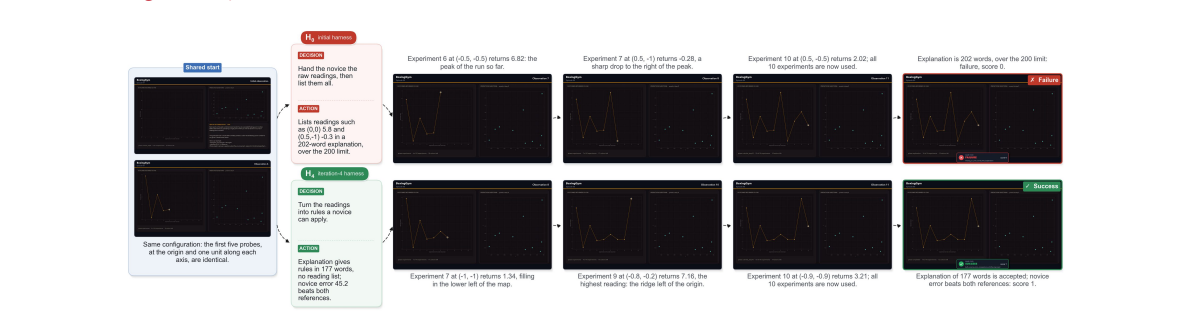


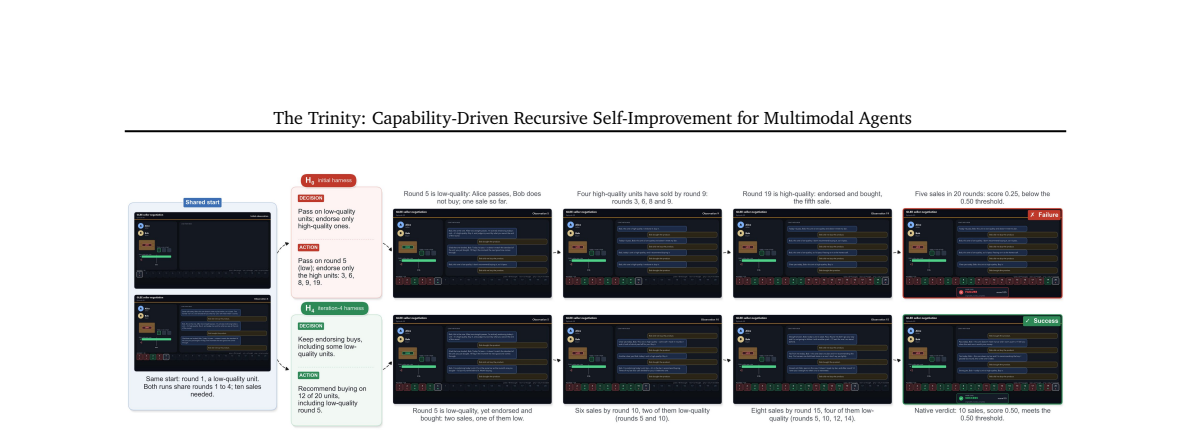

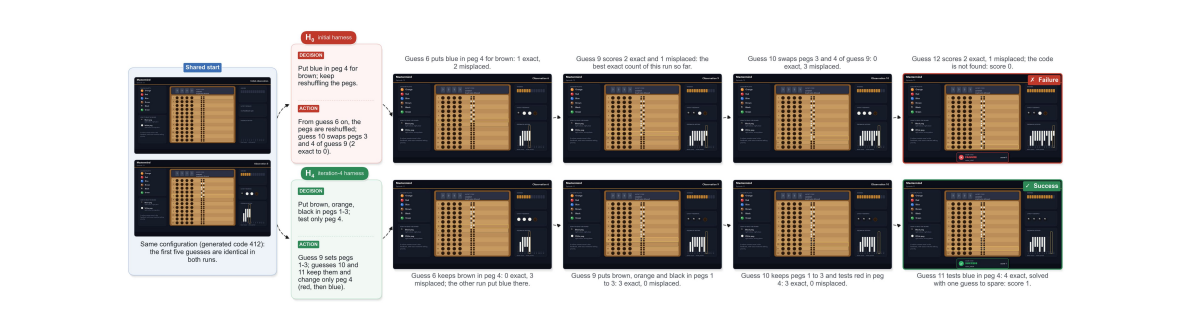


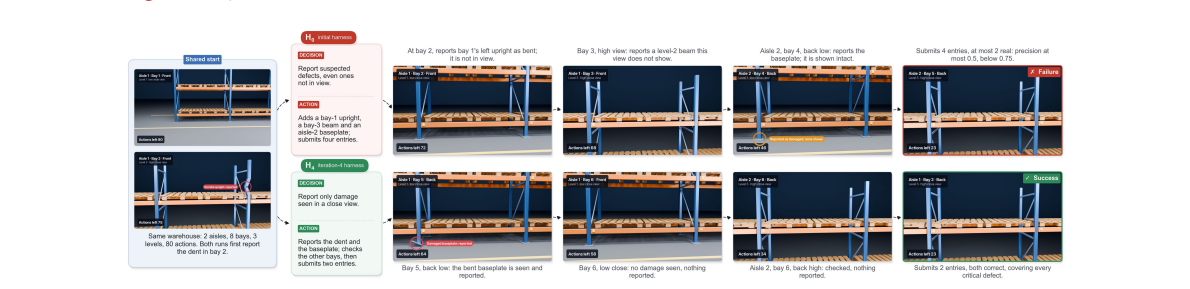


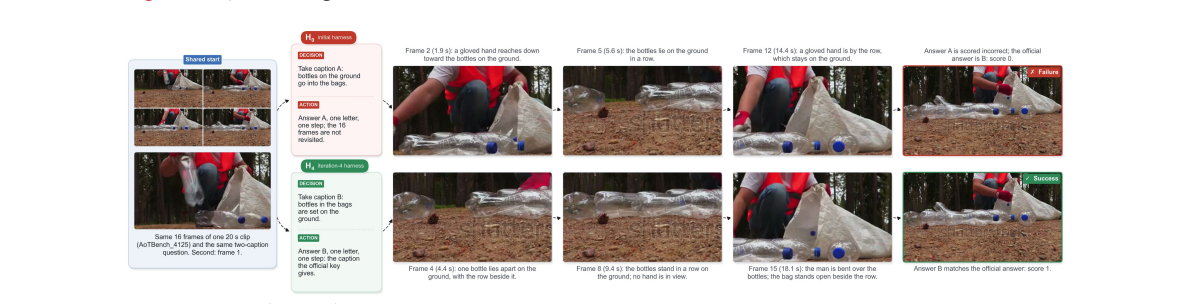


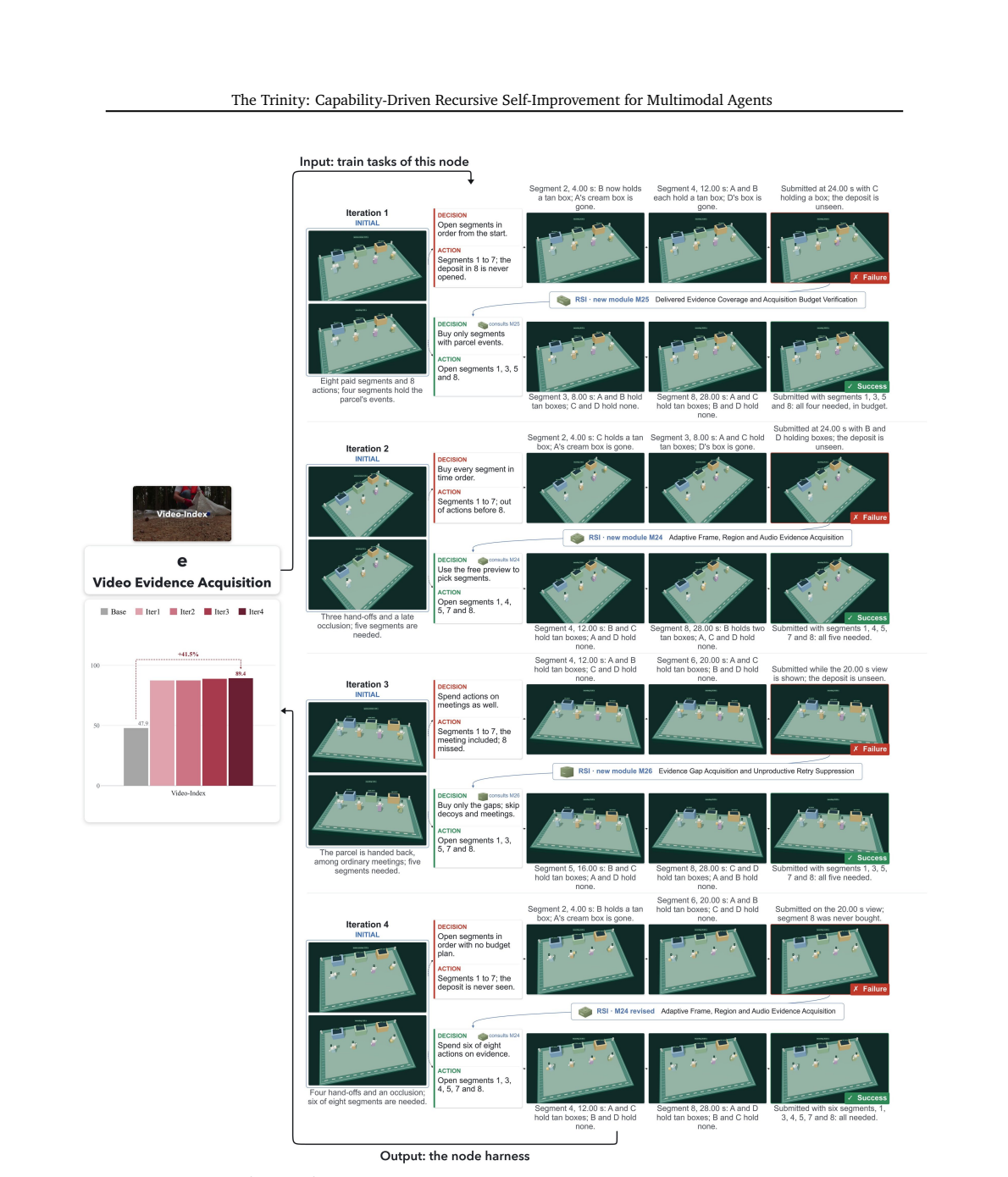
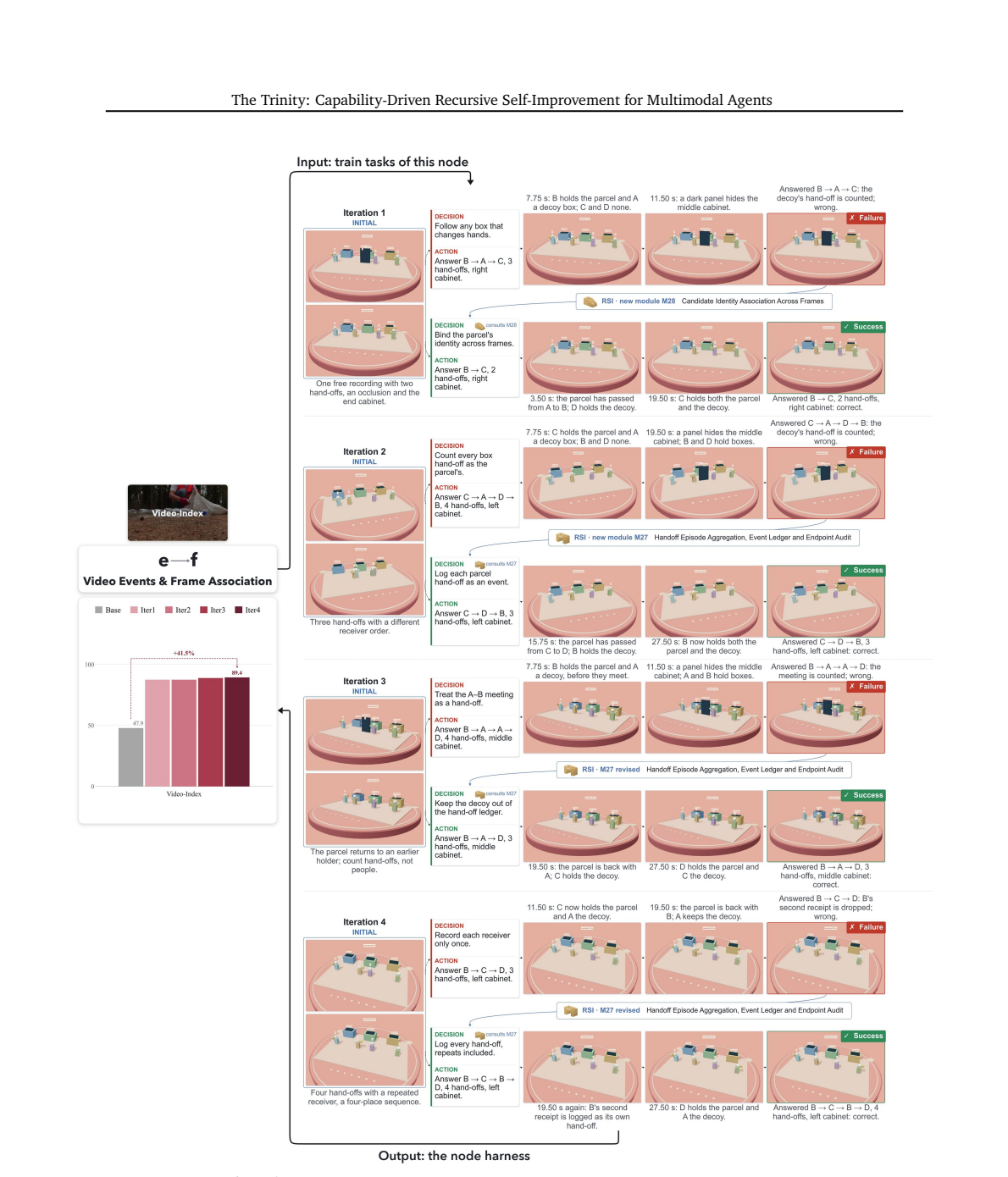


Figures are the authors', reproduced from the paper.
Cited by 1 Pith paper
Reviewed papers on Pith that cite this one. The full citation record
Challenges and discussion
Disagree with the review, or know something it missed? Leave a comment, or challenge this review formally: a challenge becomes a permanent entry in this paper's record, and its decision is published here.
Come back by email
A short list of the week's newly reviewed papers. Nothing is sent until you confirm from your inbox, and every email has a link that stops it. No account.
No comments yet.
Sign in to comment